 Reading Time: 35 minutes
I stood up and took my phone in my hand. For one terrible second, every instinct inside me screamed to call my husband. To demand an explanation.
To ask him how he could look our fifteen-year-old daughter in the face, hear a doctor tell him she needed more testing, and then drive her home and tell her she was doing it for attention.
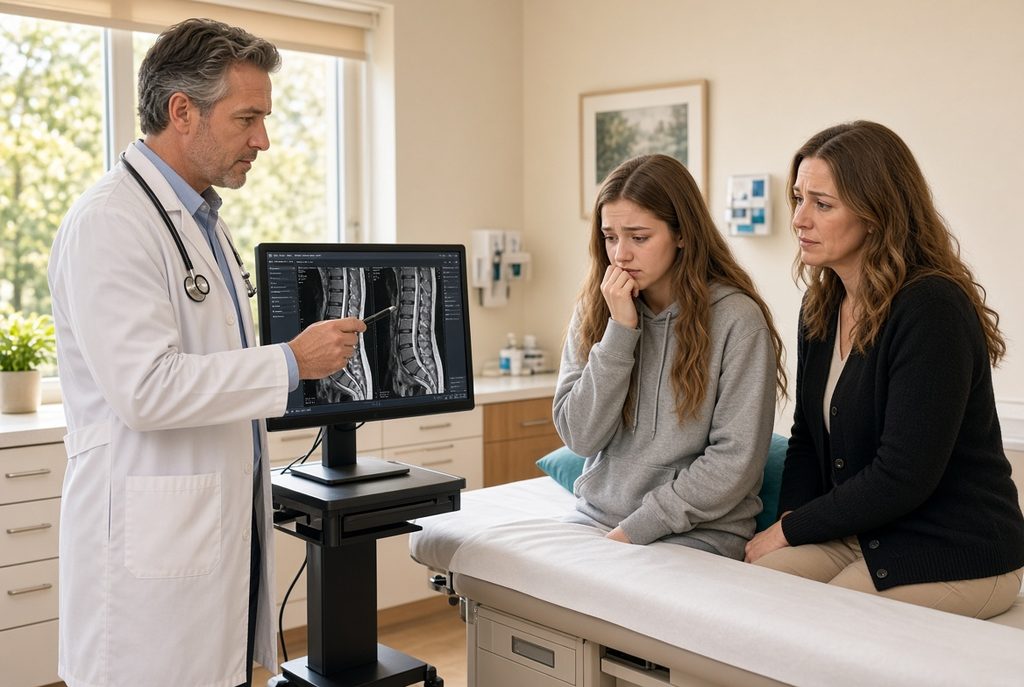
But I didn’t call him.
Because my daughter was watching me.
And something in her expression stopped me.
It wasn’t fear of the hospital.
It wasn’t fear of whatever the doctors might find.
It was fear of what I was going to do next.
That realization hurt worse than anything the doctor had said.
I slowly lowered my phone.
“Sweetheart,” I said, keeping my voice as calm as I could, “are you afraid I’m going to call your dad?”
She didn’t answer.
Her eyes dropped to her lap.
That was answer enough.
I sat back down beside her.
“I’m not calling him.”
Her shoulders moved.
Just slightly.
But I saw the tension leave them.
And that almost broke me.
A fifteen-year-old girl should not feel safer because one parent promises not to contact the other.
She should not have to measure every word before speaking.
She should not have to wonder whether telling the truth will start an argument at home.
And she definitely should not have spent five weeks believing her own mother had agreed that her pain wasn’t real.
I reached for her hand.
At first, she kept both fists hidden inside her hoodie sleeves.
Then slowly, carefully, she let one hand emerge.
I took it.
Her fingers were cold.
“I need you to hear me,” I whispered. “I never knew about that appointment. I never knew they asked Dad to bring you back. And I would never tell you that you were making up pain for attention.”
Her chin trembled.
“I thought you believed him.”
“I didn’t know there was anything to believe.”
“He said you did.”
“I know.”
There are moments when rage feels hot.
Violent.
Immediate.
This wasn’t like that.
This rage was cold.
It moved through me like ice water.
Because I was beginning to understand that my husband hadn’t merely failed to tell me something.
He had deliberately placed words in my mouth.
He had used my authority as her mother to silence her.
He had made our daughter believe both of her parents had decided she was inconvenient.
I wanted to hate him in that moment.
Maybe part of me already did.
But there was something more important sitting beside me.
So instead of thinking about him, I looked at her.
“You never have to hide pain from me again,” I said.
Her eyes flooded immediately.
“I’m sorry.”
Those two words nearly destroyed me.
I squeezed her hand.
“No.”
“I should have told you.”
“No, sweetheart.”
“I should’ve—”
“No.”
My voice came out sharper than I intended.
She flinched.
I softened immediately.
“No,” I repeated. “You do not apologize for trusting your father.”
Tears slipped down her cheeks.
“You were supposed to be able to trust him.”
She pressed her lips together.
The doctor politely looked away for a moment.
I wiped the tears from her face with my thumb.
“You were a kid believing a parent. That is not something you need to apologize for.”
She nodded.
Then she whispered the sentence that I think will stay inside me for the rest of my life.
“I thought maybe I was weak.”
I stared at her.
“What?”
“Because it hurt.”
Her voice was barely audible.
“And Dad kept saying everybody gets uncomfortable sometimes. He said if I kept focusing on it, I’d make it worse. So I thought maybe other people could handle things better than me.”
I had to look down.
Because I couldn’t let her see what that did to me.
For months I had watched her become quieter.
She had stopped asking for rides.
Stopped complaining about headaches.
Stopped telling me when she came home exhausted.
She had started saying “I’m fine” before I even finished asking how she was.
And I had mistaken independence for maturity.
I had been proud of her.
That was the part that hurt.
I had thought she was growing up.
In reality, she was learning how to disappear.
The doctor pulled his chair a little closer.
“None of this is your fault,” he told her gently. “And pain is information. It doesn’t make you weak.”
She nodded.
Then he turned toward me.
“We’re going to move quickly from here.”
The room suddenly felt smaller.
I swallowed.
“What did you find?”
He paused.
Not dramatically.
Not like television, where doctors use silence because a commercial break is coming.
His pause was careful.
Professional.
The kind of pause someone uses when they know the next sentence may divide your life into before and after.
“There’s a mass in the lower abdomen.”
My hand tightened around my daughter’s.
I heard the words.
But for several seconds, I couldn’t make them mean anything.
A mass.
My brain immediately tried to reject the word.
A cyst.
Inflammation.
Something harmless.
Something temporary.
Something that could be fixed with medication and a few days off school.
The doctor continued before panic could swallow me whole.
“We do not yet know exactly what it is.”
I nodded too quickly.
“So it could be benign?”
“Yes.”
His answer came immediately.
Relief hit me for half a second.
Then he added, “But because of its size and because of her symptoms, we need additional imaging and blood work today. I also want pediatric specialists involved.”
My daughter stared at him.
“Do I have cancer?”
The room went completely still.
I think every mother believes she knows how she will react if her child ever asks that question.
You think you’ll be brave.
You think you’ll say exactly the right thing.
You think instinct will give you wisdom.
It doesn’t.
For half a second, I forgot how to breathe.
The doctor answered before I could force my mouth to work.
“We don’t know that.”
My daughter looked at him.
He held her gaze.
“And I don’t want you assuming the worst before we have enough information.”
“But it could be?”
“It is one possibility among several.”
I saw fear pass across her face.
So I moved closer.
“Look at me.”
She did.
“We’re not borrowing tomorrow’s fear today.”
It was something my mother used to say.
I hadn’t thought about those words in years.
My daughter gave me the smallest nod.
“We deal with what we know.”
Another nod.
“And what we know is that you’re in the right place.”
She leaned against me.
For the first time since we had arrived, she let herself do it completely.
Her head rested against my shoulder.
I wrapped both arms around her.
Then her entire body shook.
Not loudly.
Not dramatically.
She didn’t sob.
She simply shook.
And I held her.
I held her while the doctor stepped out to arrange more tests.
I held her while a nurse came in with paperwork.
I held her while someone brought a warm blanket.
I held her while my phone vibrated in my pocket three times.
I didn’t need to look at the screen to know who it was.
Eventually, I did.
My husband.
Where are you?
A minute later:
School called. You signed her out?
Then:
Why aren’t you answering?
I stared at the messages.
My daughter noticed.
“Dad?”
“Yes.”
Her body tensed again.
I turned the phone face down.
“He can wait.”
She closed her eyes.
That was when I knew my marriage was probably over.
Not because of the secret appointment.
Not even because of the lie.
It was because my daughter had just received frightening medical news, and the possibility of her father entering the situation made her more anxious instead of less.
I could forgive mistakes.
I could forgive fear.
I could forgive bad judgment followed by genuine remorse.
But I could not build a family around a child who had learned to be afraid of needing help.
And for the first time in seventeen years of marriage, I stopped asking myself how to keep our family together.
I started asking what keeping it together had already cost her.
The next several hours became a blur of hallways, bracelets, machines, waiting rooms, forms, and careful voices.
My daughter had more blood drawn.
She had another scan.
A specialist arrived.
Then another.
I learned how quickly fear can distort time.
Ten minutes could feel like an hour.
An hour could disappear in a blink.
My husband continued texting.
Then he called.
I declined it.
He called again.
I declined that one too.
Eventually, the messages changed.
What’s going on?
Is she sick?
Answer me.
Then:
Are you at the hospital?
I froze.
I looked around as though he might somehow already be standing behind me.
My daughter saw my face.
“What?”
“He asked if we’re at the hospital.”
She went pale.
“Did you tell him?”
“No.”
“Maybe school did.”
Possibly.
Or maybe he had guessed.
I didn’t answer.
Another message appeared.
Do not let them scare you into unnecessary tests.
I stared at it.
My heart slowed.
Not sped up.
Slowed.
There are sentences that expose more than their author intends.
That was one of them.
He hadn’t asked what happened.
He hadn’t asked whether she was okay.
He hadn’t asked whether she was frightened.
He had jumped directly to unnecessary tests.
As though he already knew what kind of conversation we were having.
My daughter couldn’t see the screen from where she sat.
I locked the phone.
“You okay?” she asked.
“Yeah.”
The lie tasted awful.
So I corrected myself.
“No. But I will be.”
She watched me.
Then she reached over and took my hand.
That nearly made me cry.
Because she was the one waiting for test results, and she was trying to comfort me.
I kissed her forehead.
“Don’t take care of me today.”
She frowned.
“What?”
“You don’t have to manage my feelings.”
“I wasn’t.”
“Yes, you were.”
Her mouth opened.
Then closed.
I smiled sadly.
“Just be fifteen today.”
Something in her face crumpled.
“I don’t know how.”
I turned fully toward her.
“What do you mean?”
She stared down at our joined hands.
“When Dad gets upset, somebody has to calm him down.”
I stopped breathing.
She said it so casually.
As though she were explaining whose turn it was to empty the dishwasher.
“When did you start doing that?”
She shrugged.
“I don’t know.”
“Sweetheart.”
“I don’t know. A long time.”
“How?”
She looked embarrassed.
That scared me more.
“I just… don’t tell him stuff.”
“What kind of stuff?”
“Things that might annoy him.”
“Like pain?”
She nodded.
“What else?”
“Bad grades.”
“You’ve never had bad grades.”
“I got a seventy-eight on a chemistry test last year.”
I almost laughed from disbelief.
“One seventy-eight?”
“He said if I told you, you’d panic.”
“I wouldn’t.”
“I know that now.”
There it was again.
Words put into my mouth.
Feelings assigned to me that I had never had.
Reactions predicted on my behalf.
My husband had been creating a version of me for our daughter when I wasn’t in the room.
A stressed mother.
An overwhelmed mother.
A mother who couldn’t handle additional problems.
A mother who would be disappointed if her daughter needed too much.
And because I worked long hours and sometimes came home exhausted, the lie had probably sounded believable.
That realization hit harder than I wanted to admit.
Because manipulation works best when it borrows pieces of truth.
Yes, I was tired.
Yes, money had been tight for a while.
Yes, sometimes I came through the door carrying groceries, work emails, laundry, and worry all at once.
But I had never once considered my daughter a burden.
My husband had taken my exhaustion and translated it into rejection.
He had convinced her that loving me meant protecting me from herself.
I wanted to scream.
Instead, I asked, “Did he ever tell you I didn’t want to hear about problems?”
She hesitated.
Then nodded.
“How often?”
“I don’t know.”
“More than once?”
Another nod.
I felt something inside me crack.
Not loudly.
Just enough that I knew it would never fit together the same way again.
The specialist returned shortly after six in the evening.
By then the winter sky outside the window had turned dark.
My daughter had barely eaten.
I had consumed three coffees and couldn’t remember tasting any of them.
The specialist introduced herself as Dr. Reynolds.
She was perhaps fifty, with calm eyes and the kind of voice that made you feel she would tell you the truth without throwing it at you.
She sat across from us.
“I have more information.”
My daughter immediately grabbed my hand.
Dr. Reynolds turned the monitor toward us.
The mass was there.
Even to my untrained eyes, it looked far too large to belong inside my child.
My stomach twisted.
Dr. Reynolds pointed gently.
“This appears to be arising from one of the ovaries.”
My daughter swallowed.
“Is it cancer?”
“We still cannot say that with certainty tonight.”
That answer scared me more than I wanted it to.
“But?”
Dr. Reynolds inhaled.
“But because of the size, her persistent pain, some of her laboratory findings, and certain features we see on imaging, surgery is likely going to be necessary.”
My daughter’s fingers dug into mine.
“How soon?” I asked.
“Very soon.”
“Tonight?”
“Possibly tomorrow morning, depending on the surgical team’s assessment and whether her symptoms change.”
I stared at the monitor.
“How big is it?”
She gave me the measurement.
I will not repeat the number.
Not because I don’t remember.
Because I remember it too well.
I remember thinking about every morning my daughter walked upstairs carrying that thing inside her.
Every gym class.
Every school day.
Every dinner she couldn’t finish.
Every time she curled around a heating pad.
Every time her father told her she wanted attention.
I looked at my child.
“How did you go to school like this?”
She gave a tiny shrug.
“I thought I had to.”
The doctor’s expression changed.
Only slightly.
But she heard the same thing I did.
Had to.
Not could.
Had to.
I looked away before I completely lost control.
Dr. Reynolds continued.
“The encouraging thing is that she is here now.”
Now.
Such a small word.
It became the only word I could tolerate.
Not five weeks ago.
Not what should have happened.
Not what her father did.
Now.
She was here now.
We were acting now.
Doctors were helping now.
I clung to that.
Because if I allowed myself to imagine what could have happened if she had stayed silent another month, another two months, I would collapse.
Dr. Reynolds explained that they would admit her overnight.
A pediatric surgeon and gynecologic specialist would review the imaging.
Depending on what they found during surgery, tissue might be sent to pathology.
There were risks.
There were questions.
There were possibilities.
I listened.
I wrote things down.
I asked everything I could think of.
My daughter asked whether she would still be able to have children someday.
I almost shattered.
Fifteen years old.
Worried about children she hadn’t even decided whether she wanted.
Dr. Reynolds answered gently and carefully.
They would preserve as much healthy tissue as possible.
Nothing would be assumed until they knew exactly what they were dealing with.
My daughter nodded.
Then she asked, “Can my mom stay?”
Dr. Reynolds smiled.
“Absolutely.”
The relief on my daughter’s face felt like a knife.
Because of course I was staying.
There was nowhere else in the world I would have been.
My husband arrived at 7:18.
I know the exact time because I was standing near the nurses’ station when the elevator doors opened.
I saw him before he saw me.
He stepped into the hallway wearing the navy jacket he used for work, his tie loosened and his expression already irritated.
Not frightened.
Not yet.
I had known this man for almost twenty years.
I knew the difference between his worried walk and his angry walk.
He was angry.
He spotted me.
“Finally.”
That was his first word.
Not:
Where is she?
Not:
Is she okay?
Finally.
He strode toward me.
“I have been calling you for hours.”
“I know.”
“What the hell is going on?”
“Lower your voice.”
His jaw tightened.
“Don’t start with me.”
Something inside me became perfectly still.
“Do not speak to me like that in this hospital.”
He stared at me.
Then he looked toward our daughter’s room.
“Is she in there?”
“Yes.”
“What did you tell them?”
The question landed strangely.
“What did I tell them?”
“About everything.”
I studied his face.
“What exactly are you worried I told them?”
His expression changed.
Barely.
But I saw it.
Fear.
Not fear for her.
Fear of information.
That distinction removed the final piece of doubt from my mind.
“You took her to a doctor five weeks ago.”
He exhaled.
“Okay.”
Okay.
Not denial.
Not confusion.
Just irritation that the secret had surfaced.
“The doctor recommended follow-up imaging.”
“It wasn’t urgent.”
“The chart says it was recommended.”
“Recommended doesn’t mean required.”
“She was in pain.”
“Teenagers get pain.”
I stared at him.
“Do you hear yourself?”
“Don’t make this into something it isn’t.”
I laughed once.
There was no humor in it.
“Apparently that’s what you’ve been telling her for months.”
His eyes flicked toward her room.
“Where did she get that idea?”
“From you.”
“Oh, come on.”
“She told the doctor you said she was doing it for attention.”
His face hardened.
“She’s scared. She’s exaggerating.”
The cruelty of that sentence was almost breathtaking.
Even now.
Even here.
With our daughter in a hospital bed.
He was still doing it.
Still making her unreliable.
Still making her emotions the problem.
I stepped closer.
“She also said you told her I agreed.”
Silence.
For the first time since he arrived, he had nothing ready.
I watched his face.
He looked away.
That was the confession.
Not legally.
Not formally.
But as his wife, I knew it.
“You used me to silence her.”
“That is not what happened.”
“Then tell me what happened.”
He glanced toward the nurses.
“Not here.”
“Yes. Here.”
“Can we act like adults?”
I almost smiled.
“Adults take their children back for medical follow-up.”
His nostrils flared.
“I was going to.”
“When?”
“She stopped complaining.”
“No. She stopped telling you.”
“That’s the same thing.”
“No.”
My voice broke.
I hated that it did.
He saw it and immediately changed tactics.
He softened his face.
“Megan.”
My name sounded almost gentle.
For years, that voice had worked on me.
After arguments.
After slammed doors.
After cruel comments he later described as stress.
“Megan, listen to me.”
I didn’t.
He reached toward my arm.
I stepped back.
“Don’t touch me.”
His hand froze.
Something like disbelief crossed his face.
Because I had never said that to him before.
Not once.
He dropped his hand.
“I was trying to protect you.”
I stared at him.
“From what?”
“You were already overwhelmed.”
There it was.
The same story he had told our daughter.
“You were working overtime. We had the property tax bill. Your mother needed help. I knew if you heard one more thing was wrong, you’d spiral.”
I couldn’t believe what I was hearing.
“So you decided not to tell me our daughter needed medical testing?”
“I decided not to panic over a doctor covering himself.”
“A doctor covering himself?”
“They always recommend more tests.”
My eyes filled.
I hated that too.
“Do you know what they found?”
He looked at me.
I watched his anger weaken.
“What?”
I swallowed.
“A large mass.”
His face went blank.
For two seconds, he didn’t move.
Then:
“What kind?”
“We don’t know yet.”
His skin lost color.
“She’s being admitted.”
He looked toward the room.
“What does that mean?”
“It means she will probably have surgery.”
His mouth opened.
Nothing came out.
And for the first time that night, I saw genuine fear enter his face.
He leaned against the wall.
“How serious?”
“Serious enough that you should have taken her back five weeks ago.”
He closed his eyes.
I had expected that moment to satisfy me.
It didn’t.
There was no satisfaction.
There was only exhaustion.
Because no amount of fear on his face could give those five weeks back to our daughter.
No apology could remove the nights she had lain awake thinking she was weak.
No remorse could erase the lie that her mother considered her a burden.
He opened his eyes.
“I didn’t know.”
“You knew she needed follow-up.”
“I didn’t know this.”
“That’s why follow-up exists.”
He looked at me.
Then he whispered, “Please don’t do this right now.”
A bitter laugh escaped me.
“I’m not doing anything.”
“You’re blaming me.”
“I’m telling you what happened.”
“We don’t even know whether five weeks made a difference.”
“That is not the point.”
“Then what is?”
“The point is that she told you she was hurting and you trained her to stop telling you.”
He recoiled.
“I did not train her.”
“You taught her that pain annoys you.”
“That’s ridiculous.”
“You taught her that needing help creates problems.”
“Megan—”
“You taught her to believe I agreed.”
His voice dropped.
“I said that because I knew she would listen to you.”
There.
The truth.
Not accidental.
Not misunderstood.
Not something our daughter had interpreted incorrectly.
He had said it intentionally because he knew my name carried weight.
I stared at the man I had slept beside for seventeen years.
And suddenly I didn’t recognize him.
Not because he had changed.
Because I was finally seeing the shape of something that had been there for a long time.
Control does not always arrive shouting.
Sometimes it arrives as practicality.
Sometimes it calls itself efficiency.
Sometimes it tells you that you’re too emotional, so it should make the decisions.
Sometimes it tells a child that Mom is already stressed, so don’t bother her.
Sometimes it teaches an entire household to arrange itself around one person’s irritation.
I had spent years calling my husband “difficult.”
“Impatient.”
“Not great with feelings.”
Those words now seemed embarrassingly small.
My daughter had adapted her behavior around him.
And I had helped normalize it by doing the same.
I lowered my voice.
“You need to leave.”
His head snapped up.
“What?”
“You’re not going into her room angry.”
“I’m her father.”
“And right now she’s afraid of you.”
His face hardened again.
“She told you that?”
“She didn’t have to.”
“You cannot keep me from my daughter.”
“I am not having this argument in the hallway.”
“I have rights.”
I stared at him.
“And she has needs.”
He stepped toward me.
A nurse looked up from the desk.
I didn’t move.
“If you raise your voice again,” I said, “I will ask hospital security to remove you.”
He looked at me like I had slapped him.
“You wouldn’t.”
“I absolutely would.”
For several seconds, neither of us spoke.
Then the door behind me opened.
My daughter was standing there.
Barefoot.
Hospital bracelet around her wrist.
Blanket wrapped around her shoulders.
She looked so young.
So impossibly young.
Her father’s face changed immediately.
“Baby.”
She flinched.
He saw it.
So did I.
He took one step forward.
She stepped backward.
That stopped him.
The entire hallway seemed to disappear.
His face collapsed.
“Sweetheart, I didn’t know.”
She stared at him.
“You knew enough.”
Her voice was quiet.
But it carried.
He shook his head.
“No, listen—”
“You told me Mom knew.”
His eyes moved to me.
Then back to her.
“I was trying to—”
“You lied.”
He swallowed.
“I made a mistake.”
“You told me she thought I wanted attention.”
“I shouldn’t have said that.”
“Why did you?”
He had no answer.
My daughter’s mouth trembled.
“I thought neither of you believed me.”
He took another step.
She lifted one hand.
“Don’t.”
He stopped.
I had never seen her tell him no before.
Neither had he.
She clutched the blanket tighter.
“I’m having surgery.”
His eyes filled.
“I know.”
“No, you don’t.”
He went still.
“You don’t know anything because I stopped telling you.”
She was crying now.
Silent tears.
“I stopped telling you when my stomach hurt. I stopped telling you when I couldn’t eat. I stopped telling you when I got dizzy in gym. I stopped telling you when I woke up at night because every time I said something hurt, you looked annoyed.”
His face broke.
“Baby—”
“My name is Lily.”
He froze.
I closed my eyes for half a second.
He always called her baby when he wanted to soften her.
She knew it too.
“My name is Lily,” she repeated.
He nodded slowly.
“Lily.”
She wiped her face.
“I don’t want you in my room right now.”
The silence afterward felt enormous.
He looked at me as though I had put the words in her mouth.
I didn’t defend myself.
I didn’t need to.
He looked back at his daughter.
“I love you.”
She nodded.
“I know.”
His shoulders dropped.
“But I don’t want you in there.”
He stood motionless for another few seconds.
Then he turned.
And walked toward the elevator.
I watched until the doors closed.
Only then did Lily’s knees buckle.
I caught her before she hit the floor.
She buried her face against me and sobbed.
“I’m sorry.”
Again.
That word.
I held her tighter.
“No more apologizing.”
“I hurt him.”
“You told him how you feel.”
“He looked so sad.”
“I know.”
“What if I’m being mean?”
I cupped her face in my hands.
“Having a boundary is not the same thing as being cruel.”
She cried harder.
“Even with Dad?”
“Especially with people you love.”
The surgery took place the next morning.
I slept less than forty minutes.
My husband spent most of the night somewhere else in the hospital.
I knew because I saw him once through the glass doors near the waiting area around three in the morning.
He didn’t come toward us.
I didn’t go toward him.
Lily slept intermittently.
When she woke before dawn, she asked if I was still there.
“Always.”
She smiled weakly.
“You promise?”
“I promise.”
Before they took her back for surgery, she became terrified.
Not the controlled fear she had shown the night before.
Real fear.
Child fear.
Her lower lip shook.
“What if I don’t wake up?”
I bent over her bed.
“You are going to have an entire team taking care of you.”
“But what if?”
I kissed her forehead.
“Then you spend every second until they take you back knowing this.”
“What?”
“You are loved beyond measure.”
She squeezed her eyes shut.
I took both her hands.
“And you did the right thing.”
Her eyes opened.
“Coming here?”
“Speaking.”
She stared at me.
“Your voice got you here.”
Tears slid toward her ears.
“Remember that.”
She nodded.
“When your body said something was wrong, you kept trying to tell someone. Even after you were dismissed. You eventually told me. That took courage.”
She squeezed my fingers.
“Mom?”
“Yes?”
“If they let Dad come back later… I might want him.”
The confession came with shame.
I kissed her hand.
“That’s okay.”
“You’re not mad?”
“No.”
“He lied to me.”
“I know.”
“But he’s still my dad.”
“I know.”
Her face crumpled.
“I hate that I still love him.”
I leaned closer.
“You don’t have to hate anybody for me.”
She looked at me.
“And you don’t have to stop loving someone before you’re allowed to protect yourself from them.”
She stared at me for a long moment.
Then she nodded.
The anesthesiologist came.
A nurse adjusted the blanket.
They began rolling her bed away.
I walked beside her until the doors.
She held my hand until the last possible second.
Then her fingers slipped from mine.
The doors closed.
And I stood alone in the hallway.
For the first time since the doctor had shown me the scan, I let myself fall apart.
I covered my mouth.
Bent forward.
And cried so hard no sound came out.
A hand touched my shoulder.
I turned.
My husband stood several feet away.
He looked destroyed.
I didn’t move toward him.
He didn’t move toward me.
“She asked if she was going to wake up,” I said.
His face twisted.
He looked down.
“I’m sorry.”
I laughed through tears.
“Those words are too small.”
“I know.”
“No, I don’t think you do.”
He nodded.
“You’re right.”
That stopped me.
In seventeen years, I couldn’t remember him saying those words without a qualification.
No but.
No explanation.
No counterattack.
Just:
You’re right.
He sat in one of the waiting-room chairs.
I remained standing.
After a while, he spoke.
“I was embarrassed.”
I stared at him.
“What?”
“At the first appointment.”
His voice was low.
“She had missed school twice. I had to leave work early. The doctor kept asking questions. Then he wanted more tests. And I…”
He rubbed both hands over his face.
“I thought it was becoming a whole thing.”
“A whole thing.”
“I know how that sounds.”
“It sounds like your daughter’s health inconvenienced you.”
He nodded slowly.
“It did.”
I wasn’t prepared for him to admit it.
He looked up.
“That’s the ugliest truth I’ve ever said out loud.”
I said nothing.
“I kept thinking about the cost. The time. Missing work. The doctor making it sound serious when I thought she looked fine.”
“She wasn’t fine.”
“I know.”
“You could have told me.”
“I should have.”
“Why didn’t you?”
He looked toward the surgery doors.
“Because I knew what you would do.”
“What would I do?”
“You’d take it seriously.”
The sentence hung between us.
There was nothing I could say.
He had just admitted that he kept information from me because he knew I would respond appropriately.
He laughed once.
A broken, miserable sound.
“I hear it.”
“Do you?”
“Yes.”
He looked at me.
“I knew you’d take her back. And I didn’t want another bill. I didn’t want another appointment. I convinced myself she was okay because that was easier.”
I felt sick.
“And the lie?”
He looked down.
“She asked if she should tell you.”
My heart stopped.
“She asked you?”
He nodded.
“And you told her I already knew.”
“Yes.”
“Why?”
“Because she kept saying she wanted to call you.”
I stared at him.
“I told her you agreed with me because I knew it would end the argument.”
The waiting room blurred.
“You used my relationship with our daughter to win an argument.”
“Yes.”
I sat down because suddenly I couldn’t stand.
He covered his face.
“I am so sorry.”
I looked at him.
For years I had imagined that what I wanted most from him was accountability.
To hear him admit when he was wrong.
To stop defending every mistake.
To stop twisting conversations until I wondered whether I had overreacted.
Now he was finally admitting everything.
And it didn’t fix anything.
That was the cruel surprise.
Accountability matters.
But accountability after harm does not erase harm.
Sometimes an apology is only the beginning of consequences.
“I don’t know if I can forgive you,” I said.
He nodded.
“I know.”
“I don’t know if our marriage survives this.”
His eyes closed.
“I know.”
“But whatever happens between us, you will not pressure her to forgive you.”
“I won’t.”
“You will not tell her this is breaking the family.”
“I won’t.”
“You will not tell her I turned her against you.”
His eyes opened.
“I won’t.”
“You will not make her responsible for making you feel better.”
His voice cracked.
“I won’t.”
I held his gaze.
“And if you do any of those things even once, I will remove her from the situation.”
He nodded.
“I understand.”
I didn’t know whether he truly did.
But that was no longer something I could solve for him.
The surgery lasted almost four hours.
Four hours is a strange measurement when your child is behind double doors.
It is long enough to imagine every possible disaster.
Long enough to remember her first day of kindergarten.
Long enough to remember the time she broke her wrist at eight and tried not to cry because she thought the emergency room nurse would think she wasn’t brave.
Long enough to wonder how many times she had been teaching herself not to need anyone.
Long enough to bargain with a God you aren’t even certain how you believe in.
Long enough to promise you will change everything if those doors open and somebody tells you your child is okay.
When Dr. Reynolds finally walked into the waiting room, I stood so quickly the chair tipped backward.
My husband stood too.
The doctor removed her surgical cap.
“She’s stable.”
My knees almost gave out.
I covered my mouth.
My husband grabbed the chair beside him.
“She did very well.”
I started crying immediately.
“Is it cancer?”
“We removed the mass successfully.”
She paused.
“We also preserved healthy ovarian tissue on the opposite side, and there was no obvious evidence during surgery of widespread disease.”
I clung to the word successfully.
“What about pathology?”
“We’ll have more definitive results after the laboratory examines the tissue.”
“How long?”
“A few days for preliminary results, sometimes longer for complete characterization.”
I nodded.
My husband asked, “Can we see her?”
“She’s in recovery. Her mother can go first when the nurse calls.”
He didn’t argue.
That mattered.
It didn’t repair anything.
But it mattered.
Lily looked incredibly small when I finally saw her.
Pale.
Groggy.
Hair tangled around her face.
Her eyes opened slowly.
“Mom?”
“I’m here.”
Her fingers moved under the blanket.
I took her hand.
“Did they get it?”
“They did.”
“All of it?”
“The doctor said the surgery went well.”
She closed her eyes.
“Am I okay?”
“We’re waiting on the final testing.”
She nodded weakly.
Then after a moment:
“Dad?”
“He’s outside.”
Her eyes stayed closed.
“Is he mad?”
The question stabbed straight through me.
“No.”
“Are you sure?”
“Yes.”
She opened her eyes.
“He’s scared.”
She stared toward the ceiling.
“So am I.”
“I know.”
A minute passed.
Then she whispered, “He can come in.”
I squeezed her hand.
“Are you sure?”
“Yes.”
I leaned down.
“You can change your mind at any point.”
“I know.”
I found him in the hallway.
“She said you can come in.”
His eyes filled immediately.
He nodded.
Before he went through the door, I stopped him.
“She is tired.”
“I know.”
“You do not explain yourself.”
He nodded.
“You do not ask forgiveness.”
Another nod.
“You do not cry in a way that makes her comfort you.”
His jaw trembled.
“I understand.”
He entered.
Lily looked at him.
He stood near the foot of the bed, uncertain.
For probably the first time in his life, he didn’t try to control the moment.
He waited.
She lifted her hand slightly.
He approached.
He took it.
And then he said the first correct thing I had heard him say to her in a very long time.
“I believe you.”
Lily’s face crumpled.
Her father’s did too.
But he didn’t ask her to comfort him.
He simply held her hand.
“I should have believed you the first time.”
She cried quietly.
“I’m sorry.”
His voice broke.
“I’m so sorry.”
She looked at him.
“You hurt me.”
“I know.”
“You made me think Mom didn’t care.”
“I know.”
“You made me think I was dramatic.”
“I know.”
“I hate that word.”
He nodded.
“I’ll never use it about your pain again.”
She stared at him.
Then she said something that surprised both of us.
“I don’t forgive you yet.”
Her father’s face collapsed.
But he nodded.
“Okay.”
“I might someday.”
“Okay.”
“But not yet.”
“That’s okay.”
She looked toward me.
I nodded.
Then she turned back to him.
“I want you to leave now.”
He swallowed.
“All right.”
He kissed the back of her hand.
Not her forehead.
Not her cheek.
He didn’t assume.
Then he let go.
And walked out.
Lily watched the door close.
Then she looked at me.
“Was that mean?”
“No.”
“Really?”
“Really.”
She thought for a moment.
“Good.”
Then she fell asleep.
The pathology results came four days later.
Those four days rearranged my understanding of anxiety.
Every phone vibration made my chest tighten.
Every time Dr. Reynolds entered the room, I searched her face before she spoke.
Lily improved steadily after surgery.
She walked the hallway slowly, one hand on her IV pole.
She complained that hospital eggs should be illegal.
She laughed once when a nurse accidentally called her “ma’am.”
That laugh sounded better than any music I had ever heard.
My husband visited only when Lily agreed.
Sometimes she said yes.
Sometimes she said no.
He accepted both answers.
He brought her a book one day.
No dramatic gift.
No flowers filling the room.
No guilt wrapped in ribbon.
Just the next novel in a series she liked.
He left it on the table.
“Thought you might want it.”
She did.
She didn’t thank him at first.
He didn’t ask her to.
On the fourth afternoon, Dr. Reynolds came in carrying a folder.
My heart began pounding.
Lily grabbed my hand.
My husband was not in the room.
That had been Lily’s choice.
Dr. Reynolds sat down.
“We have the preliminary pathology.”
I could barely breathe.
She looked first at Lily.
Then at me.
“The mass is benign.”
For a moment, neither of us reacted.
It was as though my brain had forgotten what the word meant.
Then Lily whispered:
“Not cancer?”
Dr. Reynolds smiled.
“Not cancer.”
I burst into tears.
Lily did too.
I wrapped my arms around her, careful of every tube, every sore place, every incision.
She laughed and cried against my shoulder.
“Mom.”
“I know.”
“I’m okay.”
“I know.”
“I’m okay.”
“Yes.”
She repeated it again.
And again.
Each time the words sounded more real.
The mass had still required surgery.
It had still been large.
It had still caused her months of pain.
There would still be follow-up appointments and recovery.
But it was benign.
My daughter was going to be okay.
The relief was so powerful it almost felt painful.
I sat beside her bed and cried until my entire face hurt.
Lily eventually laughed.
“You’re making me cry more.”
“I’m sorry.”
“No apologizing.”
I stared at her.
Then we both laughed.
That was the first time the rule belonged to both of us.
My husband came in that evening.
Lily wanted to tell him herself.
He sat in the chair beside the window.
She tried to hold a serious face.
She lasted about three seconds.
“It’s benign.”
His entire body folded forward.
He covered his face with both hands.
A sound came out of him that I had never heard before.
Not quite a sob.
Not quite relief.
Something deeper.
He stood up.
Then stopped himself.
“Can I hug you?”
Lily looked at him for a long moment.
Then nodded.
He crossed the room.
He hugged her gently.
She hugged him back.
I looked away.
Not because I was angry.
Because that moment belonged to them.
When he stepped away, Lily looked at him.
“Dad?”
“Yes?”
“You’re still going to therapy.”
He blinked.
I nearly laughed.
He nodded.
“Yes.”
“And not the kind where you go twice and say the therapist agrees with you.”
For the first time, genuine embarrassment crossed his face.
“I did that once.”
“Mom told me.”
I had.
Three years earlier, after months of arguments, he had attended two counseling sessions and returned home claiming the therapist agreed that I worried too much.
I eventually learned the therapist had actually recommended continued sessions.
The irony was almost painful.
Lily folded her arms.
“You need real therapy.”
“I know.”
“And I’m going too.”
He nodded.
“I think that’s a good idea.”
“Not with you at first.”
His expression fell slightly.
But he caught himself.
“Okay.”
She looked at me.
“And Mom should go.”
I raised an eyebrow.
“Excuse me?”
“For marrying him.”
I stared at her.
My husband stared too.
Then Lily grinned.
I laughed so loudly my stomach hurt.
My husband actually smiled.
It was strange.
A tiny, human moment inside the wreckage.
It did not mean everything was fixed.
But it reminded me that healing is not always solemn.
Sometimes healing laughs in a hospital room five days after surgery.
We went home six days later.
Not to the house.
To my sister’s home.
That decision had been made quietly while Lily was recovering.
My husband did not fight it.
He moved into a short-term apartment near his office.
He told Lily she could call him whenever she wanted.
He did not ask where my sister lived, even though he already knew.
He did not show up unexpectedly.
He did not send long emotional messages.
For once, he allowed distance to exist without trying to close it by force.
My sister cleared out her home office and turned it into a temporary bedroom for Lily.
She bought three pillows too many.
She made soup every night even though Lily mostly wanted crackers.
She cried in the laundry room where she thought we couldn’t hear her.
On the second night there, Lily woke me at 2:14 in the morning.
“Mom?”
I opened my eyes immediately.
“What hurts?”
The question came automatically.
She stood in the doorway wearing pajama pants and an oversized sweatshirt.
For half a second she looked startled.
Then she smiled.
“Nothing.”
I exhaled.
“Okay.”
“I just can’t sleep.”
I pulled back the blanket.
“Come here.”
She climbed into bed beside me like she hadn’t done since she was little.
We lay there in the dark.
After a while, she said, “You asked what hurts.”
“Of course.”
“Right away.”
I turned toward her.
She was staring at the ceiling.
“I like that.”
My chest tightened.
“You never need permission to tell me.”
“I know.”
“Even if it turns out to be nothing.”
“I know.”
“Even if I’m at work.”
“Okay.”
“Even if we’re broke.”
She looked at me.
“Mom.”
“Even if the house is on fire and aliens have landed and I’m being chased by wolves.”
She laughed.
“Fine.”
“I’m serious.”
“I know.”
We were quiet.
Then she whispered:
“What if Dad really changes?”
I stared into the darkness.
“I hope he does.”
“Would you take him back?”
There it was.
The question I knew would eventually come.
I answered carefully.
“I don’t know.”
“You still love him?”
I took a breath.
“Yes.”
The truth deserved to exist.
She turned toward me.
“Even after everything?”
“Yes.”
She thought about that.
“Love is weird.”
“It can be.”
“Does that mean you forgive him?”
“No.”
“Does loving somebody mean you should stay?”
“No.”
That answer came faster.
She noticed.
I smiled sadly.
“You can love somebody and still know they are not safe for your peace.”
She absorbed that.
“And people can change?”
“Yes.”
“But you don’t have to wait for them?”
I looked at her.
Something warm and painful moved through my chest.
“No.”
She nodded.
“Good.”
A minute later, she fell asleep beside me.
I stayed awake for another hour.
Thinking.
My husband and I separated formally three weeks later.
He didn’t argue.
I think part of him had finally understood that arguing would only prove the point.
We began communicating mostly by text.
Logistics.
Appointments.
School.
Insurance.
He attended individual therapy weekly.
I knew because Lily asked him directly, and he answered without defensiveness.
I began therapy too.
Not because my daughter told me I needed it for marrying him.
Although she took great pride in claiming credit.
I went because once the immediate crisis passed, difficult questions arrived.
Why had I tolerated his anger for so long?
Why had I normalized everyone walking carefully around him?
Why had I accepted that he was “just like that”?
Why had I mistaken avoiding conflict for creating peace?
Those questions hurt.
Because it would have been easier to make him the only villain.
But families are systems.
And while I had never known he was hiding medical information, I had known that our home revolved around his moods.
I had known Lily became quiet when he was irritated.
I had known I sometimes whispered:
“Not tonight, your dad’s stressed.”
I had taught accommodation too.
Not intentionally.
Not maliciously.
But still.
That mattered.
My therapist helped me understand something I wish I had learned years earlier.
Protecting a child does not only mean protecting them from obvious danger.
Sometimes it means refusing to make another adult’s emotional comfort the organizing principle of the home.
I wrote that sentence down.
I read it often.
Lily returned to school gradually.
At first, half days.
Then full days.
Her friends decorated her locker with ridiculous handmade signs.
One read:
LILY 1 — EVIL STOMACH THING 0
She laughed so hard when she saw it that she had to sit down.
Her chemistry teacher quietly offered extensions.
Her volleyball coach told her she could return whenever her doctors cleared her.
She had been convinced everyone would be annoyed by her absence.
Instead, people made room.
That lesson became part of her healing too.
Needing help did not make her difficult.
Taking up space did not make her selfish.
People who loved her did not keep a secret tally of her inconveniences.
Sometimes they just showed up.
Her best friend Maya came over almost every afternoon for a month.
My sister drove her to appointments when I couldn’t.
Teachers sent notes.
Neighbors brought food.
One nurse mailed her a card.
Every act of kindness quietly contradicted the story she had been taught.
You are too much.
You cause problems.
Your pain annoys people.
One by one, life answered:
No.
You matter.
My husband’s change was less dramatic.
Real change usually is.
There was no grand speech on our lawn.
No bouquet.
No expensive trip.
No public apology.
Instead, he stopped using the word dramatic.
Then he stopped calling my concerns overreactions.
When Lily canceled a weekend visit because she was tired, he wrote:
Okay. Rest. We can try another time.
Nothing more.
She showed me the message.
“He didn’t guilt me.”
“No.”
“Do you think his therapist wrote it?”
I laughed.
“Possibly.”
She laughed too.
Then she stared at the message again.
“I like it.”
I nodded.
Months later, he asked if she would attend one therapy session with him.
She said no.
He replied:
I understand. The invitation stays open, but I won’t ask again unless you bring it up.
She eventually did.
Not because he pressured her.
Because he stopped pressuring her.
That distinction became everything.
Six months after the surgery, Lily and her father attended their first joint therapy session.
I drove her.
She asked me to wait outside.
When she emerged fifty minutes later, her eyes were swollen.
My stomach dropped.
“What happened?”
She buckled her seat belt.
“Dad cried.”
I studied her face.
“Did you have to comfort him?”
“No.”
“Good.”
“He said something.”
“What?”
She stared through the windshield.
“He said he always thought being a good father meant keeping the family from becoming complicated.”
I waited.
“He said when problems came up, he saw them like things he had to eliminate.”
I nodded slowly.
“And he said when he couldn’t eliminate something, he got angry at the person who brought it to him.”
That sounded painfully accurate.
Lily wiped her nose.
“He said I became the problem because I had pain he couldn’t fix.”
I gripped the steering wheel.
“What did you say?”
“I said I was never the problem.”
My eyes filled.
“And?”
“He said, ‘I know that now.’”
We sat in silence.
Then Lily added:
“I believe he knows.”
I looked at her.
“Do you forgive him?”
She thought about it.
“A little.”
I smiled.
“That’s allowed.”
“But not all the way.”
“That’s allowed too.”
She looked relieved.
Forgiveness had become another thing we refused to turn into an obligation.
Our divorce became final eleven months after the day I took Lily to the hospital.
People were surprised.
Especially relatives who had watched my husband work hard in therapy.
My mother asked me once:
“If he’s changing, why not try again?”
It was a fair question.
But the answer was simple.
Because his change did not obligate me to restore the old relationship.
Growth is not a receipt you hand someone in exchange for reconciliation.
He needed to change because it was right.
Because he was a father.
Because his daughter deserved better.
Not because change guaranteed him his marriage back.
When I told him I wanted to proceed with the divorce, he sat quietly for a long time.
Then he asked:
“Is there anything I could do?”
I answered honestly.
“Maybe years ago.”
He looked down.
“That’s fair.”
I almost cried.
Not because I wanted him back.
Because the man sitting across from me saying “that’s fair” was closer to the man I once hoped he would become.
And somehow that made leaving both easier and sadder.
He signed the papers.
No battle.
No revenge.
No threats.
When we walked out of the lawyer’s office, he stopped me near the elevator.
“I’m sorry for what I did to both of you.”
I looked at him.
“I know.”
“I thought if I admitted I was wrong, I would lose control.”
I said nothing.
He gave a small, painful smile.
“Turns out refusing to admit it cost me more.”
The elevator arrived.
Before I stepped inside, I said:
“Keep doing the work.”
He nodded.
“I will.”
“For Lily.”
“I know.”
The doors closed.
And that was the end of my marriage.
But it was not the end of our family.
Only the end of the version that required one person to stay small so another person could feel comfortable.
A year after surgery, Lily and I went back to the hospital for a routine follow-up.
Everything looked good.
No recurrence.
No concerning symptoms.
She had regained weight.
She was playing volleyball again.
She had also developed an almost aggressive commitment to telling people exactly when something hurt.
One afternoon she stubbed her toe on my coffee table and shouted:
“ATTENTION, EVERYONE. I AM EXPERIENCING PAIN.”
I laughed until I cried.
“Would you like imaging?”
“Yes, immediately.”
“Would you like me to notify your father?”
She pretended to consider it.
“No. He’ll recommend seventeen specialists now.”
That part was actually true.
Her father had swung temporarily too far in the other direction after the surgery.
A headache became:
“Do we need urgent care?”
A sore throat became:
“Should we call the pediatrician?”
Eventually, Lily told him:
“Dad, believing me doesn’t mean panicking.”
To his credit, he listened.
Balance took time.
But they were building something healthier.
Not the old relationship repaired.
A new one.
Built on different rules.
She spoke.
He listened.
When he disagreed, he said so without telling her that her feelings were false.
When she needed space, he respected it.
When he apologized, he stopped adding “but.”
Those little things were enormous.
The real ending came almost eighteen months after the hospital.
Lily was seventeen.
We were sitting at the kitchen table in the small townhouse I had bought after the divorce.
Nothing fancy.
Two bedrooms.
A narrow backyard.
A dishwasher that made alarming noises.
But it was ours.
The house was quiet.
Not tense quiet.
Peaceful quiet.
There is a difference.
She was filling out a summer program application while I made tea.
Her phone buzzed.
She checked it.
“Dad.”
I glanced over.
“Everything okay?”
“Yeah.”
She typed something.
Then she smiled.
“What?”
“He asked if I still wanted him to pick me up Saturday or if I wanted to drive myself.”
“That seems normal.”
“It is.”
She put the phone down.
“That’s the weird part.”
I laughed.
She returned to the application.
A few minutes later, she asked:
“Mom?”
“Yes?”
“Do you remember what I said that night?”
I looked over.
“What night?”
“The night before the hospital.”
My hands stopped.
Of course I remembered.
Every word.
“I stopped telling Dad when it hurts.”
My throat tightened.
“Yes.”
She tapped her pen against the table.
“I don’t do that anymore.”
I looked at her.
She shrugged.
“If something hurts, I tell somebody.”
I smiled.
“Good.”
“If somebody doesn’t believe me, I tell somebody else.”
“Very good.”
“And if they tell me I’m being dramatic…”
She raised an eyebrow.
I laughed.
“What do you do?”
“I become extremely dramatic.”
I threw a dish towel at her.
She ducked.
We laughed.
Then she grew serious again.
“I mean it, though.”
“I know.”
“I used to think being strong meant handling things alone.”
I sat across from her.
“What do you think now?”
She considered the question.
Then she said:
“I think being strong means knowing when something is wrong and refusing to pretend it isn’t.”
I couldn’t speak for a moment.
She looked embarrassed.
“What?”
“Nothing.”
“You’re doing the mom face.”
“What mom face?”
“The one where you look like you’re about to cry because I said something moderately intelligent.”
I laughed.
Then I cried anyway.
“Oh my God.”
She shook her head.
“Here we go.”
I reached across the table.
She let me take her hand.
“Do you know how proud I am of you?”
“I know.”
“No. I really mean—”
“I know, Mom.”
She squeezed my fingers.
“I know.”
And those two words meant something different now.
Before, my husband had used my name to convince her she knew what I thought.
What I felt.
What I would say.
Now she knew because I had told her.
Again and again.
Until there was no doubt left.
I believe you.
You are not a burden.
Your pain matters.
Your voice matters.
You never have to earn the right to be cared for.
Sometimes people ask whether I hate her father.
I don’t.
That surprises some people.
They expect a cleaner ending.
A villain punished.
A mother vindicated.
A daughter who cuts him off forever.
Life is usually messier than stories like that.
Her father did something terrible.
He minimized her pain.
He withheld medical information.
He lied to her about me.
He created fear where trust should have been.
Those facts did not disappear because he eventually changed.
But another fact is also true.
He changed.
Not immediately.
Not perfectly.
Not because change erased consequences.
He changed because his daughter finally showed him the cost of the man he had been.
And she did not owe him reconciliation for doing so.
She chose, slowly, to rebuild a relationship with him.
On her terms.
With boundaries.
With therapy.
With truth.
I chose differently.
I forgave enough to stop carrying anger everywhere I went.
But I did not return to the marriage.
That was my boundary.
And he learned to respect it.
A family does not always survive by staying under the same roof.
Sometimes it survives because the people inside it finally stop pretending.
Two years after the surgery, Lily graduated from high school.
Her father and I sat in different seats but in the same row.
She had arranged it that way.
“No weird divorced-parent seating,” she had warned us.
So we sat there together while hundreds of students crossed the stage.
My former husband wore a gray suit.
I wore the blue dress Lily had chosen for me.
When her name was called, we both stood.
Lily walked across that stage with her shoulders straight.
Confident.
Healthy.
Alive.
The word hit me harder than any other.
Alive.
I saw the hospital bed.
The IV.
Her pale face.
The hoodie sleeves pulled over her hands.
The way she whispered that she had stopped telling her father when it hurt.
Then the vision was gone.
She was seventeen feet away beneath bright auditorium lights, accepting her diploma.
She looked into the crowd.
Found us.
And smiled.
Her father started crying.
I did too.
Neither of us pretended otherwise.
Afterward, outside the auditorium, he asked her if she wanted a picture.
She nodded.
Then she pulled both of us beside her.
For one photograph, the three of us stood together.
Not married.
Not pretending.
Not repaired into what we used to be.
Something else.
Her family.
Her father on one side.
Her mother on the other.
And Lily in the middle, not trapped between us.
Just loved by us.
The camera flashed.
Afterward, her father hugged her.
“Proud of you.”
She smiled.
“Thanks, Dad.”
Then she hugged me.
I held her longer.
“Mom.”
“What?”
“You’re crushing me.”
“I almost lost the privilege of embarrassing you at graduation.”
Her face softened.
She knew exactly what I meant.
She hugged me tighter.
“But you didn’t.”
“No.”
“You listened.”
My throat closed.
Eventually I whispered:
“You spoke.”
She pulled away.
For a moment, we just looked at each other.
Then she smiled.
And that was the truth of everything.
I spent months blaming myself for not seeing it sooner.
The heating pad.
The unfinished meals.
The exhaustion.
The quietness.
I replayed a hundred ordinary days and searched for the moment I should have known.
Therapy taught me that hindsight is cruel because it gives yesterday the information of today.
Could I have asked more questions?
Yes.
Could I have noticed sooner?
Maybe.
But guilt is only useful if it teaches you something.
After that, it becomes another form of hiding.
So I stopped asking:
How did I miss it?
And started asking:
What will I do differently now?
Now I ask twice when someone I love says they’re fine but doesn’t look fine.
Now I listen to changes in behavior, not only words.
Now I do not treat children as unreliable narrators of their own bodies.
Now I do not confuse inconvenience with insignificance.
Now I know that love without listening can still do terrible damage.
And most of all, I know this:
If a child tells you something hurts, believe that they are experiencing something.
You may not know the cause.
You may later discover it is minor.
You may need professional guidance to understand it.
But pain should never become a character test.
A frightened child should never have to prove they deserve care.
Years later, when Lily was in college, she sent me a message one afternoon.
Mom, don’t freak out.
Naturally, I immediately freaked out.
What happened?
She responded:
Nothing serious. My shoulder has been hurting after practice. I made an appointment at student health tomorrow.
I stared at the screen.
Then I smiled so hard my cheeks hurt.
Good. Proud of you for getting it checked. Let me know what they say.
Three dots appeared.
Then:
See? I tell people now.
I closed my eyes.
For a moment, I was back in that hospital exam room.
Sanitizer.
Crinkling paper.
A frightened fifteen-year-old hiding her hands inside her sleeves.
A doctor asking:
“How long has her father known about this?”
That question had exposed a secret.
But it had also opened a door.
On one side of that door was the family we had been.
A family where problems were hidden to keep the peace.
Where discomfort was minimized.
Where a child learned that silence made adults happier.
On the other side was something harder.
Honesty.
Consequences.
Therapy.
Divorce.
Boundaries.
Apologies that did not guarantee forgiveness.
Fear spoken aloud.
Pain acknowledged.
And a girl learning that her voice did not make her difficult.
It made her visible.
I typed back:
Yes, you do. Keep doing it.
Her reply came almost immediately.
Always.
I stared at that word for a long time.
Always.
It was not a promise that nothing would ever hurt again.
Life does not give us that promise.
It was something better.
A promise that pain would no longer have to live in silence.
And sometimes, that is where healing truly begins.
Not when nothing hurts.
Not when every wound disappears.
But when somebody finally understands that being heard is not attention-seeking.
Being believed is not being spoiled.
Asking for help is not weakness.
And telling the truth does not destroy a healthy family.
It only destroys the version of a family that depended on silence.
My daughter learned that at fifteen.
I learned it at forty-two.
Her father learned it when it cost him almost everything.
And if there is one thing I would tell any parent who hears a child whisper that they stopped telling someone when it hurts, it is this:
Do not immediately ask why the child became silent.
First ask what happened every time they tried to speak.
Because children rarely stop talking for no reason.
Sometimes silence is something they learn.
Fortunately, so is courage.
And my daughter found hers.
One quiet sentence at a time.
The first was:
“I stopped telling Dad when it hurts.”
The next was:
“You lied.”
Then:
“I don’t forgive you yet.”
Then:
“I want you to leave.”
Then:
“I want to try therapy.”
Then:
“I’m not the problem.”
And years later:
“I tell people now.”
Those were not just sentences.
They were the steps she used to walk back into her own life.
And I will spend the rest of mine being grateful that, when she finally whispered the truth, I listened.
THE END! THANK YOU FOR READING!❤️