 Reading Time: 37 minutes
Three weeks before Natalie expected me home, I stood outside my own house with a duffel bag at my feet and watched a stranger pour himself a drink in my kitchen.
It was 10:47 at night. The porch light was off. Emily’s bedroom light was glowing upstairs. And through the narrow opening between the living room curtains, I could see a man I recognized from Marcus’s photographs.
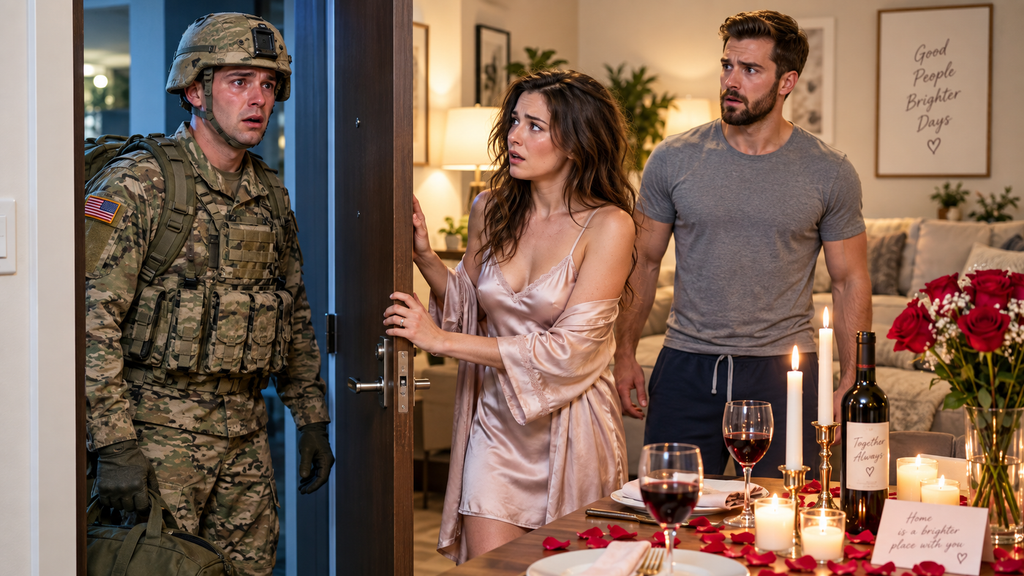
Brett.
He was barefoot.
That detail bothered me more than I expected.
Not because it proved anything I didn’t already know.
I had seen the hotel charges.
I had seen the photographs.
I had watched footage of him arriving after dark and leaving the following morning.
But seeing a stranger barefoot in the house where my children slept felt different.
It made everything suddenly real.
This was not a story happening thousands of miles away anymore.
This was my kitchen.
My refrigerator.
My son’s cereal bowl was sitting beside the sink.
Emily’s backpack was leaning against the dining-room chair.
And some man I had never met was standing beneath the lights I had installed with my own hands, drinking from one of my glasses as if he belonged there.
I didn’t move.
For nearly a minute, I simply stood in the darkness at the edge of my driveway.
Every instinct inside me wanted to march through the front door.
I wanted answers.
I wanted Natalie to see me.
I wanted Brett’s face to change when he realized whose house he was standing in.
But anger had never served me well overseas.
Anger made people careless.
And I had not traveled seven thousand miles to become careless at the finish line.
So I picked up my duffel bag.
And walked away from my own front door.
Marcus was waiting around the corner.
The moment I opened the passenger door of his truck, he looked at my face.
“You saw him?”
I nodded.
“Brett?”
“Yeah.”
Marcus gripped the steering wheel.
For a few seconds, neither of us spoke.
Then he asked quietly, “You still want to do this your way?”
I looked back toward the street where my house stood hidden behind a row of trees.
“Especially now.”
He exhaled.
“You’re a better man than me.”
“No,” I said. “I’m just trying not to become the worst version of myself.”
That was the truth.
I had spent the entire flight home imagining what confrontation might feel like.
In some versions, I kicked the door open.
In others, I dragged Brett outside.
Sometimes Natalie cried.
Sometimes she denied everything.
Sometimes I screamed.
But every version ended the same way.
My children remembered their father losing control.
I refused to give Natalie that ending.
And I refused to give myself one either.
So instead of going home, I slept on Marcus’s couch.
At 6:12 the next morning, my phone vibrated.
It was Emily.
Dad, are you awake?
I stared at the message.
She still believed I was overseas.
Always for you. What’s wrong?
The typing bubble appeared.
Disappeared.
Returned.
Then:
He’s still here.
My jaw tightened.
Are you safe?
Yes. I’m getting ready for school. Evan is downstairs watching cartoons.
I closed my eyes.
For fifteen years, I had tried to teach Emily that adults were supposed to make children feel safe.
Now my daughter was reporting activity inside her own home like she was conducting surveillance.
That thought broke something in me.
Listen to me carefully. None of this is your responsibility. Don’t watch Mom. Don’t follow anyone. Don’t take pictures. Just go to school and be fifteen. Promise me.
Her reply came almost immediately.
Promise.
Then another message.
Dad?
Yeah?
When are you coming home?
I looked across Marcus’s dark living room.
My boots were beside the couch.
My uniform bag sat near the door.
I was less than a mile from her.
I typed:
Sooner than you think.
Then I put the phone down before emotion could make me say more.
At 7:30, Marcus drove me to the law office.
I had already spoken to an attorney named Rebecca Lawson by video call two weeks earlier.
She specialized in family law and had worked with military families before.
She had been direct from the beginning.
“Do not empty accounts.”
I hadn’t.
“Do not threaten anyone.”
I wouldn’t.
“Do not enter the situation looking for a fight.”
I wasn’t.
“Most importantly, do not make the children responsible for proving adultery.”
I had already promised myself that.
Rebecca stood when I entered her office.
She was in her early fifties, with silver beginning at her temples and the kind of calm voice that made you lower your own.
“So,” she said.
“You’re back.”
“Three weeks early.”
“Does your wife know?”
“No.”
“Good.”
She motioned for me to sit.
Then she slid a folder across her desk.
Inside were copies of everything I had sent her.
Joint account records.
Credit-card statements.
Hotel charges.
Messages Marcus had legally obtained from public social-media posts.
A timeline of Brett’s visits.
Photos from Natalie’s private Instagram account that had been sent to me by someone who followed her.
I looked at the stack.
Eight years of marriage reduced to paper.
Rebecca folded her hands.
“You need to understand something before we proceed.”
I looked up.
“Infidelity will matter emotionally more than it necessarily matters financially. Depending on the court and circumstances, it may influence certain issues, but this is not a television trial where the judge slams a gavel and hands you everything because your spouse cheated.”
“I know.”
“What matters most is the children.”
“I know.”
“And your financial conduct while you were deployed.”
I leaned back.
That was the part I hadn’t fully understood until she explained it.
The dinners and hotel stays were bad enough.
But there were transfers too.
Small ones at first.
Then larger.
Two hundred dollars.
Five hundred.
Eight hundred.
Money moving from savings into Natalie’s personal account.
Then disappearing.
There were cash withdrawals.
Several.
There was a credit card I hadn’t known existed.
Balance: nearly eleven thousand dollars.
And buried in the statements was something that bothered Rebecca more than the hotel.
A payment to a real-estate attorney.
I had asked Natalie about refinancing months earlier.
She told me she was simply gathering information because interest rates had shifted.
But Rebecca discovered that Natalie had actually been discussing the possibility of borrowing against equity in the house.
My house.
Our house.
Our children’s home.
Without telling me the full extent of what she intended.
“She hasn’t completed anything,” Rebecca said. “And from what I can see, she couldn’t easily do so without your involvement because of how the title is held. But she was exploring it.”
“For what?”
“We don’t know yet.”
“Brett?”
“Maybe.”
The word made my stomach twist.
Rebecca watched me.
“This is exactly why I told you to stay calm.”
“I am calm.”
“No.”
She gave me a knowing look.
“You’re quiet. That’s not always the same thing.”
For some reason, that sentence stayed with me.
I looked down at my hands.
She was right.
I wasn’t calm.
I was furious.
I was humiliated.
I was exhausted.
But underneath all of that was something worse.
Grief.
Because despite everything, some part of me had still hoped there was an explanation.
Maybe Emily had misunderstood.
Maybe the footage looked worse than it was.
Maybe Natalie had made one catastrophic mistake instead of building an entire second life.
But the deeper I looked, the clearer it became.
This wasn’t one mistake.
This was a system.
A schedule.
A secret identity.
A private account.
Excuses planned in advance.
Money hidden in small pieces.
And my deployment had not caused it.
My deployment had simply made it easier.
Rebecca tapped the folder.
“I’ve prepared the filing.”
I stared at it.
Divorce.
A word I had tried not to think too loudly.
“Once we file, things change.”
“I understand.”
“Are you sure?”
I thought of Emily asking if I was mad at her.
I thought of Evan eating breakfast downstairs while Brett slept under my roof.
I thought of Natalie posting photographs of herself holding my hand at the airport four months earlier.
The caption had read:
Counting the days until my hero comes home.
I remembered believing her.
“File it.”
Rebecca nodded once.
And just like that, the future I thought I had disappeared.
I spent the rest of the morning preparing.
Not for revenge.
For the children.
Marcus helped me collect groceries.
I arranged a short-term furnished apartment nearby.
Two bedrooms.
Nothing fancy.
Clean.
Safe.
Close enough that Emily could stay in her school district while our attorneys worked through the living arrangements.
The leasing agent showed us a small balcony overlooking a parking lot.
“You can see the high school stadium from here,” she said.
I almost laughed at how ordinary that sentence sounded.
The world had exploded.
And somewhere, teenagers were still playing football under Friday-night lights.
I signed the paperwork.
At noon, I called my commanding officer and confirmed the final administrative details connected to my early return.
Then I sat in Marcus’s truck and stared at my phone.
There was one person I wanted to see more than anyone.
Emily.
But I couldn’t just show up at school in the middle of the day without creating questions.
So I waited.
At 3:18 p.m., students began spilling out of the front entrance.
Marcus parked across the street.
I stayed low in the passenger seat.
Then I saw her.
My daughter had grown while I was gone.
It shouldn’t have surprised me.
Four months can change a fifteen-year-old in ways photographs don’t capture.
Her hair was longer.
She carried herself differently.
A little more cautiously.
Like she had learned something about adults she hadn’t been ready to learn.
She was walking beside a friend when her phone buzzed.
I had sent her one message.
Look across the street.
Emily stopped.
She glanced at the screen.
Then looked up.
Her eyes searched the line of cars.
Marcus rolled down his window.
I leaned forward.
For half a second, she didn’t react.
Then her backpack fell from her shoulder.
“Dad?”
I was already opening the door.
“Dad!”
She ran.
I barely had time to stand before she crashed into me.
Her arms wrapped around my chest so hard I staggered backward.
I held her.
And all the discipline I’d been maintaining since her first message nearly disappeared.
She was crying.
Not loudly.
Just shaking against me.
“You’re here,” she kept saying.
“I’m here.”
“You said three more weeks.”
“I know.”
“You lied.”
That made me laugh through the pressure in my throat.
“Just this once.”
She pulled back and looked at my face.
Then she looked toward Marcus.
Then back at me.
“Does Mom know?”
“No.”
Her expression changed immediately.
Fear replaced relief.
“What are you going to do?”
I put both hands on her shoulders.
“Nothing stupid.”
“Dad—”
“Listen to me.”
She went quiet.
“You are not in trouble.”
“I know.”
“No, I need you to really hear me. You are not responsible for what happens between your mother and me. You did not cause this by telling me.”
Her eyes filled again.
“I feel like I did.”
“You didn’t.”
“But if I hadn’t said anything—”
“Then the truth would still be true.”
She stared at me.
“Secrets don’t become harmless because nobody says them out loud.”
Her mouth trembled.
“I didn’t want you to hate her.”
I swallowed hard.
“I don’t want you to hate her either.”
Emily looked stunned.
I continued.
“Your mother is still your mother. Whatever happened in our marriage is between adults. You’re allowed to love both of us.”
She wiped her cheek quickly.
“What if I’m angry at her?”
“Then be angry.”
“What if I’m angry at you too?”
I nodded.
“Then be angry at me.”
That finally pulled a tiny smile from her.
“You always say that.”
“Because it’s true.”
She hugged me again.
For the first time since her message, something inside me loosened.
Not healed.
Just loosened.
Then she whispered something against my chest.
“Please get Evan out of there before you tell her.”
I looked down.
“Why?”
Emily hesitated.
My whole body went cold.
“Did anyone hurt him?”
“No. No, nothing like that.”
“Then why?”
She looked away.
“Because Mom told him Brett is her cousin.”
I stared at her.
“What?”
“She said he’s Cousin Brett. Evan believes her.”
I closed my eyes.
That was when I realized another part of the betrayal.
Natalie hadn’t just lied to me.
She had recruited our children into different versions of reality.
Emily knew too much.
Evan knew too little.
And both were trapped inside the lie.
I touched Emily’s cheek.
“We’re going to fix what we can.”
We didn’t go home immediately.
I took Emily to a small diner where Marcus gave us space.
She ordered fries and a chocolate shake even though it was almost dinner.
I didn’t comment.
Deployment teaches you not to waste reunions discussing nutrition.
She told me more than I had expected.
Natalie had started going out frequently about a month after I left.
At first, Emily didn’t think anything about it.
Military spouses had friends.
People got lonely.
Then Brett began coming to the house.
The first time, Natalie said he was helping with a leaking faucet.
The second time, she said he was dropping something off.
The third time, he stayed until nearly 2 a.m.
Soon there were others.
At least two men Emily didn’t recognize.
One only visited twice.
Another came for dinner.
But Brett was the regular.
“Did Mom know you saw him staying over?”
“I think so.”
“What did she say?”
Emily stared at her fries.
“She said adults have complicated friendships.”
I felt my jaw tighten.
“What else?”
“She told me not to make assumptions because I was too young to understand marriage.”
I looked away toward the window.
Cars moved through the intersection.
People carried grocery bags.
Someone laughed outside.
Everything ordinary continued while my daughter told me how she had been manipulated into distrusting her own eyes.
“One night,” Emily continued, “I asked if you knew Brett was staying over.”
“What did she say?”
“She got really mad.”
My hands tightened under the table.
“How mad?”
“She said I was trying to cause problems because I missed you.”
I said nothing.
“Then she cried.”
“Natalie cried?”
Emily nodded.
“She told me she was lonely because you always leave.”
That sentence landed harder than any photograph.
Because Natalie had used the oldest wound in a military family.
Absence.
As if deployments were vacations I chose over them.
As if birthdays missed and anniversaries celebrated through screens had been easier for me.
As if I had wanted to sleep in tents, metal containers, barracks, aircraft, and temporary quarters while my children grew older without me.
Emily looked embarrassed.
“I felt bad after that.”
“Of course you did.”
“I almost didn’t tell you.”
I reached across the table.
“Thank you for telling me.”
“I didn’t want to hurt you.”
“I know.”
She looked toward the empty booth beside us.
“Are you divorcing her?”
There are questions your children ask that no training prepares you for.
I could have lied.
I could have said we would see.
I could have given her false hope because it would have made that moment easier.
But she had already lived through enough dishonesty.
“Yes.”
She didn’t cry this time.
She just nodded slowly.
“I thought so.”
“That doesn’t mean your family disappears.”
“It kind of does.”
The honesty in her voice broke my heart.
“Parts of it will change.”
“Everything will change.”
I couldn’t argue.
“Probably.”
She looked at me.
“Are you going away again?”
That question revealed the fear underneath everything else.
I squeezed her hand.
“My deployment is over.”
“But later?”
“I don’t know what my future orders will be.”
Her face fell.
“But here’s what I do know. Whether I’m in this city or another country, I don’t stop being your father.”
She gave me the tired look only teenagers can give.
“I know.”
“No. You know it here.”
I tapped my temple.
“I need you to know it here too.”
I touched my chest.
Her eyes watered.
“That’s cheesy.”
“Extremely.”
She laughed.
It was the first real laugh I’d heard from her all afternoon.
And I would have paid every dollar I had just to hear it again.
At 5:42 p.m., we made our next move.
Natalie believed Emily was staying late for a school club.
That gave us time.
Marcus drove to my house.
I stayed in the truck.
He walked to the front door carrying a small toolbox.
We had agreed on a simple story.
I had asked him to check something in the garage before my return.
Natalie knew Marcus.
Not well.
But enough that his presence would not immediately create suspicion.
A few minutes later, he texted me.
Brett gone. Natalie home. Evan in living room.
Then:
She bought the story.
We waited.
At 6:03, Marcus walked out with Evan.
My son was holding a baseball glove.
He looked confused.
Then he saw me standing beside the truck.
His whole face changed.
“DAD!”
He ran so hard one shoe nearly came off.
I knelt just in time.
He slammed into me.
“Dad! Dad! Dad!”
I buried my face against his hair.
God.
I had forgotten his smell.
Shampoo.
Grass.
Something sweet from whatever snack he had been eating.
He grabbed my face with both hands.
“You’re early!”
“Surprise.”
“Mom said three weeks!”
“Plans changed.”
He twisted around.
“Emily, Dad’s home!”
Emily stepped from the other side of the truck.
“I noticed.”
Evan laughed.
Then he looked toward the house.
“Mom’s gonna freak out.”
That was one way to describe it.
“What did Marcus tell her?” I asked.
“That we’re going to get pizza.”
“Perfect.”
Evan’s eyes widened.
“Are we?”
“We absolutely are.”
His entire world was still simple enough that pizza could temporarily outrank marital catastrophe.
I intended to protect that simplicity as long as I could.
We drove to the apartment.
I had already placed a few things there.
Toothbrushes.
Basic clothes.
Snacks.
A gaming controller Marcus had picked up for Evan.
Emily knew what was happening.
Evan didn’t.
He ran from room to room.
“This place is cool!”
“It’s temporary,” I told him.
“Can I sleep here?”
“Tonight, yes.”
“Why?”
I looked at Emily.
She looked back.
This was the part I dreaded.
I crouched in front of him.
“Your mom and I need to talk about some grown-up things.”
“Are you mad at her?”
Kids always ask the direct question adults spend paragraphs avoiding.
“I’m upset about some things.”
“Is Mom mad at you?”
“Maybe.”
He considered that.
“Did you forget your anniversary?”
Emily made a choking sound that might have been laughter.
I smiled despite myself.
“No.”
“Then what?”
“Nothing you need to fix.”
He frowned.
“I didn’t say I was gonna fix it.”
“Good. Then we’re already making progress.”
He accepted that with the strange flexibility of a ten-year-old.
“Can we order pepperoni?”
“We can order two pepperonis.”
“Best deployment ever.”
Emily and I exchanged a look.
I hated that phrase.
But I let him have it.
At 6:51 p.m., my phone started ringing.
Natalie.
I watched her name light up the screen.
Once.
Twice.
Three times.
Then messages.
Where is Evan?
Marcus said he was taking him for pizza.
Why isn’t he answering?
Another call.
Then:
Emily isn’t answering either. Do you know what’s happening?
I stared at the screen.
Emily sat on the couch with her knees pulled up.
“She’s going to figure it out.”
“Yes.”
“Are you going to answer?”
I nodded.
But first I told both children I needed privacy.
Marcus stayed with them while I stepped onto the balcony.
Then I accepted the call.
“Natalie.”
Silence.
Then:
“Daniel?”
My name sounded strange in her voice.
“Yeah.”
Another silence.
“Where are you?”
“Home.”
She gasped.
“What?”
“I’m back.”
“You’re—what do you mean you’re back?”
“I returned early.”
“Why didn’t you tell me?”
The question was almost funny.
“I wanted to surprise you.”
Silence again.
Then I heard movement.
A door closing.
Maybe she had stepped into our bedroom.
Maybe she had gone outside.
“Where are the kids?”
“With me.”
Her voice sharpened.
“Daniel, what is going on?”
“They’re safe.”
“Why did Marcus take Evan?”
“Because I asked him to.”
“Why?”
“We need to talk.”
There it was.
The sentence that ends eras.
Natalie became very quiet.
“What happened?”
I stared out over the apartment parking lot.
“Do you want the polite answer?”
“What does that mean?”
“It means I know.”
She stopped breathing for half a second.
Then she recovered.
“Know what?”
Even then.
Even with every opportunity to tell the truth.
She lied.
I almost admired the instinct.
Almost.
“Natalie.”
“What?”
“Don’t insult me.”
Her voice dropped.
“I don’t know what you’re talking about.”
“Brett.”
Nothing.
Then:
“Daniel, whatever you think—”
“The hotel.”
Silence.
“The Instagram account.”
Silence.
“The nights at our house.”
Her breathing changed.
“The money.”
“Daniel—”
“The attorney you spoke to about borrowing against the house.”
That finally broke her rhythm.
“What attorney?”
I laughed once.
Not because anything was funny.
Because the denial had become absurd.
“You really want to do this?”
“I can explain.”
“You’ve had months to explain.”
“You were deployed!”
The words came out sharper than she intended.
I closed my eyes.
There it was.
The excuse.
Not an apology.
An accusation.
“You were gone,” she continued. “Do you understand how hard that is?”
“Yes.”
“No, you don’t.”
“I was the one who was gone, Natalie.”
“You had people around you! You had a mission! You had something to focus on! I was here handling everything!”
“With Brett?”
“Don’t do that.”
“Do what?”
“Reduce everything to sex!”
The sentence hit me like a slap.
Not because of the word.
Because she had just admitted what she had denied thirty seconds earlier.
I let the silence hang.
She realized it too.
“Daniel—”
“Thank you.”
“For what?”
“For finally telling the truth.”
Her voice cracked.
“It wasn’t supposed to happen.”
“Which time?”
Silence.
“The first?”
Nothing.
“The second?”
“Stop.”
“The hotel?”
“Stop it!”
“Or the nights in our house while Emily was upstairs?”
That shut her down.
When she spoke again, her voice was barely audible.
“Emily told you.”
I looked through the glass door at my daughter sitting on the couch.
My anger sharpened.
“No.”
“What?”
“You don’t get to do that.”
“Do what?”
“You don’t get to move responsibility from yourself to our daughter.”
“I’m not.”
“You just did.”
“She had no business getting involved in our marriage.”
I felt something inside me turn cold.
“She didn’t involve herself. You brought it into her home.”
“She’s a child. She doesn’t understand.”
“She understood enough to be scared.”
Natalie said nothing.
“She understood enough to hide in her room when strange men came over.”
“Daniel, there weren’t strange men—”
“Do not lie again.”
“It wasn’t like that!”
“Then tell me what it was like.”
I heard her start crying.
Months earlier, that sound would have moved me instantly.
I would have stopped the argument.
I would have reassured her.
I would have apologized even if I wasn’t wrong.
But tears stop working when they are used too often as doors out of accountability.
“I was lonely,” she whispered.
“So was I.”
“You don’t understand.”
“I slept four hours some nights.”
“That’s not what I mean.”
“I missed Evan’s tournament.”
“Daniel—”
“I missed Emily’s school ceremony.”
“I know.”
“I ate my anniversary dinner from a plastic tray.”
“Please.”
“I watched families back home living through a screen while I counted the days.”
“Please stop.”
“And through every one of those days, I believed you were waiting for me.”
She sobbed.
I felt tears rise in my own eyes.
But I didn’t let my voice break.
“I was lonely too, Natalie.”
For several seconds, neither of us spoke.
Then she said:
“Did you come home to leave me?”
“Yes.”
The crying stopped.
“You’re serious.”
“I filed today.”
“What?”
“Divorce.”
“No.”
“It’s already started.”
“You can’t just decide that!”
“I didn’t decide it today.”
“Daniel, eight years—”
“I know how long we were married.”
“We have children!”
“Which is why I’m not screaming at you in front of them.”
“We can fix this.”
“No.”
“You haven’t even heard my side.”
“I’ve been looking at your side for two weeks.”
“It was a mistake.”
“No.”
“It was.”
“A mistake is one night.”
She went quiet.
“A mistake doesn’t need a separate Instagram account.”
Nothing.
“A mistake doesn’t come with hotel charges, cover stories, and repeated visits.”
“Please.”
“A mistake doesn’t tell a fifteen-year-old that she’s too young to trust what she sees.”
Natalie inhaled sharply.
“She told you that?”
Again.
Emily.
Always Emily.
I had heard enough.
“We’re not discussing our daughter like she’s a witness for the prosecution.”
“But she—”
“No.”
I forced myself to lower my voice.
“Emily is not the reason we’re divorcing.”
Natalie began crying again.
“Then what do you want?”
“Tonight?”
“Yes.”
“I want you to leave the children alone.”
“What?”
“They’re with me. They’re safe. You can call them later once you’ve calmed down.”
“You can’t keep my kids from me.”
“I’m not.”
“You took them without asking me!”
“I picked up my children.”
“From my house!”
“Our house.”
“Don’t start with me.”
That sentence almost made me laugh.
“You know what’s remarkable?”
“What?”
“You still think this is an argument you can win.”
“I’m their mother.”
“And I’m their father.”
“You’ve been gone for four months!”
“I’ve been deployed.”
“Same thing.”
“No.”
My voice became quieter.
“It’s not the same thing.”
She didn’t answer.
Then I said the sentence I had rehearsed since I booked the flight.
“Rebecca Lawson will contact you tomorrow.”
“Who’s Rebecca?”
“My attorney.”
That made everything real for her.
I could hear it in her breathing.
“Daniel, please come home.”
“No.”
“Please.”
“We’ll communicate through attorneys about finances and living arrangements.”
“Don’t do this over the phone.”
“I originally planned to do it in person.”
“Then come here.”
I looked through the window again.
Evan was laughing at something Marcus had said.
Emily wasn’t laughing.
She was watching me.
“No.”
“Why?”
“Because the kids need me calm tonight.”
“I need you too.”
I shut my eyes.
Once upon a time, that sentence would have brought me running.
But marriage does not give someone unlimited access to the person they repeatedly betray.
“I’m sorry you’re hurting.”
“You don’t sound sorry.”
“I am.”
“Then come home.”
“No.”
She sobbed.
“Is there someone else?”
I opened my eyes.
“What?”
“For you. Is there someone else?”
The question stunned me.
“No.”
“Then why won’t you even try?”
Because I finally understood something.
People sometimes imagine that betrayal ends when the betrayer stops touching the other person.
But betrayal doesn’t live only in a bedroom.
It lives in every lie told before breakfast.
Every deleted message.
Every false explanation.
Every dollar moved in secret.
Every moment your spouse looks into your eyes and lets you believe something they know is false.
I didn’t say all of that.
I simply said:
“Because I don’t trust you.”
Silence.
“And I don’t know how to be married to someone I don’t trust.”
Then I ended the call.
I stood on the balcony for several minutes.
I had imagined hanging up on Natalie would feel powerful.
It didn’t.
It felt like burying something.
Not her.
Us.
The version of us that once existed.
The young couple who had eaten takeout on moving boxes.
The parents who stayed awake together when Emily had pneumonia at age four.
The husband and wife who danced badly in our kitchen when Evan learned to walk.
Those people had been real.
That’s what made the betrayal hurt.
People like to rewrite broken marriages as if every year must have been false.
Ours wasn’t.
There had been good years.
Real laughter.
Real affection.
Real sacrifice.
And somehow, despite all of that, we had still arrived here.
My daughter tapped the glass.
I opened the balcony door.
“You okay?” she asked.
“Not particularly.”
She smiled faintly.
“That’s probably the first time you’ve admitted that.”
“Character growth.”
She stepped outside.
“Is Mom crying?”
“Yes.”
Emily’s face fell.
“Is she mad at me?”
“Probably.”
Her shoulders sank.
“But that’s not your responsibility.”
“She’ll blame me.”
“Then I’ll correct her.”
“You can’t control what she says.”
“No.”
I leaned against the railing.
“But I can control what I say.”
Emily stood beside me.
“Do you hate her?”
I thought about it.
“No.”
“Really?”
“Really.”
“How?”
“Because anger and hate are different.”
She waited.
“I’m angry enough that I don’t want to see her right now. I’m hurt enough that I don’t know when I’ll be able to speak to her without feeling sick. But hate?”
I shook my head.
“Your mother gave me you and Evan. We had years that mattered. I can’t erase all of that.”
Emily’s eyes watered.
“I don’t know how to feel.”
“You don’t have to know tonight.”
She rested her head against my shoulder.
We stood there under the apartment lights.
Father and daughter.
Both learning that sometimes coming home does not mean returning to the life you left.
Natalie’s attorney contacted Rebecca the next morning.
Then everything moved quickly.
Predictably, Natalie shifted through several versions of the story.
First, Brett was a friend.
Then an emotional affair.
Then she admitted it had become physical.
Then she insisted it had only happened twice.
The evidence showed otherwise.
By the end of the first week, her attorney stopped trying to dispute the existence of the affair and focused instead on practical issues.
Custody.
The house.
Money.
Schedules.
Temporary arrangements.
I followed Rebecca’s advice.
I documented.
I responded.
I did not insult Natalie.
I did not post anything online.
I did not tell mutual friends details beyond what was necessary.
I did not contact Brett.
That surprised Marcus.
“You’re seriously never going to talk to him?”
“No.”
“He was in your house.”
“I know.”
“He slept there.”
“I know.”
Marcus shook his head.
“I don’t know how you do it.”
I looked at him.
“What would talking to him change?”
Marcus didn’t answer.
“Brett didn’t promise me fidelity.”
“Natalie did.”
“Exactly.”
It didn’t excuse him.
He knew she was married.
I had proof of that too.
But I refused to waste energy imagining some dramatic confrontation between two men over a woman who had made her own choices.
I wasn’t going to fight him in a parking lot.
I wasn’t going to threaten him.
I wasn’t going to give my children a father with criminal charges because someone else lacked integrity.
My battle was not with Brett.
My battle was with what came next.
The first supervised conversation between Natalie and the children happened two days later.
Not supervised legally.
Supervised emotionally.
We met at a family counselor’s office Rebecca recommended.
I did not want Emily becoming the mediator.
And I did not want Evan learning pieces of the truth in random fragments.
Natalie arrived ten minutes early.
I saw her through the waiting-room window before she saw me.
She looked smaller.
Tired.
No makeup.
Hair pulled back.
For one dangerous second, all I saw was my wife.
Not the affair.
Not the lies.
My wife.
The woman whose hand I had held in the hospital when Evan was born.
The woman who used to steal the blankets from me.
The woman who cried at airport departures.
I hated that my heart remembered love even after my mind understood betrayal.
Then she looked up.
Our eyes met.
Her face crumpled.
I did not go to her.
I nodded once.
She nodded back.
Emily sat beside me.
Evan was playing a game on my phone.
The counselor opened the door.
“Come in.”
We sat in a circle.
Natalie across from me.
The children between us.
The counselor explained that we would speak honestly without exposing the children to adult details.
Then she asked Natalie if she wanted to begin.
Natalie looked at Emily.
Immediately, I tensed.
But instead of accusing her, Natalie said:
“I’m sorry.”
Emily stared at the carpet.
“For what?”
“For putting you in a position where you felt you had to protect Dad.”
Emily’s chin trembled.
“You told me I didn’t understand.”
“I know.”
“You said I was trying to cause problems.”
Natalie began crying.
“I was wrong.”
“I thought maybe I was crazy.”
That sentence destroyed whatever emotional distance I had managed to create.
I looked toward the counselor.
Even she seemed affected.
Natalie covered her mouth.
“Oh, Emily.”
“You made me feel like I couldn’t trust myself.”
“I know.”
“No, you don’t.”
The anger finally came.
Emily stood up.
“You don’t know because you’re the adult! You’re supposed to know what you’re doing!”
Natalie cried harder.
“I know.”
“You made me keep secrets from Dad!”
“I never asked you to lie.”
“You told me not to tell him!”
Silence.
There it was.
Another detail I hadn’t known.
I kept my voice controlled.
“Natalie.”
She looked at me.
“What did you tell her?”
Natalie wiped her face.
“I told her that what happened in our house while you were gone was my business.”
Emily laughed bitterly.
“You said I’d destroy the family if I told him.”
My stomach dropped.
I turned slowly toward Natalie.
She looked ashamed.
“I was scared.”
I could barely speak.
“You told our daughter she would destroy the family?”
“I didn’t mean it like that.”
“How else could you mean it?”
The counselor raised a hand.
“Daniel.”
I stopped.
Not because Natalie deserved protection from my anger.
Because Emily deserved protection from having to watch it.
I breathed slowly.
The counselor turned to Emily.
“You did not destroy your family.”
Emily cried.
“I know.”
“Do you?”
She shook her head.
The counselor leaned forward.
“Adults are responsible for adult choices. Telling the truth about those choices does not create them.”
Emily looked at me.
I nodded.
“That’s what Dad said.”
“Your father is right.”
Natalie wiped tears from her jaw.
“I’m sorry, baby.”
Emily looked furious.
“Don’t call me baby.”
Natalie flinched.
I wanted to intervene.
But sometimes consequences arrive in the tone of a child who no longer feels safe being affectionate.
Natalie nodded.
“Okay.”
Then Evan looked up from my phone.
“Why is everyone crying?”
The room became painfully quiet.
The counselor smiled gently.
“Your mom and dad are going to live in different places for a while.”
Evan frowned.
“Because they’re mad?”
“Because they have grown-up problems they need to work through.”
“Are you getting divorced?”
No one had used the word with him yet.
I looked at Natalie.
She looked at me.
Then I answered.
“Yes, buddy.”
His face changed.
“But married people stay married.”
“Sometimes they don’t.”
“Why?”
I had rehearsed this.
Still, my voice nearly broke.
“Because sometimes adults hurt each other in ways they can’t fix while staying married.”
“Did Mom hurt you?”
Natalie shut her eyes.
I could have said yes.
It would have been true.
But Evan did not need my truth weaponized against his mother.
“Your mom and I both have things we need to work through.”
He looked at Natalie.
“Did Dad hurt you?”
She opened her eyes.
And to her credit, she did not lie.
“No.”
I looked at her.
She swallowed.
“No, sweetheart. Dad didn’t cause this.”
For the first time since coming home, I felt something other than anger toward her.
Gratitude.
Small.
Painful.
But real.
Evan started crying.
Not dramatically.
Just tears sliding down his cheeks.
“But where will my Xbox go?”
Emily laughed through her tears.
Even Natalie smiled.
And somehow that ridiculous question gave us all permission to breathe.
“We’ll figure out the Xbox,” I promised.
Evan sniffed.
“And Max?”
Max was our dog.
“Max will be okay too.”
“Can he have two houses?”
“I don’t think Max understands joint custody.”
Evan almost smiled.
Natalie laughed once, then covered her face and cried harder.
And for one brief second, sitting in that counselor’s office, we were almost a family again.
Broken.
Changed.
But still connected by two children who deserved better from us than bitterness.
The financial situation became uglier before it improved.
The unknown credit card wasn’t the only hidden debt.
Natalie had borrowed money from her sister.
She had withdrawn from a personal investment account.
She had paid for weekend trips she told the kids were military-spouse events.
And then Rebecca discovered what the real-estate attorney consultation had been about.
Natalie and Brett had discussed opening a wine bar.
I stared at Rebecca across her desk.
“A wine bar?”
“That appears to be the plan.”
“With money from my house?”
“Potentially.”
I laughed.
I couldn’t help it.
Not joy.
Disbelief.
While I had been deployed, my wife had apparently been considering leveraging the home where our children slept to finance a business venture with her boyfriend.
Rebecca slid printed emails across the desk.
I read one.
Natalie had written:
Once the equity situation is handled, we could finally have something that’s ours.
Something that’s ours.
I read it twice.
Then a third time.
My house.
My deployment income.
Our children’s stability.
Transformed into “something that’s ours.”
I placed the page down.
Rebecca watched me carefully.
“Are you okay?”
“No.”
“Want a minute?”
“No.”
I looked at the document again.
“Does this help establish dissipation of marital assets?”
Her eyebrow lifted slightly.
“I’ve taught you too much.”
“Answer the question.”
“Potentially. We’re documenting everything.”
I nodded.
Then I asked:
“Did they ever get close?”
“Doesn’t appear so.”
That was the first financial mercy I’d received.
The house had not been mortgaged into a fantasy business.
Not yet.
A week after I came home, Brett contacted me.
Not by phone.
By email.
I almost deleted it.
Then curiosity won.
The subject was:
I owe you an explanation.
He did not.
But I read it anyway.
He claimed Natalie had told him our marriage was “effectively over.”
He claimed she said we were planning to separate after deployment.
He claimed she described me as emotionally absent and uninterested in the marriage.
He admitted he knew I was still legally married to her.
He apologized for coming into the house.
He said he should have known better.
Then came the sentence that surprised me.
I ended things after learning she had been seeing someone else besides me.
I read it twice.
Then I laughed.
Not loudly.
Just one stunned breath.
Brett wasn’t the only one.
Apparently, he had believed he was Natalie’s exception.
I forwarded the email to Rebecca.
Then I deleted it from my thoughts.
Or tried to.
Later that night, Emily found me washing dishes.
She leaned against the kitchen counter of the apartment.
“You look weird.”
“Thank you.”
“You know what I mean.”
“I received an interesting email.”
“From Mom?”
“No.”
She understood immediately.
“Brett?”
I glanced at her.
“I don’t want you involved.”
“I’m already involved.”
“Less involved.”
She folded her arms.
“What did he say?”
“Adult stuff.”
“Dad.”
“Emily.”
She rolled her eyes.
“Fine.”
Then she hesitated.
“I hated him.”
I dried my hands.
“I know.”
“But sometimes he was nice to Evan.”
I waited.
“I feel bad saying that.”
“Why?”
“Because you’re supposed to hate the person.”
“No.”
“Aren’t you?”
“Life is usually more complicated than that.”
She looked relieved.
“He’d bring Evan baseball cards.”
I nodded.
“That doesn’t make what he did okay.”
“I know.”
“But you’re allowed to remember people accurately.”
She considered that.
“Do you think Mom loved him?”
The question hurt more than I expected.
“I don’t know.”
“Would it make it worse?”
“I don’t know.”
“Worse than if it meant nothing?”
I leaned against the sink.
“That’s the problem with betrayal. Your brain keeps looking for the version that hurts least.”
“Is there one?”
“Not usually.”
She nodded.
Then walked over and hugged me without warning.
I held her.
“You’re going to be okay, Dad.”
I nearly laughed.
“You’re supposed to be the kid.”
“I can still know things.”
“Apparently.”
Natalie and I finally met alone twelve days after my return.
At her request.
Public place.
Daytime.
Neutral territory.
A coffee shop near Rebecca’s office.
She was already sitting when I arrived.
I almost turned around.
Not because I was afraid of her.
Because there are moments when seeing the person who hurt you can awaken every version of them at once.
The woman at that table was simultaneously my wife, my betrayer, my children’s mother, the girl I had once proposed to, and a stranger I no longer understood.
I sat across from her.
“Thank you for coming.”
“You asked.”
She pushed a coffee toward me.
“Black.”
I looked at it.
She remembered.
Of course she remembered.
Knowing how someone takes their coffee does not prevent you from destroying their trust.
I didn’t touch it.
Natalie looked thinner.
Her wedding ring was still on.
Mine wasn’t.
Her eyes noticed immediately.
She looked at my bare hand.
“You took it off.”
“Yes.”
She twisted her own ring.
“I haven’t.”
“That’s your choice.”
“Daniel, please don’t talk to me like I’m a stranger.”
I looked at her.
“I don’t know how to talk to you anymore.”
Her eyes filled.
“I deserved that.”
I said nothing.
“I’ve been thinking about what to say.”
“Okay.”
“There isn’t a version that makes me look good.”
“No.”
“I was lonely.”
I almost stood up.
She raised a hand quickly.
“I’m not saying that as an excuse.”
I stayed.
She continued.
“I was lonely, and instead of dealing with it like an adult, I let myself start resenting you.”
“Resenting me for being deployed?”
“Yes.”
I stared at her.
“I knew it wasn’t fair.”
“Did you?”
“Not enough.”
She wiped her eye.
“Every time you left, everyone praised me for being strong. People said I was amazing. Independent. A hero at home.”
She laughed bitterly.
“And I hated it.”
I waited.
“I didn’t want to be strong.”
“Neither did I.”
“I know that now.”
“That’s convenient.”
She flinched.
“I deserved that too.”
She looked down.
“Brett started as someone to talk to.”
“The oldest sentence in the world.”
“I know.”
“When did it become physical?”
She hesitated.
Then answered.
“About six weeks into deployment.”
I did the math automatically.
The first month had already been hard.
Communications were inconsistent.
There were nights I stayed awake reading old messages from her.
Six weeks.
That quickly.
“Was he the first?”
She stared at me.
“No.”
The word was almost inaudible.
My stomach turned.
“During this deployment?”
“No.”
My heart stopped.
“Natalie.”
She began crying.
I suddenly understood.
“Before?”
She nodded.
The coffee shop seemed to tilt.
“How long?”
“It wasn’t an ongoing affair.”
“How long?”
“There was someone two years ago.”
I couldn’t breathe properly.
Two years.
I had been home two years ago.
“Who?”
“It doesn’t matter.”
“It matters to me.”
“Someone from the gym.”
“Name.”
She looked away.
I stood.
“Daniel.”
“No.”
“Please sit down.”
“Eight years.”
“I know.”
“No, you keep saying that.”
People at nearby tables glanced toward us.
I lowered my voice.
“Eight years, and I’m learning the truth like I’m interviewing a suspect.”
“I’m trying to tell you now.”
“Because you got caught.”
She cried.
I hated that I still hated seeing her cry.
“You let me come home after that.”
“I’m sorry.”
“You let me sleep beside you.”
“I’m sorry.”
“You let me kiss you.”
“I know.”
“You let me think we were okay.”
“I know.”
I pressed my knuckles against my mouth.
Everything I had built in my mind shifted again.
The deployment hadn’t started the betrayal.
It had exposed a pattern.
I sat back down because my legs suddenly felt unreliable.
“How many?”
She looked terrified.
“Daniel.”
“How many?”
She shook her head.
“I don’t know how to answer.”
“With a number.”
“Three.”
My eyes closed.
Three.
Including Brett?
I asked.
“Does that include Brett?”
She hesitated.
“Yes.”
Three men.
Three separate lies.
Maybe more.
I thought I would feel rage.
Instead I felt empty.
“You never planned to tell me.”
“No.”
I looked at her.
At least that answer was honest.
“Why now?”
“Because I don’t want you finding out pieces forever.”
I laughed softly.
“That’s considerate.”
She cried.
“I know I’ve destroyed this.”
“Yes.”
“I know saying sorry doesn’t fix it.”
“No.”
“But I need you to know something.”
I waited.
“I did love you.”
That sentence hurt worst of all.
Because I believed her.
I believed that, somehow, she had loved me.
Imperfectly.
Selfishly.
In a broken way that had not stopped her from betraying me.
And that meant love alone had never been enough.
“I loved you too,” I said.
She covered her mouth.
“Then please—”
“No.”
She froze.
“Don’t turn that into hope.”
“Daniel.”
“Love isn’t the problem.”
She stared at me.
“Trust is.”
“I can rebuild it.”
“Maybe.”
Her eyes widened.
“But not as my wife.”
The hope disappeared.
She leaned back.
“You’re really done.”
“Yes.”
“There’s nothing I can say.”
“No.”
“Nothing I can do.”
“Be a good mother.”
Her face crumpled.
“That’s all?”
“That’s not small.”
She nodded through tears.
“And don’t ever blame Emily again.”
“I won’t.”
“Not privately. Not in anger. Not years from now when you’re telling your version of this.”
“I won’t.”
“She saved me from living inside a lie.”
Natalie swallowed.
“I know.”
I stood.
She looked at my untouched coffee.
Then at me.
“Daniel?”
I paused.
“Did you ever cheat on me?”
“No.”
She closed her eyes.
Somehow, that answer seemed to hurt her.
Then she asked:
“Did you ever want to?”
I thought carefully.
“I wanted a lot of things while I was gone.”
I looked at her.
“I wanted home.”
Then I walked away.
The divorce took months.
There was no dramatic courtroom ambush.
No judge gasping over secret photographs.
No audience cheering.
Real endings are usually less cinematic.
They are paperwork.
Waiting rooms.
Financial disclosures.
School calendars.
Boxes packed quietly.
Text messages about soccer practice.
Arguments about holidays.
Meetings where two people who once knew everything about each other negotiate who gets which set of dishes.
Natalie eventually agreed that the children should remain primarily in the family home during the school week, with a structured shared-custody schedule once I secured stable local housing.
I did not try to take the children from her.
Some people criticized me for that.
Marcus’s brother said I should “go for full custody.”
But betrayal as a spouse does not automatically mean failure as a parent.
Natalie had made terrible decisions.
She had manipulated Emily.
She had lied.
But she loved the children.
And after counseling began, she worked to repair what she’d damaged with them.
Especially with Emily.
That relationship did not heal quickly.
Some weeks, Emily refused to go to Natalie’s.
Other weeks, she went and returned angry.
Then one Sunday, months later, she came home from lunch with her mother carrying a small plant.
“What’s that?”
“Mom bought it.”
“What kind?”
“No idea.”
“Excellent start.”
She smiled.
Then she said:
“She apologized again.”
I waited.
“I believed her this time.”
That mattered.
Not because I wanted Natalie back.
I didn’t.
But because I wanted my daughter to have a mother she could eventually trust again.
Even if I never could.
The house was sold the following spring.
That surprised people too.
I could have fought harder to keep it.
Natalie could have tried.
Instead, we both realized the place had become too heavy.
Too many memories.
Too many ghosts.
I walked through the empty rooms one final time the morning before closing.
The kitchen looked smaller without furniture.
There were pale rectangles on the walls where photographs had hung.
I stood near the window where I had once imagined Christmas mornings decades into the future.
Emily’s height marks remained inside the pantry doorway.
Evan’s too.
Each year a small pencil line.
Each line evidence that something good had happened there too.
I ran my fingers over them.
That was when I cried.
Not when I saw Brett through the window.
Not when I filed for divorce.
Not when Natalie admitted there had been three men.
There.
Beside those pencil marks.
Because grief waited until I was alone.
I leaned against the pantry door and let myself mourn the family I thought would grow old inside that house.
Every birthday.
Every sick day.
Every lazy Sunday.
Every fight.
Every apology.
Every ordinary morning I had taken for granted.
Then I heard footsteps behind me.
Emily.
I wiped my face quickly.
She stood in the kitchen doorway.
“You know I can see you, right?”
“Apparently my stealth skills are gone.”
She walked over.
“You okay?”
“No.”
She nodded.
“Me neither.”
We looked at the height marks.
“Can we take that piece?”
“The doorframe?”
“Yeah.”
“Pretty sure the buyers want the house intact.”
She smiled.
Then I took out my phone.
We photographed every mark.
Every date.
Every badly written initial.
“Now we keep it,” I said.
She leaned against me.
And I understood something.
A house can hold a family.
But it is not the family.
A year after the message, life looked nothing like I had expected.
I lived fifteen minutes from Natalie.
The kids moved between our homes with backpacks, chargers, sports equipment, and the irritating ability to leave one important shoe at the wrong parent’s house.
Emily turned sixteen.
I taught her to drive.
Which frightened me more than deployment ever had.
“Brake.”
“I am braking.”
“Brake earlier.”
“Dad.”
“The mailbox did nothing to you.”
“I didn’t hit it!”
“Because the mailbox has survival instincts.”
She laughed so hard she nearly missed the turn.
For her birthday, Natalie and I both attended dinner.
Not together.
Not as a couple.
But at the same table.
We were civil.
At one point, our eyes met while Emily opened presents.
Natalie gave me a small nod.
I returned it.
That was enough.
Evan adjusted faster than any of us.
Children sometimes do.
He had two bedrooms.
Two sets of routines.
Two Christmas mornings, which he privately admitted was “kind of awesome.”
But one night, while I was tucking him into bed, he asked:
“Are you ever going to marry Mom again?”
I sat beside him.
“No.”
“Never?”
“Never.”
He considered that.
“Do you still like her?”
“I respect her as your mom.”
“That’s not what I asked.”
Ten years old.
Already a lawyer.
I smiled.
“I don’t hate her.”
“Mom says she hurt you.”
“She did.”
“Do you forgive her?”
That question stayed with me.
Did I?
I had spent months thinking forgiveness meant excusing.
Then I realized it didn’t.
Forgiveness did not mean returning.
It did not mean forgetting.
It did not mean pretending trust still existed.
Sometimes forgiveness simply meant deciding you were no longer going to carry the event into every new room you entered.
“I think I’m getting there,” I said.
Evan nodded.
“Good.”
“Why?”
“Because being mad all the time makes your forehead weird.”
I laughed.
“Go to sleep.”
Natalie never opened the wine bar.
Brett disappeared from our lives almost immediately after the divorce started.
The other men became irrelevant.
That surprised me too.
For months, I thought their identities would matter.
Eventually, they became background characters.
The real story was never about them.
It was about the damage secrecy does to a home.
It was about a fifteen-year-old girl believing the truth would destroy her family.
It was about a ten-year-old boy being told a stranger was a cousin so he wouldn’t ask questions.
It was about a husband realizing that courage on deployment does not automatically prepare you for the courage required at home.
And it was about learning that walking away can sometimes require more strength than fighting.
Two years after my early return, Emily and I were sitting on the back steps of my new townhouse.
She was seventeen.
College brochures were scattered across the kitchen table.
She wanted to study psychology.
I joked that surviving our family had given her advanced placement.
She did not find that particularly funny.
We were drinking lemonade when she suddenly asked:
“Do you remember the message?”
I knew exactly which one.
“Every word.”
She stared into her glass.
“I almost deleted it.”
My chest tightened.
“What stopped you?”
She shrugged.
“I thought about what you always told me.”
“What?”
“That if something feels wrong, I can call you no matter where you are.”
I looked away.
She continued.
“I thought maybe you’d be mad.”
“At you?”
“Yeah.”
“Why?”
“Because part of me knew once I told you, everything would change.”
I nodded.
“Everything did change.”
“Do you ever wish I hadn’t told you?”
I turned toward her immediately.
“No.”
She searched my face.
“Not even a little?”
“Not for one second.”
She looked down.
“If you hadn’t told me, I might have stayed married longer.”
She looked guilty.
I touched her shoulder.
“But longer is not always better.”
She nodded slowly.
“The truth hurt.”
“Yeah.”
“But living inside the lie would have hurt more.”
She leaned against me.
After a while, she asked:
“Do you think you’ll ever get married again?”
I laughed.
“Trying to get rid of me?”
“No.”
“Then why?”
She smiled.
“I don’t know. You seem less sad.”
That surprised me.
“Did I seem sad before?”
“Sometimes.”
“When?”
“Mostly when you thought nobody was watching.”
Children see too much.
I looked out across the little backyard.
There was a grill I rarely used.
A chair Evan had left crooked.
A basketball near the fence.
Ordinary things.
A peaceful life.
“I might marry again.”
Emily grinned.
“Interesting.”
“Do not make that face.”
“What face?”
“That matchmaking face.”
“I literally said one word.”
“Your eyebrows said several.”
She laughed.
Then became serious.
“Dad?”
“Yeah?”
“I’m glad you came home early.”
I put my arm around her.
“So am I.”
I used to think coming home from deployment would be simple.
A terminal.
A crowd.
Children running into my arms.
Natalie crying.
A banner over the garage.
Maybe a grill going in the backyard.
I imagined I would drop my bags inside the door and everything would resume where I left it.
But life doesn’t always wait in the shape you remember.
Sometimes you come home and discover someone else has been sleeping in your bed.
Sometimes you discover money missing.
Sometimes you discover your child has been carrying an adult secret alone.
Sometimes homecoming is not a reunion.
Sometimes it is an awakening.
For months, I was ashamed.
Not because Natalie cheated.
But because I thought I should have known.
I replayed old conversations.
The nights she seemed distracted.
The sudden new clothes.
The times she accused me of being distant.
The moments she turned her phone facedown when I entered the room.
I asked myself how someone trained to notice danger could miss what was happening in his own marriage.
Counseling helped me understand the obvious answer.
I trusted my wife.
That was not stupidity.
Trust is not a character flaw.
What someone does with your trust belongs to them.
What you do after learning the truth belongs to you.
And I knew exactly what I wanted my children to remember.
Not that their father destroyed their mother.
Not that he screamed.
Not that he fought some stranger on the lawn.
Not that he emptied bank accounts or posted revenge online.
I wanted them to remember something quieter.
That when the truth came, I listened.
That when Emily was scared, I told her she had done nothing wrong.
That when Evan needed stability, I gave him as much as I could.
That I did not let betrayal decide the kind of man I became afterward.
The last time Natalie and I spoke about the affair directly was nearly three years after the divorce.
Emily was graduating high school.
We stood outside the auditorium waiting for the doors to open.
Natalie had changed.
So had I.
Time had softened some edges.
Not erased them.
Just made them less sharp.
She looked toward the parking lot.
“I’ve wanted to ask you something for a long time.”
I glanced at her.
“What?”
“Why didn’t you come into the house that first night?”
For a second, I didn’t understand.
Then I realized what she meant.
She knew.
Maybe Marcus had told her eventually.
Maybe Emily had.
“I saw Brett through the window.”
She nodded.
“I know.”
“I almost came in.”
“Why didn’t you?”
I thought about it.
Then answered honestly.
“Because I knew Emily was upstairs.”
Natalie’s face changed.
“I didn’t want her first memory of me coming home to be violence.”
She looked down.
“I deserved your anger.”
“Probably.”
“I mean it.”
“I know.”
“Sometimes I wish you had yelled.”
“Why?”
“Because the way you stayed calm made me realize how far gone things were.”
I considered that.
“I wasn’t calm.”
“You looked calm.”
“I was barely holding myself together.”
She nodded.
“I know that now.”
We stood quietly.
Then she said:
“I’m sorry.”
I almost told her she’d said it enough.
But something stopped me.
Maybe because she no longer said it expecting anything.
Not reconciliation.
Not forgiveness.
Not reassurance.
Just acknowledgment.
So I looked at her.
“I know.”
She breathed out slowly.
“And for what it’s worth, I hate that Emily was the one who had to tell you.”
“So do I.”
“I’ve apologized to her.”
“I know.”
“She says she forgives me.”
“She’s a good kid.”
“Because of you.”
I shook my head.
“Because of both of us.”
Natalie looked surprised.
But it was true.
She had failed horribly in one part of her life.
That did not mean every good part of our children’s childhood belonged to me alone.
That was another thing I had learned.
You can acknowledge someone’s wrongdoing without rewriting them into a monster.
The doors opened.
Families began walking inside.
Natalie looked at me.
“Ready?”
I smiled faintly.
“For our daughter to graduate?”
“Yeah.”
“No.”
She laughed.
“Me neither.”
We walked inside separately.
But when Emily crossed the stage, we both stood.
We both cheered.
And from the stage, our daughter looked at both of us and smiled.
That was the family we had become.
Not the one I expected.
Not the one I would have chosen.
But still a family.
That night, after the graduation party, Emily found me outside.
She was still wearing her graduation dress beneath an oversized sweatshirt.
“You disappeared.”
“Too many teenagers.”
“This is literally my graduation party.”
“My point exactly.”
She stood beside me.
“Mom told me she talked to you.”
“Briefly.”
“Was it weird?”
“Extremely.”
Emily smiled.
“She told me something.”
I looked at her.
“What?”
“That you said I was a good kid because of both of you.”
“That’s true.”
She leaned into my shoulder.
“You know what I remember most?”
“What?”
“The day you came back.”
I smiled.
“You nearly knocked me into traffic.”
“I did not.”
“You absolutely did.”
“You deserved it.”
“Why?”
“For saying ‘sooner than you think.'”
I laughed.
Then she grew quiet.
“I remember thinking you’d be furious when I saw you.”
“I was.”
“Not at me.”
“Never at you.”
She looked across the yard.
“I think that changed how I understand love.”
I turned toward her.
“That’s a terrifying sentence.”
She laughed.
“I mean it.”
“Explain.”
“You were hurt.”
“Yes.”
“Really hurt.”
“Yes.”
“But you didn’t make me carry it.”
My throat tightened.
She continued.
“Mom did, for a while.”
I didn’t respond.
“But you kept telling me it wasn’t mine.”
“Because it wasn’t.”
“I know.”
She looked at me.
“But I didn’t know then.”
I nodded.
She hugged me.
“Thank you.”
“For what?”
“For coming home like a dad.”
Those words broke me more completely than any betrayal ever had.
I held her tightly.
Over her shoulder, I could see Evan arguing with one of his friends over a basketball.
Music drifted through the open back door.
Someone inside laughed.
Life.
Ordinary, imperfect, continuing life.
And suddenly I understood that my story had never truly been about catching Natalie.
It wasn’t about Brett.
It wasn’t about proving an affair.
It wasn’t even about divorce.
It was about the moment my daughter trusted me with something frightening.
Everything after that came down to what I chose to do with her trust.
I could have exploded.
I could have made the entire situation about my pain.
I could have demanded details from her.
I could have turned her into my spy.
I could have confronted Natalie immediately and forced Emily to live inside the explosion.
Instead, I came home.
Quietly.
Carefully.
Not because I was weak.
Because my children were watching.
And sometimes the greatest test of strength is not whether you can destroy the person who hurt you.
It is whether you can protect the people who did not.
Years later, I still have the original message.
I never deleted it.
Dad, I need to tell you something, but I’m scared.
Sometimes I read it and remember exactly where I was sitting.
The metal walls.
The dust.
The hum of equipment.
The sudden silence in my head.
Then the second message.
Mom has been bringing men to the house.
At the time, I thought those words had destroyed my family.
They hadn’t.
The choices made before that message had done the damage.
Emily had simply turned on the light.
And while the truth cost me a marriage, it gave me something too.
Clarity.
A deeper relationship with my children.
A chance to rebuild without pretending.
And eventually, peace.
Not the loud kind.
Not the victorious kind people imagine at the end of revenge stories.
There was no moment where Natalie lost everything and I stood smiling over the ruins.
I never wanted that.
Because my children’s mother losing everything would have hurt my children too.
The peace I found was quieter.
It was Emily calling me from college because she needed advice.
It was Evan asking if he could bring three friends over even though I knew three meant six.
It was Christmas mornings that no longer felt incomplete.
It was learning that an empty side of the bed could feel peaceful instead of lonely.
It was taking my wedding ring from the back of a drawer one afternoon, holding it for a few seconds, and realizing I felt nothing sharp anymore.
Just history.
I placed it back inside.
Then closed the drawer.
If I could speak to the man I was before that deployment, I wouldn’t warn him.
I wouldn’t tell him Natalie would cheat.
I wouldn’t tell him his daughter would be the one to expose it.
I wouldn’t tell him his marriage had an expiration date.
I would tell him something simpler.
Pay attention to what matters when everything goes wrong.
Your anger will tell you to punish.
Your pride will tell you to perform.
Other people will tell you revenge is justice.
They will tell you to ruin her.
Expose her.
Humiliate her.
Make her feel what you felt.
But pain multiplied is still pain.
And children are usually the ones standing closest when the pieces fly.
So when Emily’s message arrived, I answered the only way I knew how.
Thank you for telling me, sweetheart.
At the time, I thought I was simply calming my daughter.
Years later, I understand that message became a promise.
I was telling her:
You can bring me the truth.
Even an ugly truth.
Even one that hurts me.
And I will still be your father before I become anything else.
I kept that promise.
Not perfectly.
I had angry nights.
I had mornings when I couldn’t eat.
I had moments when I hated Natalie.
Moments when I imagined saying cruel things just to watch her break.
But I never forgot who was watching.
And eventually, the rage passed.
The humiliation passed.
Even the grief changed shape.
What remained was the part worth keeping.
My children.
My self-respect.
And the knowledge that on the worst day of my marriage, when I could have become someone I would later regret, I chose not to.
Three weeks before anyone expected me, I came home from deployment.
I thought I was coming home to uncover my wife’s secret.
Instead, I uncovered something about myself.
I learned that you can lose the future you planned without losing your entire future.
I learned that betrayal can end a marriage without ending your ability to trust everyone.
I learned that leaving does not always mean abandoning a family.
Sometimes leaving a broken marriage is how you stop the damage from becoming the family’s permanent language.
Most of all, I learned that home is not the building where someone waits for you.
Home is the place where the people you love know they can tell you the truth.
Even when they’re scared.
Even when it hurts.
Even when that truth changes everything.
And that is why, whenever I think back to the message that made the entire world go quiet, I don’t remember Brett first.
I don’t remember the hotel charge.
I don’t remember the hidden Instagram account.
I don’t remember seeing another man’s silhouette inside my kitchen.
I remember my daughter’s question.
Are you mad at me?
And I remember my answer.
Never. You did the right thing.
Because she did.
And when I came home three weeks early, so did I.
THE END! THANK YOU FOR READING!❤️