 Reading Time: 39 minutes
When I arrived at my daughter’s house, she was holding her screaming baby with one arm while washing a mountain of greasy dishes with the other.
Her husband sat at the dining table carving roast beef. His mother sat beside him drinking wine. Neither of them moved to help her.
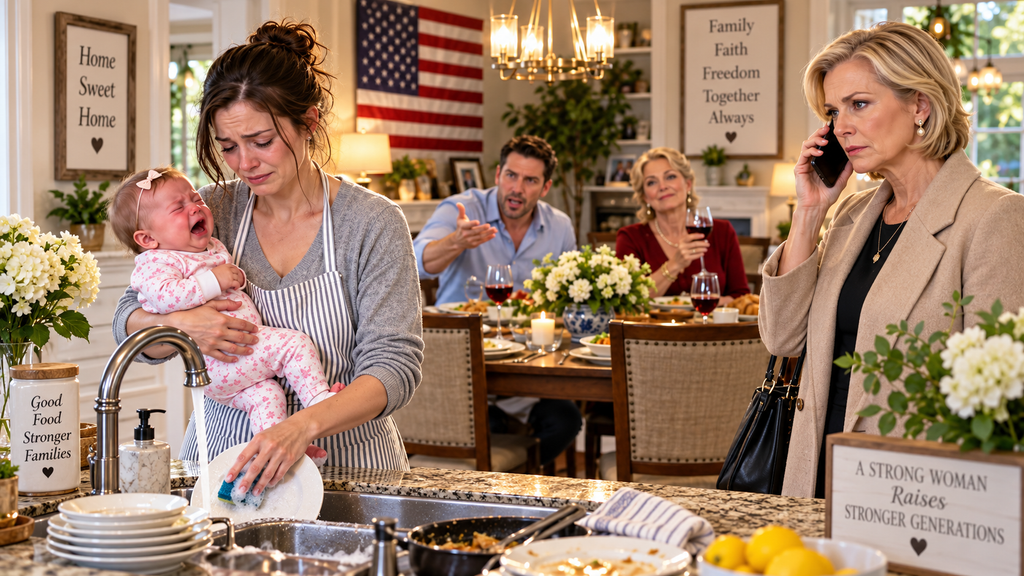
“Emily,” her husband snapped without even looking up, “move faster. Mom needs more potatoes.”
My daughter flinched.
Actually flinched.
Like the sound of his voice had struck her.
I stood in the kitchen doorway with my overnight bag still hanging from my shoulder and felt something inside me turn to ice.
Emily had not seen me yet.
Neither had Evan.
For several seconds, I simply watched.
Not because I didn’t want to interfere.
Because I needed to understand exactly what I was looking at.
My granddaughter Lily was red-faced from crying, her tiny fists clenched against Emily’s sweater.
Emily bounced her weakly against one hip while scrubbing a roasting pan with her free hand.
There were dirty plates stacked beside the sink.
Bowls covered the counter.
A saucepan sat soaking on the stove.
A pile of laundry waited near the hallway.
And my daughter—the daughter who once argued with a college dean because he had unfairly blamed a scholarship student for something she hadn’t done—stood in the middle of it all with her shoulders hunched and her eyes lowered.
She looked exhausted.
Not tired.
Not overwhelmed.
Exhausted in a way that reached all the way into her bones.
Her blond hair, once something she took pride in, had been twisted into a loose knot that looked several days old.
There were dark circles beneath her eyes.
Her lips were dry.
The skin around her wrists was red and chafed.
And when she reached for another plate, the sleeve of her sweater slipped upward.
That was when I saw the bruise.
Purple.
Curved.
Finger-shaped.
For one terrible second, the entire room seemed to disappear.
All I could see was that bruise.
Then Evan spoke again.
“For God’s sake, Emily, she’s still crying.”
“I know,” Emily whispered.
“So make her stop.”
“I’m trying.”
“Well, try harder.”
His mother, Gloria, lifted her wineglass.
“You’ve spoiled that baby,” she said. “Every time Lily makes a sound, you pick her up. That’s why she behaves like this.”
Emily said nothing.
I had heard enough.
I stepped into the kitchen.
“Maybe she’s crying because her mother hasn’t been allowed to sit down.”
Emily froze.
The plate in her hand slipped.
It struck the bottom of the sink with a sharp crack.
Her head turned slowly.
“Mom?”
I will never forget the way she said that word.
There was surprise in it.
But there was something else too.
Relief.
Pure, painful relief.
The kind of relief a drowning person feels when she finally sees the shore.
“Hello, sweetheart.”
Her face crumpled for half a second before she forced it still.
Evan turned in his chair.
Gloria looked over her shoulder.
She recovered first.
“Margaret.”
No smile.
No greeting.
Just my name.
Her eyes flicked toward the front hallway.
“You should have called.”
“I did.”
She looked uncomfortable.
“I mean before coming.”
“I called Emily six times this week.”
Evan wiped his mouth with a napkin.
“She’s been busy.”
“I can see that.”
He leaned back in his chair.
Evan was thirty-seven years old, handsome in the polished, expensive way that photographed well at company events.
Dark hair.
Perfect teeth.
Tailored shirts.
A watch he liked people to notice.
When Emily first introduced him to me, he had been charming.
Almost excessively so.
He remembered which wine I preferred.
Asked intelligent questions about my company.
Held doors open.
Sent handwritten thank-you notes.
When my husband Richard died, Evan carried boxes, arranged chairs, spoke quietly to funeral-home employees and stood beside Emily with his hand firmly around hers.
I had thought he was protecting her.
Now, looking back, I wondered if he had simply been learning how much we owned.
“Margaret,” he said with the practiced patience people use around someone they intend to dismiss, “Emily has been having a difficult adjustment since Lily was born.”
Emily stared into the sink.
Evan continued.
“Sleep deprivation. Mood swings. Anxiety. You know how new mothers can get.”
I looked at my daughter.
“Do I?”
He smiled as if I had agreed with him.
“We’ve been helping her establish structure.”
Gloria nodded.
“She had none.”
Emily’s fingers tightened around the sponge.
Gloria continued talking.
“She lets dishes sit. Laundry piles up. She sleeps during the day whenever the baby sleeps. It isn’t healthy.”
I stared at her.
“She gave birth four months ago.”
“Yes, and women have been giving birth for thousands of years.”
“Gloria.”
“What? It’s true. I raised three children without making everyone around me miserable.”
Evan chuckled.
Emily lowered her head farther.
That sound—his laugh—did something to me.
I crossed the room.
“Give me Lily.”
Emily immediately shook her head.
“I’m okay.”
“I didn’t ask if you were okay.”
Her eyes lifted to mine.
I softened my voice.
“Give me my granddaughter.”
She hesitated.
Then she placed Lily in my arms.
The baby was warm.
Too warm.
Her little cheeks were wet with tears, and she immediately buried her face against my shoulder.
I rubbed slow circles across her back.
Within seconds, she started calming.
Emily turned back toward the sink.
I caught her hand.
“No.”
She stared at me.
“Sit down.”
From behind me, Evan laughed.
“She doesn’t need to sit down, Margaret. Dinner isn’t finished.”
I looked at him.
He stopped smiling.
“Emily,” I repeated, “sit.”
My daughter did not move.
Not at first.
And that frightened me more than anything else I had seen.
She was waiting.
Waiting for permission.
Not from me.
From him.
I turned toward Evan.
He was staring at her.
There was something in his face then.
A warning.
Small enough that someone who didn’t know Emily might have missed it.
She didn’t.
Her shoulders tightened.
That was when I knew this wasn’t a difficult marriage.
It wasn’t postpartum tension.
It wasn’t a husband who had become selfish after the arrival of a baby.
My daughter was afraid of him.
I took one slow breath.
Then I looked at Emily and said one word.
“Bluebird?”
Her eyes snapped toward mine.
Silence.
Gloria frowned.
“What?”
I ignored her.
“Emily.”
My daughter’s lower lip trembled.
“Bluebird?”
Years earlier, when Emily was twenty-two and preparing to backpack through Europe with two friends, I had made her choose an emergency word.
Something ordinary.
Something no one would question if she slipped it into a telephone conversation.
If she ever said that word—or if I said it and she answered yes—it meant one thing.
I am not safe.
No explanations needed.
No questions.
No hesitation.
Bluebird.
We had laughed about it back then.
Emily had rolled her eyes.
“Mom, you watch too many crime shows.”
“Humor me.”
“Fine. Bluebird.”
For fifteen years, neither of us had ever used it.
Until that afternoon.
Emily looked at Evan.
Then at Gloria.
Then down at the floor.
Her eyes filled with tears.
And almost invisibly, she nodded.
Once.
My heartbeat slowed.
It sounds strange, but it did.
Fear disappeared.
So did surprise.
There are moments when panic is a luxury.
That was one of them.
I became very calm.
“Thank you,” I said softly.
Evan pushed his chair backward.
“What is this nonsense?”
I kissed Lily’s forehead.
“Nothing you need to worry about.”
“Oh, I think I do.”
“You probably should.”
Gloria set down her glass.
“Margaret, you arrive without warning, criticize our household, interrupt dinner, and now you’re whispering secret code words to Emily. You’re upsetting her.”
I looked at Emily.
She was trembling.
Not because of me.
“Has she eaten?”
Gloria blinked.
“Excuse me?”
“I asked whether Emily has eaten.”
Evan sighed.
“Of course she has.”
“What?”
“What?”
“What has she eaten today?”
His eyes narrowed.
“How would I know?”
“You just told me you were helping her establish structure.”
“We are.”
“Then what did she eat?”
Gloria rolled her eyes.
“This is ridiculous.”
Emily whispered, “Toast.”
I turned toward her.
“What?”
“I had toast.”
“When?”
“This morning.”
It was almost six in the evening.
I felt Lily breathe against my neck.
“What else?”
Emily shook her head.
“Nothing.”
Evan slammed his palm on the table.
“For Christ’s sake, she could eat whenever she wanted!”
Emily jerked violently at the sound.
Lily began crying again.
There it was.
The room went very still.
Evan saw me watching him.
He lowered his voice.
“She chooses not to eat. She gets dramatic.”
“Interesting.”
“What’s that supposed to mean?”
“It means I’m beginning to understand.”
“You don’t understand anything.”
“No,” I said. “Not yet.”
I shifted Lily into one arm and removed my phone with the other.
Evan laughed.
“Who are you calling?”
“Someone who handles family emergencies.”
Gloria’s eyebrows rose.
“Oh, please.”
She lifted her wineglass again.
“Margaret loves theatrics.”
I looked at the glass.
It belonged to me.
Not in some sentimental sense.
Literally.
The crystal had been part of a wedding collection Richard and I had purchased twenty-eight years earlier.
So had the dining table.
So had the house.
Technically, almost everything around them belonged to a legal structure Evan apparently knew nothing about.
That misunderstanding was about to become extremely expensive.
I opened my contacts.
Daniel Cho answered on the second ring.
“Margaret?”
“Daniel.”
Something in my voice changed his tone immediately.
“What happened?”
“I’m at Emily’s house.”
A pause.
Then:
“Is she safe?”
“Not yet.”
I looked at my daughter.
Her face had gone completely pale.
“Activate Bluebird.”
Daniel did not ask a single unnecessary question.
“Confirmed?”
“Confirmed.”
“I’ll open the archive.”
“Do that. Freeze every discretionary Hartwell account tied to Evan. Suspend company cards. Revoke vehicle authorization. Preserve emails, cloud backups, vendor records and security footage. No deletions.”
Evan slowly stood.
“What the hell are you doing?”
I continued speaking.
“Send Melissa from compliance to secure his office access.”
Daniel’s voice came through the phone.
“Already calling her.”
“Contact building security.”
“Yes.”
“And Daniel?”
“I’m here.”
“Come yourself.”
“I’m leaving now.”
“Bring whoever you think we’ll need.”
A pause.
Then:
“Understood.”
I ended the call.
Evan stared at me.
His face had changed.
Not frightened yet.
But alert.
“What exactly did you just do?”
I returned my phone to my purse.
“Sat down for dinner.”
He gave a sharp laugh.
“This is my house.”
“No.”
His smile disappeared.
I nodded toward Emily.
“Sit beside me, sweetheart.”
Evan pointed at her.
“Emily, finish the kitchen.”
I looked at my daughter.
She looked at him.
Then something astonishing happened.
She took one step away from the sink.
Evan’s expression hardened.
“Emily.”
Another step.
“Don’t.”
She walked toward me.
I pulled out the chair beside mine.
She sat.
Her whole body shook.
But she sat.
Gloria stared at her as though she had committed an act of treason.
“I cannot believe how ungrateful you are.”
Emily closed her eyes.
I rested one hand over hers.
“Don’t answer.”
Gloria turned toward me.
“You have no idea what we’ve put up with.”
“I suspect I’m going to find out exactly what everyone in this house has been putting up with.”
Evan stepped away from the table.
“Mom, get your coat.”
Gloria frowned.
“Why?”
“We’re leaving.”
I almost smiled.
“No, you’re not.”
His head snapped toward me.
“Excuse me?”
“You’re going to stay exactly where you are until Daniel arrives.”
“You can’t hold me here.”
“I’m not holding you anywhere.”
“Then I’m leaving.”
“You can.”
I shifted Lily gently against my shoulder.
“But I strongly recommend you leave the Range Rover and Mercedes in the driveway.”
Evan stared at me.
“What?”
“Company vehicles.”
“They’re mine.”
“No.”
“I use them every day.”
“Yes.”
“They were given to me.”
“No. They are leased through Hartwell Dining Group and assigned to you as part of your employment package.”
His face tightened.
“That’s semantics.”
“It tends not to be when law enforcement gets involved.”
Gloria laughed.
“Law enforcement? Margaret, have you lost your mind?”
“Possibly.”
Evan’s phone buzzed.
He pulled it out.
Looked at the screen.
His eyebrows drew together.
Another notification appeared.
Then another.
“What the hell?”
He tapped rapidly.
Gloria leaned toward him.
“What?”
“My card was declined.”
I looked down at Lily.
“Was it?”
Evan glared at me.
“You froze my American Express.”
“Hartwell froze Hartwell’s American Express.”
He started tapping again.
“What did you do to the vehicles?”
“What do you mean?”
“My driver profile is gone.”
“Then I imagine you’ll need a ride.”
Gloria stood.
“This is outrageous.”
Her own phone buzzed.
She looked at it.
Then her expression changed.
“What does access suspended mean?”
I looked at her.
“I suppose it means your access has been suspended.”
“To what?”
“That depends.”
“My household account.”
Emily made a tiny sound beside me.
Not laughter exactly.
But close.
Gloria heard it.
Her head whipped around.
“You think this is funny?”
Emily immediately went quiet.
I stood.
“Do not speak to her like that again.”
“You have no right to come into my son’s home—”
“It is not your son’s home.”
“Yes, it is!”
“No, Gloria.”
I looked around at the kitchen.
The oak cabinets.
The stone countertops.
The French doors opening onto the garden Richard had loved.
“This house belongs to the Hartwell Family Trust.”
She stared at me.
Evan waved one hand dismissively.
“Which Emily owns.”
“Not exactly.”
His face changed by a fraction.
I continued.
“The trust owns the property.”
“Emily is the beneficiary.”
“Yes.”
“And I’m her husband.”
“Yes.”
“So legally—”
“You are a licensed occupant.”
Silence.
“A what?”
“A licensed occupant.”
Evan gave a disbelieving laugh.
“That’s absurd.”
“Read the documents.”
“I signed documents when we moved in.”
“Yes.”
“I was told it was our home.”
“It is Emily’s home in every meaningful sense. The trust protects it for her and her children.”
“I’m her husband.”
“You keep saying that as though marriage magically rewrites property law.”
Gloria sat down slowly.
Evan’s jaw tightened.
“You did this intentionally.”
“Yes.”
“To keep me from ownership.”
“To protect my daughter’s inheritance.”
“From her husband?”
“From anyone.”
His face flushed.
I watched his hands.
Emily did too.
He realized it and curled them into fists at his sides.
“You always hated me.”
“No.”
“That’s a lie.”
“I distrusted entitlement. You developed quite a lot of it.”
“You gave me nothing.”
“I gave you a management position in a company you did not build.”
“I tripled regional revenue!”
“And received bonuses for doing so.”
“I renovated this house.”
“With whose money?”
His eyes flickered.
There.
Half a second.
But I saw it.
So did Emily.
I turned toward her.
Her fingers had tightened around mine.
“Emily?”
She swallowed.
Evan said, “Don’t.”
The word came out low.
Dangerous.
Emily looked at him.
He stared directly into her eyes.
“Don’t embarrass yourself.”
My daughter inhaled shakily.
Then she leaned down.
Reached beneath Lily’s stroller.
And removed a black flash drive.
Evan went completely still.
Gloria frowned.
“What is that?”
Emily placed it on the table.
“For eight months,” she whispered, “Evan has been moving company money.”
No one spoke.
She looked at me.
Tears filled her eyes.
“I’m sorry.”
“For what?”
“I should have told you.”
“Tell me now.”
She glanced toward Evan.
He laughed suddenly.
Not because anything was funny.
Because he was frightened.
“She’s confused.”
Emily’s jaw tightened.
“Stop saying that.”
“She hasn’t slept properly in months.”
“Because you wouldn’t let Lily sleep in our bedroom.”
“Here we go.”
“You said her crying affected your performance at work.”
“It did.”
“You made me sleep in the nursery.”
“Because you insisted on hovering over the baby every five minutes.”
“She was six weeks old.”
Gloria spoke sharply.
“Emily, enough.”
Emily looked at her.
For the first time since I had entered the house, something changed in my daughter’s face.
Fear was still there.
But anger had finally found a place beside it.
“No.”
Gloria blinked.
“What did you say?”
“I said no.”
“Do not talk to me in that tone.”
“You put a lock on the pantry.”
I turned toward Gloria.
She went pale.
Evan spoke quickly.
“That was for Lily.”
Emily stared at him.
“Lily cannot walk.”
He opened his mouth.
Nothing came out.
I said quietly, “Why was there a lock on the pantry?”
Emily looked at me.
“Because he shoved me inside it.”
The air left my lungs.
I did not move.
Could not.
“When?”
“Three months ago.”
“Why?”
She looked at the table.
“I wanted to call you.”
I closed my eyes for one second.
Only one.
Then I opened them again.
“What happened?”
Emily’s voice trembled.
“He took my phone. I tried to get it back. We argued. Gloria said I needed to calm down. Evan grabbed my arms and shoved me inside the pantry.”
Gloria interrupted.
“She was hysterical.”
Emily looked at her.
“You locked the door.”
“To prevent you from hurting yourself.”
“You left me in there for almost two hours.”
“You were screaming!”
“Lily was crying!”
Evan stepped toward the table.
“Enough!”
Lily startled in my arms.
I turned toward him.
“Sit down.”
He laughed.
“Or what?”
“Try me.”
For several seconds, neither of us moved.
Then his phone rang.
He looked at the screen.
Hartwell corporate.
He answered immediately.
“Yes?”
I could hear a man speaking quickly.
Evan turned away.
“What do you mean suspended?”
More talking.
“This is ridiculous. I’m regional director.”
He listened.
“No. Listen to me. You do not deactivate my access without my authorization.”
A pause.
His face darkened.
“Who authorized it?”
He looked at me.
The answer was obvious.
I sat back down.
Emily stared at the flash drive.
“How much?” I asked.
She looked confused.
“The money.”
She swallowed.
“I don’t know all of it.”
“How much do you know?”
“Almost seven hundred thousand.”
Gloria shot to her feet.
“That is a lie!”
Emily didn’t look at her.
“Six hundred and eighty thousand that I could trace.”
Evan slammed his phone onto the table.
“She doesn’t know what she’s talking about.”
“She has records.”
“She found business expenses and decided they were theft.”
Emily shook her head.
“The vendor was registered three months after you became regional director.”
“Plenty of vendors are new.”
“It’s registered to your mother.”
Gloria froze.
Emily continued.
“Same mailing address as the condo in Sarasota.”
Gloria’s mouth opened.
My daughter turned toward me.
“He created a vendor called GSR Hospitality Solutions.”
“What does GSR stand for?”
“Gloria Susan Reynolds.”
Gloria’s face drained of color.
“It does not.”
Emily reached for the flash drive.
Evan moved.
Fast.
He lunged across the table.
Not at Emily.
At the drive.
I stepped between them.
His shoulder struck mine.
Lily screamed.
I stumbled backward.
Emily cried out.
Evan froze.
His expression changed instantly.
“Margaret, I didn’t—”
The doorbell rang.
No one moved.
Then it rang again.
I heard a car door closing outside.
Another.
Evan looked toward the hallway.
I picked up the flash drive.
“Before you make another mistake,” I said, “you should probably know who is standing outside.”
I walked toward the front door.
Emily followed me.
So did Evan.
Gloria stayed near the table.
When I opened the door, Daniel Cho stood on the porch holding a leather folder.
He was sixty-three, silver-haired and impeccably dressed.
Beside him stood Melissa Greene, Hartwell’s director of compliance.
Behind them were two private security officers.
And standing near the driveway was a woman wearing a dark police jacket.
Evan stopped walking.
“What is this?”
Daniel entered.
“Hello, Evan.”
“You can’t just bring these people into my house.”
Daniel removed his glasses.
“It is not your house.”
“I’m getting very tired of hearing that.”
“I imagine you are.”
The woman behind him stepped inside.
She showed her badge.
“Detective Lena Ortiz.”
Evan stared at me.
“You called the police?”
“I called my attorney.”
Detective Ortiz looked toward Emily.
“Mrs. Mercer?”
Emily’s entire body stiffened.
“Yes.”
“I understand you may have information concerning financial crimes and a possible domestic violence incident.”
Evan laughed.
“This is unbelievable.”
Detective Ortiz turned toward him.
“Sir, please allow her to answer.”
“She’s my wife.”
“I’m aware.”
“She’s suffering from postpartum depression.”
Emily flinched.
The detective’s expression did not change.
“That does not prevent her from speaking.”
Evan rubbed both hands across his face.
“This whole thing is insane.”
Daniel opened his folder.
“I’ve reviewed the archive.”
I looked at him.
“How bad?”
“Very.”
Gloria appeared in the hallway.
“What archive?”
Daniel looked at Emily.
“May I?”
She nodded.
He set several printed pages on the dining table.
“Mrs. Mercer began uploading documents approximately nine weeks ago.”
Evan looked at Emily.
“You did what?”
She took a step closer to me.
Daniel continued.
“Bank screenshots. Vendor contracts. recorded conversations. photographs. copies of emails. medical documentation. images of physical injuries. videos from interior security devices.”
Gloria’s face changed.
“Security devices?”
Emily looked at her.
“You forgot about the nursery camera.”
Silence.
Evan went pale.
“You recorded private conversations?”
“You screamed at me in our baby’s nursery.”
“That doesn’t give you the right—”
Detective Ortiz raised one hand.
“Sir.”
He stopped.
Daniel removed another paper.
“We have identified nine unauthorized transfers from Hartwell operating accounts to GSR Hospitality Solutions.”
Gloria shook her head.
“No.”
“Current total is six hundred eighty-two thousand four hundred dollars.”
“It was consulting work!”
Melissa spoke for the first time.
“I oversee vendor compliance at Hartwell.”
Gloria looked at her.
Melissa placed a thin file beside Daniel’s papers.
“GSR has no employees.”
Gloria said nothing.
“No operating office.”
Silence.
“No hospitality consulting licenses, contracts outside Hartwell, payroll records or documented deliverables.”
Evan stepped forward.
“I approved the work.”
“You cannot approve a related-party vendor without disclosure.”
“I didn’t know it belonged to my mother.”
Emily laughed softly.
Everybody turned toward her.
The sound was sad rather than amused.
She looked at Evan.
“You created the email address for her.”
His face hardened.
“That proves nothing.”
“You spelled ‘consultancy’ wrong in the password hint.”
Gloria whispered, “Evan.”
“Shut up, Mom.”
That was the first time I saw Gloria look afraid of her son.
Not disappointed.
Not angry.
Afraid.
Interesting.
Daniel continued.
“Someone also attempted to use this house as collateral for a private business loan.”
I stared at Evan.
He didn’t look at me.
“When?”
“Three weeks ago.”
My stomach turned.
“Amount?”
“1.2 million.”
Emily covered her mouth.
“You told me those were insurance papers.”
Evan snapped, “Because you wouldn’t have understood them.”
She stared at him.
There are sentences that destroy marriages.
Not infidelity.
Not shouting.
Sometimes just one sentence that suddenly reveals exactly how someone has always viewed you.
Because you wouldn’t have understood.
Emily slowly lowered her hand.
“I understood more than you thought.”
He glared at her.
“You’ve destroyed our family.”
“No,” she whispered.
Then she looked him straight in the eye.
“You did.”
Detective Ortiz stepped toward her.
“Mrs. Mercer, may I ask you something?”
Emily nodded.
“Do you feel safe remaining in this home tonight if your husband is here?”
She looked at Evan.
His expression softened immediately.
It was astonishing.
One second earlier, fury.
The next, concern.
“Emily.”
She recoiled.
“Baby, come on.”
“Don’t call me that.”
“We can fix this.”
She shook her head.
“You said that after the pantry.”
His expression tightened.
“You were having an episode.”
“I was begging you to let me feed our daughter.”
“You’re twisting everything.”
“You threw my breast pump against the wall.”
Gloria cut in.
“Because you were using motherhood as an excuse not to behave like a wife.”
Every person in the room stared at her.
She realized too late what she had said.
Detective Ortiz’s eyes narrowed.
“What does ‘behave like a wife’ mean?”
Gloria crossed her arms.
“I meant household responsibilities.”
Emily looked at her.
“You rationed my groceries.”
“That is ridiculous.”
“You put labels on everything.”
“Because food was being wasted!”
“You wrote my name on three yogurt cups for an entire week.”
Gloria’s mouth tightened.
“I was teaching you budgeting.”
Emily laughed again.
This time tears spilled down her cheeks.
“My mother owns forty-two restaurants.”
I felt something break inside me.
Not because of the money.
Because she had been starving while surrounded by abundance.
While I had been calling.
While I had been sending messages.
While I had been assuming she was simply overwhelmed with the baby.
I touched her shoulder.
“Why didn’t you tell me?”
Her face crumpled.
“Because he said you’d take Lily.”
I stared at Evan.
Emily continued before I could speak.
“He said if I told anyone I was struggling, he would tell a judge I had postpartum psychosis. He said he had emails proving I was unstable. He made me think you believed it too.”
My throat tightened.
“Emily.”
“I’m sorry.”
“No.”
“I should have known—”
“No.”
I moved closer.
“You were trying to survive.”
She began crying.
“I thought if I stayed calm enough, if I kept the house clean enough, if I stopped arguing, maybe he would go back to normal.”
Evan scoffed.
“I am standing right here.”
Emily looked at him.
“So was I.”
That silenced him.
Detective Ortiz spoke gently.
“Emily, would you like to make a formal statement?”
Her eyes dropped.
Evan took one step toward her.
Daniel immediately moved between them.
“Don’t.”
Evan laughed bitterly.
“I’m trying to speak to my wife.”
“You’ve had plenty of opportunities.”
“Stay out of my marriage.”
Daniel’s voice became colder.
“Your marriage became my business when you attempted to encumber protected trust property with forged authorization.”
“That has nothing to do with Emily.”
“It has everything to do with her.”
He removed two documents from the folder.
Then placed them on the table.
“Your employment with Hartwell Dining Group is terminated for cause, effective immediately.”
Evan stared at him.
“What?”
“Your corporate access has been revoked.”
“You can’t fire me.”
“Margaret can.”
Evan turned toward me.
“You wouldn’t.”
I met his eyes.
“It’s already done.”
His face went white.
“My team—”
“Has been instructed to preserve your office and electronic devices.”
“You’re destroying my career.”
“No. Your actions did that.”
Daniel placed down the second paper.
“This is formal revocation of your license to occupy trust property.”
Evan stared at it.
“What does that mean?”
“It means you no longer have permission to live here.”
Gloria gave a nervous laugh.
“You cannot evict someone in five minutes.”
Daniel nodded.
“Correct.”
She smiled triumphantly.
“Then this is meaningless.”
“No. It means the legal process begins immediately. But given the evidence of domestic violence and Emily’s status as the protected beneficiary, we are also pursuing an emergency protective order.”
Detective Ortiz looked toward Emily.
“That depends partly on what Mrs. Mercer wants to report.”
Every eye turned toward my daughter.
She looked terrified.
Evan saw it.
And he moved in.
Not physically.
Emotionally.
The old strategy.
“Em.”
His voice softened.
“Look at me.”
She didn’t.
“Please.”
Her eyes lifted.
He looked devastated now.
Perfect performance.
“I know things have been hard.”
Emily said nothing.
“We’re both exhausted.”
Nothing.
“I never wanted you to be afraid of me.”
Her lips trembled.
“I love you.”
Gloria began crying quietly.
Evan continued.
“Think about Lily.”
Emily closed her eyes.
He stepped closer.
“Think about her growing up without her father.”
My daughter’s eyes opened.
Something changed.
Maybe it was the cruelty of using their child.
Maybe exhaustion had finally burned through fear.
Maybe she realized that the man begging her to preserve Lily’s family was the same man who had punished Lily’s cries.
Whatever happened, Emily straightened.
For the first time that entire evening, her shoulders came back.
“I am thinking about Lily.”
Evan smiled faintly.
“Then don’t do this.”
“I’m thinking about the day she turns twenty.”
His smile vanished.
“I’m thinking about her standing in a kitchen somewhere, afraid of a man who says he loves her.”
Nobody moved.
Emily wiped her cheeks.
“And I’m thinking about what she would do if she knew her mother stayed.”
Evan whispered, “Emily.”
She shook her head.
“I won’t teach her that.”
Then she turned toward Detective Ortiz.
“Yes.”
The detective waited.
Emily swallowed.
“Yes, I want to make a statement.”
Evan’s face transformed.
Charm vanished.
“You stupid—”
Detective Ortiz stepped forward.
“Careful.”
He stopped.
His jaw worked.
Emily stared at him.
For once, he was the person measuring his words.
Detective Ortiz asked us to move into the living room.
Emily sat on the sofa with me beside her.
Lily had finally fallen asleep against my chest.
Daniel and Melissa remained near the dining table reviewing documents.
One security officer stood near the front door.
The other went upstairs with permission to make sure no company property was removed or damaged.
Evan paced.
Gloria sat rigidly in a chair.
Detective Ortiz pulled up another seat.
“Emily, I’m going to ask some difficult questions.”
Emily nodded.
“You can stop at any time.”
Another nod.
“When did your husband first become physically aggressive?”
Emily stared at her hands.
“About five months into my pregnancy.”
My head snapped toward her.
That long?
She saw my expression.
“I’m sorry.”
I reached for her hand.
“You have nothing to apologize for.”
Evan groaned.
“This is absurd.”
The detective turned.
“Mr. Mercer, you need to remain silent while she speaks.”
“She’s lying.”
“Then you may have an opportunity to provide your statement later.”
Emily continued.
“It started with grabbing.”
“Where?”
“My wrists. Arms.”
“Did it leave marks?”
“Sometimes.”
“Did you photograph them?”
“Later.”
“When did you start documenting?”
“After Lily was born.”
“Why then?”
Emily’s eyes filled again.
“Because he grabbed me while I was holding her.”
My stomach twisted.
Detective Ortiz stayed calm.
“Did the baby get hurt?”
“No.”
“Did you believe she could have been?”
“Yes.”
“What happened?”
Emily inhaled.
“I had been up most of the night. Lily had reflux and wouldn’t sleep unless I held her upright. Around six in the morning Evan came in and told me to make breakfast before he went to work.”
I stared at her.
She continued.
“I told him there were eggs in the refrigerator and asked if he could make them himself.”
Evan laughed bitterly.
“Listen to this.”
The detective ignored him.
Emily’s voice became smaller.
“He said I was disrespecting him.”
“What happened next?”
“I tried to walk past him.”
Her fingers trembled.
“He grabbed my upper arm.”
“While you were holding Lily?”
“Yes.”
“How hard?”
“I had bruises.”
“Did you tell him he was hurting you?”
“Yes.”
“What did he do?”
“He squeezed harder.”
My eyes burned.
“What did he say?”
Emily looked down.
“He said, ‘Then listen the first time.’”
I closed my eyes.
Richard would have killed him.
That thought arrived unexpectedly.
My husband had adored Emily.
She had been his whole universe.
At age six, she used to sit beside him in our first restaurant folding napkins badly while he pretended she was an employee.
At sixteen, she wrecked his station wagon and came home shaking.
Richard looked at the car, looked at her, and asked only one question.
“Are you hurt?”
When she said no, he hugged her.
The vehicle could be replaced.
His daughter could not.
He had been dead four years.
Sitting in that room, I missed him with such force that I almost couldn’t breathe.
Because if he had been alive, Emily might have called him.
Maybe she would have told him.
Maybe Evan would never have dared.
But grief is useless when it starts rewriting history.
I opened my eyes.
My daughter needed the parent who was still there.
Detective Ortiz asked, “Did the violence escalate?”
“Yes.”
Emily told her about being shoved against a bathroom door.
About the pantry.
About Evan taking her phone.
About Gloria telling relatives Emily needed “quiet” and should not receive visitors.
About doctor appointments Evan insisted on attending.
About how he answered questions for her.
About how he had once told a pediatrician Emily was “struggling emotionally” after she disagreed with him about formula.
“He wanted it documented,” Emily said.
“Documented for what?” I asked.
She looked at me.
“Custody.”
A cold realization settled over me.
This had not been random cruelty.
Evan had been building a story.
Unstable mother.
Concerned husband.
Helpful grandmother.
He had been manufacturing a version of reality in which he controlled the money, the house, the child and the narrative.
Daniel heard us.
He stepped closer.
“Emily, do you have copies of those medical records?”
She nodded.
“In the archive.”
“Good.”
Evan pointed at Daniel.
“Stop coaching her.”
“I asked whether records exist.”
“You’re building a case.”
Daniel looked at him.
“Yes.”
There was no drama in his voice.
That frightened Evan more than yelling would have.
Around eight thirty, Detective Ortiz asked to see the pantry.
Emily led us there.
It was narrow.
Barely large enough for two adults to stand comfortably.
Shelves lined both walls.
Canned soup.
Pasta.
Cereal.
Cleaning supplies.
On the outside of the door was a brass slide bolt.
I touched it.
My hand shook.
“Was this here before?”
Emily shook her head.
“Evan installed it.”
“When?”
“After Lily was born.”
I looked at him.
He was standing several feet away with his arms crossed.
“It was for childproofing.”
Detective Ortiz stared at the bolt.
“It is mounted five feet from the floor.”
Evan said nothing.
“And the child is four months old.”
Silence.
Emily pointed toward a small camera above the refrigerator.
“The kitchen camera caught part of it.”
Evan’s head turned.
I looked up.
He whispered, “You told me that camera didn’t work.”
Emily met his eyes.
“I lied.”
It was the first time she looked almost proud.
Daniel’s phone rang.
He stepped aside.
A minute later he came back.
“We found more.”
I knew from his face that it wasn’t good.
“What?”
“GSR Hospitality transferred one hundred seventy thousand dollars into an LLC registered in Florida.”
Gloria stared at him.
“No.”
“Property records show that LLC purchased your condominium nine months ago.”
Everyone looked at her.
She went pale.
“That condo was a gift.”
“From whom?”
“My son.”
“With stolen company funds?”
“It wasn’t stolen!”
Melissa spoke quietly.
“We have the transfers.”
Gloria’s hands began shaking.
“I didn’t know where the money came from.”
Emily stared at her.
“You signed the invoices.”
“I signed what Evan gave me!”
Evan’s face turned toward his mother.
“Stop talking.”
Gloria looked at him.
“I’m not going to prison for you.”
There it was.
The alliance broke.
Not with a dramatic confession.
Just fear.
Evan stared at her.
“You knew exactly what we were doing.”
“I knew you said it was legal!”
“You wanted the condo.”
“You told me it was a tax strategy!”
“Mom.”
“You told me Margaret would never notice!”
Silence.
She covered her mouth.
Too late.
Daniel looked at Melissa.
Melissa wrote something down.
Evan stared at his mother with murder in his eyes.
Gloria began crying.
“I didn’t mean—”
Detective Ortiz said, “Mrs. Reynolds, I strongly recommend you stop speaking until you’ve obtained legal counsel.”
She stopped.
Evan laughed.
It was an ugly sound.
“Well.”
He looked around the room.
“Congratulations, Margaret.”
“For what?”
“You got what you wanted.”
“I wanted my daughter safe.”
“No. You wanted me gone.”
“I barely thought about you.”
That landed.
His face tightened.
“You always thought Emily was too good for me.”
“I thought Emily was happy.”
“You never respected me.”
“I gave you a career.”
“I earned that.”
“Yes. And then you apparently stole from the company that employed you.”
He stepped toward me.
“Do you know what it’s like being married into this family?”
Emily stared at him.
“What?”
He laughed.
“There it is. The Hartwell look.”
I had no idea what he meant.
He continued.
“Every room I walked into, I was Margaret Hartwell’s son-in-law.”
“You took my name off almost everything,” Emily whispered.
“That isn’t the point.”
“You told people you built the regional division.”
“I did!”
“You inherited it.”
He turned toward her.
“You think you’re better than me?”
She shook her head.
“No.”
“You always did.”
“No, Evan.”
“Yes, you did. Your trust fund. Your family. Your mother’s company. You walked around pretending money didn’t matter because you never had to worry about it.”
Emily stared at him.
“And that made it okay to hurt me?”
He stopped.
For one second, shame crossed his face.
Then disappeared.
“You pushed me.”
“No.”
“You knew how to push every button.”
“No.”
“You made me feel like nothing.”
Emily’s voice broke.
“So you made me feel smaller.”
He didn’t answer.
That was answer enough.
At 9:12 that night, Detective Ortiz asked Evan to turn around.
He stared at her.
“For what?”
“Based on the statement, documented injuries, recorded evidence and what we observed here tonight, you are being placed under arrest on suspicion of domestic assault and unlawful restraint.”
Gloria gasped.
Emily’s hand found mine.
Evan laughed.
“You’re joking.”
“Turn around.”
“You don’t have probable cause.”
“Turn around, sir.”
He looked at Emily.
“Stop this.”
She shook.
But she didn’t look away.
“Emily.”
Nothing.
“You know this isn’t who I am.”
A tear rolled down her cheek.
“I think it is.”
His face changed.
Detective Ortiz took his wrist.
He pulled away.
One of the officers stepped closer.
Evan looked around.
Suddenly, the room no longer belonged to him.
The people did not obey him.
His money was inaccessible.
His position was gone.
His cars were gone.
His carefully constructed version of Emily had begun collapsing.
And the house he had called his kingdom had never legally belonged to him at all.
The handcuffs clicked.
Gloria started sobbing.
“Evan!”
He turned toward me.
“You planned this.”
“No.”
“You were waiting.”
“No.”
“You set me up.”
I shook my head.
“You set yourself up every time you assumed nobody was watching.”
He looked at Emily.
“You think your mother is going to protect you forever?”
My daughter’s face went white.
Detective Ortiz tightened her grip on his arm.
“Enough.”
But Emily raised one hand.
“No.”
The detective paused.
Emily stepped forward.
I almost stopped her.
Then I realized she needed this.
She stood three feet from her husband.
The man she had loved.
The father of her child.
The man she had spent months shrinking herself to accommodate.
He looked at her with contempt.
“You cannot survive without me.”
Emily began to cry.
But she smiled.
A small, devastated smile.
“I already did.”
Evan stared at her.
“I survived every day I was married to you.”
His jaw clenched.
“That was harder.”
Detective Ortiz led him outside.
The front door closed.
And just like that, the house became silent.
No one moved.
Emily stared at the door.
Her breathing became uneven.
I handed Lily to Daniel.
Then I reached for my daughter.
She collapsed.
Not delicately.
Her knees simply stopped holding her.
I caught her around the waist, and we sank onto the floor together.
She began sobbing.
Deep, painful sobs that seemed to come from somewhere beneath language.
“I’m sorry.”
I held her.
“I’m sorry, Mom.”
“Stop.”
“I should’ve told you.”
“Stop apologizing.”
“I let it get so bad.”
“You survived it.”
“I kept thinking he’d change.”
“I know.”
“I thought I could fix it.”
“I know.”
“I didn’t want you to think I was stupid.”
That one broke me.
I pulled back.
“Look at me.”
She shook her head.
“Emily.”
She finally lifted her face.
“You are not stupid.”
“I married him.”
“You loved someone who learned how to use that love against you.”
“I ignored things.”
“You were manipulated.”
“I stayed.”
“You were afraid.”
She sobbed harder.
“I should have been stronger.”
“No.”
I touched her face.
“No more of that.”
“But—”
“Strength is not how long you can stand inside a burning building.”
She stared at me.
“Sometimes strength is walking out.”
Her eyes closed.
I held her again.
We stayed on the kitchen floor while Daniel stood silently nearby holding Lily.
No speeches.
No celebration.
No satisfaction.
Because despite what people imagine, there is no triumphant music when an abusive marriage finally cracks open.
There is grief.
There is embarrassment that doesn’t belong to the victim but somehow settles on her anyway.
There is love for the person she thought existed.
There is fear about tomorrow.
There is relief so powerful it hurts.
And there is exhaustion.
So much exhaustion.
That night Emily slept in my bed.
I slept beside Lily’s bassinet.
At two in the morning, I heard Emily scream.
I ran into the room.
She was sitting upright, breathing wildly.
“What happened?”
She looked around.
Then at me.
“Where is he?”
“Gone.”
She stared toward the doorway.
“Are you sure?”
“Yes.”
“Did you lock it?”
“Yes.”
“The back door?”
“Yes.”
“The windows?”
“Yes.”
She looked unconvinced.
I sat beside her.
“Do you want to check?”
She nodded.
So at two fifteen in the morning, we walked through every room together.
Front door.
Locked.
Kitchen door.
Locked.
Windows.
Locked.
Garage.
Secure.
We checked Lily.
We checked the alarm.
Then Emily stood in the dark living room staring at the front door.
“I used to listen for his key.”
“When?”
“Every evening.”
“Why?”
“So I could tell what mood he was in by how he opened the door.”
I said nothing.
“If he turned the key slowly, he was usually okay. If he shoved it in and rattled the lock…”
Her voice trailed off.
“What would you do?”
“Check the kitchen.”
“For what?”
“To see if dinner was ready.”
My heart hurt.
“And if it wasn’t?”
She gave me a tired look.
“You know.”
No.
I hadn’t known.
That was the painful part.
For years, I had built a business on noticing problems before they became disasters.
Food costs.
Vendor irregularities.
Bad managers.
Falling sales.
I could walk into one of our restaurants and know within ten minutes whether the staff respected the general manager.
But I had missed my own daughter disappearing.
Maybe because Evan was careful.
Maybe because Emily was ashamed.
Maybe because I had accepted her excuses.
“She’s tired.”
“The baby’s fussy.”
“Evan’s busy.”
“We’ll visit next month.”
Ordinary words can hide terrible things.
At three in the morning, Emily stood beside Lily’s crib.
“I don’t know who I am anymore.”
I sat in the rocking chair.
“You’re Emily.”
She shook her head.
“I used to know what I liked.”
“You still do.”
“No.”
“You’ll remember.”
“What if I don’t?”
“Then you’ll discover new things.”
She looked at me.
“I don’t even know what I want for breakfast without thinking whether he would complain about it.”
That sentence hurt more than the bruise.
So the next morning, when she woke, I asked one question.
“What do you want for breakfast?”
She frowned.
“I don’t care.”
“I didn’t ask what you don’t care about.”
“Mom.”
“What do you want?”
“I don’t know.”
“Take your time.”
She stood in the kitchen for nearly a minute.
Then:
“Pancakes.”
I smiled.
“What kind?”
Her eyes filled with tears.
“Blueberry.”
We made blueberry pancakes.
She ate four.
Gloria was gone by then.
Daniel had arranged temporary lodging after explaining in very precise legal language that remaining in the house was no longer advisable.
She packed three suitcases.
Then tried to take one of my silver serving sets.
Daniel noticed.
“That stays.”
She stared at him.
“My son bought this.”
“No.”
She looked at me.
“You don’t need all these things.”
“Neither do you.”
She dropped the silver into the drawer.
As she walked toward the door, she looked at Emily.
“I hope you’re happy.”
Emily went pale.
I started to speak.
She stopped me.
“No, Mom.”
She stood.
Gloria stared at her.
Emily’s hands were shaking, but her voice wasn’t.
“I am going to be.”
Gloria’s lips tightened.
“You destroyed your child’s family.”
Emily looked toward Lily.
“No.”
She swallowed.
“I stopped you from destroying it.”
Gloria left.
For the next several weeks, life became lawyers, investigators, therapists and forms.
So many forms.
Temporary custody.
Protective orders.
Financial disclosures.
Medical releases.
Police interviews.
Company audits.
Emily hated every minute of it.
There were mornings she wanted to stop.
One afternoon she threw a stack of paperwork onto the dining table.
“I can’t do this anymore.”
I looked at her.
“What part?”
“All of it.”
She started pacing.
“I tell the same story over and over and over.”
“I know.”
“A detective asks me.”
“I know.”
“A lawyer asks me.”
“I know.”
“A therapist asks me.”
“I know.”
“Then some stranger asks why I didn’t leave sooner.”
My jaw tightened.
“Who asked you that?”
She waved one hand.
“It doesn’t matter.”
“It matters to me.”
“I’m tired of proving something happened to me.”
I pulled out a chair.
“Then don’t prove anything tonight.”
She stared at me.
“We’ll order dinner.”
“I have paperwork.”
“Tomorrow.”
“Daniel said—”
“Daniel works for us.”
That almost made her smile.
“What do you want?”
She stared at me.
Again, that question.
What do you want?
At first, she had hated it.
Because wanting had become dangerous.
Wanting to sleep.
Wanting to see friends.
Wanting a different dinner.
Wanting her own money.
Wanting to visit me.
Evan had taught her that desire created conflict.
So I kept asking.
What do you want?
That evening she whispered:
“Chinese.”
“What kind?”
“Everything.”
We ordered far too much.
Dumplings.
Lo mein.
Fried rice.
Sesame chicken.
Soup.
Egg rolls.
Emily ate on the sofa wearing pajamas while Lily slept against her chest.
Halfway through dinner, she started laughing.
I looked at her.
“What?”
She held up a dumpling.
“Evan hated Chinese food.”
I smiled.
“Then order extra.”
She laughed harder.
Then she cried.
Healing is strange like that.
Sometimes freedom looks like a woman crying over a dumpling because no one can tell her she ordered the wrong dinner anymore.
The financial investigation widened.
Hartwell’s auditors discovered that Evan’s theft had begun earlier than Emily knew.
Small invoices first.
Then inflated consulting contracts.
Then transfers.
He had been testing the system.
Learning how much could disappear without triggering immediate scrutiny.
Eventually, the total passed eight hundred thousand dollars.
Some had funded Gloria’s condominium.
Some had paid credit cards.
Some had gone into an investment account Evan believed we would never find.
The attempted loan against the house was worse.
He had forged Emily’s electronic consent.
Daniel was almost offended by how badly.
“He copied her signature from a Christmas-card scan.”
Emily stared at him.
“He scanned our Christmas cards?”
“Apparently.”
She rubbed her forehead.
“There is something deeply pathetic about that.”
It was the first joke she had made about Evan.
I considered it progress.
The criminal case took months.
Evan’s attorney tried exactly what we expected.
Postpartum instability.
Marital conflict.
Financial misunderstanding.
Overbearing mother-in-law.
Vindictive wealthy family.
But evidence has a wonderful quality.
It does not care how charming someone looks in a suit.
The nursery camera captured Evan grabbing Emily.
A kitchen recording caught Gloria telling Emily she had “not earned dinner.”
A voice memo recorded Evan threatening to tell a judge she was mentally unstable if she tried to leave.
The pantry bolt was photographed.
Medical records showed bruising.
Text messages showed Evan instructing Gloria to delete conversations.
Financial records showed money moving into shell companies.
The story they had constructed around Emily collapsed under the weight of their own words.
Five months after that terrible dinner, Evan accepted a plea agreement.
Fraud.
Forgery.
Domestic assault.
Unlawful restraint.
Additional financial charges.
He was ordered to pay restitution.
He received a prison sentence.
And the protective order remained in place.
Emily did not attend sentencing at first.
Then she changed her mind.
“Are you sure?” I asked.
“No.”
“Then you don’t have to go.”
“I know.”
“Daniel can handle it.”
“I know.”
“Then why?”
She looked at Lily.
“Because I want him to see me standing.”
So we went.
Evan looked smaller in court.
That surprised me.
No tailored suit.
No company watch.
No expensive car waiting outside.
Just a man sitting beside his attorney.
When Emily entered carrying Lily, he stared at her.
She did not look away.
The judge asked whether she wanted to speak.
Emily stood.
Her statement was short.
“I spent a long time believing survival meant keeping my family together.
I was wrong.
Survival meant making sure my daughter never grows up believing fear is love.
I hope someday you understand what you did.
But whether you understand it or not, Lily and I are going to have a life you do not control.”
She sat.
Her hands shook afterward.
I squeezed them.
“You okay?”
“No.”
“Good answer.”
She looked at me.
Then smiled.
“I will be.”
Gloria avoided prison but faced substantial civil consequences.
The Sarasota condominium was sold.
The proceeds went toward restitution.
Her accounts were reviewed.
A judgment followed her.
She blamed me.
Then Emily.
Then Daniel.
Then Hartwell.
Then “the system.”
As far as I know, she never blamed herself.
Some people would rather lose everything than accept responsibility.
That was no longer our problem.
The divorce became final seven months after the night I arrived.
Emily walked out of the courthouse carrying Lily.
I expected tears.
Instead she stood on the steps and lifted her face toward the sun.
“What are you thinking?” I asked.
“That I’m hungry.”
I laughed.
“What do you want?”
She smiled.
“Thai.”
“Your father hated Thai.”
“I know.”
We both laughed.
That afternoon, over curry and iced tea, Emily told me she wanted to return to work.
I put down my fork.
“At Hartwell?”
“Maybe.”
“You don’t have to.”
“I know.”
“You have enough from the trust.”
“I know.”
“You can take another year.”
“I know, Mom.”
I smiled.
“Sorry.”
She stared down at her plate.
“I want to do something useful.”
“You already are.”
“You know what I mean.”
“What are you thinking?”
She hesitated.
“Employee welfare.”
I leaned back.
She continued.
“When this was happening, I kept thinking how much easier I had it than most women.”
I nearly choked.
“Easier?”
“Yes.”
“You were trapped in your own house.”
“But when I finally got out, I had somewhere to go. I had you. I had Daniel. I had money. I had childcare. Lawyers.”
I said nothing.
She looked toward Lily.
“What happens to the woman working one of our lunch shifts who has forty dollars in her account?”
I felt something shift.
“What do you want to build?”
“Emergency grants.”
I smiled.
She continued.
“Protected leave. Confidential transfers between locations. Maybe temporary hotel partnerships.”
“Keep going.”
“Legal-resource referrals.”
“Yes.”
“Childcare support.”
“Yes.”
“Managers trained to recognize coercive control without interrogating employees.”
My chest tightened.
“Emily.”
“What?”
“Your father would be very proud.”
Her eyes filled.
“He would have hated Evan.”
“That too.”
She laughed.
Six weeks later, Emily joined Hartwell Dining Group as director of employee welfare.
Not because she was my daughter.
I made her interview.
She was furious.
“You’re joking.”
“No.”
“Mom.”
“If this program matters, the person leading it should be qualified.”
“I created the program.”
“Then the interview should be easy.”
She glared at me.
Then showed up the next morning wearing a navy suit.
Melissa interviewed her.
So did human resources.
Emily got the job.
On merit.
Within six months, her department had helped eleven employees leave dangerous situations.
One woman relocated three states away.
Another received emergency childcare after obtaining a protective order.
A dishwasher named Rosa cried when Emily handed her a hotel voucher and told her she did not have to choose between sleeping in her car and returning to the man who had broken her wrist.
That night Emily came home and sat silently at the table.
I was staying over because Lily had a cold.
“What happened?”
She looked at me.
“Rosa.”
I waited.
“She asked why we had a program like this.”
“What did you say?”
“The truth.”
I took her hand.
“What truth?”
“That once I needed one.”
She started crying.
“So I made sure somebody else would have it.”
I squeezed her fingers.
“That sounds like a pretty good reason.”
One year after I had first walked into that kitchen, we celebrated Lily’s birthday in the same house.
The transformation was almost impossible to describe.
Not because we had remodeled.
Emily refused.
“I don’t want him taking another thing from me,” she said.
So the cabinets stayed.
The table stayed.
The garden stayed.
Even the pantry stayed.
But the lock was removed.
Emily replaced it with a small brass bird.
Blue.
A bluebird.
When I saw it, I cried.
She pretended not to notice.
The birthday party started at noon.
Children ran across the lawn.
Music drifted through the open doors.
Lily wore a blue dress and tried to eat wrapping paper.
There were balloons in every room.
Employees from Hartwell came.
Old friends came.
Friends Emily had stopped seeing during the marriage returned slowly, carefully, without asking questions she was not ready to answer.
Her college roommate Sarah stood in the kitchen crying.
“I thought you hated me.”
Emily shook her head.
“He blocked your number.”
Sarah covered her mouth.
“I sent you messages for months.”
“I know now.”
They hugged.
I stepped outside and gave them privacy.
Around six, everyone gathered around Lily’s cake.
Emily held her daughter.
We sang.
Lily stared at the candles as though we had personally invented fire for her entertainment.
Emily helped her blow them out.
Everyone clapped.
Then Lily plunged both hands directly into the frosting.
The room erupted with laughter.
Emily laughed too.
Not politely.
Not carefully.
Not while checking someone else’s expression.
She threw her head back and laughed.
I stood at the other side of the room and watched her.
For months, I had waited for that sound.
There she was.
My fearless girl.
Different.
Scarred.
Wiser.
But there.
Later, after the guests left, the house became quiet.
Paper plates had been cleared.
Balloons floated near the ceiling.
Lily sat in her high chair babbling to herself while smearing the last bit of blue frosting across the tray.
I walked into the kitchen.
Emily was standing at the sink washing a plate.
For one terrible second, memory struck me.
I saw her as she had been that first evening.
Baby on one hip.
Bruise beneath her sleeve.
Mountain of dishes.
Evan ordering.
Gloria watching.
“Emily.”
She turned.
“What?”
I walked over and took the plate from her.
“Leave it.”
She smiled.
“Mom, it’s one plate.”
“I know.”
“I can wash one plate.”
“I know.”
She stared at me.
I held out the dish towel.
“Then we do it together.”
She laughed softly.
“Okay.”
I washed.
She dried.
Lily babbled behind us.
Outside the window, dusk settled across the garden.
Afterward, Emily walked me to the front door.
A small brass plaque had been installed beside it that morning.
I had not asked for it.
Daniel had arranged it.
Emily had cried when she saw it.
Now she touched the engraved letters.
EMILY HART
TRUSTEE
Her name.
Her home.
Her future.
Not Evan’s.
Not Gloria’s.
Not even mine.
Hers.
“You know,” she said, “for months after he left, I still felt like I was borrowing this house.”
I looked at her.
“From whom?”
“Him.”
“He never owned it.”
“I know.”
She smiled sadly.
“Fear doesn’t care about paperwork.”
No.
It doesn’t.
She looked back into the living room.
Lily was banging a plastic spoon against her tray.
Emily’s smile softened.
“I used to think the happiest day of my life was when I married Evan.”
I said nothing.
“Then I thought it was the day Lily was born.”
“A strong contender.”
She laughed.
“But I think maybe happiness isn’t one day.”
“What is it?”
She looked around.
“This.”
“What?”
“Being able to lock my own door.”
My throat tightened.
She stepped onto the porch and hugged me.
“Thank you.”
“For what?”
“For coming that day.”
“I wish I had come sooner.”
She pulled back.
“Don’t.”
“I should have noticed.”
“You told me not to apologize for surviving.”
“Yes.”
“Then stop apologizing for not knowing what I was hiding.”
I stared at her.
Apparently therapy had made my daughter irritatingly wise.
“Yes, ma’am.”
She smiled.
I walked toward my car.
Halfway down the path, I turned.
Emily was still standing in the doorway.
Strong.
Calm.
The porch light illuminated her face.
Lily squealed somewhere behind her.
Emily looked back inside.
Then at me.
“Drive safely.”
“I will.”
“Call me when you get home.”
“I always do.”
She waved.
Then she stepped into the house.
Her house.
She closed the door.
For years, I believed protecting the people we love meant standing between them and everything capable of hurting them.
Age teaches you otherwise.
You cannot stand between your child and every cruel person.
You cannot choose whom she loves.
You cannot recognize every lie before she believes it.
You cannot guarantee that she will never be betrayed.
What you can do is leave a door unlocked somewhere inside your relationship.
A door she can come through without shame.
A word she can say without explanation.
A place where she does not have to prove how badly she has been hurt before someone believes her.
For Emily, that word had been Bluebird.
One quiet word.
One tiny nod.
That was all it took.
Not to save her.
I understand that now.
I did not save my daughter.
Emily saved herself.
She gathered evidence when she was terrified.
She protected her baby while she was being threatened.
She documented what happened when everyone around her insisted it wasn’t happening.
She survived the pantry.
The hunger.
The humiliation.
The financial manipulation.
The threats.
The nights listening for a key turning in the front door.
And when the door finally opened, she chose to walk through it.
All I did was believe her.
Sometimes that is where rescue begins.
Not with revenge.
Not with police cars.
Not with frozen bank accounts.
Not with a powerful lawyer walking through the door.
With belief.
I believe you.
You are not imagining it.
You are allowed to be afraid.
You are allowed to leave.
You are allowed to want something better.
Months later, Emily told me something I have never forgotten.
We were sitting on the back porch while Lily chased bubbles across the grass.
“I thought freedom would feel dramatic,” she said.
“How?”
“I don’t know. Like fireworks. Like winning something.”
“And?”
She watched Lily laugh.
“It mostly feels quiet.”
I smiled.
“Quiet can be beautiful.”
She nodded.
“I can leave a cup in the sink overnight.”
“Scandalous.”
“I can order Chinese food.”
“Reckless.”
“I can take a nap.”
“Disgraceful.”
She laughed.
“I can say no.”
That one stopped me.
She looked at me.
“I can say no, Mom.”
I reached across the table and took her hand.
“Yes.”
She looked toward the house.
“No one gets angry.”
“No.”
“No one grabs me.”
“No.”
“No one tells me I’m crazy.”
“No.”
She breathed deeply.
“I think that’s my favorite part.”
A few months later, I received an envelope at my office.
Inside was a photograph.
Emily and Lily.
They were standing beside the bluebird ornament on the pantry door.
Lily was laughing.
Emily was holding her.
On the back, Emily had written:
Mom,
I used to think Bluebird meant danger.
Now it means I survived.
Love,
Emily.
I kept that photograph on my desk.
Not because I wanted to remember the worst day of my daughter’s life.
But because I wanted to remember what came after.
The first blueberry pancakes.
The first night she slept without checking the locks.
The first time she chose dinner without wondering whether someone would criticize her.
The first day back at work.
The first employee she helped.
The divorce decree.
The birthday cake.
The sound of her laughter returning.
The quiet house.
The door she could finally lock from the inside.
People sometimes ask whether I regret giving Evan so much access to our family.
The job.
The house.
The cars.
The dinners.
The trust.
My answer is complicated.
I regret that Emily suffered.
I regret every moment she believed she had to endure cruelty to preserve a family.
I regret that I did not understand sooner.
But I do not regret trusting my daughter to build her own life.
If we stop people from living because someone might hurt them, fear wins before anything even happens.
What matters is what we do when trust is broken.
Evan believed kindness was weakness.
He believed generosity meant ownership.
He thought living in a beautiful house meant it belonged to him.
He thought driving company cars meant he possessed them.
He thought managing restaurants meant he controlled the company.
He thought marriage meant he owned his wife’s choices.
He thought motherhood had made Emily weak.
He was wrong about all of it.
Especially the last one.
Because the woman who sat beside me on that porch a year later was stronger than the fearless girl I remembered from before her marriage.
Not because suffering improves people.
I hate that idea.
Pain is not a gift.
Abuse is not a lesson anyone should need.
Emily was stronger because she had been forced to rebuild herself one choice at a time.
Breakfast.
Sleep.
A phone call.
A boundary.
A job.
A locked door.
A life.
One evening, almost two years after Evan’s arrest, Lily came running through my front door carrying a piece of paper.
“Grandma!”
She was talking constantly by then.
“What have you got?”
“A bird!”
She held up a drawing.
Blue crayon covered almost the entire page.
Two crooked wings.
Three legs for reasons known only to a toddler.
A huge yellow circle overhead.
Emily followed her inside carrying a grocery bag.
“She insists it’s a bluebird.”
“It’s magnificent.”
“It has three legs.”
“Evolution.”
Emily laughed.
Lily climbed into my lap.
“Mommy says bluebirds are brave.”
I looked at Emily.
She froze.
For a second, neither of us spoke.
Then I looked down at Lily.
“Your mommy is right.”
“Are bluebirds scared?”
Emily quietly set down the grocery bag.
I considered the question.
“Yes.”
Lily frowned.
“Then how are they brave?”
I felt tears rise unexpectedly.
Across the room, Emily covered her mouth.
I pulled Lily closer.
“Being brave doesn’t mean you aren’t scared.”
She stared at me with serious little eyes.
“It means you do what you need to do even when you are.”
She thought about this.
Then nodded.
“Like Mommy.”
I looked at my daughter.
She was crying now.
“Yes,” I whispered.
“Exactly like Mommy.”
Lily jumped down and ran toward the kitchen.
Emily stood still.
“Did you teach her that?”
I asked.
She wiped her cheeks.
“No.”
We both laughed.
Then she came across the room and hugged me.
Life did not become perfect.
That is another lie people like to tell about endings.
There were difficult custody proceedings.
Therapy sessions that left Emily drained.
Nightmares.
Triggers.
Unexpected fear.
A slammed cabinet in a restaurant once made her drop a glass.
A man raising his voice in a parking garage made her freeze so badly that I had to come get her.
There were days she missed the version of Evan she thought she had married.
That confused her.
“How can I miss someone who did those things?”
Her therapist gave her the answer before I could.
“You aren’t missing the man who hurt you. You are grieving the man you believed he was.”
Grief takes time.
So does trust.
Emily dated eventually.
Very slowly.
The first man who asked her out was a teacher named Noah.
After three dates, he reached across a table too quickly to move a glass.
Emily flinched.
He immediately pulled his hand back.
“I’m sorry.”
She stared at him.
“What?”
“I moved too fast.”
No anger.
No mockery.
No accusation.
Just awareness.
She came to my house that night and cried.
“Did he do something?”
“No.”
“Then why are you crying?”
“Because he apologized.”
I understood.
Months later, when Noah first visited her house, Lily spilled an entire glass of juice across his shirt.
Emily froze automatically.
Noah looked down.
Then at Lily.
Then said:
“Well, I was worried this shirt was too clean.”
Lily giggled.
Emily cried in the bathroom afterward.
Healing came in moments like that too.
Evidence that the world contained people who did not weaponize mistakes.
She and Noah took their time.
I stayed out of it.
Mostly.
Emily would disagree with the word mostly.
Three years after that first terrible dinner, Hartwell Dining Group opened its first dedicated family-safety assistance office.
Emily stood on a small stage in front of employees, local advocates and journalists.
I sat in the second row holding Lily’s hand.
Behind Emily was a simple sign.
THE BLUEBIRD FUND.
She had not told me what she planned to call it.
When I saw the name, my vision blurred.
Emily stepped to the microphone.
“This program exists because leaving a dangerous situation should not require money a person doesn’t have, a lawyer they don’t know, or a family powerful enough to intervene.”
She paused.
“I was fortunate.”
Her voice trembled once.
Then steadied.
“When I needed help, someone believed me.”
She looked at me.
I stopped trying not to cry.
“Everyone deserves that.”
The audience applauded.
Lily leaned toward me.
“Grandma, why are you crying?”
“I’m happy.”
She frowned.
“Happy crying is weird.”
“Yes.”
She considered that.
Then joined the applause.
That year, the Bluebird Fund helped more than one hundred employees and family members.
Not every story ended cleanly.
Some people returned to their partners.
Some needed help more than once.
Some cases never reached a courtroom.
Some victims did not want police.
Emily made sure the program respected that.
“We don’t decide what courage looks like for somebody else,” she told the team.
I wrote that down.
Sometimes our children end up teaching us what we thought we had taught them.
One winter evening, Emily and I returned to the old house after an employee-benefit meeting.
Snow had started falling.
Lily was spending the night with Noah’s sister.
The house was unusually quiet.
Emily made tea.
We sat at the same dining table where Evan had once ordered her to bring more food.
She ran one finger along the wood.
“Do you ever think about that night?”
“Yes.”
“Every day?”
“Not anymore.”
She nodded.
“Me neither.”
I looked around.
“Does the house still bother you?”
“No.”
“Never?”
“Sometimes.”
She smiled.
“But then I remember something.”
“What?”
“He thought power meant making everyone afraid.”
She looked around the peaceful room.
“And he was wrong.”
“How do you define power now?”
Emily lifted her tea.
“Being able to make other people feel safe.”
I smiled.
“That’s a pretty good definition.”
Outside, snow covered the garden.
Inside, no one was shouting.
No one was rushing.
No one was checking whether dinner had been served quickly enough.
Two cups sat on the table.
One plate remained in the sink.
Neither of us cared.
When I finally got up to leave, Emily walked me to the front door.
The brass plaque still hung beside it.
EMILY HART — TRUSTEE.
The letters had darkened slightly with age.
The bluebird decoration on the pantry door remained too.
She opened the front door.
Cold air rushed inside.
“Mom?”
“Yes?”
“Thank you for asking.”
“Asking what?”
She smiled.
“Bluebird.”
My throat tightened.
“I almost didn’t.”
“Why?”
“I thought maybe I was overreacting.”
“You?”
I laughed.
“Believe it or not.”
She leaned against the doorframe.
“What made you ask?”
“The way you looked at him before you sat down.”
Her smile faded.
“I remember.”
“You were waiting for his permission.”
“I used to do that all the time.”
“I know.”
We stood quietly.
Then she said:
“I’m glad you asked.”
“So am I.”
I hugged her.
Then walked down the porch steps.
At the car, I looked back.
Emily waved.
I waved back.
She went inside.
And just as she had on Lily’s first birthday, she closed the door.
Then I heard the lock turn.
Once.
A simple sound.
Ordinary.
Almost insignificant.
But I smiled.
Because once, that lock had been something used against my daughter.
A pantry door.
A prison.
A threat.
Now the lock on her front door meant something completely different.
Safety.
Choice.
Privacy.
Home.
Freedom.
And this time, Emily was the one holding the key.
THE END! THANK YOU FOR READING!❤️