 Reading Time: 37 minutes
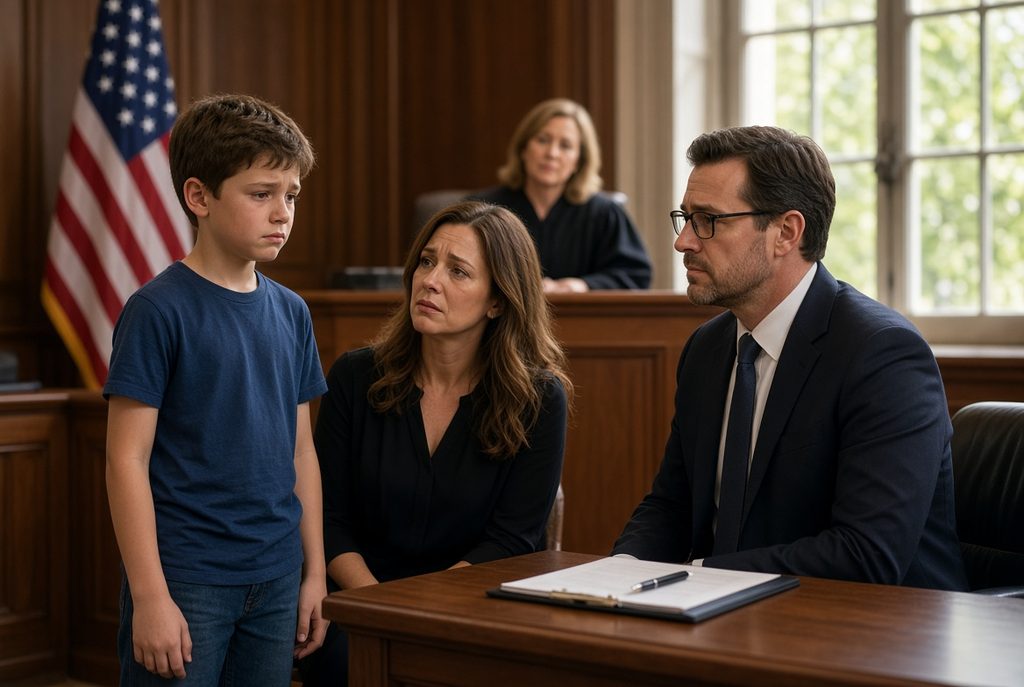
Nolan continued. “She told me not to tell anyone.” The courtroom seemed to stop breathing. Not metaphorically. Not in the exaggerated way people describe moments afterward because they want them to sound important.
It truly felt as though nearly everyone in that room inhaled at the same time and then forgot how to let the air back out. I heard the faint hum of the fluorescent lights above us.
I heard a chair creak somewhere behind me.
I heard the nervous click of a pen in the hand of Grant’s attorney.
And then I felt it.
Every pair of eyes turning toward me.
Judge Whitmore looked over the top of the papers on her bench.
“Mrs. Parker?”
My mouth opened.
Nothing came out.
“I…”
My voice disappeared.
I swallowed and tried again.
“I don’t know what he means.”
That wasn’t completely true.
And my son knew it.
Nolan stood several feet away from me, looking impossibly small beneath the enormous wooden seal mounted behind the judge.
Eight years old.
Eight.
He should have been worrying about spelling tests, soccer practice, cartoons, whether he could stay up half an hour later on Friday nights.
Instead, he was standing in family court holding evidence against his own father.
Evidence I had been too frightened to bring forward myself.
Because three nights earlier, I had discovered something.
Something strange.
Something I had told no one about.
Not my attorney.
Not my sister.
Not the police in its entirety.
Not even myself, if I was being completely truthful.
It had started with a car.
A black SUV.
The first night, I noticed it because its headlights shone through the cheap blinds in our apartment.
Nolan and I lived on the second floor of a narrow brick building on the edge of Knoxville.
It wasn’t the sort of place I had imagined raising my son.
The heater coughed more than it worked.
The hallway smelled like old carpet and somebody’s cigarette smoke.
The kitchen floor had a crack running from the refrigerator almost to the sink.
There was a water stain above Nolan’s bedroom window shaped like Florida.
But it was ours.
At least temporarily.
And after everything Grant had done, temporary safety felt better than permanent luxury.
I had been sitting at the kitchen table that night sorting bills into three piles.
Pay now.
Pay later.
Pray.
The third pile was the biggest.
I remember rubbing my forehead and trying to calculate whether I could delay the electric bill another week when those headlights appeared through the blinds.
They stayed there.
Engine running.
Lights on.
For maybe four minutes.
Then the vehicle drove away.
I barely thought about it.
People parked outside apartment buildings.
That wasn’t a crime.
The second night, it came back.
Same low engine rumble.
Same headlights.
Same position beneath our window.
This time I stood behind the curtain and watched.
The windows were tinted so dark I couldn’t make out the driver.
Five minutes later, it left.
The next afternoon, Nolan came home from school carrying his backpack by one strap.
He dropped it beside the door.
“Mom?”
“Yeah?”
“There’s a black truck that keeps coming to my school.”
I looked up from the laundry I was folding.
“What black truck?”
“The big one.”
He pointed toward the window.
“Like the one that comes here.”
Every muscle in my body tightened.
“How do you know it’s the same one?”
“It has a scratch on the side.”
He dragged a finger through the air.
“Like this.”
I put down the towel in my hands.
“Did anybody inside talk to you?”
“No.”
“Did anybody get out?”
“No.”
“Did you tell your teacher?”
He shook his head.
“I thought maybe it was Dad.”
Grant did not own a black SUV.
That was the moment fear became real.
I called the police.
An officer came.
He asked questions.
Had Grant threatened me recently?
Yes.
Had anyone followed me?
I didn’t know.
Was there a restraining order?
No.
Could I identify the license plate?
No.
Was I certain the vehicle outside Nolan’s school was the same vehicle outside our apartment?
No.
Without a plate number, a photograph, a direct threat, or somebody physically approaching us, there was very little they could do.
The officer was kind.
That almost made it worse.
He told me to keep my doors locked.
To change my routine.
To photograph the SUV if it returned.
To call immediately if anyone approached Nolan.
Then he left.
That night, I pushed the sofa against the front door.
I told Nolan we were making a fort.
He believed me.
Or pretended to.
At 11:17 p.m., the SUV returned.
I reached for my phone.
Before I could photograph it, the headlights went dark.
The vehicle disappeared into shadow.
My hands began trembling.
I stood there for nearly fifteen minutes.
Nothing happened.
Then I heard something slide beneath the apartment door.
Paper scraping against carpet.
I froze.
For several seconds, I couldn’t move.
Then I grabbed the kitchen knife.
Ridiculous.
I knew it was ridiculous.
But fear does not ask whether something is ridiculous.
Fear simply tells your body to survive.
I walked slowly toward the door.
There was a white envelope on the carpet.
No stamp.
No name.
No return address.
Only three words written across the front in thick black marker.
LOOK AT THE PHOTOS.
I should have called the police immediately.
I know that now.
Instead, I opened it.
Inside were photographs.
Dozens.
Grant leaving restaurants.
Grant entering office buildings.
Grant talking to men I had never seen.
Grant standing beside expensive cars.
Grant exchanging envelopes.
Grant shaking hands with a man in a gray coat outside a downtown office.
Several pictures had dates written on the back.
One was taken the same week my employer had received the anonymous complaint accusing me of stealing company property.
Another was taken the day before our landlord announced he would not renew our lease.
Another showed Grant walking out of a bank on the exact morning he had testified during a child-support hearing that his consulting business had experienced “severe financial setbacks.”
Then I reached the final photograph.
And my stomach turned cold.
Grant stood outside the county courthouse.
He wasn’t alone.
Beside him was Carroway.
His attorney.
The photograph had been taken two weeks before our custody hearing.
They were standing near a parking garage.
Carroway had something in his hand.
An envelope.
Grant was reaching for it.
I stared at that photograph until my vision blurred.
I didn’t know what it meant.
Maybe nothing.
Lawyers met their clients.
Documents changed hands.
Photographs without context could make ordinary things appear criminal.
I knew that.
And Grant had spent years teaching me another lesson.
Nobody will believe you.
He had said it so many times that his voice had become part of my own thoughts.
Nobody will believe you.
You’re emotional.
Nobody will believe you.
You’re broke.
Nobody will believe you.
You lost your job.
Nobody will believe you.
Look at yourself.
That night, I put the photographs back into the envelope.
Then I placed the envelope inside an old cardboard box beneath winter blankets in my closet.
I told nobody.
Not even my attorney.
I convinced myself I was being cautious.
But the truth was simpler.
I was terrified.
Because I had only one thing left in the world that Grant had not taken from me.
My son.
Nolan.
And I was afraid that if I challenged Grant without undeniable evidence, he would find a way to take Nolan too.
Now, standing in that courtroom, I realized Nolan had found the envelope.
I looked at him.
“Nolan, where did you get that?”
He swallowed.
“From the box.”
“What box?”
“The one Dad told me never to open.”
Grant moved.
It happened so fast that everyone noticed.
His chair slammed backward.
“That’s enough.”
His voice cracked through the courtroom.
“Nolan, come here.”
My son stepped backward.
“No.”
Grant stared at him.
“Nolan.”
“No!”
The word echoed against the walls.
Judge Whitmore raised her hand immediately.
“Mr. Parker. Sit down.”
Grant remained standing for one second too long.
Then he slowly lowered himself into his chair.
But something had changed.
For two years, Grant had controlled every room he entered.
He knew when to smile.
When to lower his voice.
When to look wounded.
When to appear concerned.
During mediation, he had spoken about me as though I were a troubled woman he desperately wanted to help.
During custody evaluations, he had described himself as “heartbroken” by my instability.
When I cried, he stayed calm.
When I raised my voice, he whispered.
When I accused him, he looked disappointed.
It was performance.
And Grant was very, very good at it.
But now the performance was slipping.
His face had gone pale.
His fingers trembled slightly against the table.
Carroway leaned toward him and whispered something.
Grant shook his head.
Then he looked at me.
Not with anger.
Not with contempt.
Fear.
And that was when I understood.
Whatever Nolan had brought into that courtroom mattered.
A lot.
Judge Whitmore looked at my son.
“Nolan, would you like to give me the envelope?”
He hesitated.
His eyes found mine.
I nodded.
“It’s okay.”
Slowly, Nolan walked forward.
His sneakers squeaked against the polished floor.
One step.
Then another.
When he reached the bench, he stretched upward and placed the plastic envelope in front of the judge.
Judge Whitmore opened it.
She removed the first page.
Then another.
Then another.
The courtroom remained silent.
Her face barely changed.
But I had spent months watching judges, lawyers, mediators, counselors, and social workers study my life.
I had learned to recognize tiny reactions.
The slight tightening of the jaw.
The pause before turning a page.
The second reading of a particular paragraph.
Judge Whitmore reached the fourth document.
She stopped.
Read it again.
Then looked directly at Grant.
“Mr. Parker.”
Grant didn’t answer.
“Would you like to explain this?”
Carroway stood.
“Your Honor, before my client responds, I would point out that these documents have not been authenticated.”
Judge Whitmore did not look away from Grant.
“I asked Mr. Parker.”
Grant cleared his throat.
“I don’t know what those are.”
The judge held up one page.
“Your name appears repeatedly.”
“Anyone could type my name on a piece of paper.”
“There is also a signature.”
“That isn’t mine.”
Carroway stepped forward.
“These materials were apparently obtained by an eight-year-old child under circumstances that remain completely unclear. We have no chain of custody, no authentication, and no indication that any of this is relevant to the custody question before this court.”
Judge Whitmore looked at him.
“Then I assume you have no objection to authentication.”
For the first time all afternoon, Carroway had nothing to say.
The judge removed a photograph.
She stared at it.
Her eyebrows tightened.
She handed it to the clerk.
“Make a copy of this.”
The clerk took the photograph.
He looked down.
His expression changed.
“What is it?” I whispered.
Nolan stood beside me now.
“It’s Dad.”
My heart pounded.
“What was he doing?”
Nolan looked across the courtroom at his father.
“He was taking money.”
Grant shot out of his chair.
“That is a lie!”
The gavel slammed once.
“Mr. Parker!”
Grant froze.
“You will sit down.”
His jaw clenched.
He sat.
His hands were shaking now.
Not slightly.
Visibly.
I looked at Carroway.
This was the same attorney who, less than an hour earlier, had held up Nolan’s faded blue shirt as though it were proof of my moral failure.
He had displayed it before the court.
The fabric was old.
The collar stretched.
There were two stubborn stains near the hem that would not wash out.
A tiny crescent moon had been embroidered over the pocket.
Carroway had lifted it and said, “Mrs. Parker sends her child to school dressed like this.”
I had wanted to disappear.
Because I knew exactly why Nolan still wore that shirt.
It was his favorite.
And because we couldn’t afford another one.
Four months earlier, I had pawned the last valuable thing I owned—my grandmother’s antique locket—to buy him school shoes and a birthday dinner.
Yet Grant’s lawyer had made that shirt seem like evidence that I didn’t care.
Now Carroway stared at the photograph on the clerk’s desk as though that faded blue shirt no longer mattered.
Judge Whitmore continued reading.
Then she stopped.
Her eyes settled on one particular page.
“Mrs. Parker.”
“Yes, Your Honor?”
“Did you know your son was keeping written records concerning his father’s behavior?”
My chest tightened.
“No.”
Nolan lowered his head.
“I started writing things down.”
Judge Whitmore looked at him.
“Why?”
He rubbed his thumb across the edge of his sleeve.
“Because Mom was always scared.”
“Nolan…”
He looked at me.
“You cried in the bathroom.”
I felt the first sting of tears.
“You thought I couldn’t hear you.”
My throat closed.
He continued.
“But I heard you.”
There are certain moments as a mother that never leave you.
The first time your child says your name.
The first fever.
The first day of school.
The first time they fall hard enough that you can see confusion on their face before the pain arrives.
I knew, standing there, that this would be another one.
The day I learned my son had heard every tear I thought I had hidden from him.
He reached into the envelope.
A small notebook appeared in his hands.
The cover was bent.
Blue crayon marks covered the front.
One corner had been chewed by our old dog before Grant and I separated.
“I wrote down everything,” Nolan said.
Grant stared at the notebook.
Then something happened that I would remember for the rest of my life.
He looked at the clock.
Not at Nolan.
Not at me.
Not at the judge.
The clock.
As though he was calculating something.
How long until someone arrived?
How long until something could be destroyed?
How long until he could escape?
Judge Whitmore noticed too.
“So,” she said quietly, “you’ve been keeping notes.”
“Yes, ma’am.”
“Why?”
Nolan swallowed.
“Because Dad said nobody would believe Mom.”
Grant’s face lost all color.
Judge Whitmore leaned backward.
The silence stretched.
Finally, she said, “Mr. Parker, I am ordering a temporary recess.”
Carroway stood instantly.
“Your Honor—”
“Mr. Carroway.”
Her voice turned cold.
“Before you say another word, I strongly suggest you review the material that has just been presented.”
He sat.
Judge Whitmore looked at me.
Then at Nolan.
“I also want this child interviewed privately by the court-appointed evaluator before the hearing resumes. No parent present.”
I nodded.
“Of course.”
Nolan’s hand found mine.
His fingers were cold.
“It’s okay,” I whispered.
But as we turned toward the door, he tugged my sleeve.
“Mom.”
I bent down.
“What?”
“There’s one more thing.”
The fear in his face made my stomach tighten.
“What?”
His eyes moved across the courtroom.
First Grant.
Then Carroway.
Then back to me.
“The last paper isn’t about Dad.”
My heartbeat seemed to stop.
“What is it about?”
His eyes filled with tears.
“You.”
For one terrible second, the room tilted.
Judge Whitmore was gathering her papers.
People were moving toward the doors.
But Nolan reached beneath his shirt.
He pulled out a folded yellowed piece of paper.
Older than everything else.
The edges were brittle.
Across the front were four handwritten words.
YOUR GRANDMOTHER KNEW EVERYTHING.
I stared.
My grandmother.
Evelyn Mercer.
Dead six years.
I had been with her during the last week of her life.
She had been eighty-two.
Tiny.
Stubborn.
Sharp until the end.
The sort of woman who could look at someone for five seconds and tell whether they were lying.
Grant hated her.
He never said so directly.
Instead, he called her “difficult.”
“Suspicious.”
“Old-fashioned.”
She called him charming.
But never when he was in the room.
Once, when I was twenty-seven and Grant and I had been married less than a year, she took my hand and said something I had never forgotten.
“Never trust a person who needs you to believe you are powerless.”
I had laughed.
“Grandma, that sounds like something from a fortune cookie.”
She didn’t smile.
“I mean it.”
Now those words rang through my head.
I stared at the yellow paper.
“Nolan,” I whispered, “where did you find this?”
“Dad’s desk.”
Grant’s chair scraped violently.
“That’s enough.”
The judge looked sharply toward him.
“Mr. Parker.”
“But that document—”
“Sit down.”
“This is absurd.”
“Sit.”
He obeyed.
And as he lowered his arm, his expensive watch slipped slightly down his wrist.
I saw the mark underneath.
A small red crescent-shaped scar.
My breath caught.
I had seen that mark before.
In one of the photographs.
The man in the gray coat.
The photograph had been blurry.
I had assumed the man was a stranger.
But as he handed Grant an envelope, his sleeve had risen.
A red crescent-shaped scar was visible near his wrist.
Except now I realized something.
The man wasn’t receiving the envelope from Grant.
Grant was receiving it from him.
And the watch.
The expensive watch Grant wore every day.
Could the man in the gray coat have been—
No.
The face looked different.
But not completely.
“Your Honor,” I said.
Judge Whitmore looked toward me.
“I think I know something about one of the photographs.”
Carroway’s face tightened.
Grant looked at him.
One glance.
Barely a second.
But it told me more than anything either man had said.
They knew.
Judge Whitmore saw it too.
“Mrs. Parker, explain.”
I stood.
My knees trembled beneath me.
“For two years, my ex-husband has told this court that I destroyed our finances.”
Grant shook his head.
“This is ridiculous.”
“He has told everyone I lost my job because I was irresponsible.”
“Your Honor—”
“He has told counselors that I can’t manage money. He told the school I was unstable. He told our landlord I had financial problems. He told everyone that Nolan would be better off living with him.”
My voice began to shake.
I looked directly at Grant.
“But I didn’t destroy our finances.”
His jaw tightened.
“You did.”
“No.”
I finally said the words I had been afraid to say for two years.
“You did.”
Grant leaned backward.
“You have no evidence.”
I looked at the pile before the judge.
And something inside me changed.
Maybe courage isn’t the absence of fear.
Maybe courage is simply the moment fear becomes less important than truth.
“No evidence?”
I pointed toward the documents.
“Your eight-year-old son just carried the evidence into court.”
Grant stared at me.
For years, that stare had been enough to silence me.
Not anymore.
Judge Whitmore began reviewing the papers again.
“Who gave these documents to Nolan?”
“I don’t know,” I said.
She looked toward my son.
“Nolan?”
He hesitated.
“Someone left them in Dad’s office.”
Grant’s face hardened.
Judge Whitmore turned toward him.
“Mr. Parker?”
“I have no idea what the child is talking about.”
Nolan suddenly spoke.
“Yes, you do.”
Everyone turned.
My son reached into the pocket of his jeans.
He removed something tiny.
Metal.
A key.
“I found this too.”
Grant’s face changed instantly.
“What is that?”
Nolan looked at him.
“You know.”
“Nolan.”
“You said it was for the special drawer.”
Judge Whitmore extended her hand.
Nolan gave her the key.
“Where is this drawer?”
“At Dad’s office.”
Carroway stood again.
“Your Honor, this proceeding has clearly gone far beyond the intended scope of a custody hearing.”
Judge Whitmore looked at him.
“I agree.”
Relief flashed across his face.
Then she continued.
“Which is precisely why I am referring these materials for immediate investigation.”
Grant stood.
“You cannot do that.”
“I can.”
“This is a family court hearing!”
“It was.”
The judge closed the folder.
“Now there appear to be allegations involving financial manipulation, potential fraud, witness intimidation, possible interference with employment, and perhaps more.”
Grant stared at her.
Carroway stared at the table.
And in that instant, Grant finally understood something.
His lawyer could not talk this away.
His expensive suit could not hide it.
His money could not control everyone.
His polished smile was useless.
The courtroom doors opened.
Two investigators entered with a court officer.
Grant’s face went blank.
One investigator approached the counsel table.
“Grant Parker?”
Grant did not answer immediately.
“Yes.”
“We need to speak with you.”
“I’m in the middle of a custody hearing.”
“We’re aware.”
Grant looked at me.
For once, I didn’t lower my eyes.
He had spent two years reducing me.
Piece by piece.
First the bank account.
Then the house.
Then my job.
Then my confidence.
Then my reputation.
He had made me believe poverty was evidence of incompetence.
That exhaustion meant instability.
That crying meant weakness.
That asking for help meant failure.
He had convinced me that every consequence of his actions was somehow proof of my shortcomings.
But now Grant Parker was sitting beneath the same fluorescent courtroom lights he had expected to expose me.
And people were finally looking at him.
Really looking.
One investigator placed a photograph on the table.
It showed Grant entering First Tennessee Bank.
Behind him walked the man from the gray-coat photographs.
The investigator addressed Judge Whitmore.
“We also obtained security footage this morning.”
Grant stopped moving.
“We received information suggesting Mr. Parker may have been transferring assets through several accounts associated with shell entities.”
My legs almost gave out.
The investigator turned another page.
“Some transfers coincide with dates Mrs. Parker reported missing or reduced child-support payments.”
I looked at Grant.
He couldn’t meet my eyes.
“What shell entities?” Carroway asked.
The investigator looked at him.
“That is part of an active investigation.”
Grant whispered something.
Carroway leaned close.
“What?”
“I said call Mercer.”
My blood turned cold.
Mercer.
My grandmother’s last name.
Carroway glanced at me before looking back at Grant.
Too late.
I heard it.
Judge Whitmore heard it too.
“Who is Mercer?”
Grant shook his head.
“No one.”
I stepped forward.
“That was my grandmother’s surname.”
Silence again.
Judge Whitmore looked at Grant.
“Was?”
“She died six years ago,” I said.
The judge’s expression tightened.
“And yet Mr. Parker just instructed his attorney to call someone by that name.”
Carroway raised both hands.
“I cannot speak to what my client meant.”
Grant leaned toward him.
“Stop talking.”
That sentence changed the room.
Because Grant had always been the composed one.
Now panic was eating him alive.
The investigators asked Judge Whitmore for permission to examine the documents.
She granted it.
The hearing was suspended.
Nolan was escorted to a private room with a child advocate.
Before he left, he hugged me.
“Are you mad?”
I knelt.
“At you?”
He nodded.
“Never.”
“I opened Dad’s drawer.”
“You were trying to understand what was happening.”
“I stole the key.”
I touched his cheek.
“You are not responsible for fixing what the adults around you broke.”
His eyes filled.
“I just wanted you to stop being scared.”
That sentence broke the last wall inside me.
I pulled him into my arms.
For almost two years, I had believed I was protecting him by hiding my fear.
Children know.
Maybe not the details.
Maybe not the names of legal motions or bank transfers or financial crimes.
But they know when the person they love wakes up frightened.
They know when groceries are counted before they enter the cart.
They know when Mom says she already ate because there isn’t enough food.
They know when she smiles too quickly.
They know when she cries with the bathroom faucet running.
“I’m sorry,” I whispered against his hair.
“For what?”
“For making you carry things you should never have had to carry.”
He hugged me tighter.
“You didn’t make me.”
I closed my eyes.
That was the first time I cried in front of him without trying to hide it.
Not because I had lost.
Because I finally realized I had survived.
The investigation lasted weeks.
And each week uncovered another piece of the life Grant had manufactured around me.
The money had never simply disappeared.
He had moved it.
First into consulting accounts.
Then through companies registered under names I had never heard.
Then into accounts controlled by acquaintances.
Some payments were marked as “vendor services.”
Others as “business development fees.”
One company listed an address that turned out to be an empty office above a dry cleaner.
Another supposedly employed twelve people.
It had no employees.
No products.
No customers.
Only money moving in and out.
But that was only the beginning.
My job.
For eleven years, I had worked in the accounting department of a regional medical-supply company.
I wasn’t wealthy.
I wasn’t powerful.
But I was good at what I did.
I had never been disciplined.
Never received a negative evaluation.
Then, six months after I filed for divorce, anonymous complaints began arriving.
One accused me of improperly accessing customer information.
Another claimed I had used company resources for personal business.
A third alleged that I had spoken negatively about our director to a vendor.
I denied everything.
My supervisor believed me at first.
Then screenshots appeared.
Emails.
Messages supposedly sent from my work account.
They looked real.
Human resources opened an investigation.
Three weeks later, I was fired.
No criminal charges.
No lawsuit.
Just termination.
Grant had looked almost sympathetic when I told him.
“That’s terrible,” he said.
Then came the sentence I had replayed a thousand times.
“Maybe this is a sign you should let me have Nolan until you get yourself together.”
The investigators eventually traced two of the anonymous complaints to an internet connection associated with one of Grant’s businesses.
Another had been submitted from a laptop purchased by his assistant.
The screenshots?
Manipulated.
The emails?
Fabricated.
My job had not been lost because I was careless.
Grant had engineered it.
Then there was our apartment.
Before the one in Knoxville, Nolan and I rented a small townhouse in Maryville.
Nothing fancy.
But there was a yard.
A tree Nolan loved climbing.
A kitchen with enough room for a table.
I thought we were finally becoming stable.
Then, eleven months into the lease, the landlord suddenly announced that he would not renew.
No explanation.
Three days later, Grant petitioned the court for primary custody, arguing that my “unstable housing situation” demonstrated that Nolan needed a more secure environment.
The landlord, investigators discovered, had attended college with Grant.
Two months before refusing to renew my lease, he received a $14,000 payment from one of Grant’s companies for “consulting services.”
He was not a consultant.
He owned rental properties.
Piece by piece, the truth emerged.
Grant had not merely watched me struggle.
He had created the struggle.
Then documented my reaction to it.
Every time I fell, he photographed the bruise and called it evidence that I could not walk.
I thought that discovery would make me furious.
It did.
But underneath the anger was grief.
Because humiliation feels different when you realize it was designed.
I remembered standing in the grocery store returning cereal because my card declined.
I remembered counting quarters at a gas station.
I remembered Nolan asking why we couldn’t order pizza anymore.
I remembered pawning Grandma Evelyn’s locket.
I remembered sitting in my car outside the pawnshop afterward with my forehead against the steering wheel.
That locket had been the last physical thing I owned that belonged to my grandmother.
Gold.
Oval.
A tiny vine engraved around the edge.
Inside had once been a photograph of my mother as a little girl.
Grandma gave it to me the week before Grant and I married.
“Keep it,” she said.
“For what?”
“For when you need to remember yourself.”
I laughed.
“Grandma, it’s jewelry.”
“No.”
She closed my fingers around it.
“It’s mine. Someday it’ll be yours. There’s a difference.”
I pawned it for $475.
I used eighty-seven dollars for Nolan’s school shoes.
Twenty-four dollars for the blue birthday shirt.
Sixty dollars for groceries.
The rest went toward rent.
I had hated myself for selling it.
Grant later mentioned it during mediation.
“She even sold family heirlooms.”
As though desperation were a character flaw.
As though he had not manufactured the desperation.
Now I needed the locket back.
Not for sentiment.
Because of the message.
YOUR GRANDMOTHER KNEW EVERYTHING.
The pawnshop sat between a laundromat and a closed beauty salon.
I had passed it twice before gathering the courage to enter.
A bell rang when I opened the door.
The owner looked up from behind the counter.
His name was Mr. Harlan.
I remembered him.
He had been kinder than necessary the first time.
He had looked at the locket for nearly a minute before asking, “You sure?”
I lied and said yes.
Now he studied me.
“You came back.”
“You remember me?”
He nodded.
“The locket.”
My chest tightened.
“Is it gone?”
He didn’t answer immediately.
Instead, he turned toward a cabinet behind him.
He unlocked it.
Removed a small velvet box.
Then placed it on the counter.
“I’ve been holding this.”
I stared at him.
“Why?”
He shrugged.
“Your grandmother came in here years ago.”
I froze.
“What?”
“Evelyn Mercer.”
“You knew my grandmother?”
“Everybody knew Evelyn.”
A faint smile touched his face.
“She could argue twenty minutes over fifty cents.”
That sounded like her.
My eyes burned.
“She brought this locket here?”
“Not to sell.”
“When?”
“Years ago.”
He opened the box.
There it was.
Exactly as I remembered.
The fine scratches.
The tiny dent near the hinge.
The engraved vines.
I reached for it.
My fingers shook.
“She asked me a strange question,” Mr. Harlan said.
“What question?”
“She asked whether I knew how to keep something safe without knowing what it was.”
I stared at him.
“What did you say?”
“I told her I’d been married thirty-eight years.”
Despite everything, I laughed.
He smiled.
“Then she handed me the locket and asked me to repair the hinge.”
I turned it over.
A tiny seam ran along the back.
I had never noticed it.
“What did you repair?”
“Not the hinge.”
He pointed.
“That.”
I pressed the seam.
Nothing happened.
“Harder.”
I pressed again.
Click.
The back opened.
There was a second compartment inside.
My breath caught.
A tiny folded piece of paper rested there.
I removed it.
The handwriting was unmistakable.
Grandma Evelyn’s.
If Grant ever tries to take Nolan from you, show them what is inside the blue moon.
My knees weakened.
Mr. Harlan pulled a chair from behind the counter.
“You okay?”
I sat.
“The blue moon.”
Nolan’s shirt.
The faded blue shirt.
The same shirt Carroway had held up in court.
The same shirt he had used to humiliate me.
The same shirt Nolan wore the day everything changed.
I stood so quickly the chair scraped backward.
“I need to go.”
“Take the locket.”
“I can’t afford—”
“It was paid for yesterday.”
I stopped.
“By who?”
He shrugged.
“Cash.”
“Who?”
“A woman.”
“What woman?”
“Didn’t give a name.”
“What did she look like?”
“Gray coat.”
My skin prickled.
The photographs.
The man—or person—in the gray coat.
“Did she say anything?”
Mr. Harlan thought.
“She said Evelyn would want you to have it.”
I drove home with my heart hammering.
The blue shirt was in a laundry basket beside Nolan’s bed.
I pulled it out.
For several seconds I simply stared at it.
A cheap cotton shirt.
Faded.
Stained.
The tiny embroidered moon sat above the chest pocket.
Blue thread around blue fabric.
Almost invisible.
I ran my thumb beneath the moon.
There.
A second layer.
A hidden pocket.
So small I had never noticed.
I pulled at the seam.
Something hard rested inside.
A memory card.
I sat on the floor.
The room seemed suddenly too small.
Nolan appeared in the doorway.
“Mom?”
I looked up.
“Did you know this was here?”
His eyes moved to the shirt.
“The card?”
My stomach dropped.
“You knew?”
He nodded.
“Grandma Evelyn showed me.”
“That’s impossible.”
He looked confused.
“What?”
“She died when you were two.”
“I know.”
“Then how—”
He pointed toward the laptop on my desk.
“In the video.”
My entire body went cold.
“What video?”
“The one Dad showed me.”
I stood.
“When?”
“A long time ago.”
“Nolan, tell me exactly what happened.”
He hesitated.
“Dad took me to his office after school. He was looking for something in the blue shirt.”
“Why did you have the shirt?”
“It was in my backpack.”
My mind raced.
“Then what?”
“He found the little pocket. But it was empty.”
I looked at the memory card in my hand.
“Because you had taken it?”
Nolan nodded.
“Grandma said to hide it.”
“You saw Grandma?”
“On the computer.”
I sat beside him.
He continued.
“Dad put a card into his computer. Grandma was talking. She said if I ever saw the video, I should remember the blue moon.”
My heart pounded.
“Did Grant know you saw it?”
“No. I was behind the door.”
I inserted the memory card into my laptop.
A single file appeared.
EV_MERCER_FINAL.
My hands hovered over the keyboard.
Then I clicked.
The screen went black.
For three seconds, nothing happened.
Then my grandmother appeared.
She sat in the old floral chair from her living room.
Her silver hair was pulled into a loose bun.
She wore the green cardigan I had buried her in.
Seeing her again felt like someone reached through six years and touched my heart.
She looked directly into the camera.
“If you’re watching this, then something has happened that I hoped would never happen.”
I covered my mouth.
Nolan climbed beside me.
Grandma continued.
“I have discovered information concerning Grant Parker and members of his family.”
My breath caught.
“I tried speaking to Claire.”
Me.
“But she loves him.”
A sad smile appeared.
“And people in love often defend the person hurting them before they defend themselves.”
Tears blurred the screen.
“I believe Grant’s family has used legitimate businesses to conceal financial misconduct for many years.”
She lifted several papers.
“I have copied records.”
Bank documents.
Company names.
Transaction numbers.
“I do not know the full scale of it. I am not an investigator. I am simply an old woman who spent thirty-four years keeping books for businesses and who knows when numbers are lying.”
That was Grandma.
She had been a bookkeeper.
Meticulous.
Stubborn.
Impossible to fool with money.
She continued.
“Grant knows that I have been asking questions.”
I looked at Nolan.
His hand found mine.
“If anything happens to me, do not assume it was because of this. I am old, and I am ill. But if Grant ever attempts to use money, housing, employment, or reputation to separate Claire from her child, then the pattern has repeated.”
My skin prickled.
Repeated?
Grandma looked away from the camera.
When she looked back, her expression was different.
“He did not invent this method.”
I leaned closer.
“Grant’s father used it against Grant’s mother.”
My breath stopped.
“They destroyed her financially before taking custody of her children.”
The room went silent except for Grandma’s recorded voice.
“They made her appear unstable. They interfered with her employment. They controlled her accounts. They convinced people she was incapable.”
Tears rolled down my cheeks.
History.
Grant hadn’t improvised my destruction.
He had inherited a blueprint.
Grandma continued.
“Grant once told me something he believed was clever.”
She paused.
“He said courts believe paperwork more than tears.”
I closed my eyes.
I had heard him say that.
After our first mediation.
I had been crying in the parking lot.
Grant had leaned against my car and said, “You can cry all you want, Claire. Courts believe paperwork more than tears.”
Grandma looked directly into the camera.
“If you’re hearing this, he has probably already tried to convince you that you are the problem.”
My lips began trembling.
“Don’t believe him.”
The video ended.
I sat frozen.
Six years.
For six years, Grandma’s warning had waited inside a shirt I nearly threw away dozens of times.
Except something still didn’t make sense.
The shirt was only two years old.
Grandma had been dead six.
How had the memory card ended up inside it?
Then I understood.
Grant.
He had hidden it there.
Or someone had.
Maybe after finding Grandma’s files.
Maybe intending to retrieve it later.
Maybe believing a child’s shirt was the safest hiding place in a house full of adults searching desks and safes.
Nolan looked at me.
“Mom?”
“Yes?”
“Are we okay now?”
I looked at my son.
The boy who had memorized my crying.
The boy who had watched his father lie.
The boy who had hidden papers because adults failed to protect him from adult problems.
I pulled him against me.
“We’re going to be.”
“Really?”
I kissed his hair.
“Really.”
The recording changed everything.
My attorney immediately turned the memory card over to investigators.
The financial documents shown in Grandma’s video led them to companies they had not yet discovered.
One belonged to Grant’s father.
Another had been dissolved years earlier.
Another remained active through a nominee owner.
And then they found something none of us expected.
The mysterious person sending me photographs was named Marissa Cole.
Grant’s former executive assistant.
She had worked for him for seven years.
She was the woman in the gray coat.
The photograph had made her look like a man because of the distance and angle.
Marissa eventually agreed to meet investigators.
Then she asked to speak to me.
We met in a quiet conference room.
She was forty-eight.
Short brown hair.
Tired eyes.
She twisted a paper coffee cup between her hands.
“I’m sorry,” she said.
I sat across from her.
“For what?”
“For waiting.”
I didn’t answer.
“I knew pieces,” she continued. “Not everything.”
“How long?”
Her eyes dropped.
“Almost two years.”
Anger rose in me.
“You watched him destroy my life for two years?”
“I watched him move money.”
“You sent the complaints?”
“No.”
“You knew about them?”
“Not at first.”
“What about my landlord?”
“I processed the payment.”
The room became blurry.
“You processed the payment.”
“I thought it was legitimate consulting work.”
“But later?”
“I figured it out.”
“And you said nothing.”
Her eyes filled.
“I was scared.”
A bitter laugh escaped me.
“So was I.”
“I know.”
“No. You don’t.”
She flinched.
And for a moment, I hated her.
Not as much as Grant.
But enough.
Then she reached into her bag.
She placed a folder on the table.
“Your grandmother came to me six years ago.”
Everything inside me went still.
“What?”
“She knew I worked for Grant.”
“How?”
“She followed him.”
That sounded like Grandma Evelyn too.
“She asked me whether I knew what kind of man I worked for.”
“What did you tell her?”
“That she was crazy.”
Marissa looked ashamed.
“Then three months later, I found the first fake invoice.”
I said nothing.
“I kept watching.”
“Why didn’t you go to police?”
“Because the invoices weren’t enough. Grant was careful.”
“So you helped him.”
“Yes.”
The honesty surprised me.
“I told myself I was only doing my job. Then I told myself someone else would stop him. Then I told myself you probably knew.”
Her voice broke.
“And eventually I realized those were all excuses.”
She pushed the folder toward me.
Inside were copies of emails.
Payments.
Instructions.
One email from Grant made my stomach turn.
Subject: C.P. EMPLOYMENT.
Make sure complaint #2 lands after performance review. Better if termination looks procedural rather than retaliatory.
Another:
If landlord refuses renewal before October petition, housing instability becomes useful.
Useful.
My suffering had been useful.
Another:
She’s emotional under pressure. Keep pressure consistent.
I closed the folder.
“I can’t read any more.”
Marissa nodded.
“I understand.”
“No, you don’t.”
“I probably don’t.”
For once, nobody tried telling me how I should feel.
That helped more than an apology.
Before leaving, Marissa said, “Your grandmother scared him.”
I looked up.
“Grant?”
“Yes.”
“He always acted like he thought she was ridiculous.”
“That was the act.”
“Why was he scared?”
“Because Evelyn kept copies.”
I almost smiled through the tears.
Of course she did.
Three months after the custody hearing, Grant was indicted on multiple financial charges.
The criminal case would take much longer.
Lawyers warned me not to expect quick justice.
Justice, they explained, moves through paperwork.
Slowly.
Painfully.
Sometimes unfairly.
But family court moved sooner.
Grant’s petition for primary custody was dismissed.
His visitation was restricted and supervised pending further findings.
The court ordered an independent review of financial disclosures he had submitted during the divorce.
Several were false.
Child-support calculations were reopened.
Assets were frozen.
And one Tuesday morning, my attorney called.
“They found another account.”
I stood in our apartment kitchen.
“How much?”
She told me.
I sat down.
It was more money than I had earned in four years.
Money Grant had claimed did not exist.
Money he had hidden while telling a judge he could barely afford support payments.
Money he had moved while I counted quarters.
I didn’t feel victorious.
That surprised me.
I expected some movie moment.
Music.
Relief.
Triumph.
Instead, I looked at the cracked kitchen floor.
At the refrigerator covered in Nolan’s drawings.
At the stack of overdue notices.
And I cried for the woman I had been.
The woman who stood at checkout counters removing groceries one item at a time.
The woman who pawned her grandmother’s locket.
The woman who apologized to her son because she couldn’t afford field-trip money.
The woman who believed every humiliation meant she had failed.
I wanted to go backward in time.
I wanted to find her.
I wanted to put my hands around her face and say:
Look at me.
You are not failing.
Someone is pushing you down and calling the fall proof that you cannot stand.
But time does not work that way.
So I did the next best thing.
I stopped apologizing for surviving.
Six months later, I returned to the courthouse.
Not for custody.
Not because Grant had filed something.
Not because I had been summoned.
I went because there was a hearing concerning restitution and financial disclosures.
I wore a navy dress I bought secondhand.
Nolan wore new shoes.
Not expensive.
New.
That mattered.
Grant entered with two attorneys.
He looked older.
His hair had more gray.
No expensive watch.
His face had changed.
For years, I thought power lived in the suit.
The house.
The car.
The lawyer.
The bank account.
Now he wore another beautiful suit.
And looked powerless.
He saw me.
Our eyes met.
He walked over.
One of his attorneys tried to stop him.
“Grant.”
He ignored him.
“Claire.”
I said nothing.
“We need to talk.”
“No.”
“It’s about Nolan.”
“Then speak through the lawyers.”
His jaw tightened.
“You’re enjoying this.”
I almost laughed.
“Enjoying what?”
“Destroying me.”
The words were so familiar that for a second I felt twenty-nine again.
Standing in our old kitchen.
Grant explaining why something he had done was actually my fault.
But the spell was gone.
“I didn’t destroy you.”
“You gave them everything.”
“You created everything.”
“You could have protected Nolan from this.”
My voice stayed calm.
“I am protecting Nolan from this.”
His eyes hardened.
“He’s my son.”
“Yes.”
“You poisoned him against me.”
“No.”
“He stole from me.”
“He was eight.”
“He went through private files.”
“He was eight.”
“He lied.”
“He was eight.”
Grant leaned closer.
“He ruined my life.”
And there it was.
The sentence that told me he had learned nothing.
I looked at him.
“Nolan did not ruin your life.”
“He brought those documents—”
“You did the things written on them.”
His mouth closed.
“That is the difference you still refuse to understand.”
One attorney approached.
“Mr. Parker, we need to go.”
Grant didn’t move.
I stepped closer.
Not because I wanted to intimidate him.
Because for once, I wanted him to hear me without being able to reshape the words.
“You spent years teaching me that consequences belong to the person who discovers the lie instead of the person who tells it.”
His face tightened.
“That worked for a long time.”
I looked toward the courtroom doors.
“But not anymore.”
I walked away.
My legs trembled afterward.
Healing doesn’t mean fear disappears.
Sometimes healing is simply refusing to obey it.
The hardest part came later.
Not the court hearings.
Not the money.
Not even rebuilding my career.
The hardest part was helping Nolan become a child again.
For months, he watched every adult conversation.
If my phone rang, he listened.
If I opened mail, he studied my face.
If somebody knocked on the door, he froze.
He kept his notebook beneath his pillow.
One night I found him writing.
“What are you doing?”
He covered the page.
“Nothing.”
I sat beside him.
“You don’t have to keep records anymore.”
“What if something happens?”
“Then the adults handle it.”
“What if they don’t believe us?”
The question shattered me.
I took the notebook gently.
“They will.”
“How do you know?”
“Because we have people helping us.”
“What if Dad comes back?”
“We handle that too.”
“What if he lies?”
“Then he lies.”
“But—”
“Nolan.”
He looked at me.
“You are allowed to be eight.”
His face crumpled.
“I don’t know how.”
I pulled him into my arms.
Neither did I.
So we learned together.
We bought a soccer ball.
He joined a Saturday league.
The first game, he spent more time watching clouds than watching the ball.
I had never been happier.
We got library cards.
We made pancakes for dinner.
We adopted a ridiculous orange cat Nolan named Detective because he said Detective always looked suspicious.
The cat hated everyone except Nolan.
At night, I began leaving my bedroom door open.
Not because I was afraid.
Because Nolan liked knowing I was there.
Slowly, the notebook disappeared from beneath his pillow.
Then one afternoon, I found it in a drawer beneath comic books.
That was how I knew we were healing.
Not because he threw the notebook away.
Because it was no longer the most important thing he owned.
I got my job back.
Not the same position.
The company offered reinstatement after investigators confirmed the allegations against me were fabricated.
But I didn’t return.
For a long time, I felt guilty about that.
The salary would have helped.
The benefits were good.
But every time I imagined walking through those doors again, I remembered being escorted out carrying a cardboard box while coworkers pretended not to stare.
So I started somewhere else.
Smaller company.
Less money at first.
But the owner knew what happened.
On my first day, she shook my hand.
“We hired you because you’re good at your job.”
I nearly cried in the parking lot.
That simple sentence felt like someone handing me back a piece of myself.
Over time, the money recovered from Grant stabilized our lives.
I paid debts.
Moved us into a little two-bedroom house.
Nothing luxurious.
A porch.
A maple tree.
A kitchen with yellow cabinets.
Nolan chose the bedroom facing the backyard.
The first night, we ate pizza sitting on moving boxes.
He looked around.
“Is this ours?”
“It’s rented.”
His face fell slightly.
I smiled.
“But we can stay.”
“How long?”
“As long as we want.”
He grinned.
That sentence meant more to us than any mansion ever could.
A year after the courtroom hearing, I washed the blue shirt one final time.
It was too small for Nolan now.
The sleeves ended above his wrists.
The fabric had thinned.
The stains remained.
I stood in the laundry room holding it.
For years, clothing had embarrassed me.
Not because clothes matter.
Because poverty makes ordinary things feel like public confessions.
A worn shoe tells people you cannot replace it.
A stretched collar tells people money is tight.
A stain tells them laundry detergent came after rent.
Grant understood that.
So did Carroway.
That was why they used the shirt.
They wanted the judge to see failure.
I carried it upstairs.
I found a wooden memory box in my closet.
Inside were Nolan’s first hospital bracelet.
A baby tooth.
His kindergarten photograph.
A handmade Mother’s Day card with the words I LOVE MOM written backward.
I folded the blue shirt.
Before placing it inside, I ran my thumb over the embroidered moon.
Such a tiny thing.
Half hidden.
Easy to overlook.
Like evidence.
Like courage.
Like a child listening from behind a door.
Nolan appeared.
“You’re keeping that?”
“Yes.”
“Why?”
I smiled.
“Because it matters.”
“It’s ugly.”
I laughed.
“You loved this shirt.”
“I was little.”
“You’re nine.”
“That was a long time ago.”
Apparently twelve months constituted ancient history.
He sat beside me.
“Is the card still inside?”
“No. Investigators have it.”
“Are we getting it back?”
“Eventually.”
He looked at the moon.
“Grandma Evelyn was smart.”
“Yes.”
“Smarter than Dad?”
I thought carefully.
“Smart is complicated.”
“What does that mean?”
“Your dad is intelligent.”
Nolan frowned.
“Then why did he do stupid things?”
I looked at my son.
Because someday, he would be old enough to understand his father more completely.
I never wanted hatred to be his inheritance.
“Because intelligence doesn’t make someone good.”
He thought about that.
“Was Grandma good?”
“She tried to be.”
“Are you good?”
“I try.”
“Am I good?”
I kissed his forehead.
“You’re learning.”
He seemed satisfied.
Then he pointed at the shirt.
“Can we put a note in the box?”
“What kind?”
He grabbed a marker.
On a small card, he wrote carefully:
THIS SHIRT SAVED MOM.
I felt tears rise.
I turned the card over.
And underneath his sentence, I wrote:
NO.
THE TRUTH DID.
Then I added:
AND A BRAVE LITTLE BOY CARRIED IT.
Nolan read it.
He smiled.
“Can Detective be brave too?”
The orange cat was asleep on a pile of clean towels.
“No.”
“Why?”
“He’s scared of the vacuum.”
Nolan laughed.
The sound filled the house.
And for a moment, that laughter was the only evidence I needed that we had survived.
Grant eventually pleaded guilty to several financial offenses.
Other charges remained disputed.
I didn’t attend sentencing.
People seemed surprised by that.
“Don’t you want closure?”
For years, I thought closure was something another person gave you.
An apology.
A confession.
A verdict.
A punishment.
It isn’t.
Closure is deciding that the worst thing someone did to you does not get to become the most important thing about you.
I knew where Grant was.
I knew what sentence he received.
I knew restitution had been ordered.
That was enough.
Nolan eventually asked whether he could write his father.
I said yes.
His therapist helped.
Nolan spent three days writing the letter.
He did not show me.
I did not ask.
That was his relationship.
His pain.
His choice.
When he handed me the sealed envelope, I drove him to the post office.
He dropped it into the mailbox.
On the drive home, he was quiet.
Then he said, “I told Dad I’m mad.”
“That makes sense.”
“I told him I still love him.”
“That makes sense too.”
He looked at me.
“You’re not mad?”
“No.”
“Why?”
“Because loving someone doesn’t mean pretending they didn’t hurt you.”
He stared out the window.
After a moment, he said, “Grandma Evelyn would say something weird right now.”
I laughed.
“She absolutely would.”
“What would she say?”
I thought.
Then I remembered.
“Maybe she’d say, ‘A locked door can protect you without becoming your whole house.’”
Nolan looked confused.
“That is weird.”
“I warned you.”
Years later, when Nolan was old enough to understand the full story, I gave him the blue shirt.
Not because I wanted him carrying the past.
Because I wanted him to understand what happened without believing he had been responsible for saving me.
We sat at the kitchen table in the house I eventually bought.
By then, Nolan was sixteen.
Tall.
His father’s dark hair.
My eyes.
The orange cat Detective was very old and still hated the vacuum.
I placed the memory box between us.
Nolan opened it.
He lifted the shirt.
His hands looked enormous against the tiny fabric.
“I really wore this?”
“All the time.”
“This thing is awful.”
“You refused to take it off.”
“Why?”
“You said the moon made you faster.”
He laughed.
Then his expression softened.
“I remember court.”
“I know.”
“Not everything.”
“That’s probably good.”
“I remember Dad yelling.”
I said nothing.
“I remember you crying.”
“I remember that too.”
“Were you scared?”
“Yes.”
He stared at the moon.
“Were you scared of Dad?”
“Yes.”
That admission once would have humiliated me.
Now it was simply true.
“Did you hate him?”
I thought.
“At times.”
“Do you now?”
“No.”
“Why?”
“Because hate is expensive.”
He looked at me.
“Grandma Evelyn again?”
“No. That one’s mine.”
He smiled.
I reached across the table.
“Nolan, there is something I need you to know.”
“What?”
“You did not save me.”
His eyebrows pulled together.
“But I gave the judge the papers.”
“Yes.”
“And the notebook.”
“Yes.”
“And the key.”
“Yes.”
“So—”
“You helped expose the truth.”
He looked down.
“But I was the adult.”
He started to argue.
I continued.
“You were a child caught in something adults should have handled long before it reached you. I am proud of your courage. I always will be. But I never want you believing my survival depended on an eight-year-old boy.”
He became quiet.
“So what saved you?”
I looked around the kitchen.
At the mortgage statement on the counter.
At the photographs on the refrigerator.
At my grandmother’s locket hanging around my neck.
At the boy—almost a man—sitting across from me.
“Lots of things.”
“Like what?”
“Evidence.”
He smiled.
“Grandma.”
“Definitely Grandma.”
“Marissa?”
“Eventually.”
“The judge?”
“Yes.”
“Your lawyer?”
“Yes.”
“Me?”
I squeezed his hand.
“Absolutely you.”
He smiled.
“And you?”
I looked at him.
“Yes.”
“Mostly you?”
I laughed softly.
“It took me a long time to learn how to say that.”
“Say what?”
“That I saved myself too.”
Sometimes people ask me how I didn’t see Grant clearly when we were married.
There is judgment hidden inside that question.
Even when people do not mean it.
How did you not know?
Why did you stay?
Why didn’t you fight sooner?
Why didn’t you keep better records?
Why did you believe him?
The answer is complicated.
Grant did not become cruel on our wedding night.
He did not wake one morning and announce that he planned to dismantle my life.
Control arrived in teaspoons.
A comment about spending.
A suggestion that he handle the bills.
A joke about my memory.
A criticism disguised as concern.
A friend he didn’t like.
A job he thought took too much time.
A decision made without me because it was “easier.”
Then came consequences.
Then explanations.
Then blame.
By the time I understood the architecture of the cage, I had been living inside it for years.
That does not mean I was stupid.
It means cages built slowly can look like homes until somebody tries to leave.
Grandma Evelyn understood before I did.
Maybe because she had lived long enough to know the difference between love and possession.
Maybe because numbers told her the truth people refused to.
Maybe because she recognized something in Grant that I could not see while standing too close.
I used to wish I had listened to her.
Now I try not to punish my younger self for information she did not have.
She loved someone.
She trusted her husband.
Those things should not require an apology.
On the fifth anniversary of the courtroom hearing, Nolan and I visited Grandma Evelyn’s grave.
It was early winter.
A thin layer of snow covered the cemetery.
Nolan carried flowers.
I carried the locket.
We stood beside the stone.
EVELYN MERCER.
BELOVED MOTHER.
GRANDMOTHER.
1928–2020.
Nolan brushed snow away from the letters.
“I barely remember her.”
“She remembered you.”
“How do you know?”
“Because she planned for you.”
He stood.
“Do you think she knew everything?”
I smiled.
“No.”
“But the note said she did.”
“Grandma sometimes exaggerated.”
He laughed.
Then I looked at the stone.
“She knew enough.”
The wind moved through the trees.
For a moment, I remembered her house.
Coffee simmering too long.
Peppermints in a glass dish.
Knitting needles beside her chair.
The television permanently too loud.
And her voice.
Never trust a person who needs you to believe you are powerless.
I had misunderstood that sentence for years.
I thought she meant I should distrust powerful people.
She didn’t.
She meant I should distrust anyone whose power depended on making me forget my own.
I touched the locket.
“Thank you,” I whispered.
Nolan heard.
“For the card?”
“For everything.”
He put an arm around my shoulder.
He was taller than me now.
“When I have kids, I’m going to tell them about her.”
“What will you tell them?”
“That she hid secret evidence in jewelry.”
I laughed.
“Of course.”
“And that Mom had an ugly blue shirt.”
“It was your shirt.”
“Details.”
I pushed his shoulder.
He grinned.
We walked back toward the car.
Halfway there, snow began falling more heavily.
Soft flakes.
Quiet.
The same kind of snow that had covered Knoxville on the morning Nolan walked into court wearing the faded blue shirt.
For years, I couldn’t see snow without remembering that day.
Grant’s expression.
Carroway holding the shirt.
Nolan’s shaking hands.
Judge Whitmore opening the envelope.
My own terror.
Now the memory had changed.
I still remembered the fear.
But fear was no longer the ending.
That was the difference.
There is one photograph from that period I keep on my desk.
Not a photograph of Grant.
Not the courthouse.
Not the evidence.
It was taken about six months afterward.
Nolan and I are sitting on the floor of our little rental house.
Moving boxes surround us.
There is pizza on paper plates.
Detective is trying to climb into one of the boxes.
My hair is a mess.
Nolan’s front tooth is missing.
Neither of us looks polished.
Neither of us looks wealthy.
The curtains do not match.
The furniture is borrowed.
If Grant’s old attorney had displayed that photograph in court, perhaps he would have pointed out every imperfection.
Cheap pizza.
Used furniture.
Small house.
Tired mother.
But when I look at it, I see something else.
Safety.
That is the strange thing about surviving humiliation.
Eventually, the things someone used to shame you stop carrying the meaning they assigned to them.
The apartment wasn’t proof I was unstable.
It was proof I found shelter.
The pawn ticket wasn’t proof I was irresponsible.
It was proof I sacrificed something precious to feed my child.
The tears weren’t proof I was weak.
They were proof I was still human after being pushed past what I thought I could survive.
And the blue shirt?
That shirt became the clearest lesson of all.
Grant wanted the court to see poverty.
Carroway wanted the judge to see neglect.
They wanted everyone in that room to look at faded fabric and permanent stains and conclude that the woman responsible for washing it must be a failure.
Instead, hidden beneath a tiny embroidered moon was the truth.
The same shirt they raised to shame me carried the evidence that exposed them.
Life rarely gives you symbolism that perfect.
But sometimes it does.
I still have that shirt.
The fabric is more fragile now.
The blue has faded almost gray.
The stains never disappeared.
I stopped wishing they would.
They belong there.
Because I no longer need every scar erased before I can call something beautiful.
Some things become beautiful because they survived being damaged.
I learned that about shirts.
I learned it about families.
Eventually, I learned it about myself.
Grant bankrupted me.
He interfered with my work.
He manipulated people around me.
He tried to make my instability visible while keeping the hand causing it invisible.
And for a while, he succeeded.
I believed I was losing everything.
Money.
Marriage.
Home.
Career.
Dignity.
Security.
Then one cold morning, my eight-year-old son walked into a courtroom wearing a stained blue shirt.
His father’s attorney lifted that shirt like an accusation.
My son lifted the truth hidden behind it.
And suddenly the entire story changed.
Not because some miracle rescued me.
Not because a wealthy stranger appeared.
Not because revenge made everything right.
The truth was slower than that.
Messier.
It required documents.
Witnesses.
Investigations.
Therapy.
Court hearings.
Apologies.
Boundaries.
Time.
There were no trumpets when my life began to return.
There were ordinary moments.
A grocery cart I could finally fill without counting every dollar.
A new pair of shoes for Nolan.
A landlord saying, “The lease is yours.”
A supervisor saying, “We hired you because you’re good at your job.”
A child leaving his fear notebook beneath comic books.
A pizza dinner in a small safe house.
A ridiculous orange cat asleep beside a boy who finally felt safe enough to laugh.
Those were my victories.
Quiet ones.
Real ones.
Years after everything happened, I opened the memory box again.
Grandma Evelyn’s note was inside.
So was Nolan’s card.
THIS SHIRT SAVED MOM.
And beneath it, my handwriting:
NO.
THE TRUTH DID.
AND A BRAVE LITTLE BOY CARRIED IT.
I read the words and smiled.
Then I added one final sentence.
So that someday, if Nolan’s children opened the box, they would understand the whole lesson.
I wrote:
BUT FIRST, SHE HAD TO BELIEVE SHE WAS WORTH SAVING.
I closed the box.
Outside my window, snow was beginning to fall.
For a moment, I could almost hear Grandma Evelyn laughing at me.
Too dramatic, Claire.
She would have said that.
Then she probably would have asked whether I had balanced my checking account.
I touched the locket around my neck.
The metal had warmed against my skin.
Across the room, Nolan called from the kitchen.
“Mom! Detective knocked something over!”
I smiled.
“Was it expensive?”
A pause.
“…Define expensive.”
I laughed and walked toward him.
Toward the ordinary noise of our ordinary life.
Toward everything Grant once convinced me I would never have again.
And before leaving the room, I glanced once more at the wooden box.
At the faded blue shirt inside.
At the tiny moon sewn over its hidden pocket.
That moon had once seemed like nothing more than decoration.
Now it reminded me of something I wished every frightened woman could know.
Power does not always announce itself.
Sometimes it looks like money.
Sometimes it looks like a courtroom.
Sometimes it looks like an expensive attorney holding up your worst day for strangers to examine.
But courage can be quiet too.
Sometimes courage is an old woman leaving behind a warning.
Sometimes it is an employee finally deciding silence costs too much.
Sometimes it is a judge noticing the person who keeps looking at the clock.
Sometimes it is a mother returning to the pawnshop for the one thing she thought she had lost forever.
And sometimes courage is an eight-year-old boy in a faded blue shirt stepping away from the father who frightens him and saying one word.
No.
One word.
That was where everything changed.
Grant had spent years convincing me that I was powerless.
But power built on someone else’s silence survives only as long as the silence does.
Nolan broke his.
Marissa broke hers.
Grandma had broken hers years before any of us understood.
And finally—
so did I.
Grant wanted everyone to see a broken mother.
He wanted them to see unpaid bills.
A lost job.
A cheap apartment.
A stained shirt.
He wanted those things to become the entire story of who I was.
But he made one mistake.
He believed hardship and weakness were the same thing.
They aren’t.
He believed being poor meant being powerless.
It doesn’t.
He believed tears meant defeat.
They don’t.
And he believed that if he controlled the story long enough, truth would eventually stop mattering.
It didn’t.
Because truth has a strange way of surviving.
In notebooks.
In photographs.
In bank records.
In old women’s memories.
In hidden compartments.
In the hearts of children who hear more than adults realize.
And sometimes—
in the smallest pocket beneath a blue embroidered moon.
The shirt Grant used to shame me became the thing that helped expose him.
The son he believed he could manipulate became the person brave enough to speak.
The grandmother he dismissed as paranoid had left a trail he couldn’t erase.
And the woman he spent years convincing she was nothing eventually stood in the same courtroom, looked directly at him, and refused to look away.
I used to think winning meant watching Grant lose.
I know better now.
Winning was Nolan sleeping through the night.
Winning was paying bills without fear.
Winning was laughing again.
Winning was not checking the parking lot every time a black SUV drove past.
Winning was hearing my son talk about soccer instead of court.
Winning was putting Grandma’s locket around my neck without remembering the day I pawned it.
Winning was building a life Grant had no power to define.
Most of all, winning was waking one morning and realizing I had gone an entire day without thinking about him.
Then two.
Then a week.
Eventually, Grant became exactly what he should have been all along.
A chapter.
Not the whole story.
Nolan grew.
I healed.
The snow melted.
Life continued.
And the blue shirt stayed folded inside its wooden box.
The stains never disappeared.
I hope they never do.
Because sometimes the thing people use to shame you becomes the very thing that saves you.
And sometimes the marks that refuse to wash away are not proof that something is ruined.
Sometimes they are proof—
that it survived.
THE END! THANK YOU FOR READING!❤️