 Reading Time: 31 minutes
When I opened my eyes in the hospital, the first thing I heard was my twin sister whispering my name. “Faye…” Her voice was so weak that, for one horrible second, I thought I had imagined it.
The ceiling above me was painfully white. Machines beeped somewhere beside my bed. My mouth tasted like metal, and every breath sent a dull ache through my ribs.
I tried to turn my head.
Pain exploded behind my eyes.
I gasped.
Then I saw her.
Chloe.
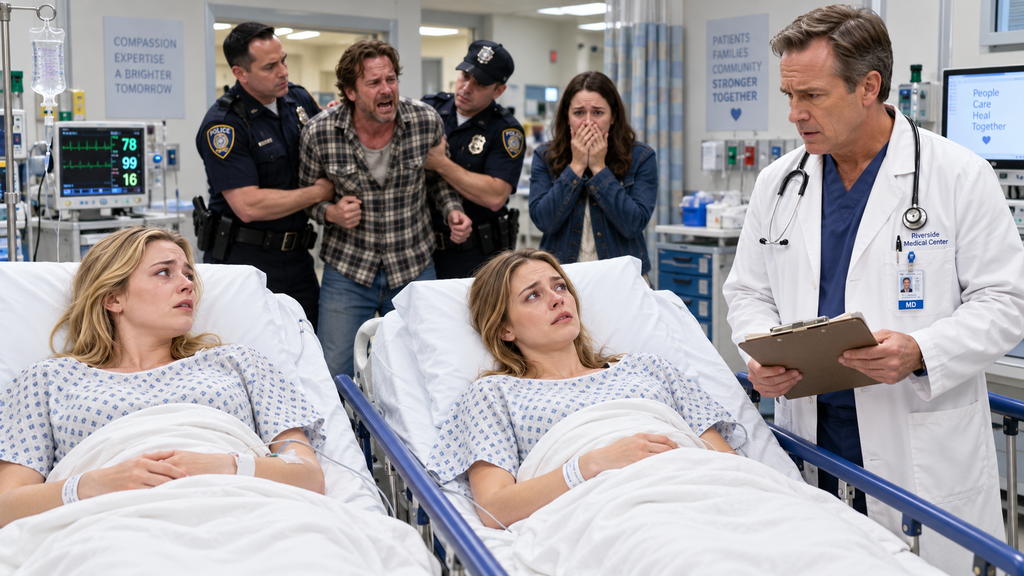
My twin sister was lying in the hospital bed across from mine.
Her face was bruised.
One side of her lip was swollen.
A bandage wrapped around her forehead.
But her eyes were open.
She was alive.
For a moment, nothing else mattered.
Not the pain.
Not the hospital.
Not the police.
Not my mother.
Not even Edric.
Chloe was alive.
“Faye,” she whispered again.
“I’m here.”
Her lower lip trembled.
I wanted to get out of bed.
I wanted to crawl across the room and hold her.
Instead, I could barely lift my hand.
Then I heard a soft laugh near the door.
My entire body went cold.
Edric.
My stepfather stood against the wall with his arms folded over his chest.
He looked irritated.
Not scared.
Not ashamed.
Irritated.
As if the two of us lying bruised in hospital beds were an inconvenience he had been forced to deal with.
Beside him stood my mother.
Brenda.
Her eyes were red.
Her hands trembled around the strap of her handbag.
She refused to look directly at either of us.
Edric smiled.
It was the same smile he used at home whenever he wanted us to understand that nobody was going to believe us.
“You girls are confused,” he said calmly.
“You’ve been through a traumatic accident.”
Dr. Marcus Cooper, the emergency physician standing between our beds, turned slowly toward him.
“No.”
One word.
Quiet.
Certain.
Edric’s smile disappeared.
The security guard in the hallway stepped closer.
Another hospital employee stood behind him, already speaking urgently into a telephone.
“Police are on the way.”
For the first time that night, I saw something change in Edric’s face.
His eyes moved toward the exit.
Then toward the security guard.
Then toward my mother.
Then back toward Chloe and me.
He was calculating.
Distance.
Time.
Witnesses.
Possibilities.
I knew that look.
I had seen it hundreds of times.
Edric never panicked.
He planned.
That was what made him terrifying.
But there was something different now.
Something tiny behind his eyes.
Fear.
Chloe noticed it too.
Her fingers slowly curled around the blanket.
“Faye,” she whispered.
“What?”
“The phone.”
My heart nearly stopped.
I stared at her.
She barely moved her lips.
“The phone.”
Edric’s head snapped toward us.
“What phone?”
Neither of us answered.
Dr. Cooper looked between us.
“Girls, I need you to tell me exactly what happened tonight.”
My mother suddenly stepped forward.
“They’re confused,” she said quickly. “They hit their heads. They don’t know what they’re saying.”
Dr. Cooper turned toward her.
“Mrs. Morgan, please step away from the beds.”
My mother froze.
Then she did something she had done throughout nearly our entire childhood.
She looked at Edric.
Just for a second.
But I saw it.
So did Chloe.
And judging by the doctor’s expression, so did he.
My mother always looked at Edric before answering difficult questions.
As though she needed to know which version of the truth she had permission to tell.
Edric’s jaw tightened.
My mother suddenly began to cry.
Not loudly.
Not dramatically.
Just enough.
“I didn’t know what else to do,” she whispered.
Something inside me cracked.
Not because of my injuries.
Not because I was frightened.
Because after all those years, I finally understood.
I had spent so much time wondering whether my mother truly believed Edric.
Whether maybe he had manipulated her.
Whether maybe she genuinely thought Chloe and I were exaggerating.
But standing there in that hospital room, watching her look to him for instructions, I finally saw the truth.
She knew.
Maybe she had not known every detail.
Maybe she had refused to admit the worst parts to herself.
Maybe she had spent years giving herself excuses so she could sleep at night.
But she knew enough.
She had always known enough.
“You told them we fell down the stairs,” I said.
Mom covered her mouth.
“I was scared.”
“So were we.”
Her eyes finally met mine.
“I was trying to protect you.”
Chloe let out a tiny laugh.
A broken sound.
“You were trying to protect him.”
Mom flinched.
Edric took one step forward.
“That’s enough.”
The security guard immediately moved in front of him.
“Sir. Stay where you are.”
Edric’s jaw tightened.
Then two police officers entered the room.
There were no dramatic shouts.
No weapons.
No handcuffs immediately clicking around anyone’s wrists.
Just two officers walking in and quietly looking at the people inside the room.
One was a woman with short dark hair.
Her gaze moved to me.
Then Chloe.
Then the bruises.
Then the doctor.
Her expression hardened.
“Who is responsible for these injuries?”
Nobody answered.
My throat closed.
For years, I had imagined what it would feel like if someone finally asked.
I imagined screaming Edric’s name.
I imagined pointing at him.
I imagined telling everything.
The locked doors.
The threats.
The shouting.
The nights Chloe and I sat awake together because neither of us wanted to sleep first.
But now that the moment had arrived, I couldn’t make a sound.
Chloe could.
“He did.”
Her hand rose from the blanket.
Slowly.
Her finger pointed toward Edric.
He stared at her.
And smiled.
Not kindly.
Not warmly.
It was a warning.
The same warning he had given us countless times without speaking.
You’ll regret this.
Chloe’s hand began shaking.
I reached toward her.
The beds were too far apart, but she stretched too.
Our fingertips touched.
Then our fingers locked.
She squeezed.
I squeezed back.
The female officer looked at Edric.
“Sir, you’re going to need to come with us.”
He laughed once.
“You’re making a mistake.”
“That’s what the evidence will determine.”
“I brought them here.”
“Yes,” she replied. “You did.”
There was something in her voice that made him stop arguing.
She turned to the doctor.
“Doctor?”
Dr. Cooper handed her a folder.
“These injuries are inconsistent with a single accidental fall down a staircase.”
The officer opened the folder.
Her eyes moved over the pages.
She looked back up.
“Are the injuries consistent with repeated physical assault?”
Dr. Cooper glanced toward Chloe and me.
Then back at the officer.
“Yes.”
Edric shook his head.
“This is ridiculous.”
The officer met his eyes.
“Then I’m sure you’ll have no trouble explaining yourself.”
He said nothing.
For the first time in my life, I watched another adult make Edric uncomfortable.
It felt almost unreal.
Then the officer turned toward me.
“Faye, is there anything else you want us to know?”
My mouth went dry.
The phone.
The recordings.
The cloud account.
The hidden floorboard.
Dad’s trust.
Uncle Alan.
Everything rushed through my mind.
I looked at Chloe.
She knew exactly what I was thinking.
She gave me the smallest nod.
I swallowed.
“Yes.”
The officer waited.
“There are recordings.”
Edric’s face changed completely.
The confidence vanished.
“What recordings?”
I looked directly at him.
And for the first time in years, I didn’t look away.
“Yours.”
Silence.
His breathing changed.
“You’re lying.”
“No.”
“You don’t have anything.”
“I do.”
He stepped forward.
The security guard blocked him immediately.
Edric’s eyes remained fixed on me.
“Where?”
Something almost like strength moved through me.
“That’s what you’re afraid of, isn’t it?”
His face lost color.
The officer noticed.
“Where are these recordings, Faye?”
“In my bedroom.”
Edric shook his head rapidly.
“No. She doesn’t have anything.”
I stared at him.
“You just said I was lying.”
“I said you were confused.”
“You asked where they were.”
He went silent.
Chloe looked at me.
For the first time in years, I saw something in her eyes I hadn’t seen for a long time.
Pride.
Not because I had beaten him.
Not because he was scared.
Because I had finally stood up to him.
The officer turned toward her partner.
“Secure the house.”
Edric’s voice rose.
“You cannot search my home without a warrant.”
The officer’s voice remained calm.
“We can secure a potential crime scene while seeking one.”
Edric looked toward my mother.
“Brenda.”
She didn’t answer.
“Brenda!”
My mother began crying harder.
He stared at her as though she had betrayed him.
Maybe she had.
Maybe people like Edric eventually considered everyone a traitor when they stopped obeying.
The officers began escorting him toward the hallway.
When he passed my bed, he slowed.
The security guard moved between us.
Edric leaned just enough for his voice to reach me.
“You have no idea what you’ve started.”
A chill moved through my body.
Because I knew him.
And I knew that wasn’t an empty threat.
It was a promise.
Then he disappeared through the doorway.
The door closed.
For several seconds, I couldn’t breathe.
Chloe turned toward me.
“Faye.”
I looked at her.
“We did it.”
I shook my head.
“Not yet.”
Her smile vanished.
“What do you mean?”
I looked toward the door.
“He was scared of the recordings.”
“So?”
“So he wasn’t scared of being arrested.”
Chloe went still.
“He was scared of what was on them.”
Neither of us said anything.
Because suddenly I realized something terrifying.
Those recordings might contain more than proof of what Edric had done to us.
They might contain the reason he had spent nearly two years making sure we were afraid to speak.
And if that was true, our nightmare had only just begun.
We had not always been afraid of home.
That was important.
Sometimes I worried my memories were becoming divided into two separate lives.
Before Edric.
After Edric.
Before him, Chloe and I were simply twins.
Annoying each other.
Borrowing each other’s clothes.
Fighting over the bathroom mirror.
Laughing until Dad yelled from downstairs that he could hear us through the floor.
Our father, David Morgan, had been the center of our world.
Dad was the kind of man who made pancakes at midnight because one of us mentioned being hungry.
He attended every school performance, even when work kept him awake until two in the morning.
He remembered the names of our teachers.
He knew Chloe hated tomatoes.
He knew I pretended not to be afraid of thunderstorms.
He also knew we were different even though almost everyone else treated us like matching copies.
“Chloe thinks before she jumps,” he once told me.
“And you?”
“I jump and think on the way down.”
I had laughed.
“That sounds bad.”
Dad smiled.
“It means you’re brave.”
Chloe rolled her eyes.
“It means she’s reckless.”
“That too.”
Those memories hurt after he died.
Dad had been driving home from a business meeting when his car left the road during a storm.
The police called it an accident.
Mom stopped speaking for nearly a week.
Chloe cried every night.
I didn’t cry at all until the funeral.
Then I saw Dad’s watch around Uncle Alan’s wrist.
Dad had given it to him years earlier.
Something about seeing it shattered whatever wall I had built inside myself.
I collapsed.
Our mother seemed to disappear after Dad died.
Not physically.
She still lived with us.
She still made dinner.
She still drove us to school.
But the mother we knew became quieter.
Weaker.
More distant.
Then Edric entered our lives.
At first, he seemed kind.
That was the part people never understood later.
Men like Edric did not walk into your life announcing what they were.
He brought Mom flowers.
He fixed the leaking faucet.
He helped us carry groceries.
He listened when Mom talked about Dad.
He told Chloe she had talent when she showed him one of her drawings.
He helped me study for a math test.
We did not trust him immediately.
But slowly, carefully, he made himself useful.
Then necessary.
Then permanent.
Within eleven months, he married our mother.
The first major rule came two weeks after the wedding.
“No phones after ten.”
It sounded reasonable.
Then it became nine.
Then eight.
Then he began checking them.
“Family accountability,” he called it.
Next came passwords.
Then restrictions.
Then questions.
Who were we talking to?
Why?
How long?
Why had I deleted a text?
Why had Chloe liked a photograph posted by a boy from school?
Why did I need to speak to Uncle Alan so often?
Then Mom started repeating his language.
“He’s trying to keep you safe.”
“He cares about this family.”
“You girls need structure.”
By the time we realized what was happening, every piece of privacy had disappeared.
The shouting started later.
The first time Edric grabbed my arm hard enough to leave bruises, I was sixteen.
I had told him I wanted to go to a friend’s birthday party.
He said no.
I asked why.
That was my mistake.
He pulled me into the hallway.
His fingers tightened.
“Because I said so.”
I looked down at his hand.
“You’re hurting me.”
He squeezed harder.
“You think this hurts?”
Then Mom walked into the room.
I expected her to scream.
Instead, she froze.
Edric released me immediately.
I showed her the red marks.
She stared at them.
Then she whispered,
“Faye, why do you always have to push him?”
That was the day something inside me began dying.
Not all at once.
Slowly.
Chloe noticed.
She stopped asking Mom for help after that.
So did I.
We began protecting each other instead.
When Edric shouted at Chloe, I stayed close.
When he focused on me, Chloe distracted him.
When one of us cried, the other sat beside her until morning.
We learned to communicate without speaking.
A glance toward the hallway meant he was coming.
Two taps against the wall meant Are you okay?
Three taps meant Stay in your room.
Sometimes survival creates its own language.
The old phone had belonged to Dad.
I found it months after Edric moved in.
It was buried inside a box of old electronics in the garage.
The screen was cracked.
The battery barely lasted thirty minutes.
But it still worked when plugged in.
More importantly, it still connected to Dad’s cloud account.
Dad had once shown me how automatic uploads worked.
I remembered the password because it had been based on a ridiculous family joke.
I charged the phone.
Then Chloe and I began recording.
At first, we only wanted proof.
Proof that Edric screamed.
Proof that he threatened us.
Proof that we were not imagining things.
Proof that if something happened, somebody might eventually believe us.
We hid the phone beneath a loose floorboard near the heating vent.
At night, when Edric thought we were asleep, his voice sometimes traveled through the ductwork.
The phone caught pieces of conversations.
Arguments with Mom.
Phone calls.
Names we did not recognize.
Numbers.
Money.
Something about accounts.
Something about Dad.
We never understood most of it.
Until the hospital.
The police went to our house before dawn.
Chloe and I remained at the hospital.
Doctors treated injuries we had learned to ignore.
A social worker spoke with us separately.
Then together.
Hospital staff photographed bruises.
Every bruise felt like a sentence in a story we had been forced to hide.
I answered questions until my voice became numb.
Had Edric hurt us before?
Yes.
How often?
I didn’t know.
Had our mother seen it?
Sometimes.
Had she intervened?
Sometimes verbally.
Never enough.
Had Edric ever threatened us if we told anyone?
Yes.
What had he said?
That nobody would believe us.
That our mother would choose him.
That Uncle Alan was dangerous.
That we would be separated.
That Chloe would blame me.
That I would blame Chloe.
That everything bad that happened afterward would be our fault.
Fear does strange things to time.
By five in the morning, it felt as though I had been awake for a week.
Then a detective entered.
Her name was Lena Shaw.
She looked like someone who missed very little.
She pulled a chair beside my bed instead of standing over me.
That small choice mattered.
“I want to ask you about the recordings.”
I nodded.
“They’re automatically uploaded.”
“To where?”
“A private cloud account.”
“Whose account?”
“My father’s.”
She paused.
“Your biological father?”
“Yes.”
“David Morgan?”
I blinked.
“Yes.”
She wrote something down.
“Does anyone else know how to access the account?”
“Uncle Alan.”
“Alan Morgan?”
“Yes.”
“Your father’s brother?”
I nodded.
“Where is he?”
“I don’t know.”
“When did you last speak with him?”
I looked toward Chloe.
She was awake and listening from across the room.
“Months ago.”
Detective Shaw looked up.
“Months?”
“Mom stopped letting us talk to him.”
“Why?”
“She said he was trying to turn us against her.”
Chloe spoke quietly.
“That wasn’t true.”
Detective Shaw turned to her.
“How do you know?”
“Because Uncle Alan always told us he didn’t care whether Mom liked him. He just wanted us to know we could call if we ever needed help.”
“Did you?”
“No.”
“Why not?”
I answered.
“Edric took our phones.”
Shaw wrote that down.
Then she asked something unexpected.
“Did your father leave you money?”
My stomach tightened.
“How do you know about that?”
She didn’t answer immediately.
Instead, she closed the notebook.
“Because someone has already asked about it.”
I stared at her.
“Who?”
“We’re still determining that.”
Chloe pushed herself slightly higher against the pillows.
“What does our money have to do with any of this?”
Detective Shaw looked at both of us carefully.
“That’s what concerns me.”
She leaned forward.
“Your father created a trust before his death.”
“Yes.”
“You gain access when you turn eighteen?”
“Tomorrow,” Chloe whispered.
Shaw nodded.
September seventh.
Our eighteenth birthday.
The date had lived in my imagination for months.
I had thought turning eighteen would mean freedom.
Maybe college.
Maybe a cheap apartment.
Maybe two mattresses on the floor and instant noodles for dinner.
Anything would have been better than Edric’s house.
I had imagined Chloe and me staying awake until midnight and laughing because he could no longer tell us when to sleep.
I had never imagined our eighteenth birthday beginning in a hospital.
Detective Shaw continued.
“According to preliminary financial records, the trust contains substantially more than your mother has led people to believe.”
My heartbeat changed.
“How much?”
She hesitated.
“Enough to give someone a very strong motive for keeping control of you.”
Chloe looked at me.
And suddenly I remembered something.
Months earlier.
Dinner.
Edric had been drinking.
Chloe had asked whether we could apply to universities outside the state.
Edric had laughed.
“You girls aren’t going anywhere.”
I argued.
“When we’re eighteen, you can’t stop us.”
His face had changed.
Then he looked at Chloe and said,
“You girls have no idea what your father left behind.”
At the time, I assumed he meant money.
Now I wasn’t sure.
Detective Shaw watched my face.
“You remembered something.”
“Yes.”
“What?”
I told her.
She listened.
Then she stood.
“I need to make a call.”
She reached the door before turning.
“Faye?”
“Yes?”
“Do not log into your father’s account yourself.”
“Why?”
“Because right now we don’t know who else may be watching it.”
The door closed behind her.
Chloe stared at me.
“What does that mean?”
“I don’t know.”
“Yes, you do.”
I looked at her.
She whispered one word.
“Dad.”
Our father had been dead for almost two years.
Yet suddenly it felt as though he had reached through time and left something waiting for us.
Something he never trusted anyone to give us before we were old enough to protect ourselves.
At 6:17 a.m., Detective Shaw returned.
She wasn’t alone.
A man stood behind her.
Tall.
Gray beginning at his temples.
Dark jacket.
Exhausted face.
For one second, I couldn’t recognize him because he looked older than the last time I had seen him.
Then his eyes met mine.
His face crumpled.
“Girls.”
Chloe made a sound halfway between a sob and a gasp.
“Uncle Alan?”
He crossed the room.
For a second I thought he would hug us.
Then he stopped.
His eyes moved over our injuries.
His hands curled into fists.
“I should have come sooner.”
Chloe’s eyes filled with tears.
“So should Mom.”
Alan closed his eyes.
“I know.”
I looked at Detective Shaw.
“Mom told us he was overseas.”
“He was,” Shaw said. “He returned last night.”
Alan looked at me.
“Your father warned me something like this could happen.”
I stared at him.
“What?”
He reached inside his jacket and removed an envelope.
It was old.
Yellowed along the edges.
Two names were written across the front in handwriting I recognized immediately.
Faye and Chloe.
Underneath, one sentence.
For my girls — when you’re eighteen.
My hands began shaking.
“Where did you get that?”
“Your father gave it to me three days before he died.”
Chloe stared at him.
“Why didn’t you give it to us?”
“Because he made me promise not to.”
“Why?”
Alan looked toward the closed door.
Then back at us.
“Because David believed someone close to you might be watching.”
My stomach twisted.
He placed the envelope on the small table beside my bed.
“Your father didn’t trust your mother.”
It felt like being struck.
“What?”
“He loved her,” Alan said quietly. “But toward the end, he didn’t trust her judgment.”
I stared at the envelope.
“What’s inside?”
Alan’s expression darkened.
“The reason your father believed you could become targets after his death.”
Detective Shaw stepped closer.
“Mr. Morgan, they need to know.”
Alan hesitated.
Then he nodded.
“David discovered something inside the company.”
“What?”
“I don’t know exactly what he knew when he wrote the letter.”
“You’re lying.”
“No, Faye.”
“You just said—”
“I said he discovered something. David gave pieces of information to different people because he was terrified that one person knowing everything would make that person a target.”
That sounded like Dad.
Careful.
Methodical.
Protective.
“What was he afraid of?”
Alan looked at the envelope.
“Not losing money.”
His voice dropped.
“He was afraid of who would come looking for it.”
A knock sounded from the hallway.
Everyone turned.
A nurse appeared.
“Detective?”
“Yes?”
“There was a man downstairs asking about the Morgan girls.”
Detective Shaw’s posture changed immediately.
“Did you get his name?”
“No. He said he was family.”
Alan stood.
“What did he look like?”
The nurse hesitated.
“Dark hair. Maybe mid-forties. Scar near his left eyebrow.”
Alan went completely still.
I had never seen my uncle look frightened.
Not once.
“Alan?”
He didn’t answer.
Chloe whispered,
“Who is he?”
Alan stared toward the hallway.
Then he said,
“Someone who should have been dead.”
The words changed the room.
Detective Shaw stepped between our beds and the door.
“Explain.”
Alan’s eyes remained fixed on the hallway.
“There was a man named Victor Hale.”
“Who was he?” I asked.
“Your father’s business partner.”
I felt my stomach tighten.
“Dad had a partner?”
“For several years. Victor handled outside investment accounts. David handled compliance and client protection.”
“What happened?”
Alan pulled the chair closer.
“Your father discovered Victor had been stealing.”
Detective Shaw looked sharply at him.
“How?”
“Fake companies. Fabricated consulting contracts. Money diverted through shell corporations. David found irregularities and began collecting documents.”
“What did he do with them?”
“He reported Victor.”
“And Victor?”
Alan swallowed.
“Disappeared before investigators could question him.”
Chloe frowned.
“You said he should be dead.”
“Several months after Victor disappeared, authorities were informed that he had been killed abroad.”
“Were they sure?”
“No body was publicly identified.”
Detective Shaw’s eyes narrowed.
“So David believed he was alive.”
“I think David suspected it.”
“What does any of that have to do with us?” I asked.
Alan looked at the envelope.
“Because David didn’t only report Victor.”
He paused.
“He kept copies of everything.”
I thought of the recordings.
“The phone?”
“No.”
Alan shook his head.
“Much bigger than that.”
He opened the envelope.
Inside was a small metallic key.
Not a house key.
Something stranger.
Beside it was a folded handwritten letter.
Alan gave it to me.
My hands shook as I opened it.
The handwriting was Dad’s.
My girls,
If you’re reading this, you’ve made it to eighteen.
I’m sorry I couldn’t be there to see it.
My vision blurred immediately.
Chloe moved as close to me as the hospital equipment allowed.
I continued reading.
There are things I could not explain while I was alive because explaining them might have put you in danger.
But never mistake secrecy for lack of love.
Everything I did was meant to give you a chance at a life without fear.
I wiped my eyes.
The trust I created for you is not simply money.
It also protects copies of records connected to financial crimes I discovered through my work.
Contracts.
Account records.
Correspondence.
Names.
Evidence.
I placed those materials somewhere they could not be altered without authorization.
The key enclosed with this letter is part of the access process.
Then I reached the next line.
My breathing stopped.
And if Edric Kaine is still in your lives when you read this, be careful.
Chloe covered her mouth.
I stared at the words.
Dad knew Edric.
Dad had known his name before he died.
Alan looked down.
I forced myself to continue.
Edric contacted Victor Hale shortly before I discovered the extent of the fraud.
I was unable to establish how deep their relationship went.
I do know Edric asked questions about Brenda.
About you.
About the trust.
I warned your mother.
She believed I was overreacting.
If something happens to me, do not trust anyone who suddenly shows unusual interest in what I left behind.
Trust each other.
Trust Alan only so long as he gives you the freedom to question him.
And remember that no inheritance is worth your safety.
At the bottom, the last words were written more heavily.
I love you beyond anything I can put on paper.
Dad.
The letter fell into my lap.
Chloe started crying.
Not quietly.
Not the careful crying we had learned at home.
She sobbed.
I reached for her.
Our hands found each other again.
And for the first time since our father died, we allowed ourselves to grieve without fear that someone would hear.
Dad had known.
Not everything.
But enough.
He had tried to protect us even after he was gone.
Detective Shaw looked toward Alan.
“Where does the key lead?”
Alan shook his head.
“I know only part of the process.”
“Who knows the rest?”
“David’s attorney.”
“Name?”
“Evelyn Price.”
Shaw wrote it down.
“Where is she?”
“Chicago.”
The detective’s phone rang.
She answered immediately.
Her expression changed as she listened.
“Understood.”
She hung up.
“What?” I asked.
“The officers at your house found the phone.”
Chloe exhaled.
“And?”
“It was still recording.”
My stomach dropped.
“What do you mean?”
“They believe Edric may have entered the bedroom sometime before bringing you to the hospital.”
I stared at her.
“Did he find it?”
“No.”
She paused.
“But it recorded him searching for something.”
A chill went through me.
“He knew.”
“Apparently he suspected.”
Chloe whispered,
“What else did it record?”
Detective Shaw looked at Alan.
Then at us.
“A telephone conversation.”
My pulse accelerated.
“With who?”
“We’re still working on that.”
“Victor?”
She did not answer.
And somehow, the silence frightened me more.
By noon, the hospital had placed additional security near our floor.
Police moved Chloe and me to a private room.
Uncle Alan remained nearby.
Mom was not allowed to visit.
Edric had been taken in for questioning.
For the first time in years, I knew exactly where he was.
And yet I still felt like he could walk through the door at any moment.
That was one of the first things I learned about fear.
Removing the person does not immediately remove the fear.
The body remembers longer than the mind wants to.
At one point, a tray clattered in the hallway.
I nearly threw myself out of bed.
Chloe saw me.
“It’s okay.”
“I know.”
“No, you don’t.”
I looked at her.
She gave me a sad little smile.
“Neither do I.”
I reached for her hand.
Hours later, Detective Shaw returned.
This time her face told me she had found something.
“We identified the voice on the call.”
Chloe sat up.
“Victor?”
Shaw nodded.
A strange pressure filled my chest.
“So he’s alive.”
“Yes.”
“Was he the man downstairs?”
“We believe so.”
Alan swore under his breath.
Shaw continued.
“The recording suggests Edric expected him.”
“What did they say?”
She opened a notebook.
“I can’t play the entire recording yet because it’s evidence, but there are parts you should understand.”
She looked directly at me.
“Edric told Victor that the accident had not gone according to plan.”
My blood went cold.
“The accident?”
Chloe’s face emptied of color.
Shaw nodded.
“He also said the two of you would be eighteen within twenty-four hours.”
My fingertips went numb.
Then I remembered the staircase.
Edric shouting.
Chloe trying to get past him.
Mom crying.
My shoulder hitting the wall.
The darkness afterward.
The story he told doctors.
The fall.
The so-called accident.
It had not been uncontrolled rage.
Not entirely.
There had been a purpose.
“What were they planning?” I whispered.
“We’re still establishing the details.”
Alan’s voice hardened.
“Say what you know.”
Shaw looked at us carefully.
“They appear to have believed that if you were incapacitated, your mother could make emergency decisions regarding the trust.”
“That doesn’t make sense,” I said.
“She couldn’t access it,” Alan replied.
“Not directly.”
Shaw nodded.
“But according to recovered messages, they were trying to create circumstances in which Brenda could petition for temporary control based on medical incapacity.”
Chloe stared at the wall.
“They hurt us for money.”
Nobody answered.
I felt anger rise inside me.
Not hot anger.
Not explosive.
Something colder.
For years, I had wondered why Edric hated us.
Why every independent thought made him furious.
Why he became worse as our eighteenth birthday approached.
It hadn’t only been hatred.
It was control.
We were assets to him.
Numbers.
Signatures.
Obstacles.
And my mother had allowed him close enough to nearly destroy us.
“What happens now?” I asked.
Detective Shaw closed the notebook.
“Now we make sure you stay safe.”
“And Victor?”
“We find him.”
He disappeared again before police reached the hospital lobby.
Security footage showed him leaving through a side exit.
But this time he had made a mistake.
He had been seen.
His face existed.
His car appeared on traffic cameras.
And Edric had been recorded speaking to him.
The wall around them was beginning to crack.
Our eighteenth birthday began at midnight in a hospital room.
No candles.
No music.
No friends.
Just two cups of terrible pudding a nurse found in the staff refrigerator.
She put tiny birthday candles in them.
Hospital policy probably did not allow that.
Nobody said anything.
“Make a wish,” Chloe told me.
I looked at her.
“What are you wishing for?”
“If I tell you, it won’t happen.”
I almost laughed.
“Since when are you superstitious?”
“Since today.”
We closed our eyes.
I didn’t wish for money.
I didn’t wish for Edric to suffer.
I didn’t even wish for Victor to be caught.
I wished for something simple.
Please let this be the last birthday we are afraid.
We blew out the candles.
Uncle Alan stood near the window.
His eyes were wet.
“Happy birthday, girls.”
Chloe looked at him.
“Did Dad know you’d be here?”
Alan smiled sadly.
“He hoped.”
Then he handed us two small wrapped packages.
“I bought these almost a year ago.”
Inside mine was a simple silver bracelet.
Chloe received an identical one.
Each had a tiny engraved word inside.
Mine said:
Breathe.
Chloe’s said:
Stay.
I looked at Alan.
“What do they mean?”
“Your father used to say Chloe reminded people to stay, and you reminded them to breathe.”
Chloe laughed through tears.
“That makes absolutely no sense.”
“I told him that.”
For one brief moment, the room felt normal.
Almost like family again.
Then Detective Shaw came in.
“We found Victor.”
Everything stopped.
“Where?”
“A motel outside the city.”
“Is he arrested?”
“They’re moving in now.”
I gripped Chloe’s hand.
Minutes passed.
Then twenty.
Then forty.
Nobody spoke much.
Finally Shaw’s phone rang.
She answered.
Listened.
Then looked at us.
“They have him.”
Chloe closed her eyes.
I felt air leave my lungs.
For the first time since waking in the hospital, something inside me loosened.
Not completely.
But enough.
Victor Hale was alive.
And now he was in custody.
The investigation lasted months.
At first, I hated that.
I wanted everything resolved immediately.
I wanted one courtroom.
One confession.
One sentence.
One moment that would transform our nightmare into the past.
Life did not work that way.
Evidence had to be processed.
Accounts traced.
Documents verified.
Witnesses questioned.
Attorneys appeared.
Charges changed.
Hearings were scheduled.
Then delayed.
The truth came in pieces.
Some pieces hurt more than others.
The recordings from our hidden phone became some of the strongest evidence.
They contained months of Edric’s voice.
Threats.
Arguments.
Conversations with our mother.
Telephone calls with Victor.
Once, Edric could be heard saying,
“The girls will sign what they’re given if Brenda tells them it’s routine.”
Victor replied,
“And if they don’t?”
Edric laughed.
“They will.”
Another recording captured Mom whispering,
“You promised nobody would get hurt.”
Edric answered,
“Then stop making me repeat myself.”
When Detective Shaw played that section for us, Chloe covered her ears.
I couldn’t.
I needed to hear it.
Needed to know.
Needed to remove every excuse I had ever created for my mother.
She knew enough.
She knew enough to be scared.
Enough to ask questions.
Enough to recognize danger.
And still she stayed.
Police also recovered messages from Edric’s laptop.
He had spent years gathering information about Dad’s trust.
He tracked our birthdays.
Contacted financial advisers.
Researched guardianship law.
Asked how control of a trust might change if beneficiaries became medically incapacitated.
He had not lost control on the night we went to the hospital.
He had been trying to create the circumstances he needed.
The financial investigation uncovered something even darker.
Victor had used Edric as an intermediary years earlier.
Dad had discovered irregular transactions connected to several businesses.
One of those businesses had ties to Edric.
Dad had confronted Mom before his death.
Mom denied that Edric was involved.
At the time, they were not married.
But they knew each other.
That fact destroyed one of the last pieces of the story we had believed.
Mom always told us she met Edric months after Dad died.
That was a lie.
She had known him before.
According to messages, they had been communicating privately.
Whether Dad knew the full extent remained unclear.
But he knew enough to distrust Edric.
Enough to name him in the letter.
Enough to place evidence beyond anyone’s immediate control.
The key inside Dad’s envelope unlocked a security device required to open an encrypted archive.
Inside were financial ledgers.
Contracts.
Email copies.
Recorded meetings.
A detailed timeline of suspicious transactions.
And one final video from Dad.
We watched it in Detective Shaw’s office.
Dad appeared on the screen wearing the blue shirt Chloe used to tease him about.
He looked tired.
Older than I remembered.
But alive.
So painfully alive.
He stared into the camera.
“If you are seeing this, then something has gone wrong.”
Chloe started crying before he finished the first sentence.
Dad continued.
“I hope I was overly cautious. I hope none of this was necessary. I hope Faye is rolling her eyes because her father has once again turned something simple into a complicated system.”
I laughed through tears.
He smiled in the recording.
“And Chloe, I hope you are telling her not to interrupt.”
Chloe covered her face.
It was as if he knew us too well even from the past.
Then his expression changed.
“There are people who believe money gives them ownership over other human beings.”
His voice became firmer.
“It does not.”
“No trust, inheritance, house, company, or account is more valuable than your freedom.”
“If someone tries to convince you otherwise, leave.”
“If someone tells you love requires fear, leave.”
“If someone asks you to become smaller so they can remain comfortable, leave.”
“If I am not there to help you leave, help each other.”
That broke me.
I lowered my head and cried.
For years, Chloe and I believed we had failed Dad by allowing Edric to control us.
But Dad’s message reminded us of something we had forgotten.
We were children.
We were surviving.
And surviving had been enough.
The video ended with Dad smiling.
“I love you both.”
“And no matter what anyone tells you, being sisters is the greatest inheritance I ever gave you.”
The screen went black.
Chloe leaned into me.
We stayed like that for a long time.
Mom was arrested.
That hurt more than Edric’s arrest.
I wish I could say I felt nothing.
I wish I could say betrayal erased love instantly.
It didn’t.
When Detective Shaw told us Mom had admitted she knew Edric had hurt us before, Chloe cried for nearly an hour.
I sat beside the window.
Silent.
Sunlight moved slowly across the hospital floor.
Eventually Chloe whispered,
“Do you hate her?”
I thought about it.
“No.”
She looked surprised.
“Why not?”
“Because I don’t want to spend the rest of my life carrying her choices.”
Chloe stared at me.
Then she nodded.
“Do you forgive her?”
“No.”
The answer came easily.
“I don’t think those are the same thing.”
Chloe squeezed my hand.
“What do we do now?”
I looked at her.
“We live.”
Her eyes filled.
“Together?”
“Always.”
After leaving the hospital, we did not return to Edric’s house.
The state arranged temporary housing while legal matters were handled.
Uncle Alan offered to take us in.
We said no.
Not because we didn’t love him.
Because we needed something that belonged to us.
For nearly two years, every room had belonged to Edric.
Every key.
Every rule.
Every schedule.
Every decision.
We wanted one place where nobody could tell us when to close a door.
The victim-support program helped us find a small apartment.
It was not beautiful.
The kitchen barely had enough counter space for two plates.
The carpet had stains.
The couch had clearly lived several lives before reaching us.
One bedroom window refused to close properly.
The bathroom fan sounded like a lawn mower.
We loved it.
The first night, Chloe and I sat on the living-room floor eating noodles from cardboard containers.
The apartment was quiet.
Too quiet.
At first, neither of us knew what to do with it.
No footsteps in the hallway.
No key turning in the bedroom lock.
No voice asking why the television was on.
No one demanding our phones.
No one telling us laughter was disrespectful.
Chloe looked around.
“We can leave.”
I smiled.
“What?”
“Right now. If we wanted to.”
“We just got here.”
“I know.”
She laughed.
“But we could.”
I understood exactly what she meant.
Freedom was not always doing something.
Sometimes it was simply knowing nobody could stop you.
She raised her plastic cup.
“To freedom.”
I lifted mine.
“To freedom.”
We tapped them together.
The sound was tiny.
But to me it sounded louder than anything.
Healing was not dramatic.
Nobody warns you about that.
In stories, people survive something terrible and eventually there is a beautiful montage.
Therapy.
Sunsets.
Laughter.
A new haircut.
Then they are healed.
Real healing is stranger.
One morning I woke at 3:12 because somebody in the apartment above us dropped something.
My body immediately expected Edric.
I ran to Chloe’s room.
She was already sitting up.
We stared at each other.
Then started laughing.
Not because it was funny.
Because sometimes fear needs somewhere to go.
Another day, a teacher raised his voice in class.
I froze so completely that I couldn’t remember where I was.
Chloe had similar moments.
A man wearing Edric’s cologne passed her in a grocery store and she abandoned the shopping cart.
I found her crying beside our car.
We went to therapy.
At first, I hated it.
The therapist asked questions I did not want to answer.
“What did you feel?”
“I don’t know.”
“What do you feel now?”
“I don’t know.”
“What would you say to your younger self?”
“I don’t know.”
One afternoon I snapped.
“Why does everyone keep asking me how I feel?”
The therapist remained calm.
“Because for years, knowing how Edric felt was safer than knowing how you felt.”
That silenced me.
She was right.
I had spent years studying his face.
His footsteps.
His breathing.
The way he closed a cabinet.
The volume of his voice.
Whether he had been drinking.
Whether Mom seemed nervous.
I knew his emotions better than my own.
Healing meant learning to look inward again.
It was uncomfortable.
Slow.
Sometimes painful.
But it happened.
Little by little.
We returned to school.
We graduated.
Chloe applied to study art therapy.
I chose business law.
When I told her, she laughed.
“Of course you did.”
“What?”
“You spent two years surviving financial criminals and decided to study contracts.”
“I like knowing what things mean before I sign them.”
She grinned.
“Trauma really gave you a career plan.”
I threw a pillow at her.
For once, laughter did not make me afraid.
The trust was released under independent supervision.
The amount shocked us.
Dad had left more than enough for both of us to attend university, buy homes, and never depend financially on anyone who tried to control us.
But Chloe and I made a rule.
Money would never become another cage.
We did not buy sports cars.
We did not move into some enormous mansion.
We did not suddenly begin dressing like people who wanted strangers to know what they owned.
We purchased a modest house.
Two bedrooms.
A large kitchen.
A garden in the back.
Big windows.
A porch swing.
The first thing Chloe checked was the bedroom doors.
I knew what she was doing.
“No outside locks,” she said.
“No outside locks.”
That mattered more than the size of the house.
We painted the walls ourselves.
Badly.
Chloe was an artist, but apparently artistic talent did not extend to keeping paint away from the ceiling.
I found blue streaks everywhere.
“You did that.”
“I absolutely did not.”
“You’re holding the brush.”
“That proves nothing.”
We laughed until our sides hurt.
The garden became our favorite place.
Chloe planted lavender.
I planted tomatoes.
She reminded me she hated tomatoes.
I reminded her it was my garden too.
Then we created something Dad never asked us to create.
A foundation.
Small at first.
The David Morgan Freedom Fund.
We used part of the trust to provide emergency support for teenagers leaving unsafe homes.
Transportation.
Temporary housing.
Legal assistance.
Phones.
School supplies.
Counseling.
All the things we wished had been easier to access when we were trapped.
At the opening, Chloe stood beside me.
Dad’s photograph hung in the hallway.
She squeezed my hand.
“Do you think he’d be proud?”
I looked at his face.
“I know he would.”
She smiled.
“He’d probably complain about the logo.”
“He absolutely would.”
“And the budget.”
“Definitely.”
“And then secretly tell everyone we were geniuses.”
I laughed.
“That sounds like him.”
For a moment, he didn’t feel gone.
The criminal case finally reached court nearly a year after the hospital.
Edric looked smaller in the courtroom.
That surprised me.
At home, he had seemed enormous.
Not physically.
Emotionally.
His presence filled rooms.
His moods controlled everyone.
His anger changed the temperature of the house.
But sitting behind a defense table in a plain suit, he looked ordinary.
That was almost insulting.
How could someone so ordinary create so much fear?
He turned once and looked at us.
Old instinct made my stomach tighten.
Then Chloe slipped her hand into mine.
I remembered the hospital.
The beds.
The bruises.
The moment she pointed at him.
And I realized something.
He could look at us.
But he could not reach us.
The difference was everything.
Victor’s attorneys tried to separate him from Edric.
Edric’s attorneys tried to blame Victor.
Both tried to portray Mom as unstable.
Mom eventually agreed to cooperate with prosecutors.
I had mixed feelings about that.
Part of me wanted her to tell everything.
Part of me hated that cooperation might reduce her sentence.
But Detective Shaw reminded us that justice was not about creating the amount of pain we personally believed someone deserved.
It was about evidence.
Responsibility.
Protection.
Truth.
Mom testified.
I watched from the gallery.
She looked older.
Her hair contained gray strands I had never noticed.
For hours, she described how Edric gradually isolated her.
How he convinced her Alan wanted the trust.
How he told her Dad had been paranoid.
How he claimed the girls were manipulative.
How every lie became easier to believe once accepting the truth meant admitting what she had allowed.
Then the prosecutor asked,
“Did you ever see Mr. Kaine physically hurt your daughters?”
Mom looked toward us.
Tears appeared in her eyes.
“Yes.”
“How many times?”
“I don’t know.”
“More than once?”
“Yes.”
“More than five?”
She closed her eyes.
“Yes.”
“Did you report him?”
“No.”
“Did you remove your daughters from the home?”
“No.”
“Did you seek medical help?”
“No.”
“Why?”
Mom cried.
“Because I was afraid.”
The prosecutor paused.
“Were your daughters afraid?”
Mom looked at us.
“Yes.”
“Then why did your fear matter more than theirs?”
Silence.
Mom had no answer.
Neither did I.
That question stayed with me longer than anything else said during the trial.
Why did her fear matter more than ours?
Maybe because she was the adult.
Maybe because she had convinced herself she had more to lose.
Maybe because children are expected to survive whatever the adults responsible for them cannot face.
I didn’t know.
Maybe I never would.
Edric was convicted on multiple charges connected to the assaults, abuse, conspiracy, attempted fraud, and obstruction.
Victor was convicted on financial crimes and conspiracy charges connected to the trust scheme.
Our mother was convicted on charges related to endangerment and participation in parts of the attempted financial scheme.
When sentencing ended, reporters waited outside.
Alan wanted us to leave through another exit.
Chloe looked at me.
“What do you want?”
Months earlier, I would have hidden.
That day, I shook my head.
“Front door.”
We walked out together.
Cameras flashed.
People shouted questions.
“Faye!”
“Chloe!”
“Do you forgive your mother?”
“What do you want to say to Edric?”
“What will you do with the trust money?”
I stopped.
Chloe stopped beside me.
A reporter pushed a microphone forward.
“What do you want people to understand about what happened?”
I looked into the cameras.
Then I said the only thing that mattered.
“Believe children when they tell you they’re afraid.”
The crowd went quiet.
I continued.
“People always ask why someone didn’t speak sooner.”
“Sometimes they did.”
“Sometimes they spoke in behavior.”
“In silence.”
“In bruises.”
“In fear.”
“In suddenly not wanting to go home.”
“In changing grades.”
“In flinching when someone raises a hand.”
“Not every child knows how to say the exact words adults want to hear.”
I looked at Chloe.
“But someone still needs to listen.”
Then we walked away.
One year after the night everything changed, Chloe and I returned to the hospital.
Not as patients.
As volunteers.
Dr. Marcus Cooper recognized us immediately.
He stared for a second.
Then smiled.
“You two look different.”
Chloe laughed.
“We’re sleeping better.”
“That helps.”
He looked at me.
“And you?”
I thought about the girl who had woken in that hospital bed.
Terrified.
Bruised.
Unable to answer a simple question.
Who hurt you?
I thought about how impossible those three words had felt.
“I feel different.”
Dr. Cooper nodded.
“You should.”
Before we left, he reached into a drawer.
“I kept something.”
He handed Chloe and me two envelopes.
Inside each was a photograph.
Hospital security footage had captured Edric being escorted away that night.
In the image, he was looking backward toward us.
His face was furious.
But something else mattered more.
Neither Chloe nor I was looking at him.
We were looking at each other.
Holding hands across the distance between our beds.
Chloe stared at the photograph.
“Keep it.”
I looked at mine.
For months, part of me believed we needed evidence of everything.
Proof.
Documents.
Recordings.
Photographs.
Because without evidence, perhaps the truth could somehow disappear.
But this photograph was different.
It was not evidence.
It was a memory of Edric.
And I no longer wanted him to be the center of our story.
I tore the photograph in half.
Chloe looked shocked.
Then I tore it again.
And again.
I dropped the pieces into the trash.
“We don’t need him in our story anymore.”
Chloe stared at the trash.
Then smiled.
“You’re right.”
She tore hers too.
Dr. Cooper watched silently.
When we finished, he nodded once.
Then we left.
Two years later, our twentieth birthday arrived on a warm September evening.
Fairy lights hung from the trees in our garden.
Music floated from open windows.
Friends crowded around folding tables filled with food.
Uncle Alan argued with Chloe about whether store-bought cake counted as a personal betrayal.
“It’s your twentieth birthday,” he said. “Your father would haunt me.”
Chloe pointed toward the cake.
“That is a perfectly respectable cake.”
“It has plastic flowers.”
“They’re decorative.”
“They’re offensive.”
I laughed.
“Dad would have eaten three slices.”
“Exactly,” Alan said. “While complaining about every bite.”
The garden was filled with people who knew us as we were now.
Not as victims.
Not as court witnesses.
Not as the Morgan twins from the news.
Just Faye and Chloe.
Chloe handed me a glass of lemonade.
“You remember what you said in the hospital?”
“When?”
“That first night.”
I thought.
“What did I say?”
“When I told you, ‘We did it.’”
I remembered.
“And you said, ‘Not yet.’”
I smiled.
“You remembered that?”
“I remember almost everything from that night.”
Her smile became softer.
“You were right.”
I looked around the garden.
Our home.
Our friends.
Alan laughing near the table.
The foundation director talking with one of our old teachers.
Music.
Food.
Freedom.
“Yes,” I said.
“We weren’t finished.”
Chloe slipped her arm through mine.
“No.”
She leaned her head against my shoulder.
“We were just beginning.”
I looked toward the night sky.
For years, I believed survival meant waiting for the next terrible thing.
Waiting for footsteps.
Waiting for shouting.
Waiting for the door to open.
Waiting for punishment.
Waiting for fear.
But survival was not simply the absence of disaster.
It was the doorway to everything afterward.
Dad had tried to protect us.
Alan had returned.
Dr. Cooper had believed us.
Detective Shaw had listened.
Chloe had held my hand.
And eventually, I learned how to hold my own life again.
We had not forgotten.
That was important.
Healing did not mean pretending nothing happened.
We remembered.
We remembered the locked doors.
The bruises.
The nights without sleep.
The fear.
Our mother’s silence.
Edric’s threats.
The staircase.
The hospital.
The recordings.
Dad’s letter.
All of it.
But memory was no longer a prison.
It was simply somewhere we had been.
Not somewhere we had to remain.
Chloe looked at me.
“Faye?”
“Hmm?”
“Are you happy?”
The question caught me off guard.
I turned toward her.
Really looked at her.
My twin.
My first friend.
My safest place.
The girl who whispered my name from a hospital bed.
The girl who found the courage to point at Edric when I could not speak.
The girl who sat beside me on a stained apartment carpet drinking soda from a plastic cup and called it freedom.
The girl who survived beside me.
I smiled.
“Yes.”
She searched my face.
“Really?”
“Really.”
Her smile widened.
“Me too.”
Someone called from across the garden.
“Birthday girls! Cake!”
Chloe grabbed my hand.
“Come on.”
She started running.
I ran after her.
The fairy lights blurred above us.
People laughed.
Music grew louder.
For years, whenever Chloe and I ran, it had meant one thing.
Escape.
Run upstairs.
Run to the bedroom.
Run away from the shouting.
Run before Edric catches you.
Run before things get worse.
But that night was different.
There was nobody behind us.
Nothing chasing us.
No locked door waiting at the end.
We ran because cake was waiting.
Because our friends were calling.
Because music was playing.
Because the night belonged to us.
Because we were twenty.
Because we were alive.
Because we were free.
And somewhere in the middle of all that laughter, I finally understood what Dad had meant.
The money had never been our greatest inheritance.
The evidence wasn’t either.
Not the house.
Not the foundation.
Not the trust.
It was Chloe.
And maybe I was hers too.
We reached the table.
Everyone started singing.
Chloe looked at me across the candles.
Twenty flames danced between us.
“Make a wish,” she whispered.
I smiled.
“I already got mine.”
She raised an eyebrow.
“That is unbelievably cheesy.”
“You asked.”
“I regret it.”
I laughed.
Then together, we leaned forward.
And blew out the candles.
The garden erupted in cheers.
For once, darkness did not frighten me.
Because I knew the lights would come back on.
And even if they didn’t—
I knew exactly whose hand I would reach for.
THE END! THANK YOU FOR READING!❤️