 Reading Time: 30 minutes
The first time four-year-old Emma asked her mother if she could stop taking the pink spoon, Claire almost didn’t understand what she meant.
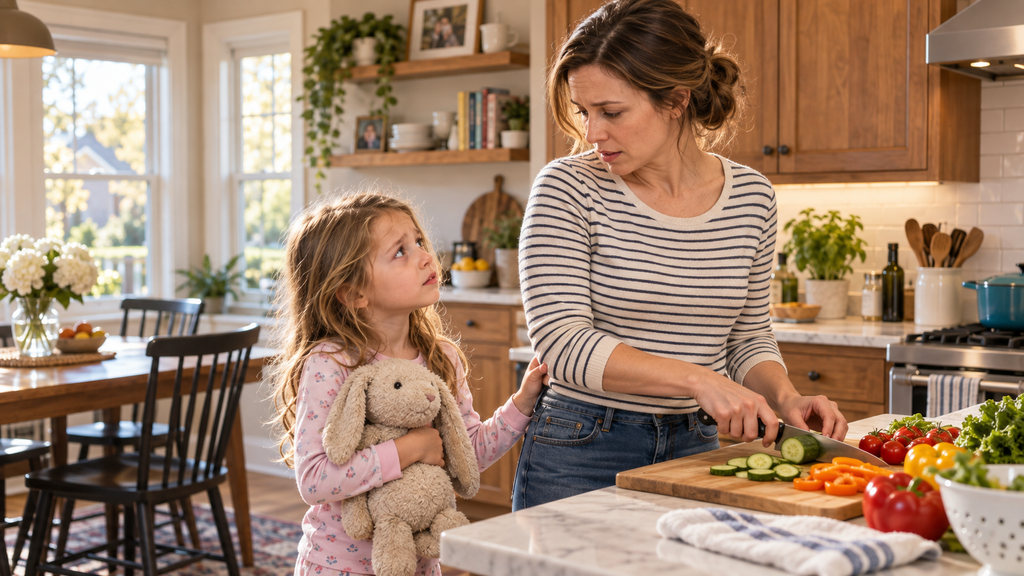
She was standing at the kitchen counter, chopping carrots for dinner, while a pot of chicken soup simmered quietly on the stove. Outside, rain tapped softly against the windows.
Inside, the house smelled of rosemary, onions, and warm bread.
It should have felt peaceful.
Normal.
Safe.
Emma stood beside her mother with one hand wrapped around the faded ear of her stuffed rabbit, Mr. Buttons.
The rabbit had once been white.
After four years of bedtime hugs, car rides, spilled juice, and emergency wash cycles, he had faded into a soft gray.
Emma took him everywhere.
Especially when she was nervous.
Claire noticed that immediately.
Her daughter wasn’t just holding Mr. Buttons.
She was squeezing him.
Hard.
So hard that one of his ears was folded completely inside Emma’s tiny fist.
“Mommy?”
Claire looked down.
“Yes, sweetheart?”
Emma shifted from one foot to the other.
“Can I not have the pink spoon tonight?”
Claire’s knife stopped against the cutting board.
For a second, she thought she had misheard.
“The what?”
Emma looked toward the hallway.
Not toward Claire.
Toward the hallway leading to the guest room.
The room where Grandma Patricia had been staying for the past three weeks.
“The pink spoon,” Emma whispered.
Claire slowly set the knife down.
“What pink spoon, honey?”
Emma’s lower lip trembled.
“The one Grandma gives me.”
Every sound in the kitchen seemed to disappear.
The bubbling soup.
The rain.
The low hum of the refrigerator.
Everything.
Claire crouched beside her daughter.
“What does Grandma give you in the spoon?”
Emma shrugged.
“The sweet stuff.”
Claire felt something cold move through her stomach.
“What sweet stuff?”
“I don’t know.”
Emma pulled Mr. Buttons against her chest.
“It makes my legs sleepy.”
Claire stared at her daughter.
“What do you mean, it makes your legs sleepy?”
Emma looked embarrassed, as though she had done something wrong.
“They get heavy.”
Her voice became quieter.
“And my eyes get funny.”
Claire felt her pulse beating in her throat.
“Emma, when does Grandma give you this?”
Emma thought for a moment.
“When I’m bad.”
Claire’s heart seemed to stop.
“You are not bad.”
Emma blinked.
“Grandma says I get difficult.”
Claire swallowed.
“What does she mean by difficult?”
“When I cry.”
Emma looked down.
“Or when I ask for you.”
Claire felt as if the floor beneath her had shifted.
Her mother-in-law had been staying with them for three weeks because Claire had recently returned to working several afternoon shifts at the architectural firm where she was a project manager.
Patricia had offered to help.
Actually, offered wasn’t quite the right word.
She had insisted.
“You’re exhausted,” Patricia had said.
“You can’t do everything.”
At the time, Claire had almost been grateful.
Almost.
Her relationship with Patricia had never been easy.
Patricia was the kind of woman who could criticize someone while smiling warmly enough that anyone listening from across the room would assume she was offering a compliment.
When Emma was a baby, Patricia had opinions about breastfeeding.
When Emma began walking, Patricia had opinions about shoes.
When Emma started preschool, Patricia had opinions about discipline.
Too soft.
Too much comfort.
Too many choices.
Too much patience.
According to Patricia, Claire was raising a child who would never learn to handle disappointment.
Claire had tolerated it.
She had rolled her eyes privately.
She had complained to Daniel occasionally.
But Patricia was Emma’s grandmother.
And Emma had once adored her.
That was what made the fear in Emma’s eyes so frightening.
Claire reached for her daughter’s hands.
“Sweetheart, listen to me.”
Emma looked up.
“You’re not in trouble.”
Emma nodded uncertainly.
“I need you to tell Mommy something.”
Another tiny nod.
“What happens when Grandma gives you the pink spoon?”
Emma’s face tightened.
“She says it helps me calm down.”
“And then?”
“I get sleepy.”
“How sleepy?”
Emma rested her head sideways against Mr. Buttons.
“Like this.”
Claire’s chest tightened.
“Do you fall asleep?”
“Sometimes.”
“And Grandma gives it to you when you don’t want to nap?”
Emma nodded.
“Sometimes when I cry.”
Claire struggled to keep her voice steady.
“How many times?”
Emma’s eyebrows pinched together.
Children Emma’s age did not understand weeks in the way adults did.
They understood preschool days.
Bedtimes.
Cartoons.
Trips to the grocery store.
So Claire tried differently.
“Did Grandma give it to you yesterday?”
Emma nodded.
“The day before?”
Another nod.
“What about when Daddy was home?”
Emma hesitated.
Then nodded again.
Claire’s fingers turned cold.
She sat on the kitchen floor.
Emma immediately climbed into her lap.
“Mommy?”
“Yes?”
“Are you mad?”
The question nearly broke her.
Claire wrapped both arms around her.
“No.”
Emma whispered against her shoulder.
“Grandma said you’d be mad.”
Claire closed her eyes.
“At you?”
Emma shook her head.
“At Grandma.”
Claire held her tighter.
“She said if you knew, you would make her leave.”
There it was.
The secret.
The deliberate secret.
Not a misunderstanding.
Not a grandmother casually giving cough medicine during an illness and forgetting to mention it.
Patricia had specifically told Emma not to tell her mother.
Claire felt anger rise so quickly that she almost became dizzy.
But she pushed it down.
Emma did not need to see rage.
She needed safety.
Claire kissed her hair.
“Listen to me very carefully.”
Emma looked up.
“You never have to keep a secret about medicine from Mommy or Daddy.”
Emma nodded.
“Even if a grown-up tells you to?”
“Even then.”
“What if they say I’ll get in trouble?”
“You come tell me.”
“What if they get mad?”
“You still tell me.”
Emma studied her mother’s face.
“Are you going to make Grandma leave?”
Claire did not answer immediately.
Because the truth was yes.
Absolutely.
Without hesitation.
But she wanted to understand everything first.
“We’re going somewhere.”
“Where?”
“To see a doctor.”
Emma’s eyes widened.
“I’m not sick.”
“I know.”
“Do I need a shot?”
“No.”
Claire prayed that would remain true.
“We just need someone to make sure you’re okay.”
Emma nodded.
Then she whispered the sentence Claire would remember for the rest of her life.
“I don’t want the pink spoon anymore.”
Claire kissed her forehead.
“You’re never taking it again.”
She stood.
The carrots remained on the cutting board.
The soup remained simmering.
The bread stayed unopened.
Dinner was forgotten.
Everything else could wait.
Her daughter could not.
The clinic was twelve minutes away.
Claire made the drive in eight.
Emma sat in the back seat hugging Mr. Buttons while rain streaked across the windows.
Every red light felt personal.
Every slow driver seemed unbearable.
Claire kept glancing into the rearview mirror.
Emma looked tired.
Maybe she was always tired around this time.
Maybe Claire was imagining it because she was frightened.
Or maybe she had been missing something for weeks.
That possibility hurt the most.
Parents often imagined that if something serious were happening to their children, they would somehow know.
A mother’s instinct.
A father’s intuition.
Some invisible alarm.
But real life was not always dramatic.
Sometimes danger did not announce itself.
Sometimes it looked like a grandmother making afternoon tea.
Sometimes it sounded like someone saying,
“She just needs a nap.”
Sometimes it came in a small plastic spoon.
Claire gripped the steering wheel harder.
She remembered several things now.
Emma falling asleep unusually early two weeks earlier.
Patricia laughing.
“Finally wore herself out.”
Emma stumbling slightly after an afternoon nap.
Claire asking if she felt sick.
Patricia answering before Emma could.
“She woke up too fast.”
Emma being strangely quiet during dinner.
Patricia saying,
“She had a tantrum earlier. I think she exhausted herself.”
One memory after another surfaced.
Every explanation had seemed reasonable at the time.
Now they felt like doors Claire should have opened.
She hated herself for that.
Then she stopped.
No.
Not now.
Self-blame could come later.
Right now she needed facts.
She pulled into the clinic parking lot, lifted Emma from her booster seat, and hurried through the rain.
The pediatric urgent-care clinic was bright and warm.
Too bright, Claire thought.
Bright rooms made terrible news feel even more surreal.
A receptionist looked up.
“Can I help you?”
Claire placed one hand on Emma’s shoulder.
“My daughter may have been given medication without my knowledge.”
The receptionist’s expression changed immediately.
“What medication?”
“I don’t know.”
“Has she taken anything today?”
“I don’t know.”
“How old is she?”
“Four.”
The receptionist stood.
“One moment.”
Within minutes they were taken into a private examination room.
Emma climbed onto the chair instead of the exam table.
She curled both feet beneath her.
Mr. Buttons remained pressed against her chin.
A nurse took Emma’s vital signs.
Then a clinician named Dr. Maya Lopez entered.
She was calm.
Not casually calm.
Professionally calm.
The kind of calm that made frightened people feel as though at least one person in the room knew what to do next.
She greeted Emma first.
“Who’s your friend?”
Emma lifted the rabbit slightly.
“Mr. Buttons.”
“That’s a very serious-looking rabbit.”
Emma almost smiled.
Claire nearly cried from relief at seeing that tiny expression.
Dr. Lopez sat rather than standing over Emma.
“Your mommy told me Grandma sometimes gives you something with a pink spoon.”
Emma looked toward Claire.
Claire nodded.
“You can tell her.”
Emma whispered,
“It’s sweet.”
Dr. Lopez asked simple questions.
Nothing suggestive.
Nothing complicated.
What color was the spoon?
Pink.
Was the liquid always the same color?
Emma thought it was purple.
Where did Grandma keep it?
In the tall cabinet above the microwave.
What happened afterward?
Emma got sleepy.
Why did Grandma give it?
When Emma cried.
When she asked for Mommy.
When she wouldn’t nap.
Did Grandma say what it was called?
No.
Did Grandma say anything else?
Emma tightened her grip around Mr. Buttons.
“She said it was our secret.”
Claire looked away.
She felt tears burn her eyes.
Dr. Lopez remained composed.
“Did Grandma tell you why it had to be a secret?”
Emma nodded.
“Mommy doesn’t like medicine.”
Claire almost laughed from disbelief.
It would have sounded like crying anyway.
Dr. Lopez looked at Claire.
“Do you know what medicines are in the house?”
“Normal things. Children’s fever medicine. Allergy medicine. Cough medicine. My husband keeps antacids. Patricia has blood-pressure medication.”
“Any sleep aids?”
“Not for Emma.”
“I understand.”
Dr. Lopez asked whether Emma had unusual breathing, vomiting, confusion, trouble walking, prolonged sleepiness, or any recent illness.
Claire answered what she could.
Then the clinician said,
“The most important thing right now is identifying what she may have received and making sure she isn’t given anything else.”
Claire nodded.
“I’ll call my husband.”
Daniel answered on the third ring.
“Hey.”
His voice was distracted.
Traffic noise sounded in the background.
Claire imagined him leaving his office, balancing his phone against his shoulder, completely unaware that their family was about to change.
“Where are you?”
“Just leaving work. Why?”
“I’m at the pediatric clinic with Emma.”
Everything on his end went quiet.
“What happened?”
Claire stared through the glass panel in the exam-room door.
“I need you to go home first.”
“Claire, what happened?”
“Your mother has been giving Emma something.”
Silence.
“What do you mean something?”
“Medicine.”
“What medicine?”
“I don’t know.”
“Why would she—”
“Daniel.”
Her voice sharpened.
“Emma says your mother gives her sweet liquid in a pink spoon when she cries or won’t nap.”
Daniel did not speak for several seconds.
Then he said,
“That doesn’t make sense.”
Claire shut her eyes.
“I know.”
“No. I mean Mom wouldn’t just give her something without telling us.”
“She did.”
“Maybe it was children’s allergy medicine.”
“That wouldn’t make this okay.”
“I didn’t say it would.”
“Emma says your mother told her not to tell me.”
Another silence.
Claire heard Daniel inhale slowly.
“She said that?”
“Yes.”
“I’m sure there’s an explanation.”
Claire’s jaw tightened.
“Go home.”
“Claire—”
“Go to the cabinet above the microwave and tell me what’s there.”
Daniel did not answer.
“Please.”
“All right.”
“I want you to check every bottle.”
“Okay.”
“And Daniel?”
“Yes?”
“Don’t ask your mother first.”
He paused.
“Why?”
“Because I want to know what is actually missing before she has a chance to explain anything.”
Daniel clearly did not like that.
But he said,
“Fine.”
The call ended.
Claire returned to Emma.
Her daughter had placed Mr. Buttons on the exam table and was carefully making him “walk” along the paper covering.
Claire sat beside her.
“Daddy’s coming.”
Emma froze.
“What?”
“Daddy is coming here.”
Emma looked scared.
“Is he mad?”
“No.”
“Grandma said Daddy knows.”
Claire stopped breathing.
“What?”
Emma looked toward Dr. Lopez, then back at her mother.
“Grandma said Daddy knows.”
Claire felt a second wave of cold sweep through her.
“Knows what?”
“About the spoon.”
Claire tried to speak.
No sound came.
Daniel called fourteen minutes later.
His voice had changed.
The disbelief was gone.
“Claire.”
“What did you find?”
“There’s children’s nighttime cold medicine in the trash.”
Claire closed her eyes.
“Empty?”
“No. Maybe half.”
“Was it in the cabinet before?”
“I think so.”
“You think?”
“I remember buying it months ago when Emma had that cold.”
Claire looked at Dr. Lopez, who was listening.
Daniel continued.
“The measuring cup is gone.”
Claire looked at Emma.
“What about the pink spoon?”
“I don’t know.”
“Check the dishwasher.”
A cupboard opened.
Drawers.
Ceramic clinking.
Then Daniel went quiet.
“Daniel?”
“I found it.”
Claire’s stomach dropped.
“Where?”
“Rinsed out beside the sink.”
“A pink plastic spoon?”
“Yes.”
Claire pressed two fingers against her forehead.
“Bring the bottle.”
“Okay.”
“And come here.”
“Mom is home.”
Claire’s eyes opened.
“Do not leave Emma alone with her.”
“Emma isn’t there.”
“You know what I mean.”
“Claire—”
“No.”
Her voice shook now.
“Whatever your mother says, bring the bottle and come here.”
Daniel sighed.
“I’m going to ask her what happened.”
“You can ask her in front of me.”
“That’s going to turn this into a war.”
Claire stared through the window at the rain.
“It became a war when she told our four-year-old to hide medicine from us.”
Daniel did not answer.
“Bring the bottle.”
The call ended.
Twenty-two minutes later, Daniel entered the clinic.
Patricia walked directly behind him.
Claire’s entire body stiffened.
Daniel carried the bottle inside a clear plastic bag.
Patricia carried her purse.
She looked furious.
Not frightened.
Not ashamed.
Furious.
“This is ridiculous,” she said before the door had even closed.
Dr. Lopez stood.
“Mrs. Carter—”
“No.”
Patricia lifted one hand.
“I want to know why my granddaughter has been dragged into a medical clinic over something this stupid.”
Claire rose slowly.
“Stupid?”
“Yes.”
Patricia removed her raincoat.
“Absolutely stupid.”
Emma saw her grandmother.
The reaction was immediate.
She climbed down from the chair.
Moved behind Claire.
And grabbed the back of Claire’s sweater.
Patricia noticed.
Her face tightened.
“Oh, stop that.”
Emma hid farther behind her mother.
Patricia frowned.
“Emma, come here.”
Emma did not move.
“Sweetheart, Grandma said come here.”
Claire stepped sideways, placing herself completely between them.
“No.”
Patricia stared at her.
“Excuse me?”
“She doesn’t want to.”
“This is exactly what I’m talking about. You indulge every dramatic little behavior.”
Claire’s voice became very quiet.
“Do not call my daughter dramatic.”
Patricia laughed sharply.
“She was fine an hour ago.”
Claire felt Emma’s hand gripping the fabric at her waist.
“She told me about the spoon.”
Patricia’s expression shifted.
Barely.
But Claire saw it.
“So?”
“So you gave my child medication without permission.”
“It was children’s medicine.”
“For what illness?”
Patricia folded her arms.
“She was overtired.”
Claire stared at her.
“That is not an illness.”
“She was hysterical.”
“She is four.”
“She was screaming for you.”
Claire’s anger rose.
“So you drugged her because she missed me?”
Daniel flinched.
“Claire.”
She turned on him.
“No. Don’t ‘Claire’ me.”
Patricia rolled her eyes.
“Drugged. Listen to yourself.”
Dr. Lopez stepped in.
“Mrs. Carter, regardless of terminology, medication should not be administered to a child outside appropriate directions and caregiver authorization.”
Patricia looked offended.
“I know how to raise children.”
Claire almost laughed.
“That isn’t what she said.”
“I raised Daniel.”
“And that gives you permission to medicate Emma?”
“It gave her a nap.”
“It made her afraid of you.”
Patricia glanced behind Claire.
Emma peeked around her mother’s side.
Patricia softened her voice artificially.
“Emma, honey, come tell everyone Grandma never hurt you.”
Emma did not move.
“Come on.”
Nothing.
Patricia reached forward.
Emma recoiled.
Claire blocked Patricia’s hand.
“Don’t touch her.”
Patricia’s eyes widened.
“You cannot be serious.”
“I have never been more serious.”
Patricia looked at Daniel.
“Are you going to let your wife speak to me like this?”
Daniel stood holding the medicine bottle.
His knuckles had gone pale around the plastic bag.
“Mom, how often did you give this to her?”
Patricia stared at him.
“Oh, please.”
“How often?”
“A few times.”
“How many?”
“I didn’t keep a diary.”
Claire said,
“Emma says almost every day.”
Patricia scoffed.
“Children exaggerate.”
Behind Claire came a tiny voice.
“I don’t.”
The room became silent.
Emma emerged halfway.
Her eyes were wet.
“I don’t tell stories.”
Patricia looked momentarily uncomfortable.
Then she sighed.
“Sweetheart, nobody said you’re telling stories.”
“You said I exaggerate.”
The innocence of the correction made Daniel look away.
Claire reached down and held Emma’s hand.
Patricia said,
“You don’t understand what grown-ups mean.”
Emma looked at the bottle in Daniel’s hand.
Then back at her grandmother.
“I don’t want the spoon.”
Patricia exhaled impatiently.
“You’re not getting the spoon.”
“Ever?”
“No.”
Claire answered before Patricia could say anything else.
“Ever.”
Emma leaned against her.
Then she looked at Daniel.
“Daddy?”
Daniel crouched.
“Yes, bug?”
“You saw.”
Daniel froze.
Claire felt something inside her go still.
“What did she say?” Patricia asked quickly.
Emma pointed at her father.
“Daddy saw Grandma give it.”
Daniel’s face lost color.
Claire stared at him.
“Daniel.”
He said nothing.
“Daniel.”
He stood slowly.
“I—”
Claire’s heart pounded.
“You saw this?”
“Not like this.”
“What does that mean?”
“I saw Mom give Emma something once.”
Claire stared at him.
“When?”
Daniel rubbed both hands over his face.
“A couple of weeks ago.”
Patricia interrupted.
“It was nothing.”
Claire turned back to Daniel.
“What exactly did you see?”
“I came into the living room. Emma was lying on the couch. Mom gave her a spoonful of something.”
“And you didn’t ask?”
“I did.”
“What did she say?”
“She said Emma had been coughing.”
Patricia lifted her chin.
“She was.”
Emma whispered,
“I wasn’t.”
Patricia snapped,
“You had been whining all afternoon.”
Claire felt rage flare through her.
“That is not coughing.”
Daniel closed his eyes.
Claire’s voice broke.
“You saw your mother give our daughter medicine and didn’t tell me?”
“I thought it was cough syrup.”
“You thought.”
“Yes.”
“Did Emma have a cough?”
Daniel said nothing.
“Did she?”
“No.”
Claire stepped away from him.
That hurt more than she expected.
Not because Daniel had known everything.
Clearly he hadn’t.
But because he had seen one piece of the truth and chosen the easiest explanation.
“You didn’t ask what it was.”
“I trusted her.”
Claire laughed once.
It sounded hollow.
“You trusted her.”
Daniel looked miserable.
“She’s my mother.”
“And Emma is your daughter.”
“I know that.”
“Do you?”
“Claire.”
“No.”
Her eyes filled.
“She told our child to keep medication secret from me.”
“I didn’t know that.”
“You saw enough to ask questions.”
Daniel’s face crumpled slightly.
“You’re right.”
Claire had expected an argument.
The immediate admission stopped her.
He looked at Emma.
“I should have asked.”
Patricia threw both hands in the air.
“This is insane.”
Daniel turned toward his mother.
“Stop.”
Patricia stared at him.
“What?”
“Stop talking.”
Her mouth fell open.
Daniel rarely spoke to his mother like that.
“Daniel.”
“I saw you give her something.”
“I explained it.”
“You lied.”
“I did not lie.”
“You said she was coughing.”
“She was upset.”
“That isn’t the same thing.”
Patricia’s expression hardened.
“Oh, so now you’re going to stand there acting like I’m some monster?”
Daniel looked at the medicine bottle.
“I don’t know what I’m supposed to think.”
“You think I was helping.”
“I think you gave my daughter medication because she wouldn’t take a nap.”
Patricia’s voice sharpened.
“She needed sleep.”
“So did you ask us?”
“I didn’t need permission to use common sense.”
Claire whispered,
“That sentence tells me everything.”
Patricia looked at her.
“You have been looking for an excuse to push me out since the day you married him.”
Claire shook her head.
“This has nothing to do with you and me.”
“It has everything to do with us.”
“No.”
Claire pointed toward Emma.
“It has to do with her.”
Patricia looked toward the child.
“She was impossible.”
Emma’s face changed.
Claire felt it through the tiny hand in hers.
That instant when a child heard an adult define her as something terrible.
Impossible.
Claire crouched immediately.
“You are not impossible.”
Emma’s eyes filled.
Patricia said,
“I didn’t mean—”
Claire looked over her shoulder.
“Don’t.”
Emma whispered,
“Grandma says difficult kids need medicine.”
Daniel made a broken sound.
Patricia paled.
“I never said that.”
Emma looked confused.
“Yes, you did.”
“No, sweetheart.”
“You did.”
Patricia’s voice rose.
“She is four! She doesn’t understand context!”
Dr. Lopez stepped forward.
“That’s enough.”
Patricia turned.
“You stay out of family business.”
“This became my concern when the child was brought here for evaluation.”
“She is perfectly fine.”
“That is something we assess medically, not something you decide.”
Patricia opened her mouth.
Then closed it.
For the first time since she entered the room, she looked uncertain.
But only for a moment.
Then her expression changed.
Almost triumphant.
“Fine.”
She reached into her purse.
“I knew you people would turn this into some ridiculous accusation.”
Daniel frowned.
“What are you doing?”
“I have proof.”
Claire stared.
“Proof of what?”
“That I knew exactly what I was doing.”
She pulled out a folded sheet of paper.
“This will end the drama.”
Patricia placed it on the counter.
The paper landed beside the examination gloves.
For several seconds nobody moved.
Then Patricia pushed it toward Daniel.
“Read it.”
Daniel picked it up.
Claire watched his face.
At first, he looked confused.
Then his eyebrows tightened.
Then something drained from his expression entirely.
“Mom.”
Patricia folded her arms.
“There.”
Daniel kept reading.
Claire stepped closer.
“What is it?”
Daniel did not answer.
“Daniel?”
He looked at his mother.
“This says the exact opposite of what you claimed.”
Patricia’s confidence flickered.
“No, it doesn’t.”
“Yes.”
“What does it say?” Claire demanded.
Daniel handed her the paper.
Claire looked down.
It was a discharge instruction sheet from Emma’s pediatrician.
Dated six months earlier.
Claire remembered the visit.
Emma had been suffering from a severe cold and fever.
Claire had been stuck at work during an emergency client meeting, and Patricia had volunteered to accompany Daniel to the appointment.
Claire scanned the page.
Most of it was routine.
Hydration.
Rest.
Temperature monitoring.
Medication instructions.
Then she saw the handwritten note near the bottom.
The doctor had underlined it twice.
Do not use nighttime cold medication to induce sleep or calm behavior. Use only for appropriate symptoms and only according to labeled pediatric guidance.
Below the note were two signatures.
Daniel’s.
And Patricia’s.
Claire looked up.
“You signed this.”
Patricia’s mouth tightened.
“It was months ago.”
“You signed instructions specifically telling you not to use this medicine to make her sleep.”
“That’s not what I did.”
Emma whispered,
“Yes, it is.”
Nobody moved.
Patricia snapped,
“Children repeat things they don’t understand.”
Claire held the paper in shaking hands.
“You told us you thought it was harmless.”
“It is harmless when used correctly.”
“You weren’t using it correctly.”
“I gave her a small amount.”
“For behavior.”
“She needed rest.”
“For crying.”
“She was hysterical.”
“For asking for me.”
Patricia’s face hardened.
“You weren’t there.”
The words landed differently.
Claire stared at her.
“What?”
“You weren’t there.”
Patricia’s voice became sharp and resentful.
“She would cry for you for forty-five minutes.”
“She’s four.”
“She would refuse food.”
“She would throw toys.”
“She would refuse naps.”
“She missed her mother.”
“And someone had to deal with it.”
Claire felt something inside her break.
Not loudly.
Quietly.
Something final.
“You mean you had to deal with my child having emotions.”
Patricia laughed bitterly.
“You have no idea what she’s like when you leave.”
“I know exactly what she is.”
Claire’s voice trembled.
“She’s a little girl who misses me.”
“She manipulates you.”
“She is four years old.”
“She knows crying gets attention.”
“Yes.”
Claire stepped closer.
“That is literally what crying is supposed to do.”
Patricia stared.
Claire continued.
“She cries because she needs comfort.”
“You can’t comfort every emotion away.”
“I never said I could.”
“You’re raising her soft.”
“No.”
Claire’s voice lowered.
“I’m raising her to believe home is safe.”
Emma pressed against her side.
Claire looked down at the paper again.
The signatures blurred through tears.
Patricia had walked into the room believing the document would defend her.
Instead, it proved something worse.
She had been warned.
Clearly.
Specifically.
She knew.
And she did it anyway.
Daniel seemed to reach the same conclusion.
“Why did you keep this?”
Patricia frowned.
“What?”
“The discharge sheet.”
He pointed toward the paper.
“Why was it in your purse?”
“I keep medical paperwork.”
“For six months?”
“Yes.”
Daniel stared at her.
“You carried this around after giving Emma the same medicine?”
Patricia’s eyes shifted.
Claire noticed.
Daniel noticed too.
“Mom.”
“What?”
“Why was this in your purse?”
Patricia said nothing.
“Mom.”
Finally, she snapped,
“Because I wanted to know the dosage.”
The silence after that sentence was devastating.
Claire almost could not process it.
Daniel whispered,
“You used this sheet to check how much medication to give her?”
Patricia realized too late what she had admitted.
“I checked the dosage because I didn’t want to accidentally give too much.”
Claire’s stomach twisted.
“That is not the defense you think it is.”
“I was careful.”
“You planned it.”
“No.”
“You carried the paper because you were repeatedly giving her the medicine.”
Patricia shook her head.
“That’s ridiculous.”
“Then why keep it?”
“I already explained.”
Claire felt tears on her cheeks now.
Not weak tears.
Not confused tears.
The kind that came when anger had nowhere else to go.
“You knew enough to check dosage.”
Patricia said nothing.
“You knew enough to hide it.”
Silence.
“You knew enough to tell Emma not to tell me.”
Silence.
“You knew enough to remember the instructions.”
Patricia’s chin trembled.
“And you knew those instructions said not to use the medicine to make her sleep.”
Patricia finally looked away.
There it was.
Not an apology.
Not remorse.
Just nowhere left to argue.
Daniel sat down heavily.
For the first time in Claire’s memory, his mother looked small to him.
Not physically.
Emotionally.
The unquestioned authority was gone.
The woman who always knew better.
Who always had an explanation.
Who always turned criticism into disrespect and boundaries into betrayal.
Gone.
In her place stood a frightened woman who had lost control of the story.
And Patricia hated that.
“You’re making me sound evil,” she said.
Claire shook her head.
“No.”
Her voice was strangely calm now.
“Your choices are doing that.”
Patricia looked at Daniel.
“You know me.”
Daniel stared at the floor.
“Do I?”
The question seemed to wound her more than anything Claire had said.
“Daniel.”
He looked up.
“You told Emma to lie to us.”
“I told her not to upset Claire.”
“You told my daughter to keep medication secret.”
“She would have overreacted.”
Daniel gestured around the room.
“Look at where we are.”
Patricia’s eyes filled.
“You’re choosing her over your mother.”
Claire stiffened.
Daniel stood.
“No.”
His voice was quiet.
“I’m choosing my daughter over the person who hurt her.”
Patricia stared at him.
The words hung between them.
Claire would remember them forever.
Not because they fixed everything.
They did not.
But because Daniel finally understood the choice.
There should never have been a competition between wife and mother.
Between loyalty and honesty.
Between keeping peace and protecting a child.
Emma came first.
Period.
Patricia’s voice cracked.
“I did not hurt her.”
Daniel glanced at Emma.
She was half-hidden behind Claire.
Mr. Buttons covered part of her face.
“Look at her.”
Patricia did.
Emma immediately stepped backward.
Daniel’s eyes filled.
“She’s afraid of you.”
That finally broke through.
Patricia’s expression collapsed.
For one second, genuine pain appeared.
She whispered,
“Emma?”
Emma did not answer.
Patricia took one step forward.
Claire lifted her hand.
“No.”
Patricia stopped.
“I just want to tell her—”
“No.”
“I want to explain.”
“No.”
“She thinks I’m a monster now.”
Claire looked at her.
“Your feelings are not Emma’s responsibility.”
Patricia’s eyes flashed.
“I love her.”
“Then loving her means leaving her alone when she says no.”
The words were simple.
Patricia seemed unable to accept them.
But she stopped moving.
Emma watched from behind Claire.
For the first time that evening, her grip on Mr. Buttons loosened slightly.
The next several hours moved slowly.
Clinicians evaluated Emma.
Questions were asked.
Notes were taken.
Daniel answered what he knew.
Claire answered what she knew.
Patricia’s version changed repeatedly.
First it had happened only twice.
Then maybe three times.
Then she admitted it might have happened more often during the last week.
She insisted the amounts were small.
She insisted Emma had never been in danger.
She insisted she had only wanted the child to sleep.
Each explanation sounded worse than the one before.
Eventually, Patricia was asked to wait elsewhere.
Emma immediately relaxed once she was gone.
That detail hurt Daniel visibly.
He sat in the corner with his elbows on his knees and his hands clasped together.
Claire remained beside Emma.
At one point Emma whispered,
“Mommy?”
“Yes?”
“Am I still good?”
Claire’s heart broke.
She pulled her daughter onto her lap.
“You were always good.”
“Even when I cry?”
“Especially when you cry.”
“Even when I don’t nap?”
Claire smiled through tears.
“Even when you don’t nap.”
Emma thought about it.
“Grandma says good girls listen.”
Claire brushed hair from her forehead.
“Good kids can say no when something scares them.”
Emma’s eyes widened.
“Really?”
“Yes.”
“To grown-ups?”
“Yes.”
“To Grandma?”
“Yes.”
“To Daddy?”
Daniel looked up.
Claire glanced at him.
“Yes.”
Daniel moved closer.
“Especially to me if I’m doing something that makes you uncomfortable.”
Emma studied him.
“Will you get mad?”
“No.”
“What if I’m wrong?”
Daniel’s voice broke.
“You can still tell us.”
Emma leaned against Claire.
Daniel looked at his wife.
His eyes were red.
“I’m sorry.”
Claire did not immediately answer.
He continued.
“I should have questioned it.”
“Yes.”
“I should have told you what I saw.”
“Yes.”
“I wanted to believe Mom’s explanation.”
Claire nodded.
“I know.”
“I didn’t want another argument.”
Claire stared at him.
“That’s the problem.”
He lowered his eyes.
“I know.”
“No, Daniel.”
Claire’s voice remained quiet because Emma was listening.
“You wanted peace so much that you accepted an explanation you knew didn’t quite fit.”
He swallowed.
“Yes.”
“You let me become the difficult one every time I raised concerns about your mother.”
His face tightened.
“I did.”
“You told me she meant well.”
“Yes.”
“You told me I was reading too much into things.”
“Yes.”
“And all the while…”
Claire looked toward Emma.
“…our daughter was learning that Grandma’s comfort mattered more than her own fear.”
Daniel wiped his eyes.
“I don’t know how to fix that.”
Claire looked at him for a long moment.
“You don’t fix it with one apology.”
“I know.”
“You fix it by changing what you do next.”
He nodded.
“I will.”
Claire wanted to believe him.
But trust had been damaged in more than one direction that night.
Not destroyed.
Damaged.
There was a difference.
And Claire understood something she had never fully understood before.
Love could survive disappointment.
Trust required evidence.
Patricia did not return home with them.
Daniel collected her belongings the following morning.
Claire stayed with Emma.
Patricia called seventeen times.
Claire did not answer.
Then came messages.
Please stop making this bigger than it is.
Then:
I would never hurt Emma.
Then:
I was trying to help you.
Then:
Daniel is devastated. You are destroying this family.
Then:
You know how emotional children can be.
That was the message that ended any possibility Claire had of speaking to her immediately.
Not because Patricia refused responsibility.
Claire already knew she would.
But because even after everything, Patricia was still blaming Emma.
The four-year-old.
The child who had whispered,
Can I stop taking the pink spoon?
Claire blocked Patricia’s number temporarily.
Then she sat beside Emma on the living-room floor and helped build a castle out of blocks.
No dramatic speeches.
No explanation about family betrayal.
Just blocks.
Emma placed Mr. Buttons inside the tallest tower.
“He’s the king.”
Claire smiled.
“I thought he was a rabbit.”
“He can be both.”
“Fair enough.”
Daniel came downstairs carrying Patricia’s final suitcase.
Emma went quiet.
He noticed.
“Grandma isn’t coming back here today.”
Emma looked relieved.
“Tomorrow?”
Daniel sat beside her.
“No.”
“Next week?”
“No.”
Emma studied him carefully.
“Why?”
Daniel glanced at Claire.
Then answered honestly, but simply.
“Because Grandma broke an important rule.”
“What rule?”
“She gave you medicine without asking Mommy or Daddy.”
Emma frowned.
“But you saw.”
Daniel inhaled.
“I did once.”
Emma waited.
“And I made a mistake.”
“What mistake?”
“I didn’t ask enough questions.”
She considered this.
“Did you get in trouble?”
Daniel almost smiled.
“In a way.”
“With Mommy?”
Claire raised an eyebrow.
Daniel gave a tiny laugh.
“Yes.”
Emma leaned closer.
“Big trouble?”
“Pretty big.”
Claire shook her head despite herself.
Emma giggled.
It was the first real laugh Claire had heard from her since the clinic.
The sound nearly made both adults cry.
Daniel leaned toward her.
“I’m sorry I didn’t listen better.”
Emma touched his cheek.
“You can listen now.”
Daniel closed his eyes.
“Yes.”
His voice cracked.
“I can listen now.”
The changes came slowly.
At first, Emma refused to sleep alone.
Claire allowed her mattress to be moved into their bedroom for several nights.
Patricia would have called that weakness.
Claire did not care.
When Emma woke from nightmares and whispered,
“No pink spoon,”
Claire held her until the shaking stopped.
“No pink spoon.”
Daniel repeated it too.
“No secrets about medicine.”
Emma made Claire inspect every spoon in the kitchen.
Metal spoons were fine.
Wooden spoons were funny.
The pink plastic spoon went into a sealed bag with the bottle and paperwork.
Emma did not watch.
Weeks passed.
A child therapist helped Emma understand that medicine was not punishment.
Doctors could recommend medicine when people were sick.
Parents could explain what it was.
Children could ask questions.
No one should tell her that medicine was necessary because she was bad.
That lesson mattered more than Claire initially realized.
One afternoon Emma had a fever.
Claire brought the recommended children’s fever medicine.
The moment Emma saw the measuring syringe, she panicked.
“No!”
Claire stopped.
Immediately.
“Okay.”
Emma scrambled backward against the couch.
“No sleepy.”
“This medicine is for your fever.”
“No.”
Claire sat across from her.
She did not force.
She showed Emma the bottle.
Explained it.
Let Emma ask questions.
Daniel read the instructions aloud.
Emma remained frightened.
So they waited several minutes.
Then Emma asked,
“You won’t make me?”
Claire shook her head.
“We need to help your fever, but we’ll explain everything first.”
Emma thought.
“Can Mr. Buttons watch?”
“Absolutely.”
Mr. Buttons watched.
Emma took the medicine.
Then she cried afterward.
Not because it hurt.
Because she had done something brave.
Claire held her.
Daniel held both of them.
Healing did not happen in grand scenes.
It happened like that.
One safe experience at a time.
Daniel changed too.
At first, Claire watched carefully.
Words were easy.
Boundaries were harder.
Patricia called him constantly.
She cried.
She accused.
She reminded him of everything she had ever sacrificed.
She reminded him that his father had died when Daniel was young.
That she had raised him alone.
That she had worked two jobs.
That she had attended every game.
Paid for college.
Helped with their down payment.
Babysat Emma.
Loved Emma.
Every fact was true.
None erased what she had done.
One night Claire found Daniel sitting alone at the kitchen table.
His phone lay facedown in front of him.
“You okay?” she asked.
“No.”
Claire sat opposite him.
He rubbed his forehead.
“She says I’ve abandoned her.”
Claire said nothing.
“She says Dad would be ashamed of me.”
“That’s cruel.”
“She knows it works.”
Claire looked at him.
“What are you going to do?”
He stared at the phone.
“I don’t know.”
Claire felt disappointment begin to rise.
Then Daniel said,
“I mean I don’t know what relationship I’m going to have with her long-term.”
Claire waited.
“But she’s not coming back into this house.”
The disappointment eased.
“And she’s not being alone with Emma.”
Claire nodded.
“Not unless Emma wants a relationship someday, and not until there’s been a lot of work.”
“Yes.”
Daniel looked toward the dark hallway.
“I spent my whole life thinking keeping Mom calm was the same thing as keeping peace.”
Claire understood more than she wanted to.
“She trained you to think that.”
“Yes.”
“Understanding it doesn’t excuse it.”
“I know.”
“But it can help you stop repeating it.”
Daniel nodded.
“I’m trying.”
Claire believed that.
Not because he said it.
Because for the first time, she saw him doing uncomfortable things rather than choosing comfortable explanations.
That was different.
That mattered.
Three months later, Patricia sent Emma a birthday card.
Claire opened it first.
She and Daniel had agreed on that boundary.
Inside was a picture of a rabbit.
Patricia had written:
Grandma misses you every day. I hope one day you understand that everything I did was because I loved you.
Claire stared at the sentence.
Daniel read it over her shoulder.
His face fell.
“She still doesn’t get it.”
“No.”
“She thinks love explains everything.”
Claire closed the card.
“Love doesn’t excuse control.”
Daniel nodded.
They did not give Emma the card.
Instead, Daniel called his mother.
Claire heard only his side of the conversation.
“Mom, I got the card.”
Pause.
“No.”
Pause.
“Because you still didn’t apologize.”
Another pause.
“You said you were sorry everyone got upset.”
Daniel rubbed his forehead.
“That isn’t the same thing.”
Pause.
“No. Listen.”
His voice strengthened.
“You told a four-year-old that medicine would make her good.”
Pause.
“You told her to hide it from us.”
Pause.
“You used medication to make her sleep.”
Pause.
“No. I’m not debating intent.”
Pause.
“This is exactly what I mean.”
Then a long silence.
Finally Daniel said,
“You keep asking when you can see Emma again.”
He looked toward Claire.
“The answer is not until you can talk about what happened without blaming Claire, blaming me, or blaming Emma.”
Another silence.
Daniel’s eyes filled.
“I love you.”
Claire looked away.
It was hard hearing that.
Not because it was wrong.
Because complicated love was painful.
Daniel continued.
“But loving you doesn’t mean giving you access to my daughter.”
He ended the call.
Then sat quietly.
Claire walked over.
“You okay?”
He shook his head.
“No.”
She placed her hand on his shoulder.
“But I think that was the right thing.”
Claire squeezed gently.
“It was.”
Sometimes the right thing still hurt.
That was another lesson their family had learned.
Six months after the clinic visit, Emma stood on a small stage at preschool wearing paper butterfly wings.
Claire sat in the front row beside Daniel.
Emma had one line in the spring play.
One.
She had practiced it approximately eight hundred times at home.
When her turn came, she stepped forward.
Then froze.
Completely.
The teacher waited.
Parents smiled encouragingly.
Emma looked toward Claire.
For one terrible second, Claire wondered whether she would cry.
Instead, Claire put her hand over her heart.
Their signal.
You’re safe.
Emma took a breath.
Then said her line.
Loudly.
“The butterfly knew it was time to fly.”
The audience applauded.
Emma beamed.
Daniel clapped so enthusiastically that Claire nudged him.
“You’re embarrassing her.”
“I don’t care.”
Emma looked directly at them.
And laughed.
Afterward, she ran across the room and jumped into Claire’s arms.
“Did you hear me?”
Claire kissed her cheek.
“Every word.”
“I was scared.”
“I know.”
“But I did it.”
“You did.”
Emma turned toward Daniel.
“Daddy heard too?”
He lifted her.
“Daddy heard everything.”
Emma wrapped her arms around his neck.
Claire stood beside them.
For a moment, the clinic felt very far away.
Not forgotten.
Never forgotten.
Just no longer controlling every moment.
That was healing too.
Patricia finally agreed to counseling nearly a year later.
Claire did not attend the first sessions.
Daniel did.
The therapist required Patricia to describe what she had done without using the words:
but,
only,
trying,
helping,
or overreacting.
Apparently the exercise was extraordinarily difficult for her.
Eventually she managed one sentence.
“I gave Emma medication to make her sleep because I wanted her behavior to be easier for me.”
Daniel told Claire that Patricia cried afterward.
Not because someone accused her.
Because for the first time she had said the truth without decorating it.
Months later, Patricia wrote Claire a letter.
Claire left it unopened for two days.
Then she read it.
It said:
I kept telling myself that because I loved Emma, I could not have harmed her.
I understand now that those two things can exist together.
I loved her.
And I made choices that frightened her.
I thought experience made me entitled to decide what was best.
I thought being her grandmother meant I did not need permission.
I was wrong.
Claire read that paragraph several times.
Then continued.
I told Emma to keep the medicine secret because I knew you would stop me. That means some part of me knew I was crossing a boundary even while I was convincing myself I was justified.
Claire’s eyes filled.
That sentence mattered.
Not because it erased anything.
It didn’t.
But because it was the first time Patricia stopped rewriting the past.
The letter ended:
I understand that forgiveness would not mean access.
I understand that an apology does not create trust.
If Emma never wants a relationship with me again, that will be painful, but it will be a consequence of my actions, not hers.
Claire folded the letter.
Daniel watched her.
“What do you think?”
Claire took a long breath.
“I think she finally wrote an apology.”
“Does it change anything?”
“Yes.”
Daniel looked surprised.
Claire continued.
“It changes whether I believe she understands.”
“And the boundaries?”
“No.”
He nodded.
“That’s what I thought.”
Claire touched his hand.
“Understanding is the beginning.”
“Not the finish.”
“Exactly.”
Emma was six when she finally asked to see Grandma Patricia again.
The request happened unexpectedly.
Claire was brushing Emma’s hair before school.
“Mommy?”
“Hmm?”
“Does Grandma still live by the lake?”
Claire paused.
“Yes.”
“Does she still have the ducks?”
“I think so.”
Emma thought.
“Is she still bad?”
Claire put down the brush.
Children asked complicated questions with terrifying simplicity.
Claire turned Emma around.
“Grandma isn’t a bad person.”
Emma frowned.
“She did a bad thing.”
“Yes.”
“More than one.”
“Yes.”
“Does she still do it?”
“No.”
“How do you know?”
“Because she’s been working very hard to understand what she did wrong.”
Emma considered this.
“Can people stop doing bad things?”
“They can.”
“Do we have to trust them?”
Claire smiled softly.
“No.”
Emma’s shoulders relaxed.
That answer seemed important.
“Can I see her?”
Claire’s heart tightened.
“If you want.”
“Will you be there?”
“Yes.”
“Daddy too?”
“Yes.”
“No sleepovers.”
“Definitely no sleepovers.”
“No medicine.”
“Never without us knowing exactly what it is and why.”
Emma looked satisfied.
“Okay.”
Then she turned back around.
“You pulled my hair.”
Claire laughed.
“Sorry.”
The reunion happened in a public botanical garden.
Neutral territory.
Patricia was already waiting when they arrived.
She looked older.
Not dramatically.
Just softer somehow.
The kind of aging that came from a year of consequences.
Emma held Claire’s hand.
Mr. Buttons was tucked under her other arm.
Yes, at six, she still carried him sometimes.
Claire hoped she would carry him as long as she wanted.
Patricia saw them.
She stood.
But did not approach.
That mattered.
Emma stopped several feet away.
Patricia smiled nervously.
“Hi, Emma.”
“Hi.”
“I like your shoes.”
Emma looked down at her purple sneakers.
“They light up.”
“I can see that.”
Silence.
Daniel stood beside Claire.
Nobody rushed to fill it.
Finally Patricia said,
“I’m glad you came.”
Emma studied her.
“Mommy says you’re sorry.”
Patricia’s eyes filled instantly.
“Yes.”
“For the spoon?”
“Yes.”
Emma hugged Mr. Buttons.
“Why did you do it?”
Claire held her breath.
This was the question Patricia had spent more than a year learning to answer.
Patricia crouched.
But remained several feet away.
“Because I wanted you to stop crying and go to sleep.”
Emma frowned.
“Why?”
“Because I was tired and frustrated.”
“You said I was bad.”
Patricia’s face crumpled.
“Yes.”
“Was I?”
“No.”
“Was I difficult?”
Patricia took a breath.
“You were having difficult feelings.”
Emma waited.
“That isn’t the same as being a difficult child.”
Emma looked at Claire.
Claire nodded slightly.
Patricia continued.
“I should have helped you feel safe.”
“You gave me medicine.”
“Yes.”
“That was wrong.”
“Yes.”
“You told me not to tell Mommy.”
“Yes.”
“That was lying.”
Patricia swallowed.
“Yes.”
Emma stared at her for several seconds.
Then asked,
“Are you going to do it again?”
“No.”
“How do I know?”
Patricia’s tears spilled over.
And somehow, she gave the best answer she could have given.
“You don’t know yet.”
Emma tilted her head.
Patricia continued.
“I have to show you.”
Claire felt tears burn her eyes.
Patricia did not ask for forgiveness.
Did not ask for a hug.
Did not tell Emma that Grandma was sad.
Did not put responsibility on the child.
She simply said,
“I have to show you.”
Emma looked at Mr. Buttons.
Then at Patricia.
“Can we see the ducks?”
Patricia smiled through tears.
“If your mom and dad say yes.”
Emma turned.
“Mommy?”
Claire nodded.
“Yes.”
They walked toward the lake.
Emma remained between her parents.
Patricia walked several feet away.
No one pretended everything was normal.
That would have been another lie.
Instead, they allowed something new to begin.
Slowly.
Carefully.
Honestly.
Years later, Claire would remember that first evening in fragments.
The carrots drying on the cutting board.
The abandoned soup.
Rain on the clinic windows.
Emma’s fingers disappearing into Mr. Buttons’ worn ear.
Daniel holding the bottle.
Patricia placing the folded paper on the counter with absolute confidence that it would prove she was right.
And the silence that followed when it proved the opposite.
But most of all, Claire remembered five words.
Can I stop the pink spoon?
Such a small sentence.
Almost nothing.
A sentence that could easily have been brushed aside.
Maybe later.
Finish dinner first.
What are you talking about?
Go wash your hands.
Adults often imagined children would tell them the truth in a dramatic way.
Mommy, something terrible is happening.
Daddy, I need help.
But children rarely had those words.
Sometimes the truth arrived quietly.
Can I stop the pink spoon?
Sometimes fear looked like a rabbit held too tightly.
Sometimes distress looked like unusual sleepiness.
Sometimes a child asked permission to escape something adults had never realized she was enduring.
That was what Claire never forgot.
Listening did not require perfect instincts.
It required stopping.
Looking.
Asking one more question.
And believing that a child’s discomfort mattered even before an adult had proof.
Emma did not understand medication labels.
She did not understand family loyalty.
She did not understand why her grandmother believed experience entitled her to ignore boundaries.
She did not understand why her father had looked away from something uncomfortable because questioning his mother felt harder.
She understood something simpler.
The spoon made her feel strange.
She did not want it.
She had been told not to tell.
And eventually she found the courage to whisper the truth.
That whisper changed their entire family.
It changed the way Daniel understood loyalty.
It changed the way Patricia understood love.
It changed the way Claire understood listening.
And most importantly, it changed what Emma learned about her own voice.
For a while, the pink spoon represented fear.
Then it represented the night the truth came out.
Eventually it came to represent something else.
The moment a little girl discovered that saying no mattered.
That secrets involving her body did not belong to adults.
That being sad did not make her bad.
That crying did not make her difficult.
That needing her mother did not make her weak.
And that the people who truly loved her would never require silence in exchange for love.
One evening, years after everything happened, Claire tucked eight-year-old Emma into bed.
Mr. Buttons sat beside the pillow.
Nearly bald now.
One ear had been repaired twice.
Emma was reading a book about planets.
Claire kissed her forehead.
“Goodnight.”
Emma caught her hand.
“Mom?”
“Yes?”
“Do you remember when I was little and I told you about Grandma?”
Claire sat on the edge of the bed.
“Yes.”
“Were you scared?”
Claire considered lying.
Parents often wanted to appear invincible.
But Emma was old enough for honesty.
“Very.”
“Really?”
“Really.”
“You didn’t look scared.”
“I was trying not to make you more scared.”
Emma thought about that.
“Did you know what to do?”
“No.”
That surprised her.
“You didn’t?”
“No.”
“Then how did you know to take me to the clinic?”
Claire smiled.
“I didn’t know everything.”
She touched Emma’s cheek.
“I only knew I needed to listen to you.”
Emma became quiet.
Then she smiled.
“That was the right thing.”
Claire’s eyes filled.
“Yes.”
“It was.”
Emma returned to her book.
Claire stood.
At the doorway, Emma called,
“Mom?”
Claire turned.
“If something weird happens when I’m older, can I still tell you?”
Claire looked at her daughter.
Eight years old.
Long legs beneath the blankets.
Hair spread across the pillow.
Already becoming someone separate from her.
Someone who would eventually have secrets.
Mistakes.
Heartbreaks.
Questions Claire could not answer.
“Always.”
Emma smiled.
“Even if you get mad?”
“Even then.”
“Even if I did something wrong?”
“Yes.”
“Even if I think you won’t believe me?”
Claire walked back to the bed.
She kissed her daughter’s forehead again.
“Especially then.”
Emma nodded.
“Okay.”
Claire turned off the lamp.
The hallway light spilled softly through the doorway.
“Goodnight, butterfly.”
Emma smiled sleepily.
“Goodnight, Mom.”
Claire closed the door halfway.
And as she walked down the hall, she realized something.
The most important thing that came out of the worst night of their lives was not the truth about Patricia.
It was not the medicine bottle.
It was not the paper.
It was not even the boundaries they built afterward.
It was this.
Emma knew she could speak.
And she knew someone would listen.
That knowledge would protect her long after Claire could no longer be beside her every second.
Because children grow.
They enter classrooms.
Friendships.
Relationships.
Workplaces.
Rooms parents cannot enter.
And one day, every child becomes an adult who must decide whether their discomfort matters enough to name.
Whether they are allowed to say no.
Whether they are allowed to leave.
Whether they are allowed to tell.
Claire hoped Emma would always remember the lesson her four-year-old self had taught their entire family.
Fear does not have to sound loud to be real.
Love does not become safe simply because someone calls it love.
And trust should never require silence.
Sometimes the sentence that changes a family forever is not shouted.
Sometimes it is whispered beside a kitchen counter while dinner grows cold.
Sometimes it comes from a frightened little girl holding a worn rabbit.
And sometimes all it takes to change everything is for one person to stop what they are doing, crouch down, look into a child’s eyes, and ask:
“What does the spoon do?”
Then listen carefully to the answer.
Because that answer might change everything.
For Emma, it did.
And from that night forward, no one in her family would ever mistake silence for peace again.
THE END! THANK YOU FOR READING!❤️