 Reading Time: 24 minutes
Standing outside the motel room was Judge Calvin Mercer. For several seconds, nobody moved. Marcus remained beside the curtain, one hand resting against the wall as he stared through the narrow gap.
Jonah slowly closed the laptop in front of him. Elias looked at me. I looked at the door. Three knocks came again. Slow. Measured.
Almost polite.
Knock.
Knock.
Knock.
“Dennis.”
Mercer’s voice came through the door.
“I know you’re in there.”
Something about the calmness in his tone made the room feel colder.
This wasn’t a frightened man.
Not yet.
He still believed he was in control.
Men like Calvin Mercer spent their entire lives building rooms where everybody else was afraid to speak.
Courtrooms.
Private offices.
Closed-door meetings.
Back hallways where favors were exchanged and records disappeared.
He had probably never once imagined himself standing outside a cheap roadside motel, asking permission to enter a room occupied by the men investigating him.
Marcus looked toward me.
“Want him gone?”
I shook my head.
“No.”
I stood.
“Let him in.”
Jonah immediately understood what I was doing.
He opened the laptop again and activated the audio recorder.
Elias moved to the side of the room where Mercer wouldn’t immediately notice him.
Marcus unlocked the door.
Judge Calvin Mercer stepped inside.
I had cleaned his courtroom hundreds of times.
For seventeen years, I had watched him pass me in courthouse hallways.
Most mornings, he never even looked at me.
Sometimes he would step around my mop bucket without saying excuse me.
Once, several years earlier, he had dropped an empty coffee cup beside a trash can while I was standing five feet away.
He had glanced at me and said, “You’ll get that.”
That was the kind of man Calvin Mercer was.
He wasn’t cruel because he was angry.
Cruelty was simply the natural shape of his world.
Some people were important.
Everyone else existed to clean up after them.
Now he stood in front of me wearing expensive slacks, a dark overcoat, and a pale expression he was desperately trying to hide.
His eyes moved around the room.
Marcus.
Jonah.
Elias.
Then me.
Recognition flickered across his face.
Not recognition of who I had once been.
Recognition of the janitor.
The invisible man.
Mercer almost looked offended.
“Dennis Hale.”
I said nothing.
His gaze sharpened.
“You work at the courthouse.”
“I clean it.”
Mercer glanced at the computers.
Then at Jonah.
Something in his expression changed.
“Who are these men?”
“Friends.”
“This concerns your son.”
“It concerns a lot more than my son.”
Mercer’s jaw tightened.
“You need to listen to me very carefully.”
I almost smiled.
Important men love saying that.
They think the sentence itself gives them authority.
He stepped closer.
“What happened to Tyler was unfortunate.”
The room went completely still.
Unfortunate.
My seventeen-year-old son had been shot through both knees.
His bones had been shattered.
He had spent hours in surgery.
My wife was sitting beside his hospital bed wondering whether he would ever run again.
And Judge Calvin Mercer called it unfortunate.
Marcus’s fingers curled into a fist.
Jonah stared at the judge with an expression I remembered from war zones.
Elias lowered his eyes, almost like he was afraid Mercer might see how much contempt was in them.
I kept my voice calm.
“Unfortunate?”
Mercer inhaled.
“You know what I mean.”
“No.”
I stepped closer.
“I don’t.”
He looked at me.
I had spent years learning how powerful men behaved when they felt a room slipping away from them.
First came irritation.
Then threats.
Then negotiation.
Then fear.
Mercer was still somewhere between irritation and threats.
“Your son saw something he misunderstood.”
“What did he misunderstand?”
Mercer’s eyes flicked toward the laptop.
That was enough.
Jonah noticed it too.
Mercer knew there was evidence.
He just didn’t know how much.
“A private conversation.”
“Between you and Sheriff Barnes?”
Silence.
I continued.
“In the parking lot behind Hawthorne Pharmacy.”
Mercer’s face changed.
Barely.
But it changed.
“You’re making accusations you don’t understand.”
“I understand that Tyler saw Barnes hand you an envelope.”
Mercer’s nostrils flared.
“You should be careful.”
There it was.
The threat.
I tilted my head.
“Careful about what?”
Mercer lowered his voice.
“You have a wife.”
Marcus took one step forward.
I raised my hand.
He stopped.
Mercer continued.
“You have a son who is already in a fragile medical condition.”
That sentence erased the last trace of restraint inside me.
I walked toward him until there was less than a foot between us.
He tried to hold my gaze.
He couldn’t.
“Say my son’s name.”
Mercer blinked.
“What?”
“Say his name.”
“I don’t see—”
“His name is Tyler.”
Mercer said nothing.
“You sent someone to his hospital room using your credentials.”
His face hardened.
“I did no such thing.”
“You want to try that answer again?”
“I don’t answer to you.”
For the first time that morning, I smiled.
It wasn’t because anything was funny.
It was because I finally understood.
Mercer genuinely believed the old world still existed.
The courthouse.
The badge.
The robes.
The favors.
The sealed files.
The frightened deputies.
The small-town newspaper editor who knew which stories not to publish.
The prosecutors who wanted promotions.
The business owners who needed permits.
The citizens who had families to protect.
For decades, men like Barnes and Mercer had created a tiny kingdom.
They had convinced themselves that the kingdom was the world.
They had forgotten something.
Every kingdom ends the same way.
Someone stops being afraid.
I walked back to the table.
“Jonah.”
Jonah turned the laptop around.
On the screen were copies of bank transfers.
Construction contracts.
Campaign donations.
Property records.
Witness statements.
Mercer stared.
His face went white.
Elias placed another folder on the table.
Inside were printed photographs.
Barnes meeting known smugglers.
A deputy transferring evidence boxes after midnight.
Mercer entering a private warehouse owned by his brother.
A county contractor handing cash to Barnes behind a restaurant.
Mercer’s breathing changed.
Small.
Fast.
Controlled.
But not controlled enough.
I watched his eyes move from page to page.
“You broke into confidential systems.”
Jonah smiled faintly.
“No.”
Mercer looked at him.
“Who are you?”
Jonah reached into his jacket and placed his credentials on the table.
Mercer stared at them.
For the first time, fear entered his face.
Not irritation.
Not arrogance.
Fear.
“You’re federal.”
Jonah nodded.
“Among other things.”
Mercer looked at me.
“Who are you?”
I didn’t answer.
He stepped backward.
“Dennis… who are you?”
Marcus chuckled softly.
“That took you long enough.”
Mercer’s gaze shifted toward him.
Marcus walked closer.
“You’ve seen him almost every night for seventeen years.”
Mercer swallowed.
“He cleans the courthouse.”
Marcus stared at him.
“No.”
His voice was quiet.
“He chose to clean the courthouse.”
Mercer looked confused.
Marcus pointed toward me.
“You think that man is some nobody who spent his whole life pushing a mop?”
He shook his head.
“You have absolutely no idea who you threatened.”
“Marcus.”
He stopped.
The room fell silent again.
I didn’t want glory.
I didn’t want Mercer afraid of a legend.
I wanted him afraid of evidence.
Of consequences.
Of the ordinary laws he had avoided for so long.
I pulled out a chair.
“Sit down.”
Mercer didn’t move.
“That wasn’t a request.”
He sat.
I remained standing.
“Why was Barnes paying you?”
Mercer laughed nervously.
“You think I’m going to confess to something based on whatever fantasy you’ve created?”
Jonah opened another document.
“This isn’t fantasy.”
Mercer looked.
His face drained further.
Jonah continued.
“Seven transfers from Blackridge Development into a holding company owned by your sister.”
Another page.
“Three contracts approved by your office within forty-eight hours of those transfers.”
Another page.
“Evidence suppression involving two narcotics cases.”
Another.
“A sealed civil complaint accusing Barnes of excessive force.”
Another.
“An amended report with your handwritten corrections.”
Mercer stopped looking.
His eyes settled on the carpet.
Jonah leaned forward.
“We’ve spent careers building cases against people smarter than you.”
Mercer’s head snapped up.
“I want an attorney.”
“Good idea.”
Jonah leaned back.
“You’re going to need one.”
Mercer stood abruptly.
“This conversation is over.”
I blocked the door.
He froze.
For a second, neither of us spoke.
Then I moved aside.
“Go.”
Mercer hesitated.
He hadn’t expected that.
He looked toward Jonah.
Then Marcus.
Then me.
“You’re letting me leave?”
“Yes.”
Suspicion entered his eyes.
“Why?”
“Because you came here voluntarily.”
He stared.
“And because if I wanted revenge, Judge, you wouldn’t have been invited into a room with cameras.”
Mercer’s face stiffened.
I pointed toward a tiny lens mounted near the television.
Then another beside the lamp.
Everything had been recorded.
Every threat.
Every mention of my family.
Every word.
Mercer’s mouth opened.
Nothing came out.
I stepped closer.
“You came here because you thought I was scared.”
He remained silent.
“You thought I was a janitor who could be intimidated.”
Another step.
“You threatened my wife.”
Another.
“You threatened my son.”
His face was inches from mine.
“And you did it while a federal investigator was recording you.”
Mercer stared at Jonah.
For the first time, the judge looked old.
Not physically old.
Powerless.
There’s a difference.
People think power disappears dramatically.
It usually doesn’t.
It leaks away quietly.
One certainty at a time.
The phone calls that stop being returned.
The allies who suddenly have meetings.
The lawyers who insist on written agreements.
The deputies who start saving copies of emails.
The friends who delete your number.
Power dies when people stop believing you can protect them.
Mercer had spent years teaching Livingston County that Sheriff Barnes was untouchable.
Now he was beginning to realize the opposite.
Barnes had become radioactive.
And Mercer was standing beside him.
He reached for the doorknob.
Then stopped.
“There are things you don’t understand.”
I said nothing.
He turned around.
“Barnes isn’t the top.”
Jonah’s eyes sharpened.
Neither Marcus nor Elias moved.
Mercer looked at all of us.
“He never was.”
I felt something settle in my stomach.
“Who is?”
Mercer shook his head.
“If I talk, I’m dead.”
Jonah spoke.
“If you don’t talk, you’re going to prison.”
Mercer laughed bitterly.
“You don’t understand these people.”
Marcus crossed his arms.
“We might.”
Mercer looked at him.
Something about Marcus’s expression made the judge reconsider his next words.
He turned back to me.
“Barnes handles enforcement.”
“Meaning?”
“Fear.”
“Whose orders?”
Mercer closed his eyes.
For several seconds, the only sound was traffic outside.
Finally, he whispered one name.
“Commissioner Wade.”
Elias immediately started typing.
County Commissioner Gregory Wade.
Businessman.
Developer.
Major donor.
Public face of half the charities in Livingston County.
The kind of man who attended every ribbon cutting and shook every hand.
His photograph hung in the courthouse lobby.
I had dusted it hundreds of times.
Mercer continued.
“Wade controls contracts. Barnes controls intimidation. I handled the courts.”
Jonah stared at him.
“And how long has this been going on?”
“Fourteen years.”
Even Marcus looked surprised.
“Fourteen?”
Mercer nodded.
“Maybe longer. I joined later.”
“Joined?”
Mercer looked embarrassed by the word.
Like corruption was a club whose membership had once seemed prestigious.
“They helped my campaign.”
“And afterward?”
“I owed them.”
Nobody said anything.
Mercer laughed once.
It sounded empty.
“That’s how it starts.”
I looked at him.
He continued.
“One favor. Then another. A delayed warrant. A sealed complaint. A reduced sentence.”
His eyes lowered.
“Then one day you realize every favor has become evidence.”
Jonah leaned toward him.
“Why did Barnes shoot Tyler?”
Mercer’s face tightened.
“Because Tyler saw the envelope.”
“An envelope containing what?”
“Copies of payment schedules.”
“For?”
Mercer swallowed.
“County contracts.”
Elias stopped typing.
“How much money?”
“Millions.”
The motel room seemed smaller.
I thought of Tyler.
Seventeen years old.
Probably on his way home.
Probably thinking about basketball practice.
College.
Dinner.
Nothing more complicated than the ordinary problems of a teenager.
Then he looked across a parking lot.
And because he saw the wrong man holding the wrong envelope, his life was almost destroyed.
I felt anger rise inside me again.
But this time, it was colder.
I looked at Mercer.
“Did you tell Barnes to shoot my son?”
His head snapped up.
“No.”
“Did you know?”
“No.”
“Did you tell him to scare Tyler?”
Mercer hesitated.
That hesitation was enough.
I moved toward him.
Marcus stepped between us.
Not because he was protecting Mercer.
Because he was protecting me from making a decision I would regret.
“Dennis.”
I stopped.
Mercer’s voice trembled.
“I told Barnes the boy might have seen something.”
My vision narrowed.
“What exactly did you say?”
“I said he needed to make sure your son stayed quiet.”
Sarah’s face appeared in my mind.
Tyler lying under hospital lights.
Blood soaking through gauze.
His voice.
Dad… he laughed while I screamed.
My hands curled.
Marcus stood directly in front of me.
“Dennis.”
I looked at him.
He shook his head once.
That was all.
Twenty years earlier, Marcus had followed my orders while bullets tore through concrete around us.
Now I followed his.
I stepped back.
Mercer exhaled.
“You’re going to cooperate.”
Jonah’s statement wasn’t a question.
Mercer sat again.
“If you can protect me.”
Jonah nodded toward the phone.
“Start talking.”
For the next ninety minutes, Judge Calvin Mercer dismantled the empire he had helped build.
He gave us names.
Accounts.
Dates.
Storage locations.
Companies.
Deputies who were involved.
Deputies who weren’t.
Prosecutors who had been pressured.
Evidence that had disappeared.
Cases that had been manipulated.
Families that had been threatened.
Every answer led to another question.
Every question led to another crime.
By eight-thirty that morning, Jonah had contacted people I never asked him to name.
By nine, a federal task force was moving.
By nine-fifteen, three warrants had been requested outside Livingston County so Mercer couldn’t interfere.
By ten, state investigators were coordinating with federal agents.
And at 10:22 a.m., Sheriff Rick Barnes finally realized something was wrong.
Marcus’s phone rang.
He answered.
Listened.
Then looked at me.
“Barnes just left his house.”
“Where’s he going?”
“Courthouse.”
Of course.
Men like Barnes always return to power when they’re afraid.
The badge.
The office.
The weapons locker.
The deputies.
The building where everyone had spent years lowering their voices when he entered.
He believed the courthouse would protect him.
The irony almost made me laugh.
Because that courthouse was my building too.
I knew every stairwell.
Every utility corridor.
Every service entrance.
Every blind corner.
Every door that squeaked.
Every camera angle.
Every room where men thought nobody was listening.
Seventeen years of being invisible had taught me more about Livingston County than Barnes could imagine.
I looked at Marcus.
“Take me back.”
Jonah immediately shook his head.
“Dennis.”
“I’m not interfering.”
“You’re emotionally involved.”
“He shot my son.”
“Exactly.”
I stared at him.
Jonah sighed.
Then he looked toward Mercer.
“What happens if Barnes thinks the files are exposed?”
Mercer’s answer came immediately.
“He’ll destroy everything he can.”
“Where?”
“The sheriff’s evidence annex.”
I nodded.
“I know the building.”
Jonah frowned.
“Of course you do.”
“It shares maintenance access with the courthouse basement.”
Elias looked up.
“Is there another entrance?”
“Yes.”
“Cameras?”
“Two. One has been broken for six months.”
Marcus smiled.
Jonah noticed.
“No.”
Marcus shrugged.
“I didn’t say anything.”
“I know that look.”
I picked up my jacket.
“We’re not attacking anyone.”
Jonah stared at me.
“We’re observing.”
“You always used to say that before things exploded.”
“That was a long time ago.”
Marcus smiled.
“Not that long.”
We left Judge Mercer with two federal agents Jonah trusted.
Then we drove toward the courthouse.
The sun had risen over the mountains.
For everyone else in Livingston County, it looked like an ordinary morning.
People were buying coffee.
Parents were dropping children at school.
Delivery trucks were backing into alleys.
A woman walked a golden retriever past the pharmacy.
Nobody knew their county was about to split open.
When we reached the courthouse, Barnes’s SUV was already parked outside.
I stared at it through the windshield.
Same black vehicle.
Same county seal.
Same chrome badge painted on the door.
I had polished the tile beneath Barnes’s office countless times.
He knew me by sight.
Barely.
Sometimes he called me Danny.
My name is Dennis.
That was how little attention he had paid.
We entered through the maintenance corridor.
Marcus followed behind me.
Jonah remained in contact with the incoming agents.
Elias monitored courthouse cameras from his phone.
I moved through the basement without hesitation.
Past the boiler room.
Past storage.
Through a narrow hall beneath the east staircase.
Old habits returned.
Not the violence.
The awareness.
Sounds.
Angles.
Movement.
Footsteps above us.
Doors opening.
Voices.
I had tried for seventeen years to forget this version of myself.
But some skills don’t disappear.
They sleep.
We reached the stairwell beneath the sheriff’s administrative wing.
Elias touched my shoulder.
“Movement.”
He showed me his phone.
A courthouse camera had captured Barnes entering the evidence hallway carrying a metal container.
Marcus looked at me.
“Fire?”
“Probably.”
Jonah whispered into his radio.
“Teams are two minutes out.”
Two minutes.
That can be forever.
We moved.
At the top of the stairs, smoke was already creeping beneath a door.
Barnes had started burning records.
I pushed through.
The evidence room was thirty yards away.
An alarm suddenly screamed.
Someone shouted.
Employees began spilling into the hallway.
Smoke thickened.
Then Barnes appeared.
He was carrying a cardboard box.
He saw me.
Stopped.
For one absurd second, confusion crossed his face.
The janitor.
That was still what he saw.
Then he recognized Marcus.
Jonah.
Something changed.
Barnes dropped the box.
“Get out of my building!”
Nobody moved.
He reached toward his belt.
Marcus’s voice cut through the hall.
“Don’t.”
Barnes froze.
Jonah raised his credentials.
“Federal investigation.”
Barnes stared.
“Bullshit.”
“Hands where I can see them.”
Barnes looked toward me again.
And then he laughed.
Actually laughed.
I will remember that sound for the rest of my life.
“Are you kidding me?”
He pointed at me.
“This is about his little punk kid?”
The world stopped.
Marcus looked at me.
Jonah looked at me.
Barnes kept smiling.
“He should’ve learned some respect.”
I walked toward him.
Jonah said my name.
I ignored him.
Barnes puffed out his chest.
He was a large man.
Still physically strong.
Still wearing a gun.
Still wearing the badge.
Still wrapped in all the symbols he had mistaken for character.
I stopped ten feet away.
“My son’s name is Tyler.”
Barnes smirked.
“Whatever.”
“Did he threaten you?”
Barnes said nothing.
“Did he attack you?”
Nothing.
“Was he armed?”
Barnes’s jaw tightened.
“No.”
“Then why did you shoot him?”
Barnes stared at me.
People had stopped moving behind us.
Courthouse employees.
Clerks.
A deputy.
Two attorneys.
Everyone listening.
Barnes realized it.
But arrogance is addictive.
Men who spend years without consequences lose the instinct to stop talking.
“He was told to stay out of things that didn’t concern him.”
I felt my heart beating slowly.
“And when he didn’t?”
Barnes smiled.
“I taught him.”
Somebody behind me gasped.
Jonah said nothing.
His phone was recording.
I stepped closer.
“You shot a seventeen-year-old boy through both kneecaps to teach him?”
Barnes’s smile vanished.
Now he understood.
He looked at Jonah’s phone.
Then at the growing crowd.
Then at the courthouse cameras overhead.
His face hardened.
“You set me up.”
I shook my head.
“No.”
“You did this.”
“You did this.”
I pointed toward the badge on his chest.
“You just finally did it where people could hear you.”
Sirens grew louder outside.
Barnes looked toward the windows.
Panic flashed across his face.
He reached for his gun.
Everything happened at once.
Deputies shouted.
Marcus moved.
Jonah reached forward.
I was faster.
My hand closed around Barnes’s wrist before the weapon cleared leather.
I twisted.
Not violently.
Precisely.
His fingers opened.
The pistol hit the floor.
Marcus kicked it away.
Barnes stared at me in disbelief.
For the first time, he truly saw me.
Not the gray hair.
Not the work boots.
Not the faded janitor shirt.
Something behind those things.
Training.
Memory.
The man I had chosen not to be.
“You…”
He breathed heavily.
“Who the hell are you?”
I released his wrist.
I looked at him.
“A father.”
That answer seemed to hurt him more than anything else.
Because Barnes wanted a conspiracy.
A secret operative.
A legendary enemy.
Something grand enough to explain his fall.
He couldn’t accept the truth.
His empire had collapsed because a father refused to accept what had been done to his child.
Federal agents flooded the hallway.
Barnes tried to pull away.
They pushed him against the wall.
Handcuffs closed around his wrists.
He shouted.
Threatened.
Demanded names.
Demanded lawyers.
Demanded someone call Commissioner Wade.
Jonah looked at him.
“You might want to stop saying that name.”
Barnes went silent.
Outside, two black SUVs came screeching into the courthouse parking lot.
Another team entered through the west doors.
Elias glanced at his phone.
“They’ve got Wade.”
Barnes’s face collapsed.
Not completely.
But enough.
The sheriff who had terrorized Livingston County for years suddenly looked like what he had always been.
A frightened man surrounded by symbols.
Badge.
Gun.
Office.
Connections.
Without them, there wasn’t much left.
Federal agents led him away.
As Barnes passed me, he leaned close.
“This isn’t over.”
I looked directly into his eyes.
“For you?”
I shook my head.
“Yes, it is.”
He was escorted down the stairs.
The courthouse remained silent.
People watched.
Some stared at me.
Others whispered.
Deputy Nathan Collins stood by the wall.
I knew him.
Young father.
Two daughters.
Always respectful.
He had once helped me carry a broken floor buffer down the stairs.
He removed his hat.
“Dennis.”
I looked at him.
He seemed ashamed.
“We knew things were wrong.”
I said nothing.
“We just…”
His eyes lowered.
“We were afraid.”
That sentence mattered.
Because this wasn’t only a story about Barnes.
It was about fear.
Barnes had power because dozens of decent people believed somebody else would speak first.
Mercer signed papers because he was afraid.
Deputies stayed silent because they were afraid.
Witnesses withdrew complaints because they were afraid.
Editors buried stories because they were afraid.
People changed sidewalks when Barnes walked toward them.
Power had been built out of everybody else’s silence.
I put my hand on Collins’s shoulder.
“Then don’t be afraid anymore.”
His eyes filled.
He nodded.
By afternoon, Livingston County was national news.
Sheriff arrested.
Judge cooperating.
Commissioner detained.
Federal corruption investigation.
The courthouse parking lot filled with reporters.
Satellite trucks lined the street.
People who had ignored me for seventeen years suddenly wanted interviews.
I gave none.
I didn’t care about cameras.
I cared about one room.
Trauma Wing.
Mercy General.
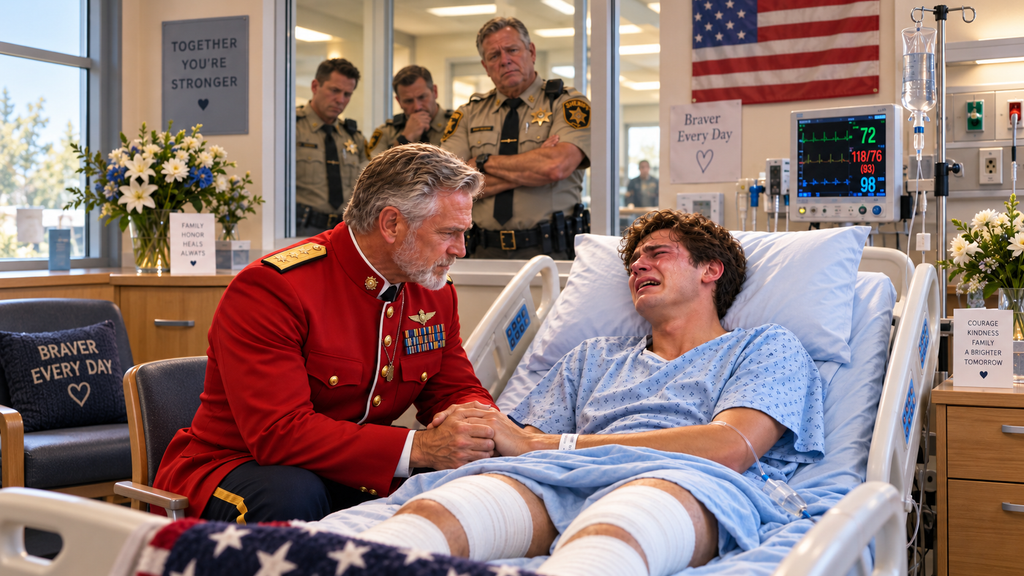
When I returned to the hospital, Sarah was asleep in a chair beside Tyler’s bed.
Her head rested against the wall.
One hand still held his.
I stood in the doorway.
Everything inside me changed.
The motel.
The files.
The courthouse.
Barnes.
All of it disappeared.
There was only my family.
Tyler looked toward me.
His eyes opened weakly.
“Dad?”
I walked inside.
Sarah woke.
She stood and hugged me so tightly I could barely breathe.
“Where were you?”
“Taking care of something.”
She pulled back.
Her eyes searched mine.
Sarah had known me long enough.
She knew there were parts of my past I rarely discussed.
She knew why I sometimes woke at three in the morning and checked every door.
She knew why crowded restaurants made me choose seats facing entrances.
She knew I carried names I never spoke.
But she had never asked me to become that man again.
I kissed her forehead.
“It’s over.”
She stared at me.
“Barnes?”
“Arrested.”
Her knees nearly gave out.
She sat.
Tyler looked confused.
“What?”
I moved beside his bed.
“Sheriff Barnes is in federal custody.”
Tyler stared.
“And the judge.”
“What judge?”
“The man Barnes was working with.”
Tyler swallowed.
His eyes filled.
“Because of me?”
“No.”
I held his hand.
“Because of what they did.”
There’s an important difference.
Victims often believe they caused the consequences that follow truth.
They didn’t.
The person who commits the harm owns the consequences.
Tyler stared at the ceiling.
After a moment, he whispered, “Is he going to get out?”
I understood the real question.
Will he come back?
Will he finish what he started?
I squeezed his hand.
“He cannot hurt you anymore.”
Tyler closed his eyes.
A tear rolled down his cheek.
Then he said the sentence that almost broke me.
“Dad… I was so scared.”
I leaned down.
“I know.”
“He had the gun pointed at me.”
“I know.”
“I thought he was going to kill me.”
My throat closed.
Sarah covered her mouth.
Tyler began crying.
Not quietly.
Not the way teenagers cry when they’re embarrassed.
The way children cry when they’ve been forcing themselves to stay strong.
I pulled him against me carefully.
He buried his face against my chest.
And suddenly, I wasn’t a soldier.
I wasn’t Reaper.
I wasn’t the man Barnes feared.
I wasn’t the invisible janitor.
I was just Tyler’s father.
I held my son while he cried.
And then I cried too.
For several minutes, none of us spoke.
We didn’t need to.
Harold entered later that afternoon.
He examined Tyler’s legs.
Reviewed scans.
Checked swelling.
Then he pulled a chair toward us.
His expression was serious.
Tyler noticed immediately.
“Just tell me.”
Harold nodded.
“The damage is severe.”
Tyler looked away.
“But…”
Tyler looked back.
Harold leaned forward.
“There is a path forward.”
Sarah grabbed my hand.
“What does that mean?”
“It means I can’t promise what Tyler’s recovery will look like.”
Harold chose every word carefully.
“He will need more surgery. Extensive rehabilitation. There may be permanent limitations.”
Tyler’s eyes filled again.
“Basketball?”
Harold paused.
That silence answered before he did.
“I don’t know.”
Tyler turned toward the window.
I watched him.
Basketball had been his world.
His bedroom walls were covered with team posters.
College recruitment letters sat on his desk.
He woke before school to practice free throws.
He studied game footage while eating breakfast.
To adults, basketball was a sport.
To Tyler, it was a future.
Now that future had vanished in gun smoke.
Harold rested a hand on his arm.
“Tyler.”
Tyler didn’t respond.
“Listen to me.”
Slowly, he turned.
“You asked whether you’ll play basketball again.”
Tyler nodded.
“I can’t answer that today.”
Harold continued.
“But I can tell you this.”
He leaned closer.
“You are going to fight for everything you can get back.”
Tyler stared at him.
“One degree of motion.”
“One step.”
“One flight of stairs.”
“One day at a time.”
Harold pointed toward his chest.
“This part matters more than your knees.”
Tyler looked down.
Harold smiled faintly.
“And I’ve met your father.”
Tyler looked toward me.
“So I know where you get your stubbornness.”
A weak smile appeared.
It was the first smile I had seen since the shooting.
That tiny smile meant more to me than Barnes’s arrest.
The investigation exploded over the next several weeks.
What began with Tyler’s shooting turned into one of the largest public-corruption cases Colorado had seen in years.
Judge Mercer cooperated fully.
Not because he suddenly became noble.
Because he wanted a reduced sentence.
I never confused cooperation with redemption.
He provided records proving Commissioner Wade had manipulated more than thirty million dollars in county contracts.
Barnes had intimidated witnesses in at least twelve cases.
Several people came forward.
A mechanic whose jaw Barnes had broken during a “traffic stop.”
A mother whose son had been jailed after reporting a deputy.
A business owner who had paid thousands in protection money disguised as campaign donations.
A former clerk who had discovered missing evidence and was forced to resign.
One story became ten.
Ten became fifty.
Fear began losing.
That was the most beautiful part.
People realized Barnes was in a cell.
Then they started talking.
Deputy Collins testified.
Two prosecutors resigned and agreed to cooperate.
Three officers were cleared after evidence showed they had attempted to report Barnes years earlier but were threatened.
Others were indicted.
The county government was placed under temporary external oversight.
Wade’s companies were frozen.
His photograph disappeared from the courthouse lobby.
The empty space remained on the wall for months.
I kept cleaning around it.
Reporters eventually discovered my military history.
I don’t know who leaked it.
Maybe Marcus.
He still denies it.
Headlines appeared.
Former Elite Commander Exposes Corruption Ring.
Courthouse Janitor’s Secret Past.
The Soldier Behind the Mop.
I hated all of them.
They made it sound like my past was the reason we won.
It wasn’t.
Evidence won.
People speaking won.
Tyler survived.
That was the victory.
Still, reporters camped outside our house.
One evening, Tyler watched a television segment from his hospital bed.
A retired officer I hadn’t seen in twenty-two years was describing an operation we had conducted overseas.
The anchor called me a hero.
Tyler looked at me.
“You never told me.”
I turned off the television.
“Most of it isn’t worth telling.”
He stared.
“They said you rescued twelve men.”
“They forgot the two we didn’t bring home.”
His expression changed.
That answer ended the glamour.
War often becomes a story told by people who weren’t there.
They remember victories.
The people who were there remember names.
Tyler was quiet for a while.
Then he asked, “Why did you quit?”
I looked toward Sarah.
She smiled.
“You.”
Tyler blinked.
“Me?”
“You were four months old.”
I sat beside him.
“I came home from an assignment.”
“You were crying.”
“Probably hungry.”
“You always were.”
He smiled.
“I picked you up.”
I remembered it perfectly.
Tiny fingers.
Warm cheek.
Blue blanket.
“You grabbed my shirt.”
Tyler laughed.
“I don’t remember that.”
“I do.”
I looked at him.
“And I realized I had spent most of my adult life believing courage meant running toward danger.”
His smile faded.
“But that night I understood courage could also mean walking away from it.”
Sarah’s eyes filled.
“I wanted to see you grow up.”
Tyler swallowed.
“So you became a janitor?”
I smiled.
“It had good insurance.”
He laughed.
Actually laughed.
The sound filled the hospital room.
I had missed it.
God, I had missed it.
Months passed.
Tyler’s first rehabilitation session lasted eleven minutes.
He hated every second.
His therapist, Maya Chen, had the patience of a saint and the personality of a drill instructor.
“Lift.”
“I am lifting.”
“You’re complaining.”
“I can do both.”
“Lift.”
He lifted.
Two inches.
His face twisted in pain.
Then three.
Then the leg dropped.
Tyler slammed his hand against the mat.
“I can’t.”
Maya looked at him.
“You just did.”
“Barely.”
“Barely counts.”
“No, it doesn’t.”
Maya crossed her arms.
“Interesting.”
Tyler glared.
“What?”
“Was your first basketball shot from the three-point line?”
He said nothing.
“Did you dunk the first time you touched a ball?”
“No.”
“Then why do you expect your damaged legs to perform like nothing happened?”
Tyler looked away.
Maya softened.
“Your body is learning again.”
He swallowed.
“I hate this.”
“I know.”
“What if I never get back?”
Maya’s voice became quiet.
“Back where?”
Tyler frowned.
“To who I was.”
She sat beside him.
“You may not.”
That answer surprised all of us.
Tyler stared.
Maya continued.
“And that doesn’t automatically mean your life becomes worse.”
His eyes filled.
“It means it becomes different.”
I watched my son absorb those words.
Different.
Not over.
Different.
There are moments when a life changes direction so violently that we keep staring backward, waiting for the old road to return.
Sometimes it doesn’t.
Sometimes healing begins when we stop demanding our old life back and start building whatever comes next.
Tyler began working harder.
Not dramatically.
There was no movie montage.
No miracle music.
Recovery was ugly.
Painful.
Boring.
Repetitive.
Some days he improved.
Other days he went backward.
There were infections.
Swelling.
Scar tissue.
Two additional surgeries.
Sleepless nights.
Anger.
Depression.
Days when Tyler refused to speak.
Days when Sarah cried in the laundry room so he wouldn’t hear.
Days when I sat in my truck after work because I needed five minutes alone before walking inside and pretending I was strong.
That was our war.
Not guns.
Not corruption.
Rehabilitation.
Marriage.
Parenthood.
Hope.
A year after the shooting, Sheriff Rick Barnes went to trial.
His lawyers claimed he had acted under pressure.
They attacked Tyler.
They called him confused.
They claimed he had exaggerated.
They called the shooting a tragic misunderstanding.
Then the prosecution played the courthouse recording.
Barnes’s voice filled the courtroom.
“He should’ve learned some respect.”
Then my voice.
“You shot a seventeen-year-old boy through both kneecaps to teach him?”
And Barnes.
“He was told to stay out of things that didn’t concern him.”
No one moved.
Tyler sat beside me wearing braces on both legs.
He stared straight ahead.
Barnes stared at the defense table.
For the first time since this began, I felt something almost like peace.
Truth sounded different in a courtroom.
Cleaner.
Sharper.
Impossible to intimidate.
Barnes was convicted on multiple federal counts.
Civil-rights violations.
Obstruction.
Witness intimidation.
Conspiracy.
Evidence tampering.
Bribery-related offenses.
The sentencing hearing filled every seat.
The judge asked whether Tyler wanted to speak.
He did.
My son stood.
Not easily.
He used two forearm crutches.
The room went silent.
Tyler slowly made his way toward the podium.
Every step cost him something.
Barnes watched.
Tyler adjusted the microphone.
His hands shook.
Then he looked directly at the man who shot him.
“When you pulled the trigger…”
His voice cracked.
He stopped.
Breathed.
Started again.
“When you pulled the trigger, you thought you were teaching me fear.”
Barnes stared.
“For a while, you did.”
Tyler swallowed.
“I was scared to sleep.”
“I was scared when cars slowed near our house.”
“I was scared when I saw police uniforms.”
“I was scared every time somebody opened my hospital door.”
Sarah started crying.
I looked down.
Tyler continued.
“You broke my knees.”
He paused.
“But you didn’t break my life.”
Barnes’s face changed.
“You don’t get that.”
Tyler’s voice became stronger.
“You don’t get my future.”
“You don’t get my family.”
“You don’t get the rest of my story.”
He stepped away from the microphone.
The entire courtroom stayed silent.
Then one person began clapping.
Maya.
Tyler’s therapist.
Another joined.
Then another.
The judge asked for order.
But even the judge’s eyes were wet.
Tyler returned to his seat.
He sat beside me.
I wrapped an arm around him.
“You okay?”
He nodded.
“Yeah.”
Then he whispered.
“I think I finally am.”
Barnes received a sentence that would keep him in prison for decades.
Commissioner Wade was convicted months later.
Judge Mercer accepted a plea agreement and received a reduced sentence in exchange for cooperation.
Several officials lost their careers.
Some deserved worse.
Others were cleared.
The county slowly rebuilt.
Not perfectly.
Nothing human is perfect.
But sunlight reached places where darkness had survived for years.
And Tyler?
Tyler never played competitive basketball again.
That sentence hurt him for a long time.
It hurt me too.
At first, he couldn’t walk without braces.
Then he used crutches.
Then one crutch.
Then a cane.
The day he took his first unassisted steps happened twenty-one months after the shooting.
We were in the rehabilitation gym.
Sarah was beside me.
Maya stood twenty feet away.
Tyler was holding parallel bars.
“Ready?” Maya asked.
“No.”
“Good.”
Tyler laughed nervously.
He released the bars.
His knees trembled.
He took one step.
Stopped.
Another.
His face tightened.
Another.
Sarah began crying.
I couldn’t breathe.
Tyler looked toward us.
“Dad.”
I nodded.
He took another step.
Then another.
Five.
Six.
Seven.
By the eighth, tears were running down his face.
By the tenth, they were running down mine.
He reached me.
His legs nearly gave out.
I caught him.
For a moment, I held my seventeen-year-old boy the same way I had held him when he was four months old.
Except now he was nineteen.
Taller than me.
Stronger than he believed.
He laughed into my shoulder.
“I walked.”
I held the back of his head.
“Yes.”
“I walked.”
“Yes, son.”
He pulled back.
“I walked.”
Sarah wrapped both of us in her arms.
Maya turned away and wiped her eyes.
No newspaper reported it.
No television crews came.
No federal agents stood nearby.
No headline appeared.
But that was the greatest victory of my life.
Years later, Tyler returned to the basketball court.
Not as a player.
As a coach.
He studied physical therapy in college.
Then sports rehabilitation.
Eventually he started working with injured teenagers.
Young athletes who believed one accident had ended everything.
Kids sitting in wheelchairs.
Kids learning to use prosthetics.
Kids rebuilding bodies after surgeries.
And Tyler told them the same thing Maya had told him.
“Different doesn’t mean over.”
Sometimes I stood outside the gym and watched.
He walked with a slight limp.
Cold weather still bothered his knees.
He couldn’t run the way he once had.
But when he laughed, I didn’t see what Barnes took.
I saw what Barnes failed to take.
Everything important.
Sarah and I stayed in Livingston County.
People expected me to leave courthouse maintenance after the story became public.
I didn’t.
A reporter once asked why.
I told her the truth.
“I like clean floors.”
She thought I was joking.
I wasn’t.
There is dignity in ordinary work.
That was something men like Mercer and Barnes never understood.
They believed uniforms created worth.
Titles created worth.
Money created worth.
Access created worth.
They were wrong.
A janitor can be more honorable than a judge.
A teenager can be braver than a sheriff.
A frightened clerk who finally tells the truth can be stronger than the politician who threatened her.
Real power is quieter than people think.
Years after Barnes went to prison, the county installed a plaque in the courthouse lobby recognizing citizens who helped expose corruption.
My name was on it.
So was Tyler’s.
I hated mine being there.
Tyler loved teasing me about it.
One evening, after the courthouse had closed, I stood beneath the plaque holding a mop.
Tyler had stopped by after work.
He was twenty-five now.
Married.
Planning to become a father himself.
He leaned against the wall and looked at the plaque.
“You know what’s funny?”
“What?”
“You spent seventeen years trying to be invisible.”
I wrung out the mop.
“And?”
“Now there’s literally a bronze sign with your name on it.”
I looked at the plaque.
Then at him.
“Terrible planning.”
He laughed.
That same laugh.
Older now.
Deeper.
But still my boy.
He walked toward me.
There was a slight stiffness in his left knee.
Most people wouldn’t notice.
I always did.
“Dad?”
“Yeah?”
“Can I ask you something?”
“Sure.”
“When I have kids…”
He hesitated.
“Are you ever going to tell them about all the secret military stuff?”
“No.”
He laughed.
“Seriously?”
“Absolutely not.”
“Come on.”
“They’ll think Grandpa cleaned a courthouse.”
“You did clean a courthouse.”
“Exactly.”
Tyler shook his head.
Then his expression softened.
“You know…”
He looked down the empty hallway.
“I used to think what you did to Barnes was the part that saved me.”
I stopped mopping.
“What do you mean?”
“The investigation.”
“The team.”
“The whole secret-warrior-dad thing.”
I smiled faintly.
“And now?”
He looked at me.
“It wasn’t.”
I waited.
“You saved me when you sat beside my hospital bed.”
My throat tightened.
Tyler continued.
“When I couldn’t move.”
“When I was angry.”
“When I yelled at you.”
“When I told you I wanted to quit therapy.”
He smiled.
“You kept showing up.”
I looked away.
Some praise is harder to hear than criticism.
He stepped closer.
“That was the strongest thing you did.”
I nodded once.
Because if I spoke, my voice would betray me.
Tyler reached out and hugged me.
I hugged him back.
For seventeen years, I had believed I left my old life because I wanted peace.
Maybe that was only part of it.
Maybe I left because I wanted to learn a different kind of courage.
The courage to stay.
To love people who can be taken from you.
To build a home even though homes can break.
To raise a child knowing the world can hurt him.
To wake up the next morning and keep going.
Sheriff Rick Barnes believed strength was making people afraid.
Judge Mercer believed strength was controlling the system.
Commissioner Wade believed strength was money.
I once believed strength was surviving gunfire.
We were all wrong.
Strength was Tyler taking ten painful steps across a rehabilitation room.
Strength was Sarah sitting beside his bed night after night.
Strength was Deputy Collins finally telling the truth.
Strength was frightened people speaking when silence would have been easier.
Strength was choosing not to become cruel simply because cruelty had found you.
And sometimes…
Strength was nothing more dramatic than an old man in work boots pushing a mop down an empty courthouse hallway after midnight.
A man everyone had once ignored.
A man who had spent years hiding from who he used to be.
A father who learned that the most important battle of his life wasn’t won with weapons.
It was won by refusing to let fear write the ending.
Tyler survived.
He walked again.
He built a life.
Barnes lost the badge he believed made him untouchable.
Mercer lost the courtroom he believed belonged to him.
Wade lost the empire he had bought with fear.
And me?
I went home.
Every night.
To Sarah.
To my son.
To the life I had chosen all those years ago.
Because in the end, that was the only mission that ever truly mattered.
And this time…
I brought everyone home.
THE END! THANK YOU FOR READING!❤️