 Reading Time: 50 minutes
Everyone around us cheered when the first slice of cake revealed a bright pink center. Everyone except my daughter.
Lauren stared at that piece of cake as if someone had just placed evidence of a crime in front of her. Then she started crying. At first, people smiled.
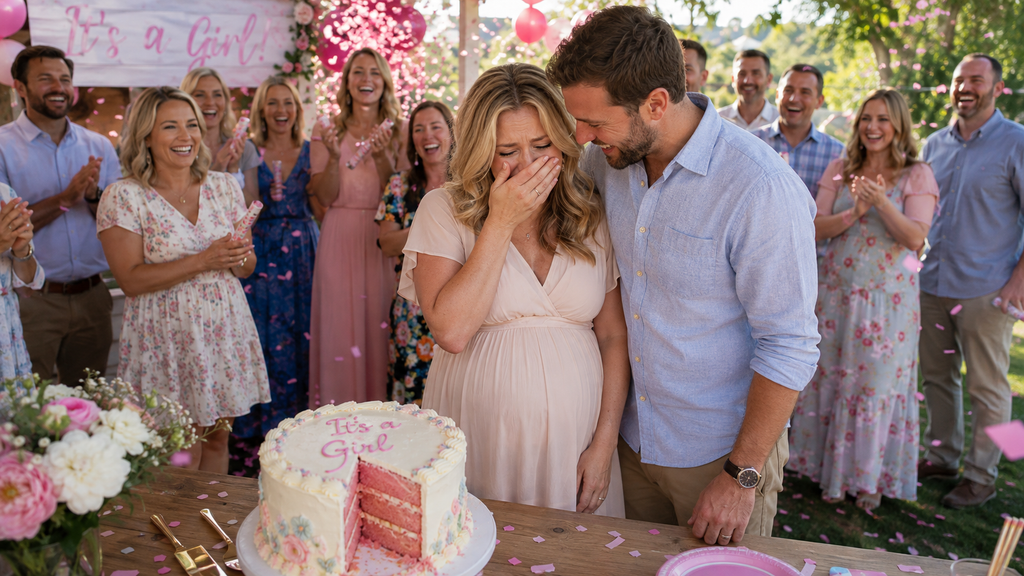
They thought they understood.
After four years of heartbreak, two miscarriages, three failed fertility treatments, and enough hospital visits to make the smell of disinfectant feel permanently attached to our family, no one questioned a pregnant woman crying at her gender reveal.
Her best friend hugged her.
My sister clapped both hands over her mouth.
Someone behind me shouted, “It’s a girl!”
Lauren’s husband, Mark, wrapped his arms around her and kissed her temple.
“We’re having a daughter,” he whispered.
Everyone thought it was beautiful.
I didn’t.
Because I knew my daughter.
And those were not tears of happiness.
Lauren looked terrified.
Her face had gone almost colorless.
One hand gripped the edge of the table.
The other rested protectively over her stomach.
And while everyone else stared at the pink cake, Lauren stared at her husband.
Then I saw the baker standing by my backyard gate.
She had delivered the cake that morning.
Now she was staring at Mark too.
When our eyes met, she didn’t smile.
She lifted one hand and quietly motioned for me to come over.
I hesitated.
Then she mouthed four words that changed everything.
“You need to know.”
That was the moment my daughter’s gender-reveal party stopped being a celebration.
And became the day her marriage fell apart.
But to understand why, you have to understand what it took for Lauren to get to that backyard in the first place.
My daughter had waited four years for that baby.
Four years.
People say that number casually.
Four years doesn’t sound like forever.
It is only forty-eight months.
A few birthdays.
A handful of Christmases.
A presidential term.
But when you are trying desperately to have a child, four years can feel like an entire lifetime measured in pregnancy tests, blood draws, waiting rooms, medications, whispered prayers, and disappointment.
Lauren had always wanted to be a mother.
Even when she was little, she mothered everything.
Dolls.
Stuffed animals.
Injured birds.
Her younger cousins.
Once, when she was six, she found a caterpillar on our front porch and carried it around in a plastic cup filled with leaves because she was convinced it had been “abandoned by its family.”
That was Lauren.
She felt everything deeply.
She loved carefully.
And when she married Mark, I believed she had found someone who understood that softness.
They met when Lauren was twenty-seven.
He was charming without being flashy.
Quietly confident.
The kind of man who remembered how you took your coffee and carried grocery bags without being asked.
I liked him almost immediately.
More importantly, Lauren loved him.
They married three years later in a small ceremony by a lake.
I still remember Mark’s face when she walked toward him.
He looked overwhelmed.
Genuinely overwhelmed.
For years afterward, whenever I saw their wedding photographs, that was what reassured me.
No matter what difficulties they faced, I would look at Mark’s expression in that picture and think:
That man loves my daughter.
At the time, I had no idea how incomplete love could be when it was built beside secrets.
Lauren became pregnant during their second year of marriage.
She called me before she even told Mark.
“Mom?”
There was something strange in her voice.
I was standing in the grocery store holding a bag of oranges.
“What happened?”
“Nothing happened.”
“Lauren.”
“I took a test.”
My fingers tightened around the phone.
“A pregnancy test?”
“Yes.”
“And?”
She laughed.
Then she started crying.
“Positive.”
I abandoned my shopping cart beside the oranges.
I sat in my car for nearly twenty minutes afterward because I was too emotional to drive.
Lauren had wanted that baby so badly.
Mark had too.
Or at least that was what we believed.
For seven weeks, they lived in a kind of cautious happiness.
Lauren downloaded pregnancy apps.
She refused caffeine.
She researched car seats that she would not need for eight more months.
She bought one tiny pair of white socks and hid them in the back of a drawer because she was afraid buying anything else might “tempt fate.”
Then, during the eighth week, she called me at 2:17 in the morning.
“Mom.”
That one word told me everything.
I was out of bed before she finished the sentence.
“There’s blood.”
The emergency room confirmed the miscarriage before sunrise.
I sat beside her while she cried into Mark’s chest.
He held her.
He cried too.
I remember looking at them and thinking grief like that would either pull them apart or bind them together forever.
I believed it had bound them.
Six months later, Lauren became pregnant again.
This time she didn’t call me immediately.
She waited three days.
When she finally told me, she almost apologized.
“I’m scared to be happy.”
“You don’t have to be anything,” I told her. “Just take it one day at a time.”
That pregnancy lasted eleven weeks.
The second loss was worse.
Not because one baby mattered more than another.
Grief doesn’t work like that.
But because the first miscarriage had taken away their innocence.
The second one took away Lauren’s confidence.
After that, pregnancy no longer meant a baby to her.
Pregnancy meant waiting for something terrible to happen.
She blamed herself.
Of course she did.
People can tell a grieving woman a hundred times that a miscarriage wasn’t her fault, but sometimes the heart is crueler than science.
Lauren analyzed everything.
Maybe she had exercised too much.
Maybe she had worked too late.
Maybe the coffee she drank before she knew she was pregnant had hurt the baby.
Maybe she shouldn’t have taken that road trip.
Maybe she had done something.
Maybe.
Maybe.
Maybe.
I spent months trying to pull her out of those thoughts.
Mark seemed to do the same.
He attended appointments.
He researched fertility specialists.
He sat beside Lauren during testing.
When doctors recommended treatment, he held her hand while she learned how to give herself injections.
He told her they were a team.
“We’re in this together,” I heard him say more than once.
At the time, those words comforted me.
Years later, I would remember them and feel sick.
Because while Lauren was grieving that second miscarriage, Mark made a choice that would eventually destroy everything.
We simply didn’t know it yet.
The fertility treatments began the following year.
People who haven’t gone through infertility sometimes imagine treatment as a straightforward medical process.
Take medication.
See a doctor.
Become pregnant.
It isn’t like that.
Not emotionally.
Lauren’s life became ruled by calendars.
Day three bloodwork.
Day five medication.
Day ten ultrasound.
Another injection.
Another appointment.
Another number.
Another phone call.
Every month contained hope and grief compressed into the same few weeks.
The first treatment failed.
Lauren cried for two days.
Then she went back to work Monday morning.
The second failed.
She stopped talking about baby names.
The third failed.
That one broke something in her.
I found her sitting on her bathroom floor that night.
She wasn’t crying anymore.
She was simply staring at the wall.
“I think my body hates me,” she whispered.
I sat beside her.
“No.”
“It won’t do the one thing I want it to do.”
“Lauren.”
“I see pregnant women everywhere.”
She laughed bitterly.
“At work. At Target. At the grocery store. Online. Everyone gets pregnant accidentally except me.”
I put my arm around her.
She leaned into me.
“I’m jealous of people I don’t even know,” she said. “What kind of person does that make me?”
“A hurting one.”
She finally cried then.
Mark came home while I was still there.
He sat beside her on the bathroom floor.
He pulled both of us into his arms.
“I don’t care how long this takes,” he told her. “We’ll keep trying if you want to keep trying.”
Lauren looked at him.
“What if it never happens?”
He kissed her forehead.
“Then I still have you.”
That sentence stayed with me.
For years, I considered it proof of his devotion.
I didn’t know that approximately a year earlier, while Lauren was recovering from her second miscarriage, Mark had slept with another woman.
Her name was Tania.
And that one night had resulted in a daughter.
Mark knew.
He had known for more than three years.
He simply chose not to tell his wife.
My daughter.
The woman who spent those same three years believing he was grieving beside her.
But on that bathroom floor, none of us knew any of that.
We knew only the version of Mark he had carefully maintained.
The supportive husband.
The patient partner.
The man who wanted a baby just as desperately as Lauren did.
Then, after the third failed treatment, Lauren’s doctor suggested taking a break.
Not quitting.
Just resting.
Three months without injections.
Without appointments.
Without constant monitoring.
Lauren initially hated the idea.
She felt as though stopping meant giving up.
Eventually, she agreed.
For the first time in years, she and Mark took a vacation without calculating fertile windows.
They went to the mountains.
They hiked.
They ate food without Googling whether it helped fertility.
Lauren drank wine.
She slept late.
She came home looking more like herself than she had in years.
Six weeks later, she called me.
“Mom.”
That voice again.
I immediately sat down.
“What?”
“I think I’m pregnant.”
My heart stopped.
“Think?”
“I’m three days late.”
“Have you tested?”
“No.”
“Why not?”
“Because I’m terrified.”
I understood.
For another woman, a pregnancy test might have represented possibility.
For Lauren, it represented a door that might open directly into grief.
“Do you want me to come over?”
There was a pause.
“Yes.”
I drove there immediately.
Mark was at work.
Lauren had already purchased three tests.
They were lined up on the bathroom counter like tiny pieces of evidence.
She took the first.
We waited.
She refused to look.
“You look,” she whispered.
I did.
Two lines.
For a second, I couldn’t breathe.
“Lauren.”
She covered her face.
“What?”
I reached for her hand.
“It’s positive.”
She started shaking.
Not cheering.
Not laughing.
Shaking.
“Take another.”
She did.
Positive.
Then the third.
Positive.
Lauren sat on the closed toilet seat staring at all three.
“This wasn’t treatment,” she whispered.
“No.”
“We weren’t even trying properly.”
I laughed through my tears.
“Apparently your baby didn’t check the schedule.”
That finally made her smile.
Then she placed both hands over her stomach.
“Please stay,” she whispered.
Those two words nearly destroyed me.
Please stay.
She wasn’t talking to me.
She was talking to a baby the size of a seed.
A child who could not hear her.
A child she already loved.
When Mark came home that evening, Lauren recorded his reaction.
She handed him a small gift box.
Inside were the three tests.
He stared at them.
Then at her.
Then back at the box.
“Are you serious?”
Lauren nodded.
He dropped the box onto the couch and hugged her so tightly she laughed.
I watched the video later.
For a long time, I wondered whether that joy had been real.
Eventually, I decided it probably had been.
Human beings are complicated enough to love someone and still betray them.
Mark could have loved Lauren.
He could have wanted their baby.
He could have meant every kiss, every hug, every word.
And he could still have been lying to her every single day.
The first trimester was brutal.
Not physically.
Emotionally.
Every cramp frightened Lauren.
Every quiet morning frightened her because she worried the disappearance of nausea meant something had gone wrong.
She checked for blood almost every time she used the bathroom.
She called her doctor constantly.
At six weeks, they saw a heartbeat.
Lauren cried.
At eight weeks, another ultrasound.
Still healthy.
At ten weeks, healthy.
At twelve weeks, healthy.
With every appointment, the fear loosened a little.
Not completely.
I don’t think anyone ever returns fully to innocence after pregnancy loss.
But slowly, Lauren started believing that this baby might actually come home.
She bought another pair of socks.
Then a stuffed rabbit.
Then a wooden picture frame.
She kept them on a shelf in the spare bedroom.
“Not the nursery yet,” she told me.
“Of course.”
“Just the spare room.”
“Absolutely.”
A week later, she ordered a crib.
I didn’t tease her.
I knew what it meant.
Hope had started winning.
By eighteen weeks, Lauren’s stomach had a visible curve.
She took pictures almost every morning.
Mark appeared attentive.
He attended appointments whenever work allowed.
He cooked when she felt tired.
He rubbed her back.
He reminded her to drink water.
From my perspective, he was doing everything a husband should do.
I was grateful.
I had watched my daughter carry so much emotional weight.
I was relieved she didn’t have to carry it alone.
Then came the gender reveal.
Lauren never wanted anything extravagant.
No smoke cannons.
No fireworks.
No huge party designed for social media.
“I just want cake,” she said.
“Cake I can do.”
“And family.”
“Also manageable.”
“And maybe a few friends.”
“Done.”
She smiled.
“Your backyard?”
“Of course.”
The plan was simple.
Lauren’s obstetrician wrote the baby’s sex on a card and sealed it inside an envelope.
Lauren and Mark took the envelope directly to a bakery across town.
They had never opened it.
Or at least Lauren hadn’t.
The bakery would prepare a white cake containing either pink or blue filling.
Nothing outside would reveal the answer.
Lauren loved the simplicity.
During the week before the party, she became excited in a way I had not seen throughout the pregnancy.
“What do you think?” she asked me over the phone.
“About what?”
“Boy or girl?”
“I refuse to guess.”
“Mom.”
“I want a healthy grandbaby. That’s my official prediction.”
“You’re boring.”
“I’m wise.”
She laughed.
“I think boy.”
“Why?”
“I don’t know. I just do.”
Then she became quiet.
“I dreamed about him.”
“Him?”
“A little boy.”
“What happened?”
“We were walking on the beach.”
Her voice softened.
“He was holding my finger.”
Something squeezed inside my chest.
“Maybe you met him early.”
“Maybe.”
Then she laughed.
“But if the cake is pink Saturday, forget I said any of that.”
Saturday morning arrived warm and bright.
I was outside before eight.
I cleaned patio furniture that was already clean.
I hung cream-colored and gold decorations along the fence.
Lauren had specifically asked me not to use pink and blue because she didn’t want anyone guessing from the decorations.
My sister arrived around ten carrying flowers.
Lauren’s best friend arrived with a tray of sandwiches.
By eleven, the backyard looked beautiful without looking staged.
That mattered to Lauren.
The baker arrived just before noon.
Her name was Emma.
I remembered because Lauren had spoken about her several times.
“She’s been amazing,” she told me. “She takes this gender-secret thing more seriously than a government agency.”
Emma climbed from a white delivery van carrying the cake carefully with both hands.
She was around Lauren’s age.
Early thirties.
Dark hair tied in a loose knot.
There was flour on one sleeve.
“Rose?”
“That’s me.”
“Where would you like this?”
I opened the gate.
“Covered patio. We have a table ready.”
The cake was heavier than it looked.
Large, round, white frosting, simple piping.
Elegant.
Nothing about the outside indicated pink or blue.
“Lauren will love it.”
Emma smiled.
“I hope so.”
At the time, I didn’t notice the hesitation.
We set it on the table.
Emma crouched briefly, adjusting something beneath the cake board.
I assumed she was making sure it sat evenly.
Then she stood.
“Keep it shaded.”
“We will.”
“And preferably don’t move it until you cut it.”
“Understood.”
She glanced toward the house.
“Is Lauren here yet?”
“Not yet.”
Emma nodded.
Then she lingered.
Just a few seconds.
Long enough for me to notice.
“Everything okay?” I asked.
Her eyes met mine.
“Yes.”
The answer came too quickly.
Before I could ask anything else, she thanked me and returned to her van.
I watched her leave.
Then I forgot about it.
By one thirty, the yard was full.
My brother came with his wife.
My sister brought her teenage daughters.
Lauren’s closest friends arrived carrying presents despite being told gifts weren’t necessary.
Someone brought balloons.
Lauren laughed when she saw them.
“I specifically said no balloons.”
Her friend shrugged.
“I specifically ignored you.”
For the first time in a very long time, my daughter looked surrounded by uncomplicated happiness.
That was what I thought at first.
Lauren wore a pale green dress.
Her hair fell loosely around her shoulders.
Pregnancy had softened her face.
She glowed in the way people always describe pregnant women glowing, though I knew some of it was carefully applied concealer because she still didn’t sleep well before appointments.
Mark stayed close to her.
Too close, perhaps.
I only noticed that in retrospect.
His hand remained near her waist as they greeted guests.
Whenever Lauren walked away, his eyes followed her.
At the time, it looked protective.
Later, I realized it might have been nervousness.
There is a terrible thing that happens after discovering a lie.
Your mind rewinds everything.
You examine old conversations.
Old gestures.
Old silences.
You ask whether every ordinary moment contained clues you were too trusting to notice.
That afternoon became like that for me.
Every memory changed after I knew what Mark had done.
Around three, I found Lauren alone in the kitchen.
She was standing at the sink drinking water.
“You okay?”
She jumped slightly.
“Yeah.”
“You sure?”
She smiled.
“Just overwhelmed.”
I hugged her.
“Good overwhelmed?”
“Mostly.”
Mostly.
I noticed the word.
I should have asked more.
Instead, I kissed her cheek.
“You deserve today.”
Her eyes filled immediately.
“Oh, no,” I said. “Don’t start crying before the cake.”
She laughed and wiped her eyes.
“Pregnancy hormones.”
That was the answer everyone used whenever Lauren became emotional.
Pregnancy hormones.
Anxiety.
Excitement.
No one knew she had seen something on Mark’s phone the night before.
Not yet.
Around four, the sun began drifting behind the trees.
Someone suggested we cut the cake while there was still good light for pictures.
Everyone gathered near the patio.
Phones came out.
Lauren stood behind the table with Mark beside her.
Her best friend handed her the knife.
Lauren laughed nervously.
“I feel like this is our wedding again.”
Mark smiled.
“Hopefully the cake tastes better.”
People laughed.
Lauren looked at him.
There was something strange in that look.
Only for a second.
Then she turned toward the cake.
Someone started counting down.
“Three!”
Everyone joined.
“Two!”
Lauren gripped the knife.
“One!”
She pushed the blade through the white frosting.
People leaned closer.
The yard went quiet.
She made one cut.
Then another.
Mark placed his hand over hers.
Together they lifted the slice.
Pink filling.
For half a heartbeat, nobody reacted.
Then the backyard exploded.
“It’s a girl!”
People screamed.
My nieces jumped up and down.
Lauren’s best friend burst into tears.
Someone popped a balloon even though there wasn’t supposed to be anything inside it.
I laughed.
I clapped.
Then I looked at my daughter.
And stopped.
Lauren was staring at the cake.
Motionless.
The smile had disappeared.
Her lips parted slightly.
The knife remained in her hand.
Then tears started sliding down her face.
Everyone assumed they were happy tears.
Her best friend hugged her from one side.
Mark hugged her from the other.
“A girl,” someone shouted.
“You’re getting your baby girl!”
Lauren didn’t respond.
Mark kissed her temple.
“We’re having a daughter,” he said.
Lauren whispered something.
I was close enough to hear it.
“I know.”
Two words.
Nothing unusual.
Except for the way she said them.
There was no joy in her voice.
Only fear.
I watched her closely.
She wasn’t looking at the cake anymore.
She was looking at Mark.
And Mark—
Mark looked relieved.
That was what bothered me.
Not happy.
Relieved.
There is a difference.
Happiness expands a person.
Relief releases them.
His shoulders dropped.
His jaw loosened.
He exhaled.
Like someone who had just watched a dangerous moment pass.
My stomach tightened.
I told myself I was imagining it.
Then I noticed Lauren’s hand shaking.
She set the knife down.
“You okay, sweetheart?” I asked.
She nodded immediately.
“Yeah.”
“You’re pale.”
“I’m fine.”
Mark answered for her.
“She’s emotional.”
Lauren looked at him.
Again, that strange expression.
Again, only for a second.
Before I could ask anything else, I saw movement near the back gate.
Emma.
The baker.
She was standing outside.
At first, I assumed she had forgotten something.
Then I noticed she wasn’t looking at the cake.
She was staring at Mark.
Her arms were folded tightly against her body.
When our eyes met, she lifted her hand.
She motioned me over.
I looked at Lauren.
People surrounded her.
Talking.
Hugging.
Taking photographs.
Mark remained beside her.
Emma motioned again.
More urgently.
I crossed the yard.
“What happened?” I asked.
She glanced over my shoulder.
“Can we talk somewhere private?”
My stomach tightened.
“About what?”
“The cake.”
“What about it?”
Emma swallowed.
“Not here.”
Something in her expression frightened me.
We walked toward her delivery van parked along the side of the house.
She opened the passenger door and reached inside for her phone.
“What’s going on?”
She unlocked the screen.
“I almost didn’t come back.”
“Come back for what?”
“To tell you.”
“Tell me what?”
She looked directly at me.
“This morning your son-in-law came to the bakery.”
My first reaction was confusion.
“Mark?”
“Yes.”
“He was supposed to be with Lauren.”
“I don’t know where he told her he was.”
My heart began beating faster.
“What did he want?”
Emma took a breath.
“He said there had been a mistake with the envelope.”
I stared at her.
“What mistake?”
“He claimed the envelope you originally brought us contained incorrect information.”
“That doesn’t make sense.”
“I know.”
“What did you do?”
“At first, I refused to change anything.”
She opened a video on her phone.
“Our front counter has security cameras.”
The footage showed the bakery.
A timestamp from that morning appeared in the corner.
Then Mark entered.
Even without audio, there was no mistaking him.
My stomach dropped.
But he wasn’t alone.
A woman walked beside him.
Tall.
Dark blond hair.
Red coat.
Maybe thirty-five.
I had never seen her before.
She carried a white envelope.
“Who is that?”
“I don’t know,” Emma said. “At least, I didn’t then.”
Onscreen, Mark spoke to someone behind the counter.
The woman beside him handed over the envelope.
Emma continued.
“They said the doctor had called and there had been a labeling mistake.”
“Did you believe them?”
“No.”
“Then why change the cake?”
Emma looked ashamed.
“They paid the owner five hundred dollars.”
I stared at her.
“Five hundred dollars?”
She nodded.
“For us to use the result from the second envelope.”
Everything inside me went cold.
I looked back toward the backyard.
People were still laughing.
My daughter stood beside the pink cake.
Mark had one arm around her.
“How would Mark know the first envelope was wrong?”
Emma didn’t answer.
Because there was no reasonable answer.
I turned back.
“What did the original envelope say?”
She hesitated.
“Rose…”
“What did it say?”
“Male.”
I felt the world tilt.
“A boy?”
“Yes.”
Lauren had been right.
Her baby was a boy.
The cake should have been blue.
Instead, Mark had paid someone to make it pink.
“Why?”
“That’s what frightened me.”
I stared at her.
“What do you mean?”
Emma looked toward the backyard again.
“The woman came back.”
“Who?”
“The woman who was with Mark.”
“When?”
“About an hour after he left.”
“Alone?”
“Yes.”
My mouth went dry.
“What did she want?”
Emma lowered her voice.
“She asked me to hide something underneath the cake board.”
For a moment, I genuinely thought I had misheard her.
“Hide something?”
“Yes.”
“What?”
“She wouldn’t tell me.”
“You put something under my daughter’s cake without knowing what it was?”
Emma winced.
“I know how that sounds.”
“It sounds insane.”
“It is. I shouldn’t have done it.”
“Then why did you?”
“Because she was crying.”
That stopped me.
“What?”
“She came in completely different from earlier. She looked furious, but she was crying. She said your daughter deserved the truth and that she couldn’t let Mark erase someone.”
Erase someone.
The words made my stomach twist.
“What did she give you?”
“A sealed envelope.”
“Where is it?”
Emma looked toward the cake.
“Still under the board.”
I didn’t say another word.
I turned and hurried across the yard.
Emma followed.
I could hear laughter as we approached.
Someone was asking Lauren whether she had names picked out for a girl.
Lauren smiled weakly.
Mark answered.
“We have time.”
I reached the cake.
My hands shook as I moved plates aside.
“What are you doing, Mom?” Lauren asked.
“Nothing.”
Mark saw Emma behind me.
His expression changed immediately.
That was when I knew.
Whatever was happening, Mark knew about it.
His face tightened.
“Rose.”
I ignored him.
I gripped the cake stand.
“Mom?” Lauren asked again.
Emma stepped closer.
“Underneath.”
I lifted one side of the cake board.
For a second, I saw nothing.
Then the cardboard shifted.
There.
A white envelope.
Taped flat beneath the board.
My heart pounded so hard I heard it in my ears.
I pulled it free.
Lauren stared.
“What is that?”
Mark was already moving.
“Rose.”
His voice sounded different now.
Low.
Warning.
“Give me that.”
I stepped backward.
“No.”
Conversations around us began stopping.
“What is it?” Lauren asked.
Mark held out his hand.
“Rose, this isn’t the place.”
I looked at him.
“You’re right.”
His expression flickered with relief.
Then I continued.
“The place was three and a half years ago, when apparently you should have told my daughter something.”
His face turned white.
Lauren froze.
“What?”
Mark looked at Emma.
“You had no right.”
Emma’s voice shook.
“She had a right to know.”
“Know what?” Lauren demanded.
Neither answered.
Lauren stepped toward me.
“Mom.”
I looked at my daughter.
Her eyes were wide.
One hand was pressed against her stomach.
“What is happening?”
I held up the envelope.
“Mark came to the bakery this morning.”
Lauren slowly turned toward her husband.
“No, he didn’t.”
Nobody moved.
She looked at me again.
“He was at the gym.”
Mark closed his eyes.
That was enough.
Lauren’s face changed.
“You weren’t at the gym?”
“Lauren.”
“You told me you went to the gym.”
“I can explain.”
Those words.
I have never understood why people caught in devastating lies reach for those words.
I can explain.
As though explanation is the same as innocence.
Lauren looked at Emma.
“What happened?”
Emma took out her phone.
“Your husband came to the bakery with another woman.”
Lauren’s lips parted.
“What woman?”
“I have footage.”
Mark stepped forward.
“Don’t.”
Lauren spun toward him.
“Don’t what?”
“Let’s talk inside.”
“No.”
“Lauren.”
“No!”
Her voice cracked across the backyard.
Everything became silent.
My sister immediately took the younger children into the house.
A few guests moved toward the gate.
Others remained frozen.
Lauren looked at Emma.
“Show me.”
Mark reached for her arm.
She jerked away.
“Do not touch me.”
He stopped.
Emma turned the phone toward Lauren.
The video played.
Mark entered the bakery.
The woman beside him appeared.
Lauren stopped breathing.
I saw recognition before she spoke.
Her entire face went still.
“Oh my God.”
“You know her?” I asked.
Lauren stared at the screen.
“Yes.”
Mark looked toward the ground.
“Who is she?” I asked.
Lauren whispered the name.
“Tania.”
Mark said nothing.
Lauren raised her eyes.
“What was Tania doing with you?”
“Lauren—”
“What was she doing with you?”
“I was trying to handle something.”
Her laugh was tiny and broken.
“Handle what?”
Silence.
Lauren looked at me.
“The envelope.”
I handed it to her.
Mark moved again.
“Please don’t do this here.”
Lauren looked at him.
“I’m not doing anything.”
Her voice became frighteningly calm.
“You did.”
Then she tore open the envelope.
Inside were two things.
A folded sheet of paper.
And a photograph.
Lauren pulled out the photograph first.
She stared at it.
I watched color disappear from her face.
“No.”
Mark closed his eyes.
Lauren held the picture closer.
“No.”
I stepped beside her.
The photograph showed Mark.
Tania.
And between them, a little girl.
Three years old, perhaps four.
Dark hair.
A yellow dress.
She was holding Mark’s hand.
But it wasn’t the hand-holding that made the truth obvious.
It was her face.
Her eyes.
Mark’s exact eyes.
The same shape.
The same deep brown.
Even the same slight tilt at the corners.
Lauren noticed too.
Her fingers began trembling.
“Who is this child?”
Mark looked devastated.
“Lauren…”
“Who is she?”
He swallowed.
No one else in the yard seemed to breathe.
Finally, Mark whispered:
“My daughter.”
The photograph slipped from Lauren’s fingers.
I caught it before it hit the ground.
Lauren grabbed the edge of the table.
“What did you say?”
Mark’s eyes filled with tears.
“She’s my daughter.”
Lauren stared at him.
“How old?”
He hesitated.
That hesitation told her everything.
“How old, Mark?”
“Three and a half.”
Lauren made a sound I will never forget.
Not quite a cry.
Not quite a gasp.
It was the sound of something breaking.
Three and a half years.
I did the calculation instantly.
So did Lauren.
The second miscarriage.
Mark had slept with Tania shortly after Lauren lost their second baby.
While my daughter was drowning in grief, her husband had created a child with someone else.
Lauren pressed both hands against her stomach.
“You cheated on me.”
Mark stepped closer.
“It happened once.”
She laughed.
Actually laughed.
But there was so much pain in it that I wanted to cover my ears.
“Once.”
“Yes.”
“Is that supposed to help?”
“No.”
“Because you keep saying it like that changes something.”
“I’m not trying to—”
“You slept with another woman while I was recovering from losing our baby.”
“I know.”
“You knew I couldn’t sleep.”
“I know.”
“You knew I blamed myself.”
“I know.”
“You watched me cry every night.”
His face crumpled.
“I know.”
“And you left me in that house and slept with someone else.”
“I was drunk.”
Lauren stared at him.
Then something hardened inside her.
“Do not insult me with alcohol.”
He lowered his eyes.
“We had been fighting.”
“Because I had just miscarried!”
“I know.”
“No, you clearly don’t.”
Tears poured down her face.
“You know what I remember from that month?”
Mark said nothing.
“I remember you telling me I was pushing you away.”
He covered his face.
“I was angry.”
“You told me you missed your wife.”
“I shouldn’t have said it.”
“I was bleeding from losing our child, and you told me you missed the fun version of me.”
“I was horrible.”
“Yes.”
He flinched.
Lauren pointed toward the photograph.
“And then you found someone fun?”
“No.”
“Then what?”
“I made one terrible mistake.”
Lauren’s expression changed.
“One mistake?”
She picked up the photograph again.
“That child is three and a half years old, Mark.”
He went silent.
“This stopped being one mistake the morning after you slept with Tania.”
Her voice trembled.
“It became a choice every day after that.”
He shook his head.
“I wanted to tell you.”
“But you didn’t.”
“I was afraid.”
“Of what?”
“Losing you.”
Lauren’s eyes filled again.
“You were willing to let me live inside a lie because you didn’t want to experience the consequences of what you did.”
He had no answer.
She unfolded the note.
Her hands shook so badly she had to steady the paper against the table.
I watched her read.
Once.
Then again.
When she reached the end, she closed her eyes.
“What does it say?” I asked gently.
Lauren looked at Mark.
“She says you’ve known since before the baby was born.”
He nodded.
Three and a half years.
Not three and a half days.
Not three months.
Years.
Lauren pressed the note against her chest.
“You knew.”
“Yes.”
“When she was pregnant?”
“Yes.”
“And you said nothing.”
“I panicked.”
“When she gave birth?”
“Yes.”
“And you said nothing.”
“Yes.”
“When our first fertility treatment failed?”
His eyes closed.
“Yes.”
“When the second failed?”
“Yes.”
“When I cried on the bathroom floor after the third?”
He started crying.
“Yes.”
Lauren’s voice broke.
“You sat next to me.”
“I know.”
“You held me.”
“I know.”
“You told me we were in this together.”
“I meant it.”
She stared at him.
That sentence seemed to hurt more than everything else.
“You meant it?”
“Yes.”
“How?”
“I loved you.”
“Loved?”
“I love you.”
“No.”
“Lauren.”
“No.”
She shook her head.
“You don’t get to use love like that.”
I had never seen my daughter so angry.
Not loud.
Not wild.
Lauren’s anger was colder than that.
“You knew there was a little girl in this world who was yours while I was injecting hormones into my stomach every night because we thought we couldn’t have a child.”
Mark wiped his face.
“I never thought of it that way.”
“Well, I did.”
She pointed toward the photograph.
“Just now.”
He looked completely broken.
But my sympathy stayed with my daughter.
Because Mark was grieving consequences.
Lauren was grieving reality.
Those were not the same thing.
I looked at Emma.
“Why the cake?”
Lauren turned.
“Yes.”
Her voice was quiet.
“What does any of this have to do with the cake?”
Emma glanced at Mark.
He didn’t answer.
So she did.
“The original envelope from your doctor said male.”
Lauren went still.
I watched the words reach her.
Her eyes moved toward the cake.
Pink.
Then toward Mark.
“What?”
Emma repeated gently.
“You’re having a boy.”
Lauren covered her mouth.
A sob escaped.
For months, she had suspected boy.
She had dreamed about a little boy holding her finger on a beach.
And now even this moment had been stolen from her.
Not because she cared whether she was having a son or daughter.
But because her husband had manipulated the truth.
Lauren turned to Mark.
“You changed it?”
He whispered, “Yes.”
“You paid them?”
“Yes.”
“Five hundred dollars?”
He nodded.
“Why?”
He looked toward the ground.
“Mark.”
Nothing.
Lauren slammed her palm against the table.
“WHY?”
He flinched.
“Tania knew we were having a boy.”
Silence.
Lauren stared at him.
“How?”
“I told her.”
Another blow.
“You told Tania our baby’s gender before me?”
“It wasn’t like that.”
“How was it?”
“She had seen the envelope.”
“You had opened it?”
“Yes.”
Lauren staggered backward.
I caught her arm.
She pulled away gently and stood on her own.
“So you knew.”
“Yes.”
“Before today.”
“Yes.”
“How long?”
“Three days.”
Lauren breathed in slowly.
“And you let me stand here pretending we were discovering this together.”
“I’m sorry.”
“Why did she care that it was a boy?”
Mark looked toward the photograph.
When he finally spoke, his voice barely carried.
“She thought if we had a son, I would forget about Ava.”
Lauren’s eyes moved toward the photograph.
“Ava.”
“Our daughter’s name.”
“Our?”
Mark realized what he had said.
Lauren laughed bitterly.
“Interesting.”
“I didn’t mean—”
“No. Say it.”
“Lauren.”
“Say her name.”
He looked confused.
“What?”
“The little girl.”
“Ava.”
Lauren stared at the photograph.
For a moment, her anger changed.
There was pain.
But also something softer.
Because that was my daughter.
Even at the moment of discovering the worst betrayal of her life, she could still look at the innocent child in that photograph and understand that the child had done nothing wrong.
“Ava,” she whispered.
Then she looked back at Mark.
“So Tania thought a son would replace her?”
“Yes.”
“And you thought making the cake pink would convince her we were having another girl.”
“Yes.”
“That’s your explanation?”
“I thought she would calm down.”
Lauren stared at him in disbelief.
“You turned our baby into a strategy.”
“No.”
“Yes.”
“I was trying to protect you.”
That was the wrong thing to say.
Lauren’s expression became ice.
“Protect me?”
“I knew this pregnancy had been difficult.”
“Do not.”
“I didn’t want stress hurting you or the baby.”
“Do not use my pregnancy to excuse what you did.”
“I’m not.”
“You absolutely are.”
Her voice rose.
“You lied because you were afraid I would leave you. You lied because telling the truth would make your life difficult. You changed our gender reveal because Tania threatened to expose you. None of this was protecting me.”
Mark began crying harder.
“I didn’t know what else to do.”
“You could have told the truth.”
“I thought I would lose everything.”
Lauren looked at him for several seconds.
Then she said quietly:
“You already had.”
Mark seemed to collapse without moving.
I thought that would be the worst part.
I was wrong.
Because Lauren suddenly looked at him differently.
Not shocked.
Not angry.
Knowing.
She whispered:
“That message.”
Mark froze.
I looked at her.
“What message?”
Lauren closed her eyes.
“Last night.”
Mark’s face turned gray.
Lauren pressed one hand against her stomach.
“I saw Tania’s name on his phone.”
“Lauren…”
“I didn’t read the whole message.”
She looked at me.
“His phone lit up on the nightstand. I wasn’t snooping.”
“You don’t have to explain that.”
“I saw her name.”
Her mouth trembled.
“And the words, ‘You cannot hide her forever.’”
The entire scene suddenly made sense.
Lauren’s tears when the cake turned pink.
Her fear.
The way she had looked at Mark.
“I asked him who Tania was,” she continued.
Mark whispered, “I told you.”
“You told me she was someone from work.”
“She used to work with me.”
“So technically true?”
He said nothing.
Lauren gave a hollow laugh.
“I didn’t sleep after that.”
She looked toward the cake.
“This morning I almost asked him again.”
“Why didn’t you?” I asked.
“Because I was scared.”
Her voice became small.
“I thought maybe he was having an affair.”
My heart broke.
She glanced at the photograph.
“I thought that was the worst possibility.”
Then she looked at Mark.
“When the cake turned pink, you smiled.”
He shook his head.
“I was happy.”
“No.”
Lauren wiped her face.
“You were relieved.”
He didn’t answer.
“And that scared me.”
She pressed her fingertips to her forehead.
“I thought, why is he relieved?”
Nobody spoke.
“I had convinced myself I was imagining things.”
Her voice cracked.
“I told myself pregnancy was making me paranoid.”
She looked at me.
“I was crying because when that cake came out pink, something inside me knew he had been waiting for that result.”
I stepped forward.
She finally let me embrace her.
For several seconds, she remained rigid.
Then she broke.
My daughter collapsed into my arms and sobbed.
Not politely.
Not quietly.
She sobbed from somewhere deep inside herself.
I held the back of her head the way I had when she was a child.
“I’m here.”
Her whole body shook.
“I’m here.”
Mark took one step toward us.
“Lauren.”
I looked at him.
“Don’t.”
He stopped.
“I need to talk to my wife.”
“She doesn’t need anything from you right now.”
Lauren lifted her head.
“No, Mom.”
I looked at her.
She wiped her face.
“I need to say something.”
She turned toward Mark.
He looked hopeful.
For one terrible second, I think he believed she might forgive him immediately.
Lauren slipped her wedding ring from her finger.
Mark stared.
“Lauren.”
She looked down at it.
Eight years of marriage represented by one thin circle of gold.
Then she placed it beside the cake.
Right next to the pink frosting that should have been blue.
Mark started crying again.
“Please.”
Lauren’s voice remained steady.
“I waited four years for this baby.”
“I know.”
“No. Listen.”
He stopped.
“I survived two miscarriages.”
Her hand settled against her stomach.
“I survived waking up in blood.”
Mark closed his eyes.
“I survived hearing doctors tell me there was no heartbeat.”
His shoulders shook.
“I survived injecting myself with medication until my stomach was covered in bruises.”
“Lauren…”
“I survived three failed treatments.”
Tears rolled down her cheeks.
“And through every one of those things, I thought there were two truths I could depend on.”
He looked at her.
“My mother loved me.”
She squeezed my hand.
“And my husband was beside me.”
Mark covered his mouth.
Lauren continued.
“But you weren’t beside me.”
“I was.”
“No.”
Her voice softened.
“You were standing next to me.”
He stared at her.
“That is not the same thing.”
The words landed with a silence heavier than shouting.
“You were physically there,” she said. “You held my hand. You drove me to appointments. You told me everything would be okay.”
“I meant those things.”
“I believe you.”
That surprised him.
It surprised me too.
Lauren looked exhausted.
“And that makes this worse.”
He frowned through his tears.
“Why?”
“Because apparently you could love me and still do this.”
Mark had no answer.
Lauren picked up the photograph of Ava.
She studied the little girl.
“This child didn’t ask for any of this.”
“No.”
“She didn’t ask you to cheat.”
“No.”
“She didn’t ask you to hide her.”
“No.”
“She didn’t ask her mother to put this picture under my cake.”
“No.”
Lauren looked at him.
“So whatever happens after today, do not ever blame that child for what happens to us.”
“I wouldn’t.”
“You already turned her existence into a secret you resented.”
His face tightened.
“That’s not fair.”
Lauren’s eyes flashed.
“Fair?”
He immediately lowered his gaze.
“Sorry.”
She handed him the photograph.
“Go.”
“What?”
“Leave.”
“This is our family.”
“This is my mother’s house.”
“Lauren, please.”
“I cannot look at you right now.”
“Come home with me tonight. We’ll talk.”
“No.”
“Please.”
“I said no.”
He looked at me.
As if I might help him.
I didn’t.
“Go, Mark.”
He stood there several seconds.
Then he picked up the wedding ring.
Lauren immediately said:
“Leave it.”
His hand froze.
He looked at the ring.
Then at her.
She shook her head.
“That belongs to a marriage I didn’t actually understand.”
He set it down.
And walked away.
No one stopped him.
Nobody comforted him.
The backyard emptied slowly after that.
There was no dramatic announcement.
No one knew what to say.
My sister hugged Lauren before leaving.
Her best friend stayed long enough to help gather presents.
Someone quietly threw away the balloons.
The cake remained on the table.
White frosting.
Pink center.
One perfect slice missing.
It looked ridiculous now.
A beautiful lie sitting in the middle of paper plates and flower arrangements.
Emma apologized before leaving.
Lauren hugged her.
That surprised all of us.
“You came back,” Lauren said.
“I should never have agreed to any of it.”
“But you came back.”
“I couldn’t stop thinking about you cutting that cake.”
Emma cried.
“I’m so sorry.”
Lauren nodded.
“So am I.”
After everyone left, Lauren and I sat outside.
The sun had disappeared.
The patio lights came on automatically.
Neither of us had switched them on.
For a long time, we said nothing.
Eventually I asked:
“Do you want me to throw away the cake?”
Lauren looked at it.
“No.”
I waited.
Then, unexpectedly, she laughed.
It was a tired, broken laugh.
“I waited four years to find out what I was having.”
She wiped her eyes.
“And apparently I still haven’t had a proper gender reveal.”
I smiled sadly.
“You’re having a boy.”
She put both hands over her stomach.
“A boy.”
This time, when she said it, something changed.
The betrayal was still there.
But behind it appeared the smallest spark of joy.
“My little boy.”
“Yes.”
She looked down.
“I dreamed about him.”
“I remember.”
Tears filled her eyes again.
“He was holding my finger.”
I moved my chair closer.
“Then maybe he was introducing himself.”
Lauren leaned against me.
We stayed outside until almost midnight.
She told me everything she had noticed in recent months.
Small things.
Nothing dramatic enough to cause suspicion individually.
Mark turning his phone face down.
Leaving the room for certain calls.
A mysterious monthly bank transfer he said was repayment on an old loan.
Occasional evenings when he came home late.
A birthday card in his car containing a child’s drawing.
He had told Lauren it belonged to a coworker’s daughter.
Once you know the answer, clues become obvious.
Before that, they look like ordinary life.
Around midnight, Lauren whispered:
“Mom?”
“Yes?”
“Was I stupid?”
The question broke my heart more than almost anything else that day.
“No.”
“I lived with him.”
“You trusted your husband.”
“I should have known.”
“Trusting someone you love is not stupidity.”
She looked away.
“I feel stupid.”
“You may feel anything you need to feel.”
I squeezed her hand.
“But what he did belongs to him.”
She cried quietly.
I made up the guest room.
Lauren slept less than two hours.
At three in the morning, I heard her walking down the hallway.
I found her standing in my kitchen staring through the window.
“Baby moving?” I asked.
She nodded.
“Won’t stop.”
“Maybe he knows his mom needs company.”
That made her cry again.
I stood beside her.
“Do you still love him?” I asked carefully.
She answered without hesitation.
“Yes.”
Then she covered her face.
“I hate that.”
“You don’t have to.”
“How can I still love him?”
“Because you learned the truth yesterday. Your heart hasn’t had time to catch up.”
She leaned against the counter.
“Does loving him mean I should forgive him?”
“No.”
“Does leaving mean I never loved him?”
“No.”
She looked at me.
“Then what am I supposed to do?”
“Nothing tonight.”
She frowned.
“You don’t have to decide the rest of your life at three in the morning.”
That became our rule for the next few weeks.
No permanent decisions during temporary emotional storms.
Lauren contacted an attorney.
Not because she immediately decided to divorce Mark.
Because she needed to understand her rights.
The house.
Their savings.
Insurance.
The baby.
Everything.
Mark called constantly at first.
Lauren didn’t answer.
He texted.
Long messages.
Short messages.
Apologies.
Explanations.
Promises.
She read some.
Ignored others.
Eventually she asked him to communicate only about practical matters.
Then Tania contacted her.
That created a different kind of pain.
Lauren stared at the message for almost an hour before showing me.
Tania wrote:
I know you probably hate me. You have every right to. I should never have involved your party. But Mark has refused to openly acknowledge Ava for years, and when I learned you were having a son, I panicked. He told me he would tell you after your baby was born. He has been saying “later” for three years. I’m sorry.
Lauren read it three times.
Then she said:
“I don’t hate her.”
I looked at her.
“You don’t?”
“I’m angry with her.”
“That’s understandable.”
“She humiliated me.”
“Yes.”
“She chose one of the biggest days of my pregnancy to expose this.”
“Yes.”
Lauren looked at the message.
“But I don’t hate her.”
“Why?”
“Because she’s been raising his child alone while he pretended she didn’t exist.”
Her eyes filled with tears.
“That doesn’t excuse what she did.”
“No.”
“But I understand being desperate for your child to matter to someone who keeps acting like they don’t.”
That was Lauren.
She could see complexity even while hurting.
Eventually, through attorneys and one carefully arranged conversation, more of the truth came out.
Mark had met Tania through work.
After Lauren’s second miscarriage, their marriage had been strained.
Lauren withdrew emotionally.
Mark felt rejected.
None of that justified what happened.
Even Mark eventually admitted that.
One night after drinking with coworkers, he slept with Tania.
He claimed it happened only once.
Whether that was true ultimately became irrelevant to Lauren.
The single night wasn’t what ended the marriage.
The years afterward did.
Tania discovered she was pregnant several weeks later.
She told Mark.
He panicked.
She decided to keep the baby.
Mark promised financial support but begged her not to contact Lauren.
He told himself Lauren was too fragile after the miscarriage.
Then Ava was born.
He told himself he would confess once Lauren was emotionally stronger.
Then months passed.
Lauren started fertility treatment.
Mark told himself revealing a secret child during treatment would destroy her.
The first treatment failed.
Not a good time.
The second failed.
Still not a good time.
The third failed.
Definitely not a good time.
Then Lauren became pregnant naturally.
Surely pregnancy was not a good time.
Mark had transformed cowardice into an endless series of supposedly compassionate postponements.
There was always a reason to wait.
Always another milestone after which he would tell her.
After twelve weeks.
After twenty weeks.
After the baby was born.
After Lauren recovered.
After the holidays.
After Ava’s next birthday.
Later.
Later.
Later.
The word became a hiding place.
Meanwhile, Mark sent money every month.
He occasionally saw Ava.
Not often enough, according to Tania.
But enough for Ava to know him as “Daddy Mark.”
That detail nearly destroyed Lauren.
“Daddy Mark.”
She repeated it while sitting at my dining table.
“He went to see her?”
“Yes.”
“How often?”
“Every few months.”
“He told me those were work trips.”
I watched grief spread across her face.
“So while I was home waiting for him…”
She stopped.
I didn’t finish the sentence.
She didn’t need me to.
Mark attended one of Ava’s birthday parties.
The photograph hidden beneath the cake had been taken there.
Ava in the yellow dress.
Tania beside her.
Mark holding the little girl’s hand.
A family photograph.
Except Mark already had a family.
Lauren.
One afternoon, about three weeks after the party, Mark asked to meet Lauren.
She agreed.
I offered to go.
She shook her head.
“I have to do this myself.”
They met in a quiet park.
Lauren told me about it afterward.
Mark looked exhausted.
He had lost weight.
He started apologizing before she even sat down.
Lauren stopped him.
“I don’t want another apology.”
He looked confused.
“What do you want?”
“The truth.”
“I told you everything.”
“No.”
She placed her phone on the bench.
“I want truth without justification.”
He stared.
“No ‘I was drunk.’ No ‘we were fighting.’ No ‘I wanted to protect you.’ Just what happened.”
For the first time, Mark apparently stopped trying to make himself understandable.
He told her:
“I cheated.”
“I was ashamed.”
“I was afraid you would leave.”
“So I lied.”
“When Tania became pregnant, I asked her not to tell you.”
“When Ava was born, I continued lying.”
“When you started fertility treatment, I continued lying.”
“When you became pregnant, I continued lying.”
“When I found out we were having a boy, I panicked because Tania threatened to tell you.”
“I changed the cake because I thought I could control everyone.”
“I was selfish.”
“I was a coward.”
“I hurt you.”
“I hurt Ava.”
“And I turned both of you into problems I was trying to manage.”
Lauren cried while he spoke.
But she let him finish.
Then Mark said:
“I love you.”
Lauren looked at him.
“I know.”
Apparently that surprised him.
“You do?”
“Yes.”
“Then maybe—”
“No.”
His hope disappeared.
Lauren continued.
“That’s what I had to understand.”
“What?”
“That love isn’t enough.”
Mark began crying.
“I always thought if two people loved each other enough, they could survive anything.”
She looked down at her hands.
“But love without honesty isn’t safety.”
He said nothing.
“And I don’t feel safe with you.”
“I would never hurt you physically.”
“That’s not what I mean.”
“I know.”
She looked at him.
“I don’t know what is real when you speak.”
That sentence ended the conversation.
Because there was nothing Mark could say to fix it.
Any promise sounded like another statement from a man whose words had already been separated from reality.
Lauren came home to me afterward.
She didn’t cry immediately.
She made tea.
Sat on the couch.
Turned on the television.
Then, after almost twenty minutes, she said:
“I think my marriage is over.”
I sat beside her.
“Are you sure?”
“No.”
She looked at me.
“But I think that’s the problem.”
“What?”
“I don’t need to be one hundred percent sure that leaving is right.”
Her voice shook.
“I only need to know staying like this would destroy me.”
That night she called her attorney.
The separation became official.
Mark moved into an apartment.
Lauren returned to their house temporarily, but she changed the locks after her lawyer advised her on the proper process.
She converted the spare bedroom into a nursery.
At first, she couldn’t touch anything.
Mark had helped choose the crib.
Mark had painted one wall.
Mark had assembled the dresser.
Every object carried him.
One Saturday, I came over and found Lauren sitting on the nursery floor surrounded by unopened boxes.
“I can’t do this.”
“Yes, you can.”
“No.”
She picked up a package of baby blankets.
“We chose everything together.”
“So choose again.”
She looked at me.
“What?”
“You don’t have to throw everything away.”
I sat beside her.
“But make this room yours.”
“Ours,” she said, touching her stomach.
I smiled.
“Yours.”
So we changed it.
Not dramatically.
We moved the crib.
Repainted one wall.
Changed the curtains.
Her friend came over and helped hang shelves.
I brought the wooden frame Lauren had bought during early pregnancy.
She placed an ultrasound photograph inside.
Slowly, the room stopped looking like a monument to the family Lauren thought she had.
It became a room waiting for her son.
Meanwhile, Mark began seeing Ava more regularly.
To his credit—and I say this carefully—he finally stopped hiding her.
Perhaps losing Lauren forced him to confront the damage he had also done to his daughter.
Ava deserved a father who acknowledged her openly.
Lauren encouraged that.
Not because Mark deserved praise.
Because Ava deserved consistency.
Then something happened I never expected.
Lauren asked to meet Ava.
I thought I had misheard her.
“You want to meet her?”
“Yes.”
“Why?”
Lauren looked uncomfortable.
“I don’t know.”
“You don’t have to.”
“I know.”
“She’s not your responsibility.”
“I know.”
“Then why?”
Lauren sat quietly for a moment.
“Because when I think about her, I feel angry.”
I waited.
“And I hate that.”
“You’re allowed to feel angry.”
“At Mark.”
“Yes.”
“At Tania.”
“Yes.”
“But when I see Ava’s face in that photograph, my brain connects her to the worst day of my marriage.”
Her eyes filled.
“She’s a little girl.”
I understood.
Lauren wanted to separate the child from the betrayal.
Not intellectually.
Emotionally.
So the meeting was arranged.
Neutral place.
A small children’s museum.
Tania brought Ava.
Mark was not there.
Lauren asked him not to come.
I waited nearby in case she needed me.
The moment Ava entered, I recognized Mark immediately.
Not because she looked exactly like him.
She didn’t.
She had Tania’s smile.
Tania’s light brown hair.
But those eyes were unmistakable.
Ava held her mother’s hand and carried a stuffed rabbit under one arm.
Lauren froze when she saw the rabbit.
It resembled the stuffed rabbit she had purchased for her own baby months earlier.
Children have a strange way of dismantling adult resentment without knowing they are doing it.
Ava looked at Lauren’s stomach.
“Is there a baby?”
Lauren smiled nervously.
“Yes.”
“Where?”
Lauren pointed.
“In here.”
Ava stared.
“How?”
Tania nearly died of embarrassment.
“Ava.”
Lauren laughed.
For the first time in weeks, it sounded like her real laugh.
“That’s a big question.”
Ava considered this.
“Is it a girl?”
Lauren shook her head.
“A boy.”
“Does he have a name?”
“Not yet.”
Ava leaned closer to Lauren’s stomach.
“Hi, baby.”
Lauren’s face changed.
I saw tears forming.
Ava looked up.
“Can he hear me?”
“Maybe.”
The little girl bent toward Lauren’s stomach again.
“I’m Ava.”
Lauren closed her eyes.
One tear slipped down her cheek.
Ava immediately looked alarmed.
“Are you sad?”
Lauren crouched as much as her pregnant belly allowed.
“No, sweetheart.”
“Then why crying?”
Adults build entire philosophies around grief.
Children ask the obvious question.
Lauren smiled.
“Sometimes people cry because they’re feeling many things at once.”
Ava nodded seriously.
Then she offered Lauren the stuffed rabbit.
“You can hold Bunny.”
That nearly finished all of us.
Lauren took the rabbit.
“Thank you.”
The meeting lasted less than an hour.
Lauren didn’t suddenly become part of Ava’s life.
There was no unrealistic instant bond.
No magical reconciliation.
That wasn’t the point.
When we got back to the car, Lauren sat silently.
Finally, she said:
“She’s funny.”
I smiled.
“She is.”
“And sweet.”
“Yes.”
Then Lauren started crying.
I waited.
“She looks like him.”
“I know.”
“But when she smiled, I didn’t see what he did anymore.”
That was why she had needed to meet Ava.
To look at the child and understand something the mind already knew:
Ava was not an affair.
She was not a lie.
She was not betrayal.
She was a little girl who loved stuffed rabbits and asked inappropriate questions about pregnancy.
Mark’s actions belonged to Mark.
Tania’s choices belonged to Tania.
Ava belonged only to herself.
After that meeting, something inside Lauren softened.
Not toward Mark.
Toward life.
Her final weeks of pregnancy became easier.
She stopped checking Mark’s social media.
She stopped rereading old messages searching for hidden clues.
She stopped trying to identify the precise moment her marriage became unsalvageable.
One evening she told me:
“I keep thinking if I understand exactly why he did it, maybe it won’t hurt.”
“And?”
“It still hurts.”
“Yes.”
“So maybe understanding isn’t the same as healing.”
That was one of the wisest things she said through the entire experience.
Healing did not require solving Mark.
It required rebuilding Lauren.
At thirty-eight weeks, she called me at 4:13 in the morning.
“Mom.”
I sat straight up in bed.
“What?”
“I think my water broke.”
For one bizarre second, my first thought was:
Not again.
Because for years, nighttime phone calls from Lauren had meant bad news.
Then I understood.
“Are you having contractions?”
“Yes.”
“How far apart?”
“Eight minutes.”
“I’m coming.”
“I already called the hospital.”
“I’m coming anyway.”
She laughed through a contraction.
“I knew you would.”
The drive to the hospital felt surreal.
The sky was still dark.
I kept thinking about all the drives before it.
The emergency room after the first miscarriage.
The second miscarriage.
The fertility clinic.
The ultrasounds Lauren could barely watch because she was afraid the screen would reveal another loss.
Now we were driving toward a birth.
Lauren labored for nearly fourteen hours.
There were moments when she was calm.
Moments when she cursed everyone who had ever described childbirth as beautiful.
At one point she grabbed my hand and said:
“Why did humans continue as a species?”
I laughed.
“Poor decision-making.”
She laughed too.
Then another contraction hit and she informed me she hated me.
“I’ll forgive you.”
Mark knew she was in labor.
Lauren had decided months earlier that she didn’t want him in the delivery room.
That was painful for him.
I understood why.
But birth was not a reward for fatherhood.
It was a medical event happening to Lauren’s body.
She deserved to choose who made her feel safest.
Mark respected the decision.
He waited for updates through his sister.
Near sunset, the doctor finally said the words we had waited years to hear.
“One more push.”
Lauren screamed.
Cried.
Pushed.
Then suddenly—
A baby cried.
Everything stopped.
I don’t mean literally.
Doctors still moved.
Nurses still spoke.
Machines still beeped.
But for Lauren and me, the world stopped.
Her son was lifted into the air.
Red-faced.
Furious.
Perfect.
Lauren covered her mouth.
“Oh my God.”
The nurse placed him against her chest.
And my daughter made the same sound she had made at the gender reveal.
A sob.
But this time, I knew exactly what it meant.
She wrapped both arms around him.
“Hi.”
The baby continued crying.
Lauren kissed the top of his head.
“Hi, baby.”
Her entire body shook.
“I’ve been waiting for you.”
I turned away because I was crying too hard to see.
For four years, Lauren had imagined this moment.
Through every test.
Every loss.
Every injection.
Every appointment.
Every night she believed motherhood might never happen.
Now her son was lying against her chest.
Alive.
Warm.
Real.
Completely unaware of everything his mother had survived to reach him.
Lauren named him Daniel.
The name came from her grandfather.
When Mark arrived the next morning, Lauren allowed him to visit.
I wasn’t sure how it would go.
Neither was she.
Mark entered the room carrying no flowers.
No balloons.
No dramatic gifts.
I think he understood that anything grand would have been inappropriate.
He stopped when he saw Daniel.
His face crumpled.
Lauren watched him carefully.
“Wash your hands.”
He immediately did.
Then she let him hold his son.
Mark cried.
Real tears.
He whispered:
“Hey, buddy.”
Lauren looked toward the window.
For a moment, I wondered whether she regretted letting him come.
Then she glanced at me.
I walked closer.
“You okay?”
She nodded.
“He’s still Daniel’s father.”
“Yes.”
“That doesn’t mean he gets to be my husband.”
“No.”
She exhaled.
“I think I finally understand that.”
Mark returned Daniel to her.
“Thank you.”
Lauren nodded.
Then Mark did something important.
He didn’t ask for another chance.
Not that day.
He didn’t make the birth about their marriage.
He didn’t ask Lauren to reconsider.
He simply kissed Daniel’s forehead, told Lauren she had done an incredible job, and left.
Months passed.
Divorce proceedings began.
There was no dramatic courtroom battle.
Mark did not become a monster simply because the marriage ended.
Lauren did not become vindictive.
They made mistakes.
They argued.
There were days when communication became difficult.
But gradually, they learned to speak as Daniel’s parents instead of as betrayed wife and desperate husband.
Mark also became more involved in Ava’s life.
For the first time, he openly introduced her as his daughter.
Not “a family friend’s child.”
Not someone he quietly visited every few months.
His daughter.
Ava eventually met Daniel.
Lauren allowed it.
Watching them together affected her more than she expected.
Ava peered into Daniel’s carrier and announced:
“He’s very small.”
Lauren laughed.
“He is.”
“Can he play?”
“Not yet.”
“Why?”
“He’s a baby.”
Ava looked disappointed.
“When will he be normal?”
Lauren laughed so hard she cried.
Later she told me:
“I thought seeing them together would hurt.”
“Did it?”
“A little.”
She looked at Daniel sleeping in her arms.
“But mostly I thought… they’re siblings.”
“Yes.”
“They didn’t choose how they became siblings.”
“No.”
“So maybe they deserve the chance to know each other without carrying our mess.”
I couldn’t have been prouder of her.
That did not mean Lauren became close friends with Tania.
Life is not a movie.
There were boundaries.
Awkwardness.
Occasional resentment.
Tania apologized directly for the cake.
Lauren accepted the apology without pretending the choice had been okay.
“You could have contacted me privately,” Lauren told her.
“I know.”
“You could have sent the photograph to me.”
“I know.”
“You involved my pregnancy and my family because you wanted maximum impact.”
Tania lowered her eyes.
“Yes.”
“That hurt me.”
“I’m sorry.”
Lauren nodded.
“I believe you.”
Then she added:
“But I also believe Ava deserved better than being hidden.”
Tania cried.
“So do I.”
Two truths could exist simultaneously.
Tania had been wrong to turn Lauren’s gender reveal into a confrontation.
Mark had been far more wrong to create the circumstances in which desperation grew.
And Ava was innocent.
Lauren learned to hold all three truths without forcing them into a simple story of heroes and villains.
That may have been the hardest part of healing.
People wanted simple answers.
Friends asked:
“How could Mark do that if he loved you?”
Lauren didn’t know.
Others asked:
“Couldn’t you stay together for Daniel?”
Lauren hated that question.
Stay together for the child.
As if children benefit from growing up inside homes where trust has rotted.
Some people thought she should forgive Mark because he seemed genuinely remorseful.
Others thought she should never speak to him except through lawyers.
Lauren eventually stopped listening to everyone.
Including me.
One afternoon she told me:
“I appreciate that you hate him for me.”
I laughed.
“I’m trying not to.”
“You’re failing.”
“Terribly.”
She smiled.
“But I need to decide who he is now.”
I looked at her.
“What do you mean?”
“He hurt me.”
“Yes.”
“And I won’t forget that.”
“Good.”
“But he’s Daniel’s father.”
“Yes.”
“And Ava’s.”
“Yes.”
“I don’t want to spend the next eighteen years treating every interaction with him like punishment.”
I understood.
Forgiveness, Lauren discovered, did not mean restoring access.
It did not mean pretending betrayal hadn’t happened.
It did not mean remarriage.
It did not even mean trust.
Sometimes forgiveness simply meant refusing to let someone’s worst decision control the emotional temperature of the rest of your life.
A year after the gender reveal, Lauren returned to my backyard.
We were celebrating Daniel’s first birthday.
The same patio.
The same table.
Different cake.
This one was covered in little blue stars.
No secrets hidden underneath.
No manipulated envelopes.
No cameras waiting for a dramatic reveal.
Just cake.
Family.
Children.
Sunshine.
Daniel sat in his high chair wearing a paper crown.
He destroyed his smash cake with both hands.
Ava stood nearby laughing.
“Daniel! Eat it!”
He slapped frosting against the tray.
Everyone laughed.
Lauren stood beside me.
For a moment, I noticed her staring toward the place where the gender-reveal cake had sat.
“You okay?” I asked.
She nodded.
“Just remembering.”
I looked toward Daniel.
“A lot happened here.”
“Yeah.”
She smiled softly.
“I used to hate this backyard.”
“What?”
“After that day.”
“I didn’t know.”
“Every time I came here, I saw the cake.”
She paused.
“And the envelope.”
I put my arm around her.
“What do you see now?”
Lauren watched her son.
Ava was helping him smear frosting across his cheeks.
Mark stood several feet away talking to my brother.
He had come for Daniel.
Nothing more.
Nothing less.
Lauren leaned her head against my shoulder.
“I see his first birthday.”
That was healing.
Not erasing memory.
Building new memories beside it until the worst one no longer occupied the entire landscape.
I once believed healing meant reaching a point where something no longer hurt.
Lauren taught me otherwise.
Sometimes healing means the pain becomes smaller than the life growing around it.
Daniel grew.
Lauren returned to work.
She bought a smaller house nearby after the divorce was finalized.
The first night there, I helped her unpack.
She stood in the living room surrounded by boxes.
“Feels strange.”
“Good strange?”
“I don’t know yet.”
I looked around.
Fresh walls.
Empty shelves.
No photographs.
No memories built into the rooms.
“What do you want it to feel like?”
She considered the question.
“Mine.”
So we made it hers.
A few weeks later, she hung the wooden frame beside Daniel’s crib.
The same frame she had purchased before the gender reveal.
Inside it was no longer an ultrasound photograph.
It contained a picture of Lauren holding Daniel after his birth.
Her hair was messy.
Her face exhausted.
Her eyes swollen from crying.
She had never looked more beautiful.
Below the photograph, she placed a small handwritten card.
I saw it one afternoon.
Three words.
Completely worth it.
I stood there longer than I intended.
Because that was the part people often miss when they hear stories like Lauren’s.
They focus on betrayal.
The cheating.
The secret daughter.
The manipulated cake.
The hidden photograph.
Those things are dramatic.
They make people gasp.
They make people angry.
But they were not the most important part of my daughter’s story.
The most important part was what happened afterward.
Lauren refused to allow Mark’s lie to teach her that everything was a lie.
She still believed in love.
She still believed in family.
She still trusted me.
Her friends.
Eventually, slowly, even herself.
Most importantly, she refused to turn another woman’s child into a symbol of betrayal.
That required a kind of courage nobody applauds.
Ava would never know the full details of what happened at that gender reveal.
At least not while she was young.
She would not grow up believing her existence destroyed a marriage.
Because it hadn’t.
Ava did not destroy anything.
A grown man’s dishonesty did.
Those distinctions matter.
Especially to children.
Years later, I once asked Lauren whether she regretted meeting Ava.
She looked horrified.
“No.”
“Never?”
“Never.”
“Even though it was difficult?”
“That’s why I needed to.”
She looked thoughtful.
“If I had never met her, she might have stayed frozen in my mind as that little girl in the photograph.”
“The photograph from the cake.”
“Yes.”
“Instead?”
Lauren smiled.
“She’s Ava.”
That was the difference.
A photograph had made the little girl part of the betrayal.
Knowing her returned her humanity.
Ava liked dinosaurs.
Hated peas.
Loved glitter.
Asked endless questions.
Called Daniel “Danny” even though Lauren never did.
She was not evidence.
She was a child.
And Daniel adored her.
Life reorganized itself around truths Mark should have admitted years earlier.
Not perfectly.
But honestly.
Sometimes I wonder what would have happened if Emma had never returned to my backyard.
Suppose the baker had stayed silent.
Suppose Lauren had cut into that pink cake.
Suppose everyone had celebrated a daughter who was actually a son.
Suppose Tania had waited.
Mark might have kept lying.
Maybe until Daniel was born.
Maybe longer.
Lauren might have discovered the truth through a forgotten text message.
A bank statement.
A photograph.
A knock on the door.
Perhaps Ava herself would eventually have grown old enough to ask questions.
Secrets rarely disappear.
They age.
And the older they become, the more people they can hurt.
Emma once told me she nearly drove home that afternoon.
She sat in her van for twenty minutes debating whether she had any right to interfere.
“I kept telling myself it wasn’t my family,” she said.
Then she imagined Lauren cutting the cake.
Celebrating the wrong result.
Taking photographs.
Posting them.
Decorating a nursery around a lie.
“And I couldn’t do it,” Emma told me.
“So I came back.”
Sometimes the person who interrupts a lie looks like the troublemaker.
But silence can be participation too.
I am grateful she came back.
I am not grateful for how the truth arrived.
I wish Lauren had learned privately.
Gently.
From the husband who owed her honesty.
But we do not always get to choose how truth enters our lives.
Sometimes it knocks.
Sometimes it whispers.
Sometimes it is taped beneath a cake board at a gender reveal while your entire family stands ten feet away.
What matters afterward is what you build with it.
Mark once apologized to me personally.
Almost two years after the party.
Daniel was playing in the yard.
Ava was chasing bubbles.
Mark approached while Lauren was inside.
“Rose?”
I looked at him.
“Yes?”
“I owe you an apology.”
“You owe Lauren one.”
“I know.”
He paused.
“But I owe you one too.”
I waited.
“You trusted me with your daughter.”
That sentence caught me.
He looked toward the house.
“I knew how much she meant to you.”
“She means everything to me.”
“I know.”
His eyes filled.
“And I lied to both of you.”
I could have been cruel.
Part of me wanted to.
There were still moments when I looked at him and remembered Lauren collapsing in my arms beside that cake.
But anger had become heavy.
I no longer wanted to carry more of it than necessary.
So I said:
“Yes, you did.”
He nodded.
“I’m sorry.”
“I believe you.”
He looked surprised.
“That doesn’t mean I think what you did is okay.”
“I know.”
“It doesn’t mean I trust you.”
“I know.”
“And if you ever put my daughter through anything like that again—”
A tiny smile touched his face.
“I know.”
I almost smiled too.
Then I looked toward Ava.
“Be better for both of them.”
He followed my gaze.
Ava was showing Daniel how to pop bubbles using both hands.
Mark nodded.
“I’m trying.”
That was all I needed from him.
Not perfection.
Not redemption in my eyes.
Responsibility.
Lauren eventually started dating again.
Not quickly.
For almost two years, she refused.
“I already have enough men demanding things from me.”
She meant Daniel, who at age two considered sleeping optional.
Then she met someone through work.
His name was Michael.
The first time she told me about him, she immediately said:
“Don’t get excited.”
“I’m not.”
“You’re smiling.”
“I smile naturally.”
“You do not.”
I laughed.
She dated Michael slowly.
Painfully slowly.
He knew why.
Lauren told him about Mark.
About Ava.
About the cake.
About the years of lying.
Then she told him the most difficult part.
“I will probably ask questions that feel unreasonable.”
Michael asked:
“Like what?”
“If your phone goes off at two in the morning, I may ask who texted.”
“Okay.”
“I might need more reassurance than someone else.”
“Okay.”
“I’m working on it.”
“I know.”
She looked suspicious.
“You’re very calm.”
He shrugged.
“You’re telling me what you need.”
Lauren later told me that sentence made her cry in her car.
She had spent years believing needing reassurance made her difficult.
Healing taught her that the right people do not exploit your vulnerabilities and then criticize you for having them.
I don’t know what the future holds for Lauren and Michael.
Neither does she.
That is another thing she learned.
Not knowing does not automatically mean danger.
Sometimes it simply means the future hasn’t happened yet.
Daniel is older now.
So is Ava.
They fight like siblings.
They defend each other like siblings too.
Once, at a playground, another child told Daniel that Ava “wasn’t his real sister” because they had different mothers.
Daniel, who was five at the time, looked genuinely confused.
“She is real,” he said. “I can see her.”
Lauren laughed for ten minutes when she heard.
Children are often better at family than adults.
They care less about technical categories.
Who showed up?
Who played with them?
Who remembered their birthday?
Who helped when they fell?
Who was there?
For Lauren, family stopped being something defined by the picture she once imagined.
Husband.
Wife.
Baby.
Perfect house.
Perfect story.
Instead, family became something stranger.
Messier.
More honest.
There was me.
Lauren.
Daniel.
Ava visiting sometimes.
Mark co-parenting.
Tania at school events.
Friends who became aunties.
Eventually Michael.
No photograph could make the relationships simple.
But simple had once been a lie.
Lauren chose complicated truth.
And she became happier inside it than she had been inside perfect appearances.
Every now and then, someone who knows the story asks what became of the wedding ring Lauren placed beside the cake.
I kept it.
Not secretly.
That night, after everyone left and Lauren went inside, I found the ring still sitting on the patio table.
Mark had obeyed her.
He left it there.
I picked it up before cleaning everything else.
For months it remained in my kitchen drawer.
Eventually I gave it back to Lauren.
“What do you want me to do with this?” I asked.
She rolled it between her fingers.
“I don’t know.”
“Sell it?”
“Maybe.”
“Keep it?”
“I don’t want it.”
She thought for a while.
Then she smiled.
“Actually…”
Months later, she sold the ring.
She used part of the money to buy a rocking chair for Daniel’s nursery.
I thought that was perfect.
Something representing a broken promise became something that held her while she comforted her son.
Many nights, she rocked Daniel there.
Sometimes while exhausted.
Sometimes while laughing.
Sometimes while crying.
She told me once:
“I think this chair was the best thing Mark ever bought me.”
I laughed so hard I nearly spilled my coffee.
Humor returned gradually.
That was another sign of healing.
The ability to laugh without feeling guilty.
The ability to remember without being swallowed.
The ability to tell the story without becoming the woman standing beside the cake again.
Lauren never forgot that afternoon.
Neither did I.
How could we?
I can still see the pink center.
The cheering.
The photograph.
Mark’s face.
Emma by the gate.
The ring on the table.
But I also remember what came afterward.
The hospital room.
Daniel’s first cry.
Ava offering Lauren her stuffed rabbit.
The first birthday cake covered in blue stars.
The rocking chair.
The new house.
The laughter.
Those memories matter too.
Maybe more.
Because betrayal can change your life.
But it does not automatically own the rest of it.
Lauren fought too hard for her future to surrender it to one man’s cowardice.
She fought four years to become a mother.
Then she fought again to become herself.
And that second fight was quieter.
There were no doctors.
No injections.
No ultrasounds.
No medical charts.
Just mornings when she got out of bed even though she didn’t want to.
Nights when she resisted checking Mark’s phone records again.
Appointments with a therapist.
Conversations with lawyers.
Moments when Daniel smiled and she realized she had gone an entire hour without thinking about betrayal.
Then half a day.
Then a full day.
Healing arrived like that.
Not dramatically.
In minutes returned to her.
Then hours.
Then days.
One evening, years after the gender reveal, we were sitting outside in the same backyard.
Lauren had come over with Daniel.
Ava happened to be with him that weekend.
Both children were running around the yard with water guns.
I watched Lauren watching them.
“What?” she asked.
“Nothing.”
“You’re staring.”
“I’m allowed. I’m your mother.”
She smiled.
Then Daniel ran past us screaming while Ava chased him.
Lauren laughed.
I looked at her.
“Happy?”
She considered the question seriously.
Then nodded.
“Yes.”
Not “mostly.”
Not “I’m trying.”
Not “I think so.”
Yes.
I remembered the kitchen on the day of the gender reveal.
When I had asked the same question with different words.
Are you okay?
She had said she was mostly overwhelmed.
Mostly.
Now she simply said yes.
I reached for her hand.
She squeezed mine.
And that was when I realized something.
The day of the gender reveal had once felt like the day everything ended.
But endings are strange things.
Sometimes what feels like destruction is actually revelation.
The marriage ended.
The illusion ended.
The version of Mark Lauren believed in ended.
But Lauren did not.
Her motherhood did not.
Her capacity to love did not.
Her future did not.
Those things continued.
And they became stronger because they were finally built on truth.
If you had asked me that afternoon whether Lauren would ever be okay again, I probably would have lied and said yes because mothers are supposed to say hopeful things.
Inside, I would not have known.
Watching your child experience betrayal creates a special kind of helplessness.
When Lauren was little, I could fix things.
Scraped knee?
Bandage.
Nightmare?
Hold her.
Broken toy?
Glue.
Bullied at school?
Call the teacher.
But there was no bandage for discovering your husband had hidden a child for years.
No phone call I could make.
No person I could fight on her behalf that would restore what she lost.
All I could do was stay.
So I did.
Maybe that is what love looks like when fixing is impossible.
Staying.
Sitting beside someone without forcing them to heal faster.
Listening to the same question five times.
Making tea at three in the morning.
Watching the baby so they can sleep.
Reminding them that a bad chapter is not the whole book.
Lauren once thanked me.
“Why?”
“For not telling me what to do.”
I laughed.
“I definitely told you what to do.”
“Not about Mark.”
That was true.
I hated what he had done.
Part of me wanted to pack Lauren’s belongings before the party was even over.
But the decision had to belong to her.
So when she asked:
“Should I leave?”
I said:
“What do you need to feel safe?”
When she asked:
“Should I forgive him?”
I said:
“What would forgiveness mean to you?”
When she asked:
“What if Daniel hates me because we aren’t together?”
I said:
“Then we will help him understand when he is old enough.”
Lauren eventually realized she did not need permission to leave someone she still loved.
That mattered.
People often imagine relationships end only when love disappears.
Sometimes love remains.
Trust disappears.
Safety disappears.
Respect disappears.
And love, standing by itself, cannot hold the entire structure up.
Mark learned that too late.
Maybe that became his punishment.
Not losing Lauren because he never loved her.
Losing her despite loving her because he believed love allowed him to postpone honesty indefinitely.
It didn’t.
Love never makes truth less necessary.
It makes truth more necessary.
And if there is one thing I wish people understood from my daughter’s story, it is this:
Children should never have to carry the shame of how adults created them.
Ava did not choose to be conceived during betrayal.
Daniel did not choose to be born while his parents separated.
Neither child deserved to become a weapon.
Lauren understood that almost immediately.
I am still amazed by it.
The day after the party, she could barely eat.
She could barely sleep.
Yet when I angrily referred to Ava as “that affair child,” Lauren corrected me.
“Don’t call her that.”
I stared at her.
“What?”
“She’s not an affair child.”
I immediately felt ashamed.
“You’re right.”
“She’s a child.”
“Yes.”
“Mark had the affair.”
“You’re right.”
That distinction shaped everything afterward.
And because Lauren made it, Daniel gained a sister.
Ava gained a brother.
Not perfectly.
Not traditionally.
But genuinely.
Years later, when Ava eventually became old enough to understand more about her parents, Lauren told me she hoped nobody would make her feel responsible.
“She’ll probably ask questions,” I said.
“I know.”
“What would you tell her?”
Lauren thought for a moment.
“The truth.”
“All of it?”
“Age appropriate.”
I smiled.
“Of course.”
“But the most important part?”
“What?”
“That she was never the mistake.”
Tears filled my eyes.
Lauren continued.
“The adults made mistakes.”
She watched Ava and Daniel playing together.
“She was just the person who came afterward.”
There are sentences you remember forever.
That is one of mine.
Because maybe that is how generational damage stops.
Not by pretending ugly things didn’t happen.
By refusing to hand their shame to innocent people.
Today, if you looked at Lauren’s life without knowing the history, you would probably see something ordinary.
A mother packing lunches.
A little boy complaining about vegetables.
A half-sister arriving for weekends.
A father showing up for soccer games.
A grandmother carrying too many snacks in her purse.
Ordinary.
But ordinary can be miraculous after chaos.
I no longer underestimate peaceful mornings.
Lauren doesn’t either.
She once told me the happiest moment of her life wasn’t Daniel’s birth.
That surprised me.
“What was?”
She smiled.
“Some Tuesday.”
“What Tuesday?”
“I don’t remember.”
“That sounds very memorable.”
She laughed.
“It was months after the divorce.”
She explained.
Daniel was napping.
The dishwasher was running.
Rain tapped against the kitchen window.
Lauren was sitting on her couch drinking coffee.
Nothing happened.
No phone rang.
No secret appeared.
No doctor called.
No one was lying.
She simply sat there.
Safe.
“And I realized,” she said, “I wasn’t waiting for something terrible.”
I understood immediately.
After years of infertility, pregnancy anxiety, betrayal, and separation, peace itself had become extraordinary.
That random Tuesday mattered because nothing happened.
Sometimes nothing happening is the greatest gift.
So when people ask me whether Lauren regretted walking away from the marriage she had fought so hard to build, I tell them they are asking the wrong question.
Lauren did not walk away from everything she built.
She carried the important parts with her.
Her strength.
Her motherhood.
Her compassion.
Her capacity to love.
Her family.
Her future.
She left the lie behind.
There is a difference.
And what about Mark?
He became a better father.
I can say that without excusing what he did.
Life is complicated enough to allow both truths.
He hurt Lauren terribly.
He also learned from it.
He became present for Ava.
He became present for Daniel.
He stopped hiding the uncomfortable parts of his life.
Perhaps shame finally taught him what love alone hadn’t.
Truth delayed becomes damage multiplied.
I don’t know whether Mark will ever fully forgive himself.
That is not Lauren’s responsibility.
Her responsibility was healing.
And she did.
Not perfectly.
No one does.
There are still moments.
Certain songs.
Old photographs.
A bakery box.
Once, years later, someone brought a gender-reveal cake to a coworker’s party.
Lauren laughed when she told me.
“What happened?”
“I almost left.”
“Did you?”
“No.”
She smiled.
“I ate two pieces.”
“That’s my girl.”
Then she became thoughtful.
“It was blue.”
We both laughed.
Maybe that is the final stage of surviving something.
Not forgetting.
Not approving.
Not pretending it didn’t change you.
Simply reaching a day when the memory no longer has enough power to ruin the cake.
The baker who returned that afternoon probably thought she was bringing disaster into our family.
In one way, she was.
But she was also bringing truth.
And truth can look destructive when it enters a room built on lies.
It knocks pictures off walls.
It breaks routines.
It ruins parties.
It sends people packing bags at midnight.
But once the dust settles, truth gives you something deception never can.
Solid ground.
Lauren rebuilt on that ground.
Slowly.
Painfully.
Beautifully.
And when I remember her today, I no longer picture the terrified pregnant woman staring into a pink cake.
I picture the woman in the hospital holding her son.
I picture her meeting Ava and accepting the stuffed rabbit.
I picture her sitting in the rocking chair purchased with the money from her wedding ring.
I picture her laughing in my backyard while two children chase each other through the grass.
I picture her standing in the doorway of her own house.
Safe.
Whole.
Free.
The gender reveal was supposed to tell us whether Lauren was having a son or daughter.
Instead, it revealed something much bigger.
It revealed what her husband had hidden.
It revealed the existence of an innocent little girl.
It revealed how far a frightened person would go to avoid consequences.
It revealed the strength my daughter didn’t know she possessed.
And eventually, it revealed something to me too.
You can lose the life you thought you were building without losing your future.
Sometimes the future begins only after the lie ends.
That afternoon, everyone screamed because the cake was pink.
My daughter cried because she knew something was wrong.
The baker pulled me aside because she couldn’t live with what she had been asked to hide.
And beneath a cake board, taped where no one was supposed to look, we found a photograph that changed our family forever.
But the photograph did not destroy us.
The secret did not destroy us.
Mark’s betrayal did not destroy Lauren.
It hurt her.
Deeply.
It changed her.
Permanently.
But destruction and change are not the same thing.
Lauren survived.
Then she healed.
Then she built something new.
And years later, if you ask her what she thinks when she remembers that pink cake, she no longer says betrayal.
She smiles.
Looks toward her son.
And says:
“That was the day I finally learned the truth.”
Not the truth she wanted.
Not the truth she deserved to discover that way.
But the truth that eventually set her free.
And sometimes freedom does not arrive gently.
Sometimes it is hidden beneath a cake.
Sometimes it arrives in an envelope.
Sometimes it stands in your mother’s backyard while everyone around you is celebrating the wrong thing.
Sometimes it breaks your heart before it gives your life back.
Lauren knows that better than anyone.
Because after four years of trying to become a mother, she finally had her son.
After years of believing she and Mark had survived every loss together, she finally understood the truth about their marriage.
After fearing Ava as the symbol of everything stolen from her, she met a little girl carrying a stuffed rabbit and discovered that innocence and betrayal could exist in the same story without belonging to the same person.
And after spending so long asking herself whether she should save the marriage she had fought for, she realized something that changed everything:
She did not have to save the marriage.
She had to save herself.
So she did.
And that became the real reveal.
Not pink.
Not blue.
Truth.
And unlike the cake, that part was real.
THE END! THANK YOU FOR READING!❤️