 Reading Time: 39 minutes
They lost their confidence in pieces. First, Victor’s smile disappeared. Then the relaxed posture he had carried into the courtroom like a tailored suit.
Then the little movements that told everyone he believed he was still in control. His fingers began tapping against the polished wooden table.
Once.
Twice.
Three times.
Beside him, his attorney, Daniel Mercer, leaned close and whispered something into his ear.
Victor shook his head immediately.
“No.”
The word was barely audible.
But I heard it.
“No, she doesn’t have those.”
For the first time that morning, I looked directly at my husband.
At least, he was still legally my husband for another few hours.
His eyes met mine.
“Yes, Victor,” I said quietly.
His face stiffened.
“I do.”
Mercer shot to his feet.
“Your Honor, we object to the introduction of documents that have not been properly disclosed to the defense.”
My attorney, Grace Whitmore, rose slowly beside me.
Grace never moved quickly in court.
She didn’t have to.
She had a way of speaking that made everyone else feel as if they were rushing.
“They were disclosed fourteen days ago, Your Honor.”
Mercer frowned.
Grace calmly opened her briefcase.
She removed a white envelope.
Then another.
“Certified copies were delivered to opposing counsel on August seventeenth. We also have confirmation of receipt bearing the signature of a member of Mr. Mercer’s staff.”
The judge turned toward Victor’s attorney.
“Mr. Mercer?”
His mouth opened.
Nothing came out.
The judge’s voice sharpened.
“Is that accurate?”
Mercer glanced at Victor.
Then at the documents.
Then back at the judge.
“Yes, Your Honor.”
“Then the objection is overruled.”
Victor twisted toward his lawyer.
“What the hell is going on?”
Mercer whispered something.
Victor shook his head again.
“You said they had nothing.”
“Mr. Hale.”
The judge’s voice cut across the courtroom.
Victor straightened immediately.
“My apologies, Your Honor.”
I watched him settle back into his chair.
But he didn’t look comfortable anymore.
That pleased me less than I thought it would.
For months, I had imagined this moment.
I had imagined Victor embarrassed.
Cornered.
Speechless.
I had imagined myself feeling victorious.
Instead, I felt tired.
Not weak.
Not afraid.
Just tired in a way that seemed to reach all the way into my bones.
Twenty-seven years of marriage will do that when you spend most of them carrying someone who insists he climbed every mountain alone.
The judge reached for the blue folder Grace had placed on the bench.
Victor stared at it.
I knew that folder scared him.
He simply didn’t know yet how much it should.
The judge opened it.
She removed the first page.
Then the second.
Her expression remained controlled.
Judges are trained that way.
They hear lies, grief, rage, betrayal and cruelty every day.
They cannot react to each revelation the way ordinary people do.
But I noticed the tiny changes.
Her eyebrows pulled together.
Her lips tightened.
She stopped longer over certain pages.
Once, she went back and reread something.
Victor noticed too.
His fingers stopped tapping.
Finally, the judge looked at me.
“Mrs. Hale, I’m going to ask you several questions.”
“Yes, Your Honor.”
“Did you work at Hale’s Kitchen?”
My throat tightened.
Hale’s Kitchen.
Just hearing the name pulled twenty years of memories through me at once.
The restaurant Victor claimed he had built from nothing.
The restaurant whose red-and-gold logo appeared on delivery vans, billboards, television advertisements and wine bottles.
The restaurant that had begun with twelve tables and a secondhand stove.
The restaurant that eventually expanded to seven locations.
The restaurant reporters described as Victor Hale’s “self-made empire.”
Self-made.
I almost smiled.
There was a framed newspaper article hanging above Victor’s office desk.
He loved that article.
The headline read:
LOCAL ENTREPRENEUR BUILDS DREAM FROM NOTHING.
He had positioned it where every banker, investor, employee and journalist who entered his office would see it.
There was a photograph beneath the headline.
Victor standing outside the original restaurant.
Arms folded.
Chin raised.
Young.
Handsome.
Hungry.
I was standing ten feet away when that photograph was taken.
I had been carrying two boxes of produce into the kitchen.
No one asked me to be in the picture.
“Yes,” I said.
The judge looked down.
“For how long?”
“Twenty years.”
Victor shifted.
The judge continued.
“And were you paid for your work?”
I hesitated.
“Sometimes.”
Victor gave a short laugh.
“Sometimes?”
The judge’s eyes snapped toward him.
“Mr. Hale.”
He immediately stopped.
I kept my attention on the judge.
“For the first few years, Victor told me the business couldn’t afford to put me on payroll.”
“Did you nevertheless work regular hours?”
“Yes.”
“How many?”
I swallowed.
“It depended on the day.”
“Approximately.”
“Fourteen hours.”
Grace touched the corner of her legal pad.
I corrected myself.
“Sometimes sixteen.”
A silence spread through the courtroom.
The judge looked up.
“Per week?”
“No, Your Honor.”
I heard someone in the gallery inhale.
“Per day.”
Victor stared straight ahead.
The judge looked at him.
“Mr. Hale, did your wife regularly work at your restaurant?”
Victor leaned forward.
“She helped me.”
“That is not what I asked.”
His jaw tightened.
“Yes.”
“How often?”
“She was there.”
Grace spoke.
“Six days a week for much of the first decade.”
Victor glared at her.
“She wasn’t an employee.”
Grace didn’t react.
She simply opened the folder in front of her.
The judge lifted another sheet.
“Then perhaps you can explain this.”
Victor’s face changed before the judge even finished speaking.
I knew exactly which document she was holding.
The workers’ compensation report.
The document Victor had told me disappeared.
The document he claimed had been destroyed years ago.
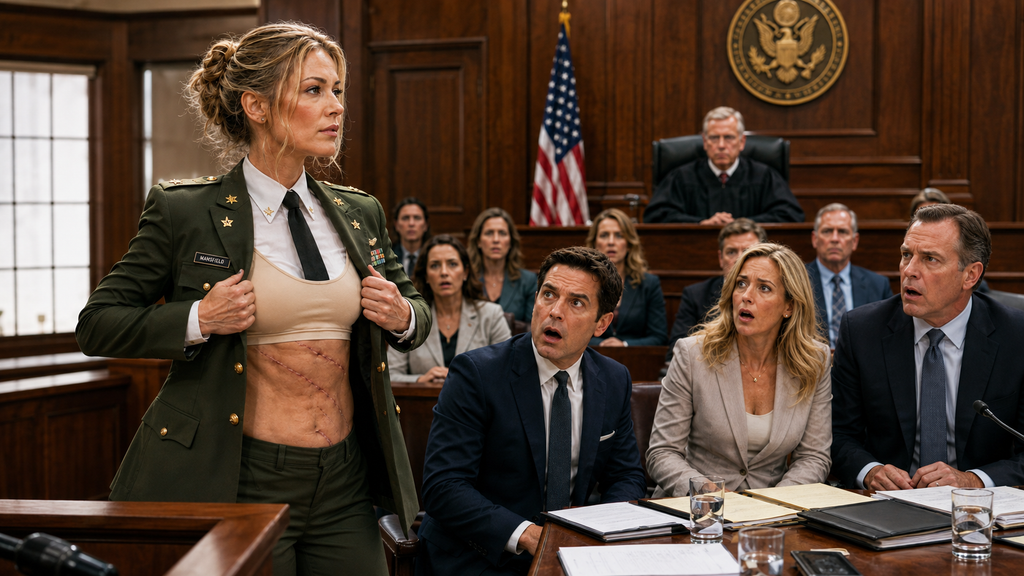
The document connected to the scar that curved from underneath my left arm down along my ribs.
The scar I had hidden beneath one-piece bathing suits.
The scar I had covered with loose clothing.
The scar Victor once called “unpleasant” when I wore a sleeveless dress to an anniversary dinner.
The judge looked down at the page.
“This report identifies Evelyn Hale as an injured kitchen worker employed at Hale’s Kitchen.”
Victor said nothing.
“Mr. Hale?”
His attorney leaned toward him.
“Don’t answer until—”
“I can answer.”
Victor’s voice sounded different.
Lower.
Smaller.
The judge waited.
“It was an administrative mistake.”
For several seconds, I thought I had misheard him.
An administrative mistake.
Twenty years of pain reduced to three words.
The kitchen returned to me in a flash.
The heat.
The shouting.
The clang of metal.
The smell of onions burning in a pan.
The slick floor beneath my shoes.
Victor cursing because a refrigeration unit had broken during dinner service.
My arms full of containers.
Someone calling for clean towels.
A server crying because table seven had been waiting forty minutes.
Then—
Metal screaming overhead.
A shelf collapsing.
The pan.
The oil.
The pain.
God, the pain.
I had been thirty-seven.
Victor and I had been married seven years.
Back then, Hale’s Kitchen was not an empire.
It was twelve tables packed into a narrow brick building beside a dry cleaner.
We had borrowed money from three relatives.
Maxed out two credit cards.
Sold my mother’s diamond earrings.
Lived above a laundromat where the walls vibrated until midnight every night.
There were winters when we turned the heat down because the restaurant’s utility bill came first.
Victor had held my hands in that tiny apartment before opening day.
His eyes had been bright.
“We’re going to make it, Evie.”
“We are?”
“I swear.”
He kissed my knuckles.
“One day this place will be ours.”
Ours.
That word mattered.
I believed it.
Not because I was stupid.
Because I loved him.
People often describe trusting the wrong person as foolishness.
It isn’t.
Sometimes trust is simply love before it has evidence to be afraid.
The night of the accident, we were short-staffed.
A cook hadn’t shown up.
A dishwasher walked out halfway through service.
Victor had been furious since five o’clock.
I remember carrying a stainless-steel container toward the back.
I remember noticing water near the storage rack.
I remember telling Richard Miller, our kitchen manager, someone needed to mop.
Then I heard a metallic snap.
I looked up.
The shelf above me tilted.
Someone shouted my name.
A pan filled with boiling oil slid forward.
It hit my arm first.
Then my side.
The container flew from my hands.
I fell.
Pain consumed everything.
There are certain moments the brain remembers strangely.
Not like a movie.
Like photographs.
The ceiling.
A broken fluorescent light.
My own hand clawing at the tile.
Steam.
Richard shouting.
Victor standing above me.
I screamed for an ambulance.
And Victor—
hesitated.
For years, I had tried to convince myself that hesitation didn’t happen.
That shock had distorted my memory.
But I remembered it.
He looked at me.
Then at the collapsed shelf.
Then toward the kitchen door.
Not like a husband terrified his wife might die.
Like a businessman calculating consequences.
Eventually, Richard called the ambulance.
Not Victor.
Richard.
The judge set the document down.
“Mrs. Hale, according to this report, you suffered third-degree burns, two fractured ribs and internal injuries.”
“Yes.”
“You were hospitalized?”
“For eleven days.”
“And the insurance claim was later withdrawn.”
“Yes.”
“By whom?”
I looked at Victor.
“He handled it.”
Victor shook his head.
“No.”
“Yes.”
“You don’t understand what happened.”
For the first time that morning, anger rose in me.
Not the wild kind.
The quiet kind.
The kind that had been aging for twenty years.
“I understand exactly what happened, Victor.”
The judge looked between us.
“Why was the claim withdrawn?”
Mercer stood.
“Your Honor, my client believed the incident was not covered by the business policy.”
Grace rose.
“That is inaccurate.”
Mercer turned.
“Counsel—”
Grace removed another document.
“The insurer denied the claim after receiving a sworn statement from Mr. Hale asserting that Mrs. Hale was not an employee and had merely been visiting the kitchen that evening.”
The judge looked at Victor.
“You stated she was not an employee?”
Victor’s face reddened.
“She was my wife.”
“That was not my question.”
He looked down.
“Yes.”
“And your testimony today is that she worked at the restaurant?”
Silence.
“Mr. Hale.”
“Yes.”
“How often?”
Victor’s shoulders stiffened.
“A lot.”
The judge stared at him.
“Yet you represented to your insurer that she was not an employee.”
“She wasn’t formally employed.”
Grace stepped forward.
“Except we have payroll records listing Mrs. Hale for portions of three prior years.”
Mercer closed his eyes.
I looked at Victor.
His face was different now.
The man who had strutted into the courthouse that morning had disappeared.
Only an hour earlier, he had leaned toward his girlfriend, Melissa, while waiting outside the courtroom and whispered something that made both of them laugh.
Then, during testimony, when Grace described the years I spent lifting crates, balancing books and working in the kitchen, Victor had smirked.
“My wife liked making herself useful,” he said.
Grace had stared at him.
“Useful?”
Victor shrugged.
“She was strong. She carried things. Supplies, boxes, whatever we needed.”
Then he laughed.
“She was basically my pack mule.”
I remember the sound of Melissa giggling behind him.
I remember Mercer touching Victor’s sleeve as if warning him to stop.
And I remember feeling something inside me go perfectly still.
Pack mule.
Twenty years.
Six days a week.
Two miscarriages worked through.
A burned body.
Missed birthdays.
Unpaid wages.
And I was his pack mule.
Grace had turned toward me.
Her expression asked one silent question.
Are you okay?
I had nodded.
Because for once, I was.
Victor thought that insult had humiliated me.
It hadn’t.
It liberated me.
There are words that hurt because you believe them.
And there are words that reveal exactly who the speaker has always been.
Victor had finally said the quiet part out loud.
The judge turned another page.
“This document shows transfers from Hale’s Kitchen into an account associated with Mrs. Hale.”
Victor’s face went pale.
I stared at the judge.
“What account?”
Grace glanced at me.
We had discussed the documents, but not every detail.
The judge looked at Grace.
“Counsel?”
Grace stood.
“The account was opened in Mrs. Hale’s name.”
I frowned.
“I never opened a business account.”
“You didn’t,” Grace said.
Victor whispered, “Stop.”
Everyone heard him.
The judge looked at him sharply.
Grace continued.
“The account was opened by Mr. Hale using documents containing his wife’s identifying information.”
My stomach turned.
The judge studied the page.
“Mrs. Hale, did you authorize this?”
“No.”
Victor looked at me.
“You knew.”
“I didn’t.”
“You signed things all the time.”
“You told me they were vendor forms. Tax papers. Insurance renewals.”
“You never asked questions.”
That hurt.
Not because it was entirely false.
Because there had once been truth inside it.
I had trusted him enough not to read everything.
Back then, when Victor placed papers in front of me after fourteen hours on my feet and said, “Sign here, sweetheart,” I signed.
Marriage had seemed like a place where vigilance should not be necessary.
I met his eyes.
“You’re right.”
Victor seemed surprised.
“I trusted you.”
The room went still.
“That was the mistake.”
He looked away first.
The judge turned toward Grace.
“How is the account relevant to the marital distribution?”
Grace inhaled.
“Because, Your Honor, Hale’s Kitchen was created during the marriage. Mrs. Hale contributed substantial unpaid labor to its development. In addition, we have reason to believe that corporate income was diverted into accounts not disclosed during discovery.”
Victor laughed.
But there was no humor in it.
“Substantial labor?”
Grace looked directly at him.
“Yes.”
Then she removed another document.
“And we believe Hale’s Kitchen has been intentionally undervalued.”
That sentence changed the room.
Victor stopped moving.
Mercer whispered, “Daniel—”
Except Victor had forgotten that Daniel was his lawyer’s first name, not his own.
Panic does strange things.
The judge leaned forward.
“Undervalued?”
“Yes, Your Honor.”
“Explain.”
“We requested ten years of complete financial records, including tax filings, merchant processing statements, vendor payment histories and corporate distributions.”
“And?”
“We received incomplete records.”
Mercer stood.
“That is counsel’s characterization.”
Grace didn’t even turn toward him.
“No, Your Honor.”
She lifted a stack of papers.
“It is documented.”
The judge motioned for her to continue.
“Hale’s Kitchen disclosed approximately four hundred thousand dollars in average annual distributable profit during the relevant period.”
Victor leaned back.
Grace placed another page before the court.
“However, merchant processing records obtained through subpoena show revenue significantly higher than the figures contained in the marital disclosures.”
The judge scanned the numbers.
“How much higher?”
“In several years, nearly three times higher.”
A murmur spread through the gallery.
The judge immediately lifted her head.
“Silence.”
The room obeyed.
I looked at Victor.
He was no longer watching me.
He was staring at the documents like they had crawled onto the table by themselves.
One hand slowly tightened into a fist.
Mercer leaned close.
This time Victor listened carefully.
“What did they find?”
The whisper carried just far enough.
Daniel answered too quietly for me to hear.
But I saw Victor’s face.
There was something else.
Something worse.
I turned toward Grace.
“You knew?”
“I suspected.”
“Is there more?”
Grace did not answer.
She didn’t need to.
The judge closed the blue folder.
“I am ordering both parties to provide complete and amended financial disclosures. I am further authorizing forensic review of the relevant corporate and personal accounts.”
Victor rose immediately.
“Your Honor, that’s excessive.”
“No, Mr. Hale.”
The judge’s voice was flat.
“I don’t believe it is.”
“You’re treating me like a criminal.”
“I am treating you like a litigant whose disclosures appear inconsistent with subpoenaed financial documents.”
Victor sat down.
His face burned.
Then the judge looked at me.
“Mrs. Hale, is there anything else you believe the court should know at this stage?”
For a moment, I couldn’t breathe.
Because there was.
Something I had carried for fifteen years without understanding why.
A small black notebook.
Victor’s notebook.
He believed I had thrown it away.
I had almost thrown it away.
I found it one summer while cleaning boxes in the basement after a pipe burst.
It was buried beneath old invoices and employee schedules.
The cover was black vinyl.
The corners were worn.
Inside were names.
Dates.
Numbers.
Initials.
I assumed it was an old expense ledger.
Victor saw it in my hand and reacted strangely.
“Where did you get that?”
“Basement.”
“Throw it away.”
“Why?”
“It’s useless.”
He took it from me.
Or tried to.
But his reaction bothered me.
That night, after he went to sleep, I retrieved the notebook from the trash.
I didn’t read all of it.
I simply wrapped it in plastic and hid it inside a box containing my mother’s Christmas ornaments.
I don’t know why.
Instinct, perhaps.
The quiet survival sense women develop after years of being told they imagined things.
Inside that notebook was one sentence that had haunted me ever since I found it.
A sentence written in Victor’s handwriting.
Four words.
KEEP EVELYN QUIET.
I looked at Grace.
She nodded.
Then I faced the judge.
“Yes, Your Honor.”
Victor’s head snapped toward me.
“What are you doing?”
My heart was hammering now.
But my voice did not shake.
“Finally telling the truth.”
Grace reached beneath the table.
She removed a sealed evidence sleeve.
Inside was the little black notebook.
She placed it beside the blue folder.
Victor stared at it.
And all the color drained from his face.
Not some of it.
All of it.
He looked suddenly older.
The judge reached toward the notebook.
And before she even opened the cover, Victor whispered my name.
“Evelyn.”
I looked at him.
His lips trembled.
“Please don’t.”
For twenty years, I had waited for Victor Hale to understand that I had power.
Not power over him.
Power over myself.
For twenty years he had seen me as useful.
Dependable.
Strong enough to lift what he handed me.
Quiet enough not to ask why.
He had mistaken patience for weakness.
Love for obedience.
Trust for stupidity.
Now the man who had called me his pack mule was looking at me as if I held the walls of his empire in my hands.
And maybe I did.
The judge opened the notebook.
Victor stopped breathing.
The first pages looked ordinary.
Inventory amounts.
Produce invoices.
Liquor deliveries.
Initials beside numbers.
Cash payments.
Then the entries became stranger.
Names without explanations.
Dates.
Amounts.
Short handwritten notes.
The judge turned a page.
Then another.
“What exactly is this?”
Grace stood.
“We believe it contains records of cash payments that were not reflected in Hale’s Kitchen’s formal accounting.”
Victor shook his head.
“No.”
The judge looked at him.
“No?”
“They’re personal notes.”
“They contain employee names.”
“Some.”
“And dollar amounts.”
“I kept records.”
“Records of what?”
Victor said nothing.
Mercer leaned toward him.
“Do not answer.”
The judge continued reading.
I felt my heartbeat in my throat.
Grace leaned closer to me.
“These are cash wage payments.”
“Off the books?”
“It appears so.”
I looked at Victor.
For years, he complained about taxes.
Payroll.
Regulations.
He had made everything sound complicated enough that I stopped asking questions.
“Accountants handle that, Evie.”
That had been one of his favorite phrases.
Accountants handle that.
Attorneys handle that.
Managers handle that.
You don’t need to worry about that.
In marriage, exclusion can masquerade as protection for a long time.
The judge turned another page.
Then she stopped.
I knew which page before she spoke.
Her eyes hardened.
“Mr. Hale.”
Victor looked down.
“What does this entry mean?”
He said nothing.
“Mr. Hale?”
Mercer stood.
“Your Honor, I advise my client not to answer questions that may implicate matters outside the scope of the dissolution proceeding.”
That changed the air.
The judge looked at him carefully.
“So noted.”
Grace stood.
“Your Honor, may I direct the court to the date?”
The judge nodded.
Grace spoke slowly.
“The entry was made approximately three months after Mrs. Hale’s workplace injury.”
My palms turned cold.
The judge read aloud only the relevant information.
“R.M. Thirty thousand.”
She paused.
Then looked at me.
I didn’t need to see the page.
R.M.
Richard Miller.
Our former kitchen manager.
Richard had disappeared several months after the accident.
Victor told me he stole money.
“He cleaned out the safe and vanished,” Victor said.
I had believed him.
Why wouldn’t I?
Richard had never contacted me.
The restaurant stopped mentioning him.
His photograph disappeared from the employee wall.
His name became something no one said.
The judge continued.
“Beside the entry are the words ‘Keep Evelyn quiet.’”
The courtroom disappeared.
Sound seemed to drain from the room.
I stared at Victor.
“What does that mean?”
He shook his head.
“Nothing.”
“What does it mean, Victor?”
“It doesn’t mean what you think.”
“What do I think?”
He looked away.
For twenty years, he had been excellent at answering questions with other questions.
I had forgotten how much I hated that.
Grace rose.
“Your Honor, Richard Miller is available to testify.”
Victor stood so fast his chair scraped violently against the floor.
“He’s here?”
The courtroom doors opened.
I turned.
And there he was.
Older.
Much older.
Gray hair.
Bent shoulders.
A cane in his right hand.
The same deep-set brown eyes.
Richard Miller.
For a moment, I saw him as he had been.
Forty-five years old.
Broad shoulders.
White apron.
Always sneaking extra bread to the dishwasher because the kid couldn’t afford dinner.
Always arguing with Victor about safety.
Always calling me “Boss Lady” even though technically I wasn’t a boss at all.
My hand flew to my mouth.
“Richard?”
He looked at me.
His eyes filled instantly.
“I’m sorry, Evelyn.”
Something in my chest broke.
Not loudly.
Quietly.
Like ice giving way on a lake.
Richard took the witness stand.
The clerk swore him in.
He sat carefully, placing his cane beside him.
Grace approached.
“Mr. Miller, were you employed at Hale’s Kitchen?”
“Yes.”
“In what capacity?”
“Kitchen manager.”
“How long?”
“Nearly six years.”
“Were you working on the evening Mrs. Hale was injured?”
Richard looked at me.
“Yes.”
Victor stared straight ahead.
Grace continued.
“Please tell the court what happened.”
Richard swallowed.
“We’d been warned about that storage rack.”
My breath caught.
Grace remained still.
“Warned by whom?”
“Me.”
Victor shifted.
Richard continued.
“Two of the bolts were pulling out of the wall. The shelf held heavy pans. Equipment. Containers. I told Victor it needed to be repaired.”
“When?”
“First time? Several weeks before the accident.”
“And did he repair it?”
“No.”
“Why not?”
Richard gave a humorless laugh.
“He said we couldn’t afford downtime.”
Grace turned toward the judge.
“Were there other safety issues?”
“Yes.”
“How many?”
“A lot.”
Victor’s attorney stood.
“Objection. Vague.”
“Sustained.”
Grace nodded.
“Were there specific safety violations that had been brought to management’s attention before Mrs. Hale was injured?”
“Yes.”
“Describe them.”
Richard began counting on his fingers.
“Improperly secured storage. Electrical problems near the dishwasher. A damaged gas connection. A floor drain that backed up. Fire suppression equipment overdue for inspection.”
My stomach turned.
I knew about the drain.
I knew about the electricity.
I did not know about the gas line.
“Had inspectors visited Hale’s Kitchen before the accident?”
“Yes.”
“How soon before?”
“About six weeks.”
“And what happened?”
“We were warned that certain violations had to be corrected.”
“Did Mr. Hale know?”
Richard looked at Victor.
“Yes.”
Victor’s jaw worked.
Grace approached the witness stand.
“Let’s discuss the evening of Mrs. Hale’s accident. What did you observe?”
Richard took a breath.
“Evelyn was carrying food containers toward storage. The floor was wet because the drain had backed up again. She told me somebody needed to mop.”
I closed my eyes.
The memory returned exactly.
Someone needs to get this before a server breaks her neck.
Those were my words.
Richard continued.
“The wall rack failed.”
“Did Mrs. Hale touch it before it fell?”
“No.”
“Did she cause it to fall?”
“No.”
“What happened?”
“A pan of fryer oil came down. Hit her arm and side. Then part of the rack hit her.”
A woman in the gallery covered her mouth.
Richard’s voice weakened.
“She screamed.”
Grace paused.
“What did you do?”
“I went to her.”
“And Mr. Hale?”
Richard’s eyes dropped.
“He came over too.”
“Did anyone immediately call emergency services?”
“No.”
Grace allowed the silence to sit.
“Why not?”
“Victor told us to wait.”
My eyes snapped toward him.
Even though I remembered the hesitation, hearing it confirmed felt like being injured again.
Grace’s voice softened.
“Why?”
Richard looked at Victor.
“He was afraid.”
“Of what?”
“Inspectors coming.”
My heart began pounding.
“He said if an ambulance came, there’d be reports. Questions. The kitchen might be inspected.”
Victor stood.
“That’s a lie.”
“Mr. Hale!” the judge barked.
Mercer grabbed his arm.
“Sit down.”
Victor obeyed.
His face was red.
Richard’s hands trembled.
Grace waited.
“What happened next?”
“I told Victor Evelyn needed an ambulance.”
“And?”
“He told me to give him a minute.”
A tear slipped down my cheek.
I wiped it away.
Richard continued.
“She was screaming. Skin was coming off her arm. I told him I wasn’t waiting.”
His voice cracked.
“So I called.”
I remembered.
Not clearly.
But I remembered Richard kneeling beside me.
A towel.
His hand near my head.
His voice telling me not to move.
Stay with me, Boss Lady.
Stay with me.
Grace asked, “After Mrs. Hale was taken to the hospital, what occurred?”
“Victor called me.”
“When?”
“That night.”
“What did he say?”
Richard stared at the floor.
“He said Evelyn wasn’t officially an employee.”
Grace waited.
“He said if anyone asked, she had only stopped by to help.”
My mouth fell open.
The judge’s face hardened.
“Did you agree?”
“No.”
“What did you say?”
“I said it was a lie.”
“And how did Mr. Hale respond?”
“He said the restaurant would close if the insurer discovered everything.”
“What did you tell him?”
“That wasn’t Evelyn’s problem.”
Richard finally looked at me.
“I told him his wife almost died.”
I began crying then.
Silently.
Grace handed me a tissue without looking away from the witness.
“What happened after that?”
“Victor filed the insurance paperwork.”
“Did you see it?”
“Some of it.”
“What did it say?”
“That Evelyn wasn’t employed there.”
“And was that accurate?”
“No.”
“Why?”
“Because she worked harder than almost anybody.”
Victor looked down.
Richard continued.
“She opened the restaurant some mornings. Closed it other nights. Ordered inventory. Trained servers. Cooked. Washed dishes. Did books. Covered shifts.”
Richard looked directly at me.
“She worked all the time.”
I pressed the tissue against my lips.
No one had ever said it that plainly in a room where it mattered.
For years, whenever I mentioned my contribution, Victor corrected me.
“You helped.”
That word again.
Helped.
As if I had wandered in occasionally with fresh flowers.
As if I hadn’t built my life around the place.
Grace reached for the black notebook.
“Mr. Miller, do you recognize this?”
Richard stared at it.
“Yes.”
“What is it?”
“Victor’s cash book.”
Victor looked at Mercer.
Grace opened to the marked page.
“Do you recognize your initials?”
“Yes.”
“Did you receive thirty thousand dollars from Mr. Hale approximately three months after Mrs. Hale’s injury?”
Richard closed his eyes.
“Yes.”
My stomach dropped.
Grace’s voice was quiet.
“Why?”
Richard looked at me.
There was so much shame on his face that for one terrible second, I almost wanted him to stop.
But the truth had waited long enough.
“Victor paid me to leave.”
The courtroom became completely silent.
Grace stepped closer.
“Why?”
“Because I threatened to tell the insurer what really happened.”
My hands began shaking.
Victor whispered, “You took the money.”
Richard turned toward him.
“Yes.”
Victor laughed bitterly.
“You took every dollar.”
“Yes.”
“So don’t act righteous now.”
Richard’s face tightened.
“I’m not.”
He looked at me.
“I’ve lived with that for twenty years.”
Grace said, “Mr. Miller, why are you testifying today?”
“Because money doesn’t make a lie disappear.”
His voice broke.
“And because Evelyn deserved the truth before one of us died.”
I lowered my head.
Tears fell onto my hands.
For years, I blamed myself.
Maybe I hadn’t watched where I was walking.
Maybe I had been careless.
Maybe I should not have been carrying so much.
Maybe I should have insisted the floor be cleaned first.
Maybe.
Maybe.
Maybe.
Self-blame had lived inside me like a tenant who never paid rent and never moved out.
Now, in one afternoon, I finally understood.
The accident had not happened because I was careless.
Victor had known about the dangerous equipment.
He had chosen revenue over repair.
Then, while I lay on a kitchen floor screaming from third-degree burns, he had worried first about the restaurant.
Not me.
The restaurant.
Grace approached the bench.
“Your Honor, we also have documentation that Mr. Miller contacted Mrs. Hale’s counsel voluntarily after learning about the divorce proceeding.”
The judge nodded.
Mercer stood.
“We reserve all objections and rights regarding collateral proceedings.”
“Understood.”
Then the judge looked directly at Victor.
“Mr. Hale.”
Victor raised his head.
“Did you know about the safety problems before your wife was injured?”
Mercer immediately spoke.
“My client invokes—”
Victor lifted a hand.
“No.”
Mercer turned.
“Victor.”
But Victor looked at me.
Something in him had changed.
Maybe he finally understood there was no longer a version of the story he could control.
“Yes,” he whispered.
One word.
Yes.
Twenty years of confusion collapsed beneath it.
The judge continued.
“Did you misrepresent Mrs. Hale’s employment status to your insurer?”
Mercer touched his shoulder.
“Do not answer.”
Victor ignored him.
“Yes.”
My eyes filled again.
Not because I felt sorry for Victor.
Because I finally had something pain rarely gives you.
An answer.
I had spent twenty years wondering why the claim disappeared.
Why hospital bills landed on our personal accounts.
Why Victor grew furious whenever I brought up workers’ compensation.
Why Richard vanished.
Why I was discouraged from talking to anyone about the accident.
Now I knew.
Victor had not simply failed me.
He had protected the business from the consequences of what happened to me.
And in doing so, he had protected himself.
The judge called a recess.
The moment she left the bench, the courtroom erupted into whispers.
Mercer turned on Victor.
“What else is in that notebook?”
Victor stood.
“Nothing.”
“Do not lie to me.”
“I said nothing.”
“You already withheld material information.”
Victor glanced at me.
I looked away.
Melissa, who had been sitting behind him all morning, rose from her seat.
She was twenty years younger than I was.
Beautiful.
Perfect hair.
Cream-colored dress.
Diamond bracelet Victor probably bought with money he insisted the restaurant couldn’t afford to distribute during our separation.
She touched his shoulder.
“Victor?”
“Not now.”
“What does he mean?”
“Melissa.”
“Did you lie about the company?”
His expression hardened.
“I said not now.”
She stepped back.
I recognized the look on her face.
I had worn it many times.
The look of a woman being told that asking a reasonable question was itself an offense.
For a strange moment, I felt no anger toward her.
She had begun sleeping with my husband before our divorce papers were filed.
I knew that.
I wasn’t naive enough to call her innocent.
But as I watched Victor dismiss her, I saw the beginning of a story I already knew by heart.
The first time he makes you feel foolish for asking.
The first time he says you’re too emotional.
The first time he tells you not to worry about money.
The first time he explains that something complicated is being handled by people who understand it better than you.
The first time you shrink so he can remain large.
Melissa looked at me.
Our eyes met.
She looked away.
Grace leaned toward me.
“Do you want some water?”
“Yes.”
My hands still shook.
Grace handed me a bottle.
“You did well.”
“I barely said anything.”
“Sometimes surviving the truth is the hard part.”
I looked through the glass doors at the courthouse hallway.
Richard stood alone near a window.
I walked toward him.
He saw me coming.
His shoulders fell.
“Evelyn.”
I stopped several feet away.
For a long moment, neither of us spoke.
Then I asked the only question that mattered.
“Why didn’t you tell me?”
His eyes filled.
“I was ashamed.”
“Twenty years?”
“I kept thinking I’d call.”
“But you didn’t.”
“No.”
“You took thirty thousand dollars.”
“Yes.”
“Did you need it?”
He stared at me.
“No.”
That answer hurt more than if he had said yes.
Richard swallowed.
“My marriage was falling apart. Victor told me he’d destroy me if I talked. Said he’d accuse me of stealing. Said no restaurant would hire me. He offered money.”
“And you took it.”
“Yes.”
I looked through the window.
Cars moved along the street below.
People crossed with coffees and briefcases.
Ordinary life continuing while mine cracked open.
“I hated you for disappearing,” I said.
“I know.”
“I believed you stole from us.”
“I know.”
“Victor made me feel stupid for defending you.”
Richard lowered his head.
“I’m sorry.”
I wanted to forgive him.
I wasn’t ready.
And for once, I understood that forgiveness did not have to be immediate to be real someday.
“I appreciate you telling the truth.”
He nodded.
“That’s more kindness than I deserve.”
“I didn’t say I forgive you.”
“I know.”
“But I might.”
His face crumpled.
“That’s more than I deserve too.”
When court resumed, the judge made several orders.
Complete forensic accounting.
Preservation of business records.
Disclosure of undisclosed accounts.
Production of corporate tax documents.
The financial discrepancies would be referred to appropriate authorities if further review supported that step.
The old insurance matter would be preserved for potential separate proceedings.
Victor sat through it all without speaking.
The man who had once filled every room had become remarkably small.
But our divorce was not finished.
And Victor still had one final opportunity to tell the truth.
He wasted it.
During the financial portion of the hearing, Grace called an expert forensic accountant.
She explained how money had moved through Hale’s Kitchen.
How reported profits differed from merchant revenue.
How personal expenses had been paid through corporate accounts.
How income was shifted.
How several assets Victor characterized as “separate business property” were purchased with marital funds.
The numbers were overwhelming.
But one conclusion was simple.
Victor had not merely built a successful restaurant chain while his wife occasionally helped.
We had built a marital enterprise.
My labor had value.
My sacrifices had value.
My years had value.
And Victor’s version of history was not an accounting system.
Grace asked the expert, “Based on the records you reviewed, would Hale’s Kitchen have been able to expand at the same pace during its early years without Mrs. Hale’s unpaid labor?”
Mercer objected.
“Speculative.”
The judge allowed the witness to answer within her expertise.
The accountant said, “The company would have needed to hire multiple people to replace functions performed by Mrs. Hale.”
“How many?”
“At various stages, bookkeeping, operations support, kitchen labor, purchasing and administrative work.”
“Estimated cost?”
She gave a figure.
I stared at her.
Over the years, the value of that labor reached well into six figures.
And that was conservative.
Victor laughed once.
A tiny disbelieving sound.
Grace turned toward him.
“You disagree?”
Mercer immediately objected.
Grace withdrew the question.
But Victor could not stop himself.
“She was my wife.”
The judge stared at him.
Victor continued.
“People help their spouses.”
I felt something inside me snap.
Not painfully.
Cleanly.
I stood before Grace could stop me.
“Your Honor, may I respond?”
The judge studied me.
Then nodded.
“Briefly.”
I looked at Victor.
“You’re right.”
He frowned.
“Spouses help each other.”
My voice trembled.
I let it.
For years I believed strength meant never shaking.
It doesn’t.
Strength means speaking anyway.
“I helped you.”
I swallowed.
“I helped when we couldn’t afford cooks.”
“I helped when you were too tired to do inventory.”
“I helped when the freezer broke.”
“I helped when we had no customers.”
“I helped when we had too many customers.”
“I helped when your father died.”
“I helped when you were sick.”
“I helped when you wanted a second location and the bank said no.”
“I helped when you wanted a third location and needed collateral.”
“I helped when you stayed at the restaurant all night.”
“I helped when you didn’t stay at the restaurant at all.”
Victor’s eyes dropped.
“But somewhere along the way, Victor, you stopped helping me.”
Silence.
“You stopped asking whether my body hurt.”
His face changed.
“You stopped asking whether I was tired.”
I touched the scar beneath my sleeve.
“You stopped asking what I lost.”
A tear slid down my cheek.
“And then today, in this courtroom, after everything I gave you, you called me your pack mule.”
Victor flinched.
I continued.
“I spent years thinking I wanted you to appreciate what I did.”
I shook my head.
“I don’t anymore.”
He looked at me.
“I appreciate it.”
The words came too late.
I almost laughed.
“No.”
I wiped my cheek.
“You appreciate that it has a price now.”
No one moved.
I sat down.
Grace touched my hand beneath the table.
The hearing continued.
By late afternoon, the court had enough evidence to make provisional findings regarding the marital estate.
Hale’s Kitchen would not be treated as Victor’s private monument.
The business had been created and expanded during our marriage.
Its value mattered.
Its hidden accounts mattered.
My contribution mattered.
The judge ordered a division that reflected reality rather than Victor’s mythology.
I received a substantial share of the business’s marital value.
Funds linked to undisclosed accounts were included in the estate pending final forensic reconciliation.
I received ownership of the smaller commercial property we had purchased years earlier—a building Victor considered insignificant because it was not part of his glamorous expansion plans.
There were additional adjustments relating to dissipation and undisclosed funds.
More importantly, the ruling recognized what Victor had denied for years.
Hale’s Kitchen had not been built by one man.
Victor sat silently as the judge explained her findings.
Melissa was no longer behind him.
I hadn’t noticed when she left.
After court, Victor found me near the elevators.
Grace was speaking with one of her assistants.
Richard had already gone.
I was alone for perhaps twenty seconds.
That was enough.
“Evelyn.”
I turned.
Victor looked exhausted.
His tie was loose.
His hair, normally perfect, had fallen across his forehead.
For one dangerous second, he looked like the young man I married.
The one who danced with me barefoot in our apartment because we couldn’t afford furniture.
The one who kissed flour off my cheek the night before the restaurant opened.
Memory can be cruel that way.
It doesn’t erase tenderness merely because tenderness later became betrayal.
“I never thought you’d actually leave,” he said.
I looked at him.
“You filed first.”
“That’s not what I mean.”
“What do you mean?”
He swallowed.
“I thought you’d fight for us.”
That almost stole my breath.
“I fought for us for twenty years.”
“No, I mean—”
“I know what you mean.”
His eyes reddened.
“Melissa meant nothing.”
I stared at him.
“You humiliated me in court and you think Melissa is the part I care about?”
“I made mistakes.”
“Mistakes?”
“I was under pressure.”
“You lied about my employment after I was nearly killed in your kitchen.”
His face tightened.
“Our kitchen.”
I almost laughed.
“Interesting.”
“What?”
“It’s ours now.”
He looked confused.
“For twenty years, it was yours whenever success was involved.”
I stepped closer.
“The moment responsibility showed up, suddenly it’s ours.”
He said nothing.
I continued.
“You didn’t delay that ambulance because we were under pressure.”
“Evelyn—”
“You delayed because you were afraid an injured wife would cost you money.”
His eyes filled.
“I panicked.”
“You did.”
“I was young.”
“You were forty.”
He flinched.
“I loved you.”
That was the cruelest thing he could have said.
Because once, I had desperately wanted to believe it.
Maybe some part of him did love me.
People are complicated enough to love someone and still destroy them.
But love without respect is not safety.
Love without honesty is not partnership.
Love that requires one person to disappear so the other can shine is not the love I wanted anymore.
“Maybe you did,” I said.
He looked surprised.
“But whatever you felt, Victor, it wasn’t enough to make you protect me when protecting me threatened your ambition.”
His eyes lowered.
“I’m sorry.”
I studied him.
For decades, I wanted those words.
Now they arrived like a letter sent to an address where I no longer lived.
“I believe you’re sorry.”
His head lifted.
“Then maybe—”
“I believe you’re sorry this happened.”
His face fell.
“I believe you’re sorry Richard came back.”
I stepped backward.
“I believe you’re sorry Grace found the accounts.”
Another step.
“I believe you’re sorry the judge saw the notebook.”
Then I looked at him.
“But I don’t know if you’re sorry for what you did when you believed no one would ever know.”
Victor said nothing.
The elevator doors opened.
I stepped inside.
He stayed in the hallway.
Just before the doors closed, he said my name again.
“Evelyn.”
I looked at him.
“I was wrong.”
The doors began closing.
“Yes, Victor.”
And for once, I didn’t soften the truth to protect him.
“You were.”
The doors closed between us.
Outside the courthouse, the afternoon sun struck my face.
I stood on the steps for a long time.
Cars moved past.
A siren wailed somewhere downtown.
Leaves scraped along the pavement.
People walked around me carrying their own private disasters.
Grace came outside.
“You okay?”
I looked at the courthouse doors.
“Not yet.”
She smiled gently.
“That’s fair.”
I laughed.
It was the first real laugh I had managed all day.
Then I began to cry.
Not elegantly.
Not quietly.
I cried the way exhausted people cry when they have spent too many years telling themselves they’re fine.
Grace didn’t tell me to stop.
She didn’t say Victor wasn’t worth my tears.
She didn’t say I had won.
She simply stood beside me.
And that meant more.
Because I wasn’t crying because I wanted Victor back.
I was crying for the woman I had been.
Thirty years old.
Newly married.
Sure love would be enough.
Thirty-seven.
Lying in a hospital bed.
Believing Victor when he told me the insurance company had “complications.”
Forty.
Back at work even though stretching still hurt.
Forty-five.
Watching him accept a business award while thanking investors, managers, chefs and “everyone who believed in me.”
He forgot my name.
Fifty.
Standing at an anniversary party while a reporter asked how it felt to be married to a self-made man.
I smiled.
“So proud.”
Fifty-seven.
Finally realizing Victor had not become dismissive overnight.
I had simply become accustomed to surviving it.
There is a particular grief in discovering that what you called loyalty was often fear of starting over.
I had believed leaving at fifty-seven would mean admitting I wasted half my life.
Then Grace said something during our first consultation.
“Leaving doesn’t erase the years you invested.”
I looked at her.
“It stops you from investing more.”
That sentence saved me.
The weeks after court were messy.
Justice, I discovered, rarely arrives as a clean cinematic ending.
There were accountants.
Interviews.
Lawyers.
Documents.
New hearings.
News stories.
Hale’s Kitchen released a statement saying Victor was temporarily stepping away from operations.
Two investors demanded independent reviews.
Employees began talking.
Some defended him.
Some revealed stories of their own.
Former staff described cash wages.
Unreported overtime.
Pressure to ignore safety issues.
Several said they had always wondered why I disappeared from the company’s official history after the accident.
I had not disappeared.
I had been edited out.
There is a difference.
The investigation into the financial records continued.
The authorities handled those matters.
For the first time in my life, I let professionals do their jobs without feeling responsible for protecting Victor from consequences.
He called me several times.
I blocked his number.
He emailed.
I forwarded everything to Grace.
He sent flowers.
I donated them to the rehabilitation center where I had once completed burn therapy.
The card said:
I HOPE ONE DAY YOU CAN FORGIVE ME.
I kept the card for one week.
Then I threw it away.
Not because I would never forgive him.
Because forgiveness was no longer something he got to schedule.
It belonged to me now.
Richard called too.
I didn’t answer immediately.
Then one Sunday afternoon, three months later, I called him back.
We spoke for forty-two minutes.
He told me about his children.
His second marriage.
His years managing kitchens in another state.
His heart attack.
His regret.
“I thought about telling you every year,” he said.
“Why didn’t you?”
“Cowardice.”
At least he didn’t dress it up.
We were silent.
Finally he said, “You don’t owe me forgiveness.”
“I know.”
“I just wanted you to know I’m sorry.”
“I know that too.”
A few weeks later, I met him for coffee.
Forgiving Richard did not mean pretending he hadn’t failed me.
It meant deciding I no longer wanted to carry his failure inside my chest.
Victor took longer.
Maybe because Victor’s betrayal had been larger.
Maybe because he had been the person who promised not to betray me in the first place.
Six months after the divorce became final, I stood in front of the small commercial property the judge had awarded me.
Victor had always called it “the little building.”
It sat on the corner of Maple and Fifth.
Old brick.
Large windows.
Original wooden floors beneath ugly vinyl.
Years earlier, Hale’s Kitchen had used it for storage.
Then Victor abandoned it when he built a warehouse.
“Sell it,” he had told me.
I never did.
I loved the windows.
Now I stood inside with Grace.
Dust floated through afternoon light.
“What are you going to do with it?” she asked.
“I don’t know.”
She looked around.
“Bookstore?”
I smiled.
“Too quiet.”
“Yoga studio?”
I laughed.
“You’ve seen me touch my toes.”
“Fair point.”
I walked toward the old back room.
There was space for a kitchen.
Small.
Manageable.
Not the industrial monsters Victor built later.
Just enough.
I ran my hand across the exposed brick.
And suddenly I could smell cinnamon.
Bread.
Coffee.
I turned toward Grace.
“What if I opened something?”
She blinked.
“A restaurant?”
“No.”
I shook my head.
“Not a restaurant.”
The idea grew slowly.
A bakery.
Twelve tables.
No investors.
No television campaigns.
No empire.
Just food made because I loved making it.
For years, Victor convinced me I hated restaurant work.
Maybe I hated being exploited.
There is a difference.
We renovated for four months.
I chose everything.
The tables.
The lights.
The oven.
The shelves.
The mugs.
I spent twenty minutes deciding between two shades of wall paint because nobody said, “It doesn’t matter, Evelyn.”
It mattered because I wanted it to.
That alone felt revolutionary.
I hired a young pastry chef named Tasha who had worked overnight shifts while putting herself through culinary school.
During her interview, she asked about overtime.
The old Evelyn might have thought the question bold.
The new Evelyn said, “You’ll be paid for every minute you work.”
Her face relaxed.
I knew that expression.
I hired her.
I hired Marcus, a widowed father who needed mornings free twice a week to take his daughter to therapy.
“Can we work around that?” he asked nervously.
“Yes.”
“You sure?”
“Yes.”
He stared at me like kindness in a workplace was suspicious.
Maybe sometimes it is.
We installed a large corkboard in the kitchen.
On it, I posted schedules.
Safety inspections.
Emergency contacts.
Insurance information.
Workers’ compensation procedures.
Everyone knew where everything was.
Nothing hidden.
Nothing vague.
Nothing dependent on trusting the owner.
Especially not that.
On the first Monday of every month, we had a safety meeting.
Tasha teased me.
“You know we only have eight employees, right?”
“I know.”
“And two ovens.”
“I know.”
“And you’ve checked the fire extinguisher three times this week.”
I looked at her.
“Four.”
She laughed.
But I never apologized.
Some fears become wisdom when you stop being ashamed of them.
I named the bakery Evelyn’s Table.
Grace loved it.
Richard cried when I told him.
My sister asked why I didn’t choose something more fashionable.
But I knew exactly why.
For twenty years, I had served food at someone else’s table.
Carried plates to someone else’s table.
Balanced accounts for someone else’s table.
Sacrificed holidays for someone else’s table.
Stood quietly behind someone else’s table while he accepted applause.
Now there would be one with my name on it.
Opening day arrived on a rainy Saturday in April.
At six in the morning, I unlocked the front door.
The bakery smelled like fresh paint, vanilla and yeast.
Tasha was already in the kitchen.
Marcus arrived carrying coffee.
My hands shook as I switched on the lights.
Not because I was afraid of failure.
Because I had spent so long believing beginnings belonged to younger women.
Women without scars.
Women without divorces.
Women who had not already spent decades giving their energy away.
I was wrong.
Beginnings do not check your age.
They only ask whether you are willing to begin.
At seven, we opened.
Our first customer was a nurse coming off night shift.
She bought coffee and a blueberry scone.
Our second was an elderly man who complained there weren’t enough raisins in the bread.
Our third was a mother with two children who knocked over a glass of milk within three minutes of sitting down.
I loved every second.
At nine forty-two, the bell above the door rang.
Richard stepped inside carrying flowers.
He wore a clean blue shirt.
His cane tapped against the wood floor.
He looked around.
His eyes watered.
“You did it.”
I smiled.
“I did.”
He placed the flowers on the counter.
“They’re beautiful.”
“They’ll die in four days.”
“Still beautiful.”
I laughed.
Then he looked toward the kitchen.
“Twelve tables.”
I nodded.
“Just like the old place.”
“No.”
The smile faded from my face.
“Nothing like the old place.”
He understood.
“Right.”
Tasha walked out carrying warm croissants.
Richard inhaled deeply.
“Oh, that’s unfair.”
“Sit down,” I said.
“I’m paying.”
“You testified for me.”
“That doesn’t entitle me to free pastries forever.”
“Maybe for today.”
He sat.
I brought him coffee.
For a while, we talked.
Then he said something that stopped me.
“Victor came to see me.”
My body stiffened.
“When?”
“Two weeks ago.”
“Why?”
“He wanted to know if I’d retract what I said.”
I stared at him.
Richard raised a hand.
“I told him no.”
“What did he say?”
“He asked how I could do this to him after all these years.”
A strange laugh escaped me.
Of course he did.
Richard looked down.
“I told him the same thing I should’ve told him twenty years ago.”
“What?”
“That consequences aren’t something other people do to you.”
I sat across from him.
“He didn’t like that, did he?”
“No.”
We both laughed.
It felt good.
The investigations into Victor’s business lasted longer than I expected.
Some matters ended in penalties.
Some triggered lawsuits.
Some became part of private settlements.
I did not follow every development.
That surprised people.
“You don’t want to know what happens to him?” my sister asked.
Not particularly.
For so long, Victor had been the center of my life.
My mood responded to his.
My schedule revolved around his.
My finances depended on his decisions.
Even my anger after leaving him threatened to keep him at the center.
I refused.
Freedom wasn’t watching Victor lose.
Freedom was reaching a point where his losses no longer entertained me.
Hale’s Kitchen shrank.
Locations closed.
Investors left.
The flagship restaurant remained open under new management for some time.
Eventually, even that changed hands.
One morning, a customer walked into my bakery with a newspaper.
“Isn’t this your ex-husband?”
She placed it on the counter.
Victor’s photograph filled half the business section.
Gray hair.
Tired eyes.
The headline described the collapse of the company he once called his legacy.
I looked at the article.
Then folded the newspaper.
“Would you like coffee with your muffin?”
She blinked.
“That’s it?”
“What?”
“You’re not going to read it?”
“No.”
“But after what he did?”
I smiled.
“Especially after what he did.”
She looked confused.
I understood.
People think revenge is the opposite of love.
Sometimes indifference is.
I no longer needed to witness Victor fall.
I had finally learned to watch myself rise.
A year after opening, Evelyn’s Table made a modest profit.
Nothing like Hale’s Kitchen.
No magazines called.
No television stations filmed us.
No investors chased me.
I didn’t care.
Every employee received a bonus that December.
Tasha cried when she opened hers.
“You didn’t have to do this.”
“Yes, I did.”
“No, you really didn’t.”
I smiled.
“You helped build this year.”
She stared at me.
I realized I had spoken the sentence Victor should have said to me decades earlier.
You helped build this.
Not you helped me.
Not you were useful.
Not you carried things.
You helped build this.
Three months later, Tasha asked whether I would consider making her a partner someday.
The question thrilled me rather than threatened me.
That told me how different this business was.
We created a plan.
Slow growth.
No empires.
No expansion just to prove we could.
I wanted a life, not a monument.
My scars changed too.
Or perhaps my relationship with them did.
For decades, I hated mirrors after showers.
The burn scar along my ribs was uneven and shiny in places.
The mark on my arm pulled slightly when I raised it.
Victor used to look away.
Once, before a charity dinner, I tried on a sleeveless navy dress.
I loved it.
Victor frowned.
“Are you wearing a wrap?”
“No.”
He glanced at my scar.
“You might want one.”
I wore the wrap.
I thought about that memory often after the divorce.
Not because it was the cruelest thing he ever did.
Because it was so small.
Cruelty does not always announce itself.
Sometimes it arrives disguised as preference.
Advice.
Concern.
A look.
A tiny suggestion that you should hide.
One summer afternoon, two years after the divorce, I was working the bakery counter wearing a sleeveless blouse.
A little girl stared at my arm.
Her mother noticed.
“Don’t stare.”
“It’s okay,” I said.
The girl looked embarrassed.
“What happened?”
Her mother apologized again.
I crouched slightly.
“I got hurt a long time ago.”
“Did it hurt?”
“Yes.”
“A lot?”
“A lot.”
She studied the scar.
“Are you okay now?”
I smiled.
“Yes.”
She nodded seriously.
“Good.”
Then she ran back to her cookie.
I stood there for a moment.
That was all.
No shame.
No complicated story.
No covering myself.
I got hurt.
It hurt.
I healed.
Three sentences.
For years, Victor had treated my scars like evidence of an inconvenient past.
But scars do not prove weakness.
They prove the body learned how to close a wound.
Healing does not always return you to who you were before.
Sometimes it makes someone new around the damaged place.
On the third anniversary of Evelyn’s Table, Grace came for dinner.
We closed early.
Tasha brought champagne.
Marcus’s daughter decorated a cake badly enough that everyone agreed it was perfect.
Richard came too.
My sister.
Several employees.
Friends I had made after leaving Victor.
People who knew me without knowing him first.
That mattered.
At one point, Grace raised her glass.
“To Evelyn.”
I groaned.
“No speeches.”
She ignored me.
“To the woman who walked into my office three years ago carrying six boxes of records and apologized for taking up too much space.”
Everyone laughed.
I covered my face.
“I did not.”
“You absolutely did.”
Grace smiled.
“She sat across from me and said, ‘I don’t want to ruin Victor’s life. I just want a fair divorce.’”
The room quieted.
Grace looked at me.
“And I told her something I hope she finally believes.”
I raised an eyebrow.
“What?”
“Taking your life back is not the same as ruining someone else’s.”
My throat tightened.
Everyone lifted their glasses.
I looked around the bakery.
Warm lights.
Wooden tables.
Flour on Tasha’s sleeve.
Richard laughing.
Marcus helping his daughter cut cake.
Grace smiling at me.
For one strange second, I thought about Victor.
Not with anger.
Not with longing.
Just as a chapter.
A long chapter.
Important.
Painful.
Finished.
People sometimes asked whether I regretted marrying him.
That question was harder than they expected.
If I said yes, it felt like rejecting the younger version of myself who loved him sincerely.
If I said no, it sounded like excusing what happened.
Eventually, I found my answer.
“I regret what he did with my trust.”
That was different.
I do not regret being capable of love.
I do not regret working hard.
I do not regret believing in someone.
Those were not character flaws.
The mistake was believing I had to keep proving my loyalty after he stopped earning it.
My younger self was not stupid.
She was generous.
She deserved protection.
Victor exploited that generosity.
Now I protected it.
I became careful about who received my time.
My labor.
My forgiveness.
My heart.
Not guarded.
Intentional.
There is a difference.
Five years after the divorce, I received a letter.
No return address.
But I recognized the handwriting immediately.
Victor.
I almost threw it away.
Then I opened it.
The letter was three pages long.
I read it once.
He wrote that he had spent years blaming everyone.
Richard.
Grace.
The accountants.
The judge.
Me.
Eventually, he wrote, there was nobody left to blame.
He said losing the restaurants had been easier than living with the knowledge of why he lost them.
He wrote about the night of my accident.
He admitted he had known the rack was unsafe.
He admitted he delayed the ambulance.
He admitted he asked Richard to lie.
He admitted the account in my name had been used to move money.
He admitted he resented me in later years because my presence reminded him that the “self-made” story was false.
That sentence hurt.
Then it freed me.
At the bottom he wrote:
I spent my whole life trying to prove I built everything alone.
The truth is, you carried me farther than I ever deserved to go.
I sat at my kitchen table holding that letter.
For a long time, I felt nothing.
Then I cried.
Not for him.
For me.
For every year I wished he would acknowledge the truth.
It had finally arrived.
And I no longer needed it.
That may have been the greatest freedom of all.
I folded the letter.
Put it into an envelope.
Then placed it in a drawer.
I did not reply.
I didn’t need to punish him.
I didn’t need to comfort him.
Some apologies are not invitations.
Sometimes they are simply information.
The next morning, I went to the bakery.
Tasha had burnt the first tray of cinnamon rolls.
Marcus was arguing with the coffee machine.
A delivery driver had brought almond flour instead of bread flour.
Chaos.
Ordinary, harmless chaos.
“Thank God you’re here,” Tasha said.
I laughed.
“Why?”
“Because everything is falling apart.”
I tied on my apron.
“No.”
I looked around.
“This is just Tuesday.”
And we got to work.
That afternoon, while carrying a box toward storage, I stopped.
For a second, I was back there.
Thirty-seven years old.
Metal overhead.
Oil.
Pain.
I put the box down.
Tasha noticed.
“You okay?”
I looked around.
The shelves were bolted properly.
The floor was dry.
The emergency exit was clear.
My employees were laughing.
Sunlight came through the back window.
“Yes.”
I breathed.
“I’m okay.”
And I was.
Not because the past disappeared.
Healing never demanded that.
I was okay because the past no longer controlled the meaning of the present.
When I think about that courtroom now, I don’t remember Victor’s insult first.
I don’t remember him calling me his pack mule.
I don’t remember Melissa’s laugh.
I don’t even remember the judge’s ruling.
I remember the blue folder.
The black notebook.
Richard walking through the doors.
And Victor whispering:
“Please don’t.”
For most of our marriage, I believed Victor held all the power because he controlled the money.
The company.
The public story.
But power does not always belong to the person speaking loudest.
Sometimes it belongs to the person who finally stops agreeing to the lie.
Victor spent twenty years telling people he built an empire alone.
He didn’t.
I helped build it.
Richard helped build it.
Cooks helped build it.
Servers helped build it.
Dishwashers helped build it.
Managers helped build it.
Customers helped build it.
Victor’s greatest lie was not hidden money.
It was the idea that success ever belongs entirely to one person.
He needed everyone.
He simply believed needing people made him smaller.
So he erased us.
And in the end, that erasure became the weakness beneath everything he built.
As for me, I spent twenty years believing strength meant how much I could carry.
Boxes.
Debts.
Secrets.
Humiliation.
Pain.
Marriage.
Expectations.
Other people’s dreams.
I was proud of how much weight I could survive.
Now I know better.
Strength is not measured only by what you can carry.
Sometimes strength is recognizing what was never yours to carry at all.
Victor’s ambition was not mine to carry.
His lies were not mine to carry.
His reputation was not mine to carry.
His guilt was not mine to carry.
His consequences were not mine to carry.
So I put them down.
One by one.
And with empty hands, I built something new.
Not an empire.
A life.
My life.
There are twelve tables inside Evelyn’s Table.
On busy Saturday mornings, every one of them is full.
The windows fog from coffee and ovens.
Children leave crumbs everywhere.
Couples argue over pastries.
Old women stay too long talking.
Students study in the corner.
Nurses come after night shifts.
Workers stop in before sunrise.
Sometimes I stand behind the counter and simply watch them.
No newspaper has ever called me self-made.
I hope none ever does.
Because I am not.
None of us are.
Grace helped me.
Richard finally told the truth.
Tasha helped build the bakery.
Marcus keeps everything running when I forget which day it is.
My sister painted the upstairs office.
Friends carried tables.
Customers returned.
People showed up.
The difference is that I know their names.
I say them.
I thank them.
I pay them.
I do not stand in front of what we built and pretend no one else was there.
Above the bakery counter hangs one framed photograph.
Not an article.
Not an award.
Not a magazine cover.
A photograph from opening morning.
All eight original employees are standing outside.
I am in the middle.
Tasha has flour on her shirt.
Marcus is laughing.
Richard is leaning on his cane.
Grace is holding coffee.
Nobody looks polished.
Nobody looks famous.
Everybody looks happy.
Underneath the photograph is a tiny brass plaque.
It says:
WE BUILT THIS TOGETHER.
Sometimes customers ask why those words matter so much.
I smile.
“It’s a long story.”
And it is.
A twenty-year story.
A story about a woman who confused sacrifice with love.
A man who confused control with strength.
A business built on invisible labor.
A scar hidden beneath sleeves.
A notebook hidden inside a box.
A courtroom where one insult finally revealed more than the man saying it intended.
And a woman who spent half her life standing behind someone else.
Until she finally stepped forward.
Victor once called me his pack mule.
For years, that sentence would have destroyed me.
Now I understand something he never did.
There was never shame in the fact that I carried so much.
The shame belonged to the man who kept loading weight onto my back and then mocked me for bending beneath it.
I did carry him.
I carried the restaurant.
I carried our marriage.
I carried secrets I didn’t even know were secrets.
I carried scars.
I carried grief.
I carried hope long after it deserved to die.
But eventually, I learned the most important thing I would ever learn.
I could put the weight down.
And when I did, I discovered I was not empty.
I was free.
So if I could speak to the thirty-seven-year-old woman lying on that kitchen floor, I know exactly what I would tell her.
I would kneel beside her.
I would take her hand.
I would tell her that the pain will not last forever.
That the scar will remain, but the shame will not.
That the man pacing near the back door is not the measure of her worth.
That the restaurant will grow.
That people will applaud him.
That he will forget her name in speeches.
That she will lose herself trying to earn gratitude from someone who benefits from her believing she hasn’t done enough.
I would tell her she is going to survive more than the burns.
She will survive the silence afterward.
The lies.
The loneliness.
The moment she finally understands who she married.
The courtroom.
The divorce.
Starting over.
I would tell her that one day she will stand in a bakery filled with warm bread and morning light.
There will be twelve tables.
Her name will be above the door.
People will know who built it.
And she will never need to disappear so someone else can feel important again.
Most of all, I would tell her:
You are not a pack mule.
You never were.
You are not valuable because of what you can carry for other people.
You are valuable because you are you.
And one day, Evelyn, you are going to believe that.
It will take longer than it should.
But you will.
I promise.
The strange thing about freedom is that when it finally comes, it often feels ordinary.
No music.
No courtroom applause.
No dramatic sunrise.
For me, freedom looked like waking up on a Wednesday morning and realizing no one was angry with me.
It looked like making coffee without checking Victor’s mood.
It looked like buying yellow curtains because I liked yellow curtains.
It looked like leaving a book open on the sofa.
Eating dinner at nine.
Going to bed at eight.
Calling my sister without someone complaining about how long we talked.
Wearing sleeveless shirts.
Laughing too loudly.
Saying no without preparing a defense.
Saying yes without asking permission.
Freedom arrived quietly.
Then stayed.
And if Victor ever thinks of me now, I hope he remembers the woman in the courtroom.
Not because I want him to suffer.
But because maybe somewhere inside him, he finally understands what happened.
He thought that day was the day I destroyed him.
It wasn’t.
That day was simply the first day I stopped protecting him from the truth.
There is a difference.
I did not ruin Victor’s life.
I stopped sacrificing mine to preserve it.
And once I understood that, I never confused the two again.
The bakery closes at six.
Most evenings, I am the last one out.
I wipe the counter.
Check the ovens.
Make sure the back door is locked.
Then I switch off the lights one row at a time.
Before leaving, I always pause beneath the photograph above the counter.
WE BUILT THIS TOGETHER.
Sometimes I touch the edge of the frame.
Then I walk outside.
The street is quieter after dark.
The bakery windows glow behind me for a few seconds before the automatic lights turn off.
And each night, I walk toward my car carrying almost nothing.
My purse.
My keys.
Maybe a loaf of bread.
That’s all.
No boxes.
No invisible debts.
No husband’s ego.
No secret accounts.
No responsibility for someone else’s lies.
Just me.
My scars.
My life.
My own two hands.
Victor thought the most useful thing about me was how much weight I could bear.
He never imagined what I might become once I put it down.
Neither did I.
And that was the best surprise of all.
For twenty years, Victor told the world he built an empire from nothing.
He was wrong.
He had never started with nothing.
He had started with me.
But when everything was finally over, I built something far more valuable than any restaurant chain he ever owned.
I built a life where I no longer had to earn the right to exist.
A life where my name was not hidden.
A life where love did not require silence.
A life where work was recognized.
A life where scars did not need sleeves.
A life where nobody called me useful as though usefulness were the highest thing a woman could become.
And this time, when I looked around at what I had built, I didn’t need a newspaper headline.
I didn’t need applause.
I didn’t need Victor to admit anything.
I already knew.
I had survived.
I had healed.
I had begun again.
And for the first time in decades, I wasn’t carrying anyone else toward their future.
I was walking freely into my own.
And that was enough.
More than enough.
It was everything.
THE END! THANK YOU FOR READING!❤️