 Reading Time: 35 minutes
The first thing I remember clearly is the sound of my son’s hand striking the laundry-room door. Not his voice. Not the sirens in the distance.
Not even the small, frightened breaths of my six-year-old granddaughter trembling against my chest. The sound I remember is his palm hitting that thin wooden door.
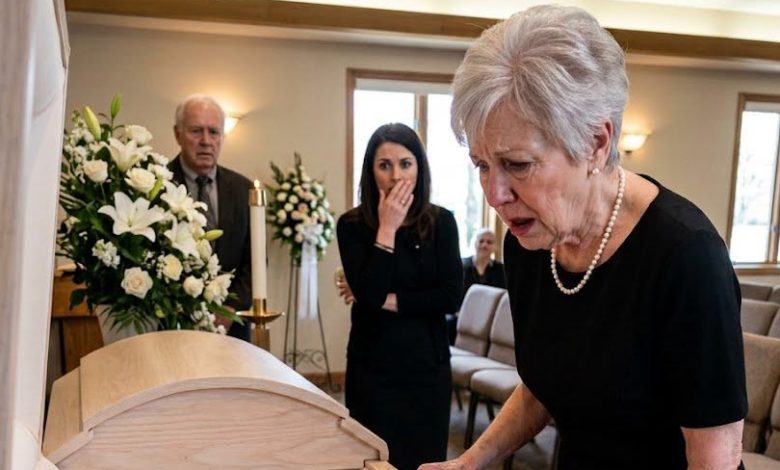
Once.
Twice.
Then a third time.
Hard enough to make the bottles of detergent on the shelf tremble.
“Mom.”
Julian’s voice was low at first.
Controlled.
Too controlled.
“Open the door.”
I sat on the cold tile floor with Chloe curled in my lap beneath an old black wool shawl I had grabbed from the coat rack.
Her body was burning with fever.
Her hands were freezing.
Every few seconds, a tremor ran through her.
I had one arm around her shoulders and the other hand pressed against my phone while an emergency dispatcher spoke calmly into my ear.
“Do not unlock the door until the responders identify themselves.”
“I won’t.”
“Is the child conscious?”
“Yes.”
Barely.
But yes.
Chloe’s head rested against my collarbone.
Her blond hair was damp with sweat.
She smelled like flowers.
Not shampoo.
Flowers.
Lilies.
The same white lilies surrounding the casket in the living room.
Her casket.
The casket where, less than twenty minutes earlier, I had touched my granddaughter’s cheek during what was supposed to be the last private moment I would ever have with her.
And felt warmth.
At first I thought grief had made me imagine it.
Then I saw her eyelid move.
Then her finger.
Then the impossible happened.
My granddaughter opened her eyes inside her own coffin.
Now my son was standing on the other side of the laundry-room door telling me to give her back.
“Mom.”
Another strike.
“Open this door right now.”
Chloe flinched so violently that her forehead struck my chin.
“Shh,” I whispered.
I pulled her closer.
“It’s okay.”
It was a lie.
Nothing was okay.
But sometimes adults lie to children because hope is the only blanket we have left to wrap around them.
Chloe’s small hand twisted into the fabric of my blouse.
“Grandma?”
“I’m here.”
“Don’t let Daddy take me.”
My throat closed.
“I won’t.”
That was when Julian stopped knocking.
For several seconds there was absolute silence in the hallway.
Then he asked the question that changed everything.
“You called someone?”
Not:
Is Chloe breathing?
Not:
Is her fever worse?
Not:
How is my daughter alive?
Not even:
What happened?
His first concern was whether I had called someone.
I looked down at Chloe.
She was staring toward the door.
Her pupils looked heavy.
Her eyelids kept drifting closed.
I touched her cheek.
“Stay awake for me, sweetheart.”
“I’m sleepy.”
“I know.”
Her voice became smaller.
“Daddy gave me the sleepy medicine again.”
Everything inside me went still.
“Again?”
Chloe nodded weakly.
The dispatcher heard me.
“What did the child say?”
I pressed the phone closer.
“She said her father gave her sleepy medicine again.”
Julian must have heard through the door.
“She has a fever!” he shouted. “She doesn’t know what she’s talking about.”
Chloe buried her face against me.
I rubbed her back.
“What medicine, sweetheart?”
“I don’t know.”
“Did Daddy give it to you?”
She nodded.
“And Mommy?”
Another nod.
“Mommy said I was still awake.”
She swallowed.
“Daddy said give me more because everybody was coming tomorrow.”
The room seemed to tilt.
I closed my eyes for one second.
Only one.
Because suddenly dozens of memories were rearranging themselves inside my mind.
Canceled visits.
Unanswered video calls.
Chloe sleeping during family dinners.
Julian saying she had anxiety.
Victoria saying she was going through a difficult phase.
The curtains always drawn.
The excuses.
The constant insistence that I stop asking questions.
Individually, each explanation had seemed irritating but possible.
Together, they became something else.
A pattern.
A pattern I had refused to see because the person creating it was my son.
Julian hit the door again.
“She is confused!”
I looked toward the handle.
“Then explain something to me.”
Silence.
I felt the small piece of metal in my fist.
The key.
The key I had found hidden beneath the padded lining of Chloe’s casket.
The key that opened the narrow restraint wrapped around her ankle.
“Why was she tied inside the coffin?”
Nothing.
My breathing sounded terribly loud.
“Julian?”
“I don’t know what you’re talking about.”
His answer came too quickly.
I stared at the door.
That frightened me more than if he had screamed.
Because Julian had always been a terrible liar when he was young.
When he broke a window at thirteen, he couldn’t meet my eyes.
When he skipped school at sixteen, he rambled.
When he borrowed my car at nineteen after I had explicitly told him not to, his ears turned red.
But the man standing outside that door had learned how to lie without stumbling.
I looked at the key again.
Its metal teeth had pressed deep red marks into my palm.
“You know exactly what I’m talking about.”
Upstairs, a floorboard creaked.
Then another door opened.
Victoria.
My daughter-in-law’s footsteps came slowly down the staircase.
She called her husband’s name.
“Julian?”
He answered sharply.
“Stay upstairs.”
She ignored him.
A moment later I heard her reach the hallway.
“What happened?”
“Mom called an ambulance.”
He said the word ambulance as though it were a betrayal.
Victoria gasped.
Not because Chloe was alive.
Because help was coming.
“Oh, God.”
That was all she said.
Chloe began shaking harder.
“Grandma.”
“Yes?”
“Don’t give me back.”
My chest felt as if something inside it cracked.
“I’m not giving you back.”
My son heard me.
“You have no right to say that!”
He was shouting now.
“You’re not her parent.”
He was correct.
Legally, biologically, he was her father.
I was only her grandmother.
For thirty-eight years, being Julian’s mother had meant something sacred to me.
It had meant defending him when he deserved defending.
Correcting him when he needed correcting.
Believing that whatever mistake he made, there was still goodness beneath it.
When he was little, he used to crawl into my bed during thunderstorms.
At seven, he cried because he found an injured bird beneath our porch.
At eleven, he spent his birthday money buying a bicycle for a boy in his class whose parents couldn’t afford one.
At seventeen, he sat beside his dying grandfather for three straight nights.
Those memories did not disappear because he became an adult.
That was what made the moment so unbearable.
The man outside the door was my son.
But the frightened child in my arms was his daughter.
And for the first time in my life, protecting one meant standing against the other.
“No,” I said quietly.
“I’m not her parent.”
I tightened my arms around Chloe.
“I’m just the person standing between her and that door.”
The hallway became silent again.
Then, faintly, beyond the walls of the house, came a sound.
A siren.
Growing louder.
Julian stopped speaking.
Victoria did not.
Her voice dropped into a frantic whisper.
“We need to clean this up before they come inside.”
My blood turned cold.
She must have thought the door muffled her words.
It didn’t.
The dispatcher heard them too.
“Ma’am,” she said, “stay where you are. Do not leave that room.”
Outside, Julian hissed something at Victoria.
Their footsteps moved away.
For a moment, I almost unlocked the door to follow them.
The thought of them touching the casket terrified me.
The straps.
The medication.
The blankets.
Whatever evidence existed in that house could disappear in minutes.
“They moved away,” I whispered into the phone.
“Do not follow them.”
“But they’re going to—”
“The responders are almost there. Stay with Chloe.”
I looked down.
That was enough to stop me.
Chloe needed me more than evidence did.
So I stayed.
I sat on the floor beside the washing machine with my back pressed against the door while my granddaughter shivered beneath my shawl.
I asked simple questions because the dispatcher told me to keep her awake.
“What’s your full name?”
“Chloe Grace Mercer.”
“How old are you?”
“Six.”
“What’s your favorite cereal?”
She thought about it.
“Chocolate stars.”
“Good.”
“What’s your rabbit’s name?”
She frowned as if I had asked the stupidest question in the world.
“Bunny.”
A laugh escaped me.
It was tiny.
Broken.
But it was a laugh.
“Of course it is.”
She almost smiled.
Then her eyelids sagged again.
“Stay with me.”
“I’m tired.”
“I know.”
“Can I sleep?”
“Not yet.”
“Why?”
Because someone may have put enough medication inside you to keep you from waking.
Because twenty minutes ago I found you breathing inside a coffin.
Because your father held a funeral while you were alive.
I said none of that.
“Because I want to talk to you.”
She rested her cheek against me.
“About what?”
“Pancakes.”
That got her attention.
“Chocolate chips?”
“Absolutely.”
“With strawberries?”
“If you want.”
“And whipped cream?”
“As much as you can handle.”
Her eyes opened a little wider.
“Daddy says sugar makes kids annoying.”
My heart broke again.
“Well.”
I smoothed her wet hair away from her forehead.
“Grandmothers have different rules.”
A pounding came from the front door.
Voices.
Men.
Julian started talking immediately.
I could hear him from the hallway.
“There’s been a misunderstanding.”
Of course.
A misunderstanding.
That was the word people used when the truth was too ugly to say aloud.
“My mother is distraught,” he continued. “She’s been having trouble since Chloe passed.”
Passed.
He said it while Chloe breathed against my chest.
“She’s confused.”
Another voice responded.
“Where is the child?”
“She—”
“Where is Chloe?”
“My mother locked herself in the laundry room.”
“With Chloe?”
A pause.
Then Julian began talking faster.
“She found the body and became hysterical. I think she thinks—”
The responder interrupted.
“Sir, move away from the hallway.”
“I’m her father.”
“Move away from the hallway.”
Heavy footsteps approached.
A man stopped outside.
He called my name.
I didn’t open the door.
The dispatcher had warned me.
“Who are you?” I asked.
He identified himself.
Then another responder.
I looked down at Chloe.
“It’s okay.”
She grabbed my sleeve.
“Daddy?”
“No.”
I unlocked the door.
The moment it opened, two paramedics saw us.
I will remember their faces forever.
Professionals are trained not to react.
But some things defeat training.
One looked at Chloe.
Then toward the living room.
Then back at Chloe.
His expression changed.
Not dramatically.
Just enough.
He dropped to his knees.
“Hi, Chloe.”
She stared at him.
“My name is Daniel. I’m going to help you, okay?”
She looked at me before answering.
I nodded.
“Okay.”
He touched her wrist.
His partner opened equipment on the floor.
“What medication did she take?”
“I don’t know.”
I looked at Julian.
“He knows.”
“She had children’s cold medicine,” Julian said.
Daniel didn’t turn around.
“What kind?”
Julian hesitated.
Victoria appeared behind him.
“The normal kind.”
“What medication?”
Silence.
“What dose?”
“The normal amount.”
Daniel finally looked up.
“Which means?”
Victoria’s mouth opened.
Nothing came out.
Chloe whispered, “The purple one.”
Daniel looked back at her.
“Purple medicine?”
She nodded.
“Mommy gives it with the little cup.”
“How much?”
Chloe lifted one hand weakly.
“Sometimes one.”
She paused.
“Sometimes two.”
Victoria stepped forward.
“She doesn’t understand measurements.”
The second paramedic moved between her and Chloe.
“Please stay back.”
“I’m her mother.”
“Stay back.”
The word mother hit me strangely.
Mother.
Father.
Grandmother.
Titles.
We use them as if they automatically mean safety.
They don’t.
Sometimes they only tell you who was supposed to protect the child.
Daniel checked Chloe’s temperature.
Her oxygen.
Her heart rate.
Her pupils.
Every reading seemed to make his expression more serious.
He wrapped another blanket around her.
“Chloe, do you know where you are?”
She looked around.
“Grandma’s laundry room.”
“Do you know what happened before you came in here?”
She stared toward the open doorway.
Then whispered something so softly Daniel leaned closer.
“Grandma found me in the box.”
Behind us, Julian made a noise.
“She’s confused.”
Daniel did not look at him.
“What box?”
Chloe pointed shakily toward the living room.
“The dead box.”
My stomach twisted.
Daniel looked at me.
I opened my fist.
The little metal key sat in my palm.
“This was hidden beneath the lining.”
He took it carefully.
“It opened the restraint around her ankle.”
That was the moment the atmosphere changed.
Before the key, I could feel people trying to understand.
After the key, no one treated the scene as simple confusion anymore.
The second paramedic spoke quietly into his radio.
More responders entered.
Then police.
Questions started.
Where exactly had I found Chloe?
Who had prepared the casket?
Had a funeral home been involved?
Why was the coffin inside the house?
When had she supposedly died?
Who certified the death?
My answers made the situation stranger.
There had been no funeral home viewing.
Julian had said Chloe died suddenly at a private clinic after a severe respiratory episode.
He said everything happened so quickly that he and Victoria wanted the memorial at home before burial.
He told me the clinic had handled the paperwork.
He told the family the casket would remain closed because seeing Chloe would be too traumatic.
But grief makes people unreasonable.
It makes mothers disobedient.
Grandmothers too.
I had begged for one last moment alone.
Julian resisted.
I insisted.
Eventually he allowed it.
Ten minutes.
That was all.
Ten minutes to say goodbye.
Ten minutes to touch my granddaughter’s hair.
Ten minutes that destroyed whatever plan he thought he had built.
Because when I lifted the lid, I noticed three things.
Chloe did not look dead.
Her lips had color.
Her skin was warm.
And when my fingers brushed her wrist, I felt a pulse.
At first I thought I had gone insane.
Then Chloe inhaled.
A tiny breath.
Barely there.
I tore away the blanket.
Found the restraint.
Found the key.
Freed her.
Lifted her out.
And before I could reach the front door, Julian entered the living room.
I had never seen fear arrive on a human face so quickly.
He didn’t say:
She’s alive.
He said:
What are you doing?
That was when I ran.
Not outside.
I never would have made it past him.
I ran to the laundry room.
Locked the door.
Called emergency services.
Now the paramedics lifted Chloe onto a stretcher.
The moment they rolled her toward the living room, she saw the casket.
Her whole body stiffened.
“No!”
She screamed.
“No box!”
It was the loudest sound she had made since I found her.
She began clawing at the blankets.
“No box! Grandma! No!”
“I’m here.”
I rushed beside her.
Daniel immediately turned the stretcher away.
“We’re not going near it.”
Chloe cried.
“No box.”
“You’re not going in the box,” I told her.
“Never again.”
Julian stood at the end of the hallway.
His face was pale.
And that was when I saw something in my son that I wish I had never learned to recognize.
Calculation.
His eyes moved from Chloe to the police.
From the police to the casket.
From the casket to Victoria.
He was measuring.
Planning.
Deciding which version of the truth might still save him.
Victoria stood near the staircase with both hands clasped in front of her.
Her face looked gray.
Then she whispered:
“She woke up earlier than we expected.”
Silence.
Absolute silence.
Julian slowly turned toward her.
“Victoria.”
His tone was not grief.
It was warning.
She blinked.
“I meant…”
Nobody moved.
“I meant the medicine.”
“What medicine?” an officer asked.
Victoria shook her head.
“The fever medicine.”
“You said she woke up earlier than you expected.”
“I’m exhausted.”
“Expected from what?”
“I don’t know.”
Julian stepped toward her.
“Stop talking.”
The officer immediately moved between them.
“Sir.”
Julian raised his hands.
“I’m just telling my wife she’s confused.”
“No.”
For the first time that night, Victoria looked directly at him.
“I’m not.”
Something passed between them.
Fear.
Hatred.
Maybe blame.
Maybe all three.
Then the paramedics took Chloe outside.
She would not release my hand.
When Daniel asked who she wanted to ride with her, she pointed at me.
“Grandma.”
I climbed into the ambulance.
Julian tried to follow.
An officer stopped him.
“That’s my daughter.”
“I understand.”
“I’m going with her.”
“Not right now.”
“You can’t keep me from my own child.”
Chloe heard him.
Her fingers tightened around mine.
“Go,” Daniel told the driver.
The ambulance doors closed.
And for the first time that night, there was a barrier between Chloe and her father that he could not open.
I sat beside her as the ambulance moved through the dark streets.
Streetlights flashed across her face.
Orange.
Black.
Orange.
Black.
She stared at the ceiling.
“Grandma?”
“Yes?”
“Am I dead?”
I nearly stopped breathing.
“No.”
“But everybody said I was.”
“You are alive.”
“Daddy said I had to pretend.”
I leaned closer.
“What?”
Her eyes drifted toward me.
“He said it was a game.”
My hands went cold.
“What kind of game?”
“The quiet game.”
She swallowed.
“He said if I was really quiet, people wouldn’t be mad.”
“Who would be mad?”
“I don’t know.”
“Did he tell you why?”
She shook her head.
Then she whispered:
“He said Mommy made a bad mistake.”
The ambulance seemed suddenly too small.
I wanted to ask a hundred questions.
But Daniel gently stopped me.
“Let the investigators handle the detailed questions.”
He was right.
So I stopped.
Not because I didn’t need answers.
Because Chloe deserved to tell her story once, carefully, to people trained to hear it.
At the hospital, everything became strangely ordinary.
A plastic bracelet around Chloe’s wrist.
A thermometer.
A paper cup.
A monitor clipped to her finger.
A nurse asking her favorite cartoon.
Ordinary things.
Safe things.
The kind of objects that should have surrounded her all along.
The medical team treated her fever and dehydration.
They took blood.
They monitored her heart.
They checked her breathing repeatedly.
I sat beside her bed.
Whenever someone touched her, they asked first.
“Chloe, can I listen to your chest?”
She nodded.
“Can I look at your arm?”
She nodded.
“Is it okay if I move your blanket?”
That question made her freeze.
The nurse waited.
She did not reach.
She did not hurry.
She simply waited for Chloe to answer.
Finally, Chloe nodded.
The nurse moved the blanket.
Such a small thing.
Permission.
I turned my face toward the window because tears were running down my cheeks.
Permission should not have felt revolutionary to a six-year-old.
Near dawn, a doctor named Dr. Patel entered.
He pulled a chair close.
He had kind eyes and the careful voice of someone who had delivered difficult information many times.
“Chloe is stable.”
My body almost collapsed with relief.
“But?”
“There is a but.”
Of course there was.
He explained that preliminary testing suggested the presence of a sedating medication.
The amount was not trivial.
It was enough to raise serious concerns, especially alongside dehydration, fever, and impaired responsiveness.
“Could cold medicine cause this?”
“Some medications can cause drowsiness.”
He paused.
“But what we’re seeing does not fit comfortably with the explanation we were initially given.”
My hands clenched together.
“Could she have died?”
Dr. Patel did not give me false comfort.
“Yes.”
The word went through me like a blade.
“If the dose had been higher, if her breathing had become more suppressed, if her condition had worsened without treatment…”
He let the sentence end there.
I looked at Chloe.
She was asleep.
Actually asleep now.
Safely.
Connected to monitors.
Breathing.
Alive.
And suddenly all the excuses from the last six months came rushing back.
“She’s sleeping.”
“She had a bad night.”
“She doesn’t want company.”
“She’s anxious.”
“She’s sick.”
“She’s being difficult.”
Ordinary sentences.
I had accepted every one.
I began remembering moments I had dismissed.
Six weeks earlier, Chloe ran to me when I visited.
Not walked.
Ran.
She threw both arms around my waist.
“Can I sleep at your house?”
I laughed.
“Anytime.”
Julian came behind her.
“She’s in a clingy phase.”
He pulled her away gently.
Too gently.
The way adults move when they know someone is watching.
Another time, during a video call, Chloe whispered:
“I don’t like the purple drink.”
Victoria immediately took the phone.
“She means grape medicine.”
I asked what was wrong.
“Seasonal allergies.”
Another time Chloe slept through Christmas dinner.
Julian said she had been awake half the night excited about presents.
I believed him.
Another visit, the child’s drawings had disappeared from the refrigerator.
Every one.
When I asked, Victoria said they were redecorating.
Now I wondered whether Chloe had drawn something they didn’t want anyone seeing.
How many signs had I overlooked because believing my son was easier than doubting him?
That question tortured me.
Still does.
But there is a difference between regret and responsibility.
I should have asked more.
I should have pushed harder.
But I had not drugged Chloe.
I had not restrained her.
I had not put her in a coffin.
That guilt belonged somewhere else.
A little after sunrise, Chloe woke.
She looked confused.
Then she saw me.
“Grandma.”
“I’m right here.”
“Can I have juice?”
I almost cried again.
“What kind?”
“Apple.”
“I think we can arrange that.”
The nurse brought a small cup.
Chloe drank slowly.
Then she asked:
“Where’s Daddy?”
My heart tightened.
“He’s not here.”
“Mommy?”
“Not here.”
She looked at her blanket.
“Are they mad?”
“You don’t have to worry about whether they’re mad.”
“But Daddy said everybody would be mad if I ruined it.”
“Ruined what?”
She picked at the edge of the hospital blanket.
“Being dead.”
I looked away.
I had to.
Because for a moment I could not let her see my face.
When I turned back, she was watching me.
“Sweetheart…”
“I didn’t want to be dead.”
“You weren’t.”
“But Daddy said I had to stay quiet.”
“Why?”
“He said Mommy made me too sleepy.”
My stomach turned.
“And then?”
“He carried me.”
“Where?”
She frowned.
“I woke up in the box.”
Her voice became shaky.
“It was dark.”
I reached for her hand.
She let me hold it.
“I yelled.”
“Did anyone hear you?”
“Daddy.”
The room seemed to shrink.
“What happened?”
“He opened it.”
My breathing stopped.
“He opened the casket?”
She nodded.
“He said I had to be quiet.”
“Why?”
“He said if people knew I woke up, Mommy could go away.”
My eyes burned.
“What did he do then?”
“He gave me more medicine.”
That sentence destroyed the last place inside me where my son was still protected by doubt.
Until then, some desperate part of me had imagined he might have panicked.
Maybe Victoria administered the medication.
Maybe Julian believed Chloe had died.
Maybe fear made him behave irrationally.
But Chloe had awakened.
He had seen her alive.
And instead of calling for help, my son had given her more.
I stood.
Walked into the hall.
And vomited into a trash can.
A nurse helped me sit.
I was shaking.
“I raised him.”
That was all I could say.
“I raised him.”
The nurse did not offer empty comfort.
She simply sat beside me until I could breathe.
An hour later, investigators arrived with a child specialist.
They explained that Chloe would be interviewed carefully.
I would not be in the room unless professionals believed it necessary.
At first, every instinct in me rebelled.
She wanted me.
But I understood.
They needed Chloe’s words to be hers.
Not mine.
I watched through glass while a woman sat with her at a small table.
No uniform.
No frightening interrogation.
Just crayons.
Paper.
A stuffed dog.
They spoke softly.
Chloe drew.
At one point she drew a rectangle.
Then a stick figure inside it.
Then another stick figure outside.
I had to leave the viewing area.
I sat in the corridor and cried silently into both hands.
That was where Detective Mara Ruiz found me.
She sat across from me.
“Mrs. Mercer?”
“Yes.”
“I’m Detective Ruiz.”
I nodded.
She held a notebook but did not open it immediately.
“I know this is difficult.”
“You have no idea.”
“No.”
She looked toward the interview room.
“I probably don’t.”
That honesty made me trust her more.
She asked about the supposed death.
Julian had called me three days earlier.
His voice was broken.
Too broken.
At least that was how I remembered it then.
He said Chloe stopped breathing after a sudden illness.
He said paramedics couldn’t revive her.
He said Victoria was inconsolable.
He asked me to help contact relatives.
I became useful.
That is what people do to grieving mothers.
Give them tasks.
Call the family.
Choose flowers.
Bring food.
Answer messages.
I had been so devastated I never thought to demand paperwork.
When I asked about seeing Chloe, Julian discouraged it.
“She doesn’t look like herself.”
I insisted.
He said the casket would remain closed.
I thought he was protecting me.
Now I understood.
He was protecting himself.
Detective Ruiz asked:
“Did you see a death certificate?”
“No.”
“Did you speak to the clinic?”
“No.”
“Did you see paramedics?”
“No.”
“Did anyone outside Julian and Victoria independently confirm her death?”
I opened my mouth.
Closed it.
“No.”
The word tasted like shame.
Ruiz leaned forward.
“Mrs. Mercer, people trust family members during emergencies. That is normal.”
“I should have checked.”
“Perhaps.”
She did not lie to make me feel better.
“But the people responsible for what happened are the people who did it.”
I looked through the glass.
Chloe was coloring the stuffed dog’s paper tag.
“Will she be okay?”
Ruiz followed my gaze.
“I don’t know yet.”
At least she was honest.
“But she is alive.”
Yes.
Alive.
For the next several hours, pieces of the lie began collapsing.
The clinic Julian named had no record of Chloe being treated there.
No physician had signed a death certificate.
No funeral home had prepared the body.
The casket had been purchased privately.
Online.
Delivered two weeks before Chloe supposedly died.
Two weeks.
That detail made everyone go quiet.
Detective Ruiz showed me the receipt.
Julian’s name.
His credit card.
Delivered to a rented storage unit.
Fourteen days before his daughter’s “death.”
I stared at the date.
“He planned it.”
Ruiz said nothing.
She didn’t have to.
The flowers had also been ordered in advance.
The memorial invitations were created days before the date Julian claimed Chloe stopped breathing.
The deeper investigators looked, the worse it became.
Then they found financial records.
A life-insurance policy.
Not enormous.
But significant.
Five hundred thousand dollars.
Taken out less than four months earlier.
I felt physically ill.
“On a six-year-old?”
Julian had told the insurer it was part of a family protection package.
That alone proved nothing.
Parents sometimes insure children for legitimate reasons.
But combined with everything else, it became another piece of a terrible puzzle.
Then came my son’s voicemail.
He called twenty-three times.
I ignored every call.
When Chloe finally slept again, I listened to one message.
His voice sounded wrecked.
“Mom.”
A long pause.
“Please answer.”
Another pause.
“Victoria caused this.”
I stared at the phone.
“She was giving Chloe medication because she wouldn’t sleep. I didn’t know how much. I swear I didn’t.”
My heart began pounding.
“I came home and Chloe wouldn’t wake up. Victoria panicked. She said we’d lose everything. She said they’d take Chloe away.”
He breathed heavily.
“I just… I thought we could handle it.”
Handle it.
That word.
“I thought she was gone at first.”
At first.
I closed my eyes.
“Then she woke up.”
There it was.
His voice cracked.
“I know how that sounds.”
No.
He did not.
“I panicked.”
He began crying.
“When she woke up, Victoria said there was no way out anymore. Everyone already knew. Family was coming. The insurance company would investigate. She said if we called an ambulance then, we’d both go to prison.”
He took a breath.
Then said the sentence that ended whatever relationship remained between us.
“I thought if we could just get through the funeral, nobody would ever know how it started.”
I listened twice.
Not because I couldn’t understand.
Because I could.
He did not say:
I was trying to save Chloe.
He said:
Get through the funeral.
He knew she was alive.
My son knew his child was alive.
And he wanted the world to bury her anyway.
I walked directly to Detective Ruiz.
I handed her my phone.
“Listen.”
She did.
Her face revealed nothing.
Then she asked:
“Can we preserve this recording?”
“Yes.”
“For evidence?”
“Yes.”
“Are you sure?”
I looked through the hospital-room window.
Chloe was sleeping with Bunny tucked beside her.
Someone had brought it from the house.
Her rabbit.
One ear bent.
Gray fur worn thin from years of love.
“Yes.”
There was no hesitation anymore.
“Use everything.”
Later I learned Victoria had given investigators a completely different account.
According to her, Julian controlled everything.
She admitted giving Chloe sedating medication on several occasions.
She claimed she had started because Chloe suffered from severe nighttime panic.
There was no prescription.
No doctor supervising it.
She said she used over-the-counter medication.
Then stronger medication obtained from someone she refused to identify.
She insisted Julian knew.
Julian insisted he didn’t.
Victoria said Julian suggested the funeral plan.
Julian said Victoria did.
Julian blamed the drugs.
Victoria blamed the casket.
Each tried desperately to move the invisible line of guilt until it landed just beyond their own shoes.
Neither could change the facts.
Chloe had needed medical help.
They chose concealment.
Chloe woke.
They chose silence.
Chloe cried.
They chose more medication.
Then they invited their family to mourn a child who was still breathing beneath flowers.
When Chloe was medically stable, the question became where she would go.
Not home.
That was clear.
Child protection officials met with me.
They inspected my house.
They asked about bedrooms, safety, finances, schools, routines.
I answered everything.
Then one woman asked:
“Are you prepared for the possibility that caring for Chloe could become long-term?”
I looked at her.
“I bought her first crib.”
She waited.
“I taught her to tie her shoes.”
She waited.
“I sat outside her kindergarten classroom because she cried on the first day.”
My voice broke.
“I will sleep on the floor beside her bed until I die if that is what she needs.”
The woman’s expression softened.
“That wasn’t meant as a challenge.”
“I know.”
I wiped my eyes.
“Yes.”
I breathed.
“Yes. I am prepared.”
When Chloe was discharged, she left with me.
She wore pink hospital socks because nobody could find her shoes.
Her hand remained inside mine the entire walk to the car.
The first night at my house, I made pancakes for dinner.
Chocolate chips.
Strawberries.
Too much whipped cream.
Exactly as promised.
She ate three bites.
Then stopped.
“Grandma?”
“Yes?”
“Am I allowed to not finish?”
For one horrible second, I didn’t understand.
“Of course.”
“Daddy says wasting food is bad.”
“It’s okay.”
“He gets mad.”
“You’re safe here.”
She stared at the pancake.
Then deliberately placed her fork beside the plate.
A tiny act.
But I saw courage in it.
That night, I showed her the guest room.
I had changed the bedding.
Soft yellow sheets.
A little lamp.
Bunny waiting on the pillow.
She stood in the doorway.
“Can the door stay open?”
“Yes.”
“All night?”
“All night.”
She climbed into bed.
I kissed her forehead.
Then stopped.
“Can I kiss you goodnight?”
She looked surprised.
“You always do.”
“I know.”
I smiled.
“But I’m asking.”
She considered.
Then nodded.
“Yes.”
I kissed her forehead.
Ten minutes later:
“Grandma?”
I was already sitting in the hallway.
“I’m here.”
“Can the door close a little?”
“Of course.”
She climbed out of bed herself.
She moved the door one inch.
Then another.
Then another.
She stopped when the opening was about the width of her hand.
“That much.”
“Okay.”
For weeks, that became our ritual.
Some nights the door stayed wide open.
Some nights nearly closed.
The important thing was that Chloe chose.
She chose the hallway light.
She chose pajamas.
She chose whether she wanted milk.
She chose whether she wanted a hug.
She chose whether Bunny slept beneath the blanket or on top.
Small choices.
Ordinary choices.
But after what had happened to her, choice became medicine.
The nightmares came later.
At first, Chloe barely spoke about the casket.
Then one night I woke to screaming.
I ran into her room.
She was standing on the mattress.
Her back pressed against the wall.
“Open it!”
“The door is open.”
“Open it!”
“It’s open, sweetheart.”
“The box!”
There was no box.
But she could see it.
I climbed onto the bed.
I did not touch her.
“Chloe.”
Her eyes were wild.
“I can’t breathe!”
“You are breathing.”
“They closed it.”
“You’re in your room.”
“It’s dark!”
I turned on every light.
Bedroom.
Hallway.
Bathroom.
Kitchen.
Then I opened the front door.
Cold night air entered the house.
“Look.”
She stared.
“Outside.”
Trees.
Streetlights.
Moon.
The entire world.
“There is no lid.”
Her breathing slowed.
“No one is closing anything.”
She began crying.
I held out my hand.
She grabbed it.
I stayed beside her until sunrise.
The investigation continued.
So did the court proceedings.
I saw Julian for the first time after the hospital at an emergency custody hearing.
He entered wearing a gray suit.
He looked thinner.
Older.
For one terrible second, my body reacted before my mind did.
That is the cruelty of motherhood.
You can be furious with your child and still notice he has lost weight.
You can know what he has done and still remember packing his school lunch.
He saw me.
“Mom.”
I turned away.
He approached anyway.
“Please.”
My attorney stepped between us.
Julian stopped.
His eyes filled with tears.
“You think I wanted this?”
I looked at him.
That question released something in me.
“No.”
He swallowed.
“I think you wanted to avoid consequences.”
“That isn’t fair.”
“Fair?”
My voice stayed low because Chloe was in another room.
“You put your daughter in a coffin.”
He looked around.
“Victoria—”
“Stop.”
“She drugged her.”
“And when Chloe woke up?”
His face changed.
I stepped closer.
“When your daughter opened her eyes inside that box, what did you do?”
He said nothing.
“What did you do, Julian?”
His lower lip trembled.
“I panicked.”
“You medicated her again.”
“I wasn’t thinking.”
“You were thinking very clearly.”
“That’s not true.”
“You ordered flowers.”
His face went pale.
“You invited relatives.”
“Mom—”
“You accepted casseroles from people who believed your daughter was dead.”
Tears rolled down his face.
“You stood beside her casket.”
“Stop.”
“And you watched me cry over her.”
“I said stop!”
A security officer looked toward us.
I lowered my voice.
“You want me to stop because saying it makes you hear what you did.”
He stared at me.
Then whispered:
“I’m still your son.”
That nearly destroyed me.
Because he was.
He always would be.
Biology does not erase itself because morality collapses.
I could not stop being the woman who remembered his first steps.
But I could stop protecting him from what he had become.
“Yes.”
I nodded.
“You are my son.”
Hope flickered in his face.
Then I finished:
“And Chloe is your daughter.”
His hope disappeared.
The court granted temporary placement with me.
Julian and Victoria were prohibited from contacting Chloe directly while the investigation continued.
When I returned home, Chloe was sitting at the kitchen table drawing.
She looked up.
“Do I have to go back?”
“No.”
“Today?”
“No.”
“Tomorrow?”
“No.”
“When?”
I pulled out the chair beside her.
“Not until the people responsible for keeping you safe believe it is safe.”
She stared at me.
“Is Daddy bad?”
There it was.
The question every child eventually asks when someone they love hurts them.
I could have said yes.
I wanted to.
But children deserve truth that leaves room for their own hearts.
“Your daddy made very dangerous choices.”
“Does he love me?”
My eyes filled.
“I think he believes he does.”
She frowned.
That answer was too complicated.
So I tried again.
“Loving someone is not only something you say.”
I touched the crayon beside her.
“It’s also how you treat them.”
She thought about that.
Then returned to her drawing.
“What are you making?”
“A house.”
It had a purple roof.
Three windows.
A huge yellow sun.
Two stick figures outside.
One tall.
One small.
I pointed.
“Who’s that?”
“You.”
“And that?”
“Me.”
No parents.
I said nothing.
Months passed.
Therapy became part of our routine.
At first Chloe hated it.
Then she discovered the therapist had kinetic sand.
That changed everything.
Children survive through strange doorways.
Sand.
Crayons.
Stuffed animals.
Pancakes.
The therapist taught me something important:
Do not make recovery another thing Chloe has to perform.
Do not praise her only when she seems “strong.”
Do not panic when she regresses.
Do not ask if she is “over it.”
Trauma is not a staircase.
It is weather.
Some days sunlight.
Some days storms.
Sometimes both within an hour.
So we built routines.
Breakfast.
School.
Afternoon snack.
Homework.
Bath.
Story.
Door choice.
Light choice.
Hug choice.
Sleep.
On bad nights, I sat outside the room.
On worse nights, I sat beside the bed.
Once, she asked:
“Will you get tired of me being scared?”
I answered immediately.
“No.”
“What if it takes forever?”
“Then I’ll be here forever.”
She stared at me.
“You’ll be old.”
“I’m already old.”
That made her laugh.
The sound filled the room.
God, that laugh.
I had spent weeks hearing her cry.
Hearing laughter again felt like opening a window in a house filled with smoke.
The legal case moved slowly.
Real life does not resolve itself as neatly as stories do.
There were hearings.
Interviews.
Experts.
Medical reports.
Financial records.
Forensic examinations.
Investigators found traces of sedating substances in items recovered from Julian’s house.
They found internet searches.
“How long can a person stay unconscious?”
“Signs of overdose in child.”
“Can death certificate be issued after home death?”
“Private burial requirements.”
“Child life insurance payout timeline.”
The searches began weeks before the memorial.
I read them once.
Never again.
They also recovered messages between Julian and Victoria.
Some were arguments.
Some were terrifyingly practical.
Victoria:
“She woke again.”
Julian:
“Give half.”
Victoria:
“What if it doesn’t work?”
Julian:
“It has to.”
Another message:
Victoria:
“She’s asking for Grandma.”
Julian:
“Do not call her.”
And another:
Julian:
“Once tomorrow is over we can figure out the rest.”
Tomorrow.
The memorial.
I had to leave the prosecutor’s office after reading that one.
Outside, I sat on a bench beneath a tree.
The sun was shining.
People walked past carrying coffee.
Cars moved.
Someone laughed across the street.
How could the world continue so normally when my understanding of my own family had been destroyed?
Detective Ruiz found me there.
She sat beside me.
“I used to believe evil looked different.”
She waited.
“I thought you would recognize it.”
“Most people don’t.”
“He used to rescue worms from sidewalks after rain.”
Ruiz looked at me.
“What?”
“Julian.”
I laughed once.
It sounded terrible.
“When he was eight, he wouldn’t let me step on worms.”
My voice broke.
“How does that child become a man who puts his daughter in a coffin?”
Ruiz did not answer.
There was no answer.
Human beings want a clean explanation.
A moment when everything changed.
A single cause.
But sometimes people become terrible through hundreds of smaller choices.
Fear.
Selfishness.
Control.
Cowardice.
One compromise after another.
Until eventually they are standing beside something monstrous and calling it necessary.
Victoria accepted a plea agreement first.
When I learned, I felt no satisfaction.
Only exhaustion.
She admitted administering sedating substances repeatedly and participating in the concealment after Chloe became dangerously ill.
Her statement implicated Julian heavily.
Julian refused to plead guilty.
He insisted on telling everyone he was trying to protect his family.
At trial, the prosecutor played his voicemail.
I sat in the courtroom.
My son’s voice filled the room.
“I thought if we could just get through the funeral, nobody would ever know how it started.”
Julian stared at the table.
I stared at him.
He never looked at me.
Chloe did not attend.
I fought hard for that.
She had already lived the evidence.
She did not need to sit inside a courtroom while adults turned her worst memories into exhibits.
Her recorded forensic interview and other evidence were handled according to the court’s process.
When the verdict came, I did not celebrate.
People expect revenge to feel warm.
It doesn’t.
Justice and joy are different things.
Julian was found guilty on multiple serious charges related to child endangerment, unlawful restraint, drugging, and attempts to conceal what had happened.
I listened.
I cried.
Then I went home and made spaghetti.
Because Chloe had school the next morning.
That was life now.
Courtroom.
Spaghetti.
Trauma appointment.
Laundry.
Legal documents.
Packing a lunch.
Grief.
Homework.
Love.
Life refuses to stay in one emotional category.
A year after the night of the casket, Chloe asked me something while we were gardening.
“Do you hate Daddy?”
I froze.
She was kneeling beside a row of marigolds.
Dirt on her knees.
Hair escaping from her ponytail.
I put down the watering can.
“Sometimes I hate what he did.”
“That’s not what I asked.”
Seven now.
Sharper.
“Do you hate him?”
I sat beside her.
“I don’t know.”
She looked surprised.
“Adults can not know?”
“All the time.”
She smiled faintly.
Then she became serious.
“I think I love him.”
I nodded.
“That’s okay.”
“But I’m mad.”
“That’s okay too.”
“And sometimes I don’t want to remember him.”
“That’s okay.”
“And sometimes I do.”
“Also okay.”
She dug one finger into the soil.
“Therapy says two feelings can be true.”
“Therapy is right.”
She looked at me.
“Do you still love him?”
I took a long time answering.
“Yes.”
Her eyes widened.
I continued.
“But loving someone does not mean pretending they didn’t hurt you.”
She considered that.
“Can you love somebody and never see them?”
“Yes.”
“Can you forgive somebody and still not trust them?”
“Yes.”
“Did you forgive Daddy?”
I looked toward the garden.
“I’m working on not letting what he did poison the rest of my life.”
“That’s not forgiveness.”
“No.”
I smiled sadly.
“It’s where I am.”
She accepted that.
Children sometimes understand unfinished answers better than adults do.
The black wool shawl remained folded over a chair in my bedroom for months.
I could not wear it.
Every time I touched it, I saw Chloe inside that casket.
The lilies.
Her pale face.
The tiny movement of her eyelids.
The first breath.
My own scream.
One afternoon I found the shawl missing.
I panicked.
“Chloe?”
No answer.
“Chloe!”
Then she ran into the kitchen.
Wearing it.
The shawl trailed behind her like a royal cape.
She had one of my necklaces around her head as a crown.
“I’m Queen Chloe!”
For one second, all I saw was the shawl.
That night.
That room.
Then Chloe spun.
The fabric lifted behind her.
She laughed.
I almost told her to take it off.
Instead, I bowed.
“Your Majesty.”
She burst out laughing.
“Bring me cookies!”
“As the queen commands.”
That afternoon, something changed.
The shawl stopped belonging to the casket.
It became a cape.
That is how Chloe reclaimed things.
Slowly.
Without announcing it.
The word quiet stopped meaning fear.
Sometimes quiet meant coloring at the kitchen table.
A closed door stopped meaning being trapped.
Sometimes it meant Chloe wanted privacy while changing clothes.
Medicine stopped meaning purple liquid forced into a cup.
Sometimes medicine was antibiotics for an ear infection, explained by a doctor while she asked questions.
Sleep stopped meaning danger.
Eventually, sleep became ordinary.
Recovery did not erase what happened.
It changed who owned the meaning of it.
Two years later, Chloe asked if she could have a sleepover.
I almost said no.
Every instinct screamed no.
A sleepover meant another house.
Other adults.
Medication cabinets.
Closed doors.
I had become careful.
Then overly careful.
Then, without noticing, afraid.
Chloe saw my hesitation.
“I can come home if I want.”
“Yes.”
“I can call you.”
“Anytime.”
“Mrs. Hernandez is nice.”
“I know.”
“And Mia’s house has a camera doorbell.”
I laughed.
“You’ve done your research.”
She grinned.
“So?”
I wanted to protect her forever.
But protection can become another kind of cage when fear makes every decision.
“Yes.”
Her mouth fell open.
“Really?”
“Really.”
She screamed.
Threw her arms around me.
Then stopped.
“Sorry.”
“For what?”
“I hugged without asking.”
I stared at her.
Then smiled.
“You’re allowed to surprise your grandmother sometimes.”
She laughed.
That night I drove her to Mia’s house.
She carried a purple sleeping bag and Bunny.
Yes.
Bunny still came.
I stood at the door longer than necessary.
Chloe turned.
“Grandma.”
“What?”
“You can go.”
“I know.”
She gave me a look.
“Do you?”
Barely.
But I nodded.
“I do.”
She walked inside.
The door closed.
I stood on the porch.
My chest tightened.
Then through the window, I saw Chloe run toward her friend.
Two children laughing.
Nothing terrible.
Nothing dramatic.
Just life.
I drove home.
At 1:17 a.m., my phone rang.
I grabbed it immediately.
“Chloe?”
“Grandma?”
“What happened?”
“Nothing.”
I sat up.
“Then why are you calling?”
“I miss you.”
My eyes filled.
“I miss you too.”
“Can I stay?”
It took me a second to understand.
“You mean at the sleepover?”
“Yeah.”
“Of course.”
“I just wanted to hear your voice.”
I smiled in the dark.
“Well, now you have.”
“Okay.”
“Are you safe?”
“Yes.”
“Do you want me to come?”
“No.”
That word made me proud.
Not because she rejected me.
Because she knew I would come.
And chose to stay anyway.
“Goodnight, sweetheart.”
“Goodnight.”
She hung up.
I lay awake for another hour.
Not from fear.
From gratitude.
Years passed.
The story became something people around us knew in fragments.
Teachers knew enough.
Doctors knew what mattered.
Therapists knew more.
Neighbors knew less.
I never wanted Chloe to become “the coffin girl.”
She was not what happened to her.
She loved astronomy.
She hated peas.
She learned piano.
She had a ridiculous talent for remembering movie quotes.
She became obsessed with horses at nine.
She broke her wrist at ten trying to roller-skate too fast.
She got braces at eleven and complained dramatically for six straight months.
Normal life.
Beautifully boring normal life.
At twelve, she asked to see the newspaper articles about her case.
I had kept them hidden.
Not because I believed secrets were healthy.
Because timing mattered.
“You’re sure?”
“Yes.”
We sat at the dining table.
I brought out a folder.
She read quietly.
Sometimes she frowned.
Sometimes she asked questions.
When she finished, she stared at the final page.
“That picture is awful.”
I looked.
It was a photograph of Julian being led from court.
“Yes.”
“No.”
She pointed.
“His tie.”
I blinked.
Then laughed.
So did she.
The laughter dissolved into tears.
Hers first.
Then mine.
“I look like him.”
She touched her own nose.
I understood immediately.
Chloe had Julian’s eyes.
His dark eyebrows.
His stubborn chin.
“Part of me is him.”
“Biologically.”
“What if…”
She stopped.
“What?”
“What if I become like him?”
I moved beside her.
“Chloe.”
“You said he used to be nice.”
My heart twisted.
“Yes.”
“So what if I change?”
I took her hands.
“You are not doomed by somebody else’s choices.”
“But he’s my dad.”
“And I’m your grandmother.”
I smiled.
“You hate my music.”
She almost laughed.
“You drink orange juice after brushing your teeth.”
“That is normal.”
“It is criminal.”
She smiled.
I squeezed her hands.
“Your father’s actions belong to him.”
“But what if I get angry like him?”
“Everyone gets angry.”
“What if I make bad choices?”
“You will.”
She stared at me.
“Thanks.”
“You’re welcome.”
I smiled.
“Everybody makes bad choices. Character is not never failing. Character is what you do after you realize you’re wrong.”
She looked at the photograph again.
“Did Daddy know he was wrong?”
“I think he did.”
“Then why didn’t he stop?”
I breathed.
“Because stopping would have required him to face consequences.”
She nodded slowly.
“And he cared more about himself.”
“Yes.”
That answer hurt.
But truth can hurt without being cruel.
At thirteen, Chloe wrote her father a letter.
She did not send it.
Not then.
She left it on my kitchen table.
I did not read it.
“Do you want me to?”
She shook her head.
“No.”
“Okay.”
“You’re not curious?”
“Extremely.”
That made her smile.
“But it’s yours.”
A week later, she asked me to read it.
The letter began:
Dear Dad,
I remember more than you probably think I do.
I remember waking in the dark.
I remember calling for you.
I remember being scared.
But what I remember most is hearing your voice.
Because when I heard you, I thought I was safe.
That was the worst part.
I stopped.
My vision blurred.
“Keep going,” Chloe said.
I did.
You were supposed to open the lid and save me.
Instead you told me to be quiet.
For years I thought maybe I did something wrong.
I thought maybe I was too loud or difficult or annoying.
Grandma says children aren’t responsible for adults being dangerous.
My therapist says the same thing.
I believe them now.
I don’t know if I forgive you.
I don’t know if I ever will.
But I wanted you to know I’m not dead.
Not just my body.
You didn’t kill the rest of me either.
I have friends.
I play piano.
I hate algebra.
I’m going to learn to drive someday even though Grandma says she’ll have a heart attack.
I stopped again.
“That part is unnecessary.”
Chloe smiled.
“Keep reading.”
I am alive.
You tried to make being alive something I had to hide.
Now I refuse to hide it.
I finished.
The room became quiet.
Not the frightening kind.
The peaceful kind.
“Do you want to send it?”
“I don’t know.”
“You don’t have to.”
“Would it hurt him?”
“Probably.”
“Good.”
She looked guilty immediately.
“Is that bad?”
“No.”
I sat beside her.
“Wanting someone who hurt you to understand pain is human.”
She stared at the letter.
“But hurting him won’t fix me.”
“No.”
She sighed.
“Therapy is annoying.”
“Very.”
We laughed.
She eventually sent the letter.
Months later, a response arrived from prison.
Chloe stared at the envelope for nearly a week.
Then opened it.
Julian’s letter was six pages.
He apologized.
He admitted things he had spent years denying.
He wrote that fear turned into cowardice and cowardice into cruelty.
He said nothing could excuse what he had done.
He said becoming a father had once been the proudest moment of his life.
He said destroying his daughter’s trust was the greatest shame.
Chloe read the letter once.
Then placed it in a drawer.
“What do you feel?”
I asked.
“I don’t know.”
“That’s allowed.”
“Do you believe him?”
I considered.
“I believe he regrets the consequences.”
She raised one eyebrow.
“That’s not what I asked.”
Teenagers.
“I don’t know whether he has become a different man.”
“Could he?”
“People can change.”
“Does that mean I have to forgive him?”
“No.”
“See him?”
“No.”
“Love him?”
“No.”
She looked at the drawer.
“What if I do love him?”
“That doesn’t mean you owe him access to you.”
She nodded.
Then closed the drawer.
That was where the letter stayed.
Life continued.
At fifteen, Chloe stopped sleeping with Bunny.
I found the rabbit inside her closet one day.
I held him by one worn ear.
“Retired?”
Chloe looked embarrassed.
“Grandma.”
“What?”
“Don’t make it weird.”
“I’m asking a reasonable question.”
“Put Bunny down.”
I placed him dramatically on the shelf.
“Thank you for your service.”
She threw a pillow at me.
At sixteen, she learned to drive.
I did nearly have a heart attack.
At seventeen, she played piano at a school concert.
I sat in the front row.
Her hands moved over the keys.
For one moment I saw Julian at that age.
Same concentration.
Same slight tilt of the head.
The resemblance hurt.
Then Chloe looked into the audience.
Saw me.
Smiled.
And the resemblance no longer frightened me.
She was not him.
She was herself.
After graduation, she told me she wanted to study child psychology.
I said:
“Are you sure?”
She said:
“Grandma.”
“I’m only asking.”
“I want kids to know adults are supposed to listen.”
That sentence brought me back to the laundry room.
The locked door.
The phone in my hand.
Her whisper.
Don’t give me back.
“You’ll be good at it.”
“Yeah?”
“Yes.”
She smiled.
“Then I guess all the therapy paid off.”
“Do not tell Dr. Harmon.”
“Why?”
“She’ll become unbearable.”
The night before Chloe left for college, I could not sleep.
I walked past her bedroom.
The door was closed.
Fully closed.
I stopped.
For years, some part of me had needed to see that opening.
The width of a hand.
A crack of hallway light.
Proof that she was reachable.
Now the door was shut.
I stood there.
Listening.
Nothing.
Once, silence meant danger.
Once, a closed door meant fear.
Once, I had spent an entire night terrified that if I stopped hearing Chloe breathe, I would lose her.
Now she was eighteen.
Packing clothes.
Planning classes.
Complaining about dorm mattresses.
I lifted my hand to knock.
Then stopped.
She was sleeping.
Safe.
She had closed the door herself.
I walked away.
The next morning, her car was packed.
Boxes.
Pillows.
A lamp.
Books.
Far too many shoes.
Bunny was sitting on top of one box.
I pointed.
“I thought he retired.”
“He’s coming for emotional support.”
“Of course.”
She hugged me.
Long.
Tight.
“Grandma?”
“Yes?”
“Thank you.”
“For what?”
She pulled back.
“For opening it.”
I knew immediately.
The casket.
All those years.
Everything led back to one impossible moment.
“I almost didn’t.”
Her face changed.
“What?”
“I thought you were gone.”
My eyes filled.
“I almost kissed your forehead and closed the lid.”
Chloe stared at me.
“But you didn’t.”
“No.”
“Why?”
I thought about it.
There was no dramatic answer.
“I felt warmth.”
That was all.
Warmth.
A grandmother touching her granddaughter’s cheek.
Something so small.
Something so ordinary.
“And then?”
“I paid attention.”
Chloe nodded.
She looked toward the car.
“Sometimes I think about what would’ve happened if you hadn’t.”
“I don’t.”
That was true.
I refused.
Some doors inside the mind should stay closed.
She hugged me again.
Then got into the car.
I stood in the driveway.
“Call me when you arrive!”
“I will.”
“And don’t drive too fast!”
“I won’t!”
“And eat actual food!”
“Goodbye, Grandma!”
“I mean it!”
She laughed.
Then drove away.
I watched until the car disappeared.
For a long time, I stood there.
Not because I was afraid she wouldn’t come back.
Because she could leave.
That was the miracle.
She could go.
She could choose.
She could walk away from me and know that love would not punish her for it.
Years earlier, my granddaughter had begged:
Don’t give me back.
Now she drove toward a life nobody owned but her.
That evening, I sat on the porch wrapped in the old black shawl.
Yes.
That shawl.
Queen Chloe’s cape.
The wool was thinner now.
A few threads had come loose.
I ran my fingers over them.
My phone rang.
Chloe.
I answered immediately.
“You’re alive.”
She groaned.
“Grandma.”
“What?”
“You told me to call.”
“I know.”
“I made it.”
“How’s the room?”
“Tiny.”
“Roommate?”
“Nice.”
“Food?”
“Questionable.”
“Door?”
There was a pause.
Then she laughed softly.
“Closed.”
I smiled.
“Good.”
“You know what’s weird?”
“What?”
“I like it closed now.”
My throat tightened.
“That isn’t weird.”
“I know.”
Another pause.
“Grandma?”
“Yes?”
“I’m okay.”
Three words.
I looked out at the sunset.
For years I had wanted someone to promise me those words.
Doctors.
Therapists.
Judges.
Teachers.
Anyone.
Tell me Chloe would be okay.
Nobody could.
Because recovery cannot be guaranteed.
Safety cannot be promised forever.
Life cannot.
But now Chloe herself said it.
I’m okay.
Not perfect.
Not untouched.
Not unchanged.
Okay.
Alive.
Free.
Her own.
“I know,” I whispered.
After we hung up, I remained on the porch.
The evening grew cool.
Somewhere down the street, children were laughing.
A dog barked.
A door slammed.
Normal sounds.
I thought about Julian.
I thought about the little boy who once rescued worms after rain.
I thought about the man who looked at his living daughter and chose fear over love.
I thought about how long I had tortured myself asking where I failed.
Eventually I understood something.
Parents do not control the final shape of their children.
We guide.
We teach.
We love.
Then they choose.
Julian chose.
So did Victoria.
And on the worst night of my life, I chose too.
I chose to trust what my hands felt instead of what my son told me.
I chose to open the casket.
I chose to unlock the restraint.
I chose to run.
I chose the laundry-room door.
I chose the emergency call.
I chose Chloe.
And later, Chloe chose herself.
That is the part people misunderstand when they hear what happened.
They think the story is about a coffin.
It isn’t.
The coffin was only the darkest room.
The story is about doors.
The casket lid I opened.
The laundry-room door I locked.
The ambulance doors that closed between Chloe and her father.
The hospital room where nurses asked permission before touching her.
The bedroom door Chloe once needed open.
The same door she later learned to close.
The front door she walked through on her way to school.
The sleepover door I had to trust her to walk through without me.
The courtroom doors I entered even though my own son sat on the other side.
The college dorm door she eventually closed because she wanted privacy, not because someone trapped her.
For years, I thought my job was to keep every door open for Chloe.
I was wrong.
My job was to make sure she had the key.
The right to enter.
The right to leave.
The right to close.
The right to open.
The right to say yes.
The right to say no.
The right to sleep.
The right to wake.
The right to speak.
The right to stay silent.
The right to love someone and still refuse them access to her life.
The right to survive without making survival her entire identity.
The right to be more than the child inside the casket.
Much more.
Months after Chloe left for college, she came home for Thanksgiving.
She walked into the kitchen without knocking.
Dropped her bag on the floor.
Opened the refrigerator.
“Do we have pie?”
I stared at her.
“Hello to you too.”
She hugged me.
“Hi.”
Then returned to the refrigerator.
“Pie?”
“Top shelf.”
She found it.
Sat at the counter.
Ate directly from the dish.
“You were raised better.”
“No, I wasn’t.”
“Fair.”
She laughed.
I stood across from her.
Eighteen.
Healthy.
Annoying.
Beautiful.
Alive.
“Why are you staring?”
“I’m allowed.”
“It’s creepy.”
“I’m your grandmother.”
“That doesn’t make it less creepy.”
She took another bite.
Then noticed the shawl hanging on the chair.
She smiled.
“You still have that?”
“Of course.”
“Queen cape.”
“Sacred royal clothing.”
She stood.
Wrapped it around herself.
The fabric barely reached her knees now.
When she was six, it had swallowed her completely.
She lifted the edges dramatically.
“Bow.”
I bowed.
“Your Majesty.”
She laughed.
For a second, I saw the six-year-old girl running through my kitchen.
Then the woman she was becoming.
Both existed at once.
That is what healing looks like sometimes.
Not forgetting.
Not erasing.
Carrying the old self gently while allowing the new one to grow.
Later that night, Chloe fell asleep on the couch.
No medicine.
No fear.
Just too much Thanksgiving food and a long drive.
I covered her with a blanket.
She did not wake.
I stood there watching her breathe.
Old habits.
Some never disappear completely.
Her chest rose.
Fell.
Rose again.
I smiled.
Then turned off the lamp.
I did not need to wake her.
I did not need to ask her to stay awake.
I did not need to keep a door open.
My granddaughter was sleeping.
And sleeping was no longer something anyone could use against her.
That might sound ordinary.
To us, it was everything.
Because once, an entire room full of people stood around a casket believing Chloe was dead.
Once, her own father expected silence to hide the truth.
Once, I touched her cheek thinking it would be the last time.
But beneath the flowers, beneath the lies, beneath the medication and fear and terrible decisions made by adults who should have protected her, there was still warmth.
A heartbeat.
A breath.
A child waiting for someone to notice.
I noticed.
Then she survived.
And years later, she became something far more powerful than the tragedy built around her.
She became ordinary.
A student.
A friend.
A terrible cook.
A good pianist.
A stubborn teenager.
A young woman who calls me too late at night.
A person who sometimes forgives and sometimes doesn’t.
A person who closes her bedroom door when she wants privacy.
A person who laughs loudly.
A person who refuses grape medicine because she still hates the color purple.
A person who wants chocolate-chip pancakes when she comes home.
A person who knows her life belongs to her.
That is how our story ends.
Not beside the casket.
Not in a courtroom.
Not with Julian.
Not with punishment.
It ends with Chloe.
Always Chloe.
Years ago, she walked out of a box where someone expected her to disappear.
Now she walks through every open doorway without looking back.
And every time I see her do it, I remember the little girl who once held my sleeve and whispered:
“Don’t give me back.”
I kept my promise.
But eventually, I learned the deeper truth.
Chloe never belonged to me either.
She belonged to herself.
So I did the only thing love should ever do when the person you protected becomes strong enough to stand alone.
I opened the door.
And I let her walk through.
THE END! THANK YOU FOR READING!❤️