 Reading Time: 35 minutes
I heard Marcus’s car start in the driveway. Then the sound faded into the distance. I did not move. Not immediately.
I remained exactly where he had left me, lying on my back beneath our gray comforter, one arm positioned unnaturally beside my head because that was where he had placed it for one of the photographs.
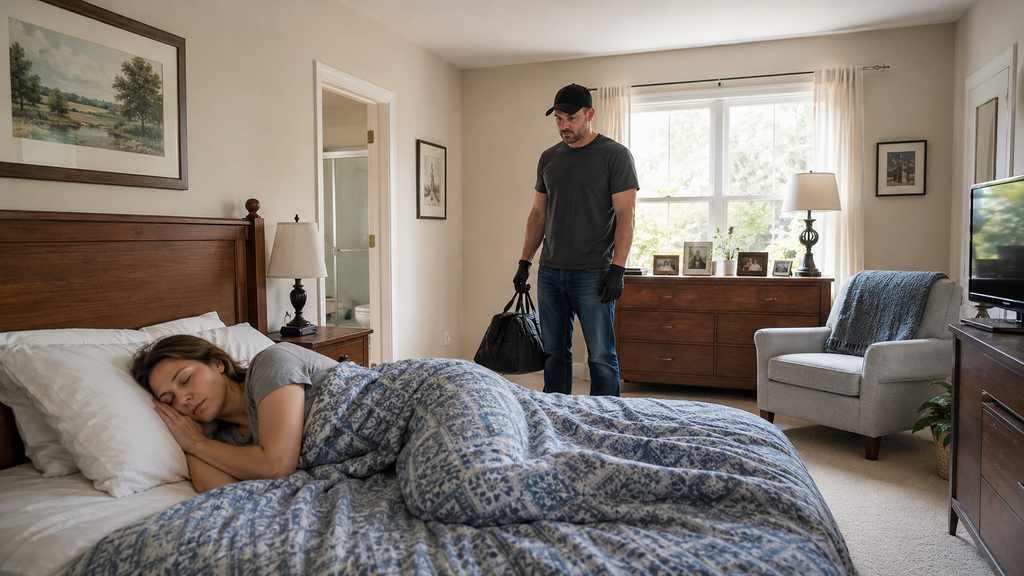
The bedroom was completely dark now.
The camera was gone.
The black bag was gone.
Marcus was gone.
And still, I couldn’t move.
My body had forgotten how.
For nearly an hour, I had forced myself to remain motionless while the man I had married moved around me as though I were an object.
He had touched my arms.
Adjusted my clothing.
Cut fabric from my pajamas.
Collected samples from my skin.
Photographed me.
Uploaded those photographs somewhere.
Received instructions from someone on his phone.
Then kissed my forehead.
That kiss was what broke something inside me.
Not the camera.
Not the gloves.
Not even the scissors.
The kiss.
Because it was familiar.
Marcus had kissed me like that hundreds of times.
Before work.
At airports.
On birthdays.
After arguments.
When my grandmother died.
When I was sick.
When he proposed.
The same lips.
The same soft pressure.
The same gentle voice.
“Sweet dreams, Anna.”
Except now I understood that tenderness could be performed.
Love could be rehearsed.
Concern could be camouflage.
And the man I had trusted enough to fall asleep beside every night had been waiting for me to become helpless.
At 3:04 a.m., I finally sat up.
My entire body began shaking.
Not dramatically.
Not the kind of shaking people do in movies.
It started in my fingertips.
Then traveled into my arms.
My teeth began chattering even though the room was warm.
I reached for my phone.
Then stopped.
Marcus knew my password.
He had known it for years.
I stared at the screen.
For the first time, I wondered what else he knew.
My banking passwords?
My email?
My location history?
My sister’s address?
My work schedule?
Everything suddenly felt dangerous.
Everything I had considered ordinary now looked like a door I had unknowingly left open.
I turned my phone off.
Then I walked barefoot into the bathroom.
The empty teacup was still beside the sink.
I had rinsed it earlier because I wanted Marcus to believe I had finished the tea.
Now I regretted it.
Maybe I had washed away evidence.
Then I remembered something.
The kettle.
Marcus prepared the tea at the kitchen counter.
If he had added something there, maybe residue remained.
I went downstairs.
Every creak in the house made my heart stop.
I knew Marcus had driven away.
I had heard the car.
But terror does strange things to certainty.
I kept expecting him to step from behind a doorway.
The kitchen still smelled faintly of chamomile.
The tea box sat near the stove.
Beside it was the little ceramic honey jar Marcus had bought during our anniversary trip to Vermont.
A tiny wooden spoon rested across the lid.
Everything looked peaceful.
Domestic.
Normal.
That frightened me more than anything.
I opened the cabinet beneath the sink and found a clean plastic food-storage container.
Using a dish towel so I wouldn’t touch anything directly, I placed the teacup inside.
Then the teaspoon.
Then the tea bag from the trash.
Then I sealed the container.
I took photographs of the entire counter.
The kettle.
The box.
The honey jar.
The garbage.
The sink.
The clock.
3:11 a.m.
Only after I had documented everything did I notice the kitchen drawer was not completely closed.
Marcus hated open drawers.
It was one of those tiny habits you learn after six years of marriage.
He would walk across a room just to push one shut.
I pulled it open carefully.
Inside were batteries, tape, scissors, takeout menus, and miscellaneous junk.
Nothing unusual.
Then I noticed the drawer was shorter than it should have been.
My father had built cabinets when I was growing up.
I knew what normal drawer depth looked like.
This drawer should have extended another four or five inches.
Instead, it stopped.
My pulse accelerated.
I pulled harder.
Nothing.
Then I removed it entirely.
Behind it was a narrow compartment.
And inside that compartment was a small amber prescription bottle.
No label.
I stared at it for several seconds.
Then I wrapped it in a clean kitchen towel without opening it.
I placed it inside another container.
That was when I realized I needed help.
Not tomorrow.
Not after breakfast.
Not after I had time to think.
Now.
I had spent three weeks questioning myself.
I was finished doing that.
There was only one person I trusted completely.
My sister.
I turned my phone on long enough to call Claire.
She answered on the fourth ring.
“Anna?”
Her voice was thick with sleep.
“Do not say my name again.”
There was a pause.
“What?”
“Claire, listen to me. Please.”
Something in my voice woke her completely.
“What happened?”
“I need you to come get me.”
“Did Marcus hurt you?”
The question almost made me collapse.
Not because she asked it.
Because she asked it so quickly.
As though somewhere deep inside, Claire had already been afraid of the answer.
“I don’t know how to explain.”
“Are you in danger right now?”
“I think so.”
“I’m coming.”
“Don’t come here.”
“Anna—”
“Meet me at the twenty-four-hour gas station on Fairmont. Park near the front. Stay where there are cameras.”
Claire didn’t argue.
“I’ll be there in fifteen minutes.”
I packed almost nothing.
Wallet.
Identification.
Laptop.
Medication.
A sweatshirt.
One pair of jeans.
The containers containing the possible evidence.
And the tiny portable hard drive where I kept copies of important work documents.
Then I stopped in front of my bedroom door.
My wedding photograph hung beside it.
Marcus and I were standing beneath a white flower arch.
His forehead rested against mine.
I remembered exactly what he had whispered after the photographer took that picture.
“We made it.”
At the time, I thought he meant we had survived the stress of planning a wedding.
Now I wondered whether the sentence had meant something entirely different to him.
I left the photograph hanging.
I walked downstairs.
At the front door, I hesitated again.
There was an alarm panel beside the entrance.
Marcus received notifications whenever it was activated or deactivated.
If I opened the door normally, he might know.
So I went through the garage.
The side garage door had an old mechanical lock.
No sensor.
I hadn’t used it in years.
At 3:29 a.m., I walked out of my own home carrying one backpack and two plastic containers.
I did not know whether I would ever come back.
Claire’s car was already waiting beneath the bright gas-station lights when I arrived.
I had walked six blocks.
The streets were empty.
Every passing vehicle made me flinch.
The moment I opened Claire’s passenger door, she looked at me.
Then her face changed.
“Anna.”
I climbed inside.
She reached toward me.
I recoiled so violently that my shoulder struck the window.
Claire immediately pulled her hand back.
“I’m sorry.”
That broke me.
I began crying.
Not softly.
Not elegantly.
Everything I had held inside while Marcus stood beside our bed came out at once.
Claire locked the doors.
Then she sat silently while I cried.
She didn’t ask questions.
She didn’t touch me.
She simply stayed.
When I could finally breathe again, I told her everything.
The tea.
The mornings I couldn’t remember.
The bruises.
The camera.
The notebook.
The gloves.
The photographs.
The messages.
The samples.
The black bag.
When I finished, Claire was staring through the windshield.
Her hands were gripping the steering wheel so tightly her knuckles had turned white.
“I’m going to kill him.”
“No.”
“I swear to God—”
“Claire.”
She looked at me.
“I need you to stay calm.”
“He drugged you.”
“I know.”
“He stood over you while you were unconscious.”
“I know.”
“He photographed you.”
“I know.”
Her voice cracked.
“And you had to lie there pretending?”
That was the sentence that destroyed what remained of my composure.
I covered my face.
Claire started crying too.
“I should’ve done something when you called me confused last week,” she whispered.
“You did.”
“No, I should have come over.”
“You asked if I was okay.”
“I should’ve known.”
“How?”
“I don’t know.”
“Exactly.”
Claire turned toward me.
For several seconds, neither of us spoke.
Then she said something I desperately needed to hear.
“We’re going to the police.”
I nodded.
“Yes.”
No confronting Marcus.
No giving him an opportunity to explain.
No warning him.
No asking whether I had misunderstood.
I had seen enough.
We drove directly to the central police station.
At 4:07 a.m., I walked through those doors and told a desk officer that I believed my husband had been drugging me while I slept.
Everything after that happened slowly and quickly at the same time.
A female officer brought us into a private room.
A detective arrived twenty minutes later.
Her name was Detective Sofia Ramirez.
She was probably in her mid-forties, with tired eyes and a calm voice.
She placed a recorder on the table.
Then she said, “Anna, I know you’re frightened. I’m going to ask you questions that may feel repetitive. That doesn’t mean I don’t believe you. It means I need details.”
That sentence mattered.
I told the story again.
Every detail.
When I described the notebook, she leaned forward.
“What kind of notebook?”
“Black cover. Maybe leather.”
“Did you see what was written inside?”
“Not clearly.”
“Any names?”
“No.”
“Dates?”
“I think so.”
“Numbers?”
“Yes.”
“What kind?”
“I couldn’t tell.”
She wrote something.
“And the messages?”
“I couldn’t read them.”
“Did you see the application?”
“No.”
“Did he say anything while he was working?”
“Only at the end.”
“What?”
My throat tightened.
“Sweet dreams, Anna.”
Detective Ramirez stopped writing.
She looked at me.
Something passed across her face.
Not disbelief.
Recognition.
“Has your husband ever been married before?”
The question surprised me.
“No.”
“Engaged?”
“He told me he was engaged once in his twenties.”
“To whom?”
“I don’t remember her last name.”
“First name?”
I thought.
“Rachel.”
Detective Ramirez exchanged a look with the officer beside her.
It lasted less than a second.
But I saw it.
“What?”
Ramirez didn’t answer immediately.
“What is Marcus’s full name?”
“Marcus Adrian Cole.”
She stood.
“Give me a moment.”
She left the room.
Claire and I stared at each other.
“What was that?” Claire whispered.
“I don’t know.”
Ten minutes passed.
Then fifteen.
When Ramirez returned, another detective was with her.
He introduced himself as Daniel Lee.
Ramirez sat across from me again.
“Anna, I need to ask you about something that happened eight years ago.”
My stomach dropped.
“What?”
“A woman named Rachel Bennett filed a report against Marcus Cole.”
I forgot how to breathe.
Claire whispered, “Oh my God.”
Ramirez continued.
“Rachel stated that during the final months of their relationship, she experienced episodes of memory loss after drinking beverages Marcus prepared.”
The room blurred.
“She reported waking with unexplained injuries and suspected someone had entered her apartment while she was unconscious.”
My hands went numb.
“What happened?”
“There was insufficient evidence to pursue charges.”
“Why?”
“She waited several weeks before reporting. Toxicology couldn’t confirm anything by then. Marcus denied the allegations.”
I stared at the detective.
“What happened to Rachel?”
Ramirez hesitated.
“She moved out of state.”
“Is she alive?”
“Yes.”
The word hit me harder than I expected.
Alive.
There was another woman.
Another person who had lain awake later wondering whether she was losing her mind.
Another person Marcus had probably called paranoid.
Another person people had probably asked why she hadn’t noticed sooner.
“When did you say she reported him?”
“Eight years ago.”
I had met Marcus seven years ago.
He had proposed to me eighteen months after that.
The room suddenly felt freezing.
“He told me Rachel cheated on him.”
Ramirez’s expression did not change.
“That may have been the story he chose to tell.”
I looked at Claire.
She was crying silently.
I remembered all the times Marcus had spoken about Rachel.
Never often.
But always with sadness.
“She broke me,” he once told me.
“I had trouble trusting people after her.”
I had spent years being extra patient with him because of that story.
Years reassuring him.
Years proving I was different.
Now I understood.
Rachel hadn’t broken Marcus.
She had escaped him.
And he had rewritten himself as the victim.
By sunrise, the investigation had become much bigger than my marriage.
The amber bottle was collected.
The cup.
The spoon.
The tea bag.
My clothing.
My phone.
Detective Ramirez asked whether I would consent to medical testing.
I said yes.
At the hospital, blood and urine samples were taken.
The doctor explained that some substances leave the body quickly.
Others could still be detected.
I sat on an examination table wearing a paper gown while Claire waited outside.
The doctor was gentle.
She asked permission before every step.
That almost made me cry again.
Permission.
Such a small word.
Yet suddenly it felt enormous.
Afterward, Claire brought me clean clothes.
We returned to the police station around 8:30 a.m.
Marcus texted while we were there.
His name appeared on my screen.
Marcus: Morning, sleepyhead ❤️
I stared at the message.
The detective photographed it.
Thirty seconds later another arrived.
Marcus: You looked exhausted last night. Hope you’re feeling better.
Then:
Marcus: Big meeting this morning. Might be home late. Love you.
Love you.
I thought about the camera.
The gloves.
The black bag.
Detective Lee said quietly, “Don’t respond yet.”
I didn’t.
At 9:14 a.m., police obtained authorization to search our home based on the evidence and Rachel’s prior complaint.
I was not allowed to go with them.
Part of me wanted to.
Another part never wanted to see that house again.
So Claire took me to her apartment.
I showered for almost an hour.
I scrubbed my arms until the skin turned red.
Then I looked at myself in the mirror.
My eyes were swollen.
My hair was wet.
There were faint marks near my elbow I had noticed two mornings earlier.
I had accepted Marcus’s explanation that I probably bumped into something.
I touched one carefully.
Then I stopped.
My body was evidence now.
That thought hurt.
I wrapped myself in Claire’s robe.
When I walked into the living room, she had made coffee.
I stared at the mug.
My stomach turned.
Claire noticed.
Without saying anything, she poured it down the sink.
Then she opened two sealed bottles of water and handed me one.
The gesture was so simple.
It meant everything.
We sat on her couch.
Neither of us spoke.
Around noon, Detective Ramirez called.
Her first words were:
“We found the room.”
I stood.
“What room?”
“A concealed storage area in your basement.”
“We don’t have a storage room.”
“Yes,” she said quietly. “You do.”
Marcus had built it behind a shelving unit.
I remembered when.
Two years earlier.
He had spent an entire weekend reorganizing the basement.
He told me he was building shelves for camping equipment.
I had laughed because we had gone camping exactly once.
Apparently, part of the shelving opened.
Behind it was a narrow insulated room.
Inside, investigators found cameras.
Hard drives.
Packaging materials.
Prescription containers.
Disposable gloves.
Swabs.
Several notebooks.
And boxes labeled with women’s first names.
One of them said:
ANNA.
I sat down.
Claire took the phone from my hand and put it on speaker.
Detective Ramirez continued.
“There are other names.”
“How many?”
A pause.
“Currently, we’ve counted fourteen.”
Fourteen.
The number didn’t make sense.
People aren’t supposed to become numbers.
Fourteen names meant fourteen lives.
Fourteen homes.
Fourteen families.
Fourteen women who might have spent mornings staring into mirrors wondering why they couldn’t remember the night before.
Some may never have known.
“Are they all alive?”
“We’re working on identifying everyone.”
That wasn’t an answer.
And I knew it.
“What else did you find?”
Ramirez hesitated.
“One notebook appears to document dates, quantities, and reactions.”
“Reactions?”
“Things like duration of unconsciousness, memory impairment, physical symptoms.”
Claire made a sound like she might be sick.
I closed my eyes.
Marcus hadn’t been guessing.
He had been studying us.
Improving.
Learning.
“What about the photographs?”
“We found a large digital archive.”
“How large?”
Again, hesitation.
“Very large.”
I pressed my hand against my mouth.
Then Ramirez said something worse.
“There are payment records.”
I opened my eyes.
“What?”
“Cryptocurrency transfers. We’re still tracing them.”
Marcus had sold them.
The messages.
The instructions.
The photographs.
He hadn’t only been doing this because he wanted control.
Other people were paying him.
I felt as though the floor had disappeared.
“How long?”
“We don’t know yet.”
“Detective.”
“I don’t know, Anna.”
“Please.”
She exhaled.
“The earliest material we’ve identified so far appears to be from approximately eleven years ago.”
Three years before Rachel.
Four years before I ever met him.
I whispered, “Jesus.”
Marcus hadn’t become this person during our marriage.
He had brought this person into our marriage.
He had carried him through our wedding.
Our anniversaries.
Our vacations.
Our ordinary Tuesday mornings.
Our plans for children.
Our discussions about buying a bigger house.
He had known.
Every second.
I hadn’t married someone who changed.
I had married someone who was hiding.
At 1:42 p.m., Marcus called.
Detective Ramirez had instructed me to answer if I felt able.
The police were already trying to locate him.
His company said he had never arrived at the morning meeting he mentioned.
His vehicle had been captured traveling north around 5:20 a.m.
Before answering, I looked at Claire.
She nodded.
I pressed the button.
“Hello?”
Marcus sounded cheerful.
“Hey, there she is.”
I almost vomited.
“Hi.”
“You okay?”
“Yes.”
“You sound weird.”
“I just woke up.”
He laughed softly.
“Told you that tea would knock you out.”
My eyes flew toward Claire.
She was recording the call on another device as instructed.
Marcus immediately corrected himself.
“I mean, chamomile. You know. Helps you sleep.”
“Right.”
“Where are you?”
“At home.”
The lie came more easily than I expected.
There was a short pause.
“In bed?”
“Yes.”
Another pause.
Marcus knew.
Or suspected.
I could hear it.
“Did you go downstairs yet?”
“No.”
“Okay.”
That word changed the entire conversation.
Okay.
Not casual.
Relieved.
Why did he care whether I had gone downstairs?
“Why?”
“No reason.”
“Marcus?”
“Yeah?”
“Where are you?”
“Heading into a meeting.”
I looked at the clock.
Detective Ramirez had told me he wasn’t at work.
“What city?”
He laughed.
“What?”
“I forgot where the meeting was.”
“Milford.”
The police had already confirmed his car was traveling in the opposite direction.
“Okay.”
“Anna?”
“Yes?”
“I love you.”
My fingers tightened around the phone.
“I know.”
Silence.
He expected me to say it back.
I always said it back.
Maybe that was what exposed me.
Because Marcus’s voice changed.
Only slightly.
“Did something happen?”
“No.”
“You sure?”
“Yes.”
“You’re acting strange.”
“I’m tired.”
Another silence.
Then he asked:
“Did you drink all your tea last night?”
Claire looked at me.
My blood went cold.
“Yes.”
“All of it?”
“Yes.”
“That’s my girl.”
The call ended thirty seconds later.
I stared at the phone.
My hands were trembling again.
Claire whispered, “He knows.”
I knew she was right.
By mid-afternoon, Marcus’s phone was turned off.
Police issued a regional alert.
His photograph circulated among departments.
Investigators traced several accounts connected to him.
And then one of the detectives found something on the hard drives that changed everything.
A schedule.
Not a calendar.
A list.
Names.
Dates.
Locations.
Next to my name were several entries from the previous month.
The final entry had been scheduled for the coming Friday.
Beside it were two words:
Final session.
I read those words three times.
“What does that mean?”
Nobody wanted to answer.
Eventually Detective Ramirez said, “We don’t know.”
But there was another document.
A draft email Marcus had written and saved.
It was addressed to my sister.
To Claire.
The subject line was:
Anna
The body contained only four paragraphs.
It said I had been struggling emotionally for months.
It said my workload had overwhelmed me.
It said Marcus had tried everything to help.
And it said he was devastated to report that I had suffered an accidental overdose during the night.
I stopped reading.
Claire took the paper.
Her face lost all color.
“He was going to kill you.”
The room became silent.
Detective Ramirez didn’t correct her.
Friday.
Three days away.
Final session.
Accidental overdose.
Suddenly, the previous weeks made sense in an even darker way.
Marcus had been creating a story.
He had encouraged me to complain about exhaustion in front of friends.
He had repeatedly suggested I see someone for anxiety.
He had told Claire I seemed “emotionally fragile.”
He had mentioned pills even though I rarely took medication.
He had once joked that I worked so hard I would “sleep for a week if someone let me.”
Every sentence had been preparation.
Every casual comment had been a brick.
He was building the version of my death he intended other people to believe.
And if I had drunk the tea that Friday night, maybe nobody would have questioned it.
Marcus would have cried at my funeral.
He would have held Claire.
He would have talked about how much he loved me.
Maybe he would have displayed our wedding photograph beside my casket.
The one where he whispered, “We made it.”
A strange calm came over me.
“He’s not getting away.”
Claire looked at me.
I wiped my eyes.
“He doesn’t get to turn me into a sad story about his dead wife.”
At 5:06 p.m., investigators located Marcus’s abandoned car outside a motel ninety miles north.
He wasn’t inside.
The room had been rented under a false name.
He had left clothes.
A prepaid phone.
Cash.
And an empty backpack.
Security footage showed him leaving on foot thirty minutes earlier.
For the next several hours, there was nothing.
No calls.
No sightings.
No digital activity.
As evening approached, police moved Claire and me to a hotel under another name.
Two officers remained nearby.
I sat on the edge of the hotel bed staring at the locked door.
Claire ordered dinner.
I couldn’t eat.
At 9:30 p.m., Detective Ramirez called.
They had contacted three women from the notebooks.
Rachel Bennett was one of them.
When investigators told her Marcus was being investigated again, she cried.
Then she said:
“I knew he would do it to someone else.”
Those words hurt.
Not because Rachel blamed me.
She didn’t.
She blamed herself.
For eight years.
She had believed that because police couldn’t prove what happened to her, she had somehow failed the woman who might come next.
I understood that feeling immediately.
It was the same poison Claire had swallowed that morning when she said she should have known.
The same poison I had been swallowing for weeks whenever I wondered why I didn’t recognize Marcus sooner.
Marcus had caused the harm.
Yet somehow everyone around him was volunteering to carry his guilt.
No.
I was finished with that.
“Can I talk to Rachel?” I asked.
“Not yet,” Ramirez said. “But she wants you to know something.”
“What?”
“She said to tell you she believes you.”
I cried harder than I had all day.
Three words.
She believes you.
I never understood how powerful those words could be until that moment.
I did not sleep that night.
At 2:17 a.m., I looked at the clock.
Exactly twenty-four hours earlier, Marcus had walked into our bedroom wearing gloves.
Now I was sitting in a hotel room with the television on mute and Claire asleep in the other bed.
I kept staring at the door.
At 2:23, my phone vibrated.
Unknown number.
I froze.
A text appeared.
You should have kept sleeping.
For several seconds, I couldn’t feel my hands.
Then another message.
This didn’t have to become ugly.
I woke Claire.
She saw my face and immediately sat up.
“What?”
I handed her the phone.
She read the messages.
“Oh my God.”
A third arrived.
Where are you?
I called Detective Ramirez.
Within minutes, officers were in the hallway.
The number was traced to a prepaid device.
Then another message came.
They won’t understand us.
I almost laughed.
Us.
There had never been an us.
There had been Anna.
And there had been the version of Marcus I was allowed to see.
A fourth message:
Come home and we can fix this.
I typed nothing.
Ramirez arrived twenty-five minutes later.
She looked at the messages.
“He wants engagement.”
“Why?”
“Control.”
“What happens if I answer?”
“That depends.”
“Can it help you find him?”
“Possibly.”
I looked at the screen.
Then I typed:
What did you do to me?
Marcus responded in less than ten seconds.
Nothing you didn’t survive.
Claire whispered, “Monster.”
I typed:
Why were you taking pictures?
There was a pause.
Then:
You wouldn’t understand.
Try me.
Three dots appeared.
Disappeared.
Appeared again.
People pay for things. We needed money.
I stared.
We needed money?
Marcus earned more than I did.
We had savings.
A mortgage we could comfortably afford.
Two cars.
Retirement accounts.
We weren’t rich.
But we certainly weren’t desperate.
He had turned exploitation into household budgeting.
I typed:
Who are the other women?
This time he waited nearly a minute.
You went into the room.
Not a question.
I glanced at Ramirez.
She nodded for me to continue.
Police did.
No answer.
Then:
Anna, listen carefully. There are people involved who are much worse than me.
My skin went cold.
There it was.
The coward’s final defense.
I am dangerous.
But other people are worse.
Give me their names.
His reply came immediately.
Come alone.
Ramirez shook her head.
I typed:
No.
Then I can’t help you.
I stared at those words.
Help me.
Marcus had drugged me.
Filmed me.
Planned my death.
And still, in his mind, he was the person offering help.
I typed one final message.
You already helped me. You left evidence.
He stopped responding.
But the exchange had been enough.
Police narrowed the prepaid phone to an area near the industrial district on the north side of the city.
Units were dispatched.
At 4:46 a.m., they found the phone.
It was sitting on a bench.
Marcus wasn’t there.
He had used it to mislead them.
He was still running.
The next morning, investigators discovered why.
Marcus had another identity.
Not a complete one.
But enough.
A driver’s license under the name Adrian Mercer.
A bank account.
A storage unit.
A post-office box.
A second laptop.
The storage unit contained more files.
More equipment.
More clothing.
More notebooks.
And one suitcase.
Packed.
Ready.
Marcus had planned for the possibility that someday someone would discover him.
For years, he had maintained an escape route.
That realization devastated me in a way I didn’t expect.
I had believed we were building a life together.
He had been building an exit.
Every mortgage payment.
Every anniversary.
Every conversation about the future.
And somewhere, hidden behind all of it, was a suitcase waiting for the day I learned who he really was.
Police also identified six more women.
Some knew Marcus personally.
Some had met him through work.
One had been a coworker.
One had been a former neighbor.
Another had attended the same gym.
Two said they had experienced unexplained memory gaps after being around him.
One remembered nothing suspicious at all.
Until police showed her a photograph recovered from Marcus’s archive.
She recognized the bedroom.
Her own bedroom.
She broke down.
The most disturbing discovery involved a woman named Lauren Mills.
Lauren had died nine years earlier.
Official cause:
Accidental medication overdose.
I saw her photograph in the news.
She was twenty-seven.
Dark curly hair.
Bright smile.
Elementary-school teacher.
Marcus had worked for a medical supplier that serviced her school district.
He claimed he barely knew her.
But her initials appeared in one notebook.
L.M.
Under the initials:
Reaction unpredictable.
Then:
Resolved.
That single word made Detective Ramirez’s voice shake when she explained it.
Resolved.
A human life reduced to a bookkeeping term.
The investigation into Lauren’s death was reopened that afternoon.
Marcus was no longer simply a fugitive accused of drugging and photographing women.
He was now a person of interest in a death.
News stations began showing his face.
My husband’s face.
The photograph they used was from a corporate event.
He was wearing a navy suit.
Smiling.
I had taken that photograph.
The reporters described him as “charming,” “successful,” and “well respected.”
Neighbors said they were shocked.
Coworkers said he was polite.
One described him as “the last person you’d expect.”
I turned the television off.
Claire asked, “What?”
I said, “I hate that sentence.”
“What sentence?”
“The last person you’d expect.”
Because what does a dangerous person look like?
I had spent six years believing danger looked like strangers in parking garages.
Men following women home.
Dark alleys.
Unlocked doors.
I never understood that danger could remind you to take your vitamins.
Danger could wash dishes.
Danger could call your mother on her birthday.
Danger could remember exactly how you liked your tea.
Marcus remained missing for three days.
Those three days felt longer than the six years I had been married to him.
Every sound made me jump.
Every unknown number made my stomach clench.
Police moved us twice.
I stopped sleeping completely.
When I closed my eyes, I saw the red light on the camera.
I began sitting in corners because I hated having space behind me.
I checked locks repeatedly.
I opened bottled drinks myself and watched them constantly.
Claire never complained.
If I woke her at four in the morning because I thought I heard something, she checked.
If I asked whether she had touched my water, she answered without offense.
If I apologized, she said:
“You don’t have to apologize.”
On the fourth morning, Rachel Bennett called.
Detective Ramirez had asked whether I wanted to speak with her.
I said yes.
Her voice was quieter than I expected.
“Anna?”
“Yes.”
“This is Rachel.”
I closed my eyes.
“Hi.”
For several seconds, neither of us knew what to say.
Then Rachel began crying.
“I am so sorry.”
My eyes opened.
“For what?”
“I should’ve stopped him.”
“No.”
“I reported him, but then I dropped everything. My family convinced me I was destroying my life. Marcus threatened to sue me. Everyone said there wasn’t proof.”
“Rachel.”
“I moved away. I changed my number. I tried to forget.”
“You survived.”
“But then he found you.”
“No.”
She went silent.
I stood beside the hotel window.
“Marcus found me because Marcus chose me. That is not something you did.”
She cried harder.
I continued.
“You went to the police eight years ago.”
“Yes.”
“You told the truth.”
“Yes.”
“Then you did your part.”
Rachel took a shaky breath.
“When I saw his picture on the news, I almost threw up.”
“I know.”
“He used to make me hot chocolate.”
My stomach turned.
“Tea for me.”
“Did he tell you I cheated?”
I closed my eyes.
“Yes.”
Rachel laughed once.
There was no humor in it.
“He told everyone I was unstable.”
“He told me you broke his heart.”
“That sounds like Marcus.”
Silence.
Then Rachel said:
“There’s something else.”
“What?”
“He likes souvenirs.”
I gripped the phone.
“What kind?”
“Little things. Things nobody would notice missing.”
“The fabric?”
“What?”
“He cut fabric from my pajamas.”
Rachel stopped breathing for a second.
Then she whispered:
“He did that to me too.”
My knees weakened.
“I found pieces missing from clothes,” she continued. “Hair ties disappeared. Earrings. Once, half of a movie ticket I kept in my wallet.”
“Why?”
“I don’t know. Maybe trophies. Maybe proof. Maybe control.”
I thought about the boxes in the hidden room.
Boxes labeled with women’s names.
My box.
Suddenly I understood what was inside.
Pieces.
Fragments.
Things taken from people without permission.
A private museum of stolen moments.
Rachel said, “Anna?”
“I’m here.”
“There’s one thing I wish somebody had told me eight years ago.”
“What?”
“You’re going to spend a lot of time trying to figure out which memories were real.”
My throat tightened.
She continued.
“You’ll think about vacations and dinners and Christmas mornings. You’ll ask yourself whether he meant anything he ever said.”
I began crying.
Because she understood.
She understood the exact question haunting me.
Was my entire marriage fake?
Rachel said softly:
“You don’t have to decide that right now.”
“How do I live with not knowing?”
“You stop trying to understand him.”
I stared at the wall.
“You understand yourself instead.”
Those words stayed with me.
Marcus was arrested on the fifth day.
Not because of brilliant technology.
Not because of some dramatic highway chase.
Because he made one ordinary mistake.
He went to see his mother.
She lived almost four hours away.
Marcus had told police years earlier that they were estranged.
Apparently they weren’t estranged enough.
A neighbor recognized him getting out of a borrowed truck.
She called police.
Marcus ran through the backyard when officers arrived.
He climbed a fence.
Crossed two properties.
Tried to hide inside a detached garage.
A police dog found him behind a stack of tires.
At 6:18 p.m., Detective Ramirez called me.
“We have him.”
I sat completely still.
Claire jumped from her chair.
“What?”
Ramirez repeated:
“Marcus is in custody.”
I expected relief.
Instead, my entire body went cold.
“Is he alive?”
“Yes.”
“Did he hurt anyone?”
“No.”
“Are you sure it’s him?”
“Yes.”
I started crying.
Claire wrapped her arms around me only after I nodded.
For five days, I had imagined Marcus appearing everywhere.
Outside the hotel.
Behind my car.
At Claire’s apartment.
In a parking lot.
In a dream.
Now he was behind a locked door.
For the first time since 2:17 that morning, I exhaled without immediately checking what was behind me.
Marcus’s first court appearance happened two days later.
I almost didn’t go.
Detective Ramirez said I wasn’t required to.
Claire said she would support whatever I chose.
Rachel told me I owed him nothing.
But I needed to see him without the house around us.
Without the bedroom.
Without the tea.
Without our wedding rings pretending we belonged to one another.
So I went.
Marcus entered wearing a jail uniform.
His wrists were restrained.
His hair looked unwashed.
There was a bruise along his cheek from the arrest.
For a moment, I barely recognized him.
Then his eyes found me.
And the old Marcus returned.
Not physically.
In his face.
That expression.
Soft.
Concerned.
Almost wounded.
He looked at me the same way he used to look when we argued.
As though I were hurting him.
His lips moved.
I couldn’t hear him.
But I knew what he said.
Anna.
I looked directly at him.
And for the first time in our marriage, I did not respond.
His attorney argued that Marcus had no meaningful criminal history.
Strong community ties.
Stable employment.
A mother who depended on him.
The prosecutor stood and described the hidden room.
The recordings.
The drugs.
The notebooks.
The escape identity.
The reopened death investigation.
Then she mentioned the draft email describing my supposed overdose.
The courtroom went silent.
Marcus looked at his attorney.
For the first time, the softness disappeared.
Something colder surfaced.
The judge denied bail.
Marcus turned as officers led him away.
He looked back once.
Our eyes met.
And I realized something.
I was no longer afraid of disappointing him.
For six years, that fear had controlled more of my life than I understood.
Marcus hated when I questioned him.
Hated when plans changed.
Hated when I stayed late at work.
Hated when I didn’t answer texts quickly.
He never screamed often.
He didn’t need to.
A disappointed look.
A quiet withdrawal.
A small punishment.
A ruined evening.
I had learned to adjust myself to avoid those reactions.
Now he had no access to my evenings.
No access to my phone.
No access to my tea.
No access to my sleep.
No access to me.
When the door closed behind him, I whispered:
“Goodbye.”
Not because the case was over.
It wasn’t.
But the marriage was.
The next several months were ugly.
There is no beautiful way to rebuild a life after learning that someone you loved had been violating your trust for years.
Television shows like neat endings.
An arrest.
A courtroom.
A sentence.
Music.
Credits.
Real life keeps going.
I had to return to the house.
Police had finished processing most of it.
Claire came with me.
So did Detective Ramirez.
I stood in the entryway for almost five minutes before stepping inside.
Everything looked exactly the same.
Marcus’s shoes were beside the door.
His jacket hung in the closet.
A grocery list was attached to the refrigerator.
Milk.
Eggs.
Coffee.
Chamomile.
I tore the list down.
The kitchen made me sick.
The bedroom was worse.
I couldn’t walk inside.
So Claire packed my clothes.
I waited in the hallway.
Then we went downstairs.
The shelving unit had been removed.
Behind it was the hidden doorway.
I stared at that opening.
Twenty feet from where I had once wrapped Christmas gifts.
Twenty feet from where Claire and I drank wine while Marcus grilled burgers outside.
Twenty feet from ordinary life.
Detective Ramirez asked:
“Do you want to see inside?”
Every part of me wanted to say no.
Instead, I said yes.
The room was smaller than I imagined.
Maybe eight feet by ten.
White walls.
Bright ceiling light.
Metal shelves.
Most of the evidence had been removed.
Only tape marks remained where boxes once sat.
I walked to the back wall.
There were small labels stuck to one shelf.
Initials.
Dates.
Numbers.
I found mine.
A.C.
My married initials.
Beside them:
04/12
04/18
04/26
05/03
My knees almost gave out.
Those were nights.
Nights Marcus made tea.
Nights I remembered almost nothing.
Claire touched my shoulder.
I didn’t recoil this time.
I looked around the empty room.
Then I noticed something scratched into the wood near the bottom shelf.
One word.
CONTROL
I don’t know whether Marcus carved it.
Maybe it was part of some inventory system.
Maybe an investigator wrote it.
Maybe it meant something entirely unrelated.
But that word gave me the answer I had been searching for.
Not money.
Not photographs.
Not desire.
Control.
Marcus wanted to choose when women remembered.
When they moved.
When they knew.
When they didn’t.
Who believed them.
What story survived afterward.
Control was the real addiction.
And the night I poured the tea down the sink, I had unknowingly taken the first piece of it back.
I filed for divorce.
Marcus contested it.
Of course he did.
Through his attorney, he claimed we should delay proceedings until the criminal case concluded.
My lawyer disagreed.
So did the judge.
The marriage ended eleven months after the night I stayed awake.
I did not attend the final hearing in person.
I signed my papers in my lawyer’s office.
When she said, “It’s done,” I stared at my old signature.
Anna Cole.
Then I signed another document using my birth name.
Anna Mercer.
My hand shook.
But only slightly.
Claire took me to lunch afterward.
We sat outside.
I ordered sparkling water.
When the waiter placed it down already opened, I froze.
Claire noticed.
She calmly asked him for a sealed bottle instead.
No explanation.
No embarrassment.
The waiter brought one.
I opened it myself.
That became one of the strange realities of my new life.
Tiny things mattered.
Opening bottles.
Locking doors.
Choosing where I sat.
Watching someone prepare food.
Sleeping with a lamp on.
For months, I couldn’t drink tea.
Any tea.
Even the smell of chamomile made my heart race.
My therapist never pushed me.
She said:
“You decide what comes back into your life.”
So I did.
Slowly.
On my terms.
The criminal case took nearly two years.
Investigators eventually identified eighteen women.
Eighteen.
Some had photographs in Marcus’s archive.
Some had physical items stored in boxes.
Some appeared only in notebooks.
Fourteen agreed to cooperate fully with prosecutors.
Three chose not to participate publicly.
One had died.
Lauren.
The digital investigation uncovered an encrypted group where Marcus shared material with several other men.
Some paid him.
Some traded files.
Some apparently encouraged specific actions.
Several arrests followed.
One man was a pharmacist.
Another worked in private security.
A third lived two states away and claimed he had never met Marcus.
The investigation expanded far beyond anything I had imagined that first night.
But Marcus remained at the center.
He had been operating longer than anyone else.
He had recruited others.
He had advised them on how to avoid detection.
And the records recovered from his storage unit connected him directly to Lauren Mills during the week before her death.
Her case changed everything.
Toxicology records had been preserved.
Investigators reexamined them with experts.
A drug had been found in Lauren’s system that investigators originally attributed to something she had taken voluntarily.
But there was no prescription.
No bottle.
No purchase record.
Marcus had access to the same medication through his job at the time.
Then investigators found an old photograph.
Marcus had taken it.
Lauren was unconscious.
A timestamp placed him inside her apartment hours before she died.
When prosecutors showed me that evidence privately, I went into the bathroom and vomited.
Because suddenly I could see the path I had escaped.
That draft email about my accidental overdose had not been imagination.
Marcus had done this before.
Friday wasn’t going to be another recording.
Friday was supposed to be my last night.
The trial lasted seven weeks.
I testified on the fourth week.
I had dreaded that day for almost two years.
Marcus sat beside his attorneys.
He wore a dark suit.
His hair was neatly cut.
If someone had walked into the courtroom without knowing why we were there, they might have mistaken him for a lawyer.
He watched me approach the witness stand.
I did not look away.
The prosecutor asked how we met.
“At an art fundraiser.”
“How long were you married?”
“Six years.”
“Did you trust the defendant?”
“Yes.”
“With your life?”
I looked at Marcus.
“Yes.”
The prosecutor let the answer sit.
Then we talked about the tea.
The missing memories.
The marks.
My sister’s phone call.
The night I pretended to drink.
2:17 a.m.
The gloves.
The camera.
The notebook.
The black bag.
“Why didn’t you move?”
The courtroom disappeared.
For one moment, I was back in the bedroom.
Marcus standing beside me.
Red camera light blinking.
His fingers near my wrist.
I took a breath.
“Because I believed that if he knew I was awake, he might kill me.”
Marcus lowered his eyes.
The prosecutor asked:
“What did he say before he left?”
My voice nearly failed.
I forced it out.
“He kissed my forehead and said, ‘Sweet dreams, Anna.’”
Several people in the gallery began crying.
I didn’t.
Not then.
Then the prosecutor showed the jury the draft email Marcus had prepared.
The one announcing my death.
She asked:
“When was that email created?”
An investigator had already testified.
“Five days before the night I pretended to sleep.”
“And what was scheduled three days afterward?”
I swallowed.
“My final session.”
“What did you understand that to mean?”
Marcus’s attorney stood.
“Objection.”
The judge considered.
“Sustained.”
The prosecutor changed the question.
“When you saw the email, how did you feel?”
I looked at the jury.
“I realized I had been rehearsing my own death without knowing it.”
No one moved.
I continued.
“He had been telling people I was anxious. Tired. Overworked. Forgetful. He was creating an explanation before anything happened.”
The prosecutor asked:
“Why do you believe you survived?”
This time, I answered immediately.
“Because I poured the tea down the sink.”
Marcus’s attorney tried to destroy me on cross-examination.
He was polite.
Almost painfully polite.
That was somehow worse.
He asked about work stress.
My sleeping habits.
Whether I drank alcohol.
Whether I had ever taken medication.
Whether Marcus and I argued.
Whether I had been unhappy in the marriage.
Then he asked:
“Mrs. Mercer, is it possible you interpreted ordinary marital behavior through the lens of suspicion after convincing yourself your husband was drugging you?”
I stared at him.
“No.”
“But you cannot personally identify the substance allegedly placed in your tea.”
“The laboratory did.”
He paused.
“Yes.”
He changed direction.
“You testified that you remained conscious the entire night.”
“Yes.”
“And yet you did not leave.”
“No.”
“You did not scream.”
“No.”
“You did not call police while Marcus was still in the room.”
“No.”
“You did not physically resist him.”
“No.”
He walked closer.
“Wouldn’t someone who truly believed she was in danger try to escape?”
The prosecutor objected.
Before the judge could rule, I spoke.
“I was escaping.”
The attorney stopped.
I continued.
“I was lying perfectly still so he wouldn’t know I was awake. That was how I escaped.”
Silence.
The judge instructed me to wait for questions.
I apologized.
But the jury had heard me.
The attorney never asked that question again.
Rachel testified two days later.
I watched from the gallery.
Marcus did not look at her.
She described the hot chocolate.
The memory gaps.
The missing belongings.
The report she filed eight years earlier.
Then the defense attorney asked why she never pursued the case further.
Rachel looked straight at the jury.
“Because I was twenty-six years old and everybody around me kept asking what evidence I had instead of asking what had happened to me.”
You could hear a pin drop.
When she stepped down, our eyes met.
We had only seen each other in person twice before.
I stood.
She walked toward me.
We hugged.
Marcus watched.
I hope he understood what he was seeing.
Two people he had tried to isolate from their own memories standing together.
He failed.
Lauren’s mother testified during the final week.
Her name was Patricia Mills.
She carried a photograph of Lauren into court.
The judge did not allow her to display it during every part of her testimony, so she kept it facedown beside her hands.
She described her daughter.
Lauren loved children.
Hated olives.
Sang terribly but loudly.
Called her mother every Sunday.
Wanted to open a literacy center.
The night Lauren died, police told Patricia it appeared accidental.
For nine years, she carried the belief that her daughter had made one fatal mistake.
Then investigators called.
They told her someone else might have been responsible.
She looked at Marcus for the first time.
“You stole nine years from me twice.”
The prosecutor asked what she meant.
Patricia’s voice cracked.
“First, he took my daughter. Then he took the truth.”
I lowered my head and cried.
The jury deliberated for thirteen hours.
We waited in a courthouse conference room.
Claire sat beside me.
Rachel sat across from us.
Patricia held Lauren’s photograph.
Detective Ramirez came and went.
Nobody talked much.
At 4:38 p.m., word arrived.
Verdict reached.
My legs felt weak walking back into the courtroom.
Marcus entered.
He looked thinner than he had at the beginning of the trial.
The judge asked the jury foreperson to stand.
Count one.
Guilty.
Count two.
Guilty.
Count three.
Guilty.
Again.
Again.
Again.
The charges continued.
Drugging.
Unlawful recording.
Conspiracy.
Evidence tampering.
Attempted murder.
And finally, the charge connected to Lauren.
The courtroom became so quiet I could hear someone breathing behind me.
“Guilty.”
Patricia collapsed into tears.
Rachel covered her mouth.
Claire grabbed my hand.
I stared at Marcus.
He didn’t cry.
He didn’t look shocked.
He simply stared forward.
But when the final verdict was read, he turned toward me.
For years, I had imagined what I would feel in that moment.
Victory?
Joy?
Revenge?
I felt none of those things.
I felt tired.
And free.
Marcus had spent years turning other people into objects inside his secret files.
Names.
Dates.
Initials.
Sessions.
Reactions.
Resolved.
But now he was the one reduced to entries.
Case number.
Charges.
Verdicts.
Sentence.
And we were the ones walking out into the sunlight.
At sentencing, the judge allowed victim-impact statements.
I wrote mine seventeen times.
Every version sounded either too angry or not angry enough.
Eventually, I stopped trying to make it perfect.
I stood at the podium.
Marcus sat behind me.
I faced the judge.
“My name is Anna Mercer.
“For six years, Marcus Cole was my husband.
“He knew my favorite music.
“He knew which side of the bed I slept on.
“He knew I called my sister when I was scared.
“He knew I hated thunderstorms.
“He knew I drank chamomile tea before sleeping.
“And he used that knowledge against me.
“For a long time, I thought betrayal was the worst thing he had done.
“It wasn’t.
“The worst thing Marcus tried to steal was my trust in myself.
“When I woke confused, he told me I was tired.
“When I found marks, he said I was sleepwalking.
“When I couldn’t remember conversations, he suggested stress.
“He made me question my own mind because he knew that if I stopped trusting myself, I would depend on him to explain reality.
“That was the real prison.
“And I lived inside it without knowing the door was locked.
“The night I poured the tea down the sink, something changed.
“I trusted myself.
“It was a small decision.
“But it saved my life.
“Marcus wanted me unconscious because an unconscious person cannot say no.
“Cannot ask questions.
“Cannot remember.
“Cannot expose him.
“But I was awake.
“I remember.
“And I am speaking.”
I turned then.
For the first and last time, I addressed Marcus directly.
“You told me sweet dreams.
“You were planning my funeral.
“You believed I would never know.
“You were wrong.”
Marcus stared at me.
I didn’t recognize anything in his face anymore.
And that was good.
I turned back toward the judge.
“I’m not asking for revenge.
“I’m asking for distance.
“Distance between Marcus and every woman he might ever hurt again.
“Whatever sentence the court believes provides that distance, I ask you to impose it.”
Then I stepped away.
Marcus received a sentence that meant he would likely spend the rest of his life in prison.
Lauren’s mother closed her eyes.
Rachel squeezed my hand.
Claire whispered:
“It’s over.”
I looked at Marcus being led away.
Then I said:
“No.
“It’s beginning.”
Two years after sentencing, I bought a small house across town.
Nothing fancy.
Two bedrooms.
A little studio.
A backyard with one enormous oak tree.
The first night there, Claire helped me unpack.
We ate pizza on the floor because my dining table hadn’t arrived.
At around ten, she stood.
“You want me to stay?”
I almost said yes.
Old fear answered first.
Then I looked around.
My house.
My locks.
My windows.
My kitchen.
My bedroom.
My choices.
“No,” I said.
Claire studied me.
“You sure?”
I smiled.
“Yes.”
She hugged me.
“I’m fifteen minutes away.”
“I know.”
After she left, I checked the doors once.
Not six times.
Once.
Then I walked into the kitchen.
On the counter was a box Claire had brought.
She knew what was inside.
She hadn’t mentioned it.
Chamomile tea.
I stared at the box.
For years, I couldn’t smell chamomile without feeling Marcus standing beside the bed.
My therapist had told me I never had to drink it again.
Healing did not require reclaiming everything.
But that night, I wanted to.
Not for Marcus.
For me.
I filled the kettle.
Watched the water boil.
Opened the tea bag myself.
Placed it in the cup.
Poured the water.
Waited.
Steam curled upward.
My hands trembled slightly.
I carried the cup toward the living room.
Then stopped.
I laughed.
Because some habits take longer than others.
I returned to the kitchen.
I poured the tea into the sink.
For one terrible second, I was back there.
2:17 a.m.
Pretending.
Terrified.
Then I smiled.
I made another cup.
This time, I drank it.
Not because I needed to prove anything.
Not because fear had disappeared.
But because this cup belonged to me.
I sat beside the window watching rain fall through the light from the streetlamp.
One sip.
Then another.
Nothing happened.
No dizziness.
No missing hours.
No confusion.
I remained awake.
I remained myself.
A year later, Rachel called me with an idea.
We had stayed in touch.
So had several of the other women.
Not everyone wanted contact.
We respected that.
Healing does not look the same for everyone.
Rachel wanted to create a nonprofit organization helping people preserve evidence and find legal support when they suspected drug-facilitated crimes.
“You’re the graphic designer,” she said. “We need a website that doesn’t look terrifying.”
I laughed.
“What does a terrifying website look like?”
“Government forms.”
“Fair.”
I agreed.
That small project became something larger.
We built guides.
Connected survivors with advocacy organizations.
Raised money for emergency hotel stays.
Helped people understand toxicology windows.
Explained evidence preservation.
Most importantly, we repeated one sentence everywhere:
Trust the moment when something feels wrong.
Not because intuition is magical.
Not because fear is always accurate.
But because questions deserve answers.
Confusion deserves investigation.
And nobody should be taught to ignore themselves simply because someone they love says everything is fine.
We named the organization Awake.
Rachel suggested it.
I cried when she did.
On the fifth anniversary of the night Marcus was arrested, I received a letter.
It had been screened by the correctional facility.
Marcus.
I almost threw it away unopened.
Instead, I took it to my therapist.
I opened it there.
Three pages.
He said he had changed.
He said prison gave him time to think.
He said outsiders misunderstood what happened.
He said he had been influenced by terrible people.
He said he had loved me.
He said he still loved me.
Then, near the bottom of the final page:
I forgive you for turning against me.
I stared at the sentence.
Then I started laughing.
Not because it was funny.
Because it was so completely Marcus.
Even now.
Even after trials.
Evidence.
Witnesses.
Verdicts.
Years behind bars.
Marcus still needed to be the person granting forgiveness.
My therapist asked:
“What do you want to do with the letter?”
I folded it once.
Then twice.
“I think I’m done letting him write the ending.”
I tore it in half.
Then again.
And again.
When I walked outside, the afternoon sun was bright.
Claire was waiting at a café across the street.
Rachel was joining us later.
We were celebrating the opening of Awake’s second regional office.
I crossed the street.
Claire waved through the window.
For one second, I stopped.
Traffic moved.
People talked.
Someone laughed.
A dog barked from a passing car.
Ordinary life.
I had spent years believing ordinary life was something Marcus stole from me.
But maybe ordinary life was never his to give or take.
Maybe it was something I could build again.
Piece by piece.
Choice by choice.
Morning by morning.
Sometimes people ask when I first knew something was wrong.
They expect me to say the camera.
The gloves.
The hidden room.
The photographs.
But those things came later.
The truth started much smaller.
It started with mornings when my own body told me something had happened that my memory could not explain.
It started when Marcus said I was imagining things.
It started when I stopped believing myself.
And my escape began the moment I started believing myself again.
One cup of tea.
One kitchen sink.
One decision.
I poured it out.
I climbed into bed.
I closed my eyes.
And I pretended to sleep.
Marcus entered our bedroom at 2:17 a.m. believing the woman beneath those blankets was helpless.
He believed I couldn’t see him.
Couldn’t hear him.
Couldn’t remember.
He believed morning would erase everything.
But morning didn’t erase it.
I remembered the gloves.
I remembered the camera.
I remembered the bag.
I remembered his voice.
I remembered every second.
And eventually, so did a courtroom.
Rachel remembered.
Lauren’s family remembered.
The women in his notebooks remembered.
The investigators remembered.
The jury remembered.
The world he had built depended on silence and missing memories.
Instead, he got witnesses.
For years, Marcus had stolen pieces of women and hidden them in boxes.
A strip of fabric.
A photograph.
A hair tie.
A private moment.
A memory.
He thought possessing pieces of us meant possessing us.
He never understood something important.
A person is more than what someone steals from her.
I am more than the woman who lay frozen in that bed.
Rachel is more than the frightened twenty-six-year-old nobody believed.
Lauren is more than a file labeled “resolved.”
We have names.
Families.
Histories.
Dreams.
Futures.
Voices.
And voices become powerful when they stop whispering alone.
One spring morning, Patricia Mills came to the Awake office.
Lauren’s mother carried a cardboard box.
“I found these while cleaning the attic.”
Inside were children’s books.
Dozens of them.
Lauren had collected them because she dreamed of opening a literacy center.
Patricia ran her fingers across one worn cover.
“I couldn’t throw them away.”
“You shouldn’t.”
She looked around our office.
“What if we made a little library here?”
My eyes filled with tears.
“I’d love that.”
We built shelves along one wall.
Above them, Patricia placed a small sign.
Lauren’s Library
No photograph of Marcus.
No case number.
No mention of the way Lauren died.
Just Lauren.
Her dream.
Her name.
Children who came with their mothers could choose a book and take it home.
That felt like justice in a way no courtroom ever could.
Marcus had tried to make Lauren’s final night the most important thing about her.
We refused.
On the tenth anniversary of my escape, I woke at 6:32 a.m.
Sunlight filled my bedroom.
For years, I noticed the time immediately whenever I woke.
Especially if it was 2:17.
That morning, I didn’t.
I stretched.
Walked downstairs.
Fed my ridiculous orange cat, Winston, who had somehow convinced me breakfast required screaming.
Then I opened the back door.
The oak tree had grown thick with summer leaves.
Birds moved through the branches.
My phone buzzed.
Claire.
Breakfast Sunday?
I replied:
Only if you’re paying.
She sent three laughing emojis.
I opened the cabinet.
Coffee.
Green tea.
Chamomile.
The chamomile box had been sitting there for months.
It no longer felt like an enemy.
Just tea.
I chose coffee.
Not from fear.
Because I wanted coffee.
That difference mattered.
I carried the mug outside.
The morning air was warm.
Winston followed and immediately attacked a leaf.
I laughed.
Then I thought about the woman I had been that night.
Lying perfectly still.
Eyes closed.
Heart pounding.
Trying not to breathe too deeply.
I wished I could somehow reach backward through time and sit beside her.
Not to warn her.
She already knew something was wrong.
Not to tell her everything would be fine.
Some things would not be fine for a long time.
I would simply tell her:
Trust yourself.
Stay still a little longer.
Listen.
Remember.
When the door closes, get up.
Take the cup.
Take the tea bag.
Call Claire.
Walk out.
Do not look back.
Your life is waiting on the other side of that door.
And you are going to reach it.
People sometimes ask whether I hate Marcus.
I used to.
For a while, hatred helped.
It gave shape to feelings too enormous to carry.
Eventually, even hatred became a connection I didn’t want.
So no.
I don’t spend my mornings hating Marcus.
I don’t spend my nights forgiving him either.
Forgiveness is not an admission ticket to healing.
Some things can simply be finished.
Marcus exists somewhere behind concrete walls.
That is enough information for me.
I exist here.
That is the part that matters.
I exist in a house with sunlight.
In an office full of women who once believed they were alone.
Beside a library carrying Lauren’s name.
Across restaurant tables from my sister.
In photographs I choose to take.
In memories nobody gets to edit.
In nights I remember from beginning to end.
For years, Marcus had depended on unconscious women.
Women who couldn’t speak.
Women who couldn’t remember.
Women who might doubt themselves by morning.
He had built his entire secret life around one assumption:
That silence meant safety.
He was wrong.
Because one night, the woman in the bed was awake.
And she stayed awake long enough to see him clearly.
That woman was me.
Marcus whispered:
“Sweet dreams, Anna.”
He believed those would be the last words I remembered.
They weren’t.
The last words belong to me.
I survived.
I remembered.
I spoke.
And I never drank anything he handed me again.
THE END! THANK YOU FOR READING!❤️