 Reading Time: 39 minutes
Six months after my husband’s funeral, I found the letter he had never meant me to read while he was alive. It was hidden inside an empty decorative urn beside his grave.
Everyone who visited Richard assumed the urn was there for flowers. It wasn’t. Inside was a waterproof envelope tied with a faded blue ribbon. And beneath it rested a small brass key.
I remember standing there beneath the gray New York sky, my fingers trembling as I recognized Richard’s handwriting.
Even after forty-two years of marriage, I could have recognized that handwriting in darkness.
Strong letters.
Slightly crooked.
The handwriting of a man who had spent most of his life signing contracts, writing grocery lists, leaving notes beside the coffee machine, and slipping ridiculous little messages into my purse before business trips.
Don’t forget that your husband loves you.
Buy milk.
Call the plumber.
You’re beautiful when you’re angry.
That was Richard.
Practical and sentimental in the same breath.
I had sat on the stone bench beside his grave and opened the envelope.
The first line nearly broke me.
My beautiful Teresa.
Nobody had called me that since he died.
I pressed the paper against my lips.
Then I kept reading.
If you’re reading this, then I’ve already left you alone in this world.
I’m sorry for that.
But listen carefully.
Never tell Daniela about the basement vault.
If greed ever enters this family, let greed expose itself first.
At the time, I thought grief had made him dramatic.
Richard had always worried too much.
About insurance.
About taxes.
About protecting the business.
About protecting me.
About protecting Daniela.
Especially Daniela.
Our only daughter had inherited my impulsiveness and Richard’s stubbornness, which was a dangerous combination when she believed she was right.
Still, she was our child.
The same little girl who once cried for two hours because she accidentally stepped on a ladybug.
The same teenager who secretly saved half her allowance because she wanted to buy me a birthday necklace.
The same young woman Richard had danced with at her wedding while whispering something into her ear that made them both cry.
So I folded the strange letter.
I wrapped the brass key in the blue ribbon.
And I hid everything in the bottom drawer of my bedroom dresser.
I never told Daniela.
I never told David.
I never told anyone.
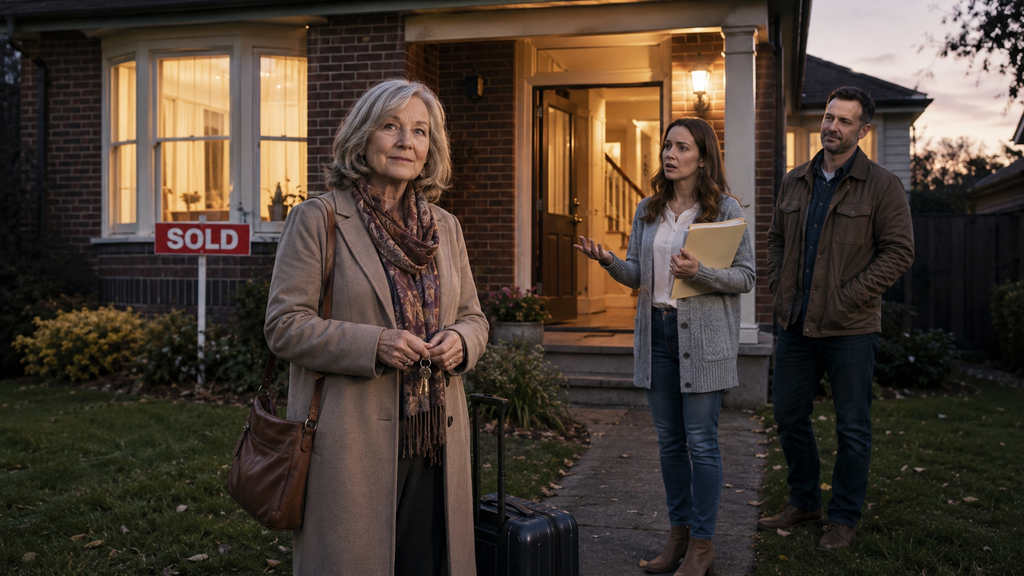
Until the day my own daughter sold my house while I was in London.
And slapped me when I came home.
That afternoon, after standing on the sidewalk staring at the blue front door of the house where I had lived for more than forty years, I understood what Richard’s words meant.
Let greed expose itself first.
Greed had exposed itself.
It had exposed David.
And, in the most painful way imaginable, it had exposed my daughter.
So I took my suitcase.
I left the house I had supposedly lost.
And I went straight to the cemetery.
Richard’s grave looked exactly as it always did.
Quiet.
Almost ordinary.
The stone bore his name.
RICHARD HAWTHORNE
BELOVED HUSBAND, FATHER, FRIEND
The flowers I had arranged before leaving for London were gone.
Someone had replaced them with fresh white lilies.
Daniela, perhaps.
The thought hurt more than I expected.
How strange that a daughter could place flowers on her father’s grave while taking away the home he had built for her mother.
I stood there for a long time.
Then I whispered, “All right, Richard.”
The wind moved through the trees.
“You knew something.”
Of course there was no answer.
There never was.
That was the cruelty of losing someone after decades together.
You still talked to them.
You still expected answers.
Sometimes you even knew exactly what they would have said.
But the silence always remained.
I reached beneath the stone urn.
The envelope was exactly where Richard’s instructions said the next clue would be.
Another brass key.
Another blue ribbon.
Another message.
Ask Evelyn.
I almost laughed.
“Of course,” I whispered.
Even dead, my husband was turning my life into a scavenger hunt.
Mrs. Evelyn Harper had managed the cemetery office for almost thirty years.
She had known Richard since before our hair turned gray.
When I pushed open the office door, the small brass bell above it rang.
Evelyn looked up from behind her wooden desk.
She was nearly eighty, but her eyes were as sharp as ever.
“Teresa?”
I tried to smile.
“Hello, Evelyn.”
She slowly removed her glasses.
“I heard you were in England.”
“I was.”
Then her gaze dropped toward my suitcase.
From the suitcase, her eyes traveled upward.
And stopped on my cheek.
The red mark from Daniela’s hand had faded slightly.
But not enough.
Evelyn’s expression changed.
“What happened?”
For several seconds, I couldn’t speak.
There are some humiliations that become harder to explain once you have to put them into words.
“My daughter sold my house.”
Evelyn stared at me.
I swallowed.
“While I was in London.”
Another silence.
“And when I came home,” I continued, “she told me it wasn’t my home anymore.”
Evelyn stood.
“She did what?”
“She and David sold it.”
“To whom?”
“A woman named Helen Brooks.”
“Does Daniela have the authority to sell it?”
“I thought she did.”
Evelyn’s eyes narrowed.
“What do you mean you thought she did?”
I placed Richard’s brass key on the desk.
The moment she saw it, all color left her face.
“Oh.”
That one word made my heartbeat accelerate.
“What?”
Evelyn quietly walked to the office door.
She locked it.
Then she turned the sign from OPEN to CLOSED.
“Sit down, Teresa.”
“Evelyn—”
“Sit.”
I did.
She disappeared into the tiny kitchen and came back carrying two cups of tea.
I almost laughed.
“Tea?”
“You look like you’ve had enough surprises for one day. Drink.”
I wrapped both hands around the cup.
For the first time since returning from London, warmth touched my fingers.
Evelyn sat across from me.
“Tell me everything.”
So I did.
I told her about arriving home unexpectedly.
About seeing unfamiliar furniture through the window.
About Daniela opening the door wearing my pearl earrings.
About David standing behind her like he owned the place.
About the papers.
The supposed sale.
The money.
The lies.
The assisted-living story.
The forged signature.
And finally, the slap.
Evelyn listened without interrupting.
When I finished, she stood and walked toward the archive room.
She returned carrying a thick leather ledger.
The book was so old its corners had cracked.
She opened it.
Turned several yellowing pages.
Then stopped.
“Richard came here three weeks before he died.”
“I remember.”
“No,” Evelyn said softly. “I don’t think you do.”
She rotated the ledger toward me.
There, halfway down the page, was Richard’s name.
Beside it were three words.
VAULT B-17.
Below that:
99 YEARS — PAID IN FULL.
I looked up.
“What vault?”
Evelyn closed the book.
“He rented one beneath the old cemetery.”
I stared at her.
“There are vaults under this cemetery?”
“A lot of things exist beneath old cemeteries that nobody talks about.”
Despite everything, I almost smiled.
“That sounds like something Richard would have loved.”
“He did.”
Evelyn touched the key.
“He came in alone. He paid everything himself. And before he left, he gave me very specific instructions.”
My throat tightened.
“What instructions?”
She looked directly into my eyes.
“He said, ‘One day my wife will come carrying a blue ribbon. Give her whatever she asks for.’”
I looked down.
The ribbon was still wrapped around the key.
My husband had known.
Maybe not exactly what would happen.
Maybe he hadn’t known our daughter would betray me.
But he had known that one day I might need protection.
And because Richard was Richard, he had prepared for that day decades in advance.
Evelyn stood.
“Come with me.”
We walked through the oldest section of the cemetery.
Past monuments blackened by rain.
Past names belonging to people who had died before electricity reached half the city.
Near the far stone wall stood an iron gate.
Evelyn unlocked it.
Behind the gate was a narrow staircase descending underground.
“You have got to be joking.”
She smiled.
“I told Richard the same thing.”
The air became colder with every step.
At the bottom stretched a long stone corridor.
Small lamps glowed along the walls.
Iron doors lined both sides.
Family names were engraved on brass plaques.
I had walked through that cemetery hundreds of times and never known this place existed.
Our footsteps echoed.
B-12.
B-13.
B-14.
My heartbeat grew louder.
B-15.
B-16.
Then we reached the final door.
B-17.
There was no family name.
Only the number.
Evelyn nodded toward my key.
I pushed it into the lock.
For one awful second, nothing happened.
Then I turned it.
Click.
The heavy iron door opened.
I expected darkness.
Dust.
Maybe a coffin.
Instead, a small electric light flickered on automatically.
The room was dry and clean.
Shelves covered three walls.
There was a wooden chair.
A narrow table.
And on the middle shelf sat three metal boxes.
Each one had a white label.
Each label was written in Richard’s handwriting.
BOX 1 — LEGAL
BOX 2 — FAMILY
And then:
BOX 3 — WHEN THEY BETRAY YOU
My knees nearly gave way.
Evelyn reached for my arm.
“Teresa?”
“I’m fine.”
But I wasn’t.
Not remotely.
I walked toward the shelf.
My fingers hovered above the third box.
“When they betray you.”
Richard had actually written those words.
Not if.
When.
My chest tightened.
Did he know?
Had he seen something in Daniela that I refused to see?
Had he distrusted David more than he admitted?
Had he spent his final years protecting me because he feared our daughter’s husband would eventually turn her against me?
I lifted the lid.
Inside were documents.
Photographs.
A red leather folder.
A USB drive.
And another envelope.
My hands shook as I opened the letter.
My beautiful Teresa.
I sat down.
Evelyn quietly stepped away, giving me privacy.
I continued.
If you’ve opened this box, then something I prayed would never happen has happened.
Someone in our family chose money over blood.
If Daniela is involved, you are going to want to protect her.
Don’t.
My vision blurred.
Richard knew me too well.
For forty-two years, your greatest strength has also been your greatest weakness.
You forgive before people have earned forgiveness.
You rescue people before they learn how to rescue themselves.
You have done it with friends, relatives, neighbors, and especially with our daughter.
If she has betrayed you, do not protect her from the consequences.
A tear slid down my cheek.
I kept reading.
Everything she believes she sold belongs to Hawthorne Family Holdings.
Not to me.
Not to you personally.
Not to Daniela.
I transferred the house twenty-one years ago after my former business partner was sued.
The trust agreement prevents any beneficiary from selling, transferring, mortgaging, or otherwise disposing of the property while the primary trustee is alive.
The primary trustee is you.
I stopped breathing.
I read those words again.
Then again.
The primary trustee is you.
My head lifted.
“Evelyn.”
She came closer.
“What?”
“I own the trust.”
She frowned.
“Is that good?”
I almost laughed.
“I think it means Daniela never had the legal right to sell the house.”
Richard’s letter continued.
Any attempted transfer using forged authorization activates Clause Nine.
Read the red folder.
I reached inside the box.
The red leather folder was thick.
Inside were certified copies of trust documents.
Property records.
Corporate filings.
Notary seals.
Signatures.
Dates.
And there it was.
MAY 14, 2005.
Twenty-one years earlier.
Richard had transferred ownership of the blue house to Hawthorne Family Holdings.
I remembered 2005.
He had been terrified because one of his business partners was involved in a lawsuit.
Richard told me he was restructuring some assets.
I had signed several documents.
I trusted him.
Forty-two years of marriage does that.
Sometimes love looks like candlelight and anniversary dinners.
Sometimes it looks like signing a complicated trust agreement at the kitchen table because your husband says, “This protects us.”
I stared at my own signature.
I was the sole managing trustee.
Daniela was a future beneficiary.
Nothing more.
Which meant she couldn’t sell the house.
David couldn’t sell the house.
No lawyer working for them could legally sell the house without my approval.
And I had never given it.
Evelyn leaned closer.
“What does it mean?”
My hands were still trembling.
But now the fear was changing.
Something steadier was replacing it.
“They didn’t steal my house.”
Evelyn waited.
I looked at her.
“They committed fraud.”
For the first time since I had arrived home from London, I laughed.
It wasn’t a happy laugh.
It was almost disbelief.
Yesterday, I had stood on the sidewalk believing my entire life had been taken from me.
Today, I was sitting beneath a cemetery holding proof that the people who thought they had destroyed me had actually destroyed themselves.
I closed my eyes.
“Richard.”
Evelyn smiled faintly.
“Clever man.”
“The most irritatingly clever man I ever knew.”
I took the documents.
The USB drive.
And the letters.
Then I locked the vault.
That evening, I checked into the smallest hotel I could find in Brooklyn.
Not because I lacked money.
Richard had left me comfortable.
I simply needed silence.
My room was on the third floor.
Room 312.
The window overlooked an alley filled with fire escapes, trash cans, and one miserable-looking tree growing through a crack in the concrete.
It was perfect.
No memories.
No family photographs.
No empty side of the bed.
No blue front door.
I put my suitcase near the wall.
Then I opened my laptop.
The USB drive contained three folders.
PROPERTY
BANK
VIDEO
I opened VIDEO.
There was one file.
FOR TERESA.
My hand froze over the trackpad.
Then I clicked.
Richard appeared on the screen.
Alive.
For one painful second, my entire body forgot he was dead.
He was sitting in his workshop wearing his old green sweater.
The sweater I hated because one sleeve was permanently stained with varnish.
Behind him hung the wooden clock he had spent six months restoring.
His hair was thinner.
His face looked tired.
But his eyes were the same.
Warm.
Mischievous.
Mine.
“Hello, my girls.”
I covered my mouth.
Richard smiled into the camera.
“If you’re watching this, I’m probably gone.”
He chuckled.
“I always wanted to be in one of those detective movies.”
A sound escaped my throat somewhere between a sob and a laugh.
“Idiot,” I whispered.
He continued.
“Teresa, everything important is protected. The house. The savings. The old business interests. The insurance. Things you probably don’t even remember signing.”
He smiled.
“You never did like paperwork.”
I laughed through my tears.
Then Richard’s expression became serious.
“But money isn’t the reason I made this recording.”
He paused.
“I know our daughter.”
My heart tightened.
“She has your heart.”
Another pause.
“And unfortunately, sometimes she has my stubbornness.”
That sounded exactly like him.
“If someone named David is still around when you watch this…”
Richard leaned closer toward the camera.
“…I never trusted him.”
I stared at the screen.
Then I actually laughed.
“Richard!”
Even dead, he had to say it.
He had never liked David.
Not from the first dinner.
David had arrived late, complained about the wine, talked too much about investments, and spent most of dinner explaining how rich people stayed rich.
After they left, Richard stood at the sink and said, “That man sees price tags where everyone else sees people.”
I accused him of being judgmental.
Richard said, “Write down the date. You’ll apologize eventually.”
I never did.
Now I wished I had.
On the screen, Richard sighed.
“If Daniela is watching this with you, sweetheart, I hope I was wrong.”
My smile disappeared.
“But if she has done something terrible, listen carefully.”
He looked straight into the camera.
“Teresa will forgive you too quickly.”
I began crying again.
“She will blame herself.”
My shoulders shook.
“She will wonder where she failed as a mother.”
I closed my eyes.
“She will remember every mistake she made when you were growing up and somehow convince herself that those mistakes explain what you did.”
Richard shook his head.
“They don’t.”
I whispered, “Stop.”
But the recording continued.
“People become responsible for their own choices eventually.”
His voice softened.
“Daniela, if greed brought you to this recording, then I am disappointed in you.”
Those words hurt even though they weren’t meant for me.
“But disappointment is not the same as absence of love.”
Richard leaned back.
“I still love you.”
I cried harder.
“And because I love you, I refuse to protect you from the consequences of becoming someone you were not raised to be.”
The video shifted.
Richard placed several documents on the table.
“I hired an attorney years ago.”
“If anyone attempts to forge Teresa’s authorization or transfer trust property illegally, Clause Nine activates automatically.”
I froze.
Automatically?
Richard nodded as if he could hear my question.
“Yes, Teresa.”
He smiled.
“Automatically.”
I stared at him.
“You don’t have to do anything.”
He pointed toward the camera.
“And before you start arguing with a dead man, I know exactly what you’re thinking.”
Despite myself, I smiled.
“You think lawyers are expensive.”
I laughed.
He knew me.
“The trust already paid them.”
I covered my face.
“You think this will embarrass Daniela.”
My smile disappeared.
“It will.”
“You think family matters should stay private.”
He paused.
“Fraud stops being a private family matter when someone sells another person’s home.”
I lowered my hands.
For the first time that day, I felt as if Richard wasn’t simply a memory.
He was speaking directly to the weakest part of me.
The part still wanting to call Daniela.
The part wanting to say:
Tell me you’re sorry.
Tell me David manipulated you.
Tell me there is an explanation.
Tell me I can forgive you now so this pain will stop.
Richard knew.
That was why he had built the trust.
Not merely to protect property.
To protect me from myself.
The video ended with him smiling.
“One final thing.”
His expression softened.
“Teresa.”
I held my breath.
“You were the best thing that ever happened to me.”
The tears came immediately.
“Don’t let anyone convince you that being kind makes you weak.”
He smiled.
“But sweetheart…”
His eyes sparkled with that familiar mischief.
“…occasionally, being kind requires a very good lawyer.”
The screen went black.
I cried for almost an hour.
Then I opened the PROPERTY folder.
Inside were electronic copies of everything from the vault.
Trust agreements.
Property records.
Signed instructions.
And an email written years earlier to Harrison & Cole Attorneys.
I read the first sentence.
Upon activation of Clause Nine, contact Teresa Hawthorne immediately and initiate full legal protection of trust assets.
Richard had built an invisible safety net decades before anyone needed it.
He had protected the house.
But more than that, he had protected me from having to fight my daughter alone.
At 9:03 the next morning, my phone rang.
Daniela.
I stared at her name.
For thirty-eight years, seeing my daughter’s name on my phone had meant something.
Birthday questions.
Recipes.
Emergencies.
Gossip.
Christmas plans.
Arguments.
Laughter.
A hundred ordinary things.
Now it meant betrayal.
I let it ring.
Two minutes later, she called again.
Then again.
By noon, I had fourteen missed calls.
David called six times.
Three unknown numbers called.
One voicemail appeared.
David.
His voice sounded different.
The arrogance was gone.
“Teresa, listen. There’s been some misunderstanding. We need to talk. Call us before you do anything stupid.”
I replayed the final sentence.
Before you do anything stupid.
Yesterday, he had watched my daughter throw me out of my own house.
Today, he was frightened that I might do something.
Interesting.
I deleted the voicemail.
Then I called Harrison & Cole.
A woman answered.
“Harrison & Cole Attorneys. How may I direct your call?”
“My name is Teresa Hawthorne.”
Silence.
Not normal receptionist silence.
A specific kind.
Recognition.
Then the woman said, “Mrs. Hawthorne?”
“Yes.”
“One moment, please.”
Another voice came on the line.
Older.
Male.
Calm.
“Mrs. Hawthorne, my name is Michael Cole.”
“Mr. Cole.”
“We have been expecting your call.”
“For how long?”
There was a pause.
“Eight years.”
I nearly dropped the phone.
“What?”
“Your husband finalized his most recent instructions eight years ago.”
I sat slowly on the edge of the hotel bed.
“Has Clause Nine been activated?”
“Yes.”
“When?”
“Eight twelve this morning.”
I looked at the clock.
“What happened?”
“An automated title review identified an attempted transfer of Hawthorne Family Holdings property using documentation inconsistent with the trust authorization requirements.”
My grip tightened around the phone.
“In simple English?”
“The sale was fraudulent.”
I closed my eyes.
“And now?”
“Now we protect you.”
Those four words nearly broke me.
Because I had spent twenty-four hours feeling entirely alone.
My husband was dead.
My daughter had betrayed me.
My house appeared gone.
And suddenly a stranger was telling me that, years after his death, Richard had still found a way to protect me.
Michael continued.
“The buyer has been notified.”
“Is she in trouble?”
“No. At this stage, she appears to be another victim.”
“Good.”
“The title company has frozen the transaction.”
“And David?”
A pause.
“Mr. Collins appears to have submitted several documents carrying what is represented as your signature.”
“It isn’t mine.”
“We know.”
My eyes opened.
“You know?”
“Our preliminary comparison suggests digital tracing.”
The slap on my cheek suddenly felt warm again.
“What happens now?”
Michael’s voice remained calm.
“Mrs. Hawthorne, everyone involved is about to discover they never sold a house.”
He paused.
“They sold evidence.”
The next morning, the rain began before sunrise.
At 9:47, Michael called again.
“I’m outside the property.”
“With whom?”
“Two investigators and a court officer.”
I stood.
“So it has begun.”
“It has.”
His voice lowered.
“You may want to come.”
I looked toward the miserable alley outside the hotel window.
Then I reached for my coat.
“Give me twenty minutes.”
By the time my taxi turned onto my street in Queens, half the neighborhood had gathered outside.
That was the thing about old neighborhoods.
People noticed everything.
Mrs. Rodriguez from across the street stood beneath a yellow umbrella.
Mr. Miller, the baker Richard had known for thirty years, leaned on his cane beneath the awning of the house next door.
Mrs. Patel stood near her gate whispering to her husband.
Everyone had seen me return from London.
Everyone had seen my suitcase.
Some had probably seen Daniela slap me.
And now they were watching two investigators and a court officer stand outside my blue house.
The taxi stopped.
I paid the driver.
Then I stepped into the rain.
Mrs. Rodriguez immediately rushed toward me.
“Teresa.”
Her face was full of concern.
“Are you all right?”
I looked toward the house.
“I think I’m about to be.”
The blue front door opened.
Daniela stepped outside.
She was wearing my pearl earrings again.
The sight hit me with surprising force.
Richard had given those earrings to me on our thirtieth anniversary.
Daniela knew that.
Behind her came David.
He carried a folder.
Yesterday he had looked smug.
Today his face was pale.
His shoulders were tense.
He looked like a man who had spent the entire night searching the internet for legal consequences.
The court officer stepped forward.
“Mr. David Collins?”
David lifted his chin.
“Yeah?”
The officer held out several pages.
“You are hereby ordered to vacate these premises pending an investigation into fraudulent conveyance and unlawful title transfer.”
David laughed.
Too loudly.
“What?”
The officer did not react.
“You are required to leave the property.”
“No, no, no.”
David waved the folder in his hand.
“You’ve got the wrong address.”
“We do not.”
“We bought this house legally.”
Michael Cole stepped forward.
He wore a dark raincoat and rectangular glasses.
Very ordinary.
Nothing dramatic.
I liked him immediately.
“Mr. Collins?”
David looked at him.
“Who the hell are you?”
“Michael Cole. Counsel for Hawthorne Family Holdings.”
Daniela frowned.
“Hawthorne what?”
Michael turned toward her.
“Hawthorne Family Holdings.”
She looked at me.
“Mom?”
I said nothing.
Michael continued.
“The legal owner of this property.”
David scoffed.
“No. Teresa owned this house.”
“No.”
Michael opened his leather folder.
“Mrs. Hawthorne is the sole managing trustee.”
Daniela stared.
“What does that mean?”
“It means this property has been held in trust since May 14, 2005.”
Her face slowly changed.
“And?”
“And you had no legal authority to sell it.”
Rain dripped from the edge of her hair.
She looked at me.
“Mom… what is he talking about?”
I walked past her.
I placed my palm against the blue door.
Home.
The wood was cold from the rain.
Richard and I had painted that door together twenty-nine years earlier.
We had argued for three days about the color.
I wanted white.
He wanted blue.
He won.
Afterward, every time I complained, he would kiss my forehead and say, “You married a man of vision.”
Standing there now, I almost heard him.
I closed my eyes.
Then whispered, “I’m home.”
Behind me, David raised his voice.
“This is ridiculous.”
He shoved the deed toward Michael.
“We bought it legally.”
Michael barely glanced at it.
“You attempted to transfer trust-owned property using fraudulent authorization.”
“I didn’t forge anything.”
One of the investigators opened a case.
He removed two enlarged signature samples.
One was mine.
The other was from the sale authorization.
Even from several feet away, I could see the difference.
My signature tilted slightly upward.
The forged one was too perfect.
Too slow.
Like someone had drawn it instead of written it.
The investigator spoke.
“The submitted signature appears to have been digitally traced from an older banking document.”
David’s mouth opened.
No sound came out.
Daniela turned toward him.
Slowly.
“You told me she signed it before leaving.”
David stared at the papers.
“You told me,” Daniela repeated.
“Daniela—”
“You said Mom had agreed to everything.”
He lowered his voice.
“Keep your voice down.”
That sentence changed something in her face.
Maybe, for the first time, she saw him the way Richard had.
Not as her husband.
Not as the man she needed to defend.
As someone afraid of being exposed.
Daniela stepped away from him.
“You told me the lawyer handled the authorization.”
“I thought he had.”
“You thought?”
“Daniela, don’t do this here.”
Her voice cracked.
“You told me.”
Everyone on the street had gone silent.
“You told me Mom was getting too old to manage this place.”
David’s jaw tightened.
“This isn’t helping.”
“You told me she wanted to move.”
“Stop talking.”
“You told me we were helping her!”
“Shut up!”
The words exploded between them.
Daniela flinched.
So did I.
Michael said quietly, “Mrs. Collins, you should probably stop discussing this without counsel.”
David suddenly looked toward the end of the sidewalk.
Then he ran.
It happened so fast that for a second nobody reacted.
He shoved past the officer.
Jumped off the curb.
And sprinted toward the intersection.
The investigator didn’t chase him.
He simply looked toward the police cruiser parked around the corner.
Two officers stepped out.
David made it fourteen steps.
Fourteen.
I counted.
Then one officer blocked his path.
David tried to turn.
The second caught his arm.
His shouting echoed down the street.
“I didn’t do anything!”
One officer began reading him his rights.
Mrs. Rodriguez quietly said, “About time.”
Under different circumstances, I might have laughed.
I didn’t.
Because when I looked at Daniela, she wasn’t watching David.
She was watching me.
Her face had collapsed.
All that confidence.
All that anger.
Gone.
For a moment she looked five years old again.
“Mom.”
I walked inside.
Everything smelled wrong.
That was the first thing I noticed.
Not the furniture.
Not the missing photographs.
The smell.
Some expensive air freshener pretending to be cedarwood.
My home had always smelled like coffee, old books, Richard’s aftershave, cinnamon during winter, and whatever I happened to burn while cooking.
Now it smelled like strangers.
My sofa was gone.
Richard’s armchair was gone.
The framed family photographs had disappeared.
The piano remained, but someone had pushed it against the opposite wall.
Above the fireplace was an enormous television.
Where Richard’s portrait had hung, there was only a pale rectangle.
I walked toward it.
Touched the wall.
For a moment, I couldn’t breathe.
Objects are not people.
I knew that.
A chair is not a husband.
A photograph is not a marriage.
A house is not a life.
But grief attaches itself to objects because objects are what remain.
Richard had sat in that chair every Sunday morning.
He had fallen asleep watching baseball in that chair.
He had held our newborn daughter in that chair.
He had spent his final Christmas in that chair, wrapped in a blanket, pretending he wasn’t tired so Daniela wouldn’t worry.
And somebody had thrown it away.
“Where is Richard’s chair?”
My voice sounded strange.
Daniela stood behind me.
“What?”
“Your father’s chair.”
She wiped her face.
“David sold some of the furniture.”
I turned.
“You let him sell your father’s chair?”
She began crying.
“I didn’t think—”
“No.”
My voice remained quiet.
“That’s the problem.”
She covered her mouth.
“You didn’t think.”
I walked into the kitchen.
The old table was gone too.
In its place stood something white and polished that looked like nobody had ever eaten at it.
I ran my fingers over the countertop.
Behind me, Daniela said, “Mom, I didn’t know about the forged signature.”
“I believe you.”
She looked surprised.
“You do?”
“Yes.”
Relief appeared too quickly on her face.
Then I asked, “Did you sell the house?”
Her relief vanished.
She swallowed.
“Yes.”
“Did you sign the sale documents?”
“Yes.”
“Did you tell a buyer that I wanted to move into assisted living?”
Her eyes filled.
“Yes.”
“Did you pack my belongings?”
“Yes.”
“Did you wear my jewelry?”
She reached automatically toward the pearl earrings.
Her hands shook.
“Yes.”
“Did you tell me I had no home here?”
Daniela began sobbing.
“Yes.”
I stepped closer.
“Did you slap me?”
She closed her eyes.
“Yes.”
The room became very quiet.
I looked at my daughter.
Really looked at her.
Not the child I remembered.
Not the woman I hoped she would be.
The person standing in front of me.
“My daughter disappeared long before yesterday.”
She collapsed.
Her knees hit the floor.
“No.”
She cried harder.
“Mom, please.”
I didn’t move.
“I didn’t know about the trust.”
“This isn’t about the trust.”
“I didn’t know David forged—”
“This isn’t about David.”
She looked up.
Rainwater still clung to her hair.
Mascara had run beneath her eyes.
I said, “He did not put your hand across my face.”
Her shoulders shook.
“He did not make you pack forty-two years of my life into boxes.”
“I know.”
“He did not make you lie to a stranger and say your mother was too old to live alone.”
“I know.”
“He did not put my earrings in your ears.”
She pulled them out immediately.
Her fingers fumbled with the clasps.
“I’m sorry.”
“You’re sorry because the police are outside.”
“No!”
“Then why weren’t you sorry yesterday?”
She froze.
That question did what anger never could.
It made her silent.
I looked down at her.
“If the trust had not existed, would you have given me my house back?”
Daniela opened her mouth.
Then closed it.
I waited.
Her answer came as a whisper.
“I don’t know.”
There it was.
The truth.
Ugly.
Painful.
But finally honest.
I nodded.
“Thank you.”
She stared at me.
“For what?”
“For not lying this time.”
I walked upstairs.
My bedroom had been emptied.
My clothes were gone.
The quilt Richard’s mother made us as a wedding gift was gone.
The photograph from our honeymoon was gone.
My jewelry box sat open and mostly empty.
For the first time that day, anger truly arrived.
Hot.
Clean.
Sharp.
Not at David.
At Daniela.
There is a special kind of heartbreak that only a child can give a parent.
Parents expect strangers to disappoint them.
Friends drift.
Partners fail.
The world can be cruel.
But your child?
Some small part of you always remembers the first time they wrapped their fingers around yours.
And because you remember that tiny hand, you keep believing the person attached to it could never deliberately break your heart.
Daniela had.
I sat on the edge of the bare mattress.
For several minutes, I simply breathed.
Then Michael appeared at the doorway.
“Mrs. Hawthorne?”
“Yes.”
“We need to discuss next steps.”
I nodded.
He remained near the door.
“Would you prefer to do this somewhere else?”
“No.”
I looked around the empty room.
“This is where it happened.”
He understood.
Over the next three days, the story spread faster than I imagined.
The newspapers called it The Queens Trust Fraud.
I hated the name.
It made everything sound entertaining.
As if my daughter’s betrayal were a puzzle readers could enjoy over breakfast.
But the details were worse than I knew.
David had nearly nine hundred thousand dollars in gambling debts.
Not one debt.
Dozens.
Sports books.
Casinos.
Private loans.
Credit lines.
Cash advances.
Money borrowed from friends.
Money borrowed from relatives.
Money borrowed from people whose names made investigators stop speaking whenever I entered the room.
He had been drowning financially for years.
And Daniela either hadn’t known or had refused to know.
The sale of my home had been his escape plan.
The house was valuable.
Very valuable.
More valuable than I understood.
Queens had changed.
Property prices had risen.
Developers wanted the block.
David calculated that if he convinced Daniela to sell quickly, he could clear his worst debts and still keep enough money to disappear into another investment scheme.
But there was one problem.
I was alive.
So he invented a story.
I wanted assisted living.
I had already agreed.
I was tired of maintaining the house.
London had convinced me to relocate.
Daniela believed pieces of it because believing was easier than confronting the truth.
She had complained for years that the house was too much work for me.
She had told me to move somewhere smaller.
I always refused.
Apparently David turned those old conversations into evidence.
Then came the forged signature.
A title company employee eventually noticed irregularities.
But by then, the transfer had already moved far enough to trigger Clause Nine.
Richard’s trap closed.
I learned another painful truth during the investigation.
Daniela had not received most of the sale money.
David had controlled it.
He transferred large amounts almost immediately.
Some went toward debts.
Some disappeared into accounts investigators were still tracing.
When they searched his office, they found plans for one-way travel.
Not two tickets.
One.
David had intended to leave Daniela too.
When she learned that, something inside her finally shattered.
She had betrayed her mother for a man who planned to abandon her the moment he had enough money.
People called that poetic justice.
I didn’t.
There was nothing poetic about watching your child realize the person she destroyed her family for had never loved her the way she believed.
David was charged with fraud, forgery, attempted fraudulent conveyance, financial deception, and several related offenses.
Daniela cooperated.
Her attorney negotiated based on the evidence showing she had not created the forged documents and had not known the extent of David’s financial scheme.
But ignorance did not erase her choices.
She still faced civil consequences.
She still had to return property she had taken.
She still had to explain herself under oath.
And most painfully, she had to live with what she had done.
The buyer, Helen Brooks, came to my house one afternoon carrying white lilies.
She was in her late sixties.
Silver hair.
Straight posture.
Nervous smile.
“I owe you an apology,” she said.
I shook my head.
“No.”
“Yes.”
“No, Mrs. Brooks. You were lied to.”
Her eyes filled.
“I thought your daughter was helping you.”
“I know.”
“She told me you wanted assisted living.”
“I know.”
“I should have asked to speak with you.”
“You had no reason to think she was lying.”
Helen looked toward the blue door.
“I loved this house the first time I saw it.”
That surprised me.
I stepped aside.
“Come in.”
She hesitated.
“Are you sure?”
“Yes.”
We sat at my old kitchen table.
It had been found in a storage facility along with most of my belongings.
Apparently David hadn’t thrown everything away.
He had planned to sell some of it.
That realization hurt in ways I tried not to examine.
I made tea.
Helen looked around.
“It feels different now.”
“From when you toured it?”
She smiled sadly.
“Yes.”
“Because now it’s mine again.”
She nodded.
For a while, we drank tea without speaking.
Then Helen said, “My husband died four years ago.”
I looked up.
“I’m sorry.”
“He was a school principal. I taught third grade for thirty-two years.”
Her smile trembled.
“We always wanted a blue house.”
I glanced toward the front hallway.
“Richard chose the color.”
“Good taste.”
“Don’t encourage him.”
She laughed.
Then stopped, remembering.
“I’m sorry.”
“Don’t be.”
It was the first time someone had laughed about Richard with me since his death.
Not politely.
Not carefully.
Naturally.
And I realized how much I had missed that.
Helen had lost thousands in legal fees and temporary housing arrangements because of the fraudulent sale.
The trust’s attorneys told me she could recover most of it eventually.
I didn’t want eventually.
I instructed the trust to reimburse her immediately.
Michael objected.
“Legally, you are not responsible.”
“I know.”
“The trust should preserve its assets.”
“The trust exists to protect people.”
He stared at me.
I smiled.
“My husband left me very specific instructions about kindness.”
Michael sighed.
“I’m beginning to understand why Richard liked you.”
I raised an eyebrow.
“You knew him?”
“Unfortunately.”
I laughed.
“That sounds familiar.”
Six months passed before Daniela came to my door.
During those months, we barely spoke.
She sent letters.
I didn’t answer.
She called twice.
I let the phone ring.
At Christmas, she left a box on the porch.
Inside was Richard’s old green sweater.
She had found it among belongings David stored.
I held that sweater against my chest and cried until my ribs hurt.
But I still didn’t call her.
Forgiveness forced too quickly becomes another form of denial.
I had denied too much already.
So I let myself be angry.
I let myself grieve.
I let myself miss my daughter without pretending I was ready to see her.
Then, one cold morning in February, the doorbell rang.
I opened it.
Daniela stood on the porch.
She looked thinner.
Her hair was shorter.
No designer coat.
No expensive jewelry.
She held a grocery bag with both hands.
Neither of us spoke.
Finally, she said, “I made soup.”
My throat tightened.
“What kind?”
“Chicken.”
I almost smiled.
“Your father hated your chicken soup.”
A tiny laugh escaped her.
“I used his recipe.”
“That was my recipe.”
“He always said it was his.”
“That sounds like him.”
For one second, we were a mother and daughter again.
Then the memory returned.
The slap.
The sidewalk.
The sale.
Everything.
Daniela lowered her eyes.
“There’s bread too.”
“From where?”
“Mr. Miller.”
“He still overbakes it.”
“I know.”
Another silence.
She took a breath.
“I’ll understand if you never forgive me.”
I looked at her.
The little girl with princess stickers on her bedroom wall.
The teenager who screamed that she hated me because I wouldn’t let her go to a party.
The college student who called home crying after her first breakup.
The bride Richard walked down the aisle.
The woman who sold my home.
All of them existed inside the same person.
That was what made love difficult.
People are rarely only the worst thing they have done.
But sometimes their worst act changes everything.
“I can’t forgive what happened in one afternoon,” I said.
She nodded.
“I know.”
Her eyes filled.
I continued.
“But forgiveness isn’t one afternoon either.”
A tear slid down her cheek.
I stepped aside.
“Come in.”
She entered slowly.
Almost respectfully.
As if the house itself had to decide whether it recognized her.
We ate soup at the kitchen table.
It was terrible.
Richard’s recipe had apparently been terrible too.
I ate two bowls.
Neither of us mentioned David.
Neither of us mentioned the court case.
Not that day.
Healing began with soup.
Not apologies.
Not dramatic speeches.
Soup.
Weeks later, Daniela asked if she could help in the garden.
I said yes.
We replanted the bougainvillea together.
Richard loved those flowers.
Bright pink against the blue house.
Daniela knelt in the soil beside me.
For almost an hour, we worked without speaking.
At one point our hands reached for the same gardening tool.
Both of us froze.
Then she pulled back.
“Sorry.”
I looked at her.
“For the shovel?”
Her face changed.
We both knew she wasn’t apologizing for the shovel.
I handed it to her.
“Dig deeper.”
She did.
Healing is often like that.
Quiet.
Awkward.
Small.
You don’t notice it happening until one day something that used to hurt suddenly hurts less.
David’s trial began that summer.
I attended only because I needed to see the end.
He looked smaller in court.
Men like David often do once their confidence no longer has an audience.
The expensive suits were gone.
The smile was gone.
The man who once sat in my kitchen explaining financial success now struggled to look me in the eye.
His attorney argued that the situation had become complicated.
That some signatures were misunderstood.
That marital finances had blurred responsibility.
Evidence said otherwise.
Emails.
Transfers.
Forged documents.
Messages instructing Daniela what to say.
A file on his computer containing a scanned copy of my signature.
One message hurt more than anything.
David had written to an associate:
Old woman won’t know until it’s finished.
Old woman.
Forty-two years in that house.
One daughter raised.
One husband buried.
A lifetime reduced to two words.
I didn’t cry.
I looked at David.
For the first time, he looked back.
And perhaps he finally understood something.
I wasn’t angry anymore.
Anger still gives someone space inside you.
I had none left for him.
The judge sentenced him.
The exact number of years mattered less than I expected.
People assume justice feels like triumph.
It doesn’t.
The courtroom didn’t erupt.
Music didn’t play.
Richard didn’t walk through the doors.
My daughter didn’t become who she had been before.
The judge spoke.
The gavel came down.
David was taken away.
And the sun still rose the next morning.
Justice is a verdict.
Healing is a lifetime.
Three years passed.
The blue house slowly became alive again.
I repainted the porch.
I repaired the upstairs windows.
I found a carpenter who restored Richard’s armchair after Mr. Miller discovered it in a secondhand shop across town.
When the chair came through my front door, I cried so hard the delivery man pretended to check his paperwork for ten minutes so he wouldn’t embarrass me.
Every Sunday morning, I walked to Miller’s bakery.
Fresh bread.
Coffee.
Sometimes a pastry I absolutely did not need.
Exactly as Richard and I had done for forty-two years.
Daniela came more often.
At first, once a month.
Then twice.
Eventually every Sunday.
She never asked when I would forgive her.
That mattered.
She simply behaved like someone trying to become worthy of forgiveness.
There is a difference.
On the third anniversary of David’s conviction, I went to Richard’s cemetery vault again.
Evelyn had retired.
Her granddaughter worked at the desk now.
She knew my name immediately.
“Mrs. Hawthorne.”
“Please. Teresa.”
She smiled.
“Grandma said you would come eventually.”
That sounded suspicious.
“Did Richard leave another message?”
She laughed.
“Apparently your husband enjoyed planning ahead.”
“Too much.”
She handed me the key to B-17.
Inside the vault, the three metal boxes remained.
LEGAL.
FAMILY.
WHEN THEY BETRAY YOU.
But there was one envelope I had never opened.
It rested inside the FAMILY box.
Richard had written across the front:
ONLY AFTER YOU’VE FORGIVEN HER.
For three years, I had refused to touch it.
Not because I was angry at Richard.
Because I wasn’t sure I had fulfilled the condition.
What does forgiveness look like?
Does it mean forgetting?
No.
Trusting again completely?
No.
Pretending the wound never existed?
Certainly not.
Forgiveness, I had learned, was stranger than that.
It was choosing not to use Daniela’s worst day as a weapon every time we disagreed.
It was allowing her to sit in her father’s chair without silently thinking you sold this.
It was watching her laugh and not feeling guilty for laughing too.
It was accepting that she would never become the daughter she had been before the betrayal.
And understanding that perhaps she could become someone better.
So that afternoon, I opened Richard’s final envelope.
The page inside was short.
My beautiful Teresa,
If you opened this, then you have done something much harder than winning a lawsuit.
You chose love after betrayal.
My throat tightened.
Don’t let our daughter spend the rest of her life paying for her worst mistake.
Consequences matter.
So does redemption.
I wiped my eyes.
People should face what they have done.
But if they truly change, they should also be allowed to become someone better than the person who hurt us.
I sat down.
Richard’s handwriting blurred.
Our family name was never meant to protect wealth.
It was meant to protect kindness.
Promise me the house will never become a monument to pain.
Make it a place where broken people heal.
And Teresa?
Stop arguing with me.
I laughed through my tears.
I know you’re arguing with me.
“You’re dead and still irritating,” I whispered.
The final lines waited.
I loved that house because you were in it.
I loved our family because you were in it.
The walls never mattered.
People did.
—Richard.
I pressed the letter against my heart.
Then I cried harder than I had at his funeral.
Because I finally understood.
All those trusts.
The secret vault.
The automatic legal protection.
The lawyers.
Clause Nine.
None of it had really been about preserving money.
Richard knew money disappears.
Businesses fail.
Markets collapse.
Houses burn.
Objects break.
He had spent his final years protecting something far more fragile.
The chance for our family to survive its worst moment.
Daniela’s redemption did not happen quickly.
I would not have trusted it if it had.
She went back to college at thirty-eight.
The first day she told me, I almost dropped my coffee.
“You’re serious?”
She nodded.
“What are you studying?”
“Financial counseling.”
I stared at her.
She looked uncomfortable.
“For women leaving abusive or financially controlling relationships.”
I didn’t respond immediately.
She continued.
“I know what manipulation looks like now.”
I set my cup down.
“David manipulated you.”
“Yes.”
“But you still made choices.”
“I know.”
That answer mattered more than anything else she could have said.
No excuses.
No pretending.
No turning herself into the victim.
“I signed the papers,” she said.
“I believed things because believing them benefited me.”
I watched her carefully.
“I told myself I was helping you because admitting I wanted the money would have made me hate myself.”
Her voice trembled.
“And then when you came home…”
She looked down.
“I slapped you because for one second, if I could make you the unreasonable one, maybe I didn’t have to look at what I had become.”
Tears filled her eyes.
“I think about that every day.”
I reached across the table.
Not to comfort her completely.
Not yet.
But I placed my hand over hers.
“You shouldn’t think about it every day forever.”
She looked up.
“Dad wrote something like that, didn’t he?”
I smiled.
“He always hated being left out of conversations.”
Every anniversary of Richard’s death, Daniela came with me to the cemetery.
She never missed one.
She stood beside his grave and whispered the same thing.
“I’m trying to become the daughter you believed I could be.”
The first year, I looked away.
The second year, I held her hand.
The third year, I believed her.
Then came the idea for the house.
Richard’s final letter stayed on my kitchen table for weeks.
Make it a place where broken people heal.
One Sunday, I said to Daniela, “What if we actually do it?”
She looked up.
“Do what?”
“Use the house.”
“For what?”
“I don’t know yet.”
That was how the Hawthorne Family House began.
Not as a grand organization.
Not as a charity with millions of dollars.
As a conversation over burnt toast.
We converted most of the downstairs rooms into community spaces.
One room became a small legal clinic twice a week.
Another became a sitting room for widows and seniors who were lonely.
The dining room hosted financial literacy workshops.
The kitchen became the busiest room.
Of course.
Mrs. Rodriguez taught knitting every Thursday.
She claimed knitting prevented crime because “people with occupied hands have less time for foolishness.”
Nobody argued with her.
Mr. Miller donated bread every Saturday.
Helen Brooks volunteered as a reading tutor.
The woman who had almost unknowingly bought my house became one of my closest friends.
Sometimes life repairs itself through people you never expected to meet.
Michael Cole offered free legal consultations once a month.
“I bill the trust,” he told me.
“You better not.”
He smiled.
“Richard warned me you would say that.”
Of course he had.
Daniela ran workshops for women rebuilding their finances after controlling marriages.
The first time I watched her stand in front of twelve women and say, “Manipulation often sounds like love before it sounds like control,” I had to leave the room.
Not because I was angry.
Because I was proud.
And pride after betrayal is complicated.
Part of you resists it.
You think loving them again means what they did didn’t matter.
That isn’t true.
What Daniela did mattered.
It would always matter.
But what she did afterward mattered too.
People began coming from other neighborhoods.
Widows.
Divorced women.
Retired men whose children lived far away.
Young mothers.
Immigrants who needed help understanding contracts.
Seniors who almost signed away their homes.
Women rebuilding credit after abusive marriages.
Teenagers needing tutoring.
People who had nowhere else to sit on Christmas afternoon.
The blue house had never been louder.
Laughter traveled through rooms that once felt like graves.
Children ran down hallways.
Coffee brewed constantly.
Someone was always burning something in the kitchen.
Richard would have loved it.
On my seventy-fifth birthday, Daniela told me to come into the backyard.
“Why?”
“Just come.”
“I don’t like surprises.”
“You married Dad.”
“That cured me.”
She rolled her eyes.
For the first time in years, she looked exactly like the teenager she had once been.
I followed her outside.
Beneath the old maple tree stood a little girl holding a green watering can.
She couldn’t have been older than six.
Dark curls.
Brown eyes.
Pink sneakers.
She looked terrified.
I stopped walking.
Daniela stood beside me.
Her voice became soft.
“Mom, I’d like you to meet Lily.”
The little girl stared at the grass.
“Hello, Lily.”
“Hello.”
Her voice was barely audible.
Daniela touched my arm.
“Lily has been living in foster care for almost two years.”
I looked at my daughter.
Her eyes were wet.
“I’m adopting her.”
For several seconds, I couldn’t speak.
Daniela smiled nervously.
“The paperwork isn’t completely finished. But the court hearing is next month.”
I looked back at Lily.
She was holding something behind her back now.
“What have you got there?”
She hesitated.
Then walked toward me.
“I made you something.”
She handed me a drawing.
Three women stood in front of a blue house covered in enormous pink flowers.
One woman had white hair.
One had dark hair.
The smallest had curly hair.
Their hands were joined.
Across the top, in careful crayon letters, Lily had written:
HOME IS WHERE LOVE STAYS.
My knees almost gave out.
I knelt despite every joint protesting.
“Did you draw this?”
She nodded.
“The flowers are very big.”
“I like flowers.”
“So do I.”
She studied my face.
Then asked, “Are you going to be my grandma?”
That was it.
I pulled her into my arms.
She smelled like strawberry shampoo and sunshine.
Behind her, Daniela began crying.
I looked over Lily’s shoulder.
My daughter covered her mouth.
For one impossible second, I saw us all at once.
Myself.
Daniela.
Lily.
Three generations standing in the backyard of the house that greed had nearly destroyed.
And I understood what Richard had meant.
Consequences matter.
But so does redemption.
The chain of hurt had not broken because we forgot.
We remembered everything.
We broke it because we chose not to pass it forward.
Lily grew quickly.
Children always do when adults aren’t paying attention.
She learned piano on the same instrument Daniela had played as a child.
The first few months were painful for everyone in the neighborhood.
She practiced the same song constantly.
Wrong note.
Restart.
Wrong note.
Restart.
Mr. Miller once arrived with bread and said, “I support children’s education, but does education need to happen at this volume?”
Lily threw a dinner roll at him.
He adored her immediately.
Years passed.
My hair turned completely white.
My knees became unreliable.
I stopped pretending stairs were my friends.
Daniela eventually moved into a small house ten minutes away, but Lily spent half her time at mine.
Or, as she corrected me, “our house.”
The Hawthorne Family House expanded.
A local nonprofit partnered with us.
Then a law school.
Then the city gave us a small grant.
We opened a second community center.
Then a third.
People asked if I was proud.
I always said the same thing.
“Richard would be unbearable.”
They laughed.
But it was true.
He would walk around telling everyone it had all been his idea.
One autumn morning, many years after the day my daughter sold my home, I sat alone on the front porch.
The neighborhood was quiet.
The bougainvillea climbed higher than it ever had before.
Pink flowers stretched across the blue wall.
Children rode bicycles down the street.
Mrs. Rodriguez’s granddaughter now lived in her house.
Mr. Miller was gone.
Helen was gone too.
Evelyn had been gone for several years.
Age slowly turns a neighborhood into a collection of ghosts.
But it also brings new people.
New babies.
New families.
New arguments.
New laughter.
Life doesn’t preserve anything forever.
It replaces.
Renews.
Continues.
Inside the house, I could hear Lily practicing piano.
She was sixteen now.
Much better than she had been at six.
For a second, the melody sounded exactly like one Daniela learned when she was ten.
I closed my eyes.
Suddenly I could see Richard.
Sitting in his chair.
Newspaper open.
Pretending not to listen.
Then clapping dramatically whenever Daniela finished.
The memory was so clear I almost turned my head.
His chair stood beside the window.
Empty.
Always empty.
I had stopped hating that emptiness.
Some absences become part of the furniture of your life.
You don’t overcome them.
You learn how to live around them.
I lifted my coffee.
“Well,” I whispered toward the chair.
“You were right.”
The morning breeze moved through the roses.
I smiled.
“I know. Don’t look so pleased with yourself.”
Inside, Lily hit a wrong note.
“Grandma!” she shouted.
“Yes?”
“Did you hear that?”
“No!”
“You’re lying!”
“I’m old. My hearing is terrible!”
She laughed.
Then started the song again.
I looked toward Richard’s chair.
For just a moment, I could almost hear him.
Good morning, my beautiful girl.
My eyes filled with tears.
But I did not close them because I was sad.
I closed them because gratitude sometimes hurts almost as much as grief.
Daniela once believed she had sold my home.
David believed he had stolen my future.
I believed, for one terrible afternoon, that everything Richard and I built had disappeared.
We were all wrong.
Because the blue house was never the inheritance.
The trust was never the inheritance.
The money was never the inheritance.
Not even Richard’s secret vault was the inheritance.
The greatest thing my husband left behind was harder to see.
He left protection without control.
Justice without cruelty.
Consequences without hatred.
And one final chance for our daughter to find her way back.
My daughter did not sell my home.
She nearly destroyed our family trying to sell a house.
There is a difference.
A house is wood.
Brick.
Paint.
Windows.
A deed filed in an office.
A home is something else.
Home is Richard painting a front door blue while I complain that white would have looked better.
Home is Daniela practicing piano badly while her father applauds anyway.
Home is chicken soup after six months of silence.
Home is two women kneeling in dirt, planting flowers because neither knows how to say I still love you.
Home is a stranger named Helen drinking tea at your kitchen table and becoming family.
Home is lawyers helping widows understand contracts.
Home is Mr. Miller complaining about piano practice while delivering free bread.
Home is a six-year-old foster child drawing three women holding hands.
Home is having every reason to close the door…
and choosing, slowly and carefully, to open it again.
I had spent years believing Richard’s final act was protecting our property.
Only much later did I understand.
He was protecting our ability to choose what kind of people we became after betrayal.
Daniela chose greed once.
Then she spent the rest of her life choosing differently.
I chose anger.
Then boundaries.
Then patience.
Then, eventually, forgiveness.
And Richard?
Richard had chosen love long before any of us understood why we would need it.
That evening, Daniela came by carrying groceries.
She was older now too.
Silver had begun appearing near her temples.
Sometimes that still startled me.
A mother always carries several versions of her child inside her.
Baby.
Girl.
Teenager.
Bride.
Woman.
No matter how old they become, some part of you still expects them to run into the kitchen wearing muddy shoes.
“Mom?”
I looked up.
“What?”
“You’re staring at me.”
“I made you.”
“That was a long time ago.”
“I’m allowed to admire my work.”
She laughed.
Lily came downstairs.
“What’s for dinner?”
Daniela held up a bag.
“Chicken soup.”
I groaned.
“Oh, absolutely not.”
Lily looked confused.
“What’s wrong with chicken soup?”
“Your mother has been trying to make decent chicken soup for twenty years.”
Daniela pointed at me.
“You eat it every time.”
“Because I love you.”
Lily burst out laughing.
“So Grandma’s forgiveness is soup?”
I looked at her.
“Sometimes.”
Daniela placed three bowls on the table.
We sat down together.
The kitchen filled with evening light.
Above the mantel stood Richard’s photograph.
He was laughing in it.
The day we painted the blue door.
Daniela had written something on the back years earlier.
I knew the words by heart.
Home was never the building. Home was the people we almost lost.
I once thought that sentence was the ending of our story.
It wasn’t.
Families do not have neat endings.
Neither does forgiveness.
Neither does love.
There is only the next morning.
And the next choice.
And the next door we decide whether to close or open.
After dinner, Lily went upstairs.
Daniela helped me with the dishes.
She stood beside the sink.
For several minutes, we worked quietly.
Then she said, “Mom?”
“Yes?”
“Do you ever wish you had never forgiven me?”
The question surprised me.
I turned off the water.
Daniela looked down.
“Sometimes I think you would have had a simpler life if you’d just walked away from me.”
I dried my hands slowly.
“Simpler?”
She nodded.
“Maybe.”
I looked toward Richard’s photograph.
“Your father and I never built our lives around what was simple.”
She smiled faintly.
“That sounds like him.”
“Besides, I did walk away.”
Her smile disappeared.
“For a while.”
“Yes.”
I touched her hand.
“I forgave you after you learned how to stand without being carried.”
Her eyes filled.
“That’s different.”
“It needed to be.”
I looked directly at her.
“If I had forgiven you the day you slapped me, I would not have helped you.”
She frowned.
“I would have taught you that apologies erase consequences.”
A tear slid down her cheek.
“They don’t.”
“No.”
“But consequences don’t have to erase people either.”
She squeezed my fingers.
“I miss Dad.”
“So do I.”
“Every day?”
I smiled sadly.
“Not the way I used to.”
She waited.
“At first, missing him felt like drowning.”
I glanced toward his chair.
“Now it feels more like weather.”
“Weather?”
“Always around somewhere.”
I smiled.
“Some days sunny.”
“Some days terrible.”
“Exactly.”
Daniela leaned her head against my shoulder.
For a moment, neither of us moved.
Then she whispered, “I’m glad you opened the door.”
I kissed her hair.
“So am I.”
Late that night, after everyone had gone home, I walked through the downstairs rooms.
The legal clinic was empty.
Chairs neatly stacked.
Someone had left a child’s red sweater near the reading room.
A half-finished knitting project sat beside Mrs. Rodriguez’s old chair.
The kitchen refrigerator was covered in photographs.
Families.
Graduations.
Babies.
People we had helped.
People who had helped us.
At the center was Richard.
I touched his picture.
“We did it,” I whispered.
Then corrected myself.
“We’re doing it.”
Because that was the lesson.
Nothing truly important is finished.
Not love.
Not grief.
Not redemption.
Not family.
You keep doing it.
Day after day.
Choice after choice.
Door after door.
Years before, when I stood outside this house with a suitcase, my cheek burning from my daughter’s slap, I believed I had reached the worst ending imaginable.
I was seventy-two.
Widowed.
Betrayed.
Apparently homeless.
I thought my story had been reduced to everything I had lost.
But life is strange.
Sometimes what looks like an ending is only the moment the truth finally arrives.
Daniela sold a house she never owned.
David stole money he never got to keep.
I lost trust I thought would never break.
And beneath all of it, hidden behind legal documents and cemetery walls, Richard had left one final gift.
Not revenge.
A choice.
I could let betrayal turn my home into a monument to bitterness.
Or I could make it mean something more.
So I chose more.
More truth.
More boundaries.
More justice.
Eventually, more forgiveness.
More people around my table.
More children at the piano.
More bread in the kitchen.
More flowers climbing over that ridiculous blue door.
And more love than greed ever managed to take.
That was Richard’s secret trust.
Not the paperwork locked beneath the cemetery.
The real trust was what he had placed inside me.
He trusted that when the moment came, I would know the difference between protecting my daughter and enabling her.
Between forgiveness and surrender.
Between justice and revenge.
Between a house and a home.
I wish I could tell him I understood immediately.
I didn’t.
It took years.
It took tears.
Courtrooms.
Silence.
Soup.
Gardens.
A little girl with crayons.
And more grace than I believed I had.
But eventually, I understood.
One morning, long after the scandal had become something people in the neighborhood barely remembered, Lily asked me a question.
She had been reading an old newspaper clipping.
“Grandma?”
“Yes?”
“Were you scared?”
“Of what?”
“When Mom sold the house.”
I thought about it.
“Yes.”
“How scared?”
I smiled.
“Very.”
“Did you think you were going to lose everything?”
“Yes.”
She frowned.
“But you didn’t.”
“No.”
“Because Grandpa had the trust?”
I looked toward the photograph on the mantel.
“Partly.”
She waited.
“What’s the other part?”
I reached for her hand.
“Because everything isn’t what you own.”
She thought about that.
“What is everything?”
I squeezed her fingers.
“This.”
She rolled her eyes.
“That’s cheesy.”
“Your grandfather would have loved it.”
She laughed.
Then hugged me.
I closed my eyes.
The blue house creaked around us.
Old wood.
Old memories.
New laughter.
And once again, I understood.
A deed can be forged.
Money can disappear.
Furniture can be sold.
A door can be locked.
A family can break.
But if there is truth…
if there are consequences…
if there is real change…
and if there is still love left after all of it…
sometimes broken things do not return to what they were.
Sometimes they become something stronger.
My daughter thought she had sold my house.
Instead, she exposed the lie that had been swallowing her life.
David thought he had stolen my future.
Instead, he handed investigators the evidence that destroyed his own.
And my husband, who had been gone for years, somehow reached through time and placed one final key in my hand.
A key to a vault.
A key to the truth.
And, eventually, a key back to my daughter.
The house still stands in Queens.
The door is still blue.
The bougainvillea still blooms pink every summer.
And above the doorway of the community room hangs a small wooden plaque.
Daniela had it made for my eightieth birthday.
It contains only one sentence.
A sentence taken from Richard’s last letter.
PEOPLE SHOULD FACE CONSEQUENCES, BUT THEY SHOULD ALSO HAVE THE CHANCE TO BECOME SOMEONE BETTER.
Every morning, someone walks beneath those words.
A widow.
A child.
A frightened mother.
An old man.
A woman starting over.
My daughter.
My granddaughter.
Me.
And whenever I see it, I think about that terrible afternoon when I stood outside my own home believing my life had been stolen.
If I could speak to that version of myself now, I would take her hand.
I would tell her:
Your cheek will stop hurting.
Your daughter will have to face what she has done.
The man behind this will not escape forever.
The house will come back.
But none of those will be the greatest miracle.
The greatest miracle will happen slowly.
So slowly you won’t recognize it at first.
It will happen when anger stops being the first thing you feel when your daughter enters the room.
When the kitchen begins smelling like soup again.
When laughter returns without permission.
When a child calls you Grandma.
When your husband’s empty chair stops looking only empty and starts reminding you how lucky you were that he once sat there.
When you realize that surviving betrayal isn’t about returning to the person you were before.
That woman is gone.
You become someone else.
Someone who understands that love without boundaries can become weakness.
That consequences can be merciful.
That forgiveness can take years.
That a home is not protected by locks, deeds, lawyers, or secret trusts.
It is protected by the people willing to tell the truth inside it.
And one evening, when the house is full of voices and the blue door is standing open, you will understand what Richard knew all along.
Greed can expose a family.
Truth can break one apart.
But courage…
courage gives people the chance to rebuild.
I stood on the porch that evening until the sky turned gold.
Lily was inside laughing.
Daniela was arguing with someone about whether there was enough bread for dinner.
A volunteer was carrying folding chairs down the hallway.
Somewhere upstairs, the piano waited.
Life moved around me.
Messy.
Noisy.
Imperfect.
Beautiful.
I touched the blue door.
The same door I once believed had been stolen from me.
Then I smiled.
“Good night, Richard.”
The roses moved softly in the wind.
And whether it was memory, imagination, or simply forty-two years of loving the same man, I heard his voice as clearly as if he were standing beside me.
Good night, my beautiful girl.
I closed my eyes.
And for once, I did not answer with tears.
I answered with a smile.
Because my daughter had never truly sold my home.
She had only forced us to discover what home was.
And the inheritance Richard left behind was never hidden under a cemetery.
It had been waiting inside us all along.
The courage to face what we had done.
The strength to accept consequences.
The wisdom to rebuild trust slowly.
And the grace, when change became real, to choose love again.
That was the fortune David never found.
That was the trust Daniela could never sell.
That was the inheritance no thief could touch.
And that was how I lost almost everything…
only to discover that the things worth keeping had never belonged to greed in the first place.
They belonged to us.
And this time—
we knew how to protect them.
THE END! THANK YOU FOR READING!❤️