 Reading Time: 19 minutes
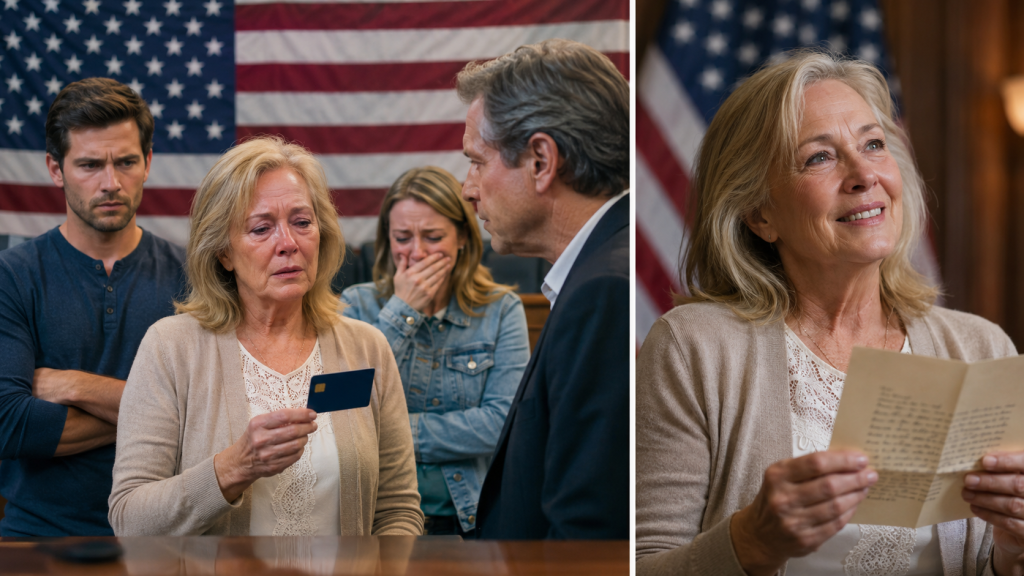
“No matter what happens,” Bob said, closing my fingers around it, “keep this.” I wanted to throw it back at him.
Instead, I shoved it into my purse, went home, buried it inside an old shoebox at the back of my closet, and didn’t touch it for nearly four years.
Four years of struggle.
Four years of unanswered questions.

Four years of hating the man who had walked away from our marriage without giving me a reason.
Then a medical emergency forced me to take that card to the bank.
I thought I was going to withdraw enough money to cover a few bills.
I had no idea I was about to discover the truth about my marriage.
And when I finally did, I wished more than anything that Bob had trusted me enough to tell me while he was still alive.
My name is Linda Harper.
I was sixty-five years old when I finally used the debit card my ex-husband gave me on the day our divorce became official.
For almost four years, it sat untouched inside a dusty shoebox beneath old photographs, birthday cards, and the dried corsage Bob had given me at our high school prom.
I hadn’t forgotten about the card.
I knew exactly where it was.
Some nights, after counting change on my kitchen table to see whether I could afford groceries until payday, I would take out that shoebox.
I would stare at the card.
Other nights, after cleaning office buildings until my lower back screamed every time I stood upright, I would hold it between my fingers and remember Bob standing outside the courthouse.
Then I would put it away.
Because to me, it wasn’t money.
It was the last thing Bob ever gave me.
And for years, it felt like an insult.
For most of my life, I thought my story was ordinary.
I married my high school sweetheart.
Bob and I met in Tacoma, Washington, when I was sixteen and he was seventeen.
He had terrible hair, a dented Ford pickup, and enough confidence for three teenage boys.
Our first date was at a diner where he discovered halfway through dinner that he’d left his wallet at home.
I paid.
For the next thirty-seven years, he joked that he married me because he still owed me $8.42.
We weren’t wealthy.
But we built something.
Bob worked his way from an apprentice electrician to owning a small electrical contracting company. I spent years working part-time while raising our children and later became the office manager for a dental practice.
We bought a modest house south of Seattle.
We raised Chloe and Jake there.
We argued about bills.
We celebrated birthdays around the same scratched dining table.
We took inexpensive vacations.
We worried when Jake broke his arm playing baseball.
We cried when Chloe left for college.
We buried Bob’s father.
Then my mother.
We watched our children become adults.
There were difficult years, certainly.
But there were good ones too.
Thousands of them.
Ordinary Tuesday mornings when Bob made coffee before I woke up.
Saturday afternoons working in the yard.
Sunday dinners when the kids came home.
Thirty-seven years of tiny moments that I believed added up to something permanent.
Then, six weeks after our thirty-seventh wedding anniversary, Bob destroyed it in less than five minutes.
It happened at our kitchen table.
I remember almost everything about that evening.
The dishwasher was running.
Rain tapped against the window.
There was half a meatloaf cooling on the stove.
Bob sat across from me with both hands wrapped around a coffee mug.
“Linda,” he said, “I want a divorce.”
I actually laughed.
Not because it was funny.
Because the sentence was so absurd that my mind rejected it.
“What?”
“I think we should end the marriage.”
I stared at him.
“Stop it.”
“I’m serious.”
The smile disappeared from my face.
I waited for him to explain.
He didn’t.
“Is there someone else?”
“No.”
“Are you unhappy?”
He looked down.
“Yes.”
“For how long?”
He didn’t answer.
I felt something inside me begin to break.
“Thirty-seven years, Bob. You owe me more than silence.”
“I know.”
“Then explain it.”
“I can’t.”
“Can’t or won’t?”
His jaw tightened.
“Maybe both.”
That answer haunted me for years.
There was no affair that I could discover.
No secret girlfriend.
No dramatic betrayal.
No screaming match.
Nothing that made sense.
That was almost worse.
If Bob had cheated, I could have hated him cleanly.
If he’d fallen in love with someone else, at least there would have been an explanation.
Instead, he simply dismantled our life.
Chloe came over the next morning.
She was thirty-four then, married with two children of her own.
She confronted her father in the driveway.
“You don’t get to do this and refuse to tell us why.”
Bob looked exhausted.
“It’s between your mother and me.”
“No, Dad. When you blow up a family, it becomes everybody’s business.”
“Chloe—”
“Is there another woman?”
“No.”
“Then what happened?”
He looked toward the house.
Through the window, I could see him.
And even then, something about him seemed wrong.
He had lost weight.
His face looked gray.
Sometimes his fingers trembled.
There were dark circles beneath his eyes.
I thought it was guilt.
I thought he wasn’t sleeping because he knew what he was doing to us.
I never imagined another possibility.
Jake reacted differently.
He simply stopped speaking to his father.
“If he wants out of this family,” Jake told me, “then let him go.”
I wish I had understood what those words would eventually cost him.
The divorce moved quickly.
Bob didn’t fight over money.
That should have been another clue.
He let me keep most of our joint savings.
He agreed to sell the house and give me the larger share of the proceeds.
He transferred his interest in several investments.
My attorney actually said, “Your husband is being unusually generous.”
But I didn’t feel fortunate.
I felt discarded.
Money couldn’t explain why the man who had slept beside me for nearly four decades suddenly couldn’t stand to remain married to me.
The divorce became final on a gray November morning in Seattle.
When we walked out of the courthouse, Bob asked me to wait.
I almost kept walking.
Then he reached into his wallet and removed a debit card.
“Please take this.”
I stared at it.
“What is it?”
“A personal account.”
“I don’t want your charity.”
“It isn’t charity.”
“Then what is it?”
He hesitated.
That hesitation would replay in my memory hundreds of times.
“Something I set aside.”
“For what?”
“For you.”
I laughed bitterly.
“You already gave me something, Bob. A divorce.”
His face changed.
For just a second, I saw the man I had loved.
His eyes filled with something that looked almost like fear.
He placed the card in my hand.
“The PIN is our wedding date.”
That nearly broke me.
“How sentimental.”
“Linda, please.”
“What?”
His voice became quieter.
“No matter what happens, keep this.”
I should have asked what he meant.
Instead, I shoved the card into my purse.
“I hope whatever life you’re running toward was worth destroying this one.”
He closed his eyes.
Then he nodded once.
“I hope someday you’ll understand.”
He turned away.
That was the last time I ever saw my husband alive.
Three months later, Bob moved to Oregon.
At least, that’s what we were told.
Six months after that, he had almost completely stopped answering calls.
Even Chloe and Jake struggled to reach him.
When Chloe did manage to speak with him, he always had an excuse.
He was traveling.
He was busy.
He was tired.
Eventually, she stopped trying.
Jake had already stopped.
Then, ten months after our divorce, an attorney called.
Bob was dead.
Pancreatic cancer.
Stage four.
I remember sitting on the edge of my bed while the attorney spoke.
The room seemed to tilt.
“What did you say?”
“I’m very sorry, Mrs. Harper.”
“It’s Ms. Harper now.”
It was a ridiculous correction.
But grief does strange things to people.
“When was he diagnosed?”
There was a pause.
“Shortly before your divorce.”
I stopped breathing.
According to the medical records eventually shared with the family, Bob had learned that he had advanced pancreatic cancer weeks before he asked me to leave the marriage.
Doctors had told him treatment might buy time, but his prognosis was poor.
He had undergone treatment privately.
When his condition worsened, he entered hospice.
He specifically instructed the hospice staff not to contact us until after his death.
Chloe collapsed when I told her.
Jake punched a hole through his garage wall.
And I became angrier than I had ever been.
Because now the divorce made even less sense.
Why would a dying man abandon his wife?
Why would he deliberately make his children believe he no longer wanted them?
Why would Bob choose to die alone?
The attorney gave me a note.
It contained only two words.
I’m sorry.
I hated him for that note.
I kept it anyway.
For years, life became smaller.
The money from the divorce didn’t last as long as I’d expected.
There were debts I hadn’t understood.
Taxes.
Moving expenses.
Then I made a terrible investment after trusting someone I shouldn’t have.
Within two years, most of my financial cushion was gone.
I rented a small apartment above a detached garage owned by a widow named Mrs. Reynolds.
I cleaned houses.
Stocked shelves at a grocery store.
Scrubbed office floors at night.
Chloe and Jake offered money.
I accepted a little.
Refused most.
“You spent your life helping us,” Chloe told me. “Let us help you.”
“I can manage.”
But some months I barely did.
The debit card stayed in the shoebox.
Once, during a particularly bad winter, I nearly used it.
My heating bill was overdue.
I had sixty-three dollars until payday.
I sat on the bed holding the card.
Then I remembered Bob saying, “I hope someday you’ll understand.”
Anger rose inside me again.
I put it away.
I told myself I didn’t want his money.
The truth was more complicated.
Part of me wanted to suffer.
Because as long as I struggled, I could blame Bob.
And as long as I blamed Bob, I didn’t have to admit how desperately I still missed him.
Then, one July afternoon, nearly four years after Bob died, my body finally gave me an ultimatum.
I had been carrying groceries up the outside staircase to my apartment when everything went black.
I woke up in a hospital.
Chloe was sitting beside me.
She looked furious.
Not scared.
Furious.
“You’re done.”
“What?”
“You’re done doing this to yourself.”
“Doing what?”
“Pretending you’re twenty-five.”
I tried to sit up.
She pushed the call button.
“The doctor says you’re exhausted, dehydrated, anemic, and your blood pressure is all over the place.”
“I’ll be fine.”
“No.”
“Chloe—”
“No, Mom.”
Her eyes filled with tears.
“You’re sixty-five years old. You’re cleaning offices at night and stocking grocery shelves in the morning because you’re too stubborn to let anyone help you.”
“I don’t want to be a burden.”
“You’re my mother.”
That sentence silenced me.
Then she said something harder.
“Dad is dead. You don’t have to keep punishing him.”
I stared at her.
She wiped her eyes.
“Because you’re really punishing yourself.”
That night, back in my apartment, I sat alone for hours.
At midnight, I opened the closet.
At 12:15, I took out the shoebox.
At 12:20, I finally admitted something I had refused to say aloud for years.
“I can’t do this anymore.”
The next morning, I went to the bank.
I almost turned around twice.
The teller was a young woman named Rachel.
I slid the debit card beneath the glass.
“This account is old,” I explained. “I’m not even sure it’s still active.”
She typed something into her computer.
Her expression changed.
Then she typed again.
“Mrs. Harper?”
“Yes?”
“Do you have identification?”
My stomach tightened.
I gave it to her.
She examined it, looked back at the computer, and frowned.
“Is something wrong?”
“Not exactly.”
“What does that mean?”
“There are special instructions attached to this account.”
I felt suddenly embarrassed.
Of course there were.
Maybe Bob had closed it.
Maybe there was twenty dollars left.
“What kind of instructions?”
She wrote a phone number on a piece of paper.
“This account is connected to a privately managed trust. You’ll need to contact the attorney listed here.”
I stared at her.
“A trust?”
“Yes.”
“How much money is in the account?”
She gave me an apologetic look.
“I can’t discuss the full trust from this screen.”
“Can you tell me whether there’s enough to pay a hospital bill?”
She looked at the screen again.
Then she looked at me.
“Yes, ma’am.”
Something in her expression made my heart beat faster.
“How much?”
“I really think you should call the attorney.”
An hour later, I was sitting in an office overlooking downtown Seattle.
The attorney’s name was Michael Harris.
He was in his early sixties, silver-haired and soft-spoken.
When his receptionist told him my name, he came into the lobby himself.
“Linda Harper?”
“Yes.”
He stared at me for a moment.
Then he said something I wasn’t prepared to hear.
“I’ve been expecting you for almost four years.”
He led me into his office.
I sat down.
Michael opened a filing cabinet and removed several thick folders.
“What exactly did Bob do?”
Instead of answering, he slid a financial statement across the desk.
I looked down.
There were several accounts.
Investment funds.
Municipal bonds.
A property holding.
Cash reserves.
And at the bottom was a number.
$2,846,391.17.
I stared at it.
Then I laughed.
“This isn’t mine.”
“Yes, it is.”
“There must be some mistake.”
“There isn’t.”
“Bob didn’t have this kind of money.”
Michael folded his hands.
“Actually, he did.”
I looked at him.
“How?”
“Your husband sold his ownership interest in Harper Electrical Services shortly before the divorce.”
I knew Bob had taken on a partner years earlier.
I had assumed the business had struggled after we separated.
Michael continued.
“He also liquidated several long-term investments and transferred proceeds from a commercial property partnership.”
My hands began shaking.
“Why?”
“To fund this trust.”
“For whom?”
“For you.”
I pushed the statement away.
“No.”
“Mrs. Harper—”
“Linda.”
“Linda, Bob created the trust before your divorce was finalized.”
My eyes filled with tears.
“Then why divorce me?”
Michael became very still.
“Because he believed it was the only way to protect you.”
“Protect me from what?”
He opened another folder.
Inside were medical records.
Insurance documents.
Business statements.
And letters.
Dozens of letters.
Each envelope had a date written across the front.
Michael pushed them toward me.
“Bob left instructions that these were to be given to you only if you used the card.”
“Why?”
“Because he believed that would mean you were ready to know.”
I stared at the envelopes.
The first was dated six weeks before our divorce.
I opened it.
Linda,
If you’re reading this, then I didn’t find the courage to tell you while I was alive.
I already knew.
Before the divorce.
Before the arguments.
Before our children stopped speaking to me.
I knew I was dying.
My vision blurred.
I kept reading.
The doctors believe I may have less than a year.
You would have stayed.
That’s the problem.
You would have stayed every single day.
You would have spent every dollar we had trying to save me.
You would have slept in hospital chairs.
You would have stopped living.
And when I died, you would have been left with medical bills, business liabilities, and memories of watching me disappear.
So I made a decision you may never forgive.
I made you hate me.
The letter slipped from my hands.
“No.”
Michael quietly placed a box of tissues beside me.
I looked at him.
“He divorced me because he was sick?”
“There’s more.”
I shook my head.
“I would have stayed.”
“I know.”
“He knew that.”
“Yes.”
“That was my choice!”
My voice cracked across the room.
Michael didn’t argue.
“He had no right.”
“No,” Michael said quietly. “He didn’t.”
That surprised me.
“He thought he was protecting you,” he continued. “But protecting someone and making the right decision aren’t always the same thing.”
I cried then.
Not politely.
Not quietly.
I cried for the husband I’d hated.
For the dying man who had apparently believed becoming a villain was an act of love.
And for myself.
Because I would have chosen the hospital chair.
I would have chosen the fear.
I would have chosen every terrible day if it meant one more day holding his hand.
When I could finally breathe again, Michael opened another file.
“There was another reason.”
I looked up.
Bob’s company had been facing a lawsuit connected to an accident involving a subcontractor.
The claim was eventually dismissed, but when Bob received his diagnosis, the outcome was uncertain.
“He was terrified that if he died while the lawsuit was active, your shared assets could become tangled in litigation,” Michael explained.
“So he separated everything.”
“Yes. The divorce transferred the house proceeds, retirement funds, and other assets directly to you. Then he sold his remaining business interests and placed what he could into the trust.”
I stared at the financial documents.
“He planned all of this?”
“For months.”
“And our children?”
Michael looked uncomfortable.
“Bob believed they needed to be angry with him too.”
I covered my mouth.
“No.”
“He didn’t want Chloe bringing the grandchildren to hospice. He didn’t want Jake abandoning work and his family to care for him.”
“That wasn’t his decision!”
“I agree.”
I opened another letter.
This one was dated three months after the divorce.
Linda,
Today Chloe called me seventeen times.
I answered on the eighteenth.
She screamed at me for ten minutes.
I’ve never been prouder of her.
She sounds exactly like you when she’s angry.
I told her I was busy.
The truth is I had chemotherapy this morning and could barely hold the phone.
Please forgive me.
I pressed the letter against my chest.
Another was addressed to Jake.
Another to Chloe.
There were letters for birthdays Bob knew he would miss.
Letters for our grandchildren.
One envelope had my name and the words READ LAST.
I couldn’t open it.
Not yet.
Instead, I asked Michael the question that suddenly mattered more than the money.
“Was he alone when he died?”
Michael hesitated.
“No.”
I looked up.
“A hospice nurse named Teresa was with him.”
“Only a nurse?”
“There was someone else.”
Michael reached into the folder and removed a photograph.
Bob was sitting in a wheelchair beside a lake.
He was painfully thin.
Standing beside him was an older man I recognized immediately.
“Frank?”
Bob’s younger brother.
The two had barely spoken in years.
“Frank knew?”
“During the final months.”
I called him from Michael’s office.
Frank answered on the third ring.
When he heard my voice, he went silent.
“You knew.”
“Linda—”
“You knew Bob was dying.”
“Yes.”
“And you said nothing.”
“He made me promise.”
I started crying again.
Frank did too.
“He was scared, Linda.”
“Bob wasn’t scared of anything.”
“Yes, he was.”
Frank’s voice broke.
“He was terrified of you watching him die.”
That sentence changed something inside me.
Not forgiveness.
Not yet.
But something.
Frank told me about Bob’s final months.
The vomiting.
The weight loss.
The pain.
The nights when medication barely helped.
“He talked about you constantly,” Frank said.
I closed my eyes.
“He had your wedding picture beside his bed.”
“Why didn’t he call me?”
“He picked up the phone a hundred times.”
My throat tightened.
“Then why didn’t he dial?”
“Because he knew if he heard your voice, he’d ask you to come.”
I stayed in Michael’s office nearly five hours.
Before leaving, I finally opened the envelope marked READ LAST.
Linda,
There is no version of this letter that makes what I did fair.
I stole your goodbye.
I know that.
Maybe you will hate me forever for it.
If you do, I understand.
But there is something I need you to know.
I didn’t divorce you because I stopped loving you.
I divorced you because after thirty-seven years, I knew exactly what loving me would make you do.
You would have sacrificed everything.
And I couldn’t bear to let the last thing I took from you be your future.
So I chose to let you believe something cruel.
I chose to let you believe I didn’t love you.
It was the hardest lie I ever told.
The money in this trust isn’t payment for forgiveness.
Don’t use it to build a shrine to me.
Don’t save it because you’re afraid.
Don’t give all of it to the children.
They have their lives.
This is for yours.
Travel somewhere we always talked about going.
Buy a house with a porch.
Sleep late.
Stop cleaning other people’s floors.
Order dessert without checking the price.
And Linda?
Please fall in love with being alive again.
I couldn’t finish the last paragraph for several minutes.
Then I forced myself.
I loved you when I was seventeen.
I loved you when you walked down the aisle.
I loved you when Chloe was born and you squeezed my hand so hard I thought you’d broken two fingers.
I loved you when Jake wrecked my truck.
I loved you during every stupid argument.
I loved you across that courthouse hallway.
And I loved you when I signed the papers that made you believe I didn’t.
I am sorry I wasn’t brave enough to let you say goodbye.
Please be braver than I was.
Live.
Bob.
For the first time in four years, my anger collapsed.
Not completely.
Some of it deserved to remain.
Love does not give us the right to make every choice for another person.
Bob had protected me financially.
But emotionally, he had wounded all of us.
Both things could be true.
That became the hardest lesson.
A person can love you deeply and still make a terrible decision.
Forgiveness doesn’t require pretending the decision was right.
That evening, I called Chloe and Jake.
“Come over,” I said.
“What’s wrong?” Chloe asked.
“Nothing.”
I looked at the box of letters beside me.
“Your father left us something.”
They arrived together.
We sat around my tiny kitchen table until after midnight.
Jake refused to read his letter at first.
“I don’t want excuses.”
“Neither did I.”
Eventually, he opened it.
Halfway through, he stood and walked to the window.
His shoulders began shaking.
Chloe went to him.
Jake hadn’t cried at his father’s funeral.
He cried that night.
“I told him I hated him,” he whispered.
I walked over and put my arms around my son.
“He knew you didn’t.”
“How?”
“Because he was your father.”
Over the following weeks, we read everything.
Bob had left recordings too.
Some were funny.
Some were almost impossible to watch.
In one, he was sitting in a hospice bed wearing the Mariners cap Jake had given him years earlier.
“If you’re seeing this,” Bob said, “then I assume Linda finally used that stubborn debit card.”
I laughed and cried at the same time.
“I knew she’d hold out,” he continued. “Frank owes me twenty bucks.”
For the first time since Bob’s death, our family spoke about him without anger swallowing every memory.
We didn’t excuse him.
We understood him.
There is a difference.
The trust changed my life, but not in the way Bob probably imagined.
I didn’t buy a mansion.
I bought a small two-bedroom house outside Tacoma.
It had a porch.
That detail mattered.
The first morning after I moved in, I carried coffee outside and sat beneath a blue Washington sky.
For nearly an hour, I did absolutely nothing.
It was glorious.
I quit cleaning offices.
I paid my medical bills.
I set aside money for retirement.
I created education accounts for the grandchildren despite Bob specifically telling me not to give everything away.
“Sorry, Bob,” I said while signing the paperwork. “You don’t get every decision.”
I could almost hear him laughing.
Then I did something I never expected.
I created a small emergency fund through a local nonprofit for older women going through divorce, widowhood, or sudden financial hardship.
Nothing enormous.
Just enough to help someone cover rent, groceries, transportation, or a medical bill while they got back on their feet.
I knew what it felt like to count coins.
I knew what pride could cost.
I knew how frightening sixty-five could feel when you believed you were starting from nothing.
The first woman we helped was named Carol.
She was sixty-eight.
Her husband had died unexpectedly, leaving debts she knew nothing about.
When I handed her the assistance paperwork, she cried.
“I’ll pay it back.”
“You don’t have to.”
“I can’t accept charity.”
I smiled.
“I used to say exactly that.”
She looked embarrassed.
So I reached across the table.
“This isn’t charity. It’s breathing room.”
Those words stayed with me.
Breathing room.
Maybe that was what Bob had been trying to give me all along.
He simply chose the most painful possible way to do it.
Two years later, Chloe and I drove to Oregon.
For the first time, I visited the hospice where Bob died.
Teresa still worked there.
When I introduced myself, she immediately knew who I was.
“Oh,” she whispered. “Linda.”
She hugged me.
Then she took me outside to a garden behind the building.
“Your husband used to sit right there.”
She pointed toward a wooden bench.
“He talked about you.”
“So everyone keeps telling me.”
Teresa smiled.
“He said you made terrible pancakes.”
I laughed.
“I do.”
“He said you always burned the first batch.”
“He ate them anyway.”
“He said that too.”
We sat together.
Then Teresa told me something nobody else had.
On Bob’s final night, he became restless.
Frank was sleeping in a chair.
Teresa asked whether Bob needed anything.
“He said your name,” she told me.
I stared at her.
“What exactly did he say?”
She took my hand.
“He said, ‘Tell Linda I was wrong.’”
I couldn’t speak.
“He said, ‘I thought leaving would make it easier for her. I think I just made her lonely.’”
Tears ran down my face.
Teresa continued.
“Then he asked me whether I thought people could forgive someone after they were gone.”
“What did you tell him?”
“I said forgiveness belongs to the living.”
I sat on that bench long after Teresa returned inside.
Eventually, I took Bob’s final letter from my purse.
I had brought it with me deliberately.
For years, I had imagined what I would say if I could see him one last time.
At first, I imagined screaming.
Later, I imagined demanding answers.
But sitting there, none of that mattered anymore.
“You were wrong,” I whispered.
The wind moved gently through the trees.
“You should have told me.”
My voice cracked.
“I would have stayed, Bob.”
I wiped my eyes.
“I would have stayed until the last second.”
Then I smiled.
“But I understand why you were afraid.”
That was as close to forgiveness as I had ever come.
And strangely, it was enough.
I left the letter in my purse.
I didn’t leave it at the hospice.
It belonged with me.
Today, I am seventy.
The debit card has expired.
I still keep it.
Not in the shoebox anymore.
It sits inside a small frame on my desk beside our wedding photograph.
People sometimes misunderstand when I tell them this story.
They think it’s a story about money.
It isn’t.
The money saved me from financial hardship, certainly.
But money wasn’t the thing Bob left me that mattered most.
He left me a painful truth.
For years, I believed our thirty-seven-year marriage had ended because love disappeared.
It hadn’t.
Love had been there the entire time.
It was simply tangled with fear.
Bob was afraid of dying.
Afraid of becoming helpless.
Afraid of draining everything we’d built.
Most of all, he was afraid of watching the woman he loved sacrifice herself to save a man who couldn’t be saved.
So he made a choice.
A flawed choice.
A heartbreaking choice.
A choice I would never have made for him.
For a long time, I thought forgiveness meant deciding that what someone did was acceptable.
Age taught me otherwise.
Sometimes forgiveness means saying:
You hurt me.
You were wrong.
I wish you had trusted me.
And I love you anyway.
Every November, on the anniversary of our divorce, I do something Bob asked me to do in his final letter.
I order dessert.
Something ridiculous.
Chocolate cake.
Cheesecake.
Apple pie with ice cream.
I never check the price.
Last November, Chloe and Jake joined me.
We sat at a restaurant overlooking Puget Sound.
My grandchildren were there too.
Jake raised his glass.
“To Dad.”
Chloe smiled.
“To complicated fathers.”
Everyone laughed.
Then Chloe looked at me.
“And stubborn mothers.”
“Careful,” I warned.
We raised our glasses.
For a moment, I looked around the table at the family Bob had believed he needed to leave in order to protect.
He had been wrong about many things.
But he had been right about one.
Life continued.
Not the life I expected.
Not the life I would have chosen.
But a life still filled with mornings, grandchildren, coffee on the porch, arguments, birthdays, laughter, and ordinary days.
Those ordinary days were what Bob and I had built our marriage from.
And now I understood their value better than ever.
When the waiter brought dessert, he placed a huge slice of chocolate cake in front of me.
I laughed.
“What?” Jake asked.
“Nothing.”
But in my mind, I could hear Bob.
Order dessert without checking the price.
So I picked up my fork.
For thirty-seven years, Bob had been my husband.
For four years, I thought he had become the man who abandoned me.
It took one forgotten debit card to teach me the truth.
He hadn’t stopped loving me.
He had simply been too frightened to let me love him through the end.
I wish he had given me that choice.
I always will.
But I no longer spend my days wishing I could rewrite our final chapter.
Instead, I remember the thousands that came before it.
The seventeen-year-old boy with the terrible hair.
The nervous young husband waiting at the altar.
The father holding our newborn daughter.
The man teaching Jake to ride a bicycle.
The grandfather crawling around the living room with our grandchildren.
The husband who made my coffee.
The stubborn fool who thought he could protect me from grief.
And finally, the dying man who loved me imperfectly.
That is the Bob I choose to remember.
Not because the ending didn’t hurt.
But because the ending was never the whole story.
One evening recently, my oldest granddaughter noticed the framed debit card on my desk.
“Grandma, why do you keep an expired bank card in a frame?”
I picked it up.
For a second, I was sixty-one again, standing outside that Seattle courthouse while Bob pressed it into my palm.
No matter what happens, keep this.
I smiled.
“Because your grandfather gave it to me.”
“Was there a lot of money on it?”
I laughed softly.
“Eventually.”
Her eyes widened.
“How much?”
“That isn’t the important part.”
“Then why is it special?”
I looked toward the photograph beside it.
Bob and I were twenty-two in that picture.
Young.
Terrified.
Certain we understood love.
We didn’t.
Maybe nobody ever completely does.
“Because,” I told her, “sometimes something that looks like the end of your life turns out to be the beginning of another part of it.”
She considered that.
Then she shrugged in the way teenagers do and went downstairs.
I remained at my desk.
Outside, evening sunlight stretched across the porch Bob had asked me to buy.
For once, the house was quiet.
I touched the edge of the old card.
“You happy now?” I whispered.
There was obviously no answer.
There didn’t need to be.
I walked into the kitchen, made myself coffee even though it was far too late in the evening, and carried it outside.
Then I sat on my porch.
I watched the sun disappear.
And I lived.
Exactly as he had asked me to.
THE END! THANK YOU FOR READING.