 Reading Time: 13 minutes
He came to me asking for help. And I told him, “I’m not going to give you a single dime.” Arthur was not my biological father. But when everyone else abandoned me, Arthur became the only father who stayed.
My mother died when I was ten years old. One rainy Tuesday morning, she left our apartment complaining about a headache and never came home. A blood vessel had ruptured in her brain while she was at work. By the time the ambulance reached the hospital, there was nothing the doctors could do.
My biological father had disappeared years earlier. I could not have recognized him if he had walked past me on the street.
After my mother’s funeral, our relatives gathered in my aunt Denise’s living room to decide what would happen to me.
I remember sitting on a brown carpet near the stairs, pretending to play with a toy truck while listening to adults discuss my life as if I were a piece of furniture nobody had room for.
“Poor child,” Aunt Denise whispered.
Then came the sentence I would hear from almost everyone.
“But we just can’t take him in.”
My uncle had three children.
My grandmother said she was too old.
Another aunt lived in a one-bedroom apartment.
Someone suggested foster care.
Someone else said maybe my biological father could be located.
Then Arthur stood up.
“The boy comes with me.”
The room went silent.
Arthur had been my mother’s husband for only three years.
He was not wealthy.
He had no children of his own.
He worked wherever he could find work—loading trucks, repairing bicycles, delivering packages, helping fishermen unload boats near the river.
My grandmother looked at him.
“Arthur, you don’t have to do this.”
He looked toward me.
“Yes, ma’am. I do.”
That was the end of the discussion.
He took my small suitcase in one hand and held my shoulder with the other.
And I went home with him.
Our home was a rented room on the outskirts of Savannah, Georgia.
Calling it an apartment would have been generous.
There was one bedroom, a tiny kitchen, a bathroom where the shower sometimes produced warm water, and an old window air conditioner that sounded like a lawn mower.
Whenever it rained hard, water slipped beneath the window frame.
Arthur would place an old cooking pot beneath the leak.
“Indoor waterfall,” he would joke.
We were poor.
I knew that even as a child.
But somehow Arthur made poverty feel temporary instead of shameful.
He woke up before sunrise almost every morning.
Sometimes he hauled produce crates at the market.
Sometimes he repaired bicycles.
Sometimes he drove an old motorcycle delivering groceries.
On weekends, he mowed lawns.
At night, when his hands were swollen and his back hurt, he would sit at our small kitchen table helping me with homework.
He was terrible at algebra.
Absolutely terrible.
One night he stared at my math worksheet for ten minutes and finally said, “Son, whoever invented letters in mathematics deserves prison.”
I laughed so hard milk came out of my nose.
Arthur laughed harder.
That was our life.
Cheap food.
Old furniture.
Secondhand clothes.
And more love than many rich homes ever know.
When I was fourteen, my school announced an advanced preparatory program.
It cost $180.
That might not sound like much now.
Back then, $180 was nearly impossible for us.
I brought the paper home but left it folded inside my backpack.
Arthur found it while looking for a permission slip.
“What’s this?”
“Nothing.”
He read it.
“You want to take this class?”
I shrugged.
“It doesn’t matter.”
“Yes, it does.”
“It costs too much.”
He stared at me.
“Who told you that?”
“Nobody.”
“Then don’t decide what I can afford for me.”
Two days later, he handed me an envelope filled with crumpled bills.
“Here.”
I looked at the money.
Then at him.
Arthur looked pale.
There was a small bandage inside his elbow.
My stomach dropped.
“Where did this come from?”
He scratched his chin.
“Worked something out.”
“What?”
“Don’t worry about it.”
I grabbed his wrist and looked at the bandage.
“Dad.”
He sighed.
“I went to a plasma center.”
“You sold your blood?”
“Plasma.”
“That’s blood.”
“Technically, yes.”
I felt sick.
“I’m not taking it.”
“Yes, you are.”
“No.”
Arthur placed both hands on my shoulders.
“Listen to me. Money comes back. Time doesn’t. Opportunity doesn’t always come back either.”
“But—”
“You study.”
His voice softened.
“You become something bigger than this room.”
That night, I cried into my pillow.
I covered my mouth with the blanket because I did not want him to hear.
But years later, I learned that had not been the only time.
Arthur donated plasma many times to pay for books, exam fees, school clothes, and bus passes.
When I received my acceptance letter from Georgia Tech, I ran three blocks to the bicycle shop where he was working.
“Dad!”
He came outside wiping grease from his hands.
I held up the letter.
“I got in.”
He stared at me.
“What?”
“I got accepted.”
Arthur read the first line.
Then he pulled me against his chest.
That man cried harder than I did.
People walking down the sidewalk probably thought somebody had died.
Instead, Arthur kept saying, “You did it. You did it, boy.”
Finally, he stepped back.
“Your mother would be proud.”
That broke me.
I wiped my face.
“I couldn’t have done it without you.”
“Yes, you could.”
“No.”
“Yes.”
“No.”
He laughed.
“Fine. Maybe I helped a little.”
“A little?”
“All right. A medium amount.”
College was difficult.
There were months when I considered quitting.
Some students arrived with new laptops and parents who paid for apartments.
I worked nights.
Arthur sent me twenty-dollar bills hidden inside birthday cards even when it was not my birthday.
On the back he would write:
Eat something besides noodles.
I graduated with a degree in computer engineering.
Arthur attended the ceremony wearing the same gray suit he had worn to my mother’s funeral.
It was too large around his shoulders because he had lost weight over the years.
When my name was called, nobody screamed louder than him.
“That’s my son!”
People laughed.
I loved him for it.
My first job paid more money than Arthur had ever earned in his life.
I promised myself everything would change.
I rented a better apartment.
Then a better one.
Eventually, I moved into a high-rise building in Atlanta.
My salary climbed.
Five thousand a month.
Seven thousand.
Ten thousand.
Then more.
I bought a black luxury sedan.
A designer watch.
Expensive shoes.
I started taking clients to restaurants where one dinner could cost what Arthur once spent on groceries for a month.
Every time I tried to give Arthur money, he refused.
“Let me pay your rent.”
“No.”
“Let me buy you a car.”
“My truck works.”
“Your truck is older than me.”
“Still works.”
“Move to Atlanta.”
“I hate traffic.”
“Let me at least fix the roof.”
“I already fixed it.”
“With duct tape.”
“Good duct tape.”
He always smiled.
“A father doesn’t charge his son for raising him.”
Years passed.
Then something changed.
Arthur stopped answering some of my calls.
When he did answer, he sounded tired.
He claimed he had been working too much.
Then I visited Savannah unexpectedly.
When Arthur opened the door, I almost didn’t recognize him.
He had lost weight.
His face looked gray.
His hands trembled slightly.
“What happened to you?”
“Nothing.”
“Dad.”
“Getting old.”
“You’re sixty-three.”
“Exactly. Ancient.”
I did not laugh.
I took him to lunch.
Halfway through the meal, he barely touched his food.
When I asked questions, he changed the subject.
That evening, after he went to bed, I found a hospital appointment card beneath a pile of mail.
I called the clinic the next morning.
They would not tell me anything without Arthur’s permission.
So I confronted him.
Finally, he admitted the truth.
His heart was failing.
Years of hard physical labor, untreated blood pressure, poor medical care, and bad luck had caught up with him.
Doctors wanted to perform surgery.
Arthur had postponed it twice.
“Why?”
He stared at the floor.
“Money.”
I became furious.
“You know I can pay.”
“I know.”
“Then why didn’t you ask?”
“Because you’ve got your own life.”
“You sold blood for my education.”
“That was different.”
“How?”
“You were my son.”
I stared at him.
“And what does that make you?”
He smiled sadly.
“Your old man.”
I contacted the hospital privately.
I spoke with the billing department.
I talked with his cardiologist.
The surgery would cost approximately twenty thousand dollars after assistance programs and insurance adjustments.
I paid the entire amount.
Immediately.
Arthur knew nothing.
Then I did something else.
For years, he had talked about a small white house outside Savannah that he passed every morning on his way to work.
It had a porch.
A pecan tree.
A little workshop in the back.
When I was a teenager, he once pointed toward it and said, “That’s the kind of place I’d buy if I ever got lucky.”
The house went on the market.
I bought it.
Cash.
I had the deed prepared in Arthur’s name.
But there was one more thing.
Three months before his visit to my Atlanta apartment, I had started searching through old legal records.
I wanted to surprise him by formally changing my last name.
I had spent my whole life carrying the last name of a father who had abandoned me.
I wanted Arthur’s.
During that process, my attorney discovered something in old county records.
A document filed shortly after my mother died.
I had never seen it.
Never even known it existed.
It was an adoption petition.
Arthur had tried to legally adopt me.
The document was incomplete because certain legal requirements involving my missing biological father had delayed the process.
But attached to it was a handwritten statement Arthur had submitted to the court.
I could barely read past the first line.
It said:
“I do not have his blood, but if the court permits it, I am asking to give him my name, my home, and every remaining year of my life as his father.”
I stopped reading.
I sat in my lawyer’s office and cried.
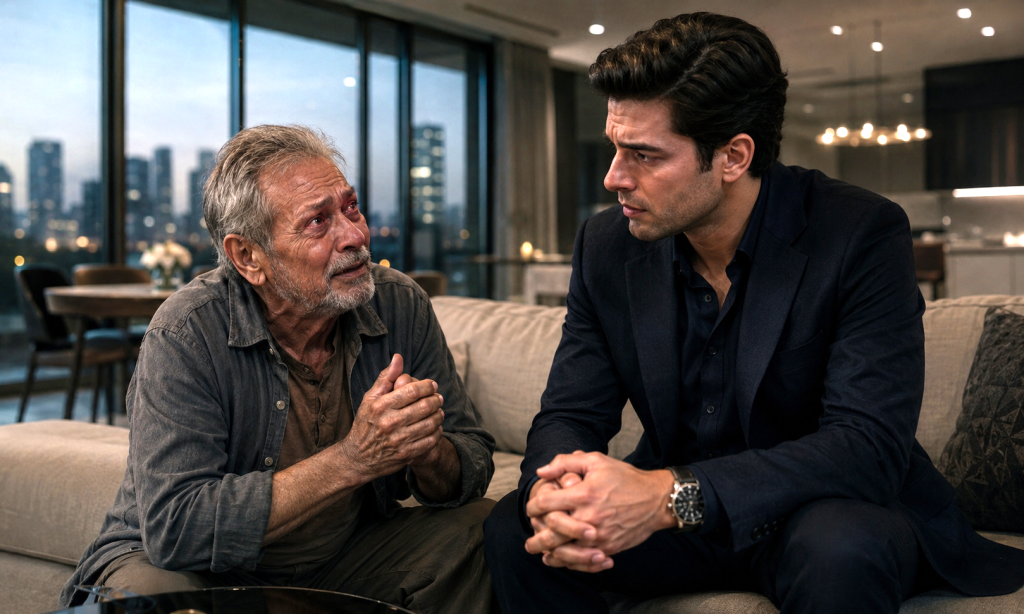
Three months later, Arthur came to my apartment asking for money.
I already knew why.
But I did not know he was coming that day.
My wife, Emily, opened the door.
“Arthur!”
He stood in the hallway wearing an old blue work shirt.
He had lost even more weight.
His baseball cap was crushed between his trembling fingers.
I came out of my office.
“Dad?”
He smiled.
“Hey, son.”
Something about his face told me immediately.
This was difficult for him.
He sat on the edge of our expensive sofa as though he was afraid of damaging it.
Emily brought him water.
Arthur barely touched it.
Finally, he looked at me.
“Son, I need to ask you something.”
My chest tightened.
“Tell me.”
He stared at his hands.
“The doctor says I need that surgery.”
“I know.”
“They say if I keep putting it off…”
His voice disappeared.
I waited.
He swallowed.
“It’s twenty thousand dollars.”
I said nothing.
“I know that’s a lot.”
Still nothing.
“I’m asking for a loan.”
“A loan?”
“Yes.”
He nodded quickly.
“I’ll pay you back.”
“Dad—”
“Little by little. I can still work some. Maybe sell candy. Repair bikes again. Whatever it takes.”
I looked at him.
At those hands.
The same hands that had tied my shoes.
Packed my lunches.
Repaired my bicycle.
Held my report cards.
Counted crumpled bills.
Signed school forms where the blank said Father.
The same arms that carried me away from a family meeting where everyone else had decided I was someone else’s responsibility.
And I said, “I can’t.”
Arthur stopped breathing for a second.
Emily looked at me.
“What?”
I continued.
“I’m not going to give you a single dime.”
The words sounded horrible.
Exactly as I intended.
Arthur’s eyes filled with tears.
But he did not become angry.
He did not remind me about the plasma centers.
He did not mention college.
He did not say, After everything I did for you.
He just nodded slowly.
“I understand.”
He stood.
“Dad—”
“No.”
He tried to smile.
“You’ve got your own responsibilities.”
He placed the baseball cap on his head.
“Forgive me for asking.”
He walked toward the door.
I let him leave.
Emily turned on me the instant the door closed.
“What is wrong with you?”
I grabbed my keys.
“Come with me.”
“Why?”
“Just come.”
We drove behind Arthur.
He did not notice us.
He walked past the bus stop.
Past a pharmacy.
Past two restaurants.
Eventually, he reached a small chapel.
He sat on the concrete steps.
Then he removed his cap.
And covered his face.
I had seen Arthur cry only a few times.
At my mother’s funeral.
At my graduation.
And now.
Emily looked at me.
“If you have a reason for what you just did, it better be extraordinary.”
I picked up a thick envelope from the back seat.
“Come on.”
We crossed the street.
Arthur did not hear us until I sat beside him.
He immediately wiped his face.
“Son?”
I handed him the envelope.
“What’s this?”
“The reason I’m not giving you twenty thousand dollars.”
He looked confused.
“Open it.”
He pulled out the first paper.
Hospital receipt.
PAID IN FULL.
Arthur stared.
His lips moved without sound.
“What…”
“The surgery is already paid for.”
He looked at me sharply.
“What?”
“I paid it three weeks ago.”
His eyes filled again.
“You…”
“There’s more.”
He pulled out another document.
Property deed.
Arthur read the address.
His hands started shaking harder.
“No.”
“Yes.”
He stared at me.
“No, no, no.”
“The white house.”
“Son.”
“The one with the porch and the pecan tree.”
“I can’t take this.”
“It’s already yours.”
“I said I can’t—”
“And I’m not asking.”
He covered his mouth.
Emily began crying beside us.
Arthur looked at me like he wanted to be angry.
“You made me think…”
“I know.”
“You let me walk out believing…”
“I know.”
“That was cruel.”
“It was.”
He stared at the papers.
“Why?”
“Because there’s one more thing.”
I pulled out the final document.
My hands were trembling now.
“This is what I really wanted you to see.”
Arthur unfolded it.
The old adoption petition.
His face changed.
He recognized it immediately.
“Where did you find this?”
“My attorney.”
Arthur looked down.
“I thought this was gone.”
“Why didn’t you ever tell me?”
“Tell you what?”
“That you tried to adopt me.”
He exhaled.
“It didn’t work.”
“You tried.”
“Of course I tried.”
“Why?”
Arthur looked at me as if it were the strangest question anyone had ever asked.
“Because you were my son.”
I pointed to the handwritten statement.
“Read the first line.”
He shook his head.
“You read it.”
My voice broke.
“I already did.”
So he read aloud.
“I do not have his blood, but if the court permits it, I am asking to give him my name, my home, and every remaining year of my life as his father.”
He stopped.
I reached into my coat.
There was one more envelope.
Brand-new legal documents.
A name-change order.
Approved the previous morning.
I handed it to him.
Arthur stared at my new name.
Daniel Carter.
His name.
My name.
For the first time in my life.
He whispered, “You changed it?”
I nodded.
“You spent years telling me a father doesn’t charge his son.”
Arthur stared at me.
“So I’m not paying you back.”
I pointed to the surgery receipt.
“That isn’t repayment.”
Then toward the deed.
“That isn’t repayment either.”
I touched the name-change document.
“This is just me finally putting the correct name on the life you gave me.”
Arthur broke.
He leaned forward and wrapped both arms around me.
I was forty years old.
Successful.
Educated.
Well paid.
But sitting on those chapel steps, I became ten years old again.
I buried my face against the shoulder of the man who had chosen me when nobody else would.
“I thought you didn’t want me,” Arthur whispered.
I pulled back.
“What?”
“When you said you wouldn’t give me anything.”
“Dad—”
“For one minute, I thought maybe I had become one of those old people who bother their children.”
I grabbed his hands.
“Never say that again.”
“I don’t want to be a burden.”
“You carried me for thirty years.”
“That’s different.”
“No. It isn’t.”
I squeezed his hands.
“You remember what you told me about the preparatory course?”
He smiled faintly.
“What?”
“Money comes back. Time doesn’t.”
His face crumpled.
“So this is me buying time.”
Arthur’s surgery took place six days later.
I stayed at the hospital the entire time.
When the surgeon finally walked into the waiting room and said everything had gone well, I cried harder than I had in years.
Arthur spent several weeks recovering.
Then one Saturday morning, Emily and I drove him to the house.
He thought we were simply taking a scenic route.
When I pulled into the driveway, he looked around.
“What are we doing here?”
“Getting you home.”
He stared at the porch.
Someone had painted the front door blue.
There were two rocking chairs outside.
The pecan tree stretched across the yard.
Behind the house was the workshop.
Arthur slowly stepped out of the car.
He walked toward the porch.
Touched one of the columns.
Then turned toward me.
“You remembered.”
“Of course I remembered.”
“I said that once.”
“You said it thirty-seven times.”
He laughed.
Then he cried again.
Neighbors came over during the next few weeks.
Arthur fixed bicycles in the workshop—not because he needed the money anymore, but because he loved having something to do.
Kids from the neighborhood started bringing broken bikes.
Arthur rarely charged them.
Sometimes I would visit and find three children sitting on overturned buckets while Arthur showed them how to repair a chain.
He became everybody’s grandfather.
Two years later, Emily and I had our first child.
A boy.
We named him Arthur.
When I told my father, he stared at me for almost a full minute.
“You didn’t.”
“We did.”
“You should’ve given that boy a better name.”
“It’s the best one I know.”
The first time he held his grandson, his hands trembled.
Not from illness.
From emotion.
He whispered, “Hello, little man.”
Then he looked at me.
“You know I’m going to spoil him.”
“I’m counting on it.”
Years have passed since then.
My expensive watch eventually broke.
The car I once thought made me successful was traded in.
My salary changed.
Companies changed.
Homes changed.
Almost everything I once believed proved I had made it eventually became old, scratched, outdated, or replaceable.
Arthur taught me what wealth actually looks like.
Wealth was a tired man coming home after twelve hours of work and still asking about my homework.
Wealth was twenty dollars hidden inside birthday cards.
Wealth was canned beans eaten without complaint because textbooks mattered more.
Wealth was a man with no biological obligation standing in a room full of relatives and saying, “The boy comes with me.”
Wealth was plasma money folded into an envelope.
Wealth was an adoption petition that never became official, written by a man who had already become my father in every way that mattered.
Arthur lived another eleven years after the surgery.
Eleven years.
We got eleven Christmas mornings.
Eleven birthdays.
Eleven summers sitting on his porch.
Eleven years of him teaching my son how to ride a bicycle, fish from the riverbank, change a tire, and always return borrowed tools.
When he finally died, he was seventy-six.
I sat beside him during his final night.
His breathing was shallow.
His hair was completely white.
On the table beside his bed was an old photograph of my mother.
He opened his eyes once.
“Daniel?”
“I’m here.”
“You doing okay?”
I laughed through my tears.
Even then, he was checking on me.
“I’m okay, Dad.”
“Good.”
He was quiet for a while.
Then he whispered, “Your mother would be proud of you.”
I leaned closer.
“She’d be proud of you too.”
He smiled.
“I tried.”
“No.”
I held his hand.
“You stayed.”
His eyes opened again.
“What?”
“Everyone else said they couldn’t take me.”
My voice broke.
“You stayed.”
Arthur squeezed my hand with the little strength he had left.
“Best decision I ever made.”
Those were almost his last words.
He died before sunrise.
At the funeral, the chapel was overflowing.
Neighbors.
Children whose bicycles he had repaired.
Old coworkers.
Friends.
People from the market.
People I had never met.
Near the end of the service, my son stood beside me.
He was ten.
The same age I had been when Arthur took me home.
He looked at the casket.
“Dad?”
“Yes?”
“Grandpa Arthur wasn’t your real dad?”
I looked at him.
“Who told you that?”
“I heard somebody say he was your stepdad.”
I knelt in front of him.
“Arthur wasn’t my biological father.”
My son frowned.
“So he wasn’t really your dad?”
I thought about the rented room.
The leaking window.
The old motorcycle.
The school uniform folded on a chair.
The plasma center bandages.
The graduation ceremony.
The adoption petition.
The porch.
The pecan tree.
The final night.
Then I smiled.
“No, son.”
I placed my hand over his heart.
“He was something even rarer.”
“What?”
“He was a man who didn’t have to be my father.”
I looked toward Arthur.
“But chose to be one every single day.”
My son nodded slowly.
Then he slipped his small hand into mine.
Years ago, Arthur told a courtroom he wanted to give me his name, his home, and every remaining year of his life.
He never got the court’s permission.
But he gave me all three anyway.
And when he came to me asking for twenty thousand dollars, I truly did not give him a single dime.
I gave him something else.
I gave him the surgery he was too proud to accept.
I gave him the house he had dreamed about.
I gave him eleven more years with his family.
And finally, I gave myself the name I should have carried all along.
Carter.
His name.
My father’s name.
Some fathers give their children blood.
Arthur gave me something greater.
He gave me his life.
And because of him, I learned that family is not always the person whose blood runs through your veins.
Sometimes family is the person willing to give their blood so you can build a future.
THE END. THANK YOU FOR READING.