 Reading Time: 14 minutes
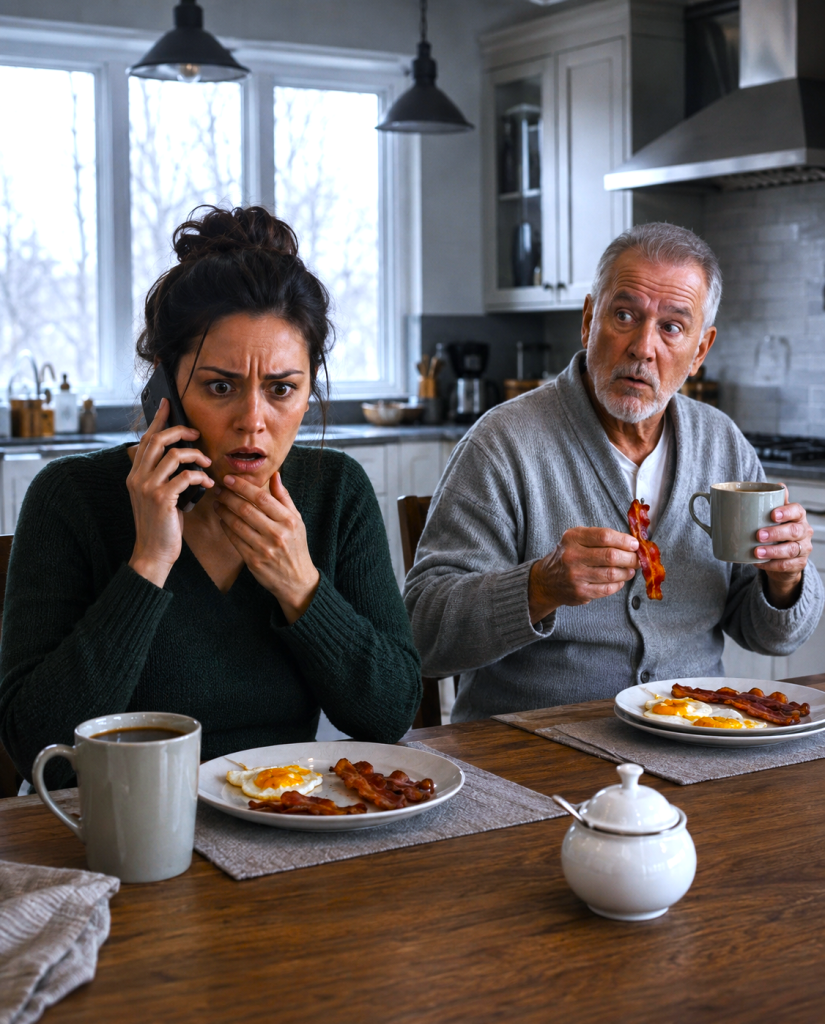
There was only one problem. Dad was sitting three feet away from me at my kitchen table, wearing a navy flannel robe, sipping fresh coffee, and stealing bacon from my plate like he had been doing every morning for the past two days.
I stared at the glowing name on my phone. Vanessa Cole. My older sister almost never called before noon. Vanessa treated mornings like some kind of personal attack, so seeing her name on my screen while the sky outside was still dark gray made my stomach tighten.
I assumed there had been an emergency.
I had no idea she was about to invent one.

Dad reached across the table, stole another strip of bacon, folded it neatly in half, and dipped one corner into the runny yolk on his plate.
His silver hair was still damp from the shower.
He looked completely alive.
Annoyingly alive, considering that bacon had been mine.
Then he noticed my expression.
“What?” he whispered.
I raised one finger.
“Vanessa?” I answered.
For two long seconds, nobody spoke.
I could hear the low hum of a car engine through the phone and the rhythmic clicking of a turn signal.
Click.
Click.
Click.
Then Vanessa spoke.
“Natalie, Dad died last night.”
My hand froze around my coffee mug.
Behind me, the coffeemaker released a final hiss of steam.
Dad stopped chewing.
Slowly, I turned my head toward him.
He stared back at me with his eyebrows raised.
I looked at him.
Then at the phone.
Then back at him again.
If the situation had not been so disturbing, I might have laughed.
Dad certainly looked surprised, but he did not look frightened.
After everything that had happened during the previous forty-eight hours, surprise was about the only emotion either of us had left.
Without saying anything, I pressed the speaker button and placed my phone beside the sugar bowl.
Dad leaned slightly forward.
“When?” I asked.
“Sometime during the night,” Vanessa replied. “Harold found him.”
Dad’s expression changed immediately.
Harold Pike had been his closest friend for more than forty years.
The two of them had gone fishing together, attended football games together, and helped each other through marriages, illnesses, and more bad decisions than either of them cared to admit.
More importantly, Harold had owned the town’s funeral home before retiring.
That detail made Vanessa’s story sound disturbingly believable.
Almost.
I kept my voice steady.
“What happened?”
Vanessa sighed.
She did not cry.
She did not sniffle.
She did not even pause.
She sighed as though I had asked her something inconvenient while she was trying to get to an appointment.
“Does it matter?” she said. “He’s gone.”
Across the table, Dad slowly lowered his fork.
His eyes hardened.
I knew that look.
Vanessa apparently did not.
She kept talking.
“Grant and I are handling everything. There’s really no reason for you to come to the house.”
Dad glanced at me.
Vanessa continued.
“The locks are being changed this morning.”
There was a brief silence.
Then I heard laughter in the background.
Grant.
My brother-in-law had one of those loud, breathy laughs that always sounded as if he had just tricked someone and could not believe he had gotten away with it.
Dad’s jaw tightened.
I folded my arms.
“Why are the locks being changed?”
Another sigh.
Vanessa sounded almost bored now.
“Because Grant and I found Dad’s papers.”
Dad stopped moving completely.
“He left the house to us,” Vanessa continued. “The truck too. The accounts. Everything else.”
I looked directly at Dad.
He looked directly at me.
Neither of us spoke.
Then Vanessa delivered the part she had clearly been waiting to say.
“You were specifically excluded.”
Grant laughed again.
This time louder.
There was unmistakable satisfaction in it.
He said something to Vanessa that I could not quite hear.
“What was that?” I asked.
There was some shuffling on their end.
Then Grant’s voice came much closer to the phone.
“I said you’re finally out of the family.”
Dad’s fingers tightened around his coffee mug.
Grant was not finished.
“No more showing up every few months and pretending you’re the devoted daughter.”
That sentence hit harder than I expected.
For years, Vanessa had loved telling people I was the daughter who ran away.
Apparently, moving three states away for work counted as abandoning everyone, even though I called Dad several times a week, paid for plane tickets whenever he needed me, and had spent the previous forty-eight hours dealing with something Vanessa knew absolutely nothing about.
I could have defended myself.
I did not.
Because there was something much more interesting happening across the table.
Dad slowly placed his coffee cup down.
The ceramic base touched the wooden tabletop so softly that Grant and Vanessa probably could not hear it.
But I could.
And that tiny sound worried me more than if Dad had shouted.
My father was not a man who exploded easily.
When he was angry, he became quiet.
Very quiet.
Vanessa kept talking, completely unaware.
“Look, Natalie, I’m calling because we’re trying to handle this like adults. Grant already has someone coming to evaluate the truck. We’ve contacted the bank, and we’re going through Dad’s office today.”
Dad’s eyebrows rose.
His office.
I almost smiled.
“And the house?” I asked.
“Obviously we’re keeping it,” she said.
Grant called from the background, “Might renovate the kitchen!”
They both laughed.
Dad did not.
His face had become eerily calm.
Vanessa continued, “There are probably some personal things of yours still in your old bedroom. I’ll box them up. Grant can leave them by the garage.”
“How thoughtful.”
Vanessa missed the sarcasm.
“I knew you’d understand.”
Dad looked at me and silently mouthed, “Understand?”
I bit the inside of my cheek to keep from laughing.
Grant apparently grabbed the phone again.
“And Natalie?”
“Yes, Grant?”
“Don’t make this difficult.”
I stared through the kitchen window at the thin layer of frost covering my backyard.
“Difficult?”
“Don’t start challenging the will or demanding things that aren’t yours. Vanessa is Dad’s eldest daughter. She stayed close to home. She deserves this.”
Dad slowly leaned back in his chair.
Grant continued.
“You made your choice years ago.”
Vanessa murmured something approvingly.
Then Grant added the sentence that finally changed Dad’s expression.
“Your father obviously knew who really loved him.”
The kitchen became completely silent.
Dad’s face went still.
Not hurt.
Not angry.
Something colder.
I had seen that expression only twice in my life.
Both times, somebody had deeply regretted what happened next.
I reached toward the phone.
For a second, I considered ending the call.
Dad stopped me.
He raised his hand.
Then he pointed at himself.
I hesitated.
He pointed again.
You want to talk?
Dad nodded.
On the speaker, Vanessa said impatiently, “Natalie? Are you still there?”
“Oh, I’m here.”
“Good. Then understand this clearly. Dad made his decision. Everything belongs to Grant and me now.”
Grant laughed.
“Finally.”
Dad stood.
He tightened the belt of his robe and walked around the table.
Vanessa continued talking about paperwork, funeral arrangements, property, accounts, and everything she believed she had inherited from a man currently standing beside me.
Then Dad bent toward the phone.
Grant was still laughing when Dad calmly said, “Good morning, Vanessa.”
The laughter stopped.
For several seconds, the only sound coming through the speaker was the clicking turn signal.
Click.
Click.
Click.
Then Vanessa whispered, “Dad?”
My father smiled without warmth.
“Yes. Apparently, I died last night.”
A sharp breath came through the phone.
Grant muttered something I could not understand.
Vanessa recovered first.
“Dad, I can explain.”
“I’m sure you can.”
“This isn’t what it sounds like.”
Dad looked at me.
“It sounds like my eldest daughter just announced my death, claimed my property, changed the locks on my house, and told my younger daughter she had been removed from the family.”
Vanessa’s voice became frantic.
“We thought you were missing.”
“You said Harold found my body.”
Silence.
Dad leaned closer to the phone.
“Would you like to try again?”
Grant spoke in the background.
“He’s confused. Don’t argue with him.”
Dad heard every word.
His eyes narrowed.
“Put Grant on the phone.”
“Dad, please—”
“Now.”
There was muffled movement, followed by Grant’s forced, cheerful voice.
“Walter. Thank goodness you’re safe.”
Dad almost laughed.
“Am I?”
“Of course. We were worried.”
“So worried that you hired a locksmith before sunrise?”
Grant cleared his throat.
“We found some documents. We misunderstood the situation.”
“What documents?”
Another silence.
Dad knew exactly what documents they had found.
Two days earlier, he had arrived at my home carrying one overnight bag and a metal lockbox.
I had opened the door expecting a cheerful visit.
Instead, Dad had stepped inside, locked the door behind him, and asked me to close the curtains.
He had looked exhausted.
Not physically tired.
Defeated.
He told me that money had begun disappearing from one of his accounts. At first, the withdrawals were small. Two hundred dollars. Three hundred. Then came a transfer of five thousand dollars to a company he had never heard of.
When he contacted the bank, an employee informed him that Grant had recently presented a financial power-of-attorney document bearing Dad’s signature.
The signature was convincing.
It was also fake.
Dad had confronted Vanessa privately.
She cried, denied everything, and blamed Grant.
The following morning, Dad discovered an appointment card on his desk for a medical evaluation he had never scheduled. The doctor specialized in determining whether elderly patients could manage their own financial affairs.
Grant and Vanessa were not waiting for Dad to die.
They were trying to take control while he was still alive.
So Dad called Harold.
Together, they created a test.
Harold drove Dad to my home without telling anyone. Before leaving, Dad placed a folder in his office safe. Inside was a fake will naming Vanessa and Grant as sole beneficiaries.
The safe combination had been changed months earlier.
Only Dad knew it.
At least, that was what Vanessa and Grant believed.
Dad had deliberately written the new combination on a slip of paper and hidden it in a desk drawer where Vanessa would easily find it.
He wanted to know how far they would go.
Now we had our answer.
Grant’s voice trembled through the phone.
“Walter, whatever Natalie told you—”
“Natalie didn’t tell me anything,” Dad replied. “I heard you myself.”
“I was upset.”
“You sounded delighted.”
“We were under tremendous stress.”
“You laughed while telling my daughter that I knew who really loved me.”
Grant had no response.
Dad straightened.
“The papers you found were fake.”
Vanessa gasped.
“What?”
“The will was fake. The account information was fake. Even the truck title was an expired copy.”
“You set us up?” she whispered.
“No, Vanessa. I gave you an opportunity to reveal your intentions.”
Her voice cracked.
“We’re your family.”
“So is Natalie.”
“She left us!”
I flinched.
Dad did not.
“Natalie moved because she received a job opportunity. She called me every Sunday. She visited whenever she could. When I had surgery six years ago, she used all her vacation time to take care of me.”
“I lived fifteen minutes away!”
“And you visited twice.”
“I had children!”
“Your children were teenagers.”
Vanessa began crying.
Real tears this time, although I could not tell whether they came from remorse or fear.
“Dad, please. Grant said we needed to protect the property. He said Natalie would take everything.”
Grant immediately protested.
“Don’t put this on me!”
Vanessa shouted back, “You said he was losing his mind!”
“You agreed!”
Their voices rose together, each accusing the other.
Dad listened for several seconds.
Then he said, “Stop.”
They stopped.
“The bank has copies of the forged documents,” he said. “The transfer to Grant’s company has been traced.”
Grant’s breathing became louder.
“That was a loan.”
“I never authorized it.”
“You told me I could ask if I needed help.”
“Ask,” Dad repeated. “Not steal.”
“It wasn’t stealing.”
“Then explain it to the police.”
The line went quiet.
Vanessa whispered, “Police?”
As if summoned by the word, a loud knock echoed through their side of the call.
Someone called out from beyond the car.
“Mr. and Mrs. Cole? Detective Warren. Please step out of the vehicle.”
Vanessa made a sound like a frightened child.
Dad closed his eyes briefly.
He had spent the night hoping Vanessa would fail the test.
He had wanted his suspicions to be wrong.
That was the part that hurt him most.
They had not merely taken the bait.
They had swallowed it whole.
“I didn’t want this,” Dad said softly.
“Then tell them to leave,” Vanessa pleaded. “Please, Dad. We can fix everything.”
“You announced my death before breakfast.”
“We panicked!”
“No. You celebrated.”
The car door opened on their end.
Wind rushed against the phone.
Detective Warren’s voice became clearer.
“Mrs. Cole, hand me the phone.”
Vanessa whispered, “Dad, don’t do this.”
Dad’s face tightened with pain.
“You already did.”
The call ended.
For a long moment, neither Dad nor I moved.
The kitchen clock ticked above the refrigerator.
His coffee sat untouched.
The bacon on his plate had gone cold.
Finally, he lowered himself into the chair across from me.
“You all right?” I asked.
“No.”
It was the most honest answer he could have given.
I reached across the table and covered his hand with mine.
Dad had always seemed unbreakable to me.
He was the man who repaired leaking roofs during thunderstorms, drove through blizzards to pick us up from school, and sat beside my hospital bed all night when I had appendicitis at twelve.
But that morning, he looked every one of his seventy-four years.
“I kept hoping she’d call Harold,” he said. “Or the hospital. Or the police. I thought she might get scared and check whether I was really gone.”
“She knew you weren’t dead.”
Dad looked at me.
The realization had been sitting between us since the call began.
Vanessa had not made a mistake.
She had lied deliberately.
“But why?” he asked.
I had no answer.
We learned the truth later that afternoon.
Detective Warren arrived at my house carrying a folder and a weary expression.
Vanessa and Grant had not been arrested yet, but they had been brought in for questioning.
The forged power of attorney was only part of the scheme.
Grant’s construction business was collapsing. He owed suppliers, employees, and the state nearly three hundred thousand dollars. Their home had a second mortgage. Their credit cards were full.
Vanessa had known about the debt for months.
Together, they planned to have Dad declared mentally incompetent. Once Vanessa gained control of his finances, they intended to sell his investments, mortgage his house, and use the money to save Grant’s company.
The false announcement of Dad’s death had been designed to keep me away.
They knew Dad was missing, but they also knew there had been no body.
Harold had never told them Dad had died.
They used his name because they believed it would make the lie sound convincing.
Their plan was to tell relatives that Dad had died suddenly and requested a private burial. They believed they could delay questions long enough to secure control of his accounts.
“What did they think would happen when I came home?” Dad asked.
Detective Warren sighed.
“Grant claims they planned to say Mrs. Cole misunderstood a message from Harold. According to him, it was only supposed to buy them one day.”
“One day to do what?”
“To access the accounts and remove documents from your home.”
Dad looked sick.
I asked the question he could not.
“Will they be charged?”
“The forged document and unauthorized transfer are serious. The district attorney will decide the final charges.”
Dad nodded slowly.
Detective Warren slid another paper across the table.
“We also recovered this from their vehicle.”
It was a handwritten list.
Dad’s truck.
Dad’s savings.
Dad’s pension.
Dad’s jewelry.
The antique clock that had belonged to my grandfather.
The house.
Beside each item, Grant had written an estimated value.
At the bottom was a calculation.
Total: $846,000.
Dad stared at the number.
His entire life reduced to a sum scribbled on a piece of paper.
Then he noticed one final note.
Renovate kitchen before resale.
Dad pushed the page away.
“They weren’t even planning to keep the house.”
“No,” Detective Warren said gently. “It appears they intended to sell it.”
That evening, Dad sat in my living room wrapped in the same navy robe.
He held an old photograph of Vanessa and me as children.
In the picture, Vanessa was nine and I was six. We were sitting on Dad’s shoulders at a county fair, laughing so hard our faces were blurred.
“She wasn’t always like this,” he said.
“No.”
“When did money become more important than people?”
I sat beside him.
“I don’t know.”
“Did I do something wrong?”
The question broke my heart.
“No, Dad.”
“Maybe I helped them too much. Every time Grant’s business struggled, I wrote a check. Every time Vanessa complained, I solved the problem. Maybe I taught them there would always be more.”
“You taught us that family helps each other. They chose to take advantage of it.”
Dad looked at the photograph for another moment.
Then he placed it facedown.
The following week, he returned home.
I went with him.
The locksmith had already changed the locks, but Detective Warren had recovered the new keys from Grant. Inside, the house looked as if a storm had passed through it.
Desk drawers hung open.
Boxes covered the floor.
Vanessa had removed framed photographs from the walls, including one of our mother.
Grant had placed colored stickers on furniture he intended to sell.
Dad walked from room to room without speaking.
In the kitchen, a contractor’s brochure rested on the counter.
Grant had circled marble countertops, new cabinets, and stainless-steel appliances.
Dad picked up the brochure and tore it in half.
Then he tore it again.
And again.
When he was finished, he dropped the pieces into the trash.
“I like my kitchen,” he said.
“So do I.”
“It needs new cabinet handles.”
“Maybe.”
“But it’s my kitchen.”
“Yes, it is.”
For the first time in days, he smiled.
Vanessa called repeatedly.
Dad did not answer.
She sent long messages blaming Grant, then sent new messages blaming me. She said I had manipulated Dad, stolen him from his family, and destroyed her children’s future.
Her children were twenty-one and nineteen.
Neither of them had known what their parents were doing.
Both contacted Dad separately to apologize.
Dad told them they had nothing to apologize for.
Grant’s business closed three months later.
He pleaded guilty to fraud and theft in exchange for a reduced sentence. Vanessa avoided prison but received probation, community service, and an order to repay the money taken from Dad’s account.
She and Grant sold their home to cover part of their debts.
Their marriage did not survive.
Dad never celebrated their suffering.
That surprised some people.
It did not surprise me.
Justice satisfied him.
Revenge did not.
Six months after that freezing Thursday morning, Dad invited Vanessa to meet him at a small diner outside town.
He asked me to come but sit at another table.
Vanessa arrived wearing no makeup, an old coat, and the expression of someone who had finally run out of explanations.
She looked smaller than I remembered.
Dad did not embrace her.
But he stood when she approached.
For nearly an hour, they talked quietly.
Vanessa cried.
Dad listened.
Then he spoke for a long time while she stared at her hands.
Later, in the parking lot, I asked what he had told her.
“The truth,” he said.
“What truth?”
“That I still love her.”
I looked toward the diner window, where Vanessa remained seated alone.
“And?”
“And loving someone doesn’t mean trusting them.”
Dad updated his will shortly afterward.
He left small educational trusts for each grandchild. Vanessa would receive no direct inheritance, but Dad agreed to pay for counseling if she chose to continue attending.
The house was not left to me.
Dad donated it to a local veterans’ organization, with instructions that it be sold and the proceeds used to provide temporary housing for elderly veterans.
He left me his truck, his fishing rods, and the antique clock.
Most importantly, he named me executor because, as he wrote in the document, “Natalie understands that love is measured by presence, not distance.”
Dad lived another nine years.
Every Thursday morning, no matter where I was, he called me at 6:30.
Sometimes he said nothing important.
He complained about the weather, asked whether I had eaten breakfast, or described whatever Harold had done to annoy him.
Once, he called simply to inform me that bacon tasted better when stolen from someone else’s plate.
Vanessa slowly rebuilt her relationship with him.
It was never what it had been.
Some things, once broken, do not return to their original shape.
But she showed up.
She drove him to appointments.
She brought groceries without asking for money.
She apologized to me, although it took her nearly four years.
I accepted the apology.
I did not forget the call.
Dad died peacefully at eighty-three, with both his daughters beside him.
This time, Vanessa did not call me.
She was holding his left hand while I held his right.
After the funeral, we returned to his house and sat together in the kitchen.
The cabinets still had the same old handles.
The countertops were still worn.
The coffeemaker still hissed exactly as it had that Thursday morning nine years earlier.
Vanessa stared at Dad’s empty chair.
“I really thought money would fix everything,” she said.
“Did it?”
She shook her head.
“It cost me everything that mattered.”
I poured two cups of coffee.
Then I placed a plate of bacon between us.
Vanessa laughed through her tears.
“Dad would have stolen all of it.”
“Only from my side of the plate.”
We sat quietly as winter light entered through the kitchen window.
For years, I had wondered what Dad felt during that phone call when he heard his own daughter declare him dead.
Near the end of his life, I finally asked him.
He thought for a long moment before answering.
“I felt grateful.”
I had stared at him.
“Grateful?”
“Yes,” he said. “Because lies eventually reveal the truth. Sometimes they reveal something ugly. But once you see it, you can stop pretending it isn’t there.”
Then he smiled.
“And because I was sitting in your kitchen, eating your bacon, when it happened.”
That was Dad.
Even after betrayal, he found something worth being thankful for.
On the final Thursday before we handed the house over to the veterans’ foundation, Vanessa and I met there at 6:30 in the morning.
We wore Dad’s old flannel robes, drank fresh coffee, and divided a plate of bacon evenly between us.
For a while, neither of us spoke.
Then Vanessa reached across the table and stole one strip from my plate.
I looked at her.
She froze.
“Sorry,” she said.
I started laughing.
After a moment, she laughed too.
It did not erase what had happened.
It did not restore the years we lost.
But it reminded me of something Dad had understood better than either of us.
A family does not survive because nobody ever hurts anyone.
A family survives when people tell the truth, accept the consequences, and choose to become better than the worst thing they have done.
Dad had been declared dead by a daughter who wanted his money.
But in the end, his greatest legacy was not his house, his truck, or the amount written in his bank accounts.
It was the lesson he left behind.
Love could forgive.
Justice could protect.
And trust, once destroyed, could only be rebuilt through years of honest actions.
I looked at Vanessa across the old kitchen table.
“More coffee?” I asked.
She nodded.
I filled her cup.
Outside, frost covered the yard just as it had on that strange Thursday morning years earlier.
But inside the house, the lights were warm.
And for the first time in a very long while, neither of us was pretending.
THE END. THANK YOU FOR READING.
THE END! THANKS FOR READING!