 Reading Time: 14 minutes
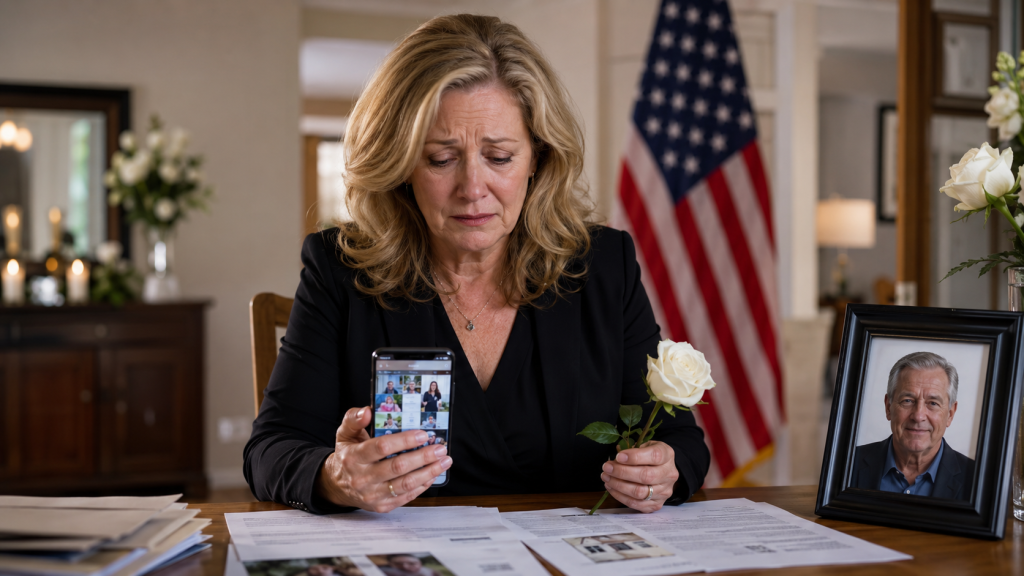
My husband, Richard, and I were married for twenty-seven years.He died in a car accident on a Tuesday afternoon.At four twelve, a state trooper knocked on my door and asked whether I was Margaret Lawson.
By four fifteen, I was sitting on the floor of my entryway while a stranger explained that Richard’s car had left a rain-slick highway outside Salem, struck a barrier, and rolled down an embankment.
He died before the ambulance arrived.
The trooper kept speaking, but I heard only fragments.
Weather.
Speed.
Investigation.
Personal belongings.
Richard had kissed me goodbye that morning and said.
he was driving to Portland for a meeting with a construction client.
He complained about the coffee, reminded me to call the plumber,
and promised he would be home by dinner.
The chicken I had prepared was still thawing in the refrigerator when
I learned I was a widow.
For the next six days, I moved through life like someone walking underwater.
Richard’s younger brother, Peter, arranged most of the funeral details.
Friends delivered casseroles. Neighbors filled our house with flowers.
Men from Richard’s financial-consulting firm stood in my living room telling stories about his generosity and intelligence.
Everyone kept describing the man I thought I knew.
Reliable.
Loyal.
Devoted.
A family man.
At the funeral, I sat in the front row beside Peter and stared at Richard’s closed casket. The funeral director had advised against viewing him because of the injuries from the crash.

I accepted that explanation.
I accepted almost everything people told me during those first days because grief left no room for suspicion.
The chapel was nearly empty when the woman arrived.
She was around forty, perhaps a few years younger than me. She wore a simple black dress beneath a gray coat, and her dark hair was pulled away from a pale, exhausted face.
I had never seen her before.
She did not sign the guest book.
She walked directly toward Richard’s casket, carrying a single white rose.
Something about the way she approached him made me stand.
She placed the flower beside his photograph and rested her fingertips on the polished wood.
“I’ll take care of them,” she whispered.
I reached her before she could turn away.
“Take care of who?”
The woman froze.
Up close, I could see that she had been crying for days.
“Who are you?” I demanded.
She pulled her arm from my hand.
“I’m sorry.”
“Sorry for what?”
People nearby had begun watching us. Peter hurried down the aisle, but the woman was already moving toward the exit.
“Wait!” I called. “What did you mean?”
She did not look back.
Peter placed a hand on my shoulder.
“You’re upset,” he said. “Let her go.”
“Do you know her?”
“No.”
He answered too quickly.
I looked at him.
“Peter.”
“She may have worked with Richard. He had hundreds of clients.”
“She said she would take care of them.”
“People say strange things at funerals.”
His expression was calm, but his fingers tightened around my shoulder.
I should have questioned him then.
Instead, another wave of mourners approached to offer condolences, and the woman with the white rose disappeared.
That night, I could not sleep.
The house felt wrong without Richard. His shoes remained beside the back door. His reading glasses were still on the nightstand. A half-finished crossword puzzle lay on the kitchen counter.
At two in the morning, I went into the garage looking for the small radio Richard used while repairing furniture.
I wanted noise.
Anything was better than the silence.
His toolbox stood beneath the workbench. Richard had always kept it locked, claiming expensive tools had disappeared from job sites when he was younger.
The key was attached to his car-key ring, which the police had returned after the accident.
Inside the top drawer, beneath several folded shop towels, I found a phone.
It was not Richard’s regular phone.
That one had been destroyed in the crash.
This device was older, protected by a six-digit code.
I tried our wedding anniversary.
The screen unlocked.
Fourteen years of my marriage opened in my hands.
There were thousands of messages between Richard and a woman named Vanessa Cole.
Photographs filled the gallery.
Richard holding a newborn baby.
Richard standing beside a Christmas tree with three children wearing matching pajamas.
Richard grilling hamburgers in a backyard I did not recognize.
Richard kissing Vanessa on a beach.
The dates went back fourteen years.
I sat on the cold garage floor and kept scrolling.
The oldest child was Emily, thirteen. Then came Caleb, nine. The youngest, Grace, was four years old.
The photograph from Grace’s birth was dated nine months after the anniversary trip Richard and I took to Hawaii.
I remembered that trip perfectly.
Richard had surprised me with oceanfront reservations. On the third evening, he claimed he needed to attend a video meeting with a difficult client. He left our room for two hours while I sat alone on the balcony watching the sunset.
According to the messages, Vanessa had been staying at a hotel three blocks away.
He had left our anniversary dinner to conceive a child with another woman.
I ran to the bathroom and became sick.
When I returned to the garage, the phone was still glowing on the floor.
I wanted to throw it against the wall.
Instead, I kept reading.
There were mortgage statements for a house in Portland purchased in 2016 for eight hundred ninety thousand dollars.
Vanessa’s name was on the deed.
Richard had written:
The house is yours no matter what happens to me.
Another message said:
Margaret cannot touch it. Everything is arranged.
I looked around our garage, at the cracked concrete floor and the shelves Richard had promised to repair for six years.
We had postponed replacing our roof because he said retirement required sacrifice.
I had stopped taking vacations.
I had driven the same twelve-year-old car.
Meanwhile, my husband had bought another woman an eight-hundred-ninety-thousand-dollar house.
I found Vanessa’s number and called from the hidden phone.
She answered on the first ring.
For several seconds, neither of us spoke.
Then she whispered, “Richard?”
“My name is Margaret Lawson.”
The silence changed.
It became heavier.
“Oh, God,” she said.
“You came to his funeral.”
“I shouldn’t have.”
“You said you would take care of them.”
She began crying.
“Please, Margaret.”
“Are those children Richard’s?”
“Yes.”
The answer should not have hurt after everything I had seen.
It did.
“All three?”
“Yes.”
“Did you know he was married?”
“At first, he told me you were separated.”
“And later?”
Vanessa took a shaking breath.
“He said you were terminally ill. He said you had a degenerative condition and that leaving you would kill you.”
I looked at my reflection in the dark kitchen window.
I was fifty-eight years old. I had high cholesterol and mild arthritis in one knee.
I was not dying.
“He told me he stayed because you had no one else,” Vanessa continued. “He said your marriage had been over for years.”
“You believed that for fourteen years?”
“Not every day.”
Her honesty surprised me.
“There were times I questioned him,” she said. “But then he would show me hospital parking receipts or photographs of medication bottles. He said you had good months and bad months. He always had an explanation.”
The medication bottles had probably belonged to his mother before she died.
“You had three children with my husband.”
“I know what it looks like.”
“It looks like exactly what it is.”
“I’m not asking you to forgive me.”
“Then what are you asking?”
Her voice lowered.
“I need you to understand something. Richard wasn’t driving alone when he died.”
I gripped the phone.
“What?”
“Emily was in the car.”
The room tilted.
“Is she alive?”
“Yes. She broke her arm and suffered a concussion. She was unconscious for two days.”
“Why didn’t anyone tell me?”
“She was transported to a different hospital. The police contacted me because I’m her mother. Richard’s brother told me you knew about us and wanted no involvement.”
“Peter?”
“Yes.”
I closed my eyes.
Peter had stood beside me at the funeral and pretended he did not recognize Vanessa.
“Why was Emily with Richard?”
“He picked her up from school. He said he was finally going to tell you everything.”
I almost laughed.
“Richard had fourteen years to tell me.”
“I know.”
“Where is Emily now?”
“At home. But she remembers something from before the crash.”
“What?”
Vanessa hesitated.
“She heard Richard arguing on the phone. He kept saying, ‘You were supposed to move it before Margaret’s review.’ Then he told someone, ‘If she sees the Portland transfer, we’re both finished.’”
I thought about our annual appointment with my financial adviser, scheduled for the following week.
Richard had managed most of our household investments, but the money originated from the sale of my parents’ printing company. My father had left the business to me, and after selling it, I placed the proceeds into long-term accounts intended to fund our retirement.
Richard always insisted he was protecting me from unnecessary stress by handling the details.
“Who was he speaking to?” I asked.
“Emily said he called the person Peter.”
I ended the call and sat at the kitchen table until sunrise.
Grief had made me feel hollow.
Betrayal filled every empty space.
At eight thirty, Peter arrived carrying coffee and a folder of estate documents.
He kissed my forehead as though he had not lied to me at his brother’s funeral.
“You look terrible,” he said.
“Vanessa called.”
The coffee tray slipped slightly in his hands.
“Who?”
“The woman you claimed not to know.”
He set the drinks down carefully.
“Margaret, you shouldn’t speak with strangers while you’re vulnerable.”
“She has three children with Richard.”
Peter closed his eyes.
“I wanted to tell you.”
“When?”
“After the funeral. After things settled.”
“Fourteen years wasn’t enough time?”
“This was Richard’s mess.”
“You helped him hide it.”
“No.”
“Emily heard him arguing with you before the crash.”
Peter’s face drained of color.
“She was injured. She may be confused.”
“She remembers Richard saying you were supposed to move money before my review.”
He stood slowly.
“You need to be careful.”
“Why does everyone keep telling me that?”
“Because you don’t understand the financial situation.”
“Then explain it.”
Peter looked toward the windows as though checking whether someone was outside.
“Richard made investments on your behalf. Some performed badly. He moved funds temporarily to protect the accounts.”
“Did he use my money to buy Vanessa’s house?”
“It was more complicated than that.”
“How complicated is eight hundred ninety thousand dollars?”
Peter removed his glasses.
“Richard believed the Portland property would increase in value. It was an investment.”
“With his mistress’s name on the deed?”
“He was protecting the children.”
“From me?”
Peter’s silence answered.
I picked up the estate folder and held it toward him.
“Leave.”
“Margaret, if you start making accusations, you could destroy Richard’s reputation and damage your own finances.”
“He destroyed his reputation when he stole from me.”
“You don’t know that.”
“I will.”
The expression on Peter’s face frightened me more than anger would have.
He looked desperate.
“I loved my brother,” he said. “I cleaned up his mistakes for years. Do not force me to choose between protecting him and protecting you.”
“You already chose.”
After he left, I called my own attorney, Diane Mercer.
Diane had handled the sale of my parents’ company and had repeatedly encouraged me to maintain independent oversight of the proceeds. I ignored her because Richard said distrust could destroy a marriage.
I told her everything.
By noon, she had arranged for a forensic accountant and sent notices freezing all estate-controlled accounts.
“Do not sign anything Peter gives you,” she warned. “Do not allow him into the house again. Preserve the phone exactly as you found it.”
“Can Vanessa keep the Portland house?”
“That depends on where the purchase money came from.”
“And if it came from me?”
“Then we pursue it.”
The forensic review took three weeks.
During that time, I met Vanessa.
We chose a quiet café halfway between my home and Portland. She arrived carrying a thick envelope and looking as though she had not slept since the funeral.
I expected to hate her instantly.
Part of me did.
But the woman sitting across from me was not the glamorous thief I had imagined. Her coat was worn at the cuffs. Her nails were unpainted. She looked frightened and ashamed.
“I brought everything I have,” she said.
The envelope contained copies of letters, property records, insurance documents, and photographs.
Richard had created an entire second identity without changing his name.
To me, he was a financial consultant who traveled often for clients.
To Vanessa and the children, he was a regional investment director who spent weekdays caring for his sick wife and weekends in Portland.
He attended school performances.
He coached Caleb’s youth baseball team.
He took Grace to preschool.
He had been a father in secret while telling me that parenthood was not meant for us.
That betrayal cut deepest.
Richard and I had tried to have children during the first ten years of our marriage. I endured fertility treatments and two miscarriages. When I suggested adoption, Richard refused.
“A child deserves two parents who are completely certain,” he told me.
I believed he was grieving with me.
In reality, Emily was born the following year.
“He told the children you were very ill,” Vanessa said. “Emily used to make cards for you.”
She slid a small bundle of folded paper across the table.
One card showed a purple house beneath a yellow sun.
Dear Margaret, I hope you feel better soon. Dad says you are brave.
I pressed my hand over my mouth.
“She was seven when she made that,” Vanessa said.
“He turned me into a dying woman so his children would forgive him for leaving them every week.”
“I know.”
“No, you don’t.”
Vanessa lowered her eyes.
“You’re right.”
I wanted her to defend herself so I could remain furious.
Instead, she said, “I should have searched for you. I should have contacted you years ago. I accepted his explanations because the truth would have forced me to admit what I had done.”
That was the first moment I believed she might be telling me everything.
“Why did you come to the funeral?”
“Emily asked me to.”
“Why?”
“She said someone from his other life should know that he loved them.”
The sentence wounded me in a way I could not explain.
“Did he?”
“Yes,” Vanessa said. “But he also lied to them. Those things can exist together.”
I met the children the following week.
Emily wore a cast on her left arm. She had Richard’s green eyes and the same habit of pressing her lips together before saying something difficult.
Caleb remained close to his mother.
Grace hid behind a chair until I offered her a cookie.
They were not evidence.
They were children.
Emily handed me Richard’s watch, recovered from the hospital.
“Mom said this belongs to you.”
I closed my fingers around it.
“Thank you.”
“Did Dad really tell you he was working when he visited us?”
“Yes.”
“He told us he was taking care of you.”
“I know.”
Her eyes filled with tears.
“Were you sick?”
“No, sweetheart.”
She looked down.
“Then he lied about everything.”
“Not everything.”
She looked at me.
“He loved you,” I said. “Whatever else he did, the way he looked at your photographs was real.”
I did not say it for Richard.
I said it because no thirteen-year-old should have to wonder whether her dead father ever loved her.
The forensic accountant completed his report a month after the funeral.
Richard had stolen far more than the price of the Portland house.
Over fourteen years, he transferred nearly two million dollars from accounts funded by my inheritance. He disguised the withdrawals as investment-management fees, property partnerships, tax reserves, and temporary loans.
Peter authorized several transfers through his accounting firm.
The Portland house had been purchased almost entirely with my money.
Richard also borrowed three hundred thousand dollars against our marital home without fully explaining the loan documents to me.
His secret family believed the Portland property was paid off.
It was not.
There was a large mortgage, unpaid taxes, and a private loan connected to Peter’s firm.
Richard had not created security for either family.
He had created two collapsing houses and placed one woman inside each.
Diane asked what I wanted to do.
Legally, we could seek full ownership of the Portland property through a constructive-trust claim. Vanessa’s name was on the deed, but the purchase had been funded by fraud.
“If we win,” Diane said, “Vanessa and the children could be required to leave.”
I thought of Grace hiding behind the chair.
I thought of Emily’s cast.
I thought of fourteen years of lies.
“I want my money back,” I said. “But I don’t want the children punished for having him as a father.”
The life-insurance policy offered a solution.
Richard had taken out a two-million-dollar policy years earlier. I was the only named beneficiary. He apparently intended to change it but never completed the paperwork correctly.
Vanessa had no legal claim.
The children might have had a difficult claim through the estate, but it could take years.
Peter called the evening after he learned the accounts were frozen.
“You’re ruining everything,” he said.
“I’m discovering what you ruined.”
“If you report this, I lose my firm.”
“You helped Richard steal from me.”
“I helped him support his children.”
“With my inheritance.”
“He was going to repay it.”
“From where?”
Peter had no answer.
Then he began crying.
It was the first time I had ever heard him cry.
“Richard was my brother.”
“And I was his wife.”
“He said you had more than enough.”
“That was not his decision.”
“He was desperate.”
“No, Peter. Desperate people ask for help. Richard built a second life and made me finance it without my knowledge.”
Peter’s voice hardened.
“If you turn these records over, his children will learn their father was a criminal.”
“They will learn that adults are responsible for their choices.”
I reported the fraud.
Peter’s accounting license was suspended during the investigation. He eventually pleaded guilty to conspiracy, falsifying financial records, and assisting unauthorized transfers.
He avoided prison because he cooperated, surrendered his profits, and testified about Richard’s actions, but he lost his firm, his professional license, and the reputation he had protected more carefully than his conscience.
The Portland house was sold.
By then, its value had risen substantially. After paying the mortgage, taxes, and legal expenses, there was enough money to return most of the stolen purchase funds to me.
Vanessa moved with the children into a modest rental near Emily’s school.
She did not ask me to save the house.
“I knew it wasn’t truly mine the moment you called,” she said.
I used the insurance proceeds to pay the loan on my home and restore the retirement accounts Richard had emptied.
Then I placed three hundred thousand dollars into separate education trusts for Emily, Caleb, and Grace.
Diane asked whether I was certain.
“The money is legally yours,” she reminded me.
“I know.”
“You owe them nothing.”
“I’m not doing it because I owe Richard.”
“Then why?”
“Because they already inherited enough damage from him.”
Vanessa cried when I told her.
“I can’t accept that.”
“The money does not belong to you. It belongs to them.”
“Why would you help us after what I did?”
“I’m not erasing what you did.”
She lowered her eyes.
“I know.”
“But those children did not deceive me. They did not steal from me. They did not choose how they were born.”
Vanessa signed documents giving independent trustees full control over the funds until each child reached adulthood.
There would be no luxury house.
No expensive cars.
No access for Vanessa.
Only tuition, medical care, and educational support.
It was the first honest arrangement Richard had ever created for them, and he had nothing to do with it.
Six months after the accident, the police released the final report.
Richard had been driving too fast in heavy rain.
Phone records showed he was arguing with Peter through the car’s hands-free system moments before losing control. Emily remembered him striking the steering wheel and shouting that I was about to discover everything.
There was no mysterious vehicle.
No sabotage.
No conspiracy surrounding his death.
Richard died the way he had lived during those final years—rushing between two worlds, panicking because the truth was catching him.
I expected the report to give me peace.
It did not.
Peace arrived slowly.
It came when I removed Richard’s clothes from our bedroom.
It came when I sold his luxury watch and donated the money to a women’s legal-aid organization.
It came when I replaced the leaking roof he insisted we could not afford.
It came when I took my first trip alone and realized loneliness was less painful than living beside someone who had made me lonely without my knowledge.
I attended therapy.
I stopped referring to my marriage as twenty-seven wasted years.
Not every memory had been false.
My love had been real.
My loyalty had been real.
The meals I cooked, the sacrifices I made, and the life I tried to build were real because they came from me.
Richard’s dishonesty did not erase my integrity.
A year after his death, Vanessa invited me to Emily’s high-school concert.
I nearly refused.
Then Emily sent me a message.
I know this is strange, but Dad said you loved music. I would like someone from his other life to hear me play.
I attended.
Vanessa sat at one end of the row. I sat at the other.
Emily played the cello.
When the performance ended, she found me in the lobby and handed me a white rose.
The same kind Vanessa had placed on Richard’s casket.
“I thought you might want this,” she said.
“Why?”
“Because Mom says white roses can mean a new beginning.”
I looked at Vanessa.
She gave a small, uncertain nod.
I accepted the flower.
Over time, our relationship became something without a simple name.
Vanessa and I were not friends.
There were wounds between us that kindness could not erase.
But we were no longer enemies.
We attended the children’s important events without pretending the past had not happened. She apologized more than once. I never told her the apologies made everything right.
Sometimes healing does not require everything to become right.
It requires the lying to stop.
On the second anniversary of Richard’s death, I visited his grave alone.
His headstone listed his name, his birth date, and the date of the accident.
It did not say husband.
It did not say father.
Stone is too small for complicated truths.
I placed the white rose beneath his name.
“I loved you,” I said. “That was your privilege, not my shame.”
The wind moved through the cemetery trees.
For years, I had imagined that discovering the full truth would destroy me.
It did not.
The truth destroyed the marriage I thought I had, but that marriage had already been destroyed by the person who lied inside it.
The truth gave me my life back.
Richard had believed he could divide love, money, time, and identity into separate rooms and keep every door locked forever.
He underestimated the power of one grieving woman opening a toolbox.
He underestimated the records he left behind.
Most of all, he underestimated me.
I did not protect his reputation.
I did not punish his children.
I did not allow his brother to call theft an act of compassion.
I recovered what was mine, protected those who were innocent, and walked away from the wreckage without carrying his guilt.
The woman with the white rose had whispered that she would take care of them.
In the end, we both did.
But I also learned to take care of someone Richard had neglected for far too long.
Myself.
THE END! THANK YOU FOR READING!