 Reading Time: 20 minutes
“Melinda, it’s not too late to cancel. Don’t embarrass us like this.” Then she hung up. No goodnight. No apology. No hesitation in her voice. I sat alone on my living room couch in a wrinkled gray T-shirt, staring at my wedding veil draped over the back of a dining chair.
My ivory shoes waited beside the front door. The marriage license was tucked inside a canvas tote bag with tissues, lipstick, breath mints, safety pins, and the small silver compact my grandmother had once carried on her own wedding day.
The apartment was quiet except for the rain tapping against the windows.
Sixty-eight invitations had gone to my side of the family.
Not one person had accepted.
My parents refused to attend “in good conscience.”
My younger brother, Trevor, followed them.
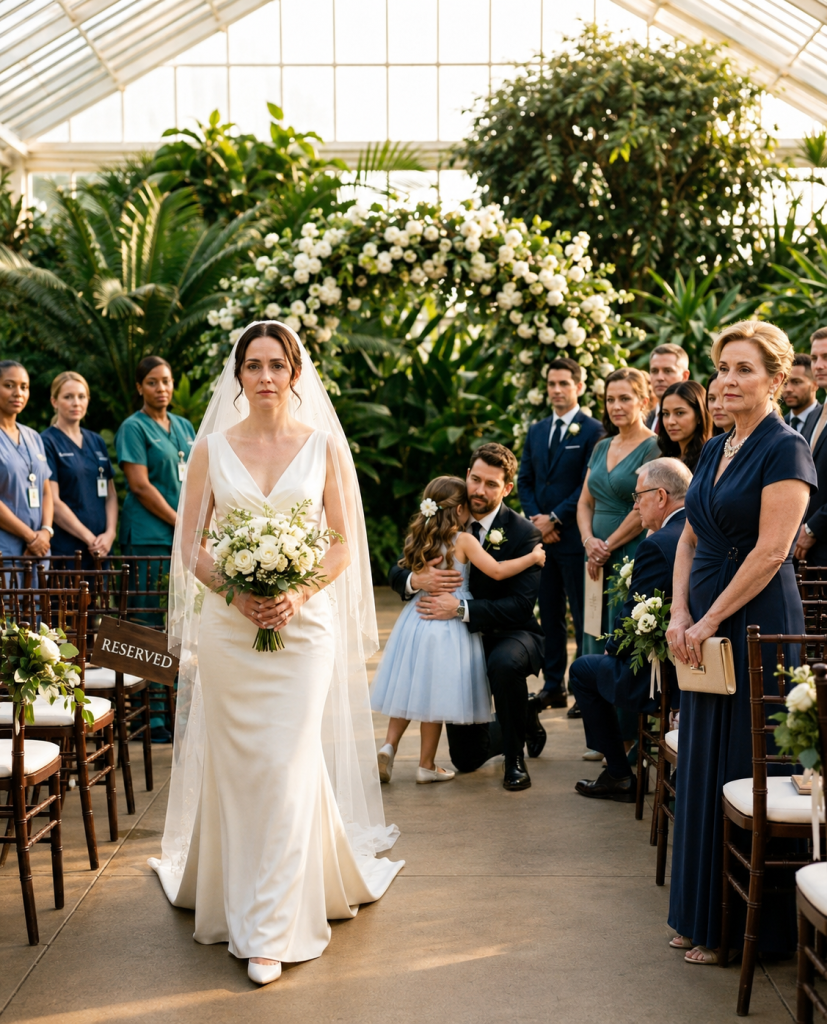
Then my aunts, uncles, cousins, and nearly every family friend quietly removed themselves from the guest list.
Some called with excuses.
One cousin suddenly had an unavoidable work conference.
An aunt claimed she had already booked a trip she had never mentioned before.
Several people did not bother responding at all.
Two weeks before the ceremony, I sat in my car outside a pharmacy and canceled sixty-eight meals while crying so hard I could barely read the catering contract.
The coordinator had spoken gently.
“Are you sure you want to remove all of them?”
I had looked at the neat list of names on my phone.
Names from Christmas dinners, graduation parties, childhood birthdays, and family vacations.
Names of people who had watched me grow up.
“Yes,” I whispered. “They’re not coming.”
The reason was Nathan.
More precisely, the reason was Nathan’s job.
Nathan Cole worked as a security officer at Mercy General Hospital.
He wore a dark navy uniform, carried a radio, checked locked doors, escorted disruptive visitors from the emergency room, helped elderly patients find their cars, and spent long night shifts walking hallways most people never noticed.
My mother believed that made him beneath us.
My father, Charles Whitmore, served on the board of a private hospital foundation across the city. He had spent decades building relationships with executives, donors, surgeons, and politicians.
My mother treated our family name like an heirloom that had to be polished and protected.
Nathan, in her opinion, was a stain on it.
The first time I introduced him to my parents, he wore a blue button-down shirt and brought my mother white roses.
She left the flowers on the kitchen counter without putting them in water.
During dinner, she asked Nathan what he did at Mercy General.
“I’m part of the security team,” he replied.
My mother blinked.
“You mean you’re a guard?”
Nathan smiled politely.
“Yes, ma’am.”
My father placed his fork down.
“Is that permanent?”
Nathan’s expression did not change.
“I’ve been there for six years.”
My mother looked at me as though I had announced I was moving into a bus station.
After Nathan left that evening, she closed the front door and turned toward me.
“You cannot be serious.”
“I am serious.”
“Melinda, you have a master’s degree.”
“So?”
“So you work in corporate communications. You attend foundation dinners. You know doctors, attorneys, executives.”
“And I love Nathan.”
My mother folded her arms.
“Love is not a retirement plan.”
“He has a pension.”
“That is not what I meant.”
I knew exactly what she meant.
Nathan did not have an impressive title.
He did not come from money.
His father had repaired elevators. His mother had worked in a school cafeteria. Nathan had joined the Army after high school, served four years, and later taken the job at Mercy General because he liked helping people and valued steady work.
My mother saw none of that.
She saw a uniform without medals, a modest apartment, and a man who did not know which fork to use at a charity banquet.
Nathan saw my mother’s contempt clearly.
He never complained about it.
When I apologized after that first dinner, he only said, “You don’t have to apologize for another adult’s behavior.”
That was Nathan.
He never demanded that I choose between him and my family.
My family made that choice for me.
Three months before the wedding, my parents invited us to dinner.
They had prepared a proposal.
If I ended the engagement, my father would pay the remaining balance on my graduate-school loans and give me the down payment for a condominium.
My mother presented it as though she were rescuing me from a bad investment.
Nathan listened quietly.
Then he looked at me.
“We should go.”
My father leaned back in his chair.
“A reasonable man would understand that we’re protecting our daughter.”
Nathan stood.
“A reasonable man would never ask his daughter to trade her dignity for money.”
My mother’s face hardened.
“You are exactly the kind of man I feared she would choose.”
Nathan helped me into my coat.
Before we left, I turned toward my parents.
“If you cannot respect him, don’t come to the wedding.”
My mother stared at me.
“Careful, Melinda. People may take you seriously.”
“They should.”
By the end of the week, she had called half the family.
According to my aunt Elaine, my mother described Nathan as unstable, unambitious, and socially inappropriate.
She claimed I was rushing into marriage because I was lonely.
She told relatives that attending the ceremony would encourage me to ruin my future.
My father said nothing publicly, but his silence gave her campaign authority.
Soon, relatives who had already mailed back acceptance cards began withdrawing.
My cousin Julia called me crying.
“Aunt Patricia says the family has to stand together.”
“Against what?”
“She says this marriage is a mistake.”
“Do you believe that?”
Julia was silent for several seconds.
“I don’t want trouble.”
She did not come.
Neither did anyone else.
The front door opened four minutes after my mother’s voicemail ended.
Nathan stepped inside wearing his dark hospital jacket, damp from the rain.
Exhaustion sat heavily beneath his eyes.
He had worked a twelve-hour shift because another officer’s son was sick.
“You’re still awake,” he said.
I held up my phone.
“My mother called.”
Nathan removed his jacket and hung it beside the door.
“What did she say?”
I played the message.
He listened once.
His jaw tightened slightly, but he did not insult her.
He sat beside me and looked at the veil across the room.
“We can call it,” he said.
I turned toward him.
“What?”
“City Hall on Monday. Just us. We don’t need the venue or the empty chairs.”
Part of me wanted to agree.
I imagined walking into the ceremony and seeing rows of vacant seats where my family should have been.
I imagined the whispers.
The pity.
The photographs that would show Nathan surrounded by people who loved him while I stood alone.
For one weak moment, hiding seemed easier.
Then I remembered my mother’s voice.
Don’t embarrass us like this.
I wiped my face with the sleeve of my T-shirt.
“No.”
Nathan waited.
“I want the wedding,” I said. “I want the flowers, the music, and the vows. I want the empty chairs too.”
“Are you sure?”
“Yes. I want them to know what they chose.”
Nathan reached for my hand.
“Then we do it your way.”
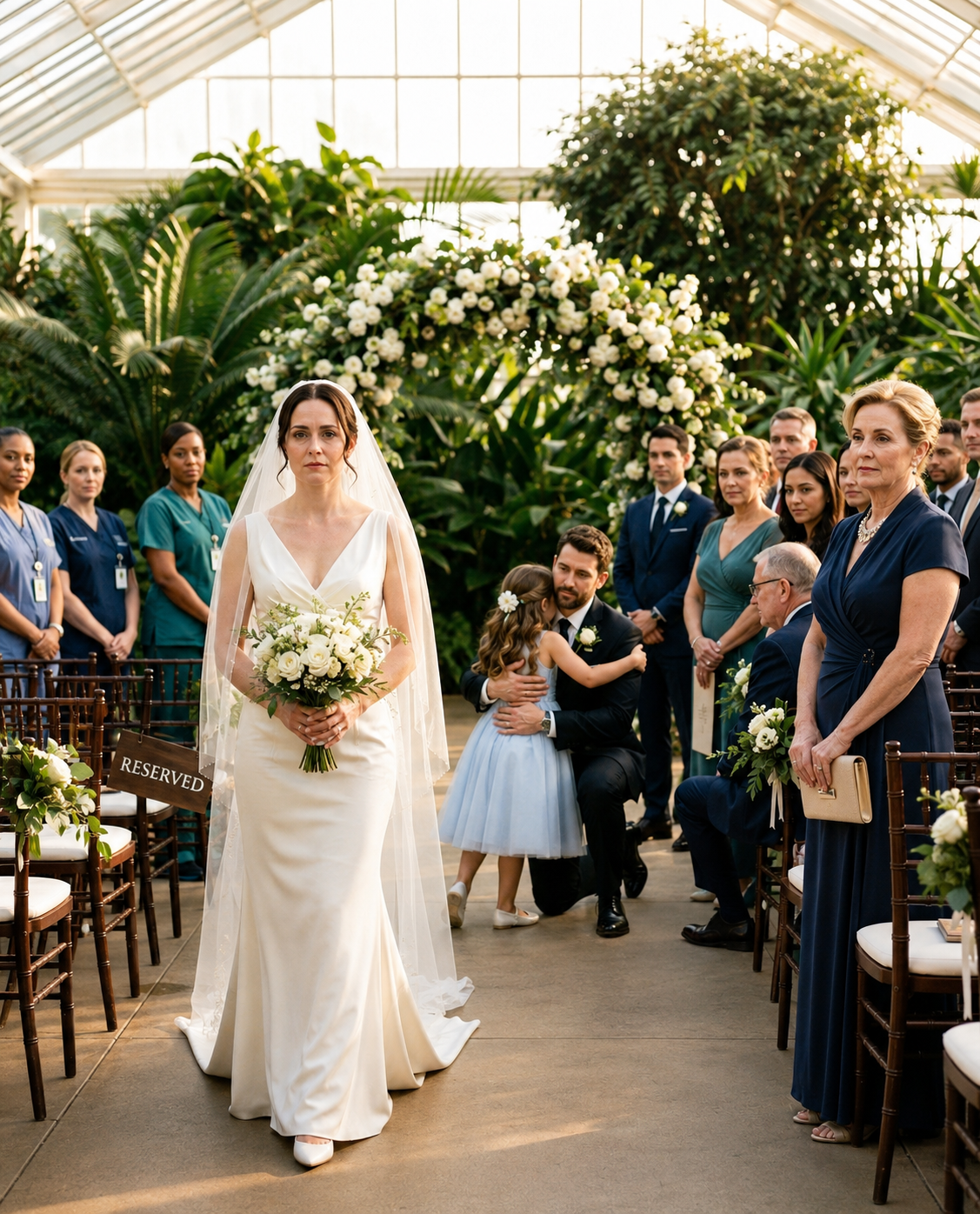
The next afternoon, I dressed alone in the bridal suite at the Horticulture Center.
Sunlight poured through the tall windows, making the glass ceiling above the conservatory glow.
Outside, the rain had stopped. Water clung to the leaves in the garden, and the late-spring air smelled of roses and damp earth.
My dress hung from an iron hook near the mirror.
It was simple and elegant, with a fitted bodice, long lace sleeves, and a soft skirt that moved like water.
My mother had once insisted that we shop for gowns together.
She had imagined champagne, photographs, and a bridal consultant who would recognize our family name.
Instead, I had chosen the dress with Nathan’s older sister, Joanne, who cried when I stepped out of the fitting room.
Joanne had offered to join me in the bridal suite that morning, but she was managing Nathan’s nervous nieces, so I told her I would be fine.
I was not fine.
Rachel, the wedding coordinator, helped fasten the buttons along my back.
She talked continuously about the flowers, the photographer, and the timing of the reception, pretending not to notice that my hands were trembling.
When she placed my veil into my hair, I stared at myself in the mirror.
I looked like a bride.
I did not feel like one.
A bride was supposed to be surrounded by women she loved.
Someone should have been fixing my necklace.
Someone should have been taking pictures.
My brother should have knocked on the door and announced that the ceremony was about to begin.
Instead, Rachel quietly stepped into the hallway and removed three rows of unused reserved signs from my side of the aisle.
I saw her through the glass.
She folded each sign carefully and handed them to an assistant.
When she returned, she smiled.
“Everything is ready.”
“Thank you.”
She hesitated.
“Your guests are beginning to arrive.”
Nathan’s guests had come.
Dozens of them.
Nurses in bright dresses.
Maintenance workers in suits.
Paramedics.
Receptionists.
Lab technicians.
Two police officers Nathan often worked with during emergency calls.
A hospital custodian named Mr. Harris wore his best blue suit and a red tie that was slightly too short.
An elderly man entered with an oxygen tank while his wife steadied his arm.
A woman named Dana arrived with her eight-year-old daughter, Lily.
I had never met either of them.
Lily wore a pale yellow dress and a flower crown that kept sliding over one eye.
Nathan’s supervisor greeted people near the entrance.
Members of his Army unit from years before stood together near the back.
Even the coffee shop manager from Mercy General had closed early so three employees could attend.
My side remained almost completely empty.
Rachel returned a few minutes later.
“It’s time.”
My heart began beating so hard that the room seemed to pulse with it.
She opened the bridal-suite doors.
Music drifted through the conservatory.
I could see the aisle beyond the hallway.
White flowers framed the altar.
Sunlight reflected off the glass ceiling.
Every chair on Nathan’s side was occupied.
Mine looked like a waiting room after closing time.
Rachel touched my arm gently.
“Who’s walking you down?”
I looked through the open doors at the empty rows.
My father should have been standing beside me.
For years, I had imagined his hand beneath mine.
I had pictured him trying not to cry.
Instead, he was probably at home pretending the ceremony was not happening.
“I am,” I said.
Rachel’s eyes softened.
“All right.”
The room grew quiet when I entered.
I heard the music, but it seemed far away.
My shoes clicked softly against the floor.
People turned toward me.
I could feel them noticing the vacant chairs.
I could feel their confusion and their pity.
For the first few steps, my legs barely worked.
Then I looked toward the altar.
Nathan stood beneath an arch of white roses and greenery.
He wore a plain black suit, a white shirt, and the silver watch his father had given him before he died.
He watched me as though there were no empty chairs.
As though there were no disappointed parents.
As though I were the only person in the entire building.
My shoulders straightened.
I continued walking.
Halfway down the aisle, Lily stepped out from the front row.
Her flower crown had slipped over her left eye.
Dana reached for her, but Lily moved toward Nathan instead.
A few guests laughed softly.
Nathan crouched.
He gently straightened the flower crown and whispered something to her.
Lily smiled.
Then she wrapped both arms around his neck.
The gesture was sudden and fierce.
Nathan closed his eyes for a second and hugged her back.
Dana lifted her phone.
She filmed for ten seconds.
I did not think anything of it.
Nathan returned to the altar and took my hands.
“You came,” he whispered.
“I told you I would.”
“You look beautiful.”
“You look terrified.”
“I am.”
That made me laugh.
The minister began.
Our vows were not elaborate.
Nathan promised to be honest, patient, and present.
He promised to stand beside me during ordinary days, not only dramatic ones.
I promised to choose him publicly and privately.
I promised never to measure his worth by someone else’s standards.
When the minister pronounced us husband and wife, the room erupted in applause.
The sound filled the conservatory so completely that, for a moment, the empty side of the aisle disappeared.
After the ceremony, Nathan and I took photographs beneath the glass ceiling.
The photographer positioned us near a wall of flowering vines.
I had just rested my head against Nathan’s shoulder when my phone began vibrating inside Rachel’s hand.
Once.
Then again.
Then without stopping.
Rachel glanced at the screen.
“You have nineteen missed calls.”
The phone vibrated again.
“Now twenty-three.”
I took it from her.
My mother.
My father.
Trevor.
Aunt Elaine.
Aunt Susan.
Cousin Julia.
People who had ignored every message I sent for a month were suddenly desperate to reach me.
Nathan looked over my shoulder.
“You don’t have to answer.”
A notification appeared from Dana.
She had posted the short clip of Lily hugging Nathan at the altar.
At first, I saw only the image.
Nathan kneeling in his wedding suit.
Lily’s arms wrapped around his neck.
Dozens of Mercy General employees standing behind them.
Then I read Dana’s caption.
“Her groom is Nathan Cole, the Mercy General security officer who carried my daughter out of a smoke-filled pediatric wing. Her entire family stayed home because they thought his job was embarrassing.”
The post had already been shared hundreds of times.
Comments appeared faster than I could read them.
A nurse named Rebecca had written, “He unlocked the evacuation doors when the electrical system failed.”
A paramedic added, “Eleven people got out because he stayed inside.”
Someone else wrote, “Nathan gave his oxygen mask to a child and went back for two nurses.”
I looked at my husband.
“What are they talking about?”
Nathan’s expression changed.
“It was an electrical fire.”
“When?”
“Three months ago.”
“You told me there was a small incident at work.”
“There was.”
“You carried people out?”
He looked uncomfortable.
“Security helped evacuate the wing.”
“That is not what they’re saying.”
Nathan glanced toward Dana.
She lowered her phone.
“I’m sorry,” she said. “I thought you knew.”
Lily stood beside her holding a small bouquet.
Dana’s eyes filled with tears.
“The smoke alarms malfunctioned on the west side,” she explained. “The electronic locks froze. Nathan broke open the emergency access panel and manually released the doors.”
I looked at him.
He said nothing.
Dana continued.
“My daughter was recovering from surgery. I had stepped into the hallway when the smoke started. Staff were moving patients, but Lily was still inside her room.”
Her voice shook.
“Nathan went back for her.”
Lily looked up at him.
“He carried me.”
Dana nodded.
“He covered her with his jacket and carried her through the smoke. Then he returned to the wing.”
“How many times?” I asked.
Nathan looked toward the floor.
Dana answered.
“Four.”
The reception room had begun filling behind us, but people stopped to listen.
A nurse stepped closer.
“He helped clear eleven patients and three staff members.”
Another employee added, “He was treated for smoke inhalation and refused to stay overnight because he said the emergency department needed the bed.”
My chest tightened.
“You never told me.”
Nathan met my eyes.
“You were dealing with the wedding and your family.”
“That is not an answer.”
“I didn’t do it for attention.”
Dana’s phone chimed again.
“The video has been shared six thousand times.”
My screen lit up with another call from my mother.
Thirty-two missed calls.
One new voicemail.
I pressed play.
My mother’s voice was no longer cold.
It was terrified.
“Melinda, call me before your father’s hospital foundation board sees that video. And whatever you do, do not let anyone from Mercy General speak at the reception.”
The message ended.
For several seconds, no one spoke.
Then Nathan gave a quiet, humorless laugh.
“She’s worried about the foundation.”
I looked at the empty rows beyond the conservatory doors.
My mother was not calling because she regretted hurting me.
She was calling because the truth had become public.
Before I could respond, the ballroom doors opened.
A tall man with silver hair entered wearing a dark suit.
Several hospital employees immediately straightened.
I recognized him from local news reports.
Dr. Malcolm Hayes, the chief executive of Mercy General Hospital.
He carried a sealed envelope.
Two board members walked behind him.
Dr. Hayes crossed the room and stopped in front of Nathan.
“I hope we are not interrupting.”
Nathan looked genuinely stunned.
“Sir?”
“We came as soon as we saw the video.”
Dr. Hayes turned toward me.
“Mrs. Cole, congratulations.”
“Thank you.”
He held out the envelope.
“This was supposed to be presented privately next week, but circumstances have changed.”
Nathan accepted it reluctantly.
“What is it?”
Dr. Hayes motioned toward the small stage at the front of the reception room.
“With your permission, I would prefer to explain it to everyone.”
Nathan looked at me.
I thought of my mother’s warning.
Do not let anyone from Mercy General speak.
I smiled.
“Please do.”
Guests gathered around the dance floor.
Dr. Hayes stepped onto the stage and took the microphone.
“Good afternoon,” he began. “I apologize for arriving without an invitation. My name is Malcolm Hayes, and I serve as the chief executive of Mercy General Hospital.”
The room became completely silent.
“Three months ago, an electrical fire broke out in our pediatric west wing. A system failure disabled several smoke alarms and locked multiple security doors.”
His voice tightened.
“While nurses and physicians began evacuating patients, Security Officer Nathan Cole entered a smoke-filled corridor and manually released the doors.”
People turned toward Nathan.
He stood beside me, visibly uncomfortable.
“He carried a child to safety,” Dr. Hayes continued. “Then he returned for another patient. And another. He assisted staff members, guided first responders through the building, and refused to leave until he knew the wing was clear.”
Dana wrapped an arm around Lily.
“Eleven patients escaped that section of the building,” Dr. Hayes said. “Every one of them survived.”
Applause began somewhere near the back.
It spread through the room until everyone was standing.
Nathan lowered his head.
Dr. Hayes waited for the applause to settle.
“Nathan never requested recognition. In fact, he repeatedly asked us not to release his name because he believed the medical staff deserved the credit.”
A nurse near the stage shook her head.
“He deserves it too.”
Dr. Hayes smiled.
“Our board agrees.”
He looked at the envelope in Nathan’s hand.
“Mercy General has unanimously voted to award Nathan Cole the Medal of Courage, the highest honor our hospital has ever presented to a non-medical employee.”
The room erupted again.
I covered my mouth.
Nathan looked at me, overwhelmed.
Dr. Hayes raised his hand for silence.
“There is something else.”
A board member stepped forward and handed him another document.
“For several years, Mercy General has been developing a new emergency-preparedness department. After reviewing Nathan’s actions, his military record, and his work history, we have offered him the position of Director of Hospital Safety and Emergency Response.”
Nathan stared at him.
“Director?”
“Provided you accept.”
A maintenance worker shouted, “You’d better accept!”
Laughter moved through the room.
Nathan glanced at me.
I squeezed his hand.
Dr. Hayes stepped down from the stage and spoke more quietly.
“The title is not a reward for one heroic act. It is recognition of the leadership you have demonstrated every day.”
Nathan looked around at his coworkers.
Nurses.
Custodians.
Receptionists.
Security officers.
People who had filled the chairs my family left empty.
“I’ll accept,” he said.
The applause was deafening.
My phone continued vibrating.
I turned it off.
For the next forty minutes, the reception became everything I had feared it would not be.
Warm.
Joyful.
Full.
Mr. Harris danced with Lily.
Joanne gave a speech about Nathan trying to rescue an injured bird when he was nine.
A paramedic told a story about Nathan staying four hours after his shift to help locate the family of a confused elderly patient.
No one mentioned money.
No one mentioned status.
They spoke about kindness.
Courage.
Reliability.
Character.
Then Rachel approached me near the cake table.
“There are three people outside asking to come in.”
My stomach tightened.
“Who?”
“Your parents and your brother.”
Nathan had heard her.
He did not tell me what to do.
He only asked, “Do you want them here?”
I looked through the glass doors.
My father stood in the hallway wearing the suit he should have worn to walk me down the aisle.
My mother stood beside him in a pale blue dress.
She had dressed for the wedding after all.
Perhaps she had always planned to sit at home wearing it.
Trevor stood behind them, hands in his pockets.
They looked frightened.
Not heartbroken.
Frightened.
I walked into the hallway.
Nathan followed several steps behind me.
My mother rushed forward.
“Melinda, thank God.”
I raised one hand.
“Stop.”
She froze.
My father looked past me toward the crowded reception.
“We need to talk privately.”
“You had months to talk.”
“This situation has become public,” he said.
“That is not my fault.”
Trevor looked ashamed.
“I didn’t know what Nathan did.”
“You did not need to know,” I replied. “You should have come because I’m your sister.”
He lowered his eyes.
My mother reached for my arm.
I stepped back.
“We made a mistake,” she said quickly. “Your father’s board members are calling. The video makes it appear that we rejected a hero.”
“You rejected a hospital security guard.”
She swallowed.
“That was before we understood the circumstances.”
I stared at her.
“So if he had never entered that burning wing, you would still believe he was beneath us?”
My mother opened her mouth.
No answer came.
My father’s voice hardened.
“This is not the time for emotional accusations.”
Nathan moved closer.
I touched his hand, silently asking him to let me speak.
“No, Dad,” I said. “This is exactly the time.”
Guests had begun noticing us through the glass doors.
I did not lower my voice.
“You sent me an offer to pay my debts if I ended my engagement. Mom called sixty-seven relatives and convinced them to boycott my wedding. Trevor ignored me. You all left my side of the aisle empty because Nathan’s job embarrassed you.”
My father looked around nervously.
“We were concerned about your future.”
“My future is inside that room.”
My mother’s face crumpled.
“We are your family.”
“Family does not disappear to teach a bride a lesson.”
“We came now.”
“You came because the video embarrassed you.”
My father’s jaw tightened.
“The foundation has relationships with Mercy General. This could damage years of work.”
There it was.
The truth.
Not grief.
Not regret.
Reputation.
I looked at my mother.
Her eyes filled with tears, but I no longer trusted them.
“What did you think would happen?” I asked. “Did you imagine I would walk down the aisle, see those empty chairs, and run back to you?”
She said nothing.
“You wanted me humiliated.”
“I wanted you to understand what you were losing.”
“I understand now.”
My mother’s face went pale.
“What does that mean?”
“It means I know exactly what I lost.”
Behind us, the ballroom doors opened.
Dr. Hayes stepped into the hallway.
My father straightened immediately.
“Malcolm.”
Dr. Hayes did not shake his hand.
“Charles.”
My mother’s expression changed.
“Dr. Hayes, there has been a misunderstanding.”
“I watched the video,” he replied. “Then I read several comments describing why the bride’s family did not attend.”
My father attempted a careful smile.
“Social media rarely presents the full context.”
Dr. Hayes looked toward the empty side of the ceremony room.
“The empty chairs provide considerable context.”
My father’s face reddened.
“This is a private family matter.”
“It became a hospital matter when you repeatedly referred to one of our employees as an embarrassment.”
My mother looked at me.
“You told him?”
“I didn’t have to.”
Dr. Hayes folded his hands.
“Mercy General’s board is meeting Monday. Your foundation’s proposed partnership is on the agenda.”
My father stiffened.
“Are you threatening to withdraw?”
“I am informing you that character matters in our partnerships.”
For the first time in my life, my father looked powerless.
My mother turned toward Nathan.
“We owe you an apology.”
Nathan regarded her calmly.
“Yes, you do.”
She blinked, surprised that he had not immediately excused her.
“I judged you unfairly,” she said. “What you did at the hospital was extraordinary.”
Nathan’s expression remained steady.
“My value did not change when you learned about the fire.”
My mother looked away.
Nathan continued.
“I was the same man yesterday when you left that voicemail.”
Her cheeks flushed.
“I was upset.”
“You told your daughter she was an embarrassment on the night before her wedding.”
“I thought I was protecting her.”
“From what? A man who works for a living?”
My father stepped forward.
“That is enough.”
Nathan looked directly at him.
“No, sir. It isn’t.”
The hallway became silent.
“Respect is not earned by titles,” Nathan said. “It is earned by how you treat people when nobody is watching. You had every opportunity to treat your daughter with respect. You chose not to.”
My father lowered his eyes.
He had no argument.
My mother began crying.
This time, I believed some of the tears.
But regret did not erase what she had done.
“I want to come inside,” she whispered. “Please. I want to see your reception.”
I looked through the doors.
Joanne was holding my bouquet.
Lily was laughing beside the cake.
Mr. Harris was teaching a nurse how to dance.
Every person inside had shown up without needing proof that Nathan was worthy.
I turned back to my mother.
“No.”
Her face collapsed.
“Melinda—”
“You do not get to enter now that the room is important enough for you.”
“I’m your mother.”
“And today I needed a mother.”
She covered her mouth.
My father looked toward the floor.
Trevor stepped closer.
“I’m sorry,” he said. “I should have called.”
“Yes.”
“I was afraid Mom would cut me off.”
“You are thirty-one years old.”
“I know.”
His eyes filled with shame.
“I was weak.”
That answer, at least, was honest.
“I’m not ready to forgive you,” I said.
He nodded.
“I understand.”
My mother did not understand.
She continued pleading until my father gently took her arm.
“Patricia,” he said. “We should go.”
She stared at me as though she expected me to stop them.
I did not.
My parents walked toward the exit.
Trevor followed, then paused.
“Your dress is beautiful,” he said.
“Thank you.”
He left.
Dr. Hayes returned to the reception.
Nathan and I remained in the hallway.
For several seconds, neither of us spoke.
Then my hands began shaking.
Nathan pulled me into his arms.
“I’m sorry,” he whispered.
“For what?”
“That they did this to you.”
I pressed my face against his shoulder.
“I kept thinking the empty chairs would be the worst part.”
“And now?”
“Now I think they were honest.”
Nathan leaned back.
“What do you mean?”
“They showed me who wasn’t there.”
I looked through the glass doors at the crowded room.
“And everyone inside showed me who was.”
Nathan kissed my forehead.
“Ready to go back?”
“Yes.”
We returned to the reception hand in hand.
No one asked what had happened.
Joanne simply gave me my bouquet.
Dana hugged me.
Lily took my hand and pulled me toward the dance floor.
That evening, Nathan and I danced beneath strings of warm lights while rain began falling softly against the glass ceiling.
The empty chairs remained in the ceremony room.
The photographer asked whether I wanted them removed from the final photographs.
“No,” I said. “Leave them.”
Six months later, one of those photographs hung in our living room.
In it, I was walking down the aisle alone.
The empty chairs were visible beside me.
At the end of the aisle, Nathan was waiting.
The photograph did not look lonely anymore.
It looked brave.
Nathan began his new position at Mercy General two weeks after our honeymoon.
He created updated evacuation plans, organized emergency drills, and established a support program for hospital employees injured during crises.
He still walked the halls.
He still helped lost visitors.
He still carried extra crayons in his pocket for children in the emergency department.
His new office had a polished plaque on the door, but the title changed nothing essential about him.
Dana and Lily became part of our lives.
Lily called Nathan her “wedding hero,” although he always told her she had rescued him by fixing his nerves at the altar.
My father resigned from the foundation board after Mercy General paused its partnership.
The official announcement said he wanted to spend more time with family.
For several months, I heard nothing from my parents.
Then handwritten letters began arriving.
My mother’s first letter was four pages long.
Most of it defended her actions.
I did not respond.
The second letter contained fewer excuses.
The third included an apology without conditions.
She wrote that she had spent her life confusing status with security and obedience with love.
She admitted that leaving the chairs empty had been cruel.
She asked for no invitation and no immediate forgiveness.
I kept the letter.
A year after the wedding, my mother asked to meet me at a coffee shop.
I agreed.
She looked older when she walked in.
Not physically fragile, but less certain.
She carried no designer handbag and wore no jewelry except her wedding ring.
“I watched your wedding video,” she said after we sat down.
“Which one?”
“The full recording.”
I had sent it to Trevor months earlier.
She looked into her coffee.
“I saw you walk alone.”
I waited.
“I thought you would turn around,” she whispered. “I thought the empty chairs would prove that you needed us.”
“They proved I could live without your approval.”
She nodded slowly.
“I know.”
Tears filled her eyes.
“I cannot undo it.”
“No.”
“But I am trying to understand what I did.”
“That is a beginning.”
She looked at me.
“Do you think you will ever forgive me?”
“I don’t know.”
It was the truth.
Forgiveness, I had learned, was not the same as pretending nothing happened.
It was not access.
It was not permission to repeat the injury.
It was not a reward given because someone cried.
My mother nodded.
“I’ll keep trying anyway.”
Over time, she did.
She volunteered at a community hospital instead of attending charity galas.
She learned the names of security officers, custodians, technicians, and cafeteria workers.
At first, I suspected she was performing remorse.
Then one winter evening, I visited the hospital and saw her helping an elderly visitor find the correct elevator.
She did not know I was watching.
That mattered.
My relationship with my father healed more slowly.
He apologized to Nathan in a letter, but Nathan asked him to say it in person.
Months later, my father came to our home.
He stood in our modest living room beneath the wedding photograph.
“I judged you because I believed my daughter’s marriage reflected my success,” he told Nathan. “I treated your job as though it measured your worth.”
Nathan listened.
“I was wrong,” my father continued. “Not because you received an award. I was wrong before the fire. I was wrong when you brought flowers to our home. I was wrong when you asked to marry her.”
Nathan shook his hand.
It was not complete forgiveness.
But it was another beginning.
Trevor changed too.
He stopped depending on our parents financially and eventually admitted that he had spent most of his life obeying them because it was easier than becoming his own person.
On our second wedding anniversary, he gave me a small wooden box.
Inside was one of the reserved signs Rachel had removed from the empty chairs.
“I asked the venue if they still had one,” he explained.
The sign read:
BRIDE’S FAMILY.
I stared at it.
“I thought you might hate it,” Trevor said.
“I don’t.”
“What will you do with it?”
I placed it beside our wedding photograph.
“Keep it.”
The empty side of the aisle was part of our story.
Not because my family’s absence defined the wedding.
Because it revealed what presence truly meant.
Sixty-seven relatives stayed home because they believed Nathan’s uniform made him unworthy.
They did not know about the fire.
They did not know about Lily.
They did not know about the eleven patients who escaped because he stayed behind.
But the truth was, they should not have needed to know.
Nathan deserved respect before anyone called him a hero.
He deserved respect when he checked doors at midnight.
When he calmed frightened families in the emergency room.
When he walked nurses to their cars.
When he spent holidays protecting strangers.
When he came home exhausted, listened to my mother’s cruel voicemail, and offered to cancel his own wedding to protect me from humiliation.
The ten-second video did not change who Nathan was.
It only forced everyone else to see him.
Years later, people still asked me whether I regretted walking down the aisle alone.
I always told them the same thing.
I was never alone.
I walked past sixty-eight empty chairs.
But at the end of the aisle stood one good man.
And behind him stood a room full of people who understood his worth long before the rest of the world did.
That was more family than I had ever known.
THE END! THANK YOU FOR READING!