 Reading Time: 13 minutes
Instead, I watched my own mother turn our home into a place of fear. And before the camera feed ended, she said something that made me race out of the office without a single word to anyone. At exactly 2:17 that afternoon, my phone buzzed with a motion alert from the nursery camera.
I was sitting at the head of a glass conference table on the twenty-third floor of our Phoenix office, listening to the regional managers argue over delivery delays and warehouse staffing. My laptop was open. A report was on the screen.
Someone was asking me whether we could reroute six trucks through Tucson before midnight. And all I could think about was Brooke and Jonah. Brooke was my wife. Jonah was our two-week-old son. Two weeks old.
Still tiny enough that his whole body seemed to fit between my wrist and elbow.
I smiled when the alert appeared, thinking I would catch a quick glimpse of Brooke rocking him in the nursery before getting back to work.
I missed them both so much that even a ten-second camera feed felt like oxygen.
I opened the app under the table.
What I saw made every drop of blood leave my body.
Brooke was not in the nursery chair.
She was standing in the living room, barely able to keep herself upright.
Her face was pale.
One hand clutched her abdomen.
Her shoulders were hunched in pain, and she was visibly shaking from the complications she had suffered during childbirth just two weeks earlier.
My mother, Lorraine Calder, stood in front of her holding my crying son, Jonah, in one arm.
With her other hand, she pointed toward the kitchen floor.
“Being weak after birth does not excuse a dirty house,” she said coldly. “Get up and clean it.”
I was already on my feet before she finished the sentence.
The conference room went silent.
Eight faces turned toward me.
“Travis?” my assistant, Erin, asked. “Is everything okay?”
I did not answer.
I grabbed my keys, walked straight out of the glass meeting room, and headed for the elevator.
Nothing at work mattered anymore.
Not the trucks.
Not the delays.
Not the quarterly report.
Not the people calling my name behind me.
My wife was alone in our house with a woman I had trusted, and that woman was holding my newborn son like a weapon.
For most of my life, I believed I knew exactly who my mother was.
My name is Travis Calder, and I work as an operations director for a logistics company in Phoenix.
Every day, I solve problems before they become disasters.
I read patterns.
I watch systems.
I notice when one small failure can turn into a collapse.
But nothing in my career prepared me for discovering that the greatest threat to my family was the woman who raised me.
Lorraine Calder was elegant, respected, and terrifyingly good at looking generous in public.
At church, people called her devoted.
At family gatherings, she was the woman who brought homemade pies and remembered everyone’s allergies.
At charity lunches, she held my arm and told people she was “so proud of her boy.”
But at home, behind closed doors, she had always been harder.
Sharper.
She believed love was control with softer lighting.
When I was a child, if I cried, she told me to stand up straight.
If I was sick, she said I was making myself weaker by thinking about it.
If I won something, she reminded me not to get arrogant.
If I failed, she reminded me that failure embarrassed the family.
I grew up calling that strength.
Then I met Brooke.
Brooke had always been the kindest person I knew.
She remembered birthdays nobody else remembered.
She cried during old movies.
She put sticky notes in my lunch bag when I had early meetings.
She somehow made every place feel like home just by being there.
When my mother first met her, she smiled politely and said, “She’s sweet.”
Later, in the car, she added, “Sweet women often lack backbone.”
I should have defended Brooke harder then.
Instead, I said, “Mom, don’t start.”
That was my pattern.
Don’t start.
As if my mother’s cruelty were weather and I could only ask it not to rain.
Brooke noticed more than she admitted.
She noticed how my mother corrected the way she folded napkins.
How Lorraine commented on her clothes.
How she said, “Travis likes things done properly,” whenever Brooke did something differently.
But Brooke always tried.
She invited Lorraine to dinners.
Sent flowers on Mother’s Day.
Included her in baby shower planning, even after Lorraine rejected three themes because they were “too childish,” as if a baby shower should have the seriousness of a courtroom.
When Brooke got pregnant, I truly believed our happiest chapter had begun.
Then the delivery went terribly wrong.
One moment, I was holding Brooke’s hand while she cried and laughed at the same time.
The next, the room changed.
Doctors moved too fast.
Nurses surrounded the bed.
Someone said “pressure dropping.”
Someone else said “hemorrhage.”
Brooke’s face went gray.
I stood there holding a tiny hospital blanket, completely helpless except for praying she would survive.
She did.
But the woman who came home was still healing.
She was alive, but fragile.
Some mornings, sitting up exhausted her.
Her hands trembled constantly.
Her doctor gave us strict instructions.
No lifting.
No bending.
No housework.
No unnecessary stress.
Rest, medication, hydration, help with the baby, and immediate medical attention if pain or bleeding increased.
I memorized every word.
I built a schedule on the fridge.
I arranged meals.
I took two weeks off work, but the third week, a crisis at the company forced me back into the office for three days.
That was when my mother offered to stay with us.
“I can help,” Lorraine said. “Brooke needs a woman in the house.”
At the time, it sounded reasonable.
Safe.
Even loving.
Brooke hesitated, but only for a second.
“If you think it’ll help,” she said quietly.
I kissed her forehead.
“It’s just for a few days. She’ll cook, help with Jonah, and you can sleep.”
I believed that.
God help me, I believed it.
Lorraine arrived carrying two expensive suitcases, smelling of designer perfume and wearing the same flawless smile she showed the world.
The first thing she did was look Brooke up and down.
“You look terrible, sweetheart,” she said with a tight smile. “Motherhood is difficult, but that doesn’t mean you should stop taking care of yourself.”
Brooke forced a polite smile.
“She just had major complications,” I reminded my mother.
Lorraine shrugged.
“Women have been giving birth for thousands of years. They didn’t lie around making excuses.”
I noticed Brooke’s smile disappear for only a second before she quietly looked away.
At the time, I convinced myself my mother was simply old-fashioned.
That was the excuse I had used for years.
Old-fashioned.
Strict.
Blunt.
Difficult.
Anything but cruel.
As I sped home with the nursery camera still playing on my phone, I watched Brooke slowly bend toward the kitchen floor despite the pain written across her face.
My hands tightened on the steering wheel.
“Don’t do it,” I whispered, as if she could hear me through the screen. “Brooke, don’t.”
Jonah cried harder in my mother’s arms.
Lorraine did not soothe him.
She only bounced him once, impatiently, while Brooke braced one hand on the counter and lowered herself toward a dish towel lying near the sink.
Then my mother’s expression suddenly changed.
She looked toward the nursery.
She walked out of frame.
For three seconds, I saw only Brooke trying to stand again, one hand pressed to her incision area, her breath coming in shallow bursts.
Then the nursery camera angle shifted as Lorraine entered Jonah’s room.
She leaned over his crib.
Reached beneath his blanket.
And pulled out something hidden there.
A small velvet pouch.
The one Brooke used to keep the baby monitor charger and spare pacifier clips.
But when Lorraine opened it, cash spilled into her palm.
My cash.
Emergency money I kept hidden in the nursery after Brooke’s delivery complications, just in case she needed medication, a ride to the hospital, or anything urgent while I was away.
Lorraine smiled.
Then she whispered, “This will teach her not to waste my son’s money.”
My chest went cold.
Brooke saw it too from the living room.
“Lorraine,” she said weakly. “Please put that back.”
My mother turned so sharply Jonah startled in her arms.
“You do not give orders in my son’s house.”
My son’s house.
Not Brooke’s.
Not ours.
Mine.
Then she said the sentence that made me break every speed limit between my office and home.
“By the time Travis gets back, he’ll understand you’re too unstable to care for this baby.”
For half a second, the world narrowed to the road in front of me.
Then training took over.
Not military training.
Not police training.
Just the cold, practical part of me that solved disasters.
I called 911 from the car.
“My wife is recovering from childbirth complications,” I said, forcing my voice steady. “My mother is in my home, refusing care, taking emergency cash, and making threats about my wife’s ability to care for our newborn. I need officers and medical assistance sent to my address.”
The dispatcher asked if anyone was in immediate physical danger.
“I don’t know,” I said. “But my wife is medically vulnerable, and I’m watching this live on camera.”
Then I called my neighbor, Mrs. Patel.
She lived directly across the street, a retired school principal with more courage than most men I knew.
“Mrs. Patel,” I said, “go to my house now. Brooke is not safe.”
She did not ask for gossip.
She did not ask for proof.
She only said, “I’m going.”
I watched on the camera as Brooke sank into a chair, trembling.
Lorraine stood over her, Jonah still in her arms.
“You have no idea how lucky you are,” my mother said. “Travis works himself to death while you sit here like a princess.”
Brooke’s voice was barely audible.
“I almost died.”
Lorraine scoffed.
“But you didn’t.”
Those three words changed something in me permanently.
But you didn’t.
As if survival erased suffering.
As if Brooke’s pain was an inconvenience because it had not ended in a funeral.
As if my mother was angry that my wife had lived but still needed care.
I reached the house in twelve minutes.
The longest twelve minutes of my life.
Mrs. Patel was already inside.
I heard her voice before I opened the door.
“Lorraine, put the baby down and step away from Brooke.”
My mother snapped, “This is family business.”
Mrs. Patel answered, “Then it needs better family.”
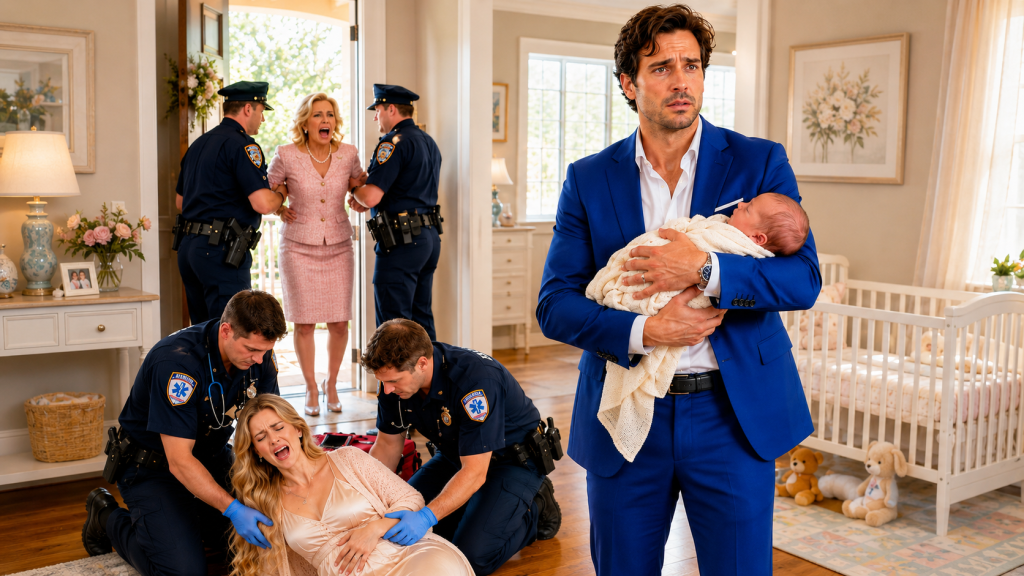
I burst through the front door.
The scene froze.
Brooke sat on the sofa, pale and crying silently.
Mrs. Patel stood between her and my mother like a shield.
Lorraine held Jonah against her chest, her face flushed with fury.
My mother’s suitcase sat open beside the stairs.
Stuffed inside were Brooke’s jewelry box, the emergency cash pouch, Jonah’s birth certificate folder, and a stack of our legal documents from the office drawer.
For one second, I could not speak.
Then Jonah cried.
That broke the spell.
I walked straight to my mother and held out my arms.
“Give me my son.”
Lorraine clutched him tighter.
“Travis, you need to calm down.”
“Give me my son.”
“Brooke is hysterical. I was trying to protect—”
I stepped closer.
“Do not make me ask again.”
Something in my face must have reached her, because she finally handed Jonah over.
The moment he was in my arms, his tiny body warm against my chest, I felt my anger sharpen into something controlled and absolute.
I turned to Mrs. Patel.
“Can you hold him for a moment?”
She took Jonah gently.
I went to Brooke.
She tried to smile when I knelt in front of her.
That hurt worse than tears.
“Did she make you clean?” I asked.
Brooke’s lips trembled.
“She said if you came home and saw the house like this, you’d think I wasn’t trying.”
My throat closed.
“You never had to prove that.”
My mother laughed behind me.
A short, ugly sound.
“Oh, please. She’s manipulating you. Look at her. She knows exactly how to appear helpless.”
I stood slowly.
“Mom, you’re leaving.”
Her face changed from outrage to disbelief.
“Excuse me?”
“You are leaving this house.”
“You need me.”
“No,” I said, looking at the police stepping in behind me. “My family needs protection from you.”
Two officers entered first, followed by paramedics.
Lorraine immediately transformed.
Her voice softened.
Her eyes watered.
“Officers, thank goodness. My daughter-in-law is emotionally unstable. I’ve been trying to help, but my son is upset and misunderstanding what he saw.”
Officer Ramirez looked at me.
“Sir?”
I opened my phone and handed it to him.
“The camera recorded everything.”
My mother’s eyes widened.
Not with guilt.
With surprise.
She had forgotten about the cameras.
Or maybe she had assumed I only used them for the baby.
Officer Ramirez watched the clips without expression.
The second officer examined the suitcase.
Brooke’s jewelry.
Cash.
Documents.
My mother began talking too fast.
“I was organizing. Brooke misplaces things. The papers were safer with me.”
I looked at her.
“Why did you need Jonah’s birth certificate?”
She opened her mouth.
No answer came.
The paramedics checked Brooke’s blood pressure.
It was too high.
Her pain had worsened.
They recommended she return to the hospital for evaluation.
Brooke looked at me, frightened.
“I don’t want to leave Jonah.”
“I’ll bring him,” I said. “We’re going together.”
Lorraine stepped forward.
“I can watch him.”
The room went silent.
Even Officer Ramirez looked at her like she had lost the right to speak.
“No,” I said.
My mother’s face twisted.
“After everything I’ve done for you?”
That sentence unlocked years.
Everything she had done for me.
Every meal turned into debt.
Every sacrifice sharpened into a hook.
Every kindness later used as evidence that I owed her obedience forever.
I had spent my life trying to repay a bill whose amount kept changing.
But Brooke owed her nothing.
Jonah owed her nothing.
And I was done paying with my family’s safety.
“You gave birth to me,” I said quietly. “That does not give you ownership of everyone I love.”
Her expression hardened.
“You’ll regret this.”
“No,” I said. “I regret not seeing you sooner.”
The officers escorted Lorraine outside.
She did not go quietly.
She shouted that Brooke was weak.
That I was ungrateful.
That I would come crawling back when I realized how useless my wife was.
Mrs. Patel closed the door on her voice.
Then the house became quiet except for Brooke’s soft crying and Jonah’s tiny sounds in the blanket.
At the hospital, doctors confirmed Brooke had strained herself and needed rest, monitoring, and medication adjustment.
Nothing irreversible.
But it could have become dangerous if the stress and activity continued.
I sat beside her bed holding Jonah and felt shame settle into me like stone.
Brooke reached for my hand.
“Don’t,” she whispered.
I looked at her.
“Don’t what?”
“Blame yourself for her.”
“I left you with her.”
“You trusted your mother.”
“I trusted the wrong person.”
Brooke’s eyes filled.
“She was different when you were home. Cold, but careful. The minute you left, she changed.”
I believed her.
Because people like Lorraine know when witnesses are watching.
My phone exploded that night.
My mother called fourteen times.
Then my aunt.
Then cousins.
Then my father, who had divorced Lorraine years earlier and rarely involved himself in family wars.
His message was short.
I warned you your mother needs control more than love. Call me when you can.
That one hurt.
Because maybe people had warned me.
Maybe Brooke had warned me in softer ways.
Maybe I had not wanted to hear it.
The next morning, I filed for a protective order.
Not because I wanted drama.
Because I wanted records.
I changed every lock.
Changed the alarm code.
Removed my mother from every emergency contact list.
Moved important documents to a safe deposit box.
Blocked her access to family photos, baby updates, shared calendars, and our home security app.
When she showed up two days later with my aunt, carrying flowers and wearing a face arranged into sorrow, Officer Ramirez’s warning made it easy.
She was told to leave.
My aunt called me cruel.
I asked if she wanted to see the video.
She did not.
That became the pattern.
Everyone had opinions until evidence appeared.
Then they became uncomfortable.
Lorraine tried one more tactic.
She sent me a letter.
My dear son,
You are being controlled by a fragile woman who resents the bond between mother and son. I only wanted Jonah safe. Brooke is not strong enough for motherhood right now. One day you will understand that I was the only person willing to tell the truth.
I read it once.
Then I placed it in a folder for my attorney.
Brooke did not read it.
She did not need more poison disguised as concern.
The hardest part came after the emergency ended.
People think once the villain leaves, peace arrives.
It does not.
Fear lingers in corners.
Brooke flinched when the doorbell rang.
She apologized when dishes sat in the sink.
She tried to stand too quickly whenever Jonah cried, as if rest had become proof of failure.
So I took more leave from work.
Then remote hours.
Then I hired a postpartum nurse Brooke chose herself.
I cooked badly.
I learned to fold baby clothes.
I sat with Brooke during night feedings even when she insisted I sleep.
Every time she apologized, I said the same thing.
“You are healing. You are not failing.”
At first, she cried every time.
Then less often.
Then one morning, six weeks later, I came downstairs and found her sitting in the nursery chair, Jonah asleep on her chest, sunlight spilling over both of them.
She looked tired.
Still pale.
But calm.
When she saw me, she smiled.
A real smile.
Small, but real.
That was the first morning I felt like our house might become ours again.
Not mine.
Not my mother’s.
Ours.
Three months later, Lorraine requested mediation through a family counselor.
She claimed she wanted reconciliation.
I agreed to one video call.
Brooke did not attend.
That was my condition.
Lorraine appeared on screen wearing pearls and soft makeup.
She looked wounded.
“My therapist says we need to repair trust,” she said.
“Good,” I replied. “Start with admitting what you did.”
She sighed.
“I was overwhelmed.”
“That is not an admission.”
“I may have been too firm.”
“No.”
Her lips tightened.
“Travis, I am still your mother.”
“And Jonah is my son. Brooke is my wife. You harmed them.”
“I never harmed that baby.”
“You used him to control a recovering woman.”
Her eyes flashed.
“She needed discipline.”
There it was.
Not regret.
Not sorrow.
The truth.
I ended the call.
No announcement.
No final speech.
Just one click.
Some people hear boundaries only as pauses before negotiations.
I decided mine would be walls.
A year has passed.
Jonah is walking now, if wobbling counts.
Brooke is healthy again.
Stronger than before, though she hates when people say childbirth made her stronger.
“Nearly dying did not make me strong,” she told me once. “Surviving people who minimized it did.”
She is right.
Our home is different now.
There are locks where there used to be assumptions.
New emergency contacts.
New routines.
New family.
Mrs. Patel is Jonah’s honorary grandmother, a title she pretends to find silly while keeping a framed photo of him on her mantel.
My father visits once a month and never comes without asking first.
Brooke’s sister stayed with us for two weeks and spent the whole time cooking, cleaning, and telling Brooke to sit down with such loving bossiness that Brooke laughed instead of flinching.
That is the difference.
Care does not make you feel small.
Control does.
Lorraine has never met Jonah again.
Maybe one day that will change, but not soon.
Not because I hate her.
Because love without accountability is just another door left unlocked.
And I have learned what comes through unlocked doors.
Sometimes I still think about that moment in the conference room.
My phone buzzing.
The camera opening.
My mother’s voice cutting through the speaker.
Being weak after birth does not excuse a dirty house.
For years, that sentence would have made me defend her.
Explain her.
Translate cruelty into concern.
Now I hear it plainly.
It was not old-fashioned.
It was not blunt.
It was not strength.
It was abuse wearing perfume.
The nursery camera was installed so I could watch my son sleep.
Instead, it woke me up.
It showed me the difference between the woman who raised me and the family I chose.
It showed me Brooke’s pain.
My mother’s mask.
My own failure to see what had been happening in front of me for years.
But it also gave me proof.
A timestamp.
A record.
A reason to stop explaining and start protecting.
At 2:17 p.m., I opened that camera expecting to see peace.
Instead, I saw fear.
By 2:29, I was on the road.
By 2:41, I was through the front door.
And by the time the police stepped into my living room, I finally understood something I should have known the day Jonah was born.
A man does not become a husband by saying vows.
He becomes one when he chooses his wife’s safety over every voice that taught him obedience.
A man does not become a father by holding a baby.
He becomes one when he builds a home where that baby’s mother can heal without fear.
My mother thought she could decide who was strong enough to belong in my house.
She was wrong.
Brooke belonged there.
Jonah belonged there.
I belonged there only after I learned to protect them.
And Lorraine?
She belonged outside the locked door.
THE END! THANKS FOR READING!