 Reading Time: 13 minutes
Mara Bell arrived with blood on her sleeve and asked the mountain giant if he feared women. The noon train screamed into Mercy Hollow with steam coughing over the platform and grit blowing hard enough to sting.
Coal smoke hung beneath a pale Colorado sky. The iron steps were still trembling when Mara appeared in the passenger car doorway, one gloved hand gripping the rail, her brown traveling dress stained with mud from three days of railcars, hard benches, and men who thought a woman alone was an invitation.
Every voice on that depot platform went dead.
Mr. Pike, the stationmaster, had been shouting about mail sacks a moment earlier.
Men in canvas coats had been squinting toward the baggage car.
Women held baskets close and pulled children nearer without seeming to know they were doing it.
Then Mara stepped down.
She was not the bride Mercy Hollow had spent two months inventing in whispers.
Abel Stone of Wolfjaw Mountain had advertised for a wife, and the story had grown taller every time it crossed a porch, a church step, or the feed counter.
They said Abel stood six feet ten, seven if a person counted the hat.
They said his hands looked made for splitting pine, not holding teacups.
They said his voice could knock frost off branches, though nobody on the platform seemed eager to test that claim.
So the town expected a frightened woman.
A thin woman.
Some pale, grateful creature who would look at that mountain of a man and decide any roof was better than no roof at all.
Mara Bell came down with a carpetbag in one hand, a cracked leather satchel in the other, and a stare sharp enough to make people remember their manners too late.
Her brown traveling dress pulled tight across her soft hips and fuller waist, the way honest cloth does when a body refuses to apologize for taking up room.
She knew what people saw.
Twenty-eight years had taught her that lesson with a steady hand.
Too loud.
Too stubborn.
Too hungry.
Too heavy.
Too much.
Somewhere west of Kansas City, she had decided too much was better than not enough.
Abel Stone stood by the freight office, impossible to mistake for anyone else.
He looked like part of Wolfjaw Mountain had walked down into town for supplies and forgotten how to seem harmless.
Broad shoulders.
Dark beard.
Brown coat stretched over a chest built by axes, weather, and winters that did not negotiate.
Still, he held himself careful and still, the way a large man learns to stand when smaller people flinch before he has done anything.
Mara crossed the platform straight toward him.
Half the crowd moved back.
“You Abel Stone?”
His dark eyes settled first on her face, then on the blood on her sleeve.
“Yes, ma’am.”
His voice was lower than she expected.
Rough, but not cruel.
Quiet, but not weak.
“Good,” Mara said. “I’m your wife, unless you plan on fainting.”
Somebody gasped.
Somebody else made the mistake of laughing, then remembered who Abel was and swallowed the sound whole.
Abel did not look at the crowd.
He looked at her sleeve.
“Are you hurt?”
“No.”
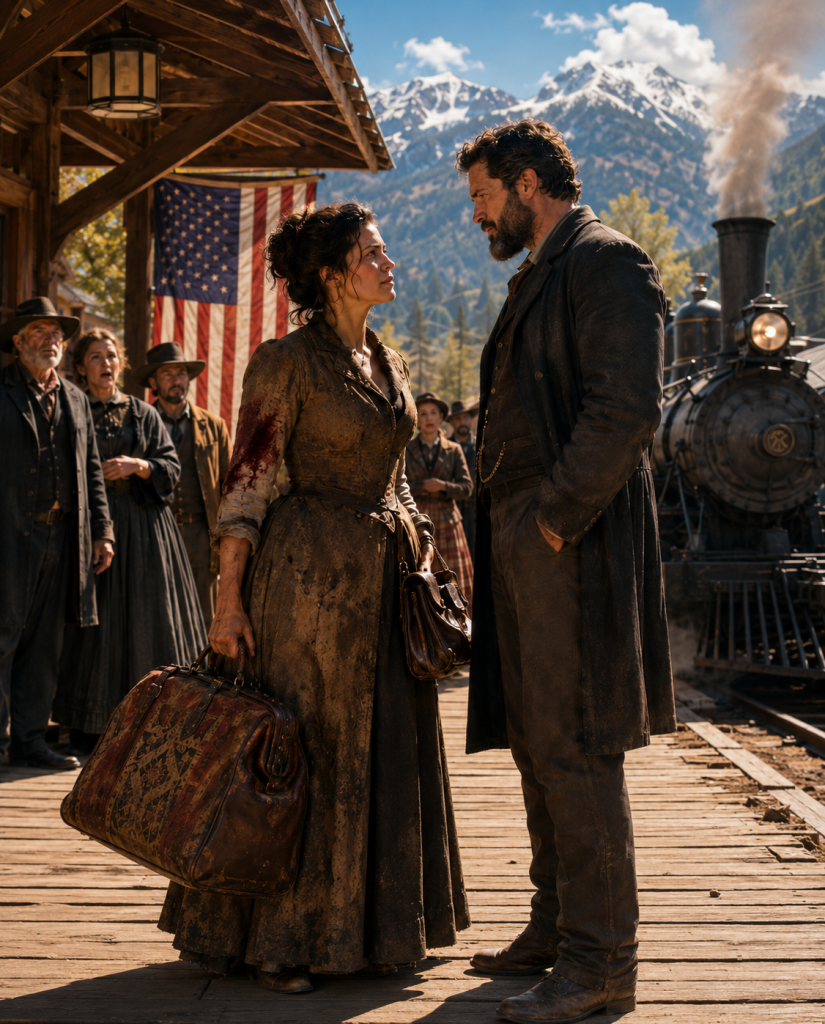
“Whose blood is that?”
Mara glanced down like she had misplaced the memory.
“A man on the train thought my seat belonged to him because I was a woman traveling alone. His nose disagreed.”
The platform went so still that the steam sounded louder.
“You broke his nose?” Abel asked.
“He tried to put his hands on me.”
That changed Abel’s face.
Not much.
Only enough.
The men closest to him suddenly found reasons to look anywhere but at Mara.
“Where is he?” Abel asked.
“Still on the train,” Mara said, “reconsidering his theology.”
A smile almost appeared under Abel’s beard, then vanished before the town could make gossip out of it.
Mara set down her carpetbag.
“Now answer me plain, Mr. Stone. Your advertisement said you wanted a quiet wife. If that’s true, I’ll save us both trouble and sleep in the depot until the next train east.”
Abel’s jaw tightened.
His gaze moved past her to the crowd pretending not to listen.
“I wrote steady.”
“Well, the Denver newspaper printed quiet.”
“That wasn’t my word.”
“Good,” Mara said. “Because I have many virtues, but quiet has never been one of them.”
Near the ticket window, a woman whispered, “Lord help him.”
Mara turned her head with a smile polished enough to cut.
“Ma’am, the Lord has had twenty-eight years to improve me and seems to have declined.”
This time the laugh came from Abel himself.
It rolled out of him low and sudden, like thunder remembering it had once belonged to the sky.
For one brief second, the frightening giant from Mercy Hollow’s stories looked less like a warning and more like a lonely man startled by his own laughter.
Then he put the moment away.
“My wagon’s this way,” he said. “Wolfjaw’s a long ride.”
“How long?”
“Six hours if weather holds. Longer if the trail’s bad.”
“Then we’d better start.”
“We usually stay in town the first night.”
“I didn’t cross half the country to admire your depot.”
Abel studied her as if the answer told him more than the words did.
“Trail gets narrow after dark.”
“I grew up in the Cumberland backwoods. Roads there were rumors, and the mules had more sense than the men. I’ll manage.”
He nodded once.
Mara picked up her bags.
Behind her, Mr. Pike muttered, “She’ll last a week.”
Mara stopped.
Abel stopped with her.
She turned slowly, reading the crooked badge on his vest.
“Mr. Pike, I have outlasted hunger, flood, bad men, worse women, a courthouse judge, and a corset maker from Nashville who told me my waist was a moral failing. I expect I can survive your opinion.”
Abel coughed into his fist.
Mara was certain he was hiding another laugh.
By dusk, the road to Wolfjaw Mountain had narrowed from wagon track to argument.
Pine branches scraped the sides.
Stone jumped under the wheels.
The air turned cold and resin-sharp, and below the trail, a ravine opened like the earth had split its mouth to see whether they would make a mistake.
Abel drove with one hand on the reins and the other braced against the wagon seat, steady as a fence post in bad wind.
Mara sat beside him, refusing to clutch the bench even when the wheels struck hard enough to rattle her teeth.
“Rock on the left,” she said.
“I see it.”
“Washout ahead.”
“I see that too.”
“Low branch.”
Abel ducked just before it took his hat clean off.
“Do you intend to drive from the passenger seat the whole way?”
Mara gave him a sideways look.
“If you intend to keep us alive, I’ll only assist where necessary.”
Abel’s mouth twitched.
“Generous.”
“Practical.”
The wagon climbed higher, and Mercy Hollow disappeared behind black pines and lowering clouds.
For a while, only the wheels, the horses, and the wind spoke.
Then Abel said, “You asked at the depot if I feared women.”
Mara watched the cliff edge slide past.
“I did.”
“No.”
“Good.”
“I fear what people do to them.”
That made her turn.
His face was still on the trail, hard and unreadable, but his voice carried something old and bruised beneath it.
“My first wife died because a doctor in town said women complained too much,” he continued. “By the time I carried her down the mountain, it was too late.”
Mara’s sharpness softened, not into pity, but respect.
“Then why ask for another?”
Abel’s hands tightened on the reins.
“Because loneliness makes a house colder than winter.”
Before Mara could answer, a rifle shot cracked through the trees.
One horse screamed.
The wagon lurched violently toward the ravine.
Abel threw one arm across Mara and hauled the reins with the other, but the back wheel slammed against stone and split.
The wagon tilted.
Mara grabbed the sideboard.
The ravine yawned black beneath them.
Abel roared, not from fear but effort, and braced one boot against the wagon frame, holding the reins so tight the leather cut into his palm.
The horses shuddered and stopped inches from disaster.
From the pines, three men stepped out.
One grinned.
His nose was swollen purple.
Mara sighed.
“Seems my train friend found religion after all.”
The man spat blood into the dirt.
“You embarrassed me in front of a whole car.”
“You did most of the work yourself.”
His eyes flicked toward Abel.
“You the husband?”
Abel slowly stood from the wagon bench.
The movement changed the air.
The men had expected a large man.
They had not expected the mountain to rise.
“I am,” Abel said.
The man lifted his rifle.
“Then tell your woman to hand over her satchel, apologize proper, and maybe we let you keep your horses.”
Abel looked down at Mara’s sleeve, then at the men.
“Mrs. Stone,” he said calmly, “can you shoot?”
Mara opened her satchel and pulled out a small revolver.
“Mr. Stone, I can do many things quietly. Shooting is not one of them.”
The man with the swollen nose stopped grinning.
Abel reached beneath the wagon seat and pulled out a shotgun.
“Good,” he said. “I dislike quiet warnings.”
The next minute happened fast.
The man on the left moved first.
Mara fired.
The bullet struck the pine beside his ear, showering bark across his cheek.
He dropped flat with a cry that sounded more offended than injured.
Abel fired into the dirt at the second man’s feet, and the blast sent him staggering backward into a snowberry bush.
The swollen-nosed man tried to aim at Mara.
Abel stepped between them.
That was a mistake for the man, not for Abel.
Mara rose behind Abel’s shoulder and said, “I would reconsider.”
He did not.
His rifle came up.
Mara fired again.
This time, she hit the barrel.
The rifle spun from his hands and clattered across stone.
The man stared at it, then at Mara.
“You shot my gun.”
“I disliked where it was pointing.”
Abel moved then.
He came down from the wagon like a landslide with purpose.
The swollen-nosed man tried to run, but Abel caught him by the back of his coat and lifted him so easily Mara nearly forgot to be annoyed by the danger.
“Mercy,” the man gasped.
Abel looked at Mara.
“Do you want him?”
She tucked the revolver back into her satchel.
“No. He appears undercooked.”
Abel lowered the man until his boots touched dirt.
“Walk back to Mercy Hollow,” Abel said. “Tell Sheriff Vale what you did. If you don’t arrive before morning, I’ll come down myself and explain it for you.”
The man swallowed.
The other two scrambled up.
They ran.
When the forest swallowed them, the cold came back.
So did the problem.
The wagon wheel was split clean through.
One horse was trembling.
Night was falling fast.
Abel crouched near the wheel.
“We won’t make the house before dark.”
Mara looked at the sky.
“Is there shelter?”
“Line cabin. Half a mile ahead.”
“Then we walk.”
“You’re tired.”
“I was tired in Missouri.”
“You’re bleeding.”
“It’s not mine.”
Abel looked at her for a long moment.
Then he took both carpetbags.
Mara took the satchel.
“I can carry my own things,” she said.
“I know.”
“Then why are you carrying them?”
“Because I can carry them and watch the trees at the same time. You keep your hand near that revolver.”
That was practical enough to silence her, which she did not appreciate.
They walked the trail while the last light died behind the ridge.
The line cabin appeared as a dark square among pines, half-buried under old snowdrifts and roofed with rough shakes.
Inside smelled of cold ash, dust, and mice.
Abel built a fire with efficient hands.
Mara cleaned the blood from her sleeve in a tin basin and tried not to shiver.
The cabin had one narrow cot, one rough table, and two stools.
Abel took off his coat and hung it near the fire.
“You take the cot.”
“I’ve slept on train benches for three nights. The floor may be an improvement.”
“Take the cot.”
“Do you order everyone like that?”
“No.”
“Just wives?”
He looked at her then.
The fire lit one side of his face gold and left the other in shadow.
“I don’t know how to have a wife anymore.”
The words were so bare they stripped the teasing from her tongue.
Mara lowered the cloth in her hands.
“I don’t know how to be one.”
“That true?”
“Yes.”
“You were married before?”
“No. I was nearly married twice. Once to a preacher’s son who thought my opinions were an illness. Once to a merchant who liked my cooking and disliked my voice. I escaped both.”
“Escaped?”
“In one case through a door. In the other through a window.”
Abel stared.
Then that thunder-laugh came again, softer this time.
Mara smiled despite herself.
The cabin warmed slowly.
Outside, the wind began moving through the pines.
Abel repaired a strap, checked the horses, and returned with snow dusting his shoulders.
Mara watched him stoop to enter the cabin.
A giant, yes.
But careful.
Always careful.
As if the world had taught him that strength frightened people even when kindness held it back.
“You do not seem like the stories,” she said.
He glanced up.
“What stories?”
“That you’re a brute. That you took a wife because nobody on Wolfjaw can bear your temper. That your first wife died from fear of you.”
The strap in Abel’s hands went still.
His face closed.
Mara cursed inwardly.
“I did not say I believed them.”
“No,” he said. “But you heard them.”
“Yes.”
His gaze returned to the leather strap.
“Lydia did not fear me.”
“Your first wife?”
“Yes.”
“What happened?”
For a long time, he said nothing.
Mara let the silence stand.
At last, Abel spoke.
“She was small. Not weak. Small. People confused the two. She had a fever after childbirth, but the baby had already died, and the doctor said grief made women imagine sickness. I rode to town twice. He refused to come the first time. Came too late the second.”
“I’m sorry.”
“I carried her down after she died. Folks saw me with blood on my shirt and made their story.”
Mara’s throat tightened.
“People like stories that require nothing from them.”
Abel looked at her.
“Yes.”
The fire cracked.
Mara sat on the cot finally, but only because her body betrayed her with a yawn.
Abel took the floor near the door.
“You don’t have to guard me,” she said.
“I’m guarding the door.”
“From what?”
“Men who learned nothing from being spared.”
She could not argue with that.
Morning came silver and bitter.
Abel fixed the wagon enough to limp it home by noon.
Wolfjaw Mountain rose around them like a fortress made of pine, stone, and sky.
The house appeared at the end of a ridge road, larger than Mara expected but plain.
A log house with a wide porch.
Smoke from the chimney.
A barn built strong enough to survive the end of days.
No curtains in the windows.
No flowers.
No softness.
Just survival.
Mara stepped down and looked around.
“So this is where loneliness freezes.”
Abel looked almost embarrassed.
“I never claimed it was pretty.”
“No,” she said, walking toward the porch. “But it has bones.”
The first week was war without gunfire.
Mara discovered the kitchen shelves held flour, beans, salt pork, coffee, and exactly one cracked jar of peaches.
Abel discovered Mara refused to whisper while working.
She sang.
Badly.
Loudly.
She moved furniture.
She opened shutters.
She found curtains packed in a trunk and hung them, ignoring Abel when he said Lydia had sewn them.
“All the more reason they should see light,” Mara replied.
That silenced him.
She found the garden choked with weeds and brought it back with a hoe, a temper, and language that made Abel pause behind the barn with one eyebrow raised.
She cooked too much.
Scolded the hens.
Named the milk cow Queen Victoria because, as she said, “She expects service and gives little thanks.”
The house changed.
Not quickly.
Not gently.
But surely.
A blue cloth on the table.
Wildflowers in a jar.
A clean shelf for books.
A chair moved near the fire.
A woman’s voice filling rooms that had forgotten noise could be warm.
Mercy Hollow noticed.
Of course it did.
Three weeks after Mara arrived, two women rode up in a buggy pretending to bring church preserves.
Mrs. Pike and Mrs. Ellerby stepped onto the porch wearing smiles thin as paper.
Mara welcomed them with coffee strong enough to confess sins over.
They looked around the room, measuring.
“So,” Mrs. Pike said, “you’ve settled.”
“I’ve unpacked. Settling takes longer.”
“And Mr. Stone treats you well?”
Mara smiled.
“Do you ask because you care, or because you’re thirsty?”
Mrs. Ellerby nearly choked on coffee.
Mrs. Pike stiffened.
“We only know what happened to poor Lydia.”
Mara set her cup down.
“What happened to Lydia is that a doctor ignored her, a town believed gossip, and a widower was left alone with blame because blame is easier than shame.”
Both women went quiet.
Abel, who had just entered with firewood, froze by the door.
Mara did not look at him.
She looked only at the women.
“If you brought preserves, I thank you. If you brought cruelty wrapped in concern, take it back down the mountain. We have enough wind up here.”
Mrs. Pike left red-faced.
Mrs. Ellerby left the preserves.
Abel stood in the doorway long after the buggy vanished.
“You didn’t have to do that,” he said.
“Yes, I did.”
“Why?”
Mara looked at him.
“Because you carry enough.”
Something shifted between them then.
Not love.
Not yet.
Something quieter.
A door unlatched.
Autumn came with gold leaves and hard frosts.
Mara learned Abel rose before dawn and spoke kindly to horses, tools, and stubborn doors.
Abel learned Mara cried only when furious, never when hurt.
She learned he carved small wooden animals in the evenings and hid them in a box.
He learned she had once wanted to teach school but had been told no respectable board would hire a woman who argued with Scripture and arithmetic in the same meeting.
One night, snow fell early.
They sat near the fire, and Abel handed Mara a small carved bird.
It fit in her palm.
Rough, but beautiful.
“For me?” she asked.
“Yes.”
“Why?”
“You like things that look ready to bite.”
“It’s a sparrow.”
“Mean sparrow.”
She smiled.
Then, before courage could flee, she leaned over and kissed his cheek.
Abel went completely still.
Mara pulled back.
“Did I frighten the mountain?”
His voice was rough.
“No.”
“Good.”
Then he turned carefully, giving her every chance to retreat, and kissed her like a man approaching a warm thing he feared might vanish.
Mercy Hollow saw them again in spring.
They came down for supplies in a repaired wagon, Mara wearing a green dress that fit her as if she had stopped fighting her own reflection, Abel beside her with his beard trimmed and his hat low.
The town stared.
Mara stepped onto the platform where she had first arrived with blood on her sleeve.
Mr. Pike was there again.
Older by gossip, not years.
He looked at Abel.
Then Mara.
Then her stomach.
Round beneath the green dress.
His mouth opened.
Mara lifted one eyebrow.
“Say congratulations, Mr. Pike. It will improve your face.”
His mouth closed.
Then, surprisingly, he removed his hat.
“Congratulations, Mrs. Stone.”
Mara nodded.
“See? Better already.”
Abel’s hand rested lightly at her back, not guiding, not claiming.
Simply there.
A man big enough to crush, choosing instead to steady.
A woman the world called too much, standing exactly as she was.
Later, outside the general store, a young woman approached Mara while Abel loaded supplies.
She was thin, pale, and bruised near the wrist.
Her eyes darted toward a man waiting by the hitching rail.
“Mrs. Stone,” she whispered, “is Wolfjaw hard to reach?”
Mara understood too quickly.
She looked at Abel.
He had seen the bruise too.
His jaw tightened, but he waited.
Mara turned back to the woman.
“For those invited, no.”
The woman swallowed.
“If someone needed work?”
Mara took her hand.
“Then someone would find work.”
That summer, Wolfjaw became more than a house.
First came the young woman, Ruth.
Then a widow with two children.
Then a girl who had run from a mining camp.
Mercy Hollow muttered.
Abel built another room.
Then another.
Mara taught reading at the kitchen table.
Abel taught woodcutting, fence mending, and how to stand without apology.
The town that had once feared the mountain giant began sending women up quietly when no one else would help.
Years later, people told the story differently.
They said Mara Bell arrived with blood on her sleeve and married the giant of Wolfjaw Mountain.
They said she tamed him.
They were wrong.
Mara never tamed Abel.
And Abel never softened Mara.
They simply recognized in each other the same old truth.
The world had mistaken survival for danger.
On winter nights, when the house was full of voices and the fire burned bright, Abel would sometimes look across the room at Mara.
She would be arguing with a girl over grammar, a baby on her hip, flour on her sleeve, hair falling loose, alive in every direction.
He would remember the depot.
The blood.
The question.
Do you fear women?
And he would smile.
Because the answer had changed.
He did fear women now.
He feared their grief.
Their courage.
Their capacity to endure what should have destroyed them and rise anyway with sharp tongues, full hearts, and revolvers in their satchels.
Most of all, he feared the thought of a world without Mara Bell in it.
One evening, their daughter Lydia asked how her parents had met.
Mara looked at Abel.
Abel looked at Mara.
Then Mara said, “Your father was standing in a depot pretending not to be lonely.”
Abel added, “Your mother was covered in blood and insulting half the town.”
Lydia’s eyes went wide.
“Was it romantic?”
Mara laughed.
Abel took her hand beneath the table.
“Yes,” he said.
“In its way.”
And outside, Wolfjaw Mountain stood dark and high beneath the stars, no longer a place of loneliness, but a refuge.
A home built by a giant who feared what people did to women.
And a woman who had never been quiet enough to let fear win.
THE END! THANKS FOR READING!