 Reading Time: 13 minutes
Everyone thought I married Russell Hartwell for his money. They were not entirely wrong. That is the truth people never expected me to admit. I was thirty-two years old, drowning in bills, and one missed paycheck away from losing my apartment.
My car had a cracked windshield. My credit cards were maxed out. My landlord had started taping polite but terrifying notices to my door. I worked double shifts at a catering company, smiled at people who dropped more money on wine than I made in a week, and went home every night with swollen feet and a stomach full of leftovers wrapped in napkins.
Russell was sixty-two. Wealthy. Widowed. Elegant in that quiet old-money way that never needed to announce itself because the room announced it for him.
He owned Hartwell Holdings, a private investment company with vineyards, commercial real estate, and a charitable foundation that funded hospitals, libraries, and scholarship programs.
He wore expensive watches but never flashed them.
He lived in a stone mansion on twelve acres outside Greenwich.
And he was lonely in a way rich people try to hide with marble floors, staff, and perfect table settings.
We met at a charity dinner where I was serving champagne.
The ballroom was full of polished people wearing diamonds and carefully practiced sympathy.
I had been on my feet for nine hours.
My black shoes were cutting into my heels.
My smile felt glued to my face.
I moved from table to table with a silver tray, offering champagne to people who did not look directly at me unless their glass was empty.
Then Russell Hartwell looked directly at me.
“What is your name?” he asked.
I was so surprised I almost forgot to answer.
“Clara.”
“Clara,” he repeated, like he was testing whether the name suited me. “Do your feet hurt?”
No man had asked me that in years.
Not if I was tired.
Not if I had eaten.
Not if I was okay.
Just that simple question, asked with genuine concern, nearly undid me.
“Yes,” I said before I could stop myself.
A small smile touched his mouth.
“Then sit for one minute.”
“I can’t. I’m working.”
“I’m on the board hosting this event,” he said calmly. “I can authorize a one-minute mercy.”
I laughed because I could not help it.
He pulled out the chair beside him.
I did not sit.
But I remembered.
Later that night, when the event ended and I was helping clear tables, I found an envelope with my name written on it.
Inside was a note.
Clara, buy better shoes. Your work deserves kinder feet.
There was a gift card inside for a department store.
Five hundred dollars.
I should have been offended.
Instead, I cried in the employee bathroom.
Three months later, he proposed.
People thought there had to be some scandal behind it.
Some manipulation.
Some secret bargain.
But the truth was both simpler and more complicated.
Russell started inviting me to lunch.
Then dinner.
Then walks through the vineyard when I delivered catering to his estate.
He asked about my childhood.
My mother.
My debts.
My dreams before survival shrank them down to rent and groceries.
He listened as if my answers mattered.
No one had listened to me like that in a very long time.
My friends called me insane when I told them I was marrying him.
“Clara, he is thirty years older than you,” my best friend Nina said. “People are going to talk.”
“People already talk,” I replied. “At least this time, I’ll have health insurance.”
She stared at me.
I laughed like it was a joke.
It was not entirely a joke.
Russell’s children called me worse.
His daughter, Vivian, was thirty-eight, older than me by six years, and furious in a way she did not bother to hide.
His son, Andrew, was forty, polished and cold, with the kind of smile that felt like paperwork.
At our engagement dinner, Vivian cornered me near the powder room.
“You think you’re getting the house?” she hissed.
I looked at her in the mirror while fixing my lipstick.
“I think I’m getting married.”
“You’ll get nothing.”
I turned around.
“Then why are you so angry?”
Her face tightened.
“Because women like you ruin families.”
I almost laughed.
Families like theirs had been ruined long before women like me arrived.
Russell heard her.
He had been standing in the hallway, silent, leaning on his cane.
Vivian’s expression changed immediately.
“Dad—”
Russell only smiled faintly and said, “She’ll get exactly what she deserves.”
At the time, I thought he meant it as a warning.
Maybe we all did.
I told myself I did not care what they thought.
But the truth was, I cared too much.
I cared when the housekeeper avoided my eyes because Vivian told her I was temporary.
I cared when Andrew referred to me as “Dad’s companion” at a board dinner three months after the wedding.
I cared when women at charity events looked at my left hand before they looked at my face.
And yes, I liked the comfort.
I liked the warm house.
The quiet mornings.
The way I no longer checked my bank account before buying groceries.
The way my body stopped flinching every time an envelope arrived in the mail.
I liked sleeping without wondering whether my car would be repossessed before sunrise.
I liked safety.
But safety was not the only thing I found.
Russell was kind to me.
Kinder than I expected.
Not flashy kind.
Not romantic in the dramatic way younger men had tried and failed to be.
He was practical kind.
He noticed when I skipped lunch and had soup sent to the library.
He learned I hated lilies and changed the flowers in the foyer to white roses.
He never mocked me for not knowing which fork to use.
He taught me things without making me feel small.
When nightmares woke me after years of financial panic, he would simply turn on the bedside lamp and say, “You’re here, Clara. Nothing is due tonight.”
The first time he said that, I cried into his shoulder.
And somewhere along the way, shamefully, inconveniently, I stopped pretending I did not care about him.
It happened quietly.
Not like lightning.
Like winter becoming spring while you are busy surviving.
One morning, he came down to breakfast with his sweater buttoned wrong, and I fixed it without thinking.
He smiled at me.
“You looked like my wife just now.”
“I am your wife.”
“No,” he said softly. “I mean you looked like someone who forgot she was acting.”
That sentence stayed with me.
Because he was right.
In the beginning, I had played a role.
Young wife.
Grateful rescue.
Beautiful distraction for an older man.
But gradually, I forgot to perform.
I started telling him the truth.
That I hated feeling judged.
That I was afraid his children were right about me.
That sometimes I wondered whether comfort had made me a worse person.
Russell listened.
Then he said, “Most people come into marriage wanting something, Clara. Security. Children. Status. Companionship. Beauty. Youth. Forgiveness. You are not wicked because you wanted to survive.”
I looked down at my hands.
“And what did you want?”
He smiled sadly.
“To be seen before I disappeared.”
I did not understand then how soon that disappearance would come.
Russell got sick fast.
One cough became tests.
Tests became specialists.
Specialists became quiet hallway conversations.
Six weeks from diagnosis to funeral.
Six weeks.
That was all the time we had between the moment the doctor said cancer and the moment I stood beside a coffin listening to people whisper that at least I would be rich now.
During those six weeks, Vivian and Andrew returned to the house like heirs circling a locked vault.
They brought lawyers disguised as concern.
They questioned medication schedules.
They asked Russell about board documents when he could barely keep his eyes open.
They spoke to doctors over me, around me, through me.
I slept in a chair beside his bed.
I learned how to adjust pillows without hurting him.
I held the cup when his hands shook.
I wiped his mouth after he was sick.
I read to him when he could no longer focus on the page.
One night, while rain tapped against the windows, he opened his eyes and looked at me.
“Are you afraid?” he asked.
“Yes.”
“Of being alone?”
“Yes.”
“Of them?”
I did not answer.
His fingers moved slightly against the blanket.
I took his hand.
“I know what they think of me,” I whispered.
“I know what they are,” he replied.
The next morning, he asked to see his lawyer.
Vivian tried to sit in.
Russell told her no.
Andrew tried to argue.
Russell said, “If either of you enters this room before I call, you will regret it in language even your attorneys understand.”
They stayed outside.
His lawyer, Mr. Bellamy, arrived in a gray suit carrying a leather briefcase.
He was quiet, thin, and older than I expected, with silver hair and eyes that missed nothing.
He spoke with Russell for two hours.
I waited in the hall while Vivian stared at me with naked hatred.
“You did this,” she said.
I was too tired to pretend not to understand.
“Did what?”
“You got into his head.”
“No,” I said. “I stayed beside his bed. There’s a difference.”
Russell died eleven days later just before dawn.
I was holding his hand.
His last words were not dramatic.
They were not about money or revenge or secrets.
He looked at me and said, “You made the house warm again.”
Then he was gone.
At the service, his children stood across from me like I had killed him myself.
Vivian wore black silk and fury.
Andrew accepted condolences like a politician.
People hugged me carefully, unsure whether to treat me as a widow or an inconvenience.
I cried anyway.
Not beautifully.
Not softly.
I cried the way a person cries when someone who saw them completely has left the room forever.
After the burial, while guests gathered at the mansion for food and wine, Mr. Bellamy approached me.
“Mrs. Hartwell,” he said quietly. “Russell asked that you come to my office this afternoon.”
“Today?”
“Yes.”
I looked toward Vivian and Andrew, who were watching us from near the fireplace.
“They already know,” he said.
That was how I ended up sitting in Mr. Bellamy’s office three hours after burying my husband.
Vivian and Andrew were already there.
Vivian sat stiffly in a cream chair, her mouth curved in the faintest smile.
Andrew stood by the window, checking his watch.
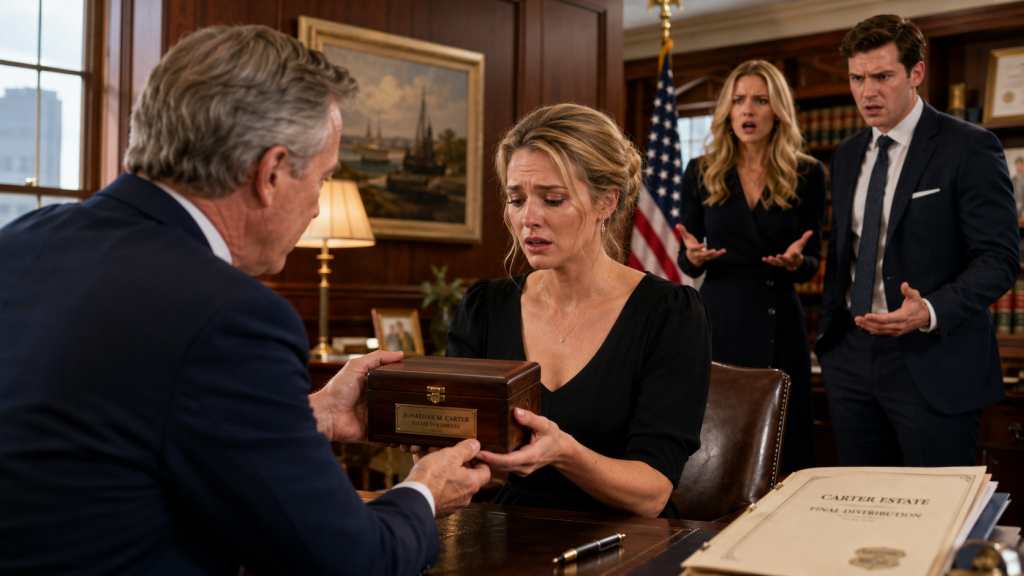
On the desk sat a small wooden box.
No envelope.
No will in sight.
Just the box.
My heart sank.
It looked too small to hold a life.
Mr. Bellamy sat behind his desk and folded his hands.
“Russell left instructions,” he said.
Vivian laughed under her breath.
Then Mr. Bellamy pushed the box toward me.
“He made sure you got exactly what you deserved.”
The room went very still.
My hands trembled as I opened the wooden box.
I expected jewelry.
Maybe a cruel note.
Maybe nothing at all.
Inside was a single brass key, a photograph of Russell and me sitting in the garden, and a folded letter in his handwriting.
His children leaned forward like vultures.
I opened the letter first.
My darling Clara,
They will tell you I was fooled. They will say you married me for comfort, and perhaps, at the beginning, part of you did. But I married you because you saw me when my own children only saw my estate.
My throat closed.
Vivian scoffed.
“Oh, please.”
Mr. Bellamy raised one hand.
“Let her finish.”
I kept reading.
You noticed when I was tired. You noticed when I was afraid. You asked whether I had eaten when others asked whether I had signed. You never once pretended my illness was inconvenient, even when it stole every comfortable part of our marriage and left only duty. Duty reveals love more honestly than romance does.
My vision blurred.
The key opens the cottage by the lake. It is yours, fully paid, untouchable, and transferred before my death. The main house and primary personal accounts will go to my children, exactly as they expected. I do not want you trapped in rooms where they can poison your peace.
Vivian smiled sharply.
“So she gets a cottage. Fine.”
But the letter continued.
The foundation, the vineyards, and controlling shares in Hartwell Holdings belong to you.
Andrew shot to his feet.
“That’s impossible.”
Mr. Bellamy slid documents across the desk.
“It’s done.”
Vivian grabbed the arm of her chair.
“No. He would never.”
Mr. Bellamy looked at her.
“Your father was very clear.”
Andrew snatched the documents and scanned them, his face changing line by line.
“The house goes to us,” he said, as if repeating the only part that comforted him.
“Yes,” Mr. Bellamy said. “The mansion and several liquid accounts were left to you and your sister.”
“Then how does she get controlling shares?”
“Through transfers completed prior to his death.”
Vivian stood slowly.
“You let this happen?”
Mr. Bellamy’s expression did not change.
“I executed my client’s instructions.”
“She manipulated him.”
I looked up then.
Something inside me, exhausted and grieving and tired of being spoken about like furniture, finally stood.
“No, Vivian. I loved him.”
She laughed cruelly.
“You served champagne when he found you.”
“And you served him requests while he was dying.”
The room went silent.
Andrew’s jaw tightened.
Vivian looked as if I had slapped her.
I did not stop.
“You asked him about board seats when he could barely breathe. You corrected nurses who knew more than you. You kept telling him not to worry because the family would protect the company, when what you meant was that you wanted him to die with a pen in his hand.”
Vivian’s face flushed.
“How dare you?”
“How dare I?” My voice shook. “I sat beside him while he cried because his own children only visited when lawyers were nearby.”
Andrew stepped forward.
“That is enough.”
“No,” Mr. Bellamy said firmly. “It is not.”
We all turned toward him.
He opened another file.
“There is one more item.”
Vivian looked ready to explode.
“Of course there is.”
Mr. Bellamy removed a sealed envelope.
“Russell recorded a statement one week before his death. He requested it be played after the contents of the box were revealed.”
Andrew said, “We object.”
“This is not court,” Mr. Bellamy replied. “And no one asked.”
He pressed play on a small recorder.
Russell’s voice filled the room.
Weak.
Raspy.
But unmistakably his.
“If you are hearing this, then I am gone, and my children are angry.”
A tiny, broken laugh escaped me before I covered my mouth.
Russell continued.
“Vivian. Andrew. I loved you both, but I failed you by allowing wealth to replace character. You treated my company as your inheritance before it was ever your responsibility. You treated Clara as a thief because you could not imagine anyone sitting beside me without wanting something signed.”
Vivian’s eyes filled, but not with soft grief.
With humiliation.
Russell’s voice went on.
“The truth is, I watched all of you. Clara came to me needing security. She never denied it. But she stayed when security became illness, fear, and sleepless nights. You came needing control, and left whenever control was refused.”
Andrew looked down.
“The foundation requires compassion. The vineyards require patience. The company requires someone who understands the lives affected by decisions made in boardrooms. Clara knows what it means to stand on tired feet and still treat people gently. That is why she will lead.”
Vivian whispered, “No.”
Russell’s final words crackled through the recorder.
“You came for survival, Clara, but you stayed for love. That is what you deserved.”
The recording ended.
No one spoke.
For the first time since I had known them, Russell’s children had nothing to say.
The months that followed were not easy.
People imagine inheritance as a clean door opening.
It is not.
It is a battlefield with paperwork.
Vivian and Andrew challenged everything.
They claimed undue influence.
They claimed diminished capacity.
They claimed I isolated Russell, even though his medical staff, nurses, lawyers, and household employees all testified that I encouraged visits and they were the ones who often refused to stay.
They leaked stories to society columns.
Gold-digger widow takes control.
Former waitress inherits empire.
Hartwell family stunned by final betrayal.
The word waitress appeared everywhere, even though I had never been ashamed of honest work.
For a while, it hurt.
Then I began using it like armor.
At my first board meeting, an older investor looked me up and down and said, “Mrs. Hartwell, do you have any experience with this level of responsibility?”
I smiled.
“I have carried trays of champagne through rooms full of people who thought I was invisible while remembering every name, preference, insult, and unpaid invoice. I have survived debt collectors, hospital rooms, and the Hartwell family. I learn quickly.”
No one laughed.
But no one asked that question again.
The foundation was the first place I began making changes.
Russell had loved it, but in later years Vivian had turned it into a social decoration.
Galas.
Photo opportunities.
Pretty checks handed to pretty causes.
I redirected funds toward caregiver support, medical debt relief, and housing assistance for women aging out of low-wage work.
Vivian called it “low-class charity.”
I called it remembering where I came from.
The vineyards were harder.
I knew nothing about soil, harvests, distribution, or wine beyond pouring it into glasses.
So I listened.
To workers.
To managers.
To drivers.
To the woman who handled seasonal housing and quietly told me the old system was unfair.
To the accountant who showed me where money had been wasted on prestige projects while staff health benefits lagged behind.
I made mistakes.
Many.
But unlike Vivian and Andrew, I did not pretend knowing less made me superior.
I asked questions.
I learned.
And slowly, people who had expected a decorative widow began calling my office because I answered.
The lake cottage became my refuge.
The brass key opened a blue door on a small stone house tucked beside quiet water and pine trees.
It was nothing like the mansion.
No marble.
No staff.
No ballroom.
Just sunlight, creaking floors, a kitchen with yellow cabinets, and a bedroom that looked over the lake.
On the mantel was another photograph Russell had left there.
The two of us in the garden.
He was looking at me, not the camera.
I sat on the floor the first night and cried until morning.
Not because I had won.
Because he had known.
He had known I would need somewhere his children’s hatred could not follow.
A year after his death, the court dismissed the final challenge.
Vivian stopped speaking to me entirely.
Andrew reached out once through attorneys asking to “discuss a reasonable restructuring of control.”
I declined.
The mansion was sold two years later.
Vivian said it was too painful to keep.
Maybe that was true.
Or maybe the upkeep was less romantic when Russell was no longer paying for every illusion.
I did not buy it.
People expected me to.
They thought I would want the grand house that proved I had arrived.
But I had never wanted marble floors.
I had wanted safety.
Warmth.
Someone asking if my feet hurt.
I kept the cottage.
I kept Russell’s photograph on the mantel.
I kept his letter in the wooden box.
And every year, on the anniversary of his death, I read it once.
Not because I need proof anymore.
Because it reminds me that people can enter your life for imperfect reasons and still become true.
I did marry Russell partly for money.
I will not polish that away.
Desperation makes choices that comfort judges from safe distances.
But love grew where survival began.
It grew in quiet rooms, in medicine schedules, in shared tea, in buttoned sweaters, in fear spoken honestly after midnight.
It grew when there was nothing glamorous left.
That is the part his children never understood.
They thought love was proven by blood.
Russell knew love was proven by presence.
His lawyer once told me, months after everything settled, that Russell had changed his plans gradually.
Not in one dramatic rewrite.
Not because of one fight.
He watched.
He tested.
He waited to see who remained when he had nothing pleasant to offer.
By the end, the answer was simple.
I did.
Sometimes I wonder what would have happened if I had met Russell when I was secure.
If my rent had been paid.
If my life had been easier.
Would I have loved him sooner?
Would I have been less ashamed?
Would his children have hated me less?
Maybe.
Maybe not.
But life does not give us clean beginnings just because endings matter.
We start where we are.
Mine began in debt, exhaustion, and sore feet.
It ended with a wooden box, a brass key, and a dead man’s voice defending me more fiercely than the living ever had.
Everyone thought I married Russell for his money.
They were not entirely wrong.
But they were not right enough.
I married him because I was tired of being unsafe.
I stayed because he became home.
And after his funeral, when his lawyer gave me that box and said Russell made sure I got exactly what I deserved, his children thought it would be nothing.
They thought I deserved humiliation.
A small payoff.
A quiet exit.
Instead, Russell gave me the one thing they had never offered him.
Trust.
And I have spent every day since trying to deserve it.
THE END! THANKS FOR READING!