 Reading Time: 18 minutes
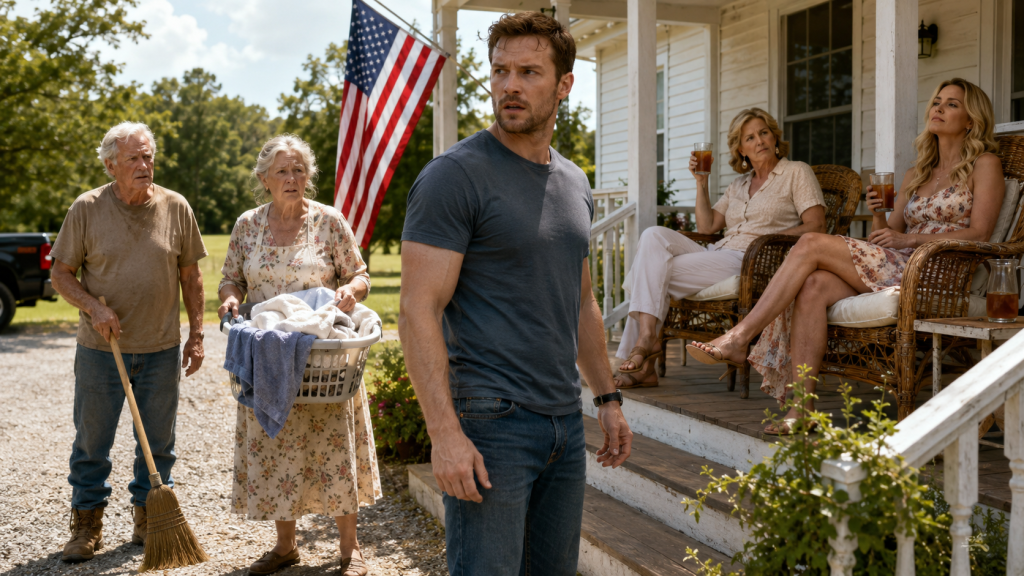
I worked eighty-hour weeks in a freezing apartment to buy my parents their farmhouse in cash. Returning unannounced six years later, I caught my frail father sweeping the driveway and my mom washing clothes under the brutal sun like indentured servants.
On the porch, my sister-in-law and her mother sipped iced tea and sneered, “Watch it, old man! You’re getting dirt on my designer shoes.” They were living like queens on the money I sent for my parents’ medicine. My blood turned cold.
Three minutes later, they were begging me not to put an end to their comfortable little kingdom. The first thing I noticed when I pulled into the long gravel driveway after six years in Chicago was the heat coming off the road in waves and the dry scrape of a broom dragging across dust.
It was not the white farmhouse with the wraparound porch I had bought in cash so my parents could grow old without rent, threats, or another winter of choosing between medicine and groceries. It was not the porch swing my mother used to point at in old magazine clippings, saying, “One day, Arthur, I’m going to sit right there with lemonade and not one bill in my hand.”
It was my father.
Arthur was bent over in the driveway under the brutal Midwestern sun, sweeping gravel dust away from the porch steps like a hired man afraid to miss a spot.
His flannel shirt was soaked dark down the back.
His hands shook around the broom handle.
His shoulders looked narrower than they did in the photos my mother mailed me every Christmas.
Across the yard, my mother stood beside a plastic laundry basket, rinsing clothes in a washtub with her sleeves rolled past her elbows.
The sun had turned her neck red.
A wet sheet sagged between her hands.
She moved slowly, like every motion cost her something.
And up on the porch, in the shade I paid for, my sister-in-law Jessica and her mother, Susan, sat in cushioned chairs with iced tea sweating on the little glass table between them.
Jessica had one ankle crossed over the other, scrolling her phone.
Susan wore oversized sunglasses, too many bracelets, and a smile so lazy it made my stomach turn.
Then my father’s broom pushed a little dust too close to Susan’s sandals.
“Watch it, old man!” she snapped, lifting one foot like the dirt had insulted her personally. “You’re getting dust all over my designer shoes.”
My hands locked around the steering wheel.
For one hard second, I saw myself getting out of that truck and saying every ugly thing I had swallowed for six years.
I saw the glass table flipping.
I saw the iced tea splashing across Susan’s white pants.
I saw Jessica’s phone hitting the porch boards.
I did none of it.
Corporate life teaches you one useful thing.
When something smells rotten, do not run in yelling.
Stand still.
Let people show you how long they have been comfortable being cruel.
So I sat there with the engine off and the cab still humming hot around me.
Six years came back all at once.
The eighty-hour weeks.
The freezing studio apartment with a radiator that knocked all night and still barely worked.
The ramen cups stacked beside my sink.
The winter I walked to work in the same thin coat because every extra dollar went into the farmhouse account.
On March 18 at 6:12 a.m., I wired the final payment.
By 9:40 that morning, the county clerk’s office had stamped the deed transfer.
Two weeks later, I set up monthly deposits for my parents’ prescriptions and household bills, labeling every transfer the same way in my bank app.
Mom and Dad Medicine.
Not gifts.
Not favors.
Medicine.
Heat.
Food.
Peace.
Jessica knew that.
My brother knew that.
Susan knew enough to know the money was not meant for iced tea on my parents’ porch while my father swept around her feet.
The trust signal was simple.
I left them in charge because they were family.
I believed family would protect what I had built.
That was my first mistake.
My second was believing silence meant everything was fine.
My mother had sounded tired on the phone for months, but she always blamed the weather.
My father had stopped getting on video calls because, according to Jessica, the internet “acted weird out there.”
The pharmacy receipts I asked for came late.
The grocery money disappeared faster.
Every time I pushed, Jessica laughed and said, “You worry too much from all the way up in Chicago.”
Now I was looking at the answer.
A man can age from years, from illness, from hard work.
But there is another kind of aging that comes from being ordered around in your own home while everyone pretends not to notice.
My father looked like that kind of old.
Jessica glanced toward my truck, but the sun was on my windshield and she did not recognize me at first.
Six years had changed me too.
My work boots were better now.
My truck was newer.
My face was harder.
Susan pointed her straw at my mother.
“Linda, those towels better not smell like mildew this time. Jessica’s guests are coming Saturday.”
My mother flinched so fast I nearly missed it.
That did it.
I opened the truck door.
The gravel crunched under my boots, loud enough that my father’s head lifted.
For a second, he just stared.
Then the broom slipped in his hands, and his mouth parted like my name had gotten stuck somewhere in his chest.
“Michael?” he said.
My mother turned so sharply the wet sheet slid out of her hands and slapped into the washtub.
Water splashed onto her shoes.
Her face changed first with disbelief, then with joy, then with something that looked too close to fear.
Jessica stood up slowly.
Susan did not.
She looked me over like I was some delivery guy who had wandered too far onto the property.
“Can we help you?” Susan asked.
I walked past the mailbox with the little American flag clipped to the side, past my father’s broom lying crooked in the dust, and stopped at the bottom of the porch steps.
Jessica finally recognized me.
Her face went pale under her makeup.
“Michael,” she said, too brightly. “You didn’t tell us you were coming.”
“I know.”
My father started toward me, but Susan snapped her fingers without even looking at him.
“Arthur, don’t track dust up here. Finish the driveway first.”
The whole yard froze.
My mother stopped breathing.
Jessica’s hand tightened around her phone.
My father lowered his eyes like apology was a reflex someone had beaten into him without ever using fists.
And for the first time since I pulled in, Susan’s sunglasses slid down her nose enough for me to see her eyes.
I took one step onto the porch, looked at Jessica, then at Susan, and said quietly, “Take one more breath like you own this porch, and I’ll make sure it’s the last comfortable one you enjoy here.”
Susan’s mouth fell open.
Jessica rushed down one step.
“Michael, please, don’t start drama. Your parents like helping.”
I looked at my father’s shaking hands, then at my mother’s burned neck and wet shoes.
“Helping?” I said. “Dad is sweeping the driveway in ninety-eight-degree heat while your mother insults him. Mom is washing your towels outside like the machine is broken.”
Jessica swallowed.
“The washer uses too much electricity.”
I laughed once, cold and sharp.
“The electricity I pay for?”
Susan stood up then, offended by my tone more than by anything happening to my parents.
“Young man, you need to learn respect.”
I turned to her.
“Respect? You’re living in a farmhouse I bought with eighty-hour weeks, drinking tea on furniture I paid for, wearing shoes bought with money labeled for my parents’ medicine.”
Jessica’s face drained.
“You checked the accounts?”
“Every transfer. Every pharmacy receipt you forged. Every grocery bill that turned into salon charges, boutique purchases, and resort deposits.”
My mother whispered, “Michael, don’t.”
I softened only for her.
“Mom, this ends today.”
Then I pulled my phone out and called the sheriff, my attorney, and the bank fraud investigator already waiting three minutes down the road.
Because I had not come unprepared.
Two weeks before that day, my bank flagged unusual spending patterns on the account I used for my parents’ support.
At first, I thought it was a mistake.
There were pharmacy charges, yes, but smaller than they should have been.
There were grocery charges, but not enough for two elderly people and certainly not enough for the special diet my father needed after his heart surgery.
Then came the charges that made my stomach turn.
A luxury spa in St. Louis.
A boutique called Maribel & Co.
Three restaurant bills over four hundred dollars each.
A deposit at a lake resort.
A designer shoe store.
All paid from the account I funded every month while my mother told me Dad’s blood pressure medication had gone up again.
I called the pharmacy directly.
They had not filled several of my father’s prescriptions in months.
Months.
When I asked why, the pharmacist hesitated.
Then she said, “Your sister-in-law told us your father’s doctor had changed his dosage.”
I called the doctor.
No dosage change.
I called the utility company.
Several bills were overdue despite my transfers.
I called the property tax office.
Paid, thankfully, because those came directly from my account.
Then I called my attorney.
Her name was Rebecca Shaw, and she had handled the farmhouse purchase years earlier.
She listened in silence as I explained.
Then she asked, “Whose name is on the deed?”
“Mine,” I said.
“Good.”
I had bought the farmhouse in my name and granted my parents lifetime occupancy rights.
At the time, my family mocked me for being too controlling.
Jessica had said, “Must be nice to act generous while still holding the keys.”
Now I understood why that bothered her.
She had wanted access.
Ownership.
A soft place to steal from.
Rebecca advised me not to accuse anyone until I had evidence.
So I hired a private accountant to trace the spending.
I asked the bank to prepare fraud documentation.
I called the sheriff’s office in my parents’ county and spoke with Deputy Harris, who had known my father for years.
Then I drove ten hours from Chicago without telling anyone.
The bank fraud investigator followed in a separate car.
Rebecca arranged to arrive with Deputy Harris.
I wanted one thing before I made my move.
I wanted to see with my own eyes what had been done to my parents.
Now I had seen enough.
When the patrol car turned into the driveway, Susan finally stopped smirking.
Jessica grabbed my arm.
“Please, Michael, don’t destroy us.”
I looked at Dad, still standing beside that broom.
“No,” I said. “You destroyed yourselves. I’m just bringing my parents home.”
Deputy Harris stepped out first.
He was a broad man with tired eyes and a calm voice.
Behind him came Rebecca in a navy suit, carrying a leather folder.
Then Mr. Alvarez, the bank investigator, opened his tablet and walked toward the porch.
Jessica’s eyes bounced between them.
“What is this?” she demanded.
Rebecca answered before I could.
“This is a property access review, a financial fraud inquiry, and an elder welfare check.”
Susan scoffed.
“Elder welfare? They live here. They’re fine.”
Deputy Harris looked at my father’s soaked shirt, my mother’s wet skirt, the washtub, the broom, the two women sitting in shade, and the untouched glasses of iced tea.
His expression hardened.
“Arthur,” he said gently, “are you all right?”
My father opened his mouth, but no sound came out.
My mother stepped forward quickly.
“We’re fine, Deputy. Just doing chores.”
I knew that voice.
The voice of a person trying to protect everyone from trouble, even when trouble is already standing on their chest.
I walked to her.
“Mom.”
She avoided my eyes.
“Michael, you shouldn’t have come all this way.”
“I should have come sooner.”
Her face crumpled for one second before she controlled it again.
Jessica jumped in.
“This is ridiculous. Linda and Arthur wanted to help. They get bored sitting around.”
I turned to Jessica.
“Dad’s cardiologist said he isn’t supposed to work outside in extreme heat. Mom’s arthritis makes handwashing laundry painful. You know both of those things because I emailed you their care notes.”
Jessica’s mouth opened.
Nothing came out.
Susan recovered first.
“Oh, please. Older people exaggerate. In my day, people worked.”
“My father is not your servant.”
Susan’s lips curled.
“You always had a chip on your shoulder, didn’t you? Big city money, big attitude, coming back here acting like some hero.”
I stepped closer.
“No. I came back acting like the owner.”
That word landed.
Owner.
Jessica flinched.
Susan blinked.
My father lifted his head slightly.
Rebecca opened her folder.
“The farmhouse, land, household furnishings purchased after March 18, and all utility accounts are under Michael Carter’s ownership or direct payment. Arthur and Linda Carter have lifetime residency rights. Jessica Carter, her husband Ryan Carter, and Susan Bell have no ownership interest, no tenancy rights, and no authority to manage funds sent for Arthur and Linda’s medical care.”
Jessica’s voice cracked.
“Ryan lives here too. He’s Michael’s brother.”
“Ryan is in Milwaukee this week, correct?” Rebecca asked.
Jessica went still.
I looked at her.
“He told me he was working double shifts.”
Mr. Alvarez looked up from his tablet.
“Actually, Mr. Carter’s debit card has been used at a casino outside Milwaukee three times this week.”
My mother closed her eyes.
My father’s mouth tightened.
Jessica whispered, “That’s separate.”
“No,” I said. “It’s all connected.”
Then I showed her the printed statements.
Six months of charges.
Receipts.
Transfers.
Altered pharmacy screenshots.
Grocery bills edited before being sent to me.
Salon appointments paid from the medicine account.
Susan’s resort deposit.
Jessica’s designer shoes.
Ryan’s casino withdrawals.
Each page was a brick in the wall they had built around my parents.
Jessica began crying.
Not the kind of crying that comes from remorse.
The kind that comes when someone realizes the lock on the cage door has turned the wrong way.
“We were going to pay it back,” she said.
Susan snapped, “Don’t say another word.”
Deputy Harris looked at Susan.
“Ma’am, you do not get to direct this conversation.”
Susan straightened.
“I have rights.”
Rebecca smiled without warmth.
“Not to this house.”
That was when my father finally spoke.
His voice was hoarse.
“Michael, I’m sorry.”
Everyone turned toward him.
He looked down at his hands.
“I should have told you.”
My chest hurt.
“Dad, why didn’t you?”
He swallowed.
“Ryan said you’d think we wasted your money. Jessica said if we complained, you might sell the house and put us somewhere else.”
My mother’s tears finally spilled.
“She said we were lucky to be here,” she whispered. “She said since the house was yours, we had to earn our keep so you wouldn’t regret buying it.”
For a moment, the world went quiet.
There are sentences that do not just hurt.
They rearrange your bones.
I looked at Jessica.
“You told my sick parents they had to earn the right to live in the house I bought for them?”
Jessica backed up.
“I didn’t mean it like that.”
“How did you mean it?”
She looked at Susan.
Susan lifted her chin.
“People should contribute. That’s not abuse. That’s discipline.”
I laughed, but there was no humor in it.
“Discipline?”
She shrugged.
“Your parents were becoming lazy.”
My mother made a small sound.
My father closed his eyes.
Deputy Harris stepped forward.
“Mrs. Bell, I think it’s time you gather your belongings.”
Susan stared at him.
“Excuse me?”
“You are not a resident here, and the property owner has requested you leave.”
“I have been staying here for eight months.”
Rebecca turned a page.
“Without a lease, without written permission from the owner, and while allegedly benefiting from misdirected medical support funds.”
Susan’s face reddened.
“This is outrageous.”
“No,” I said. “Outrageous was watching my father sweep dust away from your shoes.”
Jessica clutched the porch railing.
“Michael, please. Where are we supposed to go?”
“Not here.”
“You can’t kick us out in one day.”
“I can remove unauthorized guests today. As for Ryan and you, Rebecca already prepared the notice. You can collect personal items under supervision. Anything purchased with my parents’ medicine money stays until the investigation decides what happens to it.”
Jessica’s eyes widened.
“You’re taking our things?”
“You bought your things with stolen money.”
“It wasn’t stolen!”
Mr. Alvarez tapped his tablet.
“The account was restricted by written agreement for medical and household support for Arthur and Linda Carter. Funds were diverted, receipts were falsified, and expense reports were altered. That meets the bank’s threshold for fraud referral.”
Jessica sat down hard in one of the porch chairs.
The same chair she had occupied like a queen moments earlier.
Now she looked small.
Susan, however, was not finished.
She pointed at my mother.
“Linda, tell them. Tell them we helped you. Tell them Jessica took care of you.”
My mother looked at her.
For the first time since I arrived, something changed in my mother’s face.
Not anger.
Not exactly.
More like a tired woman remembering she had once been strong.
“You didn’t take care of me,” Mom said softly. “You took my grocery card.”
Susan’s mouth fell open.
Mom continued, voice trembling but growing clearer.
“You locked the laundry room because you said the washer was for guests. You threw away Arthur’s low-sodium food because you said it smelled bland. You told me Michael would be ashamed if he knew how much medicine we needed.”
“Linda,” Jessica warned.
Mom turned to her.
“No. I am done being quiet.”
My father reached for her hand.
She took it.
That small touch did more to break me than any accusation.
Six years ago, I bought them a house so they could hold hands on a porch in peace.
Instead, they had been afraid in it.
Deputy Harris began taking statements separately.
Rebecca supervised while Jessica packed essentials.
Susan’s things filled three guest rooms.
Three.
Designer bags.
Shoes.
Skincare.
Boxes of online purchases.
My mother and father had been sharing a tiny bedroom off the back hall because, as I later learned, Susan said the master suite had “better light” and Jessica needed the second bedroom as a dressing room.
When I stepped into my parents’ room, I had to grip the doorframe.
Two twin beds.
A small dresser.
A fan with a broken switch.
My father’s pill organizer on the windowsill, half-empty and incorrectly filled.
My mother’s church shoes tucked beneath a chair.
The room looked like a place someone had been put, not a home someone had chosen.
I walked back outside and found Jessica crying beside a suitcase.
“You hate me,” she said.
“No,” I replied. “I trusted you. That was worse.”
She wiped her face.
“Ryan said you wouldn’t care. He said you had money now and this was nothing to you.”
“This house was never nothing.”
“You don’t understand what it’s like being stuck here.”
I stared at her.
“Stuck? You lived rent-free in a house meant for my parents and treated them like staff.”
“We were under pressure.”
“So were they.”
“They’re old,” she said, then seemed to realize too late how ugly it sounded. “I mean, they don’t need much.”
I nodded slowly.
“That’s what you thought. They didn’t need dignity. Medicine. Comfort. Privacy. Shade. They didn’t need much.”
She started crying harder.
“I’m sorry.”
“No,” I said. “You’re caught.”
By late afternoon, Susan was gone.
Jessica left with her sister, who arrived angry until Rebecca showed her enough paperwork to turn her silent.
Ryan called me sixteen times from Milwaukee.
I did not answer until evening.
By then, Mom was showered, Dad was resting in the living room with his feet up, and a real nurse Rebecca helped arrange had checked their vitals.
When I finally picked up, Ryan started yelling.
“What the hell are you doing to my family?”
I stepped onto the porch and looked at the driveway Dad had been sweeping.
“My family?” I asked.
“You had cops come to the house?”
“Yes.”
“You embarrassed Jessica.”
“She embarrassed herself.”
“You kicked out Susan?”
“Yes.”
“She has nowhere to go!”
“Neither did Mom and Dad when you put them in the back room.”
Silence.
Then Ryan said, “They told you that?”
“They told me enough.”
His tone shifted.
“Mike, come on. You know how hard things have been.”
“No, I know how hard things were for Mom and Dad while you gambled in Milwaukee with money meant for medicine.”
He cursed.
“That’s not fair.”
“Fair? Dad hasn’t had all his heart medication in months.”
“I was going to fix it.”
“You were going to lose more money trying.”
He said nothing.
I looked through the window at my parents sitting side by side.
They looked exhausted.
But my mother’s shoulders were no longer curved inward.
My father had a blanket over his knees.
My blanket.
The one I bought the winter I first moved to Chicago.
“I’m filing everything,” I said.
“Mike, don’t do this.”
“You did this.”
“You’ll ruin me.”
“No, Ryan. You ruined them. I’m stopping you before you finish.”
He hung up.
Two days later, he came to the farmhouse.
Not with an apology.
With anger.
He pulled into the driveway in his old pickup and slammed the door so hard the chickens scattered near the fence.
“You think you’re better than us?” he shouted before he even reached the porch.
I stood at the top step.
Rebecca had told me not to engage without witnesses, so Deputy Harris was already parked nearby.
Ryan did not notice at first.
“You leave for Chicago, make a little money, then come back acting like king of the farm.”
“I bought the farm.”
“For Mom and Dad!”
“Yes. For them. Not for you.”
He pointed at the house.
“I stayed. You left.”
“You stayed and let Dad sweep around Susan’s shoes.”
His face twisted.
“You don’t know what it was like.”
“You’re right. I don’t know what it was like to steal from our parents.”
“I didn’t steal.”
“Then explain the casino withdrawals.”
He looked away.
“I was going to win it back.”
That sentence told me everything.
Every gambler’s prayer.
Every thief’s excuse.
Every disaster disguised as a plan.
“Win what back?”
He rubbed both hands over his face.
“Money got tight.”
“You paid no rent.”
“Jessica wanted things.”
“So you gave her Mom’s medicine money?”
“She was unhappy!”
I stared at him.
“And Mom and Dad were what?”
He looked past me into the house.
For a second, I saw my brother again.
Not the man yelling in the yard.
The boy who once carried me on his back through a flooded ditch.
The brother who taught me to ride a bike.
The kid who cried when our dog died.
Then his jaw hardened, and that boy disappeared.
“You always had to be the hero,” he said.
“No. I just didn’t become the villain.”
Deputy Harris stepped out of his car.
Ryan turned and saw him.
His anger drained.
I handed Ryan a packet.
“What’s this?”
“Notice to vacate. You can collect personal property by appointment. The investigator will contact you about the account.”
He looked at the papers.
“You’re really choosing money over your brother.”
I shook my head.
“I chose Mom and Dad. You chose money over them.”
He left without seeing our parents.
That hurt them.
They did not say it, but I saw it.
For the next month, I stayed at the farmhouse.
I moved my work remote.
I fixed the laundry room lock.
Bought new appliances.
Restocked the pantry.
Called every doctor.
Reopened every prescription.
Hired a part-time caregiver my parents liked, not one Jessica picked.
I moved my parents back into the master bedroom.
My mother cried when she saw it clean.
Dad stood in the doorway for a long time.
“This is too much,” he said.
“No,” I replied. “This was always yours.”
He touched the bedpost.
“Your mother picked this room first.”
“I know.”
That night, I made dinner.
Nothing fancy.
Chicken soup, cornbread, sliced tomatoes from the garden.
Mom ate slowly, like she had forgotten what it felt like to sit at a table without waiting for criticism.
Dad asked about Chicago.
Really asked.
Not the quick phone-call version.
He wanted to know about my job, my apartment, my friends, whether I still worked too much.
I laughed.
“Yes.”
He looked sad.
“You worked too hard for us.”
“I worked hard because I love you.”
Mom reached across the table and covered my hand.
“We should have told you.”
“Yes,” I said gently. “You should have.”
Her eyes filled.
“We were ashamed.”
“Of needing help?”
“Of letting them take over.”
Dad said, “A man doesn’t want his son to know he became weak.”
I looked at him.
“You were not weak. You were trapped by people who knew exactly where your pride hurt.”
He turned his face away, but I saw the tears.
Legal consequences came slowly, as they always do.
The bank froze the support account.
Fraud reports were filed.
Jessica tried to claim confusion, then stress, then marital pressure.
Susan claimed she thought Jessica had permission.
Ryan admitted to taking money but insisted he intended to repay it.
The prosecutor’s office did not move as dramatically as movies promise, but they moved.
Restitution was ordered.
Protective financial controls were placed around my parents’ support.
Ryan was barred from managing or accessing any account connected to them.
Jessica and Susan were banned from the property.
That part mattered most.
The farmhouse became quiet again.
Real quiet.
Not fearful quiet.
Morning quiet.
Coffee quiet.
Birdsong quiet.
The kind of quiet my mother had dreamed about when she cut porch swing pictures from magazines.
One evening, I found Dad outside.
For one terrifying second, I thought he was sweeping again.
But he was sitting on the porch swing, watching the sunset.
Mom sat beside him with lemonade.
An actual glass of lemonade, condensation running down the side.
The sight nearly knocked the breath out of me.
Dad looked over.
“Don’t just stand there, Mike. Sit.”
So I did.
The three of us sat on the porch while the sky turned orange over the fields.
No Susan.
No Jessica.
No orders.
No snapping fingers.
Just my parents breathing in their own home.
After a while, Mom said, “I used to imagine this.”
“I know.”
She smiled faintly.
“I didn’t imagine needing my son to fight a war to get it.”
I looked at the driveway, now dusty but unswept.
“It wasn’t a war.”
Dad chuckled.
“Felt like one.”
“Maybe,” I said. “But it’s over.”
He shook his head.
“No, son. It’s not over. Now we have to learn how to live without being scared.”
That was true.
Healing was not instant.
Mom still apologized before asking for things.
Dad still tried to do chores he should not do.
Sometimes I caught them hiding small problems because they did not want to “bother me.”
So I made rules.
Bother me.
Call me.
Tell me.
Need things loudly.
At first, they laughed.
Then they learned.
Six months later, I moved back part-time.
Chicago still had my office, my apartment, and the life I built, but the farmhouse had become more than a rescue mission.
It became home again.
I converted the old barn office into a remote workspace.
Installed better internet.
Planted trees along the driveway.
Put a lock on the medicine cabinet that only Mom, Dad, the caregiver, and I could access.
Not because my parents needed controlling.
Because predators hate barriers.
Ryan wrote once.
A long email full of excuses dressed as apology.
He said Jessica had left him.
Susan had moved in with another relative.
He was in debt.
He missed Mom and Dad.
He wanted to come home.
I showed the email to my parents.
Mom cried.
Dad read it twice.
Then he folded it and said, “Not yet.”
I respected that.
A year after I drove up that gravel driveway, we held a small barbecue at the farmhouse.
Only trusted people came.
Neighbors.
Dad’s old fishing friend.
Mom’s church ladies.
Deputy Harris stopped by in plain clothes with his wife.
Rebecca came too, bringing pie.
The porch was full of laughter.
The laundry dried on a real line because Mom liked the smell, not because anyone forced her.
Dad sat in the shade telling stories too long and laughing at his own jokes.
At sunset, he stood slowly and tapped his spoon against a glass.
Everyone turned.
He cleared his throat.
“I want to say something about my son.”
I immediately shook my head.
“Dad, no.”
He ignored me.
Classic Arthur.
He looked at the guests, then at me.
“Michael bought this house so Linda and I could rest. For a while, we forgot it was ours to rest in. We let shame keep us quiet. We let people who wanted comfort take our peace. Then our son came home.”
His voice shook.
“He didn’t just save the house. He reminded us we were still worth protecting.”
My mother began crying.
I looked away, but it was too late.
My eyes burned.
Dad raised his glass.
“To coming home before it’s too late.”
Everyone lifted their drinks.
I thought about the boy I had been, freezing in Chicago, eating ramen while wiring money back home.
I thought about how angry I used to feel when friends went on vacations while I worked weekends.
I thought about the first time my mother sent me a photo of the farmhouse and wrote, “It feels like breathing again.”
For years, I believed buying the house was enough.
I believed money could protect them from suffering.
But money without attention can become a weapon in the wrong hands.
I know that now.
Love is not just sending support.
It is checking where it lands.
It is showing up unannounced.
It is reading the receipts.
It is noticing when a tired voice says, “We’re fine,” too quickly.
I still work hard.
Maybe too hard.
But I no longer confuse sacrifice with distance.
Every month, I visit.
Every week, we video call.
My father complains about the caregiver fussing over him.
My mother shows me flowers she planted along the porch.
Sometimes she sits on the swing with lemonade and no bill in her hand.
That is the picture I carry now.
Not my father bent over a broom.
Not my mother washing sheets under the brutal sun.
Not Susan’s designer shoes or Jessica’s fake tears.
Those memories remain, but they are not the ending.
The ending is this.
A white farmhouse in late summer.
An American flag moving gently beside the porch.
My mother laughing in the shade.
My father resting instead of apologizing.
And me finally understanding that the home I bought for them was never just wood, land, and paint.
It was a promise.
For a while, I trusted the wrong people to keep it.
Then I came back.
And I kept it myself.
THE END! THANKS FOR READING!