 Reading Time: 18 minutes
My parents announced they were bringing twenty guests to my lake house and ordered me to fill the fridge. When I said no, Mom laughed and asked if I really thought I could stop them. By Friday morning, Dad was screaming, “What did you do to the house?”
I had worked twelve hours at St. Mercy Medical Center, most of it on my feet, most of it watching people beg for one more breath under fluorescent lights. By the time I parked outside my apartment in Portland, Oregon, my scrubs smelled like antiseptic and coffee, and my phone had been buzzing for twenty minutes.
Family group chat. Dad had tagged me three times. Dad: We’re using your lake house this weekend. Twenty guests. Mom: Fill the fridge and behave. My younger brother, Kyle, added a row of laughing faces. I stared at the messages until the letters blurred.
My hands were still stiff from changing IV bags and holding the hand of an elderly woman whose daughter had not arrived in time. My back ached. My stomach was empty. And there, glowing on my phone, was my family treating the first peaceful thing I had ever owned like it belonged to them.
My lake house was not family property.
It was mine.
I bought it after six years of double shifts, overtime, holiday shifts, night rotations, and living with roommates who stole my groceries and left laundry in the washer for three days.
It was a small cedar house near Devils Lake, tucked behind pine trees with a gravel driveway and a dock that creaked in the wind.
Nothing grand.
Nothing fancy.
But it was quiet.
It was the one place where I could sleep without alarms, breathe without hospital machines, and sit by the water without hearing my mother criticize my life.
My name is Claire Bennett.
I am thirty-four years old, a respiratory therapist, and the oldest daughter in a family that considered my responsibility a public utility.
My parents had always treated my success as something they could use.
When I was sixteen, I had a job at a grocery store, and my mother borrowed my paycheck because “family helps family.”
When I was nineteen, Dad used my student refund money to fix Kyle’s car because “your brother needs transportation more than you need books.”
When I graduated, they threw a party at their house and told everyone how proud they were, then handed me the cleaning list afterward because guests had left a mess.
That was how my family worked.
They celebrated me when it made them look good.
They used me when it made their lives easier.
They ignored me when I needed anything back.
The lake house had been my line.
The first line I drew in permanent ink.
I typed one word into the group chat.
Me: No.
The bubble appeared under Mom’s name almost immediately.
Mom: 😂😂😂 You really think you can stop us?
Kyle replied with another laughing face.
Kyle: It’s just a house, Claire. Don’t be weird.
Dad sent a voice message.
I did not play it.
I already knew the tone.
Command disguised as family love.
The message would say something like, “Your mother already invited people, don’t embarrass us,” or “You owe us after everything we did for you,” or “Family doesn’t need permission.”
That last one had been used so many times it should have been printed on our family crest.
I stood in my apartment hallway with my bag still over my shoulder and felt something inside me become very calm.
Not peaceful.
Sharper than that.
I had spent all day helping patients fight for air.
I had no energy left to argue with people who refused to respect a locked door.
So I did not argue.
I took a shower.
Changed clothes.
Made one call.
Mrs. Margaret Harper lived across the gravel road from my lake house.
She was seventy-one, widowed, sharp-eyed, and the unofficial guardian of the entire lane.
She knew every car that came down that road, every dog that barked too late, every teenager who thought the trees hid them from consequence.
When she answered, I heard birds in the background.
“Claire?”
“Hi, Margaret. I’m sorry to bother you.”
“You sound tired.”
“I am.”
“Hospital?”
“Twelve hours.”
“Sit down before you talk.”
I smiled despite myself and leaned against the kitchen counter.
“My parents are trying to use the lake house this weekend. They said they’re bringing twenty guests.”
There was a pause.
Then she said, “Again?”
“Yes.”
“Did you invite them?”
“No.”
“Did you give permission?”
“No.”
“Good. That makes this simple.”
I let out a breath I did not realize I had been holding.
“If any cars show up this weekend, they do not have permission to enter.”
“I’ll keep an eye out.”
“Thank you.”
“And Claire?”
“Yes?”
“Change the codes. Your father still thinks rules are things other people follow.”
I laughed softly.
“You know him too well.”
“I know the type.”
After we hung up, I opened my laptop and logged into the smart security system.
One by one, I changed every door code.
Front door.
Back deck.
Mudroom.
Storage shed.
I disabled the old garage keypad.
I turned off guest Wi-Fi.
I removed my parents’ temporary code from last Thanksgiving, the one I had created for one weekend and later discovered my father had saved in his phone under “Claire lake access.”
Then I activated the cameras.
Front porch.
Driveway.
Back deck.
Dock.
Garage.
I watched each live feed appear on my screen.
The lake was dark and quiet.
The porch light glowed softly over the empty steps.
The house looked peaceful.
Mine.
I was not finished.
I called the local locksmith, a man named Aaron who had helped me the previous summer after my father “borrowed” the place without asking and left beer cans in the hot tub.
He answered on the third ring.
“Bennett lake house?”
“That obvious?”
“Your dad again?”
“Yes.”
“What did he do this time?”
“Announced he’s bringing twenty guests.”
Aaron sighed.
“I can be there tomorrow morning.”
“Please change everything.”
“Everything?”
“Everything.”
By noon the next day, the locks were changed.
By three, I had emailed the sheriff’s office non-emergency line with a written statement.
I included my full name, property address, proof of ownership, and a clear sentence:
No one has permission to enter or use the property this weekend. This includes my parents, Richard and Linda Bennett, and any guests accompanying them.
I attached screenshots from the group chat.
Then I slept.
I slept so deeply I did not dream.
When I woke on Friday morning, sunlight was spilling through my apartment blinds, and my phone looked like it had survived a disaster.
Forty missed calls.
Dad’s name filled the screen again and again.
Mom had left eight voicemails.
Kyle had texted sixteen times.
Dad had sent one message in all capital letters.
CALL ME NOW.
I sat up slowly.
My head felt heavy from sleep.
For one beautiful second, I considered making coffee before answering.
Then the phone rang again.
Dad.
The forty-first call.
I answered.
“What did you do to the house?” he screamed.
His voice echoed, windy and furious.
I could hear Mom in the background yelling, “Tell her to stop acting crazy!”
Someone else muttered, “This is ridiculous.”
A car door slammed.
I pushed hair out of my face and glanced at the clock.
8:17 a.m.
“Good morning,” I said.
“Don’t you good morning me!” Dad shouted. “The front door code doesn’t work. The garage is locked. There are cameras everywhere. Your mother is standing outside with groceries melting, and everyone is staring at us!”
“Then everyone should leave.”
“This is a family weekend!”
“No,” I said. “It was a break-in attempt with witnesses.”
For once, there was silence.
Not long.
But enough.
Then Dad lowered his voice.
“Open the door, Claire.”
The sudden softness was worse than the shouting.
That was my father’s old trick.
Volume first.
Then disappointment.
Then guilt.
“You’re being selfish,” he said. “Your mother has been planning this for weeks.”
“She did not ask me.”
“She shouldn’t have to ask her own daughter.”
“She does when it’s my house.”
“It’s a house you barely use.”
“I use it when I want peace.”
Mom’s voice rose in the background.
“Peace? She thinks she’s better than us now because she has a little lake cottage?”
I opened the security app.
The live camera feed filled my screen.
There they were.
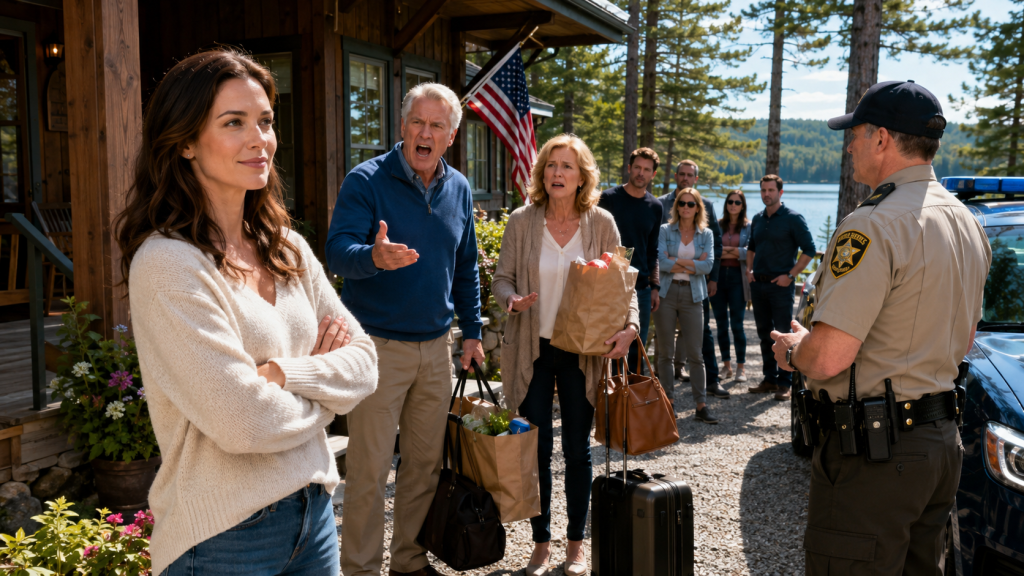
Twenty people stood on my porch and driveway.
My parents.
Kyle.
Kyle’s girlfriend.
Two cousins.
A neighbor couple from my parents’ church.
Several people I did not even recognize.
Coolers.
Suitcases.
Beach chairs.
Plastic bags of groceries sitting in the sun.
My mother wore white linen pants and sunglasses, standing near the porch with one hand on her hip like she was waiting for hotel staff.
Dad stood at the front door holding his phone to his ear, face red.
Kyle was trying the garage keypad, punching buttons aggressively.
I tapped the microphone but did not speak yet.
Behind them, at the end of the gravel road, a sheriff’s cruiser turned into the driveway.
I sat back against my pillows.
Dad kept talking.
“Your brother took time off work. People drove three hours. Do you understand how embarrassing this is?”
“Yes.”
“Then open the house.”
“No.”
“Claire.”
“No.”
“You’re done with this family if you keep this up.”
I looked at the camera feed.
At Kyle stepping back from the garage as the cruiser approached.
At my mother lowering her sunglasses.
At Mrs. Harper standing on her porch across the road with a coffee mug in her hand, watching like she had been waiting years for this episode.
“Then I guess I’m done,” I said.
Dad began shouting again, but I lowered the phone and spoke through the doorbell speaker.
“Deputy, I’m the owner. I’m available by phone if you need confirmation.”
Everyone on the porch froze.
Mom’s head snapped toward the camera.
“Claire!” she shrieked. “Stop embarrassing us!”
I almost laughed.
Twenty guests.
Melting groceries.
Illegal entry plans.
And I was the embarrassment.
The deputy stepped out of the cruiser.
He was middle-aged, calm, and moved with the steady patience of someone who had dealt with family property disputes before.
“Morning,” he said. “Who is Richard Bennett?”
Dad turned toward him, still holding the phone.
“I am. This is my daughter’s house.”
“Exactly,” I said through the speaker. “My house.”
Several guests looked at each other.
One woman backed away from the porch with her cooler.
Dad glared at the camera.
“You shut that thing off.”
“No.”
The deputy checked his notes.
“The owner submitted written notice that no one has permission to enter the property.”
Mom let out an offended laugh.
“She is our daughter.”
The deputy nodded.
“That does not give you access to her property.”
Kyle muttered, loud enough for the microphone to catch, “She actually called the cops?”
I tapped the speaker again.
“No, Kyle. I protected my property.”
His face reddened.
Dad pointed toward the house.
“We have used this place before.”
“Without permission,” I said.
“That is not true.”
“Last summer you used the hot tub, left beer cans inside it, broke the dock light, and told me I was overreacting when I sent the cleaning bill.”
One of the guests turned to Kyle.
“You said Claire knew we were coming.”
Kyle looked away.
Mom clutched her chest.
“You’re making us look like criminals.”
“You brought twenty people to a house you were told not to use.”
Dad snapped, “Because family does not need written permission.”
The deputy looked up from his notepad.
“Actually, sir, it does.”
Mrs. Harper made a sound from across the road that might have been a cough or a laugh.
Dad’s face went redder.
“This is ridiculous. We’re leaving in two days anyway.”
The deputy’s voice remained even.
“You are leaving now.”
My mother stared at him.
“You can’t force us off our own daughter’s property.”
“Ma’am, I can remove trespassers from private property.”
The word trespassers hit the porch like a bucket of cold water.
Guests began moving faster.
Coolers were lifted.
Bags were gathered.
Someone whispered, “I told you we should have booked a rental.”
Mom’s face crumpled, but I knew that expression.
It was not sadness.
It was strategy.
She turned toward the camera and let her voice tremble.
“Claire, honey, please. Don’t do this to your mother. Everyone was so excited. We just wanted a family weekend.”
I looked around my quiet apartment.
My clean sheets.
My empty morning.
My first peaceful day off in almost three weeks.
“You wanted a free vacation,” I said.
Her tears vanished almost instantly.
“You ungrateful girl.”
There she was.
Dad lowered his voice again.
“Open the door now, or you will not be welcome in my house again.”
I picked up my phone.
“Dad, I have my own house. That’s the part you keep missing.”
The deputy asked them to leave again.
This time, he did not ask gently.
Kyle kicked a pebble across the driveway and muttered something I could not hear.
Mom cried loudly for the audience.
Dad cursed all the way to his truck.
Within twenty minutes, the driveway was empty except for tire marks, two forgotten grocery bags, and Mrs. Harper crossing the road in her slippers.
She walked straight to the porch camera and lifted her coffee mug.
“Nice morning,” she said.
I laughed for the first time in days.
“Thank you, Margaret.”
“Oh, don’t thank me yet. Your mother left potato salad in the sun. That feels like a threat.”
“I’ll be there this afternoon.”
“Good. I’ll put the groceries in the shade. The edible ones. I’m not touching the potato salad.”
By noon, Mom had sent a long message to the family group chat.
Mom: I hope everyone sees what Claire did. She called law enforcement on her own parents and humiliated us in front of friends. All because she has become selfish and thinks property matters more than family.
Kyle added: She’s always been dramatic.
Dad did not write anything.
That meant he was angry enough to wait.
I stared at the messages for a while.
For most of my life, I would have defended myself.
Explained.
Apologized for tone.
Sent money for hotel rooms.
Tried to make peace.
Instead, I sent one screenshot.
It was Mom’s message from earlier.
Mom: 😂😂😂 You really think you can stop us?
Then I wrote:
Yes.
I muted the chat.
That afternoon, I drove to the lake house alone.
The road wound through pine trees, and with every mile, the tightness in my chest loosened.
By the time I turned onto the gravel lane, the lake was shining through the trees.
Mrs. Harper was waiting on her porch.
She lifted one hand.
I pulled into my driveway and sat there for a moment, looking at the house.
The cedar siding.
The green shutters.
The porch swing I had installed myself.
The little stone path I laid one painful weekend after watching too many videos and overestimating my own strength.
It was not perfect.
But it was mine.
That word still felt miraculous.
Mine.
Mrs. Harper walked over carrying a paper bag.
“Salvaged the fruit, cheese, and two bottles of sparkling water,” she said. “The rest looked suspicious.”
“Thank you.”
She studied me.
“You okay?”
I leaned against my car.
“I think so.”
“That means no.”
I smiled tiredly.
“I’m angry.”
“Good.”
“Good?”
“Anger is how your spine reminds you it exists.”
That sounded exactly like something Mrs. Harper would say.
I carried my bag inside.
Everything was quiet.
No twenty guests.
No coolers.
No loud jokes from Kyle.
No mother opening cabinets and rearranging things while calling it helpful.
No father sitting in my chair like ownership came with age.
I walked room to room checking locks.
Front door secure.
Back door secure.
Garage secure.
The old keypad disabled.
The guest room neat.
The pantry untouched.
For the first time since buying the house, I realized I had always been waiting for them to take it.
Maybe not physically.
Maybe not all at once.
But emotionally.
My family had a way of claiming space before they entered it.
They made you feel guilty for closing doors.
They made boundaries sound like betrayal.
I stocked the fridge for myself.
Fresh fruit.
Eggs.
Cream for coffee.
Salmon.
A salad kit.
One chocolate cake slice from the grocery bakery because I had survived the week and deserved frosting.
Then I made tea, walked to the dock, and sat with my feet above the water.
The lake moved softly against the posts.
A heron stood near the reeds.
Across the road, Mrs. Harper’s wind chimes rang faintly.
My phone buzzed.
I ignored it.
Then again.
I glanced down.
A voicemail from Dad.
Against my better judgment, I played it.
His voice was quieter this time.
“Claire, you went too far today. Your mother is beside herself. People are talking. You made us look like fools. I don’t know where you learned this kind of disrespect, but it did not come from us. When you are ready to apologize, call.”
I deleted it.
No hesitation.
The second voicemail was from Mom.
She was crying.
At least, she wanted me to think she was crying.
“Claire, I hope you’re happy. Your father’s blood pressure is up. Kyle is upset. Everyone thinks we lied to them. Do you know how humiliating that is? You could have just opened the door.”
I deleted that too.
Then came a text from Aunt Diane.
Your mother says you called the sheriff on them. Is that true?
I typed back:
They tried to enter my house after I said no. The sheriff asked them to leave.
Aunt Diane replied three minutes later.
Oh. She left that part out.
Of course she did.
By evening, the family group chat had split into factions.
Some relatives said I was cruel.
Some said my parents had gone too far.
A cousin privately messaged me to say, “They did this with my beach condo once. I wish I’d done what you did.”
That message stayed with me.
Because it reminded me that my parents did not only take from me.
They took from anyone who had something useful and a weak enough boundary.
The difference was, my boundary had finally held.
At sunset, I opened the windows and let the cool lake air move through the house.
I made dinner.
A quiet dinner.
Just for me.
I ate at the small wooden table facing the water.
No one criticized the seasoning.
No one asked why I had not made more.
No one invited themselves to leftovers.
After dinner, I sat on the dock wrapped in a blanket and watched the sky turn purple.
I thought about the first time I saw this house.
I had been twenty-eight, exhausted, and grieving after losing a patient I had cared for over three admissions.
I drove aimlessly after work and ended up near Devils Lake.
The house had a faded For Sale sign tilted near the road.
The real estate photos online were terrible.
Dark rooms.
Old carpet.
A kitchen with yellow counters.
But when I stood on the back deck and heard nothing but water and wind through pine needles, I started crying.
The agent thought something was wrong.
I told her, “No. It’s just quiet.”
I bought it six months later with a loan I barely qualified for and savings I had guarded like oxygen.
My parents said it was stupid.
Mom said, “A single woman doesn’t need two homes.”
Dad said, “You should have asked me before making a decision that big.”
Kyle asked if he could use it for a party before I had even moved furniture in.
They never saw the house as my refuge.
They saw it as inventory.
Something in the family ecosystem that could be used, borrowed, occupied, consumed.
Just like my time.
My labor.
My money.
My patience.
The next morning, Dad drove back alone.
I saw his truck on the camera before he knocked.
For a moment, I considered not answering.
Then I opened the door but left the screen locked.
He looked older than he had on camera.
Anger had settled into tired lines around his mouth.
“You really changed the locks,” he said.
“Yes.”
“Still treating me like a criminal?”
“I’m treating you like someone who tried to enter my house without permission.”
His jaw worked.
“I am your father.”
“I know.”
“That should mean something.”
“It used to mean I had to say yes.”
He looked away.
The lake wind moved through the pines.
“I drove three hours,” he said.
“I didn’t ask you to.”
His eyes snapped back to mine.
“You know, your mother barely slept.”
“I slept great.”
The words surprised both of us.
Dad’s face hardened.
“This attitude is ugly on you.”
“No,” I said quietly. “It’s just unfamiliar.”
For once, he did not have an immediate response.
I continued.
“I said no. You laughed. You brought twenty people anyway. You expected me to fold because I always have.”
“We are your family.”
“Then act like it.”
His face changed.
Something flickered beneath the anger.
Maybe shame.
Maybe just frustration that his usual tools were not working.
“We wanted one weekend,” he said.
“No. You wanted control.”
“That’s dramatic.”
“Is it? You ordered me to stock the fridge. You gave guests my address. You saved old access codes. You tried the garage. You told me I could not stop you.”
He looked toward the driveway.
“I didn’t think you’d actually involve the sheriff.”
“I didn’t think you’d actually try to break into my house.”
He flinched.
Good.
Not because I wanted to hurt him.
Because truth should land somewhere.
Dad lowered his voice.
“We were proud when you bought this place.”
“No, you weren’t.”
“Yes, we were.”
“You called it foolish.”
“I was worried.”
“You called it lonely.”
“I didn’t want you isolating yourself.”
“You asked if Kyle could use it for Labor Day before you asked if I was happy.”
He opened his mouth, then closed it.
He remembered.
I saw it.
That tiny crack in certainty.
I stepped closer to the screen.
“I work in rooms where people run out of time. Every week, I watch families bargain with minutes. I bought this house because I needed somewhere my life belonged to me. Not to the hospital. Not to patients. Not to you. Me.”
His face softened slightly.
“Claire…”
“No. You don’t get to make this tender now. Not before you understand it.”
He straightened.
“I understand you’re upset.”
“I’m not upset. I’m done.”
Those words hung between us.
He stared at me.
“With what?”
“With being available for taking.”
The wind moved across the porch.
For once, my father looked uncertain.
Not defeated.
Not transformed.
Just uncertain.
That was new.
“What do you want?” he asked finally.
The question almost made me laugh.
Nobody in my family asked me that.
They told me what they needed and called it love.
“I want you to leave,” I said.
His face tightened.
“That’s it?”
“For today, yes.”
“And after today?”
“You apologize. Not for being embarrassed. Not because guests saw it. You apologize for deciding my no did not matter.”
He looked at the lake.
His pride fought visibly across his face.
Then he said, “I’ll talk to your mother.”
“That is not an apology.”
“No,” he admitted. “It isn’t.”
At least he knew that much.
He walked back to his truck.
Before getting in, he turned.
“Your grandfather would have liked this place.”
That startled me.
My mother’s father had been a quiet man who fished at dawn and died when I was twelve.
“He would have,” I said.
Dad nodded once.
Then drove away.
It took three weeks for my mother to call without crying.
I answered because I was curious.
Not hopeful.
Curious.
“I suppose you think you proved something,” she said.
“Hello to you too.”
She sighed dramatically.
“Your father says I should apologize.”
“Do you agree?”
Silence.
Then, “I think you hurt me very much.”
“That is not an apology.”
Another silence.
“I don’t understand why everything has to be so formal with you now.”
“Because informal meant you took whatever you wanted.”
“That is unfair.”
“Is it untrue?”
She did not answer.
I heard dishes clinking in the background.
She was probably standing in her kitchen, staring out the window, trying to understand why the daughter she trained to be useful had become inconvenient.
Finally, she said, “I should have asked.”
It was not enough.
But it was a sentence I had never heard from her before.
“Yes,” I said. “You should have.”
“We were embarrassed.”
“You embarrassed yourselves.”
Her voice sharpened.
“You don’t have to be cruel.”
“Mom, consequences are not cruelty.”
She breathed heavily into the phone.
Then said, quieter, “I don’t know how to do this.”
“Do what?”
“Have a daughter who says no.”
That honesty surprised me.
I sat down.
“Then learn.”
She hung up soon after.
Not angrily.
Abruptly, like she had run out of tools.
The months after that were uncomfortable.
Family gatherings changed.
I stopped hosting holidays by default.
I stopped answering calls during work.
I stopped sending money to Kyle when he made poor choices and called them emergencies.
The lake house remained off-limits unless I invited someone.
At first, everyone called me difficult.
Then strict.
Then eventually, quietly, they adjusted.
Boundaries feel cruelest to people who benefited from you not having any.
Kyle complained the longest.
He sent me one message that said:
Must be nice to care more about a house than family.
I replied:
Must be nice to confuse access with love.
He did not respond.
The following spring, I invited Aunt Diane and two cousins to the lake house for a quiet weekend.
Not because they demanded it.
Because they asked.
They brought groceries.
They washed dishes.
They stripped the guest beds before leaving.
Aunt Diane sat with me on the dock and said, “I never realized how peaceful it is here.”
I looked over the water.
“That’s why I protect it.”
She nodded.
“I get it now.”
That meant more than she knew.
A year after the sheriff incident, my parents came to the lake house for lunch.
By invitation.
Just them.
No guests.
No coolers.
No assumptions.
Mom arrived holding a pie.
Dad carried a small toolbox because he had asked if anything needed fixing and I had said the porch step was loose.
Asked.
That was the difference.
They stood on the porch awkwardly, like people visiting a country whose customs they did not know.
Mom looked at the door keypad.
“You changed it again?”
“Yes.”
She nodded.
Not offended this time.
Just noticing.
Lunch was strange but civil.
Dad fixed the porch step.
Mom complimented the curtains without adding what she would have chosen instead.
After we ate, we walked to the dock.
Dad stood looking at the water for a long time.
“I was wrong that day,” he said.
Mom stiffened slightly beside him.
I waited.
He continued.
“I thought because you were my daughter, what was yours was somehow open to me. That wasn’t right.”
My throat tightened.
“No. It wasn’t.”
He looked at me.
“I’m sorry.”
A real apology is not fancy.
It does not arrive with violins.
Sometimes it is just an old man standing on a dock admitting he confused fatherhood with permission.
I nodded.
“Thank you.”
Mom looked down at her hands.
“I’m sorry too,” she said, quieter.
I turned toward her.
“For what?”
She looked uncomfortable.
“For laughing when you said no. For bringing people anyway. For making you the villain when I was embarrassed.”
That one mattered.
I let the silence sit.
Then I said, “Thank you.”
Forgiveness did not rush in.
It did not erase the past.
But something shifted.
Not enough to hand over a door code.
Enough to sit together and watch the lake.
That was a start.
People sometimes think boundaries destroy families.
Sometimes they do.
But sometimes boundaries only destroy the old arrangement where one person is expected to disappear so everyone else can be comfortable.
My family did not become perfect after that.
My mother still comments too much.
My father still struggles when I say no.
Kyle still thinks the world owes him snacks, praise, and free lodging.
But they do not show up at my lake house uninvited anymore.
They ask.
And sometimes I say yes.
Sometimes I say no.
The sky does not fall either way.
Last Friday, I drove to the lake house after another long shift.
My scrubs smelled like antiseptic and coffee.
My feet hurt.
My phone buzzed with messages.
But this time, it was Mrs. Harper.
Margaret: Heron is back. Also your porch light is flickering.
Me: I’ll fix it tomorrow.
Margaret: I have pie.
Me: I’ll be there in thirty.
When I arrived, the house was dark except for the porch light blinking softly.
The lake was still.
The air smelled like pine and rain.
I unlocked the door with my code, carried my bag inside, and stood for a moment in the quiet.
No one had entered without asking.
No one had filled the rooms with entitlement.
No one had turned my refuge into their vacation.
I put groceries in the fridge.
Made tea.
Opened the windows.
Then I walked down to the dock with the slice of chocolate cake I had bought myself on the way.
The water reflected the last gold of sunset.
Across the road, Mrs. Harper’s wind chimes rang.
My phone buzzed once.
Dad: Hope you’re resting this weekend.
I stared at the message.
Simple.
No demand.
No guilt.
No question hiding an expectation.
I typed back:
I am.
Then I set the phone down.
For years, I thought peace would come when my family finally understood me.
But peace came earlier than that.
It came the first time I said no and refused to decorate it with apology.
It came when I changed the locks.
It came when I let the sheriff turn into the driveway while my father screamed outside a house he did not own.
It came when I realized being called selfish was not fatal.
My lake house is still small.
The porch step still complains.
The kitchen drawer sticks.
The dock needs staining.
But every imperfect inch of it belongs to me.
Not because my name is on the deed, though it is.
Because I finally learned to protect the life I built.
My parents once asked if I really thought I could stop them.
They laughed when they asked.
By Friday morning, they had their answer.
Yes.
I could stop them.
And more importantly, I could stop myself from opening the door.
THE END! THANKS FOR READING!