 Reading Time: 15 minutes
The morning my hungry twins ran out of formula, I tried to sell my only bicycle.The pawn shop owner snapped, “Keep begging here and child services will take them by dinner.”I lifted my babies higher and said nothing.
Across the street, a billionaire stopped his black car.The wind had teeth that morning.It cut through my coat, through the thin blanket wrapped around Emma and Lily, and through the last piece of pride I had left.
My bicycle rattled beside me like it was begging to fall apart.The blue paint was chipped down to rust.
The front wheel shook every time it crossed a crack in the sidewalk.The chain slipped twice before I reached the pawn shop on East Mercer, but I kept one hand on the handlebars and the other pressed against the sling holding my daughters to my chest.
They were six months old and too quiet.
That scared me more than crying.
Crying meant they still had energy.
Quiet meant they were saving it.
I had watered down the last bottle before sunrise and hated myself for every drop.
I had already returned cans, sold my winter boots, and skipped meals until my hands trembled when I buttoned their pajamas.
The bicycle was the last thing I owned that someone might pay for.
It was how I had gotten to work before the diner cut my hours.
It was how I had gone to clinic appointments before the girls were born.
It was ugly and old, but it had carried me through more nights than most people.
The bell over the pawn shop door rang too cheerfully when I pushed inside.
The place smelled like dust, wet cardboard, and old smoke.
A man with gray hair and a sweater vest sat behind the counter, scrolling on his phone.
He did not look up.
“Excuse me,” I said.
Nothing.
Lily shifted against my chest and made a tiny hungry sound.
I swallowed hard.
“Sir, please. I want to sell my bike.”
He finally looked at me, then at the bicycle, then at my babies.
His mouth curled like I had dragged garbage across his floor.
“I do not buy junk.”
“It works,” I said quickly. “The tires need air, but the frame is good. I just need enough for formula.”
He set his phone down.
For one foolish second, I thought he had heard the word formula and remembered he was human.
Instead, he leaned over the counter and looked at my girls like they were evidence against me.
“Keep begging here and child services will take them by dinner.”
The words landed so hard I could not breathe.
Emma opened her eyes.
Lily’s mouth moved against the blanket, searching for a bottle I did not have.
My face burned, but I did not cry.
I lifted my babies higher and said nothing.
Because if I opened my mouth, I was afraid all the fear would spill out.
The owner pointed at the door.
“Out.”
So I backed away with the bicycle, careful not to bump a shelf of cracked plates.
The bell rang again when I stepped outside.
The cold hit the girls first, and both of them whimpered.
I tucked the blanket around their heads, bent over them to block the wind, and stood there with my forehead nearly touching theirs.
“I am going to fix this,” I whispered.
I did not know how.
Across the street, a black car sat at the curb with its engine running.
I noticed it only because it was too clean for that block.
The windows were tinted.
The hood shone even under the gray sky.
Inside, a man in a dark wool coat had both hands on the steering wheel.
He was watching me.
I tightened my grip on the bicycle.
Men in expensive cars did not stop for women like me unless they wanted something.
The light turned green.
Cars behind him honked.
He did not move.
Then his engine shut off.
The driver’s door opened, and the man stepped out into the freezing air.
He was young, maybe early thirties, tall, clean-shaven, with the kind of shoes that had never had to dodge slush.
Everything about him looked polished.
Everything about me felt torn.
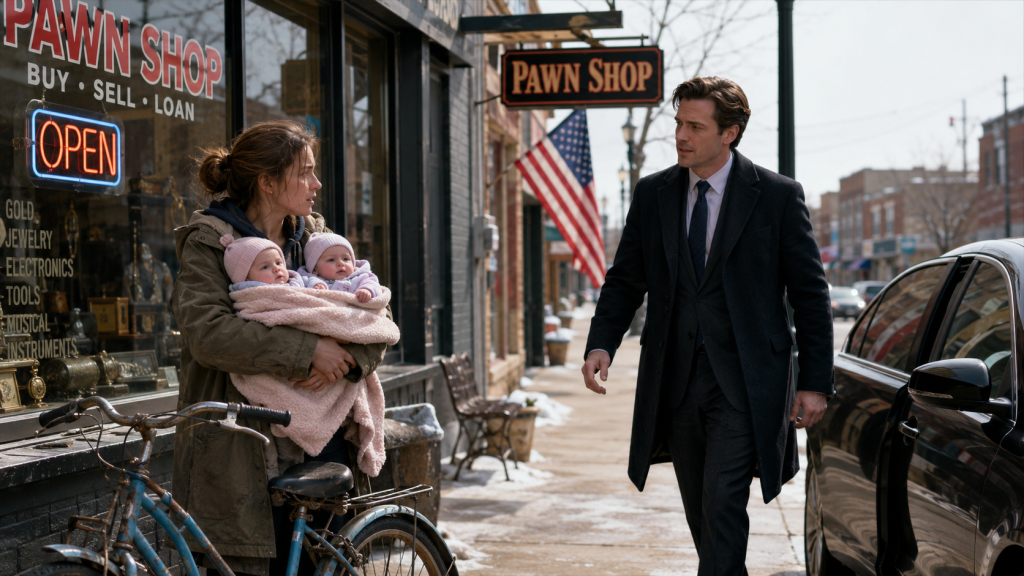
He crossed the street with both hands visible, palms slightly out, like he already knew I was ready to run.
“I’m sorry,” he said. “I saw what happened.”
“I don’t need trouble.”
“I know.”
He stopped several feet away.
His eyes moved to the girls, but not in the way the pawn shop owner’s had.
He looked worried.
Not disgusted.
“Are they hungry?”
That question almost broke me.
I hated that the answer was on my face.
“We are fine.”
One of the babies cried then, a thin, tired sound that told the truth for me.
The man’s jaw tightened.
He turned his head toward the pawn shop window.
The owner was watching from inside, wearing the same smug smile.
“What is your name?” the man asked.
“Katie.”
“Katie, I’m Dylan Reed.”
I had heard that last name before.
Everyone in the city had.
Reed Towers.
Reed hospitals.
Reed grocery chains.
The kind of name printed on buildings where women like me mopped floors after closing.
“I don’t want your money,” I said.
“I did not offer money.”
“Then what do you want?”
He looked at the bicycle.
Then at the pawn shop.
Then at my daughters.
For the first time, his voice went cold.
“I want to buy what he called junk.”
I almost laughed because I thought he was mocking me too.
But Dylan walked past me, opened the pawn shop door, and held it so I could enter first.
The owner straightened the second he recognized him.
Rich people always got recognized faster than hungry babies.
“Mr. Reed,” he said, suddenly smiling. “What can I do for you?”
Dylan did not smile back.
He looked at my shaking hands on the handlebars.
He looked at Emma and Lily pressed against my chest.
Then he reached into his coat, and even the pawn shop owner stopped smiling.
Dylan pulled out a black checkbook and placed it on the counter.
“How much for the bicycle?” he asked.
The owner blinked.
“That bicycle?”
“Yes.”
“Well, Mr. Reed, honestly, it is not worth anything. Scrap metal at best.”
Dylan opened the checkbook.
“Then you should have had no problem being kind.”
The owner’s smile twitched.
“I did not mean any offense.”
“No,” Dylan said. “You meant every word.”
My cheeks burned hotter than before.
I did not want to be there.
I did not want witnesses to my hunger.
I did not want a stranger in an expensive coat turning my humiliation into a scene.
But Emma’s little mouth was still moving against the blanket.
And pride did not fill bottles.
Dylan wrote something on the check.
Then he tore it out and placed it in front of me.
I stared at it.
Ten thousand dollars.
My eyes blurred.
“No,” I whispered.
The pawn shop owner made a choking sound.
“Sir, that bicycle is not worth—”
“I didn’t ask you,” Dylan said.
His voice was calm.
That made it worse.
Some people yell when they are angry.
Dylan Reed sounded like a door locking.
I pushed the check back.
“I cannot accept this.”
He looked at Emma and Lily.
“Then accept it for them.”
My arms tightened around the girls.
“I am not a charity case.”
“No,” he said gently. “You are a mother standing in the cold with two hungry babies and a bicycle you were willing to lose for them. There is nothing shameful about that.”
The words hit me in a place I had kept hidden.
All morning, I had felt like failure.
Like every stranger could look at me and see that I had not slept, had not eaten, had not managed to keep enough formula in the cupboard.
But Dylan looked at me like I was not broken.
Like I was fighting.
The pawn shop owner folded his arms.
“Mr. Reed, with respect, you are encouraging this kind of behavior. People come in here every week with stories.”
Dylan turned to him.
“What kind of behavior?”
The man hesitated.
“Begging. Bringing children into it. Making people feel guilty.”
Dylan stared at him.
“She tried to sell something she owned.”
“She was making a scene.”
“The only scene I saw was a grown man threatening a mother with child services because she asked for help feeding infants.”
The owner’s face reddened.
“That is not what happened.”
Dylan glanced toward the ceiling.
“Do you have cameras?”
The owner went pale.
I looked up.
A small black camera pointed toward the counter.
Dylan saw it too.
“Good,” he said. “Then it should be easy to confirm.”
The owner swallowed.
“I think we all got off on the wrong foot.”
“No,” Dylan said. “You showed me exactly who you are.”
He turned back to me and held the check out again.
“Katie, the bicycle is mine now. That is a purchase, not charity.”
My hands were shaking so badly I could barely take it.
The check felt unreal.
Too thin to hold the difference between despair and survival.
I tucked it inside my coat with numb fingers.
“Thank you,” I said, though the words felt too small.
Dylan nodded once.
“Now we are going to get them formula.”
“I can go myself.”
“You can,” he said. “But you are freezing, and they need warmth. My car is right outside.”
Every warning bell in my head rang at once.
I looked toward the street.
“I do not get into cars with strangers.”
“Good,” he said. “Do not start today.”
Then he pulled out his phone.
“I’ll call a female staff member from our family services office. She can meet us at the pharmacy, or she can ride with you. Your choice.”
That stopped me.
He did not look offended.
He did not pressure me.
He gave me a choice.
I had gone so long without choices that the simple decency almost hurt.
“The pharmacy is two blocks away,” I said. “I can walk.”
“Then I will walk too.”
So we walked.
Me with the twins pressed to my chest.
Dylan beside me, holding the old bicycle by the handlebars.
The black car followed slowly along the curb, driven by a silent man in a suit.
People stared.
I would have laughed if I had not been so tired.
A billionaire walking a rusted bicycle through East Mercer like it was priceless.
At the pharmacy, Dylan did not sweep through like a savior in a movie.
He stood back.
He let me choose the formula my babies used.
He asked before adding diapers.
He asked before adding blankets.
He asked before adding baby medicine, wipes, bottles, and a thermometer.
Every time I nodded, he placed the item gently into the cart.
When we reached the counter, I braced myself.
The total would have made me sick yesterday.
Dylan tapped his card before the cashier even finished speaking.
“Wait,” I said. “I have the check now.”
“And the check is for the bicycle,” he replied. “This is for making sure my newest investment has properly fed passengers.”
I frowned.
“What investment?”
He nodded toward the bicycle leaning outside the window.
“That one.”
For the first time that day, I almost smiled.
Almost.
We sat in the pharmacy’s small waiting area while I made the bottles.
My hands shook so badly that Dylan asked the cashier for warm water and clean napkins. He did not try to take over. He did not touch the babies without permission.
He just stood nearby, blocking the cold draft from the door.
Emma drank first.
Her tiny body relaxed against me in a way that made tears fill my eyes.
Then Lily.
Both of them drank like they had been waiting forever.
I bent my head over them and cried silently.
No sound.
Just tears falling onto the blanket.
Dylan looked away to give me privacy.
That small kindness undid me more than any grand gesture could have.
When the girls were fed, they fell asleep almost immediately.
Their cheeks looked less hollow.
Their hands unclenched.
I could breathe again.
Dylan sat across from me.
“Where are you staying tonight?”
I looked down.
His expression changed.
“You do not have to answer if you do not want to.”
“We have a room,” I said.
It was not exactly a lie.
It was a motel room.
One week behind.
With a heater that clicked all night and a bathroom sink that dripped brown water for the first few seconds.
The manager had warned me that morning.
Pay by six or leave.
Dylan heard the part I did not say.
“Is it safe?”
I looked at my sleeping daughters.
“No.”
He nodded slowly, as if that answer mattered more than his discomfort.
“My family funds a housing program for mothers and children,” he said. “Private apartments. Case managers. Job placement. Child care support. It is not a shelter with rows of beds. It is quiet, secure, and voluntary.”
I stiffened.
“I told you I do not want charity.”
“It is not charity,” he said. “It is infrastructure. Everyone wealthy enough to put their name on a building should be required to build doors people can actually walk through.”
I stared at him.
“That sounds like something printed in a brochure.”
He smiled sadly.
“My sister wrote the brochure.”
The smile disappeared as quickly as it came.
“She had twins too.”
Something in his voice shifted.
Not performance.
Pain.
“She died?” I asked softly.
Dylan looked toward the pharmacy window.
“After childbirth complications. Her husband left before the babies were one. My parents and I raised them.”
“I’m sorry.”
“So am I.”
For a moment, we were not a poor mother and a billionaire.
We were just two people sitting under fluorescent lights, both haunted by babies who needed more from the world than the world had given.
He looked back at me.
“I did not stop because I wanted to feel generous,” he said. “I stopped because I know what hungry babies sound like. And because no mother should have to stand outside a pawn shop deciding which piece of her life to sell next.”
My throat tightened.
The motel manager called while we were still sitting there.
I stared at the screen until it stopped ringing.
Dylan did not ask.
I told him anyway.
“We have until six.”
“Then let us get your things.”
An hour later, Dylan stood outside the motel office while his driver, a woman from the family services program named Mrs. Alvarez, and I packed everything I owned into three garbage bags and one cracked plastic bin.
It took fifteen minutes.
That was how little my life had become.
A few baby clothes.
Half a pack of diapers.
Two worn sweaters.
A folder with birth certificates.
A photo of my mother.
A yellow blanket from the hospital.
The motel manager watched from the doorway.
“You got money now?” he asked.
Dylan turned slowly.
The manager stepped back.
Mrs. Alvarez took the room key from my hand.
“I will handle checkout,” she said.
Her voice was warm but firm.
She was in her sixties, with silver hair pulled into a bun and eyes that seemed to notice everything without judging any of it.
In the car, she sat beside me while Dylan rode in the front.
She showed me her identification.
She explained the housing program.
She gave me paperwork, but did not ask me to sign anything yet.
“Tonight, you sleep,” she said. “Tomorrow, we talk.”
The apartment they brought us to was on the third floor of a clean brick building near a hospital.
It had two bedrooms.
A small kitchen.
A blue couch.
A crib with fresh sheets.
Then another crib beside it.
I stopped in the doorway and could not move.
Mrs. Alvarez put a hand gently on my shoulder.
“You are safe here.”
I looked at the cribs.
Fresh sheets.
Tiny blankets.
No heater clicking like it might fail.
No motel manager banging on the door.
No pawn shop owner threatening to take my babies.
Just warmth.
I walked into the room, laid Emma in one crib and Lily in the other, and watched both of them sleep.
Then my knees gave out.
Mrs. Alvarez caught my elbow and guided me to the couch.
Dylan stayed near the door.
He did not step deeper into the apartment.
“This is yours for as long as the program approves,” he said. “Mrs. Alvarez will explain everything. I will not bother you.”
I looked up at him.
“Why?”
He understood the real question.
Why me?
Why stop?
Why care?
Why not just drive away like everyone else?
He held the rusted bicycle upright beside him.
“Because someone should have stopped for my sister sooner,” he said. “And because today, I could.”
Then he left.
For three days, I slept between feedings.
Mrs. Alvarez checked on us.
A pediatric nurse visited and examined the girls.
They were underweight, but stable.
That word became my first miracle.
Stable.
Not fine.
Not perfect.
But stable.
I opened a bank account with the check from the bicycle.
I paid off the motel debt.
I bought groceries.
Real groceries.
Eggs.
Rice.
Vegetables.
Chicken.
Fruit.
Coffee.
Formula stacked in the cabinet like treasure.
Every time I opened that cabinet, I touched the cans just to make sure they were real.
A week later, Mrs. Alvarez sat across from me at the little kitchen table.
“What kind of work have you done?”
“Diner shifts. Cleaning. Stockroom. Reception for six months before the pregnancy got complicated.”
“You finished high school?”
“Yes.”
“Any college?”
“One year. I dropped out when my mother got sick.”
She nodded and wrote something down.
“What do you want, Katie?”
The question startled me.
“Want?”
“Yes. Not just what job will keep you alive. What life are you trying to build?”
No one had asked me that in years.
I looked toward the twins sleeping in their cribs.
“I want them to never know what it feels like to be hungry.”
Mrs. Alvarez smiled gently.
“That is a beginning. Now let’s build the rest.”
She helped me apply for child care assistance through the program and a trainee position at Reed Hospital’s daycare center.
I almost did not go to the interview.
I had one decent blouse, borrowed from the program closet.
My hair was tied back.
My shoes were old.
I looked at myself in the mirror and saw every failure first.
Then Emma made a soft sound from the crib.
Lily kicked her blanket.
And I remembered the pawn shop owner’s voice.
Keep begging here and child services will take them by dinner.
I went to the interview.
Two weeks later, I started work.
The daycare smelled like baby shampoo, crackers, crayons, and clean laundry.
For the first few days, every crying child made my chest tighten.
But slowly, I learned the routines.
Bottles.
Nap schedules.
Tiny shoes.
Gentle voices.
I was good at it.
Not because it was easy.
Because I knew what it meant to hold something fragile and fight the whole world for it.
Three months after the pawn shop, the girls laughed for the first time on the same afternoon.
Emma laughed because Lily sneezed.
Lily laughed because Emma laughed.
Then both of them kept going until I was sitting on the floor crying and laughing with them.
That night, I took a video and almost sent it to Dylan.
I did not have his number.
I only had the program office contact.
So I sent it to Mrs. Alvarez.
She replied:
This is what rebuilding sounds like.
Spring came slowly.
The city thawed.
The girls grew rounder.
Their cheeks filled out.
Their eyes brightened.
I started classes at night for early childhood education.
I was tired all the time, but it was different from before.
Before, exhaustion felt like drowning.
Now it felt like climbing.
Hard, painful, but upward.
One afternoon, Mrs. Alvarez came to the daycare with a strange look on her face.
“Katie,” she said, “there is somewhere I think you should go.”
She drove me back to East Mercer.
My stomach tightened the closer we got.
The pawn shop was gone.
The dirty window was covered with brown paper.
A construction crew stood outside.
Above the door hung a temporary sign.
REED FAMILY CENTER FOR MOTHERS AND CHILDREN
Opening Soon
I stared at it.
My throat closed.
Mrs. Alvarez stood beside me.
“He bought the building.”
“He said he would,” I whispered.
“He meant it.”
The old pawn shop owner was nowhere to be seen.
In the window, taped to the inside of the glass, was a printed announcement.
No mother asking for help will ever be turned away.
I covered my mouth.
The words blurred.
For months, I had wondered whether that day was just a strange accident of fate.
A rich man at the right traffic light.
A cold morning.
A crying baby.
But standing there, I understood something.
Kindness becomes real when it does not stop at one person.
Dylan had not just helped me.
He had removed a locked door and built another one for women behind me.
A week before the center opened, Dylan visited the daycare.
I saw him through the glass first.
Same dark coat.
Same polished shoes.
But when Emma saw him, she reached toward the window and slapped her tiny hand against it.
He looked startled.
Then he smiled.
I carried both girls into the hallway.
“They look healthy,” he said.
“They are.”
“And you?”
I thought about lying.
Then I smiled.
“I am getting there.”
His eyes softened.
“That counts.”
I shifted Lily on my hip.
“I saw the center.”
He nodded.
“I hoped you would.”
“You named no one.”
“It was not my story to name.”
That nearly made me cry.
“I never thanked you properly.”
“You did.”
“When?”
“The day you kept going.”
I looked down, overwhelmed.
Dylan glanced at the babies.
“May I?”
I nodded.
He offered Emma his finger, and she grabbed it with fierce little strength.
He laughed quietly.
“She has a grip.”
“She gets that from me,” I said.
For the first time, I said it with pride.
A year later, I stood outside the Reed Family Center on opening day, wearing a navy dress from a thrift store and holding both twins by the hands.
They could walk now.
Wobbly, determined, fearless.
The sidewalk was crowded with reporters, staff, nurses, volunteers, and mothers pushing strollers.
Dylan gave a short speech.
He talked about dignity.
He talked about access.
He talked about how hunger should never be treated like a moral failure.
Then he paused and looked toward me.
He did not say my name.
He did not point me out.
But I knew he was speaking to me when he said, “Sometimes help arrives as a check. Sometimes it arrives as a safe room. Sometimes it arrives as someone believing you before you have the strength to explain.”
The ribbon was cut.
People applauded.
Emma clapped because everyone else did.
Lily tried to eat a piece of the ribbon.
I laughed so hard I had to pull it gently from her hand.
Inside the center, there were shelves of formula.
Rows of diapers.
A warm waiting area.
A job board.
Private counseling rooms.
A small playroom painted yellow.
And near the entrance, behind glass, hung an old blue bicycle with chipped paint and a rusted chain.
My bicycle.
A small plaque beneath it read:
Purchased for $10,000.
Worth much more.
I stood in front of it for a long time.
Mrs. Alvarez came beside me.
“You okay?”
I nodded, tears slipping down my face.
“I thought that bike was the last thing I had.”
She looked at the twins playing nearby.
“No,” she said. “It was the first thing you traded for your new life.”
Years later, when Emma and Lily were old enough to ask about the bicycle in the family center, I told them the truth.
Not all at once.
Not the cruel parts first.
I told them their mother had been scared.
I told them she had tried to sell something she loved to feed them.
I told them a stranger saw us and chose not to look away.
Emma asked, “Was he an angel?”
I smiled.
“No. He was a person. That is better.”
Lily frowned.
“Why?”
“Because angels are supposed to help,” I said. “People choose to.”
And that was what I wanted my daughters to understand.
Not that billionaires save poor mothers.
Not that suffering magically turns into miracles.
But that cruelty is a choice.
Looking away is a choice.
Kindness is a choice too.
So is asking for help.
So is accepting it.
So is rebuilding.
The pawn shop owner had looked at me and seen a problem.
Dylan Reed had looked at me and seen a mother.
Mrs. Alvarez had looked at me and seen a future.
And slowly, painfully, I learned to see one too.
I finished my certification.
Then another.
I became a supervisor at the daycare.
Then a program coordinator at the family center.
Every winter, when the first cold wind cut through the city, I remembered that morning.
The bicycle rattling beside me.
The twins too quiet against my chest.
The pawn shop bell ringing above my head.
That cruel man’s voice telling me my children would be taken by dinner.
And then I remembered the black car stopping across the street.
Not because a rich man saved me.
Because on the worst morning of my life, I still walked through the cold.
I still pushed that bicycle.
I still lifted my babies higher.
I still refused to let shame make me disappear.
That was the beginning of my rescue.
Not the check.
Not the car.
Not the apartment.
Me.
Choosing to keep going one more block.
One more breath.
One more minute.
And when my daughters ask me what that day means, I tell them this:
Sometimes the world will call you junk because it cannot see what carried you.
Do not believe it.
Sometimes people will mistake your need for weakness.
Do not believe them.
And sometimes, just when you think you are standing alone in the cold, someone across the street will finally see you.
But until they do, hold what you love closer.
Lift it higher.
And keep walking.
THE END. THANKS FOR READING!