 Reading Time: 17 minutes
The Night After I Started My First Real Job, My Father Ordered Me to Quit and Babysit My Brother’s Son—Then My 76-Year-Old Apartment Manager Unlocked the Door and Changed Everything
That morning, I walked into Northshore Children’s Rehabilitation Center with a brand-new identification badge clipped to my blouse and my hands trembling with pride. The job was not glamorous.
It did not come with a private office, an impressive title, or a large salary. I was an administrative rehabilitation assistant, which meant answering phones, updating files, organizing therapy schedules, preparing equipment, and helping families navigate a building that could feel overwhelming on their hardest days.
But after six years of night classes, grocery-store shifts, weekend cleaning jobs, and eating instant noodles at midnight so I could afford textbooks, the position felt like the first thing in my life that nobody had handed to me and nobody could take away.
For eight hours, I was not Ethan’s backup babysitter.
I was not my mother’s errand runner.
I was not the daughter expected to understand, adjust, cancel, cover, and forgive.
I was Emily Dawson.
The newest member of a team helping children learn how to walk, speak, reach, trust, and try again.
My supervisor, Linda Powell, met me near reception.
She was in her late fifties, with silver curls, comfortable shoes, and the kind of calm expression that made frightened parents breathe more easily.
“You’re early,” she said.
“I didn’t want to be late.”
“You arrived forty minutes early.”
“I really didn’t want to be late.”
Linda smiled and handed me a blue folder.
“Keep that enthusiasm. Lose the panic.”
By ten that morning, I had learned the building’s four wings.
By noon, I knew which therapy rooms needed extra sensory toys and which printer jammed whenever someone tried to use colored paper.
At two, a little girl named Sophie placed a sticker on my sleeve after completing her first assisted steps.
“You did good,” she told me solemnly.
I nearly cried.
Not because I had done anything extraordinary.
Because someone had looked at me and said I had done well without immediately asking what else I could provide.
At five, Linda stopped beside my desk.
“How was your first day?”
“Better than I hoped.”
“Good. Come back tomorrow.”
I laughed.
“I plan to.”
The pride stayed with me all the way home.
Then I turned into my apartment complex and saw three familiar vehicles parked near the entrance.
Dad’s pickup.
Mom’s SUV.
My brother Ethan’s silver sedan.
The warmth inside me disappeared.
My father stood beside the entrance with his arms crossed, looking like a man guarding a gate.
“You ignored my calls,” he said before I reached him.
“I was working.”
“Exactly.”
That one word carried years of accusation.
My family did not object to work in general.
They objected whenever my work interfered with theirs.
Dad followed me upstairs without waiting to be invited.
When I unlocked my apartment, I discovered Mom had already entered using the emergency key I once gave her.
She sat in the center of my couch with her purse beside her.
Ethan occupied the armchair, scrolling through his phone like the entire meeting bored him.
My apartment was small but mine.
A secondhand dining table stood near the kitchen.
Cheap curtains covered the windows.
Half-unpacked boxes lined one wall.
Every object had been purchased with money earned during exhausted hours.
Nothing inside that room had arrived easily.
Dad closed the door.
“You’ll submit your resignation tomorrow.”
I stared at him.
“What?”
“Ethan needs reliable childcare.”
My brother finally looked up.
“It’s only for a few months.”
“Hire a babysitter.”
“I can’t afford one.”
“Yes, you can. You simply don’t want to.”
Ethan’s expression hardened.
“You don’t know my finances.”
“I know you bought a new television last month and spent a week in Las Vegas in April.”
“That was already paid for.”
“So was my education, one exhausted semester at a time.”
Mom sighed as though I had embarrassed her.
“Emily, your brother has a child.”
“And I have a future.”
Dad stepped closer.
“Family comes first.”
I looked around my apartment.
At the secondhand table.
The cheap curtains.
The stack of medical-administration books I had not yet placed on the shelf.
Everything in that room had cost me sleep.
Every item had a receipt written in hours.
“I’ve already spent years putting everyone else first.”
Ethan laughed.
“You’re being selfish.”
It was almost funny.
I had practically raised his six-year-old son, Noah, while earning my degree.
When Noah’s mother left, Ethan arrived at my door with a diaper bag and called it an emergency.
That emergency lasted five years.
I watched Noah before class.
After class.
During exams.
On weekends.
I missed lectures when he was sick.
Turned down additional work shifts when Ethan wanted to go out.
Studied with a sleeping child across my lap.
Whenever I complained, Mom reminded me that Noah needed stability.
Whenever I asked Ethan to contribute, Dad said family did not keep score.
“You volunteered,” Ethan said.
Something inside me became very still.
“No. I was told I had no choice.”
Mom rolled her eyes.
“You always rewrite history when you’re angry.”
“I’m not angry. I finally stopped forgetting.”
Dad’s jaw tightened.
“You’re quitting tomorrow.”
“No.”
“You’ll call that center first thing in the morning.”
“No.”
His hand moved toward his belt.
At first, I thought he was adjusting it.
Then the metal buckle struck the hardwood floor with a sharp sound that made the room shrink.
Mom smiled.
Not at me.
At him.
As though she had been waiting for the old order to return.
“She forgot she’s just spare labor,” she said.
Not daughter.
Not family.
Not Emily.
Spare labor.
Dad pulled the belt free and wrapped the leather around his fist.
“One last chance.”
I looked him in the eye.
“No.”
The first strike caught my shoulder before I could move.
Pain burst down my arm.
The second burned across my upper back.
I stumbled into the dining table hard enough to knock a framed photograph onto the floor.
The glass shattered.
Ethan rose, but not to stop Dad.
“Can we finish this?” he said. “Noah’s daycare closes at six.”
My mother remained seated.
No one asked whether I could breathe.
Outside, someone began pounding on my door.
“Emily!”
A woman’s voice came through the hallway.
“Open this door!”
Mrs. Rosa Alvarez managed the apartment complex.
She was seventy-six years old, barely five feet tall, and always wore knitted cardigans regardless of the Phoenix heat.
She had managed the building for twenty-eight years.
She knew which tenants worked nights, whose children had asthma, and who might need groceries left outside the door without being embarrassed by the offer.
She watched me leave for classes, interviews, and shifts.
On the morning of my first day at Northshore, she had been watering flowers near the entrance.
“Stand straight,” she told me. “Let that badge know it belongs to someone important.”
Now keys rattled outside my door.
Dad froze.
“Don’t,” he barked.
The lock clicked anyway.
Mrs. Alvarez pushed the door open with a grocery bag hooked over one arm.
Apples rolled across the floor when she saw me doubled over beside the dining table and Dad standing with the belt still wrapped around his fist.
For one breath, nobody moved.
Then she looked at my shoulder.
Looked at the belt.
And said in the calmest voice I had ever heard, “I’ve managed apartments for twenty-eight years. I have never seen a disagreement leave marks shaped like that.”
Dad stepped toward her.
“This does not concern you.”
Mrs. Alvarez walked straight past him.
She placed one gentle hand beneath my elbow and lifted my sleeve.
Red welts were already rising across my skin.
“Oh, sweetheart,” she whispered.
Those two words nearly broke me.
My own mother was standing five feet away and had not once asked whether I was all right.
Mrs. Alvarez removed her phone from her cardigan pocket.
Dad reached for it.
She stepped back faster than I expected.
“Touch me,” she said, “and the police report will become longer.”
She had already called them from the hallway.
Within minutes, two patrol officers stood inside my apartment.
They photographed the broken frame.
The overturned chair.
The belt on the floor.
My shoulder and back.
Dad kept calling it a family disagreement.
Mom said I was dramatic.
Ethan asked whether the process could be hurried because his son’s daycare closed at six.
One officer looked at him.
“Why can’t you collect your own child?”
Ethan opened his mouth.
Nothing came out.
The officers separated us.
Mrs. Alvarez remained beside me.
When they asked whether I wanted to press charges, I hesitated.
Dad heard the silence and smiled.
He believed that smile still controlled me.
Family did not involve police.
Family forgave.
Family protected its own.
But I finally understood that those rules had never protected me.
“Yes,” I said.
Dad’s smile disappeared.
He was arrested for assault.
Mom began crying only when an officer placed him in handcuffs.
“You’re destroying this family,” she told me.
I looked at the belt inside the evidence bag.
“No. I stopped letting this family destroy me.”
Because Mom had entered using a key without permission and supported Dad’s threats, the officers removed her and Ethan from the apartment.
Mrs. Alvarez changed my lock that night.
She refused payment.
“You can argue with me later,” she said. “Tonight, you sleep.”
I barely did.
Every time I closed my eyes, I heard the buckle striking the floor.
At six the next morning, I stood in front of my bathroom mirror trying to button a blouse without lifting my injured arm.
The bruises had darkened.
I considered calling Northshore and saying I was sick.
My first real job had lasted one day.
Perhaps my family had been right.
Maybe every attempt to build a life would collapse the moment they needed me.
Then I remembered Sophie’s sticker still attached to my sleeve.
You did good.
I dressed carefully and went to work.
Linda saw me before I reached my desk.
Her gaze moved from my stiff posture to the bruise near my collar.
“Come with me.”
Inside her office, she closed the door.
I began explaining too quickly.
“It was a family problem. The police handled it. I know this looks unprofessional, but it won’t affect my work.”
“Emily.”
“I really need this job.”
“Emily.”
I stopped.
Linda placed a mug of coffee in front of me.
“We teach children here that asking for help is not weakness. We should probably believe it ourselves.”
That kindness was almost unbearable.
She helped me contact the employee-assistance counselor and adjust my duties so I would not need to lift heavy files.
Then her office phone rang.
She listened.
Frowned.
And looked toward me.
“There’s a man in the lobby asking for you.”
“Who?”
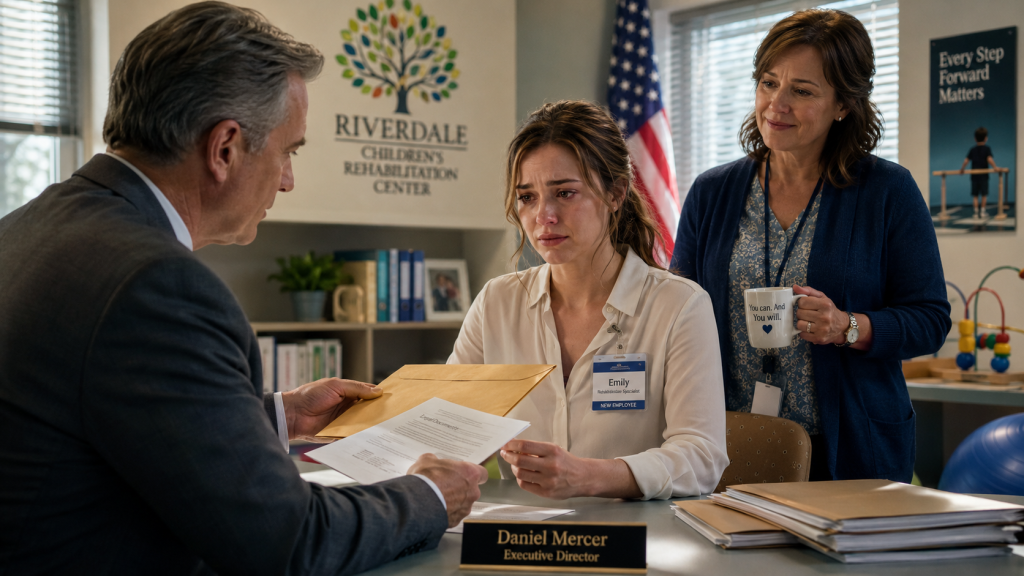
“He says his name is Daniel Mercer.”
I shook my head.
“I don’t know him.”
Linda glanced at the visitor slip.
“He says he has something your grandfather wanted you to receive. He also believes your parents made sure you never knew it existed.”
Daniel Mercer entered carrying a weathered leather case and a sealed envelope.
He was in his early sixties, with gray hair and the careful manner of someone accustomed to delivering information that changed lives.
“Emily Dawson?”
“Yes.”
“My name is Daniel Mercer. I served as attorney and trustee for your grandfather, Samuel Dawson.”
Grandpa Samuel died when I was seventeen.
He had been the only adult in my childhood who asked what I wanted before telling me what I owed.
He taught me to balance a checkbook.
Bought me my first dictionary.
Once told Dad that children were not unpaid employees.
After his death, my parents claimed he had left almost nothing.
Daniel placed the envelope on Linda’s desk.
My name was written across the front in Grandpa’s unmistakable handwriting.
I touched it but could not open it.
“What is this?”
“Your grandfather created an education and maintenance trust for you before he died.”
My knees weakened.
“What trust?”
“The one your parents managed while you were a minor.”
I stared at him.
“I paid for school myself.”
His expression became grim.
“The trust was intended to pay tuition, books, housing, transportation, and reasonable living expenses.”
I thought of the grocery-store shifts.
The cleaning jobs.
The nights I skipped meals.
“My parents said there was no money.”
“There was initially more than two hundred forty thousand dollars.”
The room tilted.
Daniel opened his leather case and removed folders.
Bank statements.
Trust documents.
Withdrawal records.
My father had served as temporary custodian.
Mom had co-signed the transactions.
Over eight years, they withdrew nearly one hundred eighty thousand dollars.
Not for my education.
For Ethan.
A truck.
Credit-card debt.
Two vacations.
A failed landscaping company.
Legal fees after he was arrested for driving intoxicated.
The down payment on his house.
There were even payments to the daycare whose costs Ethan now insisted I cover with free labor.
I stared at a withdrawal marked BENEFICIARY HOUSING SUPPORT.
The money had been used for Ethan’s mortgage.
“I lived in a basement room with mold during college.”
Daniel said nothing.
“They told me I was a burden.”
His voice softened.
“I’m sorry.”
I finally opened Grandpa’s envelope.
Emily,
If you are reading this, someone has delayed the truth longer than I intended.
You have spent your childhood being taught that usefulness earns love. It does not. Anyone who loves you should want your future to become larger, not smaller.
The trust is not payment for serving your family. It is protection from anyone who asks you to disappear for their convenience.
Build a life that belongs to you.
Grandpa Samuel
I pressed the letter against my chest.
Linda looked away to give me privacy.
Daniel allowed me to cry without interrupting.
After several minutes, he continued.
“The trust became yours when you turned twenty-five.”
“I turned twenty-five last month.”
“That is why I began contacting you directly. Letters sent to your parents’ address were returned. Emails connected to the original records were no longer active.”
“My parents handled all my mail until I moved here.”
“I eventually hired an investigator. Mrs. Alvarez helped confirm your address.”
I looked up.
“Mrs. Alvarez?”
Daniel removed another document.
“Your grandfather also owned this apartment complex.”
I stared at him.
“That’s impossible.”
“He purchased the building more than thirty years ago. It is held through Dawson Residential Trust.”
“Who owns it now?”
“You do.”
The words did not make sense.
“My apartment?”
“The entire property. Forty-two units, two commercial spaces, and the adjacent lot.”
I laughed once because the alternative was screaming.
“I can barely afford my rent.”
“You have been paying rent into your own trust account.”
“Mrs. Alvarez knew?”
“She knew you were the future beneficiary. Your grandfather asked her to protect the property and watch over you if you ever became a tenant. She was not permitted to reveal the ownership before the transfer date unless there was an emergency.”
The key.
Her willingness to enter.
The way she always watched my family’s vehicles.
She had not merely been my apartment manager.
She had been guarding something until I was legally old enough to claim it.
Daniel showed me the building’s financial statements.
The property carried no mortgage.
It produced steady income.
My parents had tried twice to persuade the trustee to sell it.
Grandpa’s instructions prohibited any sale before my twenty-fifth birthday.
“When they realized the property would soon become yours,” Daniel said, “your father submitted paperwork requesting extended management authority.”
“On what grounds?”
“He claimed you lacked financial maturity and remained dependent on the family.”
The cruelty of it stole my breath.
They stole my education fund.
Forced me to struggle.
Then used that struggle as evidence that I could not manage what belonged to me.
Daniel continued.
“Yesterday, your father sent another request. He claimed you intended to abandon stable employment and become a full-time caregiver for your nephew.”
I looked at him.
“They came to force me to quit.”
“Yes. Your resignation would have supported his argument that you lacked an independent career and relied on family direction.”
The assault had not been only anger.
It had been strategy.
If I quit, Dad could portray me as financially unstable.
If I continued babysitting Noah, he could say I had no career.
Then he would seek control over the building and remaining trust assets.
My phone began ringing.
Dad.
The call ended.
Mom.
Then Ethan.
Over and over.
Daniel’s phone rang next.
He checked the number.
“Your father’s attorney.”
“What happened?”
“This morning, I formally terminated your parents’ access to every trust account. I also notified them that the property transfer is complete.”
My phone rang again.
This time, I answered on speaker.
Dad’s voice exploded through Linda’s office.
“Come home and fix this!”
I looked at Daniel.
Then at Linda.
Finally, I thought of Mrs. Alvarez standing over the broken apples in my apartment.
“I am home.”
“You have no idea what you’re doing. Mercer froze everything.”
“The money belongs to me.”
“We used it for family.”
“You used my tuition fund to buy Ethan a truck.”
“He needed transportation.”
“I walked forty minutes to class.”
Dad ignored that.
“You’re not capable of managing an apartment building.”
“Neither are you.”
“You will sign the authority papers today.”
“No.”
His breathing became heavy.
“Emily, do not forget who raised you.”
Mom’s voice appeared in the background.
“Tell her Ethan could lose his house!”
I stared at the transfer records.
“Then Ethan should speak to his lender.”
“You selfish little—”
I ended the call.
My hand trembled afterward.
Linda covered it with hers.
Daniel closed the folder.
“What would you like to do next?”
For the first time, an adult with authority had asked what I wanted.
“I want to understand everything.”
So we began.
Over the next several weeks, Daniel and an independent forensic accountant reviewed every trust transaction.
The theft was worse than we initially knew.
My parents had created false expense reports.
They claimed Ethan’s vehicle transported me to school.
It never had.
They labeled his business debt as family educational support.
Mom signed statements saying I lived in Ethan’s house while attending college.
I had visited twice.
They even submitted receipts for Noah’s preschool under dependent-care expenses supposedly necessary for my education.
In reality, I provided the care for free.
The district attorney expanded the investigation.
Dad’s assault case now intersected with suspected financial exploitation, fraud, forgery, and breach of fiduciary duty.
Mom insisted she signed whatever Dad placed before her.
Emails showed she actively discussed hiding withdrawals.
One message said:
Emily will work anyway. She likes feeling independent.
That line hurt more than the stolen money.
They had watched me struggle and interpreted survival as permission to take more.
Ethan claimed ignorance.
The evidence showed Dad transferred money directly to his accounts.
He might not have understood the trust structure, but he knew the money was intended for me.
In one text, he wrote:
She’ll never use all of it. School isn’t going anywhere for her.
I read that sentence once.
Then never again.
Mrs. Alvarez became my guide to the apartment building.
On my first official day as owner, she handed me an enormous ring of keys.
“You don’t have to carry all of them,” she said. “I simply wanted you to feel the weight once.”
The building was not luxurious.
Paint peeled along one stairwell.
Three air-conditioning systems needed replacement.
The laundry room required new machines.
But it was solid.
Generations of tenants had built lives inside its walls.
Mrs. Alvarez introduced me to everyone not as an heiress but as the new owner who had lived among them.
“You know what leaking pipes sound like at two in the morning,” she said. “That matters.”
I kept her as property manager.
Then I increased her salary.
She protested.
“I’m too old for raises.”
“You’re not too old to be paid fairly.”
Using legitimate trust funds, I repaired the building.
We replaced broken lighting.
Added security cameras in public areas.
Created an emergency-maintenance line.
Converted an unused commercial space into an affordable childcare center for tenants who worked irregular hours.
The irony was not lost on me.
My family tried to destroy my career to force me into unpaid childcare.
I used the property they wanted to steal to help parents access safe, paid care.
I did not quit Northshore.
I continued working full time.
The children there reminded me why I had fought so hard to build a future.
Linda helped me balance my job with ownership responsibilities.
Daniel handled legal matters.
Mrs. Alvarez managed daily operations.
For the first time, support did not mean someone taking control.
It meant people helping me remain in control of my own life.
Dad pleaded not guilty to assault.
His attorney called the belt an instrument of discipline used during an emotional family argument.
The courtroom photographs showed otherwise.
Mrs. Alvarez testified.
She was seventy-six, five feet tall, and completely unshaken.
“Did you witness Mr. Dawson strike his daughter?” the prosecutor asked.
“I entered immediately afterward.”
“So you did not see the actual strike?”
“No.”
Dad’s attorney smiled.
“Then you cannot say with certainty how those injuries occurred.”
Mrs. Alvarez looked toward the judge.
“I found a woman doubled over, a belt in a man’s hand, and marks shaped exactly like that belt. I’ve spent twenty-eight years fixing buildings. When water is on the floor beneath a broken pipe, I do not blame the carpet.”
Dad’s attorney stopped smiling.
He was convicted of assault.
The financial charges took longer.
Eventually, both parents accepted plea agreements requiring restitution, probation, and permanent removal from any fiduciary authority.
Dad served a short jail sentence because of the physical attack and prior threats.
Mom avoided incarceration but was ordered to complete financial-ethics and family-violence intervention programs.
They were required to sell several assets to repay the trust.
Ethan’s truck was repossessed.
His business closed.
He blamed me publicly.
Relatives called to say I had gone too far.
I asked each one the same question.
“How much of your child’s education fund would you allow someone to steal before consequences became reasonable?”
No one answered clearly.
Ethan arrived at my office one afternoon carrying Noah.
Security stopped him in the lobby.
I agreed to meet him in a conference room because Noah was crying.
Ethan looked exhausted.
Without Dad’s money and my labor, his life had become complicated.
“I need help,” he said.
“With what?”
“Childcare. Work. Everything.”
“Then hire someone.”
“I can’t afford full-time care.”
“There are subsidy programs.”
“You own a building now.”
“Yes.”
“You created a childcare center.”
“For tenants who qualify.”
“I’m your brother.”
“That is not a qualification.”
He stared at me.
“You’re punishing Noah.”
“No. I’m holding his father responsible.”
Noah reached toward me.
I still loved him.
None of this was his fault.
That made the boundary harder, not less necessary.
I knelt and hugged him.
Then I gave Ethan information about legitimate childcare assistance.
I did not offer to become the solution.
“You used to care about family,” he said.
“I still do. I simply stopped confusing care with servitude.”
He left angry.
Months later, he secured a steady job and enrolled Noah in a licensed after-school program.
Responsibility did not destroy him.
It forced him to grow.
Mom wrote letters.
The first accused me of humiliating her.
The second reminded me of sacrifices she had made.
The third finally contained an apology.
We taught you that your value came from what you did for us. Your father called it duty. I called it family. We were both wrong.
I read the letter.
I did not respond immediately.
Forgiveness was not an emergency.
Dad’s apology took longer.
Two years after the assault, he requested a meeting through Daniel.
We met in a public office with a counselor present.
Dad looked smaller.
His hair had turned mostly gray.
“I was raised with discipline,” he said.
“So was I.”
He looked down.
“I thought fear created respect.”
“It created silence.”
He nodded.
“I know that now.”
I wanted to ask why he had chosen Ethan’s comfort over my future.
Why he watched me work nights while spending money Grandpa left for me.
Why being his daughter had never protected me.
Instead, I said the only thing that mattered.
“You will never have authority over my life again.”
“I understand.”
That was not reconciliation.
It was truth.
My relationship with my parents remained distant.
Structured phone calls.
Public meetings.
No keys.
No financial access.
No demands disguised as emergencies.
I learned that boundaries were not walls built from hatred.
They were doors with locks I controlled.
Three years after my first day at Northshore, Linda promoted me to program coordinator.
At the announcement, Sophie—the little girl who gave me the sticker—returned for a follow-up visit.
She was walking independently.
“You still work here,” she said.
“I do.”
“I knew you would.”
I laughed through tears.
That evening, the tenants held a small celebration in the apartment courtyard.
Mrs. Alvarez brought apple pie.
Daniel Mercer attended wearing the same careful expression he had carried into Linda’s office years earlier.
A plaque had been installed beside the childcare center entrance.
THE SAMUEL DAWSON FAMILY RESOURCE ROOM
Underneath were words from Grandpa’s letter:
Build a life that belongs to you.
Mrs. Alvarez stood beside me.
“He would be proud.”
“You knew him well?”
“Well enough to know he worried.”
“About my parents?”
“About the way they measured people.”
She looked toward the building.
“Your grandfather said your father saw every relationship as a ladder. Someone always had to stand underneath.”
For years, that person had been me.
The spare labor.
The daughter who could cancel.
The student who could work another shift.
The sister who could raise someone else’s child.
The beneficiary whose future could be converted into a brother’s comfort.
My first real job did not merely give me employment.
It gave me a place where my effort was recognized rather than consumed.
Mrs. Alvarez did not merely unlock my apartment door.
She opened the life my family had tried to keep closed.
Daniel did not simply reveal money.
He revealed the final proof that my struggle had never been necessary.
My family had not lacked resources.
They had chosen where those resources went.
They chose Ethan.
They chose convenience.
They chose control.
I finally chose myself.
People sometimes hear that I inherited an apartment building and assume the inheritance rescued me.
It helped.
But money did not teach me to say no.
The belt did.
My mother’s words did.
Spare labor.
That phrase stripped away the lie.
For years, I had believed sacrifice would earn belonging.
But people who love you do not require your future as proof.
They do not call your dreams selfish because those dreams make you harder to use.
The photograph Dad knocked from my table was repaired.
It showed Grandpa Samuel and me outside a library when I was ten.
I placed it in my office at Northshore.
Beside it, I kept my original identification badge.
The plastic was scratched now.
The clip had bent.
But I never replaced it.
It reminded me of the morning I entered that building believing the job was the first thing nobody could take from me.
My father tried.
He failed.
He failed because an elderly woman heard violence through a wall and refused to call it private.
He failed because my supervisor believed injured employees deserved support instead of shame.
He failed because my grandfather had planned for a future in which I might need protection from my own family.
Most importantly, he failed because I finally said no and allowed the answer to stand.
The night my father ordered me to quit, he believed I was still the frightened daughter who would surrender after one strike.
By the following morning, the truth had begun unlocking every door he tried to hold closed.
The education trust.
The stolen money.
The apartment building.
My independence.
When Dad called and demanded that I come home to fix everything, he still imagined home was wherever he held authority.
He was wrong.
Home was my small apartment with a new lock.
It was Northshore’s busy hallways.
It was the courtyard where tenants knew my name.
It was every place where I was valued for being present, not merely useful.
I did not quit my job.
I did not surrender the trust.
I did not return to unpaid servitude.
Spare labor became a program coordinator.
A property owner.
An advocate.
And yes, eventually, the landlord of the family members who had tried to take everything before I knew it belonged to me.
But the greatest inheritance was not the money or the building.
It was the sentence my grandfather left behind.
Build a life that belongs to you.
So I did.
Thanks for reading❤️ Follow Page For More Real Life Stories.