 Reading Time: 13 minutes
My twenty-two-year-old daughter brought her boyfriend over for dinner, and I welcomed him with a smile. But when he dropped his fork for the third time, I saw something beneath the table that made me dial 911 without letting anyone hear me.
My daughter was pale. He was not blinking. And his shoe was pressing down on her foot like a warning. My name is Mary Davis. That night, I cooked pot roast, mashed potatoes, buttered carrots, and peach cobbler because Danielle was finally bringing home the man who, according to her, had “saved her life.”
“His name is Evan,” she had told me over the phone three days earlier. “Please don’t judge him, Mom.”
“I won’t judge him.” “You always notice things.” “I’m your mother. That’s my job.” “I just want tonight to go well.”
There was something strange in her voice, but when I asked if she was all right, she laughed.
“I’m fine. Evan just wants to make a good impression.”
I believed her because I wanted to believe her.
Danielle had been lonely since moving to Dallas after college.
She worked at a marketing company, lived in a small apartment, and called me every Sunday evening. At least, she used to call every Sunday.
Then she met Evan.
At first, she talked about him constantly.
He sent flowers to her office.
He took her to expensive restaurants.
He drove across the city when her car broke down.
“He takes care of everything,” she said.
Within two months, the calls became shorter.
Then they became less frequent.
If I called while Evan was present, Danielle sounded careful.
She stopped talking about work.
She stopped visiting her friends.
She stopped posting photographs unless Evan was standing beside her.
When I asked questions, she became defensive.
“He just worries about me.”
“He thinks some of my friends are a bad influence.”
“He says my job is too stressful.”
“He wants us to spend more time together.”
I recognized the warning signs.
My late husband, Robert, had never controlled me, but I had spent years volunteering at a women’s shelter after he died. I had heard survivors explain how abuse rarely began with a fist.
It began with concern.
Then came isolation.
Then rules.
Then fear.
I did not accuse Evan because I knew an accusation could push Danielle further away.
Instead, I kept the door open.
“You can come home anytime,” I told her.
“I know, Mom.”
“No questions asked.”
“I’m not in trouble.”
“I didn’t say you were.”
She went quiet.
Then she changed the subject.
On the evening of the dinner, Danielle arrived at exactly eight o’clock.
She wore a beige dress, pearl earrings, and dark red lipstick.
She looked beautiful from a distance.
Up close, she looked exhausted.
Her cheeks appeared thinner.
There were shadows beneath her eyes.
Her smile was the kind a mother recognizes immediately—the kind created to prevent questions.
Evan stood behind her.
He was tall, well-groomed, and handsome in a way that seemed carefully constructed.
White shirt.
Dark trousers.
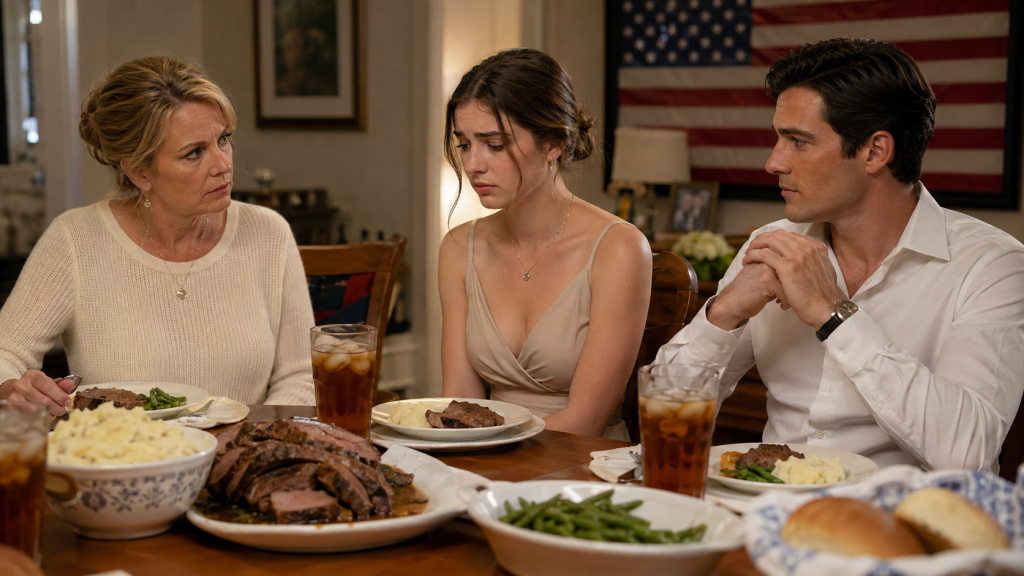
Polished shoes.
Flowers in one hand and a bottle of wine in the other.
“Mrs. Davis,” he said warmly. “It is a pleasure to finally meet you.”
He hugged me before I could decide whether I wanted him to.
He smelled of expensive cologne and something colder.
Control.
“Call me Mary,” I said.
“Danielle speaks highly of you.”
I looked at my daughter.
“Does she?”
Danielle’s smile tightened.
“All the time.”
Evan placed the flowers on the counter.
“Beautiful home.”
“Thank you.”
“Danielle told me you live here alone.”
The question sounded casual.
It did not feel casual.
“I have neighbors,” I replied. “Good ones. They notice everything.”
For the first time, his smile faltered.
Only for a second.
Then it returned.
“That must make you feel safe.”
“It does.”
We moved into the dining room.
I had set the table with the blue-and-white dishes Robert and I received as a wedding gift. Candles burned in the center beside a small vase of yellow roses.
Danielle sat across from me.
Evan sat beside her.
The moment he took his chair, he moved it closer to hers.
Not affectionately.
Possessively.
I served the food and tried to keep the conversation light.
“How did you two meet?”
“At a restaurant,” Danielle began.
“At a charity event,” Evan corrected.
She looked at him.
“Yes. The restaurant was hosting a charity event.”
“What charity?”
Danielle opened her mouth.
Evan answered.
“A youth development organization.”
He spoke smoothly.
Too smoothly.
He said he owned several businesses in Dallas.
He mentioned investments, real estate, and private consulting.
Whenever I asked for details, his answers became vague.
“What kind of consulting?”
“Strategic operations.”
“For what industry?”
“Several industries.”
Danielle stared at her plate.
Evan reached over and rested his hand on the back of her neck.
To another person, it might have looked affectionate.
I saw Danielle’s shoulders stiffen.
“She doesn’t understand the business side,” he said.
“I understand more than you think,” Danielle murmured.
His fingers tightened slightly against her neck.
“What was that?”
“Nothing.”
I forced myself to take a sip of sweet tea.
Evan smiled at me.
“Danielle is very independent.”
“She has always been independent.”
“Yes, but sometimes independence becomes stubbornness.”
I set down my glass.
“What does that mean?”
“She has trouble accepting direction.”
Direction.
I did not like that word.
It sounded as though he were discussing an employee.
Or a disobedient child.
“My daughter is capable of making her own decisions.”
“Of course.”
He smiled, but his eyes remained cold.
“She just benefits from guidance.”
Danielle barely ate.
Every time I asked her a question, he answered for her.
“How is work?”
“Danielle is taking some time off.”
I looked at her.
“You didn’t tell me that.”
“She was becoming overwhelmed,” Evan said.
“Were you?”
Danielle hesitated.
Evan’s shoe moved beneath the table.
“I was tired,” she whispered.
“Are you going back?”
“She doesn’t need to,” he replied. “I provide for her.”
I ignored him.
“Danielle?”
She looked down.
“We’re discussing it.”
Evan laughed softly.
“There is nothing to discuss.”
A chill moved through me.
I reached for the serving bowl.
“More potatoes?”
“No,” Danielle said.
“She doesn’t eat this many carbohydrates anymore,” Evan added.
Danielle’s face flushed.
“I made them for her.”
“I’m sure they’re delicious.”
His tone was polite.
The message was not.
I noticed Danielle’s left hand trembling beside her plate.
She quickly placed it in her lap.
Then Evan dropped his fork.
Clink.
“How clumsy of me,” he said.
He bent down to retrieve it.
When he sat upright, he looked directly at me.
Not at Danielle.
At me.
His expression seemed to ask whether I had noticed anything.
I smiled.
“So, Evan, where did you grow up?”
“Houston.”
Danielle looked confused.
“I thought you said Austin.”
He turned to her.
“My family moved.”
“Oh.”
The word came out like an apology.
Several minutes later, his fork fell again.
Clink.
This time, his hand brushed Danielle’s ankle beneath the table.
She flinched so hard that her water glass shook.
“Everything okay, sweetie?” I asked.
“Yes, Mom.”
But it was not her normal voice.
It was fear shaped like a word.
Evan rested his hand on her shoulder.
“She’s nervous because she wants you to approve of me.”
“Why would she be afraid of my opinion?”
“She values family.”
Danielle’s eyes met mine for half a second.
There was a message there.
Help me.
Then she lowered them.
I felt my heart pounding, but I kept my face calm.
The third time Evan dropped the fork, it bounced farther away, landing near my chair.
I bent down before he could.
And that was when I saw it.
Under the table, Evan’s right shoe was planted on top of Danielle’s foot, crushing it against the floor.
The skin around her ankle was red.
His heel shifted when she moved, increasing the pressure.
But that was not what made my blood run cold.
The hem of Danielle’s dress had risen slightly.
Her calf was covered with old bruises.
Purple.
Yellow.
Brown.
A bandage was wrapped poorly around the side of her leg.
And taped beneath the edge of her dress was a small folded piece of paper.
Danielle had placed it where only someone bending toward the floor might notice it.
My hand shook as I reached for the fork.
Evan leaned down too.
“I’ll get it, ma’am.”
He smiled.
But his eyes ordered me to stop.
I picked up the fork.
At the same moment, I used two fingers to tear the paper free.
I closed it inside my fist before standing.
“Thank you,” Evan said.
I placed the fork beside his plate.
“I’m going to get more napkins.”
“There are napkins here,” he said.
“I spilled something in the kitchen.”
His gaze remained fixed on my closed hand.
Danielle’s face went pale.
I walked toward the kitchen.
I did not run.
If I ran, Evan would know.
If I confronted him, he might hurt Danielle.
If Danielle cried, he might punish her before help arrived.
My home suddenly felt like a cage.
I stepped into the kitchen and opened the paper beside the sink.
Six words were written in black eyeliner.
MOM, DON’T ARGUE. HE’S ARMED.
My stomach turned.
For a moment, I could not breathe.
Then I heard Evan’s voice from the dining room.
“Everything okay, Mom?”
Mom.
As if he had already claimed a place in our family.
I pulled open the drawer beside the refrigerator.
Inside were old recipes, batteries, pens, and the spare phone I kept charging for emergencies.
I took it out and dialed 911.
I did not speak immediately.
I placed the phone on the counter, turned on the faucet, and allowed the operator to hear the water and the voices from the dining room.
“911. What is your emergency?”
I lowered my face near the phone.
“Private residence,” I whispered. “My daughter is in danger. There is an armed man inside.”
“Can you give me the address?”
I whispered it.
“Is the weapon visible?”
“Black handgun at his belt.”
“Are you in a secure location?”
“No.”
“Officers are being dispatched. Stay on the line.”
A chair scraped across the dining-room floor.
“Mary,” Evan called.
His voice was closer.
“Who are you talking to?”
I ended the call and pushed the phone into my apron pocket.
When I turned, Evan stood in the kitchen doorway.
He was no longer smiling.
Danielle stood behind him, crying silently.
“How curious,” he said. “Danielle told me you were an obedient woman.”
“I’m not sure where she got that idea.”
His eyes moved toward my apron pocket.
“What did you take from under the table?”
“The fork.”
“You were holding something else.”
“No.”
He stepped closer.
Danielle whispered, “Evan, please.”
He turned his head slowly.
“Did I ask you to speak?”
She lowered her eyes.
I looked at her hands.
Empty.
Then I looked at Evan’s belt.
There it was.
The black grip of a handgun.
Partially hidden beneath his shirt.
My mouth went dry.
“Why did you bring a gun into my home?” I asked.
“For protection.”
“From whom?”
“People make poor decisions when they think there are no consequences.”
His eyes moved to Danielle.
She began trembling.
I realized then that he had not brought her to dinner because he wanted my approval.
He had brought her to show me he owned her.
The doorbell rang.
Once.
Twice.
Evan moved instantly.
He pulled the handgun from his belt, grabbed Danielle around the waist, and pressed the barrel against her side.
She gasped.
“Mom,” she cried.
“Quiet,” he whispered.
Then he looked at me.
“Tell them everything is fine.”
The doorbell rang again.
“Mary Davis?” a man called from outside. “Police department.”
Evan’s eyes hardened.
“You called them.”
“No.”
“Do not lie to me.”
His arm tightened around Danielle.
“If you make one mistake, your daughter dies first.”
I forced myself to breathe.
“All right.”
“You will open the door halfway.”
I nodded.
“You will tell them it was an accidental call.”
“All right.”
“You will smile.”
I walked toward the front door.
Every step felt slow.
Behind me, Danielle’s breathing came in short, terrified bursts.
Evan stayed several feet back, keeping the gun hidden against her body.
I opened the door a few inches.
Two officers stood on the porch.
A third figure waited near the patrol car.
The older officer looked at my face.
“Mrs. Davis?”
“Yes.”
“We received an emergency call from this address.”
Behind me, Evan shifted.
I could feel him watching.
I forced a smile.
“I’m sorry. It must have been—”
The officer’s eyes dropped toward my apron pocket.
The phone screen was glowing through the fabric.
He looked back at me.
“Are you safe?”
I had one chance.
“No,” I said.
Evan swore.
He dragged Danielle backward and raised the gun.
The officers pushed the door open.
“Gun!” one shouted.
Danielle screamed and dropped her full weight toward the floor.
Evan lost his grip for half a second.
I grabbed the heavy ceramic umbrella stand beside the door and swung it into his wrist.
The gun fell onto the rug.
One officer pulled Danielle away.
The other tackled Evan against the wall.
He fought hard, kicking and twisting, but the officers pinned him to the floor.
“Hands behind your back!”
“You have no idea who I am!” Evan shouted.
“I know exactly what you are,” I said.
Metal handcuffs closed around his wrists.
Danielle crawled toward me.
I dropped to my knees and wrapped my arms around her.
She buried her face against my chest.
“I’m sorry, Mom.”
“No. Don’t apologize.”
“He said he would kill you.”
“You got the message to me.”
“I didn’t know what else to do.”
“You did exactly the right thing.”
The officers searched Evan.
They removed a second magazine, a folding knife, two cell phones, several credit cards under different names, and three identification cards bearing his photograph.
None of the names was Evan Cole, the name he had given Danielle.
One officer looked at the cards.
“Who is this man?”
Danielle began sobbing harder.
“I don’t know.”
Police cars filled the street.
Paramedics examined Danielle in the living room.
Her foot was badly bruised but not broken.
The bandage on her calf covered a deep cut that had become infected.
There were bruises on her arms, back, and ribs.
I sat beside her while a paramedic cleaned the wound.
“How long?” I asked gently.
She stared at the floor.
“About four months.”
“You met him six months ago.”
“He was kind at first.”
I held her hand.
“He made everything feel easy. He brought me gifts. He said I was different from every woman he had ever met.”
Her voice shook.
“Then he started checking my phone. He said my friends were jealous of us. He convinced me to leave my job because my boss was supposedly flirting with me.”
“Did you want to leave?”
“No.”
“Why didn’t you tell me?”
“He listened to our calls. He read every message. After I tried to leave the first time, he found me at a hotel.”
She touched the bandage on her leg.
“That was when he cut me.”
I closed my eyes.
Anger rose inside me, but I kept my voice steady.
“Did he threaten you with the gun?”
“Every day.”
She began crying again.
“He said if I ran, he would come here. He knew your address. He had pictures of your house.”
One of the detectives entered the room carrying a clear evidence bag containing Evan’s phone.
“Mrs. Davis, we need to ask Danielle some questions.”
“She needs a hospital.”
“She’ll be transported shortly. But there is something she should know.”
Danielle looked up.
The detective sat across from us.
“The man you knew as Evan appears to be using several identities.”
“I don’t understand.”
“We found photographs of other women on one of his phones.”
He paused.
“Three of them have been reported missing.”
The room became silent.
Danielle’s lips parted.
“Missing?”
“We do not yet know his connection to their disappearances.”
She began shaking violently.
“He told me they were his ex-girlfriends.”
The detective leaned forward.
“He showed you pictures?”
“Yes. He said they had betrayed him. He said one stole money and another ran away with someone else.”
“Did he ever mention their names?”
Danielle gave him two names.
The detective wrote them down.
“What about the third woman?”
“I only saw her once. Her photograph was inside a locked drawer.”
“Where?”
“At his house.”
The police searched Evan’s property that night.
What they found turned the case into a statewide investigation.
His home contained fake passports, women’s jewelry, hidden cameras, sedatives, and files documenting the lives of several women.
He had selected them carefully.
Young.
Far from family.
Recently heartbroken or financially vulnerable.
He learned their routines.
He presented himself as successful, protective, and devoted.
Then he isolated them.
Two of the missing women were later found alive in another property he controlled outside the city.
They had been imprisoned in separate locked rooms.
The third woman had escaped months earlier but had been too frightened to contact police. Once Evan’s arrest became public, she came forward.
Danielle was not his first target.
But because she had slipped six words beneath her dress during dinner, she became his last.
The weeks after his arrest were difficult.
Danielle moved back into my home.
For the first few nights, she slept with the bedroom light on.
She jumped whenever a car stopped outside.
She apologized constantly.
For breaking a cup.
For crying.
For taking too long in the shower.
For waking me after a nightmare.
Each time, I told her the same thing.
“You do not have to apologize for surviving.”
A counselor from the women’s shelter began visiting.
Danielle attended therapy and joined a support group.
At first, she sat silently.
Then, slowly, she began to speak.
She learned that Evan’s cruelty had not been her fault.
She learned that intelligent women could be manipulated.
She learned that love did not demand passwords, obedience, isolation, or fear.
The criminal case took nearly a year.
Evan’s real name was Nathaniel Ross.
He had outstanding warrants in two states and a history of using wealthy appearances to hide criminal behavior.
Danielle testified against him.
On the morning she entered the courtroom, her hands trembled.
“I don’t think I can look at him,” she whispered.
“You don’t have to look at him.”
“What if I freeze?”
“Then breathe.”
“What if he smiles at me?”
“Look at me instead.”
She did.
When the prosecutor asked her to describe the dinner, Danielle told the jury about the fork.
The shoe pressing on her foot.
The note beneath her dress.
The gun at her waist.
Then the prosecutor asked why she had risked leaving the message.
Danielle looked toward me.
“Because my mother always notices things.”
Nathaniel Ross was convicted on multiple charges, including kidnapping, unlawful imprisonment, assault, weapons violations, identity fraud, and making terroristic threats.
He received a sentence that ensured he would spend decades in prison.
After the sentencing, Danielle and I returned home.
I made pot roast again.
For months, neither of us had been able to eat it because the smell brought back the dinner.
That evening, Danielle asked if we could try.
We sat at the same table.
The damaged rug had been replaced.
The broken umbrella stand was gone.
The blue-and-white dishes remained.
Danielle placed her fork beside her plate.
Then she looked beneath the table.
Her feet were free.
No shoe pressed against them.
No threat waited in the shadows.
She took a bite of mashed potatoes.
“They’re good,” she said.
“They always were.”
She smiled.
This time, it was real.
“I’m thinking about going back to work.”
“I think that’s wonderful.”
“And maybe getting my own apartment again. Not yet, but someday.”
“When you’re ready.”
She reached across the table and held my hand.
“I thought you would blame me.”
“For what?”
“For choosing him.”
“You didn’t choose the man he became. You chose the man he pretended to be.”
“I should have seen it.”
“He worked hard to make sure you didn’t.”
She looked down.
“I was so ashamed.”
“Shame belongs to him.”
Tears filled her eyes.
“I love you, Mom.”
“I love you too.”
People later called me brave for dialing 911.
But bravery was not what I felt that night.
I felt terror.
I was terrified when I read the note.
Terrified when Evan stood in the kitchen doorway.
Terrified when I saw the gun.
Courage was not the absence of fear.
It was keeping my voice calm while fear screamed inside me.
It was opening the door when my knees wanted to collapse.
It was trusting my daughter’s six-word message.
Mothers are often told not to interfere in their adult children’s relationships.
We are told to respect privacy.
To avoid judgment.
To wait until they ask for help.
But there is a difference between judgment and attention.
I did not save Danielle because I was smarter than she was.
I saved her because I noticed what fear had changed.
The fake smile.
The unanswered questions.
The trembling hand.
The bruises beneath the dress.
The shoe pressing down beneath the table.
And Danielle saved herself because, despite everything Evan had done to silence her, she found a way to speak.
Six words written in black eyeliner.
Mom, don’t argue. He’s armed.
Those words could have disappeared beneath the table.
I could have ignored the dropped fork.
I could have accepted her smile.
I could have believed Evan’s polished manners.
Instead, I looked closer.
Sometimes danger does not enter your home wearing a mask.
Sometimes it arrives with flowers.
Sometimes it says “ma’am.”
Sometimes it smiles while crushing someone’s foot beneath the table.
And sometimes the person asking for help cannot say the words aloud.
You have to notice the message hidden beneath the dress.
You have to understand the fear inside the silence.
You have to make the call.
Thanks for reading❤️ Follow Page For More Real Life Stories.