 Reading Time: 15 minutes
I Called My Son From Our Kitchen in Detroit to Tell Him His Mother Had Died—He Said His European Vacation Couldn’t Be Refunded The telephone rang twice before Darnell answered.
His voice sounded distant and irritated, as though I had interrupted something far more important than the death of his own mother. Music played behind him. People laughed. Glasses touched together.
Maybe he was sitting in a restaurant. Maybe it was one of those rooftop places in Chicago where people posed beneath strings of lights and called the photograph happiness.
I stood alone in our kitchen in Detroit, one hand braced against the counter.
Diane had been gone less than a day.
Her coffee mug remained beside the sink, the one with the faded blue rim and the hairline crack near the handle.
Her reading glasses rested on the windowsill.
Her chair was pulled slightly away from the table, as though she had stepped into the next room and would return at any moment.
But she would not.
I told my son his mother was dead.
For several seconds, there was silence.
Then Darnell released a tired sigh.
“Dad, please don’t turn this into something bigger than it has to be.”
I stared at the kitchen wall, trying to understand how those words could come from the child Diane had carried, raised, protected, and loved.
“Darnell,” I said slowly, “your mother died this morning.”
“I heard you.”
His voice sharpened with impatience.
“I’m sorry, Dad, but what exactly do you expect me to do? Vanessa and I are leaving for Europe in a few days. The tickets can’t be refunded.”
I tightened my grip on the counter.
“I expect you to bury your mother.”
“Mom would understand.”
People often say the dead would understand when what they really mean is that they do not want their plans disturbed.
Diane would not have understood.
She would have forgiven him eventually because forgiveness came too easily to her.
But she would not have understood.
“When is the trip?” I asked.
“Saturday.”
“We can hold the funeral Friday.”
“Dad, no. We have preparations. Vanessa has appointments. We already made dinner reservations in Paris.”
His mother’s burial was competing with dinner reservations.
“Your mother asked for you yesterday.”
There was another pause.
That sentence reached him, but only briefly.
“You should have called earlier.”
“I did.”
Darnell had ignored three calls from me and two from the hospital.
He lowered his voice.
“I can’t deal with this right now. Send me the details, and we’ll visit when we return.”
Then he ended the call.
I stood there holding the telephone while a garbage truck rattled down Fielding Street and someone nearby continued mowing grass.
The world did not stop because mine had ended.
That afternoon, I made the calls.
The funeral home.
Mrs. Pette next door, who always knew when to bring food and when to bring silence.
The church on Harper Avenue, where Diane once volunteered during holiday food drives.
Every conversation felt too ordinary for the words I had to say.
My wife is dead.
We need a casket.
We need flowers.
We need a room where I can say goodbye.
The funeral director asked whether we expected many guests.
I almost said yes.
Diane had spent seventy years caring for people. Surely a life like hers should fill a chapel.
But illness had made our world smaller.
Old friends had moved away.
Relatives had died.
And the person who should have occupied the front pew had chosen Europe.
“Keep it small,” I said.
By Thursday, I buried my wife.
Only five people sat in the chapel.
Mrs. Pette and her husband came.
Diane’s oldest friend, Beverly, arrived wearing the lavender perfume she had worn to our wedding forty-three years earlier.
Deshawn, our mail carrier, came after finishing his route, still dressed in uniform. Diane used to leave cold water on the porch for him in July and coffee inside the storm door during Detroit winters.
The fifth person was Harold Whitfield, our estate attorney.
He sat near the aisle holding a black leather folder.
During the final weeks of Diane’s life, Harold had called our house several times.
Whenever I answered, she took the telephone into the bedroom.
I assumed they were discussing hospital bills or the old insurance policy she maintained through her former employer.
At the time, I did not ask.
Diane and I had never hidden important matters from each other, but she valued privacy when she was organizing something.
If she believed I needed to know, she would tell me.
Now she was gone, and Harold’s presence made those secret calls feel heavier.
I stood at the chapel lectern and looked toward the empty rows.
Diane had held people together her entire life.
She packed lunches.
Remembered birthdays.
Paid bills before they were due.
Baked Thanksgiving pies inside the same dented pan she owned before we married.
She never asked for praise.
At the end, all she wanted was her son.
He chose Europe.
I did not mention that in the eulogy.
Some truths are too painful to place before strangers.
Instead, I spoke about the day we met.
Diane worked behind the counter of a small pharmacy on Gratiot Avenue. I entered looking for aspirin and left knowing I would return the next morning.
She claimed she only married me because I kept purchasing things I did not need.
I said I had eventually run out of reasons to visit the store.
Everyone smiled.
Then I told them how she sang while cooking, always half a note too low.
How she could stretch one chicken into three dinners.
How she knew when someone was hurting before the person admitted it.
I spoke until my voice broke.
Then I sat down beside an empty chair.
After the burial, Harold approached me near the chapel doors.
“Raymond, there are matters we need to discuss.”
“Today?”
“Not unless you are ready.”
I looked across the parking lot at the hearse preparing to leave.
“I don’t think I’ll ever be ready.”
“Then tomorrow morning.”
Harold arrived at our house carrying the same black folder.
Mrs. Pette had left a casserole inside the refrigerator, though I had not eaten since the funeral.
We sat in the living room where Diane and I had spent countless evenings arguing over game shows.
Harold placed the folder on the coffee table.
“Diane changed her estate plan three days before she died.”
I stared at him.
“Why?”
“She had concerns.”
“About Darnell?”
“About Darnell and Vanessa.”
My son had married Vanessa five years earlier.
She was stylish, ambitious, and always looked faintly disappointed by our house.
The first time she visited, she asked why we had not sold the property and moved somewhere “more efficient.”
Diane smiled and said, “Efficiency is not always the same as home.”
Vanessa never forgot the answer.
Darnell changed after marrying her, though perhaps marriage only revealed changes already growing inside him.
He called less.
Visited only when he needed something.
A business loan.
Help with a vehicle.
Money for renovations.
Diane gave more than I believed we should.
Whenever I objected, she said, “He’s our only child.”
That sentence became permission for everything.
“How much did they take?” I asked Harold.
He removed several bank statements.
During the final year of Diane’s illness, nearly eighty thousand dollars had disappeared from an account carrying her name.
The account contained money inherited from her aunt and savings from thirty-two years working for the Detroit school district.
“I didn’t know this account existed.”
“It was hers before your marriage. She maintained it separately.”
The statements showed electronic transfers to accounts associated with Darnell and Vanessa.
Some were labeled medical assistance.
Others said family emergency.
The withdrawals increased after Diane’s cancer returned.
“Did she authorize them?”
“Some early payments, yes. The later withdrawals are questionable.”
My hands became cold.
“How did they access the account?”
“Vanessa helped Diane set up online banking after her surgery. She had the passwords.”
Harold showed me a transfer made while Diane was hospitalized and heavily sedated.
Twenty-five thousand dollars.
Another occurred two days later.
Fifteen thousand.
“Diane confronted them?” I asked.
“She confronted Vanessa by telephone. Vanessa claimed Darnell needed money to protect his business.”
“What business?”
Darnell had changed careers so often I no longer knew what he called his work.
For a time, he sold insurance.
Then luxury cars.
Then digital advertising services.
Most recently, he described himself as an investment consultant.
“Diane asked him to return the money,” Harold said.
“Did he?”
“No.”
I looked toward the framed photograph on our mantel.
Darnell at twelve, standing between us after a school award ceremony.
His grin was missing one front tooth.
Diane’s hand rested proudly on his shoulder.
“What did she change?”
Harold opened the folder.
Our home had been placed in a trust for my lifetime benefit. I could live there, sell it, or move if I chose.
After my death, the remaining value would be divided between a neighborhood women’s shelter and a scholarship fund for Detroit students entering nursing or public-service careers.
Diane’s life-insurance proceeds and separate savings would fund the same causes.
Darnell received one dollar.
There was also a handwritten letter addressed to him.
“She knew he might contest it,” Harold said. “We documented her capacity with her physician and two independent witnesses.”
“Why one dollar?”
“To show she did not forget him.”
A laugh escaped me, bitter and surprised.
That sounded like Diane.
Even while disinheriting someone, she made the paperwork careful.
“What about the missing money?”
“We are still investigating. She instructed me to recover it if possible.”
“Did she tell you why she waited?”
Harold looked toward the kitchen.
“She hoped Darnell would come when she became seriously ill. She kept believing seeing her condition would change him.”
He never came.
Ten days passed.
Darnell did not call.
Vanessa did not call.
Social media showed them smiling in Paris.
They posed near the Eiffel Tower.
They drank champagne on a riverboat.
One photograph showed Darnell standing outside an expensive store holding shopping bags.
The caption read: Life is too short to postpone happiness.
I closed the page.
Every morning, I woke expecting Diane in the kitchen.
A cabinet opening.
A spoon scraping inside the coffee tin.
That soft cough she made before speaking my name.
Every morning, I remembered the house belonged to me now in the loneliest way possible.
I left her mug beside the sink.
I could not wash it.
On the tenth day, the front door opened without warning.
Heels clicked across the hardwood.
A bright voice floated through the hallway as though nothing terrible had happened.
“Hello? Raymond?”
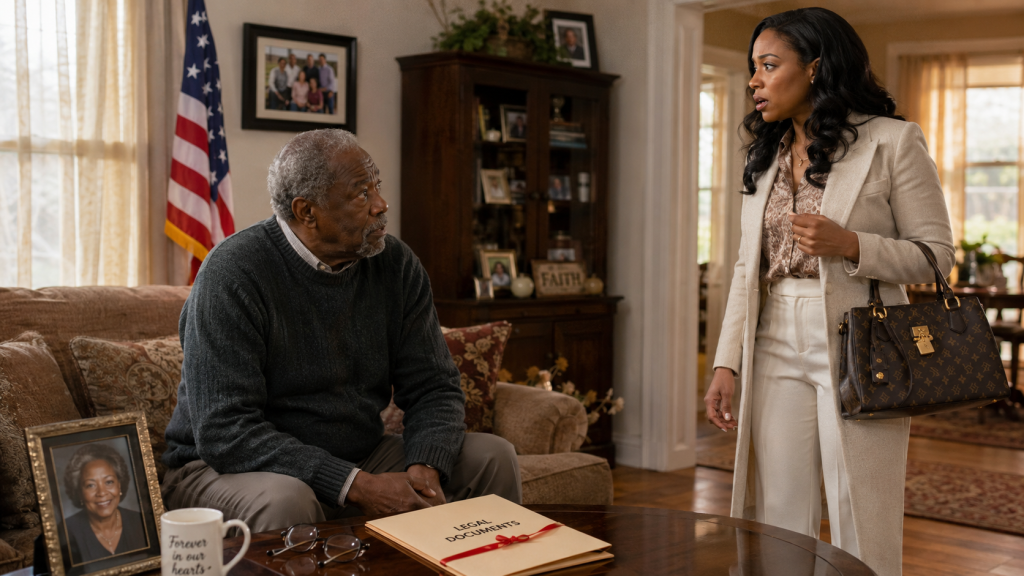
Vanessa entered the living room wearing cream trousers, a silk blouse, and shoes too delicate for our old Detroit sidewalks.
A designer handbag rested beneath her arm.
She smiled.
Not with sympathy.
With expectation.
I remained seated.
“How did you get in?”
She held up a key.
“Darnell’s.”
Of course.
We had given him a key years earlier for emergencies.
He used it now to send his wife into his dead mother’s home.
“Where’s Darnell?”
“Still in Paris. He has meetings.”
“On vacation?”
“He’s combining business and pleasure.”
She placed her handbag on Diane’s chair.
I looked at it until Vanessa noticed.
She moved the bag to the sofa.
“We tried calling,” she said.
“You did not.”
“International service has been unreliable.”
“Paris has telephones.”
Her smile tightened.
“I know you’re grieving, Raymond.”
“His name for me used to be Dad.”
She ignored that.
“I came because we need to begin sorting things before the estate becomes complicated.”
On the coffee table sat the sealed folder Harold left for our scheduled meeting that afternoon.
Vanessa noticed it immediately.
“Is that the will?”
“What exactly did Darnell send you to collect?”
She looked around the room.
“Family things. His mother’s jewelry. Important documents. Maybe the deed.”
“The deed?”
“You know how estates work. The house will eventually pass to Darnell.”
She said it casually.
As if my death were the next administrative step.
“And the accounts?” I asked.
She smoothed one sleeve.
“Those matters should stay within the family.”
“What accounts?”
Her eyes flickered.
That was enough.
I picked up the folder and broke the seal.
Harold had already reviewed the contents with me, but Diane requested that certain papers be presented formally if Darnell or Vanessa came demanding property.
I removed the will.
“Three days before she died, Diane changed everything.”
Vanessa’s posture stiffened.
“Changed what?”
“The house remains mine. After I die, it goes to charity.”
Her smile disappeared.
“What about Darnell?”
“He receives one dollar.”
For several seconds, she stared at me as though I had spoken another language.
“That cannot be legal.”
“It is.”
“Darnell is her only child.”
“He was also invited to her funeral.”
“That was an impossible situation.”
“No. It was an inconvenient situation.”
Vanessa reached for her telephone.
“He will fight this.”
I slid Diane’s letter across the table.
She hesitated before taking it.
On the first line, Diane had written:
A son who cannot pause a vacation to bury his mother should not profit from her death.
The color drained from Vanessa’s face.
She read silently.
Diane’s letter was not cruel.
That made it more powerful.
She wrote that she loved Darnell from the moment she first felt him move.
She remembered his childhood fevers, his first school day, and the afternoon he learned to ride a bicycle.
She admitted that love had made her excuse behavior she should have confronted.
Then she wrote:
You began treating our love as an account you could withdraw from without making deposits. When I became ill, you did not ask what I needed. You asked what would remain.
Vanessa placed the letter down.
“This is emotional manipulation.”
“No. It is a goodbye.”
“She was sick. Medication affected her judgment.”
“The doctors confirmed she was competent.”
“You influenced her.”
“I didn’t know about the will until after the funeral.”
Vanessa stood.
“Darnell deserves his share.”
“His share of what?”
“His mother’s estate.”
“Did he share her final days?”
Her mouth opened, but no answer came.
Footsteps sounded from the hallway.
Harold entered from the kitchen entrance, accompanied by two people I recognized from the funeral home.
One was Diane’s physician, Dr. Lane.
The other was Patricia Moore, a retired teacher who had witnessed the will.
Vanessa looked toward them.
“What is this?”
Harold set his briefcase on the table.
“Mrs. Carter, before you leave, we need to discuss the withdrawals made from Diane’s account while she was dying.”
Vanessa’s hand froze above her handbag.
“I don’t know what you mean.”
Harold placed bank records in front of her.
“We have transfers from Mrs. Carter’s savings account into an account held jointly by you and Darnell.”
“She authorized them.”
“Not all of them.”
“Yes, she did.”
“Two transfers occurred while she was medically sedated.”
Vanessa looked at Dr. Lane.
The doctor spoke calmly.
“Diane was not capable of authorizing financial transactions during that period.”
“She must have arranged them earlier.”
Harold opened another file.
“The bank records show logins from an internet address connected to your Chicago apartment.”
Vanessa’s face changed.
She grabbed her handbag.
“I’m not discussing this without an attorney.”
“That is wise,” Harold replied. “You should also know the account has been reported for suspected elder financial exploitation.”
She looked at me.
“You reported us?”
“Your mother-in-law did.”
Vanessa left without taking a single item.
She called Darnell from the sidewalk.
I could hear her shouting before the car door closed.
My son called eleven minutes later.
His name appeared on my telephone for the first time since I told him Diane had died.
I considered ignoring it.
Then I answered.
“What did you do?” he demanded.
Not how are you?
Not how was the funeral?
What did you do?
“Your mother wrote a will.”
“You manipulated her.”
“I didn’t know about it.”
“You expect me to believe that?”
“I expected you to attend her burial.”
He became quiet.
Then he changed direction.
“Vanessa said you accused us of stealing.”
“The bank records accused you.”
“Mom gave us that money.”
“She asked you to return it.”
“It was an investment.”
“In what?”
“My business.”
“What business?”
“You never respected my career.”
I almost laughed.
This conversation was becoming every conversation we had avoided for fifteen years.
“You transferred money while she was sedated.”
“Vanessa handled the account. I didn’t know every detail.”
His wife had barely left my driveway, and he was already separating himself from her.
“Come home,” I said.
“I can’t.”
“You can.”
“Dad, I have obligations.”
“Your obligation is to answer questions about your mother’s money.”
He lowered his voice.
“If you push this, you’ll destroy the family.”
“The family had five people at your mother’s funeral. You were not one of them.”
He ended the call.
Three days later, Darnell and Vanessa returned from Europe.
They did not come to the house.
Their attorney contacted Harold and announced their intention to challenge Diane’s will.
They alleged undue influence, diminished capacity, and interference with inheritance rights.
Harold expected it.
Diane had expected it too.
Her medical evaluation was recorded.
In the video, she sat upright in her hospital bed, tired but clear.
She identified the date, her assets, her beneficiaries, and the reasons for her decisions.
When asked whether anyone pressured her, she shook her head.
“My husband does not even know I am changing this,” she said. “If Raymond knew, he would tell me to leave something for Darnell because he has a softer heart than I do.”
That made me cry.
Even while planning for death, she understood me.
The attorney asked why she was disinheriting her son.
Diane looked directly into the camera.
“I am not punishing him for missing one funeral. I am responding to years of being treated as valuable only when he needed something.”
Then she described the withdrawals.
The ignored calls.
The excuses.
Her fear that Darnell and Vanessa would force me out of the house after her death.
“He should not inherit the roof his father still needs,” she said.
The will challenge collapsed after their attorney viewed the recording.
The financial investigation continued.
Bank records showed Vanessa used Diane’s login credentials to transfer money.
Darnell received most of it and spent it on business debts, travel, and credit cards.
The Paris trip had been partially paid for with money taken during Diane’s hospitalization.
That detail nearly broke me.
While I sat beside Diane’s hospital bed, watching her breathe through pain, our son was financing champagne with her savings.
Darnell eventually admitted he knew the money came from his mother’s account, though he claimed Vanessa assured him Diane approved it.
Vanessa blamed Darnell.
Their united front disappeared quickly.
Both accepted a civil settlement requiring repayment, legal fees, and relinquishment of any future estate claims.
The prosecutor offered diversion and probation because they repaid most of the funds and had no previous convictions.
Some people believed they deserved prison.
I did not know what I wanted.
Justice does not always feel like satisfaction.
Sometimes it feels like paperwork proving the people you loved did exactly what you feared.
The hardest meeting occurred six months after Diane’s death.
Darnell came to the house alone.
He stood on the porch holding the one-dollar check Harold had issued according to the will.
He looked thinner.
His marriage to Vanessa was collapsing.
Their business had failed.
Friends had learned about the investigation.
He no longer resembled the child in our mantel photographs.
But for one second, I saw him beneath the anger.
“Can I come in?”
I stepped aside.
He entered the living room and looked at Diane’s chair.
I had moved her handbag but left her reading blanket folded across the back.
Darnell sat on the edge of the sofa.
“Why would she do this to me?”
I remained standing.
“You still think she did something to you.”
“She left everything to strangers.”
“She left it to women without safe homes and children trying to build futures.”
“I’m her child.”
“You were.”
The words hurt us both.
He looked down at the one-dollar check.
“I made a mistake.”
“Which one?”
“Missing the funeral.”
“That was a choice.”
“Vanessa said we would lose everything if we canceled.”
“Your mother lost everything.”
He flinched.
“I didn’t understand how bad it was.”
“She asked you to visit.”
“I was busy.”
“She called you thirteen times during her final month.”
He looked up.
“How do you know?”
“I checked her phone after she died.”
Darnell covered his face.
For a moment, I thought he might finally grieve.
Then he said, “You could change the trust.”
There it was.
Even inside his shame, money waited.
“No.”
“Dad, I’m trying to rebuild.”
“So are the people your mother chose to help.”
“I’m your son.”
“And I am the husband who buried your mother with five people in the chapel.”
His face hardened.
“You will die alone in this house.”
The sentence landed, but it did not cut as deeply as he intended.
“I would rather be alone than surrounded by people waiting for the deed.”
He stood.
At the door, he paused.
“Did she really write that letter herself?”
“Yes.”
“Did she hate me?”
“No.”
That was the tragedy.
“She loved you until her final breath. She simply stopped letting that love excuse you.”
Darnell left.
For nearly a year, we did not speak.
I spent that year learning how to live without Diane.
Grief was not one heavy object.
It was a thousand small absences.
Only one toothbrush in the bathroom cup.
Buying milk and forgetting no one would drink it before it expired.
Hearing a joke and turning toward an empty chair.
Mrs. Pette continued bringing food.
Deshawn still placed mail inside the storm door on snowy days.
Beverly visited each Thursday with stories about Diane’s childhood that I had never heard.
The women’s shelter sent me photographs after receiving the first trust grant.
They renovated three bedrooms and named the shared kitchen after Diane.
The scholarship fund awarded its first two grants to students from Detroit.
One was a young woman studying nursing.
The other planned to become a social worker.
I attended the ceremony.
A photograph of Diane stood near the podium.
For the first time since her death, a room was filled because of her.
Not a funeral chapel.
A beginning.
Two years after I called Darnell from our kitchen, he returned again.
This time, there was no lawyer.
No demand.
No one-dollar check.
He carried a small cardboard box.
Inside were Diane’s letters, photographs, and recipe cards he had taken from the house years earlier.
“I thought these belonged here,” he said.
I looked at him carefully.
Vanessa was gone.
Their divorce had become final.
He worked at a warehouse outside Chicago and attended financial counseling as part of his court agreement.
“I visited the shelter,” he said.
“Why?”
“I wanted to see where the money went.”
“And?”
His eyes filled.
“There was a woman there with two children. She said the kitchen made the place feel like a home.”
I looked toward Diane’s chair.
“She was good at that.”
Darnell nodded.
“I listened to Mom’s recorded statement.”
My chest tightened.
“Harold allowed it?”
“My attorney kept a copy.”
He sat down.
“I heard her say she still loved me.”
“She did.”
“I don’t know how to carry that.”
“You start by not turning it into something she owes you.”
He wiped his eyes.
For the first time since her death, he apologized without asking for anything afterward.
Not money.
Not property.
Not forgiveness.
Only the chance to say he knew what he had done.
I did not embrace him immediately.
Real repair is slower than a courtroom ending.
But I poured coffee into Diane’s blue-rimmed mug and placed it in front of him.
We sat in the kitchen where I had once called to tell him his mother was dead.
He held the mug carefully.
“She would be angry that you kept using this cracked thing,” he said.
“She loved it.”
“She loved broken things.”
I looked at him.
“Yes, she did.”
The trust remained unchanged.
Darnell never inherited the house.
I never gave him the money he once believed was his.
But over time, he began volunteering at the scholarship events.
He spoke to students about financial exploitation and the damage entitlement could do to a family.
I did not pretend that erased the past.
Neither did he.
On the third anniversary of Diane’s death, six people gathered in the small chapel.
The original five.
And Darnell.
He placed flowers near her photograph and remained after everyone left.
Outside, snow began falling lightly over Detroit.
“I should have been here,” he said.
“Yes.”
“I thought there would always be another chance.”
“So did she.”
We stood quietly.
People often imagine consequences as doors slamming, inheritances disappearing, or court orders arriving.
Sometimes the deepest consequence is understanding that the person you failed is gone and no apology can return to the day it was needed.
Diane did not leave her estate away from her son because she stopped being his mother.
She did it because she finally understood that love without boundaries had helped him become someone who believed her death should wait for his vacation.
She protected me.
She protected the home we built.
And she transformed what remained of her life into safety for people who might appreciate it.
The day Vanessa entered my living room with her designer handbag, she expected jewelry, deeds, and account numbers.
Instead, she found Diane’s final boundary waiting inside a sealed folder.
A son who could not pause a vacation to bury his mother would not profit from her death.
Diane’s words sounded harsh to people who had not watched her stare at an empty hospital doorway.
To me, they were not revenge.
They were clarity.
My wife spent her life giving.
At the end, she decided that what remained would go to people who understood the value of being present.
Thanks for reading❤️ Follow Page For More Real Life Stories.