 Reading Time: 14 minutes
My husband left me for a younger woman and took the whole family abroad for his wedding. At 2:13 a.m., he texted me: “Disappear before we get back. I hate old things. I deserve a new life.”
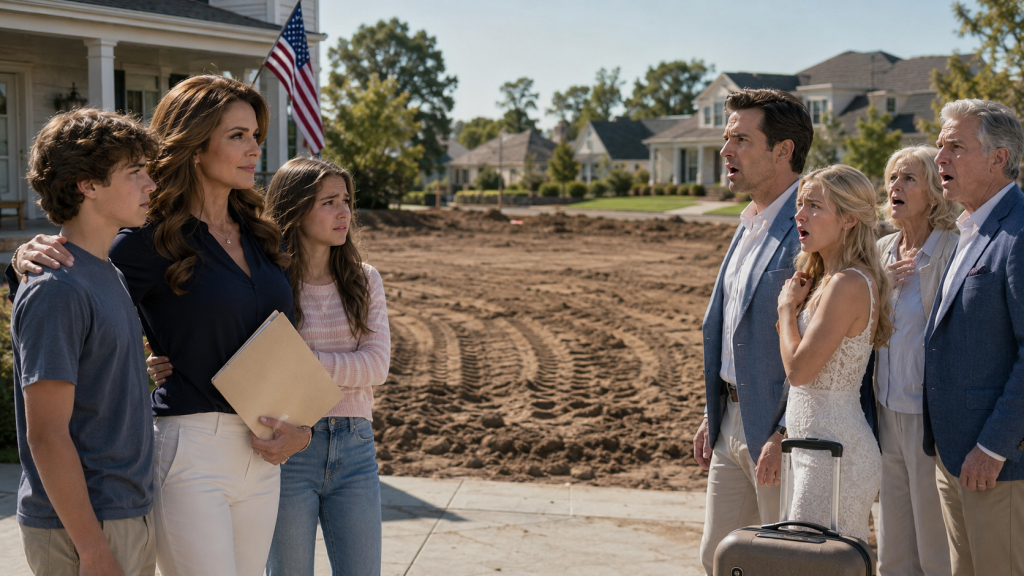
But when they returned laughing, they found only empty dirt where our house used to be. And the color drained from their faces. The message arrived in the middle of the night.
Alexandra Stone was not sleeping. She had been lying awake for hours, staring at the ceiling of the bedroom she had shared with Richard for nineteen years.
The house was silent around her. Too silent.
No sound of her daughter Chloe walking to the kitchen for water.
No sound of her son Dylan gaming quietly in his room.
No sound of Richard’s keys hitting the bowl near the door.
Because they were gone.
All of them.
Richard had flown to Maui that morning with his parents, his cousins, his friends, and their two children.
Not for a family vacation.
For his wedding.
To another woman.
Alexandra had spent the whole day moving through the house like a ghost, touching objects that suddenly felt unfamiliar.
The framed photo from their tenth anniversary.
The coffee mug Dylan made in third grade.
Chloe’s ballet shoes hanging from the laundry room hook.
Richard’s expensive watch box sitting empty on his dresser.
At 2:13 a.m., her phone lit up on the nightstand.
For a second, she thought it might be Chloe.
Maybe her daughter was homesick.
Maybe Dylan finally realized how cruel this whole trip was.
Maybe one of the children needed her.
But the message was from Richard.
Disappear before we get back. I hate old things, and I work too hard not to deserve a new life.
Alexandra sat perfectly still.
The glow of the phone lit her face in the dark room.
Before she could even breathe, another message arrived.
Don’t cause drama. The kids are coming with us.
She read both messages again.
Then again.
Each word landed like ice water.
Disappear.
Old things.
New life.
The kids are coming with us.
Outside, in the gated community of Oak Brook, the sprinklers clicked on and began sweeping water across perfect green lawns.
Somewhere far away, a motorcycle hummed along the road.
Everything outside looked normal.
Everything inside the house was still in place.
But inside Alexandra, something that had been cracking for years finally broke cleanly in two.
Richard Stone had always possessed a talent for making cruelty sound like an office memo.
Short sentences.
No explanation.
No guilt.
No room for debate.
He had not asked for a divorce with kindness.
He had announced one.
Three weeks earlier, he stood in the kitchen while Alexandra was brewing coffee and cutting fruit for Dylan and Chloe before school.
He leaned against the granite counter, wearing a freshly ironed white shirt, his phone placed face down beside him.
“I’m starting over,” he said.
Alexandra looked up slowly.
“What?”
He sighed, as if she had already made the conversation exhausting.
“I’m marrying Valerie.”
The knife stopped in her hand.
Valerie.
Twenty-seven years old.
Bright laugh.
Long blond hair.
A junior creative director at Richard’s advertising agency.
For nearly a year, Richard had called her talented, ambitious, energetic.
Now Alexandra understood every late-night strategy session, every weekend client meeting, every sudden gym habit, every new cologne.
“When?” she asked.
Her voice sounded too calm.
Richard picked up his coffee.
“Maui. In three weeks.”
The room tilted slightly.
“In three weeks?”
“I didn’t want to drag it out.”
“You planned a wedding before telling me?”
“Don’t be dramatic, Alex.”
That was what he called every emotion that inconvenienced him.
Drama.
Grief was drama.
Anger was drama.
Questions were drama.
Self-respect was drama.
Alexandra looked toward the hallway, where her children’s backpacks sat by the stairs.
“Do Dylan and Chloe know?”
“They will.”
“Richard.”
“They need to see me happy.”
“Our children need to watch their father marry another woman before their parents are even divorced?”
He put down his coffee.
“Don’t turn them against me. Playing the victim doesn’t suit you.”
That night, Alexandra cried in the bathroom with the shower running so no one would hear.
But in front of Richard, she did not shed a single tear.
She did not beg.
She did not ask if he still loved her.
She already knew the answer.
Maybe she had known it for years.
For almost two decades, Alexandra had been the one who remembered everything.
Vaccines.
School meetings.
Medications.
Lunch accounts.
Uniforms.
Doctor appointments.
Birthdays.
Anniversaries.
Family dinners.
Thank-you cards.
Homework deadlines.
Insurance payments.
Broken appliances.
Richard was the successful one.
The provider.
The man who came home late and expected dinner because his day had “been much harder.”
The man whose mother praised him for “working so tirelessly” while Alexandra packed lunches, cleaned kitchen counters, found missing permission slips, and soothed children who wondered why Dad was always too busy.
He liked being called head of the household.
But Alexandra had been the spine of it.
And now, after using that house like a throne, he was asking her to disappear from it.
She sat in the bedroom until nearly dawn, staring at those messages.
At 6:41 a.m., an email appeared in their shared household account.
Richard had meant to send it to Valerie.
Instead, it landed in the account Alexandra used for school forms, bills, travel receipts, and family calendars.
Travel itinerary.
Departure flight.
Hotel.
Wedding rehearsal.
Return flight.
Exact arrival time back in Chicago.
Alexandra read it three times.
Richard was not just cruel.
He was careless.
Careless men made mistakes.
And careful women noticed them.
At 7:20 a.m., Alexandra went downstairs to the laundry room.
Behind a stack of winter blankets was a plastic storage bin where she kept her father’s old papers.
Arthur Reed had not been a wealthy man.
He had been practical.
Suspicious of paperwork.
Careful with signatures.
He owned tools older than Alexandra and believed every important document should exist on paper, even if the world insisted everything was digital now.
Inside the bin were deeds, receipts, contracts, tax papers, yellowed copies, and handwritten notes that smelled faintly of damp cardboard.
Her fingers moved quickly until she found the folder.
The land.
Her father had inherited that plot in Oak Brook from his own mother, then gifted it to Alexandra before he died.
The house had been built later.
Richard always spoke of it as his.
His house.
His neighborhood.
His driveway.
His kitchen.
His office.
But the land beneath it had never belonged to him.
“The house might fall down, sweetheart,” her father had told her one summer afternoon, sitting on the old porch before the renovations. “But you never give the land to someone who confuses your love with obedience.”
At the time, Alexandra had laughed.
“Dad, Richard isn’t trying to steal the land.”
Arthur’s eyes had been tired but sharp.
“Maybe not today.”
Richard used to mock that advice.
“Your dad and his paranoia,” he would say. “As if I wanted to steal a patch of dirt from you.”
But Alexandra’s father had known something she had not yet learned.
A man did not need to steal what he thought he already owned.
She opened the deed.
Then she logged into the County Recorder’s Office portal.
The official record loaded slowly.
Her breath caught when the page appeared.
Owner: Alexandra Reed.
Not Richard Stone.
Not Richard and Alexandra Stone.
Just Alexandra Reed.
Her maiden name.
Her father’s final gift.
For the first time in days, Alexandra smiled.
It was not a happy smile.
It was tired.
Cold.
Hardened.
The kind of smile born when a woman realizes she still holds a card nobody else saw.
Two days later, she walked into a small office in a strip mall between a salon and a stationery store.
Attorney Gloria Miller had silver hair, red glasses, and the calm expression of a woman who had watched many men underestimate many wives.
She read Richard’s texts without interrupting.
Then she reviewed the deed, the itinerary, the bank statements, and several years of mortgage-related payments.
Finally, she took off her glasses.
“He thinks you’re going to leave quietly.”
“He does.”
“What do you want to do?”
Alexandra looked out the window.
In the parking lot, a woman loaded groceries into her trunk while a small child sat on the curb eating chips.
Life went on.
That was the strangest thing about betrayal.
The world did not stop to make room for your pain.
It kept going.
People bought groceries.
Children ate chips.
Cars pulled in and out of parking spaces.
And somehow, you were expected to decide what kind of person you would be after your heart had been dragged across the floor.
“I want him to come back,” Alexandra said, “and understand exactly what he threw away.”
Gloria set the papers down.
“Then we do it right. No screaming. No threats. No revenge that can be used against you. Just paperwork.”
That same day, Alexandra filed for divorce.
She changed passwords.
She opened a new bank account.
She froze credit lines connected to her name.
She printed every text message, every email, every travel receipt, and every financial record that proved Richard had been moving marital funds into his “new life” while still living under her roof.
She called the school and made sure Dylan and Chloe’s emergency contact information stayed current.
She contacted a family attorney about custody.
She met with a financial adviser.
She did not cry.
Not because she was strong every second.
But because there was no time.
The crying could wait.
The paperwork could not.
The most drastic decision came forty-eight hours later.
An engineer specializing in modular and prefabricated structures walked through the living room with a clipboard.
He tapped the light steel columns.
Examined the supports.
Checked the connection points.
Crawled beneath the structure.
Reviewed the original construction records.
Then he stood in the kitchen, looking thoughtful.
“This can be dismantled and moved,” he said.
Alexandra gripped the edge of the counter.
“The whole thing?”
“The main structure, yes. Additions will require some extra work. It won’t be simple. It won’t be cheap. But from what I see here, it can be done legally.”
Gloria stood beside her.
“And the lot?”
The engineer nodded.
“Cleared. We can disconnect utilities, remove the structure, salvage what’s possible, and prepare the land. You’ll need permits. We’ll move fast, but properly.”
Alexandra looked around the kitchen.
The place where she had cut fruit the morning Richard announced he was marrying someone else.
The stove where she had cooked thousands of dinners.
The table where Dylan lost his first tooth.
The hallway where Chloe once ran barefoot wearing fairy wings.
The living room window where Alexandra had waited for Richard so many nights, watching headlights pass, hoping one would be his.
For a moment, grief rose up so sharply she almost said no.
Then she remembered the text.
Disappear before we get back.
I hate old things.
I deserve a new life.
She looked at the engineer.
“Yes,” she said. “When he gets back, I want him to find absolutely nothing.”
And while Richard toasted to his new life in front of the ocean, the house he thought was his began to quietly lift off the ground.
The work started before sunrise.
Alexandra watched from across the street with a thermos of coffee in both hands.
The first day, crews disconnected utilities.
The second day, they removed fixtures, carefully labeled structural pieces, and prepared the frame.
The third day, sections began to shift.
By then, neighbors had gathered on sidewalks with phones in hand.
Mrs. Cavanaugh from next door walked over in slippers and a pink cardigan.
“Alexandra,” she whispered, staring at the crew, “is everything all right?”
Alexandra looked at the house.
Then at the woman who had once brought chicken casserole when Chloe had pneumonia.
“No,” she said honestly. “But it will be.”
Mrs. Cavanaugh reached over and squeezed her hand.
“That man never deserved you.”
Alexandra blinked.
“You knew?”
The older woman gave her a sad smile.
“Honey, women always know more than men think we do.”
On the fifth day, the mailbox came down.
That hit harder than Alexandra expected.
STONE.
Black letters on white metal.
For nineteen years, that name had sat at the edge of the road like an announcement.
Now a worker removed the post and carried it away.
Alexandra stood silently.
Gloria, beside her, said, “You okay?”
Alexandra nodded.
“I think that was the last thing still pretending.”
By the time Richard’s plane landed, the lot was bare.
The house was gone.
The porch swing was gone.
The flower boxes were gone.
The mailbox was gone.
All that remained was flat brown earth, tire marks, utility flags, and the faint outline where a life had once stood.
Alexandra did not wait alone.
She stood across the street beside Gloria, wearing sunglasses and holding a folder.
A patrol officer sat nearby in a parked car because Gloria had wisely anticipated Richard’s reaction.
Mrs. Cavanaugh watched from her window.
Several neighbors pretended to water lawns that did not need water.
At 3:37 p.m., two black SUVs turned into the neighborhood.
Richard arrived first.
Valerie sat beside him wearing oversized sunglasses and a white sundress.
Behind them came his parents, Helen and Grant Stone, in another vehicle with two cousins and enough luggage to suggest they had returned from paradise rather than betrayal.
Dylan and Chloe were in the back seat of Richard’s SUV.
Chloe looked tired.
Dylan looked angry.
Richard was laughing when he turned into the driveway.
He did not notice at first.
People rarely notice the impossible immediately.
His car rolled forward.
Then stopped.
The laughter died.
Valerie lowered her sunglasses.
Richard stared through the windshield at empty dirt.
For several seconds, no one moved.
Then he got out of the SUV slowly.
“What the hell?”
His father stepped out behind him.
His mother pressed a hand to her chest.
Valerie’s mouth fell open.
Dylan leaned forward in the back seat.
Chloe unbuckled her seat belt.
Richard turned in a circle as if the house might reappear if he looked hard enough.
“Where is my house?” he shouted.
Alexandra crossed the street calmly.
Gloria walked beside her.
“Your house?” Alexandra asked.
Richard spun toward her.
For a second, shock swallowed his arrogance.
Then rage filled the space.
“What did you do?”
Alexandra stopped several feet away.
“I disappeared.”
His jaw tightened.
“What?”
“You told me to disappear before you got back.”
She looked past him at the empty lot.
“So I did. I took my home with me.”
Valerie stepped out, gripping her purse.
“Richard, what is she talking about?”
Richard ignored her.
“You can’t move my house.”
Gloria opened her folder.
“The land belongs solely to Alexandra Reed. The structure was legally classified and permitted for relocation based on ownership records and separate-property investment documentation.”
Richard laughed once.
A sharp, unbelieving sound.
“That’s insane.”
Gloria handed him copies of the deed, permits, invoices, and legal filings.
Richard snatched them from her.
His eyes moved across the pages.
Then his face changed.
His father grabbed one of the documents from his hand.
“This can’t be right.”
Alexandra looked at Grant.
“It is.”
Helen Stone stepped forward.
“Alexandra, this is cruel. We just returned from a family wedding.”
Alexandra removed her sunglasses.
“No, Helen. You returned from your son’s wedding. I was his wife.”
Helen looked away.
That told Alexandra enough.
They had known.
All of them had known.
The cousins avoided her eyes.
Valerie’s hand tightened around Richard’s arm.
“Richard, you told me the house was yours.”
“It is,” he snapped.
“No,” Alexandra said. “You used it like it was yours. That isn’t the same thing.”
The back door of the SUV opened.
Chloe ran out first.
“Mom!”
Alexandra’s heart cracked.
Her daughter slammed into her arms, sobbing.
Dylan followed, trying to look older than his fifteen years, but his face crumpled when Alexandra pulled him close.
“Dad said you didn’t want us,” Chloe cried.
Alexandra closed her eyes.
Of all Richard’s lies, that was the one that cut deepest.
She held both children tightly.
“I never stopped wanting you,” she whispered. “Not for one second.”
Dylan looked over his shoulder at his father.
“You said she abandoned us.”
Richard’s face hardened.
“I said she was making choices.”
“You lied,” Dylan said.
The words landed harder than any legal document.
Richard reached for his phone.
“I’m calling the police.”
Gloria gestured toward the parked patrol car.
“Already covered.”
The officer stepped out and walked over.
Richard pointed at Alexandra.
“She stole my house.”
The officer looked tired before the sentence was even finished.
“Sir, I’ve reviewed the permits with counsel. This is a civil matter unless you intend to cause a disturbance.”
“A disturbance? My house is gone!”
“The structure was legally removed.”
“My children live here!”
“No,” Alexandra said quietly. “They lived with me. The house was never what made them safe.”
Valerie looked at the empty lot again.
Something ugly flickered across her face.
Fear.
Not for Alexandra.
Not for the children.
For herself.
The new life Richard had promised her had included this address.
This neighborhood.
This status.
The house on the land that was not his.
“Richard,” she said slowly, “where are we supposed to stay?”
Richard turned on her.
“Not now.”
But now was exactly the problem.
His new life had returned from paradise and found no foundation.
Literally.
By sunset, the scene had become almost pathetic.
Richard stood on the empty lot, screaming into his phone at lawyers who apparently did not give him the answers he wanted.
Grant Stone sat in the rental car, rereading the deed.
Helen cried quietly, perhaps for her son, perhaps for appearances, perhaps because neighbors were watching.
Valerie sat in the passenger seat of the SUV with her arms crossed, refusing to look at anyone.
Alexandra stayed by her car with Dylan and Chloe.
Gloria handed Richard one final envelope.
“What’s this?” he demanded.
“Temporary custody filing. Divorce petition. Notice regarding financial disclosures. And a copy of your own texts.”
Richard’s face twitched.
Gloria continued.
“I strongly suggest you stop texting threats.”
He looked at Alexandra.
“You think this makes you powerful?”
“No,” she said. “It makes me finished.”
“With me?”
“With being erased.”
That night, Alexandra drove Dylan and Chloe out of Oak Brook.
Neither child spoke much at first.
Chloe held Alexandra’s hand from the back seat.
Dylan stared out the window, jaw tight.
Finally, he said, “Where did the house go?”
Alexandra looked at him in the rearview mirror.
“To the lake.”
“What lake?”
“The one Grandpa Arthur left me.”
Chloe sniffed.
“Grandpa left you a lake too?”
Alexandra smiled faintly.
“Not the whole lake. Just a small lot near it.”
“Is our stuff there?”
“Most of it.”
“My books?”
“Yes.”
“My blue blanket?”
“Yes.”
“Dylan’s ugly gaming chair?”
Dylan turned.
“It’s not ugly.”
For the first time in weeks, Alexandra laughed.
It was small.
Shaky.
But real.
Two hours later, they arrived at the lakeside lot.
The house stood on new foundations beneath the evening sky.
Not perfect yet.
There were workers’ marks, unfinished landscaping, temporary steps, and stacks of material near the side.
But the porch light was on.
The windows glowed.
The front door waited.
Chloe gasped.
“It looks like our house.”
Alexandra parked.
“It is our house.”
Dylan opened his door slowly.
“But different.”
“Yes,” Alexandra said. “Different.”
They walked inside together.
The living room smelled of sawdust, paint, and the familiar lemon cleaner Alexandra had used for years.
Boxes lined the walls.
The furniture was not arranged yet.
The kitchen cabinets had been reinstalled, but not everything fit exactly the same.
The hallway looked both known and new.
Chloe ran to her room and cried when she found her stuffed animals waiting on her bed.
Dylan stood in his doorway staring at his posters stacked carefully against the wall.
Alexandra walked to the kitchen window.
This window no longer looked at a manicured Oak Brook lawn.
It looked toward the water.
Blue-gray.
Wide.
Quiet.
Her father’s voice seemed to move through the room.
You never give the land to someone who confuses your love with obedience.
For the first time since Richard announced Valerie, Alexandra let herself cry.
Not quietly.
Not politely.
She sank to the kitchen floor and cried until Chloe and Dylan found her.
Then all three of them sat there together.
Not broken.
Not healed.
Just finally safe enough to feel everything.
The divorce was not easy.
Richard fought.
Men like Richard always fight hardest when they are losing control.
He claimed Alexandra had alienated the children.
He claimed she had acted irrationally.
He claimed the house removal was emotionally abusive.
Gloria responded with texts.
Emails.
Ownership records.
Permits.
Financial statements.
Witnesses.
Richard’s own itinerary proving he had removed the children from the state for his wedding while pressuring Alexandra to leave the marital residence.
The judge was not amused.
Valerie did not stay long.
Three months after Maui, she moved out of the temporary condo Richard had rented.
Six months after Maui, she returned his ring.
Alexandra heard it from Dylan, who heard it from Chloe, who heard it from Richard during a tense weekend visit.
She felt no joy.
Only a dull confirmation.
A life built on humiliation rarely becomes a honeymoon.
Richard’s parents tried to repair their relationship with the children, but Dylan refused most invitations.
Chloe agreed to see them only if Alexandra came too.
Helen once told Alexandra, “This has been hard on everyone.”
Alexandra replied, “No. It has been revealing for everyone.”
The lakeside house changed with the seasons.
In spring, Alexandra planted hydrangeas along the new walkway.
In summer, Dylan and Chloe swam until their hair smelled like lake water.
In fall, they painted the front door blue because Chloe said it looked “less sad.”
By winter, the house no longer felt transplanted.
It felt rooted.
The first Christmas after the move, Alexandra hung stockings over a temporary mantel Dylan helped build.
Chloe placed a small ornament shaped like a house on the tree.
On the back, she had written:
Same home. Better place.
Alexandra held it in her palm for a long time.
That was exactly what it was.
The same home.
A better place.
One year after Richard’s Maui wedding, Alexandra received a message from him.
Not at 2:13 a.m.
Not cruel.
Not commanding.
Just one sentence.
I lost everything.
She stared at it for a long moment.
Then she typed back:
No. You threw it away.
She did not wait for a reply.
She blocked him.
Outside, Dylan and Chloe were laughing by the lake.
The sound floated through the open window.
Bright.
Free.
Alive.
Alexandra walked onto the porch with a cup of coffee and watched them.
For years, she had believed keeping a family together meant staying where she was planted, even if the soil poisoned her.
Now she knew better.
Sometimes survival meant moving the whole house.
Board by board.
Memory by memory.
Away from the person who thought you were too old, too familiar, too obedient, too easy to erase.
Richard told her to disappear.
So she did.
But not into shame.
Not into silence.
Not into the small life he imagined for her.
She disappeared from his control.
From his name.
From his driveway.
From the version of herself that kept waiting at windows for a man who had already left.
And when he came back expecting to find her broken, he found empty dirt instead.
Because Alexandra Reed had taken the house.
The children.
The truth.
And every piece of herself Richard had mistaken for his property.
Then she planted it all somewhere new.
And finally called it home.
THE END! THANKS FOR READING!