 Reading Time: 29 minutes
The first sentence of Margaret’s letter nearly brought me to my knees. “Tommy, before you read another word, you need to know something I’ve been carrying in my heart for forty-five years. My son, Daniel, is also your son.”
I stopped breathing. The church parking lot seemed to tilt beneath my feet. For several seconds, I could hear nothing except the distant rumble of traffic and the wind moving through the oak trees beside the building.
I read the sentence again.
And again.
Surely, I had misunderstood.
Surely, grief was playing some cruel trick on my mind.
But the words remained exactly where they were.
My son, Daniel, is also your son.
I slowly raised my head.
Daniel was standing three feet away, watching me with an expression I couldn’t decipher.
He was forty-four years old, tall and broad-shouldered, with dark hair beginning to gray around his temples.
I had met him several times during Margaret’s final days.
He had helped arrange our little hospital wedding.
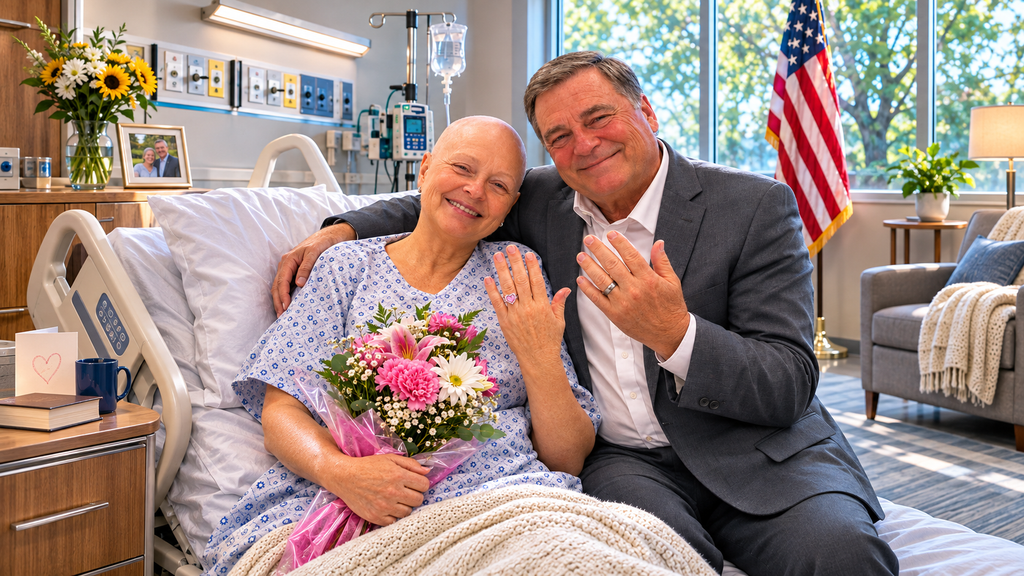
He had stood beside his mother’s bed when I slipped that ridiculous pink-hearted ring onto her finger.
And he had shaken my hand after the funeral, thanking me for making his mother’s final days happy.
All that time, I had believed he was simply the grown son of the woman I loved.
Now I was staring at him as though I had never seen him before.
“Daniel,” I whispered.
He looked away.
“Did you know?”
His jaw tightened.
“Not until eleven days ago.”
“Eleven days?”
He nodded.
“Mom told me after you agreed to marry her.”
I pressed one hand against the church wall.
“Why didn’t she tell me?”
Daniel gave a short, bitter laugh.
“That’s what I’ve been asking myself.”
I looked down at the letter.
There were several pages, folded together with the same careful precision Margaret had used when she wrote notes to me in high school.
Her handwriting was shakier now.
But I recognized every curve.
Every familiar loop.
Even after forty-five years, I would have recognized her handwriting anywhere.
Daniel stepped closer.
“There’s more,” he said.
I looked at him helplessly.
“I don’t understand.”
“Neither did I.”
He swallowed.
“Read the rest, Tom. Please.”
So I did.
And what I discovered in those pages changed everything I thought I knew about the life I had lived.
“My dearest Tommy,
If you’re reading this, then I have already gone somewhere you cannot follow me just yet.
Please don’t be angry with Daniel. He wanted to tell you immediately. I made him promise to wait.
I know what you’re thinking.
Why didn’t I tell you?
Why did I let you marry me without knowing that we had a son together?
The answer isn’t simple, and I’m afraid you may hate me when you understand.
But I need you to know one thing before anything else.
I never stopped loving you.
Not when we left for college.
Not when the letters stopped coming.
Not when I stood in a delivery room holding our newborn son.
And not when I watched you build a beautiful life without me.
I loved you quietly, from a distance, because I believed that was the only kind of love I had left to give.”
My vision blurred.
I wiped my eyes and continued.
“Do you remember the last night we spent together before you left for college?
We sat in your father’s old pickup truck beside Miller’s Lake.
You told me you were afraid we wouldn’t survive the distance.
I told you that real love didn’t disappear just because two people were far apart.
Then you kissed me and promised that someday, when we were older and had enough money, you would marry me beneath the big oak tree behind our high school.
You probably thought I was joking when I made you promise twice.
But Tommy, I believed you.
Three weeks after you left, I discovered I was pregnant.
I wrote to you immediately.
That was when everything went wrong.”
I couldn’t keep reading.
My hands trembled so badly that the pages rattled.
Daniel reached toward me.
“Are you okay?”
I looked at him.
There was something in his eyes I hadn’t noticed before.
The shape.
The deep brown color.
The slight downward tilt at the corners.
They were my father’s eyes.
My father had been dead for twenty-six years.
Yet there they were, looking back at me from the face of a stranger who was apparently my son.
“No,” I whispered. “I don’t think I am.”
Daniel studied me for a moment.
Then he said something that hurt worse than any accusation.
“I grew up wondering why my real father didn’t want me.”
I closed my eyes.
“Son, I didn’t know you existed.”
The word escaped before I could stop it.
Son.
Daniel flinched.
“Please don’t call me that.”
I opened my eyes.
His expression had hardened.
“You don’t get to call me that just because you read a letter.”
He turned away.
And for the first time since Margaret’s funeral, I realized that losing her might not be the only heartbreak waiting for me.
I am sixty-three years old.
For thirty-seven years, I have served God in one capacity or another.
I’ve buried husbands, wives, children, and friends.
I’ve comforted parents whose babies never came home from the hospital.
I’ve stood beside people who believed they had reached the end of their strength.
And I’ve preached countless sermons about forgiveness.
But nothing in all those years prepared me for the discovery that I had a son who had lived forty-four years without knowing me.
Daniel stood silently while I returned to the letter.
Margaret’s next words made my blood run cold.
“Tommy, my father found the letter before I could mail it.
He read everything.
He was furious.
He told me I had disgraced our family and destroyed my future.
I begged him to let me call you.
He refused.
Two days later, he came into my bedroom and told me he had spoken to you.
He said you knew about the baby.
He said you wanted nothing to do with us.
I didn’t believe him.
Not at first.
I told him you would never say something so cruel.
Then he showed me a letter.
It appeared to be from you.
And Tommy, it broke my heart.”
I stared at the words.
A letter from me?
I had never written such a letter.
Margaret continued.
“The letter said you were too young to become a father. It said you wanted to finish college, build a career, and forget our relationship.
It told me not to contact you again.
I cried until I was physically sick.
For months, I waited for you to change your mind.
I wrote six more letters.
None received an answer.
When my pregnancy began to show, my parents sent me to live with my aunt in another state.
I gave birth to Daniel on a rainy Thursday morning.
He weighed seven pounds, three ounces.
He had a head full of dark hair and your eyes.
I held him against my chest and promised that even if his father never came, he would never grow up without love.
And I kept that promise.”
I lowered the pages.
My chest hurt.
Not metaphorically.
It physically hurt, as though something had tightened around my heart.
I remembered that year.
I remembered receiving a letter from Margaret shortly after arriving at college.
It had said she couldn’t continue our relationship.
That she had met someone else.
That we were too young to make promises about forever.
I had been devastated.
I called her parents’ house repeatedly.
Her father told me she had moved away and didn’t want me contacting her.
Eventually, I believed him.
I spent months walking around campus feeling as if someone had hollowed out my chest.
Then time passed.
I finished college.
I entered seminary.
I eventually married a wonderful woman named Rebecca.
We had two daughters and shared twenty-nine years together before cancer took her seven years ago.
I loved Rebecca deeply.
That truth did not disappear because I had once loved Margaret.
But now I was discovering that an entirely different life had been stolen from us before either of us had been old enough to understand what was happening.
“I got a letter, too,” I whispered.
Daniel turned.
“What?”
“From your mother. Or what I thought was from her.”
He stared at me.
“What did it say?”
“That she had found somebody else.”
His face changed.
“She never told me that.”
“Her father told me she didn’t want to speak to me anymore.”
Daniel leaned against a nearby railing.
For the first time, his anger seemed to falter.
“Then you really didn’t know.”
“No.”
He looked down at his shoes.
“All these years…”
His voice broke.
“All these years, Mom thought you abandoned her.”
I nodded.
“And all these years, I thought she had stopped loving me.”
Neither of us spoke.
Somewhere inside the church, the organist began practicing a hymn.
The notes drifted through the open windows.
A hymn about grace.
I had sung it hundreds of times.
But that afternoon, I could barely bear to hear it.
Daniel drove me to Margaret’s house.
It was a modest brick home on a quiet street, with white curtains and flowering plants arranged beside the front porch.
I recognized the flowers immediately.
Pink geraniums.
Margaret had loved them in high school.
She used to pick blossoms from her mother’s garden and tuck them behind her ear.
“Mom planted those herself,” Daniel said when he noticed me looking.
“She always loved them.”
“I know.”
He gave me a strange glance.
Then he unlocked the door.
Inside, the house was filled with traces of Margaret’s life.
Photographs covered the walls.
A knitted blanket rested across the living room sofa.
Her reading glasses still lay beside a half-finished crossword puzzle.
And on the kitchen counter was a bright yellow mug bearing the words:
I’m not arguing. I’m just explaining why I’m right.
I laughed before I could stop myself.
Daniel looked over.
“What’s funny?”
“Your mother used to say that exact thing when we were teenagers.”
For a moment, his expression softened.
“She said it to me about twice a week.”
Then he walked into the hallway.
“Come on. There’s something else.”
He led me to a small bedroom that Margaret had converted into a sewing room.
An old machine stood beneath the window.
Colorful fabric filled several baskets.
Against the far wall sat a cedar chest.
Daniel knelt beside it.
“Mom told me to give you the key after the funeral.”
He opened his palm.
A small brass key rested there.
I recognized it.
Margaret had worn it around her neck during our wedding.
When I asked her about it, she had smiled mysteriously.
“Just a little piece of my past,” she’d said.
Now I understood that the past had been waiting for me inside a wooden box.
I took the key.
My fingers shook as I unlocked the chest.
Inside were dozens of envelopes.
Some were yellow with age.
Others were newer, neatly stacked and bound with faded ribbons.
There were photographs, newspaper clippings, a small blue baby blanket, and an old leather journal.
On top of everything lay a photograph of Margaret and me at our senior prom.
I was wearing an awkward black tuxedo.
Margaret wore a pale blue dress with lace sleeves.
We were laughing at something outside the camera’s frame.
On the back, written in her familiar handwriting, were four words.
My first and forever.
I pressed the photograph against my chest.
Daniel sat on the floor beside me.
“She looked at that picture a lot during her treatments.”
I couldn’t answer.
He reached into the chest and removed a bundle of letters.
“These are the ones she wrote to you.”
“All of them?”
He nodded.
“Some were mailed and returned. Some she never sent.”
I untied the first ribbon.
The earliest envelope was dated September 1981.
My name was written across the front.
I carefully unfolded the letter.
“Tommy, I’m scared. I don’t know how to tell you this without making you worry, but we’re going to have a baby. Please call me. I need to hear your voice.”
I closed my eyes.
Forty-five years.
Forty-five years since Margaret had written those words.
And I had never known.
Another letter was dated three weeks later.
“I don’t believe you would really leave us. I know you, Tommy. I know your heart. Please tell me this is all a misunderstanding.”
The next letter was shorter.
“I waited by the telephone all night. Daddy says I need to stop embarrassing myself. But I still believe you’ll call.”
By the fourth letter, her handwriting had become uneven.
“I heard our baby’s heartbeat today. I cried because I wanted you there. I don’t want to hate you. Please don’t make me hate you.”
I covered my mouth.
Daniel looked away.
I could tell he was fighting tears of his own.
Then I reached the final letter from that year.
It had been written shortly before Daniel was born.
“Tommy, I’ve decided to name him Daniel if it’s a boy. You once told me that Daniel was your grandfather’s name, and that he was the kindest man you ever knew. I hope our child grows up with that kindness. Even if you never meet him, I want him to carry something good from you.”
The letter slipped from my hands.
“My grandfather,” I whispered.
Daniel stared at me.
“What?”
“Daniel was my grandfather’s name.”
He swallowed.
“Mom always told me she liked the name because it was strong.”
I shook my head.
“No. She chose it because of my grandfather.”
Daniel looked at the stack of letters.
Then he whispered something I will never forget.
“She gave me your family’s name, but I never knew the family it came from.”
For several minutes, we sat without speaking.
Then Daniel picked up the leather journal.
“There’s something in here you should see.”
He opened it to a page marked with a pressed pink flower.
“Mom found out the truth about those letters fifteen years ago.”
I looked up.
“Fifteen years?”
He nodded.
“Her father was dying. Apparently, he confessed.”
I felt anger rising inside me.
“Where is he buried?”
Daniel glanced at me in surprise.
“Why?”
“I want to know where the man is buried who stole forty-five years from us.”
Daniel didn’t answer immediately.
Instead, he handed me the journal.
Margaret’s entry was dated October 14, 2011.
“Daddy called me into his room this afternoon.
He was terribly weak.
For weeks, he’d barely spoken.
Then he asked whether I remembered Tommy.
I told him I remembered everything.
He began crying.
I’d never seen my father cry like that.
He told me he’d lied.
He said Tommy never rejected the baby because Tommy never knew there was a baby.
Daddy had written the letter himself.
He admitted intercepting mine.
And he admitted sending a false letter to Tommy, making it appear that I had fallen in love with someone else.
He said he believed he was protecting me from a difficult life.
Then he asked me to forgive him.
I looked at that frightened old man and realized he had spent thirty years carrying the truth while I’d spent those same years carrying the pain.
I told him I would try.
But I could not tell him it was all right.
Because it wasn’t.
It never would be.”
I lowered the journal.
Daniel watched me carefully.
“What did she do after that?” I asked.
“She tried to find you.”
My heart started pounding.
“She did?”
“Yes.”
He turned several pages.
“She found your church website. She saw photographs of you and Rebecca. Your daughters, too.”
My breath caught.
“She knew about my family?”
Daniel nodded.
“Mom said you looked happy.”
He looked down at his hands.
“She told me that was when she decided not to contact you.”
“Why?”
“Because she didn’t want to destroy the family you had built.”
I stared at him.
“But she wouldn’t have destroyed anything.”
“Maybe not. But she didn’t know that.”
His voice softened.
“She was afraid that if she suddenly appeared with a grown son, everything would change.”
I thought of Rebecca.
My beautiful, patient wife.
The woman who had stood beside me through the hardest years of ministry.
She would have welcomed Daniel.
I was certain of it.
Rebecca had always believed that family was something to be expanded, never defended like a fortress.
But Margaret hadn’t known Rebecca.
She had seen photographs of a happy marriage and made a decision based on what she believed was best.
A terrible, heartbreaking decision.
Yet one made out of love.
Daniel turned another page.
“There’s more.”
I shook my head.
“I don’t know how much more I can take.”
He hesitated.
Then he said quietly, “You need to hear this part.”
Daniel opened the journal to an entry written only six months before Margaret died.
The date was circled in red ink.
“Today, I learned that Tommy’s wife passed away several years ago.
I sat at the kitchen table and cried for a woman I never knew.
I know how terrible that sounds.
I loved Tommy first, but she was the one who built a life with him.
She gave him children.
She stood beside him through the years when I was only a memory.
I wish I could thank her for loving him so well.
And now, after all this time, I find myself wondering whether God might give us one last chance to say goodbye properly.
Not to reclaim the years.
Not to change the past.
Just to look into his eyes one more time and tell him I never forgot.”
I stared at the page.
Six months before her death.
Margaret had known where I was.
She had known Rebecca was gone.
And she had wanted to see me.
Suddenly, something occurred to me.
“Daniel, why did your mother come to St. Catherine’s Hospital?”
He didn’t answer.
I looked at him.
“Her home is almost an hour away. There are excellent hospitals much closer.”
He closed the journal.
For a long moment, he stared at the wooden floor.
Then he whispered, “Because she knew you visited patients there.”
My heart stopped.
“What?”
“Mom found an old church newsletter online. It mentioned your hospital ministry.”
I gripped the edge of the cedar chest.
“Are you telling me…”
“She asked her oncologist about transferring her care to St. Catherine’s when her condition got worse. She said she wanted to be closer to a particular church.”
I could barely speak.
“So our reunion…”
Daniel shook his head.
“She didn’t know whether you’d come. She wouldn’t let me contact you directly.”
He paused.
“But when she was admitted, she asked the hospital to put her name on the list for pastoral visits.”
I remembered the afternoon I had been told about a new patient with stage-four cancer.
I remembered walking down that corridor with my Bible tucked beneath my arm.
I remembered opening the door.
And seeing Margaret.
For weeks, I had called it a miracle of coincidence.
Now I realized it had begun with the quiet determination of a dying woman who wanted one last glimpse of her first love.
“She planned it,” I whispered.
Daniel nodded.
“Only the chance to see you. Not the wedding. She never expected that.”
“Why didn’t she tell me?”
“Because she was afraid you would think she had manipulated you.”
He rubbed his forehead.
“She told me she would be happy just hearing your voice once.”
Tears rolled down my cheeks.
“Instead, I married her.”
Daniel gave a sad smile.
“Yeah. You did.”
Then his expression changed.
“And that’s what makes this so hard.”
I looked at him.
He continued.
“Because the week you married her was the happiest I’d seen her in years.”
He paused.
“But it was also the week I found out she’d lied to me about my father.”
We moved into the kitchen.
Daniel made coffee, although neither of us drank much.
I sat beneath a framed photograph of Margaret standing beside a middle-aged man in a brown jacket.
Daniel noticed me looking.
“That’s Walter.”
“Your mother’s husband?”
He nodded.
“They married when I was four.”
I studied the photograph.
Walter had his arm around Margaret’s shoulders.
They looked happy.
“He seems like a kind man.”
“He was.”
Daniel’s voice softened.
“He taught me to ride a bicycle. Took me fishing. Sat through every terrible school concert.”
He smiled faintly.
“He was the man who stayed up when I was sick and drove me to college.”
“Did he know?”
“That I wasn’t biologically his?”
I nodded.
“Yes. Mom told him before they married.”
Daniel looked toward the photograph.
“He told me the truth when I was sixteen. Said he hadn’t given me life, but he’d been lucky enough to share it.”
I felt something break open inside me.
“What happened to him?”
“He died fifteen years ago. Heart attack.”
“I’m sorry.”
Daniel nodded.
“So am I.”
He stirred his coffee long after the sugar had dissolved.
“That’s part of why I don’t know what to do with you.”
I remained quiet.
“My dad was Walter Bennett. He’s been gone fifteen years. I’ve already mourned losing my father.”
His voice became rough.
“And now Mom dies, and suddenly I’m supposed to discover another one?”
“No,” I said gently.
He looked up.
“You’re not supposed to do anything.”
He frowned.
“Then what do you want?”
The question caught me off guard.
What did I want?
I wanted to hold the infant I had never known.
I wanted to attend his first school play.
I wanted to teach him to drive and help him through heartbreak.
I wanted to stand beside Margaret while she watched him graduate.
I wanted forty-four years that could never be returned.
But none of those things was possible.
So I told him the only truth I had.
“I want the chance to know you.”
His eyes filled with tears.
“And if I can’t give you that?”
I swallowed.
“Then I’ll respect your decision.”
He looked away.
I continued.
“I cannot replace Walter. I would never try. He was your father in every way that mattered while you were growing up.”
My voice shook.
“But if there is a place for me in your life, even a very small one, I would be grateful.”
Daniel stood abruptly.
For a moment, I thought he was going to leave.
Instead, he walked to the kitchen window and covered his face.
I heard him crying.
Quietly.
The way grown men cry when they have spent their lives believing tears are something to hide.
I wanted to go to him.
But I stayed seated.
Sometimes love means letting someone decide how close you are allowed to stand.
Finally, he turned around.
“There’s something I need to ask you.”
“Anything.”
“Did you ever wish you’d had a son?”
I stared at him.
Then I smiled through my tears.
“When Rebecca and I were expecting our second child, I was convinced she was having a boy.”
Daniel listened.
“I bought a tiny baseball glove. I kept it hidden in my desk because I wanted to surprise her.”
“What happened?”
“We had another beautiful daughter.”
He smiled.
“And the glove?”
“I kept it for years.”
“Why?”
I looked down.
“I suppose some part of me always wondered what it would have been like.”
Daniel wiped his face.
Then he said softly, “I have a daughter.”
I looked up sharply.
“What?”
“Her name is Lily. She’s twelve.”
My heart started pounding again.
“A granddaughter?”
He nodded.
“Your granddaughter, I guess.”
I covered my mouth.
A son.
A granddaughter.
An entire branch of my family tree had existed without my knowing.
And suddenly, there was another thought that frightened me.
“Daniel, does Lily know?”
“Not yet.”
He hesitated.
“Neither does my wife, Rachel. Not everything.”
I nodded.
“Take whatever time you need.”
He studied me carefully.
Then he said, “There’s one thing I want us to do first.”
“What is it?”
“A DNA test.”
The room became silent.
I could have been offended.
I could have told him Margaret’s letter was enough.
But I understood.
For forty-four years, Daniel had lived with unanswered questions.
He deserved certainty.
“If that helps you,” I said, “then of course.”
He looked relieved.
And for the first time that afternoon, he reached across the table and touched my hand.
Only briefly.
But it was enough to make me believe that perhaps our story wasn’t over.
The next three weeks were some of the longest of my life.
Every morning, I woke up expecting to hear Margaret’s voice.
Sometimes I reached for my phone before remembering there was nobody to call.
I still had our photographs from the hospital wedding.
In one, Margaret was laughing as I struggled to slide that pink-hearted ring over her swollen finger.
In another, she was kissing my cheek.
And in the last photograph, she was resting against my shoulder, her eyes closed, wearing an expression of such complete peace that I could hardly look at it without crying.
I had been married twice.
Once for twenty-nine years.
Once for five days.
Both marriages had changed my life.
Both women had taught me something about love.
And both had left me with grief that could not be measured by the number of years we had shared.
One Sunday, I tried to preach about forgiveness.
I had prepared a sermon about releasing bitterness.
But halfway through, I found myself staring at the congregation.
And I couldn’t continue.
I thought about Margaret’s father.
I thought about the lies.
I thought about the birthdays I had missed.
The Christmas mornings.
The school graduations.
All the ordinary moments that make up a father’s life.
My throat tightened.
I closed my Bible.
Then I said something I hadn’t planned to say.
“Sometimes we preach forgiveness as though it means pretending the wrong never happened.”
The congregation became still.
“But forgiveness doesn’t mean the damage disappears.”
I looked toward the stained-glass window behind the altar.
“Sometimes we forgive while still grieving what can never be repaired.”
My voice cracked.
“And sometimes, the hardest person to forgive is someone who is no longer alive to hear the words.”
I didn’t tell them about Margaret.
Not yet.
Daniel deserved privacy until he was ready.
But afterward, an elderly gentleman named Harold approached me.
He had attended our church for forty years.
“Pastor Tom,” he said, “you seem troubled.”
I tried to smile.
“Just thinking about life, Harold.”
He patted my shoulder.
“Then remember something.”
“What’s that?”
“You can’t go backward and become the man you might have been.”
I looked at him.
“But you can still become the man somebody needs tomorrow.”
I stood there long after he walked away.
Because I knew he was right.
The DNA results arrived on a Thursday morning.
Daniel called me at 9:17.
I remember the exact time because I had been staring at the telephone all morning.
“Tom?”
“I’m here.”
A pause.
“I got the results.”
I gripped the kitchen counter.
“And?”
He exhaled slowly.
“There’s no doubt.”
My heart began pounding.
“The probability of paternity is over 99.99 percent.”
I sat down.
For a moment, I couldn’t speak.
Then I whispered, “Hello, Daniel.”
He was quiet.
I continued.
“I know we’ve met already, but somehow it feels like I’m meeting you for the first time.”
There was a sound on the other end of the line.
A shaky breath.
Then Daniel laughed softly.
“Hello, Tom.”
We were silent for several seconds.
Finally, he said, “I was wondering if you’d like to have dinner.”
I closed my eyes.
“I’d love that.”
“Rachel wants to meet you.”
“That would be wonderful.”
“And Lily…”
He hesitated.
“She’s been asking questions.”
I swallowed.
“What kind of questions?”
“She wants to know why Grandma never told us about you.”
My eyes filled with tears.
“That’s a difficult question.”
“Yeah.”
He paused.
“She also wants to know if you really married Grandma in a hospital.”
Despite everything, I smiled.
“What did you tell her?”
“That I have pictures.”
I laughed.
Then he said something that made the room seem brighter.
“She wants to see the pink ring.”
Dinner was scheduled for Saturday evening.
I changed my shirt three times.
I polished my shoes.
I even bought flowers, although I had no idea whether bringing flowers to meet your adult son was normal.
At six o’clock, I pulled into Daniel’s driveway.
Their home was painted pale yellow, with a wooden swing hanging from a tree in the front yard.
A child’s bicycle leaned against the garage.
There were chalk drawings on the sidewalk.
Ordinary things.
Beautiful things.
Things I had never expected to see as a grandfather.
Before I reached the front door, it opened.
A little girl with curly brown hair stood staring at me.
She had Margaret’s smile.
I knew it immediately.
“Are you Pastor Tom?” she asked.
“Yes, I am.”
She studied my face.
“Grandma said you were handsome when you were young.”
I laughed.
“She was a very generous woman.”
Lily tilted her head.
“She said you were still handsome, but that your hair had gotten tired.”
I burst out laughing.
That sounded exactly like Margaret.
Then Lily smiled.
And I saw her.
Not the sick woman in the hospital bed.
Not the woman I had buried.
But the seventeen-year-old girl who had once stood beneath an oak tree and promised to love me forever.
For one brief second, Margaret seemed alive again.
Daniel appeared behind his daughter.
“Lily, let him come inside.”
She stepped aside.
“Okay. But I have a question.”
“Go ahead,” I said.
She looked up at me with extraordinary seriousness.
“Are you my grandpa now?”
The world went quiet.
I glanced at Daniel.
He looked just as startled as I felt.
Then he gave a small nod.
I knelt carefully so I could look Lily in the eyes.
“Well,” I said gently, “I think that’s something you and your parents get to decide.”
She considered this.
Then she shrugged.
“Grandma said family isn’t always about how long you’ve known somebody.”
I felt tears rising.
“She was right.”
Lily smiled.
“Then I think you can be my grandpa.”
Before I could answer, she threw her arms around my neck.
I held her.
And something inside me that had been broken for forty-five years began, very slowly, to heal.
Dinner was wonderful.
Rachel was kind, thoughtful, and remarkably patient with her husband’s sudden discovery.
Daniel asked questions about my childhood.
I told him about my father, who repaired farm equipment, and my mother, who made the best peach cobbler in three counties.
He told me about Walter.
We shared stories about the men who had raised us.
Neither of us tried to erase the other person’s memories.
After dinner, Rachel brought out a box of old photographs.
Lily immediately climbed onto the sofa beside me.
“Grandma kept these,” she explained.
There were pictures of Daniel as a baby.
Daniel at his fifth birthday party.
Daniel wearing a graduation gown.
Daniel holding Lily when she was born.
I looked at every photograph.
Sometimes I smiled.
Sometimes I cried.
I was discovering my son’s entire life in a single evening.
Then Lily found a small envelope tucked beneath the photographs.
“Daddy, what’s this?”
Daniel took it.
His expression changed.
The envelope was addressed:
For Tommy and Daniel — when they’re ready.
I recognized Margaret’s handwriting.
Daniel looked at me.
“Mom never mentioned this.”
He opened it carefully.
Inside was a single folded sheet.
And a photograph.
The photograph showed Margaret sitting in a hospital chair, holding a tiny newborn wrapped in a blue blanket.
Daniel.
My son.
Only a few hours old.
On the back, she had written:
Our beautiful boy. November 12, 1982.
I traced the words with my finger.
Daniel unfolded the letter.
Then he began reading aloud.
“My two favorite boys,
If you’re opening this together, then perhaps the miracle I prayed for has finally happened.
I know there is pain between you.
I know there are questions that cannot be answered and years that cannot be returned.
Tommy, I’m sorry I didn’t tell you sooner.
Daniel, I’m sorry I asked you to carry a secret that should never have been yours to carry.
I thought I was protecting people I loved.
Maybe I was wrong.
Perhaps I was simply afraid.
But there is something I need both of you to understand.
Love is not a competition.
Daniel, Walter was your father. Nothing will ever change that.
Tommy, Rebecca was your wife, and the life you built with her was beautiful.
I don’t want either of you to feel that loving someone new means betraying someone who came before.
Our hearts have more room than we imagine.
And if you two can find a way to become family, I will consider my life complete.
Not because everything turned out perfectly.
But because love found a way through the mess we made of it.
I spent forty-five years believing I had lost Tommy forever.
Then God gave me five days as his wife.
Five days.
Do you know how extraordinary that is?
For some people, five days would be nothing.
For me, they were a lifetime.
Please don’t spend whatever time you have left being afraid to love each other.
I’ve already done enough of that for all three of us.
With all my love,
Mom and Margaret.”
Daniel stopped reading.
His shoulders trembled.
Rachel reached for his hand.
Lily looked from one adult to another.
“Is everybody sad because of Grandma?”
Daniel nodded.
“Yes, sweetheart.”
Lily thought for a moment.
Then she said, “But Grandma always said crying means your heart remembers something important.”
I looked at that little girl.
And I wondered how a dying woman had managed to leave so much wisdom behind.
After dinner, Daniel walked me to my car.
The evening air was cool.
A crescent moon hung above the trees.
For several minutes, we stood beside the driveway, neither of us quite knowing how to say goodbye.
Finally, Daniel spoke.
“Can I tell you something?”
“Of course.”
“When Mom first told me about you, I was angry.”
“I know.”
“I thought she was trying to replace my dad.”
I nodded.
“And when I met you, I was angry at you, too.”
“You had every reason to be confused.”
He shook his head.
“No. I was looking for someone to blame.”
He stared at the house.
“Walter was a good father. But when I was younger, I still wondered about the man who’d given me life.”
I listened.
“Sometimes I’d imagine he was a terrible person.”
His voice trembled.
“Other times, I’d imagine he was somebody wonderful who just didn’t know where to find me.”
He turned toward me.
“I guess I never expected the second one to be true.”
My eyes burned.
“Daniel…”
He raised his hand.
“Let me finish.”
I nodded.
He took a breath.
“I can’t promise this will be easy.”
“I don’t expect it to be.”
“I’ve got forty-four years of memories that don’t include you.”
“I understand.”
“And there are things I still need to work through.”
“Take all the time you need.”
He looked at me for a long moment.
Then he said quietly, “But I’d like to try.”
I felt my face crumple.
“So would I.”
He stepped forward.
And for the first time in my life, my son embraced me.
Not politely.
Not hesitantly.
He wrapped both arms around me and held on.
I held him just as tightly.
I wanted to apologize for every birthday I had missed.
Every scraped knee I hadn’t kissed.
Every sleepless night Margaret had spent alone with a crying infant.
But Daniel whispered something before I could speak.
“You didn’t know, Tom.”
I nodded against his shoulder.
“You didn’t know.”
And somehow, those three words gave me permission to stop punishing myself for a past I had never been allowed to choose.
Over the following months, Daniel and I began building something neither of us had expected.
A relationship.
It didn’t happen overnight.
There were awkward conversations.
Uncomfortable silences.
Moments when I said too much and moments when he said too little.
Sometimes he called me every day.
Sometimes an entire week passed without hearing from him.
I learned not to mistake silence for rejection.
He was learning how to make room for me.
And I was learning how to love a son without trying to reclaim the childhood we’d lost.
One afternoon, I invited him to my house.
I wanted him to meet my daughters, Natalie and Emily.
I’d told them the truth shortly after the DNA results arrived.
At first, they were stunned.
Then they asked a hundred questions.
Finally, Natalie said something that made me cry.
“Dad, you always taught us that love makes families bigger. I guess now we get to find out if you meant it.”
When Daniel arrived, both girls hugged him.
He looked terrified.
Emily laughed.
“Relax. We’re not going to make you call us your sisters immediately.”
Natalie smiled.
“Although technically, we are.”
Daniel shook his head.
“Your family is a little overwhelming.”
I grinned.
“You have no idea.”
That evening, we sat around the kitchen table sharing stories.
The girls talked about growing up in the church.
Daniel talked about his childhood with Walter and Margaret.
At one point, Emily asked whether Margaret had ever spoken about me.
Daniel laughed.
“Apparently, she talked about a boy named Tommy all the time.”
I stared at him.
“She did?”
“Oh, yes.”
He smiled.
“Mom used to tell stories about this boy who climbed a fence to bring her flowers and fell into a muddy ditch.”
Natalie turned toward me.
“Dad!”
I groaned.
“I was hoping that story had died with your grandmother.”
Everyone laughed.
Daniel leaned back in his chair.
“She also talked about a boy who waited outside her house in the rain because she had the flu and he wanted to make sure she was okay.”
My smile faded.
I remembered that night.
I had stood beneath her bedroom window holding a bag of oranges and a library book.
Her father had refused to let me inside.
So Margaret had opened the window and lowered a basket tied to a bedsheet.
I placed the gifts inside.
And she blew me a kiss.
Forty-five years later, she had still remembered.
One Sunday in spring, Daniel came to church with Rachel and Lily.
They sat halfway down the sanctuary.
I was nervous.
More nervous than I had been preaching my first sermon thirty-seven years earlier.
That morning, I spoke about the lost years of our lives.
Not specifically about Margaret.
But about the way regret can convince us that nothing beautiful remains ahead.
I told the congregation that human beings often measure love by duration.
Thirty years.
Forty years.
A lifetime.
But sometimes, I said, love is measured by what it changes.
A stranger holding your hand in a hospital room.
A friend sitting beside you through grief.
A family deciding to welcome someone unexpected.
Then I looked toward Daniel.
He was watching me intently.
And I said, “We cannot always recover what life has taken from us. But sometimes grace gives us something new to build with what remains.”
After the service, he approached me.
“You were talking about us, weren’t you?”
I smiled.
“Maybe a little.”
He laughed.
Then his expression grew serious.
“Mom would have liked that sermon.”
“I hope so.”
He looked toward the altar.
“She always said you were going to become somebody who helped people.”
I felt a lump forming in my throat.
“She said that?”
“All the time.”
He hesitated.
“There’s something I’ve been thinking about.”
“What is it?”
“Next month would have been Mom’s birthday.”
I nodded.
I knew the date by heart.
May 18.
“Rachel and I thought maybe we could do something together.”
“Of course.”
He smiled.
“Lily wants to plant a tree.”
I looked at him.
“What kind?”
He grinned.
“An oak.”
And suddenly, I was seventeen again, standing beneath the great oak tree behind our high school, promising a girl in a blue dress that I would marry her someday.
I had kept my promise forty-five years late.
Now our family was planting a new one.
On Margaret’s birthday, we gathered in the church garden.
Daniel and Rachel came.
Natalie and Emily brought their families.
Lily arrived wearing a pink dress and carrying a small shovel.
We planted a young oak tree beside the pathway leading to the sanctuary.
I had ordered a modest bronze plaque.
It read:
In Loving Memory of Margaret Bennett
1946–2026
Some love stories are not measured by years, but by the lives they continue to touch.
Daniel stood beside me as we pressed the final soil around the roots.
He had become quiet.
I knew he was thinking about his mother.
I was, too.
After everyone else had moved toward the fellowship hall, he remained beside the tree.
“Can I ask you something personal?” he said.
I smiled.
“At this point, I think we’re past being formal.”
He laughed softly.
Then he looked at the wedding band on my finger.
“Do you still wear it every day?”
I glanced down.
The plain silver band had become scratched.
It wasn’t expensive.
It wasn’t even particularly beautiful.
But it had been on my finger from the day Margaret and I married.
“Every day,” I answered.
“Why?”
I looked toward the young oak.
“Because for five days, I was married to the girl who taught me what it meant to fall in love.”
Daniel swallowed.
“And because even though those five days were short, they were real.”
He nodded.
Then he reached into his pocket.
“I have something for you.”
He handed me a small velvet pouch.
Inside was a silver chain.
And attached to it was Margaret’s wedding ring.
The little ring with the pink heart.
I stared at it.
My hands began trembling.
“Daniel…”
“Mom asked me to keep it safe.”
I looked up.
He continued.
“She said that after she was gone, you might want it.”
Tears filled my eyes.
“I thought she was buried with it.”
He shook his head.
“She asked me to remove it before the funeral.”
He smiled sadly.
“She said she wouldn’t need jewelry where she was going.”
I held the ring against my palm.
It looked even smaller than I remembered.
And suddenly, I could hear Margaret laughing in that hospital bed.
“A pink heart, Tommy? Really?”
“It was the prettiest one they had.”
“Then it’s perfect.”
I pressed the ring to my lips.
Daniel watched me.
Then he said quietly, “There was something else she told me.”
I looked up.
“She said you’d probably feel guilty.”
I swallowed.
“About what?”
“About losing all those years.”
I couldn’t answer.
He continued.
“She said if that happened, I should remind you of something.”
“What’s that?”
Daniel’s eyes filled with tears.
“She said the years you spent apart weren’t empty years.”
I looked at him.
“They were the years you became a pastor. The years you loved Rebecca. The years you raised your daughters.”
His voice shook.
“And they were the years she raised me.”
I covered my mouth.
“She said neither of you wasted your lives just because you didn’t spend them together.”
A sob escaped my chest.
Daniel stepped closer.
“She wanted you to remember that.”
I nodded helplessly.
Then he hugged me.
And beneath the newly planted oak tree, we cried together for the woman who had loved us both.
A few weeks later, something happened that I never could have imagined.
It was a Tuesday afternoon.
I was in my office preparing a sermon when someone knocked.
“Come in,” I called.
Daniel appeared in the doorway.
He was carrying two cups of coffee.
“Busy?”
“Never too busy for you.”
He smiled and sat across from my desk.
We talked about ordinary things.
His work.
Lily’s school.
The repairs he was making to his kitchen cabinets.
Then, almost casually, he said, “Oh, I almost forgot. Rachel wants to know if you’ll come for Father’s Day dinner.”
I looked up.
“Father’s Day?”
He nodded.
“Yeah.”
I stared at him.
He shifted uncomfortably.
“Unless you’ve already got plans.”
“No,” I said quickly. “No plans.”
He smiled.
“Good.”
Then he stood to leave.
And as he reached the door, he turned back.
“See you Sunday, Dad.”
The word hung in the air.
Dad.
I stopped breathing.
Daniel seemed to realize what he’d said.
He froze.
For a moment, neither of us moved.
Then he smiled awkwardly.
“Sorry. I didn’t mean to…”
“Don’t apologize,” I whispered.
My eyes filled with tears.
“Please don’t apologize.”
He looked at me.
And slowly, his expression softened.
“Okay,” he said.
Then he smiled.
“See you Sunday, Dad.”
After he left, I sat alone in my office for nearly twenty minutes.
I couldn’t stop crying.
Forty-four years.
I had waited forty-four years to hear that word from my son’s mouth.
And when it finally came, it wasn’t during some grand reunion.
There was no dramatic music.
No cheering crowd.
No miracle announcement.
Just a grown man standing in a doorway, holding an empty coffee cup, casually calling me Dad.
It was the most beautiful sound I had ever heard.
Today, nearly a year after Margaret’s death, I still visit her grave every Sunday afternoon.
I bring pink geraniums.
I sit on the little stone bench beside her headstone.
And I tell her everything.
I tell her about Daniel’s work.
About Lily’s grades.
About how Rachel makes the most wonderful lemon cake.
About how Natalie and Emily have accepted their unexpected brother with open arms.
I tell her that our family is still learning.
That there are difficult conversations.
That some wounds take longer to heal.
But I tell her we’re trying.
And that trying is enough.
Last Sunday, Daniel came with me.
We stood beside Margaret’s grave for a long time.
Then he placed a bouquet of roses beneath her name.
“Hi, Mom,” he whispered.
His voice trembled.
“I brought Dad.”
I turned away because I couldn’t stop the tears.
Daniel rested one hand on my shoulder.
And together, we stood in silence.
Finally, he said, “You know something?”
“What?”
“I used to think Mom’s life was sad.”
I looked at him.
“Because of everything she lost.”
He nodded.
“But now I don’t think that anymore.”
“Why not?”
He smiled.
“Because she never let losing something stop her from loving what she still had.”
I thought about that.
Margaret had lost her first love.
She had raised a child through heartbreak.
She had built a marriage with Walter.
She had worked, laughed, cooked dinners, celebrated birthdays, and made people feel loved.
She had survived betrayal.
She had endured illness.
And during her final days, she had found the courage to reach for one last piece of happiness.
She hadn’t lived a perfect life.
None of us had.
But she had lived a life overflowing with love.
Daniel looked at her headstone.
“Do you think she knew we’d find each other?”
I smiled through my tears.
“I think she hoped.”
He nodded.
Then he said, “I wish she could see us now.”
I reached into my shirt and pulled out the chain I wore around my neck.
Margaret’s little pink-hearted ring rested against my chest.
I held it between my fingers.
“Maybe,” I whispered, “in some way, she can.”
The wind stirred the leaves around us.
For one beautiful moment, I imagined Margaret standing beneath the trees.
Laughing.
Her eyes bright.
Her hair blowing across her face.
Just as she had been at seventeen.
I could almost hear her teasing voice.
“You’re late again, Tommy.”
And in my heart, I answered her.
“I know, sweetheart. But I finally made it.”
That evening, I returned home and opened the small wooden box on my bedside table.
Inside were the photographs from our wedding.
The hospital bracelet Margaret had worn.
The receipt for our two inexpensive rings.
And her final letter.
I unfolded it one more time.
At the very bottom, beneath her signature, she had written a sentence I had somehow overlooked during my first reading.
“Tommy, I know we missed forty-five years together, but please don’t spend the rest of your life counting the years we lost. Spend them loving the family we found.”
I sat there for a long time.
Then I smiled.
Because that was Margaret.
Even in death, she was still teaching me how to live.
I folded the letter and placed it beside our wedding photograph.
Then my phone rang.
Daniel.
“Hey, Dad,” he said cheerfully. “Lily wants to know if you’re coming over Saturday. She’s making pancakes.”
I laughed.
“Wouldn’t miss it for the world.”
“Good. She says you have to wear your apron.”
“What apron?”
“The one she bought you.”
I looked toward the kitchen, where a pink apron hung from a hook.
Across the front, in enormous white letters, it said:
WORLD’S BEST GRANDPA — FORTY-FOUR YEARS IN THE MAKING.
I burst into laughter.
“Tell her I’ll be there.”
After we hung up, I looked toward Margaret’s photograph.
For forty-five years, I thought our story had ended when we were teenagers.
Then I thought it had ended when she took her final breath in that hospital room.
But I was wrong both times.
Because sometimes the person you lose leaves behind a love you never knew existed.
Sometimes the greatest gift isn’t a second chance to change the past.
It’s a chance to love someone in the future.
And sometimes, after a lifetime of unanswered questions, the answer arrives in the form of a grown man who looks into your eyes and calls you Dad.
I still miss Margaret every single day.
I always will.
But I no longer think about our story as forty-five years stolen and five days returned.
I think about the extraordinary woman who loved me at seventeen, married me at sixty-three, and left me something I never imagined I would have.
A son.
A granddaughter.
A family made larger by the truth.
And a reminder that love doesn’t always arrive when we expect it.
Sometimes it comes late.
Sometimes it comes carrying old wounds.
Sometimes it comes in a sealed envelope, with trembling handwriting and a secret that changes everything.
But when it finally comes, we still have a choice.
We can spend our remaining years mourning the time we’ve lost.
Or we can open our hearts to the time we have left.
I choose the second.
Because Margaret taught me something that all my years as a pastor had never fully helped me understand.
The greatest tragedy isn’t loving someone too late. It’s refusing to love them now because you cannot recover yesterday.
And if I could speak to Margaret one final time, I know exactly what I would say.
“Thank you for finding me, sweetheart.”
“Thank you for those five beautiful days.”
“Thank you for our son.”
“And thank you for showing me that even when death closes one chapter, love can still be writing the next.”
Then I would take her hand, smile, and make one final promise.
“I couldn’t be there for the first forty-four years of Daniel’s life.”
“But for every year God gives me now, I’ll be there.”
And this time, Margaret, I intend to keep my promise.
THE END! THANK YOU FOR READING!❤️