 Reading Time: 28 minutes
I sat in Rosie’s nursery for almost two hours after my parents left. The room smelled faintly of lavender detergent. Her tiny clothes were folded in the dresser.
A stuffed rabbit sat against the pillow in the rocking chair, waiting for a little girl who would never hold it. I kept staring at her crib. For months, that crib had represented the beginning of everything.
Now it felt like the place where every dream I’d ever had had gone to die.
My father’s words repeated in my head.
“Your baby is gone, Natalie. Kelsey still has her whole future ahead of her.”
I pressed both hands against my mouth.
I wanted to scream.
Instead, I whispered, “I’m sorry, Rosie.”
I didn’t know exactly what I was apologizing for.
Maybe for not protecting her.
Maybe for believing that my parents would love her the way I already did.
Or maybe for spending so much of my life trying to earn affection from people who had never understood what love was supposed to look like.
The nursery door opened quietly.
Owen stood in the doorway.
He didn’t ask me to come downstairs.
He didn’t tell me everything would be okay.
He simply crossed the room, knelt beside the rocking chair, and took my hand.
For a long time, neither of us spoke.
Finally, he whispered, “You don’t owe them anything anymore.”
I stared at the tiny pink socks lying across my lap.
“I know.”
But something in my voice made him look up.
“Natalie?”
I swallowed.
“I don’t think they understand what they did.”
Owen’s expression darkened.
“They understand.”
I shook my head.
“No. They think I’m going to cry for a few days, apologize for being emotional, and send them the money.”
He said nothing.
I slowly turned toward him.
“And the worst part?”
“What?”
“They’re probably right about who I used to be.”
Owen tightened his grip on my hand.
“But that’s not who I am anymore.”
For the first time since losing Rosie, I felt something other than grief.
It wasn’t happiness.
It wasn’t relief.
It was a quiet, unfamiliar determination.
And by the following morning, that determination would expose something far worse than my parents’ cruelty.
Something that would make their $42,000 wedding invoice look almost insignificant.
At seven the next morning, my phone began ringing.
Mom.
I watched her name flash across the screen.
Once.
Twice.
Then a third time.
I ignored every call.
At 7:43, she sent a message.
Natalie, your father and I are extremely disappointed in your behavior yesterday. We understand you’re grieving, but you humiliated us in front of Owen. Please call before this gets out of hand.
I stared at the words.
Humiliated.
That was what mattered to her.
Not that she’d missed the birth and death of her granddaughter.
Not that she’d abandoned me at the hospital.
Not that she’d entered my home carrying a wedding invoice while I was still recovering from childbirth.
She was upset because my husband had told her to leave.
Another message arrived.
Your sister’s wedding is in jeopardy. We need an answer about the money today.
I placed the phone facedown.
Owen was standing at the kitchen counter, making toast neither of us would eat.
“Was that your mother?”
I nodded.
He looked at me carefully.
“What do you want to do?”
I thought about the six years of mortgage payments.
Seventy-two months.
One thousand six hundred and fifty dollars every month.
Nearly $119,000.
Then there was the $52,000 I’d loaned Dad.
And the $9,500 wedding contribution.
I had spent more money supporting my parents than I’d ever dared spend on myself.
And somehow, whenever I hesitated, they acted as though I was stealing from them.
“I want to see what happens when I stop paying for their lives.”
Owen set down the knife.
“Are you sure?”
“No,” I admitted. “But I’m doing it anyway.”
That morning, I opened my banking app.
I canceled the recurring monthly transfer to my parents.
Then I removed their information from my saved payment recipients.
I downloaded six years of transaction records.
Finally, I searched through our home office until I found the folder containing Dad’s loan agreement.
The paper looked ordinary.
His signature appeared beneath a promise to repay $52,000 according to a monthly schedule.
He had stopped making payments years earlier.
I had never pressed him.
Every time I’d considered asking, Mom would remind me how difficult things were.
Your father has so much stress.
You know how hard he works.
Family doesn’t treat family like debt collectors.
But apparently family could treat a grieving daughter like an open bank account.
I placed the agreement beside my laptop.
Then I wrote a short email to my parents.
I read it three times before sending it.
Effective immediately, I will no longer contribute to your mortgage, household expenses, business debts, or Kelsey’s wedding.
I am also requesting that Dad resume repayment of the $52,000 loan according to our signed agreement.
Please do not contact me about money again.
There.
No insults.
No threats.
No explanation.
Just boundaries I’d been too frightened to establish for six years.
I pressed send.
For a few seconds, I felt physically sick.
Then my phone rang.
Dad.
I let it ring.
He called again.
And again.
Finally, a message appeared.
You ungrateful little girl. After everything we’ve done for you, you think you can threaten your own father?
I read it once.
Then I took a screenshot.
I didn’t know why.
Something told me I might need it.
I was right.
At 9:16 that morning, an unfamiliar number appeared on my phone.
I almost ignored it.
But something made me answer.
“Hello?”
“Good morning. May I speak with Natalie Hayes?”
“Speaking.”
“My name is Laura Bennett. I’m calling from the event management office at Briarwood Estate regarding the outstanding balance for the Kelsey Hayes wedding.”
I closed my eyes.
“Whatever my parents told you, I’m not paying for that wedding.”
There was a pause.
“I’m sorry,” Laura said carefully. “I wasn’t calling about a voluntary contribution.”
My stomach tightened.
“What do you mean?”
“Mrs. Hayes, our records list you as a financial guarantor.”
I sat upright.
“That isn’t possible.”
“I understand there may be some confusion.”
“No,” I interrupted. “There isn’t any confusion. I never agreed to guarantee anything.”
Laura hesitated.
“According to our contract, you accepted responsibility for any outstanding wedding balance if the primary account holders failed to pay.”
My mouth went dry.
“Who signed that?”
“You did, ma’am.”
The kitchen seemed to tilt.
Across the room, Owen noticed my expression.
He immediately came toward me.
“Ask her to repeat that,” he whispered.
I put the call on speaker.
“Laura, I need you to tell me exactly what you’re looking at.”
“An electronically signed financial guarantee attached to the wedding agreement.”
“What’s the date?”
I heard her typing.
Then she answered.
“Last Thursday.”
I stopped breathing.
Thursday.
The day Rosie’s heartbeat stopped.
The day I went into the hospital.
The day I delivered my daughter into a silent room.
“Can you tell me the time?” I whispered.
“Yes. The electronic signature was recorded at 3:14 p.m.”
My hand began shaking so badly that Owen took the phone.
“Natalie was in the hospital that afternoon,” he said. “She did not sign a wedding contract.”
Laura’s tone changed.
“Sir, are you saying the signature is unauthorized?”
“That’s exactly what we’re saying.”
Another pause.
“I think you should speak with our contracts department. I’ll send the documents to the email address on file.”
“Please do,” Owen said.
“And Laura?”
“Yes?”
“Do not accept any new instructions in my wife’s name without contacting us directly.”
“I’ll make a note of the dispute.”
The call ended.
I stared at Owen.
“Three fourteen.”
He nodded.
“That was when the doctor came back.”
I couldn’t finish the thought.
At 3:14 that afternoon, a nurse had been helping me hold Rosie.
The hospital’s photographer had taken a few precious pictures.
I remembered the exact moment because I’d asked Owen to check the time.
I’d wanted to know when the photograph was taken.
I’d wanted to remember every second of my daughter’s existence.
And somewhere outside that hospital, someone had been using my name to sign away $42,000.
My phone vibrated.
An email from Briarwood Estate.
Owen opened the attachment.
There it was.
A three-page financial guarantee.
My full name.
My home address.
My date of birth.
And at the bottom—
My signature.
Or something that looked exactly like it.
I leaned closer.
Then I saw something that made my skin crawl.
“Owen.”
“What?”
“That’s my signature from Dad’s loan agreement.”
He looked at me.
I pointed to the capital N.
Six years earlier, my pen had skipped while making that letter, leaving a tiny break in the ink.
The same imperfection appeared on the wedding document.
Even the angle was identical.
Someone hadn’t merely attempted to imitate my signature.
They had copied it.
Owen stared at the screen.
“Your father had that original document.”
I nodded.
“And he had access to the signature.”
For several seconds, neither of us moved.
Then I said something that surprised even me.
“Call a lawyer.”
By noon, we were sitting across from a woman named Dana Mercer.
She was a civil attorney with experience handling contract disputes and financial fraud.
I hadn’t wanted to leave the house.
Every movement still reminded me of childbirth.
But I knew that if I didn’t act quickly, my parents would find another way to turn this nightmare against me.
Dana listened without interrupting.
She examined the wedding guarantee.
Then Dad’s loan agreement.
Then the hospital discharge paperwork.
Her expression grew increasingly serious.
“Did you authorize anyone to sign on your behalf?”
“No.”
“Did you ever agree, verbally or in writing, to guarantee the wedding expenses?”
“No. I gave Kelsey $9,500 as a gift. That was all.”
Dana studied the copied signature.
“Then we’re dealing with a potentially fraudulent contract.”
Owen leaned forward.
“Can they collect the money from Natalie?”
“They can attempt to pursue the guarantor listed on the paperwork,” Dana explained. “But an unauthorized signature is not a valid agreement by your wife. We need to formally dispute it and preserve the evidence.”
She glanced at me.
“Do your parents know you’ve discovered this?”
“Not yet.”
“Good.”
I looked up.
“Why is that good?”
“Because I want the original electronic signing records before anyone has an opportunity to alter their story.”
My heartbeat quickened.
“Can you get them?”
“We can request them from the venue and the signing provider. If necessary, there are legal procedures to obtain additional records.”
She set down her pen.
“Natalie, I’m also concerned about something else.”
“What?”
“Your personal information was used without your consent. I recommend checking your credit reports, securing your financial accounts, and making a report to the appropriate authorities.”
I looked at Owen.
He was already nodding.
Dana softened her voice.
“I understand you’re going through something unimaginable. You shouldn’t have to deal with this now.”
For a moment, I couldn’t speak.
Then I whispered, “They knew I was in the hospital.”
Dana waited.
“They knew my daughter had died. They knew I needed them.”
My voice cracked.
“And while I was holding her, they were signing my name to a wedding bill.”
The room fell silent.
Dana reached for a tissue box and pushed it gently toward me.
“You don’t have to excuse what happened because they’re your parents.”
That was the sentence that finally broke me.
I started crying so hard I couldn’t catch my breath.
Not because of the money.
Not because of the forged document.
But because a stranger I’d known for less than an hour had shown me more compassion than my own parents.
The next day, Kelsey called.
I almost didn’t answer.
Then I remembered how desperately I’d once wanted to be close to my little sister.
When we were children, I’d helped her with homework.
I’d taken blame for things she’d broken.
I’d stayed awake comforting her whenever Mom and Dad argued.
For years, I’d told myself that Kelsey didn’t understand our family dynamic because she’d grown up benefiting from it.
Maybe she never realized how much I’d sacrificed.
But I was tired of inventing excuses.
I answered.
“Natalie?”
Her voice sounded strained.
“Hi, Kelsey.”
She hesitated.
“Mom says you’re refusing to help with the wedding.”
I closed my eyes.
“Is that why you’re calling?”
“No. I mean—yes, partly. But that’s not the only reason.”
I waited.
She exhaled.
“Mom said you and Dad had some terrible argument.”
I looked toward Rosie’s empty nursery.
“Kelsey, do you know why?”
“She said you’re taking everything out on them because of what happened with the baby.”
Something inside me went cold.
“What happened with the baby.”
As though Rosie had been a disappointing test result.
A broken appliance.
An unfortunate inconvenience.
“Do you know what happened at the hospital?” I asked.
“Of course. Rosie died.”
“And do you know Mom and Dad promised to come?”
Silence.
“Kelsey?”
“They told me they’d visited you.”
I gripped the phone.
“What?”
“Mom said they went earlier that afternoon. She told me you’d asked them not to stay.”
I couldn’t speak.
Kelsey continued, sounding increasingly uncomfortable.
“She said you were overwhelmed and wanted privacy. That’s why I didn’t call that night.”
I stared at the wall.
My parents had not only abandoned me.
They had lied about it.
“Kelsey,” I whispered, “they never came.”
“What?”
“They never came to the hospital. Not once.”
“But Mom said—”
“I called her while she was at your rehearsal dinner.”
Kelsey stopped speaking.
“I told her I’d just delivered Rosie. I begged her to come.”
I swallowed against the growing pressure in my throat.
“She said you needed her more.”
There was a long silence.
Then my sister whispered, “Oh my God.”
I wasn’t finished.
“They didn’t come to the funeral, either.”
“What?”
“They sent flowers. White lilies. With a card that said they were thinking of us.”
I laughed bitterly.
“Three days later, they showed up at my house asking for $42,000.”
“Natalie, I didn’t know.”
“Did you know they’d used my name on the wedding contract?”
Her breathing changed.
“What are you talking about?”
“Someone copied my signature onto a financial guarantee.”
“No.”
“Yes.”
“That’s impossible.”
“Would you like me to send you the document?”
She didn’t answer immediately.
Then she whispered, “Please.”
I sent it.
For nearly a minute, I heard nothing.
Then Kelsey said, “Natalie, I need to call you back.”
And she hung up.
I stared at the screen.
For the first time in years, I didn’t chase after her.
I didn’t apologize.
I didn’t explain myself again.
I put the phone down.
If Kelsey wanted the truth, she had it.
What she did with it was no longer my responsibility.
That evening, someone knocked on our door.
Owen checked the security camera.
“It’s Kelsey.”
I felt my stomach tighten.
“Is she alone?”
“Yes.”
I almost told him not to open it.
Instead, I stood slowly and walked toward the entrance.
Kelsey was on the porch.
Her eyes were swollen.
She wasn’t wearing makeup.
For the first time in months, she looked less like a bride preparing for an extravagant wedding and more like my little sister.
“Natalie,” she whispered.
I stepped aside.
She entered cautiously.
Owen remained nearby, but I shook my head.
“It’s okay.”
Kelsey sat at the kitchen table.
She held her phone so tightly her knuckles had turned white.
“I confronted Mom and Dad.”
I waited.
“At first, they denied everything.”
Of course they did.
“Then Dad admitted he used your signature.”
I felt my chest tighten.
“He admitted it?”
Kelsey nodded.
“He said it was only supposed to be temporary.”
I stared at her.
“Temporary?”
“He said the venue wouldn’t extend the payment deadline without another guarantor. He thought you’d eventually agree to help.”
I let out a breath that almost became a laugh.
“And what did Mom say?”
Kelsey lowered her eyes.
“She said you were going through an emotional period and shouldn’t be making financial decisions.”
There it was.
The old excuse.
My feelings made me unreasonable.
Their choices were always practical.
I looked at my sister.
“What did you say?”
Kelsey’s mouth trembled.
“I asked them whether they really left you alone at the hospital.”
My throat tightened.
“Mom said she didn’t want to ruin my rehearsal dinner.”
I looked away.
Kelsey began crying.
“She told me it wouldn’t have changed anything if she’d gone.”
I closed my eyes.
“And Dad?”
Kelsey wiped her cheeks.
“He said Rosie was already gone.”
The words hit me like a physical blow.
I stood and walked toward the window.
For a moment, I couldn’t breathe.
Behind me, Kelsey whispered, “Natalie, I’m sorry.”
I didn’t turn around.
“Do you know what I did that night?”
She was silent.
“I held my daughter for hours because I knew that once I let her go, I’d never hold her again.”
My voice shook.
“I counted her fingers. I kissed her forehead. I tried to memorize the weight of her body.”
Kelsey began sobbing.
“I kept looking at the door because Mom promised she’d come.”
I pressed my hand against the window.
“Every time someone walked past, I thought it might be her.”
The kitchen was painfully quiet.
Finally, Kelsey said, “I should have called you.”
I turned around.
“Yes. You should have.”
She nodded.
There was no defense.
No explanation.
Just a quiet acceptance that she’d failed me, too.
Then she placed her phone on the table.
“There’s something else you need to see.”
My stomach dropped.
“What?”
She opened a video.
It had been recorded during the rehearsal dinner.
My parents stood near the bar.
Dad was laughing with an older family friend.
The sound was faint, but his voice was unmistakable.
“Don’t worry about Natalie,” he said. “She always comes around when money’s involved.”
The friend asked something I couldn’t hear.
Dad smiled.
“She likes feeling needed. That’s how you get her to say yes.”
My entire body went cold.
Kelsey paused the video.
“One of the guests sent me this. They thought it was strange after they heard what happened.”
I stared at my father’s frozen smile.
For six years, I’d convinced myself that my parents depended on me because they were struggling.
I’d believed they were embarrassed to ask for help.
I’d imagined Dad felt ashamed whenever he borrowed money.
But this wasn’t shame.
This was strategy.
He knew exactly how to manipulate me.
And he’d been proud enough to joke about it.
I sat down slowly.
Kelsey whispered, “I canceled the wedding.”
I looked at her.
“What?”
“The big wedding. I canceled it this afternoon.”
I blinked.
“Kelsey—”
“I called the venue. Then I called Miles.”
Miles was her fiancé.
For years, he’d been polite but distant, usually allowing our parents to make decisions.
“What did he say?”
“He told me he’d been uncomfortable with the money from the beginning.”
She laughed through her tears.
“He said he wanted to marry me, not bankrupt our family.”
I stared at her.
“The cancellation won’t recover everything,” she continued. “There are deposits we’ll lose. Dad’s furious.”
“Of course he is.”
“He said I’ve destroyed his reputation.”
I almost smiled.
“Your wedding was supposed to celebrate your marriage. Not his reputation.”
Kelsey nodded.
Then she looked directly at me.
“I’m not asking you to forgive me.”
My throat tightened.
“I’m not ready to.”
“I understand.”
For a moment, she looked toward the staircase.
“Could I see Rosie’s nursery?”
My breath caught.
I didn’t know what to say.
No one outside Owen and me had entered that room since we came home.
It held the final remnants of a future I couldn’t bear to surrender.
“Not today,” I whispered.
Kelsey nodded immediately.
“Okay.”
She didn’t argue.
She didn’t cry harder to change my mind.
She simply accepted the answer.
And somehow, that small act of respect mattered more than any apology she’d offered.
By Monday, the situation had become much more serious.
Dana called with an update.
The venue had agreed to suspend collection efforts against me while the disputed signature was investigated.
The electronic records showed that the document had been submitted through an email address connected to Dad’s printing company.
It did not, by itself, identify who had operated the account.
But combined with Dad’s admission to Kelsey, it gave Dana a clearer picture.
“We’re preserving everything,” she told me. “The next step is a formal written dispute and a report concerning the unauthorized signature.”
I sat at the dining table with Owen beside me.
“What about the loan?”
“Your father’s repayment agreement is separate. We can send a formal demand for the amount still owed under the contract.”
I looked at the document lying in front of me.
For years, I’d been afraid that asking for repayment would destroy my relationship with Dad.
Now I understood something painful.
The relationship had already been destroyed.
I had simply been the last person willing to admit it.
“Send it,” I said.
Dana paused.
“Are you certain?”
“Yes.”
I glanced at Rosie’s photograph beside the window.
“I spent six years keeping my parents comfortable while my husband and I worried about our future.”
My voice steadied.
“I’m done sacrificing the life I have to preserve their illusion of the life they deserve.”
Dana answered quietly.
“Then we’ll proceed.”
That afternoon, my father called.
For once, I answered.
“Natalie!”
He sounded furious.
“What have you done?”
I didn’t respond immediately.
“Do you have any idea what kind of trouble you’re causing?”
I leaned back against the sofa.
“Are you calling about the forged signature?”
He hesitated.
Then his voice hardened.
“Don’t use words you don’t understand.”
“I understand enough.”
“That document was a formality.”
“You signed my name without permission.”
“I was going to explain.”
“When?”
Silence.
“Before or after the venue demanded $42,000 from me?”
He exhaled sharply.
“Your sister’s wedding was important.”
“So was my daughter.”
He said nothing.
I continued.
“You were at a dinner while I held Rosie for the last time.”
“Natalie, we’ve been through this.”
“No, Dad. We haven’t.”
My voice rose.
“You got to move on to the next day. I didn’t.”
He made an impatient sound.
“Are you really going to destroy this family over money?”
For a moment, I couldn’t believe what I was hearing.
Then I laughed.
It wasn’t a happy sound.
“Money?”
My eyes filled with tears.
“You think this is about money?”
“What else would it be about?”
I closed my eyes.
That question told me everything.
My father genuinely couldn’t understand why I was angry.
To him, the worst thing he’d done was mishandle a financial arrangement.
Abandoning his daughter during the death of his granddaughter was apparently nothing worth discussing.
“Dad,” I said quietly, “Rosie had ten perfect fingers.”
He went silent.
“She had Owen’s nose. She had dark hair. She weighed a little over five pounds.”
My voice trembled.
“Did you know any of that?”
Nothing.
“Did you even ask?”
He cleared his throat.
“Natalie—”
“Do you know what color her blanket was?”
Silence.
“Do you know where she’s buried?”
He couldn’t answer.
And in that moment, something inside me finally settled.
I wasn’t talking to a father who had made a terrible mistake.
I was talking to a man who had never learned to see me as a person separate from what I could provide.
“I won’t discuss this anymore,” I whispered.
“You’re making a mistake.”
“No.”
I looked toward the photograph.
“My mistake was believing you’d come when I needed you.”
Then I ended the call.
For the first time in my life, I didn’t feel compelled to call him back.
Two weeks later, Mom arrived at our house alone.
It was raining.
I saw her standing on the porch through the security camera, clutching her handbag.
She looked smaller than I remembered.
Older, somehow.
For a moment, I wanted to open the door.
The little girl inside me still wanted her mother.
She wanted to be held.
She wanted to hear that she mattered.
But I remembered the hospital.
The empty chairs.
The sound of wedding guests laughing through the telephone.
Owen came beside me.
“You don’t have to answer.”
“I know.”
Mom knocked again.
Then she spoke through the door.
“Natalie? Please. I just want to talk.”
I hesitated.
Finally, I opened it.
But I didn’t invite her inside.
“What do you want, Mom?”
She looked startled by my tone.
“I came to see how you’re doing.”
I stared at her.
It had been weeks since Rosie’s funeral.
Weeks since she’d asked for the wedding money.
And this was the first time she’d asked how I was doing.
“I’m not doing well,” I said.
Her expression changed.
“Oh, sweetheart.”
She reached toward me.
I stepped back.
Her hand fell.
“Natalie, please don’t be like this.”
“Like what?”
“So cold.”
I almost couldn’t believe it.
Cold.
That was the word she chose.
I took a breath.
“Do you remember what you said when I called from the hospital?”
Mom looked away.
“I was under a lot of pressure.”
“Do you remember?”
She sighed.
“I said there was nothing I could do.”
I nodded.
“That’s right.”
“Natalie, I couldn’t bring Rosie back.”
“No.”
Tears slipped down my cheeks.
“But you could have held me.”
Mom’s expression crumpled.
I continued before she could speak.
“You could have sat beside my bed.”
“You could have brought me water.”
“You could have told me you loved her.”
My voice broke.
“You could have been my mother.”
For a moment, she looked as though she might collapse.
Then she whispered, “I didn’t know you needed me that much.”
I stared at her.
I’d called her crying.
I’d told her my daughter was dead.
I’d begged her to come.
And somehow, she still wanted to claim she hadn’t known.
“Mom, I shouldn’t have had to explain.”
She wiped her eyes.
“I made a mistake.”
“Yes.”
“A terrible one.”
“Yes.”
She took another breath.
“But surely you aren’t going to throw away our entire relationship over one night.”
I looked at her for a long time.
“One night?”
I shook my head.
“Mom, this isn’t about one night.”
I thought of the birthdays.
The school events.
The endless financial requests.
The years of being told that understanding was my responsibility and gratitude was optional for everyone else.
“It’s about thirty-one years of being the daughter who was expected to give everything and ask for nothing.”
Mom lowered her eyes.
“That’s not fair.”
“Neither was leaving me alone at the hospital.”
She flinched.
I continued.
“And I need you to understand something.”
She looked up.
“I am not punishing you.”
“Then what are you doing?”
“Protecting myself.”
The rain grew heavier.
Mom stood silently beneath the porch light.
Finally, she whispered, “What about the money?”
I almost laughed.
Even now.
Even after everything.
She couldn’t leave without asking.
“That’s being handled through Dana.”
She nodded slowly.
Then she said something I would remember for years.
“Your father says you’ve changed.”
I looked directly at her.
“I have.”
My voice was steady.
“And I wish it hadn’t taken losing my daughter to realize I was allowed to.”
Then I closed the door.
The months that followed were nothing like the triumphant ending people sometimes imagine when they hear a story about standing up to cruel relatives.
There was no morning when I woke up suddenly healed.
No magical feeling of freedom that erased the weight in my chest.
Grief didn’t disappear because I’d finally established boundaries.
Some days, it grew worse.
I cried in grocery stores when I passed displays of baby formula.
I cried when an advertisement showed a mother kissing her daughter’s cheeks.
I cried when the calendar reached Rosie’s expected due date.
That morning, I sat on the edge of our bed and whispered, “You should be here.”
Owen sat beside me.
“I know.”
“We should be exhausted.”
He nodded.
“We should be arguing about whose turn it is to change her diaper.”
His eyes filled with tears.
“We should be taking pictures.”
I looked down at my empty hands.
“We should be watching her grow.”
Owen wrapped his arms around me.
For a long time, we simply held each other.
Then he said, “We can still celebrate her.”
I looked up.
“How?”
He reached into the bedside drawer.
Inside was a small envelope.
I recognized the hospital’s handwriting.
Rosie’s name was written across the front.
“What’s that?”
“The nurse mailed it after we came home.”
I opened it carefully.
Inside was an additional photograph.
A close-up of Rosie’s tiny hand curled around Owen’s finger.
I pressed the picture against my chest.
Beneath it was a handwritten note.
Rosie was here. She was loved. Her life mattered.
I started crying.
But for once, there was something gentle mixed into the pain.
Someone remembered her.
Someone beyond Owen and me knew she’d existed.
And suddenly, I knew what I wanted to do.
“I want to plant something,” I whispered.
Owen looked at me.
“For Rosie?”
I nodded.
“Something that will grow.”
He kissed my forehead.
“Then we’ll plant something beautiful.”
Meanwhile, my parents’ financial situation began unraveling.
Without my monthly payments, they were forced to confront obligations they’d ignored for years.
Dad tried to borrow from relatives.
Several refused.
Others discovered, for the first time, how much I’d been contributing.
I learned this from my aunt Rebecca.
She called one afternoon.
“Natalie, I owe you an apology.”
I was folding laundry.
“For what?”
“For believing your father’s version of things.”
I sat down.
“What did he tell you?”
“That you’d cut them off because they couldn’t afford to give you the same wedding they gave Kelsey.”
I closed my eyes.
Of course.
“He said you were jealous.”
I laughed bitterly.
“My daughter died, Aunt Rebecca.”
“I know.”
Her voice trembled.
“And that’s why I’m calling.”
She paused.
“I didn’t know they’d missed the hospital. I didn’t know they hadn’t attended the funeral.”
I swallowed.
“Why would you? They didn’t tell anyone.”
Rebecca was silent for a moment.
Then she said, “Your father also told people he’d paid for your house.”
I stared at the wall.
“What?”
“He said he’d been supporting you and Owen financially.”
I shook my head.
“That’s the exact opposite of what happened.”
“I realize that now.”
I looked at the folders on our desk.
Six years of transactions.
Receipts.
Contracts.
Proof.
For years, I’d kept everything private because I didn’t want anyone to think badly of my parents.
They had counted on my silence.
And they’d used it to rewrite the truth.
“Aunt Rebecca,” I said, “can I send you something?”
“Of course.”
I forwarded her a summary of the payments and the loan agreement.
She called back twenty minutes later.
“Natalie…”
Her voice sounded shaken.
“You’ve been paying their mortgage?”
“Yes.”
“For six years?”
“Yes.”
“And your father still owes you more than fifty thousand dollars?”
I took a breath.
“The original loan was fifty-two thousand. He made some payments, but most of it remains unpaid.”
Rebecca was quiet.
Then she whispered, “Your parents have been living on your kindness.”
I looked at Rosie’s photograph.
“No,” I said softly.
“They’ve been living on my fear of disappointing them.”
The formal dispute over the wedding guarantee continued.
Dana kept me informed, carefully separating what we could prove from what we suspected.
The venue accepted that I disputed the signature and stopped pursuing me for the balance while it reviewed the evidence.
My parents remained responsible for the obligations they’d actually signed.
The cancellation reduced some expenses, but the lost deposits and contractual charges still created a substantial problem.
Dad initially insisted I’d promised to pay everything.
But his story changed when Dana’s letter requested preservation of the electronic signing records and referred to his admission.
He eventually acknowledged, through his attorney, that I hadn’t authorized the guarantee.
It wasn’t the dramatic courtroom confession I’d imagined during sleepless nights.
There was no sudden arrest.
No judge slamming a gavel while my father begged for mercy.
Just documents.
Lawyers.
Difficult conversations.
And a man gradually discovering that calling something a family matter didn’t make it disappear.
The outstanding loan became a separate dispute.
Eventually, Dad agreed in writing to a repayment arrangement as part of a negotiated resolution.
He sold some unused printing equipment and began making payments again.
They were smaller than I’d hoped.
But they arrived.
And for the first time, I didn’t feel guilty about expecting him to honor his word.
The most surprising development, however, involved Kelsey.
She and Miles decided to marry quietly at the courthouse several months later.
Only a few people attended.
I wasn’t there.
Kelsey invited me, but she made it clear that I didn’t owe her an answer.
I appreciated that.
I sent a simple card.
I hope your marriage is filled with kindness, honesty, and the courage to protect each other.
She called after receiving it.
“Thank you,” she whispered.
“You’re welcome.”
There was a pause.
“Mom said you sent that because you’re finally coming around.”
I closed my eyes.
“Kelsey—”
“I told her not to make your kindness about her.”
I went quiet.
She continued.
“I’m trying to be different, Natalie.”
I looked toward the garden outside our window.
“I hope you are.”
“I don’t expect everything to go back to normal.”
“Good,” I said softly. “Because normal wasn’t good for me.”
Kelsey didn’t argue.
“I know.”
And for the first time, I believed she might actually understand.
Six months after Rosie’s funeral, Owen and I planted a small flowering tree in our backyard.
Its blossoms were pale pink.
The nursery had been decorated in yellow, but I’d always imagined Rosie wearing pink dresses once she was old enough to choose them.
I knew she might have hated pink.
She might have preferred purple.
Or blue.
She might have grown into a girl who loved muddy shoes, loud music, and climbing trees.
I would never know.
That uncertainty was one of grief’s cruelest gifts.
It gave me an endless number of beautiful possibilities I could never witness.
We invited only a handful of people.
Aunt Rebecca came.
So did Owen’s parents.
Kelsey asked if she could attend.
I thought about it for a long time.
Then I said yes.
Not because everything was forgiven.
But because Rosie deserved to be remembered by people who were willing to love her honestly.
Kelsey arrived carrying a small white box.
She handed it to me carefully.
“I made something.”
Inside was a silver necklace.
A delicate pink stone hung beneath a tiny engraved letter.
R.
My throat tightened.
“Kelsey…”
She wiped her eyes.
“I know it doesn’t fix anything.”
I shook my head.
“No. It doesn’t.”
She nodded.
“But I wanted you to have something with her name.”
I touched the necklace.
“Thank you.”
We stood in silence for a moment.
Then Kelsey whispered, “Can I tell you something?”
I looked up.
“I used to think you were the lucky one.”
I frowned.
“What?”
“Mom and Dad always said you were the strong daughter. The responsible one. The one who didn’t need help.”
She looked ashamed.
“I thought being needed meant you were special.”
I stared at her.
“And then?”
“Then I realized they called you strong whenever they wanted an excuse not to care about you.”
My eyes filled with tears.
Kelsey lowered her head.
“I benefited from that. For years.”
I didn’t interrupt.
“I don’t know how to undo it.”
“You can’t,” I whispered.
She nodded.
“But you can choose what kind of person you become.”
She looked at me.
“I want to.”
I glanced down at Rosie’s necklace.
For the first time, I saw my sister without needing to decide immediately whether she was forgiven.
She was a person who had hurt me.
A person who was beginning to recognize it.
What happened next would depend on what she did, not what she promised.
That was enough for one afternoon.
When the ceremony began, Owen stood beside the little tree.
He held Rosie’s memory box in his hands.
I took out her hospital bracelet.
It was so small that I could barely imagine it fitting around a wrist.
I remembered the nurse fastening it.
I remembered Rosie’s little fingers.
I remembered how desperately I’d wanted to keep her warm.
Owen looked at me.
“Are you ready?”
I nodded.
He cleared his throat.
“We wanted to gather here today because our daughter deserves to be remembered.”
His voice broke.
He looked down, struggling to continue.
I reached for his hand.
He squeezed it.
“Rosie never got to take her first steps,” he said. “She never got to say our names. She never got to come home and sleep in the room we prepared for her.”
Tears slipped down his cheeks.
“But she was our daughter.”
I began crying.
“And she always will be.”
Owen stepped back.
Then it was my turn.
I looked at the people standing around us.
For a moment, I remembered the hospital.
The empty chairs.
The phone call.
The sound of laughter behind my mother’s voice.
But this time, I wasn’t surrounded by absence.
I was surrounded by people who had chosen to come.
“My daughter lived inside me for eight months,” I began.
My voice trembled.
“For eight months, she heard my heartbeat.”
I glanced at Owen.
“She heard her father talking to her every night.”
A small, painful smile touched my lips.
“She knew the sound of our laughter. She knew the rhythm of our days.”
I looked down at her photograph.
“I used to tell her about the world.”
The tears came faster.
“I promised her sunshine. Ice cream. Birthday candles. Trips to the beach.”
I swallowed.
“I promised I’d always be there when she needed me.”
My voice cracked.
“And I couldn’t keep all those promises.”
Owen stepped closer.
I shook my head gently.
“But I can keep one.”
I looked toward the little tree.
“I can make sure she is never forgotten.”
The wind moved through the branches.
A few pink blossoms trembled.
I placed Rosie’s photograph beside the tree.
Then I whispered, “You were here, baby girl.”
My knees weakened.
Owen caught me.
“You were here,” I repeated.
“And you mattered.”
That evening, after everyone left, I received a letter.
Not a text.
Not an email.
A handwritten letter from my father.
I recognized his writing immediately.
For several minutes, I simply stared at the envelope.
Then I opened it.
Natalie,
I have spent most of my life believing that providing for a family meant making sure certain things were paid for.
I thought your strength meant you didn’t need the same attention your sister did.
I told myself that because you were successful, asking you for help wasn’t a burden.
I was wrong.
I paused.
My hands began to shake.
When you called from the hospital, I knew something terrible had happened.
I also knew your mother wanted to stay at the dinner.
I could have left. I could have gone to you.
I chose not to.
Tears blurred the page.
I told myself there was nothing useful I could do.
The truth is, I didn’t want to face what had happened.
I was afraid of seeing you suffer, and I chose the easier place to be.
I pressed my lips together.
Then I made everything worse.
I used your signature because I believed you’d eventually forgive me and pay the bill.
I had confused your generosity with permission.
There is no excuse for that.
The next sentence made me stop.
I have never visited Rosie’s grave.
I closed my eyes.
I don’t know if you would want me there.
But I would like to learn who she was, if you ever choose to tell me.
The final lines were brief.
I am sorry I failed you.
I am sorry I failed Rosie.
I don’t expect you to forgive me.
Dad.
I read the letter twice.
Then a third time.
For years, I’d dreamed of hearing my father admit he was wrong.
I’d imagined that the moment would feel like justice.
Maybe even victory.
Instead, I felt sadness.
Because the apology was real enough to hurt.
And it had arrived far too late to give me what I’d needed most.
Owen sat beside me.
“What did he say?”
I handed him the letter.
He read it quietly.
Then he looked at me.
“What are you going to do?”
I thought for a moment.
“Nothing.”
He nodded.
I folded the letter carefully.
“Not today.”
And that was the difference between who I had been and who I was becoming.
The old Natalie would have rushed to comfort him.
She would have called to reassure him that everything was okay.
She would have told him not to feel guilty.
But everything wasn’t okay.
And his guilt wasn’t mine to carry.
I placed the letter in a drawer.
Then I went upstairs.
A year after Rosie’s death, I finally opened the nursery door without crying immediately.
The room had changed.
Not because we’d emptied it.
We hadn’t.
Her crib was still there.
So was the rocking chair.
Her blankets remained folded in the dresser.
But the room no longer felt like a place I was forbidden to enter.
It felt like a place that belonged to someone I loved.
I sat in the rocking chair.
Sunlight spilled across the yellow walls.
Outside the window, I could see Rosie’s tree.
It had grown taller.
New branches stretched toward the sky.
I placed one hand over the necklace Kelsey had given me.
Then I began speaking softly.
“Hi, sweetheart.”
My voice caught.
“It’s Mommy.”
I smiled through my tears.
“I don’t know if you can hear me.”
The room remained still.
“But I wanted to tell you something.”
I looked toward the crib.
“For a long time, I thought losing you meant I’d lost everything.”
I breathed slowly.
“I thought I would never be happy again.”
Outside, a bird landed on the fence.
I watched it for a moment.
“Sometimes, I still think that.”
A tear slipped down my cheek.
“But your daddy and I are learning how to live.”
I touched the tiny pink socks resting on the arm of the chair.
“We laugh sometimes.”
My lips trembled.
“And then we feel guilty for laughing.”
I paused.
“But we’re learning that loving you doesn’t mean we have to stop living.”
I closed my eyes.
“And I hope, wherever you are, you know how much we wanted you.”
For a long time, I sat quietly.
Then Owen appeared in the doorway.
He smiled gently.
“Hey.”
“Hey.”
“Want some tea?”
I nodded.
“In a minute.”
He looked around the room.
“Beautiful afternoon.”
“It is.”
He came closer.
For a moment, we both stared at the crib.
Then he whispered, “I miss her.”
I took his hand.
“Me too.”
We stood there together.
Two parents with empty arms.
Two people who had been changed forever.
But still together.
Still loving.
Still trying.
My relationship with Kelsey remained cautious.
We met for coffee occasionally.
Sometimes we spoke about ordinary things.
Her new job.
Miles’s terrible cooking.
A book I’d been reading.
Other times, we spoke about Rosie.
Kelsey never tried to force those conversations.
She never told me to move on.
She never asked whether I was planning to have another baby.
I appreciated that more than she knew.
My parents continued sending occasional letters.
I answered some.
Others remained unopened.
Dad continued his loan payments.
Mom eventually stopped asking when I’d be ready to forgive her.
Instead, she began sending short messages on meaningful dates.
Thinking of Rosie today.
I hope you and Owen are taking care of yourselves.
I know I cannot change what happened.
I didn’t always respond.
But I noticed that she’d finally begun using my daughter’s name.
Not “the baby.”
Not “what happened.”
Rosie.
It mattered.
It didn’t erase anything.
But it mattered.
One afternoon, Aunt Rebecca asked whether I thought I’d ever reconcile with my parents.
I considered the question.
“I don’t know.”
She nodded.
“That’s fair.”
I looked out at the garden.
“For a long time, I thought forgiveness meant pretending something didn’t hurt anymore.”
Rebecca remained quiet.
“But I don’t think that’s what it means.”
“What do you think it means now?”
I took a breath.
“I think it means I can stop spending every day wishing the past had been different.”
I touched Rosie’s necklace.
“That doesn’t mean I have to invite the same hurt back into my life.”
Rebecca smiled sadly.
“No, sweetheart. It doesn’t.”
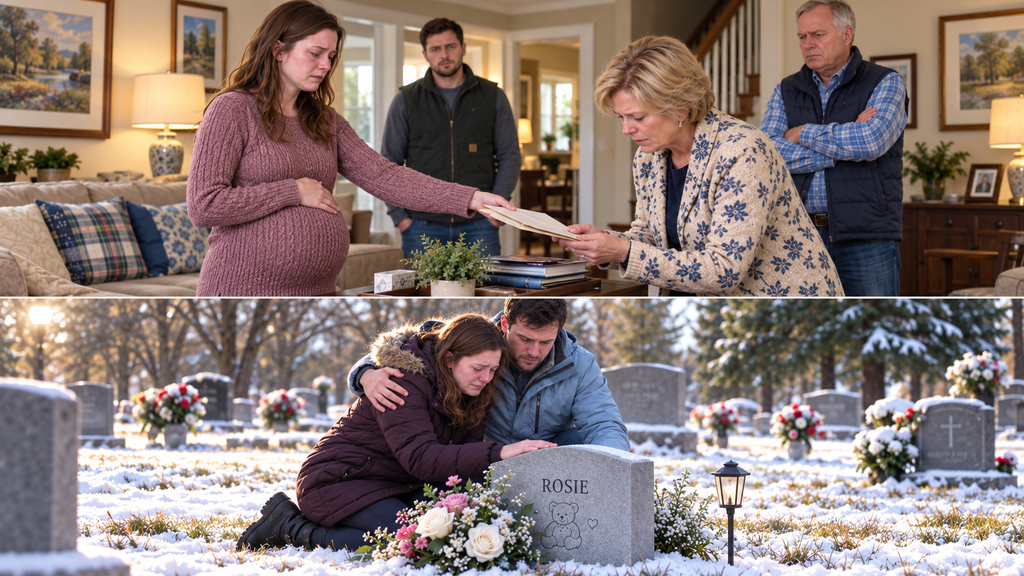
On the second anniversary of Rosie’s death, Owen and I went to the cemetery early in the morning.
We brought fresh flowers.
Pink roses.
The same color as the blossoms on her tree.
I knelt beside the small headstone.
ROSIE ELIZABETH HAYES
Forever Our Daughter
For a long time, I simply traced her name with my finger.
The letters were smooth beneath my skin.
Two years.
It seemed impossible.
The world had changed so much.
And yet some part of me remained in that hospital room, holding a tiny girl who would never open her eyes.
“Hi, baby,” I whispered.
Owen placed the flowers beside the stone.
Then he stepped back to give me a moment.
I sat on the grass.
“I brought you something.”
From my pocket, I removed a small photograph.
It showed the tree in our backyard, covered in pink blossoms.
“Look how big it’s getting.”
I smiled through my tears.
“Your daddy takes care of it like it’s the most important tree in the world.”
Behind me, Owen laughed softly.
“Because it is.”
I turned toward him.
He knelt beside me.
We held each other for a moment.
Then I noticed something near the headstone.
A small white stone had been placed beside the flowers from our previous visit.
On it, someone had written a single word.
Remembered.
I picked it up.
Owen looked confused.
“Did you put that there?”
I shook my head.
“No.”
We sat quietly.
Later, I learned that Kelsey had visited Rosie’s grave the week before.
She hadn’t told me.
She hadn’t posted about it.
She hadn’t expected thanks.
She’d simply gone to sit with the niece she’d never met.
And somehow, that quiet act meant more to me than all the expensive gifts our family had ever exchanged.
Because real love didn’t always announce itself.
Sometimes, it simply showed up.
That evening, I sat beneath Rosie’s tree.
The sky was turning gold.
Owen was inside preparing dinner.
The house was peaceful.
Not the peace of a life untouched by tragedy.
But the hard-won peace of people who had survived something they once believed would destroy them.
My phone vibrated.
A message from Mom.
We visited Rosie’s grave today. We didn’t want to disturb you. I hope that’s okay.
I stared at the screen.
Another message appeared.
I wish we’d been there when you needed us.
I looked toward the fading sunlight.
For a long time, I didn’t type anything.
Then I wrote four words.
I wish you had.
I pressed send.
It wasn’t forgiveness.
It wasn’t reconciliation.
It wasn’t an invitation to pretend the past had changed.
It was simply the truth.
And for once, the truth was enough.
Mom replied a few minutes later.
I know.
I set my phone aside.
Then I closed my eyes and listened to the wind moving through Rosie’s branches.
For most of my life, I’d believed being a good daughter meant never disappointing my parents.
I’d believed love was something earned through sacrifices.
Through obedience.
Through giving until there was nothing left.
And when I lost my little girl, I discovered how terribly wrong I had been.
Love wasn’t the $119,000 I’d spent keeping my parents comfortable.
It wasn’t the $52,000 I’d loaned Dad.
It wasn’t the $9,500 I’d contributed to a wedding I could barely afford.
And it certainly wasn’t the $42,000 they’d tried to take from me while I was grieving.
Love was Owen sitting beside me through sleepless nights.
Love was the nurse who carefully placed Rosie’s footprints inside a memory box.
Love was Aunt Rebecca arriving with groceries without demanding anything in return.
Love was my sister learning to respect the boundaries she’d once ignored.
Love was every person who said my daughter’s name without turning away from my sadness.
And love was Rosie herself.
My beautiful little girl.
The daughter who never came home.
The daughter who changed my life anyway.
I looked up at the pink blossoms above me.
Then I whispered the words I’d wanted my parents to understand from the beginning.
“She wasn’t just a baby who died.”
My voice trembled.
“She was my daughter.”
A soft breeze moved through the leaves.
I smiled through my tears.
“And she will always matter.”
For once, I wasn’t waiting for anyone to agree with me.
I knew it was true.
I always would.
THE END! THANK YOU FOR READING!❤️