 Reading Time: 32 minutes
The Morning After They Threw Me Away, I Discovered the Woman I Had Served for Twenty-Six Years Had Left Me Something Her Sons Would Do Anything to Take Back.
“Go ahead, sweetheart,” Rosella whispered. “Read what it says. See for yourself.” I leaned closer to the enormous deed book, adjusting my glasses with trembling fingers.
At seventy-two years old, I thought I had experienced every kind of surprise life could possibly offer.
I had buried my husband.
I had watched my daughter grow into a woman with troubles of her own.
I had worked through sickness, heartbreak, unpaid bills, and winters when I couldn’t afford to turn the heating up.
But nothing had prepared me for the words written on that yellowed courthouse page.
There, in carefully typed letters, was my full name.
ELNORA RUTHANNE WHITSETT.
Below it, the document read:
“Sole grantee of the remainder interest in the property known as Lockridge Farm, consisting of approximately eighty-four acres, including the principal residence, outbuildings, agricultural land, and all permanent improvements thereon, subject to a life estate reserved by Henrietta Margaret Lockridge.”
I read the paragraph once.
Then twice.
Then I looked up at Rosella.
“I don’t understand.”
She pulled out the chair beside me.
“Elnora, Henrietta transferred ownership of her farmhouse and land to you while she was alive. She kept the right to live there until she passed away.”
My mouth went dry.
“Transferred?”
Rosella nodded.
“The entire property.”
I stared at her.
“The kitchen?”
“Yes.”
“The upstairs bedrooms?”
“Yes.”
“The barn?”
“Yes, sweetheart.”
I swallowed.
“The little white house down the driveway?”
Rosella’s expression changed.
She reached across the table and covered my trembling hand with hers.
“Especially that little white house.”
For several seconds, I couldn’t hear anything except the pounding of my own heart.
Then I laughed.
It wasn’t because anything was funny.
It was the strange, frightened laugh that escapes when your mind refuses to accept what your eyes are seeing.
“Rosella, there must be some mistake. I cleaned that house. I don’t own it.”
“You do now.”
“No. No, Mrs. Lockridge wouldn’t have done something like this without telling me.”
“She had her reasons.”
I shook my head.
“Her sons will never allow it.”
Rosella leaned closer.
“Her sons don’t get to decide what their mother did with property that legally belonged to her.”
I looked down at my hands.
They were old hands.
Hands with swollen knuckles and little scars from broken dishes and hot irons.
Hands that had spent twenty-six years polishing furniture belonging to somebody else.
And now those same hands were resting on a document that said I owned the entire farmhouse.
“Why?” I whispered.
Rosella took a deep breath.
“That’s the part Henrietta wanted you to understand.”
She opened a drawer and withdrew a cream-colored envelope.
My name was written across the front in familiar blue handwriting.
I recognized it immediately.
Mrs. Lockridge always wrote her grocery lists with that same crooked little flourish beneath the last letter.
Rosella placed the envelope in front of me.
“She gave me this three months before she died. She said I wasn’t to let you read it until you had seen the deed.”
I reached for it.
Then stopped.
“Did Carlton know?”
Rosella hesitated.
That hesitation frightened me more than anything she had said.
“Rosella?”
She removed her glasses.
“Elnora, before you open that letter, there’s something I need to tell you.”
I felt a coldness travel down my back.
“Carlton came here six weeks ago.”
“What for?”
“He requested copies of every document his mother had recorded during the previous year.”
I stared at her.
“Then he already knew?”
“He knew the deed existed.”
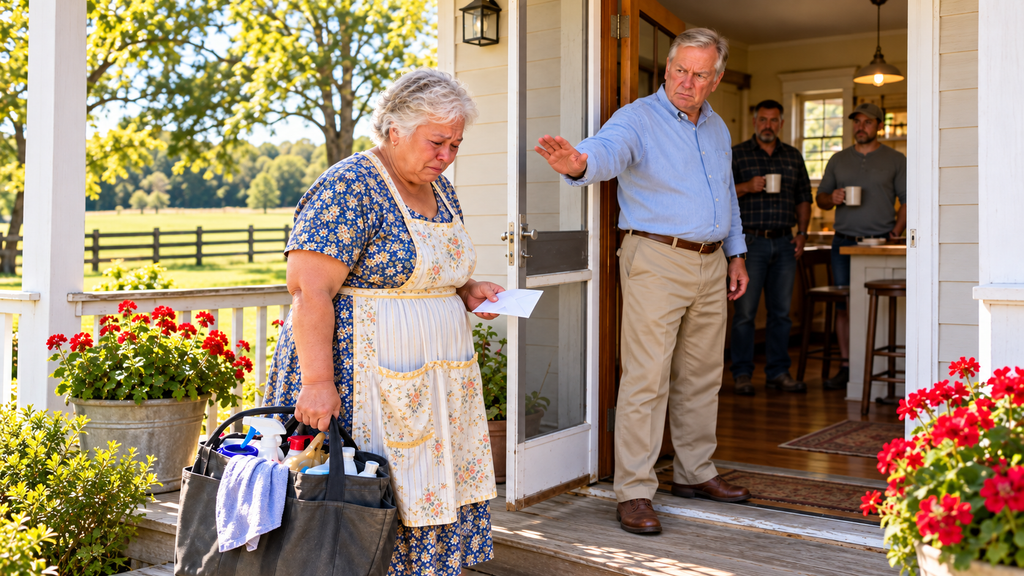
I remembered Carlton standing behind that locked screen door.
The three-hundred-dollar check.
The way he hadn’t even looked me in the eye.
And suddenly, something became clear.
He hadn’t dismissed me because he thought I no longer mattered.
He had dismissed me because he knew I mattered more than he wanted me to.
Rosella touched the envelope.
“Please read your letter, Elnora. Then call the attorney whose number is inside. Don’t sign anything Carlton brings you.”
I finally broke the seal.
Inside were four handwritten pages.
At the top of the first page, Mrs. Lockridge had written:
My dearest Elnora,
If you’re reading this, I have gone home to the Lord, and my boys have probably already shown you exactly who they are.
My throat tightened.
I could practically hear her saying it.
I know you will be frightened. I know you’ll think you don’t deserve what I’ve given you.
But there’s something about your mother that you never knew.
And there’s something about my father that I have been ashamed to tell you for nearly fifty years.
I stopped reading.
My mother?
Mama had been dead thirty-seven years.
What could Mrs. Lockridge possibly know about her that I didn’t?
I turned the page.
And the next sentence made my heart nearly stop.
Elnora, the little white house where you were born was never supposed to belong to the Lockridge family.
It belonged to your mother.
I don’t remember standing up.
One moment I was sitting at that courthouse table.
The next, I was beside the window, trying to breathe.
“My mother?” I whispered.
Rosella didn’t interrupt.
I returned to the chair and kept reading.
Your mother, Alma Whitsett, was one of the strongest women I ever knew.
She worked for my parents when she was young, but she wasn’t merely their servant. She was a woman who dreamed of owning something nobody could take away from her.
In 1951, she purchased eleven acres bordering our family’s property, including the little white cottage.
She saved for seven years to do it.
I remembered Mama talking about that little house.
She called it her blessing.
Every spring, she planted yellow flowers beneath the porch.
Every fall, she collected pecans in an old flour sack.
And every Sunday afternoon, she’d sit on that porch swing and say, “One day, baby, nobody will ever be able to tell you that you don’t belong here.”
I had always thought she was speaking about life in general.
Now I wondered whether she meant something far more specific.
My eyes moved down the page.
In 1968, your father became terribly ill. Your mother needed money for his treatment. My father offered to lend her what she needed, but he insisted she sign over the deed to her land as security.
He promised to return it when the debt was repaid.
I covered my mouth.
I remembered my father’s illness.
I remembered Mama crying over hospital bills.
But nobody had ever told me about the land.
Your mother repaid that loan, Elnora. Every penny.
I know because I found the ledger years later.
But my father never returned her deed.
Tears blurred the words.
When she asked him about it, he claimed the interest had exceeded the original debt.
He allowed your family to remain in the cottage, but he treated the property as his own.
Your mother tried to fight him. She went to the courthouse twice. But she had no money for an attorney, and my father had friends in every important office in the county.
I pressed my hand against my chest.
Mama had never told me.
Not once.
I knew enough to suspect what had happened, but I was a coward. I told myself it was between my father and your mother. Years later, when I found proof, I still didn’t correct it.
I am sorry.
There is no pretty way to say that.
Your mother died without getting back what she worked so hard to own.
I could barely see the final paragraph.
I cannot undo the years that were stolen from her. I cannot bring her back. But I can refuse to let another generation of Lockridges profit from what my father took.
The farm was legally mine to transfer. I have given it to you.
Not because you scrubbed my floors.
Not because you brought me medicine or sat beside my bed when my sons were too busy.
Those things made you my friend, and they will always matter to me.
But this property is also part of a debt that should have been settled long ago.
Please don’t mistake restitution for charity.
And please, Elnora, don’t let my boys frighten you into giving away what is yours.
With all my love,
Henrietta.
I finished reading.
Then I folded the letter carefully and pressed it against my heart.
For the first time in thirty-seven years, I wanted my mother so badly it physically hurt.
I wanted to ask why she hadn’t told me.
I wanted to ask how many nights she’d cried over those eleven acres.
And more than anything, I wanted to tell her that somebody had finally remembered.
Rosella sat quietly beside me.
Eventually, she said, “Henrietta was terribly afraid you would refuse the property.”
I wiped my cheeks.
“She knew me too well.”
Rosella smiled sadly.
“She told me you’d say it was too much.”
“It is too much.”
“No, Elnora.”
Her voice grew firm.
“Sometimes people have been taught to expect so little that receiving what they’re owed feels like stealing.”
I looked down at the deed book again.
For the first time, I didn’t see a mansion or eighty-four acres.
I saw Mama standing on her porch, holding a flour sack full of pecans.
I heard her voice.
One day, baby, nobody will ever be able to tell you that you don’t belong here.
And I began to cry again.
But those tears didn’t last long.
Because before I left the courthouse, Rosella said something that turned my joy into fear.
“Elnora, there’s another reason Henrietta wanted you to speak with her attorney immediately.”
I looked up.
“What reason?”
Rosella lowered her voice.
“Carlton has been trying to sell the farm.”
“But he doesn’t own it.”
“I know.”
She paused.
“I’m not certain the people he’s been dealing with know that.”
I left the courthouse carrying a folder against my chest like it contained something alive.
Inside were copies of the deed, Mrs. Lockridge’s letter, and the business card of an attorney named Miriam Tate.
I sat inside my Buick for nearly twenty minutes before turning the key.
My first instinct was to call Carlton.
For twenty-six years, whenever something went wrong at the farmhouse, Carlton was the person I was supposed to notify.
A broken water heater.
A leaking roof.
A fallen branch after a storm.
I had spent so long asking that family what they wanted me to do that even now, when I had discovered the property belonged to me, I almost asked their permission to believe it.
Then I remembered the screen door.
The check.
His cold voice.
Your services won’t be needed anymore.
I put my phone down.
And for the first time, I called a lawyer instead.
Miriam Tate’s office was above an old pharmacy downtown.
She was a woman in her early sixties with silver hair, sharp eyes, and a desk covered in neatly arranged folders.
When I introduced myself, she stood so quickly her chair rolled backward.
“Mrs. Whitsett.”
She came around the desk and took both my hands.
“I’ve been hoping you’d call.”
That made me nervous.
“You knew Mrs. Lockridge?”
“Very well. I prepared her deed.”
I sat down carefully.
“Then please tell me whether this is real.”
Miriam studied my face.
“It’s real.”
“Can those boys take it away?”
“They can challenge the transfer. They cannot simply erase a properly executed deed because they dislike their mother’s decision.”
She opened a thick file.
“Henrietta anticipated that Carlton and his brothers might contest it. She insisted on several safeguards.”
“What sort of safeguards?”
“Her physician documented her mental capacity. I met with her privately on multiple occasions. She signed the deed voluntarily, before a notary and independent witnesses. We also recorded a statement explaining her intentions.”
I stared at her.
“Mrs. Lockridge did all that?”
Miriam smiled faintly.
“She was quite a remarkable woman.”
A sudden memory came back to me.
One Friday morning, about eight months earlier, Mrs. Lockridge had told me to take the afternoon off.
I thought she had a doctor’s appointment.
When I’d returned Monday, there had been two extra coffee cups in the sink.
I hadn’t given them a second thought.
Now I understood.
That was probably when Miriam had visited.
I looked at the lawyer.
“What about Carlton selling the property?”
Her expression hardened.
“That’s what concerns me.”
She removed another document from the folder.
“Three months before his mother’s death, Carlton began negotiating with a development company. They want to turn the eastern portion of the farm into a large commercial distribution facility.”
My stomach twisted.
“The pecan orchard?”
“Yes.”
“The pasture where her husband used to keep his horses?”
“Yes.”
I remembered Mrs. Lockridge sitting near her kitchen window, watching deer wander through that pasture at sunrise.
She’d loved that land.
“What would happen to the little white house?”
Miriam hesitated.
“According to the preliminary development plan, it would be demolished.”
Something inside me went still.
Mama’s porch.
The little window where she kept her geraniums.
The pecan trees my father planted.
All of it flattened beneath concrete.
“Can he do that?” I asked.
“Not if he doesn’t have the authority to sell.”
“Then why is he trying?”
Miriam folded her hands.
“Because the proposed purchase price is more than three million dollars.”
I couldn’t speak.
Three million dollars.
I’d spent the previous night calculating whether I could afford groceries and my electricity bill in the same week.
And Carlton had been arranging to sell the land where I was born for three million dollars.
Miriam continued.
“We believe he signed an agreement representing that he would inherit and control the property. If that’s true, he may now have a serious problem with the developer.”
I looked toward the window.
“Does that mean he’s going to come after me?”
Miriam didn’t lie.
“It means we need to be careful.”
Then she leaned forward.
“Elnora, I need you to promise me something.”
“What?”
“Whatever Carlton offers you, don’t sign anything without showing it to me.”
I promised.
I meant it.
But I had no idea how quickly that promise would be tested.
Carlton arrived at my house the following evening.
I was standing at the stove heating a small pot of vegetable soup when I heard a black SUV pull into my driveway.
Through the kitchen window, I saw Carlton climb out wearing a navy suit.
Thurston emerged from the passenger side.
Neither man had visited my little rented house in all the years I’d worked for their mother.
Now they were standing on my porch.
Carlton knocked three times.
I considered pretending I wasn’t home.
Then I remembered something Miriam had said.
Being frightened doesn’t mean you’ve done anything wrong.
I opened the door but kept the screen latched.
“Good evening.”
Carlton looked at the latch.
“Elnora, we need to talk.”
“About what?”
He gave me a tight smile.
“Let’s not play games.”
Thurston stepped forward.
“We know you went to the courthouse.”
I said nothing.
Carlton held up a manila envelope.
“Mother was confused near the end. She signed paperwork she didn’t understand.”
I looked directly at him.
“Your mother knew the name of every person who visited her, the birthdays of all six grandchildren, and exactly how she liked her coffee.”
His jaw tightened.
“That doesn’t mean she understood legal documents.”
“Then why did she hire a lawyer?”
The question caught him off guard.
Thurston recovered first.
“Listen, Elnora. Nobody is accusing you of anything yet.”
Yet.
I heard the threat hidden inside that little word.
Carlton pushed the envelope toward the screen.
“We’re prepared to give you twenty-five thousand dollars to resolve this misunderstanding.”
My fingers tightened around the doorframe.
Twenty-five thousand dollars.
It was more money than I’d managed to save in the previous decade.
For one dangerous second, I thought about my bills.
My old Buick.
The aching knees that made every staircase feel steeper than the last.
Carlton saw my hesitation.
His expression softened.
“Think about it, Elnora. You could stop working. Buy yourself a decent car. Take a little vacation.”
Thurston nodded.
“Mother would have wanted you to be comfortable.”
That did it.
Something hot rose in my chest.
“Your mother wanted me to have the farm.”
Carlton’s smile disappeared.
“You don’t know what you’re talking about.”
“I read the deed.”
“You read words on a page. You don’t understand what owning eighty-four acres means.”
“Then perhaps I’ll learn.”
Thurston gave a short, ugly laugh.
“You’re seventy-two years old. What are you going to do with a farmhouse that size? Scrub every room for yourself?”
For twenty-six years, I had swallowed remarks like that.
I had smiled when Thurston criticized the way I folded towels.
I had apologized when he tracked mud across floors I had just mopped.
I had listened as he treated me like part of the furniture.
But something had changed.
I wasn’t standing in his mother’s kitchen anymore.
He was standing outside my door.
And I didn’t owe him another apology.
“Mr. Thurston,” I said quietly, “if I decide to scrub those floors, at least they’ll be mine.”
His face turned red.
Carlton moved closer.
“Enough. Mother was manipulated. We can make this unpleasant.”
I looked at the envelope.
“What exactly do you want me to sign?”
“A simple agreement.”
“Does it give you the farm?”
“It corrects the deed.”
“Then it isn’t simple.”
He stared at me.
I took a breath.
“My lawyer will contact yours.”
For several seconds, nobody moved.
Then Carlton leaned toward the screen.
His voice dropped.
“You need to remember who you’re dealing with.”
I met his eyes.
“No, Carlton. I think you need to remember who your mother was.”
I closed the wooden door.
My hands began shaking before I reached the kitchen.
I sat at the table, unable to touch my soup.
Then I called Alfreda.
“Mama?” she answered.
“Baby, I need you.”
She heard something in my voice.
“What’s wrong?”
And for the first time since leaving the courthouse, I told my daughter everything.
When I finished, the line went silent.
Then Alfreda whispered, “They offered you how much?”
“Twenty-five thousand.”
“And you said no?”
“Yes.”
She let out a long breath.
“Mama, are you certain the property is really yours?”
“I’ve seen the deed.”
“Then why are those men trying to buy it from you?”
I looked toward the darkened window.
“Because I think they’re scared.”
Alfreda was quiet again.
Then she said something I hadn’t expected.
“I’m coming over.”
“Honey, you don’t have to—”
“Yes, Mama. I do.”
And before I could protest, she hung up.
Alfreda arrived forty minutes later carrying a grocery bag.
Inside were chicken, bread, milk, fresh peaches, and a small container of my favorite butter pecan ice cream.
I stared at the groceries.
“What’s all this?”
She placed them on the counter.
“Dinner for the next few days.”
“Baby, I can buy my own food.”
“I know.”
She turned toward me.
Her eyes were wet.
“Mama, I need to apologize.”
I shook my head.
“Whatever for?”
“For what I said when you called after Carlton dismissed you.”
I looked away.
She continued.
“When you asked what you were supposed to do, I told you that you couldn’t move in with us.”
“I understood.”
“No, Mama. You shouldn’t have had to understand.”
She pulled out a chair.
“My husband’s hours have been cut. We’re behind on the mortgage. I’ve been terrified that if you came to stay with us, you’d see how bad things are.”
I reached for her hand.
“Why didn’t you tell me?”
“Because you’ve spent your whole life taking care of everybody. I didn’t want you worrying about us too.”
I looked at my daughter.
Forty-eight years old.
Tired eyes.
The same stubborn chin she’d had as a little girl.
And suddenly, I realized how many people in our family had been hiding their troubles to protect one another.
Mama had hidden her stolen land.
I had hidden my financial fears.
Alfreda had hidden hers.
Three generations of women pretending they weren’t struggling because they didn’t want to burden somebody else.
I squeezed her hand.
“No more secrets, baby.”
She nodded through her tears.
“No more secrets.”
We sat at the kitchen table eating soup and talking until midnight.
At one point, Alfreda asked whether I planned to move into the farmhouse.
“I don’t know,” I admitted.
She smiled.
“Can you imagine? Mama owning that big old house?”
I looked down at my hands.
“I’m still trying to imagine owning the front door.”
We both laughed.
But just before she left, Alfreda became serious.
“Mama, those men aren’t going to stop easily.”
I nodded.
“I know.”
She put her arms around me.
“Then they won’t just be fighting you.”
For the first time in years, I didn’t feel quite so alone.
Three days later, I received a telephone call that changed everything again.
It was Bertram.
The youngest Lockridge son.
Of the three brothers, he’d always been the quietest.
He visited less often than Carlton, but when he did, he usually sat with his mother in the garden rather than ordering me around.
Still, he’d been in that kitchen the morning Carlton dismissed me.
He hadn’t said a word.
“Mrs. Whitsett?” he began.
“Yes?”
“I owe you an apology.”
I nearly laughed.
There seemed to be an epidemic of apologies that week.
“For what?”
“For standing there and saying nothing when Carlton treated you that way.”
I waited.
He swallowed audibly.
“There’s something else.”
My grip tightened around the receiver.
“What is it?”
“I knew Mother was planning to change the ownership of the farm.”
I closed my eyes.
“How long?”
“Almost a year.”
“And you didn’t say anything?”
“She made me promise not to.”
“Why?”
“Because she was afraid Carlton would pressure you into refusing it before the deed was recorded.”
I thought about that.
Mrs. Lockridge had known me so well.
She knew I would never willingly accept something that might cause trouble between her and her children.
“She told me something,” Bertram continued. “Something I didn’t understand at the time.”
“What?”
“She said, ‘Bertram, a person can spend her whole life being grateful for crumbs and never realize the bread belonged to her in the first place.’”
I pressed my hand to my mouth.
That sounded exactly like her.
Bertram’s voice became strained.
“Elnora, Carlton wasn’t just trying to sell the farm after Mother died.”
I sat upright.
“What do you mean?”
“He was pressuring her to sign it over to him while she was still alive.”
I stared at the wall.
“He told her the money would pay for better medical care. But she already had everything she needed.”
“Did she refuse?”
“Every time.”
He paused.
“Last spring, they had an awful argument. Carlton told Mother the farmhouse was his inheritance and that she was being selfish.”
“What did she say?”
“She told him inheritance wasn’t something a child was owed merely for being born.”
Despite everything, I smiled.
Bertram took a shaky breath.
“That’s when Carlton said he’d have a doctor declare her incompetent if she didn’t cooperate.”
A chill ran through me.
“Dear Lord.”
“Mother threw him out.”
I remembered that spring.
Mrs. Lockridge had been unusually quiet for several days.
One Friday, she’d asked me to sit beside her rather than start cleaning.
She’d held my hand and said, “Elnora, never let somebody convince you that being old means you no longer have the right to decide your own life.”
I’d thought she was simply feeling sentimental.
Now I knew what she’d been facing.
Bertram continued.
“There’s a wooden trunk in the farmhouse attic. Mother told me it contains documents about your parents and the old property.”
My heart jumped.
“What documents?”
“Original receipts. A ledger. Maybe letters. She said if anybody challenged her decision, I was to make sure you got them.”
“Then why haven’t you?”
He was silent for so long I thought the call had disconnected.
Finally, he whispered, “Because Carlton threatened to cut me off from the family.”
I looked out the window.
“Bertram, your mother is gone.”
“I know.”
“And you’re a grown man.”
“I know that too.”
“Then perhaps it’s time you decided what kind of man you want to be.”
He didn’t answer immediately.
Then he said, “I’ll bring the trunk to your lawyer tomorrow.”
And he did.
Miriam called me the next afternoon.
“Elnora, you need to come to my office.”
Her voice was strange.
Not frightened.
Not excited.
Almost reverent.
When I arrived, Bertram was sitting in the corner.
Between him and Miriam stood an old wooden trunk with brass corners.
I recognized it immediately.
Mrs. Lockridge kept it in the attic beneath a faded quilt.
For years, she’d told me not to bother cleaning it.
“Too much dust and too many memories,” she’d say.
Miriam opened the lid.
Inside were bundles of letters tied with ribbon, several old photographs, and a thick leather ledger.
She lifted the ledger onto her desk.
“Look at this.”
The pages were brittle.
Along the left side were dates from the 1960s and 1970s.
Names.
Amounts.
Payments.
Near the bottom of one page, written in faded ink, were two words I hadn’t seen in my mother’s handwriting for decades.
ALMA WHITSETT.
Beside her name were a series of payments.
Every few weeks.
Sometimes ten dollars.
Sometimes twenty-five.
Sometimes only five.
I remembered Mama taking in laundry from neighbors.
I remembered her mending dresses late into the night.
I remembered waking up and finding her asleep in a chair with a needle still threaded beside her.
Those little amounts had cost her something.
Miriam pointed to the final entry.
Balance paid in full — June 14, 1974.
Beneath it was the signature of Henrietta’s father.
I touched the ink with one finger.
My mother had paid her debt.
Every penny.
And still, the land had never been returned.
My eyes burned.
Miriam turned another page.
A folded letter slipped out.
It was dated two weeks after that final payment.
The envelope was addressed to my mother.
But it had never been mailed.
Miriam opened it carefully.
It contained only four sentences.
Mrs. Whitsett,
I have reviewed your request concerning the property. Although your loan balance has been satisfied, I consider the matter of ownership closed. You and your family may continue occupying the cottage at my discretion.
Bennett Lockridge.
I felt something break inside me.
Not surprise.
Not even anger.
It was grief.
The kind of grief that comes when you discover somebody you loved suffered an injustice and carried it silently to the grave.
I looked at Bertram.
“Your grandfather knew.”
He nodded.
“Yes, ma’am.”
“He knew she paid him back.”
“Yes.”
“And he kept her land anyway.”
Bertram lowered his head.
“I am so sorry.”
For a moment, I couldn’t look at him.
Then Miriam spoke.
“There’s something else.”
She opened a second envelope from the trunk.
Inside was a recent letter written by Mrs. Lockridge.
It was addressed to her three sons.
Miriam read the first paragraph aloud.
My boys,
I raised you in a house that was comfortable because generations of other people’s labor helped keep it standing.
I hoped you would grow up understanding that privilege creates responsibility.
Instead, I have watched you confuse possession with deserving.
I closed my eyes.
I could hear her voice in every word.
You may disagree with my decision concerning the farm. That is your right.
But you will not pretend I was confused.
You will not accuse Elnora of manipulating me.
And you will not erase her mother’s history because it is inconvenient to yours.
Miriam looked up.
There was more.
I leave you my love, my memories, and the other assets provided for you in my estate plan.
The land is not yours.
I have spent too many years postponing what is right because I feared making you angry.
I will not spend the last of my days doing it again.
By the time Miriam finished, Bertram was crying openly.
I’d never seen a grown Lockridge man cry.
Not even at their mother’s funeral.
He wiped his face.
“She told us the same thing in person.”
Miriam looked at him.
“All three of you?”
“Yes.”
“Was Carlton present?”
Bertram nodded.
“He was.”
“And did she appear confused?”
“No.”
His voice grew stronger.
“She knew exactly what she was saying.”
Miriam closed the letter.
“Then I hope you’ll be prepared to say that under oath.”
Bertram looked at me.
For a long moment, we studied one another.
Then he nodded.
“I will.”
Carlton filed his lawsuit the following Monday.
Miriam had warned me it was possible.
Still, seeing my own name printed on court papers made my knees weak.
Carlton alleged that I had taken advantage of his mother’s age.
That I had isolated her.
That I had manipulated her into signing away her property.
He even claimed I’d discouraged him from visiting.
That accusation hurt more than I expected.
Because I remembered the Christmases Mrs. Lockridge spent waiting by the window.
I remembered her birthday when Thurston sent flowers but forgot to call.
I remembered Bertram canceling a visit because of work.
And I remembered Carlton’s Sunday telephone calls.
Five minutes.
Sometimes less.
Usually ending with a question about whether the property taxes had been paid or the roof had been repaired.
One afternoon, after reading the complaint, I sat in Miriam’s office and whispered, “Maybe I should just give it back.”
She looked up sharply.
“Why?”
“Because I don’t want all this trouble.”
“Elnora, would giving Carlton the farm correct what happened to your mother?”
I looked away.
“No.”
“Would it honor Henrietta’s wishes?”
“No.”
“Then why would you do it?”
I couldn’t answer.
Miriam’s voice softened.
“Sometimes standing up for yourself feels cruel when you’ve spent your life making sure everybody else is comfortable.”
I began twisting my handkerchief.
“But those boys have money.”
“Yes.”
“And lawyers.”
“Yes.”
“And people in this town listen to them.”
“They do.”
I lifted my eyes.
“What do I have?”
She placed the deed in front of me.
“You have a recorded property transfer, documentary evidence, witnesses, and a woman who took extraordinary care to make sure her decision was understood.”
Then she smiled.
“And you have the truth.”
I wish I could tell you those words took away my fear.
They didn’t.
For the next six weeks, I hardly slept.
People whispered at the grocery store.
A woman I’d known for twenty years asked whether I’d “talked old Henrietta into leaving me something.”
Someone left an anonymous note in my mailbox.
You should be ashamed.
I kept the note.
Not because I believed it.
But because I wanted to remember what people were willing to say about a woman they thought couldn’t defend herself.
Alfreda began coming over every Sunday.
Sometimes she brought dinner.
Sometimes she helped me organize paperwork.
Sometimes we simply sat together.
And every Thursday morning, when I would ordinarily have been washing Mrs. Lockridge’s floors, I took out her letter and read it again.
Please don’t mistake restitution for charity.
Those words kept me going.
But the hardest day was still ahead.
The hearing took place on a rainy Tuesday morning.
I wore the same navy dress I’d worn to the courthouse the day Rosella showed me the deed.
Alfreda sat beside me.
Miriam was at the table in front.
Carlton arrived with Thurston and two attorneys.
He didn’t look at me.
Bertram entered a few minutes later and sat on the opposite side of the courtroom from his brothers.
That alone caused a stir.
The proceedings began with Carlton’s attorney describing me as a “trusted household employee who had cultivated an unusually dependent relationship with an elderly woman.”
I felt my cheeks burn.
Household employee.
Twenty-six years.
That was apparently all I had been.
Then he claimed Mrs. Lockridge had become forgetful in her final years.
He suggested I’d taken advantage of her loneliness.
He implied I had turned her against her children.
By the time he finished, I was gripping Alfreda’s hand so tightly she whispered, “Mama, you’re hurting my fingers.”
I loosened my grip.
“Sorry, baby.”
Then Miriam stood.
She didn’t raise her voice.
She didn’t make a speech about injustice.
She simply began presenting evidence.
First came the deed.
Then the notary’s acknowledgment.
Then testimony about the private meetings with Mrs. Lockridge.
Then the physician’s assessment confirming she had the ability to understand her decisions when the deed was executed.
Carlton shifted in his seat.
Miriam continued.
She presented the original ledger.
The old mortgage records.
The final payment entry bearing Bennett Lockridge’s signature.
Then she called Bertram.
He walked to the witness stand slowly.
His hands shook as he took the oath.
Miriam asked whether his mother had ever discussed her intentions regarding the farm.
“Yes.”
“Did she tell you why she wanted Elnora Whitsett to receive it?”
“Yes.”
“What did she say?”
Bertram looked toward me.
“She said she’d spent most of her life living comfortably on land that should have been returned to Elnora’s family.”
Miriam nodded.
“Did your mother appear confused during that conversation?”
“No.”
“Did she know who you were?”
“Yes.”
“Did she know who Elnora Whitsett was?”
“Of course.”
“Did she understand that transferring the property meant her sons would not inherit it?”
Bertram swallowed.
“Yes.”
“Did she say anything about that?”
He looked down.
Then he answered.
“She said she loved us, but love didn’t require her to reward us for being selfish.”
A murmur moved through the courtroom.
Carlton’s attorney objected to the reaction.
The judge called for quiet.
Miriam waited.
Then she asked one final question.
“Mr. Lockridge, did Carlton know his mother intended the property for Mrs. Whitsett?”
Bertram looked at his oldest brother.
Carlton stared at him.
For a moment, I thought Bertram would lose his courage.
Then he straightened.
“Yes.”
“How did he know?”
“Mother told him.”
“When?”
“Months before she died.”
“And what was his response?”
Bertram’s voice cracked.
“He told her he’d make sure Elnora never got to enjoy a single day in that house.”
I felt Alfreda stiffen beside me.
Carlton’s face darkened.
Miriam paused.
Then she reached for another folder.
“Your Honor, I would like to introduce correspondence between Carlton Lockridge and the proposed purchaser of the farm.”
My heart began pounding.
I hadn’t known about that evidence.
The judge reviewed the documents.
Miriam explained that Carlton had been negotiating the sale while his mother was still alive.
And that he had continued making promises to the developer even after learning that the deed transferred the property to me.
A series of emails showed him discussing ways to “resolve the title problem.”
One message contained a sentence I would never forget.
The former housekeeper is elderly and has limited resources. I expect she can be persuaded to accept a modest settlement.
I stared at Carlton.
He had known.
He had known I was frightened.
He had known I’d lost my only regular job.
He had known three hundred dollars would barely cover my bills.
And he had counted on my poverty to make me surrender.
I looked down at the handkerchief in my lap.
For the first time, I wasn’t afraid of him.
I was angry.
Not the loud kind of anger.
The quiet kind.
The kind that makes a person sit up straighter.
Then Miriam said, “Your Honor, there is one final piece of evidence.”
She brought a small video recording to the court’s attention.
The recording had been made in her office several months before Mrs. Lockridge died.
It showed Henrietta sitting in a high-backed chair.
She wore a lavender cardigan.
Her silver hair was perfectly combed.
And there was a familiar cup of coffee in her hand.
When I saw her face, I made a sound I couldn’t control.
Alfreda wrapped an arm around my shoulders.
On the screen, Miriam asked, “Mrs. Lockridge, can you explain in your own words why you’ve decided to transfer the farm to Elnora Whitsett?”
Mrs. Lockridge smiled.
“Well, I suppose my boys will say I’ve gone senile.”
A few people chuckled.
She took a sip of coffee.
“Let me save everybody some trouble.”
Her expression became serious.
“I know what I own. I know what I’m signing. I know exactly who Elnora is.”
She paused.
Then she said something that made tears pour down my face.
“Elnora has cleaned my house for twenty-six years, but she was never just the woman who cleaned my house.”
Mrs. Lockridge looked directly into the camera.
“She sat beside me when my husband died. She brought soup when I had pneumonia. She remembered my birthdays. She listened when I was frightened. And when my hands began shaking too badly to button my dresses, she helped me without ever making me feel helpless.”
I covered my mouth.
“She deserves respect for those things. But that’s not why I’ve transferred the farm.”
Mrs. Lockridge set down her cup.
“My father took land from Elnora’s mother. The records prove the debt was paid, and I failed to correct the wrong when I had the chance.”
Her voice trembled.
“I cannot give Alma Whitsett back the years she spent being told the cottage was hers only as long as my family allowed it.”
She took a breath.
“But I can give her daughter the security her mother worked for.”
Then she looked straight into the camera.
“And if any of my sons are watching this, I want you to listen carefully.”
The courtroom became completely silent.
“I have loved you since the day you were born.”
Her eyes glistened.
“But I will not let my love for you become another excuse for injustice.”
A long pause followed.
Then she smiled that familiar, mischievous smile.
“And Elnora, if you ever see this, I hope you’re sitting down.”
A sob escaped me.
She continued.
“Don’t worry about keeping the floors spotless, sweetheart.”
Her voice softened.
“Go sit on the porch. Drink your coffee while it’s hot. Enjoy your life.”
The recording ended.
Nobody spoke.
Even Carlton looked shaken.
For the first time since her funeral, I had heard Mrs. Lockridge’s voice.
And the last thing she’d said was something she’d told me a hundred times before.
Those floors aren’t going anywhere.
I lowered my head and cried.
The judge did not decide everything that morning.
There were still legal arguments, property records to examine, and additional motions.
I learned that owning something legally and being allowed to enjoy it peacefully were sometimes very different things.
The following weeks brought more paperwork.
More meetings.
More waiting.
But the evidence had changed the situation.
Carlton’s attorneys began discussing withdrawal of the challenge.
The proposed developer demanded an explanation for the title problem.
And Bertram refused to change his testimony.
Two months after the hearing, Miriam called.
“Elnora?”
“Yes?”
“Are you sitting down?”
I gripped the telephone.
“Lord, what now?”
She laughed.
“Carlton’s side has agreed to dismiss the lawsuit with prejudice. The court has entered the dismissal.”
I didn’t understand the legal language.
“Does that mean it’s over?”
“The deed remains valid and unchallenged in this case. The property is yours, Elnora.”
I sat down.
For a moment, I couldn’t speak.
Miriam continued.
“There are still practical matters to handle. Insurance, taxes, management, and some of Henrietta’s personal belongings that are separate from the real estate.”
I barely heard her.
“The farm?” I whispered.
“Yes.”
“The cottage?”
“Yes.”
“The pecan trees?”
She laughed softly.
“Every last one.”
I closed my eyes.
And then I cried harder than I had at the courthouse.
Not because I suddenly felt rich.
But because I could finally stop fighting.
I returned to Lockridge Farm on a bright Saturday morning in April.
Alfreda drove behind me.
Rosella came too.
So did Bertram, who had asked whether he could be there when I entered the house for the first time as its owner.
The farmhouse looked exactly as it always had.
White columns.
Dark shutters.
Wide front porch.
Pecan trees casting their shadows across the lawn.
For twenty-six years, I’d usually entered through the back.
That morning, I stood on the front steps.
Alfreda smiled.
“Go on, Mama.”
I looked at the front door.
Then at the key Miriam had placed in my hand.
My fingers trembled as I turned it.
The lock clicked.
I pushed open the door.
The familiar smell of old wood, furniture polish, and lavender greeted me.
For a moment, I almost called out.
“Mrs. Lockridge? It’s Elnora.”
I could imagine her answering from the sitting room.
Come on in, sweetheart. Coffee’s ready.
But the house was silent.
I walked slowly through the hallway.
Past the family photographs.
Past the antique clock.
Past the little table where Mrs. Lockridge always left her mail.
When I entered the kitchen, I stopped.
Her blue coffee cup was still hanging on its hook.
I reached for it.
Then I sat at the familiar wooden table.
The same table where we’d shared hundreds of Friday mornings.
I rested my forehead against my hand.
“I’m home, Mrs. Lockridge,” I whispered.
And although the house was empty, I could almost feel her smiling.
Alfreda entered quietly.
“Mama?”
I looked up.
“Yes, baby?”
“What are you going to do with all this?”
I glanced around.
The property was beautiful.
But it was enormous.
And I was seventy-two.
I had no intention of spending whatever years remained to me managing eighty-four acres alone.
“I’ve been thinking about that,” I said.
Over the previous weeks, Miriam had helped me understand what the property required.
A neighboring farmer was interested in leasing the agricultural acreage.
The old barn needed repairs.
The farmhouse needed regular maintenance.
There were taxes and insurance to consider.
And although the property’s value was considerable, a deed did not magically put money into my checking account.
I wasn’t interested in pretending otherwise.
But for the first time, I had choices.
Real choices.
I could lease the farmland.
I could arrange for proper management.
I could renovate the cottage.
And I could finally stop worrying that one unexpected expense would leave me unable to eat.
“I want to fix Mama’s house,” I told Alfreda.
She smiled.
“The little white one?”
I nodded.
“And I want to keep this farmhouse standing.”
“What for?”
I looked toward the kitchen window.
“I haven’t decided everything yet. But I’d like it to be a place where people are welcomed through the front door.”
Alfreda studied me.
Then her eyes filled with tears.
“I think Grandma Alma would love that.”
I smiled.
“I think she would too.”
I did not become a different person overnight.
I still woke before sunrise.
I still folded towels a certain way.
I still rinsed dishes immediately after eating.
And sometimes, when I heard a truck approaching the farmhouse, my stomach tightened before I remembered nobody could dismiss me from my own property anymore.
But little by little, I began learning what freedom felt like.
I hired a local contractor to repair the cottage roof.
We replaced rotten porch boards and restored the old windows.
The pecan trees were pruned.
The flower beds were cleared.
And one beautiful afternoon, a carpenter installed a new porch swing in almost the exact place where Mama’s old one had hung.
I cried when I saw it.
Because suddenly, I could remember everything.
The smell of biscuits.
Mama calling me inside before dark.
Daddy sitting on the steps polishing his Sunday shoes.
The sound of cicadas in the summer.
I hadn’t realized how much of my childhood I had buried beneath years of simply trying to survive.
Now it was coming back.
One memory at a time.
Bertram visited twice during the restoration.
He never asked me for money.
He never asked for the house.
The second time, he brought a cardboard box.
Inside were Mrs. Lockridge’s old recipe cards and several photographs that belonged to her personal collection.
“I thought you might like these,” he said.
I lifted a photograph.
Mrs. Lockridge was standing beside my mother in the garden.
They were both young.
Mama wore a white dress with tiny blue flowers.
Mrs. Lockridge held a basket of tomatoes.
They were smiling.
I had never seen that photograph before.
“Where did you find this?”
“In Mother’s bedroom.”
He hesitated.
“She had it beside her bed.”
My eyes filled.
Bertram looked toward the cottage.
“I wish I’d done more while she was alive.”
I didn’t tell him it was all right.
Because some things weren’t all right.
Instead, I said, “Then do better with the people who are still here.”
He nodded.
“I intend to.”
As for Carlton and Thurston, I had little contact with them after the legal dispute ended.
Miriam handled the remaining correspondence about family photographs and personal belongings.
Carlton never apologized.
Thurston never admitted he had been wrong.
For a while, that bothered me.
Then one Friday morning, I realized I had spent nearly my entire life waiting for other people to decide whether I deserved respect.
I wasn’t going to spend my remaining years waiting for those two men to become decent.
Their apology was not required for me to have peace.
By late summer, the little white cottage was ready.
Alfreda helped me move my belongings.
My old dining table fit perfectly beside the kitchen window.
My husband’s photograph went on the mantel.
Mama’s Bible rested on the shelf beside it.
And I placed the courthouse copy of the deed inside a wooden box where I could find it whenever I needed reminding that all of this had really happened.
On the first evening, Alfreda and I sat on the porch swing.
The air smelled of freshly cut grass and warm earth.
Beyond the driveway, the farmhouse glowed in the sunset.
I had arranged to lease much of the farmland to a neighboring family who’d worked the fields for generations.
With Miriam’s help, I also began planning to turn part of the farmhouse into a small community gathering space.
Nothing extravagant.
Just a place where older neighbors could share meals, where families could gather, and where people who had spent years caring for others might find a little kindness themselves.
I decided to call it The Alma Whitsett House.
Not because I wanted people to remember that I’d inherited a grand farmhouse.
But because I wanted them to remember the woman who bought eleven acres with seven years of savings.
The woman who washed other people’s clothes to pay a debt she’d already repaid.
The woman who had taught her daughter to stand tall even when life gave her every reason to bend.
Alfreda leaned her head on my shoulder.
“Mama?”
“Yes, baby?”
“Do you think Mrs. Lockridge knew what she was really giving you?”
I watched the last sunlight catch the branches of the pecan trees.
“I think she knew more than I did.”
Alfreda smiled.
“You’re not going to sell any of it?”
“Maybe someday decisions will change. I’m not foolish enough to believe I can predict the future.”
I squeezed her hand.
“But I’m not selling Mama’s cottage just because somebody else thinks land is worth more as concrete.”
We sat quietly.
After a while, Alfreda said, “You know what’s funny?”
“What?”
“When you called me after Carlton fired you, I thought it was the worst thing that could have happened.”
I looked toward the big house.
“So did I.”
“And now?”
I thought about the three-hundred-dollar check.
The locked screen door.
The way Carlton had looked at me as though twenty-six years of work could be folded into a small piece of paper.
I still had that check.
I had never deposited it.
Miriam had advised me to keep it with the other documents because of the words Carlton had written in the memo line.
Final payment. All services concluded.
I’d looked at those words many times.
In the beginning, they made me cry.
Later, they made me angry.
Now they reminded me of something important.
Carlton had believed that three hundred dollars was enough to close the door on twenty-six years of my life.
He had never imagined the door he was closing belonged to me.
I smiled at Alfreda.
“Now I think it was the morning I finally discovered how little that man’s opinion mattered.”
She laughed.
Then she leaned closer.
“Grandma would be proud of you.”
I looked up at the darkening sky.
“I hope so.”
The first gathering at the Alma Whitsett House took place on a Friday.
I chose Friday deliberately.
For twenty-six years, Friday had been the day Mrs. Lockridge insisted we drink coffee and eat biscuits before I started cleaning.
So I baked biscuits.
A lot of biscuits.
Alfreda made chicken salad.
Rosella brought peach preserves.
A neighbor brought fresh flowers.
By ten o’clock, the farmhouse kitchen was full of people.
Some were old friends.
Some were neighbors who remembered Mama.
Some were women who had cleaned houses, cared for elderly relatives, raised children alone, or spent decades working jobs that rarely earned them praise.
I welcomed every one of them through the front door.
There were no uniforms.
No separate coffee cups.
No one was expected to eat standing up in the kitchen.
We all sat together.
Rosella raised her cup.
“To Alma Whitsett.”
Everybody repeated her name.
I swallowed against the lump in my throat.
“And to Henrietta Lockridge,” I added.
Rosella nodded.
“To Henrietta.”
I looked around the room.
For years, this house had belonged to a family whose history contained both kindness and cruelty.
Now I wanted its future to hold something better.
After breakfast, I noticed a young woman standing awkwardly near the kitchen sink.
She’d come with one of the neighbors.
Her name was Denise.
She was thirty-two, raising two children, and worked cleaning offices at night.
I watched as she began collecting everybody’s plates.
“Denise,” I called gently.
She looked up.
“Yes, ma’am?”
“What are you doing?”
“Just helping clean up.”
I smiled.
“Leave those for now.”
“Oh, it’s no trouble.”
I walked over and took the plates from her hands.
“Sweetheart, you’ve been working all week, haven’t you?”
She nodded.
“Then sit down and have another biscuit.”
She hesitated.
“But the dishes—”
I felt tears prick my eyes.
Because for one brief moment, I heard Mrs. Lockridge’s voice as clearly as though she were standing beside me.
Those floors aren’t going anywhere.
I smiled.
“The dishes aren’t going anywhere either.”
Denise laughed.
And she sat down.
That evening, after everyone had gone home, I walked through the quiet farmhouse.
Sunlight stretched across the polished floorboards.
The air still smelled of coffee.
I stopped beside the kitchen table.
For a moment, I imagined Mrs. Lockridge sitting in her usual chair.
Her lavender cardigan.
Her silver hair.
Her knowing smile.
“You finally did it,” I whispered.
Then I looked toward the doorway where Carlton had handed me that check.
I could still remember every detail.
The cold morning.
The smell of coffee behind the screen.
His brothers leaning against the counter.
His refusal to let me inside.
At the time, I had believed he’d taken away my livelihood and the only place where I still felt useful.
But he had been wrong about something much bigger than the deed.
He had believed that because I cleaned a home, I could never belong in it.
He had believed that because I was elderly, I could be frightened.
He had believed that because I had little money, I would accept whatever he offered.
And most of all, he had believed that a woman’s worth could be measured by the amount written on her final paycheck.
Three hundred dollars.
Twenty-six years.
As though my life could be reduced to arithmetic.
I walked across the kitchen and opened the back door.
The screen creaked on its hinges.
Beyond it, the driveway led toward the little white cottage.
My cottage.
Mama’s cottage.
I stood there a long time, watching the evening shadows settle over the pecan trees.
Then I closed the screen gently.
Not because anybody had told me to leave.
Not because I was finished working.
But because I had a home of my own to return to.
A year after Mrs. Lockridge died, I visited Mama’s grave.
I carried yellow flowers, just as she used to plant beside the porch.
I knelt slowly, my knees protesting all the way down.
“Hello, Mama.”
The cemetery was quiet.
A breeze moved through the trees.
“I found out about the land.”
My voice trembled.
“I found out what you did to try to keep it.”
I placed the flowers against the headstone.
“I wish you’d told me how hard you fought.”
For a while, I couldn’t say anything else.
Then I smiled through my tears.
“I live in your little white house now.”
I looked toward the sky.
“The porch swing is back, Mama. And the pecan trees are still there.”
A bird called somewhere nearby.
“And nobody is ever going to tell me I don’t belong.”
I sat with her until the afternoon light began to fade.
Then I stood, brushed the dirt from my skirt, and drove home.
Home.
Such a small word.
Such an enormous thing.
That night, I made coffee and sat on the porch swing.
The stars were beginning to appear above the farmhouse roof.
I thought about everything I’d lost.
My husband.
My mother.
The woman I’d come to love like family.
The years spent worrying whether I could afford to grow old.
I thought about everything I’d gained.
My daughter’s closeness.
My mother’s history.
The truth.
And the strange, beautiful knowledge that sometimes justice arrives long after the people who first deserved it are gone.
Mrs. Lockridge had not been a perfect woman.
She had admitted that herself.
She had spent years avoiding a wrong that should have been corrected much sooner.
But in the end, she had made a choice.
She had chosen truth over comfort.
Justice over inheritance.
And conscience over the approval of her own children.
That choice changed my life.
Not because eighty-four acres made me important.
Not because a farmhouse made me better than anybody else.
But because, at seventy-two years old, I finally understood something Mama had been trying to teach me since I was a little girl.
You do not have to be wealthy to deserve dignity.
You do not have to be powerful to deserve justice.
And you do not have to spend your entire life proving your worth to people determined not to see it.
Carlton had handed me three hundred dollars at the back door and expected me to disappear.
But his mother had left me something no amount of money could fully describe.
She had returned a piece of my family’s history.
She had given me the opportunity to build a different future.
And she had reminded me that even after a lifetime of being overlooked, a woman could still open a door and discover that something wonderful waited on the other side.
I finished my coffee.
The porch swing creaked softly beneath me.
Somewhere in the darkness, a familiar breeze rustled through Mama’s pecan trees.
I closed my eyes.
And for the first time in longer than I could remember, I wasn’t wondering how I would survive the next month.
I wasn’t worrying about whether somebody would need me tomorrow.
I wasn’t afraid of losing my place.
I simply sat there, seventy-two years old, listening to the night settle around a home that belonged to me.
And then I whispered the words I’d waited almost my whole life to say.
“Mama, we got our home back.”
THE END! THANK YOU FOR READING!❤️