 Reading Time: 12 minutes
My parents abandoned me in a hospital when I was thirteen because my cancer treatment was “too expensive.” Fifteen years later, when they learned I had become valedictorian of Columbia University College of Physicians and Surgeons, they demanded VIP seats.
“She owes us this,” my mother whispered from the front row, ready to claim credit for the woman I had become. I did not scream. I did not cry. I simply gave them front-row seats to the truth. Backstage, I smiled as the Dean walked toward the podium.
And when he said my name, their entire world came apart. The first time I saw my biological parents again after fifteen years, they were sitting in the premium VIP section at Madison Square Garden, pretending they belonged beside the proud families of future doctors.
My mother, Karen Parker, looked older than I remembered.
Thin. Stiff. Her hair was dyed the same dark brown she had worn when I was a child, but time had sharpened her face.
My father, Richard Parker, kept flipping through the ceremony program, dragging his finger down the list of names like he was checking whether an old investment had finally paid off.
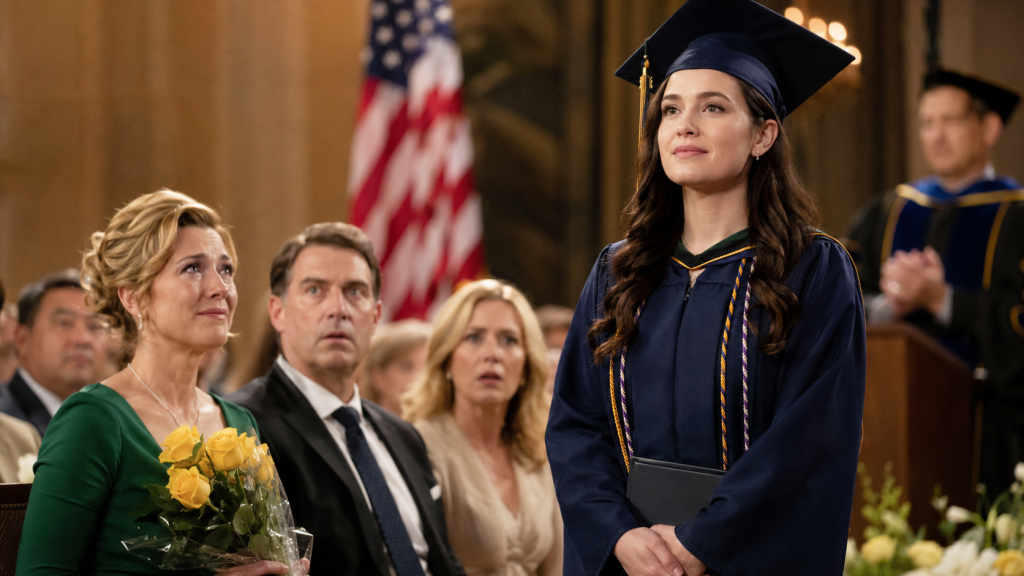
Two seats away sat Olivia in an emerald-green dress, holding yellow roses in her lap.
Her eyes were already wet before the ceremony even began.
My father glanced at her once, unaware that the woman beside him had stepped into the life he had chosen to abandon.
My name is Dr. Emily Hart.
I was born Emily Parker, but I left that name behind in a hospital room when I was thirteen.
That was the day Dr. Collins told my parents I had acute lymphoblastic leukemia.
I remember the room.
Pale blue walls.
A plastic chair with a cracked armrest.
My mother clutching her purse.
My father standing near the window, tapping his fingers against the glass as if my diagnosis had interrupted an important meeting.
Dr. Collins spoke gently.
He explained treatment.
Chemotherapy.
Hospital stays.
Blood tests.
Risk.
Hope.
My father’s first question was not whether I would live.
It was, “How much?”
Dr. Collins paused.
“What?”
“How much will this cost?”
My mother whispered, “Richard.”
But she did not sound horrified.
She sounded embarrassed.
When the doctor explained that insurance would cover part of it, but there would still be expenses, my father’s face hardened as if my illness were a bill he refused to pay.
My sister Ashley had a one hundred eighty thousand dollar college fund.
I had cancer.
My father said, “We are not destroying a promising future for an average one.”
Average.
That was the value they placed on my life.
Dr. Collins stared at him.
“There are other options. State support. Medicaid. Charity care. Hospital assistance programs.”
“We are not accepting charity,” my mother said, suddenly proud. “What would people think?”
Dr. Collins’ voice changed.
“What exactly are you suggesting?”
My father answered without hesitation.
“She’s thirteen. She can become a ward of the state. Then Medicaid pays for it, and our finances stay untouched.”
I was lying in the hospital bed listening.
I was sick, terrified, and too young to understand all the words, but old enough to understand the meaning.
They were choosing money over me.
Dr. Collins stepped into the hallway with them, but the door did not close all the way.
I heard everything.
My mother cried quietly, but not for me.
She cried because people would talk.
My father said, “Ashley has a future. Emily has always been fragile. We cannot bankrupt the family for uncertainty.”
Uncertainty.
Not daughter.
Not child.
Not Emily.
Uncertainty.
Before sunset, emergency custody papers had been signed.
My parents walked out of Mercy General Hospital without even saying goodbye.
I watched the door for hours.
Every time footsteps passed, I thought they were coming back.
They never did.
That night, while I lay terrified and alone, Olivia Hart entered my room.
She was my night nurse.
She had kind eyes, a soft voice, and a way of moving that made the room feel less cold.
She checked my IV.
Adjusted my blanket.
Then she sat beside my bed when she realized I was crying silently.
“There is no gentle way to describe what they did,” she told me honestly.
I looked at her.
Most adults lied to children when the truth was ugly.
Olivia did not.
She held my hand.
“What they did was wrong. But you are not alone tonight.”
Then she stayed.
She stayed after her shift ended.
She stayed through my fear.
She stayed through the first round of chemotherapy, when my body felt like it belonged to someone else.
She stayed when my hair began falling out in handfuls, and I screamed into a pillow because I thought losing my hair meant losing myself.
She stayed when I vomited until my throat burned.
She stayed when I asked if children could die because their parents did not love them enough.
Her eyes filled with tears.
“No,” she said. “You are going to live because your life is yours, not theirs.”
Olivia had no husband.
No children.
A small apartment.
Student loans.
An old car with a heater that only worked when it felt generous.
But every week, she came.
On her days off.
After double shifts.
Before sunrise.
She brought books, warm socks, soup I could barely eat, and notebooks with bright covers.
“Write it down,” she told me. “All of it. Pain becomes less powerful when it has somewhere to go.”
When I finished induction chemotherapy, she did the one thing no one expected.
“I want to take her home,” Olivia said.
The hospital social worker blinked.
“Ms. Hart, fostering a medically fragile child is not simple.”
“I know.”
“She will need follow-up care, medications, transportation, emotional support—”
“I know.”
“She may relapse.”
Olivia looked toward my room.
“Then she will relapse with someone holding her hand.”
She became my foster mother first.
Then, after court hearings and paperwork and questions no child should have to answer, she adopted me.
I remember the day I became Emily Hart.
The judge asked if I understood what adoption meant.
I said, “It means she chose me.”
The judge smiled.
“Yes, Emily. That is exactly what it means.”
Olivia took out a second mortgage in secret so I would never feel like a burden.
I found out years later when I was applying for college and saw the loan documents by accident.
I cried so hard I could not speak.
When I confronted her, she said, “Don’t make that face. Houses are wood and nails. You were a child.”
My biological parents saw me as a bad investment.
Olivia saw something priceless.
“We are going to prove them wrong,” she told me.
But the truth was, she never pushed me to prove anything.
She pushed me to live.
To eat when I could.
To study when I was strong enough.
To rest when I was not.
To stop apologizing for needing help.
By the time I turned sixteen, my cancer was in remission.
By seventeen, I volunteered at the pediatric oncology ward where I had once been a patient.
By eighteen, I knew exactly what I wanted to become.
A doctor.
Not just any doctor.
A pediatric oncologist.
I wanted to walk into rooms where children were terrified and speak to them like Dr. Collins had spoken to me.
With truth.
With dignity.
With hope that did not lie.
Years passed.
College.
Research labs.
Scholarships.
Medical school.
Sleepless nights.
Coffee so bad it tasted like punishment.
Exams that made me question every life decision.
Children on oncology rotations who reminded me why I kept going.
Olivia was there for all of it.
She sent good-luck texts before every exam.
She mailed snacks before finals.
She came to white coat ceremony wearing a blue dress and crying so loudly the woman beside her handed her tissues.
When I matched into pediatric oncology, Olivia hugged me so hard I could barely breathe.
“Look at you,” she whispered. “Look at what you became.”
In April of my final year of medical school, I was named valedictorian of Columbia University College of Physicians and Surgeons.
Two weeks later, an email arrived from the university.
Karen and Richard Parker have contacted us claiming to be your parents and requesting access to premium seating. Should we add them?
I stared at the screen until the words blurred.
Fifteen years of silence.
Fifteen years without birthdays, calls, letters, apologies, Christmas cards, or even the cowardice of curiosity.
They had never asked if I survived.
They had never asked if I was hungry, scared, healed, lonely, happy, grown.
But now that my name came with Doctor, honors, and a place onstage, they suddenly wanted to stand beside me.
I called Olivia.
She answered on the first ring.
“Baby?”
I tried to speak, but nothing came out.
“What happened?”
I read her the email.
She was quiet for a long moment.
Then she said, “Let them come.”
I froze.
“What?”
“Let them come.”
“Why?”
“Because they abandoned a sick child when no one was watching. Let them sit in a room full of witnesses while that child tells the truth.”
I closed my eyes.
“I don’t know if I can do that.”
“Yes, you do,” Olivia said gently. “But you don’t have to do it for revenge. Do it for every child who was made to feel expensive.”
So I did.
I gave them the best seats in the arena.
Front row.
Premium section.
Close enough to see my face.
Close enough to hear my voice without mercy.
The university coordinator asked if I wanted them listed as family.
“No,” I said. “Guest seating only. My family is Olivia Hart.”
Now, standing behind the heavy curtain at Madison Square Garden, I watched them from the shadows.
My mother leaned toward my father and whispered something.
I could not hear it, but I saw her lips form the words.
She owes us this.
Maybe she thought I owed them because they gave me life.
Maybe she thought biology was a debt that could never be paid.
Maybe she thought surviving made me available for credit.
My father leaned forward, staring at the stage as if he were waiting for a prize announcement.
Olivia sat two seats away, holding yellow roses in her lap.
She did not know they were for her.
A coordinator touched my arm.
“Dr. Hart, you are next.”
Dr. Hart.
Not Parker.
Hart.
The Dean stepped up to the podium.
The applause softened.
“It is my great honor to introduce the valedictorian of the Columbia University College of Physicians and Surgeons Class of 2026…”
My mother lifted the program.
My father went still.
Olivia pressed both hands to her heart.
Then the Dean’s voice carried across the entire arena.
“Dr. Emily Hart.”
And in that moment, the truth finally walked onto the stage.
I heard the applause like waves.
Bright lights blinded me for a second.
Then my eyes adjusted, and I saw them.
My biological parents.
My mother’s mouth was slightly open.
My father’s hand was frozen on the program.
They had expected Parker.
They had expected their name to rise with mine.
But the name on the screen behind me was HART.
Emily Hart.
Valedictorian.
Future pediatric oncologist.
Daughter of Olivia Hart.
I walked to the podium.
The Dean smiled and handed me the microphone.
“Dr. Hart requested to dedicate her address to the person who made this day possible.”
A murmur moved through the audience.
My mother sat up straighter.
My father adjusted his tie.
For one terrible second, I realized they truly believed it might be them.
I looked past the lights, straight into the front row.
“At thirteen,” I began, “I was diagnosed with acute lymphoblastic leukemia.”
The arena quieted.
“On the day of my diagnosis, my biological father asked the doctor how much I would cost.”
My mother’s face changed.
My father’s eyes sharpened.
I continued.
“When he heard the answer, he and my biological mother decided I was too expensive. They had saved one hundred eighty thousand dollars for my sister’s college fund. But for me, they decided becoming a ward of the state was cheaper.”
A wave of shock moved through the arena.
Someone gasped.
Someone whispered, “Oh my God.”
My mother whispered, “Emily, don’t.”
But I was not Emily Parker anymore.
I was not the sick child waiting by a hospital door.
I was not the abandoned daughter who hoped footsteps meant they had changed their minds.
I was Dr. Emily Hart.
And my voice did not shake.
“My parents walked out of Mercy General Hospital before sunset. They did not say goodbye.”
My father stood suddenly.
“That is not true.”
Security shifted near the aisle.
The Dean turned toward him, stunned.
I did not look away.
“It is true. There are court records. Medical records. Social work reports. But more importantly, there was a child in that bed who remembers.”
My father’s face went red.
“We are her parents.”
I leaned toward the microphone.
“No. Parents stay.”
The arena went silent.
Then I turned toward Olivia.
“A nurse named Olivia Hart stayed after her shift that night. She held my hand through chemotherapy. She took me home when I had nowhere to go. She adopted me. She mortgaged her house for my care. She taught me that a child is not an expense.”
Olivia covered her mouth, crying.
I felt my own tears rise, but I did not stop.
“So today, I dedicate this honor to my mother, Olivia Hart. The woman who did not give me life, but saved it. The woman who never asked if I was worth the cost. The woman who taught me that medicine is not only science. It is the decision to stay.”
People began standing.
First one row.
Then another.
Then the entire section around Olivia.
The applause rose like thunder.
My biological parents stayed seated.
Frozen.
Exposed.
Small.
I stepped away from the podium and walked down the stairs.
The Dean did not stop me.
No one did.
I crossed to the front row, took the yellow roses from Olivia’s trembling hands, and placed them back in her lap.
Then I knelt in front of her.
“Mom,” I said, loud enough for the microphone clipped to my gown to catch, “this diploma belongs to us.”
Olivia broke.
She pulled me into her arms, and for a moment, Madison Square Garden disappeared.
I was thirteen again.
Bald.
Scared.
Holding the hand of the woman who chose me.
When I returned to the stage, the applause still had not stopped.
My biological father tried to leave, but reporters had already noticed him.
My mother sat rigid, face pale, staring at the program as if it had betrayed her.
After the ceremony, they waited outside the graduate entrance.
Of course they did.
Karen Parker stepped forward first.
“You humiliated us.”
I looked at her.
Fifteen years older.
Fifteen years freer.
“I told the truth.”
My father’s voice was low.
“You had no right.”
“No right?”
“You made us look like monsters.”
I thought of the hospital bed.
The cracked chair.
The door that never reopened.
“I didn’t make you look like anything. I described what you did.”
My mother’s eyes filled with tears.
“You don’t understand what it was like. We had another child. Bills. Responsibilities.”
“I was your child.”
She flinched.
My father said, “We did what we thought was practical.”
I almost laughed.
Practical.
That was how he still named abandonment.
“You left me to die because survival was inconvenient.”
“You survived,” he snapped.
“Yes,” I said. “No thanks to you.”
His face hardened.
“We could have helped your career. Your name would be stronger as Parker.”
I stared at him.
There it was.
Not love.
Calculation.
Even now, he only saw value after the world had appraised me.
“You abandoned the Parker name with me in that hospital,” I said. “Don’t come back for it now.”
My mother reached for my sleeve.
“Emily, please. We are still family.”
Olivia stepped beside me.
“No,” she said softly. “Family is who shows up.”
My mother looked at her with hatred.
“You took my daughter.”
For the first time, Olivia’s gentle face hardened.
“No, Karen. You left her. I found her.”
That silenced even my father.
A university security officer approached.
“Dr. Hart, do you need assistance?”
I looked at Karen and Richard Parker one last time.
“No,” I said. “They were just leaving.”
And they did.
Not with dignity.
Not with apology.
But they left.
In the weeks that followed, the video of my speech spread.
Some people praised me.
Some accused me of being cruel.
Some said private pain should stay private.
I ignored most of them.
But the messages from former patients, foster kids, abandoned children, and adults who had been made to feel like burdens, those I read every night.
One message came from a girl undergoing treatment in Ohio.
She wrote, My dad said I cost too much. I watched your speech with my nurse. I think I want to live now.
I cried for an hour.
Then I wrote back.
Please live. The world has not met all of you yet.
A month later, Olivia and I visited Mercy General Hospital.
The pediatric oncology ward had changed.
New paint.
New machines.
New children.
Same fear.
Dr. Collins was retired, but he came to meet us in the lobby.
He was older now, walking with a cane.
When he saw me in my white coat, he cried.
“I hoped,” he said. “But I never imagined this.”
I hugged him.
“You tried to save me.”
He shook his head.
“Olivia saved you.”
I looked at her.
“She did.”
Then I donated part of my award money to create the Hart Fund, a small emergency assistance fund for families who thought treatment meant financial ruin.
Not because money should decide whether a child lives.
But because sometimes a grocery card, a motel room, a bus ticket, or a utility payment keeps a family from breaking at the worst possible moment.
At the dedication, Olivia stood beside me.
She hated attention, but I made her hold the scissors.
“This is your fault,” I whispered.
She laughed through tears.
“Good.”
Years later, people still asked about the graduation speech.
They wanted to know if I regretted it.
If I ever reconciled.
If Karen and Richard apologized.
The answer was simple.
No.
They sent one letter through an attorney, mostly concerned about defamation.
I sent back copies of the custody records.
They never wrote again.
Ashley contacted me once.
My sister.
The promising future.
She told me she had not known the whole truth.
Maybe that was true.
Maybe it was not.
We spoke carefully, like two people standing on opposite sides of a collapsed bridge.
I did not hate her.
But I did not know her.
Healing does not require pretending every broken thing can become family again.
Sometimes healing is simply choosing not to carry the poison forward.
Olivia grew older.
So did I.
The children I treated taught me humility every day.
Some lived.
Some did not.
Every loss hurt.
Every remission felt like sunrise.
Whenever a parent cried about bills, I heard my father’s voice asking how much.
Then I heard Olivia’s voice answering with her life.
She is not an expense.
I carried that into every room.
Every diagnosis.
Every bedside.
Every terrified child looking at adults to decide whether they were worth saving.
At my graduation, Karen and Richard Parker demanded VIP seats because they thought success erased abandonment.
They thought biology gave them ownership of my story.
They thought my white coat would make them look like parents.
So I gave them exactly what they wanted.
Front-row seats.
Close enough to see the woman they abandoned.
Close enough to hear the truth they buried.
Close enough to learn that some children do not grow up to beg for love.
Some grow up to become witnesses.
I did not scream.
I did not cry.
I stood at the podium in my doctoral gown, with my real mother in the front row holding yellow roses, and I said the sentence my thirteen-year-old self had needed to hear.
A child is not an expense.
A child is not a gamble.
A child is not a burden to be transferred when the bill becomes inconvenient.
And a parent is not the person whose name appears on a birth certificate.
A parent is the person who stays when staying costs something.
My name is Dr. Emily Hart.
I survived cancer.
I survived abandonment.
I survived being called average by the people who should have loved me first.
But I did not become a doctor to prove them wrong.
I became a doctor because Olivia Hart proved something better.
That one person choosing to stay can change the ending of a child’s life.
And on the day my biological parents came to claim credit, I gave the credit exactly where it belonged.
THE END! THANKS FOR READING!