 Reading Time: 14 minutes
My in-laws sent my six-year-old daughter a cute brown teddy bear for her birthday. She smiled for a second. Then she suddenly froze and asked, “Mommy, what is it?” When I looked closer, my face went pale.
I didn’t scream. I acted. And three days later, police were at their door. For Lily’s sixth birthday, my in-laws sent her a cute brown teddy bear wrapped in gold paper and tied with a satin pink ribbon. The box arrived on our porch just after breakfast.
Lily saw it through the front window and squealed so loudly Daniel almost dropped the pancake plate.
“Grandma and Grandpa remembered!” she cried, hopping barefoot across the living room carpet. I smiled. But my stomach tightened. Daniel had not spoken to his parents in nearly eight months.
Not since the argument about boundaries.
Not since the surprise visits.
Not since his mother, Margaret, stood in our kitchen and told Lily that “Mommy was too strict” because I would not let a five-year-old eat candy for dinner.
Margaret had always called her control love.
Richard, her husband, called it “family involvement.”
They acted like Daniel and I were temporary guardians of their granddaughter instead of her parents.
At first, I tried to keep peace.
I invited them for dinner.
I sent photos.
I answered calls.
I softened every boundary until it sounded like a favor.
Please call before visiting.
Please don’t tell Lily secrets.
Please don’t criticize our rules in front of her.
Please don’t promise sleepovers without asking us.
Each request was met with wounded silence, dramatic texts, or Margaret crying to relatives that I was “keeping Lily from her blood.”
Daniel tried harder than anyone.
He wanted parents.
Not perfect ones.
Just parents who could love without ownership.
But after the last fight, even he stopped trying.
Margaret had shown up at Lily’s preschool claiming she was there to pick her up early.
The school called me.
I drove there so fast I barely remembered the traffic lights.
Margaret stood in the office holding a tiny pink coat she had bought for Lily, smiling as if she had done nothing wrong.
“She’s my granddaughter,” she said when I arrived. “I don’t need permission.”
Daniel cut contact that night.
Still, it was Lily’s birthday.
She was six.
She did not understand adult betrayals.
She only knew a box had come with her name on it.
I did not want to poison the day.
“Go ahead,” I said. “Open it.”
She tore into the wrapping paper, pulled out the bear, and hugged it instantly.
It was soft, brown, and almost comically sweet-looking, with shiny black eyes, a stitched smile, and a little red bow around its neck.
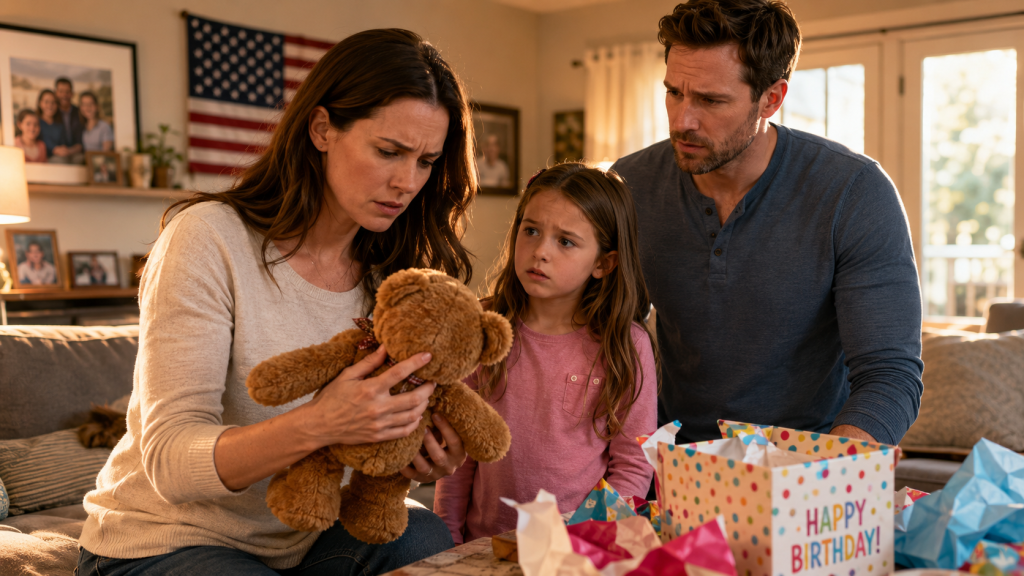
For three seconds, Lily looked happy.
Then she froze.
Her arms loosened around the bear.
Her smile disappeared.
“Mommy,” she whispered, holding it away from her body. “What is it?”
I stepped closer.
At first, I thought she meant the tag.
There was a small white gift card tucked beneath the bow.
Happy Birthday, our precious Lily. Grandma and Grandpa love you more than anyone.
That last part made my skin tighten.
More than anyone.
Margaret had a gift for turning affection into competition.
Then I noticed the bear’s left eye.
It was not like the right one.
The right eye was glossy and flat.
The left eye had a tiny dark circle in the center.
Too deep.
Too perfect.
Like a pinhole.
My mouth went dry.
I took the bear gently from Lily.
“Sweetheart,” I said, keeping my voice calm, “go help Daddy put candles on the cake.”
She frowned.
“Is it broken?”
“Maybe,” I said. “I’ll check it.”
Daniel looked over from the kitchen.
He saw my face and immediately came toward me.
That was one of the reasons I loved my husband.
He did not need me to explain fear before he respected it.
I turned the bear over in my hands.
There was a seam down the back, but near the battery compartment, I felt something hard.
Not a music box.
Not stuffing.
A square.
Daniel whispered, “Claire?”
I did not answer.
I carried the bear to our bedroom, shut the door, and placed it on the dresser.
Then I turned off the lights.
The left eye glimmered faintly.
Daniel’s face changed.
“No,” he breathed.
I searched the bear carefully and found a hidden switch beneath the stitched fabric near its leg.
My fingers were shaking, but I did not scream.
I did not call Margaret.
I did not accuse anyone.
I took photos.
I recorded a short video showing the eye, the switch, the box, the wrapping paper, and the shipping label.
Then I placed the bear in a drawer, closed it, and leaned against the dresser until my knees stopped shaking.
Daniel stood beside me, pale with rage.
“My parents wouldn’t…”
He stopped.
Because he knew.
He knew exactly how far Margaret’s entitlement had gone.
Maybe not this far.
But far enough that denial died before reaching his lips.
“Lily’s birthday,” he whispered. “They did this on her birthday.”
I swallowed hard.
“She’s still in the kitchen. We cannot let her see us panic.”
Daniel closed his eyes.
When he opened them, he looked older.
“We call the police?”
“We call someone who knows how to preserve evidence.”
I called my brother, Aaron.
He was a detective in another county and the only person in my family who could hear my voice once and know whether I needed comfort or instructions.
He answered cheerfully.
“Tell my favorite niece happy birthday.”
“Aaron,” I said.
The cheer vanished.
“What happened?”
I told him everything.
The bear.
The eye.
The hidden switch.
The in-laws.
The birthday box.
He did not interrupt once.
Then he said, “Claire, do not open it yourself. Do not destroy it. Do not plug anything into your phone or computer. Put it in a paper bag, not plastic. Keep the packaging. I’m calling someone.”
My fingers tightened around the phone.
“You think it’s a camera?”
“I think you should treat it like evidence.”
Daniel sat on the edge of the bed and covered his mouth.
“What do we tell Lily?”
Aaron’s voice softened.
“Tell her the bear needs new stuffing and you’re fixing it. Then enjoy the birthday as much as you can. Do not tip off Margaret.”
Do not tip off Margaret.
That was the hardest part.
Because for the next three hours, I had to sing happy birthday, cut cake, take pictures, and smile while the teddy bear sat in a paper grocery bag inside the closet like a creature holding its breath.
Lily wore a purple dress and frosting on her nose.
She laughed when Daniel pretended he could not light the candles.
She asked twice if her bear was fixed.
I kissed her forehead and said, “Not yet, baby. Maybe tomorrow.”
I hated that lie.
But I hated the truth more.
That night, after Lily fell asleep, Daniel and I sat at the kitchen table in silence.
The birthday balloons floated above us, silver and pink, cheerful in a room where neither of us could breathe properly.
Daniel’s phone buzzed.
His mother.
Mom: Did Lily get our gift?
Daniel stared at the message.
Another came.
Mom: She hasn’t called to thank us.
Another.
Mom: Claire better not be keeping it from her.
Daniel’s hand shook.
I took the phone from him.
“Don’t reply.”
“She knows.”
“She’s fishing.”
His jaw tightened.
“My mother put something inside our daughter’s toy.”
“We don’t know that yet.”
He looked at me.
“We know.”
Yes.
We did.
But knowing is not proving.
And I had learned with Margaret that proof mattered.
Because without proof, she became the victim.
Without proof, I was controlling.
Paranoid.
Dramatic.
The daughter-in-law who poisoned Daniel against his family.
So we waited.
Aaron called the next morning.
A local detective named Harris would contact us.
Do not open the bear.
Do not answer questions from Margaret.
Document everything.
By noon, Detective Harris arrived at our house with a female officer.
They were kind, but serious.
I handed over the paper bag, the wrapping paper, the gift tag, the box, and screenshots of Margaret’s messages.
Detective Harris examined the bear without opening it fully.
His expression remained neutral, but the female officer looked at Lily’s birthday decorations and then back at the bear.
Something in her face hardened.
“You did the right thing,” she said.
Daniel asked the question I could not.
“Is it what we think?”
Harris looked at us.
“We need a tech unit to confirm, but yes, it appears to be a concealed recording device. Possibly video.”
Daniel stood and walked to the sink.
He gripped the counter with both hands.
I knew he was trying not to break down.
His parents had disappointed him before.
They had embarrassed him.
Manipulated him.
Guilt-tripped him.
But this was different.
This was not a grandmother crying because she missed her granddaughter.
This was a person hiding a device inside a child’s toy and sending it into our home.
Our living room.
Our conversations.
Our daughter’s life.
Detective Harris asked whether the bear had been in Lily’s bedroom.
“No,” I said quickly. “She held it for maybe three seconds. Then I took it.”
He nodded.
“That was very important.”
I felt sick.
Three seconds.
That was the distance between a terrible discovery and something even worse.
After the officers left, Daniel went outside and sat on the back steps.
I joined him.
For a while, neither of us spoke.
Finally, he said, “I keep replaying every time I defended her.”
I rested my shoulder against his.
“You wanted to believe your mother loved better than she controlled.”
“She does love Lily.”
I did not answer right away.
Then I said, “Maybe. But love that ignores safety is not love we can trust.”
He wiped his eyes angrily.
“I hate that you’re right.”
So did I.
Three days later, police were at Margaret and Richard’s door.
Daniel and I waited in the car across the street because Detective Harris asked us to stay nearby but not interfere.
I felt like I was watching someone else’s life through glass.
Margaret’s house looked exactly as it always had.
White shutters.
Blue hydrangeas.
Porch swing.
A little ceramic sign near the door that said Grandchildren Welcome Anytime.
Margaret opened the door smiling.
Then she saw the badges and went white.
“What is this about?” she asked.
Detective Harris held up the evidence bag containing Lily’s teddy bear.
“A recording device was found inside a toy sent to a six-year-old child.”
Margaret’s mouth opened.
No words came out.
Richard appeared behind her, frowning.
“What nonsense is this?”
The detective said, “We have a warrant.”
Richard tried to laugh.
“That’s ridiculous. It was probably a factory mistake.”
Harris looked at him.
“The device was activated after purchase. It was connected to a private account registered to this address.”
Daniel gripped the steering wheel so hard his knuckles turned white.
I reached for his hand.
He did not move.
He watched his father step back.
His mother put one hand to her chest.
Margaret had always known how to perform innocence.
But panic is harder to choreograph.
The officers entered.
We waited.
Ten minutes.
Twenty.
Forty.
Then Detective Harris came back outside and waved us over.
Daniel got out slowly.
I followed.
Inside Margaret’s perfect living room, everything smelled like lemon polish and old perfume.
Family photos covered the walls.
Daniel as a boy.
Daniel graduating.
Daniel holding newborn Lily in the hospital.
Photos Margaret had begged for, copied, framed, and displayed like proof of ownership.
On the coffee table sat a laptop.
Beside it, several small boxes, wires, memory cards, and another stuffed animal still in packaging.
A white bunny.
My stomach dropped.
Detective Harris said, “We found the connected account. There were live-feed attempts from your living room. We also found saved audio clips.”
Daniel closed his eyes.
“From our house?”
“Yes.”
My voice came out thin.
“What kind of audio?”
“Private conversations. Some from your phone calls when the bear was near the entry table before you removed it. Most attempts failed because the device was placed in the drawer shortly after arrival.”
Margaret’s voice rang from the kitchen.
“We had a right to know what was happening to our granddaughter!”
There it was.
Not denial.
Justification.
I walked toward the doorway.
Margaret stood between two officers, crying hard now, but not like someone ashamed.
Like someone furious she had been misunderstood.
“Claire keeps her away from us!” she shouted. “We are her grandparents!”
I stared at her.
“You hid a camera inside my daughter’s birthday gift.”
“Because you stole her from us.”
Daniel moved beside me.
“No, Mom. You just proved why we kept her safe.”
Richard sat at the kitchen table, head lowered.
For once, he had nothing to say.
But Margaret kept talking.
“She’s our blood. You don’t get to cut us off because your wife is insecure.”
Daniel flinched.
Then he looked at his mother with the saddest expression I had ever seen on his face.
“You sent surveillance equipment to a child.”
“She is my grandbaby.”
“She is not your property.”
Margaret’s face twisted.
“I raised you better than this.”
Daniel’s voice broke.
“No. You raised me to feel guilty every time I protected myself. I won’t let you do that to Lily.”
One officer escorted Margaret toward the front room.
She turned to Detective Harris.
“I want grandparents’ rights.”
Harris looked at her.
“Ma’am, illegal surveillance of a child is not a custody argument.”
That shut her up.
For about five seconds.
Then she started crying again.
Not because she understood.
Because consequences had arrived wearing uniforms.
The investigation widened quickly.
The teddy bear had not been Margaret’s first attempt.
Police found messages between her and a man from an online forum who sold “home monitoring solutions.”
Margaret had written: My son’s wife is keeping our granddaughter away. I need to hear what they say about us.
The man had replied with instructions.
Richard claimed he thought it was only audio.
Margaret claimed she only wanted to “make sure Lily was okay.”
But the search history on her laptop told another story.
Can grandparents prove parental alienation?
Can recorded conversations be used in family court?
Best nanny cam hidden in toy.
How to get custody from unstable mother.
I read those printed pages in Detective Harris’s office and felt my hands go numb.
“She was building a case,” I said.
Harris nodded.
“It appears that way.”
Daniel sat beside me, silent.
The words hurt him more than the device.
Because the bear was horrifying.
But the search history revealed intention.
Margaret had not acted in a sudden emotional moment.
She had planned.
Bought.
Activated.
Wrapped.
Mailed.
Then waited for Lily to carry the bear into the private spaces of our home.
And she had done it all under the words Happy Birthday.
I thought of Lily hugging the bear.
That tiny second of joy.
Then the way her face changed.
Children know things.
Maybe not the details.
But they feel wrongness before adults explain it away.
That night, Lily slept between us.
Daniel lay awake on one side.
I lay awake on the other.
Our daughter slept curled around her favorite old stuffed rabbit, the one she had since she was a baby.
Every time she moved, my heart jumped.
Around midnight, Daniel whispered, “I’m sorry.”
I turned toward him in the dark.
“You didn’t do this.”
“They’re my parents.”
“That doesn’t make it your guilt.”
“I kept hoping they would change.”
“That makes you human.”
He was quiet for a long time.
Then he said, “I don’t want them near her again.”
I reached across Lily’s sleeping body and took his hand.
“Then they won’t be.”
Three days later, a judge granted a temporary protective order.
Margaret screamed in the courthouse hallway that family should be trusted.
I looked at the empty space beside my daughter where that teddy bear should have been and thought, Trust is exactly what you buried inside it.
The judge ordered no contact while the investigation continued.
No calls.
No gifts.
No school visits.
No third-party messages through relatives.
That last part mattered because Margaret had already started her campaign.
Daniel’s aunt called first.
“She made a mistake.”
Then his cousin.
“She just misses Lily.”
Then Richard’s sister.
“You know how emotional Margaret gets.”
I answered each call the same way.
“She hid a camera in my child’s toy. Do not contact us about this again.”
Some hung up.
Some cried.
Some accused me of destroying the family.
None of them could explain why preserving family required ignoring a crime against a child.
Daniel blocked most of them.
At first, Lily asked where Grandma and Grandpa were.
We did not tell her everything.
A six-year-old does not need adult horror.
We told her the bear had something unsafe inside, and Grandma and Grandpa had broken a very serious rule.
She frowned.
“Like when someone peeks in the bathroom?”
My throat tightened.
“Yes, baby. Like that. Everyone deserves privacy.”
“Even kids?”
“Especially kids.”
She thought about that.
Then she asked, “Are they in time-out?”
Daniel made a sound halfway between a laugh and a sob.
“Yes,” he said softly. “A very big time-out.”
Therapy helped all of us.
Lily’s therapist used dolls and drawings.
Daniel’s therapist used words like enmeshment, emotional coercion, and grief.
Mine used the simplest word.
Violation.
That was what it was.
Not overstepping.
Not meddling.
Violation.
For years, Margaret had crossed boundaries in soft shoes.
Extra candy.
Secret phone calls.
Unapproved pickups.
Comments whispered into Lily’s ear.
Every time, she relied on the same defense.
I love her.
But love does not need a hidden lens.
Months later, the case moved forward.
The man who sold the device cooperated.
Records proved Margaret created the account.
Richard had helped set up the Wi-Fi connection at their home.
The saved files showed attempts to access the feed after delivery.
Margaret accepted a plea to avoid a trial.
The protective order became longer.
And Daniel, for the first time in his life, did not attend his mother’s birthday dinner.
He stayed home with us instead.
We baked cookies.
Lily spilled flour on the dog.
Daniel laughed so hard he had to sit down.
Later that night, after Lily went to bed, he opened a small box from the closet.
Inside were childhood photos.
His mother holding him.
His father teaching him to ride a bike.
Birthdays.
Christmas mornings.
Proof that love and harm can exist in the same family album.
He touched one photo.
“I miss who I thought she was.”
I sat beside him.
“That person mattered to you.”
“She wasn’t real.”
“Maybe parts were. But not enough to make her safe.”
He nodded.
A tear slid down his face.
I did not try to fix it.
Some grief should be allowed to breathe.
A year after the teddy bear arrived, Lily turned seven.
She asked for a garden party.
Pink lemonade.
Cupcakes.
Butterfly decorations.
No big gifts, she said, just books and art supplies.
The guest list was small.
Friends from school.
My brother Aaron.
Daniel’s best friend.
My parents.
No Margaret.
No Richard.
No relatives who thought surveillance was a misunderstanding.
Near the end of the party, Lily opened a gift from Aaron.
A stuffed fox with orange fur and a blue scarf.
She hugged it, then suddenly pulled it away and looked at me.
My heart stopped for half a second.
Then she turned it around and said, “Mommy, can we check it first?”
The adults went quiet.
I knelt beside her.
“Yes, sweetheart. We can always check.”
So we did.
Right there.
Gently.
Respectfully.
Without shame.
No hidden switch.
No strange eye.
No battery compartment.
Just stuffing, seams, and a little tag that said handmade with love.
Lily smiled and hugged the fox.
“Okay,” she said. “He’s safe.”
Daniel looked away, wiping his eyes.
Aaron put a hand on his shoulder.
I watched my daughter run back to her friends with the fox tucked under one arm.
Part of me hated that she had learned caution so young.
But another part of me understood that safety is not the same as fear.
We were not teaching her to distrust the world.
We were teaching her to trust herself.
That night, after the guests left, Daniel and I sat on the porch.
Lily slept upstairs with her new fox beside her pillow.
The house was quiet.
Peaceful.
Ours.
Daniel held my hand.
“I used to think boundaries broke families,” he said.
I leaned against him.
“What do you think now?”
He looked through the window, toward the staircase leading to Lily’s room.
“I think boundaries show you who was only behaving because they had access.”
I nodded.
That was exactly it.
Margaret and Richard had lost access.
Not because we were cruel.
Not because I was insecure.
Not because Daniel had been stolen by his wife.
They lost access because they mistook our daughter’s love for a door they could force open.
They sent a cute brown teddy bear wrapped in gold paper and tied with a satin pink ribbon.
They thought a child’s excitement would hide their intent.
They thought we would never notice.
They thought grandparents could do anything if they called it love.
But Lily noticed first.
Six years old, barefoot on the carpet, holding a gift that looked sweet and felt wrong.
“Mommy,” she asked, “what is it?”
At the time, I did not know how to answer.
Now I do.
It was a warning.
A test.
A final confession wrapped in birthday paper.
And because my daughter listened to the small voice inside her, because I stayed calm, because Daniel chose truth over guilt, the people who tried to watch us from inside a toy were finally forced to look at themselves under the brightest light there is.
Consequences.
The teddy bear never came back.
Sometimes Lily still asks about it.
Not often.
When she does, I tell her the truth she can understand.
“It had something unsafe inside, and we protected you.”
She always nods very seriously.
Then she goes back to drawing, singing, living.
That is what Margaret never understood.
Children are not trophies.
They are not second chances.
They are not proof that someone is loved.
They are human beings with doors inside them that deserve locks.
My in-laws sent my daughter a teddy bear for her birthday.
They meant it to spy.
Instead, it became the last gift they ever gave her.
Because hidden inside that bear was not just a camera.
It was the proof we needed to stop pretending their love was safe.
And three days later, when police stood at their door, I did not feel victory.
I felt relief.
The kind a mother feels when the danger finally has a name, an evidence bag, and a court order keeping it far away from her child.
THE END! THANKS FOR READING!