 Reading Time: 14 minutes
My father-in-law and his eight sons brutalized my pregnant wife so severely that we lost our unborn child. Then they stood outside her ICU room smirking that nobody would ever stand up for me because I was “just a soldier.”
That night, they made two devastating mistakes. First, I was never just a soldier. Second, I was never standing alone. By the time the call finally reached me, the foundation of their entire world had already started crumbling.
The line stayed almost completely silent when I answered. Too silent. Then a nurse spoke carefully, like she was trying to deliver the kind of news that destroys a man gently. “Your wife is alive,” she whispered. “But you need to come home immediately.”
Alive. That word should have comforted me. Instead, it filled me with dread. I had spent years overseas commanding operations where hesitation meant people died. In combat zones, life becomes brutally simple.
Identify the threat.
Protect the innocent.
Survive long enough to move forward.
But nothing prepares a man for walking into a hospital room and barely recognizing the woman he loves.
Tessa lay motionless beneath harsh fluorescent lights, surrounded by machines echoing with slow mechanical beeps.
Her face was swollen.
Her body was covered in bandages.
One trembling hand rested over her stomach.
A stomach that was empty now.
The doctor avoided my eyes while speaking.
“She sustained extensive trauma,” he said quietly. “Broken ribs. Fractured collarbone. Severe internal injuries.”
Then he paused.
“And she lost the baby.”
For several seconds, I felt absolutely nothing.
No rage.
No grief.
Only silence.
The kind of silence that settles deep inside a man seconds before something irreversible changes forever.
“What happened?” I finally asked.
The doctor’s jaw tightened.
“These injuries were intentional. Based on the damage and witness statements, we believe there were multiple attackers.”
Another pause.
“At least nine.”
I did not ask who.
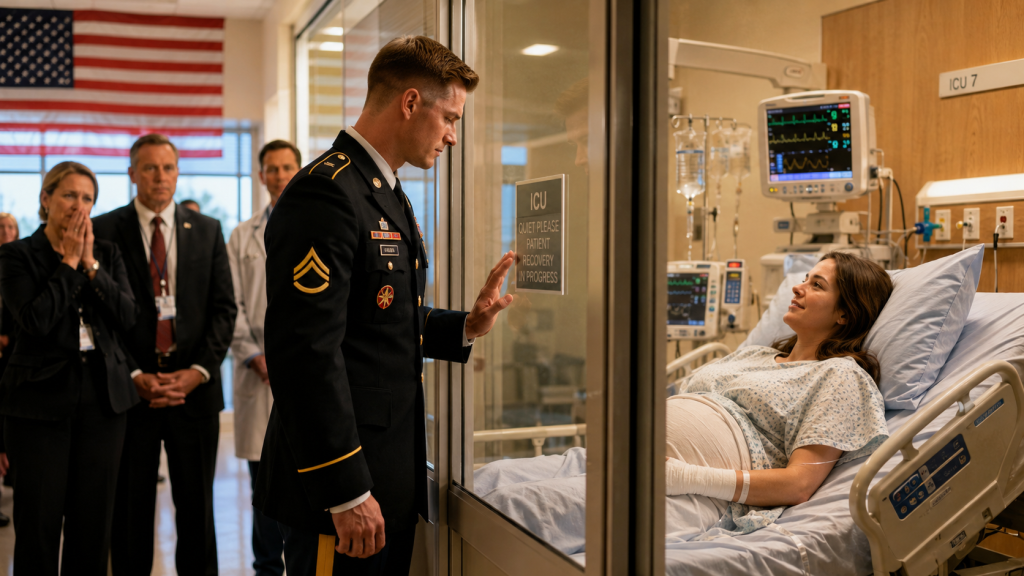
I already knew.
Tessa’s family had hated me from the day she chose me.
Victor Hale, my father-in-law, owned half the construction contracts in our county and acted as if that gave him the right to own everyone in it.
His eight sons followed him like trained dogs in expensive watches.
To them, Tessa was not a daughter.
She was property.
She had inherited land from her grandmother two months earlier, twenty-seven acres near the interstate, land Victor had tried to control for years.
When Tessa refused to sign it over to him, the threats began.
At first, she softened them when telling me.
“Dad is angry.”
“My brothers are being dramatic.”
“They just don’t understand boundaries.”
But I heard the fear beneath her voice.
Three weeks before the attack, she finally admitted everything.
Victor had cornered her in her own driveway and told her that if she didn’t sign, he would take “everything attached to the soldier.”
Meaning our home.
Meaning her reputation.
Meaning our child.
I filed a military family protection notice through my command that same night.
Tessa filed a civil protection order the next morning.
Victor laughed when he was served.
According to Tessa, he held the papers up and said, “You think a piece of paper and a uniform can stop blood?”
Now my wife was lying in the ICU.
Our baby was gone.
And the men who did it were standing in the hallway.
I found them gathered outside the ICU like they were waiting for a business meeting.
Victor.
His eight sons.
Nine grown men standing comfortably beneath hospital lights while my wife lay shattered behind reinforced doors.
I studied them carefully.
Untouched faces.
Relaxed posture.
Spotless hands.
That alone told me everything.
This had never been a fight.
It had been a punishment they fully expected her to survive.
One of the brothers, Grant, smirked the moment he saw me approaching.
“She tripped,” he said casually. “Pregnant women get emotional.”
Another one laughed.
“What exactly are you going to do about it? You weren’t even here.”
Then Victor stepped forward.
He was a large man with silver hair, polished shoes, and the dead eyes of someone who had never heard the word no and accepted it.
He spoke the sentence I would remember for the rest of my life.
“You’re just a soldier.”
I stared at him for a long moment.
Men like them never understand consequences.
They believe money protects them.
They believe influence protects them.
They believe powerful family names protect them.
And they believe uniforms come with limits.
What they never understand is what happens when those limits disappear.
I stepped closer.
Slowly.
Calmly.
“No,” I said quietly. “I’m what gets called when everything else has already failed.”
One of the brothers burst out laughing too loudly.
That was the exact moment everything changed.
Because suddenly, their phones began ringing.
Not mine.
Theirs.
One after another.
Victor looked irritated at first.
Then confused.
Then pale.
Grant answered his phone and turned away, but I heard enough.
“What do you mean seized?”
Another brother whispered, “The office?”
A third said, “Dad, they’re at the warehouse.”
The confidence drained from their faces with every call they answered.
Smirks vanished.
Eyes darted nervously.
Hands started shaking.
Then red-and-blue lights flashed across the hospital windows.
One vehicle became three.
Three became ten.
Car doors slammed outside.
Heavy boots thundered across the pavement in perfect rhythm.
For the first time that entire night, they looked afraid.
I never raised my voice.
I never touched them.
I simply stood there and watched.
The first federal agents entered the hallway, followed by military investigators, state police, and the county prosecutor himself.
Victor’s face went white.
“What is this?”
I looked at him calmly.
“Your first mistake was thinking I was alone.”
One brother tried to walk away.
An agent blocked him.
Another shouted about lawyers.
A third kept whispering, “Dad, what did you do?”
The prosecutor opened a folder.
“Victor Hale, you and your sons are being detained for questioning in connection with aggravated assault, conspiracy, witness intimidation, and unlawful interference with an active military family protection order.”
Victor’s mouth fell open.
“Protection order?”
I stepped closer.
“Tessa filed it three weeks ago. She sent it to my commanding officer when you threatened to take our baby unless she signed over her inheritance.”
The brothers stopped breathing.
The prosecutor continued.
“We also have reason to believe this attack was connected to attempted coercion involving land transfer documents, forged statements, and financial intimidation.”
Victor regained his voice.
“This is a family matter.”
“No,” the prosecutor said. “This is a criminal investigation.”
Then one of the agents turned a tablet toward them.
Hospital security footage showed the parking garage entrance.
The image was grainy, but clear enough.
Tessa arriving alone.
Victor’s black SUV pulling in behind her.
His sons stepping out.
The camera caught them surrounding her near the stairwell before the angle cut away.
Victor looked at the tablet, then at me.
“That proves nothing.”
“No,” I said. “But this does.”
The investigator pressed play on an audio file.
Tessa’s voice filled the hallway.
Broken.
Terrified.
But clear.
“Dad, please. I’m pregnant.”
Then Victor’s voice answered.
“Then obey.”
Nobody laughed after that.
Tessa had activated her emergency recorder.
She had remembered what I told her months ago.
“If you ever feel trapped, press the side button three times. Don’t argue. Don’t threaten. Record.”
She had done it.
My brave girl.
Even while terrified.
Even while alone.
She had left the truth behind.
One by one, the brothers were cuffed.
Grant shouted first.
Then Mason.
Then Luke.
The others followed, suddenly very human under the weight of steel around their wrists.
Victor did not shout.
He stared at me with pure hatred.
“You think this ends us?”
I glanced toward Tessa’s ICU door.
“No,” I said. “What you did to her ended you. I’m just making sure the world sees it.”
He leaned close as agents held him.
“You’ll regret this.”
I almost smiled.
“That’s your problem, Victor. You still think I’m asking permission.”
They led him away.
The hallway emptied slowly.
Only the smell of hospital disinfectant remained.
That was when my knees nearly gave out.
I gripped the wall.
For the first time since the call, grief reached me.
Not as tears.
As weight.
A crushing, endless weight.
The doctor came out quietly.
“She’s waking up.”
I turned toward him.
“Can I see her?”
“Yes. But keep your voice soft. She is disoriented.”
I washed my hands twice before entering, though I knew it made no difference.
Tessa’s eyes fluttered open when I sat beside her.
For a moment, she looked through me.
Then she knew.
“Caleb?”
“I’m here.”
Her lips trembled.
“I tried to protect the baby.”
The words broke me.
I leaned over her carefully, terrified of hurting her.
“You did. Tessa, you did everything right.”
Tears slipped from the corners of her eyes.
“They said you wouldn’t come.”
“I came.”
“They said nobody would believe me.”
“I believe you.”
“They said the baby was the price.”
I closed my eyes.
The machine beside her beeped steadily.
I wanted to tell her revenge was already moving.
That Victor was in custody.
That his sons were being questioned.
That agents were raiding his offices and freezing his accounts.
But none of that belonged in the first fragile seconds of her waking.
So I held her hand.
“Our child mattered,” I whispered. “And so do you.”
Her fingers tightened weakly around mine.
“I’m sorry.”
“No.”
The word came out sharper than I intended.
I softened my voice.
“No, baby. You never apologize for surviving.”
She turned her face toward me and cried silently.
I stayed beside her until medication pulled her under again.
Only then did I walk into the family waiting room, close the door, and finally break.
I did not scream.
I did not punch the wall.
I folded forward in a plastic chair and sobbed into my hands for the child whose heartbeat I had heard over a video call from a desert base.
A tiny sound like galloping horses.
A life we had already named in whispers.
If the baby was a girl, Tessa wanted Grace.
If the baby was a boy, I wanted Jonah.
We never got to know.
By morning, the story had reached the news.
Not because I leaked it.
Because Victor Hale’s family name was tied to half the county, and when nine men connected to that name were escorted out of a hospital in handcuffs, silence became impossible.
The first reports were cautious.
“Prominent businessman questioned.”
“Family dispute under investigation.”
“Pregnant woman injured.”
I hated that phrase.
Injured.
As if she had slipped on wet pavement.
As if violence had no hands.
By noon, the prosecutor released a statement confirming that the case involved suspected coordinated assault, intimidation, and attempted coercion connected to property.
By evening, reporters were outside Victor’s corporate headquarters.
By midnight, federal agents had seized computers, ledgers, and security hard drives.
Victor’s empire had always looked polished from the outside.
Construction firms.
Real estate partnerships.
Charity boards.
Political donations.
Church fundraisers.
But men who believe they are untouchable get careless.
Investigators found more than evidence against Tessa’s attackers.
They found bribery records.
Shell companies.
Fraudulent land transfers.
Payments to local officials.
A file marked “Tessa” containing unsigned custody documents and a drafted petition claiming she was mentally unstable and unfit to manage inherited property.
There was also a note in Victor’s handwriting.
After hospital incident, pressure her through husband.
I stared at those words when the prosecutor showed me.
Hospital incident.
That was what he called it.
Not an attack.
Not the loss of our child.
An incident.
Men like Victor never name the pain they cause.
Naming it would make it real.
Two days later, Tessa was stable enough to hear what had happened.
I sat beside her while the prosecutor explained gently.
Her father and brothers were being held.
The protection order strengthened.
Her inheritance placed under emergency legal protection.
Her medical records secured.
Her statement would wait until she was ready.
Tessa listened quietly.
Too quietly.
Then she asked one question.
“Did my mother know?”
The prosecutor hesitated.
That was answer enough.
Tessa closed her eyes.
Her mother, Diane, had died when Tessa was sixteen.
Victor remarried within a year, and after that, Tessa had become the only woman in a house full of men who treated obedience like oxygen.
But before Diane died, she left the land in Tessa’s name.
Not Victor’s.
Tessa once told me her mother said, “One day you may need somewhere to stand where no man can move you.”
Now I understood.
Victor had spent years trying to move her anyway.
On the fourth day, an army colonel arrived at the hospital.
Colonel Hayes was not a man who wasted words.
He stood at the foot of Tessa’s bed and removed his cap.
“Mrs. Reid,” he said, “your husband is one of ours. That makes you one of ours too.”
Tessa’s eyes filled.
“My family said nobody would care.”
The colonel’s jaw tightened.
“They were wrong.”
Behind him stood two women from the military family advocacy office, a victim liaison, and a legal officer.
They did not make speeches.
They made plans.
Secure housing.
Legal protection.
Counseling.
Medical advocacy.
Emergency funds.
Court accompaniment.
Tessa looked overwhelmed.
I squeezed her hand.
“You don’t have to fight all at once.”
She looked at the colonel.
“Why are you helping me?”
He answered simply.
“Because you asked for help when you filed that order. We should have gotten there sooner.”
That honesty mattered.
No empty promises.
No heroic lies.
Just people standing where others had failed.
Victor’s lawyers moved fast.
They tried to suggest Tessa had provoked a “family confrontation.”
They claimed the recording was misleading.
They claimed the brothers had arrived separately.
They claimed grief over “miscarriage complications” was clouding judgment.
The prosecutor did not blink.
The hospital records spoke.
The security footage spoke.
The emergency recording spoke.
The text messages Victor sent before the attack spoke.
Sign the land over before your soldier comes home.
Do not test me.
Blood can correct blood.
Each message was a nail in the coffin of his public image.
Then came the witness no one expected.
The youngest brother, Evan, broke.
He was twenty-two.
Still cruel.
Still responsible.
But not hardened enough to destroy his life for Victor without fear.
His attorney requested a meeting.
Evan admitted Victor had called a “family correction” that night.
He admitted they confronted Tessa in the parking garage because she refused to meet at the house.
He admitted Victor had ordered them to scare her until she signed.
He admitted they panicked when she collapsed.
I sat across from Evan during one pretrial hearing and watched him cry.
I felt nothing.
Not satisfaction.
Not pity.
Nothing.
Maybe someday I would feel something.
At that time, all I could see was Tessa in the ICU.
When the indictment came down, it was larger than anyone expected.
Aggravated assault.
Conspiracy.
Coercion.
Witness intimidation.
Fraud.
Attempted unlawful transfer of property.
Obstruction.
Financial crimes connected to Victor’s business.
The brothers turned on each other.
Some blamed Victor.
Some blamed Grant.
Some blamed panic.
Not one said, “We did this because we thought we had the right.”
But we all knew.
Power rarely confesses honestly.
It only negotiates when trapped.
Tessa came home six weeks later.
Not to our old house.
That place had too many memories of fear.
The military helped us move into temporary housing near the base.
Small.
Quiet.
Secure.
The first night, Tessa stood in the nursery doorway.
We had not had time to take down the crib.
A yellow blanket still hung over the side.
She touched it with two fingers and whispered, “I don’t know how to be alive without the baby.”
I stood behind her, not touching until she leaned back into me.
“I don’t either,” I said.
We cried together in that doorway.
Not like soldiers.
Not like survivors.
Like parents.
We named our baby Grace Jonah Reid.
A name for every possibility we lost.
We held a small memorial under a cedar tree near the base chapel.
No cameras.
No speeches for public consumption.
Just us, a chaplain, Colonel Hayes, two nurses from the ICU, and a handful of soldiers who had known me long enough to stand quietly without asking what to say.
Tessa wore a blue scarf.
Her hands shook when she placed a white flower at the base of the tree.
“I’m sorry,” she whispered.
I took her hand.
“She knew your voice. She knew your love. That is not nothing.”
Tessa broke then.
I held her as she cried, and behind us, every soldier bowed his head.
Months passed before the trial.
Recovery was not cinematic.
It was ugly.
Slow.
Some mornings Tessa could walk the block.
Some mornings she could not get out of bed.
Some nights she woke screaming.
Some days she asked me the same question over and over.
“Why did they hate me that much?”
I never had a good answer.
Because hatred was not the real root.
Ownership was.
They hated that she stopped belonging to them.
Therapy helped.
Not quickly.
Not neatly.
But enough.
One afternoon, Tessa sat across from me at the kitchen table and said, “I want to testify.”
I set my coffee down.
“You don’t have to.”
“I know.”
“You owe nobody your pain.”
“I know.”
“Then why?”
She looked out the window.
“Because my father spent my whole life speaking for me. I want him to hear my voice and not be able to interrupt.”
So she testified.
The courtroom was packed.
Victor sat at the defense table in a tailored suit, trying to look like a respected patriarch instead of a man whose kingdom had rotted from inside.
His sons sat behind him or at separate tables, depending on which plea deals they were chasing.
Tessa walked to the stand slowly.
Her body had healed enough to move.
Her voice had healed enough to speak.
But everyone in that room could feel what it cost her.
The prosecutor asked her to describe what happened.
She did.
Not graphically.
Not dramatically.
Truth does not need decoration.
She spoke about the threats.
The inheritance.
The protection order.
The parking garage.
Her father’s voice.
Her brothers surrounding her.
The fear for the baby.
The recorder.
The last thing she remembered before waking in the hospital.
Then the prosecutor asked, “Mrs. Reid, why did you refuse to sign over the land?”
Tessa looked at Victor.
“Because my mother left it to me so I would always have somewhere to stand.”
Victor looked away first.
That moment did more than any shout could have.
During cross-examination, Victor’s lawyer tried to suggest she misunderstood her father’s intentions.
Tessa sat straighter.
“My father’s intentions were clear. He told me to obey.”
The lawyer tried again.
“Families argue.”
Tessa looked at the jury.
“Families argue. They don’t surround a pregnant woman in a parking garage and call it correction.”
The courtroom went silent.
Victor was convicted on the major charges.
Several sons took plea deals.
Grant and two others went to trial and lost.
Victor’s business empire collapsed under separate investigations.
Contracts were canceled.
Properties seized.
Partners vanished.
The family name that once opened doors became a warning label.
After sentencing, Victor asked to speak.
The judge allowed it.
He turned toward Tessa.
For one strange second, I thought he might apologize.
Instead, he said, “You destroyed this family.”
Tessa stood slowly.
The judge warned her she did not have to respond.
But she wanted to.
She looked at her father and said, “No. I survived it.”
Then she sat down.
That was the last time she spoke to him.
A year later, we visited the land her mother left her.
Twenty-seven acres under a wide sky.
Grass moving in the wind.
A creek cutting through the back.
An old fence leaning near the road.
Tessa stood in the middle of the field and closed her eyes.
I stood beside her.
“Do you want to sell it?” I asked.
“No.”
“Build?”
“Maybe someday.”
She opened her eyes.
“For now, I just want it to stay mine.”
I nodded.
“That sounds perfect.”
We placed a small stone near the cedar line.
Grace Jonah Reid.
Loved before birth.
Remembered forever.
Tessa knelt in the grass and touched the name.
“This is where I want to come when I miss her.”
I knelt beside her.
“Then this is where we’ll come.”
That evening, as the sun dropped behind the trees, Tessa leaned against me.
“Do you ever think about what they said?”
“What?”
“That you were just a soldier.”
I looked at the field.
At the land Victor had wanted.
At the woman he had failed to break.
At the stone that held the name of our child.
“Yes,” I said.
“And?”
I took her hand.
“They were right about one thing.”
She looked at me.
“I was a soldier. But soldiers don’t stand alone. We are trained to protect, to call for support, to hold the line until help arrives.”
Tessa squeezed my fingers.
“You held the line.”
“No,” I said softly. “You did. You pressed record. You survived. You told the truth.”
Her eyes filled, but she smiled.
It was small.
It was tired.
But it was real.
That night at the hospital, Victor and his sons stood outside my wife’s ICU room smirking because they believed the world belonged to men like them.
They thought I would come home broken.
They thought grief would make me reckless.
They thought anger would make me easy to dismiss.
They thought a uniform meant I was alone outside of it.
They were wrong.
I never raised my voice.
I never touched them.
I simply stood there and watched the consequences arrive with badges, warrants, uniforms, files, recordings, and the full weight of every system they thought they could intimidate.
But justice did not give us back our child.
It did not erase Tessa’s scars.
It did not make the nursery less quiet.
That is the truth people forget in stories like this.
Consequences are not healing.
They only clear enough space for healing to begin.
Tessa and I still carry Grace Jonah with us.
In a stone beneath cedar trees.
In the silence between anniversaries.
In the way Tessa touches her stomach sometimes when she thinks I am not looking.
In the way I still wake at night reaching for a phone call I wish had come sooner.
But we also carry something else now.
Proof.
Proof that blood is not ownership.
Proof that power can fall.
Proof that a woman’s voice, even broken and afraid, can bring a dynasty to its knees.
Proof that love is not standing in front of someone because they are weak.
It is standing beside them until they remember they are not.
My father-in-law called me just a soldier.
Maybe he meant it as an insult.
But soldiers know something men like Victor Hale never learn.
A line can be held.
A threat can be answered.
And even the strongest fortress falls when the people inside finally stop being afraid of the name on the gate.
THE END! THANKS FOR READING!