 Reading Time: 42 minutes
The stranger standing at the head of my son’s Thanksgiving table reached into his pocket and pulled out a small brass key. For a moment, nobody moved.
Fourteen people sat around a table decorated with autumn leaves, expensive candles, and dishes that looked painfully familiar. My mother’s white gravy boat stood beside the turkey.
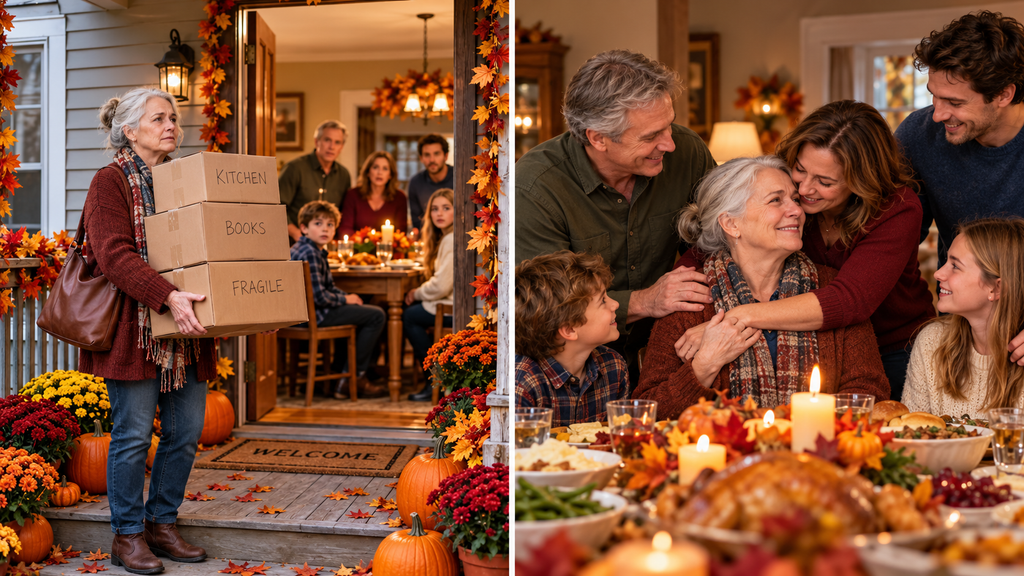
My late husband’s green cardigan hung loosely around the stranger’s shoulders.
And my daughter-in-law, Melissa, looked as though someone had just announced her execution.
“Before anyone leaves,” the man said, holding up the key, “there’s something Melissa promised me you’d never discover.”
My son, Daniel, stared at him.
“Richard, what are you talking about?”
The stranger didn’t answer.
He was looking at me.
“Mrs. Bennett,” he said softly, “I believe this belongs to you.”
My heart gave a strange, painful jump.
I recognized that key.
Not because I had seen it recently.
Quite the opposite.
I hadn’t seen it in almost four years.
It was the spare key to the little cedar chest my husband, Thomas, had kept at the foot of our bed.
The chest that disappeared three weeks after his funeral.
The chest Melissa told me had been donated to charity.
I slowly placed my handbag on the table.
“Where did you get that?”
Richard swallowed.
“Melissa gave it to me.”
I turned toward my daughter-in-law.
She stood beside the kitchen island, one hand gripping the edge so tightly her knuckles had turned white.
“Melissa?”
She opened her mouth.
Nothing came out.
And that was when I understood something that made the previous three Thanksgivings seem almost insignificant.
The lies hadn’t started with holiday invitations.
They had started when my husband died.
My name is Eleanor Bennett.
I am sixty-eight years old.
For forty-two years, I was married to a man who believed Thanksgiving was not a date on the calendar but a promise.
Thomas used to say that if somebody was lonely on Thanksgiving, it meant there was an empty chair somewhere that ought to have been filled.
We never had much money.
When Daniel was little, Thomas worked as a mechanic, and I cleaned offices at night.
Our dining room table had scratches from toy cars, candle wax in the corners, and a permanent stain where Daniel once spilled grape juice during a Christmas dinner.
But every Thanksgiving, we somehow made room.
Neighbors.
Coworkers.
Widows from church.
College students who couldn’t afford to travel home.
Thomas would pull out the folding chairs, and I would bake until my feet hurt.
He always carved the turkey.
And he always wore that ridiculous green cardigan.
The sleeves were too long.
One button was missing.
There was a tiny burn mark near the left pocket from the year he leaned too close to the oven.
I had bought it for him on our twentieth wedding anniversary.
He wore it every Thanksgiving after that.
When he died, I folded it carefully and placed it in the cedar chest beside his letters, photographs, and the small things I couldn’t bear to throw away.
I thought grief would be the hardest thing I ever experienced.
I was wrong.
Grief hurts because somebody you love is gone.
Betrayal hurts because somebody you love is still standing in front of you, choosing to hurt you.
And that morning, standing in my son’s beautiful dining room, I was about to discover how many choices had been made behind my back.
“Give me the key,” Melissa said suddenly.
Her voice was sharp enough to make everyone turn.
Richard lowered his hand.
“Not this time.”
“Richard, you’re embarrassing yourself.”
“No,” he replied. “I think I’ve embarrassed myself quite enough already.”
Daniel stepped between them.
“Would somebody please explain what’s going on?”
Melissa reached for his arm.
“Sweetheart, your mother has obviously come here looking for trouble.”
I almost laughed.
Looking for trouble.
I had spent three years avoiding trouble.
Three years pretending not to notice when my son stopped calling on holidays.
Three years smiling when people asked whether I’d enjoyed Thanksgiving with my family.
Three years baking pies for a table where I wasn’t welcome.
I looked at Daniel.
“Your wife told her mother I was dead.”
His face twisted.
“Mom, that’s ridiculous.”
Melissa’s mother, Patricia, stood slowly.
She was a tall woman with carefully styled silver hair and the kind of expensive pearl necklace that made even ordinary clothes look formal.
For years, I had assumed she disliked me.
Now I saw something else in her expression.
Confusion.
And horror.
“Daniel,” Patricia said, “Melissa told us your mother passed away shortly after your father.”
A chair scraped against the floor.
Daniel looked from Patricia to me.
Then back to his wife.
“What?”
Melissa shook her head rapidly.
“Mom, that’s not what I said.”
Patricia’s voice hardened.
“You told me Eleanor had died. You said Daniel didn’t like discussing it because losing both parents so close together had devastated him.”
Daniel took one step backward.
“I spoke to Mom last Sunday.”
Patricia covered her mouth.
Across the table, Melissa’s younger sister whispered, “Oh my God.”
I felt something inside me become very still.
I had expected embarrassment.
Maybe an argument.
Perhaps a few uncomfortable explanations about missing invitations.
I had not expected to stand in a room full of people who had been told I was buried beside my husband.
“Last Sunday,” I repeated quietly, “Daniel called to tell me Thanksgiving would be small this year.”
Daniel looked at me.
“Because you said you didn’t want to come.”
“No, son.”
My voice trembled despite my best efforts.
“I never said that.”
He frowned.
“Melissa told me she’d invited you.”
“She didn’t.”
“She said you refused.”
“She never asked.”
For a moment, his expression was almost childlike.
The way it used to look when he was little and had broken something valuable.
He wanted to believe there was a simple explanation.
A misunderstanding.
A missing message.
Something that could be fixed with an apology and a hug.
But there were three years of receipts sitting on the table.
And a brass key in a stranger’s hand.
My granddaughter, Lily, was the first person to cry.
She was eleven years old, with her father’s brown eyes and the same stubborn little chin Thomas had possessed.
“Grandma?”
I turned toward her.
She stood beside her chair, holding a napkin in both hands.
“Mom said you didn’t want to see us anymore.”
The words went straight through me.
“Oh, sweetheart.”
“She said you thought we were too noisy.”
“No.”
“And that you didn’t like coming here because we weren’t good enough.”
I crossed the room before I even realized I was moving.
I knelt in front of her.
“Lily, look at me.”
Her eyes were full of tears.
“I have missed you every single day.”
She threw her arms around my neck.
And I held her.
I held her the way I used to when she was small enough to fall asleep against my shoulder.
For three years, I had wondered why my granddaughter stopped sending me drawings.
Why she no longer asked me to help decorate cookies.
Why our phone conversations had become shorter.
I thought she was growing up.
I thought she was busy.
I thought children naturally drifted away from grandparents as their worlds expanded.
Now I understood.
Somebody had been teaching her that my absence was a choice.
My grandson, Oliver, only seven, climbed down from his chair.
“Grandma, are you staying?”
I looked at his small face.
Before I could answer, Melissa spoke.
“Children, go upstairs.”
Neither child moved.
“Now!”
Daniel turned sharply.
“Don’t.”
Melissa stared at him.
“Excuse me?”
“Don’t send them away because you’re uncomfortable.”
It was the first time in years I had heard my son speak to his wife with anything resembling firmness.
But Melissa wasn’t finished.
Not even close.
“Fine,” she snapped. “Everybody wants the truth? Let’s have the truth.”
She pointed at me.
“Your mother has spent years making me feel like I wasn’t good enough for this family.”
I blinked.
“What?”
“She criticized my cooking.”
“I gave you recipes because you asked for them.”
“She interfered with how we raised our children.”
“I watched them when you needed help.”
“She never accepted me!”
My hands began to shake.
Not from fear.
From the exhaustion of hearing kindness rearranged into cruelty.
“Melissa,” I said, “I paid for your wedding flowers when your budget ran short.”
She looked away.
“I stayed with you for two weeks after Lily was born because you were recovering from a difficult delivery.”
“That doesn’t mean—”
“I drove Oliver to speech therapy every Tuesday for eight months.”
Daniel looked at her.
“You told me Mom refused to help with that.”
Melissa’s face changed.
Just slightly.
But I saw it.
So did Daniel.
He turned toward me.
“Mom?”
“I drove him every Tuesday, Daniel. You were working out of state. Melissa said she was overwhelmed.”
He closed his eyes.
I continued.
“When your refrigerator broke, I bought you a new one. When Lily needed braces, I paid the deposit. When you were behind on your mortgage, I gave you four thousand dollars.”
Daniel’s eyes flew open.
“What mortgage payment?”
Melissa suddenly said, “This is getting completely out of hand.”
But my son was staring at me.
“Mom, what four thousand dollars?”
I looked at him.
“The money Melissa said you needed when your hours were cut.”
“My hours were never cut.”
Silence.
A terrible, heavy silence.
Then Richard spoke.
“Daniel, you need to see what’s inside the cedar chest.”
Melissa spun toward him.
“You promised!”
Richard’s expression crumpled.
“Yes,” he said. “And I’ve regretted it ever since.”
I finally looked at the stranger properly.
He was perhaps seventy, with a lined face and tired blue eyes.
He looked uncomfortable in Thomas’s cardigan.
Almost ashamed.
“Who are you?” I asked.
He took the cardigan off immediately.
Folded it.
Then held it out to me with both hands.
“My name is Richard Callahan.”
The name meant nothing.
“At least,” he continued, “that’s the name I’ve used for most of my life.”
Something in his tone made me uneasy.
“I knew your husband.”
My breath caught.
“You knew Thomas?”
He nodded.
“Long before you married him.”
Daniel frowned.
“Richard is Melissa’s uncle.”
“No,” Richard said.
Melissa made a small, desperate sound.
Richard looked at her.
“I’m not your uncle.”
Patricia gripped the back of her chair.
“Richard.”
He turned toward her.
“I’m sorry, Patty.”
And suddenly I noticed something I had missed earlier.
The way Patricia was looking at him.
Not like a brother-in-law.
Not like a family friend.
Like a woman staring at a secret that had finally escaped its hiding place.
Richard took a slow breath.
“Eleanor, Thomas and I grew up together. We worked in the same garage when we were boys. We were practically brothers.”
I searched his face.
Then, faintly, a memory surfaced.
A photograph.
Two young men standing beside a battered blue Chevrolet.
Thomas had shown it to me once.
One of the men was my husband.
The other had thick dark hair and a crooked smile.
“Ricky?” I whispered.
His eyes filled.
“Yes.”
I stepped backward.
Thomas had spoken about Ricky Callahan exactly three times during our marriage.
Each time, he had changed the subject when I asked what happened to him.
I knew there had been a falling-out.
I knew money was involved.
And I knew Thomas had once said something that stayed with me.
Some people don’t steal because they’re hungry, Ellie. They steal because they can’t stand seeing somebody else have something worth keeping.
I had assumed he meant money.
Standing there, I wasn’t so sure.
Richard sat down heavily.
“I need to tell you something about your husband’s last year.”
“No,” Melissa said.
Nobody listened.
“Thomas called me about six months before he died. We’d been estranged for decades, but he wanted to make peace.”
My throat tightened.
“He never told me.”
“He wasn’t sure you’d understand. We had a history.”
Patricia whispered, “Richard, please.”
He glanced at her.
“You’ve kept your secrets long enough.”
Then he looked back at me.
“Thomas knew somebody was taking money from you.”
I felt the floor shift beneath my feet.
“What?”
“He knew Daniel and Melissa were receiving money you believed was going toward family expenses. But he suspected the explanations weren’t true.”
I shook my head.
“Thomas was sick. He could barely walk during those last months.”
“He wasn’t helpless, Eleanor.”
I remembered my husband sitting at the kitchen table late at night, papers spread in front of him.
I remembered asking what he was doing.
He would smile.
“Just making sure you’re taken care of, sweetheart.”
I had thought he meant insurance.
Retirement.
Funeral arrangements.
Richard continued.
“He asked me to help him review some documents. I used to work in accounting. I found irregularities.”
Daniel’s voice was barely audible.
“What kind of irregularities?”
Richard looked at Melissa.
“Transfers. Withdrawals. Payments that were explained one way to Eleanor and another way to Daniel.”
Melissa laughed nervously.
“This is absurd.”
“Then you’ll have no objection to us looking at the records.”
Her laughter stopped.
Richard held up the key again.
“Thomas kept copies in the cedar chest.”
I stared at him.
“Then why did Melissa take it?”
Richard’s eyes lowered.
“Because she knew what was inside.”
Daniel sat down.
Hard.
I had never seen my son look so lost.
“Melissa,” he said quietly, “tell me he’s lying.”
She didn’t answer.
“Please.”
For the first time, I felt something other than anger toward her.
I felt a terrible curiosity.
What could make a person build such an elaborate lie?
What kind of fear could convince a woman to tell her own mother that her mother-in-law was dead?
And what was so valuable inside a cedar chest that she had hidden it for years?
Melissa looked around the room.
At her parents.
Her sister.
Her children.
Her husband.
Then at me.
And her expression changed.
The frightened woman disappeared.
In her place stood someone cold.
Calculating.
Almost relieved that she no longer had to pretend.
“You want to know why I did it?”
Daniel nodded.
“Yes.”
“Because I was tired of living in your mother’s shadow.”
I stared at her.
She laughed bitterly.
“Every holiday was Eleanor’s recipes. Eleanor’s traditions. Eleanor’s beautiful marriage. Eleanor’s perfect husband.”
“Thomas wasn’t perfect,” I said softly.
“Oh, please. Everyone worshipped him.”
“He was a good man.”
“He was a controlling man!”
My breath caught.
She pointed at the cardigan in my hands.
“Even after he died, everything was about him. His chair. His gravy boat. His precious Thanksgiving traditions.”
I looked down at the sweater.
Then back at her.
“You could have started your own traditions, Melissa.”
She shook her head.
“You don’t understand.”
“No,” I said. “I don’t.”
Her eyes flashed.
“You had everything.”
The words stunned me.
Everything?
I had buried my husband.
I had gone back to work at sixty-five because my savings weren’t enough.
I lived in a small apartment with a leaking kitchen faucet and a secondhand sofa.
I spent Thanksgiving alone.
And she thought I had everything.
Then she said the words that finally explained her bitterness.
“You had a husband who adored you.”
Nobody spoke.
Melissa’s eyes filled with angry tears.
“You had a son who called you every Sunday. You had grandchildren who loved your stupid baking. Everybody compared me to you.”
Daniel whispered, “Nobody compared you.”
“You did!”
He recoiled.
She pointed at him.
“Every time I made something, you said your mother used to make it differently.”
Daniel looked ashamed.
“Melissa, I didn’t mean—”
“Every time I planned a holiday, you talked about your father’s Thanksgivings.”
She turned toward me.
“So yes. I wanted one holiday that belonged to me.”
I looked at the four pies sitting on the table.
“And yet,” I said, “you ordered my recipes.”
Her face flushed.
I continued quietly.
“You took my mother’s gravy boat. My husband’s cardigan. My family traditions. You told your guests I was dead, and then you served them the food I baked.”
My voice broke.
“You didn’t want a holiday without me, Melissa.”
I looked directly into her eyes.
“You wanted my life without having to look at the woman who lived it.”
That was when Patricia began to cry.
Not loudly.
Just a small, broken sound.
Melissa turned toward her.
“Mom?”
Patricia shook her head.
“I raised you better than this.”
Melissa’s expression hardened.
“Don’t start.”
“I believed Eleanor was dead.”
“You misunderstood.”
“No,” Patricia whispered. “You told me you took flowers to her grave.”
Daniel covered his face.
My stomach turned.
Flowers.
A grave.
How far had this woman gone?
Patricia continued.
“You told me Daniel couldn’t bear to visit the cemetery. You said the children were too young to understand.”
Melissa stared at the floor.
“And every Thanksgiving,” Patricia said, “I watched you put that white gravy boat on the table and talk about Eleanor’s recipes.”
She looked at me.
“I thought you were honoring a dead woman.”
I couldn’t speak.
Patricia pressed a trembling hand against her chest.
“I even said a prayer for you last year.”
Something inside me broke.
Not because of the lie itself.
But because somewhere, at a table full of people, a woman had prayed for my soul while I sat alive and alone in my apartment, eating leftover soup.
And my own son had been only twenty minutes away.
Daniel finally stood.
“Where is the chest?”
Melissa looked at him.
“Daniel—”
“Where?”
Richard answered.
“In the garage.”
Daniel walked toward the back door.
Melissa lunged after him.
“Don’t!”
He stopped.
Turned.
And spoke in a voice I had never heard before.
“Move.”
She froze.
Then he disappeared into the garage.
I followed.
Richard came behind me.
The garage smelled of motor oil, cardboard, and old wood.
For one brief second, the scent reminded me of Thomas’s workshop.
Daniel switched on the light.
Against the far wall stood a stack of storage boxes.
Richard pointed.
“Behind those.”
Daniel pulled them aside.
And there it was.
My cedar chest.
The one Thomas had built for me during our first Christmas together.
There was still a small scratch near the lid where Daniel had dragged a toy truck across it when he was four.
I pressed my hand against the wood.
For a moment, I wasn’t sixty-eight.
I was twenty-six again, standing in our tiny apartment while Thomas presented me with a handmade chest and apologized because he couldn’t afford jewelry.
I had told him it was the most beautiful gift I’d ever received.
It still was.
“Mom?” Daniel whispered.
I held out my hand.
Richard gave me the key.
It slipped into the lock perfectly.
The lid opened with a familiar creak.
Inside lay folded letters, old photographs, Thomas’s watch, and a blue folder secured with a rubber band.
But there was something else.
A sealed envelope.
My name was written across it.
In Thomas’s handwriting.
I touched the letters.
Eleanor.
My husband had been dead almost four years.
Yet for one impossible moment, it felt as though he had reached across time and placed his hand over mine.
I opened the envelope.
Inside was a letter.
And the first sentence made my knees weaken.
My darling Ellie, if you’re reading this, it means somebody finally told you the truth I was too afraid to say while I was alive.
Daniel brought me a chair.
I sat beside the open chest.
My hands trembled so badly that the paper rattled.
I began to read.
Ellie,
You have spent your entire life giving people the benefit of the doubt. It’s one of the reasons I fell in love with you.
But kindness becomes dangerous when other people begin treating it as permission.
For months, I’ve suspected that money has been taken from our accounts without your full understanding.
I tried speaking to Daniel. He dismissed my concerns because he trusted Melissa.
I don’t want to destroy our son’s marriage. I don’t want to make your remaining years miserable. But I cannot leave you defenseless.
I’ve kept records.
I’ve also made arrangements concerning the house, the workshop, and the savings we built together.
There is something else you need to know.
I stopped reading.
The house?
We had sold our family home two years before Thomas died.
Or so I believed.
The money from the sale had paid medical bills and helped fund our retirement.
At least, that was what Thomas had told me.
I looked at Richard.
“What arrangements?”
He nodded toward the blue folder.
“Keep reading.”
I swallowed.
Ellie, the property on Willow Creek Road was never sold.
I stared at the words.
That couldn’t be right.
Our old house.
The little white house with the blue shutters.
The place where Daniel took his first steps.
Where Thomas planted apple trees.
Where I made Thanksgiving dinner for forty years.
We had moved out because the stairs became difficult for Thomas after his diagnosis.
I remembered signing papers.
I remembered crying in the empty kitchen.
I remembered handing over my keys.
“What does he mean?” I whispered.
Richard sat beside me.
“Thomas transferred the property into a trust for your benefit. He arranged for it to be maintained and rented while you were living in the apartment.”
I stared at him.
“But I thought we sold it.”
“Thomas planned to explain everything. Then his health declined.”
Daniel looked stunned.
“Dad owned the house?”
“Not personally by the time he died,” Richard explained. “The trust did. Eleanor is its beneficiary.”
I couldn’t breathe.
For years, I had believed the home I loved belonged to strangers.
I had driven past it only once.
The curtains were different.
There were children’s bicycles in the driveway.
I had cried all the way home.
And all that time—
“Who lives there?” I asked.
Richard hesitated.
Then looked at Melissa.
My blood went cold.
“No.”
He lowered his eyes.
“Melissa arranged for her cousin to rent it.”
Daniel shook his head.
“What cousin?”
“Vanessa.”
Melissa’s cousin Vanessa.
The woman who posted pictures of a charming country home every summer.
The woman who once told me she’d gotten an incredible rental deal through a family friend.
The woman who hosted garden parties beneath apple trees I recognized but had convinced myself were merely similar.
I looked at Daniel.
“Your father never sold our house.”
He was pale.
“I didn’t know.”
Then Richard said something even worse.
“The rent hasn’t been reaching the trust account for the past two years.”
We returned to the dining room carrying the folder.
Melissa was standing beside the front door with her handbag.
“Where are you going?” Daniel asked.
She lifted her chin.
“I refuse to participate in this circus.”
“Sit down.”
“Daniel—”
“Please.”
Something in his voice stopped her.
She sat.
Richard placed the folder on the table.
Inside were bank statements, property records, copies of checks, and handwritten notes.
Thomas had organized everything with the same precision he used when repairing engines.
Dates.
Amounts.
Names.
He had even highlighted questionable transactions in yellow.
I turned one page.
Then another.
The numbers made me dizzy.
Payments supposedly for children’s medical bills.
Payments for emergency repairs.
Money for Daniel’s business expenses.
Money for school tuition.
Some were real.
Many were not.
And then I found the transfer.
Four thousand dollars.
The money Melissa said would save my son from losing his home.
According to the records, it had gone toward a luxury vacation package.
I looked at her.
“Did you use my money for a vacation?”
She said nothing.
Daniel stared at the paperwork.
“That trip to Cabo?”
Melissa folded her arms.
“You enjoyed that vacation.”
“I thought your parents paid for it!”
“They helped.”
“With Mom’s money?”
She looked away.
And suddenly Daniel began laughing.
Not because anything was funny.
It was the hollow laughter of a man discovering that his marriage had been built around rooms he was never allowed to enter.
“Three years,” he whispered.
Melissa glanced at him.
“What?”
“Three years of telling me my mother didn’t want us.”
He shook his head.
“You made me believe she rejected my children.”
His voice rose.
“You made Lily believe her grandmother didn’t love her.”
Melissa’s eyes filled.
“I was trying to protect our family.”
“From what?”
She looked toward me.
“From her influence.”
Daniel stared at her.
Then he said quietly, “You mean from the truth.”
I wish I could tell you I felt victorious.
I didn’t.
There is no victory in watching your child discover that the person sleeping beside him has lied about almost everything that matters.
Daniel had always been a gentle boy.
As a child, he cried when he saw injured birds.
He once spent three weeks nursing a caterpillar he found in the garden.
He loved his father fiercely.
And he adored Melissa.
I remembered their wedding.
The way Daniel’s eyes filled with tears when she walked down the aisle.
The way Thomas squeezed my hand and whispered, “Our boy looks happy.”
We had wanted that happiness to last.
Now I watched my son sit across from his wife, surrounded by evidence, and realized something heartbreaking.
He wasn’t merely losing trust in Melissa.
He was losing trust in his own judgment.
Every holiday.
Every conversation.
Every time he’d accepted an explanation without asking another question.
He was replaying it all.
And I knew exactly how painful that could be.
Because I was doing the same thing.
“There’s more,” Richard said.
Melissa closed her eyes.
“Of course there is.”
He pulled a second envelope from the folder.
“This was addressed to Daniel.”
My son took it.
Opened it.
And began reading silently.
I watched his expression change.
Confusion.
Disbelief.
Then grief.
He covered his mouth.
“What?” I asked.
Daniel couldn’t answer.
He handed me the letter.
Thomas’s handwriting filled the page.
Son,
I hope you never have to read this.
I hope I’m wrong about what I’ve seen.
But if I’m not, I need you to remember something.
Marriage requires loyalty, but loyalty is not blindness.
Your mother gave you everything she could. She worked nights so you could play baseball. She sold her grandmother’s jewelry to help pay your college tuition. She sat beside your bed when you had pneumonia and didn’t sleep for three nights.
She will never remind you of those things because she doesn’t believe love should come with an invoice.
But I am reminding you.
If someone ever asks you to choose between loving your wife and respecting your mother, remember that a decent marriage should never require you to be cruel to someone who loves you.
I know you want peace.
But peace built on another person’s silence is not peace.
It’s surrender.
Be a better man than that.
Love, Dad.
By the time I finished, I could barely see the paper.
Daniel was crying.
Not quietly.
Not politely.
He bent forward, pressed his hands against his face, and sobbed like the little boy who had once climbed into my lap after a nightmare.
I wanted to hold him.
Every instinct in my body told me to.
But I stayed where I was.
Because for the first time in his adult life, my son needed to sit with the consequences of something he had allowed.
Even if he hadn’t known the whole truth.
Even if he had been manipulated.
He had stopped asking questions.
He had let his mother disappear from his family’s life without ever coming to her door.
And some truths cannot be softened without losing their meaning.
Patricia finally spoke.
“Melissa, I want you to tell me one thing.”
Her daughter looked up.
“Mom, please.”
“Did you know Eleanor was baking these pies?”
Melissa said nothing.
“Did you know?”
“Yes.”
The word was barely audible.
My chest tightened.
Patricia’s voice cracked.
“You ordered from her every year?”
“Yes.”
“Why?”
Melissa stared at the table.
Then she whispered something that made me feel colder than anything else she had said.
“Because nobody makes them like she does.”
I closed my eyes.
All those mornings.
All those pies.
All those handwritten notes requesting extra nutmeg.
She had known.
She had known I was the woman waking before dawn, rolling dough, measuring spices, and carefully packing the pies for her holiday table.
She had known I was alone.
And she had ordered anyway.
I thought of the first Thanksgiving after Thomas died.
How I’d stood in Hartley’s bakery at four in the morning, trying not to cry while I worked.
How I’d decorated a sweet potato pie with little pastry leaves because it reminded me of something Thomas used to do.
How I’d watched Melissa collect it later that morning from behind the kitchen window.
She’d smiled at the cashier.
Complimented the price.
And driven away.
I had been so close.
Just one room away.
And she’d never once come to say hello.
I rose slowly.
The room went silent.
I picked up my mother’s gravy boat.
It was heavier than I remembered.
White porcelain.
Thin gold rim.
A tiny chip beneath the handle from the year Daniel knocked it against the sink.
My mother had bought it in 1958.
She used it every Thanksgiving until arthritis made cooking difficult.
When she gave it to me, she said, “Eleanor, dishes are just dishes until people make memories around them.”
I had filled that gravy boat for forty Thanksgivings.
And for three years, it had sat at a table where people believed I was dead.
I wrapped it carefully in a clean napkin.
Then I folded Thomas’s cardigan over my arm.
And I looked at Melissa.
“I came here for this.”
She stared at me.
“I didn’t come for revenge. I didn’t come to destroy your marriage. I didn’t even come expecting an apology.”
My voice trembled.
“I came for one small piece of my mother.”
Nobody moved.
“But you’ve given me something else.”
Melissa’s eyes narrowed.
“What?”
“The truth.”
I looked around the table.
“At my age, you begin to understand that time is the only thing you cannot earn back.”
I glanced at Lily and Oliver, standing near the staircase.
“You stole three Thanksgivings from me.”
My throat tightened.
“You stole three years of birthdays, school concerts, ordinary Sunday afternoons, and bedtime stories.”
I took a breath.
“But you will not steal another day.”
Then I turned toward the door.
“Mom, wait.”
Daniel’s voice stopped me.
I didn’t turn.
“Please.”
I stood with my hand on the doorknob.
“I’m sorry,” he whispered.
Two words.
Words I had imagined hearing so many times.
I had pictured him saying them after realizing he’d forgotten my birthday.
After discovering I spent Christmas alone.
After finally understanding why I stopped asking about Thanksgiving.
But standing there, I realized something important.
An apology doesn’t erase what happened.
It only creates the possibility that something different might happen next.
I turned.
Daniel was standing in the middle of the room.
His eyes were red.
“Mom, I didn’t know.”
“I believe you.”
He looked relieved.
Until I continued.
“But you didn’t ask.”
His face crumpled.
“You called me every Sunday,” I said. “You knew I lived alone. You knew Thanksgiving was your father’s favorite holiday.”
He lowered his head.
“And when Melissa told you I didn’t want to come, you accepted it.”
“I thought—”
“You thought it was easier not to ask me directly.”
He nodded.
Tears rolled down his cheeks.
“I was wrong.”
“Yes,” I whispered. “You were.”
He took a step toward me.
“Can you forgive me?”
I looked at my son.
My only child.
The boy I had loved before I knew his face.
The man I had loved even when he broke my heart.
“I already love you, Daniel.”
He began crying again.
“But forgiveness and trust aren’t the same thing.”
He stopped.
“Trust takes time.”
I opened the door.
“And this time, son, you’re going to have to earn it.”
Outside, the November air was cold enough to sting my cheeks.
The sky was pale gray.
Somewhere down the street, a dog barked.
I walked toward my car carrying a gravy boat, a cardigan, and a cedar chest key.
I had imagined leaving that house feeling triumphant.
Instead, I felt strangely hollow.
As though I had spent years carrying a heavy suitcase and someone had suddenly taken it from my hands.
I didn’t know what to do without the weight.
I placed everything on the passenger seat.
Then I sat behind the steering wheel.
And cried.
Not graceful tears.
Not the sort you can wipe away with a tissue and pretend never happened.
I cried so hard my shoulders shook.
I cried for Thomas.
For my mother.
For the empty chair at three Thanksgiving dinners.
For the grandchildren who thought I didn’t love them.
For the house I believed was gone.
For the son who had forgotten how to ask his mother a simple question.
And finally, I cried for myself.
For the woman who had spent so many years being useful that she had forgotten she was allowed to be loved without providing something in return.
I don’t know how long I sat there.
Perhaps five minutes.
Perhaps twenty.
Then someone tapped gently on the passenger window.
It was Lily.
She wore a pink sweater and no coat.
Her cheeks were wet.
I opened the door immediately.
“Sweetheart, you’ll catch cold.”
She climbed into the passenger seat.
For a moment, she just stared at the gravy boat.
Then she asked, “Grandma, did Grandpa really wear that sweater every Thanksgiving?”
I smiled through my tears.
“Every single one.”
“Even when it was hot?”
“Especially when it was hot.”
She laughed softly.
Then her face grew serious.
“Mom said you didn’t like us.”
I reached for her hand.
“Lily, sometimes grown-ups say things that aren’t true because they’re afraid of losing something.”
She looked down.
“What was Mom afraid of losing?”
I thought carefully.
“I don’t know, sweetheart.”
“Was it Dad?”
“Maybe.”
She was quiet for a long moment.
Then she whispered, “I thought you forgot my birthday.”
My heart broke all over again.
“Oh, Lily.”
“I waited for you to call.”
“I did call.”
She looked up.
“What?”
“Every year. I left messages.”
Her eyes widened.
“Mom said you were too busy.”
I pressed my lips together.
Then I reached into my handbag and took out my phone.
I opened the photographs.
There was Lily’s eighth birthday.
A little watercolor set I had bought and never delivered.
Her ninth birthday.
A necklace with a tiny silver butterfly.
Her tenth birthday.
A book of poems with a handwritten dedication.
And this year’s birthday.
A photograph of the chocolate cake I had baked before Melissa told me the party had been canceled.
Lily stared at the screen.
“You made that?”
“Yes.”
“For me?”
“Always.”
She began crying.
Then she threw her arms around me.
“I missed you, Grandma.”
I held her close.
“I missed you more than you can imagine.”
When Lily finally returned to the house, she made me promise something.
“Will you come to my school play?”
“When is it?”
“December fifteenth.”
“I’ll be there.”
“Even if Mom says no?”
I looked at her.
“Your father and I will work that out.”
She nodded solemnly.
Then she ran back toward the house.
I watched until she was safely inside.
And for the first time that morning, something warm stirred beneath the grief.
Hope.
Not the foolish kind that pretends everything is fine.
The quieter kind.
The kind that says the story isn’t finished yet.
I drove straight to Hartley’s.
The bakery was closed for Thanksgiving, but Mr. Hartley had given me a key years ago.
He knew I sometimes came in on holidays to check the ovens or prepare dough.
I parked behind the building.
Went inside.
And sat at the little metal table in the kitchen.
The room smelled of cinnamon, butter, and warm sugar.
Usually, those smells comforted me.
That morning, they made me ache.
I took out Thomas’s letter.
Read it again.
Then I called the number printed on the trust documents.
A woman answered after the third ring.
“Whitmore Legal Services.”
“My name is Eleanor Bennett,” I said. “I believe you have a file concerning my late husband’s estate.”
There was a pause.
Then the woman said, “Mrs. Bennett?”
“Yes.”
“Oh, thank goodness.”
I sat up.
“What?”
“My name is Claire Whitmore. I’ve been trying to reach you for months.”
My stomach tightened.
“Why?”
She hesitated.
“Mrs. Bennett, I think we need to meet.”
“About the house?”
“Yes.”
“And the trust?”
“Yes.”
I closed my eyes.
“Is there something wrong?”
Another pause.
Then she said, “There are several things wrong.”
My fingers tightened around the phone.
“But there’s something else you should know.”
“What?”
“Your husband left very specific instructions about what should happen if anyone attempted to misuse the trust.”
I stared at the wall.
“And?”
Claire’s voice softened.
“Mrs. Bennett, Thomas anticipated that you might someday discover the truth under painful circumstances.”
Tears filled my eyes.
“He did?”
“Yes.”
“And he left you a choice.”
I met Claire the following Monday.
She was a woman in her fifties with short brown hair and a calm, practical manner.
Her office overlooked a small courtyard filled with bare maple trees.
She offered me coffee.
I declined.
I had spent three days barely sleeping.
I wanted answers.
Claire opened a thick folder.
“First, Mrs. Bennett, the Willow Creek property is still held in the Bennett Family Trust.”
I nodded.
“Richard told me.”
“Your husband established the trust shortly before his death.”
“Why didn’t he tell me?”
Claire folded her hands.
“He intended to. We have correspondence documenting that intention. Unfortunately, his health deteriorated rapidly.”
I swallowed.
“Then why wasn’t I notified?”
“We sent notices to the address we had on file.”
“My old address?”
“Yes. Later correspondence was redirected to an address supplied by someone claiming to assist you with estate matters.”
I felt cold.
“Melissa?”
Claire didn’t answer immediately.
“We’re reviewing the authorization documents.”
She slid a page toward me.
There was my name.
A signature.
And a date.
I stared.
“That isn’t my signature.”
Claire nodded.
“We suspected there might be an issue.”
I looked up.
“Suspected?”
“We couldn’t verify it without speaking to you directly.”
My heart pounded.
“What does that mean?”
“It means we need to investigate whether someone submitted documents without your authorization.”
I sat back.
The room seemed suddenly too quiet.
Melissa had not merely stolen Thanksgiving invitations.
She may have interfered with my husband’s estate.
With my property.
With the future Thomas had tried to protect.
Claire continued carefully.
“The trust owns the house. Your husband’s instructions allow you to occupy it, subject to the trust’s terms, or receive income from it.”
I stared at her.
“So I can go home?”
She smiled gently.
“Potentially, yes. We’ll need to address the current tenancy properly, but the property was intended to remain available for your benefit.”
I pressed my hands over my mouth.
For years, I had dreamed about walking through that front door again.
I had imagined the smell of the old wood floors.
The sunlight through the kitchen window.
The apple trees Thomas planted.
And now—
Now it might be possible.
Claire wasn’t finished.
“There is also the matter of the workshop.”
I looked up.
“What workshop?”
“Your husband’s old garage.”
I frowned.
“We sold that business years ago.”
“Your husband sold the operating business, but he retained ownership of the building.”
I stared at her.
“Thomas never told me.”
“He intended the rental income to supplement your retirement.”
She turned another page.
“There have been payments into the trust account, but some disbursements require investigation.”
“How much money are we talking about?”
Claire gave me a figure.
I thought I’d misheard.
“I’m sorry?”
She repeated it.
I sat motionless.
It wasn’t enough to make me wealthy beyond imagination.
But it was enough that I wouldn’t have needed to work five mornings a week.
Enough to repair the old house.
Enough to travel.
Enough to help my grandchildren with college.
Enough to stop lying awake wondering whether I could afford a new water heater.
I looked down at my hands.
Hands scarred by ovens.
Hands swollen from years of work.
Hands that had spent forty years preparing meals for people I loved.
“Thomas,” I whispered.
Claire waited.
I wiped my eyes.
“He was still taking care of me.”
The investigation took weeks.
And those weeks changed my life more than the Thanksgiving confrontation itself.
Claire advised me not to confront Melissa about the disputed paperwork until the records were reviewed.
I followed her advice.
I also stopped sending money.
Not dramatically.
Not with angry messages.
I simply stopped.
For years, I had treated every family emergency as my responsibility.
A broken appliance.
A school expense.
A surprise bill.
A sudden shortage.
Now I asked for documentation before offering help.
And something remarkable happened.
The emergencies became much less frequent.
Daniel called every evening.
At first, our conversations were awkward.
He apologized constantly.
I told him once that I had heard him.
Then I asked him to stop repeating the words and start showing me what they meant.
He did.
He brought Lily and Oliver to visit.
He helped repair my leaking faucet.
He took me to lunch.
He asked about my work.
Not because he needed something.
Because he wanted to know.
The first time he asked whether my knees hurt after standing all day, I nearly cried.
Such a small question.
Such an ordinary kindness.
And yet it felt like being seen after years of invisibility.
Melissa didn’t call.
Not once.
Instead, she sent a message three days after Thanksgiving.
I hope you’re satisfied. You’ve ruined my family.
I stared at the screen for a long time.
Then I typed:
I didn’t ruin your family, Melissa. I brought four pies and asked for my mother’s gravy boat. Everything else came from the truth.
I sent it.
Then I put my phone away.
For the first time in years, I didn’t feel the need to explain myself further.
Two weeks later, Daniel came to my apartment looking exhausted.
He stood in the doorway holding a paper bag from my favorite deli.
“Can we talk?”
“Of course.”
He placed the bag on the kitchen table.
Turkey sandwiches.
Pickles.
Two slices of lemon cake.
He remembered.
We sat down.
For several minutes, neither of us spoke.
Then he said, “Melissa and I are separating.”
I looked at him.
“Are you sure?”
He nodded.
“I asked her to go to counseling. She refused.”
I waited.
“She said everything would have been fine if you’d just stayed away.”
My chest tightened.
Daniel stared at his hands.
“I asked her whether she was sorry for hurting you.”
“And?”
“She said she was sorry she got caught.”
I closed my eyes.
He continued.
“Then I asked about the money.”
I looked up.
“She admitted some of it.”
“How much?”
“Enough.”
He swallowed.
“She said she felt entitled to it because you and Dad always helped us.”
I shook my head.
“Help isn’t entitlement, Daniel.”
“I know.”
He looked at me.
“I didn’t know how much you gave us.”
“I know.”
“She told me the money came from her parents.”
I sighed.
“Son, I don’t want you spending the rest of your life apologizing for every lie she told.”
He looked up hopefully.
“But I do want you to understand something.”
“What?”
“Trusting your spouse is good. Refusing to listen to anyone else because trusting is easier than questioning is not.”
He nodded slowly.
“I understand.”
I reached across the table and took his hand.
“Then start there.”
Three days before Christmas, Claire called.
“Mrs. Bennett, we have an update.”
I was at Hartley’s, rolling pastry dough.
I stepped into the office.
“Tell me.”
“The documents redirecting correspondence appear to have been submitted using a signature that doesn’t match your verified records. We’ve referred the matter for further review.”
My stomach tightened.
“And the money?”
“We’ve identified payments that went to accounts associated with Melissa. We are still establishing which transfers were authorized and which were not.”
I closed my eyes.
“Will she be arrested?”
“I can’t predict that. We need to let the investigation and legal process proceed.”
I appreciated her honesty.
After so many lies, I had begun to value people who admitted what they didn’t know.
Then Claire said, “There’s something positive.”
I held my breath.
“The current tenants have agreed to discuss an early termination of their lease, subject to a written agreement.”
My heart jumped.
“Vanessa?”
“Yes.”
I swallowed.
“Does she know?”
“She knows there is a dispute involving the management of the property. We have not accused her of wrongdoing.”
I nodded, though Claire couldn’t see me.
“And if she agrees?”
“You may be able to move back sooner than expected.”
I looked through the bakery window.
Outside, snow was beginning to fall.
For the first time in almost four years, I allowed myself to imagine Christmas in my old house.
But the biggest surprise came from Patricia.
She arrived at Hartley’s on a Tuesday morning carrying a small cardboard box.
I was decorating gingerbread cookies when the cashier came to find me.
“Eleanor, there’s a lady asking for you.”
I wiped my hands.
Walked to the front.
And stopped.
Patricia stood beside the counter.
She looked older than she had on Thanksgiving.
Her hair wasn’t perfectly styled.
She wore a plain wool coat.
And her eyes were red.
“May I speak to you?” she asked.
I hesitated.
Then nodded.
We sat at a little table near the window.
She placed the box between us.
“I found these in Melissa’s old storage room.”
I opened it.
Inside were photographs.
Birthday cards.
Letters.
And a small pink envelope covered in stickers.
My breath caught.
I recognized my handwriting.
It was the birthday card I’d mailed Lily when she turned nine.
Unopened.
I picked up another.
Oliver’s fifth birthday.
Unopened.
A Christmas card.
A Valentine’s card.
A little drawing I’d sent Lily after she told me she loved butterflies.
All unopened.
I stared at the box.
“Where did you find these?”
Patricia’s eyes filled.
“Melissa kept them.”
“Why?”
“She told me she was protecting the children from disappointment.”
I closed my eyes.
Patricia continued.
“I don’t expect you to forgive me for believing her.”
I looked up.
“You didn’t know.”
“I should have asked more questions.”
I gave a sad smile.
“You and Daniel have that in common.”
She nodded.
Then she reached into her handbag.
“I brought something else.”
It was a photograph.
A picture of last year’s Thanksgiving table.
Fourteen people smiling.
My gravy boat in the center.
Thomas’s cardigan on Richard.
My pies arranged on a silver stand.
Patricia pointed toward the empty chair beside Daniel.
“Do you see that?”
I looked.
An empty chair.
“Melissa told us it was a symbolic seat for family members who had passed away.”
I stared.
My throat closed.
“She said it represented you and Thomas.”
I couldn’t speak.
Patricia began crying.
“Eleanor, we thought we were honoring you.”
I looked at the photograph.
At the empty chair.
At my family’s dishes.
At the food I’d baked.
At the people who believed I was dead.
And something inside me finally understood the full cruelty of what Melissa had done.
She hadn’t simply removed me from the table.
She had turned my absence into a performance.
A sentimental story.
A way to make herself appear generous and loving.
And everybody had applauded.
Patricia reached for my hand.
“I want you to know something.”
I looked at her.
“Those pies were always the best part of Thanksgiving.”
Despite everything, I laughed.
A small, surprised laugh.
She smiled through her tears.
“Every year, I asked Melissa who made them.”
“What did she say?”
“She said they came from an old family recipe.”
I shook my head.
“Well, that much was true.”
Patricia squeezed my hand.
“Would you teach me?”
I stared at her.
“What?”
“How to make them.”
I hesitated.
Then she added, “Not because I want to replace you.”
Her voice trembled.
“Because I think I spent three years sitting at your table without knowing whose table it really was.”
I looked down at the unopened cards.
Then at the woman across from me.
“Come back Saturday,” I said.
Her eyes widened.
“Really?”
“Six in the morning.”
She laughed.
“That’s terribly early.”
“Good pies don’t care what time it is.”
For the first time since Thanksgiving, we both smiled without sadness.
Christmas came quietly.
Daniel had the children that morning.
Melissa was staying with her sister.
The legal questions remained unresolved.
The marriage was still uncertain.
Nothing had magically repaired itself.
But at eight o’clock, my doorbell rang.
I opened it.
And there stood Daniel, Lily, and Oliver.
All three wearing matching red scarves.
Lily held a paper bag.
Oliver carried a small wrapped box.
Daniel looked nervous.
“Mom,” he said, “we were wondering if you’d like some company.”
I stepped aside.
“Come in before you freeze.”
The children rushed inside.
Within minutes, my little apartment was filled with noise.
Lily showed me her school project.
Oliver asked whether we could make pancakes.
Daniel washed dishes without being asked.
I stood at the stove watching them.
And suddenly I remembered something Thomas used to say.
A house doesn’t need to be big to feel full.
My apartment had never felt so full.
After breakfast, Oliver handed me the wrapped box.
“It’s from us.”
I opened it.
Inside was a small wooden picture frame.
A photograph of Thomas and me from Thanksgiving fifteen years earlier.
We were standing in our old kitchen.
Thomas wore his green cardigan.
I held the white gravy boat.
Daniel stood behind us, smiling.
And in the corner, barely visible, was baby Lily in her high chair.
I pressed the frame against my chest.
“Oh, sweetheart.”
Lily hugged me.
“Dad said we should make new memories.”
I looked at Daniel.
His eyes were wet.
“Yes,” I whispered. “We should.”
That afternoon, after the children fell asleep watching a Christmas movie, Daniel sat beside me.
“Mom?”
“Yes?”
“I’ve been thinking about Dad’s letter.”
I nodded.
“He said peace built on silence isn’t peace.”
“Yes.”
Daniel looked toward the sleeping children.
“I think I spent years trying to keep everyone happy by never asking difficult questions.”
I waited.
“And I hurt the people I was trying to protect.”
I placed my hand over his.
“Sometimes avoiding conflict creates a bigger one.”
He nodded.
Then he said, “I want to do better.”
“I know.”
He looked at me.
“How can I prove it?”
I thought for a moment.
Then I said, “Don’t make promises you can’t keep.”
He listened.
“Call when you say you’ll call. Show up when you say you’ll show up. Tell me the truth even when it’s uncomfortable.”
He nodded.
“And Daniel?”
“Yes?”
“Don’t make your children responsible for fixing what happened between the adults.”
His eyes filled.
“I won’t.”
“Let them love their mother. Let them love you. Let them love me.”
He swallowed.
“They deserve that.”
“Yes,” I said. “They do.”
By February, Vanessa had agreed to move out of the Willow Creek house.
The settlement was handled through the attorneys.
I didn’t ask for every detail.
I didn’t want to spend my remaining years measuring my peace against Melissa’s consequences.
I wanted my home.
That was all.
On a cold Saturday morning, Claire handed me the keys.
We stood outside the little white house.
The blue shutters needed painting.
The front steps were cracked.
The garden was overgrown.
But the apple trees still stood.
I looked at the porch.
Thomas had built that porch himself.
I remembered him coming inside covered in sawdust, grinning like a boy.
“Ellie, come see what I made.”
I remembered Daniel riding his bicycle down the driveway.
I remembered Thanksgiving mornings when the windows fogged from the heat of the oven.
And I remembered the last time I’d left.
Thomas had been in a wheelchair.
He’d looked back at the house and whispered, “Maybe someday.”
I had thought he meant someday we’d visit.
Now I understood.
Maybe someday I’d come home.
I unlocked the door.
Stepped inside.
And began to cry.
The house was different.
Of course it was.
Someone else had lived there.
The wallpaper was gone.
The living room had been painted gray.
The old dining table had disappeared.
But the kitchen window still faced east.
The floorboards still creaked near the pantry.
And on the wall beside the back door, beneath several layers of paint, I found the pencil marks where Thomas had measured Daniel’s height.
Age five.
Age seven.
Age ten.
Age thirteen.
I touched the marks.
Then I laughed through my tears.
“Thomas, you stubborn old man.”
He had found a way to bring me home.
Even after death.
Renovating the house took months.
Daniel helped every weekend.
He repaired the porch.
Painted the shutters.
Fixed the kitchen cabinets.
Lily chose yellow curtains.
Oliver insisted we plant pumpkins.
Patricia came by with homemade soup.
Richard visited once to apologize.
He stood awkwardly on the porch, holding a small box.
“I don’t expect you to forgive me,” he said.
I looked at him.
“For what, exactly?”
“For knowing pieces of the truth and not speaking sooner.”
I considered that.
“Why didn’t you?”
He stared at the floor.
“Cowardice.”
It was such a simple answer that I almost admired it.
No excuses.
No elaborate explanation.
Just the truth.
He handed me the box.
Inside was Thomas’s missing watch.
“I found it among the things Melissa gave me.”
I picked it up.
The leather strap was cracked.
The face was scratched.
It had stopped at 3:17.
I remembered Thomas wearing it on our wedding day.
“Thank you,” I whispered.
Richard nodded.
Then he turned to leave.
“Richard?”
He stopped.
“Did Thomas forgive you?”
His eyes filled.
“Yes.”
I looked at the watch.
“Then I suppose I can try.”
Spring arrived.
The apple trees blossomed.
The house began to feel like mine again.
I still worked at Hartley’s three mornings a week.
Not because I had to.
Because I loved baking.
I loved the sound of dough hitting the counter.
The smell of butter melting.
The quiet satisfaction of sliding a perfect pie from the oven.
But I no longer worked every holiday.
Mr. Hartley nearly fainted when I told him I planned to take Thanksgiving off.
“Eleanor Bennett,” he said, “are you finally retiring?”
“Not yet.”
“Then what’s the occasion?”
I smiled.
“I’m expecting company.”
The legal investigation continued through the summer.
Some money was recovered through a negotiated repayment agreement.
Other disputed transactions remained under review.
Claire kept me informed without making promises she couldn’t guarantee.
Melissa denied some allegations and acknowledged others.
Daniel and Melissa eventually finalized their divorce.
It was painful.
Especially for the children.
I never celebrated it.
A broken marriage is not entertainment.
And no matter what Melissa had done to me, she remained Lily and Oliver’s mother.
I refused to make them feel guilty for loving her.
When Lily asked whether I hated Mom, I answered carefully.
“I don’t approve of what your mother did.”
She looked worried.
“But do you hate her?”
I thought about it.
“No, sweetheart.”
“Why?”
“Because hate would keep me tied to the worst part of what happened.”
Lily considered that.
Then she asked, “Can you forgive someone and still not let them do it again?”
I smiled.
“Yes.”
She nodded.
“That’s what Dad said.”
I hugged her.
“Your dad is learning.”
“So are you?”
I laughed softly.
“Every day.”
In September, something happened that I hadn’t expected.
Melissa came to the house.
Alone.
I was pruning roses when a car pulled into the driveway.
I recognized it immediately.
My stomach tightened.
She stepped out wearing jeans and a plain blue sweater.
No expensive handbag.
No perfect hairstyle.
She looked tired.
“Eleanor?”
I set down my pruning shears.
“Melissa.”
She approached slowly.
“Can we talk?”
I hesitated.
Then gestured toward the porch.
We sat in the same chairs Thomas and I used to occupy on summer evenings.
For a while, neither of us spoke.
Then Melissa said, “I know you probably don’t want to see me.”
I looked at her.
“Why are you here?”
She swallowed.
“I wanted to apologize.”
I waited.
She stared at her hands.
“I’ve spent months blaming everyone else.”
I said nothing.
“Daniel. My mother. Richard. You.”
She looked up.
“But the truth is, I did those things.”
My chest tightened.
“I lied about the invitations. I hid your cards. I kept the children away from you.”
Her voice broke.
“I told my parents you were dead.”
I looked toward the apple trees.
For a moment, I couldn’t bear to look at her.
Melissa continued.
“I don’t know how I became that person.”
I turned back.
“People don’t become cruel all at once, Melissa.”
She looked at me.
“It happens in little decisions.”
I thought of the first missed invitation.
The first unopened card.
The first lie repeated until it sounded ordinary.
“You tell yourself one small lie,” I said, “then another. Eventually, telling the truth feels more frightening than continuing.”
Tears rolled down her face.
“I was jealous of you.”
“I know.”
“I thought Daniel loved you more than me.”
I shook my head.
“Those are different kinds of love.”
“I know that now.”
She wiped her cheeks.
“I wanted to be the center of his world.”
I looked at her sadly.
“And instead, you made yourself the center of a secret.”
She began crying harder.
I let her.
Not because I wanted to punish her.
But because some pain needs to be experienced without somebody rushing to remove it.
Finally, she whispered, “Can you forgive me?”
I looked at the woman who had stolen three years of my family.
Who had lied about my death.
Who had taken my mother’s gravy boat and my husband’s cardigan.
Who had interfered with money and property that were meant to protect me.
And I realized something.
I no longer needed her apology to move forward.
That was the greatest change of all.
“I can work toward forgiveness,” I said.
Her eyes lifted.
“But forgiveness doesn’t mean pretending none of this happened.”
She nodded.
“I understand.”
“And it doesn’t mean you get to decide when we’re close again.”
“I know.”
I took a slow breath.
“Start by being honest with your children. In a way they can understand, without asking them to take sides.”
She nodded.
“Then honor the arrangements you and Daniel have made.”
“I will.”
“And Melissa?”
“Yes?”
“Never use those children to punish someone again.”
She covered her face.
“I won’t.”
I hoped she meant it.
But I no longer confused hope with certainty.
After she left, I sat on the porch for a long time.
The afternoon sunlight filtered through the apple trees.
A breeze stirred the curtains.
Somewhere inside, the old grandfather clock chimed four.
I thought about Thomas.
About the way he used to say that forgiveness wasn’t the same as forgetting.
He believed people could change.
But he also believed change required evidence.
“Actions,” he would say, “are the only apologies that can walk.”
I smiled.
He would have liked that afternoon.
Not because everything was fixed.
But because nobody had shouted.
Nobody had pretended.
And nobody had asked me to sacrifice my dignity to keep the peace.
Then November arrived.
One year after the Thanksgiving that changed everything.
I woke at four-thirty in the morning.
Not because I had to go to Hartley’s.
But because I was excited.
For the first time in years, I was preparing Thanksgiving dinner in my own kitchen.
The little white house smelled of cinnamon and nutmeg.
The turkey was resting in the refrigerator.
The sweet potatoes were ready.
The dining table had been polished.
And on the sideboard stood my mother’s white gravy boat.
Beside it lay Thomas’s green cardigan.
Freshly washed.
Carefully folded.
I had repaired the missing button.
The burn mark remained.
I left it there.
Some marks are part of a story.
At nine o’clock, Patricia arrived carrying flowers.
Richard came with a basket of apples.
Daniel arrived with Lily and Oliver.
The children ran through the front door shouting, “Grandma!”
I barely had time to put down my rolling pin before they wrapped themselves around me.
“Careful,” I laughed. “You’ll knock the flour everywhere.”
Oliver looked at my apron.
“Grandma, can I help?”
“Of course.”
Lily held up a paper bag.
“We brought something.”
Inside was a little wooden sign.
Painted by hand.
It read:
EVERYONE HAS A PLACE AT GRANDMA’S TABLE.
I stared at it.
Then at my grandchildren.
“Where did you get this?”
“We made it,” Lily said proudly.
Oliver nodded.
“Dad helped with the letters.”
Daniel stood behind them, smiling.
I held the sign against my chest.
For a moment, I couldn’t speak.
Then I whispered, “It’s perfect.”
By noon, the house was full.
Neighbors arrived.
Friends from the bakery.
A widower from church.
A young couple who had recently moved onto the street and couldn’t afford to travel home.
I had invited them all.
Thomas would have approved.
Daniel brought out the folding chairs.
Patricia helped with the potatoes.
Richard carved the turkey.
And for the first time in years, I didn’t feel like a guest in my own family’s story.
I felt like I belonged.
Just before dinner, Daniel approached me.
“Mom?”
“Yes?”
“There’s something I want to ask.”
I looked at him.
He held Thomas’s cardigan.
“Would you mind if I wore this?”
My throat tightened.
I looked at the sweater.
The worn cuffs.
The repaired button.
The little burn mark.
For a moment, I saw Thomas standing in the kitchen, smiling.
Then I looked at my son.
He had his father’s eyes.
His father’s hands.
And, I hoped, he was beginning to understand his father’s heart.
I nodded.
“I think he’d like that.”
Daniel slipped it on.
The sleeves were a little short.
We both laughed.
Then he looked at me.
“Mom, I know I can’t give you those three Thanksgivings back.”
My smile faded.
“I know.”
“But I want to make sure you never spend another one alone unless you choose to.”
I looked at him for a long moment.
Then I said, “Don’t promise me every Thanksgiving, Daniel.”
He frowned.
“Why not?”
“Because life changes. Children grow up. Families travel. People get busy.”
He listened.
“Promise me something smaller.”
“What?”
“Tell me the truth.”
His eyes filled.
“Always.”
“And if you can’t come, call me yourself.”
He nodded.
“I will.”
I touched his cheek.
“That’s enough.”
At two o’clock, we gathered around the table.
Fourteen chairs.
Just like the year before.
But this time, I sat at the head.
Not because I demanded it.
Because Lily insisted.
“Grandma,” she said, “you made the pies. You get the best chair.”
Everyone laughed.
Daniel stood beside me wearing Thomas’s cardigan.
Richard held the carving knife.
Patricia raised her glass.
And I looked around the table.
At the faces.
The food.
The children.
The open windows letting in the cool autumn air.
Then my eyes fell on the white gravy boat.
My mother’s gravy boat.
The one I’d carried home a year earlier like a small piece of rescued history.
I lifted it carefully.
And suddenly I knew what I wanted to say.
“Before we eat,” I began, “I’d like to tell you something.”
The room quieted.
I looked at Lily.
Then Oliver.
Then Daniel.
“A year ago, I spent Thanksgiving morning carrying four pies to a house where I believed I wasn’t wanted.”
Nobody moved.
“I thought I was going there to collect a gravy boat.”
I smiled faintly.
“But I came home with something much heavier.”
Daniel lowered his eyes.
“The truth.”
I paused.
“For a long time, I thought being a good mother meant giving without asking. Helping without questioning. Forgiving before anyone apologized.”
I looked around the table.
“But I’ve learned that love without honesty becomes something else.”
My voice trembled.
“Love should make room for people. Not erase them.”
Patricia wiped her eyes.
I continued.
“This table isn’t perfect. None of us are.”
I glanced toward Daniel.
“We’ve made mistakes. Some of them terrible.”
He nodded.
“But we’re here.”
My eyes filled.
“And being here means something.”
I lifted the gravy boat slightly.
“My mother used to say dishes were just dishes until people made memories around them.”
I looked at the gold rim.
“Today, I’d like to make a new one.”
I placed it in the center of the table.
Then I smiled.
“Now somebody pass the turkey before it gets cold.”
Laughter filled the room.
And just like that, Thanksgiving began.
Later that afternoon, while everyone was eating pie, Lily came to sit beside me.
She held a slice of sweet potato pie.
Extra nutmeg.
Just the way my mother made it.
“Grandma?”
“Yes, sweetheart?”
“Can I ask you something?”
“Anything.”
“Were you really lonely those Thanksgivings?”
I looked at her.
Children have a way of asking questions adults spend years avoiding.
“Yes,” I said.
She looked down.
“How lonely?”
I thought for a moment.
Then I answered honestly.
“Lonely enough that I sometimes turned on the television just to hear somebody talking.”
Her eyes filled.
“That’s sad.”
“It was.”
She leaned against me.
“Are you lonely now?”
I looked around the room.
Daniel was laughing with Richard.
Patricia was arguing cheerfully with Mr. Hartley about whether pecan pie should be served warm.
Oliver had fallen asleep on the sofa.
Sunlight filled the kitchen.
The smell of cinnamon lingered in the air.
I smiled.
“No, Lily.”
I kissed the top of her head.
“Not today.”
That evening, after everyone left, I stood alone in the kitchen.
There were dishes in the sink.
Crumbs on the table.
A forgotten napkin beneath a chair.
The kind of mess that used to exhaust me.
But I didn’t mind.
I looked at the empty chairs.
Fourteen of them.
And I remembered the photograph that had started everything.
Fourteen chairs.
A long table.
My gravy boat.
My pies.
My husband’s cardigan.
A celebration where I had been erased.
I walked to the sideboard and picked up the old photograph Patricia had given me.
The one from the previous Thanksgiving.
I studied it one last time.
Then I placed it in a drawer.
Not because I wanted to forget.
But because I no longer needed to look at it to remember what I’d learned.
Before bed, I went upstairs to the bedroom Thomas and I had shared for so many years.
The cedar chest stood at the foot of the bed.
Back where it belonged.
I opened it.
Inside were our letters.
His watch.
Old photographs.
And the note he’d written for me before he died.
I took out the letter.
Read the last lines again.
Ellie,
If the day ever comes when you feel unwanted, remember that being excluded from someone’s table does not mean you have no place in the world.
You were the heart of our home.
You still are.
Don’t let anyone convince you otherwise.
And please, sweetheart, keep baking those pies.
The world needs a little more sweetness.
I pressed the paper against my heart.
“Oh, Thomas,” I whispered.
“You always did know how to make me cry.”
Then I laughed.
A quiet laugh.
The kind that comes when sadness and gratitude sit together for a moment.
I folded the letter.
Placed it back in the chest.
And closed the lid.
The next morning, I woke to sunlight streaming through the curtains.
For a moment, I forgot where I was.
Then I heard birds outside.
The familiar creak of the floorboards.
The wind moving through the apple trees.
And I remembered.
I was home.
I walked downstairs in my slippers.
Made coffee.
And sat at the kitchen table.
My phone buzzed.
A message from Daniel.
Good morning, Mom. Yesterday was the best Thanksgiving we’ve had in years. Thank you for giving us another chance.
I smiled.
Then another message appeared.
A photograph.
Lily and Oliver asleep on the sofa, still wearing their Thanksgiving sweaters.
Underneath, Daniel had written:
They asked when we’re coming back.
I typed my reply.
Sunday dinner. Six o’clock. Bring your appetites.
He answered immediately.
We’ll be there.
I placed the phone on the table.
And looked out at the garden.
For years, I had believed that if I was patient enough, generous enough, quiet enough, people would eventually remember I mattered.
But that wasn’t what brought my family back.
It wasn’t another check.
Another favor.
Another pie baked before dawn.
It was the moment I stopped accepting lies as the price of belonging.
The moment I walked up those front steps carrying four pies and a handful of receipts.
The moment I asked for my mother’s gravy boat.
The moment I chose truth over keeping everybody comfortable.
People sometimes ask whether I regret confronting Melissa that Thanksgiving morning.
I don’t.
But not for the reason they expect.
I don’t enjoy remembering the look on my son’s face.
I don’t enjoy thinking about Lily crying.
I don’t enjoy knowing that a family had to break apart before some of its members could begin being honest.
There was no pleasure in any of that.
What I don’t regret is finally standing up for myself.
For years, I thought dignity meant remaining silent.
Now I know dignity sometimes means speaking even when your voice shakes.
Sometimes it means leaving a room.
Sometimes it means asking for your property back.
Sometimes it means telling your own child that love does not excuse neglect.
And sometimes it means accepting an apology without handing someone the power to hurt you again.
I still bake pies.
Sweet potato.
Apple.
Pumpkin.
Pecan.
I still add extra nutmeg to my mother’s recipe.
And every November, when the air turns cold and the bakery fills with the smell of cinnamon, I think about that Thanksgiving morning.
The four pies.
The fourteen chairs.
The green cardigan.
The brass key.
The little cedar chest.
And the woman I was when I rang that doorbell.
I had arrived believing I was merely a forgotten grandmother.
I left knowing I had been lied to, manipulated, and deliberately excluded.
But I also left with something I hadn’t possessed in years.
The courage to stop begging silently for a place in my own family.
Last Sunday, Lily helped me bake a sweet potato pie.
She stood beside me on a wooden stool, wearing an apron that was much too big.
Flour covered her nose.
Her hair was tied back in a crooked ponytail.
And she insisted on measuring the nutmeg herself.
“Grandma,” she asked, “why do you always make the same pie?”
I smiled.
“Because my mother made it.”
“And her mother?”
“Yes.”
“And someday I’ll make it?”
“If you want to.”
She stirred the filling thoughtfully.
Then she looked up.
“Can I write the recipe down?”
I handed her a little notebook.
She wrote carefully.
Sweet potatoes.
Butter.
Brown sugar.
Eggs.
Cinnamon.
Nutmeg.
Then she paused.
“Grandma?”
“Yes?”
“What’s the most important ingredient?”
I thought about the question.
Then I looked at my granddaughter.
At the little girl who had once believed I didn’t love her.
At the child who had waited for birthday cards that never arrived.
At the girl who now spent Sunday afternoons laughing in my kitchen.
And I said, “There’s something more important than the ingredients.”
She frowned.
“What?”
“Knowing who you’re making it for.”
She smiled.
“For people you love?”
“Yes.”
Then she asked, “What if they don’t love you back?”
I set down my spoon.
For a moment, I saw myself sitting alone at that little apartment table.
I saw three years of unopened cards.
Three Thanksgiving dinners eaten in silence.
Four pies delivered to people who had decided I didn’t belong.
I knelt beside her.
“Then, sweetheart, you remember that you still deserve a place at the table.”
She thought about that.
Then she smiled.
“Even if you have to make your own table?”
I laughed softly.
“Especially then.”
That evening, after Daniel and the children went home, I washed the dishes and put the kitchen back in order.
The white gravy boat sat on the shelf above the stove.
Thomas’s cardigan hung on the back of a chair.
The cedar chest was upstairs.
The house was quiet.
But it wasn’t the terrible quiet I remembered from those lonely holidays.
It was peaceful.
There is a difference.
Loneliness is silence that makes you feel forgotten.
Peace is silence that reminds you you’re safe.
I turned off the kitchen light.
Then, just before going upstairs, I looked back at the dining table.
Fourteen chairs had surrounded it on Thanksgiving.
Tonight, only four remained.
And I smiled.
Because I finally understood something my mother had tried to teach me all those years ago.
A full table doesn’t mean you’re loved.
An empty chair doesn’t mean you’re unwanted.
And being family doesn’t give anyone the right to make you disappear.
My daughter-in-law had spent three years telling people I was dead.
She had taken my recipes, my traditions, my husband’s sweater, and my mother’s gravy boat.
She had made my absence part of her perfect holiday story.
But she had forgotten one thing.
I was still alive.
And I was still capable of opening my own front door.
So when Thanksgiving came again, I didn’t wait for an invitation.
I sent them myself.
I baked the pies.
I set the table.
And when my family arrived, I opened the door with flour on my hands and tears in my eyes.
Not because they had finally decided I was worthy of being included.
But because I had finally remembered something I should never have forgotten.
I had always been worthy.
And this time, when the turkey was carved and the gravy boat passed from hand to hand, nobody had to pretend I was dead to enjoy the food I made.
They could look me in the eyes.
Say thank you.
And mean it.
Because the most important thing I recovered that Thanksgiving wasn’t the money.
It wasn’t the house.
It wasn’t even my mother’s gravy boat.
It was my voice.
And at sixty-eight years old, after three Thanksgivings spent alone, I had finally learned how to use it.
THE END! THANK YOU FOR READING!❤️