 Reading Time: 59 minutes
When I checked my purse, my heart nearly stopped. My wallet was still there. My credit cards were untouched. Even the small amount of cash I had withdrawn the previous afternoon remained neatly folded in its usual compartment.
But something else was missing. Something far more precious than money. The little silver locket my late husband had given me on our twentieth wedding anniversary was gone.
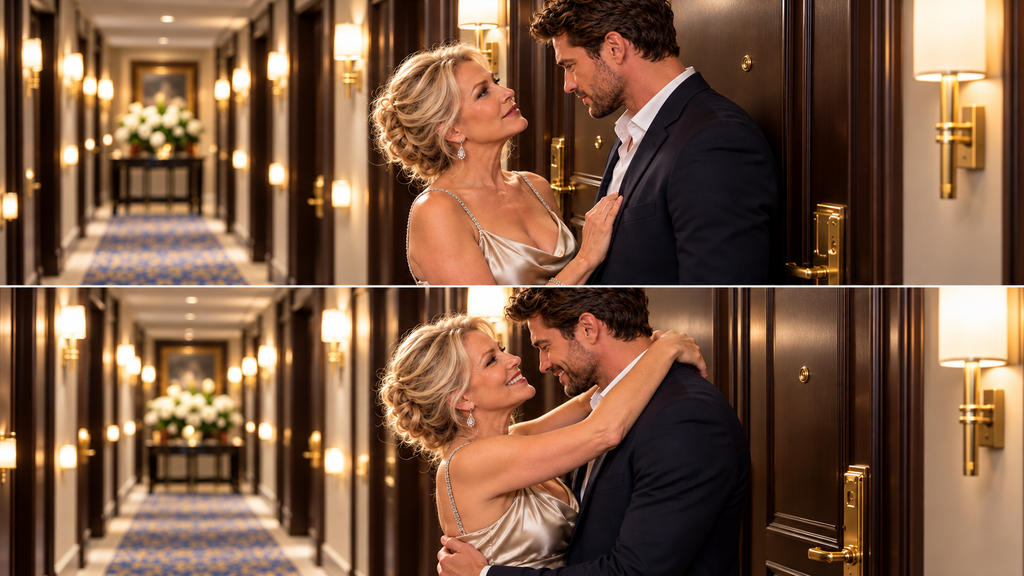
For thirty-seven years, I had kept that locket close to my heart.
Inside were two tiny photographs.
One showed my husband, Thomas, smiling on our wedding day.
The other showed our children, Emily and Michael, when they were little.
I rarely took it off.
The night before, however, I had removed it and placed it inside the small velvet pocket of my purse.
And now it had vanished.
I searched every compartment.
I emptied the entire purse onto the hotel bed.
Lipstick.
Tissues.
A comb.
My reading glasses.
The receipt for the birthday cake I had bought myself.
But no locket.
I sat motionless, staring at the photograph Daniel had left behind.
He had taken a picture of me while I slept.
He had stolen something that belonged to my dead husband.
And he had left a message promising that I would soon understand.
My stomach twisted.
What had I done?
How could I have been so foolish?
At sixty-two years old, I had allowed a handsome stranger to enter my life because he had remembered my birthday when my own children had forgotten it.
He had made me laugh.
He had held my hand.
He had looked at me as if I were still beautiful.
And I had mistaken attention for affection.
I pressed the photograph against my chest and began to cry.
Not because the man had disappeared.
Not even because the locket was gone.
I cried because, for one beautiful evening, I had believed someone truly wanted to be with me.
Then my phone rang.
An unfamiliar number appeared on the screen.
I almost ignored it.
But something made me answer.
“Hello?”
For several seconds, nobody spoke.
Then a woman’s voice whispered, “Mrs. Whitmore?”
My fingers tightened around the phone.
“Yes. Who is this?”
“Please don’t hang up. My name is Rebecca. You don’t know me, but I know what happened to you last night.”
I sat up straight.
“What do you mean?”
The woman hesitated.
“Did a man named Daniel approach you at the Marigold Bar?”
The blood drained from my face.
“How do you know that?”
“Did he leave you an envelope?”
I looked toward the nightstand.
“Yes.”
“Was there a photograph inside?”
I could barely breathe.
“Yes.”
The woman’s next words made every hair on my arms rise.
“Mrs. Whitmore, you need to leave that hotel immediately.”
“Why?”
“Because Daniel wasn’t supposed to leave you alive and unaware.”
For a moment, the room seemed to tilt.
“What did you just say?”
“Listen carefully. Take your belongings. Don’t speak to the front desk about him. Don’t tell anyone where you’re going. And whatever you do, don’t go home.”
The call ended.
I stared at the phone.
Outside the hotel window, people walked along the sidewalk carrying coffee cups and shopping bags.
Cars stopped at the traffic lights.
A young couple stood laughing beneath a tree.
The world continued as though nothing had happened.
But inside that room, my life had changed completely.
I called the unfamiliar number back.
It went straight to voicemail.
I tried Daniel again.
No answer.
Then a message appeared on my screen.
It came from Daniel.
“I am sorry. I wanted to tell you the truth last night, but I couldn’t. Please trust me one more time. Do not call your children until we speak.”
I read it twice.
My children?
Why would he mention my children?
I had told him about Emily and Michael while we sat at the bar, but only ordinary things.
That Emily was forty years old and had two children.
That Michael worked in real estate.
That they were busy.
That I sometimes wished they would call more often.
Had I said something else?
Had the wine made me careless?
I tried to remember every conversation we had shared.
Daniel had asked about my husband.
He had asked how long I had been widowed.
He had asked whether I lived alone.
And there was one question I suddenly remembered with terrible clarity.
“Do your children help you manage the house?”
At the time, it had sounded innocent.
I had laughed.
“Oh, they manage plenty. Michael handles some of my paperwork. Emily keeps telling me to sell the old place and move closer to her.”
Daniel had gone quiet.
Then he had asked, “Do you trust them?”
I had looked at him in surprise.
“Of course. They’re my children.”
He hadn’t answered.
Instead, he had lifted his wineglass and changed the subject.
Now, sitting alone in the hotel room, I wondered whether anything about our meeting had been accidental.
I stood up.
My knees felt weak.
I dressed quickly, putting on the same green dress I had worn the previous evening.
The fabric still carried a faint trace of Daniel’s cologne.
For reasons I couldn’t explain, that small detail hurt more than everything else.
Before leaving, I looked once more at the photograph.
I was sleeping on my side.
My silver hair spread across the white pillow.
One hand rested beneath my cheek.
I looked peaceful.
Almost happy.
And that frightened me.
Because I couldn’t remember the last time I had slept so peacefully beside another person.
I slipped the photograph into its envelope, picked up my suitcase, and opened the door.
A man was standing at the far end of the hallway.
He wore a dark baseball cap and appeared to be reading something on his phone.
When he noticed me, he turned away.
I told myself it was a coincidence.
But when I walked toward the elevators, I heard footsteps behind me.
I stopped.
The footsteps stopped.
My mouth went dry.
I turned.
The hallway was empty.
I stepped into the elevator and pressed the button for the lobby.
As the doors began to close, a hand suddenly appeared between them.
I gasped.
The doors opened again.
A hotel employee stepped inside carrying a stack of fresh towels.
“Good morning, ma’am.”
I forced a smile.
“Good morning.”
He glanced at my trembling hands.
“Are you feeling all right?”
“Yes. Just a little tired.”
He nodded politely.
But when we reached the lobby, I noticed something strange.
A black sedan was parked directly outside the entrance.
The man from the hallway stood beside it.
He was speaking into his phone.
Then he looked straight at me.
I turned sharply and walked toward the hotel’s restaurant instead of the front doors.
My heart pounded so violently that I could hear it in my ears.
I found an empty table near the window and sat down.
A waitress approached.
“Coffee?”
“Yes, please.”
My voice sounded unfamiliar.
As she walked away, my phone buzzed.
Another message.
This one came from the unknown woman.
“The man in the black car works for your son. Please don’t let him see you leave.”
I nearly dropped the phone.
My son?
Michael?
That was impossible.
My son might have been careless.
He might have forgotten my birthday.
But he would never send someone to follow me.
Would he?
I stared through the restaurant window.
The man beside the sedan was still there.
He glanced toward the hotel entrance, then checked his watch.
I suddenly remembered something.
Three weeks earlier, Michael had visited me with a stack of documents.
He had placed them on my kitchen table and told me they concerned property taxes and estate planning.
“Just sign where I’ve marked, Mom. It’ll make things easier later.”
I had been making soup.
The kitchen smelled of onions and chicken broth.
I remembered wiping my hands on a towel before signing.
I hadn’t read every page.
Why would I?
Michael was my son.
The boy I had taught to ride a bicycle.
The young man I had comforted after his first heartbreak.
The child who used to crawl into my bed during thunderstorms and whisper, “Mom, you’ll protect me, won’t you?”
Of course I had trusted him.
Of course I had signed.
But now I couldn’t remember what the documents actually said.
I took out my phone and opened my banking application.
My main account looked normal.
The balance was still there.
Then I checked the savings account Thomas and I had built together.
I stared at the screen.
There was a transfer pending.
$48,500.
The recipient was a company I had never heard of.
Merrick Property Holdings LLC.
The transaction was scheduled for Monday.
I didn’t recognize the company.
I hadn’t authorized the transfer.
And suddenly the missing locket seemed like only a small part of something much larger.
I called the bank.
A cheerful recorded voice told me that all representatives were busy.
I remained on hold, watching the man outside.
After several minutes, a woman answered.
“Thank you for calling First Heritage Bank. How may I help you?”
“My name is Margaret Whitmore. There’s a transfer showing on my savings account, and I don’t recognize it.”
She asked me several security questions.
I answered them.
Then she grew quiet.
“Mrs. Whitmore, I can see that the transfer was requested through an authorized representative.”
“What representative?”
“According to our records, your son, Michael Whitmore, is listed as an agent under a power of attorney.”
My throat tightened.
“A power of attorney?”
“Yes, ma’am.”
“I never gave him permission to transfer that money.”
There was a pause.
“Would you like me to begin a fraud review and place a temporary hold on outgoing transfers?”
“Yes.”
The word came out sharply.
“Yes, please. Immediately.”
“I can place a protective restriction while our security department reviews the transaction.”
“Please do.”
As she worked, I remembered Michael’s papers.
The casual way he had said, “Just sign.”
The way he had smiled when I asked whether I needed to call my lawyer.
“No need, Mom. I’ve already taken care of everything.”
I felt physically sick.
The bank representative returned.
“I’ve placed a restriction on the outgoing transfer and opened an investigation. You’ll need to verify additional information with our fraud department.”
“Thank you.”
“Mrs. Whitmore?”
“Yes?”
“Do you have reason to believe someone is using your financial information without your consent?”
I looked down at the envelope.
“I think so.”
After ending the call, I sat in silence.
My coffee arrived.
I couldn’t drink it.
Then someone slid into the chair opposite mine.
I looked up.
A woman in her late thirties sat across from me.
She had tired blue eyes, dark hair pulled into a loose bun, and a gray jacket that looked too large for her shoulders.
“Margaret?” she whispered.
I froze.
“Who are you?”
“Rebecca.”
The woman from the phone.
I started to stand.
She reached across the table.
“Please. Just give me thirty seconds.”
I remained seated.
She looked toward the window.
“The man outside is named Victor Shaw. He’s a private investigator.”
“Why is he following me?”
“Because your son paid him to.”
I felt a strange pressure behind my eyes.
“No.”
Rebecca lowered her voice.
“Michael hired Victor to confirm that you spent the night with Daniel.”
I stared at her.
“What?”
“He needs proof that you were with a younger man.”
I almost laughed.
The words were too ridiculous to understand.
“Why would my son care who I spent the night with?”
Rebecca swallowed.
“Because he’s trying to have you declared incapable of managing your own affairs.”
The restaurant noise faded.
All I could hear was a dull ringing in my ears.
Rebecca continued.
“He wants control of your house, your investments, and the money your husband left you. He’s been working on it for months.”
I shook my head.
“No. Michael would never—”
“I know how difficult this is.”
“You don’t know anything about my son.”
She reached into her handbag and placed several folded sheets of paper on the table.
“Then read these.”
The first page was a copy of an email.
From Michael.
To a person named Graham Ellis.
The subject line read:
“Margaret Whitmore — Documentation Strategy.”
My hands shook as I unfolded it.
The message was short.
We need evidence of erratic personal behavior, ideally involving a financially motivated outsider. It would support the petition if she appears vulnerable to manipulation.
Below that was another sentence.
The birthday arrangement should provide what we need.
I stopped reading.
Birthday arrangement.
My birthday.
Daniel.
The bar.
The candle.
The envelope.
I looked up at Rebecca.
“Who are you?”
Her expression changed.
For a moment, she looked almost ashamed.
“I work for Graham Ellis.”
“Who is he?”
“Your son’s attorney.”
The room seemed to close around me.
Rebecca clasped her hands together.
“I helped organize the paperwork. I scheduled appointments. I reviewed the files. At first, I thought it was a legitimate effort to protect an elderly parent.”
She hesitated.
“Then I heard Michael talking.”
“Talking about what?”
“About how much money you’d be worth once he controlled your property.”
I stared at her.
“He said you wouldn’t need much after he moved you into assisted living. He said your house was wasted on one person.”
I felt something inside me crack.
Not suddenly.
Not dramatically.
It was a quiet, terrible fracture.
The kind that happens when a truth you’ve spent years avoiding finally becomes impossible to deny.
My son had been looking at my home.
Not as the place where he grew up.
Not as the place where his father had celebrated birthdays and Christmases.
But as an asset.
A number.
Something waiting to be sold.
“And Daniel?” I whispered.
Rebecca looked away.
“Daniel was hired to get close to you.”
I closed my eyes.
There it was.
The answer I had been afraid to hear.
Every compliment.
Every laugh.
Every gentle touch.
Planned.
Paid for.
A performance.
I remembered the candle flickering on the dessert.
Daniel smiling as he said, “Make a wish.”
I had closed my eyes.
And I had wished that I might find happiness again.
For one moment, I had believed the universe had heard me.
I pressed my hand over my mouth.
Rebecca’s eyes filled with tears.
“Margaret, there’s more.”
I shook my head.
“I don’t want to hear any more.”
“I understand.”
“No, you don’t.”
My voice broke.
“You don’t understand what it means to sit alone on your birthday waiting for your children to remember you exist. You don’t understand what it means to lose the man you’ve loved for forty years and spend every evening listening to a house that no longer sounds like home.”
Rebecca remained silent.
“You don’t understand what it means for someone to look at you and make you feel alive again.”
A tear fell onto the table.
“And you certainly don’t understand what it means to discover that your own son paid for it.”
I stood.
Rebecca stood too.
“Margaret, please.”
I looked at her.
“What else?”
Her face tightened.
“Daniel wasn’t supposed to tell you anything. He was supposed to leave the photograph behind and disappear. But something happened last night.”
“What?”
“He changed his mind.”
I said nothing.
Rebecca leaned closer.
“And now Michael thinks Daniel has betrayed him.”
Before I could respond, the restaurant door opened.
The man from the black sedan stepped inside.
Victor.
He looked around.
Then his gaze found us.
Rebecca’s face turned pale.
“We have to go.”
She grabbed her handbag.
“Now.”
We moved toward the kitchen.
A waiter stepped into our path carrying a tray of dishes.
Rebecca spoke quickly.
“Please, we need to use the staff exit. It’s an emergency.”
The waiter looked confused.
Then he glanced behind us.
Victor was walking toward our table.
Rebecca pulled a small wallet from her jacket and opened it.
Inside was an identification card.
I couldn’t read the name, but the waiter immediately stepped aside.
“This way.”
We hurried through swinging doors into a noisy kitchen filled with steam and the smell of frying bacon.
A cook shouted something.
Someone dropped a metal pan.
Rebecca guided me around a stainless-steel counter and through a narrow corridor.
At the end was a heavy door marked STAFF ONLY.
She pushed it open.
Cool morning air struck my face.
We were in an alley behind the hotel.
A small blue car waited near a loading dock.
Rebecca unlocked it.
“Get in.”
I stopped.
“No.”
She turned.
“Margaret, please.”
“I don’t know you.”
“I know.”
“I trusted Daniel. Look where that got me.”
Rebecca’s expression softened.
“You’re right.”
She stepped away from the car.
“You shouldn’t trust me just because I tell you to.”
Then she took out her phone.
“Call your own attorney. Or call the police. I’ll stay here while you do it.”
I stared at her.
For the first time that morning, someone had given me a choice instead of telling me what to do.
I took a breath.
“My husband’s lawyer,” I said.
“What?”
“Thomas had a lawyer. Samuel Bennett. He handled our estate.”
“Can you call him?”
I nodded.
My hands were shaking so badly that I dropped the phone once before finding the number.
Samuel answered on the fourth ring.
“Bennett Law Office.”
“Samuel?”
“Yes?”
“It’s Margaret Whitmore.”
His voice warmed.
“Margaret! It’s been a long time. How are you?”
I tried to answer.
Instead, I began to cry.
His tone changed immediately.
“Margaret? What’s happened?”
“I think Michael is trying to take my house.”
Silence.
Then Samuel said, very slowly, “Where are you?”
I looked at Rebecca.
“Behind the Grand Carlton Hotel.”
“Are you safe?”
“I don’t know.”
“Listen to me carefully. Don’t go home. Come directly to my office. Bring every document you have.”
I swallowed.
“Samuel?”
“Yes?”
“Do you know anything about a power of attorney?”
He became quiet.
Then he said something that made my knees weaken.
“Margaret, your husband warned me this might happen.”
I gripped the phone.
“What?”
“Come to the office. We need to talk.”
The line disconnected.
I stared at the screen.
Thomas?
My Thomas?
He had been dead for almost five years.
How could he have warned Samuel about something happening now?
Rebecca opened the passenger door.
“Will you let me take you there?”
I looked toward the alley entrance.
Victor hadn’t appeared.
Not yet.
“Yes,” I whispered.
“But if you lie to me—”
“I won’t.”
I climbed into the car.
Rebecca drove without speaking.
We passed shops opening for the morning.
Children walked to school carrying backpacks.
A man stood outside a bakery arranging flowers in buckets.
Everything looked painfully ordinary.
I thought about Thomas.
His broad hands.
His crooked smile.
The way he always warmed my side of the bed with a hot-water bottle during winter.
He had been a carpenter before opening a small furniture business.
He wasn’t rich when we married.
Neither was I.
We built our life slowly.
One room at a time.
One paycheck at a time.
Our first house had leaked whenever it rained.
Thomas used to place pots beneath the dripping ceiling and joke that we had indoor waterfalls.
Later, when his business succeeded, we bought the old brick house on Hawthorne Street.
The place where our children grew up.
The place where we planted a pear tree in the backyard.
The place where Thomas took his final breath while holding my hand.
I had never considered selling it.
Not because I couldn’t live somewhere else.
But because every corner carried a memory.
And Michael knew that.
He knew how much the house meant to me.
Yet he was trying to take it anyway.
Rebecca pulled into the parking lot of a small office building.
“Mr. Bennett’s office is on the second floor.”
I looked at her.
“Are you coming inside?”
“If you’ll allow me.”
“Why are you helping me?”
She didn’t answer immediately.
Then she opened her handbag and removed a small photograph.
It showed a teenage girl with dark hair and a bright smile.
“My daughter,” she said.
“She’s beautiful.”
“Her name was Lily.”
Was.
The word hung between us.
Rebecca stared at the photograph.
“She died three years ago. She was sixteen.”
My chest tightened.
“I’m so sorry.”
Rebecca nodded.
“After she died, I stopped caring about many things. I buried myself in work. I told myself that as long as I paid my bills and didn’t ask questions, I was doing enough.”
She put the photograph away.
“Then I heard your son laughing about you.”
I waited.
“He told Graham that you were so desperate for attention that you would probably fall in love with the first man who bought you a drink.”
The words cut deeper than I expected.
Rebecca’s eyes shone.
“My daughter used to tell me that being lonely didn’t mean someone was weak. It meant they needed kindness.”
She wiped her cheek.
“I heard Michael say those things, and I imagined someone saying them about my mother.”
I looked down.
“I suppose he wasn’t entirely wrong.”
Rebecca frowned.
“What do you mean?”
“I did go home with Daniel.”
“That doesn’t make you foolish, Margaret.”
“I let a stranger into my room.”
“You made a private choice. Someone else turned it into a weapon. Those are not the same thing.”
I looked at her for a long moment.
Then I nodded.
“Come inside.”
Samuel Bennett was waiting at the top of the stairs.
He was seventy-one now, with thinning white hair and a slight stoop.
But his eyes were as sharp as ever.
When he saw me, he opened his arms.
“Margaret.”
I stepped into his embrace.
And for the first time that morning, I felt a little safer.
He led us into his office.
The familiar smell of leather chairs and old books made my eyes sting.
Thomas and I had sat in that room twenty years earlier to write our first wills.
We had joked about how grown-up it made us feel.
Now I sat in the same chair without him.
Samuel closed the door.
“Tell me everything.”
I did.
I told him about the birthday.
The bar.
Daniel.
The photograph.
The missing locket.
Rebecca.
The man following me.
The bank transfer.
And the papers Michael had asked me to sign.
Samuel listened without interrupting.
When I finished, he leaned back.
Then he opened a drawer and took out a thick brown envelope.
Across the front, in Thomas’s handwriting, were four words.
FOR MARGARET, IF NECESSARY.
I stopped breathing.
“That’s Thomas’s writing.”
Samuel nodded.
“He gave this to me nine months before he died.”
I reached toward it.
Then pulled my hand back.
“What is it?”
“A letter. And several documents.”
“Why didn’t you give them to me?”
“Because Thomas asked me to hold them unless certain circumstances arose.”
“What circumstances?”
Samuel looked directly at me.
“If either of your children attempted to obtain control of your estate without your informed consent.”
My heart sank.
“Thomas thought Michael might do this?”
Samuel sighed.
“He had concerns.”
“Why didn’t he tell me?”
“He tried.”
I shook my head.
“No. He never said anything.”
Samuel’s expression was gentle.
“Margaret, do you remember the argument you and Thomas had during his last Christmas?”
Of course I remembered.
Thomas had been ill.
Michael had visited with his wife, Claire, and their children.
After dinner, Thomas had asked me to come into the study.
He said he wanted us to review our estate documents.
I had become upset.
“Why are we talking about money on Christmas?”
He had looked exhausted.
“Because we need to make sure you’re protected.”
I remembered snapping at him.
“Michael is our son, Thomas. He isn’t a stranger.”
Thomas had gone quiet.
Then he said, “I know who he is. That’s what worries me.”
I had been furious.
I accused him of being suspicious.
I told him illness was making him imagine things.
We didn’t speak for the rest of that evening.
Two months later, he was gone.
I covered my mouth.
“Oh, Thomas.”
Samuel pushed the envelope toward me.
“He wanted you to have the truth, Margaret. But he also knew you needed time to grieve.”
My fingers trembled as I opened it.
Inside was a handwritten letter.
The paper had yellowed slightly.
I recognized every curve of Thomas’s writing.
My darling Margaret,
If you are reading this, something has happened that I hoped would never happen.
I want you to know one thing before anything else.
You have done nothing wrong by loving our children.
You gave them everything you could.
You taught them kindness.
You taught them honesty.
But children become adults, and adults make choices their parents cannot control.
I have watched Michael change.
I have watched him borrow money and forget to repay it.
I have watched him tell lies to protect himself from consequences.
And I have watched you excuse those lies because you remember the boy who used to hold your hand.
I love that boy too.
But I am afraid of the man he is becoming.
Margaret, the house is yours.
The savings are yours.
The life we built belongs to you.
Not to Michael.
Not to Emily.
Not to anyone who decides that your age makes you incapable of choosing for yourself.
Promise me you will not give away your independence just because someone calls you selfish for keeping it.
And one more thing, my love.
If someone comes into your life after I am gone, do not feel guilty.
I had forty wonderful years with you.
I would never want the rest of your life to be measured by how faithfully you remained alone.
Wear the green dress.
Go dancing.
Laugh loudly.
Fall in love if you want to.
You were a woman before you were my wife.
You are still that woman now.
Forever yours,
Thomas.
By the time I reached the last sentence, tears were falling onto the page.
The green dress.
I looked down at myself.
I was wearing it.
The same dress Thomas had bought me for our fortieth anniversary dinner.
I remembered how he had looked at me when I came downstairs.
“Good heavens,” he’d whispered. “How am I supposed to concentrate on dinner now?”
I laughed through my tears.
Samuel waited quietly.
Rebecca turned away to give me privacy.
I read the letter again.
Then I placed it carefully on the desk.
“What are the other documents?”
Samuel opened the envelope.
“Your husband created an estate structure specifically to protect your ownership. The house is held in a trust that gives you full rights to live there, with safeguards against transfers made by unauthorized people.”
I frowned.
“Michael told me he was handling the house.”
“He may believe he is.”
“What does that mean?”
Samuel took out another folder.
“It means the documents you signed three weeks ago may give him authority over certain financial matters. We need to examine them immediately. But they do not automatically give him the right to sell trust property.”
I exhaled shakily.
“So he can’t just sell my home?”
“Not merely because he wants to. And if he obtained your signature through deception, we have grounds to challenge that authority.”
I looked toward Rebecca.
She was staring at her phone.
Her expression had changed.
“What’s wrong?” Samuel asked.
Rebecca looked up.
“Graham just sent a message to the office group.”
“What does it say?”
She swallowed.
“Daniel’s missing.”
I felt an unexpected stab of fear.
Samuel leaned forward.
“Missing?”
“Victor went to his apartment this morning. The place was empty. His phone is switched off.”
Rebecca looked at me.
“And Michael is furious.”
“Why?” I asked.
She hesitated.
“Because Daniel took something from Graham’s office before he disappeared.”
My hand instinctively moved toward the place where my locket should have been.
“What did he take?”
“A folder.”
“What kind of folder?”
Rebecca’s face drained of color.
“A folder containing original documents related to your husband’s estate.”
I stared at her.
“How could Daniel get those?”
“I don’t know.”
Samuel’s expression hardened.
“Rebecca, I need you to tell me everything you know about this Daniel.”
She took a breath.
“His name isn’t Daniel.”
The room fell silent.
I felt cold.
“What?”
“Daniel is the name Michael gave us when we arranged the meeting. His real name is Nathan Cole.”
I looked away.
Even his name had been a lie.
Rebecca continued.
“He’s thirty-nine. He worked as a freelance photographer for Graham’s firm, mostly documenting property inspections and insurance claims.”
“Why would he agree to this?”
“Michael offered him twenty thousand dollars.”
I closed my eyes.
Twenty thousand dollars.
My birthday had been worth twenty thousand dollars to a stranger.
“And he was supposed to photograph me sleeping?”
Rebecca nodded reluctantly.
“The instructions were to obtain evidence that you had spent the night with him. Graham planned to present it as part of a larger argument that you were vulnerable to exploitation.”
Samuel’s mouth tightened.
“That photograph alone proves nothing about Margaret’s capacity.”
“I know,” Rebecca said. “But they weren’t planning to rely on it alone.”
She removed another document from her bag.
“They’ve been preparing a petition for guardianship.”
I stared at the paper.
My name was printed at the top.
Margaret Eleanor Whitmore.
Age 62.
The document described me as emotionally unstable.
Financially irresponsible.
Socially isolated.
It claimed I had become susceptible to manipulation by strangers.
It mentioned my grief after Thomas died.
It mentioned a small mistake I had made paying an electricity bill.
It mentioned a time I had forgotten an appointment.
Ordinary moments.
Human moments.
Twisted into evidence that I could no longer manage my own life.
I felt my cheeks burn.
“They’ve been keeping records of my mistakes?”
Rebecca nodded.
“Michael has been documenting incidents for months.”
I stared at the final paragraph.
It recommended that Michael be appointed temporary guardian over my finances and major personal decisions.
I read those words three times.
Then I set the paper down.
“And Emily?”
Neither Samuel nor Rebecca answered immediately.
My heart sank.
“Does my daughter know?”
Rebecca lowered her eyes.
“She’s listed as a supporting witness.”
I let out a sound I didn’t recognize.
It was somewhere between a laugh and a sob.
Both of them.
My son and my daughter.
The two people I had loved more than my own life.
Samuel reached across the desk.
“Margaret, we don’t yet know what Emily has been told or whether she understands what she’s supporting.”
I shook my head.
“She didn’t even call me yesterday.”
The room became very quiet.
I looked at Thomas’s letter.
He had worried about Michael.
But surely he hadn’t imagined both our children standing together against me.
I thought about the birthdays when Emily was little.
I used to wake before dawn to decorate the kitchen with balloons.
I made pancakes shaped like hearts.
I stayed up until midnight decorating cakes.
When Michael turned ten, Thomas and I spent three weeks building a wooden treehouse because he wanted somewhere to play pirates with his friends.
I remembered their excitement.
Their laughter.
Their arms around my neck.
And I wondered at what point I had stopped being their mother and started being an inconvenience.
Samuel’s desk phone rang.
His assistant’s voice came through the speaker.
“Mr. Bennett, there’s a gentleman downstairs asking for Mrs. Whitmore.”
Samuel glanced at me.
“Who?”
“He says his name is Nathan Cole.”
My heart gave a violent thud.
Rebecca stood abruptly.
“Daniel.”
Samuel pressed the intercom.
“Don’t send him up yet.”
I stared at the door.
Part of me wanted to run.
Part of me wanted to slap him.
And another part, the part I hated most, wanted to know whether anything he had said to me the previous night had been real.
Samuel looked at me.
“Margaret, you don’t have to see him.”
I wiped my face.
“No.”
My voice was surprisingly steady.
“I want to hear what he has to say.”
Samuel nodded.
“Rebecca, stay with Margaret.”
Then he pressed the intercom again.
“Have him come up. And ask building security to remain nearby.”
A minute later, footsteps sounded in the hallway.
The door opened.
And there he stood.
Daniel.
Nathan.
Whoever he was.
He looked nothing like the charming man from the bar.
His hair was disheveled.
His shirt was wrinkled.
There was a dark bruise along his jaw.
He held a small brown package beneath one arm.
When he saw me, his face changed.
“Margaret.”
I stood.
“Don’t.”
He stopped.
“Please, let me explain.”
I laughed bitterly.
“Explain what? Your name? The money? The photograph? Or the fact that my son paid you to humiliate me?”
He flinched.
For a moment, he looked genuinely ashamed.
“I deserve that.”
“You deserve much worse.”
“I know.”
My eyes burned.
“Did you laugh about me afterward?”
He stared at me.
“What?”
“Did you and my son laugh? Did you tell him how easy it was? How desperate the lonely old woman was for a little attention?”
“No.”
“Don’t lie to me again.”
His voice cracked.
“I didn’t.”
I stepped closer.
“Then tell me why you did it.”
Nathan swallowed.
“Because I needed the money.”
“Twenty thousand dollars?”
He nodded.
I studied him.
“What kind of man sells another person’s dignity for twenty thousand dollars?”
He looked down.
“The kind of man I became.”
For several seconds, nobody spoke.
Then Nathan placed the brown package on Samuel’s desk.
“I brought what I took.”
Samuel opened it carefully.
Inside was a thick folder.
And lying on top was my silver locket.
I gasped.
I reached for it before I could stop myself.
The chain was tangled.
The tiny clasp was bent.
But the locket was there.
I held it against my palm.
“Why did you take this?”
Nathan’s eyes filled with tears.
“Because there was something inside it.”
I frowned.
“What do you mean?”
He nodded toward the locket.
“Open it.”
I pressed the little catch.
The two photographs appeared.
Thomas on one side.
Emily and Michael on the other.
Nothing unusual.
Nathan leaned forward.
“Look behind your husband’s photograph.”
I stared at him.
“Why?”
“Please.”
Samuel handed me a small letter opener.
Carefully, I lifted the edge of Thomas’s photograph.
Behind it was a folded piece of paper.
So tiny I could hardly believe it had been hidden there all these years.
My breath caught.
I unfolded it.
There were six handwritten words.
“Ask Samuel about the third account.”
Thomas’s handwriting.
Again.
I looked up slowly.
“Samuel?”
My lawyer stared at the note.
For the first time that morning, he looked genuinely surprised.
“Margaret, I didn’t know Thomas had hidden that.”
Nathan spoke.
“Michael knew the note existed.”
I turned toward him.
“What?”
“He found a reference to it in an old letter. He thought it might lead to money your husband had hidden.”
I clutched the locket.
“So that’s why you stole it.”
Nathan nodded.
“That was part of my assignment.”
My anger rose again.
“You took my husband’s last gift because Michael wanted more money.”
“Yes.”
The honesty made me angrier.
“But I didn’t give it to him,” Nathan added quickly.
“Why not?”
He looked at me.
“Because when I opened it, I saw your husband’s photograph.”
I said nothing.
“And I remembered what you told me about him.”
At the bar, I had told Nathan how Thomas used to sing badly while washing dishes.
How he insisted on buying flowers from the same elderly woman at the farmers’ market.
How he had once driven six hours through a snowstorm because Emily was sick at college and wanted her father.
Nathan lowered his eyes.
“You talked about him as if he had only stepped into the next room.”
I swallowed.
“He was my whole life.”
“I know.”
“No,” I whispered. “You don’t.”
Nathan accepted the correction.
Then he said, “I was supposed to take the locket, leave the photograph, and walk away. The plan was for Michael to claim you’d been manipulated by a stranger, while quietly using the documents he’d already obtained.”
Samuel leaned forward.
“And the photograph?”
Nathan’s face tightened.
“I took it because Graham insisted. He wanted something undeniable.”
I felt sick again.
“But before I left, I realized something.”
“What?”
Nathan looked directly at me.
“Your son wasn’t planning to protect you after the petition succeeded.”
Rebecca went still.
Samuel frowned.
“What do you mean?”
Nathan reached into his jacket and removed a small recording device.
“I heard a conversation yesterday afternoon.”
He placed it on the desk.
“Michael and Graham didn’t know I was still in the office.”
Samuel studied him.
“You recorded them?”
“Yes.”
“Why?”
Nathan hesitated.
“Because I had started to suspect I was being used for something much worse than an ugly family dispute.”
Samuel turned to Rebecca.
“Did you know about this?”
She shook her head.
“No.”
Nathan pressed a button.
A man’s voice filled the room.
Michael’s voice.
I recognized it instantly.
“She’ll fight if she realizes what we’re doing.”
Another man responded.
Graham, presumably.
“Then we move quickly. The bank authority is already active.”
Michael laughed.
“Once the court paperwork starts, she’ll panic. She’ll look irrational. That’s what we need.”
A chair scraped.
Then Michael spoke again.
“And what about the house?”
Graham answered.
“We can’t transfer trust property without dealing with Bennett’s documents.”
Michael swore.
“Dad always had to complicate everything.”
I gripped the edge of the desk.
Nathan’s recording continued.
Then Michael said something that made the air leave my lungs.
“I don’t care where she ends up. I just need her out of that house before the investment deadline.”
The recording stopped.
Nobody moved.
I stared at the little device.
My son.
My own son.
Had spoken about removing me from my home as casually as someone discussing furniture.
I thought of all the years I had defended him.
Every unpaid loan.
Every broken promise.
Every time Thomas had warned me.
I had told myself Michael was struggling.
That he needed help.
That he would eventually find his way.
But he wasn’t lost.
He was making deliberate choices.
And I was the person he had chosen to sacrifice.
Samuel cleared his throat.
“Nathan, why bring this to us?”
Nathan looked at me.
“Because I couldn’t go through with it.”
I laughed without humor.
“You already did.”
He lowered his head.
“Yes.”
“You already took the picture.”
“Yes.”
“You already lied to me.”
“Yes.”
“You already accepted my son’s money.”
He hesitated.
“I received five thousand dollars in advance.”
“And you spent the night with me because you were paid to.”
His expression changed.
For the first time, he looked unable to find words.
I waited.
Finally, he whispered, “I went to the bar because I was paid to.”
The distinction struck me.
I stared at him.
“What does that mean?”
He took a slow breath.
“When I saw you sitting alone, I knew who you were. I’d seen your photograph. I knew it was your birthday.”
My stomach twisted.
“But I didn’t expect you to be so…”
He stopped.
“So what?” I demanded.
“Kind.”
I looked away.
Nathan continued.
“You asked about my childhood. You listened when I talked about photography. You remembered that I said I liked lemon desserts. You noticed I hadn’t eaten and insisted we order something.”
A faint memory returned.
Daniel laughing as I pushed half my sandwich toward him.
“You’re too thin,” I’d joked. “Every mother in the world would tell you to eat.”
Nathan swallowed.
“I’ve spent most of my life around people who only ask questions when they want something. You asked because you cared about the answers.”
My eyes filled despite myself.
“I didn’t know you were lying.”
“I know.”
“That’s what makes it cruel.”
He nodded.
“Yes.”
I held the locket tightly.
Nathan’s voice grew quieter.
“When we left the bar, I intended to say goodnight and complete the job another way. But you invited me upstairs for coffee. We talked for another hour. You told me about the first time you met Thomas.”
I remembered.
The rain.
The bus stop.
Thomas offering me his jacket even though he was shivering.
Nathan looked at the floor.
“Everything after that was my choice. I wasn’t forced to stay. And you deserved to know who I was before deciding whether you wanted me there.”
That sentence landed heavily.
Because it was true.
My choice had been stolen from me.
Not by age.
Not by loneliness.
By deception.
I wiped my cheeks.
“Why did you photograph me?”
He closed his eyes.
“Because I was a coward.”
It was the first answer he had given that required no explanation.
Samuel stood.
“I think we need to focus on protecting Margaret now.”
Nathan nodded.
“I brought copies of the communications. And the original folder I took.”
He opened it.
Inside were photographs of documents.
Bank records.
Emails.
Notes from Michael’s meetings.
And a printed schedule.
Rebecca leaned forward.
“What’s that?”
Nathan pointed to the final line.
“That’s why I came as quickly as I could.”
The schedule listed a meeting for Monday morning.
9:00 a.m.
At Merrick Property Holdings.
Under the heading were three words.
“Final Asset Acquisition.”
Samuel frowned.
“Merrick Property Holdings. That’s the company receiving the bank transfer.”
Nathan nodded.
“And it’s controlled by Michael’s business partner.”
Rebecca looked alarmed.
“There’s more.”
Nathan turned toward her.
“What?”
She opened her laptop.
“I reviewed Michael’s file last week. He’s been trying to obtain financing for a large commercial development.”
Samuel nodded slowly.
“I’ve heard about it.”
Rebecca continued.
“The lender requires additional security. Michael doesn’t have enough.”
I felt sick.
“My house.”
Samuel looked at me.
“Yes, Margaret.”
Nathan added, “And your savings.”
The truth settled over the room.
My son wasn’t simply trying to inherit my property someday.
He needed it now.
He had borrowed money.
Promised investors returns.
Made commitments he couldn’t meet.
And when the walls began closing in, he turned toward the person he believed would never refuse him.
His mother.
I sat down slowly.
“How much does he owe?”
Rebecca searched through the folder.
Then she looked up.
“Almost eight hundred thousand dollars.”
I stared at her.
Eight hundred thousand.
More money than I had ever imagined Michael could lose.
Samuel rubbed his forehead.
“That explains the urgency.”
I looked at him.
“What happens Monday?”
“If they succeed in accessing your funds and finding a way around the trust restrictions, they may try to use your assets to support Michael’s debt obligations. But we can act before then.”
I nodded.
For the first time, fear began to make room for anger.
Not the wild anger that makes people scream.
A colder anger.
The kind that comes when someone has taken advantage of your love for so long that you finally understand the cost.
“What do we do?”
Samuel looked at me with something like approval.
“First, we challenge and revoke any improper authority. We notify your financial institutions and the trust’s trustee. Then we preserve every piece of evidence.”
Rebecca said, “I can provide the emails and office records.”
Nathan nodded.
“And I can give a statement.”
Samuel looked toward him.
“You understand you may be admitting to criminal conduct?”
Nathan’s face tightened.
“Yes.”
“And that cooperating doesn’t erase your responsibility?”
“Yes.”
“Good. Because Margaret deserves the truth, not another bargain made behind her back.”
Nathan looked at me.
“I understand.”
I stared at him for a long moment.
Then I said quietly, “I don’t forgive you.”
He nodded.
“I know.”
“But I appreciate that you came.”
His eyes filled.
“Thank you.”
Samuel spent the next hour making calls.
He contacted the bank’s fraud department.
He spoke to the trustee responsible for the house.
He began preparing documents to revoke the disputed power of attorney.
He advised me to make a formal police report about the photograph, the missing locket, and the suspected financial fraud.
Rebecca carefully copied her evidence to secure storage.
Nathan provided the recording and explained how he’d obtained it.
All the while, I sat beside the window with Thomas’s letter in my lap.
I kept rereading one sentence.
You were a woman before you were my wife. You are still that woman now.
I wondered what Thomas would think if he could see me.
Would he be disappointed?
Would he be angry?
Or would he take my hand and say the words he always said when something went wrong?
“We’ll figure it out, Maggie.”
He was the only person who had ever called me Maggie.
The memory made me smile through my tears.
Then Samuel came back into the office.
“Margaret, there’s something else we need to discuss.”
I looked up.
“The third account?”
He nodded.
I sat straighter.
Samuel opened a secure file on his computer.
“When Thomas sold part of his furniture company, he invested the proceeds through a separate account. He was very deliberate about keeping it outside the everyday accounts Michael knew about.”
“How much?”
Samuel turned the screen slightly.
I looked at the figure.
Then looked again.
I must have misunderstood.
“Samuel…”
He nodded.
“It’s grown over the years.”
The balance was just over two million dollars.
I stared.
Two million.
Thomas had left me more financial security than I had ever realized.
“Why didn’t I know?”
“You knew there was a separate investment fund,” Samuel said gently. “But Thomas arranged for professional management and automatic reinvestment. You’ve received annual statements, though I suspect you haven’t studied them closely.”
I remembered the thick envelopes that arrived every December.
I always placed them in the study drawer.
Thomas had handled investments.
After his death, reading financial statements made me feel overwhelmed.
I knew enough to live comfortably.
I had never needed to investigate further.
Samuel continued.
“The account is under your control, with safeguards requiring your direct authorization for major withdrawals. Michael has no legal authority over it.”
I covered my mouth.
The note in the locket.
Ask Samuel about the third account.
Thomas had wanted me to remember.
He had wanted to protect me.
Even after his death.
Rebecca smiled faintly.
“Margaret, your husband was a careful man.”
I nodded.
“He was.”
But then something occurred to me.
“How did Michael know there was a note inside the locket?”
Samuel frowned.
“That is a very good question.”
Nathan looked uncomfortable.
“He found a letter.”
“What letter?”
“One from Thomas to Michael. It mentioned the locket and said that if Michael ever found himself in serious trouble, he should speak honestly to you rather than search for shortcuts.”
My eyes widened.
“Thomas wrote him that?”
Nathan nodded.
“The letter also said, ‘Your mother wears the reminder close to her heart.’ Michael believed there was information hidden in it.”
Samuel sighed.
“Thomas was trying to give him a moral warning.”
“And Michael treated it like a treasure map,” Rebecca whispered.
I looked down at the little silver locket.
The irony was almost unbearable.
Thomas had tried to teach his son honesty.
Instead, Michael had seen another opportunity to take.
I closed the locket.
And made a decision.
“I want to go home.”
Samuel shook his head.
“Not yet. We should first make sure it’s safe.”
“I understand.”
I looked at him.
“But I am not going to spend the rest of my life running from my children.”
He studied me.
“I wouldn’t ask you to.”
“Then I want to face them.”
Samuel nodded slowly.
“We can arrange that. But not alone.”
I looked toward the window.
The afternoon sunlight touched the rooftops outside.
Yesterday, I had been a lonely woman celebrating her birthday by herself.
Today, I was sitting in a lawyer’s office learning that the family I had spent my life protecting was trying to take everything from me.
I felt exhausted.
But beneath the exhaustion, something unfamiliar was growing.
Resolve.
I had spent years avoiding conflict because I was afraid of losing my children.
Now I understood something.
They had been willing to lose me for money.
And that changed everything.
By late afternoon, Samuel had helped me arrange a temporary stay at a small guesthouse owned by an old friend of his.
Rebecca drove me there.
Nathan didn’t come.
Before leaving the office, he had approached me one last time.
“Margaret?”
I turned.
He held something in his hand.
A photograph.
Not the one from the hotel.
This one had been taken at the bar.
I was sitting beneath the warm lights, laughing.
My green dress shimmered softly.
The candle on my birthday dessert burned between us.
Nathan had taken the picture while I was looking away.
He held it out.
“I thought you might want this.”
I stared at it.
“Why?”
“Because that’s how you looked when you laughed.”
I took it reluctantly.
For a moment, I studied the woman in the photograph.
She didn’t look frightened.
She didn’t look old.
She looked alive.
Nathan said, “I know I destroyed the memory of last night. But I hope someday you’ll remember that the happiness you felt wasn’t something I created.”
I looked up.
“What do you mean?”
“It was yours. I only happened to be there when you let yourself feel it.”
I didn’t answer.
He stepped back.
“I’m sorry, Margaret.”
Then he walked away.
I watched him go.
And I knew something important.
I might someday understand why he had done what he did.
I might even find a way to stop hating him.
But forgiveness would not mean pretending he had never hurt me.
Some wounds deserved to be acknowledged before they could heal.
That evening, I sat alone in the guesthouse bedroom.
It was a simple room with cream-colored walls and a quilted bedspread.
A vase of yellow flowers stood on the dresser.
Outside, rain began to tap against the window.
I opened my phone.
There were seven missed calls from Michael.
Three from Emily.
And four messages.
The first was from Michael.
Mom, where are you? I went by the house. Your car isn’t there.
The second arrived twenty minutes later.
Call me immediately. This is serious.
Then another.
I heard you contacted the bank. Why would you freeze anything without speaking to me?
And finally:
“You’re making a terrible mistake. You don’t understand what you’re doing.”
I stared at the words.
For years, Michael had used that tone whenever I disagreed with him.
As if age had made me foolish.
As if he were the only adult in the room.
I opened Emily’s messages.
Mom, please call me. Michael says you’re confused and behaving strangely.
Then:
I’m worried about you.
Then:
We need to discuss getting you some help.
I felt my chest tighten.
Some help.
I wondered whether Emily had any idea what Michael was planning.
Had she truly agreed to help take my house?
Or had he convinced her that I was losing my mind?
Samuel had warned me not to assume.
People could be manipulated.
Families could become tangled in lies.
I wanted to believe my daughter was innocent.
But I also knew I had spent too many years believing what I wanted instead of what was in front of me.
I turned off the phone.
Then I placed Thomas’s letter on the bedside table.
I read it again before sleeping.
And that night, for the first time in months, I dreamed of my husband.
We were standing in our old kitchen.
Thomas wore his favorite blue sweater.
He was slicing pears from the tree in our backyard.
I told him I was frightened.
He smiled.
“Maggie, you’ve always been braver than you think.”
I shook my head.
“I don’t know what to do.”
He placed a slice of pear in my hand.
“Then do what you taught our children.”
“What?”
“Tell the truth.”
When I woke, tears were on my cheeks.
But I was no longer afraid.
The next morning was Saturday.
I made coffee.
I sat beside the window.
And I called my daughter.
Emily answered immediately.
“Mom!”
Her voice shook.
“Thank God. Where have you been? Michael’s been calling everyone.”
“I’ve been taking care of some things.”
“What things?”
“My affairs.”
There was a pause.
“Mom, are you all right?”
“Yes.”
“Michael says you’ve frozen bank accounts and accused him of stealing.”
“I placed a protective hold on a transfer I didn’t authorize.”
Emily exhaled loudly.
“Mom, he was trying to help you.”
“Help me do what?”
Silence.
“Emily?”
“He said you had been making mistakes with your finances.”
“What mistakes?”
“Well…”
She hesitated.
“You forgot to pay the electricity bill last winter.”
I almost smiled.
“Yes. I did.”
“And you sent a birthday card to Aunt Helen twice.”
“Yes. I did that too.”
“And Michael said you signed something without understanding it.”
The irony was so sharp that I laughed.
Emily sounded startled.
“Mom?”
“Do you know why I signed those papers?”
“Because Michael asked you to.”
“Exactly.”
She was quiet.
I continued.
“Emily, do you believe I’m incapable of managing my life?”
“No, Mom. Not exactly.”
“Then why did you agree to support a guardianship petition?”
The line went silent.
I could hear her breathing.
Finally, she whispered, “How do you know about that?”
My heart sank.
So she did know.
“Did you sign a statement?”
“Mom…”
“Answer me.”
“Yes.”
I closed my eyes.
“Why?”
She began to cry.
“Because Michael said you were becoming vulnerable. He said he was worried someone would take advantage of you.”
I swallowed.
“And what did you think he meant?”
“He said you were lonely. That you’d been talking about selling the house. That you might give money to strangers.”
I stared at the rain-darkened window.
“I never told him I wanted to sell the house.”
Emily went quiet.
“Never?”
“No.”
“But he said…”
“He lied.”
She inhaled sharply.
“Mom, I don’t know what to believe.”
“Then listen carefully.”
I told her about the bank transfer.
The estate documents.
The private investigator.
The photograph.
I did not describe every intimate detail of my birthday.
I didn’t owe anyone that.
But I told her enough.
When I finished, Emily was crying openly.
“Oh my God.”
I waited.
“Mom, I didn’t know.”
“Did you know he was trying to gain control of the house?”
She hesitated.
“He said it was to protect you.”
“Did he tell you he owed nearly eight hundred thousand dollars?”
Silence.
Then a faint whisper.
“What?”
“Did he?”
“No.”
“Did he tell you he wanted to use my property to secure his business debts?”
“No.”
I could hear her breathing grow uneven.
“Mom, I swear I didn’t know.”
I wanted to believe her.
I desperately wanted to.
But I had learned something painful.
Love didn’t eliminate the need for proof.
“Emily, did you read the statement before you signed it?”
A long pause.
“No.”
I closed my eyes.
There it was again.
The family habit that had nearly destroyed me.
Trusting Michael because questioning him felt disloyal.
I whispered, “You should have.”
“I know.”
“You should have asked me.”
“I know, Mom.”
Her voice broke.
“I’m so sorry.”
I felt tears gathering.
“You hurt me, Emily.”
“I know.”
“You helped your brother make me look helpless.”
She sobbed.
“I thought I was helping you.”
I took a shaky breath.
“Then help me now.”
“What do you need?”
“Tell Samuel Bennett everything Michael told you. Give him copies of every message. And don’t sign anything else.”
“I will.”
“And Emily?”
“Yes?”
“Don’t tell Michael where I am.”
She hesitated only a second.
“I won’t.”
We ended the call.
I sat holding the phone for a long time.
I had expected relief.
Instead, I felt grief.
Because even if Emily had been deceived, she had still believed I might be incapable of caring for myself without asking me.
She had trusted her brother’s version of me more than the woman who raised her.
That hurt.
But beneath the hurt, there was a small opening.
Perhaps not everything had been lost.
Perhaps my daughter could still find her way back.
By Monday morning, Samuel had assembled enough evidence to challenge the disputed authority and protect my financial accounts while the investigation continued.
The attempted transfer had not gone through.
The bank had escalated the matter to its fraud department.
The trustee had been notified.
And the police had taken my statement.
Nathan had also given a detailed account of how he had been hired.
He had handed over his phone, the recording, and the messages arranging the encounter.
I learned something else that surprised me.
After Nathan left Samuel’s office, he had gone directly to the police.
He hadn’t waited to be arrested.
He hadn’t tried to disappear.
He had confessed his involvement and provided evidence against Michael and Graham.
When Rebecca told me, I didn’t know how to feel.
Part of me respected the choice.
Another part wondered why it had taken him so long to do the right thing.
I decided I didn’t need to solve that question yet.
Monday afternoon, Samuel called.
“Margaret, Michael has agreed to meet.”
My stomach tightened.
“Where?”
“At my office. Tomorrow at eleven.”
“Will Emily be there?”
“Yes.”
“And Graham?”
“He has been invited as Michael’s counsel. He may attend.”
I took a breath.
“Good.”
Samuel paused.
“Are you certain you’re ready?”
I looked at Thomas’s photograph on the dresser.
“Yes.”
Because something had changed.
For years, I had approached every family disagreement hoping to keep the peace.
I apologized when I wasn’t wrong.
I gave money when I couldn’t afford it.
I stayed quiet when someone dismissed my feelings.
I told myself that was what mothers did.
But Thomas’s letter had reminded me of something.
A mother’s love was not a contract requiring her to surrender her dignity.
I could love my children.
And still say no.
Tuesday morning arrived gray and cold.
I wore a navy dress.
Comfortable shoes.
Pearl earrings.
And the silver locket, repaired by a jeweler Samuel trusted.
I had considered wearing green again.
But that dress belonged to a different day.
The green dress had been for a woman who wanted to feel noticed.
The navy dress was for a woman who had decided to notice herself.
When I entered Samuel’s office, Michael was already there.
He stood near the window, speaking angrily into his phone.
He wore an expensive charcoal suit.
His hair was neatly combed.
From a distance, he looked exactly like the successful businessman he had always wanted everyone to see.
But when he turned and noticed me, his expression changed.
“Mom.”
He rushed toward me.
“Thank God. Where have you been?”
I stepped aside before he could embrace me.
He stopped.
His face tightened.
“Mom?”
“Hello, Michael.”
He stared.
“You’ve had everyone worried sick.”
“Have I?”
“Yes! Emily’s been crying. I’ve barely slept.”
I looked at the dark circles beneath his eyes.
For a moment, instinct took over.
I wanted to ask whether he’d eaten.
Whether he was resting.
Whether he needed anything.
Then I remembered his voice on the recording.
I don’t care where she ends up.
I folded my hands.
“Sit down, Michael.”
His eyebrows rose.
“Excuse me?”
“Please sit.”
He glanced toward Samuel.
“What’s going on?”
Samuel gestured toward the conference table.
“We have several matters to discuss.”
Michael looked irritated.
“Mom, you don’t need a lawyer. I’m your son.”
I met his eyes.
“That’s exactly why I need one.”
His face flushed.
Emily sat at the far end of the table.
She looked exhausted.
When our eyes met, she began to cry.
“Mom.”
I nodded gently.
“Hello, sweetheart.”
She rose as if to hug me.
Then hesitated.
I opened my arms.
She crossed the room and held me tightly.
“I’m sorry,” she whispered.
I held her for a moment.
Then stepped back.
“We’ll talk later.”
She nodded.
Michael watched us with growing suspicion.
“Emily, what’s this?”
She didn’t answer.
Graham Ellis sat beside Michael.
He was a thin man with silver glasses and a polished expression.
A leather briefcase rested at his feet.
He smiled when I looked toward him.
“Mrs. Whitmore. I’m glad you’re safe.”
I stared at him.
“Are you?”
His smile faded slightly.
Samuel took his seat.
“Let’s begin.”
Michael leaned back.
“Fine. I’d like to start by saying that this entire situation has been blown out of proportion.”
I almost laughed.
Samuel opened a folder.
“Your mother’s bank account was subject to a transfer she did not authorize.”
Michael waved a hand.
“That was a business arrangement.”
“Using her money?”
“She knew about it.”
“No,” I said quietly.
Michael turned toward me.
“Mom, we discussed this.”
“We discussed property taxes.”
He blinked.
“What?”
“When you brought the papers to my kitchen, you told me they were about taxes and estate planning.”
“They were.”
“Did you explain that you were obtaining authority to move money from my accounts?”
He shifted.
“Not in those exact words.”
“Did you tell me you intended to use my property to secure your debts?”
He looked at Graham.
Graham spoke smoothly.
“Mrs. Whitmore, I think we should avoid making accusations before reviewing the documents.”
Samuel nodded.
“Agreed. Let’s review them.”
He placed several copies on the table.
Michael crossed his arms.
Samuel continued.
“Your mother has challenged the validity and scope of the power of attorney. She has revoked any authority she previously granted you, and the relevant institutions have been notified.”
Michael sat forward.
“You can’t just do that.”
Samuel looked at him calmly.
“Margaret can revoke a valid power of attorney while she has capacity. There is no court finding that she lacks capacity.”
Michael’s face reddened.
“She’s clearly not thinking straight.”
There it was.
The sentence he had been waiting to use.
I turned toward him.
“Why?”
He looked startled.
“What?”
“Why am I not thinking straight?”
“Mom, you’ve been acting strangely.”
“How?”
“You disappeared.”
“After discovering that I was being followed.”
“You froze your accounts.”
“After discovering an unauthorized transfer.”
“You spent the night with some random man!”
The room went silent.
Emily stared at her brother.
“Michael.”
He ignored her.
He leaned toward me.
“Do you understand how that looks? A woman your age going to a bar, picking up a stranger, staying in a hotel? It’s embarrassing.”
For a moment, I felt the old shame rising.
The shame of being judged.
The shame of being seen as foolish.
Then I remembered Thomas’s letter.
I lifted my chin.
“Michael, I’m sixty-two years old.”
“I know that.”
“I’m widowed.”
“Yes.”
“And I’m an adult.”
He rolled his eyes.
“Mom—”
“No. You will listen.”
My voice was firm enough that he stopped.
“I do not need your permission to have dinner with a man. I do not need your permission to dance. I do not need your permission to spend the night in a hotel.”
Emily lowered her eyes.
I continued.
“My private life is not evidence that I am incapable of managing my affairs.”
Michael scoffed.
“You don’t understand what happened.”
“I understand perfectly.”
I looked toward Graham.
“Your brother hired a man to approach me.”
Michael froze.
For the first time since I entered the room, he looked genuinely frightened.
“What?”
Samuel placed a document on the table.
“We have evidence of the arrangement.”
Graham straightened.
“I’d advise everyone to be careful about unsupported claims.”
Samuel remained calm.
“Your office employee has provided communications. Nathan Cole has given a statement. There is also a recording.”
Michael’s eyes darted toward Graham.
“Recording?”
I watched their faces.
Graham’s expression remained controlled.
Michael’s did not.
His hands tightened into fists.
I leaned forward.
“Did you pay Daniel to sleep with me?”
He stared at me.
“Mom, that’s ridiculous.”
“His real name is Nathan Cole.”
Michael swallowed.
“Never heard of him.”
Samuel pressed a button on his laptop.
A familiar voice filled the room.
Michael’s voice.
She’ll fight if she realizes what we’re doing.
Graham went rigid.
Once the court paperwork starts, she’ll panic. She’ll look irrational. That’s what we need.
Michael’s face turned white.
Then came the sentence.
I don’t care where she ends up. I just need her out of that house before the investment deadline.
Samuel stopped the recording.
The silence afterward felt endless.
Emily began to cry.
Michael stared at the table.
Graham slowly closed his briefcase.
Samuel looked toward him.
“Mr. Ellis, given your involvement in this matter, I’d suggest you obtain independent legal advice.”
Graham stood.
“This meeting is over.”
Michael looked up.
“What?”
Graham ignored him.
He gathered his papers.
Samuel said, “The authorities already have copies of the relevant materials.”
Graham stopped.
For a moment, his confident expression disappeared.
Then he walked toward the door.
Michael called after him.
“Graham!”
The lawyer kept walking.
The door closed.
My son stared after him.
Then he turned toward me.
“Mom.”
His voice had changed.
The arrogance was gone.
Now he sounded frightened.
And suddenly I saw the little boy again.
The child who used to hide beneath the blankets during thunderstorms.
“Mom, please.”
I felt tears gathering.
But I stayed still.
He leaned forward.
“You don’t understand what I’ve been dealing with.”
“Then explain it.”
He ran a hand through his hair.
“The business was supposed to work.”
“What business?”
“The development project. We had investors. We had contracts. Everything looked good.”
He swallowed.
“Then costs went up. One investor pulled out. The bank demanded more security.”
“And you decided to use my house?”
“I was going to pay everything back.”
I looked at him.
“Did you ask me?”
He hesitated.
“No.”
“Why not?”
“Because I knew you’d say no.”
The words settled heavily.
I nodded slowly.
“So you knew it was wrong.”
He began to cry.
“Mom, I was desperate.”
I felt my chest ache.
I knew desperation.
I knew what it meant to fear losing everything.
Thomas and I had nearly lost our first business after a fire destroyed the workshop.
We had survived by working sixteen-hour days and selling our second car.
But Thomas had never stolen from anyone.
He had never decided that another person’s future mattered less than his own.
I looked at Michael.
“You could have told me.”
He shook his head.
“You wouldn’t have understood.”
“Try me.”
He looked away.
“I didn’t want you to think I was a failure.”
My heart twisted.
For one second, I wanted to reach across the table and hold him.
To tell him he wasn’t a failure.
To make everything better.
But the truth stood between us.
“You were more afraid of disappointing me than of destroying me?”
He closed his eyes.
“Mom…”
“You arranged for a stranger to deceive me.”
His shoulders trembled.
“You tried to make me look incapable.”
Tears ran down his face.
“You were willing to take my home.”
He whispered, “I’m sorry.”
I looked at him for a long time.
Then I asked the question that had haunted me since my birthday.
“Did you remember?”
He frowned.
“What?”
“My birthday.”
The room became very quiet.
“Did you know it was my birthday when you arranged all of this?”
His face crumpled.
“Yes.”
I felt something break inside me.
Not because he had forgotten.
Because he hadn’t.
He had remembered.
He had planned.
He had used the date because he knew I would be lonely.
I pressed my lips together.
“Did you think I’d be so desperate for company that I’d go with anyone who smiled at me?”
Michael began sobbing.
“Mom, please.”
“Answer me.”
He looked at the table.
“Yes.”
The word was almost inaudible.
But I heard it.
And I knew I would remember it for the rest of my life.
Emily stood abruptly.
“How could you?”
Michael looked at her.
“Emily, you don’t understand—”
“No!”
Her voice shook.
“You told me Mom was becoming confused. You said you were trying to protect her.”
“I was trying to save the business.”
“You made me sign that statement!”
“You didn’t have to sign it.”
Emily stared at him.
Her face changed.
I saw the moment she understood.
He wasn’t going to take responsibility.
Even now.
Even with everything exposed.
He was looking for someone else to blame.
She stepped away from the table.
“You used me too.”
Michael looked between us.
“Can everyone just calm down?”
I stood.
He stopped speaking.
“Michael, I’m not going to scream at you.”
He stared.
“I’m not going to beg you to love me. And I’m not going to pretend this didn’t happen.”
Tears streamed down his face.
“Mom, please don’t do this.”
I took a shaky breath.
“The financial investigation will continue. You will be responsible for your choices. I will cooperate with the authorities.”
He looked horrified.
“You’re going to let them prosecute your own son?”
I felt the question like a knife.
Then I answered.
“You are my son. That is why this hurts so much.”
I picked up my handbag.
“But being your mother does not require me to become your victim.”
I turned toward the door.
Michael suddenly stood.
“Mom!”
I stopped.
His voice broke.
“I love you.”
For a moment, I couldn’t move.
How many times had I waited to hear those words?
How many evenings had I stared at my phone hoping one of my children would call just to say they missed me?
I turned back.
“I love you too, Michael.”
Hope flashed across his face.
Then I continued.
“But love is not permission.”
And I walked out.
In the hallway, I leaned against the wall.
My knees were trembling.
Samuel came out a moment later.
He didn’t speak.
He simply stood beside me.
After a while, I whispered, “I thought I would feel better.”
He nodded.
“Sometimes doing the right thing feels terrible.”
I wiped my cheeks.
“I still love him.”
“Of course you do.”
“I don’t know how to stop.”
“You don’t have to stop loving him.”
I looked at Samuel.
“Then how do I live with this?”
He considered the question.
“By understanding that love and trust are different things. Love may remain. Trust has to be rebuilt.”
I stared down the hallway.
Behind the closed door, I could hear Emily crying.
I wondered whether our family would ever sit around the same Christmas table again.
Whether I would ever laugh with Michael without remembering his voice on that recording.
Whether he would ever truly understand what he had done.
I didn’t know.
And for once, I allowed myself not to know.
The investigation unfolded over the following months.
It wasn’t quick.
It wasn’t simple.
There were interviews.
Bank records.
Lawyers.
Statements.
Documents.
Michael’s business collapsed after his financial arrangements came under scrutiny.
Graham faced a professional disciplinary investigation, along with questions about his role in preparing misleading documents.
Victor, the private investigator, admitted that he had been hired to monitor me.
Nathan continued cooperating with the authorities.
The evidence he provided helped establish the arrangement behind my birthday encounter.
The disputed financial authority was terminated.
My accounts were protected.
And the house remained mine.
But none of those victories erased what had happened.
Money could be secured.
Documents could be corrected.
Legal authority could be revoked.
Trust was harder.
Emily began visiting every Sunday.
At first, our conversations were awkward.
She brought groceries I hadn’t asked for.
She offered to clean.
She tried too hard.
One afternoon, I stopped her as she began washing dishes.
“Emily.”
She turned.
“Yes, Mom?”
“Sit down.”
Her face changed.
“Did I do something wrong?”
I smiled sadly.
“No. That’s what I want to talk about.”
We sat at the kitchen table.
The same table where I had signed Michael’s papers.
Emily folded her hands.
“I know I hurt you.”
“Yes.”
Her eyes filled.
“I don’t know how to make it right.”
I reached across the table.
“You can’t undo what happened.”
She nodded.
“But you can change what happens next.”
She looked up.
“How?”
“Talk to me. Not about me. Don’t let someone else decide what I’m capable of. If you’re worried about me, ask me.”
She began to cry.
“I thought I was protecting you.”
“I know.”
I squeezed her hand.
“But sometimes people use concern as an excuse to take away someone else’s choices.”
Emily nodded.
“I understand now.”
I studied her face.
She looked so much like Thomas when she cried.
The same trembling mouth.
The same little crease between her eyebrows.
I felt my heart soften.
“I need time,” I whispered.
“I know.”
“And I need you to understand that being sixty-two doesn’t mean my life is over.”
She gave a small, tearful laugh.
“Mom, I never thought that.”
“Then stop treating me as if I’m supposed to spend every day waiting for someone to visit.”
Emily wiped her cheeks.
“You’re right.”
We sat quietly.
Then she asked, “What do you want to do?”
I looked toward the window.
The pear tree in the backyard was beginning to bloom.
For the first time in years, I allowed myself to imagine something beyond my usual routine.
“I think I want to travel.”
Emily smiled.
“Where?”
“Somewhere I’ve never been.”
“That’s wonderful.”
“And I might take a photography class.”
Her expression changed.
“Photography?”
I nodded.
“Yes.”
She hesitated.
“Because of Daniel?”
I thought for a moment.
“No.”
I looked at the little camera Thomas had kept in the study.
“Because I’ve spent too many years looking backward. I think I’d like to learn how to see what’s still in front of me.”
Emily smiled through her tears.
“I’d like that for you.”
For the first time in a long while, our conversation didn’t revolve around what I needed to give someone else.
It revolved around what I wanted.
And that felt like a beginning.
Three months after my birthday, a letter arrived.
There was no return address.
Just my name written neatly across the envelope.
I recognized the handwriting immediately.
Nathan.
I sat at the kitchen table for a long time before opening it.
Part of me wanted to throw it away.
Part of me wanted to know what he had to say.
Eventually, I unfolded the pages.
Margaret,
I don’t know whether you’ll read this.
I don’t know whether I deserve even a moment of your time.
But there are things I should have told you before the truth became a disaster.
My mother died when I was twenty-one.
She raised me alone after my father left.
She worked nights cleaning offices and mornings at a grocery store.
I was too young and too selfish to understand how lonely she was.
When I grew older, I stopped calling as often.
I always thought there would be time.
Then she became ill.
By the time I understood how much she had sacrificed, there was nothing I could do except sit beside her hospital bed and tell her I was sorry.
I have spent eighteen years wishing I could have one more conversation with her.
When Michael approached me, I told myself it was just a job.
A dishonest job, yes, but one that would help me pay debts I had accumulated after my photography business failed.
I convinced myself that nobody would truly be hurt.
Then I met you.
You reminded me of my mother.
Not because of your age.
Because of the way you listened.
Because you noticed when I was cold and asked whether I wanted to move away from the door.
Because you thanked the waiter by name.
Because you laughed without trying to impress anyone.
And because, when you told me it was your birthday, I saw the sadness in your eyes even though you tried to smile.
I should have walked away.
I should have told you everything.
Instead, I allowed selfishness and shame to make the decision for me.
I am sorry for taking your photograph.
I am sorry for stealing your locket.
I am sorry for lying about my name.
And most of all, I am sorry for taking advantage of a moment when you deserved kindness.
I don’t expect forgiveness.
I only want you to know that the woman I met that night was not foolish.
She was brave.
She stepped into the world after years of grief and allowed herself to hope.
I betrayed that hope.
The consequences I face are mine to carry.
I hope that someday, when you remember your sixty-second birthday, you won’t remember only what I did.
I hope you’ll remember that you put on a beautiful green dress, walked into a room full of strangers, and decided you were still allowed to be happy.
You were right.
You are.
Nathan.
I read the letter twice.
Then I folded it carefully.
I didn’t cry.
Instead, I opened the drawer where I kept Thomas’s letter.
For a moment, I held both pieces of paper.
One came from a man who had loved me faithfully for forty years.
The other came from a man who had betrayed me in a single night.
Their words were different.
Their places in my life were different.
But both letters reminded me of something I had nearly forgotten.
I was still here.
My life was still mine.
And I had the right to decide what happened next.
I placed Nathan’s letter in a separate envelope.
I didn’t write back.
Not then.
I wasn’t ready.
And I no longer believed that every unfinished conversation required an immediate ending.
Summer arrived slowly.
The pear tree filled with fruit.
My roses bloomed along the fence.
The house felt different.
For years, silence had frightened me.
Every empty room reminded me that Thomas was gone.
Every untouched chair reminded me that my children had lives elsewhere.
But gradually, silence became something else.
Peace.
I began waking early to walk through the neighborhood.
I joined a photography class at the community center.
Most of the students were younger than I was.
A few were older.
On the first day, the instructor asked us why we wanted to learn.
A young man said he hoped to become a professional photographer.
A woman in her thirties said she wanted better pictures of her children.
When it was my turn, I hesitated.
Then I smiled.
“I want to stop missing the beautiful things right in front of me.”
The instructor nodded.
“That’s a very good reason.”
I bought a secondhand camera.
I photographed the pear tree.
The old church down the street.
Rain on the windows.
A yellow butterfly resting on my roses.
One afternoon, I photographed an elderly couple holding hands on a park bench.
The man leaned close to whisper something.
The woman laughed.
For a moment, the sight made my heart ache.
Then I realized something.
I could miss Thomas and still appreciate another person’s happiness.
Grief didn’t have to turn the world gray forever.
I printed the photograph and placed it beside Thomas’s picture.
Not because I had forgotten him.
But because he had taught me what love looked like.
And I wanted to keep seeing it.
In August, Samuel called.
“Margaret, I have news.”
I sat down.
“About Michael?”
“Yes.”
My stomach tightened.
The legal process had continued.
Michael had admitted to several financial misrepresentations and to his role in the scheme involving Nathan.
His attorney was negotiating the next steps.
I knew there would be consequences.
I had accepted that.
But accepting something in principle is very different from hearing it become real.
Samuel explained that Michael had agreed to repay the disputed expenses he could account for and cooperate with the investigation.
Other legal matters remained unresolved.
“He’s also asked whether you would be willing to speak with him,” Samuel said.
I closed my eyes.
“When?”
“Whenever you’re ready. If you’re ready.”
I looked toward the window.
The afternoon sun illuminated the garden.
I thought about all the things I wanted to say.
All the questions that still haunted me.
And all the ways I had imagined our conversation.
Some days I wanted to scream.
Some days I wanted to hold him.
Some days I wanted to pretend none of it had happened.
But I knew pretending was how we had arrived here in the first place.
“Tell him I’ll meet him,” I said.
Samuel paused.
“Are you sure?”
“Yes.”
“But with you present.”
“Of course.”
The meeting took place two weeks later.
Michael looked thinner.
His expensive suit was gone.
He wore a plain blue shirt and dark trousers.
When he entered the room, he stood awkwardly near the door.
“Hi, Mom.”
I looked at him.
“Hello, Michael.”
He sat across from me.
For a long time, neither of us spoke.
Then he said, “I read Dad’s letter.”
My heart tightened.
“What letter?”
“The one he left for me.”
I remembered Nathan mentioning it.
Michael looked down.
“I found it months ago. I didn’t understand it then.”
“What did it say?”
He swallowed.
“He said he knew I’d made mistakes. That he loved me. That he hoped I would become a man who could admit when he was wrong.”
His voice broke.
“He said I should never confuse my mother’s kindness with weakness.”
Tears filled my eyes.
Michael wiped his face.
“I read that sentence three times.”
I remained quiet.
“Mom, I don’t know how to explain what I did without making excuses.”
“Then don’t make excuses.”
He nodded.
“I was greedy.”
The admission surprised me.
He stared at his hands.
“I wanted people to think I was successful. I wanted the cars, the office, the lifestyle. Every time I made money, I spent more than I earned.”
He swallowed.
“When the business began failing, I was terrified everyone would find out.”
I listened.
“So I borrowed. Then I borrowed again. I lied to investors. I lied to Claire. I lied to Emily.”
He finally looked at me.
“And I lied to you.”
“Yes,” I whispered.
He began crying.
“I knew you loved me enough to help. And instead of asking, I decided to take.”
The room was very quiet.
“I told myself I’d pay everything back before you noticed.”
He shook his head.
“But the truth is, I didn’t care enough about what would happen if I couldn’t.”
I felt a tear slide down my cheek.
Michael looked devastated.
“I knew it was your birthday.”
I looked away.
He continued.
“I knew you’d be alone.”
His voice cracked.
“And I used that.”
For several seconds, I couldn’t speak.
Then I asked, “Why didn’t you call me?”
He looked confused.
“What?”
“Why didn’t you just call me on my birthday?”
He covered his face.
That was the question he couldn’t answer.
Not the money.
Not the paperwork.
Not the business.
Just a phone call.
A simple act of love.
Finally, he whispered, “Because I was thinking about what I could get from you. Not what you needed from me.”
I closed my eyes.
It was the cruelest truth.
And perhaps the most important one.
After a long silence, I said, “I don’t know whether I can ever trust you again.”
He nodded.
“I understand.”
“I don’t know whether our relationship can return to what it was.”
“I know.”
“And I will not protect you from the consequences of what you did.”
His shoulders trembled.
“I know, Mom.”
I looked at him.
“But I want you to become a better man.”
He began crying harder.
“Not for me,” I added.
“For yourself. For Claire. For your children. And because your father deserved to see the values he taught you become something real.”
Michael nodded.
“I’ll try.”
I took a deep breath.
“Trying means telling the truth even when it costs you something.”
“I know.”
“Trying means accepting no.”
“Yes.”
“And trying means never again treating another human being as something you can use.”
He looked up.
“I understand.”
I studied him.
For the first time, I wasn’t looking for the little boy inside the grown man.
I was looking at the grown man himself.
He had to become responsible for his own life.
I could not do it for him.
Michael reached across the table.
“Can I hug you?”
My heart ached.
Part of me wanted to say yes immediately.
Another part needed space.
So I answered honestly.
“Not today.”
He lowered his hand.
Then nodded.
“Okay.”
It was a small moment.
But it mattered.
For perhaps the first time in our lives, my son accepted a boundary without arguing.
And I hoped it was the beginning of something real.
Autumn came.
The leaves turned gold.
The nights grew colder.
I began planning a trip to the coast.
Thomas and I had always wanted to visit a little seaside town with white cottages and a lighthouse.
We had planned to go after he retired.
Then his illness came.
And the trip remained a photograph in a travel magazine.
One afternoon, I took the old magazine from the study drawer.
I looked at the lighthouse.
Then I booked a room for myself.
Three nights.
Ocean view.
No special occasion.
No one else’s permission.
When Emily heard, she was delighted.
“Mom, that’s wonderful!”
I laughed.
“You sound surprised.”
“I’m just happy.”
She hesitated.
“Would you like me to come?”
I thought about it.
Then I smiled.
“Another time, sweetheart. I think I want to do this one alone.”
She was quiet for a second.
Then she said, “I’m proud of you.”
I felt warmth spread through my chest.
Not because I needed my daughter’s approval.
But because she was finally beginning to see me as a whole person.
Not merely her mother.
A woman with wishes.
With memories.
With dreams that still mattered.
On the first morning of my trip, I woke before sunrise.
The hotel room smelled faintly of sea air.
Outside, the waves moved gently against the shore.
I made coffee.
Wrapped myself in a soft sweater.
And walked down to the beach.
The sand was cold beneath my shoes.
Seagulls circled overhead.
The sky glowed pink and gold.
I stood near the water and listened.
For years, I had associated mornings with loneliness.
Waking beside an empty pillow.
Making coffee for one.
Hearing no footsteps in the hallway.
But that morning, standing beside the sea, I felt something unexpected.
Contentment.
I was alone.
But I wasn’t abandoned.
There was a difference.
I raised my camera and photographed the sunrise.
Then I sat on a bench overlooking the water.
Beside me, an elderly man was reading a newspaper.
He wore a brown coat and a knitted scarf.
After a while, he looked toward my camera.
“Beautiful morning for photographs.”
I smiled.
“It is.”
He folded his newspaper.
“Visiting?”
“Yes. For a few days.”
“First time here?”
I nodded.
He pointed toward the lighthouse.
“If you walk along the cliffs after breakfast, the view is even better.”
“Thank you.”
He smiled.
“My wife and I used to walk there every Sunday.”
I glanced at him.
“Used to?”
He looked toward the water.
“She passed away seven years ago.”
My chest tightened.
“I’m sorry.”
He nodded.
“Thank you.”
For a moment, we sat quietly.
Then he asked, “And you?”
I smiled sadly.
“My husband passed away almost five years ago.”
He nodded.
“It’s a strange thing, isn’t it?”
“What is?”
“Learning how to live in a world that still expects you to keep going after the person who made it feel like home is gone.”
I looked at him.
“Yes.”
He smiled faintly.
“My name’s Arthur.”
“Margaret.”
“Nice to meet you, Margaret.”
We sat talking for nearly an hour.
Not about anything dramatic.
We talked about weather.
Gardens.
Old movies.
The best places to eat breakfast.
He told me he used to teach history.
I told him about Thomas’s furniture workshop.
At one point, Arthur made a terrible joke about seagulls stealing his breakfast.
I laughed so hard that I had to wipe my eyes.
He looked pleased.
“It’s good to hear someone laugh that much.”
I smiled.
“It feels good to laugh.”
When we stood to leave, he hesitated.
“Would you care to have breakfast with me?”
I looked at him.
For a fleeting moment, fear rose.
The memory of Daniel.
The bar.
The photograph.
The envelope.
The humiliation.
I felt myself preparing to say no.
Then I stopped.
Arthur was a stranger.
That meant I knew nothing about him.
It did not mean he was automatically dangerous.
And it certainly did not mean I had to surrender my judgment.
I could take my time.
I could ask questions.
I could choose.
I smiled.
“Perhaps another morning. I’d like to explore a little first.”
Arthur nodded easily.
“Of course.”
He reached into his pocket and handed me a small card.
“My phone number. No pressure.”
I accepted it.
“Thank you.”
He tipped his hat.
“Enjoy the lighthouse, Margaret.”
Then he walked away.
I stood watching him.
And something inside me softened.
Not because I had met a man.
Not because I thought he might become important.
But because I had said what I wanted.
And he had respected it.
That simple moment felt extraordinary.
On my last evening at the coast, I sat by the hotel window writing in a notebook.
I had bought it from a little bookstore near the harbor.
The cover was blue.
On the first page, I wrote:
Things I am grateful for.
I began with Thomas.
His love.
His humor.
His patience.
The life we built.
Then I wrote Emily.
Not because everything had been repaired.
But because she was trying.
Then I wrote Samuel.
Rebecca.
The kind people who had helped me when I was frightened.
I hesitated before adding Nathan.
Finally, I wrote:
The truth.
Because painful as it had been, the truth had saved me from something worse.
Then I wrote:
Myself.
I stared at the word.
For most of my life, gratitude had always pointed outward.
Toward my husband.
My children.
My friends.
My home.
I had rarely considered being grateful for my own strength.
But I was.
I was grateful that I had survived heartbreak.
That I had found the courage to stand up to my son.
That I had chosen not to hide forever after being deceived.
And that I was learning to enjoy my life again.
I closed the notebook.
Then I took out my phone.
There was a message from Emily.
Hope you’re having the most wonderful time, Mom. The kids want to see your photos when you get back. Love you.
I smiled.
I wrote back:
I’ve taken so many pictures that you’ll all get tired of looking at them. Love you too.
Then I opened my contacts.
Arthur’s number was there.
I had saved it that morning.
We had run into each other again near the lighthouse.
He had been walking with a small brown dog named Biscuit.
The dog had immediately decided that my shoes were fascinating.
Arthur had apologized.
I had laughed.
We talked for a while.
He told me about his grandchildren.
I told him about my photography class.
And when we parted, I felt something I hadn’t expected.
Not excitement.
Not longing.
Just the quiet pleasure of having met someone kind.
I looked at his number.
Then I typed:
Hello, Arthur. It’s Margaret from the beach. Thank you for recommending the lighthouse. The view was beautiful.
I hesitated.
Then pressed send.
A few minutes later, he replied.
I’m glad you enjoyed it. Biscuit sends his regards and hopes your shoes have recovered.
I burst out laughing.
Then came another message.
If you’re ever back in town, I’d be delighted to buy you breakfast.
I looked toward the darkening sea.
For a moment, I imagined myself sitting in a little café with Arthur.
Drinking coffee.
Talking about ordinary things.
Laughing.
Perhaps becoming friends.
Perhaps nothing more.
And for once, I didn’t feel the need to decide the entire future in advance.
I wrote:
I’d like that.
Then I put my phone down.
And watched the lighthouse beam sweep slowly across the water.
The winter after my sixty-second birthday was unlike any I had known.
I decorated the house for Christmas.
But this time, I didn’t spend days exhausting myself to create a perfect celebration for everyone else.
I bought a smaller tree.
I hung the ornaments Thomas and I had collected over the years.
I baked his favorite ginger cookies.
And I invited people who made me feel welcome in my own home.
Emily came with the children.
Samuel visited for coffee.
Rebecca brought homemade bread.
A neighbor from my photography class arrived with a framed picture of my roses.
The house filled with laughter.
For the first time in years, the laughter didn’t depend on my pretending everything was fine.
Michael didn’t come.
His legal problems were still being resolved, and we were maintaining careful boundaries.
But he sent a handwritten letter.
It arrived three days before Christmas.
Inside was no request for money.
No explanation.
No excuse.
Just a short message.
Mom,
I know I don’t deserve things to go back to the way they were.
I’m trying to understand why I thought your love meant I could keep taking from you.
I’m working with a counselor.
I’m trying to repair what I can.
I don’t expect you to trust me yet.
I just wanted to wish you a peaceful Christmas and tell you that I love you.
Michael.
I read it slowly.
Then I placed it beside Thomas’s photograph.
I didn’t know what our future would look like.
Perhaps Michael would change.
Perhaps he wouldn’t.
I had learned not to confuse promises with progress.
But for the first time, he wasn’t demanding forgiveness.
He was acknowledging that it had to be earned.
And that was something.
On Christmas Eve, Emily found me standing in the study.
I was looking at a photograph of Thomas.
“Mom?”
I turned.
“Yes?”
She came closer.
“Are you okay?”
I smiled.
“I am.”
She glanced at the picture.
“Missing Dad?”
“Always.”
She slipped her arm around me.
“Me too.”
We stood quietly together.
Then she said something that made my eyes fill.
“Dad would be proud of you.”
I laughed softly.
“Oh, sweetheart. He’d probably tell me I should have stood up for myself years ago.”
Emily smiled.
“He probably would.”
I looked at Thomas’s photograph.
His eyes seemed to hold that familiar mischievous warmth.
And I whispered, “You were right, darling.”
The following spring, something unexpected happened.
Arthur came to visit.
Over the previous months, we had spoken regularly.
At first, only messages.
Then phone calls.
Then another weekend at the coast.
We visited museums.
Walked along the harbor.
Shared meals.
He never rushed me.
Never asked questions I wasn’t ready to answer.
Never treated my grief as an obstacle he needed to overcome.
One evening, I told him about Daniel.
Not every detail.
But enough.
I told him that a man had deceived me.
That my family had been involved.
That I had struggled to trust anyone afterward.
Arthur listened quietly.
When I finished, he said, “Margaret, I’m sorry someone made kindness feel dangerous to you.”
I looked down.
“I sometimes wonder whether I should stop trusting people altogether.”
He shook his head.
“Trust isn’t something you owe strangers. It’s something they earn.”
I smiled faintly.
“You sound like my lawyer.”
Arthur laughed.
“Then your lawyer sounds like a sensible man.”
He reached across the table.
Not to grab my hand.
Just to place his palm on the table between us.
An invitation.
I looked at it.
Then placed my hand gently over his.
And for the first time, I didn’t feel foolish.
I felt free.
When Arthur came to my house that spring, he brought a small pear sapling.
He stood in the backyard looking at Thomas’s old tree.
“Emily told me your husband planted this one.”
I nodded.
“Forty years ago.”
Arthur smiled.
“Then I thought perhaps you’d like another.”
I looked at the sapling.
“Why?”
He shrugged.
“Because gardens should have things that are still growing.”
I stared at him.
Then I began to cry.
Arthur looked alarmed.
“Oh dear. Was that the wrong thing?”
I laughed through my tears.
“No.”
I wiped my cheeks.
“It was exactly the right thing.”
We planted the tree near the back fence.
Arthur dug the hole.
I held the sapling steady.
When we finished, we stood beside it with muddy hands.
He smiled.
“There. Something new.”
I looked toward Thomas’s old pear tree.
Then at the young one.
For a moment, I felt as if the past and future were standing side by side.
Not competing.
Not replacing each other.
Simply sharing the same garden.
I took Arthur’s hand.
And smiled.
My sixty-third birthday arrived on a bright Saturday morning.
I woke early.
The sunlight fell across my bedroom floor.
Birds sang outside.
For a moment, I lay still beneath the covers.
Then I reached for my phone.
There were messages.
Emily had sent one at midnight.
Happy birthday, Mom. I love you more than words can say.
My grandchildren had recorded a ridiculous song that made me laugh until my stomach hurt.
Samuel had sent a kind note.
Rebecca had promised to bring flowers.
Arthur had written:
Happy birthday, Margaret. I hope today is as lovely as the woman who taught me it’s never too late to begin again.
I smiled.
Then another message appeared.
Michael.
I stared at his name.
We had spoken several times over the preceding months.
Our conversations were careful.
Sometimes uncomfortable.
But more honest than they had been in years.
He was still working through the consequences of his actions.
I had not given him money.
I had not rescued his business.
And I had not allowed guilt to weaken my boundaries.
But he had begun to take responsibility in ways I could see.
He kept appointments.
He answered difficult questions.
He stopped blaming other people.
The message was simple.
Happy birthday, Mom. I know last year I gave you one of the worst memories of your life. I can’t undo that. I hope this year brings you peace. I love you.
I read it twice.
Then I wrote:
Thank you, Michael. I love you too. Keep doing the work.
I put down the phone.
For a moment, I thought about the previous year.
The little cake.
The empty screen.
The green dress.
The bar.
The stranger.
The hotel room.
The white envelope.
The photograph that had shattered my trust.
At the time, I had believed that night was the greatest mistake of my life.
And in some ways, it was a terrible mistake.
I had trusted someone who lied.
I had allowed myself to become vulnerable to a person who had been hired to deceive me.
I had discovered that my own son was willing to use my loneliness against me.
But the truth was more complicated.
That night had also forced me to see what I had spent years refusing to recognize.
I had confused being needed with being loved.
I had confused giving with belonging.
I had confused silence with peace.
And I had allowed my fear of losing my children to become more powerful than my responsibility to protect myself.
The envelope on the nightstand had exposed a betrayal.
But it had also opened a door.
Not to revenge.
Not to bitterness.
To a different life.
One in which I could love my children without surrendering my independence.
One in which I could remember my husband without burying myself beside him.
One in which I could make mistakes and still deserve respect.
One in which I could grow older without disappearing.
I got out of bed.
Opened my jewelry box.
And took out the silver locket.
I fastened it around my neck.
Then I opened my wardrobe.
At the far end hung the green dress.
I hadn’t worn it since that birthday.
For a long time, I had considered giving it away.
Every time I looked at it, I remembered Daniel.
The humiliation.
The photograph.
The fear.
But that morning, I reached for it.
I held it against myself.
Then I smiled.
It was only a dress.
A beautiful green dress.
It had belonged to me long before Daniel walked into the bar.
And it would belong to me long after his memory stopped hurting.
I put it on.
I styled my hair.
I wore my pearl earrings.
Then I went downstairs.
Arthur was waiting in the kitchen.
He had brought coffee and a box from my favorite bakery.
When he saw me, his face lit up.
“Margaret.”
I smiled.
“Good morning.”
He stood.
“You look beautiful.”
For a moment, I remembered Daniel saying those words.
I felt the smallest flicker of fear.
Then Arthur walked toward me.
He didn’t reach for me immediately.
He simply smiled.
“May I give the birthday girl a hug?”
I laughed.
“Yes, Arthur. You may.”
He wrapped his arms around me.
And I rested my head against his shoulder.
His embrace was warm.
Ordinary.
Safe.
There was no secret assignment.
No hidden camera.
No envelope waiting beside the bed.
Just a man who had taken the time to know me.
And a woman who had finally learned that she deserved honesty more than flattery.
Arthur stepped back.
“Ready for breakfast?”
I looked at the cake box.
“Did you bring candles?”
He grinned.
“Sixty-three of them.”
I gasped.
“Arthur!”
He laughed.
“I’m joking. Just one. I don’t want to set off the smoke alarm.”
I laughed so hard that tears came to my eyes.
Then he opened the box.
Inside was a small strawberry cake.
On top, written in pink icing, were four words.
“Your Life, Your Rules.”
I stared.
Then I looked up at him.
“How did you know?”
He smiled.
“Emily told me you needed a cake worthy of a woman who makes her own decisions.”
I began to cry.
Arthur grew concerned.
“Too much?”
I shook my head.
“No.”
I wiped my cheeks.
“It’s perfect.”
We carried the cake to the table.
Arthur lit the candle.
The little flame flickered in the morning light.
“Make a wish,” he said.
I closed my eyes.
A year earlier, I had wished for someone to make me feel loved.
This year, my wish was different.
I wished for courage.
For kindness.
For the wisdom to recognize the difference between people who loved me and people who only needed something from me.
For the strength to forgive without forgetting.
And for many more ordinary mornings filled with coffee, laughter, and peace.
Then I opened my eyes.
And blew out the candle.
Arthur applauded.
I laughed.
Outside the kitchen window, the young pear tree swayed gently in the breeze.
Beyond it, Thomas’s old tree stood tall and strong.
I looked at them both.
And I understood something I wished I had known years earlier.
Life doesn’t end when the person you love dies.
It doesn’t end when your children grow up.
It doesn’t end when your body changes or your hair turns silver.
And it certainly doesn’t end because someone younger deceives you into believing your best years are behind you.
Sometimes the greatest heartbreak of your life becomes the moment you finally begin choosing yourself.
Not because the pain was necessary.
Not because the betrayal was a blessing.
But because you decide that the people who hurt you will not get to write the rest of your story.
That morning, I took out my camera and asked Arthur to stand beside me in the garden.
We stood between the two pear trees.
One old.
One young.
Both reaching toward the sunlight.
I set the timer.
Hurried into place.
And laughed when Arthur nearly stumbled over the garden hose.
The camera clicked.
Later, when I looked at the photograph, I saw a sixty-three-year-old woman in a green dress.
Silver hair.
Laughing eyes.
A little locket resting against her heart.
Beside her stood a kind man with muddy shoes and an embarrassed smile.
Behind them were two trees.
One holding the history of a life already lived.
The other promising that something beautiful could still grow.
I printed the photograph and placed it in the living room.
Not beside the picture of my husband.
Not in place of him.
But on another shelf.
Because my life had room for both.
And that evening, when everyone gathered around the table to celebrate my birthday, I raised my glass.
Emily smiled at me.
My grandchildren giggled.
Rebecca wiped a tear.
Samuel nodded.
Arthur squeezed my hand.
I looked around at the people who had chosen to be there.
Then I said, “Last year, I thought the worst thing that could happen to me was growing old alone.”
The room became quiet.
I smiled.
“But I learned that being alone is not the same as being unloved. And being surrounded by family is not always the same as being safe.”
Emily’s eyes filled.
I continued.
“I also learned that a woman doesn’t lose her right to happiness just because she’s no longer young.”
Arthur smiled.
“And most importantly…”
I paused.
“I learned that I can love people with all my heart without handing them the power to destroy me.”
I lifted my glass a little higher.
“So here’s to second chances.”
Samuel raised his glass.
“To second chances.”
Emily followed.
“To you, Mom.”
Arthur leaned closer.
“To the most remarkable woman I know.”
I laughed.
Then I looked toward the photograph of Thomas on the mantelpiece.
His familiar smile seemed to shine in the candlelight.
And for one brief, beautiful moment, I imagined him standing beside me.
Proud.
Peaceful.
Smiling that crooked smile I had loved for forty years.
I silently whispered:
You were right, Thomas.
I still have a life to live.
And I intend to live it.
THE END! THANK YOU FOR READING!❤️