 Reading Time: 69 minutes
“Very well, Dr. Hensley. But before you walk onto that stage, I need to know one thing. When I introduce your family, do you still want me to call that man your father?”
For several seconds, I couldn’t answer. Beyond the heavy velvet curtain, nearly two thousand people waited for the graduation ceremony to begin.
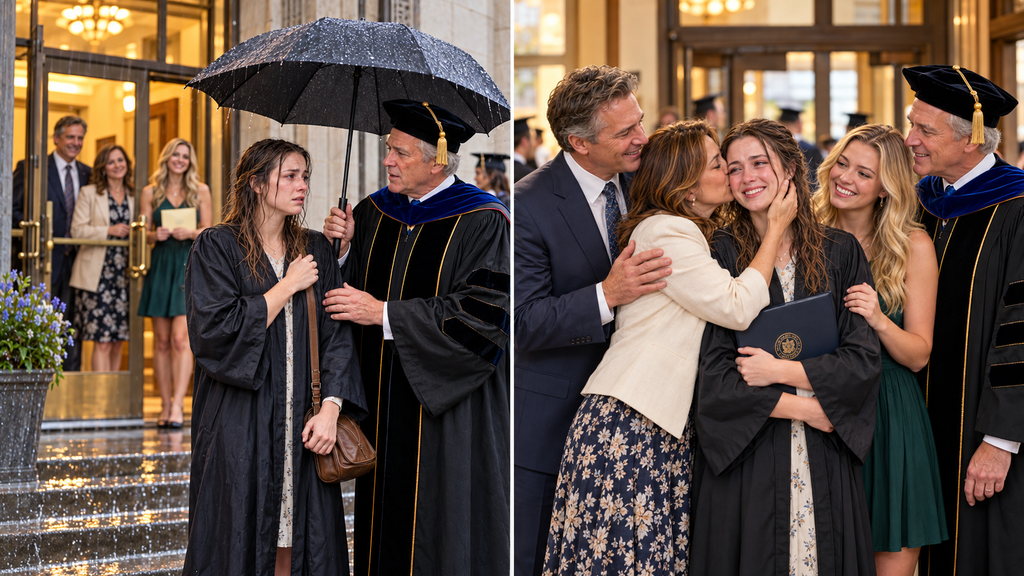
Somewhere among them sat the man who had raised me, the woman who had spent fifteen years making me feel unwanted, and the stepsister who had just stolen the invitation meant for someone who loved me.
My father had called me insignificant.
He had grabbed my arm hard enough to leave fingerprints.
And when I told him I was graduating, he had shoved me into the pouring rain.
But Dean Bradley had just asked me something nobody had ever asked before.
He was giving me a choice.
I looked down at the microphone in my hand.
Then I looked at the red marks on my wrist.
“No,” I whispered.
Dean Bradley remained silent.
I lifted my chin.
“Please don’t introduce him as my father.”
The dean nodded slowly.
“Then how would you like me to introduce your guests?”
I swallowed.
“You don’t have to introduce anyone.”
He studied my face for another moment.
“Clara, I want you to understand something.”
His voice was gentle, but there was an unusual firmness beneath it.
“You earned every honor you’re receiving today. Nobody in that auditorium has the authority to take those honors away from you. Not your family. Not the university’s donors. Not even me.”
My throat tightened.
I had spent so many years begging for scraps of approval that simple respect felt almost unbearable.
“Thank you,” I managed.
He gave me a small smile.
“Now, there’s one more thing you should know before we begin.”
Something in his expression changed.
“What is it?”
“The Board of Trustees received a rather unusual communication this morning.”
My stomach tightened.
“About me?”
“Yes.”
“From whom?”
Before he could answer, the ceremony coordinator hurried toward us.
“Dean Bradley, the university president needs you immediately. There’s been a situation in the VIP section.”
I felt the blood drain from my face.
“What kind of situation?”
The coordinator hesitated.
Then she looked at me.
“Your family is demanding to speak with someone in charge.”
Of course they were.
For years, whenever my father didn’t get his way, he demanded a manager, a supervisor, a director, or anyone else he believed could be intimidated into obedience.
Apparently, even my medical school graduation wasn’t beyond his reach.
Dean Bradley sighed.
“Tell President Whitmore I’ll be there in a moment.”
The coordinator nodded and hurried away.
I looked toward the curtain.
“Maybe I should just go out there and speak to them.”
“No.”
The word came so sharply that I blinked.
Dean Bradley softened his tone.
“Clara, you’ve spent enough of your life explaining yourself to people determined not to hear you.”
He gestured toward the stage.
“Today, they can listen.”
Then he walked away.
And for the first time that morning, I stood completely still.
Not because I was frightened.
Because something inside me had finally stopped running.
Ten minutes earlier, my father had been sitting in the third row of the VIP section, smiling as though he owned the university.
I learned what happened there later.
Haley had been busy taking pictures of the auditorium’s enormous chandeliers, flower arrangements, and polished stage.
My stepmother, Vanessa, had insisted on moving closer to the aisle because she wanted a clear view of Haley in her photographs.
My father was complaining about the rain.
Then Haley opened the ceremony program.
At first, she barely glanced at it.
She was more interested in the camera on her phone.
But as she turned the second page, something caught her attention.
A full-page photograph.
A familiar face.
And beneath it, a name printed in large gold letters.
CLARA ELIZABETH HENSLEY
CLASS VALEDICTORIAN
RECIPIENT OF THE PRESIDENTIAL DISTINGUISHED RESEARCH AWARD
KEYNOTE ADDRESS: THE COURAGE TO BE SEEN
Haley stared.
She blinked.
Then she looked at my father.
“Dad?”
He barely turned.
“What?”
“Why is Clara in the program?”
My stepmother leaned over.
“She’s probably in a group photograph, sweetheart.”
“No.”
Haley’s voice grew thin.
“She’s on an entire page.”
My father took the program.
And for a long moment, he said nothing.
He read my name.
Then he read it again.
I can imagine the confusion on his face.
Because to him, I was still the exhausted girl coming home in hospital scrubs, washing dishes after midnight and leaving quietly before sunrise.
I was the daughter who couldn’t afford designer handbags.
The daughter who took public transportation.
The daughter who worked hospital shifts while Haley went shopping.
In his mind, those things proved I was unsuccessful.
He never considered that I was building something he couldn’t see.
“That’s impossible,” he muttered.
Vanessa snatched the program.
“Maybe there’s another Clara Hensley.”
Haley looked at her.
“Mom, there’s literally a picture.”
Vanessa studied the photograph.
And then her expression changed.
Because it was me.
Standing in a laboratory.
Wearing a white coat.
Holding a research certificate beside the university president.
My father leaned forward.
“Let me see that again.”
Haley pulled out her phone.
She searched my name.
And one result after another appeared.
University announcements.
Medical research publications.
A scholarship profile.
A hospital fellowship announcement.
My photograph appeared beside each one.
Haley’s mouth fell open.
“She has articles?”
My father frowned.
“What?”
“Dad, Clara has published research.”
Vanessa scoffed.
“Anyone can put something on the internet.”
But Haley kept scrolling.
“She won an award last year.”
My father grabbed her phone.
“Give me that.”
His eyes moved across the screen.
I wasn’t there to see it.
But the ceremony coordinator later told me that his face became so pale she thought he might faint.
Then he found something that frightened him even more.
An article about the university’s research grant.
The headline announced that a graduating medical student had received a major award to advance an innovative program for earlier detection of cardiac complications in underserved communities.
The student was me.
The research had been developed over three years with my supervising physicians and research team.
The award carried significant funding for the next phase of the work.
And the university’s president had described the project as one of the most promising initiatives of its kind at the institution.
Haley whispered, “How did she do all this?”
My father answered with the only explanation he could imagine.
“She lied to us.”
Vanessa looked relieved.
“Yes. Exactly. That’s what she does.”
But the program was still open on her lap.
And my name was still printed across the page.
Behind the curtain, I stood before a mirror while a university assistant gently dried the ends of my hair.
The ceremony staff had found a clean academic gown for me because the one I had worn outside was soaked.
Someone brought me a warm towel.
Someone else brought tea.
And a young woman from the events team carefully adjusted my cap.
“You look beautiful, Dr. Hensley,” she said.
I almost laughed.
Beautiful wasn’t a word I associated with that morning.
I felt exhausted.
My eyes were swollen from crying.
My wrist hurt.
And the invisible weight of fifteen years seemed to be pressing against my chest.
But when I looked in the mirror, I saw something that startled me.
I looked like my mother.
Not Vanessa.
My mother.
The woman who had died when I was fourteen.
The woman who used to braid my hair before school and kiss my forehead before every exam.
The woman who made pancakes shaped like hearts whenever I brought home good grades.
She had been a nurse.
A brilliant one.
She could calm terrified patients with nothing more than a gentle voice and a steady hand.
When I was nine, I asked her why she never became a doctor.
She smiled and said, “Because being a nurse is already something wonderful, sweetheart.”
Then she added something I never forgot.
“But if you want to become a doctor someday, don’t let anyone convince you that you don’t belong.”
I touched the small silver necklace beneath my gown.
It was the last birthday gift she had given me.
A tiny heart.
Inside were two words engraved in her handwriting.
Be brave.
I had worn it through every examination.
Every sleepless night.
Every difficult hospital shift.
Every moment when I wanted to quit.
And now I was wearing it at graduation.
“Mom,” I whispered, “I wish you were here.”
A voice answered behind me.
“She would have been very proud.”
I turned.
An older woman stood in the doorway.
She wore a navy dress, a pearl necklace, and a familiar expression of quiet kindness.
For a moment, I couldn’t breathe.
“Mrs. Bennett?”
She smiled.
“Hello, Clara.”
My mother’s closest friend.
The woman who used to bring us homemade soup whenever Mom worked double shifts.
The woman who had held me at the funeral while my father spoke to visitors.
I hadn’t seen her in almost twelve years.
I stumbled toward her.
“Mrs. Bennett!”
She opened her arms.
And suddenly I was fourteen again.
Crying into the shoulder of someone who smelled faintly of lavender and warm laundry.
“Oh, sweetheart,” she murmured. “Look at you.”
“How did you know?”
She pulled back.
“Your dean invited me.”
I looked toward the door.
“He did?”
She nodded.
“He called me last week.”
“But how did he find you?”
Her smile became thoughtful.
“Your mother made sure I would always be easy to find.”
I frowned.
“What does that mean?”
Before she could answer, Dean Bradley appeared.
His face was serious.
“Clara, we have three minutes.”
Then he noticed Mrs. Bennett.
“Ah. You’re here. Good.”
I looked between them.
“What is going on?”
Mrs. Bennett took my hands.
“There’s something your mother wanted you to have.”
My breath caught.
“What?”
“Not yet.”
She glanced toward the stage.
“First, you need to do what you came here to do.”
“Mrs. Bennett—”
She squeezed my fingers.
“Your mother spent years teaching you to stand tall. Don’t let the people who hurt you make you miss the moment she dreamed of seeing.”
I felt tears burn behind my eyes.
The dean gently touched my shoulder.
“It’s time.”
And with my mother’s necklace against my heart, I walked toward the curtain.
The auditorium lights dimmed.
The low hum of conversation faded.
A spotlight appeared at the center of the stage.
Then President Whitmore approached the podium.
“Distinguished faculty, honored guests, families, and graduating physicians,” she began.
Her voice carried through the enormous room.
“Today, we celebrate years of perseverance, extraordinary commitment, and the pursuit of knowledge in service to others.”
Applause rose.
I stood behind the curtain, listening.
My heart pounded against my ribs.
I had spoken at academic conferences.
Presented research to physicians twice my age.
Defended complicated findings before skeptical committees.
But none of those moments had frightened me as much as this one.
Because somewhere beyond that curtain sat my father.
And for the first time, he was about to meet the daughter he had never bothered to know.
President Whitmore continued.
“Each graduating class leaves its own legacy. But occasionally, a student reminds us that academic distinction is not simply measured by grades, publications, or awards.”
She paused.
“It is measured by the courage to continue when circumstances make continuing difficult.”
The auditorium grew quiet.
“This year’s valedictorian has demonstrated exceptional achievement in medical education, research, clinical service, and community outreach.”
Another pause.
“She has completed her medical degree while helping support herself through hospital employment, continuing her research, and volunteering with patients who too often go unseen.”
My hands trembled.
“She has also received our most prestigious graduating-student research distinction, accompanied by funding to advance a project that we believe may improve patient care for years to come.”
Then she smiled.
“Ladies and gentlemen, it is my great honor to introduce Dr. Clara Elizabeth Hensley.”
The auditorium erupted.
And I stepped into the light.
For one second, everything blurred.
The applause.
The lights.
The faces.
The enormous screen displaying my photograph.
Then my eyes found the third row.
And there they were.
My father was standing halfway out of his seat.
Vanessa had one hand pressed against her mouth.
Haley’s phone hung loosely in her fingers.
They stared at me as though a stranger had walked onto the stage wearing my face.
I didn’t smile at them.
I didn’t wave.
I simply walked to the podium.
The applause continued.
Students rose from their seats.
Faculty members stood.
And when I looked toward the far side of the stage, I saw Mrs. Bennett sitting beside Dean Bradley.
She was crying.
But she was smiling too.
I took one steady breath.
Then I began.
“Good morning.”
My voice sounded stronger than I expected.
“First, I want to thank the faculty, mentors, colleagues, and patients who made this journey possible.”
I paused.
“And I want to thank everyone graduating today. Because no one in this room reached this moment without sacrificing something.”
The room settled into attentive silence.
“Some sacrificed sleep. Some sacrificed time with family. Some worked jobs between lectures and clinical rotations. Some studied while caring for children or parents. Some came to this country with nothing but a dream and the determination to build a life.”
I looked toward my classmates.
“And some of us learned that the hardest part of becoming a physician wasn’t surviving the exams.”
A few quiet laughs rose.
I smiled faintly.
“It was learning that we were worthy of being here.”
My voice caught.
I swallowed.
“For a long time, I believed success would feel like a moment when someone finally looked at me and said, ‘I was wrong about you.’”
I saw my father slowly lower himself into his seat.
“I thought if I worked hard enough, earned enough honors, and accomplished enough things, the people who dismissed me would eventually change their minds.”
The auditorium was completely silent.
“But medicine taught me something different.”
I looked toward the graduates.
“We do not choose our patients according to how much they earn. We do not decide whether their pain matters based on whether they look important. And we do not withhold compassion because someone lacks a title, a prestigious position, or an expensive coat.”
I paused.
“Every person who walks into a hospital deserves to be seen.”
My fingers tightened around the sides of the podium.
“And every person deserves that same dignity outside a hospital.”
My eyes moved across the audience.
“Some of the strongest people I have ever known wore inexpensive shoes because they spent their money on someone else’s medicine. Some cleaned hospital floors after midnight. Some brought patients water, changed bedsheets, or held frightened hands when no one else had time.”
I thought of my mother.
“None of them was insignificant.”
A soft murmur moved through the room.
I continued.
“My mother was a nurse.”
My voice trembled.
“She taught me that dignity doesn’t come from the letters after our names. It comes from how we treat people when we have nothing to gain.”
I touched my necklace.
“She passed away when I was fourteen. But she left me something that carried me through medical school.”
I swallowed.
“She told me not to let anyone convince me I didn’t belong.”
Tears slid down my cheeks.
I didn’t wipe them away.
“So today, I want to say something to anyone who has ever been told they were too ordinary, too poor, too old, too young, too unimportant, or simply not enough.”
I looked directly into the camera broadcasting the ceremony to the large screens.
“You do not need permission from someone who refuses to see your worth.”
The applause began before I finished speaking.
I waited.
Then I added softly, “You only need the courage to keep becoming who you were meant to be.”
The room rose to its feet.
Not just the graduates.
The faculty.
The families.
The university president.
And somewhere in the middle of that enormous crowd, my father finally stood.
But it was too late.
I had spent years waiting for him to applaud me.
And standing beneath that spotlight, I realized I no longer needed to hear it.
When the applause faded, President Whitmore returned to the stage.
“Thank you, Dr. Hensley.”
She waited for the room to settle.
“Before we present the graduating class, we have one additional distinction to announce.”
I turned toward her.
The program already included my research award.
I assumed she was simply preparing to present it.
But Dean Bradley was watching me with an expression I couldn’t understand.
President Whitmore smiled.
“Each year, the university’s research committee recognizes work demonstrating exceptional academic promise and the potential to improve the lives of patients.”
She read a formal description of my research.
The project had begun during my second year, when I noticed that patients from lower-income neighborhoods were often diagnosed with certain cardiac complications later than patients who had easier access to preventive care.
I had helped collect data.
Worked with statisticians.
Spent hundreds of hours in the research laboratory.
And with my mentors, developed a screening approach designed to help clinicians identify concerning patterns earlier and recommend appropriate follow-up.
It wasn’t a miracle cure.
It wasn’t a discovery that would make every disease disappear.
It was something more ordinary.
Something practical.
A way to help doctors notice certain risks sooner.
And sometimes, in medicine, noticing something sooner changes everything.
President Whitmore continued.
“The research award carries a significant grant for continued development and a dedicated fellowship opportunity with one of our affiliated medical centers.”
My heart hammered.
I already knew about the grant.
But the next words startled me.
“Today, however, the Board of Trustees has approved an additional honor.”
The enormous screen changed.
A photograph appeared.
It showed a smiling woman in pale blue nursing scrubs, holding a little girl with crooked pigtails.
My knees nearly buckled.
It was my mother.
The photograph had been taken when I was eight.
I remembered that day.
We had gone to the hospital’s annual family picnic.
Mom had bought me a strawberry ice cream, and I had dropped half of it onto her shoes.
I stared at the screen.
“How…?”
President Whitmore’s voice softened.
“Eighteen years ago, a dedicated nurse named Elizabeth Hensley helped establish a small patient-assistance fund at one of our affiliated hospitals.”
I stopped breathing.
“Her work supported families who could not afford transportation, medication, or essential follow-up care.”
I had known Mom helped patients.
But I had never heard about a fund.
“She died years before her daughter entered medical school. Yet the compassion she demonstrated became part of the very values her daughter now represents.”
I looked at Dean Bradley.
He was smiling through tears.
President Whitmore turned toward me.
“The university is proud to announce that the new community outreach component of Dr. Hensley’s research initiative will carry her mother’s name.”
The screen changed again.
THE ELIZABETH HENSLEY COMMUNITY HEALTH INITIATIVE
For a moment, I couldn’t move.
I could barely hear the applause.
My mother.
After all those years.
Her name was glowing above the stage.
Not forgotten.
Not erased.
Not buried beneath the silence that had settled over our house after her death.
Honored.
I covered my mouth.
President Whitmore approached me.
“Clara,” she said quietly, “your mother would have been very proud.”
And I broke.
Not the polite tears I’d learned to hide.
Not the silent crying I’d done into my pillow after my father humiliated me.
I cried openly.
With my mother’s photograph above me.
My classmates applauding.
And hundreds of people celebrating a woman who had once told me that kindness mattered more than recognition.
Dean Bradley stepped forward and placed the research medal around my neck.
I looked down at it.
Then at my mother’s necklace.
One silver heart.
One gold medal.
A lifetime between them.
And for the first time since she died, I felt as though my mother had somehow made it to my graduation.
My father did not applaud after that announcement.
He sat completely motionless.
Vanessa kept whispering to him.
Haley stared at her phone.
But the ceremony coordinator later told me that when my mother’s picture appeared, my father had looked as though someone had struck him.
I didn’t understand why.
Not then.
I thought he was simply embarrassed.
I was wrong.
Because the photograph of my mother had awakened a secret he’d spent fifteen years hiding.
And that secret was going to change everything.
The ceremony continued.
Names were read.
Degrees were conferred.
Families cheered.
Caps were adjusted.
Graduates embraced.
I stood with my classmates, surrounded by people who had suffered beside me through exams, night rotations, failed experiments, and exhausting days.
My best friend, Priya, wrapped both arms around me.
“You did it,” she whispered.
“We did it.”
She pulled back and examined my face.
Then her smile faded.
“Clara, what happened to your wrist?”
I glanced down.
The red marks had darkened.
I tugged my sleeve lower.
“It’s nothing.”
Priya’s expression hardened.
“Don’t.”
I looked at her.
“Don’t what?”
“Don’t tell me it’s nothing when somebody hurt you.”
Something in her voice made my throat close.
Priya knew more than anyone about my family.
She had heard my father insult me over the phone.
She had seen me stay late in the hospital library because I didn’t want to go home.
She had once found me crying in a stairwell after Vanessa told me I was selfish for spending money on a required medical textbook.
But even Priya didn’t know everything.
“My father grabbed me outside,” I admitted.
Her face changed.
“He did what?”
“He didn’t want me entering through the VIP doors.”
“Why?”
“Because I was ruining Haley’s pictures.”
Priya stared at me.
For once, she had no words.
Then she stepped closer.
“Clara, you’re not going home with them.”
I looked away.
“I know.”
“No. I mean it. You can stay with me. With my parents. Wherever you want.”
I tried to smile.
“I already have an apartment lined up near the hospital where I’ll begin residency.”
She blinked.
“You signed the lease?”
“Last week.”
“And you didn’t tell them?”
I shook my head.
Priya looked toward the VIP section.
Then back at me.
“Good.”
I laughed weakly.
She took my hand.
“Promise me something.”
“What?”
“When they come looking for you after this, don’t let them turn your achievement into another apology you have to make.”
I stared at her.
She squeezed my hand.
“You have spent your whole life apologizing for taking up space.”
Her eyes filled with tears.
“Not today.”
After the ceremony, I was escorted to a reception in the university’s historic hall.
Tall windows overlooked the rain-soaked gardens.
Crystal chandeliers reflected warm light across the polished floor.
Servers carried trays of drinks and small pastries.
Faculty members congratulated graduates.
Families posed for photographs.
I had imagined this reception for years.
I thought my father would finally look at me with pride.
Maybe put his arm around my shoulders.
Maybe tell someone, “This is my daughter.”
Instead, when I entered the room, Dean Bradley quietly approached me.
“Clara, your family has requested a private meeting.”
I stopped walking.
“Of course they have.”
He gave me a sympathetic look.
“You are not obligated to speak with them.”
I considered that.
For years, I had been told what I owed my family.
Respect.
Gratitude.
Obedience.
Silence.
And no matter how much I gave, the debt somehow grew.
But now I wasn’t standing in their kitchen.
I wasn’t a frightened teenager.
And I wasn’t dependent on my father’s approval.
“Where are they?” I asked.
“They’re waiting in the adjacent conference room.”
I took a breath.
“I’ll speak with them.”
Dean Bradley nodded.
“Would you like me present?”
“Yes.”
He didn’t question me.
“Of course.”
We walked down a quiet corridor.
With each step, my heartbeat grew louder.
Not because I was afraid of what my father would say.
Because I was afraid of how much I might still want him to love me.
My father stood beside the conference table when I entered.
Vanessa sat near the window.
Haley was examining her phone.
All three turned toward me.
For one impossible second, I saw something almost resembling pride in my father’s eyes.
“Clara!”
He stepped forward with a broad smile.
“There she is!”
I stopped.
His arms were already opening.
As though he expected a hug.
As though he hadn’t shoved me into the rain less than two hours earlier.
As though the only thing that mattered was that he now understood I was important.
I didn’t move.
His smile faltered.
“Come on, sweetheart.”
I stared at him.
Sweetheart.
The word sounded strange coming from his mouth.
He hadn’t called me that in years.
Not since before Vanessa moved into our house.
“Congratulations,” he continued. “You really surprised us today.”
I said nothing.
Vanessa rose.
“Well, I must say, Clara, you certainly know how to keep a secret.”
Haley forced a laugh.
“Seriously. Why didn’t you tell us you were basically famous?”
I looked at them.
And suddenly I understood something that made my chest ache.
They weren’t sorry.
They were confused.
Confused that the girl they had dismissed could turn out to be someone others respected.
Confused that the person they had treated like household help had become the most celebrated graduate in the room.
Confused that they hadn’t been warned in time to take credit.
My father reached for my shoulder.
I stepped back.
His hand froze.
“Clara?”
I looked at his face.
Then at Vanessa.
Then Haley.
“You told me I wasn’t allowed to attend my own graduation.”
The room became silent.
My father’s smile disappeared.
“Now, let’s not exaggerate.”
“You grabbed my arm.”
He glanced at Dean Bradley.
“That’s not exactly what happened.”
I slowly pulled back my sleeve.
The marks were clearly visible.
Dean Bradley’s expression darkened.
My father cleared his throat.
“Clara, you were being difficult. We were running late, and there was a misunderstanding.”
“A misunderstanding?”
Vanessa sighed.
“You always make things more dramatic than necessary.”
I turned toward her.
“You took my guest invitation.”
Haley rolled her eyes.
“It’s just a ticket.”
I looked at her.
“No, Haley. It wasn’t just a ticket.”
She shifted.
“It was the only VIP invitation I received. I wanted my father to come because I thought, just once, he might want to celebrate me.”
My voice shook.
“And instead, he gave it to you because he thought meeting important people mattered more than watching his daughter graduate.”
My father frowned.
“I didn’t know you were receiving all those awards.”
The words landed harder than I expected.
Because there it was.
The truth.
He didn’t regret what he’d done because it was cruel.
He regretted it because the world had exposed him.
I swallowed.
“So if I hadn’t won anything, it would have been fine?”
His expression tightened.
“That’s not what I said.”
“Then what did you mean?”
He looked toward Dean Bradley again.
“I think this is a family matter.”
Dean Bradley remained calm.
“Dr. Hensley asked me to be here.”
My father stared at him.
Then looked back at me.
“Clara, don’t embarrass us in front of the dean.”
I almost laughed.
There it was again.
Don’t embarrass us.
The sentence that had governed my childhood.
Don’t embarrass us by crying.
Don’t embarrass us by asking questions.
Don’t embarrass us by bringing up your mother.
Don’t embarrass us by wearing cheap clothes.
Don’t embarrass us by being too quiet.
Don’t embarrass us by trying too hard.
And now, somehow, I was embarrassing them by telling the truth.
I folded my hands in front of me.
“Dad, you embarrassed yourself.”
His face reddened.
“Watch your tone.”
I held his gaze.
“No.”
He blinked.
It was such a small word.
But it was the first time I’d ever said it to him without lowering my eyes afterward.
Vanessa stepped forward.
“Clara, this is ridiculous. Your father is trying to be supportive.”
I turned toward her.
“He wasn’t supportive when I came home exhausted from the hospital.”
Her mouth tightened.
“He wasn’t supportive when I asked him to read my acceptance letter.”
My father looked confused.
“What acceptance letter?”
I stared at him.
“The one I received four years ago.”
Silence.
“I left it on the kitchen counter. You used the back of the envelope to write a grocery list.”
Haley looked down.
Vanessa crossed her arms.
“Are we really going to discuss every little thing that happened years ago?”
“No,” I said.
My voice surprised even me.
“We’re going to discuss what happened this morning.”
My father exhaled sharply.
“All right. Fine. I’m sorry you got wet.”
For a moment, I couldn’t speak.
Sorry you got wet.
Not sorry I hurt you.
Not sorry I humiliated you.
Not sorry I told you that you didn’t matter.
Just sorry you got wet.
I took a step back.
And felt something inside me finally break free.
“I’m not accepting that apology.”
My father’s eyes widened.
“Excuse me?”
“You heard me.”
Vanessa gasped softly.
“Clara!”
I looked at my father.
“You don’t get to hurt me, find out other people respect me, and suddenly pretend you’ve always been proud.”
His face hardened.
“I raised you.”
“Yes.”
“I fed you. I kept a roof over your head.”
“Yes.”
“And this is how you repay me?”
I stared at him for a long moment.
Then I asked the question I’d been carrying since childhood.
“Was I supposed to repay you for being my father?”
He said nothing.
“Because I spent fifteen years trying.”
My voice cracked.
“I cleaned the house. I worked. I paid my own tuition. I kept quiet when Vanessa insulted me. I gave Haley money when she needed it. I missed holidays because someone had to work. I stopped asking you to attend my school events because you always had something more important to do.”
Tears burned my eyes.
“And somehow, none of it was ever enough.”
My father looked away.
I continued.
“Today, I don’t want money from you. I don’t want gifts. I don’t want you to introduce me to your friends.”
I touched the research medal around my neck.
“And I don’t want you to call me your successful daughter just because everyone in that auditorium knows my name.”
His jaw tightened.
“Then what do you want?”
I looked straight at him.
“I wanted you to love me when you thought I was ordinary.”
Nobody spoke.
Even Vanessa seemed unable to find a response.
Then Haley’s phone rang.
And everything changed.
Haley glanced at the screen.
Her eyes widened.
“Mom.”
Vanessa waved her away.
“Not now.”
“Mom, it’s Marissa.”
“Then answer it later.”
Haley looked panicked.
“It’s the agency.”
That caught Vanessa’s attention.
Haley had spent the past two years trying to become a lifestyle influencer.
She had a modest following and occasionally received small promotional offers.
But she had recently been hoping to secure a contract with a luxury wellness brand.
The agency managing the opportunity was apparently watching her social media that morning.
Haley answered.
“Hi, Marissa.”
She listened.
Her face drained of color.
“What?”
Another pause.
“No, that’s not what happened.”
Vanessa leaned closer.
Haley turned away.
“Please, you don’t understand.”
Her voice rose.
“Someone recorded it?”
My stomach tightened.
Recorded what?
Haley looked directly at me.
Then at my father.
“Oh, no.”
She ended the call.
The silence afterward felt enormous.
Vanessa grabbed her arm.
“What happened?”
Haley swallowed.
“There’s a video.”
My father frowned.
“What video?”
Haley’s eyes filled with tears.
“From outside the ceremony hall.”
I stood very still.
The rain.
The bronze doors.
My father’s hand gripping my arm.
His shove.
The three of them walking away.
Someone had recorded it.
Haley turned her phone around.
A short video was playing.
The camera angle came from beneath the covered walkway near the entrance.
The audio was muffled by rain, but the words were unmistakable.
“You’re just embarrassing us.”
Then my father pushed me backward.
I stumbled onto the steps.
And the three of them entered the building.
The video ended with me standing alone in the rain.
For several seconds, none of us spoke.
Then Haley whispered, “It’s everywhere.”
Vanessa snatched the phone.
She watched.
Her face turned white.
“Who posted this?”
Haley shook her head.
“A student. Someone waiting near the entrance.”
My father lunged toward the phone.
“Give me that.”
He watched the recording.
And for the first time that day, I saw something resembling fear.
Not guilt.
Fear.
Because the cruelty he had delivered privately was now visible publicly.
And he couldn’t explain it away.
“This is ridiculous,” he muttered.
He looked at Dean Bradley.
“Make them remove it.”
Dean Bradley’s expression remained controlled.
“The university cannot simply remove a video someone else posted.”
My father turned toward me.
“Clara, you need to make a statement.”
I stared at him.
“What?”
“Tell people it was a misunderstanding.”
Vanessa nodded immediately.
“Yes. Exactly. Say you slipped.”
I felt my stomach turn.
Haley stepped closer.
“Clara, please. People are tagging my accounts. They’re calling us horrible names.”
I looked at her.
“You filmed yourself laughing with my invitation while I stood outside crying.”
Her lips trembled.
“I didn’t know someone was recording.”
I let the words settle.
Then I asked quietly, “Would it have been wrong if nobody had recorded it?”
Haley didn’t answer.
My father slammed his palm against the table.
“Enough!”
Dean Bradley stepped slightly forward.
“Mr. Hensley, lower your voice.”
My father’s face reddened.
“This is my daughter. I can speak to her however I want.”
The dean looked him directly in the eyes.
“No, sir. You cannot.”
For a moment, my father seemed stunned.
He was accustomed to being the loudest person in the room.
But here, his anger carried no authority.
Dean Bradley continued.
“Dr. Hensley is an adult. She has the right to decide whether she wishes to speak with you.”
My father looked at me.
And something bitter flickered across his face.
“You’ve turned everyone against us.”
I felt tears slip down my cheeks.
“No, Dad.”
I shook my head.
“You did that when you thought nobody important was watching.”
I thought that would be the end.
I thought I would walk out of the room, take photographs with my friends, collect my award documents, and finally begin the life I’d spent years building.
But just as I reached the door, Vanessa spoke.
“You know, Clara, your mother wouldn’t have approved of this.”
I stopped.
The room became very quiet.
Slowly, I turned.
“What did you say?”
Vanessa lifted her chin.
“Elizabeth believed in family. She would have been ashamed to see you humiliating your father like this.”
For a second, I couldn’t breathe.
My mother.
She had invoked my mother.
The woman whose name she rarely allowed us to speak.
The woman whose photographs she had removed from the living room.
The woman whose favorite dishes she had donated because they didn’t match her kitchen.
And now she was using my mother’s memory as a weapon.
I took one step toward her.
“Don’t.”
Vanessa blinked.
“Excuse me?”
“Don’t speak for my mother.”
My voice was quiet.
But everyone heard it.
“You didn’t know her.”
Vanessa’s expression hardened.
“I knew enough.”
“No.”
I shook my head.
“You knew she existed before you. And you spent fifteen years trying to make sure nothing in that house reminded anyone of her.”
My father stepped forward.
“Clara, that’s unfair.”
I looked at him.
“Is it?”
His eyes shifted.
I remembered the year I turned sixteen.
I had found a box of Mom’s photographs in the garage.
I brought them inside and arranged three in my bedroom.
Vanessa saw them and told me my room looked like a funeral parlor.
The next afternoon, they were gone.
My father claimed he didn’t know where they’d been put.
I searched the house for weeks.
Eventually, Vanessa told me she’d donated the frames because they were old-fashioned.
I never found the photographs.
Until now, I had believed they were lost forever.
But Mrs. Bennett’s arrival had made me wonder.
And the look on my father’s face was making that feeling stronger.
I stared at him.
“Dad, where are Mom’s things?”
He stiffened.
“What things?”
“Her photographs. Her letters. Her nursing certificates. Her jewelry box.”
Vanessa laughed nervously.
“Good heavens, Clara. Are you going to inventory everything in the house?”
I ignored her.
“Dad?”
He looked away.
“I don’t remember.”
But I saw Vanessa’s expression change.
And suddenly I knew.
Somebody remembered.
Before I could speak again, there was a knock at the door.
A university staff member entered.
“Excuse me, Dr. Hensley. Mrs. Bennett is asking for you.”
I turned.
“She is?”
“Yes. She says it’s important.”
Dean Bradley glanced at me.
“Perhaps this conversation should end.”
My father stepped forward.
“Clara, we’re not finished.”
I looked at him.
“Yes, we are.”
He opened his mouth.
I continued before he could speak.
“At least for today.”
Then I walked out.
I expected him to follow.
He didn’t.
Perhaps he finally understood that shouting wouldn’t bring me back.
Or perhaps he was too busy wondering how to repair his reputation.
Either way, I didn’t look back.
Mrs. Bennett waited in a small sitting room near the dean’s office.
She stood when I entered.
“Oh, Clara.”
One look at my face told her everything.
I tried to smile.
“I’m sorry. Today was supposed to be happy.”
She took my hands.
“Sweetheart, happiness doesn’t mean pretending you’re not hurting.”
I sat beside her.
For a while, neither of us spoke.
Rain tapped softly against the windows.
The reception continued somewhere down the hall.
Laughter drifted through the doorway.
It felt strange to know that so much joy could exist only a few rooms away from so much pain.
Mrs. Bennett opened her handbag.
Inside was a small velvet pouch.
My heart jumped.
“What’s that?”
She looked down.
“Something I’ve kept for a very long time.”
She took out a tiny brass key.
The metal had darkened with age.
A faded blue ribbon was tied around its head.
I recognized it immediately.
I felt the air leave my lungs.
“That was Mom’s.”
Mrs. Bennett nodded.
I had seen the key hanging near our kitchen window when I was little.
Mom used to keep it on a hook beside the calendar.
Whenever I asked what it opened, she would smile and say, “Something important.”
After she died, the key disappeared.
I had forgotten about it until that moment.
“Where did you get it?”
Mrs. Bennett took a careful breath.
“Your mother gave it to me shortly before she passed away.”
I stared at her.
“Why?”
“She was worried.”
My stomach tightened.
“About what?”
Mrs. Bennett hesitated.
Then she said something that made the room seem to tilt.
“About what would happen to you if your father married again.”
I blinked.
“My mother knew Vanessa?”
“No.”
“Then why would she worry about that?”
Mrs. Bennett looked at the little key.
“Because your mother knew your father better than you did.”
I felt cold.
She continued.
“Clara, there are things about your parents’ marriage you were too young to understand.”
I shook my head.
“I don’t understand.”
“I know.”
Her voice trembled.
“And I wish I could tell you your childhood was exactly what you believed.”
She placed the key in my palm.
“But your mother wanted you to have choices.”
My fingers closed around it.
“What does it open?”
“A safe-deposit box.”
I stared.
“At a bank?”
“Yes.”
“What’s inside?”
Mrs. Bennett looked directly at me.
“Your mother’s letters. Some family documents. And something she hoped would help you build a future if your father failed to protect you.”
My heartbeat quickened.
“Why didn’t you tell me?”
Mrs. Bennett’s eyes filled with tears.
“I tried.”
I stared at her.
“What?”
“After your mother’s funeral, I visited the house. Your father told me you were too upset to see anyone.”
A memory stirred.
A rainy afternoon.
Voices arguing near the front door.
Vanessa wasn’t part of our lives yet.
I remembered sitting upstairs, hearing my father say, “She’s a child. Stay out of it.”
Mrs. Bennett continued.
“I sent birthday cards. Christmas cards. Letters.”
I shook my head.
“I never received them.”
“I know that now.”
A terrible silence settled between us.
“Your father returned some of them unopened,” she said. “Eventually, he told me to stop contacting you.”
My eyes filled.
“Why?”
Mrs. Bennett looked pained.
“He said I was making it difficult for you to move on.”
Move on.
As though my mother had been an inconvenience.
As though love could be packed into a box and forgotten because the living found grief uncomfortable.
Mrs. Bennett reached into her handbag again.
This time, she removed a small stack of envelopes bound with faded ribbon.
Every envelope had my name on it.
Clara.
Sweet Clara.
My dear girl.
The handwriting was familiar.
Not my mother’s.
Mrs. Bennett’s.
I covered my mouth.
“I wrote every year,” she whispered.
“And when I couldn’t reach you, I kept them.”
I took the letters.
My hands shook.
Some were yellowed.
Some had old postage stamps.
Some had never been sealed.
The oldest was dated just six months after my mother’s funeral.
I opened it.
Dear Clara,
Your mother would want you to remember that you are loved, even when grief makes the world feel empty. I know everything seems unfamiliar right now. But there are people who will always care about you, and I am one of them.
I couldn’t continue.
I pressed the paper against my chest.
Mrs. Bennett gently touched my shoulder.
“She never wanted you to be alone.”
And suddenly I realized something unbearable.
I had spent years believing everyone connected to my mother had abandoned me.
But perhaps they had been kept away.
Perhaps some of the loneliness I’d accepted as inevitable had been deliberately created.
I looked at the key in my hand.
“What’s really in that box?”
Mrs. Bennett hesitated.
Then she whispered, “Your mother left instructions that you should open it when you were ready to live independently.”
My heart raced.
“And Clara?”
“Yes?”
“There’s one letter in there that I think you should read before you speak to your father again.”
We left the university shortly after four.
The rain had stopped.
Clouds were beginning to part above the wet streets.
My cap and gown lay neatly in the back seat of Mrs. Bennett’s car.
Beside them sat my research award and the leather folder containing my diploma.
It should have been the happiest drive of my life.
Instead, I stared at the brass key in my palm.
The bank was across town.
A small branch with red brick walls and dark green awnings.
Mrs. Bennett had called ahead to make sure the box could be accessed.
When we arrived, a bank employee led us into a quiet room.
She checked our identification and reviewed the authorization documents Mrs. Bennett had preserved.
Then she returned carrying a narrow metal box.
My name was printed on the access paperwork.
I touched the lid.
“Are you ready?” Mrs. Bennett asked.
I took a breath.
“Yes.”
We opened it together.
Inside were several folders.
A small velvet jewelry case.
An envelope containing photographs.
A worn blue notebook.
And a white envelope with my mother’s handwriting.
For Clara, when she is old enough to understand that love should never make her feel small.
I stared at it.
My chest tightened so painfully that I had to sit down.
Mrs. Bennett moved her chair closer.
“Take your time.”
I opened the envelope.
The paper smelled faintly of old books.
My mother’s handwriting filled three pages.
I began to read.
My darling Clara,
If you are reading this, then you have grown into the young woman I always knew you would become.
I wish more than anything that I could be sitting beside you when you open this letter.
I wish I could see your face. Hear your laugh. Ask about your dreams.
But there are things a mother cannot control, no matter how fiercely she loves her child.
Tears blurred the words.
I wiped my eyes and continued.
I want you to know something important.
You were never a burden.
I stopped.
A sob escaped my throat.
Mrs. Bennett gently handed me a tissue.
I kept reading.
Not when you were born. Not when you cried through the night. Not when you needed help with your homework. Not when you asked a thousand questions about the world.
You were the greatest joy of my life.
My hands trembled.
And if anyone ever makes you feel otherwise, I want you to remember that their inability to love well is not proof that you are difficult to love.
I pressed a hand over my mouth.
The words felt impossibly precise.
As though she had somehow reached across the years and found the exact wound I’d been carrying.
Then I came to the next paragraph.
Your father has good qualities, Clara, but he is a man who cares deeply about appearances. I have worried for some time that he measures people’s worth by what they can do for him.
My stomach tightened.
I hope he grows. I hope grief changes him gently instead of hardening him. Most of all, I hope he remembers that you need a father, not a judge.
I stared at the page.
Mom had seen it.
Even then.
Before Vanessa.
Before Haley.
Before the insults became ordinary.
My mother had seen the weakness in him.
And she’d worried about me.
The final page contained something unexpected.
I have arranged for your education to be protected as best I can.
There is a modest inheritance from my parents, along with money I saved over the years. I have placed it in a trust intended for your education and future security.
I want you to use it to learn, to travel, to help people, and to build a life that makes you proud.
The documents are included in this box.
The trust is not meant to make you rich. It is meant to give you choices.
My pulse quickened.
An inheritance?
A trust?
I had never heard of either.
I read the paragraph again.
Then I looked up.
“Mrs. Bennett?”
She nodded.
“I know.”
“There was money?”
“Yes.”
I stared.
“How much?”
“The original amount wasn’t enormous. Your mother inherited money from her parents and added what she could.”
I looked back at the letter.
“But my father told me Mom left nothing.”
Mrs. Bennett’s expression darkened.
“I suspected he might.”
I opened the first folder.
Inside were copies of trust documents.
Bank correspondence.
Annual statements.
And the name of an attorney.
Margaret Sloan, Esq.
I flipped through the papers.
The trust had been established shortly before my mother’s final hospitalization.
My father was listed as the original trustee.
But there were restrictions.
The funds were intended for my education, medical needs, and eventual distribution after I reached adulthood.
There were also instructions requiring records of expenditures.
My heart began pounding.
“Why didn’t anyone tell me?”
Mrs. Bennett looked troubled.
“Your mother believed the arrangement was enough to protect the money.”
I swallowed.
“Did my father use it?”
“I don’t know.”
She paused.
“But there is someone who can help you find out.”
I looked at the attorney’s name.
Margaret Sloan.
A woman I had never met.
A woman who might know more about my childhood than my own father had ever told me.
I called the law office from the bank parking lot.
A receptionist answered.
“Sloan and Associates. How may I help you?”
“My name is Clara Hensley.”
There was a pause.
“Could you repeat that?”
“Clara Elizabeth Hensley.”
Another silence.
Then the receptionist said, “One moment, please.”
I heard a click.
A few seconds later, an older woman’s voice came through.
“Clara?”
“Yes?”
“This is Margaret Sloan.”
Her voice changed.
“Oh, my goodness.”
I gripped the phone.
“Do you know who I am?”
“Of course I do.”
My throat tightened.
“I’m calling about my mother.”
Margaret went quiet.
Then she said gently, “I’ve been hoping you would call for a very long time.”
I closed my eyes.
“There’s a trust.”
“Yes.”
“My father never told me.”
A long silence followed.
When she spoke again, her voice was careful.
“Clara, are you somewhere safe?”
The question frightened me.
“Yes.”
“Good.”
“Why?”
“Because the last time I tried to discuss that trust with your father, he became extremely hostile.”
My fingers tightened around the phone.
“What happened?”
“I think this conversation deserves more than a telephone call.”
I looked at Mrs. Bennett.
She nodded.
“Can I come today?” I asked.
“Yes,” Margaret replied. “I’ll stay at the office.”
Then she said something I will never forget.
“And Clara?”
“Yes?”
“Bring every document you found.”
Margaret Sloan’s office occupied the second floor of an old building near the courthouse.
There were framed photographs of gardens along the hallway.
A receptionist offered us coffee.
And when Margaret emerged from her office, she looked at me with such sadness that my stomach tightened.
She was in her late sixties, with silver hair and sharp blue eyes.
She took both my hands.
“You look so much like Elizabeth.”
I swallowed.
“People keep saying that today.”
Margaret smiled faintly.
“Then today must be a very special day.”
I looked down at my graduation gown bag.
“It was supposed to be.”
She led us into her office.
Mrs. Bennett sat beside me.
Margaret opened the folder I had brought.
Then she reached into a cabinet and retrieved another file.
It was thick.
Far thicker than I’d expected.
She placed it on the desk.
“Clara, before I explain anything, I want you to know that your mother made these arrangements because she loved you.”
My heart raced.
“I understand.”
Margaret looked at the documents.
“Your grandparents left Elizabeth a small inheritance years before she became ill. She saved much of it. When her health deteriorated, she worked with me to place the money into a trust.”
I nodded.
“She wanted it used for my education.”
“Yes.”
Margaret took a breath.
“And she hoped it would remain untouched until you needed it.”
I stared at her.
“Hoped?”
Margaret opened the first set of statements.
“Your father served as trustee during your childhood.”
I nodded slowly.
“He was allowed to use reasonable amounts for qualifying needs, but he was required to keep records and act in your interests.”
She slid a document toward me.
“I began requesting formal accounting reports after several unusual withdrawals.”
I looked down.
My father’s signature appeared beside transfer instructions.
I recognized it immediately.
The sharp capital letters.
The long underline.
The same signature he used on every birthday card he had bothered to send.
The withdrawals were dated over several years.
Some were labeled educational expenses.
Others carried descriptions that made no sense.
Home improvements.
Vehicle purchase.
Consulting fees.
I stared.
“Why would my trust pay for a vehicle?”
Margaret’s expression was grave.
“That is one of the questions we need answered.”
I turned another page.
A withdrawal had been made shortly before Haley’s sixteenth birthday.
I remembered that year.
Vanessa and my father had bought Haley a new car.
A red convertible.
I had been told we couldn’t afford to replace my broken laptop.
At the time, I believed them.
Now I stared at the statement until the numbers blurred.
“Could he have used my money to buy Haley’s car?”
Margaret folded her hands.
“The records raise serious concerns. But we need to trace the transactions before drawing final conclusions.”
I looked at her.
“What happened when you questioned him?”
“He refused to provide complete documentation. There were several contentious exchanges, and eventually I advised that independent legal action might be necessary.”
I swallowed.
“Why didn’t you tell me?”
Margaret sighed.
“When you were a minor, communication was complicated by your father’s position as guardian and trustee. Once you reached adulthood, we sent formal notices to the addresses available to us.”
I shook my head.
“I never saw them.”
Margaret studied my face.
“Your father told us you’d moved abroad for work.”
I stared.
“What?”
“He claimed you wanted no contact with anyone associated with the estate.”
I felt sick.
“I never lived abroad.”
Margaret’s eyes narrowed.
“I feared as much.”
She opened another folder.
“Clara, there’s more.”
I almost didn’t want to hear it.
Graduation.
The video.
My mother’s letters.
The trust.
I had learned more about my family in one afternoon than I had in the previous decade.
But Margaret wasn’t finished.
She placed a copy of a letter in front of me.
It was dated two years earlier.
The year I completed my second major research project.
The year I worked three jobs to cover expenses.
The year I almost withdrew from medical school because I couldn’t afford a required summer program.
The letter was addressed to me.
Dear Ms. Hensley,
It explained that the trust’s remaining assets were available for transfer after the completion of certain administrative steps.
There was enough money left to help substantially with educational expenses.
Not enough to erase every struggle.
But enough that I might not have needed to spend so many nights exhausted and frightened about rent.
I looked at the document.
Then at Margaret.
“Was this sent to my house?”
“Yes.”
“My father opened all the mail.”
Margaret said nothing.
I turned another page.
There was a delivery confirmation.
My father’s signature.
He had received it.
I remembered that month.
I had asked him for a small loan to cover a medical certification fee.
He had laughed.
“Maybe you’re not cut out for this if you can’t pay your own way.”
That night, I sold my grandmother’s old bracelet to cover the cost.
A bracelet my mother had given me.
One of the last things I owned from her.
And all the while, my father had known there was money intended for my education.
I felt my chest tighten.
“He knew.”
Margaret nodded slowly.
“He received the letter.”
“He knew I was struggling.”
Mrs. Bennett touched my arm.
I stared at the papers.
For years, I had convinced myself that my father was simply incapable of understanding what I needed.
That perhaps he wasn’t intentionally cruel.
That perhaps he was emotionally clumsy.
Distant.
Uncomfortable with grief.
But these documents suggested something harder to explain away.
He had been given an opportunity to help me.
And he had hidden it.
I whispered, “Why?”
Margaret’s expression softened.
“I can’t tell you what was in his heart.”
She paused.
“But I can help you find out what happened to the money.”
That evening, I made three decisions.
First, I would not return to my father’s house alone.
Second, I would allow Margaret to review the trust records and advise me on my legal options.
Third, I would stop protecting my family from the consequences of their actions.
Not because I wanted revenge.
Because silence had become the thing that allowed them to keep hurting me.
I called Priya.
She answered immediately.
“Clara?”
“Can I stay with you tonight?”
Her voice softened.
“Of course.”
I closed my eyes.
“Thank you.”
Then I told her about the letters.
The trust.
The lawyer.
And my father’s possible involvement.
For a long time, Priya said nothing.
Finally, she whispered, “Clara, I’m coming to get you.”
“Mrs. Bennett is with me.”
“Good. Stay with her.”
I smiled weakly.
“You sound like my mother.”
Priya’s voice caught.
“Then listen to me.”
At seven that evening, my phone began ringing.
Dad.
I watched the screen light up.
Then go dark.
A minute later, he called again.
Then again.
Vanessa sent six messages.
Haley sent eleven.
At first, they were angry.
You need to call your father immediately.
You’ve humiliated this entire family.
Do you understand what people are saying about us?
Then the tone changed.
We should talk.
Your father is very upset.
We can celebrate your graduation properly tomorrow.
Then came the message that made my hands go cold.
It was from Dad.
Clara, I need to know who you’ve been talking to about your mother.
I stared at the screen.
I hadn’t told him about Mrs. Bennett.
Not about the bank.
Not about Margaret Sloan.
Yet somehow, he knew.
I showed Mrs. Bennett.
Her expression changed.
“He may have received a notification related to the safe-deposit box or trust inquiry,” she said.
My stomach tightened.
“Does that mean he knows?”
“Possibly.”
Another message appeared.
Do not let Margaret Sloan fill your head with lies.
I felt my heart drop.
He knew.
And he was frightened.
The next morning, I woke in Priya’s guest room to sunlight filtering through white curtains.
For one peaceful moment, I forgot everything.
Then my phone buzzed.
A message from an unknown number.
Dr. Hensley, this is Olivia Grant from the university communications office. Please call when convenient. We need to discuss a developing situation.
I sat up.
My stomach twisted.
I called immediately.
Olivia answered on the first ring.
“Dr. Hensley, thank you for returning my call.”
“Is something wrong?”
She hesitated.
“Your graduation speech has attracted considerable attention.”
I closed my eyes.
“The video?”
“Yes, but also your address.”
I swallowed.
“Okay.”
“Several media outlets are requesting interviews. We’ve declined on your behalf until we know your wishes.”
“Thank you.”
She continued.
“There’s something else.”
I waited.
“A social media account connected to your family has posted a statement.”
My heart sank.
“What kind of statement?”
Olivia’s tone became careful.
“It suggests you deliberately staged the incident outside the ceremony hall to embarrass your father.”
I stared at the wall.
Of course.
Of course they had.
I opened Haley’s profile.
Her latest post was a photograph from the VIP reception.
She stood beside Vanessa, both wearing carefully arranged smiles.
The caption read:
Sometimes the people you love most are the ones who hurt you for attention. Our family is deeply saddened by yesterday’s misunderstanding, but we continue to wish Clara success.
I felt nauseated.
Below it, Vanessa had commented:
We are proud of all our children, even when they make choices we don’t understand.
All our children.
I stared at those words.
For fifteen years, she’d treated me like an inconvenience.
Now she was publicly claiming me.
Not because she loved me.
Because my achievements had become useful to her image.
Olivia spoke gently.
“Dr. Hensley?”
“I’m here.”
“Would you like the university to issue a statement?”
I considered it.
Then I said, “Please don’t comment on my family.”
“Understood.”
“But you can confirm my graduation honors and research achievements.”
“Of course.”
“And please make sure the video isn’t included in any university promotional material.”
Olivia paused.
“Absolutely.”
I took a breath.
“I want people to remember the medical school graduation. Not just what happened outside it.”
There was a brief silence.
Then Olivia said, “That’s a very thoughtful decision.”
I looked at my mother’s necklace lying on the bedside table.
“No,” I whispered. “It’s just the decision I can live with.”
That afternoon, Margaret called.
Her voice was serious.
“Clara, I’ve reviewed the preliminary records.”
I sat at Priya’s kitchen table.
Mrs. Bennett was beside me.
Priya stood near the sink, making tea.
“What did you find?”
Margaret exhaled.
“There appear to be several transactions requiring explanation.”
My fingers tightened around the phone.
“How many?”
“Enough that I recommend a formal accounting and preservation of the records.”
I swallowed.
“Could my father get into trouble?”
“If he misused trust assets or deliberately concealed required information, there may be civil consequences and potentially other legal issues. We need a complete review before making any accusations.”
I looked out the window.
The world beyond Priya’s house seemed painfully ordinary.
A neighbor was watering plants.
A delivery truck rolled past.
Someone was walking a golden retriever.
Meanwhile, everything I believed about my father was unraveling.
Margaret continued.
“I also discovered that a property transaction may be relevant.”
My stomach tightened.
“What property?”
“The house where your father lives.”
I blinked.
“Our house?”
“Yes.”
I stared.
“What about it?”
Margaret paused.
“Clara, did your mother ever tell you where the down payment came from?”
I frowned.
“No.”
“Your parents purchased that house while they were married, but part of the original down payment appears to have come from your mother’s separate inheritance.”
I tried to follow.
“Okay.”
“That doesn’t automatically mean you own the house,” Margaret said carefully. “But it does mean the records of ownership, your mother’s estate, and the trust should be examined together.”
I swallowed.
“Why?”
“Because I found a discrepancy between an early estate document and a later filing.”
I felt cold.
“What kind of discrepancy?”
Margaret’s voice lowered.
“A document bearing your mother’s signature appears to have been executed after she was already hospitalized and unable to sign.”
For a moment, I couldn’t hear anything.
I stared at the wall.
“What?”
“I’m not saying it’s a forgery yet. We need certified records and expert review.”
But her voice told me she was worried.
And suddenly, a memory surfaced.
Mom in the hospital.
Thin.
Exhausted.
Unable to hold a pen for long.
My father standing beside her bed.
A manila folder under his arm.
I had been fourteen.
I remembered him telling a nurse, “She can sign. She just needs a minute.”
I remembered Mom shaking her head.
And I remembered being sent into the hallway.
My breath caught.
“I think I remember something.”
Margaret went silent.
“What is it?”
I described the hospital room.
The folder.
My mother’s weakness.
My father’s impatience.
When I finished, Margaret said quietly, “Clara, I need you to write down everything you remember. Don’t try to fill in gaps. Just record what you actually recall.”
I nodded.
“Okay.”
“And one more thing.”
“Yes?”
“Please don’t confront your father about the documents yet.”
My stomach tightened.
“Why?”
“Because when someone knows records may be examined, they sometimes make poor decisions about preserving them.”
I stared at the phone.
“You think he might destroy something?”
“I don’t know. But I want to protect whatever evidence exists.”
That night, my father called from a number I didn’t recognize.
I answered without thinking.
“Hello?”
“Clara.”
My whole body tightened.
“Dad.”
His voice sounded different.
Lower.
Almost gentle.
“I’ve been trying to reach you.”
“I know.”
“Why aren’t you answering?”
“Because I needed space.”
He exhaled.
“Listen, sweetheart. Yesterday got out of hand.”
I closed my eyes.
“I agree.”
“Your stepmother is devastated.”
I said nothing.
“Haley’s receiving horrible messages.”
Again, silence.
“And I’ve had people calling me all day.”
I looked down at my wrist.
The bruising was still visible.
“I’m sorry people are harassing you,” I said. “Nobody deserves harassment.”
He seemed relieved.
“Exactly. That’s what I’ve been saying.”
“But that doesn’t change what happened.”
His tone sharpened.
“Clara, must you keep dragging this out?”
I felt my chest tighten.
“Dad, you called me.”
He went quiet.
Then he said, “I heard you visited a lawyer.”
I closed my eyes.
There it was.
“Why does that concern you?”
A long pause.
“Because Margaret Sloan has always had a grudge against me.”
“Why?”
“She’s bitter.”
“About what?”
He sighed.
“Your mother’s estate was complicated.”
I waited.
He continued.
“Elizabeth was sick. She wasn’t thinking clearly. People took advantage.”
My stomach turned.
“Who took advantage?”
“Lawyers. Financial people. Your mother’s friends.”
I looked toward Mrs. Bennett, who was sitting across the room.
She noticed my expression.
I turned away.
“Dad, was there a trust for my education?”
Silence.
For several seconds, I thought the call had disconnected.
Then he said, “Who told you that?”
“Was there?”
He exhaled sharply.
“Clara, you don’t understand finances.”
The old sentence.
You don’t understand.
I had heard it whenever I asked why Haley received expensive gifts while I paid for my own school supplies.
Whenever I asked about Mom’s belongings.
Whenever I questioned a bill.
Whenever I wanted to know why money seemed available for everyone except me.
I took a breath.
“Then explain.”
He didn’t.
Instead, he said, “Come home. We’ll talk.”
“I’m not coming home tonight.”
His voice hardened.
“You live under my roof.”
“Not anymore.”
Silence.
“What?”
“I’ve arranged another place to live.”
He laughed.
“Don’t be ridiculous.”
“I’m serious.”
“Clara, you’re still a student.”
“I graduated yesterday.”
“You know what I mean.”
I looked toward my diploma resting on the table.
“No, Dad. I don’t think you know what you mean.”
His breathing grew louder.
Then he said something that made my blood turn cold.
“If you start digging into things that don’t concern you, you could destroy this family.”
I closed my eyes.
“Things that don’t concern me?”
“You heard me.”
“My mother’s money doesn’t concern me?”
He went silent.
I continued.
“Her letters don’t concern me?”
Still nothing.
“Her name on documents doesn’t concern me?”
His voice changed instantly.
“What documents?”
I felt my heartbeat quicken.
“What?”
“What documents did Margaret show you?”
I stared at the wall.
And suddenly I knew that whatever Margaret had found was more serious than I’d imagined.
My father sounded afraid.
Not angry.
Afraid.
“Goodnight, Dad.”
“Clara—”
I ended the call.
Then I sat there trembling.
Three days later, I returned to the house where I had grown up.
Not alone.
Priya came with me.
Mrs. Bennett came.
And Margaret had advised me to arrange a peaceful collection of my belongings while keeping a record of what I took.
I had texted my father in advance.
I wasn’t sneaking in.
I wasn’t there to argue.
I only wanted my clothes, books, personal documents, and the few photographs I still owned.
When we arrived, his car was in the driveway.
Vanessa’s SUV was parked beside it.
Haley’s red convertible sat near the garage.
I stared at the car.
The same car I’d once admired through the kitchen window while struggling to pay for medical books.
It looked different now.
Smaller.
Less impressive.
Almost sad.
Priya touched my arm.
“Ready?”
I nodded.
We walked to the front door.
Before I could knock, it opened.
Vanessa stood there.
Her eyes moved from me to Priya and Mrs. Bennett.
“What is this?”
“I’m here for my things.”
Vanessa crossed her arms.
“You bring an audience?”
I took a breath.
“They’re helping me pack.”
Her lips tightened.
“Your father is in the living room.”
I stepped inside.
The smell of furniture polish and vanilla candles reached me immediately.
Everything looked the same.
The white sofa.
The glass coffee table.
The enormous framed photographs of Haley.
One from her high school graduation.
One from her birthday party.
One from her first modeling shoot.
And above the mantel, the family portrait taken three years earlier.
My father.
Vanessa.
Haley.
No me.
I had been working a hospital shift that afternoon.
They never rescheduled.
For years, I told myself it didn’t matter.
Now I looked at the picture and felt nothing.
My father rose from the couch.
“Clara.”
I stopped.
“Dad.”
His eyes moved toward Mrs. Bennett.
And his expression darkened.
“Eleanor.”
She met his gaze.
“Richard.”
The air seemed to change.
My father looked at me.
“So you’ve been listening to her.”
Mrs. Bennett spoke calmly.
“Clara is an adult. She can decide whom she trusts.”
My father ignored her.
“Clara, we need to talk privately.”
“No.”
His face tightened.
“Excuse me?”
“I don’t want to speak privately.”
“She’s turning you against me.”
I looked at him.
“Dad, nobody had to.”
He flinched.
For a brief moment, something resembling pain crossed his face.
Then he covered it with anger.
“After everything I’ve done for you—”
I held up one hand.
“Please don’t.”
The room fell silent.
I looked at him.
“I’m not here to argue about my childhood. I’m here to collect my belongings.”
Vanessa laughed sharply.
“Your belongings? Most of what’s upstairs belongs to this household.”
Priya stepped forward.
“We’re taking Clara’s personal items.”
Vanessa looked her up and down.
“And who exactly are you?”
“Her friend.”
“Well, this is a family matter.”
Priya’s expression didn’t change.
“Then perhaps the family should have treated her like family.”
Vanessa’s face flushed.
I almost smiled.
Priya had never been intimidated by people who confused cruelty with authority.
My father pointed toward the stairs.
“Go get your things.”
I nodded.
Then he added, “But you’re leaving the house key.”
I reached into my bag.
Placed the key on the hallway table.
And watched him stare at it.
He had expected a fight.
Instead, I gave him exactly what he asked for.
My bedroom was almost exactly as I’d left it.
A narrow bed.
A small desk.
Stacks of medical textbooks.
A cheap lamp with a cracked shade.
An old corkboard covered in study schedules.
I looked around.
For years, this room had been my refuge.
But it had also been a place where I learned to make myself small.
I remembered studying by flashlight when Vanessa complained that my desk lamp used too much electricity.
I remembered hiding my research acceptance email because I didn’t want another argument.
I remembered sitting on the floor after my first major examination, crying because I’d earned one of the highest scores in my class and nobody at home cared.
Now I had graduated.
I had an apartment waiting for me.
A residency position.
Research funding.
Friends who loved me.
And I no longer needed this room to survive.
I began packing.
Priya folded my clothes.
Mrs. Bennett carefully wrapped my few keepsakes.
Then I opened the bottom drawer of my desk.
Inside was an old cardboard box.
I frowned.
I didn’t remember putting it there.
I pulled it out.
The lid was dusty.
Across the top, in faded blue marker, someone had written:
ELIZABETH — PERSONAL
My heart stopped.
“Mrs. Bennett?”
She turned.
I lifted the box.
Her eyes widened.
“Oh, Clara.”
We opened it together.
Inside were photographs.
Not all of them.
But enough.
My mother holding me as a baby.
Mom laughing at a picnic.
Mom standing beside a Christmas tree.
Mom wearing her nursing uniform on her first day at the hospital.
And at the bottom, a small wooden frame.
The photograph inside showed my mother, my father, and me standing outside our house.
I was seven.
My father had one arm around Mom.
His other hand rested on my shoulder.
We looked happy.
For several seconds, I couldn’t breathe.
Mrs. Bennett gently touched the frame.
“I remember this day.”
I looked at her.
“You do?”
She nodded.
“Your mother had just finished planting roses along the front fence. You insisted everyone take a picture.”
I remembered.
Pink roses.
Mom’s favorite.
Vanessa had removed the rosebushes years later because she said they attracted insects.
I stared at the photograph.
Then I turned it over.
Something was written on the back.
In my mother’s handwriting.
Home is where Clara is loved.
I began to cry.
Not because I wanted the old house back.
Because I finally understood something.
My mother hadn’t loved the walls.
Or the furniture.
Or the garden.
She had loved the people inside.
And when the love disappeared, the house was no longer home.
We had almost finished packing when Haley appeared in the doorway.
She wore an oversized sweatshirt and no makeup.
Without her usual carefully styled appearance, she looked younger.
Almost frightened.
“Clara?”
I turned.
“What?”
She glanced at Priya and Mrs. Bennett.
“Can we talk?”
I hesitated.
Then nodded.
“Here.”
Haley looked uncomfortable.
“Alone?”
“No.”
She sighed.
“Fine.”
For a moment, she said nothing.
Then she whispered, “I’m sorry.”
I stared at her.
She swallowed.
“For the ticket. And the video. And everything.”
I wanted to believe her.
I really did.
But apologies had become complicated.
Especially after years of watching Haley use tears whenever she wanted something.
I folded a sweater and placed it in my suitcase.
“What are you sorry for?”
She blinked.
“What?”
“I want to know what you think you did wrong.”
Her eyes filled.
“I took your ticket.”
“Yes.”
“And I laughed when Dad told you not to come inside.”
I waited.
She looked down.
“And I posted that stupid statement.”
I nodded.
“Why?”
Haley rubbed her eyes.
“Mom told me to.”
There it was.
The familiar excuse.
Mom told me.
Dad told me.
I didn’t know.
It wasn’t my fault.
I looked at her.
“Haley, you’re twenty-four.”
She flinched.
“You make your own choices.”
“I know.”
“Do you?”
She looked up.
And for the first time, I saw something unfamiliar in her face.
Shame.
Real shame.
“I think so,” she whispered.
Then she started crying.
“People hate me.”
I sighed.
“Haley, people shouldn’t harass you. But that doesn’t mean you weren’t cruel.”
She nodded.
“I know.”
I studied her.
“Do you really?”
She wiped her cheeks.
“Clara, I didn’t know you were doing all that at school.”
I felt something sharp twist inside me.
“You never asked.”
“I know.”
“You had my number.”
She nodded again.
“You lived across the hallway from me for years.”
“I know.”
I swallowed.
“You knew when I was exhausted. You knew when I was struggling. You knew when Mom made me clean up after your parties while you went shopping.”
Her shoulders sagged.
“And you never once asked whether I was okay.”
Haley began crying harder.
For a moment, I saw the little girl who arrived in our house when I was fourteen.
She had been nine.
Small.
Bright-eyed.
Desperate to please her mother.
I used to braid her hair before school.
Help her with spelling homework.
Make her pancakes when Vanessa slept late.
Somewhere along the way, she had learned that the easiest way to be loved in our house was to stand beside the person with power.
And I was always the easiest person to hurt.
She whispered, “I was jealous of you.”
I stared.
“Of me?”
She nodded.
I almost laughed.
“You had everything.”
“No.”
Her voice broke.
“You were smart.”
I said nothing.
“You could do things I couldn’t. You always had these books and goals, and even when Mom made fun of you, you kept going.”
She looked toward the floor.
“I didn’t understand it. And I hated that you didn’t need everyone to clap for you.”
My throat tightened.
“Haley, I needed someone to clap.”
She looked up.
“I needed it more than you can imagine.”
We stared at each other.
Then I said gently, “But I stopped expecting it from you.”
Her face crumpled.
For a moment, I thought she’d ask me to forgive her.
Instead, she reached into her sweatshirt pocket.
And pulled out a small envelope.
My heart jumped.
“What is that?”
Haley looked toward the hallway.
Then back at me.
“I found it in Dad’s desk.”
She held it out.
“Last night.”
I hesitated before taking it.
The envelope was old.
Yellowed at the edges.
My name was written across the front.
In my mother’s handwriting.
For Clara — Her eighteenth birthday.
I stared at it.
My hands began shaking.
“Where did you get this?”
Haley swallowed.
“I was looking for the papers Dad keeps talking about.”
“What papers?”
She glanced toward the hallway again.
“The ones he’s been moving around since graduation.”
My heartbeat quickened.
“What do you mean?”
Haley lowered her voice.
“He was in his office all night after you left. Mom kept telling him to calm down. He was going through old folders and putting things into a box.”
Mrs. Bennett stepped closer.
“What kind of folders?”
Haley shook her head.
“I don’t know. But I heard him say Margaret Sloan’s name.”
I stared at the envelope.
Haley continued.
“I saw this in the desk drawer. And I remembered you asking about your mother’s things.”
Her voice trembled.
“I thought you should have it.”
I looked at her for a long moment.
Then I whispered, “Thank you.”
She nodded.
And left the room.
I stood there holding the envelope.
Another letter.
Another piece of my mother that had been hidden.
I opened it carefully.
Inside was a single page.
My darling Clara,
Today you are eighteen.
I wish I could see the young woman you’ve become.
I imagine you with your father’s dark eyes and my stubborn chin, arguing passionately about something you believe in.
I smiled through tears.
That sounded like her.
Perhaps you still want to become a doctor. Perhaps you’ve discovered another dream. Whatever you’ve chosen, I hope it belongs to you.
Then came the line that made me sit down.
I also hope, by now, your father has told you the truth about the decision we made before I became ill.
I froze.
What decision?
I kept reading.
We agreed that if anything happened to me, you would always be allowed to remain connected to my side of the family and that your education would be protected.
I know your father sometimes believes protecting someone means controlling what they know. But I hope he remembers that you deserve the truth, even when it is uncomfortable.
My heart pounded.
The final paragraph read:
And Clara, if you ever discover that someone has hidden things from you in the name of love, remember this: love without honesty becomes a cage.
You were not born to live inside one.
Happy birthday, my brave girl.
Love forever, Mom.
I lowered the paper.
The room blurred.
My mother had written those words years before I turned eighteen.
Years before medical school.
Years before my father shoved me into the rain.
And somehow, they answered everything.
Love without honesty becomes a cage.
I looked at the packed suitcase beside my bed.
Then at the bedroom door.
I was leaving.
And this time, nobody could make me stay.
As we carried my things downstairs, I heard raised voices coming from my father’s office.
Vanessa was furious.
“You promised me this was handled!”
My footsteps slowed.
Priya glanced at me.
We stood near the bottom of the stairs.
The office door was partly open.
My father answered in a harsh whisper.
“Keep your voice down.”
“No! You told me that money was legally yours!”
My blood turned cold.
Vanessa continued.
“You said Elizabeth left everything to you!”
My father snapped, “She did!”
“Then why is a lawyer calling?”
There was a thud.
Something struck the desk.
My father lowered his voice.
“Because Clara has been talking to people who should have stayed out of our business.”
Vanessa sounded panicked.
“What if they find the old records?”
My heart hammered.
Priya gently gripped my arm.
We didn’t move closer.
We simply stood where we were.
My father said something I couldn’t hear.
Then Vanessa’s voice rose.
“You told me the signatures weren’t a problem!”
The world seemed to stop.
Signatures.
Margaret’s concerns.
My memory of the hospital.
The document dated when Mom could barely hold a pen.
All of it came crashing together.
Priya looked at me.
Her eyes were wide.
Then my father shouted, “I said stop talking!”
A chair scraped.
Footsteps approached.
I moved away from the door just as my father appeared.
He froze when he saw us.
For a fraction of a second, fear flashed across his face.
Then anger replaced it.
“How long have you been standing there?”
I stared at him.
“Long enough.”
His eyes narrowed.
“What did you hear?”
My heart pounded.
But my voice remained steady.
“I heard you and Vanessa arguing about Mom’s money.”
He glanced toward Priya.
Then Mrs. Bennett.
His face darkened.
“This is exactly why I didn’t want strangers in my house.”
Mrs. Bennett stepped forward.
“Richard, I was Elizabeth’s friend long before you married her.”
He pointed at her.
“And you’ve been causing trouble ever since.”
I took a breath.
“Dad.”
He turned.
I held up my mother’s eighteenth-birthday letter.
“Why did you keep this from me?”
His expression changed.
He stared at the envelope.
“Where did you get that?”
“Haley found it.”
He looked toward the stairs.
His jaw tightened.
“That girl needs to learn to mind her business.”
I felt sick.
Even now.
Even with a letter from my dead mother in my hand.
He couldn’t understand that the problem wasn’t someone discovering the truth.
The problem was what he’d hidden.
I whispered, “Mom wrote this for my eighteenth birthday.”
He looked away.
“You weren’t ready.”
“For what?”
“For complicated adult matters.”
I laughed once.
A broken sound.
“I was ready to work nights. I was ready to pay bills. I was ready to be told I had to earn everything myself.”
My eyes filled.
“But I wasn’t ready to receive a letter from my mother?”
He said nothing.
I looked at him.
“Dad, did you misuse the trust money?”
His face hardened.
“No.”
“Then why are there withdrawals nobody can explain?”
He stepped closer.
“Those records are private.”
“They were my funds.”
“I managed the household.”
“Did you use them for Haley’s car?”
Vanessa appeared in the doorway.
“Clara, don’t you dare drag Haley into this.”
I looked at her.
“I’m asking a question.”
My father pointed at me.
“Enough.”
I didn’t flinch.
For the first time, I didn’t flinch.
“Did you?”
His face turned crimson.
“That money went toward raising you.”
I stared.
“Raising me?”
“Yes!”
He threw his hands in the air.
“Food. Housing. Clothing. Utilities. Do you think children are free?”
A deep, cold silence settled over the hallway.
I looked at him.
Then I said quietly, “You were my father.”
He blinked.
“You were supposed to raise me.”
His jaw tightened.
“I did.”
“And you made me feel indebted for every meal.”
He looked away.
I continued.
“You told me I was selfish for needing school supplies. You made me pay for my own clothes. You told me I couldn’t afford college unless I earned scholarships.”
Tears slipped down my cheeks.
“And now you’re telling me you may have spent money Mom specifically saved for my future?”
My father opened his mouth.
No words came.
Vanessa stepped forward.
“Richard, don’t answer her. She’s trying to trap you.”
I looked at Vanessa.
And suddenly all the pieces began settling into place.
The vacations.
The new furniture.
Haley’s car.
The expensive birthday parties.
The home renovations.
All those years my father claimed money was tight whenever I needed something.
Maybe not every purchase came from the trust.
Maybe some expenses were legitimate.
But now I knew there were questions he had spent years refusing to answer.
I straightened.
“Margaret Sloan is reviewing the records.”
My father’s face drained.
“You had no right.”
I stared at him.
“No right?”
He stepped forward.
“Clara—”
“No.”
My voice rose.
“You don’t get to tell me I have no right to understand what happened to my mother’s money.”
He froze.
“And you don’t get to use her memory to silence me anymore.”
For a moment, nobody spoke.
Then my father did something I had never expected.
He sat down.
Right there on the small bench near the stairs.
His shoulders sagged.
And he covered his face with his hands.
I had seen my father angry.
Impatient.
Cold.
Dismissive.
I had seen him laugh at my dreams and insult my work.
But I had rarely seen him vulnerable.
For one terrible moment, instinct pulled me toward him.
I wanted to comfort him.
To tell him everything could be fixed.
To promise I wasn’t angry.
That I would stop asking questions.
That I would carry the discomfort for both of us.
It was what I’d always done.
Then Priya touched my shoulder.
Just once.
A gentle reminder.
I didn’t move.
My father lowered his hands.
His eyes were wet.
“I did what I thought was best.”
I stared at him.
“For whom?”
He said nothing.
I waited.
Then he whispered, “Things were difficult after your mother died.”
I swallowed.
“I know.”
“You don’t understand what it was like.”
I felt tears rise again.
“Dad, I was there.”
He looked up.
“I lost her too.”
The words seemed to strike him.
I continued.
“You lost your wife. I lost my mother. But somehow, after the funeral, you acted like grief belonged only to you.”
His face twisted.
“That isn’t fair.”
“Maybe not.”
I took a breath.
“But neither was being fourteen and hearing you tell me not to cry because Vanessa didn’t like sadness in the house.”
Vanessa looked away.
My father whispered, “I was trying to move forward.”
“And I was trying not to forget her.”
He closed his eyes.
For a long moment, nobody spoke.
Then he said something unexpected.
“I was angry at her.”
My chest tightened.
“What?”
He stared at the floor.
“Your mother.”
I felt cold.
“Why?”
He swallowed.
“Because she left.”
I couldn’t believe what I was hearing.
“She died.”
His eyes filled.
“I know.”
“She didn’t choose to leave us.”
His voice broke.
“I know.”
I stared at him.
For years, I had assumed his cruelty came from indifference.
But grief had twisted into resentment.
And somehow, he had aimed that resentment at me.
Because I looked like her.
Because I spoke like her.
Because I wanted the same future she once dreamed of helping me build.
He whispered, “Every time I looked at you, I saw her.”
My throat closed.
“And that made you hate me?”
His head snapped up.
“No!”
“Then why did you treat me like you did?”
He covered his face again.
“I don’t know.”
And for the first time, his answer sounded genuine.
Not sufficient.
Not healing.
Not an excuse.
But genuine.
He didn’t know how to love me without remembering what he’d lost.
So instead, he’d chosen to make me smaller.
Maybe because he hoped I would become easier to look at.
Maybe because my ambition reminded him of everything my mother had believed.
Or maybe because hurting me gave him a terrible illusion of control.
I didn’t know.
But I finally understood something.
His pain might explain parts of his behavior.
It did not excuse them.
We left the house twenty minutes later.
My father didn’t stop us.
Vanessa stood rigidly beside the staircase.
Haley watched from the hallway.
And I carried the last box of my belongings into Priya’s car.
As I reached the driveway, my father called my name.
“Clara.”
I turned.
He stood in the doorway.
For the first time in years, he looked old.
Not powerful.
Not intimidating.
Just tired.
“Will you ever forgive me?”
The question struck deeper than I expected.
I looked at the house behind him.
The windows.
The front steps.
The place where Mom had planted roses.
Then I looked back at my father.
“I don’t know.”
His face crumpled.
I continued.
“Forgiveness isn’t something you can demand because you’re finally afraid of losing me.”
He nodded slowly.
Tears shone in his eyes.
“And it doesn’t mean I have to pretend nothing happened.”
He looked down.
I took a breath.
“If you want to change, Dad, then change.”
My voice trembled.
“Not because the internet is watching. Not because the university knows my name. Not because you’re frightened of what the lawyer might find.”
I swallowed.
“Change because the way you treated your daughter was wrong.”
He said nothing.
I turned and walked to the car.
And this time, I didn’t look back.
The next several weeks were the strangest of my life.
My graduation speech continued circulating online.
Thousands of strangers wrote messages about their own struggles.
Some were students whose parents had dismissed their dreams.
Some were nurses who felt invisible despite years of service.
Some were single mothers returning to school.
Some were adults who had spent decades believing they were failures because someone they loved had said so.
One message stayed with me.
It came from a woman named Denise.
She wrote:
I’m fifty-eight. My father told me I was stupid when I was thirteen. I believed him until last year, when I finally enrolled in college. I watched your speech three times and cried. Tomorrow I’m taking my first biology exam. Thank you for reminding me that it’s not too late.
I sat on my bed and read the message again.
Then I wrote back.
Denise, I hope you walk into that exam knowing you belong there. Whatever happens, I’m proud of your courage.
She responded with a photograph of her study notes.
Three days later, she sent another message.
She had passed.
I cried when I read it.
Not because I believed one speech had changed the world.
But because it reminded me why I’d chosen medicine.
To help people feel seen.
Even when their lives were complicated.
Even when they were frightened.
Even when the world had taught them to expect very little.
My research award brought new opportunities.
I began preparing to move for residency.
My supervising physician, Dr. Miriam Chen, invited me to join the next phase of the community screening project.
We met in her office one afternoon.
She spread several charts across the desk.
“The grant will help us expand the pilot program,” she explained.
I nodded, studying the data.
“We’ll need to coordinate with the clinics.”
“Exactly.”
She looked at me.
“Clara, I want to ask you something.”
I glanced up.
“What?”
“Are you sure you want to remain involved?”
I frowned.
“Of course.”
She smiled.
“I know you do. But your residency is going to be demanding. This project can continue with the team while you train.”
I looked at the charts.
Then at the framed photograph of my mother that I’d brought for the new initiative.
“I know.”
Dr. Chen folded her hands.
“Then why is this so important to you?”
I thought for a moment.
“Because my mother spent her career helping people who couldn’t always help themselves.”
My voice softened.
“She used to say that the patients who apologized most were often the ones who needed help the most.”
Dr. Chen nodded.
I continued.
“She believed everyone deserved care that made them feel human.”
I looked down at the data.
“And I want to build something that honors that.”
Dr. Chen smiled.
“Then let’s make it worthy of her name.”
Meanwhile, Margaret continued reviewing the financial records.
It wasn’t simple.
There were years of statements.
Missing receipts.
Transactions that had to be traced.
Questions about the administration of the trust.
And documents that required careful examination.
She reminded me repeatedly not to assume every suspicious transaction was proof of wrongdoing.
But over time, the picture became clearer.
Some funds had been used for expenses that could reasonably be connected to my upbringing and education.
Others were difficult to justify.
Several large transfers appeared to have benefited the household generally rather than me specifically.
The records surrounding the old property document also raised serious questions.
Margaret arranged for independent experts to review copies and requested the original records where available.
For weeks, I lived between two worlds.
At the hospital, I was Dr. Hensley.
A new physician preparing for residency.
A researcher working on patient care.
A woman with a future.
Outside the hospital, I was still the daughter trying to understand what had happened to the life her mother had tried to protect.
Some days, I felt strong.
Other days, I cried in the shower.
Sometimes I woke at three in the morning wondering whether I had been too harsh.
Whether my father really loved me.
Whether I should call.
Whether I should apologize.
Then I would remember the rain.
His hand around my arm.
The way he looked at me when he thought I was nothing.
And I would remind myself that love doesn’t require me to forget what happened.
Six weeks after graduation, Margaret called with news.
“Clara, we have enough information to move forward with a formal demand for an accounting and repayment of any improperly used funds.”
I sat down.
My heart hammered.
“What happens now?”
“We’ve prepared a letter outlining the concerns and requesting documentation, restitution where appropriate, and a response within a specified period.”
I swallowed.
“And the signature?”
“The expert’s preliminary findings raise significant doubts about its authenticity.”
My stomach tightened.
“What does that mean?”
“It means we need to pursue the matter carefully. If the document was improperly executed or altered, the legal consequences could be serious.”
I stared at my hands.
“Will my father go to jail?”
Margaret paused.
“Clara, it’s too early to predict that. Civil and criminal matters follow different processes, and no one should promise you an outcome.”
I nodded.
“Okay.”
She softened her voice.
“I also want you to remember something.”
“What?”
“Seeking the truth is not the same as choosing punishment.”
I closed my eyes.
She continued.
“Your father’s choices created these questions. You are allowed to ask for answers.”
I let out a long breath.
“Thank you.”
My father’s response arrived a week later.
Not through a lawyer.
Through a handwritten letter.
The envelope appeared in my mailbox on a Monday afternoon.
I recognized his handwriting immediately.
For a long time, I stood in my kitchen holding it.
Then I sat down and opened it.
Clara,
I don’t know how to write this.
Your mother was always better with words.
I swallowed.
I’ve spent the past few weeks thinking about graduation and everything that happened afterward.
At first, I was angry.
I told myself you had embarrassed me.
I told myself you had turned strangers against me.
But then I watched the video.
I stopped reading.
I could see him sitting alone in the house.
Watching himself push me into the rain.
Hearing his own voice.
Perhaps for the first time, seeing his behavior without the protection of his own explanations.
I continued.
I watched it again.
And again.
And I kept waiting to see the part where you were disrespectful.
The part where you deserved what I did.
But there wasn’t one.
Tears filled my eyes.
There was only my daughter trying to enter her graduation.
And there was me.
I pressed the paper against the table.
I don’t know when I became that man.
Maybe I’ve been him longer than I want to admit.
My chest tightened.
I’m sorry.
I stared at the words.
Two words.
So small.
So late.
And still, they hurt.
The letter continued.
I know an apology doesn’t fix the past.
I know the money needs to be accounted for.
I have contacted an attorney and instructed him to cooperate with Margaret’s requests.
There are things I did that I am ashamed of.
I cannot change them.
But I will stop pretending they didn’t happen.
My eyes blurred.
Then came the final paragraph.
I don’t expect you to come home.
I don’t expect you to forgive me.
I only want you to know that when I watched you on that stage, I saw your mother in you.
And for the first time, I didn’t feel angry that she was gone.
I felt grateful that part of her was still here.
Love, Dad.
I stared at the page.
Then I cried.
Not because everything was forgiven.
Not because I was ready to trust him.
But because somewhere beneath the years of anger and neglect, I had wanted him to tell the truth.
And now, perhaps, he was finally beginning.
A few days later, Haley called.
I nearly ignored it.
Then I answered.
“Hello?”
“Clara?”
Her voice sounded nervous.
“Hi.”
“Hi.”
An awkward silence followed.
Then she said, “Can I tell you something?”
I sat on the edge of my bed.
“Okay.”
“Mom and Dad are fighting.”
I closed my eyes.
“Haley, I don’t want to be in the middle of their marriage.”
“I know. That’s not why I’m calling.”
She took a shaky breath.
“Mom wants me to say Dad used the money for your school.”
My stomach tightened.
“What?”
“She says if anyone asks, I should tell them he paid for your tuition and hospital training and all that.”
I stared at the wall.
“But he didn’t.”
“I know.”
A long silence followed.
Then Haley whispered, “I told her I wouldn’t lie.”
I blinked.
For a moment, I didn’t know what to say.
She continued.
“She got really angry.”
I could hear tears in her voice.
“She said I was ungrateful. That after everything she’s done for me, I should protect the family.”
I recognized those words.
That familiar trap.
After everything I’ve done for you.
Protect the family.
Don’t embarrass us.
I swallowed.
“What did you say?”
Haley took a breath.
“I told her that protecting the family shouldn’t mean lying about Clara.”
My eyes filled.
She began crying.
“And she said I was becoming just like you.”
I looked down at my mother’s necklace.
For the first time, I didn’t hear those words as an insult.
I smiled faintly.
“Haley?”
“Yes?”
“That’s not necessarily a bad thing.”
She laughed through tears.
“No. I guess it isn’t.”
We were silent for a moment.
Then she whispered, “I’m trying.”
I looked toward the window.
“I know.”
“And I’m sorry it took so long.”
I closed my eyes.
“Me too.”
Two months later, I moved into my new apartment.
It was small.
One bedroom.
A narrow kitchen.
A living room with just enough space for a secondhand couch and a bookshelf.
But it was mine.
My lease.
My furniture.
My rules.
My peace.
No one complained if I left medical journals on the coffee table.
No one demanded I wash their dishes before studying.
No one told me I was selfish for buying fresh flowers.
And for the first time in years, I slept through the night without listening for angry footsteps in the hallway.
On the first evening, Priya helped me unpack.
We ate pizza on the floor because the dining table hadn’t arrived.
Mrs. Bennett brought a homemade cake.
Dr. Chen sent a small plant.
And Haley mailed a framed photograph of my mother.
The one from the picnic.
The photograph I had found hidden in the box.
She’d had it restored.
The colors were brighter.
Mom’s smile was clear.
My crooked pigtails looked ridiculous.
And my father’s face held a happiness I hadn’t seen in years.
I placed it on the bookshelf.
Then I turned it around and read the words on the back.
Home is where Clara is loved.
I stood there for a long time.
Then I whispered, “I’m home, Mom.”
The legal matter continued for several months.
Through the accounting process, Margaret and the financial experts identified trust funds that had been used for expenses outside the trust’s stated purposes.
Some transactions could be supported.
Others could not.
My father, through his attorney, eventually agreed to a civil settlement requiring repayment of the disputed amount and a formal transfer of remaining assets.
The questionable property document was also addressed through a separate negotiated correction after further review.
It wasn’t a dramatic courtroom spectacle.
There was no judge slamming a gavel while my father fell to his knees.
There was paperwork.
Lawyers.
Financial records.
Uncomfortable meetings.
And a great deal of painful honesty.
The final settlement required my father to sell certain assets and arrange repayments over time.
Vanessa was furious.
Haley told me later that she called the settlement a betrayal.
My father didn’t argue.
At least, not in front of me.
When the agreement was finalized, he sent a short message.
I’ve signed everything. Margaret will send the documents.
I stared at it.
Then replied.
Thank you for cooperating.
Nothing more.
Nothing less.
Because gratitude didn’t require me to forget.
And accountability didn’t require me to hate him.
One evening near the end of my first residency rotation, I received a call from an unfamiliar hospital number.
I answered between patient notes.
“Dr. Hensley speaking.”
A calm voice responded.
“Dr. Hensley, this is Laura from the emergency department at Westbrook Medical Center.”
My stomach tightened.
“Yes?”
“Your father has been admitted.”
For a moment, the corridor around me seemed to disappear.
“What happened?”
“He experienced chest discomfort and shortness of breath. He’s stable, and the team is evaluating him.”
My heart hammered.
“Is he conscious?”
“Yes.”
“Has he had a heart attack?”
“His evaluation is still in progress. We don’t want to speculate.”
I closed my eyes.
“Okay.”
The nurse continued.
“He asked us to contact you.”
I stared at the wall.
Then she said gently, “He understands if you don’t wish to come.”
That sentence broke something in me.
Because the father I remembered would have demanded.
He would have told the hospital to keep calling until I answered.
He would have insisted that I owed him my presence.
But now he had asked.
And acknowledged that I could say no.
I took a slow breath.
“Please tell him I’ll come after my shift.”
The hospital room smelled of antiseptic and warm plastic.
My father lay in bed wearing a pale blue gown.
There was an IV in his arm.
A cardiac monitor glowed beside him.
He looked smaller than I remembered.
Older.
His hair seemed grayer.
His hands rested quietly on the blanket.
When I entered, he turned his head.
“Clara.”
His voice broke.
I stopped beside the bed.
“Hi, Dad.”
His eyes filled.
“You came.”
I nodded.
“How are you feeling?”
He managed a weak smile.
“Better than I deserve, apparently.”
I glanced at the monitor.
“Don’t say that.”
He studied me.
“Still telling people what to do.”
I smiled faintly.
“Occupational habit.”
For the first time in months, we almost laughed together.
It felt unfamiliar.
But not unpleasant.
I pulled a chair toward the bed.
For a while, we talked about his symptoms.
The tests.
The doctors’ recommendations.
He was stable, and the immediate findings were reassuring.
He would need follow-up care.
But the situation was not as severe as I’d feared.
Eventually, he looked at my badge.
DR. CLARA HENSLEY
He stared at it for a long moment.
Then he whispered, “I remember when you used to put a toy stethoscope around your neck.”
My throat tightened.
“You remember that?”
He nodded.
“You were six.”
I smiled sadly.
“Seven.”
He chuckled weakly.
“You’d chase me around the living room telling me I needed a checkup.”
I remembered.
Mom laughing.
Dad pretending to faint.
Me pressing the plastic stethoscope against his chest.
For one brief moment, the past felt warm again.
Then his expression changed.
“Clara, can I tell you something?”
I nodded.
“Of course.”
He swallowed.
“When your mother was in the hospital, she asked me to promise her one thing.”
My heart quickened.
“What?”
He stared at the ceiling.
“She said, ‘Don’t let Clara grow up feeling she has to earn your love.’”
My eyes filled.
He closed his eyes.
“And I promised her.”
A tear slid down his cheek.
“I promised.”
I looked at his hands.
He continued.
“Then she died. And I was so angry at everything that I became exactly the man she was afraid I might become.”
My throat tightened.
“I know.”
He turned toward me.
“I don’t expect you to forgive me.”
I said nothing.
“But I need you to know something.”
He swallowed.
“The money. The lies. The way I treated you.”
His voice broke.
“None of it was because you weren’t enough.”
I felt tears spill down my cheeks.
He looked at me.
“It was because I wasn’t.”
I covered my mouth.
For years, I had imagined this moment.
My father admitting he had been wrong.
Taking responsibility without blaming Vanessa.
Without blaming stress.
Without blaming grief.
Without blaming me.
Now it was happening.
And it hurt far more than I expected.
He reached toward me.
Then stopped.
His hand hovered over the blanket.
“May I?”
I stared at him.
Then slowly placed my hand in his.
His fingers closed gently around mine.
No force.
No demand.
Just a trembling hand.
“I am proud of you, Clara,” he whispered.
My heart cracked.
I had wanted those words since childhood.
I wanted to hear them after report cards.
After scholarship interviews.
After my first hospital job.
After passing difficult exams.
After being accepted into medical school.
After nights when I wondered whether I could continue.
And now, after everything, they had finally arrived.
I cried.
But I didn’t tell him everything was all right.
Because it wasn’t.
Instead, I whispered, “Thank you.”
He nodded.
Then he said, “I know I’ve missed so much.”
I looked at him through tears.
“Yes.”
His face crumpled.
“I can’t get those years back.”
“No.”
He closed his eyes.
We sat in silence.
Then I said something I had been afraid to say for months.
“Dad, I don’t know what our relationship will look like.”
He nodded.
“I understand.”
“I don’t know if I’ll ever trust you the way I wanted to.”
Another nod.
“But I don’t want to spend the rest of my life carrying hatred.”
His eyes opened.
I took a breath.
“So if you’re willing to keep doing the work, maybe we can build something different.”
He began crying.
Not loudly.
Not dramatically.
Just quiet tears sliding toward his ears.
“I’d like that,” he whispered.
I nodded.
“Then start by following your doctor’s instructions.”
He laughed through tears.
“Yes, Doctor.”
And for the first time, the title didn’t feel like a wall between us.
It felt like something we might someday be able to share.
Healing did not happen overnight.
My father didn’t become perfect.
He still sometimes slipped into old habits.
He still had moments when he became defensive.
Sometimes he apologized awkwardly.
Sometimes he needed to be reminded that an apology didn’t erase the impact of his behavior.
But he began attending counseling.
He continued meeting his financial obligations under the settlement.
He stopped asking me to keep family matters secret simply to protect his reputation.
And he began sending messages that didn’t demand anything.
Sometimes just a photograph of the garden.
Sometimes a question about my research.
Sometimes, “Hope your shift went well.”
At first, I didn’t always answer.
He learned to accept that.
Eventually, I answered when I wanted to.
Not because I was afraid.
Not because I owed him.
But because the relationship was slowly becoming something I could choose.
Vanessa, however, found change much harder.
She never fully accepted responsibility for how she had treated me.
She continued to describe the graduation incident as a misunderstanding.
She insisted the online attention had been unfair.
She believed I should have defended the family more publicly.
I stopped arguing with her.
I simply maintained distance.
Because not every relationship needs a dramatic final confrontation.
Sometimes peace arrives when you stop returning to the same argument.
Haley surprised me.
She began working with a small local nonprofit instead of spending every day chasing social media attention.
At first, I assumed it was temporary.
But she kept going.
She helped organize a community fundraiser.
Volunteered at a food pantry.
And eventually started taking classes in digital communications.
One afternoon, she invited me for coffee.
I almost declined.
Then I agreed.
We met at a little café near the hospital.
She arrived wearing jeans and a simple sweater.
No camera crew.
No elaborate makeup.
No dramatic entrance.
Just Haley.
She looked nervous.
“Thanks for coming.”
I smiled faintly.
“Of course.”
We ordered coffee.
For a while, we talked about ordinary things.
Work.
Classes.
The weather.
Then she reached into her bag.
“I brought something.”
She handed me a small photo album.
I opened it.
Inside were photographs of us as children.
Haley and me at the beach.
Haley missing her front teeth.
Me teaching her how to ride a bicycle.
Both of us laughing beside a birthday cake.
I stared at the pictures.
“Where did you find these?”
“Mom had them.”
I looked up.
Haley’s expression softened.
“She kept more pictures of you than you think.”
I didn’t know what to say.
She continued.
“Not displayed. But in boxes.”
I looked down at the album.
There we were.
Two girls.
Before competition became our family’s language.
Before every accomplishment turned into a comparison.
Before we learned to measure love by who received more.
Haley whispered, “I was really awful to you.”
My eyes filled.
“Yes.”
She nodded.
“I know.”
Then she took a breath.
“I don’t expect you to forget.”
I looked at her.
“But I’d like to be different.”
I studied her face.
And for the first time, I didn’t see the girl who stole my ticket.
I saw a young woman beginning to understand that attention and love weren’t the same thing.
I smiled gently.
“Then be different.”
She began crying.
And this time, I reached across the table and held her hand.
Almost one year after graduation, the Elizabeth Hensley Community Health Initiative opened its first expanded clinic partnership.
The ceremony was small.
A few hospital administrators.
Local community leaders.
Physicians.
Nurses.
Volunteers.
And several families who had participated in the pilot program.
There were no enormous chandeliers.
No VIP entrance.
No luxury taxi.
Just a modest community clinic with freshly painted walls and a new sign bearing my mother’s name.
I stood outside the building holding a pair of scissors for the ribbon cutting.
Beside me stood Dr. Chen.
Priya.
Mrs. Bennett.
And several members of the research team.
The morning air was warm.
Sunlight fell across the sidewalk.
A little girl near the front of the crowd held a bouquet of pink roses.
Her mother smiled and guided her toward me.
“These are for you, Dr. Hensley.”
I knelt.
“Thank you, sweetheart.”
The girl grinned.
“My mommy says you help people.”
I felt tears rise.
“That’s what I’m trying to do.”
She handed me the flowers.
Then whispered, “I want to be a doctor too.”
My heart stopped for a moment.
I smiled.
“Then I hope you become one.”
Her eyes widened.
“Really?”
“Really.”
I gently touched her shoulder.
“And don’t let anyone tell you that you can’t.”
She beamed.
Then ran back to her mother.
I stood slowly.
My fingers tightened around the roses.
For a moment, it felt as though time had folded.
I was that little girl.
Standing beside a nurse who believed in me.
Holding a dream too large for the people around me to understand.
I looked toward the clinic sign.
ELIZABETH HENSLEY COMMUNITY HEALTH INITIATIVE
And I knew Mom would have loved this place.
Not because her name was on the wall.
But because people would walk through its doors and be treated with dignity.
Before the ceremony began, I noticed someone standing near the back of the crowd.
My father.
He wore a simple gray jacket.
His hair had grown thinner.
He held a small bouquet of white lilies.
For a moment, our eyes met.
He didn’t wave.
He didn’t move toward me.
He simply waited.
I had invited him two weeks earlier.
Not as a VIP guest.
Not as someone whose presence would make the event more impressive.
I had invited him because, after months of careful conversations, I believed he wanted to be there for the right reasons.
And for once, he had arrived early.
I walked toward him.
“Hi, Dad.”
He smiled.
“Hello, sweetheart.”
The word felt different now.
Gentler.
Less like an attempt to erase the past.
He looked toward the sign.
“Your mother would have loved this.”
I nodded.
“I know.”
He swallowed.
“I brought flowers.”
I looked at the lilies.
“They’re beautiful.”
He hesitated.
“Do you think we could put them near her photograph?”
My throat tightened.
“Of course.”
He nodded.
And then he said quietly, “Thank you for inviting me.”
I smiled faintly.
“Thank you for coming.”
There was a time when I would have begged him to attend an event like this.
Now he understood that being invited was a privilege, not an entitlement.
That mattered more than he could know.
The ribbon-cutting ceremony began shortly afterward.
Dr. Chen spoke about the research.
The clinic director described the services.
A nurse shared a story about a patient who had received crucial follow-up care through the pilot program.
Then I stepped to the microphone.
I looked at the small crowd.
At my friends.
At the medical staff.
At the families.
At Mrs. Bennett, who had tears in her eyes.
And at my father standing quietly near the back.
I smiled.
“One year ago, I gave a graduation speech about the importance of seeing people.”
I paused.
“At the time, I thought I understood what that meant.”
A few people smiled.
“But this past year has taught me that being seen is more than being recognized for an achievement.”
I looked toward the clinic entrance.
“It means someone notices when you’re frightened. When you’re struggling. When you’re doing your best and still need help.”
I took a breath.
“My mother was a nurse. She believed the greatest gift you could give someone wasn’t always a solution.”
My voice softened.
“Sometimes it was simply the feeling that they mattered.”
I looked at the children near the front.
“So this clinic exists for the people who are tired of being overlooked.”
I paused.
“For the parents working two jobs. For the older adults who don’t want to be a burden. For the patients who apologize when they ask questions. For the families who need someone to explain things one more time.”
My eyes filled.
“And for anyone who has ever been made to feel insignificant.”
I glanced toward my father.
He was crying.
I continued.
“My mother taught me that every person has value before they accomplish anything.”
I smiled through tears.
“That is the belief we intend to honor here.”
The crowd applauded.
I stepped away from the microphone.
Then Dr. Chen handed me the scissors.
Together, we cut the ribbon.
And the doors opened.
Later, after the guests had gone and the staff were finishing their work, I stood alone in the small courtyard behind the clinic.
Pink roses grew along the fence.
Mrs. Bennett had suggested planting them.
She remembered how much my mother loved roses.
The evening sunlight turned their petals almost gold.
I knelt beside one bush.
Touched a flower gently.
And thought about the girl I’d been.
The girl who studied by flashlight.
The girl who washed dishes after hospital shifts.
The girl who believed love had to be earned through exhaustion.
The girl who stood outside the ceremony hall in the rain, wondering whether she should simply disappear.
I wished I could reach back through time and take her hand.
Tell her that the world was bigger than her father’s house.
That one family’s inability to celebrate her didn’t mean she wasn’t worth celebrating.
That the people who mattered would not require her to become extraordinary before treating her with kindness.
I closed my eyes.
And for a moment, I could almost hear my mother’s voice.
Be brave, sweetheart.
A tear slipped down my cheek.
“I was, Mom,” I whispered.
“I really was.”
A few minutes later, my father appeared at the courtyard entrance.
He stopped when he saw me.
“Mind if I join you?”
I looked up.
Then nodded.
“Sure.”
He walked toward the roses.
For a while, we stood silently.
Then he reached into his jacket pocket.
“I found something.”
My heartbeat quickened.
He held out a small object wrapped in tissue paper.
I carefully opened it.
Inside was a bracelet.
A delicate silver bracelet with tiny heart-shaped links.
I froze.
My grandmother’s bracelet.
The one my mother had given me.
The one I’d sold years ago to pay for a medical certification fee.
I stared at it.
“Dad…”
He looked down.
“I found the old pawnshop receipt while sorting through some papers.”
My throat tightened.
“I didn’t know you knew I’d sold it.”
He nodded.
“I didn’t. Not then.”
I touched the bracelet.
He continued.
“I tracked down the shop. The owner told me it had been purchased years ago, but he helped me contact the buyer.”
I stared.
“You found it?”
He smiled sadly.
“It took some time.”
My eyes filled.
“Why?”
He looked toward the roses.
“Because I remembered your mother putting it on your wrist.”
My throat closed.
“She told me it was from her mother.”
He nodded.
“And I should have understood how much it meant to you.”
For a moment, I couldn’t speak.
He swallowed.
“I can’t give back the years you struggled.”
I looked at him.
“I know.”
“And I can’t undo what I did.”
“No.”
He nodded slowly.
“But I thought maybe I could return one thing you shouldn’t have had to lose.”
I began crying.
He stood quietly.
Didn’t rush me.
Didn’t ask me to forgive him.
Didn’t turn the moment into a speech about what a wonderful father he was becoming.
He simply waited.
Then I held out the bracelet.
“Could you help me put it on?”
His eyes widened.
“Of course.”
His fingers trembled as he fastened it around my wrist.
I looked down.
Silver hearts glittered in the evening sun.
My mother’s necklace rested against my chest.
Her bracelet circled my wrist.
And her name shone on the clinic beyond the courtyard.
For the first time in years, I felt surrounded by the pieces of her love that had survived.
My father stepped back.
“There.”
I smiled through tears.
“Thank you.”
He nodded.
Then he whispered, “Clara, can I ask you something?”
I looked at him.
“What?”
“Are you happy?”
The question startled me.
Not successful.
Not wealthy.
Not famous.
Not respected.
Happy.
I looked toward the clinic.
Thought of my apartment.
My friends.
The patients I was learning to care for.
The research team.
The quiet mornings when nobody shouted at me.
The nights when exhaustion came from meaningful work rather than fear.
I smiled.
“Yes.”
My voice trembled.
“I really am.”
My father closed his eyes.
A tear slipped down his cheek.
“Good.”
He nodded.
“That’s all your mother ever wanted.”
That night, I went home to my apartment and opened the window.
The city lights shimmered below.
Somewhere in the distance, an ambulance siren sounded.
I had an early shift the following morning.
There were patient notes to finish.
Research emails to answer.
Laundry waiting in a basket.
The ordinary responsibilities of an ordinary life.
And I loved every bit of it.
I took off my bracelet and placed it beside my mother’s necklace.
Then I opened the small wooden box where I kept her letters.
At the very top was the one she had written for my eighteenth birthday.
I unfolded it carefully.
Read the last lines again.
Love without honesty becomes a cage.
You were not born to live inside one.
I smiled through tears.
Then I placed the letter back in the box.
For years, I had believed the greatest moment of my life would be walking across a stage while thousands of people applauded.
And that moment had been beautiful.
But I had been wrong about what mattered most.
The greatest moment wasn’t hearing my name announced.
It wasn’t receiving the medal.
It wasn’t seeing my father’s shocked expression.
It wasn’t watching my family realize that the daughter they dismissed had become someone others admired.
The greatest moment happened much more quietly.
It happened when I finally understood that I could stop begging to be loved.
That I could tell the truth without apologizing for it.
That I could protect my peace without becoming cruel.
That I could hold someone accountable without allowing bitterness to consume my life.
And that I could choose the people who had earned a place beside me.
I looked toward the framed photograph on my bookshelf.
My mother was smiling.
Beside her stood the little girl I used to be.
The girl with crooked pigtails.
The girl who wanted to become a doctor.
The girl who believed her father would always be proud of her.
I walked toward the picture.
Touched the wooden frame.
And whispered the words I’d wanted to tell that little girl for so long.
“You made it.”
Then I smiled.
“No.”
I shook my head gently.
“We made it.”
Years later, when people asked me about my graduation, they usually wanted to hear about the rain.
They wanted to know how it felt to be pushed away by my own father.
How it felt to walk onstage while he sat in the audience, discovering for the first time that I was the valedictorian.
How it felt to watch someone who had called me insignificant realize that thousands of people were standing to applaud me.
They expected me to say it was the sweetest revenge of my life.
But revenge wasn’t what I remembered most.
I remembered the black umbrella appearing above my shoulders.
Dean Bradley calling me “Dr. Hensley” when I felt too small to enter the building.
Mrs. Bennett’s arms wrapping around me.
My mother’s photograph glowing on the screen.
Priya standing beside me when I packed my bags.
Haley choosing, little by little, to become kinder.
And my father finally learning that love wasn’t something he could offer only when it made him look good.
Most of all, I remembered the moment I stood behind the curtain holding the microphone.
Dean Bradley had asked whether I wanted my father introduced.
And I had said no.
At the time, I thought I was simply refusing to honor a man who had hurt me.
But looking back, I understand something deeper.
For the first time in my life, I had chosen to introduce myself.
Not as Richard Hensley’s disappointing daughter.
Not as Vanessa’s unwanted stepchild.
Not as Haley’s invisible shadow.
Not as the girl who cleaned the kitchen while everyone else celebrated.
I introduced myself as Clara.
A daughter.
A doctor.
A researcher.
A woman who had survived years of being underestimated without allowing those years to decide her future.
And somewhere along the way, I learned something my mother had understood long before I did.
Your worth doesn’t begin when people applaud you.
It doesn’t disappear when they refuse to see you.
And it cannot be taken away by someone who mistakes your kindness for weakness.
My father once shoved me into the rain because he believed I wasn’t important enough to walk through the doors.
But that morning, I didn’t need him to open those doors.
Someone who recognized my work and dignity stood beside me.
And when I finally walked inside, I carried every sacrifice, every sleepless night, every broken promise, and every lesson my mother had left me.
I entered that auditorium thinking the world was finally going to see who I was.
Instead, I discovered something far more important.
I could finally see myself.
And the girl who had once begged her family for a seat at their table grew into a woman who built a place where nobody had to beg to belong.
THE END! THANK YOU FOR READING!❤️