 Reading Time: 53 minutes
The senior officer standing beside me extended his hand. “Commander Reynolds,” he said quietly, “the original file, please.” For a moment, the entire parade field seemed to fall silent.
The band had stopped playing. The soldiers remained motionless. The American flag above the stage moved gently in the hot Colorado wind.
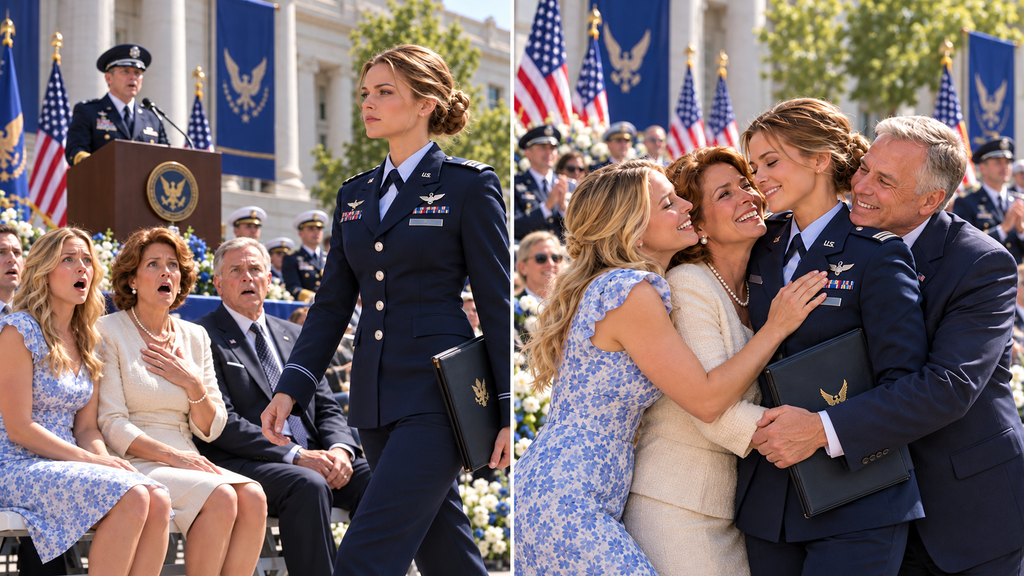
And across the platform, Colonel Jason Turner stood staring at the black leather briefcase I held against my leg.
I had imagined this moment more times than I wanted to admit.
During sleepless nights.
During long deployments.
During the years when my own family refused to believe me.
I had imagined Jason standing before the truth he thought he had buried.
But I had never imagined that when the moment finally arrived, I would feel so strangely calm.
“Commander?” the senior officer repeated.
I looked up at him.
“Yes, sir.”
I unfastened the first brass clasp.
Then the second.
The sound was small.
Almost insignificant.
But Jason reacted as though someone had fired a weapon.
“General,” he said suddenly, stepping forward, “I think there has been a misunderstanding.”
Major General Andrew Whitmore, the senior officer supervising the ceremony, turned toward him.
“Is that so, Colonel?”
Jason’s expression changed immediately.
He recovered that polished smile I had come to despise.
“Commander Reynolds and I have a personal history,” he explained. “I believe that may be influencing her judgment.”
There it was.
The same accusation.
The same carefully chosen words.
The same tactic he had used six years earlier when he convinced an investigation board that I was emotionally unstable, professionally unreliable, and incapable of making sound decisions under pressure.
Except this time, I was not a frightened young officer standing alone in a conference room.
This time, the man listening to him already knew the truth.
General Whitmore studied Jason for several seconds.
“Colonel Turner,” he said evenly, “I suggest you choose your next words very carefully.”
Madison grabbed my arm.
“Rachel,” she whispered sharply, “what have you done?”
I looked at her hand.
Then I looked into her eyes.
“Please let go of me.”
She tightened her grip.
“Tell me what is happening.”
“Madison.”
My voice remained quiet.
“Let go.”
Something in my expression must have frightened her, because she released me immediately.
I stepped away from my family and opened the briefcase.
Inside rested a sealed evidence envelope, a thick blue folder, and a small black case containing the authenticated digital records that had taken almost three years to recover.
Every document had been logged.
Every transfer had been witnessed.
Every piece of evidence had passed through the proper legal channels.
Nothing about what was about to happen was improvised.
And that was precisely why Jason should have been afraid.
I removed the sealed envelope and handed it to General Whitmore.
He examined the identification number.
Then he passed it to the uniformed legal officer waiting beside him.
“Confirm receipt.”
“Yes, sir.”
The legal officer checked the seal against the evidence log.
“Seal intact. Identification confirmed.”
A faint movement passed through the officers standing near the stage.
Nobody spoke.
Jason’s eyes followed the envelope.
And for the first time in six years, I saw something on his face that I had once believed impossible.
Fear.
Real fear.
Not embarrassment.
Not irritation.
Not anger at being challenged.
Fear.
Because he understood that the story he had built his entire career upon was about to collapse.
And this time, there was no one left who could protect him.
Six years earlier, I had trusted Colonel Jason Turner with my life.
That was the part of this story my family never understood.
Before he became my brother-in-law, before Madison started posting photographs of his awards and fancy military dinners, before my parents began treating him like the son they had always wanted, Jason had been my professional mentor.
I was thirty-two years old then.
A Navy intelligence officer assigned to a joint operational planning cell supporting a sensitive overseas mission.
Jason was the Army officer responsible for coordinating several components of the mission.
He was brilliant in briefings.
Charming with senior leadership.
Always prepared.
Always smiling.
He remembered birthdays, brought coffee to exhausted staff officers, and had a remarkable ability to make every superior believe that an idea had been theirs from the beginning.
People trusted him.
I trusted him.
When Madison met him at a military charity dinner, I was the one who encouraged her to go on a second date.
“He’s a good man,” I told her.
Those four words would haunt me for years.
At the time, Jason seemed genuinely interested in my work.
He asked intelligent questions.
He praised my assessments.
He sometimes stopped by my office late in the evening to discuss intelligence reports that had not yet been presented to command.
I interpreted his interest as respect.
I was wrong.
What he wanted was access.
And eventually, he found a way to take it.
The mission that changed everything was called Operation Iron Lantern.
Its details remained protected, but the consequences of the decisions made during its planning were painfully clear.
A joint reconnaissance team was scheduled to approach a remote facility suspected of supporting hostile operations.
My analysts identified a serious problem with the planned route.
The intelligence suggested that hostile personnel had repositioned equipment near the team’s intended approach corridor.
I submitted a recommendation to delay movement until the threat could be independently verified.
Jason disagreed.
He argued that delaying would jeopardize the mission.
I refused to withdraw my assessment.
“Rachel,” he told me during a late-night planning meeting, “sometimes intelligence officers become so worried about what might happen that they forget we have missions to accomplish.”
“And sometimes commanders become so worried about meeting deadlines that they ignore the people warning them about danger,” I answered.
His smile disappeared.
“You need to remember who is responsible for operational decisions.”
“I remember perfectly.”
The meeting ended badly.
The following morning, I learned that the mission had proceeded.
My recommendation had apparently been withdrawn.
And the document authorizing the original route carried my digital signature.
I stared at the screen.
It was my name.
My identification credentials.
My approval code.
Everything appeared legitimate.
Except I had never signed it.
Three days later, the reconnaissance team encountered a devastating attack.
Two service members were killed.
Several others were wounded.
One of the survivors, Staff Sergeant Daniel Mercer, lost his left leg.
The operational review began almost immediately.
Jason told investigators that he had followed the most current intelligence recommendation.
He produced the authorization bearing my signature.
When I protested, he appeared genuinely shocked.
“Rachel,” he said in front of the inquiry panel, “you approved the revised assessment.”
“No, I didn’t.”
He lowered his eyes.
“I understand this is difficult.”
“I’m telling you that document is fraudulent.”
His expression hardened almost imperceptibly.
“Please don’t make this worse.”
Those words were the beginning of my nightmare.
Within days, rumors spread.
I had made a dangerous mistake.
I was trying to avoid responsibility.
I had become emotionally unstable after the casualties.
I was blaming other officers because I couldn’t accept my own failure.
Jason never made those accusations publicly.
He didn’t need to.
He repeated them privately to the right people.
And by the time the story reached my family, it had become something far uglier.
Madison came to my apartment one evening carrying a bottle of wine.
I thought she had come to comfort me.
Instead, she sat across from me and said, “Jason told me what happened.”
I felt my stomach tighten.
“What exactly did he tell you?”
“That you’re having trouble accepting responsibility.”
I stared at her.
“Madison, he forged my signature.”
She closed her eyes.
“Rachel, please.”
“I’m serious.”
“So am I.”
She set down her glass.
“Jason says you’ve been under enormous pressure. He says the deaths affected you badly.”
“Of course the deaths affected me!”
My voice broke.
“Two men died. I warned them that route was dangerous.”
Madison flinched.
Then her expression changed.
Not into sympathy.
Into disappointment.
“Jason told me you would say that.”
I remember sitting there afterward, watching my sister reach for her handbag.
I remember realizing that she had arrived with her mind already made up.
And I remember asking her one final question.
“If you had to choose between believing me and believing Jason, would you even hesitate?”
She stood.
“That’s unfair.”
“Would you?”
She looked toward the door.
Then she said the words that permanently changed our relationship.
“Jason has never given me a reason not to trust him.”
I wanted to scream.
Instead, I watched her leave.
That night, I called my mother.
She told me to stop obsessing over the investigation.
My father said I should be grateful I had not been court-martialed.
And when Jason was eventually cleared of wrongdoing while I received an adverse administrative finding, my family considered the matter settled.
They attended a dinner celebrating his promotion.
I wasn’t invited.
Back on the parade field, General Whitmore quietly reviewed the evidence identification sheet.
I stood beside him.
The ceremony had not resumed.
The audience was becoming restless.
Madison kept looking from me to her husband.
My mother whispered something to my father.
And Jason was growing increasingly desperate to regain control.
“General,” he said, “I respectfully request that we address this matter privately.”
Whitmore looked up.
“We will address it through the appropriate channels, Colonel.”
“With respect, sir, this is a public military ceremony.”
“I’m aware.”
“Then surely you understand the potential damage to the institution if unverified allegations are allowed to disrupt—”
“Unverified?”
The general’s voice became dangerously quiet.
Jason stopped speaking.
Whitmore closed the folder.
“Colonel Turner, do you believe this is the first time senior leadership has examined these records?”
Jason swallowed.
“I haven’t been informed of any review.”
“Then there are several things you have not been informed about.”
The words landed heavily.
Jason’s jaw tightened.
He glanced toward the audience.
Hundreds of soldiers.
Their families.
Several local officials.
Military representatives from other installations.
All watching.
All waiting.
For a man who had spent years carefully controlling his image, the uncertainty was unbearable.
I could see him calculating.
Searching for an explanation.
Trying to identify which superior he could influence.
Which acquaintance he could call.
Which favor he could demand.
But General Whitmore was not interested in his performance.
“Colonel,” he said, “you were instructed yesterday to make yourself available for a command-directed interview following today’s administrative proceedings.”
“Yes, sir.”
“Instead, you attempted to contact three officers connected to the original Iron Lantern inquiry.”
Jason’s face went pale.
Whitmore continued.
“You also instructed your aide to retrieve archived files that had already been placed under legal preservation.”
“That was routine preparation for my departure.”
“Was it?”
“Yes, sir.”
The general glanced toward the legal officer.
“Major Bennett?”
Major Claire Bennett stepped forward.
“No, sir. The request specifically referenced documents subject to an evidence-preservation notice. Colonel Turner was informed that those files were restricted.”
Jason stared at her.
For the first time, he appeared to realize how thoroughly he had been monitored.
“I believe my instructions were misunderstood,” he said.
Whitmore did not respond.
Instead, he turned to me.
“Commander Reynolds, please confirm for the record whether the evidence package you delivered contains the original authorization document recovered from the protected archive.”
“Yes, sir.”
“And does it include the associated authentication records?”
“Yes, sir.”
“Thank you.”
He looked toward Jason.
“Colonel Turner, the administrative ceremony will be modified. You will remain available to the investigating authorities. Your departure from this command is effective under the orders previously issued.”
Jason’s voice rose.
“You cannot possibly be suggesting that Commander Reynolds is taking over based on allegations from six years ago.”
“No,” Whitmore said. “She was selected through a separate joint leadership process based on her qualifications and service record. Your pending investigation has no bearing on her merit.”
The distinction mattered.
It mattered more than I could express.
Because I had not spent six years rebuilding my career merely to inherit something that belonged to Jason.
I had earned this appointment.
The evidence had not earned it for me.
My work had.
My record had.
The people who had trusted me when trusting me was difficult had.
And the Navy uniform I wore that afternoon represented every part of my life Jason had failed to destroy.
The first crack in Jason’s story had appeared fourteen months after the Iron Lantern investigation closed.
It came in the form of a letter.
No return address.
No signature.
Just a small envelope delivered to my apartment while I was temporarily assigned to Norfolk.
Inside was a single printed sentence.
The authorization was uploaded at 02:17. Ask where you were.
I read it six times.
Then I opened my old deployment calendar.
At 2:17 on the morning of the upload, I had not been anywhere near the planning facility.
I had been aboard a Navy aircraft traveling between two installations.
That alone did not prove the signature was forged.
Digital credentials could sometimes be used remotely.
But the original investigation had stated that the authorization had been submitted from my assigned workstation.
My workstation had been located inside a secure building.
And according to the records, I had physically authenticated the document there.
That was impossible.
I requested the access records.
The request was denied.
I submitted an appeal.
That was denied too.
I asked for a formal reconsideration of the adverse finding.
For months, nothing happened.
Then a Navy captain named Rebecca Shaw asked to meet me.
Captain Shaw was not someone who offered sympathy easily.
She had built a reputation for demanding precision and refusing excuses.
When she entered the conference room, she carried my original investigation report.
She sat down and opened it.
“Commander Reynolds,” she said, “I’ve reviewed your case.”
I braced myself.
“Ma’am.”
“There are inconsistencies.”
My heart began beating faster.
“Yes, ma’am.”
“Some are minor. Others are not.”
She placed a photograph on the table.
It showed the entrance to the secure planning facility.
“Your statement says you were in transit when the authorization was submitted.”
“Yes.”
“Do you have documentation?”
I slid my flight orders across the table.
She examined them.
Then she looked up.
“Why wasn’t this included in the original inquiry?”
“It was.”
She became still.
“What?”
“I submitted those records to the investigating officer. They were not included in the final evidence summary.”
Captain Shaw looked down at the photograph.
Then she said something I had waited more than a year to hear.
“That should not have happened.”
I felt tears rise unexpectedly.
Not because she had promised to clear my name.
She hadn’t.
Not because I suddenly believed everything would be fixed.
I didn’t.
But for the first time, someone with authority had looked at the facts rather than at Jason’s reputation.
And that small act of fairness felt almost overwhelming.
Captain Shaw leaned forward.
“I need you to understand something. Reopening this matter will be difficult. It may take years.”
“I understand.”
“And we may discover that the evidence is insufficient to overturn the finding.”
“I understand that too.”
“Then why pursue it?”
I looked at the photograph.
I thought about the two men who had died.
I thought about their families.
I thought about Staff Sergeant Mercer learning how to walk with a prosthetic leg while the people responsible for the operational decisions received awards.
Then I answered.
“Because the truth doesn’t stop mattering just because finding it becomes inconvenient.”
Captain Shaw studied me.
Finally, she nodded.
“Good. Then let’s start with the records.”
The investigation that eventually brought Jason down did not begin with a dramatic confession.
It began with a missing security log.
The log should have shown which credentials were used to access the planning workstation and when.
The original inquiry had included a summary of that log.
But the raw record was absent.
The investigators initially assumed it had been deleted under normal retention procedures.
Then an information systems specialist discovered a backup.
The backup existed because of a technical failure during the original mission.
A redundant archival server had automatically preserved a snapshot that should ordinarily have been overwritten.
Nobody had requested it during the first investigation.
Nobody had even known it still existed.
When the investigators recovered the data, they found something extraordinary.
The document bearing my signature had been created using a privileged administrative session.
The session was opened from a different terminal.
The terminal was located in an office assigned to Jason’s planning staff.
And the approval certificate attached to the authorization had been exported from a credential repository several hours before I supposedly signed it.
The signature had not been created through my normal authentication process.
It had been inserted.
But there was still a problem.
The records proved that my signature was not authentic.
They did not yet establish who had inserted it.
Jason had access to the planning staff.
So did several other officers.
The investigators needed more.
And Jason, as always, appeared ready for every question.
When confronted with the authentication discrepancy, he expressed surprise.
He suggested a technical error.
He said the systems had been under extreme operational pressure.
He claimed that multiple staff members might have shared administrative resources.
He expressed concern for my emotional well-being.
Again.
That last detail nearly made Captain Shaw throw her pen across the table.
“He’s still doing it,” she told me after reviewing the interview notes.
“Doing what?”
“Answering questions about evidence by talking about your mental state.”
I gave a tired smile.
“He’s very good at it.”
“He’s been effective,” she corrected. “That isn’t the same as being good.”
I remember that conversation because it was the first time I began to understand something important.
For years, I had tried to persuade people that Jason was a bad man.
But character was not evidence.
His charm was not evidence.
His cruelty was not evidence.
What we needed were facts.
Facts that could survive scrutiny.
Facts that would remain true whether or not anyone liked me.
Captain Shaw closed the file.
“We don’t need to convince people to dislike him,” she said. “We need to establish what he did.”
And that became our mission.
Back at Fort Carson, Jason attempted one final public appeal.
“General,” he said, his voice carrying across the silent platform, “I have served this country for twenty-four years.”
Whitmore regarded him without expression.
“I am aware of your service record.”
“I have led soldiers in combat.”
“Yes.”
“I have buried friends.”
The general’s face tightened slightly.
“So have I.”
Jason took a breath.
“Then you understand what it means to have one’s career questioned in front of the people one has commanded.”
Whitmore was silent for a moment.
Then he answered.
“Yes, Colonel. I do.”
Jason seemed encouraged.
He stepped forward.
“Then I respectfully ask for the dignity of a private discussion.”
General Whitmore’s gaze did not waver.
“Your personal dignity is not the issue. The integrity of the investigation is.”
Jason stopped.
“And let me be very clear,” the general continued. “No one here is announcing a verdict. The relevant authorities will examine the evidence and determine the appropriate next steps. But you will not use this ceremony to pressure another officer into silence.”
Jason’s eyes moved toward me.
Hatred flashed across his face.
For a second, the polished colonel vanished completely.
I saw the man who had leaned over my desk six years earlier and told me to withdraw my report.
The man who had smiled while my career fell apart.
The man who married my sister and spent every family holiday reminding me that he had survived the scandal while I had not.
He knew I could see him.
And that made him angrier.
“You planned this,” he said.
I met his gaze.
“No.”
“Don’t lie to me.”
“I didn’t plan to spend six years proving that I never signed a document you used to destroy my reputation.”
His face flushed.
“You have no idea what happened during that mission.”
I felt my chest tighten.
For a moment, I was back in the original inquiry room, listening to Jason explain why I had supposedly failed.
But then I remembered the evidence in General Whitmore’s hands.
And I remembered the years of silence.
I lifted my chin.
“I know exactly what happened to my signature.”
Jason took another step.
“Rachel—”
“Colonel Turner.”
General Whitmore’s voice cut through the air.
“That’s enough.”
Two officers moved closer to the stage.
Jason noticed.
So did Madison.
Her face had become almost colorless.
She looked at me with wide, desperate eyes.
“Rachel,” she whispered, “please tell me this isn’t real.”
I wanted to say something comforting.
Something that would make her feel less frightened.
After all, she was still my younger sister.
I remembered teaching her how to ride a bicycle.
I remembered braiding her hair before school.
I remembered holding her hand in the hospital when she had her appendix removed.
Love does not disappear simply because someone has hurt you.
Sometimes it becomes the most painful part of the injury.
But I could not protect Madison from the truth without betraying myself again.
So I said the only honest thing I could.
“It’s real.”
She shook her head.
“No.”
“Madison—”
“No, Jason wouldn’t.”
I glanced toward her husband.
“Then let the evidence speak.”
The next twist had come from someone I never expected to help me.
Jason’s former executive assistant.
Her name was Lieutenant Colonel Evelyn Price.
For years, Evelyn had been one of his most loyal officers.
She managed his schedule.
Prepared his briefings.
Coordinated his meetings.
She knew how he worked.
And she had once testified that she had never observed him behaving improperly.
That testimony helped protect him during the original investigation.
Three years later, Evelyn contacted Captain Shaw.
She requested a confidential meeting.
The meeting took place in a small conference room on a rainy Thursday afternoon.
I was not present.
I learned what she had said only after investigators completed the required interviews.
According to her statement, Evelyn had begun questioning Jason after discovering irregularities in another administrative matter.
Nothing as serious as Iron Lantern.
Just altered dates on a performance report.
A recommendation that appeared to have been submitted before the officer had actually signed it.
A promotion packet containing an attachment that had been replaced after approval.
When Evelyn challenged him, Jason dismissed her concerns.
Then he became angry.
Then he reminded her how much she owed him.
That was when she recognized the pattern.
Later, while reviewing archived correspondence connected to the original Iron Lantern inquiry, she found a message she had forgotten existed.
It was a routine office communication sent at 1:48 in the morning.
Jason had instructed a staff specialist to prepare the revised authorization for immediate submission.
The message included the words:
Use the approved signature block already on file. Do not delay for additional concurrence.
At first glance, the instruction might have appeared administrative.
But the authorization required my personal approval.
A signature block was not approval.
A saved certificate was not approval.
And Jason knew it.
Evelyn also remembered something else.
The morning after the document was submitted, Jason had asked her to remove an earlier intelligence warning from his briefing materials.
He said it was outdated.
She complied.
Years later, she learned that the warning had been my assessment.
The one that might have delayed the operation.
The one that had disappeared from the final briefing package.
When Evelyn spoke with investigators, she cried.
Not loudly.
Not theatrically.
She simply sat with her hands folded in front of her and said, “I thought I was protecting the command.”
Captain Shaw asked her what had changed.
Evelyn looked down.
“I realized I was protecting a man who had convinced us that protecting him was the same thing.”
That statement became one of the most important pieces of testimony in the reopened inquiry.
But even then, we were missing something.
We still needed proof that Jason had personally directed the unauthorized signature.
And that proof came from an unexpected place.
A retired civilian technician named Harold Voss.
Harold had worked in the communications section when Iron Lantern was planned.
By the time investigators located him, he was living in New Mexico, repairing old radios in a small workshop behind his house.
He had no interest in military politics.
He disliked lawyers.
And he initially refused to speak with anyone.
Captain Shaw called me one evening.
“We found someone who may know how the certificate was copied.”
I sat upright.
“Who?”
“A retired systems technician.”
“Can he confirm it?”
“Not yet.”
“Why not?”
“He says he doesn’t remember enough.”
I closed my eyes.
Another dead end.
Then Shaw added, “But he kept something.”
“What?”
“An old maintenance notebook.”
I stared at the wall.
“A notebook?”
“Apparently he wrote down unusual system activity by hand.”
For the first time that evening, hope stirred.
Harold had spent decades troubleshooting equipment.
He trusted paper more than software.
Every time he encountered a strange malfunction, he wrote down the date, time, terminal number, and suspected cause.
During the week of Iron Lantern, he recorded an administrative certificate export that had been performed outside the normal maintenance window.
He also recorded the name of the person who called him when the system generated an alert.
Colonel Jason Turner.
The entry was brief.
But it placed Jason in direct contact with the technician at the precise time the compromised certificate was being handled.
Investigators interviewed Harold twice.
During the second interview, he remembered the conversation.
Jason had called because the system was rejecting an authorization document.
Harold explained that the certificate required the original officer’s authentication.
Jason allegedly became irritated.
He told Harold the approval had already been granted verbally and the paperwork was merely catching up.
Harold had not altered the system himself.
He had instructed Jason’s staff to contact the proper authentication administrator.
But after the call, another administrative session appeared in the logs.
The document was submitted.
And my signature appeared.
When Captain Shaw told me, I covered my mouth.
For several seconds, I couldn’t speak.
“Rachel?”
I shook my head, although she couldn’t see me.
“I remember that night,” I whispered.
“What?”
“I remember being on the plane.”
My voice began to tremble.
“I remember thinking I was finally going to get some sleep.”
Then the tears came.
Not because the nightmare was over.
It wasn’t.
But because the facts were finally beginning to resemble the truth I had carried alone for years.
The change of command ceremony resumed under a silence far heavier than the one that had preceded it.
General Whitmore returned to the microphone.
“Ladies and gentlemen,” he said, “thank you for your patience.”
His tone was composed.
Professional.
He did not mention forgery.
He did not announce charges.
He did not attempt to turn the assembled soldiers into a jury.
Instead, he explained that the transition would proceed in accordance with the modified official orders.
Colonel Turner would relinquish his current command responsibilities.
The designated incoming officer would assume the newly established joint leadership position.
The formal flag transfer would take place under the supervision of the appropriate commanders.
Everything would be documented.
Everything would be conducted lawfully.
And nothing would be hidden to preserve one man’s pride.
Jason stood at attention.
His face was rigid.
I could see the muscles working in his jaw.
He was accustomed to being the central figure at these ceremonies.
Accustomed to applause.
Accustomed to people rising when he entered a room.
But as the formal orders were read, I watched something change around him.
The officers no longer looked at him with unquestioning admiration.
They looked at him with uncertainty.
Not because they knew whether he was guilty.
They didn’t.
But because they had watched him lose control of himself when confronted with evidence.
And Jason had always depended upon control.
The band played the ceremonial music.
The outgoing colors were presented.
Commands were given.
Boots moved in perfect synchronization.
The traditions continued.
And then General Whitmore turned toward me.
“Commander Reynolds.”
I stepped forward.
“Sir.”
“Report.”
I stood at attention.
“Commander Rachel Reynolds reporting as directed, sir.”
He returned my salute.
Then the next order was read.
My full name.
My service record.
My qualifications.
The leadership responsibilities I had been selected to assume.
The words traveled across the parade field.
And as I listened, I thought of the years when I could barely bear to introduce myself at professional gatherings.
The years when people lowered their voices after hearing my name.
The years when I wondered whether any amount of good service could ever erase the damage Jason had caused.
Now my name was being spoken clearly.
Publicly.
Without apology.
I caught sight of Captain Shaw standing among the senior officers.
She gave me the smallest nod.
It was enough.
I took my designated position.
And for the first time in six years, I felt the weight of my uniform without the weight of someone else’s lie.
After the ceremony, Madison tried to reach me before I could leave the platform.
“Rachel!”
I turned.
She was struggling through the crowd, her heels clicking sharply against the pavement.
My mother followed several steps behind.
My father looked furious.
Jason had already been escorted toward an administrative building by two officers.
Madison reached me first.
“What did you do to him?”
I stared at her.
“What?”
“You heard me.”
Her eyes filled with tears.
“You humiliated my husband.”
I looked at her for a long moment.
Then I asked, “Are you seriously blaming me?”
“He worked his entire life for this!”
“So did I.”
“You don’t understand what this is going to do to our family.”
Something inside me went very still.
Our family.
For six years, those words had been used against me.
Keep the peace.
Think about the family.
Don’t embarrass Madison.
Don’t make Jason uncomfortable.
Move on.
Forgive.
Forget.
Be the bigger person.
Every request meant the same thing.
Let the truth disappear so everyone else can remain comfortable.
I looked directly at my sister.
“Madison, two service members died during the operation connected to that file.”
She flinched.
“I know.”
“Do you?”
“Of course I do.”
“Then stop talking about Jason’s embarrassment as though it’s the greatest tragedy here.”
She stepped backward.
My mother reached us.
“Rachel, lower your voice.”
I turned to her.
“I haven’t raised it.”
“This is neither the time nor the place.”
I almost laughed.
Because that had always been my mother’s answer.
Never the right time.
Never the right place.
Never the right audience.
There was always a reason I should remain silent.
“Then when, Mom?” I asked.
She blinked.
“When would you like me to tell the truth?”
“Don’t be dramatic.”
“Would Christmas dinner be better? Or Thanksgiving? Perhaps I should schedule an appointment so nobody feels uncomfortable.”
My father’s face darkened.
“That is enough.”
I looked at him.
He wore the same stern expression he had used when I was a child.
The expression that once made me apologize even when I had done nothing wrong.
But I was not a child anymore.
And his disappointment could no longer command my obedience.
“No,” I said quietly. “It isn’t.”
He stared.
I continued.
“For six years, you believed Jason without asking me for a single piece of evidence.”
My father folded his arms.
“The military investigated the incident.”
“Yes. And the investigation was flawed.”
“You expect us to believe everyone else was wrong?”
“No.”
I held his gaze.
“I expect you to understand that an investigation can be reopened when new evidence appears. That’s how accountability works.”
My mother shook her head.
“Jason has always been good to us.”
There it was.
The truth beneath everything.
Jason remembered birthdays.
Jason bought expensive gifts.
Jason paid for family vacations.
Jason took my parents to military dinners.
Jason made them feel important.
And I?
I had brought them uncomfortable questions.
I had cried.
I had asked them to trust me when doing so required courage.
I had needed something from them that could not be purchased.
Belief.
I looked at my mother.
“Was he good to me?”
She opened her mouth.
Nothing came out.
I waited.
Then I said, “That’s what I thought.”
The most painful moment of that afternoon came from someone who had barely spoken.
My nephew.
Madison’s son, Oliver.
He was eleven years old.
A serious little boy with dark hair and a habit of asking questions adults preferred not to answer.
He had been standing near the chairs with his grandfather.
When he approached, my sister immediately tried to pull him away.
“Oliver, go back to Grandma.”
But he looked at me.
“Aunt Rachel?”
I knelt slightly.
“Hey, buddy.”
His eyes moved toward the administrative building where Jason had disappeared.
“Is Dad in trouble?”
Madison’s face crumpled.
“Oliver, honey, not now.”
He ignored her.
“Did he do something wrong?”
I felt every adult around us become still.
There are questions you can answer with facts.
And questions that require something more careful.
I could not tell Oliver his father was guilty of crimes that had not yet been adjudicated.
I could not promise him that everything would be fine.
And I refused to use him as a weapon against Jason.
So I looked into his eyes and said, “Your dad is being asked some very serious questions about things that happened at work.”
Oliver swallowed.
“Are the questions true?”
“The evidence will be examined by people whose job is to find out.”
He thought about that.
Then he asked something that nearly broke me.
“Do you still love me?”
I blinked.
“Of course I do.”
“Even if Dad did something bad?”
My throat tightened.
“Oliver, nothing that happens between adults changes how much I love you.”
He stepped forward and hugged me.
I wrapped my arms around him.
He held on longer than usual.
And over his shoulder, I saw Madison begin to cry.
For the first time that afternoon, her tears did not appear to be about her husband’s reputation.
They were about her son.
About the possibility that the life she had built was not what she believed.
About the frightening realization that children eventually ask questions no adult can control.
When Oliver released me, he whispered, “I’m glad you came.”
I smiled through the ache in my chest.
“Me too.”
The investigation became public three weeks later.
Not every detail.
Not the classified operational information.
But enough.
The Army confirmed that Colonel Jason Turner had been relieved of his remaining command-related duties pending the outcome of a formal investigation into allegations involving official documents and misconduct.
The Navy announced that the adverse findings against me were under final review.
Several journalists requested interviews.
I declined.
I had not spent years fighting for the truth simply to turn the tragedy into entertainment.
But public attention brought consequences.
Jason’s former colleagues began contacting investigators.
Some provided helpful information.
Others came forward to defend him.
Several insisted he was a brilliant officer who would never knowingly falsify a document.
I understood their confusion.
I had once believed the same thing.
Then another witness appeared.
And everything changed again.
His name was Lieutenant Colonel Thomas Hale.
He had served under Jason during Iron Lantern.
He had also been one of the officers who reviewed my original intelligence warning.
When investigators contacted him during the reopened inquiry, Hale initially stated that he remembered very little.
He had since retired.
He lived quietly with his wife in North Carolina.
He claimed that the events were too distant for reliable recollection.
But shortly after Jason’s public removal from duties, Hale contacted the investigating team again.
He asked to amend his statement.
The second interview lasted nearly five hours.
When Captain Shaw called me afterward, her voice sounded different.
“Rachel,” she said, “we need to talk.”
I was sitting in my office at Fort Carson, surrounded by paperwork from my new assignment.
“What happened?”
“Hale remembered something.”
My heart tightened.
“What?”
She hesitated.
Then she said, “He says Jason knew your warning was valid before the mission launched.”
I sat very still.
“What do you mean?”
“He says there was additional intelligence.”
I looked toward the window.
The mountains beyond the installation were covered in the first pale signs of autumn.
“Additional intelligence?”
“Yes.”
“Supporting my assessment?”
“Yes.”
I closed my eyes.
For six years, I had known that the route was dangerous.
But the original record suggested that command had been forced to make a difficult judgment with incomplete information.
Now Hale was saying that Jason had received more evidence.
Evidence that strengthened the warning.
And he had proceeded anyway.
“Why didn’t Hale say anything?” I whispered.
Captain Shaw sighed.
“Because Jason told him the supporting report had been discredited.”
“Was it?”
“No.”
I pressed my hand against the desk.
“What happened to it?”
“That’s what we’re trying to determine.”
Then she added something that made my blood run cold.
“Hale says he saw Jason place the report in a classified disposal folder after the mission.”
For a moment, I couldn’t breathe.
The forged signature had been the beginning.
But perhaps it had not been the worst thing Jason had done.
Perhaps the true reason he destroyed my career was not merely to escape responsibility.
Perhaps he had needed to conceal evidence that he knowingly ignored a warning.
And if that was true, the entire tragedy had to be examined again.
I met Daniel Mercer two months later.
Not in a courtroom.
Not in an official conference room.
At a rehabilitation center outside Denver.
He had agreed to speak with me after learning that the investigation had been reopened.
I almost canceled three times.
I was terrified of seeing him.
Terrified that he would blame me.
Terrified that I would see his missing leg and remember the night I learned the reconnaissance team had been attacked.
But Captain Shaw had encouraged me to go.
“He asked for you,” she said.
So I went.
Daniel was sitting beside a window when I arrived.
He wore jeans, a dark green sweatshirt, and a prosthetic leg beneath his right pant cuff.
He was older than I remembered.
There were lines around his eyes.
A little gray in his beard.
But his expression was steady.
“Commander Reynolds?”
I stood awkwardly in the doorway.
“Yes.”
He smiled faintly.
“Daniel Mercer.”
“I know.”
He gestured toward the chair.
“Please sit.”
For several seconds, neither of us spoke.
Then I said the words I had carried for six years.
“I’m sorry.”
Daniel looked at me.
“For what?”
I stared at his prosthetic leg.
“For what happened.”
He followed my gaze.
Then he leaned back.
“Ma’am, were you the person who ordered us down that route?”
“No.”
“Did you approve the revised assessment?”
“No.”
“Did you know we were going to be hit?”
I swallowed.
“I knew there was a threat. I recommended delaying the mission.”
He nodded.
“That’s what I heard.”
Tears burned behind my eyes.
“I tried.”
My voice cracked.
“I really tried.”
Daniel was quiet for a moment.
Then he said, “I know.”
Those two words nearly brought me to my knees.
I looked up sharply.
“How?”
He reached into the pocket of his sweatshirt and removed a folded piece of paper.
It was worn along the creases.
He opened it carefully.
Inside was a copy of my original warning.
The one I believed had disappeared.
I stared at it.
“Where did you get that?”
Daniel’s expression changed.
“From Captain Elias Ward.”
My breath caught.
Elias Ward had been one of the two service members killed during Iron Lantern.
Daniel looked down at the page.
“Elias got a copy before we deployed. He was angry that the route hadn’t been changed.”
I could barely speak.
“He knew?”
“Somebody had shown him the warning. He said command was taking a risk.”
Daniel paused.
“He folded this and put it in his notebook. After the attack, his personal effects were collected. Eventually, his wife received the notebook.”
I stared at the paper.
“His wife gave it to you?”
Daniel nodded.
“She thought it might matter.”
I felt the room tilt.
A warning I had written.
A warning I had been accused of withdrawing.
A warning that had survived because a man who died had believed it deserved to be remembered.
Daniel slid the document toward me.
“I made a copy,” he said. “The original went to the investigators.”
I touched the edge of the paper.
My hands were shaking.
For six years, people had told me to move on.
To forget.
To accept.
But a dead officer had carried my warning into the field.
And his family had kept it.
Daniel watched me.
“Commander, can I tell you something?”
I nodded.
“After I lost my leg, I spent a lot of time being angry.”
“I understand.”
“No, ma’am. I mean really angry. At everybody. At command. At the enemy. At myself for surviving when Elias didn’t.”
His voice became rough.
“Eventually, I realized I could spend the rest of my life looking for someone to hate, or I could try to do something useful with what was left.”
He glanced at the paper.
“But accountability matters. If somebody altered that record, the families deserve to know.”
I covered my mouth.
Daniel leaned forward.
“Just promise me one thing.”
“Anything.”
“Don’t let this become a story about medals.”
I looked at him.
“Make it about the people.”
I nodded through tears.
“I promise.”
That promise changed the way I approached everything afterward.
Until then, part of me had been focused on reclaiming my reputation.
I wanted my adverse finding removed.
I wanted my record corrected.
I wanted every officer who had questioned my integrity to know that I had told the truth.
Those feelings were understandable.
But Daniel reminded me that the consequences of Jason’s actions reached far beyond my career.
Two families had lost loved ones.
Others had experienced life-changing injuries.
Entire units had carried the emotional weight of a mission whose record might have been deliberately distorted.
And my own humiliation was only one part of that larger injustice.
I asked Captain Shaw whether the families had been informed about the reopened investigation.
She confirmed that the appropriate casualty and legal authorities were coordinating the process.
I did not interfere.
I did not seek publicity.
I did not contact journalists.
Instead, I submitted every document I possessed.
Every note.
Every letter.
Every record of the pressure Jason had applied during the original inquiry.
Then I returned to work.
Because the most important lesson I had learned was that truth required more than anger.
It required patience.
Discipline.
And a willingness to let evidence lead somewhere you might not expect.
Madison called me late one Friday evening.
I was cooking pasta in my small kitchen when her name appeared on my phone.
For a moment, I considered letting it ring.
We had barely spoken since the ceremony.
Her messages had been a strange mixture of accusations and apologies.
One day, she insisted I had destroyed her marriage.
The next, she asked whether I knew anything about the investigation.
Then she stopped communicating altogether.
I answered.
“Hello?”
For several seconds, I heard only breathing.
Then Madison said, “Rachel?”
Her voice sounded unfamiliar.
Small.
Exhausted.
“I’m here.”
“Can I come over?”
I glanced at the clock.
It was nearly ten.
“Is Oliver okay?”
“Yes.”
“Are you safe?”
A pause.
Then she whispered, “I don’t know.”
My stomach tightened.
“Madison, where are you?”
“At home.”
“Is Jason there?”
“No.”
“Where is he?”
“I don’t know.”
I turned off the stove.
“What’s happening?”
She began to cry.
Not the angry tears from Fort Carson.
Not the wounded pride.
This was different.
This was someone trying to speak while the world she understood fell apart.
“I found something.”
I gripped the phone.
“What did you find?”
She took a shaky breath.
“A folder.”
“What kind of folder?”
“In Jason’s study.”
I closed my eyes.
“Madison—”
“Rachel, it has your name on it.”
The kitchen went silent.
“What?”
“Your name. Your service number. Copies of the old investigation papers.”
My heart began pounding.
“What else?”
Another pause.
Then she said the words I will never forget.
“There are letters from Mom.”
I froze.
“From Mom?”
“Yes.”
“What letters?”
Madison began crying harder.
“Letters she sent Jason six years ago.”
I leaned against the counter.
“What do they say?”
Madison hesitated.
Then she whispered, “Rachel, I think Mom knew.”
There are moments when a person discovers a betrayal so deep that the mind refuses to accept it.
Not immediately.
Not all at once.
The words enter your ears.
You understand their meaning.
But some part of you keeps searching for another explanation.
A misunderstanding.
An exaggeration.
A mistake.
Anything that would allow the world to remain recognizable.
When Madison said our mother might have known about the forged document, I experienced exactly that feeling.
“Slow down,” I told her.
“I can’t.”
“Madison, breathe and tell me what you found.”
She swallowed.
“Jason kept copies of emails. Old ones. Some printed. Some on a backup drive.”
I closed my eyes.
“Do not alter anything.”
“I haven’t.”
“Good.”
“Rachel, listen to me.”
“I’m listening.”
“She wrote to him during the investigation.”
“What did she write?”
Madison’s voice broke.
“She told him you were determined to fight the accusation.”
I stared at the wall.
“That isn’t surprising.”
“No.”
A long silence followed.
Then Madison whispered, “She told him you still had your old laptop.”
I stopped breathing.
My old laptop.
The one that contained notes from the Iron Lantern planning process.
The one I had stored at my parents’ house while moving between assignments.
The one that disappeared during the investigation.
I had searched for it for months.
My mother told me she assumed it had been misplaced during renovations.
I had believed her.
“Madison,” I said very quietly, “what exactly did Mom say?”
Paper rustled on the other end.
Then she read.
“Rachel refuses to let this go. She still has that computer with all the old work files. If it would help settle things, I can make sure it gets to you before she causes more trouble.”
I gripped the edge of the counter.
My fingers went numb.
For six years, I had wondered how Jason obtained certain notes that were never included in the official planning system.
Notes I had saved while preparing my original assessment.
Notes that later appeared in the inquiry without their original context.
I had assumed someone accessed a shared archive.
Now I was beginning to understand.
My mother had given him my laptop.
Without asking.
Without telling me.
Because she believed helping Jason was more important than protecting her daughter.
“Rachel?”
I couldn’t answer.
“Rachel, are you there?”
“Yes.”
My voice sounded distant.
“Is there a reply?”
“Yes.”
“Read it.”
Madison hesitated.
Then she continued.
“Jason wrote: Thank you, Diane. You’re doing the right thing. Rachel needs someone to stop her before she destroys herself.”
I slowly sank into a kitchen chair.
I remembered calling my mother the day the laptop disappeared.
She had sounded irritated.
“Rachel, you lose things all the time.”
I remembered apologizing.
I actually apologized.
Because I believed I had misplaced something important.
Because I had been so exhausted and frightened that I trusted her more than my own memory.
Now Madison was reading proof that my mother had deliberately handed my property to the man accusing me of misconduct.
I pressed my palm against my forehead.
“Where is the folder now?”
“With me.”
“Have you told Jason?”
“No.”
“Have you told Mom?”
“No.”
“Good.”
Madison took a trembling breath.
“What do I do?”
“Contact Major Bennett through the official number. Tell her you found potentially relevant documents. Don’t send them to me or anyone else. Preserve them exactly as they are.”
“You don’t want to see them?”
“Of course I do.”
My voice cracked.
“But they need to be handled properly.”
Madison was silent.
Then she whispered, “I’m so sorry.”
I closed my eyes.
I had waited years to hear those words.
I thought they would bring relief.
Instead, they hurt.
Because now I knew how much damage had been done.
And because I knew one apology could never return the years we had lost.
Madison arrived at my apartment the following morning.
She had already spoken with the investigators.
The folder and digital records were being preserved.
She brought nothing with her except an overnight bag and the kind of exhaustion that made her look years older.
When I opened the door, she stood on the threshold for several seconds.
Then she said, “I didn’t know.”
I moved aside.
“Come in.”
She stepped into the living room.
Her eyes traveled across the furniture.
The small bookshelf.
The photographs from my deployments.
The framed commendation hanging near the window.
For years, Madison had barely visited.
She had never really seen the life I built after Jason nearly destroyed it.
“You live alone?” she asked.
“Yes.”
“Doesn’t it get lonely?”
“Sometimes.”
She looked down.
“I always thought you were angry because you were jealous of me.”
I said nothing.
She continued.
“Jason told me you resented our marriage. That you’d always wanted the kind of life he gave me.”
I looked at her.
“Madison, I never wanted your husband.”
“I know that now.”
“Do you?”
Tears filled her eyes.
“Yes.”
I sat across from her.
“Then tell me something.”
She nodded.
“Why did you believe him when he said I was obsessed with him?”
Her face crumpled.
“Because it was easier.”
The answer surprised me.
She wiped her cheeks.
“Because if I believed you, I had to question my marriage. And I didn’t want to.”
I looked at my hands.
“At least you’re finally being honest.”
She nodded miserably.
“I was proud of him. Everyone admired him. Everywhere we went, people treated us like we were special.”
She laughed bitterly.
“I loved being Colonel Turner’s wife.”
I waited.
“And every time you challenged his story, I felt like you were threatening that life.”
She looked up.
“So I convinced myself you were the problem.”
Her voice broke.
“I made you the villain because I couldn’t bear the thought that my husband might be one.”
I felt tears rise.
But I did not reach for her.
Not yet.
Some wounds need honesty before comfort.
“Madison,” I said, “you watched him destroy my reputation.”
“I know.”
“You repeated things about me that weren’t true.”
“I know.”
“You told people I was unstable.”
She covered her face.
“I know.”
“And when I asked you to believe me, you said he had never given you a reason not to trust him.”
She began sobbing.
“I remember.”
I swallowed.
“So do I.”
For a long time, we sat in silence.
Then she said, “I don’t expect you to forgive me.”
I looked toward the window.
Outside, morning sunlight fell across the mountains.
“I don’t know whether I can.”
She nodded.
“I understand.”
“But I don’t want Oliver to lose his aunt.”
Madison looked up.
“He won’t.”
“And I don’t want him caught between adults who use him to punish one another.”
“He won’t be.”
I studied her.
“Then whatever happens next, we put him first.”
She nodded again.
This time, I believed she meant it.
The evidence Madison discovered changed the investigation.
It did not prove that our mother had participated in forging the signature.
That distinction was important.
But it established that she had provided Jason with access to materials I had never authorized him to possess.
Investigators examined the laptop issue carefully.
Some of the information had been copied.
Some had been altered.
And some documents appeared to have been selectively extracted to create a misleading picture of my original assessment.
The findings were deeply troubling.
When questioned, my mother initially denied giving Jason anything.
Then investigators showed her the emails.
She admitted handing over the laptop.
But she insisted she believed she was helping resolve a family dispute.
That explanation devastated me more than I expected.
Because it revealed something terrible.
My mother had known my military career was at risk.
She had known I was fighting allegations involving the deaths of two service members.
And yet she had treated the matter as though I were having an argument with my sister’s husband.
As though truth were less important than family harmony.
As though my reputation were an acceptable price to pay for keeping Jason happy.
When my father learned what she had done, he called me.
For the first time in years, his voice was uncertain.
“Rachel.”
“Dad.”
He cleared his throat.
“Your mother made a mistake.”
I closed my eyes.
“A mistake?”
“She didn’t understand the seriousness of the situation.”
“She gave Jason my computer.”
“She thought she was helping.”
“Helping whom?”
Silence.
“Dad, helping whom?”
He sighed.
“Rachel, please don’t turn this into another argument.”
I felt something break.
Not loudly.
Not dramatically.
Just a final quiet separation between the father I had needed and the man who kept standing in front of me.
“I’m not arguing,” I said.
“Then what are you doing?”
“I’m asking you to stop protecting people from the consequences of their choices.”
He became defensive.
“Your mother loves you.”
“I know.”
“Then why are you treating her like an enemy?”
“Because loving me didn’t stop her from betraying my trust.”
He breathed heavily.
“You’re being harsh.”
I looked at the photograph of myself standing beside Captain Shaw after receiving a professional commendation.
For years, I had been afraid of sounding harsh.
Afraid of seeming bitter.
Afraid that anger would confirm everything Jason had said about me.
But that day, I finally understood that setting a boundary was not cruelty.
It was self-respect.
“Dad,” I said, “I am not going to pretend this was harmless so you can feel better.”
He did not answer.
“I will not discuss the evidence with you. If investigators need anything, cooperate with them. That’s all I can say.”
Then I ended the call.
My hands were shaking.
I cried afterward.
But I did not call back.
The second anniversary of my new assignment brought another unexpected development.
By then, the investigation had moved into formal legal proceedings.
The Navy had corrected my personnel record after the appropriate review authorities concluded that the original adverse finding was unsupported by the authenticated evidence.
The correction did not erase the past.
But it removed the official stain that had followed me for years.
My promotion eligibility was reassessed.
Professional opportunities that had once been closed began opening again.
I received a letter confirming that the previous finding would no longer be used against me.
I read it alone.
Then I placed it on my kitchen table.
For a long time, I stared at the words.
I had thought I would celebrate.
Call friends.
Open a bottle of champagne.
Maybe laugh.
Instead, I sat down and cried.
Because vindication is a strange thing.
People imagine it feels like winning.
Sometimes it feels like finally being allowed to grieve.
For six years, I had been too busy defending myself to acknowledge what I had lost.
I had lost friendships.
Mentors.
Opportunities.
Holidays.
My relationship with my sister.
My trust in my parents.
And perhaps worst of all, I had lost the easy confidence I once carried into every room.
Even after the record was corrected, I sometimes heard Jason’s voice in my head.
You’re unstable.
You’re overreacting.
You need to accept responsibility.
A single letter could correct an official document.
It could not instantly silence years of humiliation.
That required time.
And I was finally willing to give myself that time.
Jason’s legal proceedings did not unfold the way my family expected.
My mother had imagined a dramatic public trial where everything would be exposed at once.
Madison feared reporters would publish every ugly detail of her marriage.
My father kept asking whether the military might handle the issue quietly.
But accountability was slower and more complicated than any of them wanted.
Investigators had to establish what could be proved.
Not what seemed obvious.
Not what everyone suspected.
What the evidence supported.
The forged authorization.
The administrative access records.
The preserved communications.
The missing warning.
The witness statements.
The circumstances surrounding the laptop.
Each issue required careful examination.
Jason retained counsel.
He contested several findings.
He argued that some actions were the result of poor procedures rather than intentional deception.
His attorneys challenged the interpretation of the technical evidence.
The process took time.
During that period, I received a letter from him.
It arrived through official legal channels.
I did not open it immediately.
The envelope sat on my desk for almost a week.
Every time I looked at it, my stomach tightened.
Finally, one evening, I opened it.
The letter was handwritten.
Three pages.
His handwriting was elegant.
Precise.
The same writing that once appeared on holiday cards addressed to my parents.
He began by saying that he regretted how our professional relationship had deteriorated.
He said the events surrounding Iron Lantern had been complicated.
He said both of us had suffered.
Then came the sentence that made me stop reading.
I hope you can acknowledge that your refusal to let the matter go has caused considerable pain to everyone involved.
I stared at those words.
Then I laughed.
A short, disbelieving sound.
Six years.
An altered document.
A ruined career.
Two dead service members.
Families carrying grief that would never disappear.
And Jason still wanted me to accept responsibility for the discomfort caused by uncovering the truth.
I folded the letter.
Then I placed it in a drawer.
I never answered.
Because some people don’t ask for forgiveness.
They ask for permission to keep telling the story their way.
And I was finished giving Jason that permission.
The final turn came during a closed legal proceeding.
The investigators presented an additional record recovered from an old personal archive.
It was a recording of a planning discussion.
Not a secret recording.
A properly retained briefing audio file that had been overlooked during the original inquiry.
It contained several officers discussing the intelligence warning.
My voice was clearly audible.
I listened to the authenticated excerpt later through the authorized review process.
I heard myself say, “The current route presents an unacceptable risk without further verification.”
Another officer asked whether the concern could be resolved before the scheduled movement.
I answered, “Not with the information presently available.”
Then Jason spoke.
His voice was unmistakable.
“We cannot afford another delay.”
I heard myself respond.
“Then the commander needs to understand that the risk has not been resolved.”
A long silence followed.
Then Jason said, “I understand.”
That was all.
Two words.
I understand.
Not agreement.
Not approval.
Not authorization.
Just acknowledgment that he had heard my warning.
The recording mattered because it directly contradicted his later claim that I had withdrawn my objection during the final planning discussion.
I had not.
The warning was still active.
Jason knew it.
And the document bearing my signature had been created afterward.
When I heard the recording, I covered my eyes.
I remembered that meeting.
I remembered the exhaustion.
I remembered the frustration of watching senior officers focus on schedules while the threat assessment remained unresolved.
But I had never known the conversation had survived.
For years, Jason’s version of that meeting had been treated as fact.
Now my own voice had returned from the past to contradict him.
And it was one of the most powerful moments of my life.
Not because I sounded heroic.
I didn’t.
I sounded tired.
Frustrated.
Worried.
Exactly as I had been.
The recording showed a young officer doing her job.
Nothing more.
And nothing less.
Months later, the military announced the resolution of Jason’s case.
The outcome was not the cinematic punishment my relatives had imagined.
There was no dramatic scene in which a judge slammed a gavel while everyone gasped.
There was a formal finding of misconduct supported by the reviewed evidence.
There were administrative and disciplinary consequences, including his loss of command, the end of his military career under adverse circumstances, and a formal correction of the record that had once implicated me.
Certain aspects of the case remained protected because of the operational information involved.
Other details became part of the official findings.
Jason’s attorneys disputed parts of the outcome.
But the central truth was no longer in doubt.
The authorization bearing my signature had not been approved by me.
The record used to damage my career had been false.
And Jason’s role in the improper handling of that authorization had been established.
When I received the official notification, I was sitting in the same office where I had spent countless late evenings reviewing command reports.
I read it once.
Then again.
Then a third time.
I placed the document on my desk.
Outside, soldiers were walking between buildings.
A maintenance vehicle moved slowly along the road.
Someone laughed in the hallway.
Life continued.
There were no trumpets.
No applause.
No dramatic music.
Just a woman sitting in an office, holding proof that she had told the truth.
I called Captain Shaw.
She answered on the second ring.
“Rachel?”
“It’s done.”
A pause.
Then she said, “I know.”
My voice trembled.
“Thank you.”
“You did the work.”
“No,” I whispered. “We did.”
She was quiet for a moment.
Then she said, “How do you feel?”
I looked down at the papers.
I searched for the right word.
Happy?
Relieved?
Victorious?
None of them seemed accurate.
Finally, I answered.
“Free.”
I saw Jason one final time.
It happened almost a year after the formal resolution.
I was attending a memorial gathering honoring service members lost during Iron Lantern.
The event was small.
Private.
Families, former teammates, and a limited number of officers connected to the mission.
There were no reporters.
No speeches about scandal.
No attempt to turn the gathering into a celebration of my vindication.
We were there to remember the dead.
I had been speaking with Daniel Mercer when I noticed Jason standing near the edge of the memorial garden.
He wore civilian clothes.
A dark jacket.
Gray trousers.
No uniform.
No ribbons.
No polished command presence.
For several seconds, I barely recognized him.
He looked older.
Not simply because his hair had begun turning gray.
There was something diminished about him.
His shoulders were rounded.
His confident expression had disappeared.
He stood alone.
When our eyes met, he hesitated.
Then he approached.
Daniel glanced between us.
“Would you like me to stay?”
I looked at Jason.
Then back at Daniel.
“I’m okay.”
Daniel nodded.
He moved a short distance away but remained nearby.
Jason stopped in front of me.
“Rachel.”
“Jason.”
For a moment, neither of us spoke.
Then he looked toward the memorial plaques.
“I didn’t expect to see you here.”
I almost smiled.
“I didn’t expect to see you either.”
He nodded slowly.
“I wanted to pay my respects.”
I glanced toward the names engraved in stone.
“That’s why we’re here.”
A long silence passed.
Then Jason said, “I’ve had a lot of time to think.”
I waited.
He looked at me.
“I know you probably hate me.”
I considered his words.
For years, I had hated him.
Not constantly.
Hatred is exhausting.
But there had been mornings when I woke with such anger that I could barely breathe.
There had been nights when I imagined confronting him.
Making him admit what he did.
Making him feel even a fraction of the humiliation I had endured.
But standing there in the memorial garden, I felt something different.
Not affection.
Not forgiveness.
Distance.
He no longer occupied the center of my life.
And that was a greater victory than I had ever anticipated.
“I don’t spend much time thinking about you anymore,” I said.
His expression changed.
He seemed genuinely surprised.
“I suppose that’s fair.”
He looked away.
Then he said, “I never intended for things to go as far as they did.”
I felt my stomach tighten.
There it was again.
The attempt to soften intention.
To separate actions from consequences.
To make deliberate choices sound like unfortunate accidents.
I studied him.
“Jason, you altered an official record.”
He looked down.
“You used my name.”
Silence.
“You let people believe I approved something I warned against.”
He swallowed.
“And when I challenged you, you told everyone I was unstable.”
His jaw tightened.
“I know.”
I stared at him.
For a moment, I wondered whether I had heard correctly.
“You know?”
He nodded.
The wind moved through the trees.
“I know.”
Those two words should have brought satisfaction.
Instead, I felt a deep, almost physical sadness.
Because he had known.
All along.
When my mother accused me of embarrassing the family.
When Madison stopped inviting me to birthdays.
When my father told me to stop making excuses.
When I lay awake wondering whether my military career was over.
Jason had known.
And he had watched it happen.
“Why?” I asked.
The word came out barely above a whisper.
He closed his eyes.
For a long time, he said nothing.
Then he answered.
“I was afraid.”
I stared at him.
“Afraid of what?”
“Failure.”
He looked toward the memorial.
“I thought if the mission was delayed, command would lose confidence in me. I thought I could manage the risk.”
My chest tightened.
“And after the attack?”
His voice became hoarse.
“I panicked.”
I looked away.
There were so many things I wanted to say.
So many questions.
So much anger.
But one truth was suddenly painfully clear.
Jason had not destroyed my career because he was protecting the country.
He had done it because he was protecting himself.
And the difference was everything.
“You could have told the truth,” I said.
He nodded.
“I know.”
“You could have admitted the signature wasn’t mine.”
“I know.”
“You could have stopped the investigation from blaming me.”
His eyes filled with tears.
“I know.”
I shook my head.
“Then you made your choice.”
He covered his mouth briefly.
When he lowered his hand, his voice was barely audible.
“I’m sorry.”
I looked at him.
I had imagined those words for six years.
But now that I heard them, they seemed painfully small.
Not meaningless.
Just insufficient.
“Jason,” I said quietly, “your apology doesn’t belong only to me.”
His eyes moved toward the memorial plaques.
I continued.
“There are families who will never get their loved ones back. There are people living with injuries and grief because of what happened. Whatever you do next, don’t make your remorse another performance.”
He nodded.
Tears slipped down his cheeks.
“I understand.”
I held his gaze.
“I hope you do.”
Then I stepped around him and walked toward Daniel Mercer.
I did not look back.
My relationship with Madison changed slowly.
There was no magical reunion.
No single conversation that repaired years of cruelty.
She separated from Jason after learning the full extent of his deception.
Their marriage ended the following year.
The divorce was difficult.
Oliver struggled.
Madison began counseling.
And for the first time since childhood, she started making decisions without asking our parents whether they approved.
We met for coffee sometimes.
At first, our conversations were awkward.
We discussed Oliver.
Work.
The weather.
Anything except the past.
Then one afternoon, she brought a small cardboard box to my apartment.
“I found these,” she said.
Inside were photographs from our childhood.
Madison and me sitting on the porch of our first house.
Madison missing her two front teeth.
Me wearing an oversized school sweater.
The two of us standing beside our father at a fishing lake.
I picked up a photograph of Madison at seven years old.
She was sitting on my shoulders.
Both of us were laughing.
“I remember this,” I whispered.
Madison smiled sadly.
“You carried me all the way back to the car because I said my feet hurt.”
“You refused to wear your shoes.”
“They were ugly.”
“They were pink.”
“They were ugly pink.”
I laughed.
For a moment, the years fell away.
Then Madison’s smile faded.
“Rachel?”
I looked up.
“I’m sorry I made you carry everything alone.”
The words were simple.
But they reached a place inside me that had remained wounded for years.
I looked down at the photograph.
“I needed you.”
She nodded.
“I know.”
“I really needed my sister.”
Her eyes filled.
“I know.”
I took a breath.
“I don’t know if we’ll ever be who we were before.”
She wiped her cheeks.
“Maybe we shouldn’t try.”
I looked at her.
She continued.
“Maybe we should try to be better than we were.”
For the first time in a long while, I felt something that resembled hope.
Not the kind that pretends nothing happened.
The kind that accepts the damage and still believes something new might grow.
I reached across the table.
Madison took my hand.
And we sat there holding on to one another, not as the sisters we had once been, but as two women finally beginning to tell the truth.
My parents were different.
My father eventually apologized.
But his apology came slowly and with difficulty.
He had spent his life believing that authority figures deserved automatic respect.
Jason had been a decorated colonel.
I had been the daughter whose career was under investigation.
My father chose the version of events that fit his understanding of the world.
Admitting he had been wrong meant questioning more than Jason.
It meant questioning himself.
When he finally came to see me, he stood in my doorway holding a small paper bag.
Inside was my favorite lemon cake from a bakery near our childhood home.
It was such an ordinary gesture that I almost cried.
He looked older.
His hands shook slightly.
“Your mother said you liked this one.”
“I do.”
He nodded.
“May I come in?”
I stepped aside.
We sat at my kitchen table.
For several minutes, he talked about the drive.
The weather.
A road closure.
Then he looked at me.
“Rachel, I read the final findings.”
I said nothing.
He swallowed.
“I was wrong.”
Those three words were difficult for him.
I could see it.
But I did not rush to make the moment easier.
He needed to say what he had come to say.
“I believed Jason because he was confident,” my father continued. “And because I didn’t want to believe our family could be involved in something so ugly.”
I looked at him.
“You believed him because you respected him more than you trusted me.”
My father lowered his eyes.
“Yes.”
The honesty hurt.
But it mattered.
“I should have listened,” he whispered.
“Yes,” I said. “You should have.”
He nodded.
Tears appeared in his eyes.
“I don’t know how to make it right.”
I thought about that.
For years, I had wanted him to say the perfect thing.
To offer an apology so complete that it erased the ache.
But no words could restore the lost time.
So I answered honestly.
“You can’t make the past disappear.”
He wiped his face.
“I know.”
“But you can stop asking me to pretend it didn’t happen.”
He nodded.
“I can do that.”
I looked at the paper bag between us.
Then I stood.
“Would you like some coffee?”
He looked up.
His expression softened.
“Yes.”
It was not forgiveness in a single afternoon.
It was a beginning.
And for the moment, that was enough.
My mother had a harder time.
She continued insisting that she had never intended to hurt me.
She said she thought Jason would help me.
She said she misunderstood the seriousness of the documents.
She said she had been frightened that I was destroying my own career by challenging him.
At first, every apology was followed by an explanation.
And every explanation sounded like another request for me to excuse what she had done.
Eventually, I told her that I needed distance.
She cried.
She accused me of punishing her.
She told relatives I had become cold.
For a while, I felt guilty.
Then I remembered something Captain Shaw once told me.
“People who benefit from your silence may experience your boundaries as cruelty.”
I repeated those words to myself whenever I felt tempted to surrender.
I did not stop loving my mother.
I simply stopped allowing love to require the abandonment of my own judgment.
Over time, she began to understand.
Not completely.
Perhaps she never would.
But she stopped asking me to deny what happened.
And that allowed us to have occasional conversations that did not end in arguments.
Some relationships heal through closeness.
Others can only survive with distance.
I learned to accept both possibilities.
Three years after the ceremony at Fort Carson, I received an invitation that brought everything full circle.
It was from the family of Captain Elias Ward.
His widow, Caroline, was organizing a scholarship ceremony in his honor.
The scholarship would support children of service members who had died in the line of duty.
She invited Daniel Mercer.
Several members of the original team.
And me.
I almost declined.
I still carried guilt.
Not responsibility for the forged authorization.
Not guilt for something I had not done.
But the sorrow of knowing that I had recognized danger and still been unable to prevent the tragedy.
Caroline called me personally.
“Commander Reynolds?”
“Yes.”
“This is Caroline Ward.”
I stood up immediately.
“Mrs. Ward.”
“Please call me Caroline.”
I sat down slowly.
“Of course.”
There was a pause.
Then she said, “I wanted to thank you.”
I closed my eyes.
“Caroline, I don’t think—”
“Please let me finish.”
I became silent.
She continued.
“For years, I had questions about what happened to Elias. Some were answered. Others weren’t. I knew nothing could bring him back, but I wanted the record to be honest.”
My throat tightened.
“I’m sorry for your loss.”
“I know you are.”
Her voice softened.
“Daniel gave me a copy of the corrected findings. And I read your original warning.”
I gripped the phone.
“Caroline—”
“You tried to protect them.”
Tears filled my eyes.
“I wish I could have done more.”
“We all wish things had been different.”
She paused.
“But I don’t want you spending the rest of your life carrying a burden that belongs to someone else.”
I began crying.
Quietly.
Helplessly.
Because this woman, who had every reason to be angry at the world, was offering me a kindness my own family had withheld for years.
Caroline continued.
“Elias believed in doing the right thing even when it was difficult. From what I’ve learned, you did too.”
I covered my face.
“Thank you.”
“I hope you’ll come.”
I nodded, although she couldn’t see me.
“I’ll be there.”
The scholarship ceremony took place in a small auditorium.
There were no elaborate decorations.
No grand military spectacle.
Just photographs.
Flowers.
Families.
A row of students who had worked hard to earn educational opportunities.
Caroline stood at the podium.
She spoke about Elias.
Not only about his service.
But about the man he had been.
How he burned pancakes every Sunday.
How he sang terribly in the car.
How he always called his mother before a deployment.
How he kept a photograph of his daughter inside his uniform pocket.
There were tears.
There was laughter.
And there was the strange, beautiful feeling of people remembering someone as more than the worst day of his life.
When Caroline finished, she invited Daniel Mercer to speak.
He walked slowly to the podium.
His prosthetic leg made a faint sound against the floor.
He looked at the audience.
Then at the photographs.
“Elias was my friend,” he began.
His voice trembled.
“He was also the kind of man who could turn a terrible day into a funny story before it was over.”
Several people laughed through tears.
Daniel smiled.
“He used to say that courage wasn’t the absence of fear. It was doing what mattered while your knees were shaking.”
He looked toward me.
“After Iron Lantern, a lot of people carried wounds. Some you could see. Some you couldn’t.”
My throat tightened.
“But over the years, I learned that truth matters. Not because it changes what happened. It doesn’t.”
He paused.
“Truth matters because the people we lost deserve to be remembered honestly.”
I lowered my head.
Then Daniel said something I will carry for the rest of my life.
“Sometimes the bravest person in the room is not the one giving orders. Sometimes it’s the one willing to say, ‘Sir, I think we’re making a mistake.’”
I began to cry.
Not because he had praised me.
But because he had finally given words to what I had been trying to do six years earlier.
I had not wanted to challenge Jason.
I had not wanted to embarrass anyone.
I had not wanted to become a symbol of controversy.
I had simply wanted the warning to be heard.
And when it wasn’t, I wanted the record to reflect the truth.
Nothing more.
Nothing less.
After the ceremony, Caroline found me standing outside near a garden.
She was holding a framed photograph of Elias.
In it, he wore his uniform and smiled toward the camera.
“He hated that picture,” she said.
I turned.
“Why?”
“He said his hair looked terrible.”
I laughed softly.
“It looks fine.”
“That’s what I told him.”
She smiled.
Then her expression became thoughtful.
“Rachel, can I ask you something?”
“Of course.”
“Do you still think about the investigation every day?”
I considered the question.
There had been a time when I couldn’t go an hour without thinking about it.
A time when I replayed every conversation.
Every accusation.
Every moment I failed to persuade someone.
But now?
I looked toward the mountains in the distance.
“Not every day.”
She nodded.
“Good.”
“Sometimes it still catches me off guard.”
“I understand.”
“I’ll hear a phrase someone used during the inquiry. Or see an old photograph. And suddenly it feels like I’m back there.”
Caroline looked at me with understanding.
“Grief does that.”
I stared at her.
She continued.
“We think we’re moving forward. Then something small brings us back.”
I nodded slowly.
“But that doesn’t mean we haven’t healed.”
I felt tears rise again.
Caroline reached for my hand.
“You don’t have to forget to be free.”
I looked at her.
And for the first time, I understood.
I had spent so long believing that moving on meant somehow becoming untouched by the past.
That I needed to reach a point where none of it hurt.
But perhaps healing was not the absence of pain.
Perhaps it was the ability to remember without surrendering the future.
I squeezed her hand.
“Thank you.”
She smiled.
“Elias would have liked you.”
I looked down.
“I would have liked to know him.”
She nodded.
“I think you would have.”
Four years after the Fort Carson ceremony, I was promoted.
The promotion board examined my corrected service record.
My assignments.
My leadership evaluations.
My operational experience.
My qualifications.
And eventually, I received the news that I had been selected for the next rank.
I was alone when the notification arrived.
For several seconds, I simply stared at the screen.
Then I started laughing.
A real laugh.
The kind that comes from somewhere deep inside your chest.
I called Captain Shaw.
She answered with her usual directness.
“Reynolds.”
“Ma’am.”
“Don’t tell me you broke something.”
I laughed harder.
“No, ma’am.”
“Then why are you calling?”
“I got selected.”
A pause.
Then she said, “Of course you did.”
I smiled through tears.
“You already knew?”
“No.”
“Then why do you sound so unsurprised?”
“Because your career was never defined by Jason Turner. It was only interrupted by him.”
I sat down.
Her words settled over me.
For years, I had thought of my life in two parts.
Before Jason.
After Jason.
Before the investigation.
After the humiliation.
Before my family turned away.
After I learned to survive without them.
But Captain Shaw was right.
My career was larger than what he did.
My identity was larger.
My future was larger.
Jason had been a chapter.
A painful chapter.
But not the whole story.
My promotion ceremony was very different from the one at Fort Carson.
There was no hidden briefcase.
No confrontation.
No dramatic interruption.
No man trying to escape the consequences of his choices.
There were simply people who had stood beside me.
Captain Shaw attended.
Daniel Mercer came with his wife.
Caroline Ward sat in the second row.
Several officers I had served with traveled from other installations.
Madison brought Oliver, who was now old enough to understand much more than he had that afternoon at Fort Carson.
My father attended.
My mother came too, although our relationship remained complicated.
When I stood at the front of the room, I looked at the faces gathered before me.
And I realized that the people I wanted most to impress were not the ones who had doubted me.
They were the ones who had believed in doing the right thing.
The ones who had listened.
The ones who had stood beside me without needing a guarantee that I would win.
During the ceremony, I was asked whether I wanted to say a few words.
I stepped toward the microphone.
For a moment, I looked down at my prepared notes.
Then I folded them.
I didn’t need them.
“Thank you all for being here,” I began.
My voice was steady.
“When I was younger, I believed that integrity meant telling the truth.”
I paused.
“I still believe that. But experience taught me something else.”
The room grew quiet.
“Integrity also means telling the truth when people would rather you remain silent.”
I looked toward Captain Shaw.
“It means doing the right thing when the outcome is uncertain.”
Then toward Daniel and Caroline.
“It means remembering that behind every official report are real people whose lives matter.”
My throat tightened.
“And it means understanding that rank, reputation, and recognition are never more important than responsibility.”
I took a breath.
“For a long time, I thought I needed to prove that I belonged in this uniform.”
I looked down at the medals on my chest.
“Today, I know something different.”
I raised my eyes.
“I don’t wear this uniform to prove my worth to people who refuse to see it.”
My voice grew stronger.
“I wear it because service means something to me. Because truth matters. Because the people we lead deserve our honesty, especially when honesty is difficult.”
I paused.
Then I smiled.
“And because sometimes the best way to answer someone who underestimated you is to continue becoming the person they insisted you could never be.”
The room erupted in applause.
I looked toward Oliver.
He was clapping so hard that Madison had to laugh.
My father wiped his eyes.
Captain Shaw stood with her arms folded, wearing a small, satisfied smile.
And for the first time in years, applause did not make me think about Jason.
It made me think about the people who had helped me keep going.
After the ceremony, Oliver found me near the reception table.
He was taller now.
Almost as tall as his mother.
He wore a navy-blue suit that was slightly too large in the shoulders.
“Aunt Rachel?”
I turned.
“Hey, buddy.”
He smiled.
“Congratulations.”
“Thank you.”
He hesitated.
Then he asked, “Can I tell you something?”
“Always.”
He glanced toward Madison.
Then back at me.
“I used to think being important meant everybody knew your name.”
I smiled.
“What changed your mind?”
He looked at the rank insignia on my uniform.
“I think being important means doing what’s right even if nobody knows.”
My throat tightened.
“That’s a pretty good way to look at it.”
He shrugged.
“Mom says you taught her that.”
I looked toward my sister.
She was standing beside our father, smiling through tears.
Oliver continued.
“She says you never stopped telling the truth, even when nobody wanted to hear it.”
I swallowed.
“Your mom has learned a lot.”
He nodded seriously.
“Yeah.”
Then he grinned.
“Also, she says you were always the smart one.”
I laughed.
“Oh, she definitely didn’t say that.”
“She did!”
“Then don’t tell her I heard.”
He laughed and hugged me.
As I held him, I remembered the frightened little boy at Fort Carson asking whether I would still love him if his father had done something wrong.
Now he was growing into a young man who understood that love and accountability could exist together.
And that gave me hope.
Not only for Oliver.
But for all of us.
Later that evening, after everyone had gone home, I returned to my apartment.
I took off my uniform jacket and carefully hung it in the closet.
Then I stood before the mirror.
For a long moment, I studied my reflection.
The years had changed me.
There were fine lines around my eyes.
A few silver strands in my hair.
Scars no one could see.
But there was also strength.
A quietness I had earned.
A confidence that no longer depended upon applause.
I walked into my study and opened the drawer where I kept the old letter from Jason.
For years, I had preserved it as a reminder of what he had done.
The letter was still folded neatly.
His handwriting had not changed.
I opened it once more.
I read the sentence blaming me for the pain caused by my refusal to remain silent.
And this time, I felt nothing.
No surge of anger.
No urge to argue.
No need to defend myself.
Just recognition.
That was who Jason had been.
And this was who I had become.
I placed the letter back in its envelope.
Then I opened another folder.
Inside was the official correction to my record.
The promotion notification.
A photograph from the scholarship ceremony.
And the handwritten note Caroline Ward had sent me afterward.
I unfolded the note.
It contained only a few sentences.
But the final line was the one I returned to most often.
Thank you for refusing to let the truth about our loved ones disappear.
I sat down.
And I cried one last time.
Not because I was broken.
Not because I wanted revenge.
But because I had finally reached the place where the past no longer controlled the meaning of my future.
Years later, people still asked me about the afternoon at Fort Carson.
They wanted to know what it felt like to stand before the man who had destroyed my reputation.
They wanted to know whether I enjoyed watching him lose his command.
They wanted to know whether my sister apologized.
Whether my parents regretted believing him.
Whether I felt victorious.
And I always gave them the same answer.
The most important thing that happened that day was not that Jason lost his position.
It was not that my family learned the truth.
It was not even that my name was announced before hundreds of soldiers.
The most important thing was that I finally stopped measuring my worth by the opinions of people who had refused to know me.
Jason had taken years from my career.
My family had taken years of trust.
The investigation had taken peace, sleep, and relationships I once believed would last forever.
But none of them had taken the one thing that mattered most.
My integrity.
I had held on to that when I had nothing else.
And in the end, it was enough to help me rebuild.
Not because the world always rewards honesty.
It doesn’t.
Not because every lie is eventually exposed.
Some aren’t.
But because living with the truth gave me something Jason never possessed.
A life I did not have to keep defending with another lie.
There is one final detail about that afternoon at Fort Carson that I rarely tell people.
Something that happened after the crowd dispersed.
After Jason was escorted away.
After Madison confronted me.
After my parents left without saying goodbye.
I was walking alone toward the parking area when an elderly man in civilian clothes stepped into my path.
He had silver hair.
A slightly stooped posture.
And the unmistakable bearing of someone who had spent decades in uniform.
“Commander Reynolds?”
I stopped.
“Yes, sir?”
He smiled.
“Retired Sergeant Major William Harris.”
I shook his hand.
“It’s an honor.”
He shook his head.
“No, Commander. The honor is mine.”
I looked at him in confusion.
He reached into his jacket and removed a small photograph.
It showed three young soldiers standing beside a military vehicle.
One of them was Captain Elias Ward.
Another was Daniel Mercer.
The third was a man I recognized from the casualty reports.
Sergeant Michael Grant.
The second service member killed during Iron Lantern.
My breath caught.
Harris noticed.
“These were my boys,” he said quietly.
I looked at him.
“I was their senior enlisted adviser before that deployment.”
My throat tightened.
“I’m sorry.”
He nodded.
“Me too.”
For a moment, we stood together in silence.
Then he said, “I heard about the review.”
I lowered my eyes.
“Yes, sir.”
He looked toward the parade field.
“Six years is a long time to carry something like that.”
“It is.”
He nodded slowly.
Then he said something I have never forgotten.
“Most people think courage is loud.”
I looked up.
He continued.
“They think it’s charging forward when everyone else is afraid.”
The wind moved across the parking area.
“But sometimes courage is quiet.”
His eyes met mine.
“Sometimes it’s one officer sitting in a room full of powerful people and saying, ‘No, sir. That isn’t true.’”
Tears filled my eyes.
He smiled sadly.
“I wanted you to know that some of us never believed you were the problem.”
I could barely speak.
“Thank you.”
He slipped the photograph back into his jacket.
Then he raised his hand in a slow salute.
I stood straight and returned it.
For several seconds, we faced one another.
Two service members separated by generations.
Connected by loss.
By duty.
By a belief that accountability was worth pursuing even when it was painful.
Then he lowered his hand.
“Take care of your people, Commander.”
I nodded.
“I will, Sergeant Major.”
He walked away.
And I remained standing there beneath the Colorado sky, holding back tears.
Because after six years of being told that I was unstable, dishonest, bitter, and unworthy, an old soldier had reminded me of something I should never have forgotten.
I had been telling the truth all along.
That night, before I left Fort Carson, I drove past the parade field one last time.
The chairs had been removed.
The stage was empty.
The band was gone.
The flags still moved in the wind.
Everything looked ordinary.
As though nothing extraordinary had happened there only hours before.
I parked near the edge of the field and stepped out.
The evening air was cooler now.
The mountains beyond the installation glowed beneath the setting sun.
I stood beside my car and remembered the morning.
Madison’s voice.
Stop staring at my husband.
My father’s irritation.
Was all of that really necessary?
My mother’s warning.
Please don’t make Jason’s ceremony uncomfortable.
Jason’s frightened expression when he saw the briefcase.
The announcer speaking my name.
The soldiers turning.
The general calling me forward.
And the moment I realized I no longer needed to convince my family that I deserved respect.
I looked down at the uniform I wore.
Then toward the empty platform.
For years, Jason had tried to make me believe that he controlled the ending of my story.
He had controlled the rumors.
Controlled the conversations.
Controlled the version of events my family accepted.
He had used charm, influence, and authority to make his lie appear stronger than my truth.
But he had forgotten something.
A lie requires constant protection.
The truth only requires a chance to be heard.
And eventually, that chance had arrived.
I returned to my car.
Before getting inside, I took one final look at the parade field.
Then I whispered five words into the Colorado evening.
“I never needed your permission.”
Not Jason’s.
Not Madison’s.
Not my parents’.
Not anyone’s.
I never needed their permission to be honest.
To stand my ground.
To demand a fair examination of the evidence.
To rebuild my career.
To choose boundaries.
To become the woman I had always been capable of becoming.
I started the engine.
And drove away.
Not toward revenge.
Not toward another battle.
But toward a future that finally belonged to me.
Because the greatest victory was never taking Jason Turner’s command.
It was taking back the truth he had stolen, the name he had tried to destroy, and the life I had almost forgotten was mine.
And when people ask me what I learned from those six years, I tell them this:
Never confuse someone’s rank with their character. Never confuse a family’s silence with peace. And never mistake a woman’s patience for surrender.
Because sometimes the person everyone has been taught to underestimate is the one who has quietly gathered the strength, the evidence, and the courage to change everything.
And sometimes, when the truth finally comes forward, the people who spent years looking down on you have no choice but to look up.
THE END! THANK YOU FOR READING!❤️