 Reading Time: 59 minutes
An emotional conclusion filled with family secrets, heartbreaking revelations, unexpected betrayals, justice, forgiveness, and the Christmas miracle no one saw coming
“Mother, don’t!” Daniel’s voice cracked across the grand ballroom like a gunshot. Every conversation stopped. The woman standing beside him slowly lowered her hand from his arm.
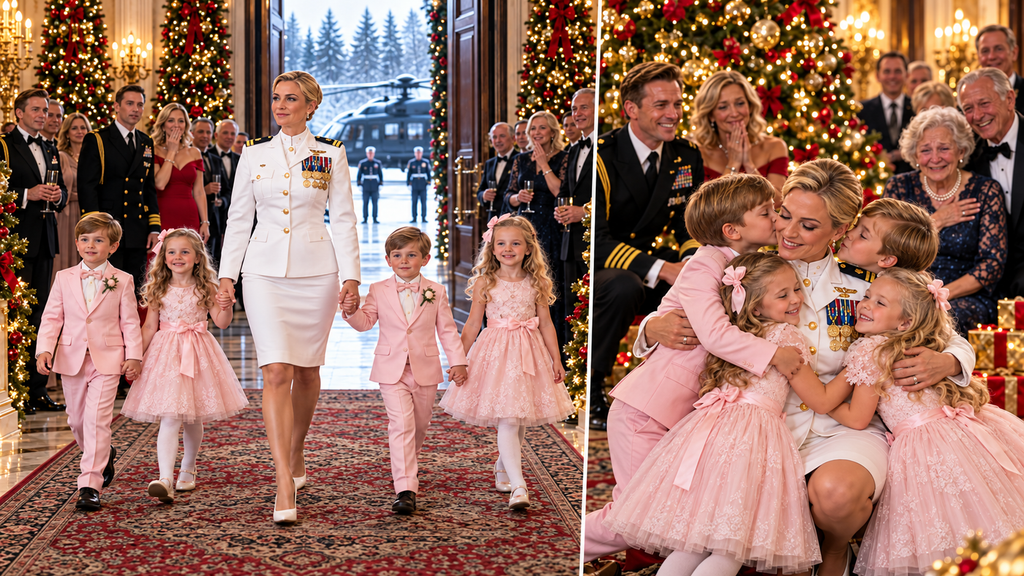
The engagement ring trembled between Daniel’s fingers.
And Margaret Reynolds, the woman who had spent decades protecting her family’s reputation, looked as though she had just seen a ghost.
I stood motionless, holding my daughters’ hands.
Noah was still waiting for an answer to his question.
“Are you our daddy?”
Four words.
Four innocent words that had somehow accomplished what eight years of anger, heartbreak, and silence never could.
They had stripped Colonel Daniel Reynolds of every carefully constructed lie.
Daniel looked at Noah.
Then at Ethan.
Then at Sophia and Olivia.
His face had gone completely pale.
“Kesha,” he whispered, “what have you done?”
I felt something cold settle inside my chest.
Not fear.
Not sadness.
Recognition.
There he was.
The same man who had abandoned me while I was pregnant.
The same man who had called my tears manipulation.
The same man who had told me that my unborn child would never interfere with his military career.
And now, standing before four beautiful children who carried his eyes, his smile, and his blood, his first question was still about himself.
What had I done?
I bent down beside Noah.
“Sweetheart,” I said gently, “why don’t you and your brother and sisters stay close to me for a moment?”
Noah frowned.
“But, Mom—”
“I know.”
I brushed a strand of hair from his forehead.
“I promise we’ll talk about everything.”
He nodded reluctantly.
Then I straightened.
And looked directly into Daniel’s eyes.
“What have I done?” I repeated quietly.
A bitter smile touched my lips.
“Daniel, I raised four children.”
His jaw tightened.
“I worked through sleepless nights, childhood illnesses, school meetings, birthday parties, and Christmas mornings.”
I took one step closer.
“I learned how to braid hair while answering emergency calls. I learned how to make four lunches before sunrise. I learned how to comfort four crying babies when I had no one to comfort me.”
The room was silent.
“And somehow, during all those years, I also built a career you once told me I wasn’t intelligent enough to have.”
Daniel swallowed.
“So, if you’re asking what I’ve done…”
I looked down at my children.
Then back at him.
“I’ve done everything you refused to do.”
A woman near the fireplace quietly covered her mouth.
Someone behind us whispered, “Good Lord.”
Daniel’s fiancée stepped away from him.
Her name, I would later discover, was Vanessa Whitmore.
She was thirty-two, came from a prominent military family, and had been engaged to Daniel for approximately forty-five seconds before my arrival interrupted his proposal.
She stared at the children.
Then at Daniel.
“You told me your former wife couldn’t have children.”
Daniel closed his eyes.
“Vanessa, please.”
“You told me she invented a pregnancy because she couldn’t accept the divorce.”
“It’s complicated.”
“No,” Vanessa said, her voice growing stronger. “Four eight-year-old children standing in front of you isn’t complicated.”
She pointed toward Noah.
“That’s your face.”
Daniel said nothing.
“Those are your eyes.”
Still nothing.
“And you knew?”
His silence answered her.
Vanessa slowly removed the diamond bracelet Daniel had given her.
She placed it on the marble table beside the engagement ring.
Then she stepped away.
But the real shock came from Margaret.
She was staring at me with an expression I had never seen on her face before.
Fear.
Not the fear of embarrassment.
Something deeper.
Something that seemed to have been waiting eight years to escape.
“Kesha,” she whispered, gripping my arm, “there’s something about your divorce you were never supposed to discover.”
Daniel lunged forward.
“Mother, stop talking!”
Margaret flinched.
And in that instant, I understood something important.
The powerful Reynolds family was not afraid of my children.
They were afraid of what my children might reveal.
I gently removed Margaret’s hand from my arm.
“What are you talking about?”
Her eyes filled with tears.
“Your divorce wasn’t what you thought it was.”
A cold sensation moved down my spine.
“What does that mean?”
Daniel stepped between us.
“Mother is confused. She’s been under considerable stress.”
Margaret stared at her son.
Then, slowly, she shook her head.
“No, Daniel.”
Her voice trembled.
“But for the first time in eight years, I am thinking clearly.”
She turned toward me.
“You didn’t abandon this family, Kesha.”
I frowned.
“I know that.”
“No.”
Margaret’s voice broke.
“You don’t understand.”
She looked at the four children.
Then whispered the words that changed everything.
“We were told your baby had died.”
For a moment, the entire world seemed to stop.
The Christmas music continued playing softly from hidden speakers.
Somewhere outside, snow brushed against the windows.
But I could hear nothing except those seven words.
We were told your baby had died.
I stared at Margaret.
“What?”
She began to cry.
“Daniel told us you lost the pregnancy shortly after the divorce.”
My hands went cold.
I looked toward Daniel.
He was staring at the floor.
Margaret continued.
“He said the doctors couldn’t save the baby. He said you blamed him for the miscarriage and refused to speak to anyone in the family.”
I felt my stomach twist.
“That never happened.”
“I know that now.”
“No,” I said, shaking my head. “You don’t understand. I was pregnant with four babies. Four. And they were born alive. Healthy enough to survive, despite arriving early.”
Margaret pressed a trembling hand against her chest.
“Four?”
Her gaze traveled across the children.
“All four?”
I nodded.
“All four.”
She let out a sound I will never forget.
It was not quite a sob.
Not quite a scream.
It sounded like something inside her had finally broken.
She sank into a nearby chair.
“Oh, my God.”
Daniel moved toward her.
“Mother, please. You’re making a scene.”
Margaret looked up.
And for the first time in my life, I saw her look at her only son with genuine disgust.
“A scene?”
Her voice rose.
“You told me my grandchild was dead.”
Daniel froze.
“You let me grieve a child who was alive.”
“Mother—”
“You watched me light a candle every Christmas.”
His mouth opened.
Nothing came out.
Margaret began trembling.
“For eight years, Daniel.”
She pressed her fingers against her lips.
“Every Christmas Eve, I lit a candle in the chapel because I believed there was a baby I would never meet.”
She looked toward my children.
“And all this time…”
Her voice dissolved.
“All this time, there were four.”
I felt tears gathering behind my eyes.
Not because I had forgiven her.
Not because eight years of silence could suddenly disappear.
But because I knew what it meant to grieve someone.
And I knew what it meant to discover that grief had been manufactured by someone you trusted.
Daniel turned toward the guests.
“I think everyone should return to dinner.”
Nobody moved.
He raised his voice.
“Now.”
A retired general near the fireplace folded his arms.
“I don’t believe this is your decision anymore, Colonel.”
Daniel’s expression hardened.
“General Whitmore, with respect—”
“Don’t.”
The older man’s voice was quiet.
But it carried unmistakable authority.
“Not another word until your mother finishes speaking.”
Vanessa stood beside her father, tears shining in her eyes.
Daniel looked around the room.
For the first time, he seemed to realize that rank, wealth, and family connections could not command people to forget what they had heard.
Then Margaret spoke again.
“There is something else.”
My heartbeat quickened.
Daniel’s head snapped toward her.
“Mother.”
She ignored him.
“Something your father discovered before he died.”
I stared at her.
General Richard Reynolds had died three years earlier.
He had been a decorated officer, respected throughout the military community.
He had also been a distant, intimidating man who rarely spoke to me without reminding me how fortunate I was to have married into his family.
“What did he discover?” I asked.
Margaret looked toward the staircase.
“Not here.”
Daniel moved quickly.
“No.”
Margaret rose.
“I’m taking Kesha to your father’s study.”
“Absolutely not.”
“Daniel.”
She straightened her shoulders.
For a moment, she looked exactly like the commanding military wife I remembered.
“This is still my house.”
Daniel’s face darkened.
“And I am still your son.”
Margaret’s reply was barely louder than a whisper.
“That is what I am beginning to regret.”
The room went completely silent.
Then she turned to me.
“Come with me, Kesha.”
I hesitated.
My children were watching everything.
Sophia’s little fingers tightened around mine.
“Mommy?”
I immediately knelt.
“Yes, sweetheart?”
“Why is everybody upset?”
I swallowed.
Because how do you explain eight years of betrayal to an eight-year-old child standing beneath a Christmas tree?
How do you tell four children that the adults around them have built their lives on secrets?
I forced my voice to remain gentle.
“Sometimes grown-ups discover that something they believed wasn’t true.”
Olivia frowned.
“Like when Ethan said he didn’t eat the cookies, but he had chocolate on his face?”
Despite everything, I almost laughed.
“Yes, baby.”
I kissed her forehead.
“Something like that.”
Ethan protested.
“That was one time.”
Noah folded his arms.
“Two times.”
“Not helping,” Ethan muttered.
A small ripple of nervous laughter moved through the room.
For a few seconds, my children reminded everyone that they were exactly what they appeared to be.
Children.
Not evidence.
Not weapons.
Not symbols of revenge.
Just four little people who had come to Christmas hoping to meet their grandparents.
I stood.
“Lena?”
My assistant had accompanied us on the trip and was waiting discreetly near the entrance with the security liaison who had coordinated our authorized travel.
She stepped forward immediately.
“Yes, Commander?”
“Would you mind staying with the children?”
“Of course.”
I turned to my four.
“Stay with Officer Brooks. I’ll be right back.”
Noah glanced toward Daniel.
“Mom?”
“Yes?”
“Is he really our father?”
I looked at Daniel.
He looked away.
That simple movement hurt more than I expected.
I returned my attention to Noah.
“Yes, sweetheart.”
Noah became very still.
“He is.”
My son looked toward the tall man in uniform.
Then he asked softly, “Does he know our names?”
Daniel’s face changed.
It was only a flicker.
But I saw it.
Shame.
Real shame.
For perhaps the first time in his life.
I waited.
Giving him the opportunity to answer.
He opened his mouth.
Then closed it.
Noah’s shoulders dropped.
I felt something inside me harden.
I touched my son’s cheek.
“He will learn them,” I said.
Then I turned and followed Margaret upstairs.
And behind us, Daniel shouted something that made every step feel heavier.
“Mother, if you open that safe, you will destroy this family!”
Margaret stopped on the staircase.
She turned slowly.
“No, Daniel.”
Her voice was steady now.
“You did that eight years ago.”
THE SAFE BEHIND THE GENERAL’S PORTRAIT
The second-floor corridor smelled of polished wood, old books, and the faint pine fragrance drifting upward from the Christmas decorations.
I remembered walking these halls as a young bride.
Back then, I had felt like an outsider in a museum.
Every painting seemed expensive.
Every piece of furniture carried a story about someone important.
Every conversation revolved around rank, legacy, and the Reynolds name.
I had spent years trying to become worthy of that name.
Now I was walking through the same corridor wearing a uniform I had earned without their help.
Margaret stopped before a heavy oak door.
“My husband’s study.”
She hesitated.
“Daniel hasn’t been allowed inside since Richard died.”
That surprised me.
“Why?”
She looked at me.
“Because Richard no longer trusted him.”
She opened the door.
The room was exactly as I remembered.
Floor-to-ceiling bookshelves.
A massive mahogany desk.
Military photographs covering one wall.
And above the fireplace, a large portrait of General Richard Reynolds in dress uniform.
Margaret crossed the room.
Her movements were slow but determined.
“Richard was not an easy man,” she said.
I remained silent.
“He could be proud. Cold. Unfair.”
She looked at me.
“I know he made you feel unwelcome.”
I gave a small, humorless smile.
“He once told me I should be grateful Daniel had overlooked my ordinary background.”
Margaret lowered her eyes.
“Yes.”
She stood before the portrait.
“But near the end of his life, he began questioning things he had once accepted without thinking.”
She reached behind the frame.
There was a soft click.
The portrait shifted slightly.
Behind it was a wall safe.
My heart began pounding.
Margaret entered a code.
The lock released.
Inside were several folders, a small leather-bound notebook, and a sealed envelope.
She removed the envelope.
My name was written across the front.
Kesha Reynolds.
I recognized the handwriting.
General Richard Reynolds.
Margaret handed it to me.
“Richard told me that if you ever returned, I was to give you this.”
I stared at the envelope.
“Why didn’t you contact me?”
Her face crumpled.
“Because Daniel told us you wanted nothing to do with the family. He said you had remarried and moved overseas.”
I shook my head.
“I lived in Texas.”
“I know.”
“Under the same name.”
Tears slipped down her cheeks.
“I know that now.”
I looked at the envelope again.
Then broke the seal.
Inside was a handwritten letter.
The first line made my breath catch.
Dear Kesha,
If you are reading this, then I have failed to correct a terrible injustice while I was alive.
I gripped the paper.
Margaret stood beside me, saying nothing.
I continued reading.
I owe you an apology.
When you married Daniel, I judged you by your background rather than your character. I assumed my son possessed the same principles I spent my life claiming to uphold.
I was wrong.
My vision blurred.
I blinked hard and kept reading.
Three years after your divorce, I discovered documents indicating that Daniel had misrepresented the circumstances of your separation.
At first, I believed he had merely behaved dishonorably as a husband.
Then I learned there was more.
I stopped.
Looked at Margaret.
“What more?”
She pointed toward the leather notebook.
“Keep reading.”
I returned to the letter.
During a review of family financial records, I found evidence that Daniel had used my name and authority to interfere with funds intended for you.
My breath caught.
Funds?
What funds?
When I confronted him, he claimed you had signed away all rights voluntarily. But the signatures on several documents did not match the samples I had retained.
I felt the floor tilt beneath me.
The divorce.
The settlement.
The strange documents my attorney had questioned.
The sudden disappearance of money from our joint savings.
All those years ago, I had been too exhausted and frightened to fight every financial detail.
I had been pregnant.
Alone.
Trying to survive.
I had accepted a settlement that left me with almost nothing because Daniel’s attorneys insisted there was nothing more to claim.
But now…
I read the next paragraph.
I retained copies of the records and consulted an independent attorney. Before I could complete the process, my health deteriorated.
I do not know whether Daniel will ever admit what he did.
But I know this: the truth belongs to you.
The letter ended with words I never expected from Richard Reynolds.
You were a better member of this family than we deserved.
I hope one day you can forgive my blindness.
Richard.
I lowered the letter.
For several seconds, I couldn’t speak.
Then I asked the question that had begun burning inside me.
“What funds?”
Margaret opened the leather notebook.
“Richard established a family trust when Daniel was born.”
I frowned.
“I knew about that.”
“But you didn’t know everything.”
She turned several pages.
“When Daniel married, Richard created a separate provision for any children of that marriage.”
My stomach tightened.
“Children?”
Margaret nodded.
“Richard wanted his grandchildren to have educational security regardless of what happened between their parents.”
She took a breath.
“The provision was supposed to become active once a child was born.”
I stared at her.
“And Daniel knew?”
“Yes.”
My fingers tightened around the letter.
“How much?”
Margaret hesitated.
Then gave me the figure.
“Originally, two million dollars was allocated to the descendants’ trust.”
I felt my heart slam against my ribs.
Two million dollars.
I thought of the apartment where I had brought four premature babies home.
The hospital bills.
The nights I had calculated whether I could afford another package of diapers.
The secondhand cribs.
The overtime shifts.
The mornings I had cried quietly in the bathroom because I was afraid I would not be strong enough to raise four children alone.
Two million dollars.
Money that had been intended for my children’s future.
I looked at Margaret.
“What happened to it?”
Her voice became barely audible.
“Daniel persuaded Richard that the pregnancy had ended.”
I closed my eyes.
“And the money?”
“Daniel requested that the provision be redirected into another family investment account.”
I stared at her.
“His account?”
She nodded.
A cold anger rose through me.
Not the explosive anger I had once felt when Daniel walked away.
This was different.
Quieter.
Sharper.
The kind of anger that makes your thoughts suddenly become very clear.
“Did Richard approve it?”
“He did, based on what Daniel told him.”
“And when Richard discovered the truth?”
“He tried to reverse the transaction.”
I looked at the documents.
“Did he succeed?”
Margaret shook her head.
“Not completely.”
Then she opened another folder.
Inside were bank records, attorney correspondence, and copies of several signed agreements.
One document bore my signature.
Except it wasn’t mine.
I knew immediately.
The curve of the K was wrong.
The final stroke of my surname was too short.
And the date—
I stopped breathing.
The document was dated the same day I had been hospitalized with severe complications during my pregnancy.
I remembered that day.
I had been admitted for observation after experiencing contractions far too early.
I had spent the afternoon attached to monitors, terrified that I might lose my babies.
I had not been in Colorado.
I had not visited an attorney.
And I certainly had not signed away anything.
“This is forged,” I whispered.
Margaret nodded.
“Richard believed so.”
I stared at the paper.
Then I noticed something else.
A witness signature.
A familiar name.
Martin Vale.
Daniel’s closest friend.
His former military colleague.
The man who had stood beside him at our wedding.
The same man who had later told me that accepting the divorce quietly would be best for everyone.
My hands began shaking.
“Oh, my God.”
Margaret watched me.
“What is it?”
I looked at her.
“Martin Vale was the witness.”
“Yes.”
“He told me Daniel had nothing left to give me.”
Margaret lowered her eyes.
“I know.”
I looked back at the document.
And suddenly, eight years of memories rearranged themselves.
Daniel insisting that I sign documents quickly.
Martin appearing at meetings that should have involved only attorneys.
Financial records disappearing.
My questions being dismissed as emotional instability.
And Daniel telling me, again and again, that no judge would believe a pregnant woman who was desperate to save her marriage.
I had thought he was cruel.
I had never imagined he was calculating.
Then Margaret reached into the safe once more.
“There is one final thing.”
She removed a small digital recorder.
My stomach tightened.
“What is that?”
“Richard recorded his last conversation with Daniel.”
I stared at it.
“Why?”
“Because by then, he no longer trusted his son to tell the truth.”
Margaret pressed the power button.
A small light blinked.
Then General Richard Reynolds’s voice filled the quiet room.
“Daniel, I am asking you one final time. Did Kesha sign those documents?”
Silence.
Then Daniel’s voice.
Younger.
Sharper.
I recognized it instantly.
“Father, we’ve been through this.”
“Answer the question.”
A long pause.
Then Daniel said something that made my blood turn cold.
“She wasn’t going to cooperate.”
I gripped the edge of the desk.
Richard’s voice grew stern.
“So you signed for her?”
Daniel exhaled impatiently.
“It was necessary.”
“Necessary?”
“She was pregnant, emotional, and threatening my future.”
My knees nearly gave way.
Richard shouted.
“You forged your wife’s signature?”
Daniel answered with chilling calm.
“I protected this family.”
There was a loud sound.
Perhaps Richard striking the desk.
Then the general spoke.
“You have confused protecting this family with protecting yourself.”
The recording crackled.
Daniel’s voice returned.
“She doesn’t need the money. She has a job.”
“And the child?”
Another pause.
Then Daniel said the sentence I would remember for the rest of my life.
“There isn’t going to be a child in my life, Father. I’ve made sure of that.”
The recording ended.
I stood completely still.
My chest hurt.
I had known Daniel rejected our children.
I had known he walked away.
But hearing him speak about an unborn baby as though it were an obstacle to be eliminated from his future…
That was something else.
Margaret began crying softly.
“I should have questioned him.”
I looked at her.
“Yes.”
She flinched.
I didn’t soften the truth.
“You should have.”
Her tears continued.
“I know.”
I placed the recorder on the desk.
Then I looked toward the door.
“We need to go downstairs.”
Margaret seemed startled.
“Now?”
“Yes.”
“But Daniel—”
“Daniel has spent eight years deciding what everyone else is allowed to know.”
I picked up the documents.
“That ends today.”
THE MAN WHO THOUGHT HIS UNIFORM MADE HIM UNTOUCHABLE
When we returned to the ballroom, the atmosphere had changed.
The music was off.
The guests were gathered in uneasy clusters.
Vanessa stood near the fireplace with her father.
Daniel was speaking urgently to Martin Vale.
I stopped.
Martin.
Of course.
He had apparently been invited to Christmas dinner.
The same man whose signature appeared on the forged agreement.
He wore an expensive charcoal suit and held a glass of whiskey.
When he noticed me carrying the folder, his expression changed.
Only for a moment.
But I saw it.
Recognition.
Then fear.
Daniel turned.
“What did she give you?”
I walked toward him.
“An explanation.”
His eyes dropped to the folder.
His jaw tightened.
“Those are private family documents.”
I almost laughed.
“Private?”
I held up the agreement.
“Is that what we’re calling forged signatures now?”
Several guests gasped.
Martin set down his glass.
Daniel’s face reddened.
“You have no idea what you’re talking about.”
“Then explain this.”
I held the document in front of him.
“My signature. On a date when I was hospitalized in Texas.”
He glanced at it.
Then looked away.
“That’s not how I remember it.”
I stepped closer.
“Fortunately, memories aren’t the only evidence.”
Martin moved forward.
“Kesha, perhaps we should discuss this privately.”
I turned toward him.
“Martin.”
He forced a smile.
“It’s been a long time.”
“Yes.”
I held up the paper.
“Eight years.”
His eyes flickered toward the witness signature.
I watched him carefully.
“You remember this document?”
He hesitated.
“I’m not sure.”
“Really?”
“It’s been years.”
I nodded.
“Then perhaps a forensic document examiner can help refresh your memory.”
His smile disappeared.
Daniel stepped between us.
“Enough.”
I looked at him.
“No.”
He lowered his voice.
“You’re embarrassing yourself.”
That sentence.
Those exact words.
He had used them so many times during our marriage.
Whenever I disagreed with him.
Whenever I questioned a decision.
Whenever I refused to smile through something that hurt.
You’re embarrassing yourself.
For eight years, I had imagined what I might say if he ever used those words again.
Now, strangely, I felt calm.
“Daniel,” I said, “look around.”
He glanced toward the silent guests.
“I’m not the one being embarrassed.”
His nostrils flared.
“You think your title gives you the right to come into my mother’s home and accuse me of crimes?”
“No.”
I held his gaze.
“My title has nothing to do with this.”
I touched the folder.
“The evidence does.”
Vanessa approached.
“What crimes?”
Daniel turned sharply.
“Vanessa, stay out of this.”
She stopped.
Then looked at him with a strange expression.
“That’s what you said when I asked about your divorce.”
He said nothing.
“That’s what you said when I asked why your first marriage ended.”
She swallowed.
“And that’s what you said when I asked whether you had ever wanted children.”
Daniel’s eyes narrowed.
“This is between me and Kesha.”
Vanessa shook her head.
“No, Daniel.”
She looked toward the four children, who were now sitting near the Christmas tree with Lena.
“This stopped being only about the two of you a long time ago.”
I followed her gaze.
Olivia was showing Lena a small drawing she had made during the flight.
Sophia was arranging cookies on a plate.
Ethan was trying to balance a candy cane across his upper lip.
And Noah—
Noah was watching Daniel.
Quietly.
Carefully.
My heart twisted.
He had spent years wondering about his father.
And now that the man was finally standing in front of him, Noah seemed afraid to approach.
I knew that look.
I had seen it when he was younger and watched other fathers picking up their children from school.
The hope.
The confusion.
The silent question.
Why not me?
I turned back to Daniel.
“We need to discuss the children.”
He folded his arms.
“Fine.”
I waited.
He glanced toward them.
Then said, “Obviously, I’ll require a paternity test.”
The words landed heavily.
Margaret gasped.
Vanessa closed her eyes.
I felt the old pain stir.
But this time, it did not control me.
“Of course,” I said.
Daniel looked surprised.
“You agree?”
“Yes.”
I reached into my bag and removed a slim envelope.
“I anticipated that.”
His expression changed.
I handed him the envelope.
“During my pregnancy, you repeatedly questioned whether you were the father. After the children were born, I preserved the relevant medical records. More recently, I obtained legally documented genetic testing with appropriate consent.”
Daniel stared at the envelope.
“The results?”
“Consistent with you being their biological father.”
He looked at me.
I continued.
“You can seek independent court-supervised confirmation. I won’t object.”
He swallowed.
Then opened the envelope.
His eyes moved across the page.
His face drained of color.
Vanessa watched him.
“Well?”
Daniel didn’t answer.
She stepped closer.
“Daniel.”
He lowered the paper.
And whispered, “They’re mine.”
The room went silent.
I looked at him.
“Yes.”
My voice shook despite my effort to remain steady.
“They always were.”
Margaret covered her mouth.
Tears streamed down her cheeks.
Daniel stared toward the children.
For the first time, he seemed to see them as individuals rather than a threat.
Noah, serious and protective.
Ethan, restless and curious.
Sophia, gentle but observant.
Olivia, imaginative and fearless.
Four lives.
Four personalities.
Four childhoods he had missed.
He looked back at me.
“Why didn’t you tell me there were four?”
The question almost took my breath away.
“Why didn’t I tell you?”
He looked defensive.
“You knew how to contact my family.”
I nodded slowly.
“Yes.”
Then I reached into the folder.
And removed another set of papers.
“I tried.”
Daniel froze.
I held up copies of letters.
“Three letters during my pregnancy.”
I placed them on the table.
“Two after the children were born.”
Another document.
“Certified notices sent through my attorney.”
Another.
“Photographs from their first birthday.”
I looked directly at him.
“Every single one was returned, rejected, or left unanswered.”
Margaret stared at the documents.
“I never saw those.”
“I know.”
Daniel’s face tightened.
I continued.
“After the first year, my attorney advised me that continued attempts were causing unnecessary distress. You had made your position clear.”
I swallowed.
“And I had four children who needed a mother more than they needed me chasing a man who didn’t want them.”
Daniel looked at the letters.
His expression flickered.
Then he said quietly, “I didn’t know.”
I stared at him.
For one moment, I almost believed he meant it.
Then I noticed Martin.
He was staring at the letters with a look of absolute terror.
I turned toward him.
“Martin?”
He looked up sharply.
“Yes?”
“Did you handle Daniel’s correspondence during his overseas assignment?”
His lips parted.
Daniel moved.
“Kesha, don’t.”
I ignored him.
“Martin.”
My voice sharpened.
“Did you?”
Martin looked toward Daniel.
Then away.
Finally, he nodded.
“Some of it.”
I felt the pieces sliding into place.
“Did you receive my letters?”
He said nothing.
“Martin.”
His shoulders slumped.
“Yes.”
Margaret let out a small cry.
I stared at him.
“And what did you do with them?”
He swallowed.
“I gave them to Daniel.”
The room seemed to contract around us.
Slowly, I turned toward my former husband.
Daniel was staring at Martin with murderous fury.
I whispered, “You knew.”
Daniel said nothing.
“You knew they had been born.”
His jaw worked.
“Kesha—”
“You knew.”
My voice broke.
“You knew I was alive. You knew the children were alive. You knew I was trying to reach you.”
He looked down.
And that was the answer.
Not a confession.
Not an apology.
Just a coward’s silence.
I felt tears spill down my cheeks.
I hated that they came.
I hated that after eight years, he could still make me cry.
But I refused to wipe them away.
“You knew,” I repeated.
Daniel finally looked at me.
“Yes.”
One word.
Eight years of questions answered in one word.
“Yes.”
I stepped backward.
My knees felt weak.
Margaret reached toward me, but I shook my head.
“No.”
I needed to stand on my own.
I had done it for eight years.
I could do it now.
Daniel’s voice dropped.
“I wasn’t ready to be a father.”
I stared at him.
“Neither was I.”
He flinched.
“I was twenty-six years old, Daniel.”
My voice trembled.
“I had four premature babies. Four. I didn’t know how I was going to survive the first week.”
He looked away.
“I was terrified.”
I took a breath.
“But I stayed.”
The words hung between us.
“I stayed.”
THE FIRST CHRISTMAS PRESENT
It was Sophia who interrupted us.
“Mommy?”
I turned immediately.
She stood several feet away, holding a small wrapped package.
Her pink ribbon had come loose.
Her eyes were wide.
“Can I give Grandma her present now?”
For a moment, I couldn’t move.
Then I knelt.
“Of course, sweetheart.”
Sophia approached Margaret.
The older woman looked stunned.
“For me?”
Sophia nodded.
“We made presents for everybody.”
She held out the package.
“Mom said we should be polite, even if people are nervous.”
A fragile smile crossed Margaret’s face.
“Your mother is a very wise woman.”
Sophia shrugged.
“She says that sometimes.”
Despite the tears, I laughed.
Margaret accepted the package with trembling hands.
She carefully removed the paper.
Inside was a small handmade ornament.
Four tiny fingerprints formed the petals of a flower.
In the center, written in uneven children’s handwriting, were the words:
Merry Christmas, Grandma. Love, Noah, Ethan, Sophia, and Olivia.
Margaret stared at it.
Her lips trembled.
Then she began crying so hard she could barely breathe.
Sophia looked alarmed.
“Did I do it wrong?”
Margaret shook her head quickly.
“No, darling.”
She reached for Sophia’s hand.
“No. It’s beautiful.”
Sophia smiled.
“We made one for Grandpa too.”
Margaret’s face crumpled.
I felt a sharp ache in my chest.
General Richard Reynolds had died without ever knowing he had four grandchildren.
He had spent his final years believing he was correcting an injustice involving a child who had never survived.
And now four children stood in his home, carrying a gift for a grandfather they would never meet.
Sophia looked around.
“Where is Grandpa?”
Margaret pressed the ornament against her heart.
“Oh, sweetheart.”
She glanced at me.
I nodded gently.
Margaret knelt as carefully as her aging knees allowed.
“Your grandfather passed away a few years ago.”
Sophia’s smile faded.
“Oh.”
She thought for a moment.
“Did he go to heaven?”
Margaret nodded through tears.
“I hope so.”
Sophia looked down at the second ornament in her hand.
Then she whispered, “Can we put his present somewhere he can see it?”
Margaret made a sound somewhere between a laugh and a sob.
“Yes, darling.”
She stood.
Then looked toward the Christmas tree.
“We can put it right at the top.”
Sophia smiled again.
“Good.”
She handed Margaret the ornament.
And for one brief moment, the ballroom stopped being a battlefield.
It became a room full of people watching an eight-year-old girl offer kindness to a grandmother who had never known she existed.
I looked at Daniel.
He was staring at Sophia.
His face was unreadable.
Then Noah approached.
He carried another small package.
He stopped in front of Daniel.
For several seconds, neither spoke.
Finally, Noah held out the gift.
“This is yours.”
Daniel stared at it.
“What?”
Noah swallowed.
“Your Christmas present.”
Daniel looked at me.
I said nothing.
He slowly accepted the package.
Inside was a simple wooden keychain.
Noah had painted it blue.
On one side were the words:
DAD.
On the other:
FROM NOAH.
Daniel stared at it.
His fingers began trembling.
Noah shifted his weight.
“I made it before we came.”
Daniel looked at him.
“You did?”
Noah nodded.
“Mom said we might meet you.”
He hesitated.
“I didn’t know what you liked.”
Daniel swallowed.
“So I made something that says Dad.”
A long silence followed.
Then Noah asked the question that broke my heart all over again.
“Do you want it?”
Daniel looked at the keychain.
Then at his son.
His eyes filled with tears.
“Yes,” he whispered.
Noah’s shoulders relaxed.
“Okay.”
He turned to walk away.
But Daniel spoke.
“Noah.”
My son stopped.
Daniel crouched awkwardly.
“Thank you.”
Noah studied him.
Then asked, “Why didn’t you come before?”
The room fell silent again.
Daniel’s face tightened.
He looked toward me.
I didn’t rescue him.
This was his question to answer.
His responsibility.
His truth.
Daniel swallowed.
“I made a terrible mistake.”
Noah frowned.
“For eight years?”
The words struck with devastating precision.
Daniel closed his eyes.
“Yes.”
Noah looked down.
Then whispered, “That’s a really long mistake.”
And walked back to his brother and sisters.
Daniel remained crouched beside the fireplace, holding a wooden keychain worth perhaps three dollars.
A man who owned luxury vehicles, expensive watches, and property across several states.
A man who had once measured his importance by medals and titles.
And he was staring at the cheapest gift in the room as though it had exposed the true cost of everything he had lost.
THE WOMAN DANIEL PLANNED TO MARRY
Vanessa approached me while Margaret helped the children hang their ornaments.
“Kesha?”
I turned.
She looked exhausted.
Her carefully styled blonde hair had loosened around her face.
Her eyes were red.
“May I speak with you?”
I nodded.
“Of course.”
She glanced toward Daniel.
“Somewhere private?”
We moved into a smaller sitting room adjoining the ballroom.
For a moment, neither of us spoke.
Then Vanessa looked at me.
“I owe you an apology.”
I shook my head.
“You didn’t know.”
“That’s not entirely true.”
I studied her.
She took a shaky breath.
“I knew there were things Daniel wouldn’t discuss.”
She sat on the edge of a sofa.
“He told me you were unstable after the divorce.”
I felt my jaw tighten.
“He said you threatened his career. That you fabricated stories. That you tried to use a pregnancy to force him to stay.”
I looked away.
Even after eight years, hearing those lies repeated hurt.
Vanessa continued.
“I believed him.”
She wiped her cheeks.
“Because he was charming. Respected. Decorated. Everyone told me what an honorable man he was.”
I sat opposite her.
“Daniel is very good at making people believe the version of himself he wants them to see.”
Vanessa nodded.
“I see that now.”
She hesitated.
“There’s something else.”
I looked at her.
“What?”
Her hands twisted together.
“Daniel told me he couldn’t have children.”
I stared at her.
“What?”
“He said a medical condition had made fatherhood impossible.”
For a moment, I almost laughed.
The absurdity was overwhelming.
“Vanessa.”
She looked at me.
“Four children just walked through that door.”
“I know.”
She gave a broken smile.
“I know.”
Then her expression changed.
“But that’s not what frightens me most.”
I leaned forward.
“What does?”
She reached into her handbag.
And removed a folded document.
“I found this in Daniel’s desk last month.”
She handed it to me.
I unfolded the paper.
It was a financial statement.
Several transfers.
An investment company.
A name I recognized.
Vale Strategic Holdings.
Martin Vale.
I looked up.
“Where did you get this?”
“Daniel asked me to organize some documents for a mortgage application.”
She swallowed.
“I noticed payments that didn’t make sense.”
I scanned the page.
The amounts were substantial.
Hundreds of thousands of dollars.
Some transfers dated back several years.
Others were recent.
“Did you ask him about them?”
Vanessa nodded.
“He said they were consulting fees.”
“Consulting for what?”
“He wouldn’t explain.”
I looked at the company name again.
Vale Strategic Holdings.
The man who had witnessed my forged signature.
The man who had handled my letters.
The man who had helped Daniel erase me from his life.
And now money was moving through his company.
I felt the familiar instincts of an investigator beginning to sharpen.
But I reminded myself that this was a personal matter, not an official case I had authority to investigate.
I would not misuse my position.
I would preserve what Vanessa voluntarily shared and let independent counsel and appropriate authorities determine what it meant.
“Vanessa,” I said carefully, “would you be willing to provide this to an attorney?”
She nodded immediately.
“Yes.”
“Are you certain?”
Her eyes hardened.
“Daniel asked me to marry him in front of his entire family.”
She looked toward the ballroom.
“He planned to begin our marriage with a lie.”
Her voice trembled.
“I won’t help him continue it.”
I studied her.
Then nodded.
“Thank you.”
She hesitated.
“Kesha?”
“Yes?”
“Did you ever love him?”
The question caught me off guard.
I looked toward the window.
Snow drifted across the estate grounds.
For a moment, I saw myself eight years earlier.
Twenty-six.
Pregnant.
Terrified.
Still believing that if I loved Daniel enough, he might become the man I needed.
“Yes,” I said quietly.
“I loved him very much.”
Vanessa lowered her eyes.
“Do you still?”
I thought about it.
Then shook my head.
“No.”
The answer surprised me with its certainty.
“I love the children we created. I mourn the family we could have had. But the man I loved was partly someone I imagined.”
I looked back at her.
“And I don’t miss living inside that illusion.”
Vanessa nodded slowly.
Then whispered, “I think I understand.”
THE CALL THAT CHANGED EVERYTHING
By late afternoon, the estate had emptied of most guests.
Some left quietly.
Others offered awkward apologies.
A few embraced Margaret before departing.
General Whitmore stayed long enough to speak privately with his daughter.
Daniel had disappeared into another wing of the mansion.
Martin Vale was nowhere to be seen.
That troubled me.
I found Lena near the staircase.
“Have you seen Martin?”
She shook her head.
“He left about twenty minutes ago.”
“Did he say where he was going?”
“No.”
I glanced toward the front windows.
A dark sedan was pulling away from the estate.
Something about the timing bothered me.
But I had no authority to stop him, and suspicion alone was not proof of wrongdoing.
I called my personal attorney, Rachel Mercer.
Rachel had helped me navigate several difficult legal matters over the years.
She was practical, intelligent, and unimpressed by powerful surnames.
She answered on the third ring.
“Kesha? Merry Christmas.”
“Rachel, I need your help.”
Her tone changed immediately.
“What happened?”
I looked toward the ballroom.
“Remember the financial irregularities we discussed after my divorce?”
A pause.
“Yes.”
“I think I finally found the missing documents.”
Another pause.
Then Rachel said, “Tell me everything.”
For the next twenty minutes, I explained the letter, the alleged forgery, the trust provision, and the recording.
Rachel listened without interrupting.
When I finished, she exhaled slowly.
“Kesha, this could be significant.”
“I know.”
“But we need to handle it carefully. Preserve the originals, document where they came from, and have independent counsel review the trust records.”
“Agreed.”
“And don’t confront anyone else about the financial documents until we know exactly what we’re dealing with.”
I glanced toward the staircase.
“That may be difficult.”
“Kesha.”
Her voice became firm.
“I know you’re an investigator. But this is your family. You need to be the client, not the detective.”
I closed my eyes.
She was right.
“I understand.”
“Good.”
She paused.
“And the children?”
My throat tightened.
“They met him.”
Rachel said nothing.
“They gave him Christmas presents.”
A long silence followed.
Then she asked softly, “How are they?”
I looked toward the tree.
Ethan was laughing.
Sophia was helping Margaret arrange ornaments.
Olivia had fallen asleep against Lena’s shoulder.
Noah sat quietly near the fireplace.
“Confused,” I whispered.
Rachel’s voice softened.
“Then that’s where your attention belongs tonight.”
I swallowed.
“Yes.”
“We’ll deal with the documents. You take care of your babies.”
After the call, I stood alone for a moment.
Then my phone vibrated.
An unfamiliar number.
A text message.
You should leave the estate before dinner. There are things you don’t understand.
I stared at the screen.
Another message appeared.
Your children are safer away from the Reynolds family.
My blood ran cold.
I immediately showed the messages to Lena.
She read them.
Her expression sharpened.
“Do you recognize the number?”
“No.”
“Could be a threat.”
“Or a warning.”
I looked toward the windows.
Outside, the sun was beginning to sink behind the mountains.
The snow had grown heavier.
I had brought my children here expecting an uncomfortable reunion.
I had not expected financial fraud allegations, hidden recordings, or anonymous messages.
I made a decision.
“We’re leaving.”
Lena nodded.
“I’ll coordinate the ground transportation.”
Our earlier helicopter arrival had been part of a separately authorized departmental itinerary, not a personal aircraft placed at my disposal. For the return, I had arranged private ground travel to our hotel, with our onward trip scheduled for the next morning.
I wasn’t going to turn a family crisis into an official operation.
And I wasn’t going to keep my children in a house where the adults had lost control of their own secrets.
But before we could leave, Margaret appeared.
“Kesha?”
I turned.
She looked frightened.
“There’s someone here asking for you.”
“Who?”
Margaret swallowed.
“A woman.”
I frowned.
“What woman?”
She glanced toward the front entrance.
Then whispered a name I hadn’t heard in eight years.
“Dr. Evelyn Carter.”
My heart stopped.
Dr. Carter.
The obstetrician who had treated me during the early months of my pregnancy.
The doctor who had suddenly transferred out of state shortly after Daniel filed for divorce.
I stared at Margaret.
“Why is she here?”
Margaret shook her head.
“I don’t know.”
Then she said something that made my skin prickle.
“She told the security guard that if Daniel is still in this house, she needs to speak with you before he finds out she’s arrived.”
THE DOCTOR WHO DISAPPEARED
Dr. Evelyn Carter stood in the entrance hall wearing a long gray coat.
Her dark hair had turned silver at the temples.
She looked older than I remembered.
But her eyes were the same.
Kind.
Intelligent.
And deeply troubled.
“Kesha.”
Her voice trembled.
I stared at her.
“Dr. Carter?”
She stepped forward.
For a moment, she seemed unsure whether to embrace me.
Then she said, “I’ve wanted to speak to you for years.”
I felt my heartbeat quicken.
“About what?”
She looked toward Margaret.
“Is there somewhere private?”
We moved into the library.
Lena remained near the door.
Dr. Carter sat down heavily.
“I heard about the children.”
I frowned.
“How?”
“Margaret called me.”
I turned toward Daniel’s mother.
She lowered her eyes.
“I called her after you arrived. I remembered she had been your doctor.”
Dr. Carter looked at me.
“I knew you were pregnant when you left Colorado.”
I nodded.
“Yes.”
“But I didn’t know you were carrying quadruplets.”
“That was discovered later.”
She closed her eyes.
“I suspected there was more to your situation than Daniel told us.”
My stomach tightened.
“What did he tell you?”
She hesitated.
Then looked directly at me.
“That you were seeking medical documentation to support a false claim of pregnancy.”
I stared at her.
“What?”
“He contacted the clinic after your final appointment.”
My fingers went numb.
“He said you were threatening him with fabricated medical records.”
I shook my head.
“That’s insane.”
“I know.”
She leaned forward.
“Kesha, I refused to release anything to him without your authorization.”
I felt a small wave of relief.
“Thank you.”
“But several weeks later, someone attempted to obtain your records through an administrative request.”
I frowned.
“Who?”
She reached into her handbag.
And removed a folder.
“I retained copies of the correspondence because the request was irregular.”
I opened it.
The first page contained a letter bearing a law firm’s name.
The second contained a request for medical information.
The third—
I froze.
A signed authorization.
My signature.
Except, once again, it wasn’t mine.
I stared at the page.
“Oh, my God.”
Dr. Carter nodded.
“I believed it was fraudulent.”
“Did you report it?”
“Yes. The clinic’s compliance office rejected the request and documented the incident.”
I looked up.
“Why didn’t you contact me?”
“I tried through the number on file, but it had been disconnected. The address was no longer current.”
I remembered.
Daniel had canceled our shared phone plan during the divorce.
I had moved shortly afterward.
Everything had happened so quickly.
Dr. Carter continued.
“I left the clinic several months later. I never knew what became of you.”
I looked at the document.
Then asked quietly, “Why are you here now?”
Her expression changed.
“Because the same law firm contacted me again two weeks ago.”
My stomach tightened.
“About me?”
She nodded.
“They asked whether I would be willing to sign a statement confirming that your pregnancy had been medically unverified.”
I stared at her.
“Eight years later?”
“Yes.”
“Why?”
“I asked the same question.”
She took a breath.
“They said it was needed for a pending family trust matter.”
The room went silent.
I slowly turned toward Margaret.
Her face had gone white.
Dr. Carter continued.
“I refused. I told them I would not sign anything inaccurate.”
I looked back at her.
“What happened then?”
She hesitated.
“Someone offered me money.”
I felt cold.
“How much?”
“Fifty thousand dollars.”
Margaret gasped.
Dr. Carter’s voice shook.
“To sign a false statement.”
I stared at her.
“Who made the offer?”
She looked down.
Then whispered.
“Martin Vale.”
The name seemed to echo through the room.
Martin.
Again.
The forged settlement.
The intercepted letters.
The financial transfers.
And now an attempt to obtain a false medical statement.
I sat back.
For the first time, I understood that the events unfolding around us might not be merely the consequences of an old betrayal.
Someone had been actively trying to preserve the lie.
Recently.
Very recently.
I looked at Margaret.
“Why would they need a false statement now?”
She shook her head.
“I don’t know.”
But I could see that she was thinking.
Then her eyes widened.
“The trust.”
I leaned forward.
“What about it?”
Margaret pressed a hand against her chest.
“Richard’s trust has a distribution review scheduled for January.”
My heartbeat quickened.
“And?”
“Certain funds are supposed to be transferred permanently to Daniel’s control if no eligible descendants make a claim.”
I stared at her.
“How much?”
Margaret hesitated.
Then whispered.
“Nearly twelve million dollars.”
For a moment, nobody spoke.
Twelve million.
Not two.
Twelve.
I looked toward the closed library door.
And suddenly, Daniel’s Christmas invitation seemed much less mysterious.
He had not invited me because he missed me.
He had not invited me because his mother wanted reconciliation.
He had invited me shortly before a major financial deadline.
Perhaps he had wanted to confirm that I was alone.
Perhaps he had expected to pressure me into signing something.
Perhaps he had believed that if he saw me without children, the lie would finally become safe.
But I had arrived with four living contradictions.
And now the entire family knew.
I turned to Margaret.
“Did Daniel know about the January review?”
She nodded slowly.
“Yes.”
My throat tightened.
“Did he know I might have a claim?”
Margaret looked devastated.
“He must have.”
I closed my eyes.
Eight years.
He had ignored his children for eight years.
But when twelve million dollars came within reach, he suddenly remembered Christmas.
THE SECRET MEETING IN THE WEST WING
We decided not to confront Daniel immediately.
Rachel was already arranging an independent review of the documents.
Dr. Carter agreed to preserve her correspondence and provide a statement through proper legal channels.
Margaret contacted the trust’s independent administrator and requested that no distribution occur until the beneficiaries’ identities and the disputed records could be reviewed.
For the first time that day, I felt we were taking sensible steps.
Then Lena received a message from the estate’s security manager.
She showed it to me.
“Daniel is asking for access to the study.”
I frowned.
“His father’s study?”
“Yes.”
Margaret stiffened.
“He knows.”
I looked at her.
“Knows what?”
“That we opened the safe.”
I felt the situation tightening.
“Is he alone?”
Lena checked the message.
“No. Martin Vale has returned.”
My pulse quickened.
Martin had left.
Now he was back.
“Where are they?”
“The west wing conference room.”
Margaret stood.
“I want to speak with my son.”
I shook my head.
“Not alone.”
She looked at me.
“Kesha, I have spent my entire life being afraid of what people might say about this family.”
Her eyes filled.
“I’m tired of being afraid.”
I understood.
But I also understood that anger could make people careless.
“Then let’s handle this properly,” I said.
Margaret nodded.
We asked the security manager to remain available and went toward the west wing.
The corridor was quiet.
As we approached the conference room, I heard Daniel’s voice through the partially open door.
“You told me the documents were secure.”
Martin answered sharply.
“They were.”
“Then how did she get them?”
“Your mother must have opened the safe.”
A pause.
Then Daniel said, “We need to fix this.”
Martin gave a bitter laugh.
“Fix it? Four children arrived in a helicopter in front of half the retired military leadership in Colorado. How exactly do you propose fixing that?”
I stopped outside the door.
Margaret stood beside me.
Her face was pale.
Daniel spoke again.
“We can challenge the paternity.”
Martin scoffed.
“Did you look at those boys? They’re practically your childhood photographs.”
“Then we challenge the trust.”
“On what grounds?”
Daniel’s voice rose.
“I don’t care. Find something.”
Martin was silent.
Then he said, “You should have let this go eight years ago.”
Daniel laughed harshly.
“You’re the one who said the paperwork would protect us.”
My heart began pounding.
Martin answered.
“And it did. Until your mother invited the woman back into the house.”
Daniel snapped.
“I invited her.”
Silence.
I exchanged a glance with Margaret.
Then Martin asked the question I had been waiting to hear.
“Why?”
Daniel exhaled.
“Because I needed to see whether she had children.”
My stomach twisted.
Martin said nothing.
Daniel continued.
“The trust administrator started asking questions. They found an old reference to a pregnancy. I needed to know whether Kesha had anything that could complicate the distribution.”
Margaret pressed her hand over her mouth.
Martin’s voice turned cold.
“And now?”
Daniel answered.
“Now we convince her to settle.”
“For how much?”
“Whatever it takes.”
Martin laughed.
“You think she’s going to accept a check after what happened today?”
Daniel’s reply was immediate.
“Everyone has a price.”
Something inside me went perfectly still.
There it was.
The belief that had shaped our entire marriage.
That every person could be bought.
That every truth could be negotiated.
That every consequence could be avoided with enough money.
I pushed the door open.
Daniel spun around.
Martin froze.
I stepped inside.
“No, Daniel.”
He stared at me.
I looked directly into his eyes.
“Not everyone.”
Margaret entered behind me.
Daniel’s expression collapsed.
“Mother—”
She raised her hand.
“Don’t.”
Her voice was quiet.
“I heard enough.”
Daniel looked toward Martin.
Then back at us.
“Kesha, whatever you think you heard—”
“I heard you say you invited me to investigate whether your children existed.”
He swallowed.
I stepped closer.
“I heard you discuss challenging their paternity despite acknowledging them earlier.”
His jaw tightened.
“And I heard you say everyone has a price.”
Daniel’s face hardened.
“Fine.”
He straightened his shoulders.
For a moment, the familiar colonel returned.
Controlled.
Commanding.
Certain that everyone would eventually obey.
“What do you want?”
I stared at him.
He continued.
“Money? An apology? Public recognition?”
I felt my chest tighten.
“You still don’t understand.”
He spread his hands.
“Then explain it.”
I took a breath.
“I wanted my children to have a father who cared enough to know their names.”
His expression flickered.
“I wanted them to grow up without wondering whether something was wrong with them because you never came.”
I swallowed.
“I wanted you to be the man I once believed you were.”
Daniel looked away.
“But you weren’t.”
Silence.
I stepped back.
“And no amount of money can change that.”
Margaret began crying softly.
Daniel stared at me.
Then said, almost desperately, “I can make things right.”
I shook my head.
“You can begin taking responsibility.”
He looked confused.
“Isn’t that the same thing?”
“No.”
My voice softened.
“Making things right would mean giving them back the eight years you stole.”
I looked toward the hallway.
“You can’t.”
THE NIGHT NOAH STOPPED ASKING QUESTIONS
We left the estate shortly after sunset.
Margaret begged us to stay.
She promised to arrange rooms, prepare dinner, and make the children comfortable.
But I knew we needed distance.
The children had experienced more confusion in one afternoon than any child should.
I told Margaret we would speak again after Christmas.
She accepted it with tears.
Before we left, she hugged each child.
Sophia hugged her back immediately.
Olivia kissed her cheek.
Ethan asked whether the estate had a basketball court.
Margaret laughed through tears and promised to show him someday, if I agreed.
Noah remained still.
Margaret knelt before him.
“May I hug you?”
He hesitated.
Then nodded.
She wrapped her arms around him.
And whispered, “I’m so sorry I didn’t know you.”
Noah looked at her.
“Mom says people can’t fix what they don’t know.”
Margaret began crying again.
My son continued.
“But now you know.”
She nodded.
“Yes.”
“So you can try.”
I turned away.
Because sometimes children say things adults spend a lifetime trying to understand.
At the hotel, the four of them were unusually quiet.
We ordered room service.
Chicken tenders.
Mashed potatoes.
Hot chocolate.
The kind of dinner that usually made them cheer.
That night, they barely touched it.
Olivia sat beside me on the bed.
“Mommy?”
“Yes, baby?”
“Does Daddy not like us?”
My heart broke.
I pulled her close.
“Oh, sweetheart.”
She looked up at me.
“He didn’t smile when we came.”
I kissed her forehead.
“That wasn’t because of you.”
She frowned.
“Then why?”
I chose my words carefully.
“Your father made choices a long time ago that hurt people. Today, he had to face those choices.”
Olivia thought about that.
“Is he bad?”
I paused.
“I think he has done some very wrong things.”
She leaned against me.
“Can people stop doing wrong things?”
“Yes.”
“Will he?”
I looked at her.
“I don’t know.”
She nodded slowly.
Then whispered, “I hope so.”
Across the room, Ethan was sitting on the floor with his back against the bed.
He had been unusually quiet.
I touched his shoulder.
“Hey, buddy.”
He looked up.
“Mom?”
“Yes?”
“Did Dad leave because there were four of us?”
The question struck me so hard I could barely breathe.
I knelt beside him.
“No.”
He looked unconvinced.
“Four babies is a lot.”
I swallowed.
“Yes, it is.”
“Maybe he got scared.”
I brushed his hair back.
“Maybe he did.”
Ethan looked down.
“Sometimes I get scared too.”
I pulled him into my arms.
“Being scared doesn’t make someone bad, sweetheart.”
“Then why didn’t he stay?”
I held him tighter.
“Because he made a choice he should never have made.”
Ethan’s voice became very small.
“Would you have left if there were five of us?”
I felt tears spill down my face.
“No.”
I kissed his head.
“Not five. Not six. Not ten.”
He laughed weakly.
“Ten would be crazy.”
“Yes,” I whispered. “It would.”
He wrapped his arms around my neck.
“I love you, Mom.”
I closed my eyes.
“I love you more than anything.”
Later, after Sophia and Olivia fell asleep, I found Noah standing near the window.
Snow drifted past the glass.
He was holding the small gift bag that had once contained Daniel’s keychain.
I approached quietly.
“Can’t sleep?”
He shook his head.
I sat beside him.
For a long time, neither of us spoke.
Then Noah asked, “Mom, did you know he wasn’t going to like us?”
I felt my throat tighten.
“I didn’t know what he would feel.”
Noah stared outside.
“He didn’t ask about my school.”
I waited.
“He didn’t ask what sports I play.”
His voice trembled.
“He didn’t even ask my birthday.”
I put my arm around him.
Noah swallowed.
“I thought maybe he’d be happy.”
I pulled him close.
“Oh, sweetheart.”
He fought his tears.
I could see it.
The way his jaw tightened.
The way he stared at the window.
The way he tried to be strong because he was the oldest by seven minutes and had decided that made him responsible for everyone else.
“Noah,” I whispered, “you don’t have to be brave all the time.”
His face crumpled.
And suddenly he was crying.
Not loudly.
Not dramatically.
Just the quiet, broken sobs of a little boy who had carried a hope for years and watched it collapse in one afternoon.
I held him.
For a long time.
Until his breathing slowed.
Then he whispered something I will never forget.
“Mom?”
“Yes?”
“I’m glad you stayed.”
I closed my eyes.
And held him tighter.
“Me too, baby.”
THE LETTER DANIEL NEVER EXPECTED
The next morning, I woke to three missed calls from Margaret.
And one message from Daniel.
We need to talk.
I stared at it.
Then another message appeared.
I know I made mistakes. But you can’t keep my children from me.
I felt anger flare.
There it was again.
Possession.
Entitlement.
Not our children deserve to know me.
Not how are they feeling?
Not I’m sorry I hurt them.
Just:
You can’t keep my children from me.
I forwarded the messages to Rachel.
Then I replied.
Any future discussion about parenting arrangements will go through appropriate legal channels. The children’s emotional well-being comes first.
I set the phone down.
A few minutes later, Rachel called.
“Kesha, I need to tell you something.”
Her voice was unusually serious.
“What?”
“I spoke with the trust administrator this morning.”
I sat upright.
“And?”
“The distribution has been suspended pending review.”
I exhaled.
“Good.”
“But that’s not all.”
I waited.
“Richard Reynolds apparently left a supplemental instruction.”
My heartbeat quickened.
“What kind of instruction?”
Rachel paused.
“A letter concerning any descendants discovered after his death.”
I stared at the wall.
“Another letter?”
“Yes.”
“What’s in it?”
“I haven’t seen the full document yet. The administrator is arranging formal disclosure.”
I looked toward the sleeping children.
“And Daniel?”
“He has been notified that the trust review is on hold.”
I closed my eyes.
I could almost imagine his reaction.
The anger.
The disbelief.
The frantic phone calls.
But Rachel continued.
“Kesha, listen carefully. We don’t yet know the full legal effect of the instruction. The trust’s governing documents will control. I don’t want you making assumptions about what the children may receive.”
“I understand.”
“And the alleged forged documents are being referred for independent review.”
I nodded.
“Good.”
She hesitated.
“One more thing.”
“What?”
“Martin Vale contacted my office.”
I froze.
“What did he want?”
“He asked whether you would consider a confidential settlement.”
I let out a humorless laugh.
“Of course he did.”
Rachel continued.
“He offered a substantial payment in exchange for releasing financial claims and agreeing not to make public allegations.”
I stared at the phone.
“How substantial?”
“Five million dollars.”
For several seconds, I said nothing.
Five million.
A number so large that my younger self could barely have imagined it.
Five million dollars could pay for education.
Homes.
Security.
Opportunities.
But it came with a price.
Silence.
And potentially surrendering rights before we understood the facts.
I looked at my children.
Sophia was sleeping with one hand tucked beneath her cheek.
Ethan had kicked off his blanket.
Olivia was hugging her stuffed rabbit.
Noah was curled beside his brother.
I thought of the years I had struggled.
The bills.
The sacrifices.
The exhaustion.
Then I remembered Daniel’s words.
Everyone has a price.
I took a breath.
“Rachel?”
“Yes?”
“Tell Martin I won’t discuss any release until we’ve seen every relevant record and obtained independent advice.”
Rachel sounded relieved.
“That’s exactly what I hoped you’d say.”
I looked toward the window.
“And tell him something else.”
“What?”
“The children’s rights are not bargaining chips.”
THE GENERAL’S FINAL WISH
Three weeks later, we returned to Colorado.
This time, there was no helicopter.
No dramatic arrival.
No crowd of wealthy guests.
Just me, Rachel, and four children who had spent Christmas trying to understand why their father had never wanted to meet them.
The trust administrator had arranged a formal meeting.
Daniel attended with two attorneys.
Martin Vale arrived separately.
Margaret sat beside me.
The room was quiet.
Professional.
Nothing like the chaos of Christmas Day.
At the head of the table sat Thomas Bennett, an independent fiduciary who had overseen portions of the Reynolds family trust for more than fifteen years.
He opened a thick folder.
“Thank you all for attending.”
Daniel leaned back.
“Let’s get this over with.”
Bennett looked at him calmly.
“We will proceed in an orderly manner, Colonel.”
Daniel’s jaw tightened.
Bennett turned toward me.
“Commander Reynolds, the purpose of today’s meeting is to review the trust provisions concerning descendants and to disclose a supplemental letter written by General Richard Reynolds.”
I nodded.
“Understood.”
He adjusted his glasses.
“Before we begin, I want to make clear that questions concerning alleged forged documents and disputed transfers are separate matters requiring legal examination.”
Rachel nodded.
“Agreed.”
Bennett continued.
“However, the existence of four biological descendants may materially affect the trust’s administration.”
Daniel shifted in his chair.
Bennett opened the letter.
Then began reading.
To any grandchildren I may have failed to know:
My breath caught.
Margaret reached for my hand.
Bennett continued.
I spent much of my life believing that honor was something a man wore on his uniform.
I was wrong.
Honor is what remains when the uniform is removed and nobody is watching.
I felt tears gathering.
If descendants of my family are discovered after my death, I ask that they not be judged by the conduct of their parents or by any family dispute that kept us apart.
Daniel stared at the table.
Children should never inherit the punishment for an adult’s pride.
Margaret began crying quietly.
Bennett paused.
Then continued.
I cannot undo the mistakes I made as a father.
But I can ask that my grandchildren be given the opportunities, dignity, and security that every child deserves.
And if they should ever learn my name, I hope they remember me not for my rank, but for the fact that I tried, however late, to do what was right.
Bennett lowered the letter.
The room was silent.
I looked at Margaret.
She was weeping.
Daniel sat motionless.
For a moment, I wondered whether he felt anything.
Regret.
Shame.
Grief.
Then he spoke.
“So what does that mean financially?”
The question shattered the silence.
Margaret closed her eyes.
I felt something inside me settle.
There it was.
The answer I had spent eight years searching for.
Even now.
Even after hearing his father’s final words.
Daniel’s first concern was money.
Bennett looked at him.
“It means, Colonel, that we must determine the proper beneficiaries under the trust instruments before any further distribution.”
Daniel leaned forward.
“And my share?”
Bennett’s expression remained neutral.
“Your interests will be addressed according to the documents and applicable law.”
Daniel looked toward his attorneys.
One whispered something to him.
He sat back, visibly furious.
Then Bennett turned toward me.
“Commander Reynolds, subject to verification and legal review, the four children may have significant beneficial interests.”
I nodded.
“Thank you.”
He continued.
“We will also examine whether prior representations concerning the absence of descendants affected trust administration.”
Martin Vale shifted.
Bennett looked toward him.
“Mr. Vale, your firm appears in several records relevant to that review.”
Martin’s face tightened.
“My counsel will respond.”
“Of course.”
Bennett closed the folder.
And for the first time since Christmas, I felt the smallest sense of peace.
Not because the matter was finished.
It wasn’t.
There would be attorneys.
Audits.
Depositions.
Possibly criminal investigations.
Months, perhaps years, of difficult questions.
But the truth was no longer hidden in a safe behind a dead general’s portrait.
It was sitting on a conference table.
In front of everyone.
And nobody could put it back.
THE DAY DANIEL FINALLY LOST HIS COMMAND
The consequences did not arrive all at once.
Life rarely works that way.
There was no dramatic moment when every institution immediately condemned Daniel.
No judge delivered a verdict on Christmas morning.
No investigator marched into the ballroom and placed him in handcuffs.
Instead, the truth moved slowly.
Methodically.
Through records, interviews, legal filings, and official reviews.
Rachel assembled an independent legal team.
The disputed signatures were examined.
Financial transactions were traced.
The trust administrator requested records from multiple institutions.
Dr. Carter provided documentation of the attempted medical-record authorization and the later request for a false statement.
Vanessa cooperated with counsel and supplied the financial records she had discovered.
Martin Vale retained an attorney.
Daniel denied wrongdoing through his representatives.
But the evidence continued accumulating.
Several months later, a formal inquiry into potential misconduct involving Daniel’s conduct and representations began through appropriate channels.
I did not direct it.
I did not participate in any official investigative role.
I provided relevant information as a private individual and potential witness, just as any other citizen would.
That distinction mattered to me.
My career had been built on integrity.
I would not compromise it for revenge.
Even revenge against the man who had broken my heart.
Eventually, Daniel was removed from his command assignment pending further administrative proceedings.
The news reached me on a rainy Tuesday afternoon.
I was in my kitchen helping Olivia with multiplication tables.
Rachel called.
“Kesha.”
I stepped into the hallway.
“Yes?”
“Daniel has been relieved of command.”
I closed my eyes.
For a moment, I expected satisfaction.
Triumph.
Perhaps even joy.
Instead, I felt strangely empty.
“Is it official?”
“Yes.”
I leaned against the wall.
Rachel continued.
“There are still proceedings ahead. Nothing about the final outcome is settled.”
“I understand.”
She hesitated.
“How do you feel?”
I looked toward the kitchen.
Olivia was arguing with Ethan about whether seven times eight was fifty-six.
Sophia was drawing at the table.
Noah was reading.
I smiled faintly.
“I feel like I need to finish helping my daughter with homework.”
Rachel laughed softly.
“That’s probably the healthiest answer I’ve heard all week.”
After we hung up, I returned to the kitchen.
Olivia looked up.
“Mommy, what’s seven times eight?”
“Fifty-six.”
She pointed at Ethan.
“I told you!”
Ethan groaned.
I laughed.
And life continued.
Because the most important part of my world had never been Daniel’s rank.
It was the four children sitting around my kitchen table.
THE FIRST TIME DANIEL ASKED PERMISSION
Six months after Christmas, Daniel requested a meeting with the children.
Not through an angry text.
Not through a demand.
Through his attorney.
The request proposed a gradual, professionally supported introduction.
I read it carefully.
Then discussed it with Rachel and a child therapist who had been helping the children process their feelings.
We agreed that any contact should be guided by the children’s needs, not Daniel’s impatience.
The first meeting took place in a family counseling center.
Neutral ground.
No uniforms.
No grand estate.
No expensive gifts.
Just a quiet room with comfortable chairs and a box of tissues on the table.
Daniel arrived early.
He looked different.
Thinner.
Older.
The confident posture remained, but something about him seemed diminished.
He wore a plain sweater and dark trousers.
For the first time since I had known him, he looked like an ordinary man.
When the children entered, he stood.
Then hesitated.
“Hello.”
Noah stopped near the doorway.
Ethan stood beside him.
Sophia held my hand.
Olivia peered around my leg.
Daniel swallowed.
“I’m glad you came.”
Nobody answered.
The therapist gently invited everyone to sit.
For several minutes, the conversation was awkward.
Daniel asked about school.
Ethan answered with one-word replies.
Sophia talked about her art project.
Olivia asked whether he liked dogs.
Noah remained silent.
Finally, the therapist asked whether anyone had questions they wanted to share.
Noah raised his hand.
Daniel looked at him.
“Yes?”
My son took a breath.
“Why did you lie about us?”
The room became very still.
Daniel looked toward me.
I held his gaze.
Then he looked back at Noah.
“Because I was selfish.”
Noah frowned.
“What does that mean?”
Daniel swallowed.
“It means I cared more about what I wanted than about what was right.”
Noah considered that.
“Did you know we were born?”
Daniel’s face tightened.
“Yes.”
My heart ached.
Noah looked down.
“Then why didn’t you come?”
Daniel’s eyes filled.
“Because I was ashamed of what I’d done. And instead of fixing it, I kept making worse choices.”
Noah was silent.
Then he asked, “Were we embarrassing?”
Daniel’s expression collapsed.
“No.”
His voice broke.
“No, Noah.”
My son looked up.
“Because you didn’t want anyone to know.”
Daniel wiped his eyes.
“You were never embarrassing.”
He took a shaky breath.
“I was.”
The therapist allowed the silence to settle.
Then Olivia spoke.
“Do you love us?”
Daniel closed his eyes.
When he opened them, tears were running down his face.
“I want to learn how to love you the way you deserve.”
Olivia frowned.
“That’s not yes.”
I felt my chest tighten.
Daniel looked at her.
“No,” he whispered. “It isn’t.”
He took another breath.
“I don’t want to make promises I haven’t earned the right to make. But I want to know you. If you’ll let me.”
Sophia looked at me.
I gently squeezed her hand.
She turned back to Daniel.
“Can we decide later?”
He nodded immediately.
“Yes.”
Ethan leaned forward.
“Can we leave if we don’t like it?”
“Yes.”
Noah studied him.
“Even if you’re a colonel?”
Daniel let out a small, broken laugh.
“Even then.”
Noah nodded.
“Okay.”
It was not forgiveness.
Not reconciliation.
Not a happy ending wrapped in a perfect bow.
But it was the first conversation Daniel had ever had with his children in which he did not try to control the outcome.
And that mattered.
THE TRUTH ABOUT THE MONEY
The financial case took nearly two years to resolve.
During that time, the children grew.
They turned nine.
Then ten.
They lost baby teeth.
Learned new sports.
Made friends.
Argued over chores.
Built science projects.
And slowly began to understand that their father’s failures were not their responsibility.
The legal process was complicated.
Some claims were disputed.
Others were resolved through documented agreements.
Independent experts examined the questioned signatures.
Financial investigators traced transfers connected to the trust.
Eventually, the parties reached a court-approved resolution addressing the children’s beneficial interests and certain disputed transactions.
The details were subject to confidentiality provisions, but the outcome secured substantial assets in protected trusts for Noah, Ethan, Sophia, and Olivia.
The money was not handed to me.
It was not a reward for suffering.
It belonged to the children under the governing arrangements.
Independent trustees would oversee the funds for their benefit.
Their education.
Their future needs.
Their opportunities.
I insisted on that structure.
Because I had learned something important.
Money can provide security.
But it cannot replace character.
And I refused to allow my children to grow up believing that wealth was the measure of a person’s worth.
Martin Vale faced separate legal consequences after findings concerning his involvement in fraudulent documentation and financial misconduct.
Daniel’s military career ended following the completion of the relevant proceedings.
He also faced significant financial and personal consequences.
I did not celebrate his downfall.
I did not attend hearings simply to watch him suffer.
I did not post triumphant photographs on social media.
Because the truth was more complicated than revenge.
Daniel was still the biological father of my children.
Whatever consequences he faced, they would eventually ask about them.
And I wanted to be able to answer without teaching them to enjoy another person’s destruction.
I wanted them to understand accountability.
Not cruelty.
Justice.
Not vengeance.
And most importantly, I wanted them to know that their worth had never depended on whether Daniel accepted them.
THE CHRISTMAS MARGARET WAITED NINE YEARS TO CELEBRATE
The following December, Margaret invited us back to the Reynolds estate.
This time, the invitation was different.
There were no commands.
No demands.
No mention of family reputation.
Just a handwritten card.
Dear Kesha,
I know I cannot recover the years we lost.
But if you and the children would like to spend Christmas with me, my home and my heart are open.
There will be no formal guests.
No expectations.
Only dinner, a Christmas tree, and a grandmother who would be grateful for the chance to know her grandchildren.
With love, Margaret.
I read the card twice.
Then placed it on the kitchen table.
Noah picked it up.
“Grandma invited us?”
I nodded.
“Yes.”
Sophia smiled.
“Can we go?”
Ethan looked interested.
“Does she still have that giant Christmas tree?”
“Yes.”
Olivia clapped.
“And the cookies?”
I laughed.
“Probably.”
Noah remained thoughtful.
“Will Dad be there?”
I shook my head.
“Not unless we agree to it beforehand.”
He nodded slowly.
“Okay.”
I looked at all four of them.
“What do you think?”
Sophia answered first.
“I want to go.”
Olivia nodded.
“Me too.”
Ethan shrugged.
“As long as Grandma has basketballs.”
I laughed.
Then looked at Noah.
He considered the question.
Finally, he said, “I think Grandma deserves a chance.”
My eyes filled.
Because that was something I had worked hard to teach my children.
People could be held accountable without being denied every opportunity to change.
And Margaret had changed.
Not perfectly.
Not overnight.
But consistently.
She called every Sunday.
Remembered birthdays.
Asked about school.
Sent thoughtful gifts rather than extravagant ones.
She had visited Texas twice, staying in a nearby hotel rather than assuming she belonged in our home.
She listened when the children spoke.
She respected boundaries.
And when she made mistakes, she apologized.
Those were the things that mattered.
So we went.
Not by helicopter.
Not in a grand procession.
We drove from the airport in a rented SUV filled with luggage, snacks, and four children arguing about Christmas music.
When we arrived, Margaret was waiting outside.
She wore a red sweater.
No diamonds.
No formal gown.
No champagne glass.
Just a grandmother standing in the snow with tears in her eyes.
The children ran toward her.
“Grandma!”
She opened her arms.
And for the first time, I watched my children embrace a grandparent without confusion or fear.
Margaret laughed and cried as they surrounded her.
“Oh, my darlings.”
She kissed their heads.
“I’ve missed you so much.”
Olivia held up a small bag.
“We brought cookies!”
Margaret laughed.
“Then this is already the best Christmas of my life.”
I stood beside the car.
Watching.
And something inside me softened.
Not toward Daniel.
Not toward the past.
But toward the possibility that the future could hold something beautiful even after terrible things had happened.
Margaret looked up.
Our eyes met.
She smiled through tears.
“Welcome home, Kesha.”
For a moment, I couldn’t speak.
Then I smiled.
“Thank you, Margaret.”
It wasn’t the home I had once dreamed of.
But perhaps it could become a place where my children felt loved.
And that was enough.
THE EMPTY CHAIR
Christmas dinner was simple.
Roasted turkey.
Mashed potatoes.
Green beans.
Fresh bread.
And a chocolate cake that Margaret had attempted to bake herself.
The cake leaned slightly to one side.
Ethan stared at it.
“Grandma?”
“Yes, darling?”
“Did something happen to your cake?”
Margaret burst out laughing.
“I believe your grandmother is better at organizing military receptions than baking.”
Sophia smiled.
“Mom’s first cake looked worse.”
I raised an eyebrow.
“Sophia.”
She grinned.
“Sorry, Mom.”
Everyone laughed.
For the first time, the Reynolds dining room felt warm.
Not impressive.
Not intimidating.
Warm.
After dinner, Margaret brought out a wooden box.
“I have something for each of you.”
The children gathered around.
Inside were four small silver lockets.
Each contained a photograph of General Richard Reynolds.
On the back, engraved in delicate letters, were the words:
With love, Grandpa Richard.
Sophia touched hers gently.
“He never met us.”
Margaret shook her head.
“No, sweetheart.”
Olivia looked up.
“Would he have liked us?”
Margaret’s eyes filled.
“Oh, darling.”
She smiled.
“He would have adored you.”
Noah studied the photograph.
“Was he a good man?”
The question hung in the air.
Margaret took her time answering.
“He did some very good things.”
She paused.
“And he made mistakes.”
Noah nodded.
“Like everybody?”
“Yes.”
She touched his cheek.
“Like everybody.”
Then she added softly, “But near the end of his life, he tried to correct some of those mistakes.”
Noah looked at the photograph again.
“I think that’s important.”
Margaret smiled through tears.
“So do I.”
Later that evening, as the children decorated the tree, I noticed an empty chair near the fireplace.
It was the same chair where Richard had always sat.
Margaret followed my gaze.
“He used to sit there every Christmas Eve.”
I nodded.
“I remember.”
She smiled sadly.
“He would pretend he didn’t care about the decorations. Then he’d complain if the star wasn’t straight.”
I laughed softly.
“That sounds like him.”
Margaret looked toward the children.
“I wish he could see them.”
My throat tightened.
“Me too.”
She turned toward me.
“Kesha?”
“Yes?”
“Thank you.”
I shook my head.
“You don’t have to thank me.”
“Yes, I do.”
Her voice trembled.
“You could have kept them away from me forever.”
I looked toward my children.
“I could have.”
Margaret nodded.
“And perhaps I would have deserved it.”
I took a breath.
“But they deserve the chance to know people who love them.”
She began crying.
I touched her hand.
“Just don’t make me regret giving you that chance.”
Margaret squeezed my fingers.
“I won’t.”
THE LAST LETTER FROM DANIEL
That night, after the children went to bed, Margaret handed me an envelope.
“Daniel asked me to give you this.”
I stared at it.
My name was written across the front.
I hesitated.
Then took it.
“Did you read it?”
Margaret shook her head.
“No.”
I sat beside the fireplace.
For a long moment, I held the envelope without opening it.
Then I broke the seal.
Inside was a handwritten letter.
Dear Kesha,
I have spent a long time trying to find words that would make what I did sound less terrible.
There aren’t any.
I stared at the page.
I abandoned you.
I abandoned our children.
I lied to my parents, my friends, and the woman I intended to marry.
I convinced myself that protecting my career justified everything.
But the truth is that I was afraid of responsibility, and I was too proud to admit it.
I swallowed.
When Noah handed me that keychain, I realized something I should have understood years ago.
He had made a gift for a father he had never met.
And I had spent eight years making excuses for why I couldn’t meet my own son.
My eyes filled.
I know you don’t owe me forgiveness.
I know the children don’t owe me love.
I know money cannot repair what I destroyed.
But I want you to know that I am trying to become someone who can at least tell them the truth.
I paused.
Then continued.
I once told you that you would never accomplish anything without me.
I was wrong.
You became everything I was too weak to recognize.
And our children are extraordinary because of you.
The final paragraph was shorter.
Thank you for staying when I ran.
Daniel.
I lowered the letter.
For several minutes, I stared into the fire.
Margaret sat quietly beside me.
Finally, she asked, “What did he say?”
I folded the paper.
“He apologized.”
She nodded.
“Do you believe him?”
I thought about it.
Then answered carefully.
“I believe he regrets what happened.”
Margaret looked at me.
“But?”
I stared into the flames.
“Regret is a feeling.”
I placed the letter beside me.
“Change is something you have to prove.”
Margaret nodded slowly.
“You’re right.”
I looked toward the staircase.
Upstairs, four children were sleeping peacefully.
For the first time, I realized I no longer needed Daniel to understand what he had done.
I no longer needed him to suffer.
I no longer needed him to apologize.
His letter mattered.
But it did not determine my peace.
I had already built that peace myself.
THE QUESTION I NEVER EXPECTED
The following morning, Noah found me in the kitchen.
He was wearing pajamas and carrying his favorite blue blanket.
“Mom?”
I looked up from my coffee.
“Good morning, sweetheart.”
He climbed onto the stool beside me.
For a moment, he said nothing.
Then he asked, “Do you think Dad is lonely?”
The question surprised me.
I set down my mug.
“Why do you ask?”
Noah shrugged.
“Grandma said he lives by himself now.”
I nodded.
“Yes.”
He looked thoughtful.
“Do you think he misses us?”
I took a breath.
“I think he does.”
Noah stared at his hands.
“Sometimes I miss him.”
My heart tightened.
Even now.
Even after everything.
My son missed a man he barely knew.
Not because Daniel had earned that longing.
But because children often long for the parent they wish they had.
I put my arm around Noah.
“That’s okay.”
He looked up.
“Even after what he did?”
“Yes.”
I kissed his forehead.
“You can love someone and still be hurt by them.”
He thought about that.
“Can I forgive him?”
I smiled gently.
“That’s your decision.”
He frowned.
“Do I have to?”
“No.”
His shoulders relaxed.
“Okay.”
Then he asked, “Did you forgive him?”
I looked toward the snowy window.
For a long time, I had avoided that question.
Not because I didn’t know the answer.
But because I had been afraid of what forgiveness might mean.
Did it mean excusing what Daniel had done?
Pretending the years of abandonment didn’t matter?
Allowing him back into my life?
No.
I finally understood that forgiveness did not require any of those things.
It could simply mean deciding that his actions would no longer control my heart.
I looked at Noah.
“I’ve stopped carrying the anger every day.”
He considered that.
“Is that forgiveness?”
I smiled.
“For me, it’s part of it.”
He nodded.
Then asked the question that made me laugh through tears.
“Can we have pancakes?”
I kissed his forehead.
“Absolutely.”
Because life, thankfully, does not remain dramatic forever.
Sometimes healing looks like a quiet kitchen.
A sleepy child.
And pancakes on Christmas morning.
FIVE YEARS LATER
Five years after that extraordinary Christmas, my children turned thirteen.
Teenagers.
Four of them.
Under one roof.
If someone had told me during those sleepless nights with four newborn babies that the teenage years would be even louder, I might have laughed.
Or cried.
Possibly both.
Noah had grown tall and serious.
He loved science, history, and basketball.
He had Daniel’s gray eyes but none of his arrogance.
He was thoughtful.
Protective.
And sometimes too hard on himself.
Ethan was our comedian.
He could turn almost any situation into a joke.
He loved soccer, music, and building things that usually required me to buy replacement parts.
Sophia was artistic and compassionate.
She painted beautiful landscapes and volunteered at an animal shelter.
She had a way of noticing when someone was sad before anyone else did.
Olivia was fearless.
She loved debate, theater, and asking questions adults weren’t always prepared to answer.
Together, they filled our home with noise, laughter, arguments, and love.
My career continued to grow.
I accepted new responsibilities.
Mentored younger officers.
And learned to protect my time with my children more fiercely than I had ever protected any professional title.
Margaret remained part of our lives.
She visited regularly.
Attended school performances.
Cheered at sporting events.
And became the grandmother my children deserved.
Daniel’s relationship with the children developed slowly.
There were setbacks.
Missed opportunities.
Difficult conversations.
Moments when the children felt disappointed.
But there were also small signs of effort.
He attended counseling.
Accepted boundaries.
Learned their interests.
Remembered birthdays.
And, gradually, began to understand that being a father was not something he could claim simply because of biology.
It was something he had to practice.
Every day.
He never became the father I had once dreamed he would be.
But he became more honest about his failures.
And my children were old enough to decide what kind of relationship they wanted with him.
I supported them without pushing.
Because their hearts belonged to them.
Not to me.
Not to Daniel.
Not to the Reynolds family.
To them.
THE CEREMONY THAT BROUGHT EVERYTHING FULL CIRCLE
The moment that finally brought our story full circle happened on a warm spring afternoon.
Noah was thirteen.
His school had organized a community leadership ceremony recognizing students who had demonstrated service, integrity, and compassion.
He had been selected to receive an award.
I sat in the front row with Ethan, Sophia, and Olivia.
Margaret sat beside us.
Daniel was seated several rows behind.
Noah walked onto the stage wearing a navy blazer.
He looked nervous.
But when he saw us, he smiled.
The principal handed him a certificate.
Then invited him to say a few words.
Noah stepped toward the microphone.
He unfolded a small piece of paper.
“Thank you,” he began.
His voice shook slightly.
“I wasn’t sure what to say because I’m not very good at speeches.”
Ethan whispered, “That’s a lie.”
Sophia elbowed him.
I smiled.
Noah continued.
“My teacher asked us to write about someone who taught us what leadership means.”
He looked down at the paper.
“At first, I thought about famous generals and presidents.”
Margaret smiled faintly.
“But then I realized that the strongest leader I know doesn’t command an army.”
My breath caught.
Noah looked directly at me.
“She raised one.”
The audience laughed softly.
I felt tears fill my eyes.
“My mom raised four kids by herself for a long time.”
He paused.
“She worked hard. She got tired. Sometimes she cried when she thought we were asleep.”
My hand flew to my mouth.
“But she always came back in the morning.”
Noah swallowed.
“She always made breakfast.”
A few people laughed gently.
“She always helped with homework.”
His voice grew stronger.
“And she always told us that being strong doesn’t mean never being afraid.”
He looked at me.
“It means doing what’s right even when you’re scared.”
Tears streamed down my cheeks.
Noah continued.
“My mom taught me that your title doesn’t make you honorable.”
Margaret lowered her head.
“Your choices do.”
I heard someone behind us begin crying.
Noah folded his paper.
“So I want to dedicate this award to my mom.”
He smiled.
“Because she taught me that the most important thing a person can do is show up.”
The audience rose to its feet.
Applause filled the auditorium.
I couldn’t move.
I could barely breathe.
Then Ethan grabbed my hand.
“Mom, stand up!”
Sophia was crying.
Olivia was cheering.
Margaret had both hands pressed against her heart.
I stood.
And watched my son smile from the stage.
My beautiful boy.
The child whose father had once refused to acknowledge his existence.
The boy who had asked whether he was embarrassing.
The boy who had given a wooden keychain to a stranger because he hoped that stranger might love him.
He was standing beneath bright lights, telling the world what mattered.
Not wealth.
Not rank.
Not prestige.
Showing up.
I looked over my shoulder.
Daniel was standing too.
Tears streamed down his face.
For a moment, our eyes met.
He gave me a small nod.
Not a command.
Not a demand.
Just an acknowledgment.
And I nodded back.
Because I no longer needed to defeat him.
I had already won the only battle that mattered.
My children knew they were loved.
THE LAST CHRISTMAS AT THE ESTATE
Margaret passed away peacefully several years later.
She was surrounded by family.
Her final months were difficult, but she faced them with a grace I had come to admire.
The children visited often.
They read to her.
Brought photographs.
Told stories.
And filled her room with the kind of laughter she had once believed she would never hear from grandchildren.
One afternoon, shortly before she died, Margaret asked to speak with me alone.
I sat beside her bed.
She took my hand.
“Kesha.”
“Yes?”
Her voice was weak.
“I need to tell you something.”
I smiled gently.
“You’ve already told me everything, Margaret.”
She shook her head.
“No.”
Her eyes filled.
“I spent so many years worrying about what people thought of our family.”
I squeezed her hand.
“I know.”
“I thought honor meant protecting our name.”
She took a slow breath.
“But you taught me something different.”
I leaned closer.
“What?”
She smiled faintly.
“Honor means telling the truth, even when it costs you something.”
Tears filled my eyes.
Margaret continued.
“I wish I had been braver when you were young.”
I swallowed.
“So do I.”
She nodded.
“I know.”
Then she whispered, “Thank you for letting me love them.”
My tears spilled.
“They loved you too.”
She smiled.
“I know.”
Her eyes drifted toward the photographs beside her bed.
Noah at a basketball game.
Ethan holding a science fair ribbon.
Sophia beside one of her paintings.
Olivia standing onstage after a school debate.
Margaret touched the edge of a photograph.
“They gave me the happiest years of my life.”
I kissed her forehead.
“And you gave them something beautiful.”
She closed her eyes.
For a long moment, we sat in silence.
Then she whispered, “Promise me something.”
“Anything.”
“Don’t let this family become a prison for them.”
I felt my chest tighten.
“Never.”
“Let them choose their own lives.”
“I will.”
Margaret smiled.
“Good.”
A few days later, she was gone.
At her funeral, the four children stood beside me.
Daniel stood on the other side of the chapel.
The service was simple.
No extravagant military display.
No endless speeches about influence or prestige.
Just people sharing memories of a woman who had learned, late in life, that love mattered more than appearances.
Sophia placed the old fingerprint ornament beside Margaret’s photograph.
The same ornament she had given her grandmother on that first extraordinary Christmas.
Four tiny fingerprints.
A handmade flower.
And the words:
Merry Christmas, Grandma.
I watched Sophia place it gently.
Then she whispered, “You knew us.”
My heart broke.
And healed.
All at once.
THE FINAL CONVERSATION
After Margaret’s funeral, Daniel asked whether we could speak privately.
I agreed.
We walked into the estate garden.
The snow had melted.
Spring flowers were beginning to bloom.
For a while, we stood in silence.
Then Daniel spoke.
“I never thanked you.”
I looked at him.
“For what?”
“For letting Mother know the children.”
I took a breath.
“She earned that relationship.”
He nodded.
“Yes.”
He looked toward the house.
“She changed.”
I smiled faintly.
“She did.”
Daniel was quiet for a moment.
Then he said, “I used to think you ruined my life that Christmas.”
I looked at him.
He continued.
“When you arrived with the children, I thought you had come to humiliate me.”
I said nothing.
He gave a sad smile.
“But now I understand.”
I waited.
“You didn’t ruin my life.”
His voice trembled.
“You exposed the life I had built on lies.”
I looked away.
For a moment, I saw that first Christmas again.
The helicopter.
The mansion.
The broken champagne glass.
The four children standing beside me.
Noah asking whether the man in front of him was his father.
Daniel continued.
“I lost my career.”
I looked at him.
“You lost your command.”
He nodded.
“I lost my reputation.”
“You damaged it yourself.”
He accepted that.
“Yes.”
He took a breath.
“And I nearly lost the chance to know my children.”
I turned toward him.
“That was the greatest loss.”
His eyes filled.
“I know.”
We stood quietly.
Then he asked, “Do you think they will ever completely forgive me?”
I looked toward the house.
Through the window, I could see Ethan laughing with Noah.
Sophia and Olivia were arranging flowers beside Margaret’s photograph.
Four young people.
Growing.
Changing.
Building lives of their own.
“I don’t know,” I said.
Daniel nodded.
“I understand.”
I looked back at him.
“But forgiveness isn’t something you can demand.”
He lowered his eyes.
“I know.”
“And it isn’t something you can buy.”
He gave a sad smile.
“I learned that.”
I took a breath.
“Just keep showing up, Daniel.”
His eyes filled again.
“That’s all?”
I shook my head.
“No.”
I looked directly at him.
“That’s everything.”
THE WOMAN I BECAME
Sometimes people ask me whether I regret going to the Reynolds estate that Christmas.
Whether I regret arriving with my children.
Whether I regret exposing Daniel’s lies in front of his family.
I always think carefully before answering.
Because the truth is that I never intended to turn my children’s first meeting with their father into a public reckoning.
I had imagined a dramatic entrance.
I had imagined the shock on Daniel’s face.
I had imagined finally proving that the woman he abandoned had not been destroyed.
And yes, part of me wanted him to feel ashamed.
I was human.
I had been hurt.
Deeply.
But if I could return to that morning, knowing everything I know now, I would do one thing differently.
I would protect my children’s hearts from the spectacle.
I would give them a quieter first meeting.
A safer place to ask their questions.
Because children should never have to carry the burden of an adult’s revenge.
That is one of the hardest lessons I learned.
But I do not regret telling the truth.
I do not regret refusing to be intimidated.
I do not regret standing up for my children’s rights.
And I certainly do not regret the life I built after Daniel walked away.
For years, I thought my greatest achievement was becoming a commander.
I was proud of my work.
Proud of the difficult assignments.
Proud of the people I had served beside.
Proud of the responsibilities I had earned.
But those achievements were never the whole story.
My greatest achievement was learning that I could survive heartbreak without becoming bitter.
That I could raise children without teaching them hatred.
That I could demand justice without sacrificing integrity.
And that I could forgive without surrendering my boundaries.
Daniel once told me I would be nothing without him.
He was wrong.
But not because I became wealthy.
Not because I earned a title.
Not because I arrived in a helicopter and stunned a room full of powerful people.
He was wrong because I was never nothing.
Even when I was frightened.
Even when I was alone.
Even when I was exhausted and holding four crying babies in a tiny apartment.
I was still worthy.
Still capable.
Still deserving of respect.
I just hadn’t learned to see it yet.
And perhaps that was the greatest gift those eight difficult years gave me.
Not revenge.
Not money.
Not recognition.
The ability to look in the mirror and recognize the woman standing there.
THE CHRISTMAS PHOTOGRAPH
Today, there is a photograph hanging in my living room.
It was taken during our last Christmas with Margaret.
The five of us are standing beside the enormous Reynolds family Christmas tree.
Noah is smiling.
Ethan is making a ridiculous face.
Sophia has her arm around Olivia.
And I am standing behind them, laughing.
Margaret sits in the center.
Her hands are resting on the children’s shoulders.
She looks happier than I ever saw her during the years I was married to Daniel.
There are no expensive gifts in the photograph.
No champagne glasses.
No military medals.
No grand announcement.
Just family.
Imperfect.
Complicated.
But real.
Sometimes, when the house is quiet, I stand in front of that picture and remember the first Christmas.
The day Daniel’s mother dropped her champagne glass.
The day four children walked into a mansion and shattered eight years of lies.
The day my former husband discovered that the family he had rejected was not a weakness.
It was the greatest blessing he had thrown away.
And I remember something else.
The night before that Christmas, Olivia had asked me whether people could stop making wrong choices.
I had told her yes.
But I hadn’t known whether I believed it.
Now I do.
People can change.
Not everyone will.
Not everyone wants to.
And change does not erase the harm already done.
But it is possible.
Margaret proved that.
Daniel, in his imperfect way, began trying.
And I changed too.
I stopped measuring my life by what I had lost.
I stopped waiting for someone else to acknowledge my worth.
I stopped believing that being abandoned meant I was unlovable.
Because every morning, four extraordinary people reminded me otherwise.
Noah.
Ethan.
Sophia.
Olivia.
My children.
My heart.
My reason for getting up when life felt impossible.
My proof that something beautiful can grow from the most painful beginning.
THE FINAL CHRISTMAS MORNING
Last Christmas, I woke before sunrise.
The house was quiet.
For once, nobody was arguing about breakfast.
Nobody was searching for a missing shoe.
Nobody was asking where I had hidden the presents.
I walked into the living room and turned on the Christmas tree lights.
The ornaments glowed softly.
Among them hung four small decorations.
Each bore a tiny handprint from the children’s first Christmas.
I touched them gently.
Then I heard footsteps.
Noah appeared in the doorway.
He was taller than me now.
“Morning, Mom.”
I smiled.
“Morning, sweetheart.”
He looked at the tree.
“Remember when we went to Grandma’s house in the helicopter?”
I laughed softly.
“How could I forget?”
He grinned.
“Ethan still tells everyone we arrived like movie stars.”
I shook my head.
“Of course he does.”
Noah came to stand beside me.
For a while, we looked at the ornaments.
Then he said something unexpected.
“Mom?”
“Yes?”
“I’m glad Dad invited us that Christmas.”
I turned toward him.
“Really?”
He nodded.
“Yeah.”
I studied his face.
“Why?”
He thought for a moment.
“Because before that, I thought maybe there was something wrong with us.”
My heart tightened.
He continued.
“I used to wonder why he didn’t want to meet us.”
I swallowed.
“And now?”
Noah looked at me.
“Now I know it wasn’t about us.”
Tears filled my eyes.
He smiled.
“It was about him.”
I nodded.
“Yes.”
He slipped an arm around my shoulders.
“And we had you.”
I laughed through my tears.
“You certainly did.”
He hugged me.
Then whispered, “Thanks for staying, Mom.”
I closed my eyes.
For a moment, I was twenty-six again.
Standing in a hospital room.
Holding four tiny babies.
Terrified of the future.
Wondering whether I could possibly be enough.
And then I was back in my living room.
Years later.
Holding my grown son.
Hearing the answer.
I had been enough.
Not perfect.
Not fearless.
Not always certain.
But enough.
I hugged him tightly.
“Always,” I whispered.
Behind us, Ethan appeared.
“Are we having an emotional moment without me?”
Sophia followed.
“Apparently.”
Olivia walked in carrying a blanket.
“Can we have breakfast before everyone starts crying?”
We burst out laughing.
And just like that, the house was alive again.
Four voices.
Four personalities.
Four extraordinary lives.
I looked around at them.
My beautiful children.
The children Daniel had once rejected.
The children who had arrived at a grand military estate and forced an entire family to confront the truth.
The children who had taught me that love is not proven through grand gestures.
It is proven through presence.
Through patience.
Through the ordinary days when nobody is watching.
Through staying.
I turned toward the kitchen.
“Who’s helping me make pancakes?”
All four shouted at once.
“ME!”
And as they raced past me, laughing and arguing, I glanced one final time at the Christmas photograph hanging beside the tree.
For eight years, Daniel Reynolds had believed he could erase us from his story.
He had been wrong.
But the most important truth was not that we had finally become part of his story.
It was that we had never needed him to become the center of ours.
I switched on the kitchen lights.
The children gathered around the counter.
And somewhere between the spilled flour, the laughter, and the smell of pancakes, I realized something that made me smile.
The greatest Christmas gift I ever received had not arrived wrapped in gold paper.
It had not come from the Reynolds fortune.
It had not been delivered by a helicopter.
It had arrived years earlier, in a hospital room, when four tiny babies were placed in my arms and I was told that the road ahead would be difficult.
Back then, I thought my life was falling apart.
I didn’t understand.
My real life was just beginning.
And the man who abandoned us?
He spent years protecting a name.
I spent those same years building a family.
He had medals.
I had memories.
He had an estate.
I had a home.
He had people who saluted him.
I had four children who ran into my arms.
And when the truth finally came out, I understood the difference between being important and being loved.
One depends on what the world thinks of you.
The other depends on what you give when nobody is watching.
Daniel had spent his life chasing the first.
I had spent mine learning the second.
And if I could speak to that frightened young woman standing outside the military courthouse eight years earlier, holding her pregnancy papers while her husband walked away, I would tell her one thing.
Don’t chase him.
Don’t beg him.
Don’t let his rejection convince you that your life is over.
Go home.
Take care of yourself.
Protect those babies.
Build the life you deserve.
One day, the man who thought he was leaving you with nothing will discover that he walked away from everything.
And when that day comes, you won’t need to shout.
You won’t need to fight for his attention.
You won’t need to prove that you survived.
Because the truth will be standing beside you.
Four beautiful children.
Four bright futures.
Four living reminders that love is stronger than abandonment.
And as for me?
I no longer dream about the day Daniel finally realizes what he lost.
I already know what I gained.
I gained a family worth fighting for.
I gained a life worth living.
And most importantly, I gained the courage to understand that a woman who has been abandoned is not a woman who has been defeated.
Sometimes, she is simply a woman whose greatest chapter has not yet been written.
THE END! THANK YOU FOR READING!❤️