 Reading Time: 89 minutes
The Final Chapter: Thirty Days to Discover the Truth I looked at Richard Hartwell as though he had just told me the cruelest joke anyone could possibly tell a starving eighteen-year-old.
Thirty days. My grandfather had left me a fortune, but I wasn’t allowed to touch a penny of it for thirty days. I couldn’t move into his house. I couldn’t use his money.
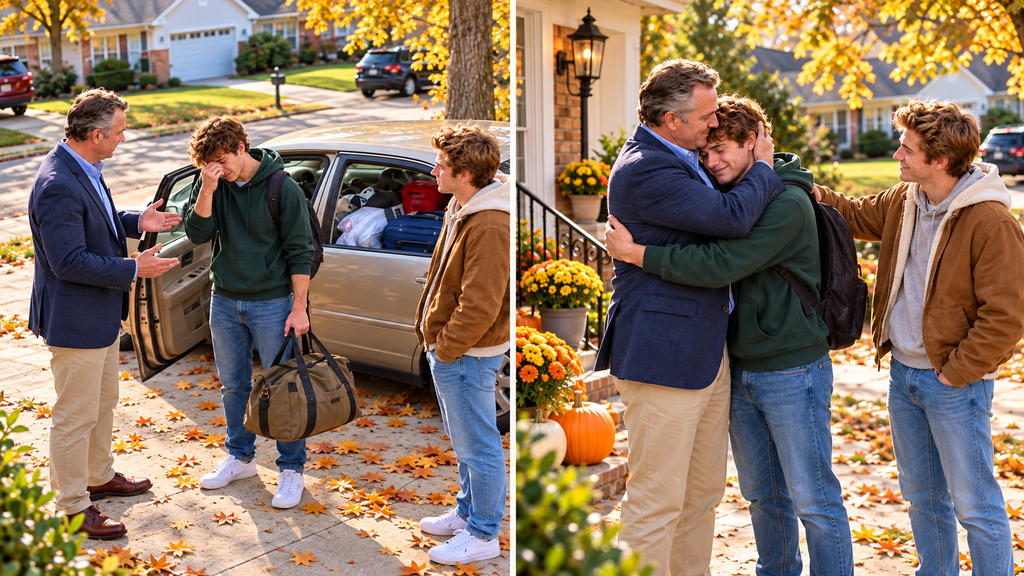
And I couldn’t return to the home where my father had thrown me out.
I looked down at the brown envelope in my trembling hands.
Then I looked toward my old sedan, sitting crookedly beside a dumpster with one tire nearly flat.
“So let me understand this,” I said quietly. “My grandfather knew what my father was like. He knew Dad had been lying to me my entire life. And his final wish was for me to keep living like this?”
Richard didn’t answer immediately.
The silence made something inside me snap.
“Did he know I was hungry?”
My voice cracked on the final word.
Richard looked away.
“Did he know I’ve been sleeping in my car? Did he know I still have three months of high school left? Did he know I spent my birthday standing on a sidewalk holding everything I owned in three garbage bags?”
“Nathan—”
“Because if he knew all that and still decided I needed another thirty days to prove something, then maybe he wasn’t much different from my father.”
Richard flinched.
It was the first time I had seen any emotion break through his professional expression.
He closed his briefcase.
“Your grandfather didn’t write that condition to punish you.”
“Then why?”
“Because he was afraid.”
I laughed bitterly.
“Afraid of what? That I might spend his money on food?”
“No,” Richard answered.
He lowered his voice.
“He was afraid your father would find a way to take everything from you before you ever had the chance to understand what belonged to you.”
The alley suddenly seemed quieter.
Even the distant traffic faded beneath the pounding of my heartbeat.
“What are you talking about?”
Richard reached into his coat and pulled out a second envelope.
This one was white.
Unlike the brown envelope, it had been sealed with red wax.
Across the front, written in shaky handwriting, were five words.
For Nathan, when he doubts.
“Your grandfather knew you might react this way,” Richard said. “He asked me to give you this only if you questioned his intentions.”
I stared at the handwriting.
For eighteen years, I had believed there was nobody on my father’s side of the family who cared whether I lived or died.
And now I was holding something written specifically for me by a man I had never met.
“Can I read it?”
Richard nodded.
I broke the seal.
Inside was a single handwritten page.
My dear Nathan,
If you are reading this, then I have failed you in one of the ways I feared most.
I wanted to meet you while I was alive.
I wanted to tell you about your grandmother, show you where your father grew up, and explain why I never stopped trying to find a way into your life.
Most importantly, I wanted you to know that none of what happened between your father and me was your fault.
But there is something you must understand.
Your father does not simply want my money.
He wants something hidden inside the company, and he believes you are the only person standing between him and it.
The thirty days are not a test of your worth.
They are protection.
During those thirty days, trust Richard, but do not trust every person who claims to be helping you.
And whatever happens, do not sign anything your father places in front of you.
I am sorry I could not give you a better childhood.
I hope the rest of your life becomes everything you deserve.
Love,
Grandpa James.
I read the final word three times.
Grandpa.
It looked so ordinary.
A word other people had used effortlessly throughout their childhoods.
A word I had never been allowed to say about a real person.
I folded the letter carefully.
Then I asked the question that had been growing inside me.
“What exactly is hidden inside Brooks Holdings?”
Richard’s expression changed.
“I don’t know.”
“You’re his attorney.”
“I handled the estate. Your grandfather had other attorneys who managed the company.”
“So you expect me to believe he left me everything, warned me about some secret, and never told you what it was?”
Richard opened his mouth.
Then he closed it.
For the first time, he looked genuinely uncomfortable.
“There’s one more thing,” he admitted.
“What?”
“Your father has already been notified that you are the beneficiary.”
A cold feeling spread through my stomach.
“When?”
“This morning.”
I looked at the alley entrance.
At the street beyond it.
At every passing car.
“Does he know where I am?”
Richard hesitated.
And that hesitation frightened me more than anything he could have said.
“We need to get you somewhere safe,” he answered.
Before I could respond, a black SUV slowly turned into the alley.
Richard saw it.
His expression hardened.
“Nathan,” he said quietly, “put the envelopes inside your jacket.”
“Why?”
“Now.”
The SUV stopped twenty feet away.
Its windows were dark.
For several seconds, nobody moved.
Then the driver’s door opened.
And my father stepped out.
For nine days, I had imagined what I would say if I saw him again.
I had imagined screaming.
I had imagined asking why he hated me.
I had imagined demanding my three thousand dollars back.
But when I saw him climbing out of that expensive black SUV, wearing the same navy-blue jacket he had worn on my eighteenth birthday, I couldn’t find a single word.
He looked at Richard first.
Then at me.
And he smiled.
Not the embarrassed smile of a parent who had made a terrible mistake.
Not the relieved smile of a father who had finally found his missing son.
It was the smile of a man who had arrived exactly where he intended to be.
“There you are,” Dad said.
Richard moved slightly in front of me.
“Mr. Brooks.”
Dad ignored him.
“Nathan, get in the car.”
I stared at him.
Nine days ago, he had told me I was an adult.
Nine days ago, he had watched me carry my belongings outside.
Now he spoke as though I were a disobedient child who had wandered too far from home.
“No.”
His smile vanished.
“Don’t make a scene.”
I almost laughed.
We were standing behind a restaurant beside three overflowing dumpsters.
There was nobody around to witness the scene except a man who had spent the last hour telling me that my father had lied to me my entire life.
“Why are you here?” I asked.
Dad glanced at Richard.
“Because apparently some people don’t understand boundaries.”
Richard straightened.
“I am carrying out your father’s lawful instructions.”
“My father is dead,” Dad snapped.
For a moment, the words hung in the air.
Then I spoke.
“Not before I was born.”
Dad went perfectly still.
I pulled the old photograph from my pocket.
“Is that him?”
He looked at it.
And something flashed across his face.
Fear.
Real fear.
“Where did you get that?”
“From the man who says Grandpa tried to contact me thirty-two times.”
Dad’s jaw tightened.
“Whatever he told you, there’s another side to it.”
“Then tell me.”
He glanced at Richard again.
“Not here.”
“Why did you tell me Grandpa died before I was born?”
“Nathan—”
“Why did you take his letters?”
“Your grandfather was a dangerous man.”
I looked at the photograph.
The silver-haired man standing outside the brick building didn’t look dangerous.
He looked proud.
He had one hand resting on the shoulder of the younger version of my father.
There was something almost heartbreaking about the picture.
It captured a moment before everything went wrong.
“What did he do?” I asked.
Dad’s voice rose.
“He tried to control every aspect of my life! He used money to manipulate people. He made promises and attached strings to everything.”
I thought about the thirty-day condition.
For one terrible moment, his explanation seemed possible.
Maybe Grandpa really had been controlling.
Maybe I had simply traded one cruel man for another.
Then Richard spoke.
“Would you like Nathan to know why your father removed you from the company, Thomas?”
Dad turned sharply.
“Keep your mouth shut.”
“Because I have the court documents.”
“Richard!”
“Your father accused you of falsifying payroll records and transferring company funds without authorization.”
Dad lunged forward.
Not toward me.
Toward Richard’s briefcase.
Richard stepped back.
“Don’t,” he warned.
My father stopped.
His breathing had changed.
And suddenly I understood something important.
For my entire childhood, Dad had controlled every conversation by deciding what I was allowed to know.
He told me my grandfather was dead.
I believed him.
He told me I owed him money for raising me.
I believed him.
He told me I was worthless, lazy, ungrateful.
Eventually, part of me had started believing those things too.
But standing in that alley, watching him desperately try to silence another man, I realized his greatest weapon had never been strength.
It had been secrecy.
“What happened to the money?” I asked.
Dad looked at me.
“What?”
“The company money. What did you do with it?”
“That’s none of your business.”
“Apparently it is now.”
He stared.
I had never spoken to him that way.
Not once.
Then his face twisted.
“You think you’re somebody now because an old fool left you a few dollars?”
Richard spoke firmly.
“Mr. Brooks, I strongly advise you to stop.”
Dad ignored him.
“You don’t understand how the world works, Nathan. You think money makes you smart? You think a piece of paper makes you a man?”
“No,” I answered.
I looked at my broken car.
“I think surviving nine days without you taught me more about being a man than eighteen years in your house ever did.”
For a second, his expression collapsed.
Then he reached into his jacket.
He pulled out a folded document.
“I came here to fix this,” he said.
He held it toward me.
“Sign it. Come home. We’ll put all of this behind us.”
I didn’t touch it.
“What is it?”
“A simple authorization. Until you’re older, I’ll manage the inheritance for you. You can finish school without worrying about any of this.”
Richard stepped forward.
“Nathan, do not sign that.”
Dad’s voice turned sharp.
“He is my son.”
“He is a legal adult,” Richard answered.
“He’s a child.”
“Then perhaps you should have considered that before evicting him.”
Dad’s face flushed.
For the first time, I felt something close to satisfaction.
Not because my father was embarrassed.
Because someone had finally said aloud what he had done.
I took a step back.
“I’m not signing anything.”
Dad’s expression went cold.
“Then don’t come crawling back when you find out that old man’s money isn’t as easy to get as you think.”
He returned to the SUV.
Before climbing inside, he turned.
“One more thing, Nathan.”
I said nothing.
“Your mother would be ashamed of you.”
That was the sentence that nearly broke me.
My mother had died when I was seven.
She was the only person I remembered ever telling me she was proud of me.
Dad knew exactly where to strike.
But before I could answer, Richard spoke.
“Your mother,” he said quietly, “is another reason you need to read the rest of that envelope.”
My father froze.
Richard looked straight at him.
“Wouldn’t you agree, Thomas?”
Dad’s face drained of color.
And for the first time in my life, he left without having the last word.
Richard took me to a diner two blocks away.
I insisted on walking.
He didn’t argue.
My legs felt weak, partly from hunger and partly from everything that had just happened.
Inside, the diner smelled like coffee, bacon, and toasted bread.
A waitress with silver streaks in her hair approached our booth.
“What can I get you boys?”
Richard looked at me.
“Whatever you’d like.”
I stared at the menu.
For nine days, I had treated food like something I needed permission to want.
I chose the cheapest breakfast.
Two eggs, toast, and hash browns.
Richard ordered the same thing, then added a side of pancakes for the table.
When the plates arrived, my stomach cramped so badly I had to sit still for a moment.
The waitress noticed.
“Honey, you all right?”
I nodded.
“Just really hungry.”
Her expression softened.
“Then eat slowly, sweetheart.”
I don’t know why those words affected me so much.
Maybe because she said them without demanding anything in return.
I picked up my fork.
And after the first bite, tears filled my eyes.
I lowered my head.
Richard pretended not to notice.
He simply pushed the pancakes closer.
For several minutes, we ate in silence.
Then I asked, “What did you mean about my mother?”
Richard set down his coffee.
“Your mother knew your grandfather.”
I froze.
“No, she didn’t.”
“Yes, Nathan. She did.”
Dad had told me Mom hated his side of the family.
He said she’d never met Grandpa.
He claimed she believed we were better off without him.
Richard opened the brown envelope again.
He removed a small photograph.
A younger version of my mother stood on a wooden porch beside James Brooks.
She was laughing.
Actually laughing.
Her head was tilted backward, and Grandpa James held a birthday cake with candles burning across the top.
On the back, someone had written:
Emily’s twenty-fourth birthday. The best daughter-in-law a father could ask for.
I stared until the words blurred.
“That’s my mom.”
Richard nodded.
“Your grandfather loved her very much.”
I swallowed.
“Then why did Dad say she never knew him?”
“Because your mother disagreed with your father about what happened at Brooks Holdings.”
“What does that mean?”
Richard took a careful breath.
“Your mother worked for the company before you were born. She handled administrative records. She discovered financial irregularities involving your father.”
I stared.
“Did she report him?”
“She spoke to James. Your father found out.”
“And?”
Richard’s expression darkened.
“Your parents separated for a short period.”
I shook my head.
“No. They were married until she died.”
“They reconciled after you were born. Your father promised to change.”
I looked down at Mom’s smiling face.
She had always seemed tired in my childhood memories.
Tired, but gentle.
She worked extra shifts.
She saved grocery coupons.
She used to tell me that being kind was more important than being impressive.
And sometimes, when she thought I was asleep, I heard her crying behind her bedroom door.
“What happened to her?” I whispered.
Richard looked surprised.
“Your father told me she died in a car accident.”
“She did.”
At least that was what I had always been told.
Richard’s face grew very still.
“Nathan, did your father ever show you the accident report?”
“No.”
“Did he tell you where it happened?”
“On the highway. It was raining.”
Richard looked down at the photographs.
Then he said something I would remember for the rest of my life.
“Your mother wasn’t driving when she died.”
I felt the world tilt.
“What?”
“She was a passenger.”
I stared at him.
“Who was driving?”
Richard didn’t answer.
He didn’t have to.
I already knew.
“My father?”
Richard nodded slowly.
I gripped the edge of the table.
Dad had always told me Mom died because another driver lost control in heavy rain.
He said she had been alone.
He said he received the phone call while I was sleeping.
He described himself as the grieving husband who arrived at the hospital too late.
But he had been in the car.
“Why would he lie about that?”
Richard’s voice was careful.
“Because the circumstances of that crash were complicated.”
“What circumstances?”
“Your grandfather obtained records. The police investigated, but no criminal charges were filed. Your father had been driving after a confrontation with your mother.”
“What confrontation?”
Richard looked at the brown envelope.
“Emily had discovered something.”
My mouth went dry.
“What?”
“Evidence that your father had used company funds to pay personal debts, and possibly to make payments connected to identities that didn’t belong to him.”
I didn’t fully understand.
But I understood enough.
My mother had learned something dangerous.
She had argued with my father.
And afterward, she was dead.
“Are you saying he killed her?”
Richard leaned forward.
“I’m saying we don’t know that, Nathan. The investigators ruled the collision accidental. I won’t tell you otherwise without proof.”
I appreciated that he didn’t pretend to know more than he did.
But his caution didn’t make the truth hurt less.
All those years, Dad had let me believe my mother had died alone.
He had allowed me to imagine her frightened and helpless on a rainy highway.
He had never told me he was beside her.
Never told me he survived.
I pressed my hands against my face.
My childhood memories suddenly felt contaminated.
Every story Dad had told.
Every answer he had given.
Every time I asked about my mother and watched him become irritated.
How much of my life had been built on lies?
Richard let me sit quietly.
Then he said, “There’s someone you should meet.”
I looked up.
“Who?”
“Your grandfather’s housekeeper.”
I almost laughed.
“A housekeeper?”
“Her name is Margaret Ellis. She’s worked for the Brooks family for forty years.”
“And she knew my mother?”
“Very well.”
“Where is she?”
Richard hesitated.
“At your grandfather’s house.”
I stared.
“You said I can’t use his property for thirty days.”
“You can’t live there or receive its financial benefits. But you can visit for a supervised meeting.”
I looked down at Mom’s photograph.
For the first time since the alley, I felt something stronger than fear.
I felt a need to know.
“Take me there.”
James Brooks had lived fifteen minutes outside the city, beyond a stretch of wooded roads and old stone walls.
Richard drove me in a modest gray sedan.
I watched through the window as apartment buildings gave way to large houses set behind iron fences.
Eventually, we turned onto a long driveway bordered by oak trees.
At the far end stood a sprawling brick house with white columns and a dark slate roof.
I had seen houses like it in movies.
Places where people hosted charity events, discussed investments, and never worried about whether their groceries would last until payday.
Richard parked beside a stone fountain.
For several moments, I didn’t move.
“This belonged to my grandfather?”
“Yes.”
I swallowed.
“And now it belongs to me?”
“Subject to the estate’s administration and the conditions we’ve discussed.”
I stared at the house.
Then I thought of my father taking three thousand dollars from a teenager and calling it rent.
The contrast felt almost obscene.
An elderly woman opened the front door before we reached the porch.
She wore a dark green cardigan and had silver hair pinned neatly behind her head.
Her eyes moved from Richard to me.
Then she stopped breathing.
One hand rose slowly to her mouth.
“Oh,” she whispered.
Richard smiled gently.
“Margaret, this is Nathan.”
She stared at me.
Her eyes filled with tears.
“Oh, my goodness.”
Before I knew what was happening, she had crossed the porch and wrapped her arms around me.
I stood stiffly.
Nobody had hugged me like that since my mother died.
Margaret held me for a long moment.
Then she stepped back and studied my face.
“You have Emily’s mouth,” she whispered. “But those eyes…”
She touched her chest.
“Those are James’s eyes.”
I couldn’t speak.
Margaret reached for my hand.
“He waited so long for you.”
Something inside my chest tightened.
Richard looked away.
Margaret squeezed my fingers.
“Come inside, sweetheart.”
The entryway smelled faintly of polished wood and fresh flowers.
There were paintings on the walls, a grandfather clock beside the staircase, and a long hallway leading toward a sunlit library.
But none of those things held my attention.
Because on the table beside the front door sat a silver picture frame.
Inside was a photograph of me.
I was about six years old.
Standing outside my elementary school.
Holding a homemade cardboard rocket.
My mother had taken that photograph.
I remembered the day perfectly.
We had built the rocket from cereal boxes, painted it blue, and glued cotton balls around the bottom to look like smoke.
I had won second place at the school science fair.
Dad hadn’t come.
Mom had taken me for ice cream afterward.
I picked up the frame.
“How did he get this?”
Margaret’s voice trembled.
“Your mother sent it.”
I turned toward her.
“What?”
“Before she died, Emily sent your grandfather pictures. She wanted him to know you.”
I stared at the little boy in the frame.
The gap between his front teeth.
The crooked haircut.
The proud smile.
All those years, I had believed that photograph existed only in an old shoebox my father had eventually thrown away.
But Grandpa had kept it beside his front door.
Where he could see it every day.
My eyes burned.
Margaret led us into the library.
Bookshelves stretched from floor to ceiling.
A fireplace stood beneath a portrait of a woman with dark hair and warm brown eyes.
“That’s your grandmother, Eleanor,” Margaret said. “She died when your father was twenty.”
I studied the portrait.
She looked nothing like the cold, distant woman Dad had described.
“James never remarried,” Margaret continued. “He said he’d already been lucky enough to marry the love of his life.”
She smiled sadly.
“Your grandfather was stubborn. Difficult sometimes. He could be proud, and he made mistakes. But he loved his family.”
I sat in a leather chair near the fireplace.
Richard stood beside the window.
Margaret took the chair across from me.
“Tell me about my mother,” I said.
Her face changed.
Not with surprise.
With grief.
“Emily was the kindest young woman I ever knew.”
I stared at my hands.
“She used to sing while she cooked.”
Margaret smiled.
“Badly.”
I looked up.
She laughed through her tears.
“Terribly. She never knew the words to anything, so she’d make them up.”
I felt my throat tighten.
Mom used to do that.
She’d sing nonsense lyrics while washing dishes, making me laugh so hard I sometimes spilled my milk.
For years, I had been afraid those memories weren’t real.
“She loved lemon cake,” Margaret said.
“With extra frosting,” I whispered.
Margaret nodded.
“And she always saved the corner piece.”
We smiled at each other.
Then the smile disappeared from her face.
“Emily was worried about your father.”
I sat straighter.
“Richard told me there were problems at the company.”
Margaret nodded.
“But there was something else.”
“What?”
“Emily was planning to leave him.”
I felt as though someone had struck me.
“No.”
“She came here three weeks before the accident. You were staying with a neighbor. She sat right where you’re sitting now and cried for nearly an hour.”
I stared at the carpet.
“Why was she leaving?”
“Because she was frightened.”
“Of Dad?”
Margaret looked at Richard.
Then back at me.
“She believed Thomas had been taking money from accounts connected to your grandfather’s business. She found documents she couldn’t explain. She also discovered he had taken out a life insurance policy on her without discussing it with her.”
My blood turned cold.
“Life insurance?”
Margaret nodded.
“She wanted James to help her find an attorney.”
I remembered something.
A memory I hadn’t thought about in years.
My mother kneeling beside my bed.
Her hands trembling as she tucked my blanket around me.
She had kissed my forehead and whispered, “No matter what happens, you remember that Mommy loves you.”
I had thought she was simply sad.
Now I wondered whether she had been afraid.
“What happened next?” I asked.
“James arranged for a lawyer to meet her. The appointment was scheduled for the Monday after she died.”
The room fell silent.
I looked toward Richard.
“Did the police know?”
“Some of the financial concerns were documented, but the insurance and company issues never established that the collision was intentional. Your grandfather spent years reviewing what happened.”
“And he couldn’t prove anything?”
“No.”
I looked toward the portrait above the fireplace.
I suddenly understood why Grandpa had never stopped trying to reach me.
Maybe he had lost his wife.
Then his daughter-in-law.
Then his grandson, stolen not by death but by silence.
Margaret reached into her cardigan pocket.
“There is something else.”
She removed a small brass key.
It was old-fashioned, with a round head and a faded blue ribbon tied through it.
“James asked me to give you this if you ever came here.”
I took it carefully.
“What does it open?”
Margaret’s eyes filled again.
“Your mother’s room.”
I followed Margaret upstairs.
At the far end of the second-floor hallway, she stopped beside a white door.
Unlike the others, it had a small brass plaque.
It read:
Emily and Nathan.
My heart began pounding.
“Why does it have my name?”
Margaret smiled sadly.
“Because your grandfather always believed you’d come someday.”
She unlocked the door.
Inside was a room that looked as though time had stopped.
The walls were pale blue.
White curtains hung beside tall windows overlooking the garden.
There was a queen-sized bed, a wooden dresser, and a small rocking chair in the corner.
Beside the rocking chair sat a basket filled with children’s books.
A stuffed brown bear rested on the pillow.
I recognized it immediately.
“That’s Mr. Buttons.”
Margaret nodded.
My mother had given me that bear when I was three.
I slept with it every night until I was seven.
After she died, Dad told me it had been ruined in the accident.
But there it was.
Sitting on a bed in my grandfather’s house.
I crossed the room slowly.
Picked it up.
The fur was worn.
One plastic eye had a tiny scratch.
The left ear had been sewn back on with blue thread.
My mother had repaired it herself.
I pressed the bear against my chest.
And suddenly I wasn’t eighteen anymore.
I was seven.
Standing in a hospital corridor.
Waiting for someone to tell me my mother was coming home.
Margaret quietly stepped into the hallway.
Richard followed.
They closed the door.
And for the first time in nine days, I cried without trying to stop myself.
I sat on the edge of the bed, holding Mr. Buttons, and sobbed until my throat hurt.
I cried for the boy who had grown up believing nobody wanted him.
For the teenager who had worked every weekend to save money his father would eventually steal.
For the grandfather who had kept a room waiting for someone who never came.
And most of all, I cried for my mother.
Because she had loved me.
She had tried to protect me.
And after all those years of wondering whether I had imagined the warmth in her voice, I was finally surrounded by proof that I hadn’t.
When I could breathe again, I noticed a small wooden box on the dresser.
A folded note lay beside it.
The handwriting was familiar.
Not Grandpa’s.
My mother’s.
Nathan’s treasures.
My hands shook as I lifted the lid.
Inside were tiny objects.
A blue toy car with one missing wheel.
A school photograph.
A yellow ribbon from a childhood art competition.
Two baby teeth wrapped in tissue.
And a small cassette tape.
Across its label, my mother had written:
For Nathan, when he’s older.
I stared at the cassette.
There was an old tape player on the shelf beside the bed.
I inserted it.
Pressed play.
For several seconds, all I heard was static.
Then a woman’s voice filled the room.
“Testing. Testing. Is this thing working?”
I stopped breathing.
My mother’s voice.
Clear.
Young.
Alive.
A little laugh followed.
“Okay. Nathan, sweetheart, if you’re listening to this, you’re probably old enough to think your mother is embarrassing.”
I let out a broken sound.
She continued.
“I wanted to record something for you because I don’t always say the important things when I should.”
There was a pause.
Then her voice became softer.
“You are my favorite person in the world.”
I pressed my hands over my mouth.
“You came into my life when I was scared and unsure of almost everything. And then suddenly there you were, with your tiny hands and those enormous brown eyes, and I understood what love really meant.”
The tape crackled.
“I hope you grow up kind. I hope you’re brave enough to stand up for people who need help. And I hope nobody ever convinces you that you have to earn love by being useful.”
My entire body trembled.
Because that was exactly how Dad had raised me.
As though every meal, every pair of shoes, every night beneath his roof was a debt I owed.
Mom’s voice continued.
“People who love you won’t make you beg to be treated like you matter.”
I bent forward.
And cried again.
Then came the words that changed everything.
“And Nathan, if anyone ever tells you that your grandfather James didn’t love you, please don’t believe them.”
I went perfectly still.
My mother’s voice grew serious.
“Your grandfather loves you very much. He is a good man. He makes mistakes, like everyone does, but he has a bigger heart than he knows what to do with.”
Another pause.
“I hope one day you get to know him.”
The recording ended with her laughter.
Then she sang a few terrible, made-up lines from a lullaby I remembered.
I sat in silence long after the tape stopped.
It was the closest I had been to my mother in eleven years.
And somehow, in a house I had never visited before, she had found a way to tell me exactly what I needed to hear.
That I mattered.
That I was loved.
That I had never been abandoned by everyone.
I carried the tape downstairs.
Richard was waiting in the library.
When he saw my face, he rose.
“Are you all right?”
I nodded.
Then shook my head.
“I don’t know.”
He didn’t press.
I placed the cassette carefully on the table.
“Richard, I need to ask you something.”
“Of course.”
“Did Grandpa know my father was going to throw me out?”
Richard’s face became grave.
“Not with certainty.”
“But he suspected?”
“Yes.”
I looked toward the window.
“Then why didn’t he help me sooner?”
Richard sat down.
“Because every attempt he made to contact you was blocked. Once you turned eighteen, he intended to approach you directly.”
I frowned.
“Then why didn’t he?”
“He became seriously ill.”
“What kind of illness?”
“Heart failure, complicated by kidney problems.”
I stared.
“How long?”
“His health deteriorated rapidly over the last six months.”
The words hurt more than I expected.
Six months.
While I was working grocery shifts and trying to pass algebra, my grandfather had been dying only fifteen minutes away.
He had been living in a house full of photographs of me.
Waiting.
Trying.
And I hadn’t known he existed.
Richard opened a folder.
“There’s something you should see.”
He showed me a hospital photograph.
Grandpa James sat upright in bed, thin and pale, holding a framed picture.
My senior-year school photograph.
I stared.
“How did he get that?”
“Your school photography company sells additional copies to family members. An investigator arranged to purchase one legally after confirming it was available.”
I studied the old man’s face.
He looked tired.
But he was smiling.
Richard’s voice softened.
“He asked about you almost every day.”
My throat tightened.
“What did he ask?”
“Whether you were doing well in school. Whether you had friends. Whether you were healthy.”
I looked at the photograph.
“And what did you tell him?”
Richard hesitated.
“The truth, as much as we knew it.”
“Which was?”
“That you worked hard. That your teachers respected you. That you’d applied to several colleges.”
I swallowed.
“And?”
Richard met my eyes.
“That despite everything, you had become a young man your grandfather would have been proud to know.”
I lowered my head.
I had spent years trying to make my father proud.
I brought home good grades.
I avoided trouble.
I worked.
I paid for my own clothes whenever I could.
I learned not to ask for things.
Nothing was ever enough.
And now I was hearing that a man I’d never met had been proud of me simply because of the person I was becoming.
It almost felt too painful to accept.
“Richard?”
“Yes?”
“Where am I supposed to sleep tonight?”
He took a slow breath.
“Let’s talk about that.”
The thirty-day condition was more complicated than it first sounded.
Richard explained that Grandpa had created a trust.
The house, business interests, investments, and personal property were held under a structured estate plan.
My inheritance would become fully accessible after the thirty-day period, provided I didn’t voluntarily return to live with my father or sign away my rights.
The financial independence clause meant I couldn’t receive discretionary distributions from the trust during those thirty days.
But it did not mean I had to refuse ordinary help or survive without shelter.
Grandpa had specifically allowed assistance from independent charities, school services, and employment income.
“He wanted you beyond your father’s control,” Richard said. “Not starving.”
I looked at him.
“Then why didn’t you say that in the alley?”
Richard’s expression was pained.
“Because your grandfather left several instructions to be explained after you’d read his letters. In hindsight, I should have told you the practical details immediately.”
I appreciated that he admitted it.
But I was still exhausted.
“Can you fix my car?”
“Not with estate funds before the condition expires. But we can arrange for a mechanic to assess it, and you can decide what to do.”
I sighed.
“Great.”
Margaret returned with a tray of sandwiches.
I almost laughed when I saw them.
Three hours ago, I had been searching through restaurant waste for food.
Now I was sitting in a library that probably cost more than my entire neighborhood, and someone was offering me turkey sandwiches on porcelain plates.
Life had become ridiculous.
Richard made several phone calls.
By late afternoon, he’d contacted a youth housing nonprofit that worked with students experiencing homelessness.
A caseworker named Denise Walker agreed to meet us.
When she arrived, I expected questions that would make me feel ashamed.
Instead, she asked whether I was safe.
Whether I had medication.
Whether I needed clean clothes.
Whether my school knew what had happened.
When I told her I had been sleeping in my car, she didn’t gasp or lecture me.
She simply nodded.
“Okay. We’re going to make sure you don’t have to do that tonight.”
I stared at her.
“Just like that?”
“Just like that.”
I felt tears rising again.
I was getting tired of crying.
Denise helped arrange temporary accommodation through a youth transitional housing program.
It wasn’t fancy.
It was a small room in a renovated building near the community college.
There was a twin bed, a desk, a closet, and a shared kitchen down the hall.
But the room had a lock.
A working heater.
Clean sheets.
And a bathroom with hot water.
When Denise handed me the key, I stood in the doorway for a long time.
“You okay?” she asked.
I nodded.
“It’s just…”
I looked at the bed.
“I haven’t slept lying down in nine days.”
Her face softened.
“Then tonight, that’s your only assignment.”
I set my three plastic bags beside the closet.
They looked pathetic in the otherwise empty room.
Everything I owned.
Eighteen years of life reduced to clothes, schoolbooks, and a phone charger.
But there was also the brown envelope.
The photographs.
My mother’s cassette.
And Mr. Buttons, which Margaret had insisted I take.
I placed the bear carefully on the pillow.
Then I sat on the bed.
For the first time since my birthday, I didn’t have to worry about police officers knocking on my car window.
I didn’t have to wonder whether someone would recognize me sleeping in a parking lot.
I didn’t have to calculate whether I had enough gas to keep the heater running for ten minutes.
I was safe.
At least for that night.
I lay down fully dressed.
And slept for thirteen hours.
The next morning, my phone displayed seventeen missed calls.
All from my father.
There were also messages.
The first arrived at 11:42 the previous night.
Nathan, call me immediately.
Then:
You need to understand what you’re getting involved in.
Then:
Richard Hartwell is manipulating you.
Then:
Your grandfather was never the man you think he was.
And finally, at 6:18 a.m.:
Come home today and we’ll forget this nonsense.
I stared at the screen.
Nine days ago, my father had made it very clear that I was no longer welcome.
Now he wanted me home.
Not because he missed me.
Not because he was worried.
Because he had discovered I was valuable.
I blocked his number.
Then I went to school.
I had never been happier to sit in history class.
The classroom smelled like dry-erase markers and someone else’s breakfast sandwich.
My classmates complained about homework.
Someone argued about prom tickets.
Another student asked whether the cafeteria was serving pizza.
Everything seemed wonderfully ordinary.
Then my guidance counselor appeared at the door.
“Nathan, could you come with me?”
My stomach dropped.
I followed her down the hallway.
Her name was Mrs. Alvarez.
She had always been kind, though we hadn’t spoken much beyond college applications.
Inside her office, she closed the door.
“Please sit.”
I obeyed.
She folded her hands.
“Nathan, I received a call yesterday from a youth services caseworker.”
I looked down.
“I was going to tell you.”
“I know.”
She waited.
I stared at the carpet.
Then the truth spilled out.
“My dad kicked me out.”
My voice sounded strange.
Like it belonged to someone else.
“He took my savings. I’ve been living in my car. I didn’t want anyone to know.”
Mrs. Alvarez didn’t interrupt.
When I finished, she reached for a tissue box and placed it between us.
“Nathan, you should never have had to manage this alone.”
I nodded.
She continued.
“I want you to understand something. Being eighteen doesn’t mean you stop deserving care, especially while you’re finishing school.”
I looked up.
“We have resources. Meal assistance, transportation support, fee waivers, and people who can help you stay on track for graduation.”
My throat tightened.
“I don’t want everybody knowing.”
“They won’t. We’ll only share what’s necessary with people involved in supporting you.”
I felt some of the tension leave my shoulders.
Then she opened a folder.
“There’s something else I wanted to discuss.”
My heart sank.
“What?”
“Your college applications.”
I had applied to four schools.
Two state universities.
One community college.
And a private university that was probably far beyond what I could afford.
I hadn’t heard from any of them.
Mrs. Alvarez frowned.
“Have you been checking your email?”
“Not much. My phone’s almost always dying.”
She turned her computer screen toward me.
“Nathan, you’ve received several admissions decisions.”
I stared.
“Really?”
She nodded.
“Three acceptances.”
For a moment, I forgot everything else.
Three.
I had gotten into three colleges.
Then she smiled.
“And one of them offered you a substantial academic scholarship.”
I looked at the screen.
My name.
The university logo.
A congratulatory message.
I read it twice.
Then three times.
I had done something good.
Something nobody could take away from me.
I laughed.
Mrs. Alvarez laughed with me.
Then I began crying.
Again.
I wiped my face quickly.
“Sorry.”
“Don’t apologize.”
I shook my head.
“It’s just that my dad always said I wouldn’t get in anywhere.”
She looked at the screen.
“Well, he was wrong.”
Those four words felt better than any revenge I could have imagined.
By the end of the first week, I had begun to understand something.
My grandfather’s money might eventually change my life.
But it wasn’t the only thing that could.
There were people willing to help me.
There were systems designed to support students in crisis.
There were teachers who cared.
And there were opportunities I had earned before I even knew I had an inheritance.
I started working evening shifts at a grocery store near my housing program.
The manager, Mr. Reynolds, remembered me from a previous location.
He knew I was dependable.
When I explained that I needed hours around school, he handed me a schedule.
“Three evenings and Saturday mornings. That work?”
I nodded.
“Perfect.”
He studied me for a moment.
“You look tired, kid.”
“Long month.”
He didn’t ask questions.
He just said, “Well, show up on time, do your job, and we’ll get along.”
I smiled.
For the first time, being told to work didn’t feel like punishment.
It felt like control over my own life.
I also began meeting with Denise regularly.
She helped me create a budget.
We discussed transportation, food, and graduation expenses.
Richard checked in every few days.
He never handed me money.
But he kept me informed about the estate.
And each update made the situation more unsettling.
On day six, he told me my father had hired an attorney.
On day seven, he said Dad was challenging Grandpa’s will.
On day eight, he informed me that someone had attempted to access a confidential file in the estate office.
“Who?” I asked.
“We’re investigating.”
“Was it Dad?”
“We don’t know.”
I was sitting on the edge of my bed when he called.
Mr. Buttons rested beside my textbooks.
“What happens if he wins?”
Richard was quiet for a moment.
“He’ll try to establish that your grandfather lacked capacity when he changed the will.”
“Did he?”
“No. We have strong medical evidence that James understood his decisions.”
“Then why are you worried?”
“Because legal challenges can become expensive and exhausting.”
I stared at the wall.
“Is he trying to make me give up?”
“That’s one possibility.”
I remembered Dad telling me not to come crawling back.
I pictured his face in the alley.
He wasn’t used to anyone refusing him.
“What should I do?”
“Continue school. Keep working. Don’t contact him. And call me if anything unusual happens.”
“What counts as unusual?”
Richard sighed.
“With your father, apparently quite a lot.”
The first unusual thing happened the following afternoon.
I was leaving school when my stepbrother, Kyle, appeared beside my car.
He was seventeen.
Dad’s wife, Linda, had brought him into the family when I was ten.
Kyle had always been treated as the golden child.
He got new clothes.
New phones.
Birthday parties.
When he needed money for sports, it appeared.
When I needed shoes, Dad reminded me how expensive children were.
I didn’t hate Kyle.
Not exactly.
But I had spent years watching him receive everything I was told not to ask for.
He leaned against my car.
“Hey.”
I stopped.
“What are you doing here?”
He shrugged.
“Mom asked me to talk to you.”
I almost kept walking.
Instead, I folded my arms.
“About what?”
Kyle glanced around.
“Can we go somewhere private?”
“Just say it.”
He exhaled.
“Dad’s losing his mind.”
I stared.
“He’s your stepdad.”
“Yeah, whatever. You know what I mean.”
He looked nervous.
That was unusual.
Kyle was normally so confident that he sometimes seemed incapable of embarrassment.
“He’s been screaming at Mom,” he continued. “He’s on the phone constantly. Some lawyer keeps coming over.”
I said nothing.
Kyle kicked a pebble.
“And they keep talking about you.”
“What are they saying?”
He looked at me.
“That you’ve been brainwashed.”
I almost smiled.
“Of course.”
“And that your grandfather was supposed to leave everything to Dad.”
“He didn’t.”
“I know.”
The words surprised me.
I stared at Kyle.
“What?”
He looked down.
“I heard them talking.”
“About what?”
“Before your birthday.”
A cold feeling moved through me.
“What about before my birthday?”
Kyle swallowed.
“Mom and Dad knew the old man was dying.”
I stared.
“They knew?”
He nodded.
“They were talking about the estate for weeks.”
My hands slowly curled into fists.
“Did they know Grandpa was my grandfather?”
“Yeah.”
“Did you know?”
Kyle looked miserable.
“Not until recently.”
I studied his face.
For once, I believed him.
He looked ashamed.
“What else?”
Kyle hesitated.
Then reached into his backpack.
He pulled out a small black notebook.
“Mom keeps this in her desk.”
I didn’t take it.
“What is it?”
“She writes everything down. Bills, appointments, stuff she doesn’t want to forget.”
“Why are you showing me?”
He opened it to a page marked with a yellow sticky note.
“Because of this.”
I looked.
The handwriting was neat and slanted.
At the top of the page was a date.
Three weeks before my eighteenth birthday.
Below it were several short notes.
Thomas spoke to attorney.
James still refusing settlement.
Nathan turns eighteen soon.
Must establish he is no longer dependent.
Remove from house immediately.
I stopped breathing.
Kyle watched my face.
“Keep reading.”
Under those notes, someone had written:
Savings account—transfer balance before birthday.
Do not allow access to mail.
Destroy remaining correspondence.
My vision blurred.
They had planned it.
Not just my eviction.
Not just taking my savings.
They had discussed it weeks in advance.
They hadn’t thrown me out because they suddenly decided I was an adult.
They had thrown me out as part of a plan involving Grandpa’s estate.
“What does ‘establish he is no longer dependent’ mean?” I whispered.
Kyle shook his head.
“I don’t know.”
I took a photograph of the page.
Then another.
“Does Mom know you have this?”
“No.”
“Why are you helping me?”
Kyle looked toward the school entrance.
For several seconds, he didn’t speak.
Then he said, “Because I thought you knew.”
“Knew what?”
“About your money.”
I stared.
He swallowed.
“The three thousand dollars.”
My chest tightened.
“What about it?”
“Mom told me you gave it to us.”
I felt suddenly sick.
“For what?”
“College applications. Soccer camp. My laptop.”
He looked embarrassed.
“I thought you were being nice.”
I laughed once.
It sounded ugly.
“I didn’t give them anything, Kyle.”
“I know that now.”
He rubbed the back of his neck.
“After you left, I heard them arguing. Mom said they should have taken the money months earlier.”
I stared at him.
He looked genuinely upset.
“I didn’t know, Nate.”
Nobody called me Nate anymore.
My mother used to.
The sound made something twist inside me.
Kyle stepped forward.
“Look, I know I was a jerk sometimes.”
I said nothing.
“And I know Mom treated us differently.”
“She did.”
He nodded.
“I know.”
For a moment, he looked younger than seventeen.
Just a kid caught inside something ugly.
“I’m sorry.”
I studied him.
I wanted to stay angry.
Part of me needed someone to blame.
But looking at Kyle, I realized something uncomfortable.
He had been raised inside the same house.
He just hadn’t been the one everyone chose to hurt.
“Thanks for telling me,” I said.
He nodded.
Then he stepped away.
“Be careful, Nate.”
I frowned.
“Why?”
Kyle glanced toward the parking lot.
“Because Dad keeps saying there’s something at Grandpa’s company that belongs to him.”
My stomach tightened.
“What thing?”
Kyle shook his head.
“I don’t know.”
He took a step backward.
“But last night, I heard him tell Mom…”
He stopped.
“Tell her what?”
Kyle looked straight at me.
“He said, ‘If Nathan opens that safe, we’re finished.'”
I called Richard before I even started my car.
He listened without interrupting.
When I finished, he asked me to send the photographs of Linda’s notebook.
I did.
There was a long silence.
Then he said, “Nathan, where are you?”
“School parking lot.”
“Go directly to your housing program.”
“Why?”
“Because I want to verify something before we discuss it.”
“Richard, what safe?”
He didn’t answer.
“Richard?”
“I know your grandfather maintained a private safe at Brooks Holdings.”
My heart pounded.
“What’s inside?”
“James never told me.”
“You keep saying that.”
“I know.”
“Then how am I supposed to protect myself?”
Richard sighed.
“By not trying to open it alone.”
I looked out the windshield.
A group of students walked past carrying sports bags.
They were laughing about something.
Their world seemed impossibly distant from mine.
“Does Dad know where the safe is?”
“Yes.”
“Does he know the combination?”
“No.”
“Do you?”
“No.”
I frowned.
“Then who does?”
Richard paused.
“You do.”
I actually laughed.
“Richard, I’ve never been inside Brooks Holdings.”
“I understand.”
“Then how could I know the combination?”
“Your grandfather left instructions. The combination is connected to something only you can identify.”
I went still.
“What does that mean?”
“I’m trying to locate the exact memorandum.”
I thought about Grandpa’s letter.
His warning.
The condition.
The way Dad had panicked when Richard mentioned my mother.
“Could it have something to do with Mom?”
Richard was silent.
Then he said, “That’s what I’m beginning to suspect.”
Day ten brought the first threat.
It arrived in a plain white envelope at my housing program.
No return address.
Inside was a single printed photograph.
My broken sedan.
Parked outside the grocery store where I worked.
The picture had been taken the previous evening.
Across the bottom, someone had written:
YOU CAN’T HIDE FOREVER.
I stood in the hallway staring at it.
My fingers went numb.
I carried it directly to Denise.
She called Richard.
Richard contacted the police.
An officer took a report and asked whether I knew who might have sent it.
I told him about my father.
About the inheritance.
About the arguments.
About the black SUV in the alley.
The officer listened carefully.
He said the photograph and message would be documented and advised me to report further threats immediately.
But there wasn’t enough evidence to determine who had sent it.
That night, I couldn’t sleep.
Every sound in the hallway made my heart jump.
Every car outside felt suspicious.
I kept looking at my phone.
At 11:27, an unknown number sent a text.
You should have signed.
I forwarded it to Richard.
Then I turned off my phone.
And sat in the darkness holding my mother’s cassette.
I wanted to hear her voice.
But I was afraid that if I did, I wouldn’t stop crying.
Eventually, I whispered into the empty room.
“Mom, what am I supposed to do?”
There was no answer.
Only the hum of the heater.
Then I remembered her words.
People who love you won’t make you beg to be treated like you matter.
I looked toward the door.
My father wanted me frightened.
He wanted me desperate.
He wanted me to believe I couldn’t survive without him.
And for most of my life, that strategy had worked.
But I had already survived nine nights in a car.
I had found shelter.
I had returned to school.
I had earned a scholarship.
I was still here.
I picked up my phone.
Turned it back on.
And sent Richard one message.
I’m not giving up.
On day twelve, Margaret called.
Her voice sounded strained.
“Nathan, I need to tell you something.”
I sat down at the desk in my room.
“What happened?”
“Someone was inside the house last night.”
My heart jumped.
“Grandpa’s house?”
“Yes.”
“Who?”
“We don’t know.”
She explained that the security alarm had activated shortly after midnight.
A back window had been forced.
Police had responded, but whoever entered was gone before they arrived.
Nothing obvious appeared missing.
Except one thing.
A framed photograph from the library.
The picture of my grandfather standing beside the original Brooks Holdings building.
I frowned.
“Why would anyone steal a photograph?”
Margaret hesitated.
“Because of what was written on the back.”
I went still.
“What was written?”
“James wrote notes behind several photographs. Dates, memories, little things he wanted to remember.”
“Do you know what this one said?”
“No.”
I stared at the wall.
Another photograph.
Another hidden message.
And now someone had broken into the house to take it.
“Margaret, is there anything else Grandpa kept locked up?”
She was quiet.
Then she answered.
“His study.”
“Where?”
“At the company.”
“Not the house?”
“No.”
My chest tightened.
“Did he ever talk about a safe?”
Margaret took a shaky breath.
“Once.”
“What did he say?”
Her voice lowered.
“He told me that one day Nathan would have to decide whether the truth was worth the trouble it caused.”
I closed my eyes.
The truth.
Again.
Everywhere I turned, people mentioned it like something dangerous.
“What truth?”
“I asked him,” Margaret whispered.
“And?”
“He said, ‘The truth about why Emily never made it to the lawyer’s office.'”
I didn’t sleep much that night.
By morning, I had made a decision.
I called Richard.
“I want to see the company.”
He was quiet.
“Nathan—”
“I know I can’t use anything yet. I know the thirty days aren’t over. But I need to understand what Grandpa was trying to tell me.”
Richard sighed.
“There’s a scheduled estate inventory tomorrow. As beneficiary, you may attend with appropriate supervision.”
“Then I’m coming.”
“All right.”
I hesitated.
“Richard?”
“Yes?”
“Please stop protecting me from things I need to know.”
There was a long silence.
Then he answered.
“You’re right.”
The next morning, I stood outside Brooks Holdings for the first time in my life.
It wasn’t the towering glass skyscraper I had imagined.
The headquarters occupied a renovated brick factory on the edge of the business district.
A metal sign beside the entrance read:
BROOKS HOLDINGS — ESTABLISHED 1978
Below it were the words:
Built on trust.
I stared at the sign.
For some reason, it made me sad.
Grandpa had built a company around a word my father had spent his life destroying.
Richard met me at the entrance.
Beside him stood a woman in her late forties wearing a charcoal suit.
“This is Evelyn Carter,” he said. “Chief Financial Officer.”
She extended her hand.
“Nathan, your grandfather spoke about you often.”
I shook it.
“Nice to meet you.”
Her expression softened.
“He would have been very happy to see you standing here.”
I looked away.
Richard led us through the building.
Employees worked behind glass partitions.
Some looked up as we passed.
A few whispered.
I wondered what they saw.
An awkward eighteen-year-old in secondhand clothes.
A teenager who had been sleeping in a car.
Or the person who might soon control the company where they worked.
The thought made me deeply uncomfortable.
Evelyn seemed to notice.
“Your grandfather didn’t expect you to run this place the day you graduated high school,” she said. “The company has professional management. He wanted you to have choices.”
I nodded.
That helped.
A little.
We passed conference rooms, accounting offices, and a large wall displaying photographs of company milestones.
Grandpa stood in many of them.
Younger.
Stronger.
Smiling beside employees.
Cutting ribbons.
Shaking hands.
I found myself searching every photograph for Dad.
There were several older pictures of him.
Then, after a certain year, he disappeared.
Richard noticed where I was looking.
“Your father left the company after the financial investigation.”
“Was he fired?”
“He resigned under a negotiated agreement.”
“What happened to the missing money?”
Evelyn answered.
“Some was recovered. Some losses were written off. Your grandfather chose a civil resolution rather than pursuing a prolonged public dispute.”
“Why?”
Richard looked sad.
“Because Thomas was his son.”
I stared at a photograph of Grandpa.
That was the part I was beginning to understand.
Grandpa had loved Dad.
Maybe he loved him so much that he had given him chance after chance.
Maybe those chances had cost everyone more than he could have imagined.
“Did Grandpa regret it?”
Evelyn nodded.
“Very much.”
At the end of the hallway, we reached a dark wooden door.
A brass nameplate read:
JAMES E. BROOKS — FOUNDER
Richard unlocked it.
The office smelled faintly of leather and cedar.
There was a large desk, bookshelves, a seating area, and tall windows overlooking the city.
A framed photograph stood on the desk.
Me.
Again.
This time, I was fourteen.
Wearing a basketball jersey.
I stared at it.
“How many pictures did he have?”
Evelyn smiled sadly.
“More than you can imagine.”
Behind the desk hung an enormous painting of the company’s original factory.
Below it sat a black steel safe built into the wall.
I stopped.
Richard followed my gaze.
“That’s it.”
I approached slowly.
The safe had an electronic keypad and a mechanical backup lock.
A small brass plate above it read:
WHAT MATTERS MOST IS NEVER FOR SALE.
I ran my fingers across the words.
“What did Grandpa keep inside?”
Evelyn shook her head.
“James kept business records, private papers, and personal items there. But he changed the access code shortly before he died.”
“Nobody knows it?”
“Not the current code.”
I stared at the keypad.
Something only I could identify.
I thought about my birthday.
My mother’s birthday.
Grandpa’s birthday.
The dates on the photographs.
Nothing made sense.
Then I noticed something on the desk.
A small blue toy rocket.
Made from cardboard.
Painted unevenly.
Cotton balls glued beneath it.
My breath caught.
It was my science-fair rocket.
The one I’d made with Mom when I was six.
I picked it up.
“How did he get this?”
Evelyn stepped closer.
“Your grandfather kept it here for years.”
I turned it over.
On the bottom, in my childish handwriting, were four numbers.
0427.
April 27.
The date of the science fair.
I remembered writing it because Mom said every inventor should date his work.
My heart began pounding.
“Richard?”
“Yes?”
“Can I try something?”
He looked at Evelyn.
She nodded.
I approached the safe.
Entered 0-4-2-7.
The keypad flashed red.
Incorrect.
My stomach sank.
Then I noticed a small symbol beside the numbers.
A star.
I remembered something.
Mom had helped me write the date.
But she had also added a tiny message beneath it.
I turned the rocket over again.
There it was.
Faded but visible.
April 27, 2014 — Nathan’s first big win.
The year.
I swallowed.
Maybe the number wasn’t 0427.
Maybe it was the whole date.
I entered 0-4-2-7-1-4.
The keypad beeped.
Green.
A mechanical click echoed through the room.
Richard stepped forward.
Evelyn covered her mouth.
I pulled the handle.
And opened the safe.
Inside were three shelves.
On the top sat several folders and a small metal box.
The middle shelf held an external hard drive, sealed envelopes, and a bundle of documents tied with blue ribbon.
On the bottom sat a wooden case.
Across its lid, in familiar handwriting, were two words.
For Nathan.
Nobody spoke.
I reached for the case.
Richard gently touched my arm.
“Nathan, before we proceed, we should document the contents as part of the estate inventory.”
I looked at him.
For a moment, frustration rose.
I wanted answers.
Immediately.
But I understood.
We were standing inside a company where millions of dollars and years of secrets might be at stake.
So I stepped back.
Evelyn called the estate administrator and arranged for the inventory to be witnessed and recorded.
Then Richard carefully opened the wooden case.
Inside was a letter.
A silver watch.
And a photograph.
The photograph showed my mother standing in front of the brick factory.
She held my hand.
I couldn’t have been older than four.
Grandpa stood beside us.
His arm was around Mom’s shoulders.
All three of us were smiling.
I stared.
I had met him.
I had actually met my grandfather.
I just hadn’t remembered.
Richard handed me the letter.
The handwriting was shaky.
Nathan,
If you’re reading this, you found the safe.
I knew you would recognize that little rocket. Your mother told me it was the first thing you ever built and refused to throw away.
There are things here I wish I had been brave enough to face sooner.
I spent years trying to protect your father from the consequences of his choices.
I told myself I was keeping the family together.
Instead, I helped create the silence that allowed him to hurt people.
Including you.
I cannot undo that.
But I can leave you the truth.
In the blue folder, you will find the documents Emily gave me before she died.
In the metal box, you will find something Thomas believes was destroyed.
And on the hard drive, you will find the complete record of what happened after the accident.
Do not let anger decide your future.
Let truth do that.
With all my love,
Grandpa.
I lowered the paper.
My entire body felt cold.
The blue folder.
The metal box.
The hard drive.
Three things my father apparently wanted hidden.
I looked at Richard.
“Open them.”
The first folder contained financial records.
Bank statements.
Copies of checks.
Insurance documents.
Company audit reports.
My father’s name appeared repeatedly.
At first, the documents meant very little to me.
Numbers.
Dates.
Transfers.
Signatures.
But Evelyn’s expression grew more serious with every page.
Finally, she looked up.
“Richard, these are original records.”
He nodded.
“What does that mean?” I asked.
She pointed to a transfer authorization.
“Your father was suspected of moving funds through several accounts controlled by an outside company.”
I frowned.
“What outside company?”
She turned the page.
Westbridge Consulting LLC.
The name meant nothing to me.
Until Richard opened the next document.
A corporate registration form.
The listed manager was:
Linda Mercer.
I stared.
“Linda?”
Evelyn nodded.
“Your father’s current wife.”
My mind raced.
Linda had married Dad when I was ten.
But this company had been registered years earlier.
Before Mom died.
“Wait,” I whispered. “How long has Dad known Linda?”
Richard’s expression changed.
Evelyn looked down at the document.
“The registration date is nineteen years ago.”
I felt sick.
Nineteen years.
I was eighteen.
Dad had known Linda before I was born.
I stared at Richard.
“Was he having an affair?”
Richard took a slow breath.
“These records establish a business connection, not necessarily a romantic one.”
I appreciated the precision.
But I already felt something terrible moving toward me.
I remembered Linda arriving in our lives after Mom died.
Dad said they had met through mutual friends.
He said she was kind enough to love a widower and his grieving child.
He said I should be grateful she wanted to become my stepmother.
But what if that story was another lie?
I turned the page.
There was a photograph attached to a private investigation report.
My father stood outside a hotel.
Linda stood beside him.
They were holding hands.
The date was printed across the bottom.
Two months before my mother’s death.
I couldn’t breathe.
I put the photograph down.
Evelyn said nothing.
Richard closed his eyes briefly.
And suddenly, memories began arranging themselves into a pattern I wished I couldn’t see.
Linda had never liked me.
She never said it directly.
But she treated my mother’s belongings like clutter.
She removed her pictures from the walls.
She packed her jewelry into boxes.
She told me not to talk about Mom at dinner because it upset Dad.
When I turned twelve, she donated the last box of Mom’s clothes without asking.
And when I cried, she called me dramatic.
I had spent years wondering what I had done to make her dislike me.
Now I wondered whether my existence reminded her of something she wanted erased.
“There’s more,” Evelyn said quietly.
I looked up.
She pointed toward the metal box.
My hands trembled.
“Open it.”
Richard lifted the lid.
Inside was a small digital recorder.
A memory card.
And a sealed evidence envelope bearing the name of a private forensic investigator.
Richard examined the label.
“James had this authenticated.”
“What is it?”
He read the writing on the envelope.
Then his face went pale.
“It’s a recording from your mother’s final week.”
I wanted to listen immediately.
Richard insisted we first confirm the recording’s condition and chain of custody.
He explained that if it contained evidence relevant to possible misconduct, mishandling it could make future investigation more difficult.
I hated the delay.
But I listened.
An independent forensic specialist was contacted.
The files were copied and preserved.
By the following afternoon, I was sitting in a private conference room with Richard, Evelyn, and an investigator named Samuel Price.
Samuel was a broad-shouldered man with closely cropped gray hair and the weary expression of someone who had spent decades hearing things people wished weren’t true.
He placed a laptop on the table.
“Before we listen,” he said, “I want you to understand something.”
I nodded.
“A recording may establish what someone said. It doesn’t automatically prove that every claim in the conversation is accurate.”
“I understand.”
He studied me.
“Are you sure you want to hear it?”
I looked at the laptop.
For eleven years, I had lived with questions nobody would answer.
Was Mom afraid when she died?
Had she known something was wrong?
Had she been trying to leave?
Had Dad lied because he was ashamed?
Or because he had something to hide?
I took a breath.
“Play it.”
Samuel clicked the file.
Static filled the room.
Then I heard my mother’s voice.
Not the warm, playful voice from my cassette.
This voice was tense.
“Thomas, I’m not signing it.”
My father answered.
“Emily, stop being difficult.”
“I’ve looked at the accounts.”
“Then you know it’s temporary.”
“Temporary? You transferred nearly two hundred thousand dollars into a company I don’t recognize.”
Silence.
Then Dad spoke.
“You don’t understand business.”
“I understand forged signatures.”
My blood ran cold.
Samuel watched the screen.
Mom continued.
“And I know about Linda.”
I gripped the arms of my chair.
Dad’s voice changed.
“What did you say?”
“I know about her, Thomas.”
A long silence followed.
Then Mom said quietly, “How long?”
My father’s response came after several seconds.
“It doesn’t matter.”
“It matters to me.”
“Emily—”
“Was it before Nathan was born?”
The room seemed to tilt.
Dad didn’t answer.
My mother made a small sound.
Not quite a sob.
Something worse.
The sound of a person realizing the answer without hearing it.
“Oh, God,” she whispered.
I lowered my head.
My father had betrayed her for years.
While she raised me.
While she worked.
While she tried to keep our family together.
He had been building another life with Linda.
Then Mom spoke again.
“I’m leaving.”
Dad’s voice became sharp.
“You’re not taking Nathan.”
“He’s my son.”
“He’s my son too.”
“You haven’t acted like it.”
I felt tears rising.
She had defended me.
Even then.
Even when her own marriage was collapsing.
Dad laughed bitterly.
“You think my father will save you?”
“I think James will help me keep Nathan safe.”
“That old man has been trying to turn everyone against me.”
“No, Thomas. You’ve done that yourself.”
There was a loud noise.
Something hitting a table.
I flinched.
Then Dad spoke in a low, furious voice.
“If you take Nathan away from me, you’ll regret it.”
Samuel paused the recording.
The room was silent.
I stared at the screen.
My whole body trembled.
I wanted to hear the rest.
But part of me wanted to run.
Because I already knew whatever came next would change my life.
“Continue,” I whispered.
Samuel clicked play.
My mother’s voice returned.
“I’m not afraid of you anymore.”
Dad answered.
“You should be careful what you say.”
Then the recording ended.
I sat motionless.
Richard looked devastated.
Evelyn wiped her eyes.
Samuel closed the laptop halfway.
“There’s another file,” he said.
I looked up.
“What?”
“A recording made the night of the collision.”
My heart stopped.
Samuel continued carefully.
“It appears to be audio recovered from a dash camera. It was copied from an old device before being transferred to the hard drive.”
I stared.
“Does it show what happened?”
“The video is badly damaged. Much of the image is unusable. But portions of the audio survived.”
I whispered, “Play it.”
Samuel hesitated.
“Are you sure?”
I nodded.
He opened the file.
At first, there was only the sound of rain.
Windshield wipers.
A car engine.
Then my mother’s voice.
“Thomas, slow down.”
My entire body went rigid.
Dad answered.
“I’m driving.”
“You’re going too fast.”
“Stop telling me what to do.”
There was a pause.
Then Mom spoke.
“Please. Nathan needs us.”
The words broke me.
Even in that car.
Even during the final minutes of her life.
She was thinking about me.
Dad said something I couldn’t understand.
The rain became louder.
Then Mom cried out.
“Thomas, look out!”
A horn sounded.
Brakes screeched.
The recording dissolved into violent noise.
Then silence.
Samuel stopped the file.
I couldn’t move.
I could still hear my mother’s voice.
Thomas, slow down.
Please.
Nathan needs us.
I covered my face.
And wept.
For a long time, nobody spoke.
Finally, Samuel said gently, “Nathan, the audio doesn’t establish that your father deliberately caused the collision.”
I nodded without looking up.
“The available accident reconstruction found excessive speed and poor road conditions, but intent was never established.”
I understood.
My father might not have intentionally killed my mother.
But he had lied to me about being there.
He had lied about who was driving.
He had lied about their marriage.
He had lied about Grandpa.
And he had allowed me to grow up believing my mother’s death was a tragic accident that had nothing to do with his own choices.
That mattered.
Even if it wasn’t murder.
I lowered my hands.
“Why did Grandpa keep this?”
Richard answered.
“Because he believed your mother deserved for you to know the truth when you were old enough to understand it.”
I stared at the table.
“Then why didn’t he give it to the police?”
Samuel spoke.
“He did submit portions of what he had gathered. The collision was reviewed, but prosecutors did not find evidence sufficient for criminal charges.”
I nodded.
Slowly.
My grandfather had tried.
He had wanted answers.
But wanting answers and proving a crime were two different things.
Then I looked at Samuel.
“What’s on the rest of the hard drive?”
His expression changed.
“That,” he said, “is where things become more complicated.”
The hard drive contained years of records.
Emails.
Scanned letters.
Business contracts.
Photographs.
Audio files.
And a folder labeled:
NATHAN — PROTECTION.
Inside was a document dated six years earlier.
I was twelve at the time.
It was an affidavit signed by my grandfather.
Richard read the first paragraph aloud.
James had become concerned that my father was using my identity for financial purposes without my knowledge.
I frowned.
“What does that mean?”
Samuel opened another document.
A credit application.
My full name appeared at the top.
Nathan James Brooks.
My Social Security number.
My childhood address.
I stared.
“I was twelve.”
Richard nodded.
“And you couldn’t legally have entered into this agreement yourself.”
The application had been rejected.
But there were others.
Loan inquiries.
Business registration attempts.
Tax documents.
All connected to my identity.
Samuel pointed to a signature at the bottom of one page.
It looked like mine.
But I had never signed it.
My stomach twisted.
“What was he trying to do?”
Samuel answered.
“Your father may have been attempting to use your identity to access credit or establish accounts beyond his own financial liabilities.”
I felt sick.
He hadn’t just taken my savings.
He had apparently been treating my identity like another asset he could exploit.
“Did Grandpa stop him?”
“Some attempts were blocked. Others need further review.”
I looked at Richard.
“Why didn’t anyone tell me?”
“Your grandfather pursued protective measures, but because you were a minor under your father’s custody, options were complicated.”
“Could he have called child protective services?”
Richard nodded.
“He did make reports about financial concerns and possible neglect, but the available information didn’t result in your removal. He also sought legal advice about contact and potential guardianship.”
I stared.
“So all those years, he was fighting?”
“Yes.”
“And Dad just kept lying?”
Richard’s eyes filled.
“Yes.”
I stood and walked toward the window.
Outside, cars moved through afternoon traffic.
People went to work.
Bought groceries.
Picked up children.
Lived ordinary lives.
I wondered how many people carried secrets they had no idea existed.
Then Samuel spoke.
“There’s something else.”
I turned.
He had opened a spreadsheet.
Across the top were dates.
Amounts.
Account numbers.
Several entries were highlighted in red.
“These transfers took place after James removed your father from the company,” Samuel explained.
I frowned.
“How could Dad move money if he didn’t work here anymore?”
“That’s what we’re investigating.”
He pointed toward one name.
Westbridge Consulting LLC.
Linda’s company.
Again.
Then he clicked another file.
A bank authorization appeared.
The listed approving officer was Evelyn Carter.
I looked at her.
She went pale.
“I didn’t sign that.”
Samuel nodded.
“We suspected you might say that.”
Evelyn leaned forward.
Her eyes narrowed.
“That’s not my signature.”
“Are you certain?”
“Absolutely.”
Richard took a slow breath.
“Then someone may have forged internal authorizations.”
I looked at the numbers.
“How much?”
Samuel studied the spreadsheet.
“The transactions we can currently identify total approximately 1.8 million dollars over several years. The full amount is still under review.”
I sat down hard.
One point eight million.
My father had taken my three thousand dollars like it was a fortune.
Meanwhile, records suggested he might have been involved in transactions worth hundreds of times more.
“Why?” I whispered.
Nobody answered.
Then Samuel opened the final document.
A confidential memorandum written by Grandpa three months before his death.
At the top were the words:
CONCERNING THOMAS BROOKS AND THE WESTBRIDGE ACCOUNTS.
I watched Richard read it.
His expression slowly changed.
“What?” I asked.
He looked at Samuel.
Then at Evelyn.
Finally, he looked at me.
“Nathan, your grandfather discovered evidence that someone inside Brooks Holdings may have been helping your father.”
I stared.
“Who?”
Richard hesitated.
Samuel turned the laptop toward me.
The name appeared in the final paragraph.
Richard Hartwell.
For several seconds, nobody moved.
I stared at the name.
Then at Richard.
My grandfather’s attorney.
The man who had found me behind a restaurant.
The man who had given me food.
The man who had explained the inheritance.
The man I had trusted because Grandpa told me to.
My chest tightened.
“Richard?”
His face was white.
“Nathan, I can explain.”
I stepped backward.
“You said Grandpa told me to trust you.”
“He did.”
“Then why is your name here?”
Richard looked at Samuel.
“This document requires context.”
Samuel’s expression remained neutral.
“Then provide it.”
Richard took a slow breath.
“Years ago, my firm processed certain documents for Westbridge Consulting. At the time, I didn’t know Linda Mercer was connected to the company.”
Evelyn stared at him.
“How could you not know?”
“Because the corporate records used nominee representatives. I wasn’t personally handling those filings.”
I looked at the memorandum again.
Grandpa had written:
Possible conflict of interest involving Hartwell firm. Require independent review.
“Grandpa suspected you,” I said.
Richard looked devastated.
“He suspected my firm. And he was right to request an independent review.”
“Did you know Dad was moving money?”
“No.”
“Did you help him?”
“No.”
“Then why didn’t you tell me about this?”
Richard lowered his eyes.
“Because I was afraid you’d stop trusting me before I could explain.”
The answer hurt.
Not because it proved he was guilty.
Because it sounded familiar.
People hiding information.
People deciding what I should know.
People asking for trust while withholding the truth.
I backed toward the door.
“Nathan,” Richard said, “please.”
I shook my head.
“No.”
He stopped.
I looked at Samuel.
“Can you help me find another lawyer?”
Samuel nodded.
“Yes.”
Richard closed his eyes.
I looked back at him.
“I’m not saying you’re guilty,” I said. “But I can’t keep accepting half the truth from people and hoping it turns out okay.”
He swallowed.
“You’re right.”
The words surprised me.
He didn’t yell.
Didn’t accuse me of ingratitude.
Didn’t remind me how much he’d done.
He simply nodded.
“I should have disclosed the potential conflict immediately.”
I felt tears burning behind my eyes.
“I trusted you.”
“I know.”
“And I want to be able to keep doing that.”
Richard looked at the floor.
“Then the best thing I can do is step aside until an independent attorney reviews everything.”
For the first time, I understood that trust wasn’t pretending someone had never made a mistake.
Sometimes, trust meant seeing how they responded when you called them out.
Richard had hidden something important.
That couldn’t be ignored.
But unlike my father, he wasn’t demanding that I accept his version of events.
He was allowing the truth to be examined.
I left the conference room with Samuel.
And for the first time since the alley, I felt truly alone again.
The next three days were exhausting.
An independent estate attorney named Patricia Monroe reviewed the records.
She was direct, sharp, and unimpressed by anyone’s reputation.
During our first meeting, she told me something I needed to hear.
“Nathan, your inheritance is not a fairy tale. It’s a legal and financial responsibility, and there are people who may try to exploit your inexperience.”
I nodded.
“I know.”
“No,” she said gently. “You’re beginning to know.”
She reviewed the thirty-day condition.
The trust documents.
The estate inventory.
The financial allegations.
The potential conflict involving Richard’s firm.
After several hours, she leaned back.
“Your grandfather’s plan was unusual, but the trust appears properly executed.”
“Can Dad overturn it?”
“He can challenge it. That doesn’t mean he’ll succeed.”
“What about Richard?”
She looked at her notes.
“At this stage, I have no evidence he personally assisted your father’s suspected wrongdoing. His firm’s past involvement creates legitimate conflict concerns, and he should have disclosed them sooner.”
I exhaled.
“So he might not be a bad person?”
“People are rarely that simple, Nathan.”
I looked at her.
She continued.
“Someone can do a helpful thing and still make a serious mistake. Someone can love you and still fail you. What matters is whether you examine the facts instead of surrendering your judgment.”
I thought about Grandpa.
About his decision to protect Dad.
About the years of silence.
About the safe.
Maybe he hadn’t been perfect either.
Maybe none of them had.
But there was a difference between making mistakes and building an entire life around refusing responsibility.
Patricia slid a folder across the desk.
“There’s one more issue.”
I almost laughed.
“There’s always one more issue.”
She smiled briefly.
Then her expression grew serious.
“Your father’s attorney has filed a petition questioning the validity of the trust.”
I stared.
“On what grounds?”
“Undue influence. Alleged incapacity. And an assertion that you were manipulated by estate representatives.”
I felt sick.
“He kicked me out.”
“I know.”
“He stole my savings.”
“We’re documenting that.”
“He spent eighteen years lying about Grandpa.”
“Which may become relevant.”
I rubbed my forehead.
“What does he want?”
Patricia looked at me.
“He wants control.”
The word settled heavily between us.
Control.
Of the money.
Of the company.
Of the truth.
Of me.
Then Patricia said, “He’s also requested an emergency hearing.”
“When?”
“Day twenty-nine.”
My heart pounded.
One day before the thirty-day condition ended.
Of course.
Dad had spent my entire childhood choosing the moments when I was weakest.
Now he was choosing the last possible moment before the inheritance became accessible.
“What happens at the hearing?”
“We present the documents, respond to his allegations, and ask the court to protect the estate while the dispute is resolved.”
I nodded.
Then I asked the question that frightened me most.
“What if I lose?”
Patricia met my eyes.
“Then we deal with the legal consequences. But you will still be Nathan Brooks.”
I looked away.
She continued.
“You had value before this inheritance existed. Don’t let your father convince you otherwise.”
I stared at my hands.
I was beginning to understand why everyone who truly cared about me kept saying versions of the same thing.
My money wasn’t my worth.
My father’s approval wasn’t my worth.
My ability to survive suffering wasn’t my worth.
I was a person.
That should have been enough all along.
On day eighteen, I received a letter from Kyle.
Not a text.
A letter.
He had left it with Mrs. Alvarez at school.
I opened it in my room.
Nate,
I don’t know how to say this, so I’m writing it.
Mom and Dad found out I showed you the notebook.
Dad screamed at me for almost an hour. Mom said I betrayed the family.
I told them the only person who betrayed our family was Dad.
He told me to get out.
I stopped reading.
My stomach dropped.
Kyle was seventeen.
He wasn’t even legally an adult yet.
I continued.
I’m staying with my friend Jordan’s parents. They said I can stay until things calm down.
I don’t know if you even want to talk to me after everything.
But I need you to know I didn’t realize how bad they treated you.
I thought you were just quiet.
I thought you liked working all the time.
I thought you didn’t care about birthdays.
Now I realize you stopped asking because they always said no.
I’m sorry I laughed sometimes.
I’m sorry I didn’t notice.
And I’m sorry I wasn’t brave enough to say anything sooner.
Your brother,
Kyle.
I read it twice.
Then I called him.
He answered after the second ring.
“Nate?”
“Where are you?”
“Jordan’s house.”
“Are you safe?”
A pause.
“Yeah.”
“Have you told a counselor what’s happening?”
“Not yet.”
“You need to.”
He gave a small, humorless laugh.
“Listen to you, all responsible.”
I smiled despite myself.
“Somebody has to be.”
Then he became quiet.
“Are you mad at me?”
I stared at the wall.
I thought about all the years I’d watched him receive gifts while I got nothing.
The jokes.
The times he stayed silent.
The laptop bought with my stolen savings.
Part of me was angry.
But I also remembered how he’d looked in the school parking lot.
Ashamed.
Trying.
“I’m hurt,” I admitted.
“I know.”
“And I don’t know how to pretend everything’s fine.”
“You don’t have to.”
I swallowed.
“But I’m glad you told me the truth.”
He exhaled shakily.
“Thanks.”
We sat in silence.
Then he said, “Nate?”
“Yeah?”
“I found something else.”
My heart sank.
“What?”
“Remember how Dad always said your mom’s jewelry got stolen after the accident?”
I went cold.
“Yeah.”
Kyle hesitated.
“Mom has a box in her closet.”
I gripped the phone.
“What box?”
“Jewelry. Rings, bracelets, necklaces.”
“Lots of people have jewelry.”
“I know.”
He swallowed.
“But there’s one necklace with a tiny silver moon.”
I stopped breathing.
My mother had worn a silver moon necklace.
Almost every day.
She told me Dad gave it to her when they first got married.
After she died, I asked for it.
Dad said it had disappeared from the hospital.
I had cried for days.
“Are you sure?” I whispered.
“There’s a little blue stone in the middle.”
My eyes filled.
That was it.
Mom’s necklace.
Linda had kept it.
For years.
While telling me my mother’s belongings were gone.
“Did you take it?” I asked.
“No. I didn’t want to steal anything.”
“You did the right thing.”
“But I took a picture.”
“Send it.”
A moment later, the photograph appeared.
I stared.
The silver crescent.
The blue stone.
The delicate chain.
My mother’s necklace.
I sat down slowly.
For eleven years, I had thought it was lost.
But Linda had been wearing or hiding it all along.
I forwarded the picture to Patricia.
Then I called Margaret.
When I told her, she began crying.
“Oh, Nathan.”
I swallowed.
“Why would Linda keep it?”
Margaret was silent for a long time.
Then she whispered, “Because some people don’t just want another person’s life. They want to erase every sign that person ever existed.”
By day twenty, my story had begun spreading through the community.
Not the inheritance.
Not yet.
Just the fact that an eighteen-year-old senior had been thrown out of his home.
Someone from the housing program had shared an anonymous story about the challenges facing homeless students.
Mrs. Alvarez had arranged a small fundraiser for graduation supplies.
A local mechanic heard that I needed help with my car and offered to inspect it at a reduced rate.
The repairs turned out to be manageable.
A faulty alternator.
A worn belt.
A dying battery.
Not cheap.
But not hopeless.
Mr. Reynolds gave me extra shifts.
I saved what I could.
And for the first time, I began believing I might actually make it to graduation without everything collapsing.
Then the article appeared.
A local business reporter published a story about the Brooks Holdings inheritance dispute.
My grandfather’s name was in the headline.
So was my father’s.
And mine.
The article described an estate worth tens of millions of dollars.
I stared at the number.
I hadn’t known the full valuation.
Richard had always spoken generally about substantial assets.
Patricia had explained that valuations were preliminary and that business interests weren’t the same as cash.
But seeing the figure printed on a screen made my stomach turn.
Millions.
More money than I could spend in several lifetimes if managed responsibly.
More money than Dad had ever allowed me to imagine.
Within hours, my phone started ringing.
Old classmates.
Distant relatives.
People I hadn’t spoken to in years.
Messages arrived from strangers offering business opportunities.
Someone wanted me to invest in a restaurant.
Someone else claimed to be a cousin.
A man I didn’t know sent me a long message explaining why I should buy cryptocurrency.
I blocked them.
Then I saw my father’s public statement.
He had spoken to the reporter.
He claimed he had never abandoned me.
According to him, I had moved out voluntarily after “a normal disagreement between a father and his adult son.”
He said I had been manipulated by people seeking access to the estate.
He described himself as a loving father who only wanted his son home.
I stared at the words until my hands shook.
A loving father.
I remembered the plastic bags.
The empty savings account.
The slammed door.
The nine nights in my car.
The hunger.
The dumpster.
And now he was telling the world I had simply moved out after an argument.
Something inside me hardened.
I called Patricia.
“I want to respond.”
She was quiet.
“Publicly?”
“Yes.”
“Nathan, anything you say could affect the proceedings.”
“I know.”
“Then let me help you keep it factual.”
We prepared a short statement.
Not angry.
Not insulting.
Just the truth.
I said my father had required me to leave on my eighteenth birthday while I was still enrolled in high school.
I said my savings had been taken without my permission.
I said I had spent nine nights sleeping in my car.
I thanked the people who had helped me find safe housing.
And I stated that I would not discuss the estate litigation in public.
That was all.
No accusations about Mom.
No claims about murder.
No insults.
Just facts.
The response was shared more widely than I expected.
Teachers supported me.
Former coworkers confirmed that I had been saving money for years.
A neighbor remembered watching me carry bags to my car on my birthday.
And someone else came forward.
Mrs. Patterson.
Our elderly neighbor from three houses down.
She had lived beside us since I was little.
She contacted Patricia and offered a signed statement.
On my eighteenth birthday, she’d seen Dad push my bags onto the porch.
She’d heard him tell me not to come back.
She had even offered to let me sleep in her guest room, but I had driven away before she could reach me.
When Patricia told me, I cried.
Because for nine days, I had thought nobody noticed.
But someone had.
Someone had seen what happened.
And now that truth mattered.
The next twist came on day twenty-three.
Patricia called me out of class.
Her voice was controlled, but I could hear urgency beneath it.
“Nathan, I need you to come to my office after school.”
“Why?”
“We’ve received the independent forensic accounting report.”
My stomach tightened.
“What does it say?”
“There’s something you should hear in person.”
I spent the rest of the day unable to concentrate.
The clock seemed to move backward.
Every time a teacher called on me, I struggled to remember the question.
Finally, the last bell rang.
I drove straight to Patricia’s office.
Samuel Price was waiting.
Evelyn Carter sat beside him.
And Richard Hartwell was there too.
I stopped in the doorway.
Patricia noticed my expression.
“Richard has been invited because he voluntarily provided records from his firm and agreed to answer questions.”
I looked at him.
He seemed older than the last time I’d seen him.
Tired.
Nervous.
But he met my eyes.
“Nathan.”
I nodded once.
We sat around the conference table.
Patricia opened a thick folder.
“The forensic accountants found evidence supporting several concerns your grandfather had documented.”
She explained that Westbridge Consulting had received payments from Brooks Holdings through contracts that appeared inflated or unsupported.
Some authorizations had been forged.
Others had been approved by employees who were no longer with the company.
And the records suggested my father and Linda had benefited from those transfers.
I listened.
My chest felt tight.
Then Patricia turned a page.
“But there’s another discovery.”
She looked at Richard.
He nodded slowly.
Patricia continued.
“Years ago, your grandfather created a separate educational trust for you.”
I stared.
“Another trust?”
“Yes.”
“Why?”
“To protect money intended for your education in case your father attempted to interfere.”
I frowned.
“Then why wasn’t it mentioned in the will?”
“Because it was established separately during your grandfather’s lifetime.”
My heartbeat quickened.
“How much?”
Patricia looked at the document.
“The original contribution was modest compared with the estate, but it has grown over time.”
I swallowed.
“And?”
She looked at me.
“Approximately four hundred and eighty thousand dollars.”
I stared.
I couldn’t process the number.
Four hundred and eighty thousand.
Set aside for my education.
While I worked weekends to save three thousand.
While I wondered whether I could afford college applications.
While Dad told me I was a burden.
I looked toward Richard.
“Did you know?”
He nodded.
“I knew the trust existed, but my firm was not its trustee. I didn’t have authority to discuss or distribute it before the independent trustee confirmed your eligibility.”
I exhaled slowly.
“Does the thirty-day condition apply?”
Patricia shook her head.
“No. This trust is separate and has its own terms. But because the trustee has now confirmed your identity and eligibility, support for qualified educational expenses can be arranged under its rules.”
I stared at the table.
I should have felt thrilled.
Instead, all I could think was that Grandpa had spent years trying to make sure I could go to school.
He had imagined a future for me.
One my father had tried to convince me I didn’t deserve.
Patricia continued.
“There’s something else you need to know.”
I almost laughed.
“Of course there is.”
She looked serious.
“The educational trust was funded partly with proceeds from a life insurance policy.”
I went still.
“Whose policy?”
She hesitated.
“Your mother’s.”
My heart stopped.
I stared.
“What?”
Patricia spoke carefully.
“Your mother had an independently owned life insurance policy naming a trust for your benefit. Your grandfather helped establish the arrangement.”
I shook my head.
“Dad told me there wasn’t any insurance money.”
Patricia’s expression saddened.
“That wasn’t true.”
I sat motionless.
My mother had planned for me.
Even before she died.
She had made sure there would be something for my future.
And Dad had told me there was nothing.
My eyes filled.
“Did he know?”
Samuel answered.
“Records indicate he knew a policy existed, but it was structured outside his control.”
I looked at the documents.
Suddenly, another piece fell into place.
Dad hadn’t just resented Grandpa because he controlled the family business.
He resented him because Grandpa had helped my mother protect something Dad couldn’t take.
“That’s why he hated Grandpa,” I whispered.
Richard looked at me.
“Part of the reason, perhaps.”
I stared at the paper.
Four hundred and eighty thousand dollars.
Not just money.
A message from my mother.
A promise she had made to a little boy who didn’t know he would one day lose her.
I cried quietly.
Nobody interrupted.
Then Patricia slid another document across the table.
“This is a copy of the original trust letter Emily signed.”
I picked it up.
Near the bottom, in my mother’s handwriting, were words that made my chest ache.
For Nathan’s education, stability, and future. Whatever happens between his father and me, I want my son to have the chance to become who he chooses to be.
I pressed the paper against my chest.
Mom.
All those years, I had thought she left me nothing except memories.
But she had left me a future.
And my grandfather had protected it.
On day twenty-five, my father appeared at the grocery store.
I was restocking canned soup when I heard his voice.
“Nathan.”
I froze.
Mr. Reynolds looked up from the end of the aisle.
Dad stood beside the shopping carts.
He looked different.
His hair was uncombed.
His eyes were red.
His suit jacket hung crookedly.
For the first time, he looked like a man who had lost control of something.
“Nathan, we need to talk.”
I glanced toward Mr. Reynolds.
He approached.
“Everything okay?”
I nodded.
“That’s my father.”
Mr. Reynolds studied Dad.
“Do you want him here?”
The question surprised me.
Not because it was complicated.
Because someone was asking what I wanted.
I looked at Dad.
Then answered.
“No.”
Mr. Reynolds nodded.
“Sir, I’m going to ask you to leave.”
Dad’s face twisted.
“I’m his father.”
“And he’s working.”
“This is family business.”
Mr. Reynolds crossed his arms.
“Then handle it somewhere else, with his agreement.”
Dad stared at him.
Then back at me.
“Nathan, please.”
The word shocked me.
Please.
I couldn’t remember the last time he had said it to me.
Not as a command disguised as politeness.
Not as sarcasm.
As a request.
I studied his face.
“What do you want?”
His voice dropped.
“Just five minutes.”
I hesitated.
Then stepped toward the end of the aisle.
Mr. Reynolds stayed nearby.
Dad lowered his voice.
“Your attorney is making this worse.”
I almost smiled.
“That’s funny. You said the same thing about Richard.”
“Because it’s true.”
“Then what do you want?”
He looked around.
“Come outside.”
“No.”
“Nathan—”
“Say it here.”
His jaw tightened.
Then he exhaled.
“I know I’ve made mistakes.”
The words sounded unnatural coming from him.
I waited.
He continued.
“I wasn’t a perfect father.”
I almost laughed.
Not perfect.
As though this was about missing a soccer game or forgetting a birthday cake.
As though throwing your son out with nowhere to sleep was simply an unfortunate parenting mistake.
Dad looked at me.
“But everything I did, I did because I thought it was best for the family.”
I stared.
“Taking my savings was best for the family?”
He flinched.
“That money went toward household expenses.”
“And Kyle’s laptop.”
“Linda handled most of that.”
I felt anger rise.
There it was.
The familiar shift.
The blame moving somewhere else.
“Then why didn’t you stop her?”
Dad looked away.
I continued.
“Why did you tell me Grandpa was dead?”
“He was toxic.”
“Why did you hide his letters?”
“Because he was trying to turn you against me.”
“Why did you lie about Mom’s accident?”
His face went white.
For several seconds, he didn’t move.
Then he whispered.
“What did you say?”
I looked directly at him.
“I know you were driving.”
His mouth opened.
Nothing came out.
“I heard the recording.”
He gripped the edge of the shelf.
“Nathan—”
“I heard Mom ask you to slow down.”
His eyes filled suddenly.
Real tears.
I had never seen him cry.
Not at Mom’s funeral.
Not when he talked about her.
Not even when he said Grandpa had died.
But now he stood in the canned goods aisle of a grocery store, staring at me with tears running down his face.
“I’m sorry,” he whispered.
I froze.
He continued.
“I’m so sorry.”
For one dangerous moment, I wanted to believe him.
I wanted to be seven years old again.
I wanted my father to hug me and say he’d made a terrible mistake.
I wanted to imagine that if I forgave him, all the years between us might disappear.
Then he spoke again.
“If you tell people about that recording, they’ll think I killed her.”
I stared.
He wiped his face.
“They’ll twist it. They’ll destroy me.”
And just like that, I understood.
He wasn’t crying because of what my mother had suffered.
He wasn’t crying because of what I had lost.
He was crying because the truth might cost him something.
I stepped backward.
“You still don’t get it.”
His eyes widened.
“What?”
“I was seven when Mom died.”
His face tightened.
“You know that.”
“For eleven years, I believed she was alone in that car.”
“Nathan—”
“For eleven years, I wondered whether she was scared. Whether she called for help. Whether she thought about me.”
He looked down.
“And you knew.”
His shoulders slumped.
“You knew exactly what happened, and you let me live with those questions.”
He whispered, “I was ashamed.”
I shook my head.
“Then you should have been honest.”
He reached for my arm.
I stepped away.
“Don’t.”
He stopped.
Then his expression changed.
The tears disappeared.
His jaw tightened.
“You think your grandfather was innocent?”
I stared.
“He covered up things too.”
“Maybe he did.”
Dad blinked.
I continued.
“Maybe Grandpa made terrible mistakes. Maybe he should have acted sooner. But he left records. He left explanations. He admitted what he’d done wrong.”
I took a breath.
“You just keep asking me to pretend none of it happened.”
Dad stared at me.
Then he said something so quiet I almost missed it.
“If you keep pushing, Linda and I could lose everything.”
I looked at him.
He continued.
“The house. The business. Our savings.”
I felt a bitter laugh rise.
“Our savings?”
His face tightened.
“Don’t be cruel.”
Cruel.
The word hung between us.
I thought about the nine nights in my car.
The hunger.
The stolen money.
The photograph with the threat.
The years of silence.
Then I asked one question.
“Dad, when you threw me out, did you worry I might lose everything?”
He didn’t answer.
I waited.
His silence was the answer.
I stepped back toward my work cart.
“Please leave.”
Dad stared at me.
For a second, I saw anger returning to his face.
Then he looked at Mr. Reynolds.
At the security camera above the aisle.
At the people watching from the checkout lanes.
And he turned away.
Before leaving, he said quietly, “You’ll regret this.”
I looked at him.
“No,” I answered. “I regret believing you for so long.”
He walked out.
I returned to stocking soup.
My hands trembled so badly I dropped two cans.
Mr. Reynolds helped me pick them up.
He didn’t ask questions.
He just said, “Take ten minutes, kid.”
I nodded.
Then went into the storage room.
And cried for the father I had wanted him to be.
Not the father he actually was.
Day twenty-seven began with a phone call from Kyle.
“Nate, are you alone?”
I was eating breakfast in the housing program kitchen.
“Yeah. Why?”
His voice shook.
“Mom’s gone.”
I sat upright.
“What do you mean, gone?”
“She packed bags last night. Took the car. Dad woke up screaming because some accounts were frozen.”
My heart pounded.
“Where did she go?”
“I don’t know.”
“Did she take anything?”
Kyle hesitated.
“That’s why I’m calling.”
“What?”
“I went back to the house with Jordan’s dad to collect my school stuff. My room was mostly untouched, but Mom’s desk was empty.”
I gripped the phone.
“What about the notebook?”
“Gone.”
My stomach sank.
Then Kyle continued.
“But I found something under the bottom drawer.”
“What?”
“A USB drive.”
I went still.
“What’s on it?”
“I don’t know. I haven’t opened it.”
“Don’t.”
“Why?”
“Because it might be important evidence. Keep it safe, don’t change anything, and give it to Patricia.”
Kyle exhaled.
“Okay.”
I called Patricia immediately.
She arranged for Samuel to receive the drive.
Later that afternoon, they contacted me.
Samuel’s voice was grave.
“Nathan, the drive contains accounting records and correspondence.”
My heart pounded.
“About Dad?”
“About both your father and Linda.”
He paused.
“And it appears to include communications showing they knew about the inheritance arrangements before James died.”
I closed my eyes.
Of course they did.
The notebook.
The eviction.
The stolen savings.
It had all been connected.
Samuel continued.
“There’s also a draft document prepared before your eighteenth birthday.”
“What document?”
“A proposed power of attorney.”
I felt sick.
“Mine?”
“Yes.”
“Did I sign it?”
“No.”
I exhaled.
“Then what was the point?”
Samuel’s voice hardened.
“The document appears designed to authorize your father to manage assets you might inherit. We also found a message discussing how to persuade you to sign after you were evicted.”
I stared at the wall.
A cold understanding settled over me.
They had thrown me out.
Taken my savings.
Left me desperate.
Then planned to offer me shelter in exchange for control of the inheritance.
The authorization Dad had brought to the alley.
It hadn’t been a spontaneous attempt to repair our relationship.
It was the final step in a plan.
I whispered, “They wanted me hungry.”
Samuel was quiet.
I continued.
“They wanted me scared enough to sign.”
“We can’t establish every motive from the documents alone,” he said carefully. “But the communications strongly suggest your financial vulnerability was part of their plan.”
I lowered my head.
For years, Dad had called me naive.
Stupid.
Too trusting.
But he was the one who had spent years designing ways to take advantage of my trust.
Then Samuel said, “There’s one more message.”
I looked up.
“What?”
“It was sent from Linda to your father four days before your birthday.”
My chest tightened.
“What did it say?”
Samuel hesitated.
Then read it.
“Once Nathan is out, he’ll have nowhere to turn. When he finds out about the inheritance, he’ll come begging. Make sure he understands the only way home is to sign.”
I closed my eyes.
My hands went numb.
That was the plan.
Not just to steal the inheritance.
To make me surrender it willingly.
To manipulate the desperation they had deliberately created.
For a long time, I couldn’t speak.
Then I remembered the alley.
Richard offering me the envelope.
Dad arriving with the document.
The anger in his face when I refused.
And I realized how close I had come.
If Richard hadn’t found me first…
If I had called Dad that night…
If I had been just a little hungrier…
A little more frightened…
I might have signed.
I might have handed over everything.
Not because I trusted Dad.
But because I needed somewhere to sleep.
The thought made me physically sick.
Samuel waited.
Then I whispered, “Can we use it at the hearing?”
“Patricia is reviewing admissibility and preparing the appropriate filings.”
I nodded.
Then asked, “Where’s Linda?”
“We don’t know yet.”
“And Dad?”
“Still at the house.”
I stared at the window.
The sky was darkening.
Tomorrow would be day twenty-eight.
The hearing was on day twenty-nine.
Then came day thirty.
The day Grandpa’s condition would end.
For eighteen years, my father had controlled my life.
Now he had less than forty-eight hours before I might become legally entitled to assets he had spent years trying to take.
I knew he wouldn’t give up easily.
I just didn’t know how far he was willing to go.
At 2:13 a.m., someone knocked on my door.
Three soft knocks.
Then silence.
I woke instantly.
For a moment, I thought I was back in my car.
Then I recognized the ceiling.
The desk.
The small lamp.
The folded blanket.
The knock came again.
I sat up.
“Who is it?”
No answer.
My heartbeat quickened.
I reached for my phone.
Then a voice whispered through the door.
“Nate?”
Kyle.
I crossed the room and opened it.
He stood in the hallway wearing a hoodie and jeans.
His face was pale.
His eyes were swollen.
“What happened?”
He stepped inside.
Then shut the door.
“Nate, I didn’t know where else to go.”
I gripped his shoulders.
“Are you hurt?”
He shook his head.
“Then what?”
He looked at me.
And began crying.
I had never seen Kyle cry.
Not when he broke his arm.
Not when his team lost the championship.
Not even when his mother screamed at him.
But now he covered his face and sobbed.
I guided him toward the chair.
“Talk to me.”
He struggled to breathe.
“Dad found out about the USB.”
My stomach dropped.
“What?”
“He called me. Said he knew I took it.”
“How?”
“I don’t know.”
I grabbed my phone.
“Did he threaten you?”
Kyle nodded.
“He said I’d destroyed the family.”
I sat beside him.
“What else?”
Kyle wiped his face.
“He said Mom left because of me.”
I felt anger rise.
“Kyle, that’s not true.”
“I know, but…”
He looked so young.
So frightened.
I remembered being fourteen and hearing Dad tell me I was the reason our family couldn’t afford nice things.
I remembered believing it.
For years.
I put my hand on Kyle’s shoulder.
“Listen to me.”
He looked up.
“Adults are responsible for their own choices. You didn’t make Linda leave. You didn’t make Dad steal money. You didn’t create any of this.”
Kyle nodded shakily.
Then whispered, “He said he wishes neither of us had been born.”
The words hit me like a punch.
I stared at him.
Kyle began crying again.
I pulled him into a hug.
It felt awkward at first.
We hadn’t hugged in years.
Maybe ever.
But he clung to me.
And something in my chest broke open.
Because I knew exactly what those words could do to a child.
Even a nearly grown child.
I had spent my life carrying them.
I held him until his breathing slowed.
Then I called the overnight program supervisor, who helped contact Jordan’s parents and make sure Kyle had a safe place to stay.
We also documented the threats.
Before leaving, Kyle looked at me.
“How did you survive it?”
I frowned.
“Survive what?”
“Living with him.”
I thought about the years.
The insults.
The fear.
The constant need to be good enough.
Then I shook my head.
“I don’t think I really survived it until I left.”
Kyle stared.
I continued.
“For years, I thought the problem was me. I thought if I got better grades or worked harder or stayed quieter, eventually he’d love me the way I needed him to.”
My voice trembled.
“But some people keep moving the finish line because they don’t want you to reach it.”
Kyle lowered his eyes.
I squeezed his shoulder.
“You don’t have to earn the right to be treated decently.”
He nodded.
Then asked, “Do you hate him?”
I looked toward the window.
Outside, the city was silent.
“I don’t know,” I admitted.
“Are you going to forgive him?”
I thought for a long time.
Then answered.
“Maybe someday I’ll stop carrying so much anger. But that doesn’t mean I’ll pretend what he did was okay.”
Kyle nodded slowly.
For the first time, I felt like an older brother.
Not because I had money.
Not because I had answers.
But because I could offer him something nobody had ever offered me.
A place where he didn’t have to pretend.
The hearing began at nine o’clock on day twenty-nine.
I arrived wearing a borrowed navy suit.
Mrs. Alvarez had helped me find it through a community clothing program.
The jacket was slightly loose.
The sleeves were a little long.
But it was clean.
And it made me feel older.
Patricia met me outside the courtroom.
“You ready?”
I shook my head.
She smiled faintly.
“That’s normal.”
My stomach churned.
“What if Dad lies?”
“He probably will.”
I looked at her.
She continued.
“Our job is to present evidence, not win a shouting match.”
I nodded.
Then the courtroom doors opened.
My father sat at the opposite table beside his attorney.
He wore a dark suit.
His hair was neatly combed.
He looked almost respectable.
For a moment, I remembered the father who used to take me fishing when I was little.
Before Mom died.
Before Linda.
Before everything became a competition I could never win.
He looked at me.
Our eyes met.
He didn’t smile.
Neither did I.
Linda wasn’t there.
Kyle sat in the back beside Jordan’s parents.
Margaret sat near the aisle.
Richard occupied a seat behind Patricia.
Evelyn was there too.
So was Mrs. Alvarez.
And Denise.
And Mr. Reynolds.
I looked around the room.
People had come.
For me.
Not because I was rich.
Not because they expected something.
Because they cared what happened.
The realization almost made me cry before the hearing even started.
Then the judge entered.
Everyone rose.
And the final battle began.
My father’s attorney spoke first.
He portrayed Dad as a devoted parent.
A man who had raised me after my mother’s tragic death.
A man who had struggled financially while doing everything he could to support his son.
He claimed Grandpa James had been estranged from the family for legitimate reasons.
He alleged that the trust was created under the influence of advisers who wanted to control company assets.
He even suggested I was being exploited.
I sat still.
My hands clenched beneath the table.
Then my father testified.
He spoke in a soft, sorrowful voice.
He said he loved me.
He said our relationship had become strained because of normal teenage rebellion.
He said I had insisted on moving out.
And he said he had tried repeatedly to bring me home.
I wanted to stand up.
To scream.
To tell the judge about the three plastic bags.
But Patricia touched my arm.
“Let him finish,” she whispered.
Dad continued.
He claimed the three thousand dollars had been used with my permission.
He said I had voluntarily contributed to household expenses.
Then he looked at me.
And said, “I only want my son back.”
I stared at him.
The performance was almost flawless.
Almost.
Because Patricia had evidence.
She began with the trust documents.
The medical assessments establishing Grandpa’s capacity.
The independent witness statements.
The estate planning history.
Then she introduced the correspondence Grandpa had sent me over the years.
Thirty-two letters.
Birthday cards.
Invitations.
Photographs.
Proof that he had tried to contact me.
Proof that my father had intercepted much of it.
Dad’s attorney objected to portions of the evidence.
The judge ruled on what could be considered.
Then Patricia introduced Mrs. Patterson’s statement about my eviction.
Followed by school records.
Housing program records.
And the financial documents showing my savings had been withdrawn shortly before my birthday.
Dad’s face tightened.
Patricia asked him a simple question.
“Mr. Brooks, did Nathan voluntarily leave your home on his eighteenth birthday?”
Dad nodded.
“Yes.”
“Did you instruct him to move out?”
“We discussed him becoming independent.”
“Did you pack his belongings?”
“Linda helped him organize some things.”
“Into three plastic garbage bags?”
Dad hesitated.
“I don’t recall the exact containers.”
Patricia looked at her notes.
“Did you tell Nathan that because he was eighteen, you were no longer responsible for him?”
Dad shifted.
“Words were exchanged.”
“Did you tell him to leave?”
He looked toward his attorney.
Then answered.
“Yes, but—”
“Thank you.”
The courtroom fell silent.
I stared at him.
There it was.
One small truth.
Finally spoken aloud.
Patricia continued.
“Did Nathan have somewhere to live?”
“I assumed he’d stay with friends.”
“Did you confirm that?”
“No.”
“Did you know he was sleeping in his car?”
Dad looked down.
“Not initially.”
“And when you learned?”
“I tried to bring him home.”
“Was that before or after you learned he was the beneficiary of your father’s estate?”
Dad froze.
His attorney objected.
After argument, the judge allowed limited questioning relevant to the requested relief.
Dad swallowed.
“After.”
Patricia nodded.
“Did you bring a document for Nathan to sign when you approached him?”
“An authorization.”
“Giving you authority over his inheritance?”
“It was meant to help him.”
“Did you tell him he could return home if he signed?”
Dad’s face flushed.
“I offered him a solution.”
Patricia paused.
Then asked.
“Mr. Brooks, did you condition shelter on your son’s willingness to surrender financial control?”
Dad said nothing.
His attorney rose.
The judge directed the questioning to continue within the relevant issues.
Patricia moved on.
But everyone in the courtroom had heard the silence.
And everyone understood what it meant.
The most important moment came when Patricia introduced the notebook and the recovered USB correspondence.
The judge reviewed the foundation for the evidence.
Samuel explained how the files had been received, preserved, and examined.
The message from Linda appeared on the screen.
Once Nathan is out, he’ll have nowhere to turn. When he finds out about the inheritance, he’ll come begging. Make sure he understands the only way home is to sign.
I heard someone gasp behind me.
My father stared at the screen.
His face turned gray.
Patricia looked toward the judge.
“Your Honor, these communications directly contradict the petitioner’s portrayal of the eviction as an ordinary family disagreement.”
My father’s attorney tried to argue that the message lacked context.
Patricia produced the draft power of attorney.
Dated before my eighteenth birthday.
Prepared before Grandpa died.
Ready for my signature.
The courtroom fell silent.
Then Patricia called Kyle.
My heart stopped.
I hadn’t known she planned to ask him to testify that day.
He stood from the back row.
His hands trembled.
He walked toward the witness chair.
I wanted to tell him he didn’t have to do it.
That none of this was worth hurting him.
But he looked at me.
And gave the smallest nod.
Then he took the oath.
Patricia spoke gently.
“Kyle, did you live in the same household as Nathan?”
“Yes.”
“Did you know your mother and stepfather were discussing Nathan’s inheritance before his birthday?”
Kyle swallowed.
“Yes.”
“What did you hear?”
He looked toward Dad.
Dad stared back.
For a moment, Kyle looked terrified.
Then he took a breath.
“I heard them say they needed Nathan out of the house.”
Patricia waited.
“Why?”
Kyle’s voice shook.
“Because they wanted him to come back desperate.”
A murmur moved through the courtroom.
My father closed his eyes.
Kyle continued.
“They said if he had nowhere to live and no money, he’d agree to let Dad manage the inheritance.”
Patricia nodded.
“Did you understand what they meant?”
“Not at first.”
“And later?”
Kyle looked at me.
“Later, I realized they were trying to take everything from him.”
My throat tightened.
Kyle’s eyes filled with tears.
He turned toward Dad.
“And I didn’t want to help them anymore.”
My father looked away.
I sat motionless.
For years, Kyle had been the favored son.
The one who never challenged Dad.
The one who got everything.
And now he was standing in a courtroom telling the truth, even though it might cost him the only family home he’d ever known.
I had never been prouder of him.
The judge did not decide every dispute that day.
There were still accounting questions.
Separate allegations requiring investigation.
And legal issues that would take more time to resolve.
But the immediate result was significant.
The court declined to give my father control over the trust.
The existing estate protections remained in place.
The judge found no persuasive basis at that hearing to suspend the trust administration or replace the independent fiduciaries with my father.
Further proceedings were scheduled for the remaining challenges.
When the hearing ended, I sat still.
I didn’t cheer.
I didn’t smile.
I simply breathed.
Patricia turned toward me.
“We did what we needed to do today.”
I nodded.
“Is it over?”
“Not completely.”
I looked toward my father.
He was speaking urgently with his attorney.
His face was red.
His hands moved sharply.
Even from across the courtroom, I could see he was furious.
Then he looked up.
Our eyes met.
For eighteen years, that look would have made me shrink.
Apologize.
Try to fix whatever I’d done wrong.
But this time, I held his gaze.
I didn’t smile.
Didn’t glare.
Didn’t say anything.
I simply looked at him.
And he looked away first.
That evening, Margaret invited me to dinner.
Not at Grandpa’s house.
At her small home near the river.
She lived in a yellow cottage with flowerpots on the porch and a wind chime beside the door.
Inside, the walls were covered with photographs.
Her children.
Grandchildren.
Family vacations.
Old holiday dinners.
I sat at her kitchen table while she prepared roast chicken, mashed potatoes, and green beans.
The smell made my chest ache.
It reminded me of Mom.
Margaret noticed.
“She used to make chicken like this.”
I nodded.
“Every Sunday.”
Margaret smiled.
“She learned the recipe from me.”
I laughed softly.
“She always told me it was a secret family recipe.”
“It was. I just didn’t tell her which family.”
We laughed together.
For a few minutes, everything felt normal.
Then Margaret placed a small plate of lemon cake in front of me.
Extra frosting.
The corner piece.
My eyes filled.
She sat beside me.
“Your grandfather asked me to make that for your eighteenth birthday.”
I stared.
“What?”
“He knew he was dying. He hoped he’d still be here when you turned eighteen. He wanted us to have dinner together.”
I looked at the cake.
“He planned a birthday dinner?”
She nodded.
“He picked the menu himself.”
My throat tightened.
“What else?”
“Roast chicken. Potatoes. Green beans. Lemon cake.”
I looked at the food on the table.
Exactly what she had made.
Margaret smiled through tears.
“I thought we should have that dinner anyway.”
I bent forward.
And cried.
Not from fear.
Not from anger.
From grief.
Because somewhere in the world, while my father was planning to throw me out on my birthday, my grandfather had been planning to celebrate it.
He had imagined me sitting at a table.
Eating lemon cake.
Opening gifts.
Being loved.
And he had died before he could make it happen.
Margaret reached across the table and held my hand.
“He wanted you to know you were worth celebrating.”
I nodded through tears.
Then she reached beneath the table.
“I have something for you.”
She placed a small wrapped package in front of me.
Blue paper.
Silver ribbon.
A birthday card.
Across the front, in Grandpa’s handwriting, were the words:
Happy 18th Birthday, Nathan.
My hands trembled.
I opened it.
Inside was a simple wristwatch.
Nothing flashy.
A silver face.
A brown leather strap.
On the back, engraved in small letters, were the words:
Your time belongs to you. Love, Grandpa.
I stared at it.
For a moment, I couldn’t breathe.
All my life, Dad had treated my time as his property.
My weekends.
My wages.
My choices.
My future.
And here was a man I’d never been allowed to know, telling me the opposite.
Your time belongs to you.
I fastened the watch around my wrist.
It fit perfectly.
Margaret smiled.
“He would have loved seeing that.”
I looked down at it.
Then whispered, “I wish I’d met him.”
She squeezed my hand.
“He met you once, Nathan.”
I looked up.
She nodded.
“You were four. Your mother brought you here for an afternoon.”
I remembered the photograph from the safe.
“What happened?”
Margaret smiled.
“You ran straight into the garden and tried to catch the koi fish with a plastic bucket.”
I laughed through my tears.
“Seriously?”
“Absolutely. James nearly fell into the pond trying to stop you.”
I laughed harder.
She continued.
“Then you asked him whether he was a king.”
I stared.
“What did he say?”
Margaret’s eyes softened.
“He told you no, but he knew a little prince.”
My smile disappeared.
She reached for a tissue.
“You asked where the prince was.”
My throat tightened.
“And?”
She whispered.
“He pointed at you.”
I covered my face.
Margaret let me cry.
Then she said something I would carry for the rest of my life.
“Nathan, love isn’t measured only by how long someone gets to stay. Sometimes it’s measured by what they tried to leave behind.”
I looked at the watch.
The letter.
The cake.
And for the first time, I felt as though my grandfather wasn’t only a stranger who had left me money.
He was someone who had loved me.
Imperfectly.
From a distance.
Too late in some ways.
But truly.
Day thirty arrived on a Friday.
I woke before sunrise.
For several minutes, I lay in bed staring at the ceiling.
I thought about the first night in my car.
The cold steering wheel.
The ache in my back.
The fear of being noticed.
Then I looked around my small room.
My schoolbooks were stacked neatly on the desk.
My grocery uniform hung in the closet.
Mr. Buttons sat beside my pillow.
My mother’s cassette rested in a protective case.
And Grandpa’s watch ticked quietly on my wrist.
Thirty days.
I had survived.
Not alone.
That was important.
I had survived because people helped me.
Because I accepted help.
Because I learned that independence didn’t mean refusing kindness.
It meant being able to make my own choices without someone using my need for shelter or love to control me.
At eight o’clock, Patricia called.
“Nathan, the trustee has confirmed the thirty-day period has ended.”
I sat upright.
“What happens now?”
“The next phase of administration begins. You’ll receive the distributions and control rights specified in the trust, subject to ongoing legal obligations and oversight.”
I took a breath.
“So Dad can’t just take it?”
“No.”
I closed my eyes.
For the first time in weeks, something loosened inside my chest.
Patricia continued.
“We also need to discuss your education trust, tax planning, asset management, and your role as beneficiary of Brooks Holdings.”
I almost laughed.
“Can we start with breakfast?”
She laughed.
“That sounds reasonable.”
We arranged a meeting for later that morning.
Then I called Margaret.
“It’s day thirty.”
Her voice trembled.
“I know, sweetheart.”
I smiled.
“Would you come with me?”
“Where?”
“Grandpa’s house.”
She was silent.
Then whispered, “I’d be honored.”
When I arrived at the house, the front door stood open.
Sunlight spilled across the marble floor.
The grandfather clock ticked beside the staircase.
The framed photographs remained on the table.
And for the first time, I didn’t feel like a visitor who had wandered into someone else’s life.
I felt like someone returning to a place that had been waiting for him.
Patricia explained the legal documents.
The estate’s operating accounts.
The investment holdings.
The company ownership structure.
The responsibilities.
The restrictions.
The professional managers who would continue running daily operations while I finished school.
I listened carefully.
I asked questions.
I took notes.
I understood that wealth wasn’t magic.
It didn’t make me wiser.
It didn’t repair my childhood.
And it certainly didn’t mean I could trust everyone who smiled at me.
But it gave me something I’d never had.
Options.
Real options.
I could go to college.
I could study what interested me.
I could live somewhere safe.
I could repair my car or replace it without wondering whether I would miss rent.
I could help Kyle, within appropriate boundaries.
I could honor Mom’s memory.
I could protect Grandpa’s company.
And I could decide what kind of person I wanted to become.
When the meeting ended, I walked into Grandpa’s library.
Alone.
I stood before his portrait.
For a long time, I said nothing.
Then I whispered, “I found the rocket.”
The room was silent.
“I found Mom’s tape too.”
My voice cracked.
“And I found out you tried.”
I looked at his face.
“I wish you’d told me sooner.”
Tears slipped down my cheeks.
“I wish you’d fought harder when I was little.”
I swallowed.
“But I know you loved me.”
The grandfather clock ticked in the hallway.
I wiped my eyes.
“Thank you.”
Then I placed the little blue rocket on his desk.
Right beside the photograph of me at six years old.
It felt like returning something precious.
Not just to him.
To both of us.
I thought the worst was over.
I was wrong.
The final twist came that afternoon.
Patricia called while I was walking through the garden.
“Nathan, are you somewhere private?”
My stomach tightened.
“Yes.”
“We’ve received news about Linda.”
I stopped.
“What?”
“Investigators have located her.”
“Where?”
“At an airport.”
I frowned.
“Was she leaving the country?”
“She had booked an international flight. Authorities had been reviewing the financial allegations, and she was approached for questioning.”
I gripped the phone.
“Did they arrest her?”
“She was detained and later arrested on financial charges supported by the investigation. The case will proceed through the courts.”
I leaned against a tree.
“And Dad?”
Patricia was quiet.
“Nathan, additional evidence has emerged concerning the financial transfers. Your father is also under investigation, and prosecutors have authorized charges.”
I closed my eyes.
For a moment, I felt nothing.
Not happiness.
Not relief.
Just a heavy silence.
“Is he going to prison?”
“That’s not something I can predict. Charges are not convictions, and the process will take time.”
I nodded.
Even now, I didn’t want people to invent certainty where there wasn’t any.
“Okay.”
Patricia continued.
“There’s another development.”
I almost laughed.
“Of course.”
She hesitated.
“The investigators recovered some personal property from Linda’s luggage.”
My heartbeat quickened.
“What kind?”
“Jewelry. Documents. Several items apparently belonging to your mother.”
I stopped breathing.
“The necklace?”
“Yes.”
I pressed my free hand against my mouth.
My mother’s silver moon necklace.
The one I’d asked for when I was seven.
The one Dad said was gone forever.
It had been found.
And for some reason, that mattered more to me than all the millions in the trust.
“Can I have it back?”
“After the evidence process is complete, we’ll pursue the proper return of anything that belongs to you or your mother’s estate.”
I nodded.
Then whispered, “Thank you.”
When the call ended, I sat on a stone bench beside the garden pond.
A koi fish moved beneath the surface.
I thought about being four years old.
Trying to catch fish with a bucket.
Grandpa nearly falling into the water.
Calling me his little prince.
Then I laughed.
Through tears.
For a moment, I could almost imagine them there.
Grandpa James.
Mom.
Laughing.
Watching me.
And I wished the past could be rewritten.
Not the inheritance.
Not the money.
Just one ordinary afternoon.
One afternoon where Mom was alive.
Grandpa was healthy.
And Dad had chosen to be a different man.
But life doesn’t work that way.
You don’t get to trade money for lost years.
You don’t get to buy a childhood back.
You only get to decide what you’ll do with the future still in front of you.
Two weeks later, I received a letter from my father.
It came through Patricia.
The envelope was plain.
His handwriting looked familiar.
For a long time, I didn’t open it.
Then I sat at the desk in Grandpa’s library and unfolded the paper.
Nathan,
I know you probably hate me.
I never wanted things to end this way.
Your grandfather and I had problems long before you were born. There are things about our relationship you don’t understand.
I did what I thought I had to do.
Maybe I made mistakes.
Maybe I was too hard on you.
But I raised you. I fed you. I kept a roof over your head for eighteen years.
I hope one day you remember that.
Your father.
I read it twice.
Then set it down.
There was no apology for stealing my savings.
No apology for intercepting Grandpa’s letters.
No apology for lying about Mom.
No acknowledgment of the nine nights I spent sleeping in my car.
Just a reminder that he had fed me.
As though food were proof of love.
As though providing basic care to a child was a favor that earned him ownership of that child’s future.
I stared at the letter.
For years, those words would have worked.
I would have felt guilty.
I would have wondered whether I was ungrateful.
I would have tried to find a way to make him happy.
But not anymore.
I took out a blank page.
And wrote a response.
Dad,
I don’t hate you.
I wish things had been different.
I wish you’d told me the truth about Mom.
I wish you’d let Grandpa know me.
I wish you’d been proud of me without requiring me to prove that I deserved a place in your home.
But I can’t change what happened.
And I won’t spend the rest of my life pretending it didn’t happen.
You were my father. Feeding me and giving me shelter were responsibilities, not debts I owed you.
I hope someday you understand that.
For now, I need distance.
Please communicate through my attorney about any legal matters. Do not contact me directly.
Nathan.
I read it once.
Then signed my name.
Not Nathan James Brooks, heir to a fortune.
Just Nathan.
The name my mother had chosen.
The name Grandpa had written on birthday cards.
The name I had almost forgotten belonged to someone worth protecting.
I gave the letter to Patricia.
And felt lighter.
The next few months changed my life in ways I never expected.
Some changes were obvious.
I moved into a modest apartment closer to school.
I purchased a reliable used car.
I hired a financial adviser recommended by an independent fiduciary.
I established a budget.
I learned about investments, taxes, and the responsibilities of owning part of a company.
I attended meetings at Brooks Holdings, but I made one thing clear.
I wasn’t ready to run a business.
I was eighteen.
I still had homework.
I still struggled with calculus.
I still forgot to do laundry sometimes.
And I wasn’t going to pretend money had magically turned me into an expert.
Evelyn remained in charge of day-to-day operations.
The company board continued its work.
Patricia helped ensure appropriate oversight.
And I asked questions.
Lots of them.
Sometimes I felt embarrassed.
Sometimes I felt overwhelmed.
But nobody made me feel stupid for wanting to understand.
That was new.
At home, I began creating a space that felt like mine.
Not enormous.
Not extravagant.
Just comfortable.
A couch.
A kitchen table.
Bookshelves.
A framed photograph of Mom.
Another of Grandpa.
And the little blue rocket.
I placed it on the shelf beside my college acceptance letters.
It reminded me that my first big achievement had nothing to do with money.
I had built something with my mother.
And she had believed it mattered.
Kyle began meeting with a counselor.
His living situation was stabilized with support from responsible adults and appropriate services.
We started having dinner together once a week.
At first, it was awkward.
We didn’t know how to talk to each other without Dad or Linda controlling the conversation.
But slowly, we learned.
Sometimes we talked about school.
Sometimes about music.
Sometimes we argued about stupid things.
And sometimes Kyle asked questions about our childhood.
“Did Dad really make you pay for your own school shoes?”
“Yeah.”
“I thought you just liked those old sneakers.”
I laughed.
“Nope.”
He shook his head.
Then became quiet.
“I’m sorry.”
I looked at him.
“You don’t have to apologize every time you learn something new.”
He nodded.
Then smiled.
“Okay.”
A few weeks later, he surprised me.
He handed me an envelope.
Inside was a check.
Three thousand dollars.
I stared.
“Kyle, what’s this?”
He looked nervous.
“Mom bought my laptop and paid for camp with your money. I sold the laptop and saved the rest from work.”
I shook my head.
“No.”
His face fell.
“What?”
“I’m not taking your money.”
“But—”
“You didn’t steal it.”
He looked down.
“I benefited from it.”
“That doesn’t mean you owe me three thousand dollars.”
He swallowed.
“I just wanted to make it right.”
I smiled sadly.
“Then keep being honest with me.”
He looked up.
“That’s it?”
“That’s enough.”
His eyes filled.
Then he hugged me.
For the first time in our lives, I felt like we might actually become brothers.
Not two boys competing for a father’s approval.
Just brothers.
Trying to build something better from the mess we’d inherited.
My graduation arrived on a warm Saturday in June.
The school gymnasium was packed.
Parents held flowers.
Grandparents waved from the bleachers.
Little kids squirmed in folding chairs.
I stood with my classmates wearing a blue cap and gown.
For most of high school, I had imagined graduation as the day I finally escaped my father’s house.
I thought I would walk across the stage, receive my diploma, and drive away without looking back.
But now everything was different.
I looked toward the bleachers.
Margaret sat in the front row.
She wore a pale blue dress and held a bouquet of white roses.
Beside her sat Mrs. Alvarez.
Denise.
Mr. Reynolds.
Richard.
Patricia.
Evelyn.
Kyle.
And Jordan’s parents.
There were more people there for me than I had ever expected.
People who had helped me at different moments.
People who had seen me struggling and chosen not to look away.
I felt my eyes burn.
Then I remembered the first morning after Dad kicked me out.
I had gone to school wearing wrinkled clothes, exhausted and hungry.
I had sat in class wondering whether I would ever graduate.
Now I was standing in a cap and gown.
And people were cheering for me.
When they called my name, I walked across the stage.
“Nathan James Brooks.”
I shook the principal’s hand.
Accepted my diploma.
Turned toward the audience.
And heard Margaret shout.
“That’s our boy!”
Everyone around her laughed.
I laughed too.
Then I saw Kyle standing.
Clapping harder than anyone.
I lifted my diploma slightly.
Not to show off.
But because I wished Mom could see it.
I wished Grandpa could see it.
I wished I could tell the seven-year-old boy inside me that we had made it.
After the ceremony, Margaret hugged me.
“I’m so proud of you.”
I held her tightly.
“Thank you.”
She stepped back.
“There’s something I brought.”
My heart gave a strange little jump.
Another envelope.
This one was small and cream-colored.
Across the front was Grandpa’s handwriting.
For Nathan, on graduation day.
I stared.
“He wrote another one?”
Margaret nodded.
“He wrote many.”
I opened it carefully.
Inside was a handwritten letter.
Nathan,
If you’re reading this, then you’ve graduated high school.
I wish I were there to embarrass you by cheering too loudly.
I wish I could take you to dinner afterward and ask a hundred questions about what you want to do next.
But even if I cannot stand beside you, I want you to know something.
I am proud of you.
Not because of your grades.
Not because of your future inheritance.
Not because of anything you’ve achieved.
I am proud of the person you are.
Your mother once told me you had a gentle heart and a stubborn spirit.
She said the world might try to make you hard, but she hoped you’d never confuse hardness with strength.
I hope you remember that.
Be strong enough to say no.
Be brave enough to tell the truth.
And remain kind enough to help someone who has nothing to offer you in return.
That is the kind of wealth nobody can steal.
Love always,
Grandpa James.
I couldn’t finish without crying.
Margaret held me.
Then Kyle joined us.
And for a moment, I stood in the middle of a crowded gymnasium, surrounded by people who loved me.
It wasn’t the family I had expected to have.
But it was real.
And that mattered more.
That summer, I made my first major decision about the inheritance.
Not a car.
Not a vacation.
Not some extravagant purchase.
I asked Patricia to help me establish a charitable scholarship and emergency assistance fund for students experiencing homelessness.
I called it the Emily and James Brooks Opportunity Fund.
Its purpose was simple.
To help high school students who had lost stable housing remain enrolled, access emergency support through qualified programs, and continue their education.
I wanted it to provide practical things.
Transportation assistance.
School supplies.
Application fees.
Meal support.
Connections to safe housing programs.
Emergency grants where appropriate.
The kinds of things that can determine whether a struggling student graduates or disappears from school entirely.
When I explained the idea to Mrs. Alvarez, she cried.
Then she laughed.
“You’re going to make me ruin my makeup.”
I smiled.
“You helped me.”
She shook her head.
“You did the hard work.”
“No,” I said gently. “I did some hard work. But I couldn’t have done it without help.”
She looked at me.
Then nodded.
“That’s an important distinction.”
We spent months working with professionals to create the program responsibly.
I didn’t want a flashy charity.
I wanted something useful.
Something that would keep helping people long after the news stopped talking about my story.
At our first planning meeting, Denise asked why I cared so much about students who were still in high school.
I thought about the ninth night.
My broken sedan.
The cold alley.
The humiliation of searching for food.
Then I answered.
“Because nobody should have to decide whether to keep going to school or find somewhere safe to sleep.”
The room went quiet.
I continued.
“And because sometimes the difference between giving up and surviving is just one person who says, ‘I can help.'”
The legal cases involving Dad and Linda continued.
The investigations were complicated.
The records covered years.
Some financial claims were disputed.
Some transactions were difficult to trace.
And the legal process moved far more slowly than I wanted.
Eventually, my father entered a plea agreement involving financial offenses.
Linda faced separate proceedings connected to her role in the transactions.
The courts determined penalties and restitution obligations based on the evidence and applicable law.
I didn’t attend every hearing.
I didn’t read every article.
I stopped treating their consequences as the center of my life.
They had already taken enough years from me.
I wasn’t going to give them my future too.
One afternoon, Patricia called to tell me that part of my stolen savings had been included in a restitution arrangement.
The full three thousand dollars was returned.
I stared at the transfer confirmation.
For years, that money had represented everything.
My escape fund.
My college fund.
My safety net.
Now it was a tiny amount compared with what I had inherited.
But it mattered.
Because it had been mine.
Money I earned by standing through long grocery shifts.
Washing dishes.
Missing parties.
Skipping weekends.
Choosing work over things other teenagers took for granted.
I didn’t spend it.
I opened a separate account and deposited the entire amount.
Then I added a note to the account name.
Nathan’s First Savings.
Not because I needed the money.
But because I wanted to remember the boy who earned it.
The boy who kept showing up.
Even when nobody appreciated him.
Even when his father treated his effort like something to be taken.
I wanted that boy to know his hard work had mattered.
The most surprising change happened with Richard.
After the independent review, Patricia concluded that although his firm’s earlier work had created conflict concerns, there was no substantiated evidence that Richard had knowingly participated in my father’s financial misconduct.
His failure to disclose the issue promptly had been serious.
And he knew it.
One afternoon, he asked whether I would meet him for coffee.
I agreed.
We sat in a small café near the courthouse.
For a while, neither of us spoke.
Then Richard looked at me.
“I owe you an apology.”
I waited.
He continued.
“I let my fear of losing your trust influence what I disclosed and when. That was wrong.”
I nodded.
He didn’t make excuses.
Didn’t blame someone else.
Didn’t tell me I should be grateful he had found me.
He simply accepted responsibility.
“I understand if you don’t want me involved in your affairs anymore,” he said.
I stirred my coffee.
Then asked, “Did Grandpa really tell you to find me?”
Richard smiled sadly.
“He did.”
“Was it his last request?”
“One of them.”
I looked up.
“What exactly did he say?”
Richard took a moment.
Then answered.
“He said, ‘Find my grandson. And when you do, don’t let him think he’s alone.'”
My eyes filled.
I looked down.
For a long time, I said nothing.
Then I asked, “Were you looking for me before he died?”
Richard nodded.
“We had been trying to arrange contact. Your father interfered repeatedly, and James’s health declined before we could complete the plan.”
I thought about the alley.
The dirty pavement.
The dumpsters.
My empty stomach.
The polished shoes.
The leather briefcase.
The words that had changed my life.
I’ve been searching for you.
I looked at Richard.
“I’m glad you found me.”
His eyes filled.
“So am I.”
I didn’t forget his mistake.
And I kept independent professional oversight in place.
But I also learned to recognize the difference between someone who demanded blind loyalty and someone who could accept accountability.
That distinction would serve me better than almost anything money could buy.
In August, just before college began, I visited my mother’s grave.
It was a quiet morning.
The grass was wet with dew.
A light breeze moved through the trees.
I carried white roses.
And the silver moon necklace.
It had finally been returned through the proper process.
I had cleaned it carefully.
The tiny blue stone still caught the sunlight.
I sat beside the headstone.
For a long time, I didn’t speak.
Then I whispered, “Hi, Mom.”
My throat tightened immediately.
“I graduated.”
I smiled through tears.
“I got into college.”
I looked down at the necklace.
“And I found Grandpa.”
The wind moved through the branches.
I continued.
“I know you wanted us to know each other. I’m sorry it took so long.”
I paused.
“I found the tape.”
My voice cracked.
“I heard you.”
Tears slipped down my cheeks.
“I heard you tell me I was your favorite person.”
I laughed softly.
“I know parents probably say that to all their kids.”
Then I shook my head.
“But I needed to hear it.”
I placed the roses beside the stone.
Then touched the necklace.
“I spent a long time thinking something was wrong with me.”
My voice trembled.
“Because Dad never seemed happy with anything I did.”
I wiped my face.
“And I thought maybe if you were alive, you’d eventually be disappointed in me too.”
I shook my head.
“But now I know.”
I took a breath.
“You loved me.”
The words seemed small.
Too small for what they meant.
But they were enough.
I fastened the necklace around my neck.
It rested just below my collarbone.
Close to my heart.
Then I stood.
Before leaving, I whispered one final thing.
“I’m going to have a good life, Mom.”
I looked at her name on the stone.
“Not because Dad lost.”
A tear slipped down my cheek.
“But because you believed I could.”
College was nothing like I imagined.
I expected to feel different.
I expected money to separate me from everyone.
I expected people to look at me and somehow know my story.
But on my first morning, I was simply another freshman standing outside the wrong building, trying to figure out where my class was.
I got lost.
Twice.
I spilled coffee on my notebook.
I forgot an assignment.
I met people who didn’t know my father.
Didn’t know Grandpa.
Didn’t know about the inheritance.
And it felt wonderful.
I didn’t tell everyone my story.
I didn’t need to.
For the first time, I could introduce myself without the weight of my family’s choices attached to my name.
“I’m Nathan.”
That was enough.
I studied business and psychology.
Business because I wanted to understand the company Grandpa had built.
Psychology because I wanted to understand what had happened to my family.
And maybe, someday, help other people recognize the difference between love and control.
I made friends.
Real friends.
People who liked me because I was funny.
Because I helped them study.
Because I listened.
Not because I could pay for dinner.
I learned to be careful with money.
I learned to trust slowly.
I learned that saying no didn’t make me cruel.
And I learned that sometimes the people who hurt you most will accuse you of being selfish the moment you stop allowing it.
But I also learned something happier.
There were good people everywhere.
People who helped without asking what they’d get.
People who apologized when they were wrong.
People who celebrated small victories.
People who didn’t make love feel like a debt.
I was finally learning what normal kindness looked like.
One year after my eighteenth birthday, I returned to the restaurant where Richard had found me.
The alley looked almost exactly the same.
The dumpsters stood against the brick wall.
Delivery trucks came and went.
The pavement was cracked.
A stray cat watched from beneath a metal staircase.
I parked my car and walked slowly toward the spot where my old sedan had broken down.
For several minutes, I stood there.
I remembered everything.
The hunger.
The shame.
The way I kept looking over my shoulder, terrified someone from school might recognize me.
The sound of Richard’s voice.
Are you Nathan Brooks?
I looked down at Grandpa’s watch.
The second hand moved steadily.
Your time belongs to you.
I smiled.
Then I heard someone behind me.
“Excuse me?”
I turned.
A teenage boy stood near the restaurant’s back entrance.
He looked about sixteen.
His hoodie was too thin for the weather.
His sneakers were worn.
He held a backpack tightly against his chest.
His eyes moved nervously between me and the dumpsters.
For a moment, I saw myself.
Not exactly.
But close enough.
“You okay?” I asked.
He shrugged.
“Yeah.”
Then his stomach growled.
He looked embarrassed.
I remembered how humiliation could hurt almost as much as hunger.
So I didn’t ask why he was there.
I didn’t demand his story.
I simply said, “There’s a diner around the corner. I’m about to get lunch. Want to join me?”
He stared.
“Why?”
I smiled gently.
“Because everybody deserves lunch.”
He hesitated.
Then nodded.
“Okay.”
We walked to the diner.
The same one where Richard had taken me.
The waitress with silver streaks in her hair was still there.
She looked at me.
For a moment, she seemed confused.
Then recognition filled her face.
“Oh, honey.”
I smiled.
“Hi.”
Her eyes moved toward the boy beside me.
Then back to me.
She understood.
Without a word, she led us to a booth.
I ordered sandwiches.
The boy ordered fries.
I told him he could have anything he wanted.
He stared at the menu.
Then looked up.
“Are you serious?”
I nodded.
“Completely.”
For a moment, he looked like he might cry.
I knew the feeling.
While we ate, he told me a little about himself.
He was sixteen.
His family situation was unstable.
He had missed school several times.
He didn’t know where he would sleep the following week.
I listened.
Then I asked whether he wanted help connecting with youth services.
He hesitated.
I told him about Denise.
About the housing program.
About school support.
I didn’t promise to solve everything.
I didn’t make myself his savior.
I simply explained that there were people who could help him safely and professionally.
After a while, he nodded.
“Maybe.”
I smiled.
“That’s enough for now.”
When we finished, he looked at me.
“Why are you helping me?”
I thought about Richard.
The alley.
The envelope.
The first meal.
Then I answered.
“Because somebody helped me when I needed it.”
The boy looked down at his plate.
Then whispered, “Thanks.”
I nodded.
“You’re welcome.”
And in that moment, I understood something Grandpa had tried to teach me through all those letters.
Wealth wasn’t just what you owned.
It was what you could protect.
What you could build.
And what you could give without expecting someone to surrender themselves in return.
On the evening of my nineteenth birthday, I hosted dinner at Grandpa’s house.
Nothing extravagant.
No photographers.
No expensive decorations.
Just a long table filled with people who had become my family.
Margaret made roast chicken.
I insisted on helping with the mashed potatoes.
Kyle burned the bread.
Mrs. Alvarez brought flowers.
Denise arrived with a homemade pie.
Mr. Reynolds brought a ridiculous birthday card that played music every time someone opened it.
Patricia laughed more than I’d ever seen.
Richard told a story about Grandpa arguing with a contractor over the location of a garden bench.
Evelyn shared memories of the company’s early years.
And for the first time, the house sounded the way I imagined Grandpa always wanted it to sound.
Full of laughter.
Conversation.
Life.
At dessert, Margaret brought out a lemon cake.
Extra frosting.
Nineteen candles.
Everyone sang.
Badly.
Just like Mom used to.
I laughed so hard my eyes watered.
Then I blew out the candles.
Kyle leaned over.
“What’d you wish for?”
I smiled.
“Can’t tell you.”
He rolled his eyes.
“Come on.”
I shook my head.
But the truth was, I hadn’t wished for money.
I hadn’t wished for revenge.
I hadn’t wished for Dad to suffer.
I had wished for something much simpler.
That I would never again confuse being needed with being loved.
That I would remember the people who helped me.
And that someday, when someone else stood hungry and frightened in the dark, I would be the kind of person who noticed.
After dinner, I stepped onto the porch.
The night air was cool.
The garden lights glowed beneath the oak trees.
Behind me, laughter drifted through the open windows.
I looked at Grandpa’s watch.
Then toward the sky.
“Happy birthday to me,” I whispered.
For the first time, the words didn’t feel lonely.
There was one last envelope.
I found it later that night.
Margaret had placed it beside my bedroom door.
Across the front, in Grandpa’s handwriting, were the words:
For Nathan, when he finally feels at home.
I sat on the bed.
Mr. Buttons rested on the pillow.
My mother’s photograph stood beside the lamp.
I opened the envelope.
Inside was a single page.
Nathan,
If you’re reading this, then perhaps you’ve finally found some peace.
I hope so.
I spent too many years believing money could repair what pride had broken.
I thought if I worked harder, built a bigger company, or created a larger inheritance, I could somehow make up for the mistakes I made as a father.
I was wrong.
Money can provide safety.
It can open doors.
It can give someone choices they never had before.
But it cannot force another person to love honestly.
It cannot turn back time.
And it cannot replace the moments we were too frightened or stubborn to share.
I wish I had held you more when you were small.
I wish I had stood beside your mother when she needed me.
I wish I had found a way to reach you sooner.
Those regrets belong to me.
They are not yours to carry.
So please, Nathan, do not spend your life trying to settle accounts with the past.
Build something new.
Love people well.
And when someone tells you that you are worthless, remember this: your worth was never theirs to determine.
You were loved before you could speak.
You were loved before you could earn a dollar.
You were loved before anyone knew what kind of man you would become.
And nothing your father said or did could change that.
The house is yours.
The business is yours.
The inheritance is yours.
But your life, Nathan…
Your life has always been yours.
Love,
Grandpa.
I read the letter three times.
Then I placed it beside Mom’s photograph.
For a long time, I sat quietly.
No tears this time.
Just peace.
The kind I had spent my entire childhood searching for.
The kind I once thought my father’s approval would finally give me.
I looked around the room.
At the bed.
The photographs.
The books.
The open window.
The moonlight falling across the carpet.
This house was enormous.
The inheritance was substantial.
My future was filled with possibilities I couldn’t have imagined a year earlier.
But none of those things was the greatest change.
The greatest change was that I no longer felt like a burden.
I no longer woke up wondering how to make myself useful enough to deserve breakfast.
I no longer believed love could be withdrawn because I failed to please someone.
I no longer measured my worth by how much money I earned or how little space I occupied.
I was Nathan Brooks.
A college student.
A grandson.
A brother.
A son who had been loved deeply by his mother.
A young man still figuring things out.
And that was enough.
Sometimes people ask me whether I ever forgave my father.
I never know how to answer that question in a single sentence.
Because forgiveness isn’t the same as trust.
And healing isn’t the same as pretending something never happened.
I don’t spend my days imagining his downfall.
I don’t celebrate his punishment.
I don’t need him to suffer in order to feel successful.
But I also don’t give him access to my life simply because we share blood.
Maybe one day he’ll take full responsibility.
Maybe one day he’ll offer an apology without excuses.
Maybe one day he’ll understand that children are not investments from which parents are entitled to collect interest.
If that day comes, I’ll decide what kind of relationship, if any, is healthy for me.
Until then, I have a life to live.
And I intend to live it.
People also ask whether I wish I had known about the inheritance sooner.
Of course I do.
I wish I had known Grandpa was alive.
I wish I had received his birthday cards.
I wish I had spent summers catching fish in his garden pond.
I wish my mother had survived.
I wish Dad had been honest.
I wish so many things had been different.
But I can’t change those years.
I can only honor the people who loved me by refusing to waste the years I still have.
And that’s what I try to do.
Every day.
A few months after my nineteenth birthday, I received an email from the Emily and James Brooks Opportunity Fund.
It was a short update from Denise.
A student who had been living in his car had found safe housing through a partner organization.
He had returned to school.
He was working part-time.
And he had just been accepted into a community college program.
The message didn’t include his name.
It didn’t need to.
I stared at the screen.
Then I smiled.
Because somewhere, a teenager who had been sleeping behind a steering wheel now had a bed.
A desk.
A chance.
Maybe he would never know my story.
Maybe he would never know where part of the funding came from.
That was fine.
I didn’t need him to.
I just hoped that someday, when he was older and life was kinder, he would remember what it felt like when somebody helped him.
And if he ever saw another frightened kid standing alone, maybe he would stop.
Maybe he would ask if they were okay.
Maybe he would offer a meal.
Maybe he would help them find someone qualified to provide support.
And maybe that small act would begin another story.
A better one.
That thought made me happier than the inheritance ever had.
I still remember the day Richard found me.
I remember standing behind that restaurant, searching for food.
I remember how ashamed I felt when he spoke my name.
I remember thinking that a man in a tailored suit had no reason to be looking for someone like me.
And I remember the first words he said.
“I’ve been searching for you.”
At the time, I thought he meant the estate.
The inheritance.
The legal documents.
The money.
But now, looking back, those words mean something different.
For eighteen years, I had been searching too.
Searching for proof that I mattered.
Searching for a reason my father didn’t love me the way I needed him to.
Searching for the family I believed I had lost.
Searching for somewhere I could finally feel safe.
I thought I needed someone to give me a home.
But what I really needed was to learn that I deserved one.
Not because I was rich.
Not because I had inherited a company.
Not because I had survived something painful.
Simply because I was human.
And nobody should have to earn the right to be loved.
On my eighteenth birthday, my father handed me three plastic bags and told me to leave.
He took the three thousand dollars I had spent three years saving.
He believed he had made me powerless.
He believed hunger and fear would eventually send me crawling back to him.
And he believed that when I returned, I would sign away anything he asked.
But nine nights later, in the place where I felt most worthless, a stranger approached with an envelope.
Inside that envelope was the truth about a grandfather who had never stopped loving me.
A mother who had tried to protect my future.
And a family history my father had spent eighteen years hiding.
My father thought he was throwing away a son who had nothing.
What he didn’t know was that the boy he abandoned was about to inherit a fortune.
But that wasn’t the real victory.
The real victory was what happened afterward.
I finished school.
I found people who cared.
I learned to trust myself.
I built a future.
And I finally understood the lesson my mother had tried to teach me before she died.
Love isn’t something you should have to purchase with obedience.
Family isn’t defined by who controls your money, your home, or your choices.
And your value doesn’t disappear just because someone refuses to recognize it.
My father took my savings.
He took my childhood.
He took eleven years of truth about my mother.
And he took eighteen years I could have spent knowing my grandfather.
But there was one thing he never truly owned.
My future.
And in the end, that was the one thing he could never take away.
THE END! THANK YOU FOR READING!❤️