 Reading Time: 31 minutes
Daniel called me at 7:42 that evening. I know the exact time because I was sitting in my car across town, staring at the screen when his name appeared.
I let it ring. Once. Twice. Three times. Then silence. Ten seconds later, he called again. I still didn’t answer. A minute after that, a text appeared.
What the hell is this?
I read it twice.
Then another message came.
Claire, answer your phone. NOW.
I placed the phone facedown on the passenger seat.
For three years, Daniel had been able to summon me with a tone.
Sometimes it was irritation.
Sometimes disappointment.
Sometimes that exhausted little sigh that meant I was expected to apologize for making his life inconvenient.
And somehow, without realizing when it had happened, I had trained myself to respond.
To explain.
To soothe.
To fix.
That evening, I did none of those things.
Because Daniel was standing in the kitchen of a house he had spent three years treating as though it belonged equally to him.
And inside the white envelope on the table were documents explaining something I had never had the courage to tell him.
The house wasn’t his.
It had never been his.
Not one brick.
Not one window.
Not one square foot of land.
My grandmother had left it to me six years before I met Daniel.
There was no mortgage.
Daniel’s name had never been added to the deed.
And eight months earlier, after discovering what he had secretly been trying to do, I had placed the property into a trust under the guidance of an attorney.
The papers on the kitchen table contained copies of the deed, trust documents, financial records, and a formal letter from my attorney.
But that wasn’t what had made Daniel call twice.
The thing that frightened him was probably sitting underneath those documents.
A photograph.
A screenshot.
And copies of emails he had never expected me to see.
Emails between Daniel and a mortgage broker.
Emails discussing my house.
My equity.
My signature.
And a home-equity loan I had never agreed to.
That was the secret I had carried for eight months.
And Daniel had no idea how much I knew.
My phone rang again.
This time I answered.
I didn’t say anything.
For several seconds, neither did he.
Then Daniel spoke.
“Where are you?”
“Somewhere safe.”
“What does that mean?”
“It means exactly what I said.”
His breathing sounded heavy.
I could hear Ava in the background.
“Is she coming back?”
Daniel covered the phone, but not quickly enough.
“Go upstairs, Ava.”
“Dad—”
“Upstairs.”
A door slammed.
Then Daniel returned.
“Claire, what is this envelope?”
“You read it.”
“Some of it.”
“Read all of it.”
“I want you to explain it.”
I almost laughed.
For once, Daniel wanted an explanation before reaching a conclusion.
Interesting.
“You didn’t want an explanation this afternoon.”
Silence.
“Claire.”
“You told me to apologize or leave.”
“I was angry.”
“You weren’t angry. You were certain.”
“I was protecting my daughter.”
“From what?”
He didn’t answer.
“From me, Daniel?”
“She said you shoved her.”
“And I said I didn’t.”
“She was crying.”
“So?”
“So she’s my daughter!”
“And I’m your wife.”
Another silence.
That one lasted longer.
Finally he said, “Those aren’t the same thing.”
I closed my eyes.
There it was.
Three years of marriage summarized in five words.
Those aren’t the same thing.
“No,” I whispered. “Apparently they’re not.”
“That’s not what I meant.”
“It doesn’t matter anymore.”
His voice sharpened.
“What is this trust?”
“The house.”
“I know it’s the house. Why did you put the house into a trust without telling me?”
“Why were you trying to borrow money against it without telling me?”
Nothing.
Not even breathing.
I picked up my phone and checked whether the call had disconnected.
It hadn’t.
“Daniel?”
“Where did you get those emails?”
That question told me everything.
Not What emails?
Not I never did that.
Not There must be some mistake.
Where did you get them?
I felt something inside me finally become still.
“You’re not denying them.”
“Claire, listen to me.”
“No. You listen.”
“I can explain.”
“Then explain.”
Another pause.
“I was exploring options.”
“For what?”
“Financial options.”
“Using my house.”
“Our house.”
“No.”
I said the word quietly.
Daniel stopped.
“It was never our house legally,” I continued. “And you knew that.”
“That’s semantics.”
“No, Daniel. That’s a deed.”
“We’re married.”
“That doesn’t give you permission to forge my signature.”
“I didn’t forge anything.”
“You sent a broker a document with a signature that looked like mine.”
“It was preliminary.”
I actually laughed then.
Not because anything was funny.
Because sometimes the lie becomes so ridiculous that your body doesn’t know what else to do.
“A preliminary forgery?”
“Don’t call it that.”
“What would you prefer?”
“I didn’t submit it.”
“Because the broker required verification.”
Silence again.
I had learned during the previous eight months that guilty people often become quiet at very specific moments.
Not when they’re accused.
When they realize you know the detail they were hoping you didn’t know.
I continued.
“The broker emailed asking for me to appear on a verification call. You stopped responding the same day.”
“How do you know that?”
“Because he contacted me.”
Daniel swore under his breath.
And there it was.
The beginning.
Eight months earlier, I had received a voicemail while sitting in my office.
A man named Gregory Pike had asked me to call him regarding a loan application.
At first, I assumed it was spam.
Then he said my address.
I called.
Gregory explained that my husband had contacted his office about accessing approximately $180,000 in equity from our property.
I told him there was no “our property.”
The house belonged to me.
He became very careful after that.
He asked whether I had signed certain preliminary paperwork.
I hadn’t.
He sent me a copy.
Someone had signed my name.
It wasn’t even a particularly good imitation.
My hands shook so badly that I had to place my phone on the desk.
Gregory apologized repeatedly.
He told me nothing had been processed.
Then he said something I never forgot.
“Mrs. Whitmore, I strongly suggest you speak with an attorney.”
So I did.
I didn’t confront Daniel.
That surprised even me.
But something told me not to.
Instead, I watched.
And once I started watching, I discovered how much I had deliberately failed to see.
Daniel had debts.
A lot of them.
Credit cards.
A personal loan.
Money borrowed from his brother.
And nearly $46,000 tied to an investment venture with a friend from work.
I hadn’t known about any of it.
We kept partially separate finances because Daniel had insisted it was “healthier.”
Apparently healthier meant his debts remained private while my assets became marital opportunities.
My attorney, Miriam Shaw, helped me protect the house.
She helped me secure my documents.
She advised me to change passwords.
She told me exactly what evidence to preserve.
And she asked me a question during our second meeting.
“Do you intend to remain married?”
I had stared at her.
“Yes.”
Even then.
Even after the attempted loan.
Yes.
Because I loved him.
Or perhaps because admitting my marriage was collapsing felt more frightening than living inside its ruins.
Miriam didn’t judge me.
She simply nodded.
“Then protect yourself while you decide.”
So I did.
For eight months.
Quietly.
Daniel never knew.
Until that Saturday.
Until Ava screamed.
Until he looked at me in front of his entire family and decided my word meant nothing.
That was the moment the decision finally made itself.
“Claire?”
Daniel’s voice brought me back.
“I’m here.”
“You’ve been planning this for eight months?”
“No.”
“Don’t lie to me.”
“I’ve been protecting myself for eight months. There’s a difference.”
“You hired a lawyer behind my back.”
“You tried to put debt against my home behind mine.”
“I told you I can explain that.”
“You keep saying that, but you haven’t.”
His voice softened suddenly.
It was a tone I knew well.
The Daniel who apologized after arguments.
The Daniel who brought coffee upstairs.
The Daniel who kissed my forehead and said we shouldn’t go to bed angry.
“Come home,” he said.
“No.”
“Please.”
“No.”
“We can talk.”
“We’re talking.”
“Not like this.”
“This is exactly how I need to talk right now.”
He sighed.
“What do you want?”
That question hurt in a completely different way.
Because for three years, what I had wanted was embarrassingly simple.
I wanted a husband.
Not a judge.
Not someone who measured my value against his daughter’s approval.
Not someone who treated loyalty like a resource I had to earn repeatedly.
I wanted the man who had stood beside me beneath a cottonwood tree on our wedding day and promised that we would always assume the best of each other.
Somewhere along the way, he had stopped assuming anything good about me whenever believing Ava was easier.
“I want you to leave the house tonight.”
His voice changed instantly.
“What?”
“You heard me.”
“Claire, I live here.”
“The attorney’s letter explains everything.”
“You cannot throw me and my daughter onto the street.”
“I am not throwing anyone onto the street. Your brother already offered you his basement when you were renovating the kitchen last year. Your mother has two spare bedrooms. You earn enough to get a hotel.”
“This is insane.”
“No. Trying to borrow $180,000 against a house you don’t own is insane.”
“Stop saying it like that!”
“How should I say it?”
“We’re married!”
“You keep using that sentence as though marriage gave you ownership over me.”
“I never said that.”
“You didn’t have to.”
I heard movement.
Then paper tearing.
“Are you ripping up the letter?”
“No.”
“You can rip every copy in the house. Miriam has the originals.”
Another silence.
Then Daniel asked quietly, “Are you divorcing me?”
I looked through my windshield.
Across the parking lot, people were walking into a grocery store.
A father held his little daughter’s hand.
An elderly couple pushed a cart together.
Normal lives.
Normal Saturday evenings.
I had imagined saying the word “divorce” would feel like falling through ice.
Instead, it felt like finally reaching the surface.
“Yes.”
Daniel breathed out.
“No.”
I frowned.
“What?”
“No. We’re not doing this.”
For perhaps the first time that day, I genuinely smiled.
“You don’t get to decide that by yourself.”
“We had one bad afternoon.”
“This isn’t about the barbecue.”
“Of course it is!”
“No. The barbecue was the moment I stopped pretending everything else was survivable.”
“Claire—”
“You forged my signature.”
“I told you—”
“You hid debt.”
“Those investments were supposed to pay off.”
“You lied about the amount.”
“I was trying to fix it!”
“With my house.”
“For our family!”
“No, Daniel. For yourself.”
His voice rose.
“You have no idea what pressure I’ve been under.”
I felt anger finally arrive.
Not explosive anger.
Something colder.
Cleaner.
“You’re right. I didn’t. Because you lied to me about it.”
He didn’t answer.
“And while you were under all that pressure,” I continued, “who paid for Ava’s braces?”
Silence.
“Who paid the deposit for volleyball camp?”
“Don’t bring Ava into this.”
“You brought Ava into our marriage every time you expected me to provide like a parent while accepting that I had no right to be treated like one.”
“That’s unfair.”
“Is it?”
“Yes.”
“Who drove her to practice when you worked late?”
“You offered.”
“Who stayed with her when she had the flu?”
“You offered.”
“Who spent six hours helping her make that ridiculous papier-mâché volcano in eighth grade?”
“You wanted to.”
“Yes.”
My voice broke.
“I wanted to.”
That finally silenced him.
“I wanted to love her, Daniel. I knew she had a mother. I never tried to take that place. I only wanted there to be room for me too.”
He spoke quietly.
“She needed time.”
“Three years?”
“Her parents divorced.”
“I didn’t cause your divorce.”
“She associates you with it.”
“You were divorced two years before you met me.”
“I know.”
“Then why have you allowed her to punish me for it?”
“I haven’t.”
“You did today.”
“She was upset.”
“She lied.”
“You don’t know that.”
I went completely still.
Even now.
Even after everything.
“You still think I might have shoved her.”
“I didn’t say that.”
“You just did.”
“No, I said—”
“Goodbye, Daniel.”
“Claire, wait.”
I ended the call.
Then I cried.
Not gracefully.
Not one cinematic tear slipping down my cheek.
I folded over the steering wheel and sobbed until my chest hurt.
Because leaving someone you no longer trust doesn’t mean you no longer love them.
Sometimes that’s what makes leaving so terrible.
You carry love out the door with you.
You just finally understand that love isn’t enough to build a safe home.
I spent that night with my friend Nina.
She didn’t ask many questions when I arrived.
She opened the door, looked at my face, and pulled me into her arms.
“Guest room is yours.”
That was all she said.
At 10:16, Daniel texted me.
We’re leaving.
Then:
Ava is hysterical. I hope you’re satisfied.
I stared at those words.
For a moment, the old reflex returned.
Guilt.
Maybe I should have waited.
Maybe I had overreacted.
Maybe throwing a marriage away over one horrible afternoon was irrational.
Then I remembered the forged signature.
The debt.
The emails.
The silence when I asked whether he believed I would hurt his daughter.
I deleted the draft response.
At 11:03, another message arrived.
This one was different.
Mom wants to talk to you.
I didn’t answer.
The next morning, Daniel’s mother called.
I nearly ignored her.
Then curiosity won.
“Hello?”
“Claire.”
Her voice sounded exhausted.
“Hi, Linda.”
“I owe you an apology.”
That wasn’t what I expected.
I sat up in Nina’s guest bed.
“For what?”
“For yesterday.”
“You didn’t say anything.”
“Exactly.”
I said nothing.
Linda continued.
“I saw what happened.”
My hand tightened around the phone.
“What do you mean?”
“I saw you bump into Ava.”
My heart began beating faster.
“You saw it?”
“Yes.”
“Then why didn’t you say anything?”
She started crying.
Not loudly.
Quietly.
Ashamed.
“I don’t know.”
“Yes, you do.”
A long pause.
“Because Daniel gets defensive when anyone questions Ava.”
There it was.
A family system built around avoiding one person’s reaction.
“I looked at you,” I said.
“I know.”
“You looked at the ground.”
“I know.”
“You could have said one sentence.”
“I should have.”
“Why didn’t you?”
“Because I was afraid Daniel would accuse me of choosing you over his daughter.”
I laughed bitterly.
“So everyone protects Ava from consequences.”
Linda didn’t deny it.
Then she said something unexpected.
“Claire, yesterday wasn’t the first time.”
My stomach tightened.
“What wasn’t?”
“Ava has done this before.”
The room seemed to become colder.
“What do you mean?”
“When Daniel was dating Melissa.”
Melissa.
The woman Daniel dated before me.
He had told me their relationship ended because Melissa “couldn’t handle the complications of dating a father.”
That was his phrase.
Complications.
“What happened with Melissa?”
Linda hesitated.
“Ava accused her of grabbing her arm.”
I stopped breathing for a moment.
“When?”
“Four years ago.”
“How old was Ava?”
“Twelve.”
“And?”
“Daniel believed her.”
“Was it true?”
“I don’t know.”
“That isn’t what I’m asking.”
Linda exhaled.
“No. I don’t think it was.”
My skin prickled.
“Why?”
“Because Ava told me afterward that Melissa hadn’t really grabbed her. She said Melissa had tried to stop her from running into a parking lot.”
I closed my eyes.
“Did you tell Daniel?”
“Yes.”
“What did he do?”
“He said Ava was confused.”
Of course.
“Anything else?”
Linda went quiet again.
“Linda?”
“There was another woman.”
My stomach dropped.
“What?”
“Before Melissa.”
Daniel had never mentioned another serious relationship.
“Her name was Brooke.”
“What happened?”
“Ava told Daniel that Brooke had yelled at her and called her spoiled.”
“Did she?”
“Apparently not.”
“How do you know?”
“Because I was there.”
I stood from the bed.
“So Daniel knew?”
“Yes.”
“And he still ended the relationship?”
“Not immediately.”
“But eventually.”
“Yes.”
I walked toward the window.
Morning sunlight spread across Nina’s backyard.
“You’re telling me Daniel has lost relationships because Ava made accusations about women he dated.”
“I’m telling you that Daniel has always been terrified Ava will think he chose another woman over her.”
“And his solution is to choose against the woman every single time.”
Linda started crying harder.
“I am sorry.”
I believed her.
But believing an apology doesn’t erase the consequences of the silence that made it necessary.
“Why are you telling me now?”
“Because something happened last night.”
I froze.
“What?”
“Ava admitted she lied.”
I turned away from the window.
“What exactly did she admit?”
“That you didn’t shove her.”
The words should have vindicated me.
Instead, they made me tired.
“How?”
“Daniel was packing. They were arguing. Ava kept saying everything was your fault. Daniel told her that because of what happened, you were ending the marriage.”
I swallowed.
“And?”
“She panicked.”
“Why?”
“Because she didn’t think you would actually leave.”
That sentence hit harder than I expected.
Of course she didn’t.
None of them did.
Because I was Claire.
Claire forgave.
Claire understood.
Claire paid.
Claire drove.
Claire adjusted.
Claire stayed.
“What did she say?”
Linda hesitated.
“Tell me.”
“She said she only wanted Daniel to make you apologize.”
I sat down.
“She wanted to humiliate me.”
“I think she wanted reassurance.”
“Don’t soften it.”
Linda went silent.
“She lied about me putting my hands on her in front of twenty people.”
“I know.”
“And when I apologized for bumping into her, she escalated it.”
“I know.”
“She said I did things when nobody was looking.”
“I know.”
“Do you understand what she was implying?”
“Yes.”
“Does Daniel?”
Another pause.
“Yes.”
“And what did he do when she admitted it?”
“He got angry.”
“At her?”
“Yes.”
That surprised me.
“For how long?”
“Claire.”
“How long before he found a way to make it my fault?”
Linda didn’t answer.
That was answer enough.
Then she said, “He wants to speak to you.”
“No.”
“Please.”
“No.”
“He knows he was wrong.”
“He knew I might be telling the truth yesterday. He simply decided my truth mattered less.”
“People make mistakes.”
“Yes.”
I looked down at my wedding ring.
“And sometimes mistakes reveal character.”
I ended the call politely.
Monday morning, I met Miriam.
She was sixty-one, silver-haired, sharp-eyed, and possessed the unnerving ability to make silence feel like cross-examination.
She read through the notes I had made.
“Ava admitted the accusation was false?”
“According to Daniel’s mother.”
“Can Linda confirm that in writing?”
“I don’t know.”
“Ask.”
I stared at her.
“Do I really need that?”
“Hopefully not.”
That wasn’t reassuring.
“Miriam.”
She removed her glasses.
“Claire, the language Ava used at the barbecue went beyond saying you bumped her. She implied a pattern of unwanted physical contact when no one was watching.”
“I know.”
“If the marriage becomes contentious, we document everything.”
My stomach twisted.
“She is sixteen.”
“Which is exactly why we don’t attack her. We document. There is a difference.”
I nodded.
Then Miriam slid another document toward me.
“Daniel retained counsel this morning.”
I stared at her.
“That quickly?”
“He’s frightened.”
“How do you know?”
“Because his attorney called me.”
“About what?”
“The house.”
Of course.
Not the marriage.
The house.
“What does he want?”
“He believes he may have an equitable interest based on contributions during the marriage.”
“Does he?”
“He can argue anything he likes.”
“That isn’t comforting.”
Miriam almost smiled.
“He has an uphill climb. You owned the property before marriage, maintained title separately, and the major improvements were paid from your separate inheritance account. But litigation is never something I promise.”
I nodded.
“What about the loan application?”
Her expression hardened.
“That is a different matter.”
“Could he actually get in trouble?”
“Yes.”
The word landed heavily.
I had spent eight months protecting evidence.
I hadn’t really considered what using it might mean.
“Miriam, I don’t want him destroyed.”
She studied me.
“That sentence concerns me.”
“Why?”
“Because people often confuse refusing to protect someone from consequences with destroying them.”
I looked away.
She continued.
“You did not create the document.”
“No.”
“You did not sign your name.”
“No.”
“You did not send it to a broker.”
“No.”
“Then whatever consequences arise from those acts belong to the person who performed them.”
I knew she was right.
Knowing didn’t make it painless.
Three days passed.
Daniel called seventeen times.
I answered none.
Ava sent one message.
I’m sorry.
Nothing else.
I stared at it for almost an hour.
Then I typed:
What are you sorry for?
Her response came immediately.
Everything.
I didn’t reply.
Twenty minutes later:
I didn’t think Dad would make you leave.
I read that twice.
Then corrected her.
Your father didn’t make me leave. I chose to leave.
The typing dots appeared.
Disappeared.
Appeared again.
Finally:
Because of me.
I thought carefully before answering.
No, Ava. The barbecue showed me problems that already existed between your father and me. But what you said was serious, and you need to understand that.
She didn’t respond.
The following evening, someone knocked on Nina’s door.
Daniel.
I saw him through the window.
Nina looked at me.
“Want me to tell him to leave?”
I almost said yes.
Instead, I stepped outside.
Daniel looked terrible.
Unshaven.
Wrinkled shirt.
Dark circles beneath his eyes.
For one dangerous second, I wanted to hold him.
Habit is cruel that way.
“Hi,” he said.
“You shouldn’t be here.”
“I needed to see you.”
“You could have asked.”
“You wouldn’t answer.”
“That was an answer.”
He flinched.
Good.
Maybe he finally understood what silence could communicate.
“I know about Ava.”
“I heard.”
“She told me everything.”
“Everything?”
“That she lied.”
“Why?”
Daniel rubbed his face.
“She said she was angry.”
“At what?”
“At you.”
“Obviously.”
“She found something.”
I waited.
Daniel looked at the ground.
“An apartment listing.”
I frowned.
“What apartment listing?”
“On my laptop.”
I stared at him.
He continued.
“A few months ago, when things were bad between us, I looked at apartments.”
My chest tightened.
“For whom?”
“Myself.”
I actually stepped backward.
“You were planning to leave me?”
“No.”
“You were looking for apartments.”
“I was angry.”
“About what?”
“Everything.”
“That’s not an answer.”
He exhaled.
“Money. Ava. Us.”
“And you didn’t tell me.”
“I wasn’t going to leave.”
“Then why look?”
“I don’t know.”
That phrase.
The refuge of people who know exactly why but don’t like the answer.
“When did Ava see it?”
“Last week.”
“And she thought you were leaving?”
“She thought we were separating.”
“Did you tell her we weren’t?”
“Yes.”
“When?”
“After the barbecue.”
I stared at him.
“Daniel.”
“I didn’t know she’d seen it.”
“How?”
“She used my laptop for homework. The listing was in the browser history.”
Everything began rearranging itself.
Ava hadn’t exploded because I bumped her.
She had arrived at the barbecue believing her father might be leaving me.
Maybe part of her was frightened.
Maybe part of her was hopeful.
Maybe she wanted proof that if forced to choose, Daniel would choose her.
So she created the test.
And Daniel passed it exactly as she expected.
“Did she admit why she lied?”
Daniel nodded slowly.
“She wanted me to prove she came first.”
I felt sick.
“And you did.”
His eyes filled with tears.
“I didn’t know.”
“You didn’t need to know she was testing you. You only needed to treat me fairly.”
“I know.”
“No. I don’t think you do.”
“I do now.”
He stepped toward me.
I stepped back.
That stopped him.
“Claire, I screwed up.”
“Yes.”
“I screwed up badly.”
“Yes.”
“I should have listened.”
“Yes.”
“I should have asked what happened.”
“Yes.”
“I should have believed you.”
I shook my head.
“No.”
He looked confused.
“No?”
“You didn’t have to automatically believe me either.”
“Then what should I have done?”
“You should have cared enough to find out.”
He stared at me.
“That is the whole problem, Daniel. I wasn’t asking you to choose me over Ava. I never asked for that. I was asking you not to decide I was guilty simply because she was your daughter.”
He wiped his eyes.
“I understand.”
“Do you?”
“Yes.”
“Then explain the loan.”
His face changed.
I waited.
“No more excuses.”
He looked toward the street.
Finally he said, “I lost money.”
“How much?”
“More than you know.”
“How much?”
“Seventy-eight thousand.”
My stomach dropped.
I had found forty-six.
“Where?”
“The investment.”
“You said forty-six.”
“That was the original amount.”
“And the rest?”
“I borrowed to keep it alive.”
“From whom?”
“Credit cards. Personal loans.”
“Anyone else?”
His silence answered.
“Daniel.”
“Mark.”
His brother.
“How much?”
“Twelve.”
“Twelve thousand?”
He nodded.
I closed my eyes.
“Anyone else?”
“No.”
“Are you sure?”
“Yes.”
I opened my eyes.
“Why my house?”
“Because I thought I could fix everything.”
“With $180,000?”
“I wasn’t going to use all of it.”
I almost laughed.
“That’s supposed to make me feel better?”
“No.”
“You signed my name.”
His eyes dropped.
“I copied it.”
There.
Finally.
Not preliminary paperwork.
Not exploring options.
Not semantics.
“I copied your signature from the insurance documents.”
My eyes burned.
“Why?”
“I thought if the application got far enough, I could convince you.”
“After?”
“Yes.”
“After you had already represented that I agreed?”
He looked ashamed.
“Yes.”
I felt strangely calm.
“That’s why you were so interested when I mentioned refinancing last winter.”
He nodded.
“You weren’t asking hypothetically.”
“No.”
“Were you ever going to tell me the truth?”
“Yes.”
“When?”
“I don’t know.”
“Before or after you took my money?”
“Claire.”
“No. Answer me.”
“I don’t know.”
And finally, there was the truth.
Ugly.
Small.
Complete.
I took off my wedding ring.
Daniel watched.
His face collapsed.
“Don’t.”
I held it between two fingers.
“Claire, please.”
I placed it in his palm.
His fingers closed automatically around it.
“I loved you,” I said.
“Loved?”
“Yes.”
“No.”
Tears rolled down his face.
“Please don’t say it like that.”
“How should I say it?”
“Say you still do.”
I swallowed.
“I probably still do.”
He looked hopeful for half a second.
Then I finished.
“But I don’t trust you.”
Hope disappeared.
“And I finally understand that loving someone I cannot trust isn’t a marriage I can stay in.”
He looked at the ring.
“What am I supposed to tell Ava?”
“The truth.”
“That our family is gone?”
“No.”
I shook my head.
“You and Ava are still a family.”
“And you?”
“I was trying to become part of it.”
The words nearly broke me.
“But neither of you ever really let me.”
Daniel cried openly then.
I did too.
For several minutes, we stood six feet apart on Nina’s porch, mourning something that had probably died long before either of us noticed.
Then Daniel whispered, “I’m sorry.”
This time I believed him.
That was the tragedy.
He meant it.
But sincerity doesn’t rewind time.
“I know.”
I went inside.
The divorce took six months.
It was ugly in ways I expected and painful in ways I didn’t.
Daniel initially challenged the trust.
Then his attorney saw the loan documents.
That changed the tone quickly.
Miriam never threatened him.
She didn’t need to.
The evidence spoke clearly enough.
Eventually, Daniel withdrew his claim to the house.
He agreed that I would retain the property completely.
We divided the few genuinely marital assets.
Daniel kept his retirement account.
I kept mine.
He assumed responsibility for the debts he had hidden.
The forged loan application never resulted in criminal charges, largely because the loan had never been completed and I chose not to pursue the matter beyond what was necessary to protect myself.
Miriam made sure Daniel signed documents acknowledging that I had not authorized the application.
I kept copies.
I still have them.
But the biggest surprise came two months into the divorce.
A letter arrived.
Not from Daniel.
From Ava.
It was handwritten.
Three pages.
I almost threw it away.
Instead, I sat at my kitchen table and read it.
She began:
Claire, I know saying sorry isn’t enough.
Then she told me things Daniel never had.
She told me how terrified she had been when her parents divorced.
How her mother had moved to Arizona after remarrying.
How Daniel became the parent who stayed.
How every woman who entered his life felt like someone coming to take the last stable thing she had.
She admitted she had learned something dangerous.
If she became upset enough, Daniel would prove his love by choosing her.
Again.
And again.
And again.
She admitted what happened with Melissa.
And Brooke.
Then she wrote:
I thought making Dad choose me meant he loved me. I didn’t understand that I was making him hurt people to prove something he had already proved by being my dad.
I stopped reading.
I cried.
Then I continued.
She wrote about me driving her to volleyball.
About the time I sat outside the bathroom when she had food poisoning because she didn’t want her father near the door.
About the Halloween costume I stayed up until 2 a.m. sewing because the one she ordered didn’t fit.
About the birthday cake she pretended not to like and secretly ate after everyone went upstairs.
Then came the sentence I wasn’t prepared for.
I did love you. I just thought loving you was betraying my mom.
That one broke me.
Because suddenly the cruel sixteen-year-old girl from the barbecue became something else.
A frightened child who had learned the wrong way to ask whether people would stay.
It didn’t excuse what she had done.
But it explained something.
And explanations, when they are honest, can sometimes create space where anger used to live.
I didn’t answer immediately.
I waited four days.
Then I wrote back.
I told her I accepted her apology.
But I also told her forgiveness didn’t mean pretending nothing happened.
I told her accusations involving physical harm were serious.
I told her she could never use someone else’s reputation as a weapon to test another person’s loyalty.
And I told her something I wished Daniel had taught her years earlier:
Someone loving another person does not mean they love you less.
She wrote back.
Then again.
Slowly, cautiously, we began communicating.
Not as stepmother and stepdaughter.
Not anymore.
Just Claire and Ava.
Two people trying to understand what had happened.
Daniel and I barely spoke outside the divorce proceedings.
Until one afternoon in November.
I was raking leaves when a familiar car pulled into the driveway.
Daniel stepped out.
For a moment, my entire body tensed.
Then Ava climbed out of the passenger side.
She was holding something.
The gold bracelet.
The one I had left beside the paper plates at the barbecue.
She walked toward me alone.
Daniel stayed near the car.
“I think this is yours,” she said.
I looked at the bracelet.
“I forgot about that.”
“I didn’t.”
She held it toward me.
I took it.
For a moment neither of us spoke.
Then Ava said, “Dad told me he gave it to you.”
“He did.”
“Do you want it?”
I looked down at the delicate chain.
Once, it represented a happy anniversary.
Then it became the thing I removed when I realized my marriage was no longer a safe place for my dignity.
“I don’t know.”
Ava nodded.
Then she looked toward the house.
“Can I ask you something?”
“Sure.”
“Did you really pay for my braces?”
I smiled sadly.
“Part of them.”
“Dad said he did.”
“I know.”
Her jaw tightened.
“How much?”
“That doesn’t matter.”
“It matters to me.”
I considered lying.
Then decided our relationship had already suffered enough from people hiding uncomfortable truths.
“About sixty percent.”
She stared at the ground.
“And volleyball camp?”
“Yes.”
“My laptop?”
“Half.”
She closed her eyes.
“Why?”
“Because we were family.”
“Even though I was horrible to you?”
“You weren’t horrible all the time.”
She gave a tiny laugh.
“Most of the time.”
“You were complicated.”
“That’s a polite word.”
“You were sixteen.”
“I was fifteen for some of it.”
“That changes everything.”
She laughed again.
Then her eyes filled.
“I thought you were trying to buy Dad.”
That surprised me.
“What?”
“My mom said that.”
My stomach tightened.
“Your mother?”
Ava nodded.
“She said women like you do nice things because you want men to think you’re indispensable.”
I had met Ava’s mother, Stephanie, only twice.
Both times she had been polite.
Cool, but polite.
“Did she tell you other things about me?”
Ava looked uncomfortable.
“Yes.”
“What things?”
“That Dad married you because of the house.”
My heart stopped.
“What?”
“She said Dad always wanted a nicer house.”
I looked toward Daniel.
He was staring at us from beside the car.
“Did your father ever say that?”
“No.”
“Did your mother say he did?”
“Yes.”
I felt an old wound opening.
Not because I believed it.
Because suddenly another piece of the puzzle existed.
“Anything else?”
“She said you’d eventually try to get Dad to send me to live with her.”
“That was never discussed.”
“I know that now.”
“How?”
“Because Dad told me.”
I nodded slowly.
Ava wiped her eyes.
“I think Mom wanted me to hate you.”
That was a complicated sentence.
I didn’t know Stephanie’s motives.
I wasn’t going to become another adult teaching Ava that love required enemies.
“Your relationship with your mother is between you and her,” I said. “I’m not going to tell you what she feels.”
Ava looked at me.
“You could say something bad about her.”
“I could.”
“But you won’t.”
“No.”
“Why?”
“Because you’re her daughter.”
Ava stared at me for several seconds.
Then she started crying.
I opened my arms instinctively.
Then stopped.
After everything that had happened, I didn’t know whether touching her was appropriate.
She noticed.
That realization seemed to hurt her more.
She stepped forward herself.
And hugged me.
It was the first time Ava had ever initiated affection with me.
I stood frozen for half a second.
Then wrapped my arms around her.
She cried against my shoulder.
“I’m so sorry.”
“I know.”
“I ruined everything.”
“No.”
“Yes, I did.”
I pulled back enough to look at her.
“You were part of what happened. But adults are responsible for their own marriages.”
“But if I hadn’t lied—”
“Then maybe the marriage would have lasted another month. Maybe another year.”
She stared at me.
“But the problems were already there.”
“The money?”
“That too.”
“Dad told me.”
I was surprised.
“All of it?”
“He said he did something really bad.”
“That sounds like enough.”
“He’s seeing a therapist.”
I glanced toward Daniel.
He looked away.
“Good.”
“He says he’s trying to figure out why he always thought protecting me meant agreeing with me.”
I smiled sadly.
“That’s probably worth figuring out.”
Ava wiped her face.
“Do you hate him?”
“No.”
“Do you still love him?”
That was harder.
“Some part of me probably always will.”
“Then why can’t you forgive him?”
“I have.”
She frowned.
“Then why aren’t you together?”
“Because forgiveness and reconciliation are different things.”
She looked confused.
So I explained.
“Forgiveness means I don’t want to carry anger forever. Reconciliation means rebuilding a relationship. That requires trust.”
“And you don’t trust him.”
“No.”
“Could you someday?”
“Maybe.”
Her face brightened.
I touched her shoulder.
“But that doesn’t mean we’ll remarry.”
The hope faded slightly.
“Oh.”
“Some things can heal without returning to what they were.”
She nodded.
Daniel finally approached.
He stopped several feet away.
“Hi.”
“Hi.”
Ava looked between us.
“I’ll wait in the car.”
She walked away.
Daniel watched her go.
“She misses you.”
“I miss her too.”
He nodded.
“She started therapy.”
“Good.”
“Stephanie isn’t happy about it.”
“I imagine not.”
He smiled faintly.
Then his expression became serious.
“Claire, there’s something else I need to tell you.”
My stomach tightened.
Even after all those months, those words could still do that.
“What?”
“The apartment listing.”
“What about it?”
“I lied.”
I stared at him.
“About what?”
“I wasn’t looking for myself.”
Cold moved through me.
“Who were you looking for?”
“My mother.”
I frowned.
“Linda?”
He nodded.
“Why?”
“She was thinking about selling her place.”
“Then why didn’t you say that?”
“Because that wasn’t the whole lie.”
Of course it wasn’t.
I waited.
Daniel looked toward the ground.
“Mom loaned me money.”
“How much?”
“Thirty thousand.”
My mouth fell open.
“You told me Mark was the only family member.”
“I know.”
“When?”
“About four months before the barbecue.”
“For the investment?”
“Yes.”
“So your debt was over a hundred thousand.”
“Yes.”
I felt almost detached from the number.
At some point, shock becomes exhaustion.
“Why was Linda looking at apartments?”
“Because she considered selling her house to help me.”
I stared at him.
“She was going to sell her home to pay your debt?”
“I didn’t ask her.”
“But you let her consider it.”
His face reddened.
“Yes.”
“And she knew about the loan application?”
“No.”
“Are you sure?”
“Yes.”
I believed him.
Mostly because Linda’s shame at the barbecue suddenly made even more sense.
Everyone in that family had been protecting Daniel from something.
Ava protected her place in his life.
Linda protected him from financial consequences.
I protected the marriage.
And Daniel protected himself from the truth.
“How much do you owe now?”
“About ninety thousand.”
“What happened to the investment?”
“It’s gone.”
“Completely?”
“Yes.”
I felt sorry for him.
That surprised me.
Not enough to rescue him.
But enough to understand how frightened he must have been.
“I’m sorry.”
He looked startled.
“You’re sorry?”
“That you’re dealing with that.”
He laughed bitterly.
“I deserve it.”
“Debt isn’t a moral punishment.”
“What I did was.”
“Yes.”
He nodded.
Then he said, “I’m selling my truck.”
“The ridiculous giant one?”
A tiny smile appeared.
“That one.”
“Good.”
“And I’m taking extra shifts.”
“Also good.”
“Mom won’t lose her house.”
“Very good.”
We stood quietly.
Then Daniel reached into his pocket.
For one terrifying moment, I thought he had brought the wedding ring.
Instead, he pulled out a folded piece of paper.
“What is that?”
“Something my therapist told me to write.”
I didn’t take it.
“What?”
“A list.”
“Of?”
“Things I blamed other people for that were actually my responsibility.”
Despite myself, I smiled.
“How long is it?”
“Embarrassingly long.”
“Sounds useful.”
He laughed.
It was the first easy moment we had shared since the divorce began.
Then his eyes became serious.
“I put you on it.”
My smile disappeared.
“What do you mean?”
“I blamed you for leaving.”
I nodded.
“I blamed you for the divorce.”
Another nod.
“I blamed you for making Ava feel rejected.”
I said nothing.
“I blamed you for exposing the loan application.”
He looked ashamed.
“And then my therapist asked me a question.”
“What?”
“If Claire had done exactly what you did, would you trust her again?”
The autumn wind moved leaves across the driveway.
“What did you say?”
“No.”
I looked at him.
“And then he asked why I expected you to.”
Something inside me softened.
Not enough to return.
Enough to stop fighting.
“That sounds like a good therapist.”
“He’s expensive.”
“Probably cheaper than another divorce.”
Daniel laughed.
Then I did too.
And for a moment, we were simply two people who had once loved each other very much.
Maybe still did.
But love had changed shape.
Before leaving, Daniel looked toward the house.
“Are you staying here?”
“I think so.”
“Good.”
“You really mean that?”
He nodded.
“I used to look at this house and think about what it could solve.”
I waited.
“Now I understand why you protected it.”
He looked at me.
“And I’m sorry I ever made you feel like protecting yourself from me was necessary.”
That apology mattered more than he probably knew.
“Thank you.”
He returned to the car.
Ava rolled down the window.
“Bye, Claire!”
“Bye, Ava.”
They drove away.
I stood in the driveway until their car disappeared.
Then I went inside.
The house felt different.
For months after the barbecue, silence had seemed enormous.
Every room carried a memory.
Daniel singing badly while making pancakes.
Ava dropping her backpack beside the stairs.
Movie nights.
Arguments.
Christmas lights.
Burned dinners.
Birthdays.
Ordinary life.
I had believed healing would mean erasing those memories.
It didn’t.
Healing meant being able to remember them without wishing I could crawl backward into them.
The divorce became final in January.
Miriam called me that afternoon.
“Congratulations feels inappropriate.”
“It does.”
“Condolences?”
“Also strange.”
“How about you’re legally divorced?”
I laughed.
“That works.”
After the call, I sat alone at the kitchen table.
The same table where I had placed the white envelope.
Sunlight came through the windows.
I made tea.
Then my phone buzzed.
Ava.
Is it official?
I answered.
Yes.
Three dots appeared.
Are you okay?
I thought about it.
Then wrote:
I will be.
She replied:
Dad cried.
I closed my eyes.
Then:
He’s okay too.
A minute later:
Can I still talk to you sometimes?
That message made me cry harder than the divorce papers.
Of course.
She responded with a heart.
Six months later, Ava invited me to her high-school volleyball banquet.
I almost didn’t go.
Then she called.
Not texted.
Called.
“Claire?”
“Hi.”
“You’re coming, right?”
“If you want me there.”
“I wouldn’t invite you if I didn’t.”
That sounded so much like the blunt Ava I knew that I smiled.
“Then I’ll be there.”
Daniel attended too.
We sat at different tables.
Stephanie was there.
For the first time, we had a real conversation.
She approached me near the dessert table.
“Claire.”
“Stephanie.”
She looked uncomfortable.
“I owe you an apology.”
Apparently apologies had become a family tradition.
“For what?”
“For things I said to Ava.”
I waited.
“She told me she talked to you.”
“She mentioned some things.”
Stephanie looked down.
“I was angry at Daniel.”
“That doesn’t explain involving me.”
“No.”
She swallowed.
“I hated that he seemed happy.”
There it was.
Not noble.
Not complicated.
Human.
Ugly and human.
“I told myself I was protecting Ava.”
“From me?”
“From being replaced.”
“Did you really think I wanted to replace you?”
“No.”
The honesty surprised me.
“I think I wanted Ava to believe that.”
“Why?”
Stephanie’s eyes filled.
“Because when she liked you, I felt threatened.”
I understood more than I wanted to.
Not because I agreed.
Because insecurity has a familiar language.
“You hurt her.”
“I know.”
“More than you hurt me.”
“I know.”
“She spent years thinking caring about me was disloyal to you.”
Stephanie nodded.
“I’m trying to fix that.”
“Good.”
I started to walk away.
“Claire?”
I turned.
“Thank you for being good to her when she made it difficult.”
I looked across the room.
Ava was laughing with teammates.
Seventeen now.
Still dramatic.
Still stubborn.
But changing.
“We all made it difficult,” I said.
Then I returned to my table.
At the end of the banquet, Ava received an award for leadership.
That nearly made me laugh considering where we had started.
She gave a short speech.
She thanked her coach.
Her teammates.
Her father.
Her mother.
Then she paused.
“And somebody else.”
I looked up.
“There was someone in my life who taught me something this year without trying to.”
My chest tightened.
“She taught me that being loved isn’t about making people prove who they’d choose.”
The room became quiet.
“Sometimes the people who love you tell you when you’re wrong. Sometimes they walk away when you hurt them. And sometimes they forgive you without pretending what you did was okay.”
My eyes filled.
Ava looked directly at me.
“So… thank you, Claire.”
People applauded.
I couldn’t.
My hands were covering my mouth.
Across the room, Daniel looked at me.
He was crying too.
Afterward, Ava ran toward me.
This time, I didn’t hesitate.
I hugged her.
“You embarrassed me,” I whispered.
“You deserved it.”
“That doesn’t make sense.”
“I know.”
I laughed.
Then she said, “There’s something I never told you.”
“What?”
“The day of the barbecue.”
My stomach tightened slightly.
“What about it?”
“Before you came outside with the lemonade, I heard Dad talking to Uncle Mark.”
“About what?”
“The money.”
I froze.
“What money?”
“The debt.”
I stared at her.
“I knew Dad was in trouble.”
“How much did you know?”
“Not everything. But enough.”
“Why didn’t you tell me?”
“Because I thought you already knew.”
I processed that.
“And when you heard him talking about it?”
“He said he didn’t know how he was going to fix everything.”
She looked ashamed.
“And I thought you were going to leave him.”
My chest tightened.
“So the apartment listing wasn’t the only reason.”
“No.”
“Why didn’t you tell me this earlier?”
“Because it makes what I did worse.”
“No.”
She looked surprised.
“It makes it more understandable.”
“Not excusable.”
“No.”
She nodded.
“I was scared.”
“I know.”
“I thought if Dad had to choose me in front of everyone, then I’d know he wouldn’t leave too.”
There it was.
The deepest truth.
It had never really been about me.
Not completely.
Ava had already watched one parent build another life.
Then she saw her father drowning financially.
She saw evidence that someone might move.
And inside a frightened sixteen-year-old mind, abandonment had begun assembling itself from unrelated pieces.
So she created a crisis she could control.
A loyalty test.
And everyone failed.
Including her.
I squeezed her hand.
“You know something now that I hope you remember forever.”
“What?”
“Never test love by hurting someone.”
She nodded.
“If you need reassurance, ask.”
“I know.”
“And if you’re scared, say you’re scared.”
“I know.”
“People aren’t mind readers.”
“I know.”
“And never falsely accuse someone of touching you.”
Her face reddened.
“I definitely know.”
“Good.”
She smiled.
Then hugged me again.
Two years passed.
Life became quieter.
I changed the kitchen.
Not because Daniel had chosen the cabinets.
Not because I wanted to erase him.
I simply wanted something new.
I painted the walls.
Turned the spare bedroom into an office.
Planted lavender along the back fence.
Nina joked that I had become aggressively peaceful.
She wasn’t wrong.
Daniel paid off a large portion of his debt.
He sold the truck.
Moved into a modest townhouse.
Stayed in therapy.
We spoke occasionally.
Birthdays.
Graduations.
Ava-related events.
Nothing more.
Then one spring afternoon, I received an invitation.
Ava was graduating.
At the bottom, handwritten:
I get four family tickets. One is yours. Don’t argue.
I laughed so hard I cried.
At graduation, I sat beside Linda.
Stephanie sat on her other side.
Daniel sat beside me.
A strange arrangement.
A family rebuilt into something none of us would have designed.
When Ava crossed the stage, all four of us stood.
She found us in the crowd.
And smiled.
Afterward, we took pictures.
At one point the photographer said, “Parents together.”
Daniel and Stephanie stepped forward.
I moved aside.
Ava grabbed my hand.
“You too.”
I hesitated.
“Ava.”
“You too.”
So I stood beside her.
Not her mother.
Not her stepmother anymore.
Something else.
Something without a convenient title.
Maybe family doesn’t always need one.
Later, while everyone else went to dinner, Daniel caught me beside my car.
“You look happy.”
“I am.”
He nodded.
“So am I.”
“I know.”
He smiled.
“I’m glad.”
“Me too.”
He looked at me for a long moment.
“Do you ever wonder?”
I knew exactly what he meant.
“Sometimes.”
“If we had done things differently?”
“Of course.”
“Do you think we could have made it?”
I considered lying.
Then smiled.
“Maybe.”
His eyes softened.
“But we didn’t.”
“No.”
“And that’s okay.”
He looked surprised.
“Okay?”
“Yes.”
I glanced toward Ava, who was posing for another photograph with Linda.
“We did damage.”
Daniel nodded.
“But some good things survived.”
He followed my gaze.
“Ava.”
“Yes.”
He smiled.
“She loves you.”
“I love her.”
“I know.”
Then he said something I never expected.
“Thank you for leaving.”
I looked at him.
“What?”
“I hated you for it at first.”
“I know.”
“But if you’d stayed, I don’t think I would have changed.”
That struck me.
“I would have kept lying.”
He looked down.
“Kept hiding things. Kept rescuing Ava from consequences. Kept expecting you to absorb whatever damage that caused.”
He looked back at me.
“You leaving was the first consequence I couldn’t explain away.”
I swallowed.
“Daniel—”
“You don’t have to say anything.”
So I didn’t.
He hugged me.
Briefly.
Carefully.
Then we stepped apart.
There was no romantic spark.
No cinematic realization that we belonged together.
Just affection.
History.
And peace.
He walked away.
I watched him join Ava.
Then I got into my car.
Before starting the engine, I looked down at my wrist.
I was wearing the gold bracelet.
Not because I wanted Daniel back.
Not because I had forgotten the barbecue.
I wore it because the bracelet no longer belonged to that day.
It belonged to me.
That was something I had learned slowly.
Healing wasn’t throwing away everything connected to the person who hurt you.
Sometimes healing was reclaiming it.
The house.
The bracelet.
The memories.
My own judgment.
My voice.
Especially my voice.
Years earlier, standing in that backyard while everyone watched, I had believed leaving meant I had lost.
Ava had Daniel.
Daniel had his family.
And I walked through the gate alone.
But I understand that moment differently now.
I wasn’t walking away because Daniel had ordered me to leave.
I was walking away because, for the first time in years, I had stopped asking permission to protect myself.
The black folder hadn’t saved me.
The trust hadn’t saved me.
Miriam hadn’t saved me.
Even the truth hadn’t saved me.
They helped.
But the thing that changed my life was much simpler.
I finally believed myself.
When something felt wrong, I stopped explaining it away.
When someone crossed a boundary, I stopped moving the boundary.
When love required me to surrender my dignity to keep everyone else comfortable, I finally understood that wasn’t the kind of love I wanted.
And maybe that’s why I don’t regret the barbecue.
I regret the pain.
I regret what Ava said.
I regret Daniel’s decision.
I regret the years we spent hurting one another because none of us knew how to say what we were actually afraid of.
But I don’t regret walking through that gate.
Because sometimes your life doesn’t change when someone finally chooses you.
Sometimes it changes when you choose yourself.
And the strangest part?
The thing Daniel thought would destroy our family ultimately forced every person in it to become more honest.
Ava learned she didn’t need to manufacture crises to know she was loved.
Daniel learned that protecting his daughter didn’t mean shielding her from truth.
Linda learned that silence can be a choice with consequences.
Stephanie learned that poisoning a child’s relationship with another adult doesn’t make a mother’s place more secure.
And I learned that being kind does not require being endlessly available for mistreatment.
The house is still mine.
But these days, that matters to me for a completely different reason.
It isn’t valuable because of what it’s worth.
It isn’t important because Daniel once tried to borrow against it.
It matters because I finally turned it into what it had never truly been during our marriage.
A home.
My home.
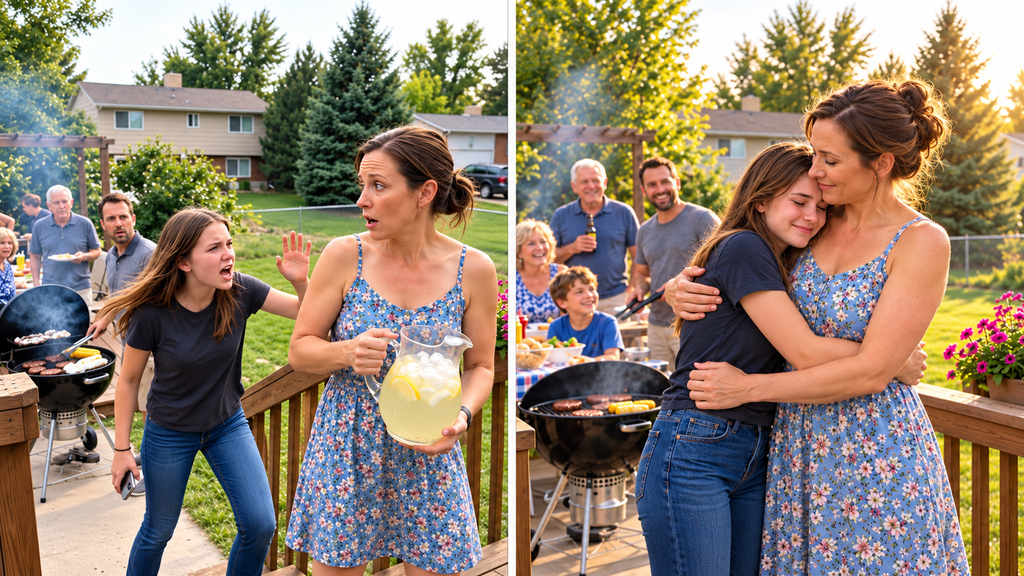
One Saturday, almost exactly three years after the barbecue, I was standing on the back deck.
Sweet corn was roasting beside the grill.
Nina was arguing with her husband about whether the burgers were done.
Linda sat beneath the umbrella drinking lemonade.
And Ava—home from college for the weekend—was standing near the deck stairs staring at her phone.
I walked out carrying a glass pitcher.
She stepped backward.
My shoulder bumped her arm.
The pitcher shook.
Ice clattered against the glass.
Both of us froze.
For half a second, the past stood between us.
Then Ava slowly turned.
Her eyes widened dramatically.
I raised an eyebrow.
She pointed at me.
“Don’t ever touch me again.”
The entire deck went silent.
Then Ava burst out laughing.
I stared at her.
“You did not.”
She was laughing so hard she nearly dropped her phone.
Nina looked horrified because she didn’t understand.
Linda did.
She covered her mouth.
“Ava!”
“What?” Ava gasped. “Too soon?”
“Three years,” I said.
“So… yes?”
I put the pitcher down.
Then chased her across the yard.
She shrieked and ran.
“You’re insane!”
“You started it!”
“Claire!”
I caught her near the fence.
She was laughing.
I was laughing.
Linda was laughing.
Even Nina finally realized something absurd was happening and started laughing too.
And standing there in the Colorado sunshine, holding the girl who had once accused me of deliberately hurting her, I understood something I never could have imagined on that terrible afternoon.
The happiest ending wasn’t revenge.
It wasn’t Daniel losing the house.
It wasn’t Ava being punished.
It wasn’t proving everyone wrong.
The happiest ending was that the truth eventually made all of us better.
Not together in the way we had once been.
But better.
I looked toward the patio table.
The lemonade pitcher sat beside a stack of paper plates.
Almost exactly where I had placed it three years earlier.
That afternoon, I had taken off a gold bracelet and walked away believing something had ended.
I had been right.
Something had ended.
Just not my life.
Not my family.
Not my capacity to love.
What ended was the version of me who believed keeping the peace was more important than keeping herself.
And I have never missed her.
Ava came beside me and slipped her arm through mine.
“Claire?”
“Hmm?”
“I’m glad you left that day.”
I looked at her.
“You are?”
She nodded.
“Because I think if you hadn’t, I might still be that girl.”
I squeezed her hand.
“And I might still be that woman.”
She rested her head against my shoulder.
Across the yard, the people I loved were arguing about hamburgers, laughing too loudly, and stealing corn before dinner.
Imperfect people.
A strange family.
A peaceful home.
I looked down at the gold bracelet around my wrist.
Then at the house behind me.
And finally at Ava.
Three years earlier, Daniel had pointed toward the door and given me a choice.
Apologize or leave.
He thought leaving would be my punishment.
For a while, I thought so too.
But sometimes the door someone tells you to walk through becomes the door that gives your life back.
So I left.
And eventually, in every way that mattered,
I came home.
THE END! THANK YOU FOR READING!❤️