 Reading Time: 20 minutes
Commander Hayes held the salute for one long second. Then he lowered his hand. Nobody spoke. Not my mother. Not my father. Not Madison. Not Aunt Patricia.
And certainly not Ryan. The only sounds beneath the white tent were the distant crash of Pacific waves and the faint snapping of the American flag above the stage.
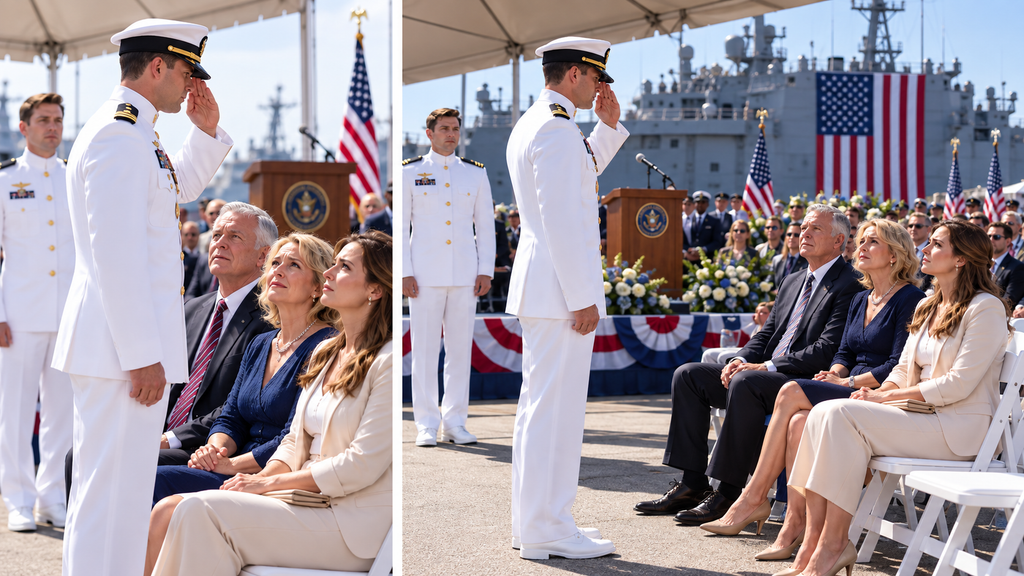
Commander Nathaniel Hayes looked at me with an expression I recognized immediately.
Respect.
Not pity.
Not curiosity.
Respect.
“Ma’am,” he said again, “we’ve been expecting you.”
My mother made a tiny sound beside me.
Almost a laugh.
Except there was nothing amused about it.
Commander Hayes turned toward the empty chair positioned beside the stage.
“Your seat is up front.”
I looked at it.
Then at him.
“I’m comfortable here, Commander.”
His mouth almost moved into a smile.
“I’m afraid protocol disagrees.”
My father cleared his throat.
“Excuse me.”
Hayes looked toward him.
Dad straightened in his chair.
“I think there’s been some confusion.”
“No, sir.”
Hayes’s answer was immediate.
“There hasn’t.”
Dad blinked.
Mom finally found her voice.
“She’s Ryan’s sister.”
“I’m aware.”
“She isn’t part of the ceremony.”
Hayes looked at her.
Then he glanced toward the dark folder the senior chief was holding.
“Yes, ma’am.”
He paused.
“She is.”
That silence was different.
Heavy.
Ryan stared at me.
“What?”
I kept my eyes on Commander Hayes.
He gave the slightest nod.
Permission.
Or maybe confirmation.
Either way, the moment I had spent ten years avoiding had finally arrived.
I stood.
My mother grabbed my wrist.
Not hard.
But urgently.
“Emily.”
I looked down at her hand.
She released me immediately.
“What is going on?”
I could have answered.
Instead, Commander Hayes did.
“Ma’am, your daughter was invited here by Naval Special Warfare Command.”
My father laughed once.
A nervous little burst.
“For what?”
Hayes looked directly at him.
“For this ceremony.”
“That doesn’t make sense.”
“No,” I said quietly.
Dad turned toward me.
“It makes perfect sense.”
Ryan stepped out of formation.
“Emily.”
A senior chief put one hand in front of him.
“Stay where you are.”
Ryan’s face reddened.
“But that’s my sister.”
“Yes,” the chief replied.
“We know exactly who she is.”
The words traveled through the first several rows.
I saw people turning.
Whispering.
Looking from me to Ryan and back again.
My mother stood.
“Emily, whatever this is, you need to tell us right now.”
I met her eyes.
“Why?”
She stared at me.
“Because we’re your family.”
For the first time that morning, I almost laughed.
Not because it was funny.
Because some sentences arrive too late to mean what they once could have meant.
I gently removed my purse from beneath my chair.
“You had ten years to ask.”
Mom went pale.
Commander Hayes gestured toward the stage.
I followed him.
Every step felt louder than it should have.
My shoes clicked against the pavement.
One.
Two.
Three.
Behind me, I could feel my family watching.
But I was not thinking about them anymore.
I was thinking about a different morning.
A morning eleven years earlier.
A helicopter door.
Cold air.
Red lights.
A voice shouting over the rotors.
And a young man named Daniel Mercer looking at me across the cabin and grinning like we were headed to a baseball game instead of somewhere neither of us was allowed to discuss.
“You scared, Carter?”
“Of your flying?”
“I’m not flying.”
“Exactly.”
He laughed.
Three hours later, Daniel was dead.
And I had stopped believing that recognition mattered.
That was the beginning of my silence.
Not shame.
Not failure.
Silence.
There is a difference.
Most people never learn it.
Commander Hayes reached the stage and stopped beside the reserved chair.
But instead of asking me to sit, he turned toward the audience.
The senior chief handed him the folder.
My folder.
Ryan stared at it.
I saw his eyes find the name.
CARTER, EMILY R.
Something shifted in his expression.
Confusion first.
Then calculation.
He was trying to rebuild every conversation we had ever had.
Every missed Christmas.
Every unexplained absence.
Every time I had answered a question with:
“I travel for work.”
Every time Dad had laughed and said:
“Still figuring yourself out?”
Every time Ryan had bragged about training while I simply listened.
Commander Hayes stepped behind the podium.
“Before we continue today’s ceremony, there is an acknowledgment that was originally scheduled to occur privately afterward.”
My stomach tightened.
That was not what we had agreed on.
I looked at him.
He saw it.
“I know,” he said quietly, away from the microphone.
“Nathaniel.”
His eyebrow lifted.
I almost never used his first name.
“Don’t.”
His expression softened.
Then he whispered:
“You’ve hidden long enough.”
My jaw tightened.
“That wasn’t the agreement.”
“No.”
He looked toward my family.
“But circumstances changed.”
I knew exactly what he meant.
He had heard them.
Maybe not everything.
Enough.
The security guard certainly had.
The senior chiefs had.
And suddenly I understood why Hayes had crossed the entire ceremony ground instead of simply sending someone to bring me forward.
This was not revenge.
It was correction.
There are moments when silence protects dignity.
And there are moments when silence allows a lie to keep living.
Commander Hayes had apparently decided this was the second kind.
He turned back to the microphone.
“Most of the men being recognized today understand that service rarely happens alone.”
He looked toward the candidates.
“They’ve had instructors, teammates, families, mentors and people whose names will never appear in newspaper articles.”
Ryan stood motionless.
Hayes continued.
“Some of those people serve publicly.”
A pause.
“Others don’t.”
My heart began beating harder.
I hated ceremonies.
Always had.
There was something unbearable about hearing complicated years reduced to polished sentences.
Hayes opened the folder.
“Lieutenant Commander Emily Rebecca Carter entered military service at twenty-one.”
My mother gasped.
Not quietly.
Not discreetly.
She actually gasped.
Ryan’s head snapped toward me.
My father simply stared.
Hayes continued.
“She later completed specialized training and served in multiple assignments supporting joint special operations.”
A murmur moved through the audience.
I kept my face still.
Hayes did not list locations.
He did not list units.
He did not list operations.
Some things were not his to say.
Some things were not mine.
“Her service included repeated overseas deployments, operational support assignments, and leadership positions requiring a level of discretion that meant even members of her own family knew very little about her work.”
Now people were looking at my parents.
I wished they wouldn’t.
Humiliation was never what I wanted.
I had spent years protecting them from precisely this kind of attention.
Hayes turned a page.
“During one deployment, Lieutenant Commander Carter was part of a joint element whose actions contributed to the recovery of wounded American personnel under hostile conditions.”
My hands went cold.
Daniel.
I stared at the horizon.
Not the audience.
Not my family.
The horizon.
Hayes’s voice continued somewhere far away.
“She sustained injuries during that operation.”
My mother whispered:
“No.”
I closed my eyes.
For half a second, I was back there.
Smoke.
Dust.
A radio screaming.
Someone yelling that the secondary route was gone.
Blood on my gloves.
Daniel on the ground.
“Emily!”
I opened my eyes.
Coronado returned.
Sunlight.
White uniforms.
Ocean.
My breathing slowed.
Hayes looked at me.
He knew.
Of course he knew.
He had been there when I came home.
Not on the operation.
At the hospital.
He had been a lieutenant then.
Young.
Skinny.
Terrible mustache.
He brought me terrible coffee every morning for three weeks because he did not know what else to do.
Hayes closed the folder slightly.
“We will not discuss the specifics of those operations today.”
Thank God.
“But I can say this.”
His eyes moved toward Ryan.
“There are people standing on this field because Lieutenant Commander Carter once refused to leave others behind.”
Ryan looked as though someone had struck him.
Then Hayes said the sentence that changed everything.
“One of those people is standing among today’s instructors.”
A man near the edge of the stage stepped forward.
Senior Chief Daniel Mercer.
Alive.
My breath stopped.
For one impossible second, the entire world narrowed to his face.
Older now.
Gray at the temples.
A scar running beneath his left ear.
But alive.
Very much alive.
I stared at him.
“You—”
Daniel smiled.
“Morning, Carter.”
I could not move.
Commander Hayes looked pleased with himself.
“You told me he was dead.”
Hayes shook his head.
“I never told you that.”
“You let me believe it.”
Daniel stepped closer.
“Because for a while, I nearly was.”
My hands began trembling.
I hated that.
I curled them into fists.
Daniel stopped several feet away.
His eyes were wet.
“So were you.”
The audience had disappeared for me.
There was only him.
“You idiot.”
His smile widened.
“That’s fair.”
“You absolute—”
“Also fair.”
I crossed the distance between us.
And hit him.
Not hard.
A flat palm against his shoulder.
Then again.
“You were alive?”
“Eventually.”
“You were alive?”
“Yes.”
I hit his shoulder a third time.
Then Daniel pulled me into his arms.
I had not cried when I was injured.
I had not cried during rehabilitation.
I had not cried when doctors told me my field career was probably over.
I had not cried when my father called me six months later and asked whether I had finally found a “real job.”
But I cried then.
Quietly.
Furiously.
Into the shoulder of a man I had mourned for eleven years.
Daniel held me tightly.
“I’m sorry.”
“You should be.”
“I couldn’t contact you.”
“You should have found a way.”
“I tried.”
I stepped back.
He wiped his eyes.
“I tried for years.”
I stared at him.
“What?”
His expression changed.
“I sent letters.”
The air seemed to leave my lungs.
“What letters?”
“To your parents’ house.”
Slowly, I turned.
My mother had gone white.
My father looked at the ground.
Daniel followed my gaze.
“I sent three.”
My heart began pounding.
“No.”
“Emily—”
I walked toward the edge of the stage.
“Dad.”
He would not look at me.
“Dad.”
My voice carried farther than I intended.
He finally lifted his head.
“Did you get letters for me?”
My mother whispered:
“Richard.”
Dad’s jaw tightened.
That was answer enough.
Something inside me went perfectly still.
“When?”
“Emily, this isn’t the place.”
“When?”
He looked around at the staring crowd.
His humiliation mattered to him.
Mine never had.
“After you disappeared,” he said.
“I didn’t disappear.”
“You stopped coming home.”
“I was deployed.”
“We didn’t know that.”
“Because you never asked!”
My voice cracked across the ceremony ground.
I hated myself for losing control.
But ten years of swallowed words were suddenly standing at the back of my throat.
Dad rose.
“You told us nothing.”
“I told you I was serving.”
“You said you worked for the government.”
“I told you what I was permitted to tell you.”
“How were we supposed to know?”
“You could have believed me.”
That stopped him.
I stepped down from the stage.
Commander Hayes did not interfere.
Neither did anyone else.
I stopped several feet from my parents.
“What did you do with the letters?”
Dad looked toward Mom.
Mom shook her head.
“Don’t.”
“What did you do with them?”
My father’s voice dropped.
“I threw them away.”
The words were barely audible.
But I heard them.
Daniel heard them.
Ryan heard them.
I think everyone did.
I stared at my father.
“Why?”
His face hardened defensively.
“Because they looked suspicious.”
“They had military return addresses.”
“Exactly.”
I almost laughed.
“What does that even mean?”
“You had already filled your head with all that secrecy nonsense. Then some man we’d never heard of started sending letters asking how to contact you.”
Daniel spoke from behind me.
“I was trying to thank her.”
Dad looked at him.
“For what?”
Daniel walked down the steps.
He stopped beside me.
“For carrying me out.”
Nobody moved.
Daniel looked directly at my father.
“Your daughter carried me.”
Dad blinked.
Daniel continued.
“I was wounded. She was wounded worse.”
My mother covered her mouth.
“She got me to the extraction point.”
I looked away.
Daniel’s voice became rough.
“I had a wife.”
He swallowed.
“And a four-month-old daughter.”
He reached inside his uniform jacket and removed a photograph.
He handed it to me.
A young woman.
A teenage girl.
Daniel stood between them.
“My daughter graduates high school next spring.”
I stared at the photograph.
“She knows your name.”
I couldn’t speak.
“My wife knows your name.”
Daniel’s voice broke.
“My entire family knows your name.”
I looked at him.
“And yours didn’t.”
That sentence broke something open beneath the tent.
My mother began crying.
Not dramatically.
No performance.
She simply sat down and covered her face.
Dad looked ten years older.
Ryan remained frozen among the candidates.
And suddenly I did not feel victorious.
I felt tired.
Painfully, completely tired.
Because this was what people misunderstand about vindication.
It rarely feels good.
Sometimes being proven right only confirms how much time was wasted being treated as though you were wrong.
Commander Hayes approached me.
“We can continue privately.”
I nodded.
“Yes.”
Then Ryan spoke.
“No.”
Every head turned.
He stepped away from formation.
“Ryan,” one instructor warned.
But Ryan kept walking.
He stopped in front of me.
His face was pale.
“What rank did he say?”
I stared at him.
“Ryan.”
“What rank?”
“Lieutenant commander.”
He blinked.
“But you’re not Navy.”
“I am.”
His mouth opened.
Closed.
“You?”
“Yes.”
“For how long?”
“Long enough.”
“Why didn’t you tell me?”
The question almost made me angry again.
Almost.
Instead, I asked:
“When would you have listened?”
His eyes dropped.
I continued.
“Last Christmas?”
He flinched.
“You spent forty minutes explaining military discipline to me.”
Someone in the audience coughed.
Ryan’s face reddened.
“Emily—”
“Thanksgiving two years ago?”
He looked away.
“You told Dad that people who don’t serve could never understand sacrifice.”
His shoulders sagged.
“I didn’t know.”
“No.”
I nodded.
“You didn’t.”
“That’s what I’m trying to say.”
“No, Ryan.”
My voice softened.
“You didn’t want to know.”
That hurt him.
I could see it.
But truth sometimes hurts precisely because there is nowhere left to hide from it.
“You wanted me beneath you.”
His eyes snapped back to mine.
“I never—”
“Yes.”
I smiled sadly.
“You did.”
“Why would I want that?”
“Because if I was lost, you were successful.”
He said nothing.
“If I was disappointing, you were the son who made everyone proud.”
Mom lowered her hands from her face.
“Emily, that’s not fair.”
I looked at her.
“Isn’t it?”
She began to answer.
Then stopped.
I turned back to Ryan.
“I came today because I’m proud of you.”
He looked stunned.
“After everything?”
“Yes.”
“Why?”
“Because what you accomplished is difficult.”
I glanced at the Trident on his chest.
“You earned that.”
His eyes filled.
“And I’m not going to diminish what you earned simply because you spent years diminishing me.”
His chin trembled.
For the first time that morning, my brother did not look like a SEAL candidate.
He looked like the little boy who used to knock on my bedroom door during thunderstorms.
The boy who once followed me everywhere.
Before comparison poisoned everything.
Before our parents turned affection into competition.
Before winning became the only language he knew.
He looked down.
“I told Mom not to invite you.”
I nodded.
“I figured.”
His head rose.
“You knew?”
“The protocol office contacted me.”
His expression collapsed.
Of course.
The invitation had never come from Ryan.
Commander Hayes had invited me.
Ryan whispered:
“Then why did you come?”
I looked at my brother.
“Because you’re still my brother.”
That did it.
Ryan looked away quickly.
But not before I saw the tears.
My father stood.
“We made mistakes.”
I turned toward him.
He spread his hands.
“I’ll admit that.”
I waited.
“But you have to admit you made this difficult too.”
There it was.
The old Carter family reflex.
Responsibility divided until nobody actually carried it.
I felt something inside me close.
Not angrily.
Permanently.
“No.”
Dad stared at me.
“No?”
“No.”
I shook my head.
“I don’t have to take responsibility for the things you chose to do.”
His face tightened.
“I’m trying to apologize.”
“Then apologize.”
“I just did.”
“No.”
I looked directly into his eyes.
“You negotiated.”
Silence.
“An apology doesn’t contain an invoice.”
My father looked away.
Mom stood slowly.
“Emily.”
I looked at her.
Her mascara had begun to run.
“I really didn’t know.”
“I believe you.”
She looked relieved.
Until I continued.
“But you didn’t know because knowing me wasn’t important enough.”
Her relief vanished.
“You called me disappointing this morning.”
She closed her eyes.
“You told a stranger I wasn’t important.”
“I was embarrassed.”
“Of me?”
She shook her head rapidly.
“No. No, honey, I meant—”
“You were embarrassed by me.”
She could not deny it.
I nodded.
“That’s okay.”
Her face crumpled.
“No, it isn’t.”
“No.”
I looked at the front row.
“At least now we agree.”
Then Aunt Patricia stood.
Perhaps she thought this was somehow salvageable.
“Well, obviously there have been misunderstandings on both sides.”
I looked at her.
She sat back down.
Madison suddenly became extremely interested in her phone.
I almost smiled.
Commander Hayes stepped toward the microphone.
“We’re going to resume the ceremony.”
Good.
That was why we were here.
Not for me.
For Ryan.
I returned to the reserved chair.
This time, nobody questioned whether I belonged there.
The ceremony continued.
Names were called.
Tridents were recognized.
Families applauded.
When Ryan’s name was announced, my parents stood.
I stood too.
Ryan walked across the stage.
He shook hands.
Accepted congratulations.
Then he reached Commander Hayes.
Hayes whispered something to him.
Ryan looked toward me.
I couldn’t hear what was said.
But later I learned.
Hayes had told him:
“The hardest thing you’ll ever learn isn’t how to be strong.”
Ryan asked:
“What is?”
Hayes replied:
“Knowing when strength isn’t yours to brag about.”
Ryan walked offstage.
After the ceremony, families flooded the courtyard.
Photographs everywhere.
Mothers fixing collars.
Fathers shaking hands.
Children running between uniforms.
My parents stood together near the tent.
Nobody approached me.
Daniel did.
He carried two coffees.
“You still drink it black?”
I accepted one.
“You remember?”
“You threatened to kill me once because I put sugar in yours.”
“I was having a difficult morning.”
“We were being shot at.”
“Exactly.”
He laughed.
And for the first time that day, so did I.
A real laugh.
It felt unfamiliar.
We walked toward the seawall.
For several minutes, neither of us spoke.
Finally, I asked:
“Why didn’t anyone tell me?”
Daniel’s smile disappeared.
“I wasn’t Daniel Mercer anymore for a while.”
I looked at him.
He stared at the water.
“There were complications after the operation. Investigations. Security issues. My identity was restricted.”
I nodded slowly.
That explained more than I wanted explained.
“I tried contacting you once restrictions were lifted.”
“The letters.”
“Yes.”
“My father threw them away.”
“I know that now.”
We walked farther.
Then Daniel stopped.
“There was another reason I wanted you here.”
I looked at him.
He reached inside his jacket again.
Not for a photograph this time.
For a small envelope.
He handed it to me.
My name was written across the front.
Not typed.
Handwritten.
I recognized the handwriting immediately.
My stomach dropped.
“No.”
Daniel said nothing.
I looked at him.
“Where did you get this?”
“From Chief Lawson.”
My fingers tightened around the envelope.
“Lawson died.”
“Last year.”
“I know.”
“He left instructions.”
I stared at the handwriting.
Thomas Lawson had been our team chief.
The closest thing I had ever had to a second father.
He was also the man who ordered me onto the evacuation helicopter after Daniel was recovered.
I had hated him for it.
Then loved him for surviving long enough for me to understand why.
“What instructions?”
Daniel nodded toward the envelope.
“Read it.”
I opened it.
Inside was a single sheet.
Emily,
If you’re reading this, then Mercer somehow managed to outlive me, which is irritating because I had twenty dollars riding on the opposite outcome.
I laughed.
Of course.
Even dead, Lawson was Lawson.
I kept reading.
There are things you never allowed yourself to understand about that night.
You think you failed because we lost people.
You think you should have done more.
You think surviving created a debt you can never finish paying.
You’re wrong.
You brought four people home.
Mercer was one.
You were another.
Don’t forget to count yourself.
My vision blurred.
I stopped reading.
Daniel waited.
I forced myself to continue.
One day somebody is going to recognize what you did.
You’ll hate it.
You’ll probably try to leave the room.
Don’t.
Stand there.
Let them say your name.
Not because you need the medal.
Not because you need applause.
Because young people need to understand that courage doesn’t always look the way they expect.
Sometimes courage is loud.
Sometimes it kicks down doors.
Sometimes it carries somebody through hell.
And sometimes courage is going home afterward and figuring out how to live.
Do that last part, Carter.
That’s an order.
—Lawson
I folded the letter.
Slowly.
Carefully.
Daniel looked toward the ocean.
“I thought you should have it today.”
I couldn’t answer.
So we stood there.
Two people who had survived the same night differently.
Eventually, someone approached behind us.
Ryan.
He stopped several feet away.
“Can I talk to Emily?”
Daniel looked at me.
I nodded.
He squeezed my shoulder.
“I’ll be around.”
Then he left.
Ryan stood beside me.
Neither of us spoke.
Finally, he said:
“I feel like an idiot.”
I looked at him.
“That’s probably temporary.”
He laughed once.
It surprised both of us.
Then his face became serious.
“I don’t know what to say.”
“You don’t have to say anything.”
“I think I do.”
He looked at the water.
“When I started training, Dad kept telling everyone I was the first person in the family to serve.”
I said nothing.
“I believed him.”
“I know.”
“He said you couldn’t stick with anything.”
I looked at Ryan.
“And you believed that too.”
“Yes.”
The honesty surprised me.
He swallowed.
“I wanted to.”
That surprised me more.
“Why?”
He rubbed his hands together.
“Because you scared me.”
I stared at him.
“Me?”
“You never needed anyone’s approval.”
I almost laughed.
“That is wildly inaccurate.”
“It didn’t look that way.”
He turned toward me.
“You left home. You disappeared. You never explained yourself. Dad would make fun of you and you would just look at him like…”
“Like what?”
“Like his opinion couldn’t reach you.”
I looked away.
It had reached me.
Every single time.
Ryan continued.
“I hated that.”
“Why?”
“Because his opinion reached me.”
That was the first completely honest thing my brother had said to me in years.
“He controlled everything,” Ryan whispered. “Football. College. My major. The Navy.”
I looked sharply at him.
“The Navy was his idea?”
“At first.”
“And becoming a SEAL?”
Ryan stared toward the ceremony grounds.
“That part was mine.”
“Good.”
He nodded.
Then he said:
“I think I needed you to be the failure because otherwise…”
He stopped.
“Otherwise what?”
His voice became almost inaudible.
“Otherwise I had to wonder whether I was actually the favorite or just the obedient one.”
I said nothing.
There are truths you cannot soften for someone.
They have to sit with them.
Ryan rubbed his eyes.
“I’m sorry.”
I watched him.
No excuse.
No “but.”
No negotiation.
Just:
“I’m sorry.”
So I believed him.
Not completely.
Forgiveness isn’t a light switch.
But I believed that he meant it.
“Thank you.”
He nodded.
Then glanced at my black dress.
“Mom really hated the dress.”
I smiled.
“I noticed.”
“For what it’s worth, I like it.”
“You called me an embarrassment thirty minutes ago.”
“I’ve had a complicated morning.”
I laughed.
He smiled.
Then he looked at the envelope in my hand.
“What is that?”
“A letter from an old friend.”
He nodded.
We stood quietly.
After a minute, Ryan asked:
“Are you coming to the reception?”
I looked toward the building.
My father’s earlier words returned.
Don’t try to come to the private reception unless Ryan specifically invites you.
I raised an eyebrow.
“Are you specifically inviting me?”
Ryan understood immediately.
His face twisted with embarrassment.
“You heard that?”
“Everybody heard that.”
“Jesus.”
“Probably him too.”
Ryan laughed.
Then he straightened.
“Emily Carter, I am specifically inviting you to my reception.”
I pretended to consider it.
“Will there be food?”
“Apparently.”
“Cake?”
“I was told there would be cake.”
“Then I’ll consider your apology.”
He smiled.
“Fair.”
We walked back together.
The reception was held inside a hall overlooking the water.
My parents were already there.
Mom approached first.
She stopped several feet from me.
For once, she did not touch me without permission.
“Emily.”
“Mom.”
“I owe you an apology.”
I waited.
She looked at Ryan.
Then Dad.
Then back at me.
“I spent years deciding who you were without asking.”
Her voice trembled.
“I thought your silence meant you had nothing to say.”
I swallowed.
“And today I learned it meant you were carrying things I knew nothing about.”
I nodded.
She took a breath.
“What I said this morning was cruel.”
“Yes.”
She flinched.
But she continued.
“You didn’t deserve it.”
“No.”
“I’m sorry.”
This time, there was no excuse.
No explanation.
So I said:
“Thank you.”
She looked hopeful.
I knew what she wanted.
A hug.
Immediate forgiveness.
A return to normal.
But normal had been the problem.
So I did not give her that.
Instead, I said:
“I need time.”
Her eyes filled again.
“I understand.”
Maybe she did.
Maybe she didn’t.
Either way, it was no longer my job to manage her reaction.
Dad was harder.
He waited until nearly everyone had eaten.
Then he approached while I stood alone near a window.
He held a glass of water.
“Lieutenant Commander.”
I looked at him.
The title sounded strange in his mouth.
“Dad.”
He looked down.
“I threw away those letters.”
“Yes.”
“I thought I was protecting you.”
“No, you didn’t.”
His eyes lifted.
I wasn’t angry.
That made the truth easier.
“You were protecting your version of me.”
He frowned.
“What does that mean?”
“If Daniel was real, then my life might have been real too.”
Dad said nothing.
“You needed me to be irresponsible.”
His jaw tightened.
“I never needed that.”
“Yes, you did.”
“Why?”
“Because I left.”
He stared at me.
“You always treated leaving as rejection.”
He looked toward the floor.
“When I didn’t choose the college you wanted, you called it rebellion.”
No response.
“When I didn’t choose the career you understood, you called it failure.”
His shoulders lowered.
“When I stopped coming home to be insulted, you called it selfishness.”
Dad closed his eyes.
“And when someone wrote letters that suggested there might be an entire part of my life you didn’t understand…”
I paused.
“You threw them away.”
He whispered:
“Yes.”
That was the first time my father had ever admitted something without defending himself afterward.
I nodded.
“That cost me eleven years.”
His face broke.
“I know.”
“No.”
My voice trembled.
“You know now.”
He nodded.
Tears appeared in his eyes.
“I can’t fix it.”
“No.”
“What can I do?”
That was the question I had wanted from him for twenty years.
Not:
What do you want from me?
Not:
What did I do wrong?
Not:
Why can’t you let it go?
What can I do?
I looked at him.
“Start believing people when they tell you who they are.”
He swallowed.
“And me?”
“Yes.”
He nodded.
“I can do that.”
“We’ll see.”
I walked away.
Not because I hated him.
Because promises are beginnings.
Not endings.
Six months later, Ryan called me at 2:13 in the morning.
I answered immediately.
“What happened?”
“Nothing.”
“Ryan, it is two in the morning.”
“I know.”
“Are you hurt?”
“No.”
“Are you drunk?”
“No.”
“Then somebody had better be dead.”
He laughed quietly.
“I just needed to ask you something.”
“What?”
There was a pause.
Then:
“How do you live with being afraid?”
I sat up in bed.
The question told me more than he intended.
Training had ended.
Real work had begun.
The mythology was fading.
Good.
My brother was becoming a professional instead of someone playing at invincibility.
“You don’t stop being afraid.”
He was silent.
“You learn what deserves more attention than the fear.”
“What if the fear wins?”
“Then tomorrow you try again.”
He breathed slowly.
“Emily?”
“Yeah?”
“I’m glad you came to the ceremony.”
I smiled in the darkness.
“So am I.”
A year later, I attended another ceremony.
Not Ryan’s.
Mine.
It was small.
Private.
Exactly the way I wanted it.
After more than two decades connected to service in one form or another, I was finally stepping away.
No cameras.
No reporters.
No dramatic speeches.
Commander Hayes was there.
Daniel came with his wife and daughter.
Ryan flew across the country.
My mother came.
My father came.
They sat in the second row.
They did not ask for the first.
That mattered.
When the ceremony ended, Dad approached me.
He handed me a small wooden box.
“What is this?”
“Open it.”
Inside were three envelopes.
For a second, I couldn’t breathe.
Daniel’s letters.
The originals.
I looked at Dad.
“You said you threw them away.”
“I thought I had.”
He swallowed.
“I found them in an old file box in the attic.”
My fingers trembled.
The envelopes were yellowed.
My name was written across each one.
Dad’s eyes filled.
“I didn’t open them.”
I looked at him.
“I almost did.”
He gave a sad smile.
“But they aren’t mine.”
I closed the box.
“No.”
He nodded.
“They aren’t.”
That night, I read them.
All three.
The first had been written while Daniel was still hospitalized.
Emily,
If this reaches you, I need you to know I made it.
I don’t remember everything.
I remember your voice.
I remember you telling me I wasn’t allowed to die because you refused to explain to my wife how I lost our anniversary bet.
I remember you dragging me.
I remember waking up.
They tell me you’re alive.
That’s enough for today.
—D
The second letter was six months later.
Emily,
Still here.
Still irritating everyone.
Walking again.
My daughter said “Dad” yesterday.
Technically she said “Da,” but I am claiming it.
I owe you that moment.
I don’t know whether I’ll ever get to thank you properly.
But if I do, coffee is on me.
No sugar.
I remember.
—D
The third letter was written almost two years after that.
Carter,
I’m beginning to think these aren’t reaching you.
Maybe that’s intentional.
If you don’t want contact, I’ll respect that.
But I need you to know something before I stop writing.
You didn’t fail us.
You hear me?
You didn’t fail.
I know you.
You’re probably somewhere carrying every person we lost like stones in a backpack.
Put the backpack down.
Live.
That’s how you bring us home.
—Daniel
I cried harder reading that letter than I had cried when I saw him alive.
Then I folded all three and placed them beside Lawson’s letter.
Four pieces of paper.
Eleven lost years.
And somehow, not an ending.
A beginning.
Two weeks later, I visited my parents.
For the first time in years, Dad did not introduce me to a neighbor by explaining what Ryan did.
He simply said:
“This is my daughter, Emily.”
Nothing else.
No rank.
No résumé.
No comparison.
Just my name.
And strangely, that was enough.
Ryan eventually framed a photograph from his Trident ceremony.
Not the official one.
Not the picture of him standing alone in dress whites.
The photograph showed the two of us near the seawall afterward.
He was still in uniform.
I was still wearing black.
Neither of us was looking at the camera.
We were laughing.
He mailed me a copy.
On the back, he had written:
TO THE FIRST PERSON WHO TAUGHT ME WHAT SERVICE LOOKED LIKE.
I called him immediately.
“This is unbearably sentimental.”
“You’re welcome.”
“I’m throwing it away.”
“No, you’re not.”
I looked at the photograph.
“No.”
I smiled.
“I’m not.”
Years earlier, I had believed strength meant never letting people see what hurt.
I had been wrong.
Strength was not silence.
It was choosing when silence protected something sacred and when speaking finally became necessary.
My family had mistaken my quiet for emptiness.
They had mistaken secrecy for failure.
Distance for weakness.
Restraint for shame.
And I had spent too many years believing that someday, if I achieved enough, survived enough, sacrificed enough, they might finally understand me.
That was the final thing I had to unlearn.
You cannot build your life around the hope that someone else will eventually recognize its value.
You have to recognize it yourself.
The salute at Ryan’s ceremony did not make me worthy.
The rank did not make me worthy.
The stories Commander Hayes told did not make me worthy.
Even the people I helped bring home did not make me worthy.
I had been worthy while sitting alone in that folding chair.
I had been worthy while my mother called me disappointing.
I had been worthy while my father laughed.
I had been worthy when my brother asked me not to embarrass him.
Nothing they learned about me that morning changed who I was.
It only changed what they were finally able to see.
And perhaps that was why, months later, when Commander Hayes mailed me a photograph from the ceremony, I did not put it in a drawer.
I framed it.
The picture had been taken at exactly the moment he saluted me.
Everyone else was slightly blurred behind us.
Mom’s hand was frozen against her pearls.
Dad was staring.
Ryan stood in the distance.
And I was looking up at Hayes.
No smile.
No tears.
Just stillness.
On the back, Hayes had written one sentence.
Carter — sometimes the hardest person to bring home is yourself.
I kept that photograph beside Daniel’s letters.
Beside Lawson’s final note.
Beside the picture Ryan sent me.
Three frames.
Four letters.
One life I no longer felt obligated to explain.
And whenever someone asked me about the Trident ceremony, they usually wanted to hear about my family’s faces.
They wanted the dramatic part.
The salute.
The revelation.
The humiliation.
They wanted to know whether my mother apologized.
Whether my father cried.
Whether Ryan felt ashamed.
Those things happened.
But they were never the part I remembered most.
What I remembered was standing beside the Pacific after everyone had gone inside.
Daniel beside me.
Lawson’s letter in my hand.
The sun dropping lower over Coronado.
And for the first time in years, realizing I was no longer carrying the desperate need to be understood by people who had never bothered to ask.
I could finally put that weight down.
So I did.
And then I went inside.
My brother had saved me a seat.
This time, it was beside him.
And when I sat down, Ryan didn’t introduce me by my rank.
He didn’t tell anyone about deployments.
He didn’t mention Commander Hayes.
He didn’t explain the scars.
He simply looked at the people around the table and said:
“This is Emily.”
Then he looked at me.
“My sister.”
I smiled.
And for once, those two words felt like enough.
THE END! THANK YOU FOR READING!❤️