 Reading Time: 12 minutes
My husband took our kids overseas for his wedding. Then he came home and found the house gone. The message arrived at exactly 2:13 in the morning. I know because I was already awake, staring at the ceiling fan as it turned in slow, tired circles above me.
My husband, Adrian Vance, was overseas with our children, his family, and the woman he planned to marry at a private resort. I was the only person not invited. Then my phone lit up. Be gone when we return. I hate old things. I worked hard for a new life.
I read it once. Then again. Then a third time, hoping the words would become less cruel if I stared long enough.
They did not.
Before I could breathe, another message came through.
Don’t embarrass yourself. The children will be with us.
That one did not sound angry.
It sounded like instruction.
Like my life had already been erased and filed away.
Nineteen years of marriage had taught me one thing about Adrian.
He did not argue with life.
He edited it.
Short sentences.
Clean exits.
No emotional mess.
Three weeks earlier, he sat across from me at our kitchen island and told me about Kendra.
Twenty-six years old.
A colleague from his firm.
“She makes things feel different,” he said calmly, like he was discussing a business upgrade.
I stared at him across the same counter where I had packed school lunches, rolled cookie dough with our daughter, helped our son fill out college applications, and paid bills while Adrian chased promotions.
“What does that mean?” I asked.
“It means I’m not happy here anymore.”
“Here?”
He looked around the kitchen with mild irritation, as if the room had personally disappointed him.
“This house. This routine. This version of life. It’s old, Claire.”
Old.
The word sat between us like mold.
Then he told me he had “handled everything.”
A destination wedding.
Private resort.
Family invited.
Clients invited.
Our children invited.
Marcus, seventeen, who had begun standing like his father.
Lila, fifteen, who had started answering me in half-sentences because someone had taught her distance before she understood pain.
And me?
Not forgotten.
Excluded.
“You’re still married to me,” I said quietly.
Adrian sighed.
“It’s symbolic. The legal details will follow.”
“Legal details?”
“Don’t make this ugly.”
That was Adrian’s favorite phrase.
Don’t make this ugly.
He said it whenever he did something ugly and wanted me to keep the room pretty around it.
When he missed Lila’s school concert because Kendra had a “client dinner,” he said, Don’t make this ugly.
When I found a receipt for a diamond bracelet that never came to me, he said, Don’t make this ugly.
When Marcus stopped asking him to practice baseball and started pretending he did not care, Adrian said, Boys grow up. Don’t make this ugly.
Now he was flying our children overseas to watch him pledge a fake new life to a woman young enough to have been one of their babysitters, and he still wanted me to stay quiet.
I asked him not to take the children.
He said they wanted to go.
I asked Marcus.
He shrugged and said, “Dad said you didn’t care.”
I asked Lila.
She stared at her phone and whispered, “It’s just a trip.”
A trip.
A wedding disguised as a vacation.
A replacement ceremony disguised as family bonding.
I should have stopped it then.
I should have called my attorney before they boarded.
But I was tired.
Not weak.
Tired.
Tired from nineteen years of being reasonable with a man who turned reason into rope.
So I let them go, because I thought at least the children would come back and then we could sort the damage in court.
Then came the 2:13 a.m. messages.
Be gone when we return.
The children will be with us.
That was not divorce.
That was erasure.
That night, after the messages, I sat alone in the dark living room of the house Adrian called his.
The old wood creaked around me.
The hallway smelled faintly of lemon oil and rain.
This was the home where I had raised our children, cooked birthday breakfasts, folded school uniforms, waited through nights when Adrian said work mattered more than coming home, and sat beside my father when cancer made him too weak to climb the stairs.
But the house had never belonged to Adrian.
That was the mistake he made.
The land had been my father’s.
Generational.
Protected.
Placed in a trust six years before he died, when he looked Adrian in the eye and said, “A man who loves a home should know the difference between living in it and owning it.”
Adrian laughed about that for years.
He stopped laughing when my attorney answered the phone at 3:04 a.m.
Her name was Marianne Bell, and she had been my father’s lawyer long before she became mine.
She was seventy-two, sharp as broken glass, and wore lipstick to emergency hearings like war paint.
I read her Adrian’s messages.
She did not gasp.
She did not comfort me.
She said, “Forward those to me now.”
I did.
Then she said, “Do you want him out, or do you want him unable to claim he was ever in?”
I closed my eyes.
“I want my children protected.”
“Then we move quickly.”
By sunrise, I had signed the first document.
By noon, the second.
By the time Adrian was standing barefoot on a beach beside Kendra, promising her a beautiful new life, the county had already recorded the transfer he never bothered to check.
The house itself was old but movable, a restored timber-frame farmhouse my father had rebuilt decades earlier after a flood.
It had been designed in sections, not because he planned to move it, but because he always said, “A family home should survive stubborn men and bad weather.”
That sentence had made me smile for years.
Now it saved me.
I did not cry.
I did not beg.
I did not pack my things into trash bags like Adrian wanted.
I simply moved what mattered.
My mother’s piano.
My father’s books.
The height marks from the kitchen doorway, carefully cut and saved.
The quilts.
The photographs.
The cedar chest.
The stained-glass window above the staircase.
The pieces of home Adrian had called old because he could not understand anything with roots.
A private preservation crew arrived before dawn.
These were not demolition men.
They were craftsmen my father had once trusted.
They worked quietly, respectfully, like they were moving a body that still had a soul.
By the end of the first day, the house was prepared.
By the second, lifted.
By the third, transported to the north property beyond the ridge, land also held in the Hayes Family Trust.
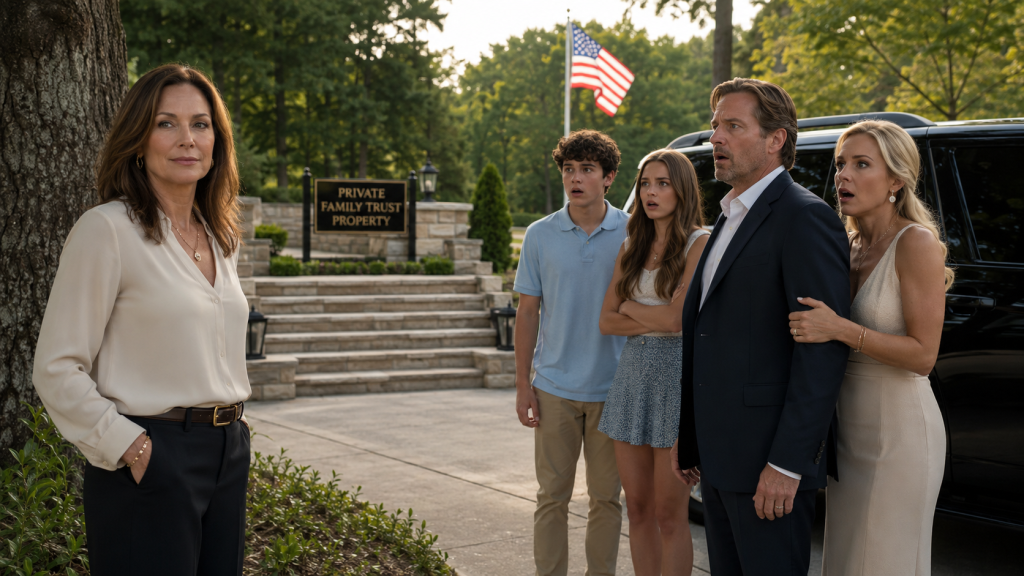
Only the stone steps remained, leading to empty air.
Beside them stood a sign from Marianne’s office.
PRIVATE FAMILY TRUST PROPERTY. UNAUTHORIZED ENTRY PROHIBITED.
Three days later, Adrian’s plane landed.
I waited down the road in my car as his black SUV turned into the driveway.
Kendra sat beside him in sunglasses, smiling like a queen arriving at her estate.
Marcus and Lila were in the back seat, quiet and confused.
Then the SUV stopped.
Adrian stepped out first.
And his face went white.
The house was gone.
Not damaged.
Not burned.
Gone.
Only the stone steps remained beneath the wide Pennsylvania sky.
Kendra screamed first.
“What is this?”
Adrian walked forward slowly, as if the house might reappear if he approached with enough authority.
He turned and saw me standing beside the old oak tree.
“You destroyed my house,” he said.
I smiled.
“No, Adrian. I removed mine.”
Marcus opened the car door, staring at the empty land.
“Dad,” he whispered, “what did you tell us Mom did?”
Adrian looked at our children.
Then at me.
For the first time in nineteen years, he had no sentence ready.
Marcus stepped out of the SUV first, his face twisted with shock.
“Dad, you told us Mom abandoned the family.”
Lila followed, staring at the empty steps.
“You said she sold everything because she hated us.”
Adrian’s mouth opened, but Kendra spoke first.
“Adrian, where are we supposed to live?”
My attorney, Marianne Bell, stepped from behind the oak tree with a folder in her hand.
“Not here,” she said calmly. “This property belongs to the Hayes Family Trust, and Mr. Vance has no legal claim to it.”
Adrian’s face flushed.
“That was my home for nineteen years.”
I looked at him.
“Living in it never made it yours.”
Marianne handed him another document.
“And because you sent written threats about keeping the children overseas, we filed an emergency custody petition before your plane landed.”
Kendra turned to him slowly.
“You told me the divorce was done.”
Marcus stared at his father.
“You lied to all of us?”
Lila ran to me then, crying against my shoulder.
Adrian reached toward her, but she stepped back.
“No,” she whispered. “You made me think Mom didn’t want me.”
That hurt more than losing any house ever could.
I held my daughter tighter and said, “He can answer to the court now.”
A sheriff’s deputy stepped from a parked car near the tree line and handed Adrian the notice.
No drama.
No handcuffs.
Just paperwork.
That was what finally scared him.
Men like Adrian can handle shouting.
They can twist crying.
They can dismiss pain.
But official documents make their lies stand still.
“This is insane,” he said.
Marianne tilted her head.
“No. Taking your minor children out of the country for a ceremonial wedding and texting their mother that they would be kept from her is insane. This is legal response.”
Kendra stared at the sign.
Then at the empty steps.
Then at Adrian.
“You said this estate was yours.”
Adrian snapped, “It was ours.”
“No,” I said. “It was never yours, and you were done with ours when you told me to be gone.”
Marcus looked at me with tears in his eyes.
“Where’s my stuff?”
“At the north property,” I said immediately. “Your guitar, your desk, your college folders, everything.”
Lila wiped her cheeks.
“My room?”
“Safe.”
“You didn’t throw anything away?”
I shook my head.
“Never.”
The relief on her face nearly broke me.
Adrian had made them believe I had abandoned them so easily that they had packed their grief into silence.
I would never forgive him for that.
The deputies allowed Marcus and Lila to leave with me under the temporary custody order.
Adrian protested, but weakly.
Kendra stood beside the SUV, suddenly less a bride and more a woman realizing she had walked into a legal disaster wearing resort jewelry.
I drove the children to the north property.
Neither spoke for the first ten minutes.
Then Marcus said, “Did you really move the whole house?”
“Yes.”
He looked out the window.
“That’s kind of crazy.”
I almost laughed.
“It was a crazy week.”
Lila reached forward from the back seat and touched my shoulder.
“Mom?”
“Yes?”
“I’m sorry.”
“For what?”
“For believing him.”
I swallowed hard.
“You’re a child. He is your father. You trusted him. That is not your fault.”
She cried quietly after that.
Marcus turned his face toward the window, but I saw his shoulders shaking.
The relocated house was not fully finished yet.
The porch was temporary.
The kitchen was disconnected.
Boxes filled the hallway.
But when the children walked inside, something changed.
The smell was still there.
Lemon oil.
Old wood.
Home.
Lila ran her hand along the saved staircase rail.
Marcus found the piece of kitchen doorway with their height marks carefully mounted against the wall.
His finger stopped at the line from when he was twelve.
He whispered, “You saved this?”
“Of course.”
“Dad said you wanted a clean start.”
“No,” I said. “That was him.”
We ate pizza on the floor that night because the dining table had not been reassembled.
Lila fell asleep with her head in my lap.
Marcus stayed awake, staring at the ceiling.
Finally he said, “Dad said Kendra understood him better.”
I brushed Lila’s hair back from her face.
“That may be true.”
He looked at me, startled.
“But understanding someone does not give them permission to hurt other people.”
Marcus nodded slowly.
“I think he wanted us to choose her.”
“He wanted you to choose his version of the story.”
“And now?”
“Now you get the truth.”
The custody hearing happened five days later.
Adrian arrived in a dark suit, angry and polished.
Kendra came too, though Marianne said that was a terrible idea.
She sat behind him with a hand on her stomach, twisting a ring that had no legal meaning.
Marianne presented everything clearly.
The messages.
The overseas trip.
The false statements to Marcus and Lila.
The trust documents.
The property deed.
The transfer record.
The emergency filing.
Adrian’s attorney tried to argue that the texts were “emotional and not literal.”
The judge read them aloud.
Be gone when we return. I hate old things. I worked hard for a new life.
Don’t embarrass yourself. The children will be with us.
Then he looked at Adrian.
“Those are not emotional statements. Those are instructions and implied threats.”
Adrian’s face tightened.
Marcus asked to speak privately with the judge.
I wanted to stop him.
Marianne gently told me not to.
“He’s seventeen,” she whispered. “Let him have his voice.”
Lila submitted a written statement.
In it, she wrote:
Dad told me Mom didn’t come because she hated his happiness. I thought she didn’t want me. I don’t want to be around people who make me feel like loving my mom is betrayal.
I cried when Marianne read it to me afterward.
The judge granted me temporary primary custody.
Adrian received structured visitation.
No international travel.
No removing the children from the state.
No involving Kendra in custodial exchanges unless both children agreed and their counselor approved.
Outside the courtroom, Adrian tried to approach Marcus.
Marcus stepped back.
“You made me lie to Mom without knowing it,” he said.
Adrian looked wounded.
“I was trying to protect you.”
“No,” Marcus said. “You were trying to protect yourself.”
That was the first time I saw real fear in Adrian’s eyes.
Not fear of losing the house.
Not fear of losing money.
Fear of being seen clearly by his son.
The divorce became uglier before it became final.
Adrian demanded half the house value.
Marianne almost smiled when his attorney filed that claim.
She produced the trust documents, my father’s recorded statement, the property history, and the clause excluding ancestral trust property from marital division.
Adrian got nothing from the house.
Then came the financial review.
That was where the second loss appeared.
The house had not been the only thing he had already lost.
For two years, Adrian had used marital accounts to support Kendra.
Rent.
Designer clothes.
Travel.
Jewelry.
A luxury SUV lease hidden under a business development expense.
And the resort ceremony.
Paid partly from a family account meant for Marcus and Lila’s college costs.
When Kendra learned some of her lifestyle could become evidence in a divorce proceeding, her loyalty cooled fast.
She stopped attending hearings.
Then she stopped answering Adrian’s calls.
By the time our divorce finalized, their symbolic wedding had become exactly that.
A symbol.
Of his arrogance.
Of his lies.
Of what it costs to build a future on stolen ground.
The judge awarded financial restitution from Adrian’s share of marital assets.
Marcus and Lila’s college funds were restored.
I retained full control over the Hayes Family Trust property.
Primary custody remained with me, with Adrian receiving scheduled visitation and required counseling.
He sat at the table when the ruling came down, staring at his hands.
For once, he had no sentence ready.
After court, Lila asked me if we could go home.
Home.
Not the old location.
Not the empty steps.
The house.
The family.
The place we were rebuilding.
“Yes,” I said. “Let’s go home.”
That evening, Marcus helped me hang the stained-glass window above the new staircase.
Lila arranged photographs on the piano.
The sun came through the glass in blue and gold patches across the floor.
For the first time in months, the house felt like it had exhaled.
Later, Marcus stood in the kitchen doorway and asked me to mark his height.
“You’re seventeen,” Lila teased.
“So?”
I smiled and took the pencil.
He stood straight, taller than me now.
I marked the wood.
Then Lila demanded her turn.
When I finished, she looked at the wall and said, “We’re still here.”
I touched the old doorway.
“Yes. We are.”
Adrian visited two weeks later.
He looked smaller without the house around him.
He brought flowers for Lila and a college brochure for Marcus.
Neither child ran to him.
But neither refused to see him.
That was their choice, and I respected it.
Before he left, Adrian stopped near the driveway.
“I didn’t think you’d actually do it,” he said.
“Move the house?”
“Any of it.”
I looked at him.
“I know.”
His jaw worked.
“I lost everything.”
“No,” I said. “You lost what you tried to own. That’s not the same thing.”
He looked toward the house.
“I did love it.”
I shook my head.
“You loved how it made you look.”
He had no answer.
Months later, the north property bloomed with spring.
The house settled into its new foundation.
The porch was rebuilt.
The kitchen connected.
The garden replanted.
Life did not become painless, but it became honest.
Marcus chose a college two hours away and still came home on weekends to do laundry and raid the fridge.
Lila joined theater and started laughing loudly again.
I slept through the night.
Not every night.
But enough.
Sometimes people ask if I regret moving the house.
No.
I regret that my children had to see their father exposed in such a brutal way.
I regret that Lila thought I did not want her.
I regret that Marcus carried his father’s lies like manhood.
I regret that nineteen years ended at 2:13 a.m. in a text message.
But I do not regret saving what was mine.
I do not regret answering erasure with action.
I do not regret teaching my children that old things are not worthless just because someone wants a new life.
Old wood holds stories.
Old doorways hold growth marks.
Old quilts hold hands that are gone now.
Old homes hold families together when people like Adrian try to turn roots into embarrassment.
My husband took our kids overseas for his wedding.
Then he came home and found the house gone.
He thought I had destroyed it.
But he was wrong.
I preserved it.
I moved it beyond his reach.
I took the piano, the books, the photos, the doorway, the quilts, and the truth.
I took my children back from the story he wrote without me.
Adrian once told me he hated old things.
That was fine.
Because old things remembered what he wanted everyone to forget.
The house was never his.
The land was never his.
The children were never his to erase.
And I was never the woman he could command to be gone.
By the time he understood that, all he had left were empty stone steps and a sign telling him what my father had tried to teach him years before.
Living somewhere does not mean you own it.
And losing someone does not mean they disappeared.
Sometimes, it means they finally went where you could not follow.
THE END! THANKS FOR READING!