 Reading Time: 25 minutes
I stared at the torn edge of the notebook page for so long that the sounds from the memorial reception seemed to disappear. People were laughing softly inside the church fellowship hall.
Someone was pouring coffee. A child ran across the grass. A car door slammed somewhere beyond the cemetery. Ordinary sounds. Ordinary life.
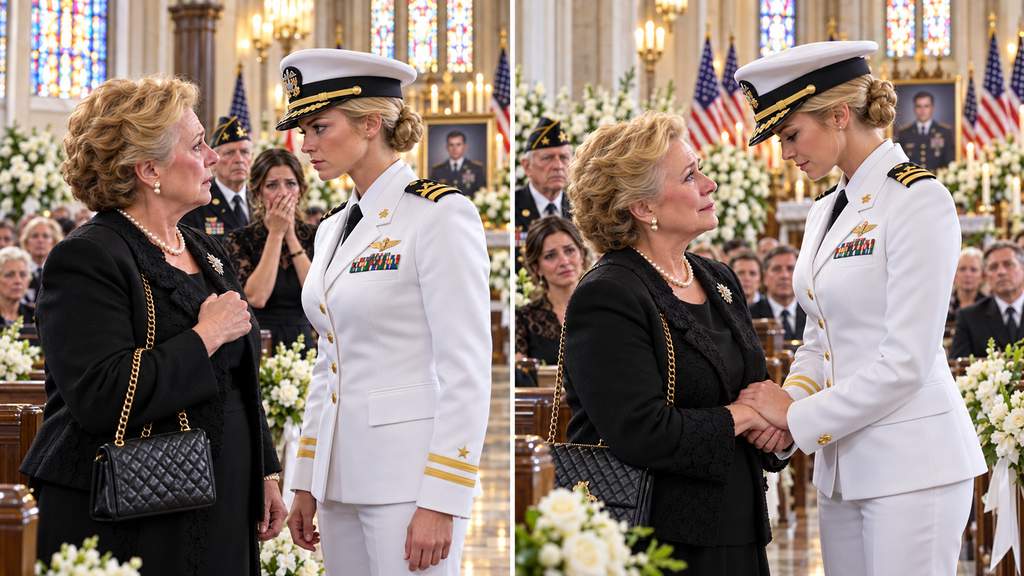
But nothing about the words in my father’s notebook felt ordinary.
Helen says Rachel wants me to stop writing. I don’t believe it.
Then came the missing pages.
Not loose pages.
Not pages that had simply fallen out.
They had been removed deliberately.
The paper had been torn close to the binding.
I ran my thumb over the ragged edge.
“Chloe.”
My sister looked at me.
“Who tore these out?”
Her eyes moved immediately toward the church.
I followed her gaze.
Through the fellowship hall window, I could see our mother standing beside Reverend Hayes.
Helen Lawson looked exactly as she always had.
Perfect posture.
Dark dress.
Pearls at her throat.
A paper cup held delicately between both hands.
To anyone watching, she was the grieving widow of Colonel Robert Lawson.
A woman who had lost her husband.
A mother whose eldest daughter had supposedly abandoned the family.
But for the first time in twelve years, I wondered how much of that woman had ever been real.
“Chloe?”
“I don’t know,” she whispered.
“You looked at Mom.”
“Because Dad hid the notebook from her.”
My stomach tightened.
“What?”
Chloe hugged herself against the afternoon breeze.
“He kept it in the garage.”
“Why?”
“I didn’t know then.”
She looked down.
“I think I do now.”
I closed the notebook.
“Tell me.”
Chloe hesitated.
“About eight months before Dad died, they started fighting.”
“About me?”
“At first.”
“At first?”
Chloe swallowed.
“Then about money.”
That stopped me.
Dad had been meticulous with money.
He wasn’t wealthy, but after decades of military service and careful saving, he and Mom were comfortable.
“What money?”
“I don’t know. Dad never told me everything. But one night I heard him ask Mom where it had gone.”
“How much?”
“I don’t know.”
“Chloe.”
“I really don’t.”
She looked frightened now.
“He said something about an account. Mom told him he was confused because of his medication.”
My fingers tightened around the notebook.
Dad had been diagnosed with pancreatic cancer eleven months before his death.
The last few months had been brutal.
Pain medication.
Chemotherapy.
Hospital visits.
Fatigue.
But confused?
Dad could forget where he put his reading glasses.
He could never forget a bank account.
“What happened?”
“Dad got angry.”
That alone told me something.
My father rarely raised his voice.
“He told her he wasn’t confused. Then he said…”
She stopped.
“What?”
Chloe looked toward the church again.
“He said, ‘You already stole enough years from my daughters. You aren’t taking this too.’”
A cold sensation moved through me.
“What did Mom say?”
“I couldn’t hear everything.”
“Try.”
“She told him he was being dramatic.”
Of course she did.
“And then Dad said he had proof.”
My heartbeat changed.
“What kind of proof?”
“I don’t know.”
I opened the notebook again.
The missing pages suddenly felt heavier than paper.
“Did Dad ever mention General Bennett?”
“All the time.”
“Did Mom know he was keeping Dad’s letters?”
“I don’t think so.”
That made sense.
Dad had spent his life planning for contingencies.
When everyone else saw one road, Colonel Robert Lawson saw six.
I had inherited that from him.
Maybe that was why my next thought came so quickly.
“Where’s General Bennett?”
Chloe pointed toward the side entrance.
“He went into Dad’s old office with Reverend Hayes.”
I handed her the box.
“Come on.”
“Rachel…”
“Dad left a trail.”
“What?”
I looked at the torn notebook.
“And I think he expected someone to follow it.”
General Arthur Bennett was sitting behind Reverend Hayes’s desk when we entered.
The general looked tired.
Not physically tired.
Older than that.
The exhaustion of someone who had carried a promise for too long.
He looked at the notebook in my hand.
Then he looked at Chloe.
Then at me.
“You found it.”
Not a question.
“You knew about this?”
“I knew Robert kept journals.”
“There are pages missing.”
His expression changed.
“I know.”
My pulse jumped.
“Do you know what was on them?”
“Yes.”
Chloe sucked in a breath.
I stepped toward the desk.
“General, twelve years of my life disappeared because people kept deciding I shouldn’t know things.”
He slowly stood.
“I know.”
“No more.”
He studied my face.
For a second, I wasn’t Commander Rachel Lawson.
I wasn’t the officer wearing ribbons.
I was sixteen again, standing beside my father’s truck while he told me never to loosen a lug nut after lifting the vehicle.
Think first.
Act second.
Finish what you start.
General Bennett opened his briefcase.
“Your father made me promise I would wait until after his memorial.”
“Why?”
“Because he didn’t want his memorial turned into a trial.”
I almost laughed.
“That ship sailed when Mom ordered me to strip off my uniform.”
The general’s mouth tightened.
“I suspect Robert underestimated Helen’s determination.”
He removed a thick envelope.
My name was written across it.
RACHEL — AFTER THE MEMORIAL.
Dad’s handwriting.
My knees almost failed.
Chloe grabbed my arm.
General Bennett came around the desk.
“You should sit down.”
“I’ve spent twelve years being told what I should do.”
His eyes softened.
“Then stand.”
I broke the seal.
Inside were photocopies.
Bank statements.
Letters.
Printed emails.
And six pages that matched the torn edges in Dad’s notebook.
Chloe covered her mouth.
“Oh my God.”
I looked at General Bennett.
“How did he get these?”
“Your father realized pages were disappearing from his journal. He began making copies.”
Of course he did.
Dad.
Always planning.
Always leaving a second route home.
I unfolded the first page.
The date was fourteen months earlier.
Dad had written:
I confronted Helen tonight.
My hands began shaking.
I kept reading.
I asked why Rachel stopped receiving my letters. Helen said perhaps Rachel threw them away. I asked how she could know that. She had no answer.
The next line was underlined twice.
I found three of Rachel’s letters in Helen’s desk. Unopened.
I stopped breathing.
Chloe whispered, “Rachel…”
I couldn’t answer.
Three letters.
My letters.
I remembered writing them.
One from Bahrain.
One from Japan.
One aboard ship during a deployment when the sea had been so rough that half my division was sick.
I had written Dad anyway.
I had told him I missed his pancakes.
I had asked how Chloe was doing in college.
I had written:
Tell Mom I love her even if she doesn’t believe it anymore.
Dad had never received them.
I continued.
Helen admitted she intercepted some correspondence. She insists she did it because Rachel needed to learn that choices have consequences.
Something inside me cracked.
Not loudly.
Quiet things break differently.
General Bennett reached for the chair.
This time I sat.
Chloe crouched beside me.
I read the next sentence.
I told my wife that punishing our adult daughter for joining the Navy was not discipline. It was cruelty.
Tears blurred the page.
Then:
Helen said Rachel chose the Navy over us. I reminded her that I served thirty-two years in the Army. She replied that it was different because I was a man.
I closed my eyes.
There it was.
The argument we’d had when I was seventeen.
Girls don’t need military academies.
You can attend Vanderbilt.
You can stay near home.
You can have a normal life.
Dad had defended me.
Mom had never forgiven either of us.
I opened my eyes.
The next page was worse.
Dad had discovered that Mom hadn’t merely hidden letters.
She had created an entire false history.
She told relatives I declined invitations I’d never received.
She told Chloe I was too busy to speak with her.
She told me Chloe wanted space.
She told Dad I’d asked him to stop writing.
When he attempted to call me through official channels, she convinced him he was embarrassing me.
When I sent Christmas gifts, some disappeared.
When I mailed Chloe a graduation card containing a handwritten six-page letter, Mom gave Chloe the card but removed the letter.
Chloe started crying.
“I remember that card.”
I looked at her.
“You never saw the letter?”
She shook her head.
“I thought you only signed your name.”
“I wrote six pages.”
She pressed her fist against her mouth.
“I told you everything.”
“What?”
“College. Mark. The miscarriage.”
My heart stopped.
“What miscarriage?”
Chloe’s face collapsed.
General Bennett quietly left the office and closed the door behind him.
I slid from the chair and knelt beside my sister.
“You were pregnant?”
“For eleven weeks.”
“When?”
“Eight years ago.”
Eight years.
My little sister had lost a baby eight years ago.
And I had never known.
“I wrote you,” she sobbed. “I wrote you because I was scared, and Mom said you never answered.”
I couldn’t speak.
“She told me you were on some important deployment and couldn’t be bothered with family drama.”
“No.”
“I believed her.”
“No.”
“I hated you.”
“Chloe.”
“I hated you for years.”
I pulled her into my arms.
She cried against my uniform.
“I needed you.”
“I would have come.”
“I know.”
“No.”
I held her face.
“You need to hear me. I would have come.”
She stared at me.
“I don’t care where I was. I don’t care what ocean I was crossing. I would have found a way.”
“I know that now.”
“I would have come.”
We held each other on the office floor.
Twelve years collapsed between us.
Birthdays.
Christmases.
Phone calls.
Arguments we should have had.
Apologies we never needed.
All those years weren’t empty.
They had been stolen.
And the person who stole them was drinking coffee fifty feet away.
Eventually Chloe whispered, “There’s more.”
I looked at the papers.
I didn’t want there to be.
But there was.
The bank statements.
I picked them up.
A savings account had once held $186,000.
Dad had created it years earlier.
The beneficiary line stopped me.
Rachel Lawson and Chloe Lawson.
“What is this?”
General Bennett had returned quietly.
“Your father called it the girls’ fund.”
“For what?”
“Anything you needed.”
I stared at him.
“He told me once that if either of you ever found yourselves trapped in a bad marriage, buried under medical bills, trying to buy a house, raising children alone, or simply needing a second chance, he wanted you to have one.”
The current balance was $11,204.
“Where did it go?”
General Bennett didn’t answer.
He didn’t need to.
I flipped through the statements.
Withdrawals.
Transfers.
Checks.
Over several years, the account had been drained.
Many transfers went to an unfamiliar name.
Daniel Mercer.
“Who’s Daniel Mercer?”
Chloe went completely still.
I looked at her.
“You know.”
“Mom knows him.”
“How?”
“I thought he was her financial adviser.”
General Bennett gave a humorless sigh.
“He isn’t.”
“Then who is he?”
A voice came from the doorway.
“My brother.”
Mom.
None of us had heard her enter.
Helen stood there without her coffee cup now.
Her face had lost all color.
Chloe stood.
“Uncle Daniel?”
Mom nodded.
I had heard the name as a child.
Daniel Mercer.
Mom’s younger brother.
The family ghost.
The man nobody discussed.
Dad once told me he’d moved west after getting into trouble.
“What did he do?”
Mom looked at the bank statements.
“Rachel, this is neither the time nor the place.”
I almost smiled.
For twelve years, those words had been her fortress.
Not the time.
Not appropriate.
Not your concern.
“We’re finished letting you choose the time.”
Her eyes flashed.
“You come back after twelve years and suddenly you think you can interrogate me?”
“I didn’t leave you for twelve years.”
“You chose to stay away.”
“No.”
“Yes, you did.”
“I wrote.”
“You could have tried harder.”
“I called.”
“You could have come home.”
“I was serving overseas.”
“You always have an excuse.”
“And you always have a lie.”
Silence.
Mom recoiled as if I had slapped her.
Chloe whispered, “Mom, stop.”
Helen looked at her.
“Don’t involve yourself.”
“I’ve been involved my entire life.”
“This is between your sister and me.”
“No.”
Chloe stepped beside me.
“This is between all of us.”
Something changed in our mother’s face.
For the first time, she realized there were two of us.
Not two daughters standing separately.
Two sisters standing together.
She turned toward General Bennett.
“You had no right.”
Arthur’s voice was calm.
“Robert gave me the right.”
“He was sick.”
“He was dying. He was not incompetent.”
“He was taking morphine.”
“He gave me these documents months before he required morphine.”
Mom had no answer.
I held up the bank statement.
“Daniel.”
She looked away.
“What happened?”
“He needed help.”
“With what?”
“Business problems.”
“Dad knew?”
“Eventually.”
“Did he approve?”
Silence.
“Mom.”
“No.”
There it was.
One syllable.
One more truth.
“You took almost $175,000 from money Dad intended for Chloe and me?”
“It was family money.”
“It was Dad’s account.”
“I was his wife.”
“And Chloe and I were the beneficiaries.”
“I gave money to my brother. I didn’t spend it on jewelry.”
“You stole it.”
Her head snapped toward me.
“Do not use that word.”
“What word would you prefer?”
“I was helping my brother.”
“With our money.”
“Family helps family.”
I stared at her.
Then I laughed.
Not because anything was funny.
Because the hypocrisy was so complete there was nowhere else for the emotion to go.
“Family helps family?”
“Yes.”
“Did family help Chloe when she lost her baby?”
Her face changed.
Chloe stiffened.
“Rachel…”
“No. I want to hear this.”
Mom looked at Chloe.
“That was private.”
“She wrote to me.”
“You were deployed.”
“So you hid the letter.”
“You couldn’t do anything.”
“I could have been her sister.”
“You couldn’t bring the baby back.”
The room went silent.
Chloe’s face crumpled.
And something in me became perfectly calm.
That calm had carried me through emergencies.
Through explosions.
Through nights when panic would have gotten people killed.
I folded the bank statement carefully.
“You don’t get to decide which kind of love is useful.”
Mom stared at me.
“You decided Dad’s letters weren’t useful.”
No response.
“You decided mine weren’t useful.”
Nothing.
“You decided Chloe didn’t need me.”
Her jaw trembled.
“You decided Dad didn’t need to know I was writing.”
“I was trying to hold this family together.”
“No.”
I stepped closer.
“You were trying to control its shape.”
For the first time, tears appeared in her eyes.
“I lost you.”
“You pushed me away.”
“You left.”
“I grew up.”
“You left.”
“I joined the Navy.”
“You left me!”
Her voice echoed down the church hallway.
People outside the office heard.
Footsteps stopped.
Mom realized it.
She lowered her voice.
“You were eighteen years old, and you couldn’t wait to get away from this town.”
“That isn’t true.”
“You wanted Annapolis more than you wanted us.”
“I wanted both.”
“You couldn’t have both.”
“Why?”
“Because…”
She stopped.
“Because what?”
Her composure finally broke.
“Because your father chose the Army every time!”
Everything stopped.
Even General Bennett looked surprised.
Mom pressed both hands against her mouth.
Too late.
The truth was already in the room.
I stared at her.
“This was never about me.”
She sank into a chair.
“I spent thirty-two years waiting for him.”
“Dad?”
“Birthdays. Anniversaries. Christmases. He missed Chloe’s first steps. He missed your school play. He missed my father’s funeral.”
Her voice broke.
“I told myself I was strong. Everyone told me military wives were strong.”
I didn’t move.
“Then you came home one afternoon talking about the Naval Academy. You had that same light in your eyes he had.”
She looked at me.
“And I hated it.”
There was no triumph in hearing her admit it.
Only sadness.
“I thought if I stopped you, I could save you.”
“From what?”
“Becoming him.”
“I wasn’t becoming Dad.”
“I know that now.”
“Do you?”
She closed her eyes.
“I didn’t then.”
Chloe wiped her cheeks.
“So you punished Rachel because you were angry at Dad?”
Mom whispered, “At first, I thought she would come home.”
My stomach twisted.
“What?”
“If you believed we were moving on without you, I thought eventually you would choose us.”
I stared at her.
“You were testing me?”
“I wanted you to fight for us.”
“I did.”
“I didn’t see it.”
“You hid the evidence.”
She flinched.
“You intercepted my letters and then blamed me for not writing.”
“I know.”
“You told Chloe I didn’t care.”
“I know.”
“You told Dad I wanted him to stop contacting me.”
Her shoulders shook.
“I know.”
“Say it.”
“Rachel…”
“Say what you did.”
She looked at me.
For once there was nowhere left to hide.
“I lied.”
The words were barely audible.
“Louder.”
“I lied.”
Chloe began crying again.
Mom looked at both of us.
“I thought I could fix it.”
“When?”
No answer.
“When were you planning to fix twelve years?”
“I don’t know.”
“After Dad died?”
She looked down.
That was when I understood something.
“You never planned to tell us.”
Silence.
“You were going to let Dad die believing his daughters had drifted apart.”
“No.”
“You were going to let Chloe spend the rest of her life believing I ignored her miscarriage.”
“I was ashamed.”
“And shame mattered more than us.”
She looked up sharply.
“That isn’t fair.”
“Neither were twelve years.”
Someone knocked softly.
Reverend Hayes stood outside.
“Rachel?”
“Yes?”
“There is someone here asking for Mrs. Lawson.”
Mom’s head lifted.
“Who?”
The reverend looked uncomfortable.
“Daniel Mercer.”
General Bennett’s expression hardened.
Mom stood so quickly the chair scraped backward.
“No.”
The word came out frightened.
I noticed.
“What?”
“Tell him to leave.”
General Bennett looked at her.
“Helen.”
“Arthur, don’t.”
“Does Daniel know Robert is dead?”
She didn’t answer.
General Bennett repeated the question.
“Helen.”
“Yes.”
“Does he know about the memorial?”
“Yes.”
“Then why are you afraid of him?”
She looked toward the hallway.
Because Daniel wasn’t simply the recipient of Dad’s missing money.
There was more.
Of course there was.
Dad hadn’t left a trail because of one secret.
He had left it because there were several.
Daniel appeared behind Reverend Hayes.
He was in his late sixties, thin, silver-haired, wearing a wrinkled sport coat.
I’d seen him only twice in my childhood.
He looked at me.
“Rachel.”
I didn’t answer.
Then he saw the bank statements.
His face changed.
“Helen.”
Mom stepped toward him.
“You shouldn’t have come.”
“You called me.”
Chloe and I looked at each other.
Mom went rigid.
“When?”
Daniel frowned.
“This morning.”
“I did not.”
“You left a voicemail.”
“No.”
He pulled out his phone.
General Bennett said quietly, “Play it.”
Mom glared at him.
“Arthur.”
“Play it.”
Daniel tapped his screen.
My father’s voice filled the room.
Not Mom’s.
Dad’s.
“Daniel. If you’re hearing this, I’m gone.”
My knees weakened.
Dad.
Daniel looked stunned.
Apparently he’d never heard the full recording.
Dad continued.
“Helen doesn’t know I kept your number. She also doesn’t know I scheduled this message to be delivered after my memorial.”
Mom whispered, “Robert…”
“If Rachel came home, Arthur has already given her the documents.”
Dad coughed.
The sound destroyed me.
I knew that cough.
I had heard it during our last phone conversation.
I had asked if he was okay.
He had told me allergies.
He had already known he was dying.
“If Rachel didn’t come home, Arthur will send everything to her anyway.”
Dad paused.
“Daniel, you owe my daughters an explanation.”
Daniel’s face collapsed.
“I tried to protect Helen for too long. That was my mistake. Don’t make it yours.”
The recording ended.
Nobody spoke.
Then I looked at Daniel.
“Explain.”
He sat.
Not because anyone offered him a chair.
Because his legs seemed unable to hold him.
“The money wasn’t for me.”
Mom closed her eyes.
I felt my heartbeat in my throat.
“Then where did it go?”
Daniel looked at his sister.
“Helen?”
She said nothing.
“Helen, I’m not lying for you anymore.”
Mom whispered, “You promised.”
“And Robert made me promise something too.”
“When?”
“Three weeks before he died.”
She stared at him.
Daniel looked at me.
“Your mother sent the money to me because she didn’t want your father seeing the final destination.”
“What destination?”
He rubbed his hands together.
“Cedar Creek Development Corporation.”
General Bennett swore softly.
I recognized the name.
Everyone in Cedar Creek did.
It was the company behind a failed housing development outside town.
The project collapsed after fraud allegations.
Dozens of local families lost money.
My stomach dropped.
“Mom invested Dad’s money?”
Daniel shook his head.
“No.”
“Then what?”
“She was paying a debt.”
Mom suddenly shouted, “Daniel!”
He ignored her.
“A debt from before you were born.”
The room became painfully quiet.
“What debt?”
Daniel looked at Helen.
Then at me.
“Your grandfather left us land outside Cedar Creek.”
“My mother’s father?”
“Yes.”
“We know that.”
“Your mother sold her share thirty-four years ago.”
“So?”
“She didn’t own it.”
I frowned.
“What?”
“She forged my signature.”
Chloe whispered, “Oh my God.”
Daniel continued.
“I was twenty-two. Drinking too much. Getting into trouble. Helen convinced herself I would waste my half anyway.”
Mom said, “You would have.”
Daniel laughed bitterly.
“There she is.”
“What does that have to do with Dad?”
“The developer who bought the land eventually discovered the signature problem. Years later, when the property became valuable, he threatened legal action.”
“And Mom paid him?”
“For years.”
“With Dad’s money.”
“Yes.”
Mom stood.
“I protected this family.”
I looked at her.
“From consequences.”
“Yes!”
She finally shouted it.
“Yes. From consequences. Is that such a terrible thing?”
I stared at her.
Then I understood the pattern.
She had controlled my letters to avoid losing me.
Controlled Chloe’s letters to avoid admitting she’d lied.
Controlled Dad’s accounts to hide an old crime.
Controlled the town’s opinion of me so nobody would question why her eldest daughter never came home.
Every lie protected the lie before it.
Until an entire family lived inside them.
General Bennett spoke.
“Robert found out.”
Daniel nodded.
“Last year.”
“How?”
“The developer’s son contacted him.”
Mom covered her face.
I asked, “What did Dad do?”
Daniel’s eyes filled.
“He paid the remaining debt.”
“What?”
“He closed it.”
I looked at the statements again.
“That explains the withdrawals?”
“No.”
Daniel shook his head.
“Those were Helen’s payments. Robert used his own separate investment account to settle the rest.”
“Why?”
Daniel looked at me.
“Because he said he wouldn’t leave his daughters a war.”
I couldn’t breathe.
Dad.
Even dying.
Even betrayed.
Still trying to clean up the battlefield before we arrived.
I turned toward General Bennett.
“Is that why Dad changed his will?”
Mom’s head snapped up.
Everyone looked at me.
I didn’t know why I’d asked.
Maybe instinct.
Maybe Dad’s envelope.
Maybe the way Mom reacted.
General Bennett was silent.
That was answer enough.
“He changed it.”
“Yes.”
Mom whispered, “Arthur…”
“When?”
“Four months before his death.”
“What changed?”
General Bennett opened his briefcase again.
Helen looked terrified.
“Arthur, this is private.”
He removed another envelope.
“No, Helen. Robert was very specific.”
He handed it to me.
Inside was a copy of Dad’s will.
The house remained Mom’s for life.
His retirement benefits remained hers where required.
But everything else—
His investments.
His collection.
His truck.
His remaining savings.
His share of inherited property.
Had been placed into a trust.
For Chloe and me.
Not equally.
Together.
The trust was called:
THE HOME AGAIN FUND.
I started crying before I reached the next page.
Dad had included instructions.
Not legal instructions.
Dad instructions.
Girls,
If you’re reading this together, something went right.
Chloe grabbed my hand.
I continued aloud.
“Money cannot return time. Don’t insult yourselves by pretending it can.”
My voice broke.
Chloe finished the next line.
“Use it to build something your mother cannot divide.”
We both stopped.
Mom was crying now.
I kept reading.
“Buy houses. Travel. Send children to college. Open a bakery. Start a business. Waste twenty dollars on terrible carnival food. I don’t care.”
A laugh escaped Chloe through her tears.
That sounded exactly like him.
Then came the final paragraph.
But before either of you spends a dollar, sit together somewhere quiet and tell each other the stories you missed.
That is the inheritance that matters.
I pressed the letter against my chest.
For a long time, nobody spoke.
Then Mom asked the question that revealed everything.
“How much?”
I looked at her.
“What?”
“The trust.”
General Bennett’s expression became cold.
Helen repeated, “How much did Robert leave them?”
Chloe stared at her.
“Mom.”
“What? I was his wife.”
General Bennett answered.
“Enough.”
“How much?”
“Enough that Robert specifically instructed me not to tell you.”
Her face twisted.
“After everything I did for that man.”
I stood.
“No.”
Mom looked at me.
“Don’t do that.”
“Do what?”
“Turn yourself into the victim.”
“I gave him my entire life.”
“And he gave you his.”
“He betrayed me.”
“He protected his daughters.”
“From their own mother.”
The words escaped her before she could stop them.
Silence.
I nodded.
“Yes.”
Mom’s face collapsed.
I wasn’t angry anymore.
That surprised me.
I had imagined anger would feel like fire.
Instead, what I felt was grief.
Because the woman standing before me was still my mother.
She had packed my lunches.
Sat beside my bed when I had chickenpox.
Taught me to braid my hair.
Clapped when I graduated high school.
Human beings are cruelest when we demand they be only one thing.
She had loved me.
And she had harmed me.
Both could be true.
“I love you,” I said.
Mom began crying harder.
“But loving you doesn’t require me to pretend you didn’t do this.”
“Rachel…”
“You stole twelve years.”
“I can’t change that.”
“No.”
I looked at Chloe.
“But we can decide what happens to the years that are left.”
Mom stepped toward us.
“What does that mean?”
“It means Chloe and I rebuild.”
“And me?”
There it was.
The hardest question.
I took a long breath.
“I don’t know.”
Her face crumpled.
“You’re cutting me out?”
“I said I don’t know.”
“You’re punishing me.”
“No.”
I shook my head.
“Consequences aren’t always punishment.”
She stared at me.
“You taught me that.”
We returned to the memorial reception twenty minutes later.
The room went quiet.
Not because everyone knew what had happened.
They didn’t.
But Cedar Creek had always been a town that could smell a secret from across a county line.
Mom walked separately.
Chloe walked beside me.
General Bennett followed.
I expected whispers.
Instead, Michael Turner approached me.
He held two cups of coffee.
“You look like you’ve fought a war.”
I accepted one.
“Family reunion.”
He winced.
“Worse.”
I laughed.
Actually laughed.
For the first time that day.
Across the room, I saw Dad’s photograph.
Colonel Robert Lawson.
Uniform.
Silver hair.
That crooked smile.
I walked toward it.
“Still causing trouble,” I whispered.
General Bennett appeared beside me.
“Your father called it contingency planning.”
“Of course he did.”
Arthur smiled.
Then he handed me one final envelope.
I stared at him.
“You’re kidding.”
“No.”
“How many letters did Dad leave?”
“Robert Lawson planned his own surprise birthday party once.”
I laughed again.
“Fair point.”
The envelope said:
FOR RACHEL ALONE.
I didn’t open it there.
I put it inside my jacket.
Some truths deserved privacy.
That evening, Chloe and I drove to Dad’s house.
Mom stayed with Reverend Hayes.
She hadn’t asked to come.
Maybe she finally understood that not every door belonged to her.
The house smelled exactly as I remembered.
Coffee.
Old books.
Cedar.
Dad.
His boots were still beside the garage door.
I touched them.
Chloe turned on the kitchen light.
“Hungry?”
“Starving.”
“What do you want?”
I looked at the stove.
Then at her.
“Pancakes.”
She smiled.
“With cinnamon?”
“Obviously.”
We found Dad’s old mixing bowl.
Neither of us knew his exact recipe.
We made them anyway.
The first batch burned.
The second was raw in the middle.
The third was edible.
We sat at the kitchen table at midnight with syrup, coffee, and Dad’s box of letters.
Then we started talking.
Really talking.
Not about Mom.
Not about lies.
About us.
Chloe told me about the man she’d married and divorced.
I told her about Lieutenant Commander Sarah Kim, my closest friend, who once smuggled a birthday cupcake into an operations center for me.
Chloe told me about the miscarriage.
I listened.
I didn’t fix it.
I didn’t tell her what she should have done.
I just listened.
Then I told her about Germany.
About the blast.
About waking up unable to remember what country I was in.
About asking the nurse to call my father.
About learning later that someone had tried.
About the weeks of rehabilitation.
About sitting alone at night wondering whether my family had finally decided they were better without me.
Chloe reached across the table.
“We never did.”
“I know.”
“No.”
She squeezed my hand.
“I need you to hear it too.”
I smiled through tears.
“Okay.”
“We never did.”
At 2:17 in the morning, I finally opened Dad’s last letter.
Sweetheart,
If Arthur gave you this, then you’re probably furious with me for keeping secrets.
I laughed.
“Accurate,” Chloe said.
I continued.
I wish I had fixed this sooner. That is my greatest regret. I thought keeping peace was kindness. Sometimes it is only cowardice wearing a polite shirt.
I covered my mouth.
Dad had known.
I should have challenged your mother sooner. I should have trusted you with the truth. I cannot give you those years back.
But I can tell you something I should have told you every time you came home.
I stopped.
Chloe whispered, “Keep going.”
You never had to choose between serving your country and being my daughter.
Tears fell onto the paper.
You never had to earn your place at my table.
You never had to apologize for becoming larger than the life this town imagined for you.
I closed my eyes.
Then came the sentence that finally broke me.
Rachel, you were never the daughter who left.
You were the daughter who went.
There is a difference.
I sobbed.
Not quietly.
Not carefully.
Twelve years came out of me.
Chloe moved around the table and wrapped her arms around me.
I cried for Dad.
For myself.
For the eighteen-year-old girl who boarded a bus believing courage meant never looking backward.
For the thirty-year-old woman who had been told her family had stopped wanting her.
For every Christmas card that disappeared.
Every unanswered letter.
Every silence that hadn’t been silence at all.
Eventually I unfolded the final section.
One last order from your old man.
Stop carrying everyone else’s guilt.
It isn’t your luggage.
Come home when you want.
Leave when you need.
But wherever you stand, stand there as yourself.
And Rachel?
Keep the uniform.
It suits you.
Love,
Dad
I laughed and cried at the same time.
Chloe looked at my ribbons.
“He was right.”
“About what?”
“The uniform.”
I smiled.
“Yeah.”
For the first time in twelve years, I believed it.
Mom came home the next morning.
Chloe and I were on the porch.
She stopped at the bottom of the steps.
No pearls.
No perfect posture.
No carefully arranged expression.
She looked old.
Not physically.
Humanly.
“I spoke to Daniel.”
Neither of us answered.
“He’s going to repay what he can.”
“That isn’t why we’re sitting here,” I said.
“I know.”
She climbed one step.
Then stopped.
“I owe you both an apology.”
Chloe looked at me.
I said nothing.
Mom continued.
“I don’t expect forgiveness.”
That was new.
“I don’t deserve to ask for it.”
Also new.
“I was angry for so long that I started calling my anger love.”
Her voice trembled.
“I thought controlling people meant keeping them close.”
Chloe’s eyes filled.
Mom looked at me.
“And when you kept succeeding without me, I resented you for proving you didn’t need my permission.”
There it was.
Not everything.
But enough truth to begin.
“I did need you,” I said.
Mom cried.
“I just didn’t need permission.”
She nodded.
“I know.”
I stood.
She looked at my uniform.
For one terrible second, I expected another fight.
Instead she touched one of my ribbons gently.
“I don’t know what these mean.”
I looked down.
“Most people don’t.”
“Would you tell me?”
I studied her face.
That question should have come twelve years ago.
Maybe that was the tragedy.
Maybe it was also the opportunity.
“Not today.”
Pain crossed her expression.
But she nodded.
“Okay.”
That mattered.
She didn’t argue.
Didn’t guilt me.
Didn’t demand.
Just—
Okay.
I walked past her.
Then stopped.
“Mom.”
She turned.
“Someday.”
Her eyes filled.
“Someday is more than I deserve.”
“Don’t turn it into another punishment.”
She blinked.
“What?”
“Don’t spend the rest of your life telling yourself you’re terrible. That’s still making everything about you.”
Chloe almost smiled.
Mom stared at me.
“So what am I supposed to do?”
“Change.”
Simple.
Impossible.
Necessary.
“Just change.”
Three months later, I returned to Cedar Creek.
Not because anyone summoned me.
Because I chose to.
I wore jeans.
Dad’s old Tennessee Volunteers sweatshirt.
And absolutely no uniform.
Mom had started counseling.
Chloe had started counseling too.
So had I.
It turned out military officers could command ships, manage crises, coordinate hundreds of people, and still need help untangling their mothers.
Chloe and I spoke every Sunday.
Sometimes for ten minutes.
Sometimes for three hours.
We were learning each other again.
Michael Turner remained in town.
He owned a small construction company now.
The prom-date chemistry hadn’t entirely disappeared.
But that is another story.
What mattered was the building.
Dad’s trust had contained more than money.
It included an abandoned storefront on Main Street.
Chloe wanted to turn it into something.
We argued for weeks about what.
A café.
A bookstore.
A veterans’ center.
A community room.
Eventually we stopped choosing.
We made it all of them.
Six months after Dad’s memorial, the sign went up.
ROBERT’S TABLE
Underneath:
COME HOME WHEN YOU WANT.
Inside was a coffee counter.
A small bookstore.
A room where veterans could meet.
A free after-school tutoring program.
And one long wooden table built from reclaimed oak.
Dad’s truck sat restored behind the building.
Michael handled that part.
On opening day, half the town came.
So did General Bennett.
He stood beneath the sign for a long time.
“Robert would hate this.”
I laughed.
“Why?”
“His name is too big.”
“Good.”
Arthur smiled.
“He’d secretly love it.”
“I know.”
Chloe came outside.
“Rachel.”
“What?”
“There’s someone you should see.”
Mom stood inside.
She wasn’t alone.
Beside her was a seventeen-year-old girl wearing a Navy ROTC sweatshirt.
The girl looked terrified.
Mom gestured toward me.
“This is my daughter Rachel.”
I stopped.
Not Commander Lawson.
Not the daughter who left.
My daughter Rachel.
The girl smiled nervously.
“Mrs. Lawson said you went to the Naval Academy.”
“I did.”
“I want to apply.”
“Good.”
“My dad thinks it’s too far away.”
I looked at Mom.
She looked back at me.
Something passed between us.
Regret.
Understanding.
Maybe even healing.
Mom turned toward the girl.
“Sometimes parents confuse being afraid of losing their children with knowing what’s best for them.”
The girl nodded uncertainly.
Mom continued.
“They’re not the same thing.”
I felt tears sting my eyes.
Mom didn’t look at me.
She didn’t need to.
Change.
Just change.
She was trying.
And for now, that was enough.
A year after Dad’s memorial, Chloe and I went to the cemetery together.
No ceremony.
No crowd.
No speeches.
Just us.
I brought cinnamon pancakes in a ridiculous plastic container because Chloe insisted Dad would appreciate the joke.
“You realize we’re leaving food on a grave.”
“He raised us.”
“Fair.”
We sat beside the headstone.
Chloe leaned against my shoulder.
“You leaving tomorrow?”
“Six a.m.”
“How long this time?”
“Four months.”
She nodded.
Then smiled.
“You’ll call?”
“Every Sunday.”
“Even if you’re busy?”
“Especially if I’m busy.”
She looked at Dad’s name.
“It’s weird.”
“What?”
“For years I thought you left us.”
“I know.”
“Now I understand you were always trying to come back.”
I looked across the cemetery.
Cedar Creek stretched beyond the trees.
The church steeple.
The water tower.
Main Street.
The place I had spent years avoiding because I believed home had rejected me.
Maybe home wasn’t a place that automatically loved you.
Maybe home was something people built through truth.
Something they repaired.
Something they chose.
I touched Dad’s headstone.
“Thanks, old man.”
The wind moved through the grass.
Chloe stood.
“Ready?”
I looked once more at Dad’s name.
Colonel Robert Lawson.
Husband.
Father.
Soldier.
Imperfect man.
Good father.
A person who waited too long to confront the truth but refused to let it die with him.
“Yeah.”
We walked toward the car.
Halfway there, Chloe stopped.
“Oh, I forgot.”
She reached into her bag.
An envelope.
I groaned.
“If that’s another letter from Dad, I’m going to kill him.”
She laughed.
“That would be difficult.”
“What’s that?”
“This came to Robert’s Table yesterday.”
She handed it to me.
There was no return address.
My name was typed on the front.
I opened it.
Inside was a photograph.
Dad.
Much younger.
Standing beside General Bennett and several soldiers overseas.
On the back was a handwritten message.
Your father saved my life in 1989.
He told me once that the bravest thing a person can do isn’t going to war.
It’s telling the truth when the truth might cost you everything.
Below it:
He hoped he would be brave enough to do that before he died.
I read it twice.
“Who sent it?” Chloe asked.
“I don’t know.”
There was one final sentence.
He was.
I looked toward Dad’s grave.
Maybe courage wasn’t one dramatic act.
Maybe it was a collection of late decisions.
Dad had failed to stop Mom soon enough.
Mom had failed us for years.
I had allowed my own hurt to become distance.
Chloe had believed things she now regretted believing.
None of us were innocent.
None of us were monsters.
We were people.
And people could lose years.
People could hurt one another.
People could hide.
People could lie.
But people could also tell the truth.
They could apologize.
They could set boundaries.
They could return.
They could rebuild.
And sometimes—
if they were very lucky—
they could still find the seat someone had saved for them.
Two years later, I stood inside Robert’s Table wearing my Navy dress uniform again.
This time, no one asked me to remove it.
A photograph of Dad hung behind the long oak table.
General Bennett sat beneath it.
Chloe stood beside me.
Mom sat in the front row.
We were holding a commissioning ceremony for the same young woman I had met on opening day.
She had been accepted into the Naval Academy.
Her father was crying harder than anyone.
After the ceremony, Mom approached me.
Her eyes moved across my uniform.
“You said someday.”
I knew immediately what she meant.
I touched the first ribbon.
“This one?”
She nodded.
So I explained it.
Then the next.
And the next.
She listened.
No interruptions.
No comparisons to Dad.
No criticism.
When I finished, she wiped her eyes.
“I should have asked sooner.”
“Yes.”
I didn’t soften the truth.
Neither did she run from it.
“Yes,” she repeated.
Then she looked at me.
“I’m proud of you.”
For twelve years, I had imagined hearing those words.
I thought they would repair something instantly.
They didn’t.
Healing wasn’t lightning.
It was carpentry.
Board by board.
Nail by nail.
Sometimes you rebuilt around damage that would always be visible.
But visible didn’t mean ruined.
“Thank you,” I said.
Mom nodded.
She started walking away.
“Mom.”
She turned.
“I love you.”
Her face broke into tears.
“I love you too.”
That was all.
No magical forgiveness.
No pretending.
Just truth.
And truth was finally enough.
That night, after everyone left, Chloe and I sat at Dad’s table.
She poured two cups of coffee.
I opened the old cardboard box of letters.
We had read nearly all of them.
Nearly.
One remained.
It had fallen beneath the cardboard lining months earlier.
Dad had written both our names across the envelope.
RACHEL AND CHLOE — TOGETHER.
We exchanged a look.
“You open it,” she said.
“No way.”
“Senior officer.”
“Younger sister.”
“Coward.”
“Absolutely.”
She laughed and opened it.
Inside was a single sheet of yellow paper.
Dad’s handwriting covered only half the page.
Chloe read aloud.
My girls,
If you’re sitting together, I don’t need to know where.
Maybe at the kitchen table.
Maybe on a porch.
Maybe somewhere I never got to see.
The location doesn’t matter.
She stopped.
Her voice cracked.
I took the letter.
I spent much of my life believing duty meant standing your post no matter what.
I was wrong.
Sometimes duty means leaving.
Sometimes it means returning.
Sometimes it means admitting the people you love have hurt you.
And sometimes it means admitting you hurt them too.
I looked at Chloe.
She was crying.
So was I.
I read the final lines.
Whatever happened before this letter reached you, don’t inherit our silence.
Talk.
Fight when you must.
Forgive when you can.
Walk away when you need to.
Come back when it’s safe.
But never confuse silence with peace.
Then Dad had written one last sentence in larger letters.
AND FOR GOD’S SAKE, CALL EACH OTHER.
Chloe burst out laughing.
I laughed too.
We laughed until we cried again.
Then she lifted her coffee.
“To Dad.”
I lifted mine.
“To Dad.”
We touched cups.
Outside, Main Street was quiet.
The lights of Cedar Creek glowed beyond the windows.
My phone sat on the table beside Dad’s letter.
Tomorrow I would leave again.
There would be another ship.
Another assignment.
Another airport.
Another goodbye.
But this goodbye would be different.
Because Chloe knew I wasn’t abandoning her.
Mom knew distance wasn’t rejection.
And I finally knew something Dad had spent his last months trying desperately to teach me.
Leaving and abandoning were not the same thing.
Neither were forgiveness and forgetting.
Neither were love and obedience.
Neither were silence and peace.
For twelve years, people in Cedar Creek had called me Robert Lawson’s daughter who left.
They had been wrong.
Dad knew it.
Eventually Chloe knew it.
Eventually Mom understood it.
And finally—
so did I.
I had never abandoned my family.
I had simply gone into the world to become the woman I was meant to be.
And when the truth finally opened the road home,
I came back.
Not ashamed.
Not apologizing.
Not asking permission.
I came back wearing everything I had earned.
My uniform.
My scars.
My grief.
My father’s pride.
My sister’s love.
My mother’s complicated, imperfect attempt at redemption.
And my own name.
Commander Rachel Lawson.
Daughter of Robert.
Sister of Chloe.
A woman who had spent twelve years believing there was no seat waiting for her.
Only to discover that her father had saved one all along.
And this time,
I sat down.
THE END! THANK YOU FOR READING!❤️