 Reading Time: 14 minutes
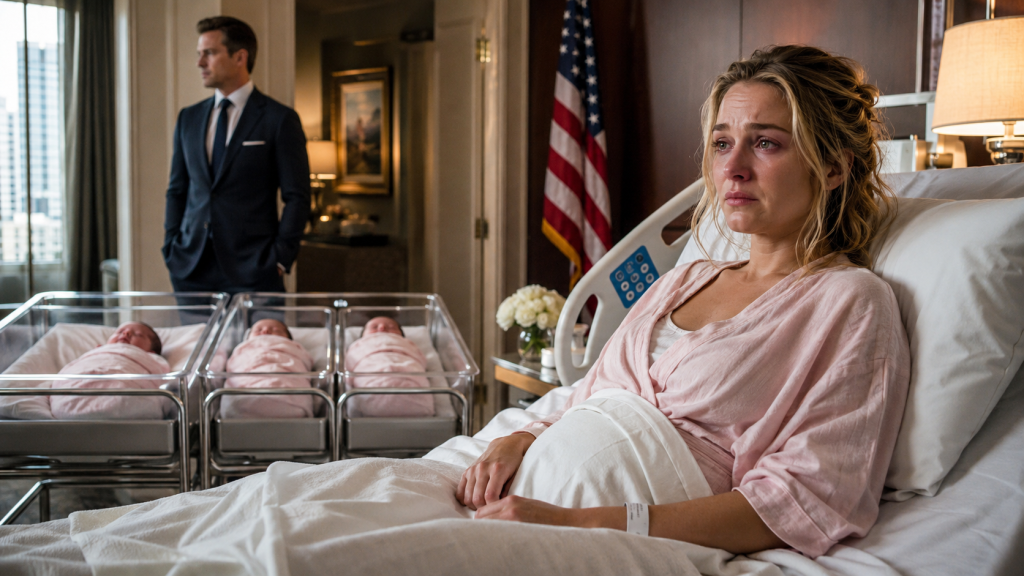
I died giving birth to triplets. While doctors fought to bring me back, my billionaire husband signed divorce papers outside the ICU. When a doctor warned him I might not survive, he asked one question that changed everything.
“How fast can we finalize this?” The smell of antiseptic filled the hospital corridor. Behind the ICU doors, a team of doctors worked desperately to save my life. Just hours earlier, I had delivered triplets through an emergency C-section.
Three tiny babies survived. I almost did not. My heart had stopped. Machines breathed for me.
Doctors were not sure I would ever wake up.
But while medical staff rushed to save the mother of his children, my husband was focused on something else entirely.
Grant Holloway stood in the hallway wearing a tailored designer suit that cost more than most families earned in a month.
No tears.
No panic.
No concern.
Only impatience.
A lawyer handed him a stack of papers.
“Mr. Holloway,” the attorney said carefully, glancing toward the ICU, “your wife is in critical condition. Are you sure you want to proceed with this right now?”
Grant barely looked up.
He signed every page.
One signature after another.
As casually as if he were approving a business expense.
Then he asked the question that left everyone speechless.
“How quickly can this be finalized?”
The lawyer hesitated.
The doctors nearby exchanged stunned looks.
A moment later, the ICU doors opened.
A physician stepped into the hallway, visibly exhausted after fighting to stabilize me.
“Mr. Holloway,” she said, “your wife is alive, but she is still critical. We need a family member to authorize additional treatment.”
Grant snapped the folder shut.
“I am no longer her husband.”
The doctor stared at him.
He checked his watch.
“As of two minutes ago, exactly. Update the records.”
The hallway fell silent.
Even the doctor seemed unable to process what she had just heard.
Then Grant walked away.
Without asking about me.
Without asking about our babies.
Without looking back once.
On his way to the elevator, his phone vibrated.
A message appeared from another woman.
Is it done?
Grant smiled and typed a single word.
Yes.
As his luxury car disappeared into city traffic, he believed he had just removed the biggest obstacle standing between him and the future he wanted.
A sick wife.
Medical expenses.
Complications.
Responsibilities.
Gone.
At least, that was what he thought.
My name is Elena Holloway.
Before I married Grant, I was Elena Reyes, daughter of a quiet man who built logistics warehouses and never trusted men who smiled too easily.
My father, Victor Reyes, made his fortune slowly.
Grant made his loudly.
When we met at a charity auction in Manhattan, Grant was already famous in certain circles.
Young.
Brilliant.
Ruthless.
A billionaire before forty.
The kind of man magazines called visionary because calling him dangerous would have sounded impolite.
He pursued me with the full force of someone who had never been denied anything for long.
Flowers.
Private dinners.
A weekend in Napa.
A handwritten note delivered to my office that said:
You are the only person in the room who looks like she could walk away from all of it.
I should have paid more attention to that sentence.
He did not love me because I stayed.
He wanted me because he believed I might leave.
My father disliked him immediately.
“He looks at people like acquisitions,” he told me.
I laughed then.
“Dad, you say that about every man.”
“No,” he said. “Only the accurate ones.”
But I was in love.
Or I thought I was.
Grant could make the world feel cinematic.
He remembered my coffee order.
He learned my favorite songs.
He brought me to rooftop dinners and spoke of building a family like he was planning a legacy, not a life.
When he proposed, I said yes before my father could finish disapproving.
My father still walked me down the aisle.
Before he gave my hand to Grant, he leaned close and whispered, “I protected you the only way I could.”
I thought he meant emotionally.
I did not know he meant legally.
The marital trust was signed two weeks before the wedding.
Grant signed it without hesitation because he believed no document could threaten him.
He had lawyers.
I had lawyers.
My father had better ones.
At the time, I barely read the paperwork.
There were asset protections, inheritance terms, medical safeguards, family provisions, and something called a maternal critical-care clause.
I was twenty-nine, healthy, glowing, and convinced love made legal protection feel pessimistic.
My father did not agree.
“Love is not weakened by a locked door,” he said. “Only thieves complain about locks.”
Grant laughed when I repeated that to him.
“Your father thinks I’m after your money?”
I kissed his cheek.
“He thinks everyone is after something.”
Grant smiled.
“And what am I after?”
“Me.”
His smile softened.
“Exactly.”
For the first few years, marriage to Grant felt like standing inside a spotlight.
Everyone watched us.
Business magazines photographed us.
Charities invited us.
People called us a power couple, though I never liked the phrase.
Power couples look equal from far away.
Up close, one person often casts the shadow.
Grant loved being seen as a devoted husband.
He loved placing his hand at my back in public.
Loved mentioning me in speeches.
Loved telling investors that family kept him grounded.
But at home, the tenderness became scheduled.
Efficient.
Conditional.
He loved me most when I reflected well on him.
When I asked too many questions about late nights, he called me anxious.
When I worried about the women who seemed to orbit him, he called me insecure.
When I wanted children, he said the timing had to align with business cycles.
Everything was strategy.
Even intimacy.
Then, after six years of marriage, I became pregnant.
Triplets.
Two girls and a boy.
For the first time in years, I saw real wonder on Grant’s face.
Or maybe I saw what I wanted to see.
He announced it at a private dinner before I had even told my closest friends.
“The Holloway legacy is expanding,” he said, raising a glass.
Legacy.
Not babies.
Not children.
Legacy.
The pregnancy was difficult from the beginning.
Severe nausea.
Exhaustion.
High blood pressure.
Doctors warned that carrying triplets came with risks.
I needed rest.
Monitoring.
Care.
Grant promised the best specialists money could buy.
And he did pay for them.
That was his language of love by then.
Payment.
Not presence.
By my sixth month, another woman had entered our life.
Camille Arden.
Thirty-one.
Blonde.
Educated.
Elegant in that brittle way some wealthy people mistake for refinement.
She worked as a strategic consultant for one of Grant’s companies.
At first, I knew her only from emails and events.
Then her name appeared more often.
Then her perfume lingered on Grant’s jacket.
Then his phone turned face down.
When I asked, he sighed.
“Elena, you are pregnant, not abandoned.”
It was such a cruel sentence because I was both.
By my seventh month, my body was failing under the strain.
One afternoon, after a frightening appointment, my doctor said, “We may need to deliver early. I want you prepared.”
I called Grant from the parking lot.
He did not answer.
Camille posted a photo that evening from a private airport lounge.
On the table beside her was Grant’s watch.
I stared at the image until the triplets kicked hard enough to make me gasp.
Two weeks later, everything happened at once.
Pain.
Blood pressure alarms.
A rushed drive to the hospital.
Doctors moving quickly.
Consent forms.
Bright lights.
Grant arriving late, irritated that no one had called his private assistant first.
Then the emergency C-section.
I remember hearing one baby cry.
Then another.
Then someone saying, “We have all three.”
Then a pressure in my chest like the whole world had sat on me.
A nurse shouted.
The room blurred.
I heard my own name from very far away.
Then nothing.
I died for a little while.
That is how the doctor later described it.
Not poetically.
Clinically.
Cardiac arrest.
Resuscitation.
Critical blood loss.
Ventilator.
ICU.
Uncertain neurological outcome.
While I floated somewhere between life and death, Grant signed the divorce papers.
He did not wait to know if I would live.
He did not name the babies.
He did not ask whether our daughters needed oxygen or whether our son could regulate his temperature.
He signed.
He walked away.
And he thought that was the end of me.
Three days later, I opened my eyes.
The first thing I saw was a ceiling light.
The second was a nurse crying.
Not dramatically.
Quietly, with relief.
“Mrs. Holloway?” she whispered.
My throat burned.
I tried to speak, but nothing came out.
“You’re in the ICU. You had complications after delivery. Your babies are alive.”
Babies.
The word pulled me back faster than medicine.
I tried to move.
Pain tore through my abdomen.
The nurse gently held me down.
“They’re in the NICU. They’re stable. Tiny, but fighting.”
I closed my eyes.
Three.
All three.
Then I remembered Grant.
I moved my hand weakly.
The nurse understood.
“Your husband is not here.”
Something in her face changed when she said husband.
The next day, I learned why.
My insurance coverage had been changed.
My emergency contact had been removed.
My newborn triplets had been placed under administrative review because my legal status had suddenly changed.
A hospital administrator came into my room with a social worker and a face full of careful sympathy.
“Mrs. Holloway,” she said, “there is an issue with your records.”
“Issue?”
“You are no longer listed as immediate family under Mr. Holloway’s household policy.”
I stared at her.
“I’m his wife.”
She hesitated.
“According to documents submitted while you were in critical care, the marriage dissolution was finalized.”
The room went silent.
Machines beeped beside me.
My body hurt too much to sit up, but rage rose where strength should have been.
“He divorced me while I was unconscious?”
The social worker’s eyes softened.
“Yes.”
My marriage.
My protection.
My access.
My rights.
Everything had been erased while I was fighting to breathe.
Grant thought he had deleted me from his life with the stroke of a pen.
What he did not know was that the moment he signed those divorce papers, he unknowingly activated something hidden deep inside the trust agreement my father created years earlier.
A protection clause.
A financial safeguard.
And a countdown that had already begun.
My father had died two years before the triplets were born, but his attorney still came when called.
Arthur Bell arrived that afternoon carrying a leather folder older than some law students.
He had been my father’s lawyer for thirty years.
Small man.
Silver eyebrows.
Voice like polished stone.
When he saw me in the hospital bed, something in his expression cracked.
“Your father would have burned the world for this,” he said.
I could barely whisper.
“Tell me he left matches.”
Arthur opened the folder.
“He left paperwork. More effective.”
The Holloway-Reyes marital trust contained a maternal critical-care abandonment clause.
Grant had signed it nine years earlier.
The clause stated that if Grant initiated divorce, withdrew legal support, altered medical coverage, or interfered with my care during pregnancy, childbirth, postpartum recovery, or critical illness, all shared assets governed by the trust would immediately transfer into independent management for the protection of me and any children.
That included company voting shares granted through our marital merger.
Personal holdings placed into joint structures for tax purposes.
Real estate.
Guardianship funds.
Children’s inheritance accounts.
Emergency medical reserves.
Grant had not freed himself.
He had locked himself out.
Arthur looked over his glasses.
“Your husband signed away more power in that hallway than he understands.”
“Ex-husband,” I whispered.
Arthur nodded.
“Gladly.”
The next morning, Grant called.
His voice was smooth, but I could hear panic hiding underneath it.
“Elena, there’s been a misunderstanding.”
I lay in my hospital bed, weak, stitched, barely able to lift my head, while three tiny bassinets sat in the NICU one floor below me under soft blue lights.
“A misunderstanding?” I whispered. “You divorced me while doctors were trying to keep me alive.”
Silence.
Then he lowered his voice.
“You don’t understand what you triggered.”
But I did now.
Arthur had explained everything.
“The board called me,” Grant snapped. “My accounts are frozen. My voting rights are suspended. Elena, fix this.”
I looked toward the window.
The morning light was pale.
My body was broken.
My babies were in incubators.
And the man who had once promised to protect me was angry that his betrayal had paperwork.
“You asked how fast you could finalize it,” I said. “Now you know.”
Then the door opened, and Arthur stepped in beside a hospital social worker.
“Mrs. Holloway,” she said, “the emergency custody order has been granted.”
Grant heard every word.
For the first time since I had known him, he had nothing to sign, nothing to buy, and nowhere left to run.
The custody order was temporary but powerful.
Grant could not remove the babies from the hospital.
Could not make medical decisions without review.
Could not access their trust accounts.
Could not enter my room without consent.
He tried anyway.
Two days later, he appeared at the NICU in another perfect suit, Camille at his side in cream silk.
A nurse stopped him.
“I am their father,” he said coldly.
“And you are restricted to supervised access pending court review,” she replied.
Camille looked embarrassed.
Not ashamed.
Embarrassed.
As if the hospital had failed to provide the correct level of privacy for their scandal.
Grant saw me through the glass outside the NICU.
I was in a wheelchair, holding the edge of a blanket while a nurse placed our smallest daughter against my chest for skin-to-skin care.
Her name was Grace.
She weighed less than a bag of sugar.
Her tiny hand opened against my skin.
Grant stared.
For one second, I thought I saw something human in him.
Then he looked at Arthur beside me and said, “This is extortion.”
Arthur smiled politely.
“No, Mr. Holloway. This is enforcement.”
The board meeting happened without Grant.
That was the part he never imagined.
Holloway Global had been built on control.
His control.
His voice.
His decisions.
But the company’s expansion years earlier had depended on Reyes capital and the merger structure my father negotiated.
Grant thought he had absorbed my family’s assets.
In truth, my father had threaded safeguards through every agreement.
If Grant abandoned me during protected medical circumstances, his voting bloc fractured.
Trustees gained temporary authority.
Independent directors were required to review executive conduct.
Emergency clauses activated.
Arthur sent me updates between nurse visits and medication rounds.
Grant had been suspended from certain executive decisions.
Company counsel had opened an inquiry.
His attempt to remove me from medical coverage during critical illness was now part of the record.
Camille’s name appeared in expense accounts.
Apartments.
Travel.
Consulting payments.
Jewelry disguised as client gifts.
Grant had not only betrayed me.
He had been sloppy.
Power makes some men careful.
Too much power makes them stupid.
The media learned first from a financial filing.
They always do.
Billionaire CEO Temporarily Stripped of Voting Control Amid Trust Dispute.
Then came the second headline.
Ex-Wife Alleges Divorce Filed While She Was in ICU After Delivering Triplets.
Grant released a statement calling the situation “deeply personal” and “legally complex.”
I released nothing.
I was too busy learning how to sit up without crying.
Too busy pumping milk every three hours.
Too busy naming my children.
Grace.
Because she survived the smallest.
Lena.
After my mother, who had died before she could see me become one.
Victor.
After my father, who protected us from beyond the grave.
When I told Arthur the names, he removed his glasses and wiped his eyes.
“Your father would be insufferable with pride,” he said.
“Good,” I whispered.
Grant tried to visit again after the headlines.
This time, alone.
Arthur advised against seeing him.
I agreed to five minutes in a hospital conference room with a social worker present.
Grant entered looking thinner.
Still handsome.
Still expensive.
But the shine had cracked.
“Elena,” he said softly.
I almost laughed.
He had found my name again now that he needed me.
“What do you want?”
“I made mistakes.”
“You made decisions.”
He flinched.
“I was overwhelmed.”
“You were not the one dying.”
His jaw tightened, then relaxed.
He was trying to perform remorse and finding the role unfamiliar.
“Camille is gone,” he said.
“I didn’t ask.”
“She wasn’t ready for all this.”
“All this?”
“The babies. The legal mess. The publicity.”
I looked at him.
“She was ready for my husband, my money, and my funeral. Not my survival.”
Grant looked away.
For the first time, shame touched his face.
“Fix the trust,” he said quietly. “Let me back into the company. We can negotiate custody, assets, whatever you want.”
Whatever I want.
The phrase was almost funny.
For years, Grant had decided what mattered.
What house we bought.
What events we attended.
When we tried for children.
Which doctors.
Which staff.
Which friends were “useful.”
Now he was offering me choice because his had run out.
“I want peace,” I said.
“Then stop this.”
“No. Peace for me and the children begins with consequences for you.”
His eyes hardened.
“There she is.”
I tilted my head.
“What?”
“The Reyes in you.”
For once, I smiled.
“Yes.”
The court proceedings were not quick, but they were decisive.
Grant’s hallway divorce became the centerpiece.
The attorney who had handed him the papers testified under subpoena.
The ICU doctor testified about his refusal to authorize additional treatment.
The hospital administrator produced the record change request.
My voicemail records showed he never called to ask about me or the babies.
His message to Camille surfaced during discovery.
Is it done?
Yes.
Camille was questioned too.
She claimed Grant told her the marriage had been over for years.
Then the prosecutor showed her hotel receipts from the week I was placed on pregnancy restrictions.
She cried.
I did not.
By then, my tears had become too expensive to spend on people like her.
Grant did not go to prison in the version of this story people online wanted.
Real life is rarely that clean.
But he lost more than money.
He lost control.
The trust remained activated.
His voting rights stayed suspended for a defined period under independent oversight.
He paid medical costs, restitution, and penalties.
He lost majority control in the family-governed entities tied to my father’s capital.
His board forced him into a reduced role.
His public image as a devoted family man collapsed.
And most importantly, he did not get to turn my children into accessories for a redemption campaign.
Custody was structured.
Supervised at first.
Then evaluated.
Every visit documented.
Every decision reviewed.
No private travel.
No unilateral medical choices.
No access to the children’s trust accounts.
Grant hated that part most.
Not because he loved paperwork.
Because the system treated him like a risk.
For the first time in his life, doors did not open just because he approached them.
The triplets came home after thirty-seven days in the hospital.
I brought them not to the penthouse Grant had chosen, but to my father’s old estate outside Greenwich.
It had wide windows, old trees, and a nursery that used to be my childhood library.
Arthur arranged round-the-clock nursing for the first month.
Not because I was weak.
Because I was healing.
That distinction mattered.
The first night alone with them, after the nurses dimmed the lights and the house finally quieted, I sat in the rocking chair between three bassinets.
Grace made tiny squeaking sounds in her sleep.
Lena stretched one hand above her head like a queen bored by the world.
Victor frowned exactly like my father.
I cried then.
For the first time properly.
Not for Grant.
Not even for the marriage.
I cried because I had died, returned, and found the world rearranged.
I cried because I had almost missed them.
I cried because my father had known enough to protect me, and I had not known enough to protect myself sooner.
Then Grace woke.
Then Lena.
Then Victor.
Within thirty seconds, all three were crying.
I laughed through my tears.
“All right,” I whispered. “I’m here.”
And I was.
Scarred.
Exhausted.
Divorced.
Protected.
Alive.
Months later, Grant came for a supervised visit at the estate.
He stood in the nursery doorway holding a stuffed elephant like a man bringing tribute to a kingdom he no longer ruled.
Grace slept through his arrival.
Lena stared at him suspiciously.
Victor cried immediately.
The supervisor documented everything.
Grant looked at me.
“Do they know me?”
“They’re babies.”
“That’s not what I asked.”
I adjusted Grace’s blanket.
“No, Grant. They don’t know you.”
The words hurt him.
I saw that.
Good.
Some pain teaches late.
Before he left, he said, “I did love you.”
I looked at him for a long time.
“I think you loved what being loved by me gave you.”
He had no answer.
After he left, Arthur found me in the hallway.
“You handled that well.”
“I wanted to throw the elephant at him.”
“That would also have been understandable.”
I laughed.
It felt strange.
Good strange.
A year later, Holloway Global restructured.
Grant remained wealthy, but not untouchable.
The independent trust created in my and the children’s favor became permanent in several key areas.
I took my seat on the board as representative of the Reyes family holdings.
The first time I entered that conference room, half the men looked at me like a ghost.
Maybe I was.
Grant had left me for dead.
Instead, I returned with voting rights.
Arthur sat beside me.
On the agenda was an ethics reform package regarding executive misuse of family-controlled assets, medical abandonment clauses, and conflict-of-interest disclosures.
Grant sat across the table.
He did not look at me when the vote passed unanimously.
But I looked at him.
Not with hatred.
Hatred is heavy, and I had triplets to carry.
I looked at him with clarity.
That was lighter.
Today, Grace, Lena, and Victor are three years old.
They run through my father’s estate like tiny storms.
Grace climbs everything.
Lena negotiates bedtime like a corporate attorney.
Victor carries toy trucks in both hands and shouts “Mine!” at birds, lamps, and sometimes the moon.
They know their father, but they do not revolve around him.
They know me.
They know home.
They know Arthur as “Grandpa Bell,” though he pretends to object every time.
Sometimes, after they fall asleep, I think about the ICU hallway.
The lawyer.
The signatures.
Grant checking his watch.
How fast can we finalize this?
He believed speed would save him.
He thought if he moved quickly enough, he could outrun responsibility.
But my father had built a trap for exactly that kind of man.
Not out of paranoia.
Out of love.
And Grant ran straight into it.
I died giving birth to triplets.
Doctors brought me back.
My husband signed me away while machines breathed for me.
He thought divorce would remove me.
Instead, it revealed him.
It activated the clause.
It protected my children.
It stripped him of the one thing he valued more than money.
Control.
People often ask what I felt when I woke up and learned what he had done.
At first, disbelief.
Then grief.
Then rage.
But now, years later, I feel something else.
Gratitude.
Not for the betrayal.
Never that.
Gratitude that I survived long enough to answer it.
Gratitude that my babies survived long enough to need me.
Gratitude that my father’s love had signatures, witnesses, clauses, and teeth.
Grant once asked how fast he could finalize the end of our marriage.
The answer was two minutes.
But the end of his power?
That had already begun the second he picked up the pen.
THE END! THANKS FOR READING!