 Reading Time: 13 minutes
I came home at 12:58 a.m. from a $3,900 business trip to surprise my seven-months-pregnant wife. But the inside-out pink nightgown and soaked sheets made me suspect the wrong betrayal first.
My pregnant wife lay curled around our unborn child when I opened the bedroom door. Her nightgown was inside out. The sheets beneath her were soaked. My name is Michael Carter, and until that Tuesday night, I thought the worst thing a husband could find in his bed was another man’s shadow.
I had been in Denver for three days closing a hospital software contract.
My flight back to Chicago was supposed to land the next evening, but the client signed early, and at 8:14 p.m., I paid the change fee and booked the last seat home.
I wanted to surprise Sarah.
She was seven months pregnant with our first child, a boy we had already named Noah.
For weeks, she had been uncomfortable, emotional, exhausted, and still somehow excited every time she folded a tiny onesie or rearranged the nursery shelf.
The pregnancy had not been easy.
Her blood pressure had been running high.
The doctor had warned her to rest.
No stress.
No lifting.
No long errands.
No emotional strain.
So when my mother, Diane, offered to stay at our Naperville townhouse while I traveled, I thought she was helping.
That was the first mistake.
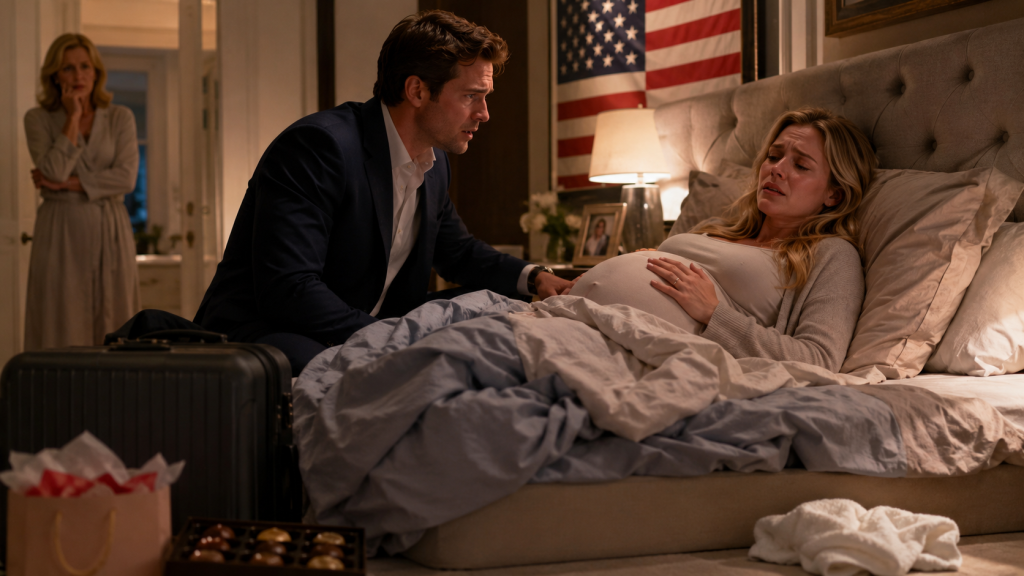
At 12:58 a.m., I stepped into the house with my suitcase in one hand and Sarah’s favorite chocolate-covered almonds in the other.
The house smelled like baby powder and cold coffee.
The hallway carpet scratched under my socks.
Somewhere in the kitchen, the refrigerator clicked on and hummed.
A thin strip of yellow light leaked from the bedroom door.
I smiled before I pushed it open.
Then my hand stopped on the knob.
Sarah was lying on her side, one hand clamped under her belly.
Her pale pink nightgown had the seams showing.
The tag stuck up at the back of her neck.
Her hair was damp at her temples, and the pillowcase under her cheek was marked with dark wet patches.
The duvet was twisted near her knees.
A white towel sat on the floor like someone had dropped it in a hurry.
My grip tightened around the candy bag until the plastic crackled.
For three seconds, my mind arranged the room into something filthy.
A man leaving fast.
A secret cleaned up badly.
A baby I had already named Noah suddenly pulled away from me by one ugly thought.
Then Sarah moved.
Not softly.
Her body jerked like pain had reached into her spine.
“Sarah,” I whispered.
She turned her face toward me.
No guilt.
No panic at being caught.
Only pain.
Her lips were cracked.
Her eyes were swollen and glassy.
Sweat shone along her upper lip.
“Michael,” she whispered, “I called you twenty times.”
My phone was still in airplane mode.
The candy bag slid from my hand and hit the hardwood.
She tried to sit up.
A sound came out of her throat, low and broken, and both hands locked over her stomach.
“Something’s wrong with the baby.”
The room narrowed to her fingers pressing into the fabric.
I grabbed my phone.
1:03 a.m.
Twenty missed calls.
Four voicemails.
One text from my mother, Diane, sent at 11:41 p.m.
She’s overreacting again. Don’t rush home and reward the drama.
My blood went cold.
Diane had been staying with Sarah while I traveled because the doctor wanted her resting.
But suddenly the soaked sheets, the towel, and the inside-out nightgown meant something different.
Not betrayal.
Neglect.
Fear.
Sarah gripped my wrist.
“Your mother said it was false labor. She took my phone after I kept calling you.”
For a moment, I could not speak.
My mother had always disliked Sarah.
Not openly enough for others to notice.
Diane was careful.
She smiled in public.
Brought casseroles.
Told people she was thrilled to become a grandmother.
But inside our family, she had a way of turning every concern into weakness.
When Sarah cried during the first trimester, Diane called her fragile.
When Sarah needed help carrying groceries, Diane called her spoiled.
When Sarah’s doctor put her on reduced activity, Diane said, “Women gave birth in fields for centuries.”
I had defended Sarah sometimes.
Not enough.
That truth would later sit in me like a stone.
I dialed 911 with one hand and grabbed Sarah’s hospital bag with the other.
“My wife is seven months pregnant,” I told the dispatcher. “Severe abdominal pain, possible fluid loss, soaked bedding, high-risk pregnancy.”
The dispatcher’s voice sharpened.
“Is she conscious?”
“Yes.”
“Is she bleeding?”
“I don’t know.”
“Keep her lying on her left side. Emergency services are on the way.”
Diane appeared in the doorway in her robe, annoyed, her silver hair perfectly pinned even at one in the morning.
“Michael, stop embarrassing everyone,” she snapped. “Pregnant women leak. She wanted attention.”
The dispatcher heard every word.
Sarah cried out again, clutching my wrist so hard her nails dug into my skin.
Diane’s face changed.
Not with concern.
With fear.
“Michael,” she said quickly, softer now, “hang up. This is unnecessary.”
I looked at her.
For the first time in my life, I looked at my mother and did not see the woman who packed my lunch in third grade or sat beside me at my father’s funeral.
I saw someone standing between my wife and help.
“No,” I said.
Her mouth tightened.
“Don’t use that tone with me.”
I turned away from her and focused on Sarah.
“I’m here,” I whispered. “I’m here. I’m sorry. I’m so sorry.”
In the ambulance, Sarah held my hand with both of hers.
Her face was pale under the harsh interior light.
The EMT asked questions.
When did the pain start?
How far apart?
Was there fluid?
Was there fever?
Had she called anyone?
Sarah answered in fragments.
Around ten.
Then worse at eleven.
She tried to call me.
Diane said I was busy.
She tried to call the hospital.
Diane took the phone.
“She said if I went to the hospital,” Sarah whispered, “they would say I was a bad mother.”
My chest filled with something darker than anger.
A bad mother.
Sarah, who had spent months reading every pregnancy book.
Sarah, who cried the first time she heard Noah’s heartbeat.
Sarah, who refused deli meat, soft cheese, sushi, and even coffee she loved because she wanted everything to be safe.
Diane had used the one fear every pregnant woman carries.
Am I doing enough?
Am I already failing this child?
At the ER, nurses rushed Sarah away.
I tried to follow, but a nurse held up one hand.
“We need room to work.”
“I’m her husband.”
“I know. We’ll update you as soon as we can.”
The doors closed.
I stood in the hallway, still wearing my travel clothes, one shoe untied, hands shaking.
Diane sat in the waiting room, arms crossed, pretending irritation was dignity.
“You’ve made this worse,” she said.
I turned on her.
“If Sarah or Noah is hurt because of you—”
She stood.
“Because of me? She is dramatic. She has always been dramatic. You baby her, Michael. That is why she acts helpless.”
“She called me twenty times.”
“You were working.”
“She needed help.”
“She needed attention.”
The words were so cold, so practiced, that I felt something long and old snap inside me.
“No,” I said quietly. “You needed control.”
Diane blinked.
Before she could answer, a doctor came through the double doors.
His face was serious but steady.
“Mr. Carter?”
“Yes.”
“Your wife arrived just in time.”
My knees weakened.
“Is the baby—”
“Currently stable. Your wife is stable. But she is experiencing preterm complications, and delaying care any longer could have been catastrophic.”
Catastrophic.
The word hit the floor between us.
Diane went still.
The doctor continued.
“We are admitting her for monitoring and treatment. She will need rest, observation, and absolutely no stress.”
I looked at Diane when he said that.
She looked away.
Then my phone buzzed.
A voicemail.
One of Sarah’s missed calls.
I pressed play and held it to my ear.
Sarah’s voice came through shaking and breathless.
“Michael, please call me. Your mother won’t let me call an ambulance. She says I’m embarrassing her. I’m scared. Something is wrong. Please.”
My hand shook.
The voicemail ended.
I pressed save.
Then I walked toward the police officer at the ER desk.
Diane saw me.
“What are you doing?”
I did not answer.
The officer looked up.
“Can I help you?”
I held out my phone.
“My wife is seven months pregnant and called for help. My mother took her phone and prevented her from calling emergency services. I have a voicemail.”
Diane rushed over.
“That is not what happened.”
The officer looked from her to me.
“Ma’am, please step back.”
“I’m his mother.”
“Then you can wait while I speak to him.”
For the first time that night, my mother lost her power in a room.
She was not the grandmother.
Not the family matriarch.
Not the woman whose opinion automatically mattered.
She was a person being asked questions.
And she hated it.
A hospital social worker joined us.
Then a nurse.
Then another officer.
They asked me for the timeline.
I gave it.
Flight landing.
Missed calls.
Text from Diane.
Sarah’s condition.
The voicemail.
Diane’s statements at the doorway.
The dispatcher hearing her.
The soaked sheets.
The towel.
The inside-out nightgown.
When I said that part, my voice broke.
Because I finally understood what had happened.
Sarah had tried to change.
Tried to clean herself up.
Tried to fix what she thought she would be blamed for.
She had turned her nightgown inside out in pain, confused, frightened, maybe trying to hide the fluid from Diane’s judgment.
And I had looked at that scene and, for three seconds, suspected my wife.
That guilt would stay with me.
The officer took Diane’s statement separately.
I could see her through the glass partition.
At first, she was calm.
Then animated.
Then defensive.
Then angry.
She pointed once toward Sarah’s room.
Then toward me.
The officer did not react.
People like Diane rely on emotional reactions.
They are less powerful in front of professionals who write everything down.
When I was finally allowed to see Sarah, she was in a hospital bed with monitors attached and an IV in her arm.
Her face looked smaller somehow.
The room beeped softly around us.
I sat beside her and took her hand.
“Noah?” she whispered.
“Stable,” I said quickly. “You’re both stable.”
Her eyes filled with tears.
“I tried to call.”
“I know.”
“She kept saying I was making it up.”
“I know.”
“I thought maybe I was.”
That broke me.
I pressed my forehead to her hand.
“I’m sorry.”
“You were on a plane.”
“No,” I said. “I’m sorry for all the times before tonight when I let her make you feel small.”
Sarah closed her eyes.
A tear slipped down her temple.
“I didn’t want you to choose between us.”
I lifted my head.
“There is no choice. You and Noah are my family. My mother had a place in that family only if she protected it.”
Sarah looked at me for a long time.
Then she whispered, “I was so scared.”
“I know.”
“I thought I was going to lose him.”
“You didn’t.”
“But I almost did.”
I could not answer.
So I held her hand and listened to our son’s heartbeat on the monitor.
Fast.
Tiny.
Real.
A sound that made every other sound in the world less important.
By morning, Diane had left the hospital.
She texted me at 6:12 a.m.
You humiliated me in public. I hope you are proud.
I stared at the message, then showed it to the officer taking my follow-up statement.
He photographed it.
Then I blocked her number.
Not permanently, perhaps.
But for that day, forever felt appropriate.
Sarah remained in the hospital for five days.
Medication helped stabilize the contractions.
Doctors monitored fluid levels, blood pressure, and Noah’s heart rate.
Every morning, I sat beside her bed with a notebook, writing down questions and instructions.
No more guessing.
No more minimizing.
No more Diane.
On the second day, the hospital social worker came in.
Her name was Amanda.
She spoke gently but directly.
“We’ve documented that your mother-in-law interfered with your access to emergency care. We are required to report concerns when a vulnerable patient is prevented from seeking medical attention.”
Sarah looked at me nervously.
Diane had trained everyone to fear “making things official.”
I squeezed her hand.
Amanda continued.
“This is not about punishing family conflict. This is about safety.”
Safety.
That word became our new foundation.
When Sarah was discharged, she was placed on strict bed rest.
The doctor looked me in the eye and said, “Stress reduction is not optional.”
I understood.
Before we left the hospital, I changed the locks at home.
I did it from my phone, calling a locksmith from the parking lot.
I removed Diane’s access code.
I called the neighbor who had our spare key and asked for it back.
Then I called my mother’s sister, Aunt Claire.
Not because I wanted to gossip.
Because someone in the family needed the truth before Diane told her version.
Claire listened quietly.
When I finished, she sighed.
“Michael, your mother has always believed fear is the same thing as discipline.”
I closed my eyes.
“You knew?”
“I knew she was hard. I didn’t know she had become dangerous.”
Dangerous.
Another word I had avoided.
That evening, I brought Sarah home.
Not to the house Diane had controlled.
To our house.
The nursery door was open.
The small white crib waited under the painted clouds Sarah had chosen.
She stopped at the doorway and began to cry.
“What if I can’t do this?” she whispered.
I wrapped my arms around her from behind, careful of her belly.
“You already are.”
She leaned into me.
“I’m tired.”
“I know.”
“I’m angry.”
“You should be.”
“I’m angry at you too.”
That hurt.
But it was fair.
I nodded.
“I know.”
“I needed you to see it before it almost killed me.”
The words landed hard.
Not because they were cruel.
Because they were true.
“I see it now,” I said.
Over the next weeks, I proved it.
Not with speeches.
With actions.
I moved my office home.
Canceled unnecessary travel.
Handled every call from family.
When Diane showed up pounding on the door with a casserole and tears, I did not let her in.
She stood on the porch camera saying, “Michael, I am your mother. You cannot shut me out.”
I spoke through the doorbell speaker.
“Sarah is resting. You need to leave.”
“This is ridiculous. I came to apologize.”
“Put it in writing and send it to our attorney.”
Her face changed.
“Attorney?”
“Yes.”
The silence that followed was almost peaceful.
She left the casserole on the porch.
I threw it away.
A week later, Diane sent a letter.
It was not an apology.
It was a performance.
I am sorry Sarah felt unsupported.
I am sorry my concern was misunderstood.
I am sorry you allowed outsiders to interfere in family matters.
Sarah read it once and handed it back.
“She’s sorry we noticed.”
I kissed her forehead.
“Yes.”
So I wrote my own letter.
Mother,
You prevented my pregnant wife from calling emergency services during a medical crisis. You dismissed her pain, took her phone, and then blamed her for needing help. The hospital, dispatcher, and police have documentation. You are not permitted in our home or around Sarah without her explicit consent. You will not be present at Noah’s birth unless Sarah personally asks for you, which she will not. Do not contact her. Any communication goes through me.
Michael
I expected guilt after sending it.
Instead, I felt grief.
That surprised me.
Boundaries do not erase love.
They expose what love has been costing you.
I still loved my mother in some wounded, complicated way.
But I no longer trusted her near my wife.
That distinction saved us.
Noah was born six weeks early.
Not that night.
Thank God, not that night.
But six weeks early, after another carefully monitored hospital stay.
He came into the world small but fierce, with a cry that sounded offended by the lighting.
Sarah cried.
I cried.
The doctor placed him against her chest, and she whispered, “You stayed.”
I do not know if she meant Noah.
Or me.
Maybe both.
Diane found out through Aunt Claire, not from me.
She sent flowers to the hospital.
White lilies.
Sarah looked at the card.
Congratulations. I hope we can all move forward.
Sarah handed it to me.
“No.”
I nodded.
“No.”
I gave the flowers to the nurses’ station.
Noah spent twelve days in the NICU.
Twelve days of monitors, tiny diapers, feeding tubes, whispered prayers, and learning that love can make a person afraid of every beep.
Sarah sat beside him in a wheelchair at first, then in a chair, then standing over his bassinet with one hand through the opening.
I watched her become a mother in the hardest possible way.
Not dramatic.
Not perfect.
But steady.
Every time she doubted herself, I reminded her.
“You knew something was wrong. You fought for him. You called for help. You saved him.”
At first, she shook her head.
Then, slowly, she began to believe it.
When Noah finally came home, the house changed.
Not magically.
We were exhausted.
He cried.
We cried.
The laundry multiplied.
The bottles never ended.
But there was peace in the exhaustion because no one was standing over Sarah calling her dramatic.
One night, around 2 a.m., I found her in the nursery rocking Noah.
Moonlight fell across her face.
She looked tired enough to disappear, but she was smiling.
“What?” I whispered.
She looked down at our son.
“I used to think being a good mother meant not needing help.”
I sat on the floor beside the rocker.
“And now?”
“Now I think it means knowing when to scream for it.”
I reached up and touched Noah’s tiny foot.
“Then you were a good mother before he was even born.”
She looked at me.
“And you?”
I swallowed.
“I was late.”
She did not deny it.
She only said, “But you came.”
That was mercy I did not deserve but accepted with gratitude.
Months later, the official report closed without criminal charges but with documented findings that Diane had interfered with Sarah’s attempt to seek emergency care.
It was enough.
Enough for hospital records.
Enough for our attorney.
Enough for our peace.
Diane continued telling relatives I overreacted.
Some believed her.
Most did not after Aunt Claire heard the voicemail herself.
One cousin called and said, “Your mom says Sarah exaggerated.”
I sent him the transcript of Sarah’s voicemail.
He never brought it up again.
Diane did not meet Noah until he was seven months old.
And only then in a public place, with Sarah’s consent, for thirty minutes.
She held him carefully, her face soft in a way I remembered from childhood.
For a moment, I almost let myself hope.
Then she looked at Sarah and said, “He’s strong. See? Everything turned out fine.”
Sarah’s face went still.
I stood.
The visit ended after eleven minutes.
In the car, Sarah whispered, “Thank you.”
I looked at Noah asleep in his car seat.
“No more second chances without change.”
She reached for my hand.
That became our rule.
Not just for Diane.
For everyone.
No more confusing family with access.
No more letting older people call cruelty tradition.
No more dismissing pain because someone finds it inconvenient.
I think often about that first three seconds in the bedroom.
The ugly thought that flashed through my mind.
Betrayal.
Another man.
A ruined marriage.
I hate myself for it.
But I also understand something now.
Suspicion is sometimes easier than fear.
It was easier for my mind to imagine Sarah had betrayed me than to imagine she and Noah were in danger while my mother stood nearby and did nothing.
The truth was worse.
Not because my marriage was broken.
Because my wife had been alone in the same house as family and still unsafe.
That knowledge changed me.
It made me a better husband, though I wish I had become one sooner.
It made me a better father before Noah was old enough to know my name.
Today, Noah is three.
He runs through the house with sticky hands and dinosaur socks.
Sarah still gets quiet sometimes when pregnancy stories come up.
Diane sends birthday cards.
We send polite thank-yous through email.
The distance remains.
Peace remains too.
Last week, Sarah found the chocolate-covered almonds in the back of the pantry.
The ones I dropped on the bedroom floor that night.
The bag had been crushed, forgotten behind the cereal boxes.
She held it up and laughed softly.
“I never got my surprise.”
I looked at her.
At Noah building a crooked tower of blocks on the rug.
At the woman I almost failed to protect but now loved with my eyes open.
“Yes, you did,” I said.
She raised an eyebrow.
“What surprise?”
I walked over, kissed her forehead, and said, “You found out your husband could still learn.”
She smiled, but her eyes filled.
Then Noah knocked down his tower and shouted, “Again!”
Sarah and I both laughed.
Again.
That is what survival sometimes gives you.
Not a perfect past.
Not erased fear.
Not a family repaired exactly as it was.
Again.
Another chance to do it right.
I came home at 12:58 a.m. and saw soaked sheets, an inside-out nightgown, and my wife curled in pain around our unborn child.
For three seconds, I suspected the wrong betrayal.
Then I listened.
Then I called.
Then I saved the voicemail.
Then I finally stood between my mother and my marriage where I should have stood all along.
The worst thing a husband can find in his bed is not another man’s shadow.
It is the evidence that his wife begged for help and no one believed her.
I believe her now.
Every time.
Always.
THE END! THANKS FOR READING!