 Reading Time: 29 minutes
Curtis Hale stood immediately. “Your Honor, we object to the introduction of any material that has not been properly authenticated.”
Judge Adrian Mercer did not even look at him. “Sit down, Mr. Hale.” The attorney hesitated. “Your Honor—” “I said sit down.” Curtis slowly lowered himself into his chair.
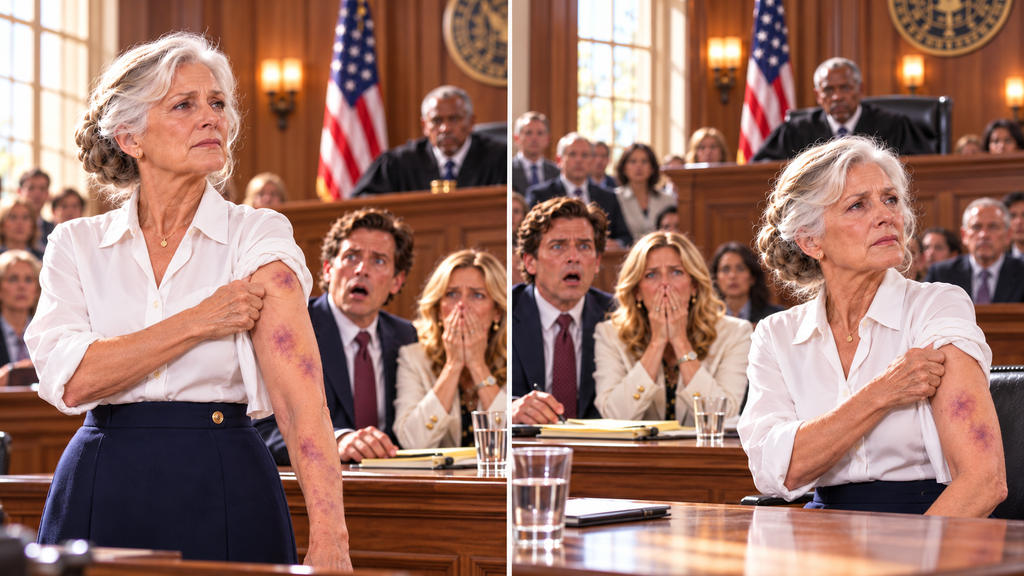
Beside him, Daniel shifted.
Vanessa stopped smiling.
I placed the blue notebook on the table in front of me.
For several seconds, nobody spoke.
Then Judge Mercer looked at me.
“Colonel Vance, proceed.”
I opened the notebook.
My handwriting filled almost every page.
Dates.
Times.
Locations.
Names.
Descriptions.
Photographs numbered to correspond with individual entries.
Copies of text messages.
Bank records.
Medical reports.
Everything.
Daniel had spent months creating a story in which I was a confused old woman who could no longer remember what happened from one day to the next.
I had spent those same months quietly creating a record proving that I remembered everything.
I turned to the first marked page.
“March 4th,” I said.
Daniel’s head lifted.
“That was the first time my son asked me to add him as a joint owner on my primary checking account.”
Daniel leaned toward his attorney.
I continued.
“He told me it would make things easier if I became ill.”
Judge Mercer looked toward Daniel.
“Did you make that request?”
Curtis rose again.
“My client—”
“I asked Mr. Vance.”
Daniel swallowed.
“Yes, Your Honor.”
“Why?”
“So I could help my mother.”
I almost smiled.
Help.
That word had become very useful to my son.
Everything he wanted to control was supposedly because he wanted to help.
My money.
My house.
My medical decisions.
My mail.
My passwords.
My life.
Judge Mercer turned back to me.
“What happened when you refused?”
I looked at Daniel.
For the first time that morning, he would not meet my eyes.
“He became angry.”
“That’s not true,” Daniel said.
Judge Mercer’s gaze snapped toward him.
“You will have an opportunity to respond.”
Daniel went quiet.
I continued.
“Three days later, he asked again. This time his wife was present.”
I removed the first document from the folder beneath my notebook.
It was a printed copy of a text message.
I read it aloud.
“Mom, you need to stop being stubborn. You are seventy-one years old. Nobody is trying to steal anything from you.”
Daniel closed his eyes.
I looked at the judge.
“That message was sent at 9:14 p.m.”
I placed another page beside it.
“At 9:22, Vanessa sent this.”
Judge Mercer read it silently.
His expression hardened.
Curtis asked to see the page.
The clerk handed him a copy.
I already knew the words by heart.
Vanessa had written:
If something happens to you, Daniel shouldn’t have to fight the bank just to access what is basically his inheritance anyway.
The courtroom became very still.
Judge Mercer slowly raised his eyes.
“Basically his inheritance?”
Vanessa shifted in her seat.
“I didn’t mean it like that.”
“How did you mean it?”
She opened her mouth.
Nothing came out.
I watched her face.
For months, she had always had an answer.
When someone asked about my bruises, she had an answer.
When neighbors wondered why Daniel was suddenly spending so much time at my house, she had an answer.
When I told people I didn’t need help, Vanessa smiled sympathetically and explained that I was embarrassed about my declining condition.
But now she had nothing.
Judge Mercer turned toward me.
“What happened next?”
I turned another page.
“March 17th.”
My voice remained steady.
“My son came to my house shortly after seven in the evening.”
Daniel whispered something to Curtis.
I continued.
“He brought paperwork.”
“What kind of paperwork?”
“A durable power of attorney.”
Judge Mercer looked toward Daniel again.
“Prepared by whom?”
Daniel did not answer immediately.
Curtis touched his arm.
Finally Daniel said, “An online legal service.”
“And your mother requested this?”
“No.”
“Had she told you she wanted you to control her finances?”
Daniel’s jaw tightened.
“No.”
I placed another document on the table.
“I refused to sign it.”
My fingers rested against the edge of the paper.
That night came back to me with uncomfortable clarity.
Daniel standing in my kitchen.
Vanessa beside the refrigerator.
The papers spread across the table.
My reading glasses beside them.
A pen placed neatly on the signature line.
As though the decision had already been made.
As though my signature were merely a formality.
I had looked at my son and asked one question.
Why?
He had sighed.
Not shouted.
Not yet.
Just sighed.
The way a parent might sigh at an unreasonable child.
“Because somebody needs to take care of things, Mom.”
“I take care of things.”
“You think you do.”
“I know I do.”
Vanessa had folded her arms.
“Eleanor, this is exactly the problem.”
I remember turning toward her.
“What problem?”
“You don’t realize how much you’re slipping.”
That sentence had stayed with me.
Not because I believed it.
Because I understood immediately what they were doing.
People rarely seize control of another person’s life all at once.
They begin by changing the vocabulary.
Independent becomes stubborn.
Private becomes secretive.
Careful becomes paranoid.
Sad becomes unstable.
Old becomes incapable.
And once everyone accepts the new words, taking control begins to look like compassion.
I looked at Judge Mercer.
“When I refused to sign, Daniel became angry.”
“How angry?”
I turned another page.
“At approximately 7:46 p.m., he took my wrist.”
Daniel’s face changed.
I could see the moment he remembered.
I rolled back the sleeve of my coat.
The bruise had faded weeks ago.
But the photograph had not.
I placed it on the table.
It showed four dark marks around my wrist.
Finger-shaped.
Daniel stared at it.
Vanessa stared at him.
For the first time, I noticed something interesting.
She looked surprised.
Perhaps Daniel had not told her everything either.
Judge Mercer examined the photograph.
“This is included in the petition.”
“Yes.”
“And the petition states you received this injury when you fell beside your bed.”
“Yes, Your Honor.”
“Did you fall?”
“No.”
Daniel suddenly stood.
“She’s lying!”
His voice cracked through the courtroom.
Every head turned.
The bailiff stepped forward.
Judge Mercer did not raise his voice.
“Sit down, Mr. Vance.”
“My mother is lying!”
“Sit down.”
“You don’t understand what she’s like!”
The judge stared at him.
“I understand that you are currently interrupting testimony in a guardianship proceeding you initiated.”
Curtis pulled Daniel toward his chair.
“Daniel.”
My son sat.
His face was red.
I had seen that expression before.
That was the Daniel nobody else saw.
Not the concerned son.
Not the patient caregiver.
Not the grieving child worried about his elderly mother.
The other Daniel.
The one who appeared when I said no.
I turned another page.
“After he grabbed me, I told him to leave.”
Judge Mercer asked, “Did he?”
“Eventually.”
“What does that mean?”
“He took the power-of-attorney papers and threw them into the kitchen sink. Then he told me I would regret embarrassing him.”
Daniel shook his head.
I continued.
“At 8:03 p.m., my neighbor, Patricia Sloan, saw Daniel leaving my property.”
Curtis looked up sharply.
“At 8:11 p.m., Mrs. Sloan came to my house because she had heard shouting.”
I removed a signed statement.
“She photographed my wrist.”
Judge Mercer looked at the photograph again.
“Your neighbor took this?”
“Yes.”
“Not Mrs. Vance?” Curtis asked.
“No.”
“And she is available?”
A voice came from the back of the courtroom.
“Yes.”
Daniel turned around.
So did Vanessa.
Patricia Sloan stood from the last row.
She was seventy-six years old, five feet two inches tall, and had spent thirty-eight years teaching seventh-grade mathematics.
She had also lived next door to me for twenty-three years.
Patricia gave Daniel a small nod.
His face went white.
He had never noticed her.
That was Daniel’s problem.
He only noticed people when he needed something from them.
Judge Mercer looked toward the clerk.
“Mrs. Sloan has been identified as a witness?”
“Yes, Your Honor.”
Curtis leaned toward Daniel.
The whispering became urgent now.
Vanessa’s eyes darted toward the courtroom doors.
I almost felt sorry for her.
Almost.
But I remembered standing outside my own house three weeks earlier.
My key refusing to turn.
My suitcase sitting beside my feet.
Rain collecting in my hair.
I remembered calling Daniel.
He answered on the fourth ring.
“What did you do?”
His voice had been perfectly calm.
“Mom, this is temporary.”
“You changed my locks.”
“You shouldn’t be staying there alone.”
“It is my house.”
“Not if the court decides you can’t manage it.”
That sentence had revealed everything.
Not if the court decides.
He wasn’t waiting for a decision.
He was counting on one.
I had stood on the porch where his father taught him to ride a bicycle.
The porch where I had bandaged his knee when he fell.
The porch where he had carried his first girlfriend’s corsage.
The porch where he hugged me after his father died and promised:
I’m going to take care of you, Mom.
And my own son had locked me outside.
That night, I did not cry until I reached the motel.
Room 214.
A flickering bathroom light.
A floral bedspread.
A television remote sticky beneath my fingers.
I sat on the edge of that unfamiliar bed and stared at the wedding ring I still wore.
“Thomas,” I whispered.
My husband’s name barely came out.
“What happened to our boy?”
That was the only night I allowed myself to ask that question.
The next morning, I stopped asking why.
I started preparing.
Judge Mercer turned toward me.
“Colonel Vance?”
I realized I had been silent.
“I’m sorry, Your Honor.”
“Take your time.”
“I don’t need time.”
Daniel looked at me.
He knew that voice.
He had heard it when he was sixteen and wrecked his father’s truck.
He had heard it when he was nineteen and tried to lie about failing a college course.
It was not anger.
It was certainty.
I turned the page.
“The second documented physical incident occurred on April 2nd.”
Vanessa’s hands tightened.
That one she remembered.
“She came to my house at approximately eleven in the morning.”
“Why?”
“She wanted access to my online banking.”
Vanessa whispered, “That’s ridiculous.”
Judge Mercer looked at her.
“Mrs. Vance, you will remain silent.”
She lowered her eyes.
I continued.
“She told me Daniel was worried I had forgotten to pay several bills.”
“Had you?”
“No.”
I produced copies.
“Electricity, water, property taxes, insurance, telephone, and credit card. All paid on time.”
Judge Mercer examined them.
“My credit score at the time was 814.”
Someone in the courtroom coughed.
I heard Patricia suppress what might have been a laugh.
Judge Mercer almost smiled.
“Understood.”
“Vanessa then told me Daniel needed to inspect my accounts.”
“Why?”
“According to her, to make sure I wasn’t being scammed.”
Judge Mercer glanced toward Vanessa.
“And what happened when you refused?”
“She took my phone.”
Vanessa looked up.
“I was helping her!”
The judge struck the bench once.
“Mrs. Vance.”
Vanessa went silent.
I looked directly at her.
“She took my phone from my hand and told me she was going to set up account access herself.”
My throat tightened.
This memory was harder.
Not because it hurt more physically.
Because Vanessa had once been family to me.
When Daniel introduced her, I liked her immediately.
She had been nervous at our first dinner.
She spilled red wine on my tablecloth and nearly cried.
I laughed.
I told her the tablecloth had survived Daniel’s childhood and would survive Cabernet.
When they married, I gave her my mother’s pearl earrings.
When she miscarried their first pregnancy, I sat beside her in the hospital while Daniel went home to shower.
I held her hand.
I brushed her hair from her face.
She called me Mom.
Years later, those same fingers closed around my arm because I would not give her my banking password.
“She grabbed me here.”
I touched my upper arm.
“Hard enough to bruise.”
I submitted another photograph.
This one had a ruler beside the injury.
Date visible.
Time stamp preserved.
Judge Mercer looked at it.
“And the petition says?”
“That I walked into the bedroom door.”
He slowly removed his glasses.
For the first time, he looked tired.
Not confused.
Not uncertain.
Tired.
The expression of a man beginning to understand exactly what had happened.
“Who took this photograph?”
“I did.”
Curtis immediately stood.
“Then we have no independent verification of its cause.”
I looked at him.
“You’re correct.”
He seemed surprised.
I continued.
“The photograph alone does not establish who caused the injury.”
Curtis glanced at Daniel as if he had finally found solid ground.
I reached for another item.
“But the recording does.”
Nobody moved.
Daniel stopped breathing.
Vanessa’s lips parted.
Curtis stared at me.
Judge Mercer leaned forward.
“What recording?”
I placed a small digital device beside the notebook.
“A recording made by the security system inside my home.”
Daniel whispered one word.
“No.”
I heard it.
So did the judge.
I looked at my son.
“Yes.”
The house had a security system.
Thomas installed the first version after a burglary down the street twelve years earlier.
Daniel knew about the outside cameras.
He knew about the door sensors.
What he did not know was that I had upgraded the system after Thomas died.
The new system included interior cameras in several common areas.
Not bedrooms.
Not bathrooms.
The kitchen.
The front hallway.
The living room.
And Thomas’s study.
Daniel had apparently forgotten that his mother spent three decades working in environments where security was not an abstract concept.
The clerk connected the recording.
The courtroom speakers crackled.
Then Vanessa’s voice filled the room.
“Give me the phone, Eleanor.”
My recorded voice answered.
“No.”
“You’re being ridiculous.”
“Give me my phone.”
“Daniel said we need access.”
“No.”
“He’s your son.”
“That doesn’t make my money his.”
Then movement.
A chair scraping.
My voice sharper.
“Take your hand off me.”
Silence.
Then Vanessa:
“Stop acting like I’m hurting you.”
My voice:
“You are hurting me.”
Vanessa:
“Then stop fighting me.”
The recording ended.
Nobody spoke.
Vanessa looked as though someone had drained the blood from her body.
Daniel stared straight ahead.
Curtis Hale slowly sat down.
Judge Mercer looked at Vanessa.
“Mrs. Vance.”
She began crying.
Not quietly.
Her shoulders shook.
She covered her face.
“I was just trying to help.”
That word again.
Help.
I had grown to hate it.
Judge Mercer said nothing.
Vanessa looked at me.
“Eleanor, tell him.”
I stared at her.
“Tell him what?”
“That I wasn’t trying to hurt you.”
“You heard the recording.”
“I was frustrated.”
“So was I.”
“I didn’t mean—”
“You left fingerprints on my arm.”
She started sobbing harder.
Daniel finally turned toward her.
“Stop talking.”
Vanessa looked at him.
“What?”
“Stop talking.”
Something changed between them at that moment.
Until then, they had been partners.
A united front.
Daniel and Vanessa against the confused old woman.
But fear has a remarkable way of revealing alliances.
Vanessa looked at her husband.
Then at the judge.
Then at me.
And I saw the calculation beginning.
She was wondering how much Daniel had told me.
Daniel was wondering how much Vanessa might say.
Curtis was wondering why neither of his clients had told him the truth.
And I was thinking about my husband.
Thomas would have hated this.
Not the courtroom.
Not the confrontation.
The reason for it.
Our son.
Thomas had adored Daniel.
There was nothing complicated about it.
He loved that boy.
When Daniel was seven, Thomas built him a treehouse so elaborate that our neighbors joked we needed a building permit.
When Daniel turned fourteen, Thomas spent six months rebuilding an old motorcycle with him.
When Daniel graduated college, Thomas cried so hard during the ceremony that I had to give him tissues from my purse.
The night before Thomas died, Daniel sat beside his hospital bed.
Thomas could barely speak.
But he took Daniel’s hand.
“Look after your mother.”
Daniel cried.
“I promise, Dad.”
I had believed him.
Maybe Daniel believed himself then too.
I still don’t know.
Judge Mercer turned toward me.
“You said there was another incident.”
I nodded.
“The cut above my eyebrow.”
I touched the small scar.
Daniel closed his eyes.
“That occurred on May 19th.”
I opened the notebook.
“Approximately 4:35 p.m.”
“What happened?”
“Daniel and Vanessa entered my husband’s study.”
“Were they permitted to be there?”
“They were permitted to visit my house. They were not permitted to remove anything.”
“What were they removing?”
I looked at Daniel.
“Financial records.”
His eyes opened.
Curtis turned toward him.
“What records?”
Judge Mercer asked.
I removed another folder.
“Investment statements. Property records. Insurance documents. My husband’s estate files.”
“Why?”
“I believe they were attempting to determine the extent of my assets.”
Daniel shot to his feet.
“That is a lie!”
This time the bailiff moved immediately.
“Sit down, sir.”
“You can’t let her say that!”
Judge Mercer looked directly at Daniel.
“Mr. Vance, one more outburst and I will have you removed.”
Daniel sat.
His breathing was heavy.
I continued.
“I entered the study and saw Vanessa putting documents into a tote bag.”
Vanessa shook her head.
“I told her to put them back.”
My voice trembled for the first time.
Not because I was afraid.
Because I remembered Thomas’s desk.
His glasses were still in the top drawer.
His fountain pen.
A stack of old birthday cards.
The little wooden box Daniel made him in shop class.
I had not been ready to clear that room.
Maybe that seemed foolish.
But grief does not obey calendars.
Some mornings I could walk past the study without thinking.
Other mornings, seeing Thomas’s empty chair felt like losing him again.
And Daniel knew that.
He knew I had barely touched the room.
Perhaps that was why he chose it.
“I reached for the tote bag.”
I paused.
“Daniel stepped between us.”
My son stared at the floor.
“He told me to stop.”
“What did you do?”
“I told him it was my house and my husband’s property.”
“And then?”
“He shoved me.”
The words were quiet.
They didn’t need to be loud.
“He shoved me backward. I struck the edge of the bookcase and fell.”
Judge Mercer looked at the photograph of the cut above my eyebrow.
“How serious was the injury?”
“Four stitches.”
“And the petition says you fell because you became dizzy.”
“Yes.”
“Did you tell medical personnel what actually happened?”
I hesitated.
“No.”
“Why not?”
That question hurt more than anything else.
I looked down at my hands.
Because despite everything, he was my son.
That was the answer.
The humiliating, heartbreaking answer.
I had spent thirty-two years telling people to report misconduct.
Document abuse.
Tell the truth.
Protect the vulnerable.
Yet when the person hurting me was the little boy whose fever I once stayed awake all night monitoring, I had done what so many people do.
I protected him.
I told myself it was the last time.
I told myself he was grieving.
I told myself he was under pressure.
I told myself Vanessa was influencing him.
I told myself families sometimes hurt one another and recover.
Mostly, I told myself that if I reported my own son, something would break that could never be repaired.
I finally looked at the judge.
“Because I was ashamed.”
The courtroom disappeared for a moment.
I saw Daniel at five years old.
Running through our backyard with a red cape tied around his shoulders.
At nine.
Missing both front teeth.
At seventeen.
Standing beside Thomas in a borrowed suit before prom.
At thirty-two.
Holding his newborn daughter.
At forty-six.
Standing in my hallway with rage in his face.
How does a mother put all those versions of her child into the same person?
How do you reconcile the boy you loved with the man who hurts you?
You don’t.
You simply stop pretending one erases the other.
“I was ashamed,” I repeated, “that my own son had become someone I was afraid to be alone with.”
Daniel looked up.
Our eyes met.
Something in his face broke.
“Mom.”
I had waited months to hear that word spoken with tenderness.
Now it came too late.
I looked away.
Judge Mercer remained silent for several seconds.
Then he asked:
“Is there a recording of that incident?”
“Yes.”
Daniel’s face collapsed.
The recording played.
Vanessa:
“Daniel, just take the files.”
Me:
“Put those down.”
Daniel:
“Mom, stop.”
Me:
“Get out of Thomas’s desk.”
A rustle.
Footsteps.
Then my voice:
“Daniel, don’t you dare—”
A crash.
Then silence.
Vanessa gasping.
My voice crying out.
And Daniel saying:
“Jesus, Mom. Why did you make me do that?”
The recording stopped.
That sentence hung in the courtroom.
Why did you make me do that?
I had replayed it exactly once before the hearing.
Once was enough.
Judge Mercer looked toward Daniel.
Daniel was crying now.
Quietly.
His shoulders trembled.
“Mom, I didn’t mean for you to fall.”
I stared at him.
“But you meant to push me.”
“No.”
“The recording—”
“I was trying to get you away from Vanessa.”
“By pushing me.”
“I didn’t know you’d hit the bookcase.”
I nodded.
“That’s the problem, Daniel.”
He looked at me.
“You stopped caring where I landed.”
He covered his face.
For one dangerous second, my heart did what mothers’ hearts do.
It wanted to go to him.
Comfort him.
Tell him we would somehow fix this.
Then I remembered the motel room.
The changed locks.
The photographs they submitted to prove I could not care for myself.
My own injuries turned into evidence against me.
And I remained seated.
Judge Mercer called a brief recess.
The instant he left the courtroom, Curtis spun toward Daniel.
“What else?”
Daniel stared at him.
“What?”
“What else haven’t you told me?”
“Keep your voice down.”
“I asked you whether there had ever been physical contact with your mother.”
Daniel glanced toward me.
Curtis followed his gaze.
“You told me no.”
“It wasn’t like she’s making it sound.”
“There is a recording.”
“She edited it.”
I almost laughed.
Curtis did not.
“Did she edit your voice?”
Daniel said nothing.
Curtis turned to Vanessa.
“And you?”
Vanessa was still crying.
“You told me the arm injury occurred when she walked into a door.”
“She did walk into doors.”
“That is not what I asked.”
Daniel snapped.
“Curtis, you’re our attorney.”
“Yes.”
“Then act like it.”
Curtis stared at him for a long moment.
“I cannot protect you from evidence you concealed from me.”
Daniel leaned back.
There it was.
The first crack.
Then Vanessa whispered:
“Tell him about the loan.”
Daniel turned toward her so quickly his chair squealed.
“Shut up.”
Curtis froze.
“What loan?”
Vanessa looked at him.
“Vanessa.”
Daniel’s voice was low.
Dangerous.
She stared at her husband.
Maybe she finally recognized the tone I had been hearing for months.
“The home-equity application.”
My heart went cold.
That was new.
Even to me.
Curtis looked between them.
“What home-equity application?”
Vanessa wiped her cheeks.
“Daniel filled one out.”
“On whose property?”
Nobody answered.
Curtis slowly looked at me.
I looked at Daniel.
“My house?”
Daniel said nothing.
My house.
The house Thomas and I had bought when interest rates were brutal and money was tight.
The house where we raised our son.
The house we finally paid off twelve years earlier.
Daniel had tried to borrow against it.
I stood.
The bailiff looked toward me, but I raised one hand.
“I am fine.”
Then I looked at my son.
“You tried to mortgage my house?”
Daniel whispered, “It never went through.”
“That was not my question.”
“We were going to pay it back.”
“We?”
He glanced at Vanessa.
She looked away.
“How much?”
“Mom.”
“How much?”
His silence answered before his mouth did.
Vanessa finally whispered:
“Two hundred and fifty thousand.”
I gripped my cane.
Not because my legs were weak.
Because rage had entered my body so quickly that I needed something solid beneath my hand.
“Two hundred and fifty thousand dollars?”
Daniel stood.
“We were in trouble.”
“What trouble?”
“My business.”
I stared at him.
Daniel owned a commercial renovation company.
For years he told me it was thriving.
New contracts.
New employees.
New trucks.
Vacations.
A remodeled kitchen.
Vanessa’s new SUV.
They looked successful.
Apparently they had been financing the appearance.
“How much do you owe?”
Daniel said nothing.
Vanessa answered.
“Almost four hundred thousand.”
He turned on her.
“Would you stop?”
“No!”
Her voice exploded.
Everyone in the courtroom turned.
“You said this would work!”
Daniel stared at her.
“You said we’d get guardianship, sell the house, clear the debt, and put whatever was left into an account for her!”
My stomach dropped.
There it was.
Not suspicion.
Not inference.
Not interpretation.
The plan.
Spoken aloud.
By one of the people who made it.
Vanessa realized what she had done.
Her hand flew to her mouth.
Daniel looked as if he might collapse.
Curtis closed his eyes.
And behind them, unnoticed by all three, Judge Mercer had returned.
He was standing beside the bench.
The entire courtroom became silent.
Judge Mercer looked at Vanessa.
“Please continue.”
She stared at him.
“I…”
“Mrs. Vance, you just stated that your husband told you the plan was to obtain guardianship, sell Mrs. Eleanor Vance’s residence, satisfy your debts, and place the remaining proceeds into an account for her.”
Vanessa’s lips trembled.
“I was upset.”
“Did you say it?”
“Yes.”
“Was it true?”
Daniel whispered:
“Don’t answer.”
Judge Mercer looked at him.
“Mr. Vance, do not instruct a witness in my courtroom.”
Vanessa looked at Daniel.
Then at me.
For the first time, there was no superiority in her face.
No victory.
Only fear.
“Yes,” she whispered.
Daniel closed his eyes.
Judge Mercer sat down.
“Bring the witness forward.”
The next hour dismantled their story piece by piece.
Patricia testified.
She described hearing Daniel shouting inside my home.
She described photographing my wrist.
She described seeing me the morning after Vanessa injured my arm.
She described the night Daniel changed my locks.
“He was carrying boxes out,” Patricia said.
“What kind of boxes?” Judge Mercer asked.
“Banker’s boxes.”
“Did you see what was inside?”
“No.”
“Did you ask?”
Patricia looked toward Daniel.
“Yes.”
“What did he say?”
“He told me Eleanor had agreed to move into assisted living and he was helping clear the house.”
Judge Mercer looked at me.
“Had you agreed to move?”
“No.”
Patricia continued.
“I knew that didn’t sound like Eleanor.”
Curtis asked why.
Patricia smiled.
“Because Eleanor spent six months arguing with the city over a maple tree. Nobody was moving that woman out of her house without a fight.”
Even Judge Mercer smiled at that.
I did too.
For the first time all morning, I felt like myself again.
Not a victim.
Not an elderly petitioner.
Not Colonel Vance.
Just Eleanor.
Stubborn Eleanor with the maple tree.
Then came the financial records.
Those were worse for Daniel.
Much worse.
Because after he changed my locks, I contacted my bank.
I froze everything.
I changed passwords.
I revoked every permission Daniel might have believed he possessed.
Then I asked the bank’s fraud department for a complete access history.
There had been attempted logins.
Multiple.
From an IP address associated with Daniel’s business.
There had also been a request to reset my password.
And an inquiry regarding the balance of my investment account.
Daniel claimed he was trying to help.
The bank records suggested otherwise.
Then I submitted the document that changed the entire direction of the hearing.
A preliminary home-equity application.
My name appeared on it.
So did Daniel’s.
The difference was simple.
I had never signed it.
Judge Mercer examined the signature page.
“Mrs. Vance, is this your signature?”
“No.”
Daniel whispered to Curtis.
Curtis did not respond.
The judge looked at me.
“How certain are you?”
I almost laughed.
“Your Honor, I signed military documents for thirty-two years. I signed mortgage documents. Insurance documents. Security forms. My husband’s death certificate paperwork. I know my own signature.”
Judge Mercer nodded.
“Understood.”
He turned to Daniel.
“Mr. Vance, who signed your mother’s name?”
Daniel stared at the table.
Curtis finally spoke.
“My client will not answer that question without separate counsel regarding potential criminal exposure.”
The words changed the air.
Potential criminal exposure.
Daniel looked at Curtis as though he had betrayed him.
But Curtis was no longer trying to win a guardianship hearing.
He was trying to stop his client from making things worse.
Judge Mercer called another recess.
This time Daniel approached me.
The bailiff immediately stepped between us.
Daniel stopped.
“Mom.”
I looked at him.
“Can I talk to you?”
“No.”
“Please.”
“No.”
“Five minutes.”
“You had months.”
His face crumpled.
“I screwed up.”
I said nothing.
“I was desperate.”
Still nothing.
“The company was collapsing.”
“And that gave you permission to hurt me?”
“No.”
“To take my documents?”
“No.”
“To lock me out of my home?”
“No.”
“To tell a court I couldn’t remember injuries you caused?”
He looked down.
“No.”
“Then what exactly are you asking me to understand?”
He began crying again.
“I didn’t know how to fix it.”
I looked at my son.
Really looked at him.
He seemed older than forty-six.
Exhausted.
Frightened.
Small.
And for the first time, I understood something that freed me.
Understanding why someone hurts you does not require you to let them keep hurting you.
Daniel was desperate.
That might explain his actions.
It did not excuse them.
“You could have come to me.”
“I was embarrassed.”
“So was I.”
He looked up.
“I didn’t want you to know I failed.”
My voice softened despite myself.
“Daniel, losing a business would not have made you a failure.”
His eyes filled.
“Doing this did.”
He flinched.
I hated saying it.
But love without truth had already cost us too much.
He wiped his face.
“Can you forgive me?”
I looked toward Thomas’s wedding ring on my hand.
“I don’t know.”
His face fell.
“I wish I had a kinder answer.”
“I’m your son.”
“Yes.”
“And you’re my mother.”
“Yes.”
“Doesn’t that mean anything?”
“It means everything.”
My voice broke.
“That is why this hurts so much.”
Daniel started to speak.
I stopped him.
“Being my son explains why I loved you enough to ignore the first warning signs. It does not give you permission to destroy me.”
He cried openly then.
I wanted to hug him.
I didn’t.
Some boundaries feel cruel only because they are new.
Judge Mercer returned.
Everyone stood.
When we sat, he looked at the case file for a long time.
Then he removed his glasses.
“The petition before this court requests emergency guardianship over Eleanor Vance on the basis that she is cognitively impaired, physically unsafe, financially vulnerable, and unable to manage her personal affairs.”
He paused.
Daniel stared downward.
Vanessa’s hands were clasped tightly together.
Judge Mercer continued.
“The evidence presented today does not support that characterization.”
My breath left me.
I had known what the evidence showed.
Still, hearing those words mattered.
“The court has observed Mrs. Vance directly. More importantly, the court has reviewed contemporaneous documentation, financial records, recordings, witness testimony, and other materials.”
He turned toward Daniel.
“The evidence raises serious questions not about Mrs. Vance’s capacity to manage her affairs, but about the conduct of the individuals seeking authority over those affairs.”
Daniel closed his eyes.
Judge Mercer continued.
“The petition for emergency guardianship is denied.”
Patricia squeezed my shoulder from behind.
I closed my eyes.
Denied.
One word.
My house.
My accounts.
My decisions.
My life.
Still mine.
But Judge Mercer wasn’t finished.
“Furthermore, given the evidence introduced concerning alleged physical abuse, unauthorized financial access, potential document falsification, and interference with Mrs. Vance’s residence, I am directing that relevant portions of today’s record be forwarded to the appropriate authorities for review.”
Vanessa began sobbing again.
Daniel looked at Curtis.
Curtis said nothing.
“The court will also issue an order prohibiting Daniel and Vanessa Vance from entering Mrs. Vance’s residence or accessing her financial accounts pending further proceedings.”
Daniel whispered:
“Your Honor…”
Judge Mercer looked at him.
“You asked this court to protect your mother.”
Daniel’s face twisted.
The judge’s voice remained calm.
“It appears protection may indeed be necessary.”
Nobody laughed.
There was nothing funny about it.
The hearing ended shortly after noon.
Outside the courtroom, reporters were not waiting.
There were no television cameras.
No dramatic crowd.
Real life rarely gives you that kind of ending.
There was simply a courthouse hallway.
Fluorescent lights.
A vending machine humming near the elevators.
People walking past carrying folders and coffee.
And my son sitting alone on a wooden bench.
Vanessa had gone into a conference room with Curtis.
I walked toward the elevator.
“Mom.”
I stopped.
Daniel stood.
The bailiff watched from several yards away.
Daniel didn’t approach me.
For once, he respected the distance.
“I really did love you.”
I looked at him.
The word did bothered me.
Past tense.
“I know.”
He blinked.
“You do?”
“Yes.”
His mouth trembled.
“That makes it worse, doesn’t it?”
I considered the question.
“Yes.”
He nodded.
Then he whispered:
“Dad would hate me.”
I felt the tears immediately.
I had spent months refusing to imagine what Thomas would say.
Now Daniel had said it for me.
“No.”
Daniel looked surprised.
I tightened my grip on the cane.
“Your father would hate what you did.”
I swallowed.
“He would never hate you.”
Daniel cried.
Neither of us moved.
“He would demand that you tell the truth,” I continued. “He would demand that you accept whatever consequences come from it. And then he would tell you that the rest of your life is still yours to decide.”
Daniel wiped his eyes.
“Is that what you’re telling me?”
“Yes.”
“After everything?”
“After everything.”
He looked toward the floor.
“I don’t deserve that.”
“This isn’t about deserving.”
The elevator doors opened.
I stepped inside.
Daniel remained in the hallway.
“Mom.”
I held the door.
He looked at me.
“Will I ever see you again?”
That was the hardest question of the entire day.
Harder than the judge’s questions.
Harder than hearing the recordings.
Harder than looking at photographs of my own bruises.
Because I didn’t know.
And for once, I refused to invent an answer just to make my son feel better.
“I don’t know, Daniel.”
The doors closed.
I cried all the way down.
Patricia waited for me outside.
She didn’t ask whether I had won.
She simply put her arm through mine.
“Coffee?”
I laughed through my tears.
“Something stronger.”
“It’s twelve-thirty.”
“Thomas always said noon was close enough.”
Patricia smiled.
“I liked Thomas.”
“So did I.”
We went home.
Home.
I had almost forgotten how powerful that word could feel.
A locksmith met us there.
Daniel had changed the locks three weeks earlier.
I changed them again.
This time, nobody but me received a key.
When the locksmith finished, I stood alone in the entryway.
Everything looked familiar.
And completely different.
Thomas’s photograph sat on the side table.
His old Army mug was still on the shelf.
The grandfather clock ticked in the living room.
But several boxes were missing.
Desk drawers had been opened.
Papers were displaced.
My bedroom closet had been searched.
I walked slowly from room to room.
Then I reached Thomas’s study.
The door was open.
I stopped.
For months, I had avoided going inside.
That afternoon, I entered.
Sunlight fell across his desk.
His chair was exactly where I remembered it.
I touched the back.
“I’m home,” I whispered.
And then I cried.
Not politely.
Not quietly.
I sat in Thomas’s chair and sobbed until my chest hurt.
I cried for him.
For Daniel.
For myself.
For the family we had been.
For the family we would never be again.
Strength does not mean you don’t cry.
I wish people understood that.
The strongest soldiers I ever knew cried.
They simply understood that tears and surrender were not the same thing.
I had not surrendered.
Three months later, the criminal investigation was still unfolding.
I won’t pretend it was satisfying.
There was no joy in watching my son’s life collapse.
Daniel’s business closed.
His employees found other work.
He and Vanessa sold their house.
Their marriage deteriorated quickly.
Vanessa eventually retained separate counsel.
Once she did, she began cooperating.
That revealed things even I had not known.
Daniel had debts I never knew existed.
Credit cards.
Business loans.
Personal guarantees.
Tax problems.
He had been borrowing from one place to pay another for nearly two years.
By the time he came after my assets, he was not thinking like the son I raised.
He was thinking like a drowning man.
But drowning people can pull others beneath the water.
I refused to be pulled under with him.
The forged loan application became the most serious issue.
So did the recordings.
So did the injuries.
I was asked whether I wanted charges pursued.
I hated that question.
People imagine justice is easy when the person who hurt you deserves consequences.
It isn’t.
Not when the defendant is your child.
Not when you remember teaching him to tie his shoes.
Not when you still have his kindergarten drawings in a box upstairs.
Not when his father’s final request was for him to look after you.
But I finally understood something.
Protecting Daniel from consequences had never helped him.
It had helped his worst decisions survive.
So I told the truth.
Every time I was asked.
Nothing more.
Nothing less.
Six months after the hearing, a letter arrived.
The handwriting on the envelope belonged to Daniel.
For almost an hour, I left it unopened on the kitchen table.
Then I made tea.
Sat down.
And read it.
Mom,
I have started this letter fourteen times.
Every version sounded like I was making excuses.
So I am going to try something I should have done months ago.
Tell the truth.
I hurt you.
I lied about you.
I used your age against you.
I knew you were not confused.
I knew exactly how capable you were.
That was why I needed other people to believe you weren’t.
I told myself I was saving my business.
Then I told myself I was protecting Vanessa.
Then I told myself Dad would have wanted me to take care of everything.
All of that was garbage.
I wanted your money because I had destroyed mine.
And when you said no, I became angry because I thought being your son meant I was entitled to what you had.
I wasn’t.
I don’t expect forgiveness.
I don’t even know if I deserve to call you Mom anymore.
But there is one thing I need you to know.
You were never weak.
I knew that better than anyone.
That was why I had to make everyone else think you were.
I’m sorry.
Daniel
I read it twice.
Then I folded it.
I didn’t call him.
Not that day.
Forgiveness and reconciliation are not the same thing.
That lesson took me seventy-one years to learn.
You can release anger without reopening a door.
You can love someone from a distance.
You can hope they become better without volunteering to be the person on whom they practice.
I put Daniel’s letter in Thomas’s desk.
Beside it, I placed my blue notebook.
Then I closed the drawer.
A year passed.
My life became quiet again.
But it was a different kind of quiet.
Not loneliness.
Peace.
I joined Patricia for breakfast every Thursday.
I volunteered twice a month with a veterans’ support organization.
I finally cleared some of Thomas’s clothes from the closet.
Not all of them.
I kept his favorite brown jacket.
Some battles aren’t worth fighting.
I repainted the guest bedroom.
I planted tomatoes.
I argued with the city about the maple tree again.
I won.
And eventually, I stopped checking over my shoulder when I heard a car in the driveway.
Then, one Sunday afternoon, the doorbell rang.
I looked through the security camera.
Daniel.
My heart stopped.
He stood alone.
No Vanessa.
No lawyer.
No papers.
Just Daniel.
Older.
Thinner.
Holding something in both hands.
I did not open the door immediately.
That mattered.
The old Eleanor would have.
The new Eleanor understood that love does not require immediate access.
I spoke through the intercom.
“What do you want?”
Daniel looked toward the camera.
“I brought something.”
“What?”
He held it up.
A wooden box.
My breath caught.
It was the little box he had made for Thomas in shop class almost thirty years earlier.
The one that had disappeared from the study.
“I found it in storage,” he said. “It belongs here.”
I stared at the screen.
“Leave it on the porch.”
Daniel nodded.
He placed the box beside the door.
Then he stepped backward.
“I’m sorry, Mom.”
“I know.”
He stood there.
I could see he wanted me to open the door.
I didn’t.
Not yet.
“Are you okay?” I asked.
He nodded.
“I’m working.”
“Where?”
“A warehouse.”
That surprised me.
Daniel had spent years introducing himself as a business owner.
Now he simply worked.
“I’m seeing someone too.”
“A therapist?”
“Yes.”
I nodded.
“Good.”
He looked down.
“Vanessa and I divorced.”
“I heard.”
“Patricia?”
“Patricia knows everything.”
For the first time, Daniel almost smiled.
“Of course she does.”
I almost smiled too.
Then silence returned.
“Mom?”
“Yes?”
“I meant what I wrote.”
“I know.”
“I don’t expect anything.”
“That is probably a good place to start.”
He nodded.
“I’ll go.”
He turned.
I watched him walk down the driveway.
At the sidewalk, he stopped.
He looked back toward the house.
For one moment, I saw the little boy again.
Not because I had forgotten what the man had done.
Because both could be true.
He had once been my little boy.
He had later become a man who hurt me.
Now perhaps he was trying to become someone else.
Whether he succeeded was his responsibility.
Not mine.
“Daniel.”
He stopped.
I opened the door.
Not all the way.
Just enough.
He turned.
His eyes filled immediately.
“Your father would have wanted that box back.”
Daniel nodded.
“I know.”
I looked at him.
“And he’d be glad you’re working.”
Daniel’s mouth trembled.
“Even in a warehouse?”
“Especially in a warehouse.”
He laughed once through his tears.
Thomas had started in a warehouse.
Daniel knew what I meant.
“Take care of yourself,” I said.
“You too.”
Then he walked away.
I picked up the wooden box.
Inside were three things.
Thomas’s old watch.
His dog tags.
And a photograph.
Daniel was eight.
Thomas was kneeling beside him.
I stood behind them, laughing.
On the back, Thomas had written:
My whole world.
I sat on the porch and cried.
But this time, the tears were different.
Not every broken family returns to what it was.
Sometimes it shouldn’t.
Sometimes healing means building something smaller.
Safer.
More honest.
Daniel and I did not suddenly become close again.
There were no weekly dinners.
No holiday miracle.
No pretending the past had disappeared.
He called occasionally.
At first, I let the calls go to voicemail.
Eventually, I answered one.
Then another.
Months later, we met for coffee in a public place.
He apologized again.
I told him he did not need to keep apologizing.
He needed to keep changing.
That was harder.
And more important.
Vanessa wrote once.
Her letter was four pages long.
I read it.
Then I put it away.
I did not answer.
That was my choice.
And after everything that happened, choice had become sacred to me.
Two years after that courtroom hearing, I returned to the courthouse.
Not because of Daniel.
Judge Mercer had invited me to speak at a community seminar on elder financial exploitation.
I almost declined.
Then I thought about the motel.
The changed locks.
The photographs.
The way Daniel had taken evidence of what he had done and tried to use it as proof that I could not protect myself.
So I went.
There were about sixty people in the room.
Some were attorneys.
Some social workers.
Some police officers.
And several were older people accompanied by their families.
I stood at the podium.
No uniform.
No medals.
No cane anymore.
Just Eleanor.
I told them what happened.
I did not dramatize it.
I didn’t need to.
At the end, an elderly woman approached me.
She waited until everyone else had moved away.
Then she whispered:
“My daughter controls my money.”
I looked at her.
Her hands were trembling.
“She says I’m forgetful.”
I asked:
“Are you?”
“Sometimes.”
“So am I.”
She almost smiled.
Then she whispered:
“She screams at me when I ask about my account.”
I felt something inside me go still.
The same instinct that had guided me for thirty-two years.
Listen.
Observe.
Document.
Protect.
I took her hand.
“Tell someone you trust.”
She started crying.
“What if nobody believes me?”
I looked into her eyes.
“Then tell another person.”
She nodded.
“And write things down.”
Her grip tightened around my hand.
“Everything?”
“Everything.”
As she walked away, Judge Mercer came to stand beside me.
“You know,” he said, “I’ve thought about your case many times.”
“So have I.”
He smiled.
“I imagine yours are less pleasant thoughts.”
“Not all of them.”
He looked toward the departing crowd.
“Your documentation made the difference.”
I shook my head.
“No.”
He looked surprised.
“The documentation gave me evidence.”
I looked toward the elderly woman disappearing through the doorway.
“But the difference came earlier.”
“When?”
“The first time I stopped believing that protecting my son required abandoning myself.”
Judge Mercer nodded slowly.
I drove home before sunset.
The maple tree was still standing.
Patricia was outside arguing with a delivery driver who had apparently committed the unforgivable offense of placing her package behind the wrong flowerpot.
I waved.
She shouted:
“Dinner at six!”
“I didn’t agree to dinner.”
“You’re seventy-three, Eleanor. You need supervision.”
I stared at her.
She stared at me.
Then we both burst out laughing.
“Six-thirty,” I called.
“Six-fifteen!”
“Six-thirty.”
“Fine!”
I went inside.
Thomas’s photograph sat where it always had.
I touched the frame.
“Still here,” I whispered.
The woman who had walked into that courtroom two years earlier had looked fragile.
That was intentional.
I could have worn my medals.
I could have brought former colleagues.
I could have arrived with attorneys and boxes and experts.
Instead, I walked in alone.
Navy coat.
Silver hair.
Cane.
I wanted Daniel and Vanessa to see exactly what they expected to see.
Because arrogance makes people careless.
They saw an old woman.
They thought age meant weakness.
They saw bruises.
They thought injuries meant helplessness.
They saw silence.
They thought silence meant confusion.
They were wrong about all three.
Age had not made me weak.
It had taught me patience.
The bruises had not made me helpless.
They had become evidence.
And my silence?
My silence had never meant I had nothing to say.
It meant I was listening.
Recording.
Remembering.
Preparing.
Thirty-two years in the Army had taught me that the loudest person in the room is rarely the most dangerous.
Sometimes the person you should worry about is the quiet one sitting in the corner with a notebook.
Daniel learned that lesson in a courtroom.
I learned another one there too.
You can love someone and still testify against what they did.
You can forgive someone and still change the locks.
You can miss the child they once were while protecting yourself from the adult they became.
And sometimes the bravest thing a parent can say is not:
“I will save you.”
Sometimes it is:
“I will no longer let you destroy me to save yourself.”
I still have the blue notebook.
It remains in Thomas’s desk.
I hope I never need it again.
But every now and then, I open the drawer.
Not because I want to remember the bruises.
Not because I want to remember the courtroom.
I open it because on the final page, after the hearing, I wrote one last entry.
The date.
The time.
The court’s decision.
And beneath those details, I wrote a sentence I wish I had understood much earlier:
My life still belongs to me.
I underlined it twice.
Because that was what Daniel and Vanessa had truly tried to take.
Not the house.
Not the savings.
Not the investments.
Those things mattered.
But they could have been replaced.
What they wanted was authority over my own voice.
The power to tell other people what I remembered.
What I wanted.
What I needed.
Who I was.
And that was the one thing I could never allow anyone to own.
Not a stranger.
Not a court.
Not even my child.
Especially not my child.
So when people ask me whether I won that day, I usually tell them they are asking the wrong question.
Because there was no real winner.
My son lost his business.
His marriage ended.
Our family was changed permanently.
I lost the version of Daniel I thought existed.
And Thomas wasn’t there to help either of us through it.
Nobody wins something like that.
But I kept something more important than victory.
I kept the right to decide what happened next.
And at seventy-three, I have learned that sometimes that is enough.
Tomorrow morning, Patricia and I are having breakfast.
Daniel may call Sunday.
I may answer.
I may not.
The maple tree needs trimming.
Thomas’s brown jacket still hangs in my closet.
And tonight, when I turn the key in my front door, I will hear the lock click behind me.
My lock.
My key.
My house.
My decision.
My life.
And nobody will ever convince me to apologize for protecting it again.
Because they made one mistake when they walked into that courtroom smiling.
They thought they had brought proof that I was helpless.
What they had actually brought was evidence of what they had done.
And they had handed it to a woman who had spent thirty-two years learning exactly what to do with evidence.
They thought the bruises would take away my freedom.
Instead, those bruises helped me take it back.
THE END! THANK YOU FOR READING!❤️