 Reading Time: 12 minutes
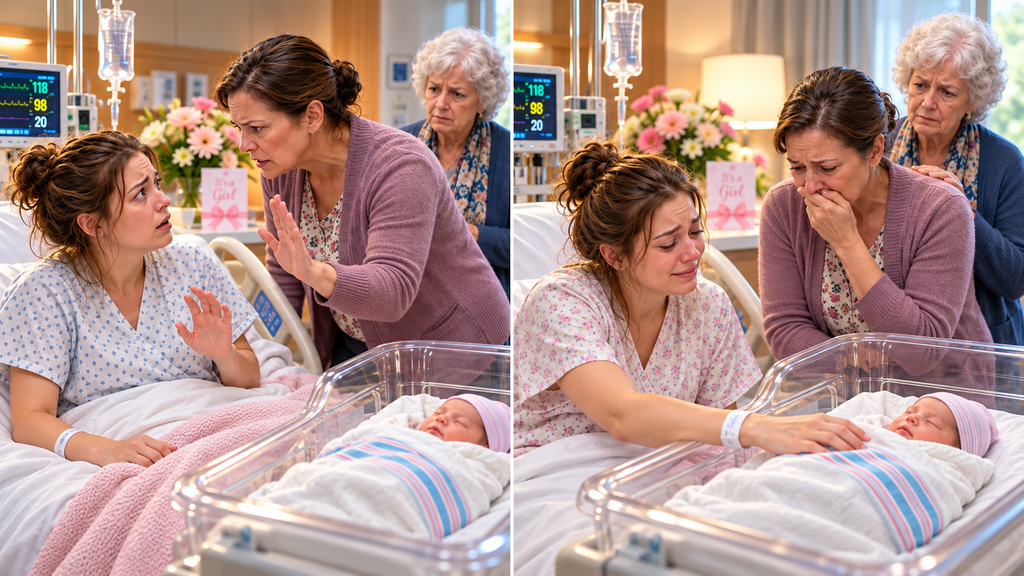
My mother sat in the chair across from my hospital bed. For several seconds, she couldn’t look at me. The room had become strangely quiet after security escorted my mother-in-law away.
Only my baby’s soft cries broke the silence. The nurses had removed most of the black substance from his skin, but faint gray stains remained around his tiny fingernails and behind one ear.
Every time I looked at them, something inside me twisted.
He had been alive for only a few hours.
A few hours.
And already someone had used him as a weapon.
My husband stood beside my bed with one hand resting protectively on the rail.
“Tell her,” he said to my mother.
My mother wiped her face.
“I thought…”
Her voice broke.
I waited.
She tried again.
“I thought your mother-in-law had caught you doing something terrible.”
I stared at her.
“You thought that?”
She nodded weakly.
“She was screaming that the baby wasn’t your husband’s. Everyone was looking at him, and she kept saying his skin proved it.”
My husband clenched his jaw.
I looked directly at my mother.
“So you hit me.”
Her face crumpled.
“I reacted.”
“No.”
My voice came out stronger than I expected.
“You made a choice.”
She stared at me.
“You walked into a hospital room where your daughter had just given birth. You saw me half-conscious, bleeding, exhausted and barely able to sit up.”
My throat tightened.
“And instead of asking me one question, you slapped me.”
She began crying harder.
“I’m sorry.”
I shook my head.
“I needed my mother.”
Those four words changed her expression completely.
She covered her mouth.
I continued.
“I woke up surrounded by people staring at me like I was disgusting. My baby was crying. I didn’t know what had happened to him. And then my own mother hit me.”
“I’m so sorry.”
“You should be.”
My husband squeezed my hand.
For once, nobody interrupted me.
Nobody told me to calm down.
Nobody asked me to forgive anyone because we were family.
My mother whispered, “What can I do?”
I looked toward my son.
“Leave.”
She stared at me.
“Please—”
“I need you to leave.”
“But you’re my daughter.”
“And he is my son.”
My voice shook.
“I have to protect him, even when protecting him means protecting him from people I love.”
My mother’s shoulders dropped.
For a moment, I thought she might argue.
Instead, she stood.
Before reaching the door, she turned around.
“I don’t expect you to forgive me.”
I said nothing.
She looked at my husband.
“Take care of her.”
He answered quietly.
“I will.”
Then she left.
The door clicked shut.
And I broke.
Not dramatically.
Not loudly.
I simply folded into my husband’s chest and cried.
He held me carefully because of my stitches.
“I’m sorry,” he whispered.
I pulled away.
“For what?”
“For leaving the room.”
“You went to get my bag.”
“I should’ve been here.”
“You couldn’t have known.”
He looked toward our baby.
“I knew my mother didn’t like you.”
That sentence made me stop.
He sat beside me.
“I knew she made comments. I knew she questioned things. I knew she thought nobody was good enough for me.”
He swallowed.
“But I kept telling myself she was just difficult.”
I understood exactly what he meant.
His mother had always been difficult.
That was the word everyone used.
Difficult.
She criticized our wedding.
Difficult.
She complained when we bought a house twenty minutes farther from her.
Difficult.
She questioned why I kept my last name professionally.
Difficult.
When I became pregnant, she asked my husband whether he was “absolutely sure.”
Difficult.
Each insult had been treated like an annoying personality trait instead of what it really was.
A warning.
My husband looked at me.
“I won’t make that mistake again.”
Before I could answer, the charge nurse returned.
She had another woman with her.
The woman introduced herself as the hospital’s patient advocate.
She pulled a chair beside my bed and explained everything slowly.
The incident had been formally documented.
The substance removed from my baby’s skin had been preserved for identification.
My mother-in-law had been banned from returning to the maternity floor.
Security had recorded statements from the nurses.
And because the victim was a newborn, additional reports would be made according to hospital policy.
I listened while holding my husband’s hand.
Then I asked the question I was terrified to ask.
“Is my baby okay?”
The nurse’s face softened.
“So far, yes.”
I closed my eyes.
Those three words felt like oxygen.
She explained that the substance appeared to be cosmetic pigment mixed with something oily.
Thankfully, my son hadn’t swallowed any.
None had entered his eyes.
His breathing remained normal.
They would continue monitoring him.
My husband asked, “Can we hold him?”
The nurse smiled.
“Absolutely.”
She lifted our son and placed him carefully against my chest.
He immediately stopped crying.
I will never forget that moment.
His cheek rested against me.
His tiny mouth opened once.
Then his fingers curled around nothing.
I kissed the top of his head.
“I’m sorry,” I whispered.
My husband heard me.
“Don’t.”
I looked at him.
“None of this was your fault.”
I knew that logically.
But motherhood had arrived with a strange new kind of guilt.
The feeling that anything bad happening to my child must somehow mean I had failed.
My husband leaned closer.
“You protected him the second you woke up.”
I looked down at our son.
That was when I made myself a promise.
Nobody would ever use the word “family” to force me into accepting cruelty again.
Not with him.
Not with me.
Never.
We stayed in the hospital for two more nights.
My mother-in-law called my husband seventeen times.
He didn’t answer once.
Then the messages started.
At first, they were angry.
“You embarrassed me.”
Then defensive.
“I was trying to protect you.”
Then manipulative.
“After everything I’ve sacrificed for you.”
Then desperate.
“Please answer me.”
Then came the message that finally made my husband block her number.
“I still think you should get a DNA test.”
He stared at the screen for several seconds.
Then he laughed.
It wasn’t amusement.
It was disbelief.
He turned the phone toward me.
I read the message.
Something surprising happened.
I didn’t feel angry.
I felt tired.
“Do you want one?” I asked.
His expression changed instantly.
“A DNA test?”
I nodded.
“If you have any doubt—”
“No.”
He put the phone down.
“I don’t.”
“I wouldn’t blame you after everything she said.”
“I would blame myself.”
He moved closer.
“I was there when our son was born. I watched you go through fourteen hours of labor. I watched you hold my hand so hard I thought you’d break two fingers.”
Despite everything, I smiled.
“You complained about that?”
“I considered filing a report.”
I laughed.
It hurt my abdomen, but I laughed anyway.
Then his face became serious.
“I don’t need a test to defend myself against something my mother invented.”
That should have ended it.
But three weeks later, something arrived in our mailbox.
An envelope.
No return address.
Inside was a DNA testing kit.
My husband stared at it.
I stared at him.
Neither of us needed to ask who had sent it.
He walked directly outside and dropped it into the garbage bin.
Then he took a photograph of it.
I raised an eyebrow.
“Why the picture?”
“Documentation.”
That word became very important over the next few months.
We documented everything.
Every message.
Every email.
Every attempt to contact us through relatives.
Every time someone showed up at our house “just wanting to talk.”
Because my mother-in-law did not accept boundaries.
She treated them like challenges.
First, she sent my husband’s aunt.
Then his cousin.
Then one of her church friends.
They all delivered variations of the same message.
She’s devastated.
She made a mistake.
She’s still his mother.
She deserves to meet her grandson.
The last sentence always made my stomach turn.
Deserves.
As though access to my baby were a prize.
My husband gave everyone the same answer.
“My son’s safety is not negotiable.”
Some relatives understood.
Others didn’t.
We learned very quickly who believed peace was more important than accountability.
My own mother didn’t contact me for nearly a month.
Then a letter arrived.
Not a text.
Not a phone call.
A handwritten letter.
I almost threw it away.
Instead, I put it in a drawer.
Three days later, while the baby slept against my chest, I opened it.
My mother’s handwriting shook across four pages.
She didn’t make excuses.
That surprised me.
She wrote that she had replayed the hospital room in her mind hundreds of times.
She wrote that she kept seeing my face immediately after she slapped me.
She admitted something I hadn’t expected.
She said she had believed my mother-in-law so quickly because she cared more about avoiding public embarrassment than protecting her own daughter.
That sentence hurt.
But at least it was true.
She wrote:
“I cannot ask you to trust me because I proved that, in the moment you needed me most, I wasn’t trustworthy.”
I stopped reading.
I cried for a long time.
Then I finished the letter.
She didn’t ask to meet the baby.
She didn’t ask me to forgive her.
She simply said she was starting counseling and would wait until I decided whether I wanted contact.
That mattered.
Not enough to erase what happened.
But enough that I didn’t throw the letter away.
Six months passed.
Our son grew.
The faint stains disappeared from his skin within days.
But sometimes I still saw them.
Not literally.
In my memory.
I’d be changing his diaper and suddenly remember the black pigment around his ankle.
I’d hear him cry and be transported back to that hospital room.
My husband noticed.
One night, after putting the baby to sleep, he found me sitting alone in the nursery.
“You okay?”
I nodded automatically.
Then stopped.
“No.”
He sat beside me.
“I keep thinking about how helpless he was.”
My husband didn’t tell me to forget it.
He didn’t tell me everything was fine now.
He just listened.
“I was asleep,” I whispered. “I couldn’t protect him.”
“You were recovering from giving birth.”
“I know.”
“She waited until you couldn’t protect him.”
That realization changed something.
My mother-in-law hadn’t acted because I failed.
She acted because I was vulnerable.
There was a difference.
And I finally understood it.
Eventually, I agreed to meet my mother.
Alone.
No baby.
We met at a small café.
She looked older than she had six months earlier.
When she saw me, she stood.
She didn’t try to hug me.
“Thank you for coming.”
We sat.
For a few minutes, neither of us knew what to say.
Finally, she asked, “How are you?”
“Better.”
“And the baby?”
“Healthy.”
Her eyes filled with tears.
“I’m glad.”
She didn’t ask for pictures.
She didn’t ask when she could see him.
That mattered too.
I looked at her.
“Why did you hit me?”
She took a long breath.
“Because I believed the loudest person in the room.”
I hadn’t expected that answer.
She continued.
“Your mother-in-law sounded certain. Everyone reacted. I saw people looking at you, and instead of thinking like your mother, I reacted like part of a crowd.”
She wiped her eyes.
“I’ve spent months trying to understand how I could do that.”
“And?”
“I cared more about what I thought you had done to the family than about whether my daughter was safe.”
I looked down at my coffee.
“That’s hard to hear.”
“I know.”
“But I needed you to say it.”
She nodded.
“I know.”
We talked for almost two hours.
I didn’t forgive her that day.
Forgiveness wasn’t a switch.
Trust certainly wasn’t.
But I agreed to meet her again.
Two months later, she saw her grandson for the first time since the hospital.
My husband was there.
So was I.
She stood several feet away and cried.
“May I hold him?”
I looked at my husband.
Then at my mother.
“Sit down first.”
She did.
I placed my son in her arms.
Her hands trembled.
She looked at him and whispered, “I’m sorry.”
He grabbed her finger.
She cried harder.
I didn’t tell her everything was okay.
Because it wasn’t.
But sometimes healing begins before everything is okay.
My mother-in-law took a different path.
She never apologized.
Not really.
She sent long messages through relatives explaining why she’d been justified.
She claimed she had been “concerned.”
She said she had “panicked.”
She insisted she had never intended to hurt the baby.
But she always added one sentence that destroyed everything else.
“I still had a right to know.”
No.
She didn’t.
Nobody had the right to smear an unknown substance across a newborn’s face.
Nobody had the right to turn my child’s skin into evidence for an accusation.
Nobody had the right to humiliate me while I was unconscious.
And nobody had the right to demand forgiveness simply because we shared relatives.
Eventually, the calls stopped.
The relatives stopped arriving.
The messages became less frequent.
Life became quieter.
Our son’s first birthday arrived faster than I thought possible.
We kept the party small.
A few friends.
My sister.
My mother.
My husband’s brother and his family.
There were balloons everywhere.
Our son destroyed his birthday cake within three minutes.
Frosting covered his cheeks.
My husband looked at him and laughed.
“Well, apparently putting substances on his face runs in the family.”
The room went silent.
I stared at him.
His eyes widened.
“Too soon?”
I tried not to laugh.
I failed.
Soon everyone was laughing.
Even my mother.
And for the first time, the memory didn’t feel like it owned me.
It was something that had happened.
Something terrible.
But it wasn’t happening anymore.
That distinction had taken me a year to understand.
Later that evening, after everyone left, my husband and I sat on the living-room floor surrounded by wrapping paper.
Our son was asleep upstairs.
My husband leaned his head against the couch.
“One year.”
“One year.”
He took my hand.
“Do you ever think about that morning?”
“Sometimes.”
“Me too.”
I looked at him.
“Do you regret cutting her off?”
He knew exactly who I meant.
“No.”
Not even a pause.
Then he added something I’ll never forget.
“I regret that it took something that extreme for me to understand what she’d been doing to you for years.”
I squeezed his hand.
“We understand now.”
“Yeah.”
Upstairs, our baby made a noise through the monitor.
We both froze.
Then we laughed.
Parenthood.
One tiny sound and two adults immediately became alert.
My husband stood.
“I’ll check.”
I watched him walk upstairs.
And I thought about the hospital room.
The screaming.
The accusation.
My mother’s hand across my face.
The black pigment coming away on white gauze.
My mother-in-law insisting she had exposed the truth.
She had been right about one thing.
The truth had been exposed that morning.
Just not the truth she expected.
We learned who would accuse before asking.
Who would strike before listening.
Who would protect appearances instead of people.
Who believed being family entitled them to cross every boundary.
But we also learned who would stand beside me.
Who would call for help.
Who would document what happened instead of pretending it didn’t.
Who understood that forgiveness and access were not the same thing.
And most importantly, I learned something about myself.
Before becoming a mother, I thought keeping a family together meant swallowing hurt.
I thought being mature meant ignoring cruel comments.
I thought boundaries were something you created only after explaining yourself enough for everyone to understand.
Motherhood changed that.
My son didn’t need a mother who kept everybody happy.
He needed a mother willing to make people unhappy if that was what keeping him safe required.
A few minutes later, my husband returned carrying him.
“False alarm,” he whispered.
Our son had apparently decided sleeping alone was unacceptable.
I held out my arms.
My husband placed him against my chest.
He curled into me immediately.
I kissed his forehead.
Clean.
Warm.
Safe.
My husband sat beside us.
For a while, neither of us spoke.
Then my phone vibrated.
A message.
I looked at the screen.
It was from an unfamiliar number.
But I recognized the words immediately.
“Please tell my son I still love him. I just want to meet my grandson.”
My husband read it over my shoulder.
He sighed.
“What do you want to do?”
A year earlier, that question would have terrified me.
I would have worried about being cruel.
I would have imagined what relatives might say.
I would have wondered whether refusing made me a bad person.
Now I simply looked at the sleeping child in my arms.
Then I blocked the number.
My husband smiled.
“That’s it?”
“That’s it.”
I put the phone facedown.
No speech.
No argument.
No explanation.
Some people believe closure means everyone eventually sits around a table, apologizes, cries and becomes a family again.
Sometimes that happens.
Sometimes closure is quieter.
Sometimes closure is realizing you don’t need another person to understand why they lost access to you.
Sometimes it’s pressing one button.
Sometimes it’s locking a door.
Sometimes it’s holding your child and realizing the chaos is finally outside your home instead of inside it.
My husband wrapped an arm around me.
Our son slept between us.
And for the first time since the morning he was born, I thought about what my mother-in-law had done without feeling afraid.
Because she had tried to paint my baby black to expose what she called the truth.
Instead, she’d exposed herself.
She had wanted everyone in that hospital room to look at my child and question who his father was.
But when the nurse wiped that first streak away, the question changed.
Nobody was looking at me anymore.
They were looking at her.
And in the end, the stain she put on my son washed away in minutes.
The stain her actions left on everyone’s trust took much longer.
My mother eventually accepted responsibility and slowly earned a place back in our lives.
My mother-in-law chose excuses.
So she remained outside them.
That wasn’t revenge.
It wasn’t punishment.
It was consequence.
My son shifted against my chest and wrapped his tiny fingers around mine.
I looked down at him.
One day, when he’s old enough, perhaps we’ll tell him the story of the morning he was born.
Not every ugly detail.
Not immediately.
But someday.
And when we do, I won’t tell him that his grandmother was a monster.
I’ll tell him something more useful.
I’ll tell him that love without respect can become dangerous.
I’ll tell him that sharing blood with someone doesn’t give them ownership over you.
I’ll tell him that when someone hurts you, an apology is only the beginning; their behavior afterward tells you whether they truly understood what they did.
And I’ll tell him that family isn’t measured by who demands a place in your life.
It’s measured by who treats that place with care.
My husband kissed my forehead.
“Ready for bed?”
I looked at our sleeping son.
“In a minute.”
I wanted to hold him a little longer.
So I did.
No screaming relatives.
No accusations.
No hospital security.
No black pigment.
Just the three of us in a quiet house.
A year earlier, my mother-in-law had stood beside my son’s hospital bassinet and shouted for everyone to come look at him.
She wanted an audience.
She wanted humiliation.
She wanted to turn the first hours of his life into proof that I didn’t belong in her family.
But she misunderstood something.
I wasn’t the person who needed to prove I belonged anymore.
I had my husband.
I had my son.
And together, we were already a family.
Everyone else had a choice.
They could treat that family with love and respect.
Or they could watch it grow from a distance.
My mother chose to change.
My mother-in-law chose not to.
And that was the difference between them.
Not what they did on the worst morning of my life.
But what they did after they were confronted with the truth.
One accepted it.
The other kept trying to paint over it.
I looked at my son’s peaceful face one last time before carrying him upstairs.
The stain was gone.
The fear was gone.
The shame had never belonged to me in the first place.
And finally, I understood that.
THE END! THANK YOU FOR READING!❤️