 Reading Time: 22 minutes
“Did Michael ever tell you where he really was that night?” The question hung between us. I stared at Margaret.
For a moment, I could hear nothing except the ticking of the little clock above her fireplace. Tick. Tick. Tick. My mouth had gone dry. “What night?” I finally whispered.
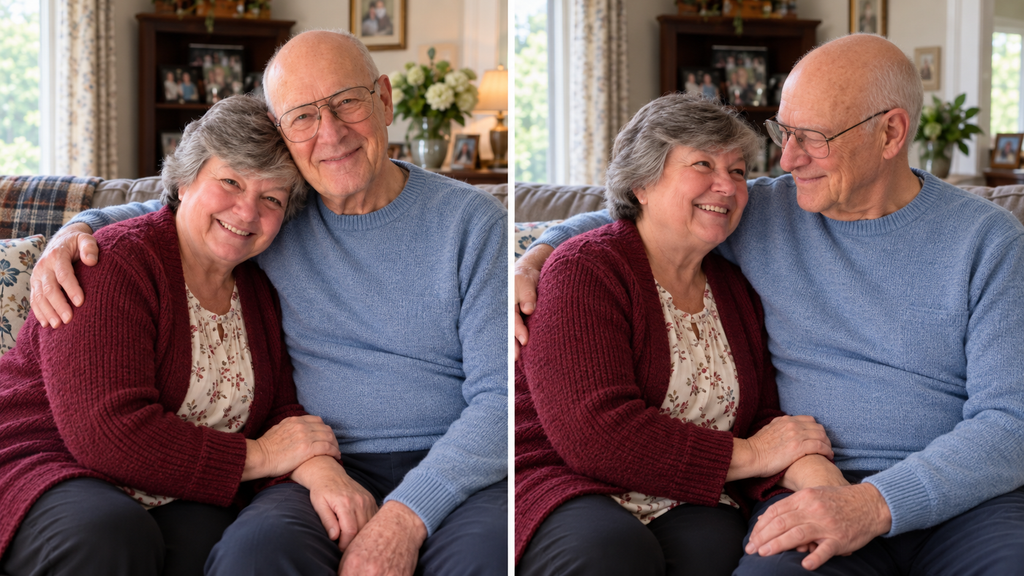
Margaret’s expression told me she already knew the answer.
“The night I disappeared.”
I gripped the edge of the chair.
“No.”
Her eyes lowered.
“No, he never told me.”
She nodded slowly, almost sadly.
“I thought he wouldn’t.”
Something inside me snapped.
I stood so quickly the chair scraped backward across the wooden floor.
“Stop doing that.”
Margaret flinched.
“Doing what?”
“Talking like you knew my husband better than I did.”
My voice cracked.
“I buried him a month ago.”
Tears burned behind my eyes.
“I sat beside his hospital bed every night. I held his hand while cancer took him piece by piece. I watched the man I had loved since I was seventeen struggle to breathe.”
Margaret said nothing.
“And now I find twenty-seven years of secret payments to a woman everyone thought was dead, and you’re standing here talking about him like the two of you shared some secret life.”
My hands were shaking.
“So stop asking me questions.”
I pointed toward the cabinet.
“Tell me the truth.”
Margaret looked at me for a long moment.
Then she opened the drawer.
She removed a thick brown envelope.
My name was written across the front.
Not Margaret’s handwriting.
Michael’s.
I recognized it immediately.
My knees almost gave out.
The same handwriting had covered birthday cards, grocery lists, anniversary notes, and little messages left beside the coffee machine for nearly four decades.
For Sarah.
Underneath it were four words.
If she ever comes.
I stared at Margaret.
“He knew I might find you?”
“He hoped you never would.”
That hurt.
More than I expected.
“Why?”
“Because if you came here, it meant he was gone.”
The anger drained from me for just a second.
Margaret held the envelope toward me.
“He left this with me seventeen years ago.”
“Seventeen?”
“He replaced it twice afterward. The last time was about six years ago.”
I couldn’t bring myself to take it.
“What is it?”
“The truth.”
I almost laughed.
The truth.
Such a simple word.
Such a cruel word.
For thirty-eight years, I had believed Michael and I shared everything.
Our first apartment.
Our first terrible secondhand couch.
The birth of our children.
Mortgages.
Illnesses.
Graduations.
Weddings.
Grandchildren.
Thousands of breakfasts.
Thousands of nights falling asleep beside each other.
And apparently, somewhere inside all those ordinary days, my husband had been carrying an entire history I knew nothing about.
I took the envelope.
My fingers trembled as I opened it.
Inside was a letter.
Several pages.
The first line nearly destroyed me.
Sarah, if you’re reading this, then I wasn’t brave enough to tell you while I was alive.
I pressed my hand over my mouth.
Margaret turned away.
I continued reading.
And before you read another word, I need you to know one thing.
Margaret was never my mistress.
My breath caught.
I read the sentence again.
Then again.
Margaret remained beside the window, her back to me.
I continued.
I never had an affair with her.
I never loved her the way I loved you.
But I did owe her a debt.
And that debt began with the worst thing I ever did.
My hands started shaking harder.
The room blurred.
I lowered myself back into the chair.
Then I read the next sentence.
And suddenly I understood why Michael had taken the truth to his grave.
Twenty-seven years earlier, Michael had told me he was attending a business dinner.
I remembered it.
Not perfectly.
But enough.
Our youngest child had been sick with the flu.
Michael had called around six and said the dinner might run late.
I had been irritated.
I remembered standing in our kitchen with a thermometer in one hand and the telephone pressed against my shoulder.
“Fine,” I’d said.
“Just don’t wake the kids when you come home.”
He had returned after midnight.
His clothes were damp.
His face was pale.
I asked whether everything was okay.
He said yes.
I believed him.
Why wouldn’t I?
Michael was my husband.
The person I trusted most in the world.
But according to his letter, there had been no business dinner.
Not really.
He had left work early after receiving a phone call from his younger brother, Daniel.
Daniel.
Even seeing the name made my stomach tighten.
Michael almost never talked about him.
Daniel had died twenty-six years ago.
At least, that part was true.
He had been Michael’s opposite.
Michael was careful.
Daniel was reckless.
Michael saved money.
Daniel gambled.
Michael rarely drank.
Daniel could disappear for days.
The brothers loved each other, but their relationship had always been complicated.
What I had never known was just how complicated.
Daniel had called Michael that evening in a panic.
He owed money.
A lot of money.
And the people he owed were threatening him.
Michael agreed to meet him at a roadside bar outside the city.
Margaret worked there.
She was thirty-nine then.
Recently separated.
Trying to save enough money to leave town and start over.
Daniel arrived drunk.
Michael tried to convince him to come home.
They argued in the parking lot.
Margaret was closing the bar when she heard shouting.
She came outside.
And then everything went wrong.
Daniel climbed into his car.
Michael grabbed the driver’s door.
“Give me the keys.”
Daniel shoved him away.
Margaret shouted that she was calling the police.
Daniel panicked.
He reversed.
Fast.
Margaret was behind the vehicle.
Michael screamed.
Daniel jerked the wheel.
The car struck Margaret.
She went down.
Then Daniel crashed into a concrete barrier.
Michael ran toward Margaret first.
She was unconscious.
Bleeding.
Barely breathing.
Michael thought she was dead.
Daniel stumbled from the car.
And instead of calling an ambulance immediately, he begged his brother not to call anyone.
There were drugs in the vehicle.
He had been drinking.
He already had previous charges.
He told Michael that prison would destroy him.
Michael made the worst decision of his life.
He hesitated.
According to the letter, it was less than four minutes.
Four minutes.
But sometimes four minutes can divide a life into before and after.
Eventually Michael ignored Daniel’s pleading and called emergency services.
But when he returned to where Margaret had fallen…
She was gone.
There was blood on the pavement.
But no Margaret.
The police searched.
Her purse was found near the road.
Her coat was later discovered near the riverbank.
Witnesses remembered hearing the crash.
And because Margaret had recently told coworkers she wanted to disappear and start over somewhere else, rumors spread.
Some thought she had wandered away injured and fallen into the river.
Others believed she had deliberately vanished.
Her body was never found.
Eventually, people assumed she was dead.
But Michael knew something nobody else did.
Three weeks later, he received a letter.
From Margaret.
She was alive.
I stopped reading.
My heartbeat was pounding in my ears.
I looked across the room.
“You survived the accident.”
Margaret nodded.
“Yes.”
“Where did you go?”
She slowly sat across from me.
“I was terrified.”
“Of Daniel?”
“Of everyone.”
Her voice trembled.
“My life was already falling apart before that night.”
She looked down at her hands.
“My husband had been violent for years.”
I felt my anger weaken.
“I had finally left him.”
She swallowed.
“But he kept finding me.”
That explained something I hadn’t understood.
The disappearance hadn’t begun with Michael.
Margaret had already been planning to run.
“I had money hidden,” she continued. “A few clothes. Documents. I was going to leave the following week.”
“But the accident happened first.”
“Yes.”
She touched the side of her head unconsciously.
“When Daniel’s car hit me, I blacked out.”
She had regained consciousness before the ambulance arrived.
Confused.
Bleeding.
Terrified.
She heard Daniel and Michael arguing.
She heard Daniel say police were coming.
And Margaret panicked.
“I wasn’t thinking clearly,” she whispered. “I just knew that if my name appeared in a police report, my husband could find me again.”
So she ran.
A truck driver found her walking along the highway several miles away.
He drove her to a small clinic.
Margaret gave a false name.
Then she disappeared.
For three weeks, Michael believed she was dead.
Until her letter arrived.
She told him she was alive.
She also told him something else.
She had heard everything.
Daniel begging Michael to delay calling the police.
Michael hesitating.
Michael choosing his brother’s future over an injured stranger’s life.
“I hated him,” Margaret whispered.
I looked at her.
“Michael?”
“Yes.”
Her eyes filled.
“For a long time.”
I understood.
Part of me hated him in that moment too.
Not the husband I knew.
The younger man in the letter.
The frightened man who had made a cowardly choice.
“But he helped you.”
Margaret nodded.
“Eventually.”
Michael found her.
He apologized.
She refused to forgive him.
He offered money for medical treatment.
She refused that too.
Then her estranged husband found her again.
That changed everything.
Margaret needed somewhere safe.
Michael helped her relocate.
Different city.
Different address.
Different life.
The first rent payment was supposed to last three months.
Then six.
Then a year.
But Margaret struggled.
The accident had left permanent damage in her hip and spine.
Some days she could work.
Some days she couldn’t.
Michael felt responsible.
Not because he caused the accident.
Because he had delayed helping her.
So he kept paying.
Month after month.
Year after year.
Twenty-seven years.
I looked around the modest room.
“You could have told me.”
Margaret gave a sad smile.
“That was what I told him.”
I stared at her.
“You told Michael to tell me?”
“Many times.”
That surprised me.
“He always said he would.”
“When?”
“After your youngest finished high school.”
She shook her head.
“Then after your daughter’s wedding.”
Another pause.
“Then after your first grandchild was born.”
My eyes closed.
There was always another reason.
Another milestone.
Another excuse.
“He was ashamed,” Margaret said.
I opened my eyes.
“He should have been.”
“Yes.”
She didn’t defend him.
That mattered.
“He wasn’t protecting me anymore,” she continued. “Not after the first few years. I think eventually he was protecting the version of himself that existed in your eyes.”
The sentence cut deeper than anything else.
Because I knew she was right.
Michael hadn’t lied because he was cruel.
He had lied because he was afraid.
Afraid I would see him differently.
And now I did.
I looked down at the letter.
There were still two pages remaining.
I continued reading.
Sarah, there is something else you deserve to know.
My stomach tightened again.
I almost couldn’t continue.
The money was never ours.
I frowned.
Then I kept reading.
I know that sounds impossible.
I never used our joint savings. I never took money from the children’s accounts or from anything we built together.
After Dad died, he left Daniel and me a small investment account you never knew about because the account had been created before we married.
Daniel died before collecting his share.
I used my portion, and later Daniel’s portion, to help Margaret.
I stopped.
Daniel’s money.
Michael had used the inheritance connected to his brother to help the woman Daniel had nearly killed.
It didn’t erase what happened.
But suddenly the payments made more sense.
I continued.
I told myself it was justice.
Maybe it was guilt.
Probably both.
Then came the line that broke me.
But every time I wrote that check, I remembered the four minutes I stood beside my brother instead of immediately choosing what was right.
Tears dropped onto the paper.
Four minutes became twenty-seven years.
That’s how long guilt can live, Sarah.
I covered my face.
For the first time since entering Margaret’s house, I wasn’t angry.
I was grieving.
Not only the husband who had died.
I was grieving the husband I thought had existed.
There is a strange cruelty in discovering someone’s flaws after they’re gone.
You can’t confront them.
You can’t demand explanations.
You can’t slam a door and wait for them to knock.
You can’t ask, “Why didn’t you trust me?”
Death leaves you arguing with silence.
I looked at the next paragraph.
I wanted to tell you a hundred times.
I almost told you on our thirtieth anniversary.
I remembered that night.
Michael had taken me to the little Italian restaurant where we’d had our first real date.
Halfway through dessert, he’d reached across the table and held my hand.
“Sarah,” he’d said, “there’s something I should have told you years ago.”
Then the waiter arrived with champagne.
The moment disappeared.
Later, when I asked what he wanted to say, Michael smiled.
“Just that marrying you was the smartest thing I ever did.”
I had laughed.
Now I was crying so hard I could barely see the page.
He had almost told me.
Almost.
But almost is a cruel word too.
I continued.
I was afraid the truth would make you question everything.
So I chose cowardice again.
I convinced myself silence protected our family.
It didn’t.
It protected me.
I whispered the words aloud.
“It protected me.”
Margaret looked toward me.
I shook my head.
“No. Him.”
I tapped the letter.
“At least he admitted it.”
“Yes.”
I kept reading.
If you’re angry, be angry.
If you hate me for this, I understand.
But please don’t let my worst decision erase thirty-eight years of love.
I stopped.
My chest tightened.
Because that was exactly what I had been doing since finding the receipts.
Rewriting everything.
Every business trip.
Every late meeting.
Every unexplained phone call.
Every moment Michael had stepped outside to answer his cell.
I had turned my entire marriage into a crime scene.
Searching backward for evidence.
But there had been no mistress.
There had been something more complicated.
A terrible decision.
A frightened brother.
An injured woman.
A secret.
And twenty-seven years of guilt.
The final paragraph was shorter.
There’s one more thing Margaret has for you.
I looked up.
Margaret was already standing.
She walked toward the cabinet again.
This time she removed a small metal box.
She placed it on the table.
Inside were envelopes.
Dozens of them.
Each one had a year written on the front.
All the way forward.
“What are these?”
“Letters Michael wrote.”
“To you?”
Margaret shook her head.
“To you.”
My heart stopped.
“He wrote me letters?”
“One every year.”
“Why didn’t I receive them?”
“He never gave me permission to send them.”
I stared at the stack.
“Then why write them?”
“Maybe because writing the truth was easier than speaking it.”
I opened the oldest envelope.
The paper was yellow around the edges.
Michael’s handwriting filled both sides.
Sarah, today Emily lost her first tooth.
My breath caught.
Our daughter had been six.
She cried because she thought she looked ugly. You told her the empty space made her smile more interesting. Ten minutes later she wouldn’t stop smiling at herself in the mirror.
I remembered.
Perfectly.
Then the letter changed.
I watched you comfort her tonight and almost told you about Margaret.
I didn’t.
Another letter.
Sarah, Daniel died today.
I froze.
Michael had written it the night his brother died.
Everyone thinks I’m grieving because I lost my brother.
They’re right.
But I’m also grieving the person he might have been if someone had stopped rescuing him sooner.
I pressed the letter to my chest.
For years, Michael blamed himself for Daniel.
Not because he caused Daniel’s death.
But because love had become enabling.
Because protecting his brother from consequences had helped Daniel continue destroying himself.
Suddenly I understood why Michael had been so strict with our children about accountability.
Whenever one of them got into trouble, Michael always said the same thing.
“Love doesn’t mean protecting someone from consequences.”
I had always admired that about him.
Now I knew where it came from.
Pain.
The next letter was from our twenty-fifth anniversary.
Sarah, you asked me tonight whether I would marry you again if I could go back.
I joked that I’d marry you sooner.
That wasn’t a joke.
My vision blurred.
If I could change one thing about our marriage, it wouldn’t be the hard years or the money problems or the fights.
It would be this secret.
You deserved the truth.
I couldn’t continue.
I put the letter down.
Margaret quietly brought me a glass of water.
“Why did he leave these with you?”
“He said someday you might need to know that the secret wasn’t another life.”
She sat beside me.
“You were his life.”
I looked at her.
“And you?”
Margaret thought for a moment.
“I was his responsibility.”
The answer made me uncomfortable.
“You were more than that.”
“Eventually we became friends.”
There it was.
The sentence I had feared.
But strangely, it didn’t hurt the way I expected.
“Friends?”
“Yes.”
“How often did he come here?”
“Not often.”
She looked toward the kitchen.
“Once or twice a year in the beginning. Later, sometimes years passed.”
“Did my husband ever touch you?”
Margaret met my eyes.
“No.”
“Did he ever kiss you?”
“No.”
“Did you ever love him?”
She hesitated.
And my heart tightened.
Then she said:
“Yes.”
The word landed heavily.
But before I could respond, she continued.
“Not the way you’re thinking.”
Tears appeared in her eyes.
“I loved the man who spent twenty-seven years trying to repair four minutes.”
She smiled sadly.
“But he was never mine.”
She reached across the table and touched the edge of Michael’s letter.
“Whenever he talked about you, his whole face changed.”
I looked away.
“He loved you terribly.”
“Terribly?”
Margaret laughed softly through her tears.
“Yes.”
“That’s an unusual way to say it.”
“Sometimes love is terrible.”
She looked toward the window.
“It makes us brave.”
Then back at me.
“And sometimes it makes us cowards.”
I understood exactly what she meant.
I spent nearly five hours in Margaret’s house that day.
We talked about Michael.
About Daniel.
About the accident.
About the payments.
About the years afterward.
And eventually Margaret told me something I wasn’t prepared for.
“The rent stopped three months ago.”
I frowned.
“Before Michael died?”
“Yes.”
“Why?”
“Because I told him to stop.”
She looked around the room.
“I receive enough now to manage. I don’t need his help anymore.”
“But he kept records through—”
“He still sent money.”
She smiled faintly.
“I returned it.”
Then she handed me three unopened envelopes.
Michael’s handwriting.
My throat tightened.
“He knew he was dying by then.”
“Yes.”
“What did he say?”
Margaret hesitated.
“He asked me for one final favor.”
My stomach tightened.
“What?”
“He asked me to forgive him.”
I looked at her.
“And did you?”
Margaret was silent for a long time.
“Yes.”
She wiped her cheek.
“I told him I’d forgiven him years earlier.”
Something broke inside me.
Because suddenly I imagined Michael sitting exactly where I was sitting.
Older.
Sick.
Knowing his time was running out.
Asking forgiveness for something that had haunted him for nearly three decades.
“Was he here recently?”
“Six months ago.”
That was around the time doctors told us the cancer had spread.
“He drove here?”
“He did.”
“He told me he was meeting an old friend.”
“He wasn’t lying.”
I looked at her.
“Not technically.”
For the first time that day, we both laughed.
It lasted only a few seconds.
But it changed something.
Margaret wasn’t my enemy anymore.
She was simply another person standing in the wreckage of Michael’s choices.
Before I left, she handed me one final envelope.
Unlike the others, this one had no year written on it.
Only two words.
Afterward, Sarah.
I stared at it.
“What is this?”
“I don’t know.”
“You never read it?”
“Never.”
I slipped it into my purse.
Then I looked at Margaret.
“What happens to you now?”
She blinked.
“What do you mean?”
“The rent.”
“I’ll manage.”
“How?”
“I always do.”
There was pride in her voice.
The same pride that had probably made accepting Michael’s help unbearable all those years ago.
I walked toward the door.
Then stopped.
“Margaret?”
“Yes?”
“I don’t know whether I forgive him yet.”
She nodded.
“You don’t have to decide today.”
That sentence stayed with me.
Because grief makes people believe they have to decide everything immediately.
Was he good?
Was he bad?
Was our marriage real?
Was it a lie?
Did I forgive him?
Did I hate him?
But human beings aren’t that simple.
Michael wasn’t a saint.
He wasn’t a monster.
He was a man.
A man who had made one terrible choice.
Then another.
And then spent twenty-seven years trying to live differently.
I drove home.
For the first time since finding the receipts, I didn’t feel like I was chasing a ghost.
I felt like I was finally meeting one.
That night, I sat on our bedroom floor.
Michael’s side of the closet was still full.
His shirts.
His jackets.
The ridiculous green sweater our daughter gave him one Christmas.
I had not been able to pack any of it.
I opened the final envelope.
Afterward, Sarah.
Inside was only one sheet of paper.
The handwriting was shakier than the others.
He must have written it after becoming sick.
My Sarah,
I stopped.
He always called me that.
My Sarah.
I forced myself to continue.
If Margaret gave you this, then you know.
And if you know, then you’re probably sitting somewhere deciding whether the man you buried was a stranger.
Tears immediately filled my eyes.
I wasn’t.
But I wasn’t exactly the man you thought I was either.
Nobody is.
You knew the best parts of me because loving you helped create them.
I covered my mouth.
Before you, I thought loyalty meant protecting the people you loved no matter what they did.
Daniel taught me how dangerous that idea can be.
You taught me something different.
Love means telling the truth even when the truth costs you something.
I laughed bitterly.
“Apparently not.”
Then I continued.
I know the irony.
Despite myself, I laughed again.
That was Michael.
He could hear my response even from the grave.
I failed that lesson with you.
I’m sorry.
Not because I helped Margaret.
I would do that again.
I’m sorry because I didn’t trust you with the truth.
That was it.
That was the wound.
Not the money.
Not Margaret.
Not even the accident.
He hadn’t trusted me.
After thirty-eight years, that hurt most.
Then I read the next line.
I was afraid that if you saw the worst thing I’d ever done, you would stop seeing everything else.
I closed my eyes.
Because he had been right.
For one terrible night after finding those receipts, I had erased thirty-eight years.
I had turned every happy memory into evidence against him.
Then came the final paragraphs.
Don’t do to our marriage what I did to that night.
Don’t let four terrible minutes become bigger than thirty-eight years.
My tears fell freely now.
Remember me honestly.
Not better than I was.
Not worse.
Honestly.
Remember the idiot who burned pancakes every Sunday.
I laughed through my tears.
Remember the father who cried harder than you when Emily got married.
True.
Remember the grandfather who cheated shamelessly at Monopoly because he couldn’t stand losing to an eight-year-old.
Also true.
Remember that I loved you.
Imperfectly.
Cowardly sometimes.
But completely.
I could barely see.
The final lines were almost illegible.
And Sarah?
Please don’t spend the rest of your life punishing Margaret for my silence.
She already paid enough for Daniel’s mistakes.
And for mine.
I love you.
Michael.
I sat there until morning.
Sometimes crying.
Sometimes angry.
Sometimes smiling.
Sometimes talking to him.
“You stupid man.”
Silence.
“You should have told me.”
Silence.
“I would’ve been furious.”
Silence.
“But I would’ve stayed.”
That was when I finally broke.
I pressed the letter against my chest and sobbed.
Because that was the tragedy.
Michael had spent twenty-seven years afraid of losing me over something that probably wouldn’t have made me leave.
I would’ve yelled.
I would’ve cried.
I would’ve demanded answers.
I would’ve insisted we help Margaret openly.
But I would’ve stayed.
He had been afraid of a disaster that existed mostly inside his own guilt.
And because of that fear, he carried the secret alone until death.
Two weeks later, I called our children.
“Come over Sunday.”
They all arrived.
Emily brought her husband.
David brought the grandchildren.
Our youngest, Luke, showed up late carrying a pie he claimed he had baked himself.
Nobody believed him.
We sat around the dining table where Michael had carved the turkey every Thanksgiving for thirty-seven years.
His chair was empty.
I looked at my children.
“There is something about your father you need to know.”
Their expressions changed.
Then I told them.
Everything.
I expected anger.
There was some.
Confusion.
Plenty.
Tears.
Many.
But when I finished, my oldest son David sat silently for a while.
Then he said:
“Dad helped her for twenty-seven years?”
“Yes.”
“Because Uncle Daniel hurt her?”
“Partly.”
“And because Dad waited to call for help?”
“Yes.”
David stared at the table.
“That sounds like Dad.”
I frowned.
“What part?”
“The guilt.”
Emily nodded.
“Dad could forgive everyone except himself.”
That sentence hit me hard.
She was right.
Then little Noah, my nine-year-old grandson, looked around the table.
He hadn’t understood most of the story.
But he understood enough.
“So Grandpa did something bad?”
The adults fell silent.
I looked at him.
“Yes.”
His face became serious.
“But then he tried to do something good?”
“Yes.”
“For a really long time?”
I smiled through my tears.
“Yes.”
Noah thought about that.
Then shrugged.
“Grandpa always said saying sorry doesn’t count if you keep doing the same bad thing.”
Everyone looked at one another.
Then Emily started crying.
Because those were Michael’s words.
He had taught them to all of us.
We simply never knew where he’d learned them.
A month later, I drove back to Margaret’s house.
She looked surprised when she opened the door.
“Sarah?”
“I brought something.”
I handed her an envelope.
Her expression changed.
“No.”
“You haven’t even opened it.”
“I know what it is.”
“Then open it.”
Inside was a check.
Enough to cover her rent for one year.
Margaret immediately pushed it back.
“I can’t take this.”
“It’s not from Michael.”
“That makes it worse.”
“No.”
I placed the envelope back in her hand.
“It makes it different.”
She stared at me.
“I don’t owe you anything.”
“I know.”
“Then why?”
I took a breath.
“Because Michael asked me not to punish you for his silence.”
Her eyes filled.
“And because he was right about one thing.”
“What?”
“You’ve paid enough.”
Margaret started crying.
So did I.
Then something happened neither of us expected.
She hugged me.
At first, my arms remained at my sides.
This woman had occupied the darkest corner of my imagination for weeks.
Mistress.
Secret lover.
Second life.
Betrayal.
But none of those things were true.
She was simply Margaret.
A woman who had survived.
Eventually I hugged her back.
Margaret became part of our lives slowly.
Not dramatically.
There was no miraculous transformation.
No instant friendship.
At first we had coffee once a month.
Then lunch.
Then Emily invited her to Thanksgiving.
Margaret refused.
The following year, she accepted.
My grandchildren adored her.
They called her Miss Margaret.
One afternoon, Noah asked how she knew Grandpa.
Margaret looked at me.
I nodded.
She smiled at him.
“Your grandfather helped me when I needed someone.”
That was enough.
Some truths belong to adults until children are old enough to understand their weight.
Three years have passed now.
Michael has been gone for four years.
His photograph still sits beside my bed.
I no longer look at it and wonder whether everything was a lie.
But I don’t pretend he was perfect either.
That was the lesson he left me.
Remember people honestly.
Michael made a terrible decision.
Then he made another terrible decision by hiding it from me.
But he also spent twenty-seven years trying to make sure the woman harmed by his brother’s recklessness never had to face life completely alone.
Was that enough?
I don’t know.
Maybe some debts can never truly be repaid.
Maybe forgiveness isn’t a mathematical equation.
Maybe redemption isn’t about balancing a scale until everything becomes equal.
Maybe it’s simply about what you choose to do after realizing who you’ve been.
Last spring, Margaret died peacefully in her sleep.
She was eighty-one.
I was the person the hospital called.
Not because I was family.
Technically, I wasn’t.
But sometime during those strange years after Michael’s death, Margaret had written my name as her emergency contact.
When I went to clear her house, I found the metal box again.
Inside were Michael’s letters.
All the ones I’d already read.
But beneath them was something else.
A photograph.
Michael and Margaret.
Taken outside her house.
Michael looked about sixty.
Margaret stood beside him.
They weren’t touching.
They were simply smiling.
On the back, Margaret had written:
The man who taught me that people can fail you terribly and still spend the rest of their lives trying to become better.
Underneath that, she had added:
Sarah, he never stopped talking about you.
I stood alone in Margaret’s empty living room holding that photograph.
And strangely, I smiled.
Then I found one more envelope.
My name.
Margaret’s handwriting.
Inside was a letter she’d written shortly before her death.
Dear Sarah,
There is one thing I never told you.
Of course.
I actually laughed when I read that.
Apparently everyone in my life enjoyed leaving secrets in envelopes.
But this secret was different.
The first year Michael paid my rent, I hated taking the money.
The second year, I tried to return it.
The third year, I told him his debt was paid.
He said it wasn’t.
I asked him how long he planned to punish himself.
He didn’t answer.
Years later, I finally understood something.
Those payments weren’t really about me anymore.
They were about you.
I frowned.
Then continued.
Michael was terrified of becoming Daniel.
He believed one cowardly decision meant there was something cowardly inside him forever.
So every month, paying that rent reminded him to choose differently.
To be a better husband.
A better father.
A better man.
I sat down.
I don’t know whether that comforts you.
But I thought you deserved to know.
You weren’t married to a perfect man.
You were married to a man who knew exactly what his worst mistake looked like and spent the rest of his life running in the opposite direction.
I cried.
Not violently.
Not like before.
Quiet tears.
The kind grief eventually becomes when enough time has passed.
The final lines read:
Thank you for coming to my door that morning.
I was terrified when I saw you.
But I’m glad you came.
Because Michael spent twenty-seven years believing the truth would destroy everything.
Instead, the truth gave both of us a friend.
With love,
Margaret.
I folded the letter.
Placed it beside Michael’s photograph.
And finally understood something I wish my husband had understood while he was alive.
Truth can hurt.
It can disappoint.
It can change how someone sees you.
But secrets have their own price.
And sometimes the price is much higher.
On the anniversary of Michael’s death, I went to the cemetery alone.
It was raining lightly.
I brought no flowers.
Michael never cared much for flowers.
Instead, I brought the final letter he had written me.
I sat beside his headstone.
For a while, I said nothing.
Then I laughed.
“You caused quite a mess.”
The rain tapped softly against my umbrella.
“You know that?”
Silence.
“Twenty-seven years, Michael.”
I shook my head.
“You stubborn, frightened, impossible man.”
My voice cracked.
Then I touched his name carved into the stone.
“I forgive you.”
The words surprised me.
I had never said them aloud before.
Maybe I had been waiting until I truly meant them.
“I forgive you for that night.”
Tears filled my eyes.
“I forgive you for not telling me.”
Then I smiled.
“But I’m still angry.”
A breeze moved through the trees.
“And I think I’m allowed to be.”
For the first time, forgiveness didn’t feel like erasing what happened.
It felt like accepting that two things could be true at once.
Michael had betrayed my trust.
And Michael had loved me.
Michael had been cowardly.
And Michael had been brave.
Michael had failed someone terribly.
And Michael had spent decades trying to become someone who wouldn’t fail that way again.
One truth didn’t cancel another.
That is something age teaches you.
When we’re young, we want people to be heroes or villains.
Good husbands or bad husbands.
Faithful or unfaithful.
Honest or dishonest.
Innocent or guilty.
But after enough years, you realize human beings rarely fit neatly inside those boxes.
Sometimes the person who hurts you is also the person who loved you most.
Sometimes a terrible mistake becomes the reason someone changes.
Sometimes forgiveness doesn’t mean saying what happened was acceptable.
It simply means refusing to let what happened own every day that comes afterward.
I stood.
Placed my palm against Michael’s headstone one final time.
Then whispered:
“You should have trusted me.”
That was the sentence I needed him to hear most.
Even if he couldn’t hear it.
“You should have told me everything.”
I stepped away.
Then stopped.
“And for what it’s worth…”
I smiled through my tears.
“I would have stayed.”
I walked toward my car.
The rain had nearly stopped.
Halfway across the cemetery, sunlight broke through the clouds.
I don’t believe every coincidence is a message.
Michael would have teased me mercilessly if I said it was.
But I stopped anyway.
Turned around.
His headstone caught a thin strip of sunlight.
And for just one second, I could almost picture him standing there.
Hands in his pockets.
That crooked smile.
The same seventeen-year-old boy who had once waited outside my parents’ house in a borrowed car because he was too nervous to knock on the door.
The same young husband who burned our first Thanksgiving turkey.
The same father who stayed awake all night beside our son’s crib during a fever.
The same grandfather who let our grandchildren eat ice cream before dinner whenever I wasn’t looking.
The same frightened brother who made a terrible choice in a dark parking lot.
The same guilty man who spent twenty-seven years trying to make amends.
All of him.
Not just the beautiful parts.
Not just the ugly parts.
The whole man.
Michael.
My husband.
I touched my wedding ring.
And walked away.
Not because I had stopped loving him.
But because I finally understood that moving forward wasn’t the same as leaving him behind.
For thirty-eight years, Michael and I had shared a life.
For twenty-seven of those years, he carried a secret.
For a while after discovering it, I thought those twenty-seven years had poisoned everything that came before and after.
Now I know better.
A secret can change the story.
But it doesn’t necessarily erase the love inside it.
Michael’s greatest mistake wasn’t helping Margaret.
It wasn’t even the four minutes he hesitated beside his brother.
His greatest mistake was believing the people who loved him could only love the perfect version of him.
He never understood that I didn’t need perfection.
I needed honesty.
And perhaps that’s the saddest part of all.
Because if Michael had come home twenty-seven years ago, sat across from me at our kitchen table, taken my hands, and told me everything…
I would have cried.
I would have screamed.
I might have slept in another room.
I might have needed weeks to forgive him.
But eventually, I would have reached across that same table and said:
“Okay.”
“Now let’s figure out how to make this right.”
Together.
Instead, he carried it alone.
And I learned the truth only after death had made it impossible for us to face it together.
So if there is one thing I learned from Michael’s secret, it is this:
Don’t wait until you’re dying to tell the people you love who you really are.
Don’t give fear decades of your life.
Don’t confuse hiding your mistakes with protecting your family.
And don’t assume that being loved means being seen as perfect.
Real love isn’t loving someone because you believe they’ve never failed.
Real love begins when you finally see the whole person.
The beautiful parts.
The frightened parts.
The mistakes.
The regrets.
The things they wish they could undo.
And somehow, after seeing all of it, you still find something worth holding onto.
Michael believed his secret would destroy my memory of him.
He was wrong.
It changed my memory of him.
There is a difference.
I no longer remember my husband as the perfect man I once imagined him to be.
I remember him as something far more complicated.
And far more human.
A man who failed.
A man who hid.
A man who regretted.
A man who tried.
A man who loved.
And in the end, perhaps that is the most honest way any of us can hope to be remembered.
Not for never making mistakes.
But for what we choose to become after them.
And whenever I think about the morning I knocked on Margaret’s door expecting to discover that my entire marriage had been a lie, I remember what actually happened.
I discovered something harder.
My marriage had been real.
The love had been real.
The happiness had been real.
And the secret had been real too.
All of those things existed together.
That’s life.
Messy.
Painful.
Beautiful.
Imperfect.
And sometimes, the truth we fear most isn’t the truth that destroys us.
Sometimes it’s the truth that finally allows us to forgive.
Michael.
Margaret.
And eventually…
ourselves.
THE END! THANK YOU FOR READING!❤️