 Reading Time: 22 minutes
Nearly two hundred SEALs were standing. But my father wasn’t. He remained frozen beside his chair, one hand gripping its polished wooden back as though it were the only thing keeping him upright.
His eyes moved from the four silver stars on my shoulders to the men and women standing throughout the ballroom. Then back to me.
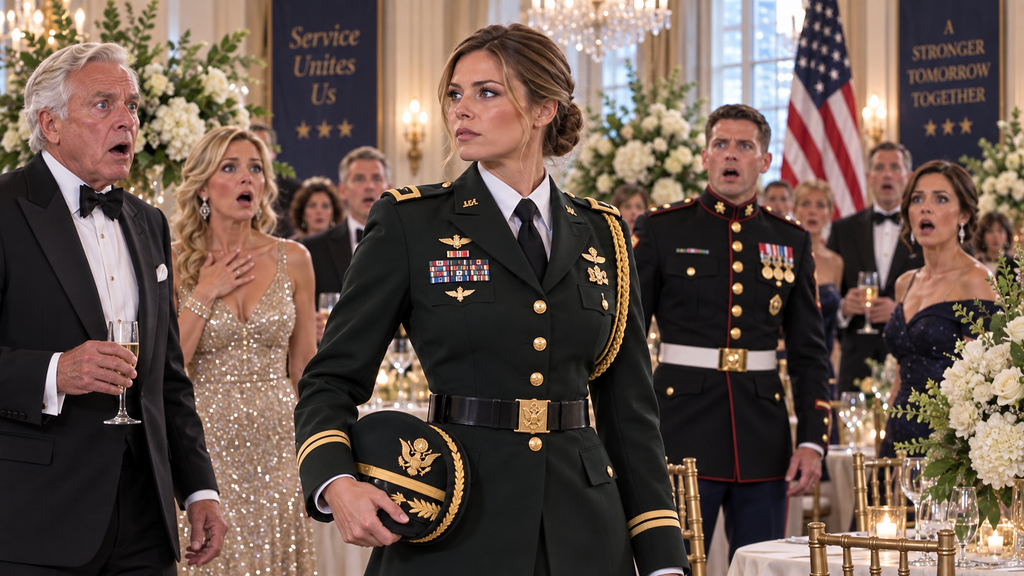
For the first time in my life, my father looked at me without an argument already waiting behind his eyes.
He simply looked confused.
Commander Daniel Mercer stepped forward.
He was tall, broad-shouldered, and gray at the temples, with the kind of stillness that came from decades spent making decisions under pressure.
He stopped several feet from me.
“Admiral Bennett.”
I gave him a small nod.
“Commander.”
Then he glanced toward my family.
His expression changed.
“Admiral,” he said carefully, “there’s something your family needs to hear.”
My stomach tightened.
“Daniel.”
It was a warning.
He knew it.
I knew it.
Apparently, he had decided to ignore it.
“With respect, ma’am,” he said, “I think they’ve gone long enough without hearing it.”
A strange silence settled over the ballroom.
Not the respectful silence that had followed the call of “Admiral on deck.”
This was different.
This was anticipation.
My sister Melanie stood near the head table in her wedding gown, one hand resting against her chest.
Her new husband, Thomas, stood beside her.
My mother had gone pale.
And my father…
My father was staring at Commander Mercer.
“What exactly,” Dad finally asked, “are we supposed to hear?”
Daniel looked at him.
“Who your daughter is.”
Dad blinked.
“I know who my daughter is.”
The commander’s jaw tightened.
“No, sir.”
The words landed softly.
But they struck harder than a shout.
“I don’t believe you do.”
My father’s face reddened.
“Excuse me?”
Daniel didn’t move.
Around him stood admirals, captains, decorated operators, pilots, corpsmen, intelligence officers, and veterans whose names would never appear in newspapers because much of what they had done would remain classified long after they were gone.
Every one of them was watching.
My father suddenly seemed very small.
Daniel continued.
“I first met Admiral Bennett twenty-three years ago.”
I closed my eyes for half a second.
I already knew which story was coming.
“Daniel,” I said quietly.
He looked at me.
“Please.”
There was something in his eyes that stopped me.
Not defiance.
Gratitude.
Then he turned back toward my father.
“I was a lieutenant commander then,” he said. “Young enough to think rank made me smart and stupid enough to think courage meant not being afraid.”
A few older officers smiled faintly.
Daniel didn’t.
“We were conducting an operation overseas. Things went wrong.”
My father glanced at me.
I kept my expression still.
Daniel continued.
“Very wrong.”
His voice dropped.
“We lost communications. Our extraction changed. We had wounded men and very little time.”
The ballroom was utterly silent now.
“You probably won’t ever know the details,” Daniel said. “Most people won’t. But you should know this.”
He pointed toward me.
“Your daughter had every reason to leave us.”
My mother covered her mouth.
“She didn’t.”
I remembered the heat.
The dust.
The metallic taste of blood in my mouth.
A radio that had stopped working.
A young sailor whispering that he didn’t want to die.
Memories are strange things.
Sometimes thirty years disappear in a second.
Daniel’s voice brought me back.
“She stayed.”
His eyes glistened.
“She stayed when staying could have killed her.”
I looked down.
“Daniel.”
“She got twelve people home.”
My father stared at me.
I wished Daniel would stop.
Not because the story was false.
Because I had spent my entire career refusing to make moments like that about me.
There had been twelve people.
Every one of them had fought.
Every one of them had mattered.
Some had carried the wounded.
Some had kept watch.
Some had refused morphine because they needed their heads clear.
I had simply been the senior officer.
Daniel looked around the ballroom.
“Some of the people standing in this room are alive because Admiral Bennett made decisions nobody should ever have to make.”
Nobody moved.
“Others served under officers she trained.”
His voice became rougher.
“Some of us watched her walk into rooms where everybody had already decided she didn’t belong.”
My father’s gaze dropped.
Daniel continued.
“She walked in anyway.”
That sentence hurt more than the others.
Because suddenly I wasn’t remembering combat.
I was seventeen again.
Standing in my parents’ living room.
My Naval Academy information packet in my hands.
Dad behind his newspaper.
Women don’t belong on warships.
Melanie laughing.
Mom telling me not to make a scene.
I swallowed.
Daniel turned toward the guests.
“How many people here served directly under Admiral Bennett?”
For one second, nothing happened.
Then hands began rising.
Ten.
Twenty.
Thirty.
Fifty.
I stopped counting.
My father looked around.
His mouth opened.
Then closed.
Daniel asked another question.
“How many had careers affected by something she taught you?”
More hands rose.
Nearly the entire room.
My throat tightened.
That was something I hadn’t expected.
I had spent thirty-six years moving from assignment to assignment.
You rarely get to see the full shape of a career while you’re living it.
You see paperwork.
Briefings.
Deployment schedules.
Budgets.
Casualty reports.
Promotion boards.
Phone calls at two in the morning.
Young officers sitting across from your desk convinced one mistake has destroyed their future.
You see the work.
You rarely see the footprint.
Standing in that ballroom, I saw it.
For the first time.
My father saw it too.
And somehow, I wished he hadn’t.
Because I had imagined this moment before.
Not this exact moment.
But something like it.
For years, a younger version of me had secretly wanted my parents to discover that I mattered.
I had imagined Dad reading about me.
Seeing my rank.
Hearing someone important praise me.
I thought one day he would finally say:
Claire, I was wrong.
I’m proud of you.
But standing there at sixty years old, I realized something painful.
I didn’t need to win anymore.
The battle had ended years ago.
I had simply never noticed.
“Enough,” I said.
Daniel looked at me.
“Ma’am—”
“I said enough.”
He immediately stepped back.
“Yes, Admiral.”
I looked around the ballroom.
“At ease.”
Nearly two hundred people sat.
The scrape of chairs against the floor rolled through the room like distant thunder.
Everyone except my father.
He was still standing.
I looked at him.
He looked old.
Not weak.
Not defeated.
Just old.
And suddenly I remembered that he was eighty.
The man who had once seemed enormous to me had become smaller with time.
His shoulders had rounded.
His hair was thin and white.
His hands trembled slightly against the chair.
For years, I had carried his words as though they were carved into stone.
Now I realized they had been spoken by a flawed man who had never understood the daughter standing in front of him.
Melanie broke the silence.
“Claire.”
I turned toward her.
Tears were running down her cheeks.
My first instinct was suspicion.
That probably says something about our relationship.
She walked toward me slowly.
“You never told me.”
I almost laughed.
“Told you what?”
“All of this.”
She gestured toward the room.
“These people. What you did. What you meant to them.”
I looked around.
“It wasn’t something I discussed at Thanksgiving.”
“But why?”
That question stunned me.
“Why?”
She nodded.
I stared at my little sister.
The princess.
The easy daughter.
The one who stayed close to home while I disappeared across oceans.
Then I said the simplest truth I knew.
“Because you never asked.”
Her face crumpled.
And somehow that was worse than anger.
She looked toward Mom.
Then Dad.
Then back at me.
“I thought you didn’t want us involved.”
I felt something cold move through my chest.
“What?”
Melanie wiped her cheek.
“Dad always said you preferred the Navy.”
My eyes shifted toward him.
Dad looked away.
Melanie continued.
“He said you were too busy for family. That you thought you were better than us.”
“That isn’t true.”
“I know that now.”
“No.”
My voice sharpened.
“You don’t.”
Several guests looked uncomfortable.
Good.
Some truths are uncomfortable.
“You remember my first deployment?” I asked.
Melanie hesitated.
“Barely.”
“I called home every Sunday.”
She stared at me.
“Every Sunday?”
“Every Sunday I could.”
Mom looked down.
“I wrote letters.”
My mother whispered my name.
“Claire—”
“I sent birthday gifts.”
Nobody answered.
“I sent Christmas cards. I sent postcards. I called when I could. And after a while, I stopped.”
Melanie’s voice trembled.
“Why?”
“Because nobody answered.”
My mother began crying.
I hated seeing it.
Even after everything, I hated seeing my mother cry.
Dad finally spoke.
“You were gone.”
I looked at him.
“Yes.”
“You chose to leave.”
“I chose a career.”
“You chose that career over us.”
There it was.
Thirty-six years compressed into one sentence.
I took a slow breath.
“No, Dad.”
His jaw tightened.
“You did.”
“No.”
I stepped closer.
“I chose a career you didn’t respect.”
He flinched.
“You decided that meant I was rejecting you.”
“That’s not fair.”
I almost smiled.
Fair.
What a strange word for him to use.
“Do you remember my Naval Academy graduation?”
He stared at me.
Mom closed her eyes.
I already knew the answer.
“No.”
“You didn’t come.”
Dad looked away.
“I had work.”
“You owned the company.”
No response.
“Do you remember when I made commander?”
Silence.
“Captain?”
Nothing.
“My first star?”
His face had lost its color.
“My second?”
I stopped.
There was no satisfaction in this.
None.
Only grief.
“Do you know where I was when Mom had her surgery twelve years ago?”
His brow furrowed.
“Overseas.”
“No.”
He looked at me.
“I was sitting in the hospital parking garage.”
Mom’s head snapped up.
“What?”
“I flew in overnight.”
Her mouth opened.
“You never came upstairs.”
“I did.”
Mom stared at me.
I nodded.
“You were asleep.”
My voice cracked despite my effort to control it.
“Dad saw me.”
Every eye shifted toward him.
My father looked as though the floor had disappeared beneath him.
Mom whispered, “Richard?”
He said nothing.
I continued.
“He told me you needed rest.”
Mom’s eyes narrowed.
“And then?”
“He told me I shouldn’t upset you.”
Her hand dropped from her mouth.
I could see the memory forming behind my father’s eyes.
I remembered it too.
The fluorescent lights.
The smell of hospital disinfectant.
My father standing in the hallway.
Me still wearing travel clothes after flying halfway around the world.
He had looked at me and said:
Why are you here?
Not hello.
Not thank God.
Why are you here?
I had told him I came to see Mom.
He said she was recovering.
Then he said something I had never repeated.
Your mother doesn’t need another performance from you.
So I left.
I sat in the parking garage for nearly an hour before returning to the airport.
My mother stared at him.
“You told me she never called.”
Dad’s lips parted.
“I—”
“You told me Claire didn’t even call.”
“I thought—”
“You thought what?”
Mom’s voice rose.
For perhaps the first time in my life, my mother wasn’t asking me to keep the peace.
She was asking him for the truth.
Dad looked around the ballroom.
“This isn’t the place.”
A strange laugh escaped me.
“You’re right.”
Everyone turned toward me.
“This isn’t the place.”
I looked toward Melanie.
“It’s your wedding.”
She shook her head quickly.
“Claire—”
“No.”
I stepped toward her.
“This day belongs to you and Thomas.”
Her eyes filled again.
“And I refuse to let thirty-six years of family dysfunction become your wedding reception.”
A few people laughed softly.
Even Melanie did.
I smiled.
“There she is.”
She laughed through her tears.
Then she did something I wasn’t expecting.
She hugged me.
For a moment, I didn’t move.
My arms remained at my sides.
I had hugged injured sailors.
Widows.
Parents receiving folded flags.
Young officers celebrating promotions.
Foreign dignitaries.
Presidents.
But somehow hugging my own sister felt unfamiliar.
Then Melanie whispered against my shoulder.
“I’m sorry.”
Three words.
That was all.
I closed my eyes.
My arms came around her.
She held tighter.
“I’m so sorry, Claire.”
My throat burned.
“I know.”
“No. You don’t.”
She pulled back.
“I laughed at you.”
I looked at her.
“When you said you wanted to go to Annapolis.”
“I remember.”
“I was thirteen.”
“You were fourteen.”
She gave a watery smile.
“Of course you remember.”
“I remember everything.”
Her smile disappeared.
“I spent my whole life believing Dad’s version of you.”
That hurt.
But she deserved honesty.
“I know.”
“I thought you didn’t care.”
“I cared too much.”
She nodded.
Then her eyes moved toward my uniform.
“Can I tell you something terrible?”
I raised an eyebrow.
“Your wedding seems like an unusual time for confessions, but go ahead.”
She almost laughed.
“When Dad told you not to wear the uniform…”
My stomach tightened.
“I agreed with him.”
I looked away.
“I figured.”
“I thought people would think you were trying to get attention.”
That sentence hurt.
She saw it.
Her face twisted.
“I’m sorry.”
“Melanie.”
“I didn’t understand.”
“No.”
I looked back at her.
“You didn’t.”
She swallowed.
“But when those doors opened…”
Her voice faded.
I waited.
She smiled faintly.
“I’ve never been prouder to be your sister.”
Something inside me broke.
Not dramatically.
Quietly.
Like ice finally giving way beneath spring sunlight.
I had received medals.
Commendations.
Letters from presidents.
Messages from sailors who told me I had changed their lives.
And somehow that one sentence from my little sister reached a place none of them ever had.
I nodded because speaking had suddenly become difficult.
Thomas stepped forward.
My new brother-in-law had barely said a word.
He was a civilian trauma surgeon, which explained why so many military people were attending. Over the years, he had worked extensively with wounded service members and veteran rehabilitation programs.
Apparently, he knew far more people from my world than Melanie realized.
He held out his hand.
“Admiral.”
I looked at it.
Then at him.
“Claire is fine.”
He smiled.
“Claire.”
We shook hands.
Then he leaned closer.
“For what it’s worth, I tried to tell Melanie that asking a four-star admiral not to wear her uniform to a wedding full of military officers was probably going to be complicated.”
Melanie slapped his arm.
“You did not say it like that.”
Thomas grinned.
“I absolutely did.”
For the first time since entering the ballroom, I laughed.
Really laughed.
The tension loosened.
Conversations gradually resumed.
A waiter began collecting abandoned glasses.
Someone restarted the music.
The wedding slowly remembered that it was a wedding.
But Dad still hadn’t moved.
I saw him walking toward the terrace doors.
Alone.
I watched him for several seconds.
Part of me wanted to let him go.
Maybe the younger Claire would have followed immediately.
Maybe she would have demanded the apology she had waited her entire life to hear.
But I wasn’t seventeen anymore.
I turned toward Melanie.
“Go dance with your husband.”
“What about Dad?”
I looked toward the terrace.
“I’ll handle Dad.”
She squeezed my hand.
Then she left.
I waited another minute before following him.
The rain had stopped.
Charleston smelled like wet stone, magnolia, and the ocean.
Dad stood at the terrace railing.
His back was toward me.
For once, he looked like the one preparing for battle.
I stopped beside him.
Neither of us spoke.
Inside, music drifted through the glass doors.
Finally, Dad said, “Four stars.”
I looked at him.
“Yes.”
“How long?”
“Three years.”
He nodded slowly.
“I didn’t know.”
“I know.”
He winced.
There was no cruelty in my answer.
That made it worse.
“I should have known.”
I didn’t rescue him.
For years, I had been expected to rescue everyone from uncomfortable truths.
Not tonight.
Dad stared into the garden.
“Your mother kept some newspaper articles.”
That surprised me.
“She did?”
“In a drawer.”
He swallowed.
“I saw them sometimes.”
I waited.
“I never read them.”
There it was.
Not ignorance.
Choice.
He closed his eyes.
“I think I was afraid.”
That was not what I expected.
“Of what?”
He took a long time answering.
“That you would prove me wrong.”
The eighty-year-old man beside me suddenly sounded very young.
I said nothing.
“When you told me you wanted the Naval Academy,” he continued, “I thought it was ridiculous.”
“I remember.”
“I thought you’d quit.”
“I know.”
“Then you didn’t.”
“No.”
“You kept going.”
“Yes.”
His hands tightened around the railing.
“And every year you went further.”
I studied his face.
“Dad.”
“I told everyone you’d come home eventually.”
His voice cracked.
“Then you made lieutenant.”
A pause.
“Commander.”
Another.
“Captain.”
He looked at me.
“And by then, admitting I was wrong meant admitting I’d been wrong for years.”
The honesty stunned me.
“So instead,” he said, “I made you the problem.”
I swallowed.
“Yes.”
He nodded.
“I told myself you were arrogant.”
I looked away.
“That you didn’t care about family.”
My jaw tightened.
“That you thought you were better than us.”
He breathed slowly.
“Because that was easier than saying my daughter had become something extraordinary after I told her she couldn’t.”
I felt tears gathering.
I hated it.
Thirty-six years in uniform and my father could still reduce me to a daughter wanting one impossible thing.
His approval.
“Dad.”
He turned toward me.
“I was cruel to you.”
I couldn’t answer.
“I was cruel because I was proud.”
That word hit me.
Proud.
He shook his head.
“No. Not proud of you.”
Of course.
“Proud as in stubborn.”
He looked toward the ballroom.
“I couldn’t admit I had been wrong.”
I nodded slowly.
“That sounds more like you.”
A laugh escaped him.
It surprised both of us.
Then he looked at me again.
“I don’t expect you to forgive me.”
I studied him.
“I don’t know if I can.”
He nodded.
“Fair.”
“But I don’t hate you.”
His eyes filled.
That nearly destroyed me.
Because my father belonged to a generation of men who treated tears like classified information.
He wiped one away quickly.
“I would understand if you did.”
“I spent too many years carrying anger already.”
He looked down.
“I don’t want to carry it into retirement.”
That made him smile faintly.
“Retirement.”
“Tomorrow.”
His eyebrows lifted.
“You’re retiring tomorrow?”
I stared at him.
He understood immediately.
Of course he hadn’t known.
He closed his eyes.
“God, Claire.”
I laughed softly.
“Yeah.”
“I really don’t know anything about your life.”
“No.”
He looked at me.
“No, you don’t.”
The words hung between us.
Then he did something I had never seen my father do.
He straightened.
Not perfectly.
Age wouldn’t allow that anymore.
But he pulled his shoulders back.
His chin lifted.
For a second, I saw the man from my childhood.
Strong.
Certain.
Impossible.
Then he raised his right hand.
It wasn’t a proper salute.
His fingers were uneven.
His elbow was too low.
His hand trembled.
But I knew exactly what he was trying to do.
My breath caught.
“Dad…”
“I know I’m probably doing this wrong.”
“You are.”
He laughed through tears.
“Of course I am.”
I smiled.
Then I raised my hand.
Perfectly.
Thirty-six years of muscle memory.
My fingers touched the edge of my cover.
And for the first time in my life, my father saluted me.
Not because he understood military protocol.
Not because someone ordered him.
Because he finally understood that the uniform he had spent decades resenting wasn’t something that had stolen his daughter.
It was something his daughter had earned.
I lowered my hand.
He lowered his.
Then he whispered:
“Admiral Claire Bennett.”
I smiled.
“Dad.”
He nodded.
“I’m proud of you.”
There it was.
The sentence I had waited thirty-six years to hear.
And the strangest thing happened.
The sky didn’t change.
No music swelled.
No old wound magically disappeared.
I didn’t become seventeen again.
I didn’t suddenly feel complete.
Instead, I felt something quieter.
Sadness.
Because I realized how much life had passed while both of us waited for this moment.
“You should have said that sooner,” I whispered.
His face crumpled.
“I know.”
I looked toward the ballroom.
“So should I.”
He frowned.
“Said what?”
“That I still wanted you in my life.”
He stared at me.
Then nodded.
“Is it too late?”
I thought carefully before answering.
“No.”
His shoulders relaxed.
“But Dad?”
“Yes?”
“You don’t get to pretend none of it happened.”
“I understand.”
“You don’t get instant forgiveness because you apologized.”
“I understand.”
“You don’t get to rewrite the past.”
He nodded.
“I understand.”
I looked him in the eye.
“But maybe we can write something different next.”
His lips trembled.
“I’d like that.”
“So would I.”
We returned to the ballroom together.
Nobody applauded.
Thank God.
I would have walked straight back outside.
Instead, Mom met us near the doors.
She looked at Dad.
Then at me.
“I owe you an apology too.”
I sighed.
“Can we schedule the Bennett family emotional reckoning for after the cake?”
Mom laughed.
Dad laughed.
And somehow I laughed too.
“Tomorrow,” Mom said.
“Next week.”
“Tomorrow.”
“Mom.”
“I’m eighty.”
“Fine.”
She hugged me.
I let her.
Then she whispered:
“I kept every article.”
I pulled back.
“What?”
“The newspaper articles.”
Dad stared at her.
“You said they were just a few.”
Mom ignored him.
“I kept everything.”
“Everything?”
She nodded.
“Articles. Photographs. Interviews.”
My throat tightened.
“Why didn’t you tell me?”
She looked ashamed.
“Because your father would get angry whenever I mentioned your career.”
Dad looked down.
“And because I was a coward.”
“Mom.”
“I was.”
She squeezed my hands.
“I thought keeping peace meant staying quiet.”
Her eyes filled.
“But sometimes silence isn’t peace.”
I nodded.
“No.”
“It’s permission.”
I looked at my father.
He nodded.
For once, nobody argued.
Later that night, Melanie pulled me onto the dance floor.
I protested.
She ignored me.
Apparently, some things never change.
Thomas danced with Mom.
Dad danced badly with one of Melanie’s bridesmaids before realizing she was young enough to be his granddaughter.
Commander Mercer stood near the bar with Ramon Hayes.
I walked toward them.
Ramon raised his bourbon.
“Well.”
I narrowed my eyes.
“You knew.”
“Knew what?”
“That half the Navy would be here.”
“Half is an exaggeration.”
“Ramon.”
He smiled.
“I knew.”
“You could have warned me.”
“And ruin that entrance?”
Daniel laughed.
I pointed at him.
“And you.”
His smile disappeared.
“Ma’am?”
“That speech.”
“Yes, ma’am.”
“Never again.”
“Yes, ma’am.”
Ramon snorted.
I turned toward him.
“Something funny, Master Chief?”
“Not anymore, Admiral.”
I took his bourbon.
“Hey.”
“Consider it punishment.”
I drank.
For the next hour, people approached me.
Some told stories I had forgotten.
A former lieutenant reminded me about the time I had forced him to rewrite an operational plan six times.
“You made me miserable,” he said.
“It was a terrible plan.”
“It was.”
Another officer introduced me to his daughter.
“She’s applying to Annapolis.”
The girl looked nervous.
I smiled.
“Don’t let anyone tell you where you belong.”
My father heard me say it.
Our eyes met across the room.
He looked down.
But this time, he didn’t look defensive.
He looked regretful.
And that mattered.
Near midnight, Melanie cut the cake.
Before she did, she took the microphone.
I immediately became suspicious.
“My sister is going to hate this.”
The guests laughed.
I pointed toward her.
“Think carefully.”
She grinned.
“For those of you who don’t know, my sister retires tomorrow after thirty-six years in the United States Navy.”
Applause erupted.
I closed my eyes.
Melanie continued.
“And apparently I have spent my entire life being too stupid to understand how remarkable she is.”
“Melanie.”
More laughter.
“But tonight isn’t about rank.”
Her expression softened.
“It’s about family.”
The room quieted.
“My sister spent decades believing she had to choose between being strong and being loved.”
My smile disappeared.
“She shouldn’t have had to.”
I looked at Mom.
She was crying.
Dad was too.
Melanie’s voice trembled.
“So before I cut this cake, I want to say something I should have said years ago.”
She looked directly at me.
“Claire, I’m glad you’re my sister.”
My eyes burned.
“And I’m sorry it took me this long to actually know you.”
I nodded.
She raised her glass.
“To Admiral Bennett.”
The room responded.
“To Admiral Bennett.”
I shook my head.
Then Melanie smiled.
“And more importantly…”
She lifted her glass higher.
“To my big sister.”
That was the one that broke me.
I cried.
Not much.
Just enough.
Ramon saw.
Naturally.
He leaned toward me.
“Admirals cry?”
“Master Chiefs get punched.”
He grinned.
“Good to know.”
The following morning, the sky over Norfolk was impossibly blue.
After thirty-six years, my final day in uniform had arrived.
The retirement ceremony was held near the waterfront.
Rows of sailors filled the seats.
Former commanders came.
Junior officers came.
People I hadn’t seen in twenty years appeared.
And then, just before the ceremony began, I saw four people walking toward the family section.
Melanie.
Thomas.
Mom.
Dad.
I stopped.
Dad was wearing a suit.
He carried something beneath his arm.
When he reached me, he held it out.
It was a frame.
Inside was my Naval Academy acceptance letter.
The original.
Yellowed at the edges.
I stared at it.
“Where did you get this?”
“Your mother kept it.”
Mom smiled.
“Of course I did.”
I touched the glass.
Across the bottom of the frame was a small engraved plaque.
I read it.
CLAIRE BENNETT
SHE KNEW WHERE SHE BELONGED BEFORE WE DID.
I couldn’t speak.
Dad looked at me.
“I had it made this morning.”
I laughed.
“You found an engraver at seven in the morning?”
“Your mother can be terrifying.”
“That I believe.”
Mom smiled proudly.
Dad’s expression became serious.
“I can’t fix thirty-six years.”
“No.”
“But I can show up today.”
I nodded.
“Yes.”
“You can.”
He took his seat.
The ceremony began.
There were speeches.
Too many.
There were stories.
Some embarrassing.
There was laughter.
There were tears.
Then came the moment I had been avoiding.
The flag.
It had flown over ships I had commanded.
Bases where I had served.
Places whose names still carried ghosts for me.
The flag was folded carefully.
Then presented to me.
I held it against my chest.
Thirty-six years.
I thought about the seventeen-year-old girl standing in her parents’ living room.
Women don’t belong on warships.
I thought about the first time I stepped aboard one.
The first time someone refused to follow an order because I was a woman.
The first sailor I lost.
The first letter I wrote to a grieving mother.
The first command I received.
The first star pinned to my uniform.
The second.
The third.
The fourth.
I thought about people whose names would never leave me.
And then I looked toward my family.
Mom was crying openly.
Melanie held Thomas’s hand.
Dad sat completely still.
Watching.
Not looking away.
For once, he was present.
Completely present.
The presiding officer finished his remarks.
Then he looked toward me.
“Admiral Bennett, would you like to say a few words?”
I walked toward the podium.
The harbor stretched behind me.
Ships rested against the horizon.
For several seconds, I simply looked at the sailors sitting before me.
Then I began.
“When I was seventeen, someone told me women didn’t belong on warships.”
A few heads turned toward my father.
I smiled.
“He knows.”
Laughter rolled through the crowd.
Dad covered his face.
I continued.
“I spent a long time believing that success would eventually silence every person who doubted me.”
The laughter faded.
“I was wrong.”
I looked across the crowd.
“Success doesn’t silence them.”
A pause.
“It teaches you that you never needed their permission.”
The waterfront became completely still.
“You will meet people who cannot imagine your future because their imagination is smaller than your courage.”
I looked toward several young sailors.
“Do not hate them.”
Then toward my father.
“Do not spend your life trying to defeat them.”
My voice softened.
“Just keep going.”
Dad’s eyes filled.
“Build something honorable.”
I looked at the flag in my hands.
“Serve something larger than your pride.”
Then I looked toward Melanie.
“And remember that strength without love becomes loneliness.”
My voice nearly broke.
“I learned that one late.”
Melanie shook her head.
I smiled at her.
“But not too late.”
I stepped away from the podium.
The applause began slowly.
Then rose.
Sailors stood.
Officers stood.
My family stood.
And finally, my father stood.
He didn’t clap at first.
He simply saluted.
This time, his hand was better.
Still not perfect.
But better.
I smiled.
And returned it.
Three months later, I was unpacking boxes in a small house overlooking the Chesapeake when someone knocked on the door.
Dad stood outside.
Holding a fishing rod.
I stared at him.
“What is that?”
“A fishing rod.”
“I know what it is.”
“You said retirement was boring.”
“I said retirement was quiet.”
“Same thing.”
I looked behind him.
Mom sat in the passenger seat waving.
I laughed.
“You drove four hours to take me fishing?”
“Yes.”
“Do you know how to fish?”
“No.”
“Neither do I.”
He shrugged.
“Then nobody gets to be superior.”
I stared at him.
That was probably the most emotionally intelligent thing my father had ever said.
“Come in.”
He did.
Our relationship didn’t magically heal.
That isn’t how real wounds work.
There were awkward conversations.
Arguments.
Mom admitted things she wished she had done differently.
Melanie and I learned how little we actually knew about each other.
Dad sometimes slipped into old habits.
So did I.
But now we stopped.
We talked.
Sometimes badly.
Sometimes painfully.
But we talked.
Six months after my retirement, Dad asked me something while we sat on my porch watching the sunset.
“Claire?”
“Yeah?”
“If you could go back…”
He hesitated.
“Would you do it again?”
“The Navy?”
He nodded.
I looked toward the water.
Thirty-six years.
The sacrifices.
The funerals.
The missed birthdays.
The fear.
The responsibility.
The loneliness.
The people.
The purpose.
“Yes.”
He nodded.
“I figured.”
Then he asked another question.
“Would you still leave home?”
I turned toward him.
That question was harder.
Finally, I said:
“I don’t think I ever wanted to leave home.”
He looked at me.
“I wanted home to let me become who I was.”
His eyes lowered.
“I understand that now.”
“I know.”
The sun disappeared beneath the horizon.
For a while, neither of us spoke.
Then Dad said:
“You know what bothers me?”
“What?”
“I spent thirty-six years thinking the Navy stole my daughter.”
I waited.
He looked at me.
“It didn’t.”
“No.”
“I pushed her away myself.”
I reached across the space between our chairs.
My hand covered his.
“But you’re here now.”
He nodded.
“I’m here now.”
And somehow, that was enough.
Not enough to erase the past.
Nothing could.
But enough to begin again.
A year later, my father died quietly in his sleep.
He was eighty-one.
The call came shortly after sunrise.
Mom’s voice broke when she told me.
I sat alone on the edge of my bed for a long time after we hung up.
Then I opened my closet.
My dress whites were still hanging there.
I hadn’t worn them since retirement.
For Dad’s funeral, I wore them.
Four stars.
Every ribbon.
Every medal.
Not because Dad would have cared about rank anymore.
But because by the end, he finally understood what that uniform meant to me.
After the funeral, Mom handed me an envelope.
“Your father wanted you to have this.”
My name was written across the front in his shaky handwriting.
CLAIRE.
I waited until that evening to open it.
Inside was a single sheet of paper.
His letter was short.
My father had never been a man of many words.
Claire,
I spent most of my life believing a father’s job was to tell his children what the world expected from them.
You taught me I was wrong.
A father’s job is to make sure his children know they are brave enough to discover that for themselves.
You knew who you were long before I did.
I am sorry I made you fight me when the world already gave you enough battles.
I cannot give you those years back.
But thank you for giving an old man enough time to know his daughter.
I was wrong about you.
I was wrong about your uniform.
And I was wrong about where women belong.
You belonged exactly where you chose to stand.
I am proud of you.
Not because you became an admiral.
Because you became Claire.
Love,
Dad
I read the letter twice.
Then a third time.
By the fourth, I couldn’t see the words anymore.
I folded it carefully.
And cried.
Not like an admiral.
Not like an officer.
Not like someone responsible for thousands of lives.
I cried like a daughter.
The daughter who had waited thirty-six years to be seen.
The daughter who had eventually learned she didn’t need anyone’s permission to exist fully.
The daughter whose father finally saw her before it was too late.
I still have that letter.
It sits beside the framed Naval Academy acceptance letter in my study.
Sometimes young officers visit me for advice.
They see the photographs on the walls.
Ships.
Commands.
Presidents.
Ceremonies.
The four stars mounted inside a glass case.
Eventually, somebody always notices the old acceptance letter.
SHE KNEW WHERE SHE BELONGED BEFORE WE DID.
They usually ask what it means.
I tell them:
“It means sometimes the people who love you can still misunderstand you.”
Then I point toward Dad’s letter.
“And sometimes people change.”
But there is one thing I always tell them before they leave.
Especially the young women.
Especially the ones who have spent their lives hearing that they’re too loud, too ambitious, too difficult, too stubborn, too much.
I tell them what I wish someone had told seventeen-year-old Claire Bennett.
You don’t have to become smaller so other people can remain comfortable.
You don’t need permission to pursue a life that makes sense to you.
You don’t need everyone to understand your calling before you answer it.
And you should never spend decades measuring your worth by whether someone else finally recognizes it.
Because sometimes recognition comes late.
Sometimes an apology comes thirty-six years late.
Sometimes your father doesn’t understand who you are until nearly two hundred Navy SEALs rise from their chairs and an entire ballroom falls silent.
But your worth did not begin when they stood.
It did not begin when your father finally saluted you.
And it did not begin when he finally said:
“I’m proud of you.”
It was there when you were seventeen.
It was there when people laughed.
It was there when nobody came to your graduation.
It was there during every lonely deployment.
It was there when you walked into rooms where people had already decided you didn’t belong.
It was there every time you stood anyway.
That was the lesson my father finally gave me.
Not through the years when he doubted me.
But through the courage it took him, at eighty years old, to admit he had been wrong.
And perhaps that is why, when people ask me which moment of my career I remember most clearly, I never mention operations.
I don’t mention promotions.
I don’t mention medals.
I don’t mention presidents.
I remember a wedding in Charleston.
A ballroom full of people.
Nearly two hundred battle-hardened SEALs rising to their feet.
A commander’s voice thundering:
“ADMIRAL ON DECK!”
And an eighty-year-old father standing completely still because, for the first time in thirty-six years, he was beginning to understand who his daughter had become.
But that isn’t my favorite part.
My favorite part came later.
On a quiet terrace after the rain.
There were no SEALs watching.
No admirals.
No medals.
No applause.
Just an old father and his daughter.
His hand trembling as he raised it toward his forehead.
My hand rising in return.
And two people realizing there was still enough time left to stop fighting the past.
Enough time to forgive imperfectly.
Enough time to listen.
Enough time to change.
Enough time to become family again.
My father once told me women didn’t belong on warships.
Thirty-six years later, he stood at my retirement ceremony and saluted the woman who had commanded them.
But the greatest victory of my life wasn’t making admiral.
It wasn’t earning four stars.
It wasn’t proving my father wrong.
It was finally understanding that I had never needed to prove myself to him in the first place.
And strangely enough…
That was the lesson that finally allowed me to forgive him.
Not completely.
Not perfectly.
But enough.
Enough to hold his hand on that porch.
Enough to answer his phone calls.
Enough to laugh when he bought fishing equipment neither of us knew how to use.
Enough to say, “Come in,” when he appeared at my door.
Enough to stand at his funeral in the uniform he once hated.
Enough to read his final letter and remember the man he became instead of only the man he had been.
Thirty-six years earlier, I left home believing I had to choose between being their daughter and becoming myself.
I know better now.
I was always both.
They simply needed time to see it.
And I needed time to understand that whether they saw it or not…
I was still Claire Bennett.
Daughter.
Sister.
Sailor.
Admiral.
And finally—
free.
THE END! THANK YOU FOR READING!❤️