 Reading Time: 15 minutes
Dr. Mercer waited until the door clicked shut behind Graham. Then he turned the computer monitor toward me.
“You have three fractured ribs on the left side,” he said carefully. “One is displaced, and the CT shows bruising around the lung. You need to stay for observation.”
I swallowed.
Three fractured ribs.
For three hours, Graham had called it a fall.
His mother had called it an accident.
His relatives had watched me lying at the bottom of the basement stairs and allowed both of them to rewrite what they had seen.
But bones did not care about family loyalty.
Scans did not understand embarrassment.
An X-ray could not be pressured into silence.
Dr. Mercer hesitated.
And that hesitation frightened me more than anything he had already said.
“There’s something else.”
My fingers tightened around the hospital blanket.
“What?”
He pulled another image onto the screen.
“I want to be careful about how I explain this.”
He pointed toward several faint lines near my ribs.
“These fractures are new.”
Then his finger moved.
“But these aren’t.”
I stared at the screen.
I had no idea what I was looking at.
“They’re healed fractures,” he continued. “Older injuries. At least two separate ones.”
My mouth went dry.
“That’s impossible.”
Dr. Mercer said nothing.
And suddenly I remembered.
Last Christmas.
Graham and I had been arguing in the garage.
I had wanted to spend Christmas morning with my sister because she had just gone through a divorce and didn’t want to be alone.
Graham wanted us at Judith’s house by seven.
When I told him I wasn’t changing our plans again just because his mother demanded it, he had grabbed both my arms.
I pulled away.
He shoved me.
Not hard, I had told myself.
I stumbled backward into the edge of his workbench.
For almost two weeks, breathing deeply had hurt.
Graham had apologized the next morning.
He brought coffee upstairs.
He rubbed my back.
He told me he had been stressed.
And I believed him.
Or maybe I had desperately wanted to believe him.
“There was another time,” I whispered.
Dr. Mercer stayed silent.
My eyes filled.
“A couple of years ago. We were arguing. He slammed a door while I was standing in the doorway.”
That wasn’t quite true.
He had slammed me against it first.
I remembered the bruise underneath my shoulder blade.
The way I wore cardigans for a week even though it had been unusually warm outside.
The way Judith noticed and said:
“You know Graham has a temper. His father did too. The smartest thing is knowing when to stop provoking a man.”
I had laughed nervously.
Then changed the subject.
My stomach turned.
Dr. Mercer leaned forward slightly.
“Nora, has your husband ever injured you?”
The sentence sat between us.
Simple.
Clear.
Terrifying.
And for the first time in nine years of marriage, I answered it honestly.
“Yes.”
My voice broke.
“Yes.”
The word seemed to change the temperature of the room.
I covered my face.
The crying came so suddenly that I couldn’t stop it.
Not graceful crying.
Not a few silent tears.
I sobbed.
For the woman who had spent years believing every bruise needed an explanation that protected somebody else.
For the woman who apologized after arguments she had not started.
For the woman who learned which subjects made her husband angry.
For the woman who watched Graham become smaller whenever Judith entered a room and somehow allowed him to make me smaller too.
For all the Sundays I had spent smiling across that polished dining table while Judith insulted me and Graham squeezed my knee beneath it—not to comfort me, but to warn me not to respond.
Dr. Mercer passed me a box of tissues.
“You don’t have to decide everything tonight,” he said.
That sentence mattered.
Because everybody else had always demanded decisions immediately.
Forgive her.
Calm down.
Don’t embarrass the family.
Don’t ruin Christmas.
Don’t upset Graham.
Don’t make Judith feel attacked.
Don’t tell people things they don’t need to know.
For once, someone was telling me I could simply exist inside the truth.
A nurse named Denise entered a few minutes later.
She closed the door.
Then she asked me whether I wanted Graham allowed back into the room.
“No.”
I surprised myself with how quickly I answered.
“No. I don’t.”
Denise nodded.
“Okay.”
No argument.
No guilt.
No explanation required.
Just okay.
She asked if I wanted to speak with a hospital social worker.
I said yes.
Then she asked whether I wanted law enforcement contacted regarding what happened at Judith’s house.
My heart began pounding.
Outside the room, I could hear Graham’s muffled voice.
He was arguing with someone.
Probably a nurse.
Probably demanding to know why his own wife wouldn’t let him inside.
My own wife.
That was how Graham thought about marriage.
Ownership disguised as devotion.
And suddenly I remembered what he had whispered at the admissions desk.
“He didn’t mean it.”
Except Judith was a woman.
Graham had said “he.”
At the time, I had thought it was panic.
A mistake.
Now the words returned with terrible clarity.
“He didn’t mean it, Nora.”
Not she.
He.
I looked at Denise.
“Can you get the doctor again?”
A few minutes later, Dr. Mercer returned.
“What is it?”
“When my husband brought me here, he kept saying something strange.”
“What?”
“He said, ‘He didn’t mean it.’”
Dr. Mercer’s expression sharpened.
I continued.
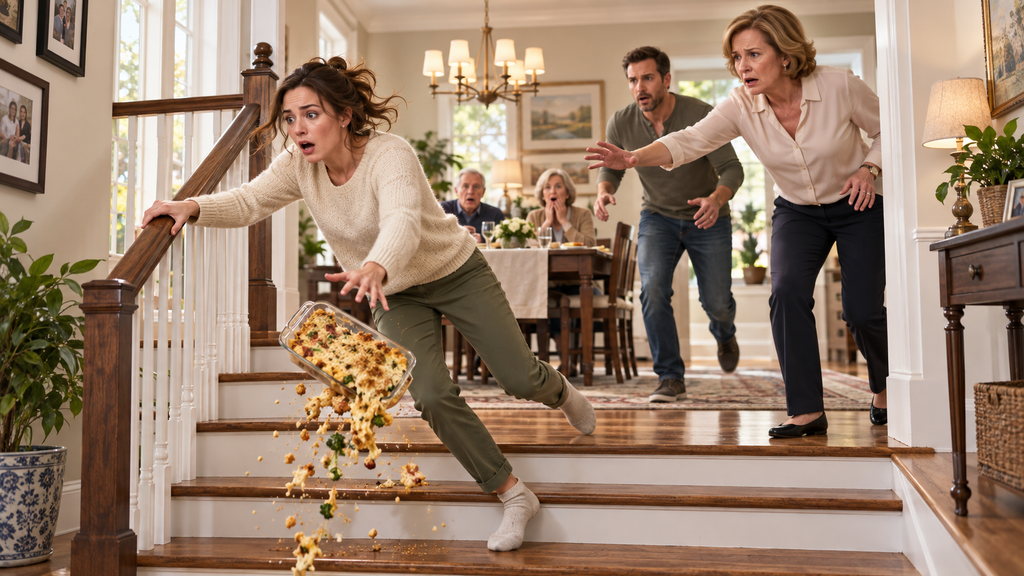
“But his mother pushed me.”
Nobody spoke for several seconds.
Then something inside me opened.
Not a memory exactly.
More like a locked door.
At the bottom of the basement stairs, everything had been chaos.
I remembered Judith behind me.
I remembered her hand touching my back.
But I also remembered falling sideways before I went down.
And before that—
A voice.
Graham’s.
“Nora, just stop.”
I shut my eyes.
Sunday dinner.
The argument had started twenty minutes earlier.
Judith had accused me of convincing Graham to skip her birthday trip to Charleston.
I told her Graham was forty-one years old and perfectly capable of making his own decisions.
She followed me toward the basement.
Graham followed us.
I had forgotten that.
Or my mind had hidden it.
Judith stood behind me at the stairwell.
“You are destroying my family.”
I turned.
And Graham appeared beside her.
“Mom, enough.”
Judith reached toward me.
I stepped backward.
Then Graham grabbed my arm.
Hard.
I yanked away.
Judith shoved me.
And as I fell—
Graham reached for me.
Not to catch me.
To stop me from grabbing the railing.
My eyes flew open.
“Oh my God.”
Dr. Mercer did not interrupt.
“He was there.”
My voice barely existed.
“Graham was at the top of the stairs.”
I remembered his face.
Not shocked.
Terrified.
Because he knew exactly what had happened.
“He grabbed me.”
Denise pulled her chair closer.
“Before you fell?”
“Yes.”
“And after his mother pushed you?”
“I think…”
I pressed both hands to my forehead.
Then another memory surfaced.
My fingers touching the railing.
Graham’s hand closing over my wrist.
The railing disappearing.
My body dropping.
“Yes.”
The room seemed to tilt.
“He pulled my hand away.”
The silence afterward was enormous.
Suddenly the scans were not the only thing nobody in Graham’s family could explain.
Neither was Graham’s behavior.
He had not brought me to the hospital because he wanted to.
His uncle Peter had insisted.
I remembered now.
Peter had stood in the hallway and said, “She can hardly breathe. Either you take her or I’m calling an ambulance.”
Graham had driven me himself because controlling the ride meant controlling the story.
A family accident.
A misunderstanding.
A slip.
Anything except the truth.
Denise asked whether I wanted police contacted.
This time, I did not hesitate.
“Yes.”
Graham must have seen the officers arrive.
Because ten minutes later, his voice exploded in the hallway.
“You’re calling the police on my mother?”
I flinched.
Then heard a nurse say sharply:
“Sir, lower your voice.”
“This is my wife!”
“And she has asked you not to enter.”
“You don’t understand our family.”
That sentence nearly made me laugh.
Because that was exactly the problem.
For years, I understood his family far too well.
Their rules were simple.
Judith could insult anyone because she was “old-fashioned.”
Graham could lose his temper because he was “under pressure.”
People who complained were “dramatic.”
People who remembered were “holding grudges.”
People who set boundaries were “breaking up the family.”
And people who got hurt were expected to recover quietly enough that dinner could continue.
Not anymore.
Two officers spoke with me.
I told them everything I remembered.
Then they asked the question I had been dreading.
“Were there witnesses?”
“Yes.”
Nearly the entire family had been upstairs.
But my heart sank immediately.
Judith’s sisters would defend her.
Her cousins would say they hadn’t seen clearly.
Graham would lie.
I knew how families like his survived.
Not because nobody saw anything.
Because everybody agreed to see less.
Then an officer said:
“One of the witnesses already called.”
I stared at him.
“Who?”
“Peter Walsh.”
Graham’s uncle.
I stopped breathing.
“He contacted us before we arrived.”
Peter.
The man with the water glass.
The man who had watched me from the dining room.
Apparently, while Graham drove me to the hospital, Peter had walked downstairs.
He photographed the broken casserole dish.
The marks on the stairway.
The blood where my elbow hit the concrete.
Then he did something nobody expected.
He checked Judith’s security cameras.
Judith had installed them months earlier after accusing a delivery driver of stealing a package.
One camera covered the kitchen.
Another covered the hallway.
And the hallway camera partially captured the basement entrance.
No audio.
But enough.
Judith approaching me.
Me turning.
Graham entering the frame.
Judith extending both arms.
My body disappearing backward.
My hand reaching for the railing.
And Graham’s arm moving toward mine.
Peter copied the recording before anyone could erase it.
Then he called the police.
I cried again when the officer told me.
But these tears felt different.
Somebody had seen.
Somebody had decided that family loyalty did not require dishonesty.
Later that night, Peter called my hospital room.
His voice shook.
“Nora?”
“Yes.”
“I’m sorry.”
I couldn’t answer.
“I should have spoken sooner,” he said. “Not just tonight.”
My heart tightened.
“What do you mean?”
Peter was quiet.
“I’ve watched Judith treat you terribly for years.”
I closed my eyes.
“So has everyone.”
“I know.”
There was shame in his voice.
“We told ourselves it wasn’t our business. We said Graham should handle his marriage. We said Judith was difficult but harmless.”
He exhaled.
“Tonight I watched you lying on that basement floor while Judith looked at Graham before she looked at you. That was when I understood.”
“Understood what?”
“That they weren’t scared because you were hurt.”
His voice cracked.
“They were scared because there were witnesses.”
I turned my face toward the dark hospital window.
Rain slid down the glass.
That sentence would stay with me forever.
Not scared because I was hurt.
Scared because there were witnesses.
Peter continued.
“I gave the police the recording. Whatever happens next, I’m not changing my statement.”
“Thank you.”
Two small words.
They felt completely inadequate.
Then he said something even more unexpected.
“Your sister is downstairs.”
I sat up too quickly and pain tore through my ribs.
“My sister?”
“I found her number in Graham’s phone when he left it on the kitchen counter.”
Of course.
Graham hadn’t called her.
He had not called anyone who belonged to me.
Peter had.
Five minutes later, my sister Rachel came through the hospital door.
She took one look at my face.
Then stopped.
Rachel was four years younger than me and had always been the emotionally fearless one.
She cried at movies.
Yelled during football games.
Told rude strangers exactly what she thought of them.
But in that moment, she made no sound.
She walked toward me slowly.
Then wrapped her arms around me without touching my injured side.
“What did they do to you?”
That question broke something open.
Not:
What happened?
Not:
Was it an accident?
Not:
Are you sure?
What did they do to you?
“I should have told you,” I whispered.
“Told me what?”
“All of it.”
She pulled back.
Her expression changed.
“What does all of it mean?”
So I told her.
The shove in the garage.
The slammed door.
The bruises.
Judith’s insults.
The way Graham monitored my calls after arguments.
The way he controlled our joint account.
The way he insisted we spend every holiday with his family.
The way he would apologize after frightening me and then explain why I had caused him to become angry.
Rachel listened.
Her face slowly crumpled.
“Nora.”
“I know.”
“You told me you were happy.”
“I wanted to be.”
There it was.
The saddest sentence I had ever spoken.
I wanted to be.
Wanting had become pretending.
Pretending had become surviving.
Surviving had become normal.
Rachel took my hand.
“You’re coming home with me.”
For the first time that night, I smiled.
“I think I am.”
Judith was questioned that evening.
Graham was questioned separately.
They both initially claimed I had slipped.
Then they learned about the camera.
Their stories changed.
Judith said she had “touched” my back during an argument but never intended to push me.
Graham said he had reached toward my arm because he was trying to save me.
The hallway footage complicated that explanation.
So did the medical report.
So did Peter’s statement.
So did the photographs.
So did the fact that Graham had repeatedly attempted to give medical staff a false version of what happened before I could speak.
For years, they had survived by making everyone else doubt what they saw.
But that night there were too many witnesses.
A doctor.
Nurses.
Police officers.
Peter.
The camera.
And finally—
Me.
I was discharged two days later.
Rachel brought me sweatpants, a soft button-down shirt, and the ugliest pair of slippers I had ever seen.
“They were on sale,” she said.
“They look radioactive.”
“That means cars can see you.”
“I’m not crossing a highway.”
“You don’t know your future.”
I laughed.
Then immediately regretted it because of my ribs.
Rachel laughed too.
And for ten seconds, inside a hospital room where my marriage had collapsed, I remembered what safety felt like.
Before leaving, Dr. Mercer came in.
“You have follow-up instructions in your paperwork.”
“Thank you.”
He nodded.
Then I stopped him.
“Doctor?”
“Yes?”
“If you hadn’t asked Graham to leave…”
He waited.
“I probably would have lied.”
Dr. Mercer looked at me for a long moment.
“Maybe.”
I looked down.
“I almost did.”
He pulled the door partially closed behind him.
“Nora, telling the truth after being pressured to hide it still counts as telling the truth.”
My eyes burned.
He gave me a small nod.
“Take care of yourself.”
I never saw him again.
But I would remember him for the rest of my life.
Not because he fixed me.
He didn’t.
He simply refused to participate in the lie.
Sometimes that is enough to help someone begin saving herself.
I did not return to the house I shared with Graham.
Rachel and her husband cleared out their guest room.
Peter went with a police officer while I collected essentials a few days later.
Graham was not there.
He had sent thirty-seven messages.
I read none of them.
Then came emails.
Then flowers.
Then a handwritten letter.
I eventually opened that one.
The first sentence read:
“I know I failed to protect you from my mother.”
I stopped reading.
Because even then, he was doing it.
Making himself a bystander.
He had not merely failed to protect me.
He had helped her.
There is a difference between weakness and participation.
I had spent years confusing the two because admitting the truth about my husband felt more frightening than absorbing another apology.
I handed the letter to my attorney.
Yes.
Attorney.
Three weeks after the fall, I filed for divorce.
Graham cried when he learned.
Then he became angry.
Then remorseful.
Then angry again.
He told mutual friends I was destroying his life over “one terrible night.”
I stopped correcting people.
The ones who wanted the truth asked.
The ones who wanted gossip did not deserve it.
Judith sent me one message.
Just one.
It said:
I hope someday you understand how much damage you’re doing to this family.
I stared at the screen for almost a minute.
Then I finally understood something I should have understood years earlier.
People who benefit from your silence often call your honesty destruction.
I blocked her.
The legal process was neither quick nor cinematic.
There was no dramatic courtroom confession.
No judge slammed a gavel and delivered a speech about karma.
Real consequences were slower.
Messier.
More exhausting.
Statements.
Interviews.
Attorney meetings.
Medical records.
Footage.
Arguments over intent.
Arguments over what could be proven.
Judith maintained that she had never intended for me to fall all the way down the stairs.
As if there were a safe number of stairs to push someone toward.
Graham continued insisting that his movement toward my wrist had been an attempt to help.
Investigators saw the footage differently.
Peter testified to what he saw before and after the fall.
And something happened that surprised everyone.
Two other relatives eventually came forward.
Graham’s cousin Leah admitted that Judith had told her, before dinner:
“Nora needs to be reminded whose family she married into.”
His aunt Margaret confirmed hearing Graham tell Judith afterward:
“You were supposed to scare her, not send her down the whole staircase.”
When my attorney repeated that sentence to me, I became physically sick.
Supposed to scare her.
Not send her down the whole staircase.
That was what Graham had meant at the hospital.
“He didn’t mean it.”
He had not been talking about Judith.
He had been talking about himself.
About the plan.
About whatever conversation he and his mother had before I walked toward the basement.
They had wanted fear.
Compliance.
A warning.
Something they could deny afterward.
The fall had simply gone farther than intended.
And somehow, that revelation hurt more than the fractured ribs.
Because accidents happen in seconds.
Planning requires time.
There had been minutes—maybe hours—during which my husband could have chosen differently.
He could have told Judith no.
He could have warned me.
He could have walked away.
Instead, he stood beside her.
Months passed.
My ribs healed.
Slowly.
For several weeks, sneezing felt like being stabbed.
Sleeping was difficult.
Laughing hurt.
Driving hurt.
Reaching for something on a high shelf hurt.
But eventually my body stopped reminding me of that staircase every time I moved.
My mind took longer.
I started therapy.
At first I hated it.
Every question felt like another accusation.
Why did you stay?
Why did you accept his apologies?
Why didn’t you tell your sister?
Except my therapist never actually asked those questions.
I did.
To myself.
Constantly.
Finally, one afternoon, she said:
“You spend a lot of time putting Nora on trial.”
I looked at her.
“What?”
“The Nora who stayed.”
I said nothing.
“You talk about her like she was stupid.”
My throat tightened.
“She should have known.”
“Known what?”
“That it would get worse.”
“Did she know?”
“No.”
“Did she hope it would get better?”
“Yes.”
“Did Graham repeatedly tell her it would?”
I looked away.
“Yes.”
“Then maybe you should stop judging her using information she only learned later.”
That sentence changed me.
I started forgiving the woman I had been.
Not Graham.
Not Judith.
Myself.
That was harder.
My divorce became final eleven months after the night of the fall.
I walked out of my attorney’s office carrying a thin folder.
Nine years of marriage ended inside documents barely thick enough to fill a manila envelope.
Rachel waited near the elevator.
“Well?”
“It’s done.”
She hugged me.
“How do you feel?”
I thought about it.
“Hungry.”
She burst out laughing.
So we went for pancakes.
At three in the afternoon.
Because freedom apparently tasted like butter and maple syrup.
The criminal case ended several months later.
I attended the final hearing.
Not because I wanted revenge.
Not because I wanted to see Judith frightened.
I went because for years, that family had taught me that keeping peace mattered more than telling the truth.
I wanted to hear my own truth spoken in a room where nobody could tell me to lower my voice.
Judith sat several rows ahead of me.
She looked smaller than I remembered.
Graham sat separately.
We did not speak.
At one point, he turned around.
Our eyes met.
For years I had been able to read every version of him.
Angry Graham.
Apologetic Graham.
Charming Graham.
Ashamed Graham.
The little boy who wanted his mother’s approval.
The husband who promised he would change.
That day I saw only a stranger.
And that was strangely peaceful.
The case concluded with consequences neither of them could dismiss as a family misunderstanding.
There were court orders.
Restrictions.
Probationary conditions.
Mandatory programs.
A permanent record of what had happened.
Not every consequence was as severe as some people wanted.
More severe than Graham and Judith wanted.
Real life rarely produces perfect endings.
But there was one thing they could never take back.
The truth existed outside the family now.
In hospital records.
In sworn statements.
In court documents.
In video evidence.
It could no longer be buried underneath Judith’s cream table runner after Sunday dinner.
Peter approached me outside the courthouse.
He looked nervous.
“I don’t know if you want to hear this.”
“What?”
“Judith still says I betrayed the family.”
I smiled faintly.
“What do you think?”
Peter glanced toward the courthouse doors.
“I think I betrayed you by waiting so long.”
My eyes filled.
He continued.
“I should have said something years ago.”
“You said something when it mattered.”
“Late.”
“Yes.”
He nodded.
“Late.”
Then I hugged him carefully.
Not because what he did erased all the years when he said nothing.
It didn’t.
But people are complicated.
Sometimes courage arrives late.
Late courage is still better than permanent silence.
Two years after the fall, I bought a small house.
Nothing impressive.
Two bedrooms.
A narrow kitchen.
A ridiculous green front door that Rachel insisted looked “hopeful.”
There was no basement.
That was not intentional.
At least that is what I told the realtor.
The first Sunday after I moved in, Rachel came over with Peter and his wife.
We ate pasta from mismatched bowls because half my dishes were still boxed.
Nobody criticized the sauce.
Nobody inspected the house.
Nobody told me who I should invite for Christmas.
Nobody asked whether I was embarrassing anyone.
After dinner, I stood at the kitchen sink while laughter drifted from the table behind me.
For a second, I froze.
The sound reminded me of Judith’s house.
Sunday dinner.
Cutlery.
Voices.
The basement door.
Then Rachel came beside me.
“You okay?”
I looked around.
At the crooked picture frames.
The unopened boxes.
The cheap curtains.
My ugly radioactive slippers near the back door.
My home.
“Yes.”
And I meant it.
People sometimes ask me when my marriage ended.
They expect me to say it ended when Judith pushed me.
Or when I saw the scans.
Or when I remembered Graham reaching for my wrist.
But they are wrong.
My marriage ended at an ER check-in desk.
It ended when my husband leaned toward me while I could barely breathe and whispered:
“He didn’t mean it. Let’s keep it in the family.”
Because in that moment, Graham made his choice.
He chose secrecy over me.
His mother over me.
His reputation over my body.
His family’s comfort over my truth.
And somewhere between that desk and Dr. Mercer closing the hospital door, I finally made mine.
I stopped protecting people who hurt me.
The X-rays showed three broken ribs.
They showed older fractures.
They helped reveal a history I had worked painfully hard not to name.
But the most important thing those scans exposed was not visible on any screen.
They exposed the lie I had been living inside.
For years, I thought keeping a family together meant absorbing whatever threatened to tear it apart.
Anger.
Humiliation.
Control.
Fear.
Bruises.
Apologies.
Silence.
I was wrong.
A family that survives only because one person agrees to suffer quietly is not being held together.
Someone is simply being held down.
My ribs healed.
The bruises disappeared.
The staircase stopped appearing in my dreams.
And eventually, when somebody asked me what happened that Sunday night, I stopped shortening the story to make other people comfortable.
I told them exactly what happened.
“My mother-in-law pushed me down the stairs.”
Then I added the part that once terrified me even more.
“And my husband helped her.”
No whispering.
No excuses.
No shame.
Because the doctor had been right to refuse silence.
Peter had been right to save the recording.
Rachel had been right to come for me.
And finally—
I had been right to believe myself.
Judith once told me that I was destroying her family.
Maybe, in her mind, I did.
But telling the truth did not destroy my life.
It gave it back to me.
And the last time I ever saw Graham, he stood outside that courtroom watching me walk away.
For once, he wasn’t asking me to forgive him.
He wasn’t telling me to calm down.
He wasn’t begging me to keep anything in the family.
He simply watched.
And I kept walking.
I never looked back.
THE END! THANK YOU FOR READING!❤️